(1)
Sunilnary and conclusions
lt has been generally known that many of the conifers take comFlaratively long years to begin f10wering and seed bearing, though the floM「 ering and bearing ages differ wlidely with tree species, Since the conifers also bear the unisettual flower, they can not reproduce if both male and female flwOers are not produced. Furthermore, it has been knOwln in many coniferous species that there is a rich Or poor harvest in flower and seed productiOn, From these facts, it may be said that controlling artificially the
flo、ver bud fOrmatiOn and flower sex differentiation of cOnifers is very important in forest tree breeding ln the prese■t research, the fio、 ver bud formation and f10wer sex differentiation of conifers were mor― phologically and physiO10gically studied. Further, the method of the artificial contro1 0f flower bud fOrmatiOn and f10wer sex differentiation in cOnifers was studied
I. Morphological studies on f10wer bud formation and flower sex differentiation. 1. Time of f10wer bud formation,
(1)The time of flower bud formation was investigated on 9 species belonging to the Pげ打。c9o9, Tc″ ο― 」Jαcθαθ and CτP'9sscc909. In general, in conifers the primordia of floMIer buds thickened and elongated
at the time of flower bud formatiOn, and they differentiated intO flower buds. The fema〕 e flo、ver buds
of species of Crノpをο7te r」α, C2■2Jη =ん
αηげα and ν?ιt7/s9929'α Were indistinguishable froln leaf buds by only the size and fOrm Of the grolving point, but they could be distinguished at a comparatively early stage of f10ral diffOrentiation by observing at the same time the state of the vascular bundle and pith. Finally, they are recognized to be flower buds when the primordia of stamens, bract scales or ovuliferOus scales are found in the basal part Of floral primordia.
(2)There was some difference in the time of ttower bud fOrmation according to tree species and flower sex. Flower bud fOrmation in conifers tOok place during the period from mid 」une to late OctOber, but the most active time was three mOnths July, August and September The time of beginning of f10wer bud formation ∼vas earliest in CTノ pιοη9T'α デαpο″jCα and CんαηαθcプpαTテG Jαttsο■サα2α, and latest in PJP22s 」θTtsヵ可οTc and P ιん″ηb9rgJJ The period of flower bud formation of P,22s species was shorter than that
of Crypι ο卿9T'c, C2η2,=/LαηJα and CんαηαθcypαT」s species. In general, there was a tendency that the be―
ginning time Of fOrmatiOn of female flower buds was later and the periOd of the f10wer bud formation was shorter as compared with male flower buds.
2. Deve10pmental cOursc of f10wer buds
(1)Pけηvs J?″dttο
TC and R沈
22b9T=テ,In the male flower buds of R」9■sttοTα,he differentiation of stamen primordia occurred in mid September The archesporium began tO differentiate in early October, and the formation of anthers 都′as observed in November. Archesporial cells segmented and multipliedin the previous・ autumn of flowering and the next spring, and in mid April they developed intO pollen mother ce■s(PMCs).The PMCs had meiosis during mid to late April and prOduced poHen grains.h female f10wer buds, the differentiation of bract scales occurred in mid fall and the next early spring. Ovuliferous scales started to differentiate in mid March, and the formatiOn of ovules was observed from mid to late April.
The development Of flower buds of R ιん″″b9T=Jぢ during the autunn, was not appreciably different frOm
Rじ
9,sち可ο Tα,but the development of the flower buds in the following spring was 7 to 10 days earlierthan that of rl 」9■sヵ可。TC.
(2)Lα″滋 Jθpιο J9p】sIIn male flower buds,the differentiation of stamen primordia occurred in early to
late August. The archepsorium started to differentiate in mid August, and in mid September the anthers were observed. Archesporial cells segmented and multiplied in a period from mid August to mid Sep― tember, and frOm late September to early October they developed into PMCs.The PMCs started meiosis
(2)
in early OctOber, and in early November the division progressed to the pachytene stage of meiOtic prophase. The PMCs passed the winter at the pachytene stage and resumed meiosis in mid February of the fOl10wing year. Pollen grains were formed frOm late March to early April.
h female flOwer buds,bract scales started to differentiate in mid August, and ovulifcrOus SCales in late September in the axils of the bracts.The differentiation of ovular primordia Occurred in late March to early Apri1 0f the next year in ovuliferOus scales, The ovular primordia differentiated into the in― tegment and the nucellus in mid April.
(3)CTノριο兜9Tテα ブ守ροttJCα:The male f10wer buds started to differentiate the stamen and the arches,Orium
soon after f10wer bud initiatiOn. Archesporial cells deve10ped into PMCs frOna late September tO early OctOber, MeiOsis in PMCs tOOk place during the period frOm late September tO early 卜bvember, being most active in mid October.In mid November the formatiOn Of oOllen grains was Observed in an the flower buds.
In female f10wer buds,bract scales began to differentiate in late 」uly. During the poriod from early August to mid OctOber, the differentiation of Ovular prrmOrdia occurred in the axils Of the bracts, In late OctOberi mature ovules which deveioped into the integument and the nuc。 1lus were observed in all female f10wer buds. Further, in this time the primO〔 dia of ovuliferOus scales appeared between bract scales and Ovules.
(4)Cクηηヴ″
=力
αttJα サαηc9οJαια: In male fiower buds, the primOrdia of stamens began tO differentiate in
early SeptelYlber, and the archespOrium, in late September. In early November the fOrmatiOn Of anthers was obseved in aH stamens, Pollen grains were formed in early ヽIarch Of the next year.
In female f10wer buds,bract scales started to differentiate in late September From late OctOber tO early November, the primordia of ovules 、vere initiated in the axils Of the bracts, The differentiation of rudimentary ovules into the integument and the nucellus Occurred in mid tO late March Of the next yearo On the Other hand, during this time the primOrdia of ovuliferous scales differentiated on the upper side of ovules
(5)″9ιαG 99″ο Jα
=秒pιοGιTObOJ」?s and S99クοJα s9ηρ9TυJTθ,s:The male flower buds Of〃 gJyp ιοsι″οbOJじ9d
started to form rudimentary stamens in a shOrt periOd after f10wer bud fOrmation. The archsporium began to differentiate in late August, and in early October the anthers 、vere observed in ali stameis, POllen grains were formed frOm mid OctOber to mid November
ln female f10wer buds, bract scales started to differentiate in early SepteIIber. FrOm late September to early OctOber, the primOrdia of Ovules initiated in inside basal part Of the bracts. The ovular pri― mordia differentiated intO the integument and the nucellus in mid to late October. The developmental course of male flower buds of S, sθ η29T7JT92S WaS much the same as that of〃 .=ゥpιοSι″οbο J」9d.
(6)Cんα7tc9CypαTJd οbttsc and Cん。 Jαωsοηjα,α:In the male fiower buds Of Cん .ο btvsα,the differentiation of rudimentary stamens occurred soon after f10wer bud fOrmatiOn The archespOrium started tO differ― entiate in early August, and in early OctOber the anthers 、vere observed in all stamens, POllen grains were fOrmed in mid March of the next year. In female flower buds, ovuliferOus scales began tO differ― ontiate in late August, In early OctOber, the primOrdia of ovule` were initiated in the axils of Ovulifer― ous scales. In mid November, mature ovules which differentiated into the integument and the nucellus were observed in almost all female fiOwer buds.
The fiOwer buds Of Cん ′αωsο “
Jα2α るorn by gibberellin treatment shoMたed much the same developmental course as thosc Of Cん . ο bι2sα. Ho∼vever, the deve10pment of flower buds which set naturally seemed tO be earlier than that Of Cん。οbιτsα Namely, in the male flower buds the differentiatiO1 0f archesporium
(3)
3. Differences in the timo of flower bud formation and he progress of development of flower buds. (1)Annual differences:The time of beginning of flower bud formation in Cん οbttθα was 10 to 15 days earlier in a year of higher temperature and less rainfall than in that of more rainfall during the period from May to 」une. In C2. ,α ηc9οιαια,hoMrever, there 、vas no remarkable difference in the time of flower bud formation according to the year.(2)Differences according to the locahty of trees: The initiation and development of flower buds of R
どθηSちVο Tα during the autumn were a little earlier at an altitudc of 600 m than at that of 5 m in the
same iocality ln C, デcPοηJCa there was nO remarkable difference in the date of beginning of flower bud fOrmatiOn between the above tれ ro altitudes,but the end of flower bud formation was about 90 days earlier at the high land than at the low land, Consequently, the development of f10wer buds was a little earlier at thp high land than at the loMI land. In L. ′9P ιοJθpJs, the development of flottrer buds in the early
autumn was about 20 days earlier in Hokkaido than in Nagano.
(3)Differences among individual treesI In R 」9″dttοTC,tIIere were 10 to 20 days'differences in the
time of flower bud formation and 20 to 30 daysi differences in the development of flower buds amOng trees growing in the same region Such differences were more bonspicuOus in C.ブ cpοηJCα.Namely,the differences of 60 days were seen in the time of beginning of flower bud formation,and the differences Of 10 to 80 days, in the period of flower bud forttation. In L. ケ9P ιο,9p ls, there was a difference of about lo days in the time of differentiation of floral organs among individual trees
(4)Differences according to the position bearing flower budsI It was recognized in Cん .ο btttsc that the
time of beginning of flower bud formation on the lower branches of a tree is about 10 days earlier than that on the upper Ones. A similar difference in time of fiower bud formation die to the position of the crottn or branch in the same tree was also found in C ブαpο,'Cα・
(5)Difference according to the time of gibberellin treatment:The time of flower bud formation and the development of flower もuds in C. ゴαpο,テCα were greatly affected by the time of gibberellin treatment
As cOmpared with the treatments in August and September, the treatments in」 une and July tOok longer time until f10wer bud formation,but the growth and development Of flower buds were better. In general, the f10wer buds induced by treatment with gibberellin in the period from June to September develOped norma1ly.However,the flower buds induced by the OctOber treatment did not develop normally and the pollen grains 、vere formed in the next early springo Consequently, the time of flolverihg was delayed and some non― flowering flower buds 邪′ere produced
4. Mcchanism or sex reversal in flowers.
(1)It was known that the mechanism of sex reversal of male flowers to female in pines differed with the stage of the floral development. If feminization is induced at the early stage of development of male flovers, rudimentary stamens differentiate into bract scales or the bract scales differentiate directly
in the periphery of fい ral axisi and the male flowers develop into the female flowers OvuhferOus scales and Ovules are formed in the fol10wing spring, When feminization is induced after antller fOrmation, the male flowers are revこ rsed into the female flowers as the result of the fact that the anthers adhere to the floral axis and differentiate into both bract and ovuliferous scales, and ovules are formed in the ovuliferOus scales,In C,,cPο 打ヴCα and Cん。 Jα ωsο2Jα ″α, the fonowing tWo modes of sex reveFSa1 0f male
flowers to female M′ ere recognized. One of them is the case in which ovules are secondarily formed in the axil of stamens. The other is the case in which anthers differentiate directly into ovules. In the latter case, howeveri the feminized flowers did nOt deve10p intO cones, although they flowered.
(2)Sex reversal of the flower from female to male in R」9,sttοTa Seems to occur by he fact that the formation of ovuliferous scales is inhibited and anhers differentiate in rudimentary bract scales,
司
(4)
it may be considered that the female flowers of conifers are not an inflorescence but a simple flower. ]. Physiological studies on fiower bud formation and flower sex differentiation.
1. Auxins and gibberllin― like substances present in he shoots of conifers.
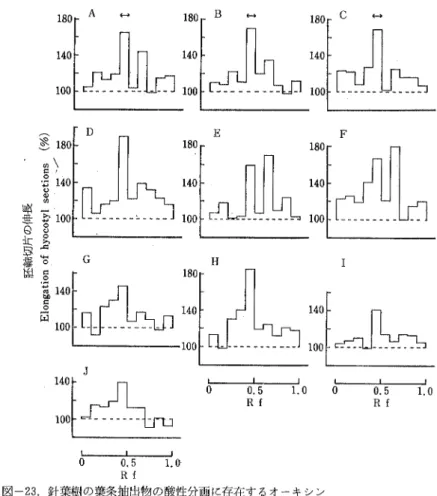
Auxins and gibberellin-llke Substances in tlle shoots of conifers were bioassayed by thЬ pine hypocotyl test and the rice seedling test. As the resulti both auxins and gibberellin-like substances were found in almOst ali species examined. When developed widi ammOniacal iso― propanol, four kinds of auxin activities were detected in each of the neutral,acid and aqucous fractions, Among these,three prOmoting zones,found at Rfs O.4∼0.5(Factor I)and O.6∼ 0.7(Factor I)in the acid fraction and at Rf O.2
∼0.5(Factor Ⅲ)in the aqueous fraction,were espeCially remalkable.The Factor l corresponded to
the Rf value of IAA developed at the same time, but the others could not be identified On the other hand, by the rice seedling test four gibberellin― like activities were found at Rfs O…-0.3, 0.4-0.5, 0.6
∼0.8 and O.8∼1.0, 4・hile a gFowth inhibiting activity was detected at Rf O.5∼ 0.8. The activity of Rf
O.6々-0.8 seems to be attributed to the known gibberellin A.
(2)The ShOOtS Of cOnifers contained relatively higher concentrations of auxins and their total contents
椰/ere equivalent to 41々 ヤ286 μg IAA per 100 g fresh weight The content of auxin in each fraction was
abundant in the following orderi aqucous fraction )> acid fraction )> neutral fraction. The amount Of
gibberellin中like substances in shoots of conifers was estimated to be equivalent to O.03-1.63 μg GA3
per 100 g fresh weight.
2. Relation between fiower bud formation and endogenous growth substances.
(1)From he comparison of endogenOus growth substances between the flower― induced and non―f10wer―
induced trees by gibberellin application, it was kno、 vn that the t、vo auxins located at Rf O.5々ヤ0.8 in the neutral fraction and at Rf O.6-0,7 in the acid fractiOn gave higher activity in the latter, especially
in the P,■2S SpeCies On the water―soluble auxins, gibberellin― like substances and inhibitors, ho、 vever,
there were found no qualitative and quantitative differences betM・een the t、vo tree groups.
(2)Considerable changes occurred on grOwth substanceS in new shoots of C ,α pο2JCα in relation to
flower induction by girdling or gibberenin treatment, Factor I (Rf O.4∼ 0.5)in the acid fraction, lvate r―soluble auxins and gibberellin― like substances tended to decrease after girdling or gibberellin treatment.On he contrary,Factor Ⅱ (Rf O.6∼ 0,7)in he acid fraction increased Suddenly and rapidly at the time of flower initiation On the other hand,growth inhibiting substances, especially inhibitor β,
tended to increase after he treatment Exogenous gibberellin A absorbed into the shoot by foliar spray― ing was consumed in that condition not converting into other gibberellin― like substances, However, a considerable amOunt of it was found even after 33 days in the shoot
(3)It was shown hat au ns in the bud of R」92sttοTα Varied according to tree ages`Factors l aゞ Ⅱ, especially Factor Ⅱ, in the acid fraction were small in young seedlings and abundant in 4ature trees. On the contrary, aqucous auxins had the highest concentration in young seedlings
The state of appearence of the Factor l was particularly 覇′atched in relation to flower bud formation
in conifers
3. Relation between fiower bud formation and nutrients in shoots,
(1)Noticeable changes occurred on chemical constittlents in new shoots of C.ブ αpο,テCα in relation to
flolver induction by gibberellin treatment. The contents of water and nitrOgen tended to decrease after the treatment,but the contents of reducing sugar, non― reducing sugar, total sugar, total soluble carbO― hydrate and insoluble carbOhydrate, to increase. Consequently, the C― N ratio was greater in the treat― ment than in the control. AmOng these constituents, the change of water, nitrogen and insOluble carbO― hydrate occurred priOr to flo、ver bud formation, but sugars seemed to increase after flower bud for―
︲ ︲
(5)
(2)In girdhng treatment,the change of constittlents in new shoots Of C.Jα ?οη'cα
was more evident as compared with gibberellin treatment. The contents of water and nitrOgen decreased after girdling, but the contents of reducing sugar, total sugar, tOtal soluble carbOhydrate and insOluble carbohydrate in― creased The change Of these cOnstituents occurred prior tO flower bud formation A high correlatiOn lvas recognized betttreen the number Of f10wer fOrmed and the content Of these chemical constituents,
(3)hL.J9p
ιοιθρJs,the contents of wateri nitrogen and phOsphorus in dwarf shOOts decreased aftergirdling, but thOse of reducing sugar, total sugar, starch and potassium increased, Among these, the change of water, starch, nitrogen and phosphorus occurred priOr to flower bud formatiOn Especially the change of water, starch and nitrogen was remarkable,
FrOm the above results,it is suggested that the induction Of flower bud formation in cOnifers is closely connected Ⅵrith the decrease of 、vateri nitrogen and phosphorus cOntents and the increase of insOluble
carもohydrate (starch)cOntent in shoots,
4. RelatiOn between flower sex differentiation and endogenous growth substances.
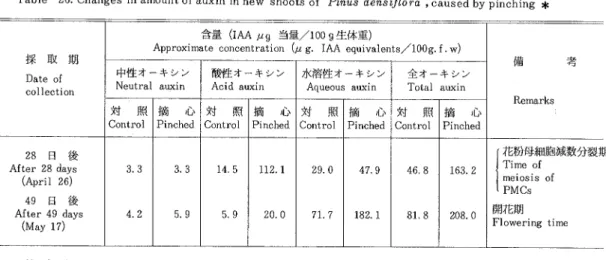
(1)The content of auxin and inhibitor in pines was greater in the bud bearing female flowers than in that bearing male flowers. Likewise in the new shOOts it was also greater in the female flower bearing paFtS than in the male parts. These differences were distinctly recognized On the growth substances Of acid and aqueous fractiOns.
(2)The content of auxin in pine shoots was increased by pinching new shoots,by which the sex re― versal of male flowers to female is induced. The increase M′ as especially marked on FactOrs l and I in the acid fraction and on Factor Ⅲ in the aqucous fractiOn Acid auxins increased rapidly,and aqueous auxins gradually after pinching
FrOm these results,it may be concluded that, in conifers, female flo∼ vers are formed in a conditiOn Of higher auxin levels than male ones.
5. Relation between flower sex differentiation and nutrients in shoots, The contents of 私′ater and nitrOgen in the shOots of C JαPοη
'cα
were greater in the female f10wer bearing parts than in the male Ones They also were greater in female f10wers than in male ones. With regard to the cOntents of carbOhydrates of sugars, starch, etc and the C― N ratiO, hOttrever,no definite result was obtained, althOugh in flowers these contents and the C― N ratio lvere greater in male than in female. FrOm these results, it may be said that the cOntent of nitrogen in the shoOt is closely associated with the sex expression of Crypテ οη9ヶヴα f10wers lt is presumed that female flowers are fOrtted in a condition Of higher nitrogen level than male ones,
Ⅲ. Studies On artificial contrO1 0f flower bud formation and flower sex differentiation.
1, Chemical cOntl・oi of flower bud fOrmation.
(1)Effect of grOwh regulatorsI The effects of 24 kinds Of grOwth regulators On f10wer bud fOrmation were examined,using 22 species belonging to the PJηαc9α9, Ta″0」テαc9α9 and Cクpressαcθα9 The effect
Of grOwth regulatord On flower bud fOrmation differed widely with their kind, Each separate application of auxins(IAA,NAA,etc),inhibitOrs(TIBA,CCC,etc,),helminthOsporOl,kinetin,ethrel,uridyhc acid, uracil, DNA, etc. did not induce the f10、ver bud formation of conifers HOwever, gibberellins markedly prOmOted the flower bud formatiOn of many species of the Tα″οじ,αc9α9 and CvpTessα cθα9 RNA tended
to promote a little the flower bud formation of R 」92sttοTα and C ,αp9,JCα
(2)Control of flower bud formation by the fOliar application of gibberellin:It was knOwn that there was a great difference in the effect Of gibberellin accOrding to the internal conditions Of he tree and the methOd Of gibberellin treatment.
(a)Gibberellin markedly promoted the f10wer bud fOrmation of many species of the Ta″ ο」どαc9α9 and CvpT9ssαc9α9,but it was little effective as to the f10wer induction of PJη αc9α9 species. The effect Of
(6)
gibberellin also varied widely with individuals in the same species Especially the variation was re― markable in immature trees.
(b)Thel efFect of gibbereHin varied with tree age ln C,α pοηJCα,the fiower buds were born by spray― ing with gibberellin On the current year old seedlings which do nOt bear flo、vers naturally. But the prOmoting offect Of gibbereHin was greater on Old trees t“ an On yOung trees ln he current year's seedlings, moSt of the f10Mrers born by gibberellin treatment were male flowers, but the number Of
female fioll・ers and the ratiO Of female fiOll・ ers tO male ones increased with the increase of tree age Furtherhore, in old trees the formation of female flowers ttas promoted 、vith gibberellin of lo、 ver con―
centrations as compared with young trees Such tendencies were also recognized in/.ξ ttριοSをTObOテJθs and Cん οbttsc
(c)Itt foliar spraying,gibberellin induced the flower bud formation Of CTノ pとοηθT」α and 〕ど9ιas9920Jα at
the concentratiOns above 10 pplla, and that of Cん αηα9c)pαTJs at the concentrations above 50 ,pm The
flowcr bud formation of T/L2デοps」d JοJαbTαとα 、vas promoted at a concentration of 500 ppm. In general, f10Mrer bud formatiOn, especially the formation of female ■o、vers, was promoted with the increase of
concentration of gibberellin Such a tendency 、vas especially recognized in young trees,
(d)The effect Of gibberellin on flower bud formatiOn varied with the time of gibbereHin applicatiOn The flower bud formation of C 」αpοηテcα occurred by spraying with gibbeFellin in the periOd frOm June
tO OctOber But male floM「ers 、vere most abundant when appliё d in July, and female flowers, when applied in Septemberi For the flower bud formation of Jど =妙pιοdιTObOテじθd,the continuous treatment from」une
tO August was more effective than the treatment of each month. In Cん ο bttdα, the lmost effective time Of gibberellin application M′ as 」uly for the inductiOn Of male f10wers, and August for that of female ones,In general,there vas a tendency that the favorable tithe of gibberellin application for the induction
of female fiowers was later than that for the induction of male flo vers
(e)Flower bud formation by gibbereHih was affected by manuring. The forlnation of female f10wers in
C
デαρο2JCC Was promoted by manuring priOr to gibberellin applicatiOn Especially the applicatiOn Of nitrOgenous fertilizer M′as effective in the prOmotion of female flowers, Ho、 vever, the formatiOn of male flowers was a little hindered by manuring, except for the NPK application(f)Flower bud formatiOn by gibberellin also was affected by the additional appHcation of other growth regulatOrs ln C, デCpοη
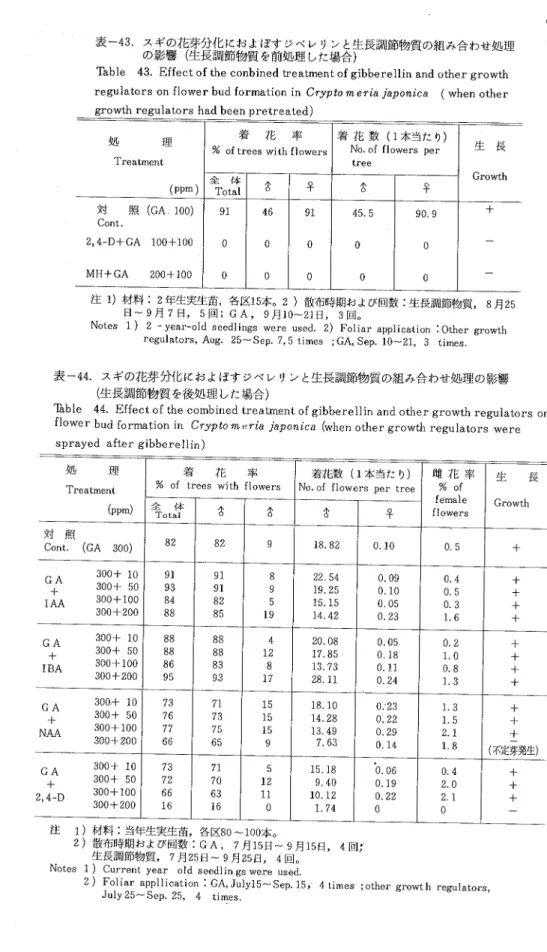
'cc, more promotion of f10wer bud formation occurred when auxin was applied after gibberellin IAA and IBA still more enhanced the formatiOn Of Female flo、 vers by gibberellin at a concentration Of 200 ppna, and NAA and 2,4-D, at the concentrations under 100 ppm, but they lvere ineffective or inhibitive in the formation of male f10、 vers. Although using gibberellin Ⅵ′ith kinetin Or nucleic acids and the related substances did not enhance gibberellin― induced fiower bud formation in
C・ ブαpο打 'Cα
, the additional application of DNA tended to stimulate slightly the flo、vёr bud formation Of
rl 」?ηstt。″α, MH and TIBA inhibited gibberellin― induced flower bud formation in C デαpοηげca when applied at high concentrations Ho、 vever, the combined treatment of gibberellin and TIBA tended to promOte a little the flower bud fOrmatiOn of R J9■ d3/Jο Tα
(3)Control of flower bud formation by the trunk― treatment of OOwdered gibberellin treatment of gibberellin and girdling
(a)FIower bud formation in young trees of Cん οbttdα and atvブ 。pd」S Jο′αbTαια was by imbeding the po、vdered gibberellin of 20-25 mg per tree in the cambial region method of trunk― treatment 、vas more effective at smaller quantity of gibberellin as
and the combined
markedly promoted Of the trunk The compared with the method of foliar spray.
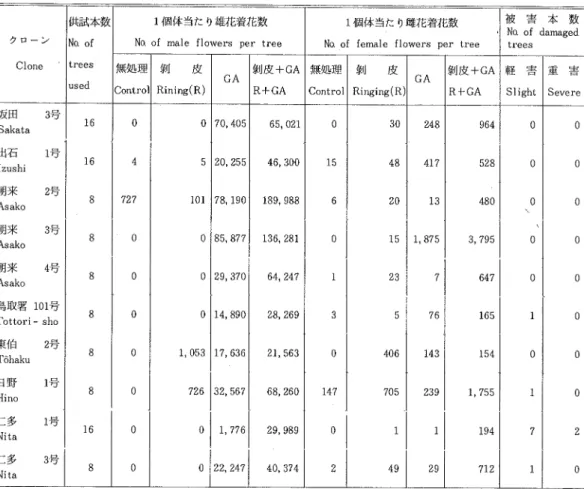
(b)AH Of girdling,gibbereHin,and the combined treatments of girdling and gibbereHin promoted fiower bud formatiOn in young clones of Cん . ο bttsα. AmOng these treatments, however, the combined treatment
(7)
Of girdling and gibberellin was most effective, fOl10wed by the treatment of gibberellin Gibberellin
showed greater effect ttThe■ 20 mg 、vas applied to a tree Regarding the time of gibberellin applicatiOn,
the 」uly and August treatments were effective for the inductiOn of male f10wers, but the August treat― ment was more effective for the induction of female flolveFs There 訥/as some difference in the effect of artificial treatments among clones, Generally, the effect Of these treatments seemed to occur strongly in ciones 、vhich bear mOre flowers naturally. As the results of gibberellin treatment and the combined treatment Of girdling and gibberellin, the trees bOre a large number Of flowers On the 、vhole of the crown, Male f10wers were most abundant in the middle part Of the crown, but there 、vas no definite tendency in the distribution of female flowers 、vithin the crOwn
(4)The fertility of pOllen and seeds obtained by gibbereHin treatment: In CTノ pιοη9Tテα and C2pT9ssαc9α ? species,generally the pollen grains prOduced by gibberellin treatment were morphologically nOrmal, and as a result of artificial germinatiOn test they shO∼ ved as high a germinatiOn pcecentage as natural
pollens. Ho∼vever, there was an instance of bad germination Of pollen M′ hen high concentrations of gib― berellin were applied to young seedlings The pollen grains of ν =妙pιοdιヶοbο J」9s did not germinate
on artificial culture medium. In young seedlings, the size and weight of cones and seeds prOduced by gibberellin treatment were smaller and lighter than thOse Of naturally born Ones, but in mature trees such differences were hardly to be fOund The seeds yielded by gibberellin treatment germinated nor― mally on artificial medium and sho、ved as high fertility as n atural ones,
2 ContrO1 0f f10wer bud formation by mechanical treatments.
(1)F10wer bud formation in C,ブcPοηJCα Was markedly promoted by girdling and banding treatments Tho
girdling lvas mOst effective 、vhen applied in 」une and July, and the banding, 、vhen in June The prOmOting
effect Of girdling Occurred strOngly on the flo、 ver formation the same year,but that Of banding, On the
flo、ver formatiOn the next year. There vas some difference in the effect Of girdling and banding among individual trees. The effect Of girdling 都′as greater on Old trees than on young trees hllanuring to young treds tendod to check the p40moting effect of girdling on flower bud formation.
(2)Girdling the trunk of young trees Of L ′9p ιοど9pJs prOmoted the fOrmatiOn Of male flowers markedly,
but it、vas only a little effective in dle formation of female f10wers There was a great difference in the effect Of girdling among individual trees Girdling or banding the branch, in general, did not bring about
good results in floI・er bud formation As a result of girdling the trunk, male flo、 vers Mrere born On
the Lvhole of the crO、vn, being most abundant in the middle part Of the cro、 vn, 、vhile female flowers were found only in the upper part of the crown With regard tO the state of bearing of flo、 ver buds on the branch, male floMrers コrere born in l´ -5 year―old parts of the branch, being most abundant in 2´ヤ3 year―old parts On the other hand, female f10wers were predominantly prOduced in 2-year― old part Of the branch
(3)Pruning in young c10nes of the plus tree of R」 9■d3/JοTα
and R
ιん22bθT=JJ increased the number Of f10wers and shoots, In R ,9■si∫Lο Tα, a strong pruning (pruning new shoots of main trunk, main branch and sub―branch)was most effective tO increase male flowers,and a mediate pruning(pruning new shoots Of main trunk and main branch), to increaSe female flowers ln R ιんクηb9Tgjど, on the other hand, the strong pruning 、vas most effective to increase both male and female fioM/ers As the result of pruning, the number of both male and female flo、 vers increased in the different parts of the crown. Further the number Of f10wers per shoot increased. So it is considered that the promotion of flower bud fOrmation by pruning is nOt due only to the increased number of shoOts. The effect of pruning seemed to differ pretty muCh according to clones3. Chemical cOntrO1 0f f10wer sex differentiation.
(8)
shoots above the portiOn bearing male flo、 vers and continuously by spraying with gibberellin一 in the
period frOm early August to mid September However, it did not occur by each separate treatment of pinching new shoots or spraying with urea, IAA, NAA Or 2,4-D ヽVhen gibberellin was sprayed tOgether
、vith urea or auxin, the urea or auxin enhanced the effect oF gibberellin on sex reversal of male flowers tO female, Among the treatments tried, the colnbined treatment of pinching nelv shoots and spraying with
gibberellin and urea was most effective in the induction of the feminized flo、 vers, Gibberellin was effec―
tive at the concentrations of 10 to 50 ppm, urea at a concentration Of l %, NAA at a concentration Of 10 ppm and IAA at a concentration Of 100 ppnl, respectively TheFe WaS a great difference in the effect of artificial treatments on f10wer sex differentiation according tO individual trees and the state of branches Sex reversal of male flo、 vers to female occurred mainly On vigorOus shoots Completely femi― nized fiowers and partially feminized flo、 vers were observed in the feminized flowers induced by gib― berellin. The completely feminized flowers grew normally, and produced fertile seeds
(2)Using yOung trees of L.ど9ριοttpJs of which flower bud formation was stimulated by girdling,growth substances were iniected into the trunk immediately after flower bud formation(in the period from late
」uly to late August) As the result, the number of female flowers was greatly increased by inieCting with NAA NAA was most effective when 100 mg applied to a tree,Most of the female flowers were found on the branches of the upper part from 4rllere NAA was iniected・ It is considered that the in― crease of female flo、vers attributes to the fact that rudimentary male flowers are developed intO female fiowers with NAA
4. Control of flower sex differentiation by mechanical treatments and other methods.
(1)In P, ιんヶηbθT=テら a strOng defoliation treatment(picking off a11 2-year― old needles, and l― year―old needles setting on the middle and lower parts of shoots)before the moiosis of poHen mother ceHs caused sex reversal of male flo、 vers to female. Ho、 vever, the feminized fio、 vers did not gr。 、v normally
and did not floMrer.
(2)In Rご92sらαοTa,sex reversal of male flowers to female was induced by pinching the winter bud or
new shoot above the portion bearing male flowers The effective time of the pinching treatment for the sex reversal to female 、vas frOm early October to mid Apri1 0f the next year, but the treatment of early October, that is irnmediately after flower bud foFmatiOn, was most effective
(3)In P
ご92sttοT9, SeX reVersal of lateral male flowers to female occurred by covering the shootwith 、vhite or brOwn coloFed paraffin paper bags, and sex reversal of terminal female flowers to male,
、vith bro、vn colored paraffin paper bags, On the other hand,in R ιん4/2b9T=テ 」a sex reversal of the flo、 ver
from male to female was induced by covering the shoot with dual bags of white and red colored paraffin papers Covering the shoot 、vith glass paper bags vras not effective in the sex reVersal of the flower. The sex reversal occurred 、Arhen the bagging treatment hハたas begun during the period fOrm early March to early A`ril inユ 」92sttοTα,and in carly March inユ とんヶηb9T=Jj.
(4)Flower sex differentiation inユ 」9ηsttοTα Was affected by manuring When he trees were densely
plantedi sex reversal of male flowers to female ocourred by only manuring with ammonium sulphate or superphosphate of lime. Double application of nitrOgenous and phosphatic fertilizers tended to increase the percentage and number of flowers 、Thich made sex reversal to female, as compared with separate
application of them.
(5)The effect of artificial treatments on flower sex differentiation of pines seemed tO Vary gre4tly with individual trees or the state of branches Sex reversal of male flowers to female were mainly observed on the main shoot of main trunk or vigorous side branches, wIIile sex reversal of female flowers to male seemed to occur on 、veak side shoots. Completely feminized floM′ers and partially fe― minizeと f10wers were observed in the feminized flowers induced by artificial treatments,Excepting the
(9)
case of defoliatiOn treatment, the cOmpletely feminized f10wers f10wered and deve10ped into cOnes The size Of cOnes and seeds produced by sex reversal M′ as smaller than that of naturally bOrn Ones, but there
∼vas no great difference in seed fertility Ⅳ.Conclusions
As mentioned abOve, in the present research the f10wer bud fOrlllation and f10wer sex differentiation Of conifers and their artificial cOntrOl were studied As the results Of fundamental studies, the time of
f10Mrer bud formatiOn,the developmental course of fiO、 ver buds,the mechanism of sex reversal in f10ttrers,
etc. 、vere made cicar hlloreover, the relation bet、 veen flower bud formation or f10wer sex differentiatiOn and endOgenOus gro、 vth substances or nutrients in the tree body was elucidated tO sOme degree, In the artificial cOntrol of flower bud fOrmatiOn and flower sex differentiatiOn, it is important that artificial treatments are prdctised On a full undersanding Of the results obtained by the fundamental studiesi
The f10、ver bud formation and f10wer sex differentiation of cOnifers can artificially be cOntrolled by the treatment of chemicals, mechanical treatments, manuring, etc HOwever, the methOd which prOduces
fio、vers 、vithout fai1 0n young trees is the gibberellin treatment only FrOm a practical stand― pOint, fOr the prOmotiOn Of fiower bud formation of Tα ″οJJαc9α9 and C2,T9sdα C9α? SpeCies the applicatiOn Of gib―
berellin is mOst favorable, because the f10ttrer bud formatiOn Of these species is easily induced 、vith gibberellin There is nO need fOr wOrrying abOut the after― effects Of gibberellin On the fertility of pollen and seed and the grOwth of seedlings Regarding the cOntrol of f10wer bud fOrmation and f10、 ver
sex differentiation Of PJ■ αcθαぞ species, 、ve were unable tO find the methOd 、vhich wOuld unmistakably produce both male and female f10wers On young trees However,since R J9.s,FJο ″α and Flιん,■b9T=JJ start to produce f10nrers at a comparatively young age, pruning ne、 v shoOts is considered tO be favorable for the cOntro1 0f fiOwer bud formatiOn in the seed orchard Of pines The pruning is effective nOt Only ln the prOmOtion of fiOttrer bud fOrmatiOn but also in the adiuStment of tree form Therefore, it is Of great
utility. AlthOugh the flower bud fOrmation and f10、 ver sex differentiation Of L ι9pうοJ9pJs which prOduces
only male flo、vers at young stage can be contr01led to a cOnsiderable degree by the cOmbined treatment of girdling and naphthaleneacetic acid, there remains the further question as tO the applicatiOn Of this method to fOrest practice, For the cOntrol of floMrer bud forlnatiOn and f10wer sex differentiation Of PJπoc9α? species, further study is required ln particular, 、ve must make effOrts tO develop the method which can easily and surely prOduce f10wers On young trees
緒
我が国においては,戦
後木材の生産を増強す る手段の 一つ として林木育種がとりあげられ,精
英樹を選抜 して 各地に採種園や採穂園が造成 された。育 種 事業が始め ら れてか らすでに十数年 を経過 し,採
種園や採穂園の値栽 木は順調に生育 して,種
子や穂木 を生産す るようになっ た。 しか し,採
種園の中には樹種や クローンによって花 のつ きに くい ものがあ り,また採穂園でもクローンによ って発根の悪い ものがあって,育
種上問題になっている。 採種園では,自然交雑の種子をとって事業用に供給す る とともに,ク ローン間の人工交配 を行なってよい両親の 組み合わせを決定する。そのためには,早
く種子をな ら せ る必要がある。一方,選
抜育種 と併行 し交雑育種 も試 み られているが,こ の場合にも花がつかなければ交雑が で きないか ら,花
を早 く咲かせ ることは育種上極めて重 要なことである。 ところが,針
葉樹は一般 に開花 。結実 を始 めるまでに比較的ながい年数を要する。また針葉樹 は単性花をつけ,雄
花 と雌花 とが別だか ら,両
方の性の 花がつかなければ繁殖で きない。 さらに樹種によっては 開花 。結実に同期性がある。 これ らのことは育種や種子 生産の大 きな障害 となっている。着花 を人為的に調節す ることがで きれば,育
種期間は著 しく短縮 され,能
率的 に育種を進めて行 くことがで きる。また計画的に種子 を 生産することができるか ら,造
林事業にも益す るところ が大 きい。本研究はこのような理由によ りなされた もの である。 花芽分化,花
性分化を人為的に調節 しようとい う試み は,林
業の分野においては比較的近年 になってか ら始め られたため,専
ら農業の分野でえられた知織を もとにし て経験的になされて きた。 しか し,林
木 とくに針葉樹は 農作物や果樹 と著 しく性質が異 なるか ら:農
業で用い ら れている技術をそのまま応用す ることは困難な場合が多 い。また応用 してもよい結果がえられるとは限 らない。 林木の花芽分化,花
性分化 を入為的に調節 しよ うとする 場合には,まず林木の性質 をよ く知 り,林
木に適合 した 技術を積極的に開発す る必要があると思われる。そのた めには,林
木の花芽分化,花
性分化に関連 した基礎的問 題を十分明 らかにしておかなければな らない。筆者は以 上のような考 えの もとに,針
葉樹の花芽分化,花
性分化 を基礎的 (形態学的,生
理学的)に
究明 し,さ らに花芽 分化,花
性分化を人為的に調節する方法の開発に努めた。 本論文は1959年以来の研究の結果をとりまとめた もので ある。 本研究に際 し,終
始御懇切な御指導 と御鞭撻を贈わっ た前北海道大学教授斉藤雄一博士な らびに鳥取大学近藤 芳五郎教授 に厚 く御礼申し上 げる。また本論文の校閲を 贈わった北海道大学名誉教授田川隆博士および同教授武 藤憲由博士に深 く感謝する。なお本論文の実験の一部は 農林省関西林木育種場山陰支場の協力によ りなされた も のである。元支場長細谷寛氏,元
経営課長村岡善昭氏お よび現原種係長綱田良夫氏に感謝の意 を表する。本論文 は北海道大学学位審査論文にその後の研究を一部追加 し て印刷 した ものである。針葉樹の花芽分化期
,花
芽の発育経過についてはかな り古 くか ら関心が もたれていたが,花
を解剖 して形態学 的に調査 したのはごく近年になってか らである。Mergen とKoerting(1957)が Pれ2s9」ιJοιι,J で研究 したのが おそらく最初ではないか と思われ る。その後 Wareing (1958)がRsプJク99ιT,s で, Duff ら (1958)が P. Tとs,ηοsoで ,GiffOrdら (1960)が R pο ηじ9Tοsαで, Fraser(1962)がPJc9a=Jα2cαで研究 した。我が国に おいては,柳
原 (1958∼1959)が カラマツで,郷
(1961) がアカマツ,ク ロマツで,松
浦 (1961)が トドマツで調 べているが,調
査例 は少ない。花性転換の機構について はくわしい報告はない。 これ らの報告をみると,花
芽分 化期のみあるいは花芽の発育の比較的短い期間の調査例 が多 く,花
芽分化か ら開花 まで一貫 して精密に調べた報 告は少 ない。花芽分化を調節す る際は,花
芽分化期のみ の調査で十分であるが,花
性分化 を調節する場合には花 芽分化か ら開花 まで花の発育経過 を把握 していなければ 表-1.供
試材料Table l. Mate rialS used for the investigation
な らない。また花性転換の機構を明 らかにしてお くこと も重要である。花芽分化期
,花
芽の発育経過,花
性転換 の様式などは樹種や花性によって異なる。また内的条件 と環境条件のちがいによって花芽分化期,花
芽の発育経 過 に差異がみ られる。 したがって,なるべ く多 くの樹種 について,色
々な条件の もとで調査 してお く必要がある。 本研究 においては,マツ科,スギ科,ヒ ノキ科の主要樹 種の花芽分化期,花
芽の発育経過,花
性転換の機構など を明 らかにし,さ らに発生形態学的にみた雌花の構造に ついて考察 した。 Ⅲ―I.花
芽分化期I.材
料 と方法 供試材料 は表-1の
通 りで,マツ科 3樹 種 (アカマツ, クロマツ,カ ラマツ),スギ科 4樹 種 (スギ,コ ウヨウザ ン,メ タセコイア,セコイア),ヒノキ科 2樹 種 (ヒ ノキOf initiation and development of f10wer buds
I.花
芽分化
,花
性分化 に関する形態学的研究
種 s 樹 S 生 育 場 所 LOcanty 齢 ge 樹 T 調 査 年 Year 着 花 状 況 Flower bearing アカマ ツ P」9■Sら守ο″α ク ロマ ツ P.ιん2,bθT=jテ´ カ ラマツ L J9pι o'ψJs ス ギ CT JCpοttJCα コウ ヨウザ ン C″ ια2ceD′αια メ タセ コイア 』ど =Jypι os,Tοbοラ」9o セ コイア S.s9れ ρ9″υ,″92s ヒノキ C力 οbι2s。 ロー ソ ン ヒノキ C力 Jαωsοtt」¢れα 鳥 取 鳥 取 長 野 鳥 取 鳥 取 鳥 取 鳥 取 鳥 取 鳥 取 5 ∼ 8 12 ∼ 15 13, 40 12 ∼ 15 40 6 4 15 10 1956 - 1959 1956 - 1959 1964∼ 1965 1958∼ 1961 1961∼ 1962 1962 1962 1961 - 1962 1961∼ 1962 自 然 着 花 lii:こ :§彎
景
皆
と
虚
為
着
花
, 自 然 着 花(鵬
亀
詠
6∼明Ш∞
弓∞
{詔
駐全
高
鶴
7∼8月に
mO∼罰
0 自 然 着 花 {亨全
言
背
祀
島
総
締 争
霞
竪
第
ローソンヒノキ)か
ら花芽 を採取 した。供試木は大部分 が鳥取市鳥取大学農学部構内の見本樹であるが,カ ラマ ッは長野県林業指導所構内の ものを用いた。供試樹種は 大部分が結実期に達 しているので,自然着生の花芽 をと ることがで きた。 しか し,カラマツの一部,メ タセコイ ア,セ コイアおよびローソンヒノキでは自然着花がみら れないかあるいは極めて少なかったので,人
工処理によ って着花 を促進 させた。花芽 はコウヨウザンとヒノキを 除 き,数
個体か ら採取 した。採取時期は花芽分化期の直 前か ら開花 までで,樹
種 によ り多少異なるが, 6月 下旬か ら翌年の 4月 下旬の期間である。花芽は10∼15日間隔 で採取 した。花芽の採取の際 しては
,樹
冠の色々な部分 か ら発育程度の異なるものをとるよう的いがけた。採取 した花芽はファーマー氏液で24時間固定 した後,70%ア
ルコール溶液に貯蔵 した。試料はずい時とりだして,徒
手縦断切片 をつ くり,酢
酸 カー ミンで染色 して,顕
微鏡 で調べた。2.結
果A.着
花習性 樹冠および枝における花芽の着生の様式は樹種,個
体, 花性などによって異なる。樹冠 における花芽の着生位置 についてみると,アカマツ,ク ロマツ,コ ウヨウザン, ヒノキなどでは,一
般 に樹冠下部の弱勢枝 に雄花芽が, 上部の強勢枝に唯花芽が多 く着生する。カラマツでは, 雄花芽 は樹冠の中部∼下部 に,雌
花芽 は中部か らやや上 の部分に多い。 しかし,花
のつ き方 は同一樹種で も個体 によってかな り変化 し,樹
冠の上部 に雄花芽ρ多いもの, 逆 に下部 に雌花芽の多い ものな どがある。 枝 における花芽の着生位置 は,アカマツ,ク ロマツの ように花性によって判然 と月Jれているものと,カ ラマツ のように一定の傾向のない ものとがある。また樹種によ って着生の状態が異なる。以下樹種別に述べる。 アカマツ,ク ロマツ :雄花芽は弱勢枝の冬芽の中郡 ∼ 下部 に多数側生す る。lH4花芽 は強勢枝の冬芽の先端部 に 1∼ 数個着生する。いずれ も鱗片葉の腋に1個 あて形成 される。 カラマツ :雌難両花芽 とも, 2∼ 5年生枝か らでた短 枝に11固頂生す る。 スギ :難花芽は弱勢枝の当年伸長 した小枝の先端部の 葉腋 に 1個 あて形成 され,多
数集まって穂状花序状をな す。雌花芽 は強勢枝の先端部の当年伸長 した主軸 か ら分 岐する小枝 に 1個頂生す る。 コウヨウザン :雄花芽は弱勢枝の当年伸長 した枝の頂 芽 あるいはその直下の腋芽の鱗片葉の上腋に 1個 あて形 成 され,多
数集 まって頭状花序 をなす。lL4花芽は強勢枝 の頂芽あるいはその直下の腋芽に形成 される。 メタセコイア :難花芽は長枝に腋生 した小枝の葉腋に 1個 あて形成 され,総
状花序状 を呈する場合 と,葉
を着 生す る小枝の先端に1個 頂生する場合 とがある。雌花芽 は普通長枝の腋芽に形成 されるが,まれに頂芽が花芽に 分化する場合 もある。 セコイア :雄花芽は主 とtノて新条の先端に1個 頂生す るが,そ
の直下の腋芽に生ずる場合 もある。 とノキ,コ ーソンヒノキ :雄花芽は雌花芽着生部よ り 下方の主 として前年度以前に生長 した主枝か ら分岐する 側枝の当年生長 した枝の先端 につ く。」4t花芽は主枝の先 端部の当年伸長 した主軸 か ら分岐す る小枝の内側先端に l TEl頂生す る。 花芽の着生状態 によ り針葉樹の花芽 を類 別すると,次
の3種 類が認められる。 (1)頂生花芽 新条の頂芽が花芽になるもの。カラマ ツ,スギ (雌花芽),ヒノキ,ロ ーソンヒノキ。2)腋
生花芽 新条の腋芽が花芽 になるもの。アカマ ツ,ク ロマツ,スギ (雄花芽),コウヨウザン(雄花芽)。 131 頂腋生花芽 新条の頂芽 と腋芽が花芽になるもの。 コウヨウザン (雌花芽),メタセコイア,セコイア。B.花
芽分化の標徴 一般 に針葉樹の花芽は,分
化期に生長点が肥厚肥大 し 伸長するので容易 に識別することができる。スギ,コ ウ ヨウザン,メ タセコイアなどの雌花芽は生長点の大 きさ や形状の変化のみでは判別 しにくいが,維
管東やずい部 の状態 を同時に観察することによ り,比
較的早期に葉芽 と区別できる。最終的には,花
芽原基の基部に雄花芽で は雄 しべの初生突起が,雌
花芽では壱鱗 あるいは種鱗の 初生突起が認 められるようになれば花芽 と認定すること がで きる。なお花芽の識別には,生
長点の形態変化ばか りでな く,花
芽の形成位置や着生状態 も重要な拠点 とな る。樹種別に識別基準 を示すと次の如 くである (図-1)。 (1)アカマツ,クロマツ 葉芽 あるいは未分化の芽 :生長点は小形である。 雄花芽 :短枝の原基が花芽 に分化する。生長点が急激 に肥大 し,そ
の下部に雄 しべの初生突起が生ずる。 雌花芽 :短枝の原基が花芽 に分化す る。生長点が急激 に肥大 し,その下部に芭鱗の初生突起が生ずる。 (2)ス ギ 葉芽 あるいは未分化の芽 :生長点は円錐形 にとが り, ずい部が肥大 しない。 雄花芽 :葉腋 に分化する。生長点は葉芽に比 して小形, 数 日でその下部 に雄 しべの初生突起が生ずる。 lHt花芽 :新条の頂芽が花芽 に分化す る。生長点は葉芽 に比 して肥厚 し,頂
部がやや丸味をおびて くる。同時に 下部の維管束 が外側に張 り出 して,ず
い部の面積が広 く なる。やや時 日を経過す ると生長点の下部に芭鱗の初生 突起が分化す る。 (3)コ ウヨウザン 未分化の芽 :生長点およびずい部は肥大 しない。ずい 部の分化は明瞭でない。 葉芽 :生長点およびずい部は未分化の芽 に比 して肥大 するが,生
長点の頂部が三角形 にとがっている。分化 し︱ ︱ ︱ ︱ ︱ ヽ 、 2 / / ︲ ヽ \
・
︱
Y
\
r
\
・
ヽ
鴻
ク
︲7ハいい]]一
四日日日2︲
、/ 、 ︲ , ノ / ヽ ・6 ^ い い い ] 一 旧 日 20 ヽ 、 ︲ チ /h
ヽヽハ
朋鮒烈
囚卿T
・9
ヽ X 谷 ぶH W ・80
・
2
肇
]
図-1.花
芽分化の標徴 1∼5:アカマツ(3,雄
花芽;5,雖
花芽祐6∼9:スギ(7,難
花芽 9,雌花芽光10∼14:メ タセコイァ (12,雄 花芽:14,堆 花芽】15∼16:セコィァ (16,雄 花芽祐17∼21:コ ゥョウザン (19,雄 花芽;21,雄花芽光22∼24:ヒ ノキ (23,雄花芽124,雌 花芽祐Fig, 1 , DiagnOses of flower bud fOrmation in cOnifers.
1∼
5:R」
9■oJrJο″α (3,male flower budi 5, female flower budl.6∼ 9 i ci デ∽。所c,(7,male f10werbud,9, female flower bud)。10∼14:″ =J砕テosιTObOだつs(12,Hlale flower bud,14,female f10wer bud).15∼ 16 :S Sつη29″υテT9,s(16, Ilale flower budl.17∼ 21:〔力 ど9TJcθ OJα ιO(19, male f10wer bud ;21, female flower budl.22∼24:C力.οbttsc(23, male flower budi24, female fiower bud).
たずいが生長点の下方に認められる。やゃ時 日を経過す
の初生突起が分化する。 ると生長点の下部に葉の初生突起が分化する。
(6)ヒ
ノキ,ロ ーソンヒ ノキ 雄花芽 :芽 の鱗片状葉の腋に分化する。生長点は急速 ´ 葉芽めるいは未分化の芽 :生 長点は肥厚肥大 しない。 に肥大 して,その下部に難 しべの初生突起が生ずる。しか し
,雌
花芽形成部位の生長点は雄花芽形成部位のそ 雌花芽 :鱗片状葉 に包 まれた芽が直接花芽 に分化する。れよ りも大 きい。 生長点は葉芽に比 して持 ち上が り
,花
軸が伸長す る。や雄花芽 :新 条の頂芽が直接花芽 に分化する。生長点は や時 日を経過す ると生長点の下部に色鱗の初生突起が分
葉芽 に比 して肥厚肥大 し
,短
期間でその下部に雄 しべの 化する。初生突起が生ず る。 ④ メタセコイア 未分化の芽 :生長点は肥大 しない。 葉芽 :生 長点は未分化の芽 に比 して肥大する。同時に 生長点の下部に葉の初生突起が生ずる。 雄花芽 :小枝に分化す る。生長点は未分化の芽に比 し
花芽分化期は花芽の発育の どの時期をとるかによって て著 しく肥大 し
,頂
部が丸味をおびて くる。やや時 日をかな り違 って くる。果樹でいわれているように葉芽 と異 経過す るとその下部に雄 しべの初生突起が分化す ると
なる内部構造 を示すよ うになる時期を花芽分化期 とする 雌花芽 :長枝の冬芽に形成される。生長点は葉芽に比
と
,表 -2の
如 くである。花芽分化期はもちろん樹種に してやや肥厚する。同時にその下部に肥厚した芭鱗の初よって異なゆが
,同
一樹種でも個体,年
度,着
花位置, 生突起が分化する。花性などによって差異がみられるので
,調
査した範囲菌 ⑤ セコイアで最大幅を示 した。 未分化の芽 :生長点は肥厚肥大 しない。
アカマツ,クロマツでは, 7月 中旬頃から冬芽の鱗片 雄花芽 :生長点は未分化の芽に比 して著 しく肥厚肥大
葉の上腋に短枝の原基が分化してくる。短枝の原基は9 し
,頂
部が丸味をおびてくる。同時にその下部に雄しべ月上
,中
旬頃急速に生長して,花
芽に分化する。雄花芽 雌花芽 :新 条の頂芽が直接花芽に分化する。生長点は 葉芽 に比 して肥厚肥大す る。 しば らくしてその下部に種 鱗の初生突起が生ず る。C.花
芽分化期樹
種 S pecles
難
花
芽 Male flower bud
雌
花
芽
Female flower bud
開 始 期 終 上 期
Beginning End 分化期間Period
開 始 期 終 上 期 B eginning End 分化期 間 Period 日 Days40 40 80 40 30 下 70 80 アカマツ P」92svι οTo クロマツ P,ι′ 'ど ―ぞメ,2b9Tr'' ス ギ CTブα?ο2'Cα コウ =ウ ザ ン C2'απc9οιαケα メ タセ コイア
*
ar.=JgριoSJTοbο l」es セ コイア*
S s9砲 ρθTυlT92s ヒノキ Cん οbιウsα ロー ソ ン ヒノキ Cん.ザαωsο21,″α9月
上 旬 ∼10月 中 旬early S ep, mid OCt
9月
上 旬 ∼10月 中 旬early S ep. mid OCt.
6月
下 旬 ∼9月
下 旬late 」une late Sep.
8月
中 旬 ∼10月 下 旬mid Aug late Oct
8月
中 旬 ∼9月
上 旬mid Aug. early S ep
8月
中 旬9月
中 旬mid,Aug, mid Sep.
7月
上 旬 ∼9月
中 旬 early」illy mFd Sep 6月 中 旬?∼
9月
上 旬mid」une early S ep.
日 D ays 50 50 100 80 30 40 80 90 10月 中 旬 mid Oct 10月 中 旬 mid Oct,
9月
下 旬 ∼ late S ep9月
下 旬 ∼ late Sep.9月
下 旬 late Sep曲
勁
蜘
賄
曲
J
u
︲
y
南
範
蜘
賄
嘲
m
i
d
嘲
m
i
d
嘲
m
i
d
嘲
︲
a
t
e
嘲
e
a
r
︲
y
7月
下 旬 ∼ late 」uly7月
上 旬 ∼ early 」uly 旬 句下
勁
中
勁
月 te 月 id ︲a m*
ジベレリンによる着花The flower bud formation was indllCed Ⅲy spraying with gibberellin`表
-2.針
葉樹 の花芽分化期Table 2.Time of flower bud formatiOn in conifers
の分化 は9月上旬∼10月中旬 (盛期は9月中旬
)に ,雌
花芽の分化 は9月中旬∼10月中旬 (盛期は9月下旬)に
認め られた。雄花芽の分化期閂は約50日,lH4花芽のそれ は約40日である。スギの花芽分化期は年度,lEl体などに よって著 しく異なる。雄花芽の分化は6月下旬 よ り認 め られ,終
止期は 9月 下旬であった。しか し,分
化の盛期 は 7月 上旬∼ 8月 下旬であった。lH4花芽の分化は雄花芽 のそれよ りも少 しお くれ, 7月 中旬か ら9月 下旬 に認 め られたが,分
化の盛期は 7月 下旬∼8月中旬であった。 花芽分化期間は,雄
花芽では約■00日,lL4花芽では約80 日で非常に長い。コウヨウザンでは,雄
花芽 は8月 中旬 ∼10月下旬 に認め られたが,分
化の盛期は8月下旬∼9 月中旬のよ うである。雌花芽の分化期は 8月 下旬∼9月 下旬であった。花芽分化期間は,雄
花芽約80日,lH4花芽 約40日である。メタセコイアの雄花芽の分化期 は8月 中 旬∼9月上旬 (盛期 は8月 中∼下旬),雌花芽のそれは9 月上∼下旬で,花
芽分化開始期は雌花芽の方が15∼20日 おそかった。花芽分化期間は雌雄両花芽 とも約30日であ る。セコイアの雄花芽の分化期はメタセコイアと大体同 様である。 ヒノキ科の樹種についてみると, ヒノキの雄 花芽の分化期は 7月 上旬∼9月中旬,雌
花芽の分化期は ややお くれて 7月 下旬∼9月下旬であった。分化期間は 前者が約80日,後
者は約70日である。 ローソンヒノキで は,雄
花芽 は6月中旬頃か ら分化するよ うである。終止 期は9月上旬で,分
化期間は約90日である。雌花芽 は7 月上旬∼ 9月 中旬 に分化 した。分化期間な約80日である。 以上の結果か ら,針
葉樹の花芽分化期 は樹種および花 性 によって異 なる。スギとヒノキ科の樹種は花芽分化開 始期が早 く,また分化期間が長い。マツは花芽分化開始 期がおそく,分
化期間 も短いようである。一般 にlht花芽 は雄花芽 に較べて分化開始期がおそ く,分
化期間が短い 傾向がみ られる。I-2.花
芽の発育経過1.材
料 と方法 供試材料および調査方法は前述のI-1と
同様である。2.結
果 花芽の発育経過は樹種 によって異 なるので,樹
種別に 述べ る。A
アカマツ 鳥取地方 における花芽の発育経過は図-2∼
3お よび 表-3の
如 くである。図
-2.ア
カマツの雄花芽の発育経過 A∼B:雄
花芽の原基,鱗片葉の上腋に分化する (7月15日祐C:低出葉 でおおわれた花芽原基 (8月25日光D:分
化期の花芽,生長点が肥大する (9月15日祐E:葉芽 (9月15日光F:難
しべの初生突起の分化(9月15日祐 G:胞原組織の分化(10月 25日光H:■月下旬の雄花芽。I:胞原細胞 ( 11月 25日祐」 :花粉母細胞 (4月15日光K:成
熟花粉 (5月4日祐 and deve10pment of male flower buds inA―B I Initiation of male flower primordia in the aXil of cttaphyHs i 」uly 15 C I Male flower primordium enveloped with prOtoctive hood scales:August 25, D : Flower bud of differentiation stage.
The growing point becomes thicki S eptember 15 E : Leaf budi Sept― ember 15 F:Initiation Of stamen primordia,S eptember 15.G i lniti― ation of archesporiumi Ocbber 25 H: Male flotter bud collected in
late November.I:ArchespOrial cell,November 25,I POllen mother celli April 15. K: Mature pollen grain:May 4
花芽原基 は7月中旬頃か ら分化を始める。最初冬芽の 中部∼下部の鱗片葉の腋に形成 され
,漸
次上方 におよぶ。 8月中,下
旬 になると,原
基の基部 に低出葉が分化 して 生長点を包む。花芽原基は9月上,中
旬 に急速に生長 し て,その下部 に雄 しべの初生突起が分化 して くる。雄 し べの初生突起は,花
芽の生長 にともなって下部か ら上部 へ求頂的に分イヒし,10月 上旬 には花軸の全面に形成 され る。10月上,中
旬 になると,鱗
片の下側に胞原組織が分 化 して くる。胞原組織の分化 も雄 しべの初生突起の分化 と同様 に,下
方の鱗片が ら上方の鱗片へ求頂的に進行 し, 発育の早い花では10月下旬に全部の鱗片に胞原組織が認 められる。胞原細胞はこの間盛んに分裂増殖 して,次
第 に約を形づ くる。10月下旬 には胞原細胞 と滴壁細胞の区 別がつ くようになる。胞原細胞の分裂 は10月上旬か ら11 月下旬の期間に認められた。その後分裂 はとま り,越
冬 する。胞原細胞 は翌年の 3月 上旬か ら4月上旬の間に再 び活発に分裂 して,花
粉母細胞 に発達するЬ花粉母細胞 は4月 中,下
旬 に減数分裂 を行なって花粉粒になる。四 分子か ら分離 した花粉粒はその後急速 に生長 して,連
続 3回 細胞分裂 をくり返 し,成
熟花粉に発達す る。飛散期 の花粉粒の中には,二
つの前葉体細胞 と,それぞれ 1個 の生殖細胞および花粉管細胞が認められる。花粉の生長 期間は15∼20日で, 5月 上旬頃開綺飛散す る。(2)lH4花芽 雌花芽の原基は8月下旬∼9月上旬 に冬芽の先端部の 鱗片葉の腋 に分化す る。9月中旬 に急速に生長 して
,著
し く大 きくなる。同時にその基部に低出葉が分化 して, 原基 を包 む。10月上旬 になると,花
軸の下部 に包鱗の初 生突起が分化 して くる。包鱗の初生突起は求頂的に分化 し,12月 までに花軸の中部よ りやや上部まで形成 される。 その後分化は進行せず,翌
年の2月下旬まで12月の状態 で停止 している3花
芽は 3月 上旬か ら再 び生長 と分化を 始 める。3月下旬 には花芽の先端部まで包鱗の初生突起 の分化が認められる。種鱗の初生突起は,早
い ものでは 図-3.ア
カマツ雌花芽 の発 育経過A:雌
花芽の原基,冬芽の先端部に分化す る(3月25日光B∼C:分化期 の花芽,生長点が肥大す る(9月15日光D:低出葉でおおわれたWl花芽 ( 9月25日祐E:芭鱗の初生突起の分化 (10月5日 光F:■月下旬の雌花芽。G:葉
芽(11月 15日祐H:種鱗の分化 (3月25日光I:胚珠の分化 (4月 15日光 」 :開 花期の胚珠。珠皮 と珠心の分化が認め られる(4月26日光Fig .3.Initiation and development of female f10wer buds in
Ptηtts ごθ2sヵげοTα
A: PrittЭrdia Of female f10wer on bud;Augllst 25 B∼ C:Flower buds
of differentiatiOn stage, Tlle growing point becOmes thicki SeptelIIber 15 D: Female flower bud enveloped with hOOd scales,september 25 E: Initiation of bract scale prinlordia,October 5 F:Female f10wer bud in late Nove ber G:Leaf bud,NovettDer 15,H!Initiatin of owuliferOus scales in the axil of bracts;March 25 1:Initiation Of ovular primOrdia;
Apri1 15 」:Omlle at floweと ing timei Apri1 26.Differentiation Of the integument and the nucellus is seen
3月 中旬に花芽の下方の芭鱗の腋に分化する。種鱗の分 化 も包鱗 と同様に求項的に進行 し, 4月 上旬には花芽の 先端部まで分化が認め られる。種鱗の初生突起は4月上 旬に急速 に生長 を始 め, 4月 中
,下
旬 にはその内側基部 に胚珠の原基が分化する。胚珠の原基はその後発育 して, 開花の直前 に珠皮 と珠心に分化す る。開花期は5月上旬 である。 B. クロマツ 花芽の発育経過 は表-4の
通 りである。 (1)雄花芽 7月に分化 した花芽原基は9月上旬に急速に生長 して,表
-3.ア
カマツの花芽の発育経過Table 3.Developmental process ofiflower buds in PJ,2S じ92Sttο T,
花
芽 F10wer bud 雄 花 芽 Male 雌 花 芽 Female F lowering time 9月中旬 には生長点の下部に難 しべの初生突起 が分化す る。雄 しべの初生突起は花舶 の下部か ら上部へ求頂的に 形成 されるが,10月 上
,中
旬 に下方の鱗片に胞原組織が 分化 を始 め,10月 下旬 には全部の鱗片 に胞原組織が認め られる。胞原細胞は10月上旬∼11月下旬の期間に分裂増 殖 して,商
を形成する。その後分化は進行 しない。花芽 は翌年の 2月 下旬か ら再 び活動 を始 め, 3月 中旬 まで胞 原細胞の分裂がみ られる。胞原細胞は3月下旬頃花粉母 細胞 に発達 し, 4月 上,中
旬 に減数分裂 を行なって花粉 粒になる。花粉はアカマツの場合 と同様に生長発育 して, 飛散の直前に成熟花粉 に発達す る。 12)雌花芽 花芽原基は9月中旬頃急速 に生長 して著 しく大 きくな る。同時にその基部に低出葉が分化 して原基を包 む。芭 鱗の分化は10月上,中
旬 に始 まる。最初生長点の下部に 月 下 旬5月
上 旬 late Apr early May分化 し
,順
次上方 におよA。 12月までに花軸の中部より やや上部まで竜鱗の初生突起が形成 される。その後分化 は進行せず,2月
中旬まで12月の状態で停止 している。 花芽 は2月下旬∼ 3月 上旬に活動を開始す る。まず花舶 の上部 に芭鱗 の初生突起が,ひ
き続 き下部の芭鱗の腋 に 種鱗の原基が分化する。3月下旬 には,芭
鱗 と種鱗が花 軸の全面に形成 される。種鱗 はその後急速に生長 して, 4月中旬 に胚珠が分化す る。胚珠 は開花の直前に珠皮 と 珠心に分化する。開花期は4月 下旬∼5月上旬である。C.カ
ラマツ 長野地方における花芽の発育経過は図二 4∼ 5お よび 表-5の
如 くである。 (1)雄花芽 7月 分化 した花芽は8月 上旬になると生長点が一層肥 大 し,頂
部が丸味を帯 びて くる。同時に生長点の下部に7月
上 旬 early 」uly9月
上 旬 ∼ early S ep9月
中 旬 mid Sep. 10月 上 旬 early Octi教
喜
:I
4月
中 旬 rnid Apr4月
中 旬 ∼ mid Apr.8月
下 旬 late Aug.9月
中 旬 mid Sep. 10月 上 旬 early Oct.3月
中 旬 mid Mar4月
中 旬 mid Apr.9月
上 旬 early S ep. 10月 中 旬 mid Oct4月
下 旬 late Apr,4月
下 旬 late Apr胸
N
o
蜘
v
・
航
嘲
︲
嘲
a
t
e
e
a
r
︲
y
鞠
O
c
t
,
蜘
O
c
t
・
蜘
峨
嘲
e
a
r
︲
y
嘲
m
i
d
期
e
a
r
︲
y
花 発 育 過 程Devel(りmental process 花芽原基分化期
D ifferentiation of floral primOrdia 花芽分化期
Floral differentiation 雄 しべ分化開始期
Initiation of rudimentary stamens 胞原組織分化開始期
Initiatioi of archesporium
胞原細胞分裂期
D ivision of archesporial cells
花粉母細胞形成期
FOrmation of PMCs
花粉形成期
Formatibn Of Pollen grains
花芽原基分化期
D ifferentiation of floral primOrdia 花芽分化期
FlOral differentiation 萄鱗分化開始期
Initiation of bract scales 種鱗分化開始期
Initiation of ovtlliferous scales 胚珠分化期
発 育 過 程 Developmental process
花芽原基分化開始期
Initiation of f10ral pFimOrdia 雄 しべ分化開始期
14itiation of rudimentary stamens 胞原組織分化開始期
InitiatiOn of archesporium
胞原細胞分裂期
DivisiOn of archesPorial cells
花粉母細胞形成期
Formation Of PMCs
花粉形成期
Formation of pOllen grains
花芽原基分化開始期
Initiati6n of flOral primordia 芭鱗分化開始期
Initiation of bract scales 種鱗分化開始期
Initiation of OvuliferOus scales 胚珠分化期 D ifferentiation of Ovtlles 雄 花 芽 Male 期 F10wering time 雄 しべの原基が分化す る。雄 しべの分化 は生長点の伸長 にともなって求頂的に進行 し
,8月
の終わ りまでには花 軸の前面に未熟な難 しべが形成 される。 しか し,その前 に下方の鱗片の下側基部に胞原組織が分化を始める。胞 原組織 の分化は 8月 中,下
旬 よ り認められた。分化は求 頂的 に進行 し, 9月 上旬には全部の鱗片に胞原組織が認 め られる。 9月 中,下
旬 には綺が識別できるようになる。 胞原細胞は 8月 中旬か ら9月 中旬の期間に数回分裂 し て, 9月 下旬頃花粉母細胞に発達する。花粉母細胞は10 月上旬 に減数分裂 を開始する。減激分裂は11月ktlに太 糸期に達 して停止 し,花
芽 は越冬す る。花粉母細胞 は2 月中,下
旬 に再 び減数分裂 を開始する。第一分裂中期の 像 は3月上旬∼下旬の前半に観察 された。3月の終わ り には未熟な花粉粒が形成 される。未熟花粉はその後急速 に生長 して, 4月 上,中
旬 に連続 4回 細胞分裂 をくり返 し,成
熟花粉 に発達する。飛散期の花粉粒の中には二つ の前葉体細胞 と,柄
細胞,中
心細胞,花
粉管細胞の合計 五つの細胞がみられる。前葉体細胞は間 もなく退化する。 表-4.ク
ロマツの花芽の発育経過Table 4.Developmental prOcess Of fiover buds in P,2,s 沈″″うθTg'J
時 芽 ud W 花 F
7月
early9月
mid 10月 earlyl鞘
3月
late l4月
early8月
late 10月 early2月
late4月
early 下 旬 Aug. 上 旬 Oct 下 旬 Feb 上 旬Apr
4月
mid Apr.中 旬 Time 上 旬 」uly 中 旬 S ep. 上 旬 Oct. 上 旬 ∼11月 下 旬Oct. late NOv
下 旬 ∼
3月
中 旬Feb, mid Mar.
下 旬 ∼
4月
上 旬 Mar. early Apr上 旬 ∼
4月
中 旬 Apr. Inid Apr旬 ・ 下 Feb 日 月 俺 花 開