Impact of Presenting in L2 to Foreign Students
on L2 Motivation, Attitudes, and Selves
journal or
publication title
Human Welfare : HW
volume
12
number
1
page range
119-131
year
2020-03-10
URL
http://hdl.handle.net/10236/00029617
1. Literature on Second Language Motivation
Dörnyei’s L2 Motivational Self System is the result of insights and theory from research on motiva tion that have developed from around 50 years ago. Social psychologists began examining how a learner’s motivation was influenced by their attitudes towards the target language and community (El lis, 2015). Gardner and Lambert (1972) began discussing integrative orientation, the desire to identify with the culture and speakers of the target language, as well as instrumental orientation, which is fo cused on a practical need for the second language for things such as an exam or job. Some time there after Deci and Ryan (1985) proposed Selfdetermination Theory which aimed to provide insight into intrinsic and extrinsic motivation where several subtypes of each were developed. Dörnyei’s L2 Moti vational Self System has been formed from these core tenets where it continues to be used quite ex tensively in the form of questionnaire surveys coupled with Likert scales with multiitem question naires.
Several studies from around the world have utilized Dörnyei’s L2 Motivational Self System with questionnaires and the Likert scale method which has shown to be a replicable and reliable method of analysis. Some examples include Dörnyei and Csizér (2002) who conducted research in Hungary, and Taguchi, Magid, and Papi (2009) who used the L2 Motivational Self System to compare results across Iran, China, and Japan. As in the case of the aforementioned studies, it is common to find research centered around English from around the world due to its position as a global lingua franca. Thus, it has been discussed by Ushioda and Dörnyei (2017) that research on motivation regarding English in volves other variables due to its global status. Therefore, macrosociological and individual psychological factors should have more value and significance when examining English language learning motivation. For example, family often influences the oughtto L2 self. These differing per spectives are compared in a comprehensive survey of several articles. Ushioda and Dörnyei (2017) de scribe English as a “‘disembodied language’ transcending borders, cultures, and community bounda ries” (p. 451) where they examined languages other than English (LOTEs) in comparison with Eng lish. The analysis discusses the motivational psychology for learning a second language and how Eng lish has an allencompassing influence on learner motivation. Returning back to Taguchi, Magid, and
〔論 文〕
Impact of Presenting in L2 to Foreign Students
on L2 Motivation, Attitudes, and Selves
Hiroko Nishimura
*1, Samuel Haugh
*2, Yoko Nakano
*3, and Seishirou Ibaraki
*4───────────────────────────────────────────────────── キーワード:English communication classes, foreign students, motivation
*1 Assistant Professor, School of Human Welfare Studies, Kwansei Gakuin University
*2 Instructor of English as a Foreign Language, School of Human Welfare Studies, Kwansei Gakuin University *3 Professor, School of Human Welfare Studies, Kwansei Gakuin University
Papi (2009), their analysis revealed the influence that English and its global status have on learner mo tivation. The results showed that Japanese participants in the study scored lower than Iranian and Chi nese participants in regard to the importance of English as a tool to succeed globally, which also cor related to the Japanese participants having an imbalance of the ideal L2 self and high preventional in strumentality. Essentially, they are aware of the importance of studying English, which is considered a duty or obligation, however they do not see it as a major factor in getting a good job (Taguchi, Magid, & Papi, 2009). This could be a consequence of the Japanese education system, where English is required to advance into higher education (Kikuchi & Browne, 2009). In recent years, research has investigated how particular events can influence learner motivation. For example, Kobayashi (2017), who found positive results regarding attitudes and motivation for learners who went on a study abroad program, and this paper that has examined presenting Japanese topics to international students.
2. Background Information 2.1 English Communication Classes
Each year, around 80 freshmen and sophomore students are placed into three elective English com munication courses that are offered at the School of Human Welfare two times a week. An English proficiency test allows for students to be streamed into one upper level class and two lower level classes. The course goal for the lower level classes is to acquire communication skills necessary for communicating in simple situations, reflecting intercultural knowledge when necessary at a level equivalent to CEFRJ A2.
2.2 Previous Projects at the School of Human Welfare Studies
2.2.1. Previous Project #1
Various effects on students’ willingness to communicate was observed where international students and our English learners negotiated meaning using augmented reality technology (Hasian, Kawasaki, Fukui, & Nakano, 2017).
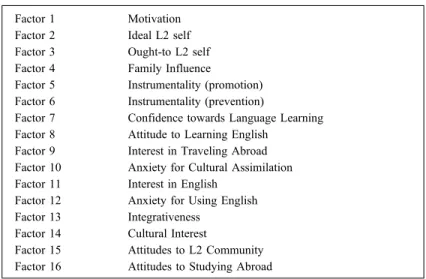
Table 1 Dörnyei’s L2 Motivational Self System
Factor 1 Motivation Factor 2 Ideal L2 self Factor 3 Oughtto L2 self Factor 4 Family Influence
Factor 5 Instrumentality (promotion) Factor 6 Instrumentality (prevention)
Factor 7 Confidence towards Language Learning Factor 8 Attitude to Learning English
Factor 9 Interest in Traveling Abroad Factor 10 Anxiety for Cultural Assimilation Factor 11 Interest in English
Factor 12 Anxiety for Using English Factor 13 Integrativeness
Factor 14 Cultural Interest
Factor 15 Attitudes to L2 Community Factor 16 Attitudes to Studying Abroad
2.2.2. Previous Project #2
Hasian and Kawasaki (2018) revealed that foreign language anxiety was reduced when American high school students who were learning Japanese were invited to participate in English communication classes. The Japanese learners and our English learners completed tasks together where students col-laborated to make up for linguistic and cultural knowledge deficiencies.
2.2.3. Previous Project #3
International students studying at Kwansei Gakuin on Japan East Asia Study Programs visited both lower and upper level English Communication classes. Significant improvements to areas such as the ideal L2 self, instrumentality, interest in traveling abroad, cultural interest, ought-to L2 self, attitudes to learning English, integrativeness, attitudes to L2 community, and anxiety for cultural assimilation were found across these two classes (Kawasaki, Haugh, Nakano, & Ibaraki, 2018).
3. The Present Study 3.1 Research Questions
RQ 1: Does presenting on Japanese topics to international students have an impact on second language
learning motivation, attitudes, and selves for Japanese learners of English at the School of Human Welfare Studies?
RQ 2: Do delayed post-test results show any long-term effects in regard to second language learning
motivation, attitudes, and selves?
3.2 Participants
For the present study, two classes of equal English abilities, class 1 with 17 students and class 2 with 16, were combined for a total of 33 freshmen English Communication students. While each class originally had more students, absences and survey errors had them removed from the study. The two classes had the same teacher.
While it was difficult to control the number of international students who participated in each class, class 1 had 10 international students and class 2 had 5 international students participating.
3.3 Classroom Activities (Treatment)
International students were invited to watch presentations from Japanese students enrolled in English Communication classes. Leading up to this class, the students had formed groups of 4 and had two 90 -minute classes to formulate their topic, write speeches and design PowerPoint slides. They were asked to make presentations on Japanese culture or places in Japan that they wanted to recommend to the in-ternational students. For example, student hometowns or good spots for taking photos for social media. On the day of the event, Japanese students were seated in their presentation groups and approximately one or two international students were asked to seat with them. Groups presented one by one where the international students asked follow-up questions and occasionally actively joined in on the presen-tations. For example, one international student went to the front of the class and tried ‘otedama’ . Fol-lowing the presentations, the Japanese students asked trivia questions to the international students which were prepared before class. These questions were about Japan and culture of foreign countries. For the remaining time of the class (approximately 5 minutes), the international students mingled with the Japanese students casually.
3.4 Instruments
Similar to previous studies conducted on motivation at the Human Welfare department at Kwansei Gakuin University, a survey was used which was made up of 59 items which covered 16 different fac-tors. This was originally developed by Taguchi, Magid, and Papi (2009) and further modified by Dörnyei and Taguchi (2010); further information can be found at https://www.zoltanDörnyei.co.uk/. The items consisted of statement types and question types. The statement-type items and the question-type items were measured with six-point Likert scales; for example, between ‘not at all’ to ‘very much’. These examples of statement type items and question type items are attached as Appendix 2 and 3. Furthermore, student self-reflection diaries also provided additional information to interpret these findings.
3.5 Process of Analysis
Before any surveys were administered, a consent form was signed and students were informed of the anonymous nature of the project. Also, while the survey was administered three times, in the form of pre, post, and delayed surveys, the items were randomized each time. The dates the surveys were administered are as follows:
Pre-survey: May 28th2019
Event: May 31st2019
Post-survey: June 4th2019
Delayed-survey: July 12th2019
Once all the surveys were collected, the data was first sorted to remove any students who were ab-sent for any of the dates above. There were also surveys where students carelessly skipped marking several answers, which were removed. Next, the data was input into SPSS, where a Cronbach’s alpha test was used to measure reliability across factors. Reliability was shown to be under 0.60 for factor 3 and factor 6 and so items 11 and 24 were removed from the data set which is shown in Appendix 4. A one-way within subjects ANOVA was used to conduct a comparative analysis across three time pe-riods to examine the effects of the event. Factor 10 was removed as the nature of the event meant that factor 10 was an unrelated variable in the survey. Finally, student self-reflection diaries were also used to assist in the interpretation of the findings in this study. The results are presented and discussed be-low.
4. Results and Discussion
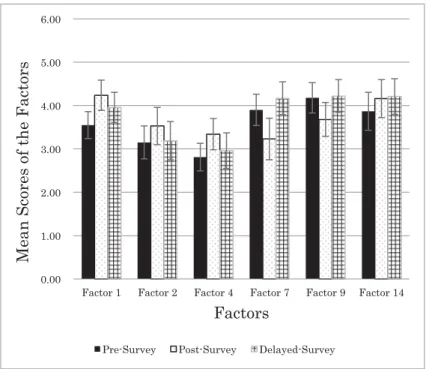
Descriptive statistics are shown in Table 2, and Table 3 details the results of post hoc tests using the Bonferroni Correction. Figure 1 shows the mean scores of the factors with significant changes. Taguchi, Magid, and Papi (2009) have discussed how having a strong ideal L2 self will often result in positive attitudes that influence other factors. This can be seen here, where all but two factors began above three points on the six-point Likert scale at the pre-survey stage before the treatment had begun. When comparing the data from pre, to post, to delayed, we can see that a large number of factors are trending positively towards higher values. The most significant of these, as described in the results section, are motivation (factor 1), ideal L2 self (factor 2), family influence (factor 4), confidence to-wards language learning (factor 7), and interest in traveling abroad (factor 9).
4.1 Motivation (Factor 1)
Motivation was its highest at 4.2 points immediately after the event and decreased to 3.9 points sev-eral weeks later on the delayed survey. It seems that presenting to international students had an effect on student motivation where students may have found the opportunity to communicate in real situ-ations highly motivating. Similar results have been found by Kobayashi (2017) who observed motiva-tion increase for students on study abroad programs and by Zohoorian (2014) who found authentic contexts to produce higher levels of motivation than traditional contexts. Zoohoorian (2014) also used student diary entries to triangulate quantitative and qualitative findings where students wrote positively above the authentic contexts. In this study, student reflections were also collected, and their comments often mentioned the positive experience they had communicating with international students and/or the need to improve their English to do better next time.
4.2 Family Influence (Factor 4) and Confidence Towards Language Learning (Factor 7)
It is difficult to interpret exactly in what regard family influence has changed and affected student
Table 2 Desriptive Statistics and One-Way Within Subjects ANOVA Results
Factor Pre-Survey Post-Survey Delayed-Survey One-Way Within Subjects ANOVA
M SD M SD M SD F df p ηp2 1* 2* 3 4* 5 6 7* 9* 11 12 13 14* 15 16 3.55 3.15 2.64 2.81 4.27 4.39 3.90 4.18 3.79 3.91 4.37 3.87 4.55 3.58 0.85 1.09 0.90 0.91 0.97 0.94 1.00 1.00 1.11 1.26 0.98 1.25 1.11 1.52 4.24 3.53 2.74 3.34 4.25 4.07 3.23 3.68 3.56 3.54 4.41 4.16 4.30 3.91 0.98 1.23 0.96 1.02 0.85 0.96 1.37 1.09 1.16 1.17 0.97 1.25 1.09 1.44 3.96 3.19 2.92 2.96 4.50 4.30 4.17 4.22 3.83 3.82 4.47 4.21 4.55 3.83 0.98 1.25 1.23 1.15 0.96 0.95 1.07 1.09 1.12 1.18 1.08 1.17 1.18 1.54 10.88 3.91 1.10 5.44 2.46 1.97 8.67 6.62 1.77 1.98 0.45 5.23 2.35 1.75 1.59,50.82a 1.55,49.61b 2,64 2,64 2,64 2,64 1.45,46.28c 2,64 2,64 2,64 2,64 2,64 2,64 1.70,54.36d <.001 .036 .340 .007 .094 .149 .002 .002 .179 .146 .643 .008 .104 .182 .25 .11 .03 .15 .07 .06 .21 .17 .18 .06 .01 .14 .07 .05
Note. N =33. *indicates that the factor score significantly changed among surveys. Factor 10 was removed due to
unrelatedness.a∼dMauchly’s test indicated that the assumption of Sphericity had not been met, χ2(2)=9.31, p
=.010; χ2(2)=10.62, p=.005; χ2(2)=14.96, p=.001; χ2(2)=6.06, p=.048, respectively;
Greenhouse-Gaisser was used to correct for degrees of freedom.
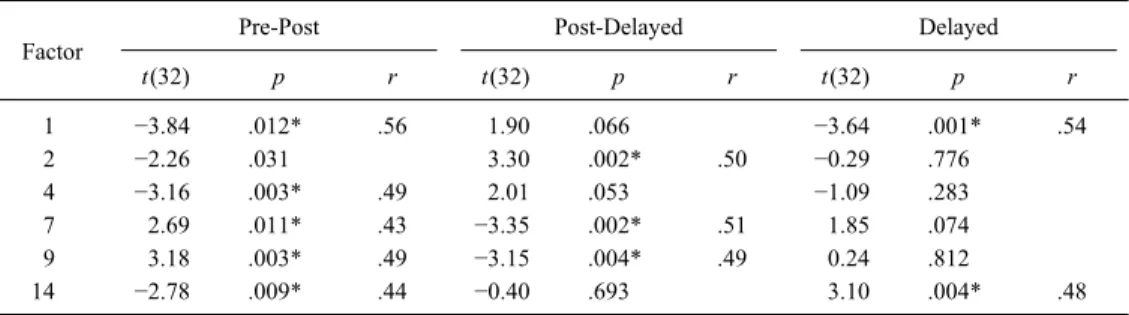
Table 3 The Results of Post Hoc Tests Using the Bonferroni Correction
Factor Pre-Post Post-Delayed Delayed
t(32) p r t(32) p r t(32) p r 1 2 4 7 9 14 −3.84 −2.26 −3.16 2.69 3.18 −2.78 .012* .031 .003* .011* .003* .009* .56 .49 .43 .49 .44 1.90 3.30 2.01 −3.35 −3.15 −0.40 .066 .002* .053 .002* .004* .693 .50 .51 .49 −3.64 −0.29 −1.09 1.85 0.24 3.10 .001* .776 .283 .074 .812 .004* .54 .48
Note. Bonferroni-adjusted p-values=.017 (.05/3) . *indicates that the factor score significantly changed, and the
motivation. While the event did not focus on family in any manner, nor did the student diaries reveal any invest into family influence, it is conceivable that through experiencing this event students came to a further realization as to why their parents encourage them to speak and learn English. Similarly, confidence towards language learning decreased significantly immediately after the event which sug-gests another realization by the students that their current level of English is not sufficient. This con-clusion is supported by the student reflection diaries where they discussed the need for improvements. Several weeks later, the delayed results revealed significant increases in confidence towards language learning where there was a 0.9-point increase. This correlates with the student increase in motivation (factor 1) which could be interpreted as confidence as a result of higher levels of motivation.
4.3 Interest in Travelling Abroad (Factor 9) and Cultural Interest (Factor 14)
Interest in traveling abroad dropped significantly immediately after the event from 4.1 points to 3.6 points. However, the delayed results showed that interest in traveling abroad was at its highest across the three surveys at 4.2 points. Potentially, meeting international students could have had two effects which caused the significant drop after the event. First, as confidence levels dropped, so too could have their confidence in their English being enough to successfully travel and communicate through-out the world. Or secondly, the knowledge that international students are within close proximity to themselves may have changed their mindset in that they feel they can get exposure to international cultures and people within Japan, and that that would be sufficient enough. Correlating with factor 9 is factor 14, cultural interest, which showed a gradual trend upwards across the three surveys beginning at 3.8 and also finishing at 4.2 points.
Figure 1 The mean scores of the factors with significant changes. Error bars denote 95% confidence interval.
Fac-tor 1: motivation; FacFac-tor 2: ideal L2 self; FacFac-tor 4: family influence; FacFac-tor 7: confidence towards lan-guage learning; Factor 9: interest in traveling abroad; Factor 14: cultural interest.
5. Conclusion
This paper has examined the impact towards second language learning motivation, attitudes, and selves among Japanese students at Kwansei Gakuin University. While the results discussed above showed significant changes in motivation (factor 1), family influences (factor 2), confidence towards language learning (factor 7), and interest in traveling abroad (factor 9), the results across all 15 factors reveal long-term effects and an upward trend across pre, post, and delayed surveys. Out of all the 15 factors, only factors 3 and 4, ought-to L2 self and family influence, remained under 3-points on the 6-point Likert scale. Despite the positive outcome of the results, there are some limitations to the study. First, the lack of a control group makes the results less reliable due to the possibility that a student’s self-evaluation might improve subconsciously when taking the same survey more than once. While the items were randomized to keep this from happening, this possibility was raised by Rod Ellis when presenting the findings from Kawasaki, Haugh, Nakano, and Ibaraki (2019) this year at the 45th JASELE Conference at Hirosaki University. Further studies aimed at using Dörnyei’s L2 Motivational Self System in a survey form with a Likert scale would be best served by also implementing a control group to examine this phenomenon.
References
Dörnyei, Z. & Taguchi, T. (2010). Questionnaires in Second Language Research: Construction, Administration, and Processing (2nd ed.) (pp.154-157). New York: Routledge.
Dörnyei, Z. & Csizér, K. (2012). How to Design and Analyze Surveys in SLA Research? In A. Mackey & S. Gass (Eds.),
Re-search Methods in Second Language Acquisition: A Practical Guide (pp.74-94). Malden, MA: Wiley-Blackwell.
Ellis, R. (2015). Understanding Second Language Acquisition 2nd Edition: Oxford Applied Linguistics. Oxford University Press. Hasian, A., Kawasaki, M., Fukui, S. & Nakano, Y. (2017). The effect of inviting guest speakers to English communication
classes. Human Welfare, 9(1), 165-178.
Kawasaki, M., Haugh, S., Nakano Y., Ibaraki S. (2019). Impact of interaction with foreign students on L2 motivation, attitudes, and selves. Human Welfare, 11(1), 145-159.
Kikuchi, K. & Browne, C. (2009). English educational policy for high schools in Japan: Ideals vs. reality. RELC Journal, 40(2), 172-191.
Kobayashi, C. (2017). Effects of A short-term study abroad on L2 motivation. Tenri University Journal 68(2), 1-19.
Taguchi, T. (2013). Motivation, attitudes and selves in the Japanese context: A mixed methods approach. In M. T. Apple, D. Da Silva, & T. Fellner (Eds.), Language Learning Motivation in Japan (pp.169-188). Bristol, UK: Multilingual Matters. Taguchi, T., Magid, M., & Papi, M. (2009). The L2 motivational self system among Japanese, Chinese and Iranian learners of
English: A comparative study. In Dörnyei, Z. & Ushioda, E. (Eds.), Motivation, Language Identity and the L2 Self (pp.66-97). Bristol, UK: Multilingual Matters.
Ushioda, E. & Dörnyei, Z. (2017). Beyond global English: Motivation to learn languages in a multicultural world: Introduction to the special Issue. Modern Language Journal, 101(3), 451-454.
Appendix 1:
Questionnaire factors and items translated into english (#11 & #24 were removed based on Cronbach’s alpha results.)
Item Factor Item
1 1 動機づけ Motivation
If an English course was offered at university or somewhere else in the future, I would like to take it. 今後さらに大学やその他の所で英語の授業があれば,受講したい。
2 I am prepared to expend a lot of effort in learning English. 英語の勉強に努力を惜しまない。
3 I am working hard at learning English. 英語を一生懸命勉強している。
4 I think that I am doing my best to learn English. 自分は英語の勉強を頑張っていると思う。 5 2 理想自己
Ideal L2 self
I can imagine myself living abroad and having a discussion in English. 外国に住み,英語で討論している自分を想像できる。
6 Whenever I think of my future career, I imagine myself using English.
将来の仕事について考えるときはいつも英語を使っている自分を想像する。 7 I can imagine a situation where I am speaking English with foreigners.
自分が外国人と英語で話をしている状況を想像できる。 8 I imagine myself as someone who is able to speak English.
英語を話せるようになっている自分を想像する。 9 The things I want to do in the future require me to use English.
将来自分がしたいことをするためには,英語が必要となる。 10 3 義務的自己
Ought-to L2 self
Learning English is necessary because people surrounding me expect me to do so. 私が英語を勉強することを周りの人々が期待しているので,英語の勉強は必要だ。
11 I have to study English, because, if I do not study it, I think my parents will be disappointed with me.
英語を勉強しないと親が残念に思うので,英語を勉強しなければならない。 12 My parents believe that I must study English to be an educated person.
英語の勉強をして教養のある人間にならなければならないと,親は強く思っている。 13 4 家族の影響
Family Influence
My parents encourage me to study English. 親が英語の勉強をすすめている。
14 My parents encourage me to study English in my free time.
時間があるときは英語の勉強をするように,と親はすすめている。
15 My parents encourage me to take every opportunity to use my English (e speaking and reading). 親は私に,あらゆる機会を利用して英語を読んだり話したりするなど,英語を使うようにすす めている。
16 My parents encourage me to attend extra English classes after class(e English conversation schools). 親は私に,授業の後さらに英会話学校などで英語を勉強するようにすすめている。 17 5 道具的―接近
Instrumentality (promotion)
Studying English can be important to me because I think it will someday be useful in getting a good job.
英語の勉強をしておくといつか良い仕事を得るために役立つと思うので,英語の勉強は大切 だ。
18 Studying English is important to me because English proficiency is necessary for promotion in the fu-ture.
19 Studying English is important to me because with English I can work globally. 英語ができれば国際的に働くことができるので,英語の勉強は大切だ。
20 Studying English can be important for me because I think I’ll need it for further studies on my major. 今後さらに自分の専門について勉強していくためには英語が必要になると思うので,英語の勉 強は大切だ。
21 Studying English is important to me because I would like to spend a longer period living abroad (e.g. study, work.).
勉強や仕事等で海外に長期滞在したいと思っているので,英語を勉強しておくのは大切だ。 22 6 道具的―回避
Instrumentality (prevention)
I have to learn English because without passing the English course I cannot graduate. 英語の単位をとらないと卒業できないので,英語の勉強をしなければならない。 23 I have to study English because I don’t want to get bad marks in it at university.
大学の英語で悪い成績を取りたくないので,英語の勉強をしなければならない。
24 Studying English is necessary for me because I don’t want to get a poor score or a fail mark in Eng-lish proficiency tests.
英語の資格試験で低い点数を取ったり不合格になりたくないので英語の勉強は必要だ。 25 Studying English is important to me because, if I don’t have knowledge of English, I’ll be considered
a weak student. 英語ができないと,出来の悪い学生と思われるので英語の勉強は大切だ。 26 7 言語学習に対 する自信 Confidence to-wards Language Learning
If I make more effort, I am sure I will be able to master English. もっと努力すれば,英語を確実に身につけられると思う。
27 I believe that I will be capable of reading and understanding most texts in English if I keep studying it.
このまま勉強を続ければたいていの英語の文章を読め,理解できるようになると思う。 28 I am sure I will be able to write in English comfortably if I continue studying.
このまま勉強を続けたら,将来楽に英語を書けると思う。 29 8 英語学習に対
する態度 Attitude to Learning English
I like the atmosphere of my English classes. 英語の授業の雰囲気が好きだ。 30 I always look forward to English classes.
英語の授業をいつも楽しみにしている。 31 I find learning English really interesting.
英語を勉強するのはとても面白い。 32 I really enjoy learning English.
英語を学ぶのは本当に楽しい。 33 9 海外旅行への
志向性 Interest in Trav-eling Abroad
Learning English is important to me because I would like to travel internationally. 海外旅行をしたいので,英語の勉強は大切である。
34 Studying English is important to me because without English I won’t be able to travel a lot. 英語ができなければ,旅行があまりできなくなるので英語の勉強は大切だ。 35 I study English because with English I can enjoy travelling abroad.
英語ができれば海外旅行が楽しめるので英語の勉強をする。 36 10 同 化 へ の 恐
れ
Anxiety for Cul-tural Assimila-tion
I think that there is a danger that Japanese people may forget the importance of Japanese culture, as a result of internationalization.
国際化によって,日本人が日本文化の重要性を忘れる危険性があると思う。 37 Because of the influence of the English language, I think the Japanese language is corrupt.
38 Because of the influence of the English-speaking countries, I think the moral of Japanese people are becoming worse.
英語圏の国々の影響で,日本人のモラルが低下していると思う。
39 I think the cultural and artistic values of English are going at the expense of Japanese values. 英語の文化的,芸術的価値は日本の価値観をだめにすると思う。
40 I think that, as internationalization advances, there is a danger of losing the Japanese identity. 国際化が進むと日本の独自性が失われる危険性があると思う。
41 11 英 語 に 対 す る興味 Interest in Eng-lish
I feel excited when hearing English spoken. 英語が話されているのを聞くとわくわくする。 42 I am interested in the way English is used in conversation.
会話の中での英語の使い方に興味がある。
43 I find the difference between Japanese vocabulary and English vocabulary interesting. 日本語と英語の単語の違いは面白いと思う。
44 12 英 語 使 用 へ の不安 Anxiety for Us-ing English
I get nervous and confused when I am speaking in my English class. 英語の授業で発言している時,不安になったり戸惑ったりする。 45 I would feel uneasy speaking English with a native speaker.
英語でネイティブスピーカーと話をする場合,不安を感じる。 46 If I met an English native speaker, I would feel nervous.
英語のネイティブスピーカーと会うと,不安になる。 47 I would get tense if a foreigner asked me for directions in English.
外国人に英語で道を聞かれると緊張する。 48 13 統合的志向
Integrativeness
How important do you think learning English is in order to learn more about the culture and art of its speakers?
英語圏の人々の文化や芸術をさらに知るためには,どの程度英語学習は大切だと思いますか。 49 How much would you like to become similar to the people who speak English?
どの程度英語圏の人々のようになりたいですか。 50 How much do you like English?
どの程度英語が好きですか。 51 14 文 化 に 対 す
る興味 Cultural Interest
Do you like English films? 英語圏の映画は好きですか。
52 Do you like English magazines, newspapers, or books? 英語圏の雑誌や,新聞,あるいは本は好きですか。 53 Do you like TV programs made in English-speaking countries?
英語圏で作られたテレビ番組は好きですか。 54 15 目 標 言 語 の コミュニティー に対する態度 Attitudes to L2 Community
Do you like to travel to English-speaking countries? 英語圏へ旅行するのは好きですか。
55 Do you like the people who live in English-speaking countries? 英語圏に住んでいる人々が好きですか。
56 Do you like meeting people from English-speaking countries? 英語圏の人々と知り合いになりたいですか。
57 Would you like to know more about people from English-speaking countries? 英語圏の人々についてもっと知りたいですか。
58 16 留 学 に 対 す る態度 Attitudes to Studying Abroad
I would like to participate in programs abroad (incl. volunteer activities) if I have a chance in the fu-ture.
今後海外研修や活動(ボランティア含む)の機会があれば参加したい。
59 I would like to study at a university in English speaking countries if I have a chance in the future. 今後機会があれば英語圏の大学に留学したい。
Appendix 2
Example of statement type items using a six-point likert scale
Appendix 3
Example of question type items using a six-point likert scale
1 ─────── 2 ─────── 3 ─────── 4 ─────── 5 ─────── 6 全くそう思わない そう思わない あまりそう思わない ややそう思う そう思う とてもそう思う 1 会話の中での英語の使い方に興味がある。 2 国際化によって,日本人が日本文化の重要性を忘れる危険性があると思う。 3 英語の勉強をしておくといつか良い仕事を得るために役立つと思うので,英語の勉強は大切だ。 4 英語が話されているのを聞くとわくわくする。 5 英語の授業の雰囲気が好きだ。 6 英語ができれば国際的に働くことができるので,英語の勉強は大切だ。 7 海外旅行をしたいので,英語の勉強は大切である。 8 もっと努力すれば,英語を確実に身につけられると思う。 1 ─────── 2 ─────── 3 ─────── 4 ─────── 5 ─────── 6 ぜんぜん∼ない あまり∼ない まあまあ 少し∼です かなり∼です とても∼です 48 英語圏の雑誌や,新聞,あるいは本は好きですか。 49 英語圏の映画は好きですか。 50 どの程度英語が好きですか。 51 英語圏の人々についてもっと知りたいですか。 52 今後海外研修や活動(ボランティア含む)の機会があれば参加したいですか。 53 英語圏で作られたテレビ番組は好きですか。 54 英語圏に住んでいる人々が好きですか。 55 英語圏へ旅行するのは好きですか。 59 今後機会があれば英語圏の大学に留学したいですか。
Appendix 4
Internal consistency checked by reliability analysis
Factor Cronbach Alpha Coefficient Number of
Items Remarks Pre-Survey Post-Survey Delayed-Survey
1 .77 .83 .81 4
2 .82 .85 .90 5
3 .67 .69 .68 2 One item removed
4 .74 .67 .79 4
5 .85 .70 .83 5
6 .71 .63 .56 3 One item removed
7 .69 .90 .85 3 8 .83 .76 .71 4 9 .63 .78 .61 3 11 .69 .74 .66 3 12 .79 .82 .80 4 13 .74 .71 .78 3 14 .80 .85 .77 3 15 .87 .81 .85 4 16 .84 .82 .83 2
Impact of Presenting in L2 to Foreign Students
on L2 Motivation, Attitudes, and Selves
Hiroko Nishimura*1, Samuel Haugh*2, Yoko Nakano*3, and Seishirou Ibaraki*4
ABSTRACT
Language learning is motivated by a variety of internal and external variables that affect learner attitudes and selves. Dörnyei’s L2 Motivational Self System has given insight into these areas where it has been combined with questionnaire surveys and Likert scales to inves-tigate factors influencing motivation among large numbers of people (Dörnyei & Csizér, 2012; Taguchi, Magid, & Papi, 2009). For this study, Japanese students studying English communication at Kwansei Gakuin University were examined under Dörnyei’s L2 Motiva-tional Self System where it was hypothesized that there would be changes to their L2 motiva-tion, attitudes and selves after presenting on Japanese topics to international students invited as guests. Each year, international students have been asked to join English communication classes at Kwansei Gakuin University and these events have been used to examine student motivation. A decrease in students’ foreign language anxiety under similar conditions was ob-served by Hasian, Kawasaki, Fukui, and Nakano (2017). Furthermore, Kawasaki, Haugh, Nakano, and Ibaraki (2018) found significant improvements to several factors regarding moti-vation, selves and attitudes among lower and upper level classes. This year the same survey was used, albeit in different classroom conditions, and showed positive effects regarding mo-tivation, family influences, and cultural interest factors. Student self-reflection diaries also provided additional information to interpret these findings. There was an increase in confi-dence towards language learning and interest in traveling abroad, however they suddenly dropped according to immediate post-survey results. Overall, student responses were above average and other factors reveal an upward trend that may indicate the positive effects that in-teractions with people who are native speakers of the target L2 can have on second language learners.
Key words: English communication classes, foreign students, motivation
*1 Assistant Professor, School of Human Welfare Studies, Kwansei Gakuin University *2 Instructor of English as a Foreign Language, School of Human Welfare Studies, Kwansei
Gakuin University
*3 Professor, School of Human Welfare Studies, Kwansei Gakuin University