
JAIST Repository: 金属ドープしたフラーレン化合物における構造相転移及び結合性質の研究
5
0
0
全文
(2) 1. Study of Bonding Nature and Structural Transitions in Metal doped Fullerene Materials Mitani Lab. 040014 Dam Hieu Chi Introduction The closed cage nearly spherical molecule C60 and related fullerene molecules, the third allotrope of carbon following diamond and graphite, have attracted a great deal of interest in recent years because of their unique structure and properties (Fig.1). For a variety of reason, fullerenes together with nanotubes are of broad-based interest to scientist in many fields, and are expected as key materials for nanotechnology. Intercalation and polymerization of fullerene solids are known as effective method to functionalize fullerene based materials. The intercalation of fullerene solids yields a variety of compounds with different physical properties, which significantly change depending upon the intercalated species (Fig. 2). Thus the information on the bonding nature including charge transfer properties is essential in understanding the physical properties of fullerene intercalated materials. Another unique aspects of fullerene molecules is the formation of interfullerene bondings, which afford a rich variety of nanoscale network structures and electronic states. It is widely known that fullerene molecules can be connected either by 2+2 cycloaddition, by C-C single bonds depending on the electronic states of fullerenes (Fig. 3). Combination of intercalation and polymerization, in other words, bridging fullerenes with intercalated metals, which has not been known so far, might provide novel aspects of solid state fullerenes. To achieve this new state, intercalation of rare earth metals might be promising, because the interaction between metal ions and fullere anions are stronger than the case of alkali metals. The main purposes of our research are: - To explore the novel family of rare-earth metal doped fullerene materials. - To clarify the bonding nature of the new compounds and to elucidate unique structural properties . Experiment The compounds of metal doped fullerene materials have been synthesized by a solid-state reaction by mixing a stoichiometric amount of metal and fullerene powders. All of the mixed powder was sealed in a quartz tube under high vacuum. Heat treatments were carried out at 550∫C - 600∫C for several days. The samples of M6C60 (M= K, Ba, Eu, Sm) were synthesized with high crystallinity. A series of new stable materials RE3C70 (RE= Sm, Eu, Yb) has been successfully synthesized. . C60 . C70 . . 7.96 ≈ . 7.10 ≈ . 7.12 ≈ . Figure 1. Molecular structure of C60 and C70 . . Figure 2. Crystal structure of. Figure 3. Electron density distribution. polymerized C60. . map of metal bridged fullerene dimer. .
(3) 2 All of the synthesized samples were sealed in thin quartz glass capillaries of 0.3 mm in outer diameter for high-resolution synchrotron x-ray powder diffraction experiments, which performed at SPring-8 and KEK. Synchrotron x-ray powder diffraction experiments were carried out for samples at high pressure and high temperature as well. In high-pressure experiments, quasi-hydrostatic pressure was generated by a diamond anvil cell. The high-temperature experiments were performed using a high temperature gas flow system. The structure analysis in the electron density level was carried out using a combination of Rietveld method and Maximum Entropy Method (Rietveld/MEM analysis). Result and Discussion 1. Experimental visualization of orbital hybridization in M6C60 (M= K, Ba, Eu) Figure 4 shows the electron density distributions of M6C60 (M= K, Ba, Eu) estimated from synchrotron x-ray diffraction experiments via Rietveld/MEM analysis. A complete charge transfer behavior was observed for the case of K6C60. An electron integrate results entirely K+ state of K atoms. The bonding in crystalline of K6C60 is ionic and each C60 molecules binds six excess electrons. In contrast, electron density of Ba6C60 and Eu6C60 clearly exhibits an overlapping of electron density between metal atoms and C60. Partial charge transfers (from metal to C60) and covalency in these materials were experimentally confirmed for the first time. The hybridization between metal and carbon is stronger in Eu6C60, than that in Ba6C60. The present results clearly demonstrate that the bonding nature of fullerene intercalates significantly changes depending upon the intercalated species. 2. Covalent metal-carbon bonds and structural transitions in RE3C70 (RE= Sm, Eu, Yb) All of the diffraction patterns of RE3C70 (RE= Sm, Eu, Yb) can be indexed on monoclinic cells, which derived by deformation of the f.c.c cells. Especially, a single phase of Sm3C70 was synthesized allow us performing a full structural analysis of this compound. A Rietveld/MEM analysis was performed for the diffraction data of Sm3C70, and obtained electron density distribution is shown in Fig 3. A strong covalent Sm-C bond was discovered in Sm3C70, forming a unique C70-Sm-C70 dimer structure. In contrast to the well known interfullerene bonding via 2+2 cycloaddition and C-C single bonds, the C70-M-C70 type bonding in solids is quite new, possibly offering a new opportunity to investigate novel structural properties based on this interfullerene bonds. Particular interests are the pressure effect and thermal effect on this novel dimer structure, because they have provided numerous important and interesting information on the bonding properties in fullerites and fullerides. Synchrotron x-ray powder diffraction profiles of Sm3C70 and Eu3C70 were collected at pressures between ambient and 5.0 GPa. A reversible first-order structural phase transition associated with almost 2.7-2.9% reduction of the unit . <100>. C60 . . C60 . . Ba . K . C60 . . K . C60. <100> . C60 . K6C60 . Eu . Ba. C60 . C60 . Ba6C60 . Eu Eu . Ba C60 . C60 . Eu . Ba . K . . <100> . C60. K <001> . . C60 . C60 . C60 . Eu6C60 . Figure 4. Structural model of <100> basal plane of M6C60 structure (left), and experimentally determined electron density distribution for M=K, Ba, and Eu. .
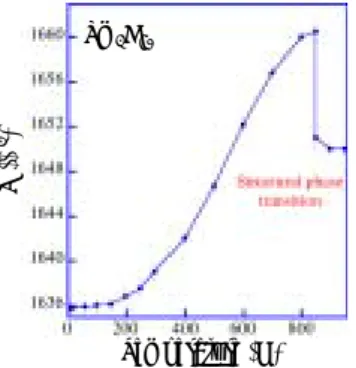
(4) 3 . Sm C. 1650. . 3. Sm3C70 . 70. V (≈ 3) . 1550. . 1500. . 1450. . 0. . 1. 2 3 Pressure (GPa). 4. 5. Temperature (K). Figure 5. Pressure dependence of unit. Figure 6. Temperature dependence of. cell volume of Sm3C70. . the unit cell volume of Sm3C70. . Ambient Condition (dimer) . High Temperature (monomer) . monomer Temperature . . High Pressure (3D covalent) . . Fig.6 . . V (≈ 3) . 1600. . . dimer . 3D covalent . Fig.5 . Figure 7. Cross section of electron density distribution map at various states of Sm 3C70.. Pressure Figure 8. Schematic phase diagram of Sm3C70. . cell volume was discovered at about 1.5 GPa for both cases of Sm3C70 and Eu3C70 (Fig. 5). Structural analyses based on the Rietveld method combined MEM prediction have shown that the transition takes place when the size of the tetrahedral hollow is smaller than the ionic radii of Sm2+ and Eu2+. Furthermore, the long axis of C70 molecules, which were aligned in zigzag pattern at ambient pressure, are realigned parallel to each other at high pressure (Fig. 7). High temperature powder x-ray diffraction experiments also have been carried out in a range of 20K-1000K, and a reversible first-order structural phase transition associated with reduction of the unit cell volume was discovered for three type of RE3C70 (RE=Sm, Eu, Yb) at high temperature (Fig. 6). Structural analyses have shown that the transition takes place when the bond is broken, and C70 molecules rotate freely around their long (five fold) axis (Fig. 7). The phase diagram of Sm3C70 is shown in Figure 8. These features at high pressure and high temperature, which have not been encountered so far in other fullerides, indicate that the phase transition observed is ascribed to the unique bonding nature of rare earth C70 compounds. Conclusion We have studied the bonding nature and phase transition in metals doped fullerenes. The result of our research are summarized as follows: - . The first demonstration of the hybridization of metal and C60 orbitals in M6C60 system. . - . Synthesis of new materials RE3C70 (RE= Sm, Eu, Yb), which displayed a strong covalent bonding between metal and fullerene that causes a novel fullerene dimer structure (C70-Sm-C70). . - . Discovery of pressure- and temperature-induced phase transition in RE3C70, associated with a significant changes of bonding nature between carbon and metals. . The results of this research will potentially open a new aspect in nano scale designing of fullerene materials. .
(5) 4 Thesis contents: 1. 2. 3. 4. 5. . Introduction Rietveld analysis and Maximum Entropy Method Bonding nature in C60 fullerides doped with metals M6C60 (M= K, Ba, Sm,Eu) Structural study of C70 fullerides doped with rare earth metals RE3C70 (RE= Sm, Eu, Yb) Pressure induced structural phase transition in C70 fullerides doped with rare earth metals RE3C70 (RE= Sm, Eu) 6. Thermal induced structural phase transition in C70 fullerides doped with rare earth metals RE3C70 (RE= Sm, Eu, Yb) 7. Structural studies of other metal doped fulleride materials 8. Conclusions 9. Appendix 10. Bibliography 11. Publication list . List of Publications: 1. Pressure-induced structural phase transition in fullerides doped with rare earth metals H. C. Dam, Y. Iwasa, K. Uehara, T. Takenobu, T. Ito, T. Mitani, E. Nishibori, M. Takata, M. Sakata, Y. Ohishi, K. Kato, and Y. Kubozono. Physical Review B, in press (2003). 2. Synthesis, structure, and magnetic properties of the fullerene-based ferromagnets Eu3C70 and Eu9C70 T. Takenobu, H. C. Dam, S. Margadona, K. Prassides, Y. Kubozono, N. Fitch, and Y. Iwasa. Journal of the American Chemical Society, in press (2003). 3. An experimental probe of bonding nature in rare earth metal doped fullerenes Dam Hieu Chi, Y. Iwasa, T. Mitani, M. Takata, E. Nishibori, and M. Sakata. American Institute of Physics Vol. 633, 51-54 (2002). 4. Correlation between Molecular Rotation and Electronic Properties Y. Iwasa, H. Shimoda, K. Ishii, T.Takenobu and Dam Hieu Chi. Solid State Physics, Vol. 37, No. 9, 595 (2002), (in Japanese). 5. Bridging fullerenes with metals Dam Hieu Chi, Y. Iwasa, X. H. Chen, T. Takenobu, T. Ito, T. Mitani, E. Nishibori, M. Takata, M. Sakata and Y. Kubozono. Chemical Physics Letters, Vol. 359, 177-183 (2002). 6. Dimmer Structure of Sm3C70 H. C. Dam, X. H. Chen, T. Takenobu, T. Itou, Y. Iwasa, T. Mitani, E. Nishibori, M. Takata and M. Sakata. American Institute of Physics Vol. 590, 447 (2001). 7. Intralayer Carbon Substitution in the MgB2 Superconductor T. Takenobu, T. Ito, Dam Hieu Chi, K. Prassides and Y. Iwasa. Physical Review B 64, 134513-134515 (2001). 8. Compressibility of the MgB2 Superconductor K. Prassides, Y. Iwasa, T. Ito, D. H. Chi, K. Uehara, E. Nishibori, M. Takata, S. Sakata, Y. Ohishi, O. Shimomura, T. Muranaka, and J. Akimitsu. Physical Review B 64 012509 (2001) 9. Synthesis, structure, and transport properties of novel fullerides A3C70 (A=Ba and Sm) X. H. Chen, D. H. Chi, Z. Sun, T. Takenobu, Z. S. Liu, and Y. Iwasa. Journal of the American Chemical Society Vol. 122, 5729-5732 (2000) 10. Structure and Magnetic Characterisation of Ce@C82 C. J. Nuttall, Y. Inada, Y. Watanabe, K. Nagai, T. Muro, D. H. Chi, T. Takenobu, Y. Iwasa and K. Kikuchi. Mol. Crys. and Liq. Crys., Vol. 340, 635-638 (2000). 11. Structure and properties of a fulleride Sm6C60 X. H. Chen, Z. S. Liu, S. Y. Li, D. H. Chi and Y. Iwasa. Physical Review B 60, 6183-6186 (1999) 12. Crystal Structure and Physical Properties of Metal Intercalated fullerenes Dam Hieu Chi, X. H. Chen, T. Takenobu, Y. Iwasa. Proceedings of The Third International Workshop on Materials Science (IWOMS'99), Hanoi, November 2-4, 1999, p 407. 13. Structural and magnetic studies of the endohedral metallofullerene Ce@C82 C. J. Nuttall, Y. Watanabe, Y. Inada, K. Nagai, T. Muro, D. H. Chi, T. Takenobu, Y. Iwasa, and K. Kikuchi. American Institute of Physics Vol. 486, 115 (1999). . . 1 12 33 47 . . 65 . . 86 101 110 115 123 129 .
(6)
図


関連したドキュメント
Approach to the fabric handle of silk Dechine zone in regard to the primary hands KOSHI and FUKURAMI... Approach to the fabric handle of silk Dechine zone in the case of
associatedwitllsideeffectssuchasgingivalhyperplasia,somnolencc,drymonth,andgcncral
Fig, 1.5 Comparison between result of plastic strain field by crystal plasticity FEA and fatigue test on crack initiation s ite in Ni alloy, a mapped region showing the grain
To accomplish the aim, the following investigations has been conducted; 1 explication of dominant factor determining fatigue crack initiation life in practical high strength
Max-flow min-cut theorem and faster algorithms in a circular disk failure model, INFOCOM 2014...
Then it follows immediately from a suitable version of “Hensel’s Lemma” [cf., e.g., the argument of [4], Lemma 2.1] that S may be obtained, as the notation suggests, as the m A
Amount of Remuneration, etc. The Company does not pay to Directors who concurrently serve as Executive Officer the remuneration paid to Directors. Therefore, “Number of Persons”
条例第108条 知事は、放射性物質を除く元素及び化合物(以下「化学
