自然環境中ではさまざまな生物や微生物が共生し多 様な生態系を形成している.特に,微生物はさまざま な宿主と共生関係を構築することが可能で,その代謝 機能は共生により過酷な環境中でも生育ができるよう に進化してきたものと推察できる.われわれに身近な 微生物の共生環境としては発酵食品が挙げられる.伝 統的な発酵食品は国や地域などにより多様な食文化が 発達しており,特に乳酸菌と酵母の共存により製造さ れる数多くの発酵食品が知られている.乳酸菌は栄養 要求性が高いため,生育にはアミノ酸やビタミンなど 多くの栄養素が必須である.乳酸菌が酵母と共生する ことの利点として,これらの栄養源の供給を酵母が担 うとともに,酸化ストレスが軽減されることなどが考 えられる.酵母と乳酸菌の共存に関する研究は古く, 乳酸菌と酵母の共培養において,乳酸菌や酵母の生育 が有意に変化することが報告されている(Nakamura & Hartman, 1961).近年では,酵母が共存すると酵母 が有機酸を資化するために,乳酸などの過剰な酸の生 成による乳酸菌の死滅を防ぐことが可能であることな どが明らかにされ(古川・片倉,2012),微生物間の相 互作用がさまざまな角度から研究されている(Onaka et al., 2011; Furukawa et al., 2015; Sawada et al., 2015). ミャンマー連邦は東南アジアのインドシナ半島の西 部に位置し,北に中国,東にタイ,ラオス,西にはイ ンド,バングラディッシュに国境を接している.広大 な自然環境を擁し,哺乳類,爬虫類,鳥類,植物類を 含めるとおよそ 7000 種以上の動植物が生息している. また,乾期と雨期が明確に区別される典型的な熱帯性 気候を示す.他の東南アジアの国々同様に部族や民族
酵母共培養法を用いた乳酸菌の新規分離法の開発と
ミャンマー産発酵食品からの分離
乙黒美彩
1)*,前田康太郎
1),岸本宗和
1),山村英樹
2),安藤勝彦
3),Nyunt Phay
4),
早川正幸
2),柳田藤寿
1) 1)山梨大学ワイン科学研究センター 〒400-0005 山梨県甲府市北新 1-13-1 2)山梨大学大学院生命環境学域 〒400-0035 山梨県甲府市武田 4-4-37 3)独立行政法人製品評価技術基盤機構(NITE),バイオテクノロジーセンター(NBRC) 〒292-0802 千葉県木更津市かずさ鎌足 2-5-8 4)Pathein University, Pathein, Myanmar乳酸菌の分離に一般的に用いられているのは集積培養法や希釈平板法であるが,分離される乳酸菌の種類は優占性や増殖 速度に依存している.本研究では酵母との共培養を利用したこれまでに報告例のない新規乳酸菌を効率的に分離することを 目的に方法を構築した.さらに,開発した方法を用いてミャンマーの伝統的発酵食品から乳酸菌の希少種を分離し,本手法 が多様性評価に有用であるか検証した. 予備試験として既知の乳酸菌 18 種 2 亜種と酵母 6 種を用いた共培養試験(組み合わせ 114 通り)において,特定の乳酸菌 と酵母の組み合わせは,ともに培養することにより乳酸菌の生育を促進あるいは抑制することが明らかとなった.この現象 を応用し分離源試料を Saccharomyces cerevisiae 等の酵母とともに液体培地中で共培養し,次いで平板分離する酵母共培養 法を構築した.本法の有効性を評価するため,ミャンマーの発酵食品 8 点(魚やエビのなれ鮨,発酵ペースト)を用いて,酵 母共培養法および希釈平板法により 52 株の乳酸菌を分離し,16S rDNA 解析による簡易同定を行った.ミャンマー産乳酸菌 は 3 属,15 種に配属され,Lactobacillus 属が最も多く 85%(44 株)を占めた.16S rDNA 解析に基づく新種推定株は希釈 平板法から 1 株,酵母共培養法から 2 株が分離された.Lactobacillus 属分離株のなかには近年台湾やタイの発酵食品から分 離例のある L. futsaii や L. plajomi が含まれていたが,いずれも希釈平板法で分離された.一方,Weissella 属は S. cerevisiae との共培養分離法でのみ分離することが可能であった.これらから,開発した共培養法を発酵食品に適用すること で,通常の希釈平板法では分離することができない乳酸菌種が得られることが示された.
キーワード:isolation of lactic acid bacteria,co-culture with yeast
*Corresponding author
E-mail: [email protected] Accepted: August 22, 2017
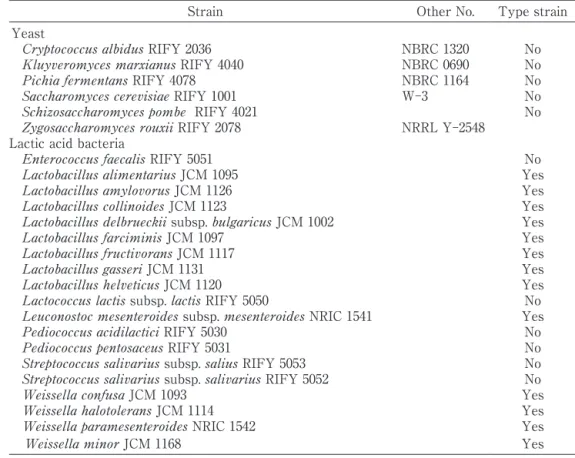
ごとにさまざまな発酵食品文化が受け継がれている. ミャンマーにはエビやカニ,魚といった魚介類を原料 にした発酵食品や,豆や野菜といった植物を利用した 発酵食品が多く,ンガピ(エビの発酵ペースト),パゾ ンチン(エビの馴れずし),モヒンガ(発酵麺)などが 知られている.一方で,これまでにミャンマー産発酵 食品に由来する乳酸菌の網羅的な研究は行われておら ず,ごく最近になり微生物探索が可能となったため に,微生物遺伝子資源保有地域としての潜在的な価値 は非常に高いと考えられる. 本研究ではさまざまな発酵食品から新規乳酸菌を効 率的に分離するために乳酸菌の新しい分離方法として 酵母共培養分離法を開発するとともに,ミャンマーの 伝統的発酵食品から乳酸菌を分離することで酵母共培 養分離法の有用性を検証し,さらにミャンマーの発酵 食品における乳酸菌の系統学的多様性を調査すること を目的とした. 各種酵母が乳酸菌の生育に及ぼす影響を調査するた め,山梨大学ワイン科学研究センターに保存している 酵母 6 属 6 種と乳酸菌 7 属 18 種 2 亜種(Table 1)を 供試菌株とした.酵母はあらかじめ MRS 培地(Difco 社製)で生育し,シクロヘキシミドに感受性であるこ とを確認した菌種を使用した.乳酸菌,酵母をそれぞ れ MRS 液体培地(Difco 社製)に接種し,30℃,2 日 間,好気条件下前培養し,MRS 液体培地 3 ml をあら かじめ分注した 12 ウェルプレート(Thermo scientif-ic 社製)に乳酸菌と酵母の前培養液をそれぞれ 50 μl ずつ接種した.比較対象として乳酸菌のみを接種した ものも調整した.本培養はアネロパック角形ジャー (三菱ガス化学社製)にアネロパック・ケンキ(三菱ガ ス化学社製)を入れ,30℃,2 日間嫌気培養を行った. 培養液を適宜希釈し,100 μl をシクロヘキシミド(和 光純薬,50 mg/l)を添加した MRS 寒天平板に塗布 し,再度 30℃,2 日間嫌気培養し出現コロニー数を計 測した.実験は同一条件で 2 回行い,S. cerevisiae, Kluyveromyces marxianus お よ び Pichia fermentans に関してはさらに追試を行い,計 3 回の実験から有意 差検定を行った.なお,出現コロニー数は平均値で示 した.
全部で 114 通りの組み合わせを試験したところ,S. cerevisiae,K. marxianus および P. fermentans は 1 回目と 2 回目の結果は促進や抑制の影響が同様な傾向
Table 1 List of strains used in this study
Strain Other No. Type strain Yeast
Cryptococcus albidus RIFY 2036 NBRC 1320 No Kluyveromyces marxianus RIFY 4040 NBRC 0690 No Pichia fermentans RIFY 4078 NBRC 1164 No Saccharomyces cerevisiae RIFY 1001 W-3 No Schizosaccharomyces pombe RIFY 4021 No Zygosaccharomyces rouxii RIFY 2078 NRRL Y-2548
Lactic acid bacteria
Enterococcus faecalis RIFY 5051 No Lactobacillus alimentarius JCM 1095 Yes Lactobacillus amylovorus JCM 1126 Yes Lactobacillus collinoides JCM 1123 Yes Lactobacillus delbrueckii subsp. bulgaricus JCM 1002 Yes Lactobacillus farciminis JCM 1097 Yes Lactobacillus fructivorans JCM 1117 Yes Lactobacillus gasseri JCM 1131 Yes Lactobacillus helveticus JCM 1120 Yes Lactococcus lactis subsp. lactis RIFY 5050 No Leuconostoc mesenteroides subsp. mesenteroides NRIC 1541 Yes Pediococcus acidilactici RIFY 5030 No Pediococcus pentosaceus RIFY 5031 No Streptococcus salivarius subsp. salius RIFY 5053 No Streptococcus salivarius subsp. salivarius RIFY 5052 No Weissella confusa JCM 1093 Yes Weissella halotolerans JCM 1114 Yes Weissella paramesenteroides NRIC 1542 Yes Weissella minor JCM 1168 Yes
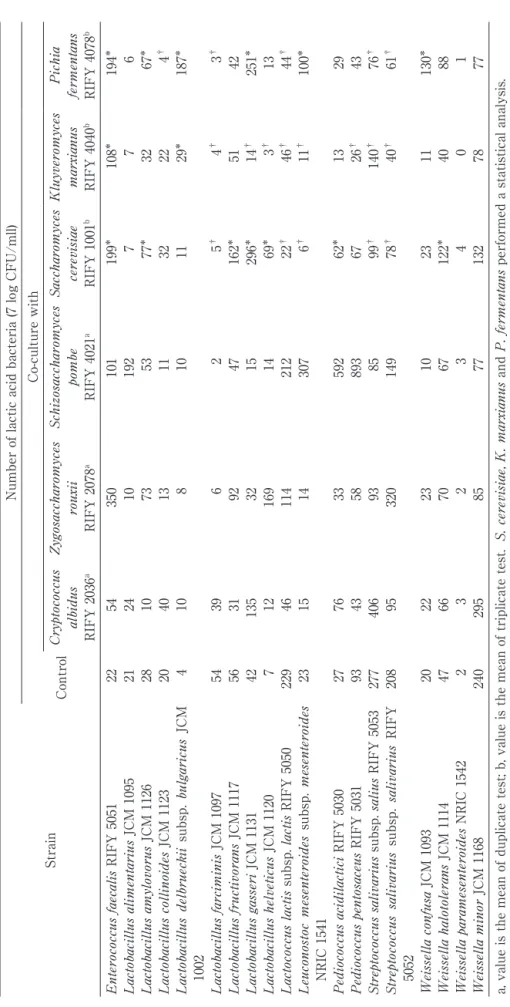
を示したが,Cryptococcus albidus,Zygosaccharomy-ces rouxii,Schizosaccaromyalbidus,Zygosaccharomy-ces pombe の 3 菌 種 は 1 回目と 2 回目の結果に同一の傾向が見られなかった. そ こ で,S. cerevisiae,K. marxianus お よ び P. fer-mentans の 3 菌種を選び 3 回目の試験を行った.これ ら 3 菌種においてコントロールと比較して有意に乳酸 菌の生育に促進効果が認められた組み合わせが 15 通 り,反対に乳酸菌の生育に対して有意に抑制効果が示 されたのは 18 通りであった(Table 2).促進効果が大 きかったのは P. fermentans と L. delbrueckii subsp. bulgaricus の組み合わせで約 47 倍であった.抑制効 果が大きかったのは L. farciminis と K. marxianus ま たは P. fermentans と共培養した場合で,それぞれ 1/14,1/18 にまで生菌数が減少した.一方,K. marx-ianus と共培養すると,試験した乳酸菌の 7 種 2 亜種 の生育が抑制される結果となった.P. fermentans は 10 種 2 亜種に促進または抑制作用があり.S. cerevi-siae は乳酸菌の生育に及ぼす影響が最も大きく,11 種 2 亜種で促進あるいは抑制の作用が認められた. 一方,2 回の試験結果で一貫した傾向が認められず 有意差は求めていないが,Z. rouxii と L. helveticus の組み合わせで約 24 倍,Schizo. pombe と Pediococ-cus acidilactici の組み合わせで約 22 倍の促進作用が あった.C. albidus は調査した菌株の生育に及ぼす影 響は小さく,Lactococcus lactis subsp. lactis および Streptococcus salivarius subsp. salivarius に対して影 響があったのみであった.しかしながら,これら C. albidus,Z. rouxii,Schizo. pombe の 3 菌種について は,結果のばらつきが大きく詳細な共培養条件を検討 する必要があると考えられた.
以上の結果から試験した酵母 6 菌種は乳酸菌の生育 に影響を与えることが明らかとなった.特に S. cerevisiae RIFY 1001,K. marxianus RIFY 4040,P. fermen-tans RIFY 4078 の 3 菌種は乳酸菌の生育に一貫した 影響を与え有意差が認められたことから,これら 3 菌 種を乳酸菌との共培養分離法に用いることとした. ミャンマーのパテイン地区周辺のマーケットより発 酵食品を取得し分離源とした.乳酸菌の分離培地には MRS 寒天培地(Difco 社製)を基本培地として,これ に抗カビ剤としてシクロヘキシミド 50 mg/l と炭酸 カルシウム 0.1 g/l を添加したものを用いた.培養は 30℃にてアネロパック・ケンキ(三菱ガス化学社製) を用いて嫌気培養を行った.各サンプル 1 g を 0.75% 生理食塩水に懸濁しサンプル希釈液とした.共培養法 は,酵母 3 属 3 種(S. cerevisiae RIFY 1001,K.
marx-ianus RIFY 4040,P. fermentans RIFY 4078)を 30℃ で 2 日間培養したものを本培養とし,各酵母培養液 50 μl とサンプル希釈液 50 μl を,MRS 液体培地 3 ml を 分注した 12 ウェルプレート(Thermo scientific 社製) に接種し,30℃で 48 時間嫌気培養を行った.培養後, 共培養液を適宜希釈し,100 μl を分離培地に塗布し た.また,比較対象としてサンプル希釈液を段階希釈 後,各溶液 100 μl を分離培地に塗布する希釈平板法も 行った.各分離法により生育したコロニーを色,形状 の違いから選択し,単離,純化した.
乳酸菌の同定は PrepMan® ultra reagent(Applied Biosystems, CA, USA)を用い分離株のゲノム DNA を抽出し,これを鋳型として PCR にてほぼ全長の 16S rDNA を増幅させ,ダイレクトシーケンスにて塩 基配列を決定した.各菌株の塩基配列は ATGC(ゼネ ティックス)でアッセンブルを行い,1,200 bp 以上の 塩基配列について EzTaxon(Kim et al., 2012)にて相 同性検索を行った.なお,L. pentosus と L. planta-rum の同定には相同性検索において上位の結果を採 用した. はじめに,酵母共培養法が新規乳酸菌の分離に有効 であるかを確認する目的でパゾンチン(エビの馴れず し,No. 198)を用い乳酸菌の分離実験を行った.比較 対象として,希釈平板法による分離も行い,各分離方 法から 1 株または 2 株を選抜し同定した.希釈平板法 では L. farciminis および L. pentosus が認められ,希 釈平板法では分離されなかった L. tucceti が酵母共培 養分離法により検出された.また,新種推定株も分離 することができた.以上より共培養分離法により通常 の希釈平板法では検出されなかった種や新種推定株が 分離され,新規乳酸菌の分離に本法が有効であると考 えられた(Table 3).次に,魚の馴れずし(ンガチン) やエビの馴れずし(パゾンチン)から同様に希釈平板 法と共培養法を用いて乳酸菌の分離を試みた.L. far-ciminis,L. plantarum,L. pentosus はいずれの分離 法でも検出可能であったが,L. formosensis,L. mu-danjiangensis,L. songhuajiangnesis,L. tuccetei, Weissella 属は共培養分離法でのみ分離することがで きた.ミャンマーの発酵食品合計 8 点(エビの馴れず し,No. 198 を含む)から分離した乳酸菌は 3 属,15 種に配属され,Lactobacillus 属が最も多く 85%(44 株)を占めた(Table 4).16S rDNA 解析に基づく新 種推定株は希釈平板法から 1 株,酵母共培養法から 2 株が分離された. 原記載によれば L. formosensis は Aspergillus 属と
Table
2 Effect of co-culture with yeast strains for growth of lactic
acid bacteria
Strain
Number of lactic acid bacteria (7 log CFU/mll)
Control
Co-culture with
Cryptococcus albidus RIFY 2036
a Zygosaccharomyces rouxii RIFY 2078 a Schizosaccharomyces pombe RIFY 4021 a
Saccharomyces cerevisiae RIFY 1001
b
Kluyveromyces marxianus RIFY 4040
b Pichia fermentans RIFY 4078 b Enterococcus faecalis RIFY 5051 22 54 350 101 199 * 108 * 194 * Lactobacillus alimentarius JCM 1095 21 24 10 192 7 7 6 Lactobacillus amylovorus JCM 1126 28 10 73 53 77 * 32 67 * Lactobacillus collinoides JCM 1123 20 40 13 11 32 22 4 † Lactobacillus delbrueckii subsp. bulgaricus JCM 1002 4 10 8 10 11 29 * 187 * Lactobacillus farciminis JCM 1097 54 39 6 2 5 † 4 † 3 † Lactobacillus fructivorans JCM 1117 56 31 92 47 162 * 51 42 Lactobacillus gasseri JCM 1131 42 135 32 15 296 * 14 † 251 * Lactobacillus helveticus JCM 1120 7 12 169 14 69 * 3 † 13 Lactococcus lactis subsp. lactis RIFY 5050 229 46 114 212 22 † 46 † 44 † Leuconostoc mesenteroides subsp. mesenteroides NRIC 1541 23 15 14 307 6 † 11 † 100 * Pediococcus acidilactici RIFY 5030 27 76 33 592 62 * 13 29 Pediococcus pentosaceus RIFY 5031 93 43 58 893 67 26 † 43 Streptococcus salivarius subsp. salius RIFY 5053 277 406 93 85 99 † 140 † 76 † St rep toc oc cus s al iv ar iu s sub sp . sa liva ri us R IF Y 5052 208 95 320 149 78 † 40 † 61 † Weissella confusa JCM 1093 20 22 23 10 23 11 130 * Weissella halotolerans JCM 1114 47 66 70 67 122 * 40 88 Weissella paramesenteroides NRIC 1542 2 3 2 3 4 0 1 Weissella minor JCM 1168 240 295 85 77 132 78 77
a, value is the mean of duplicate test; b, value is the mean of
triplicate test.
S. cerevisiae
, K. marxianus
and
P. fermentans
performed a statistical analysis.
* significant differences compared to control (P<0.05; t-test),
growth acceleration.
† significant differences compared to control (P<0.05; t-test),
Lactobacillus 属の菌株により発酵した大豆粕から分 離されている(Chang et al., 2015).L. formosensis 分 離株 8 株はいずれも P. fermentans との共培養でのみ 分離され,S. cerevisiae や K. marxianus との共培養 では分離されなかったことは,エタノール耐性の違い が影響しているものと考えられた.Clemente-Jimenez et al.(2005)の報告では P. fermentans のアルコール 生成量は最小培地およびブドウ果汁による発酵試験でそ れぞれ 2.0 mg/l,5.0 mg/l となりS. cerevisiae(4.0 mg/l および 10.6 mg/l)のおよそ半分であることが示され ている.L. songhuajiangnesis は 2013 年に中国のサ ワードウーから分離された菌株として初めて記載され た種である(Gu et al., 2013).サワードウーは酵母と 乳酸菌を共発酵させて作製する伝統的なパン種であ り,共培養分離法はこれに着想を得ている.L. song-huajiangnesis と同定した分離株のエタノール耐性は 未調査であるが本研究において S. cerevisiae との共培 養法でのみ分離することが可能であったことを考慮す ると,L. formosensis 分離株とは異なり,L. songhua-jiangnesis 分離株は高いアルコール耐性を有している ものと推察できる. 本研究では魚やエビを原料とする馴れずし 8 点から 乳酸菌を 52 株分離した.新種推定株も含めるとその 内訳は 3 属 17 種に及んだ.16S rDNA 解析に基づく
Table 3 Effect of co-culture method for the isolation of lactic acid bacteria from a food product of fermented shrimp and rice (Pazon Chin, sample No. 198) in Myanmar
Closest species based on 16S rRNA gene sequence similarity rate (%)
Number of strains Ditution method (Control) Co-culture with Saccharomyces cerevisiae RIFY 1001 Klyveromyces marxinus RIFY 4040 Pichia fermentans RIFY 4078 Lactobacillus farciminis 1 Lactobacillus tucceti 1 1 Lactobacillus pentosus 1 1 Lactobacillus plantarum subsp. planatarum 1
Lactobacillus sp. 1*
* A new species candidate with 16S rDNA similarity of 98.5% compared to the most homologous prototype species.
Table 4 Effect of co-culture method for the isolation of lactic acid bacteria from a food products of fermented shrimp and rice (Pazon Chin) and fermented fish and rice (Ngar Chinin) Myanmar (8 samples)
Closest species based on 16S rRNA gene sequence similarity rate (%)
Number of strains Ditution method (Control) Co-culture with Saccharomyces cerevisiae RIFY 1001 Klyveromyces marxinus RIFY 4040 Pichia fermentans RIFY 4078 Lactobacillus farciminis 4 2 1 Lactobacillus fermentum 1 2 Lactobacillus formosensis 8 Lactobacillus futsaii 1 Lactobacillus mudanjiangensis 2 Lactobacillus namurensis 1 1 2 Lactobacillus plajomi 1 Lactobacillus pentosus 1 1 1 2 Lactobacillus plantarum 1 1 5 1 Lactobacillus songhuajiangensis 1 Lactobacillus tucceti 1 Lactobacillus sp. 1* 1* 1* Pediococcus pentosaceus 1 1 1 Weissella cibaria 1 Weissella paramesenteroides 2 2
新種推定株は希釈平板法から 1 株,酵母共培養法から 2 株が分離された.Lactobacillus 属分離株のなかには 近年台湾やタイの発酵食品から分離例のある L. futsaii (Chao et al., 2012) や L. plajomi(Miyashita et al.,
2015)が含まれていたが,いずれも希釈平板法で分離 された.一方,Weissella 属は S. cerevisiae との共培 養分離法でのみ分離することが可能であった.Moe et al.(2015)もミャンマーの馴れずし 8 点から 43 株の乳 酸菌を分離し,その微生物フローラを解析している. Miyashita et al.(2012)はタイの発酵食品 114 点から 945 株を分離し,410 株について 16S rDNA 塩基配列 を行い,6 属が認められたことを報告している.また, Nguyen et al.(2013)はベトナムの伝統的な発酵食品 21 サンプルから 881 株を分離し,その分布を明らかに している.その結果 L. fermentum が 56.6%,次いで L. pentosus(24.4%),L. plantarum(17.1%)が数多 く分離され,Pediocuccus 属がごくわずかに分離され たと報告している.これらの研究結果と比較すると本 研究では供試した試料数,分離株数は少ないながら も,酵母共培養法により効率的に多様な乳酸菌が分離 できたと考えられた. 本研究においては酵母との共培養法を利用した乳酸 菌の新規分離方法を開発し,さらに実際に発酵食品か ら多様な乳酸菌を分離することができた.本研究で考 案した共培養分離法は発酵食品中の微生物が共生関係 にあることに発想を得ている.したがって,共培養に 利用した S. cerevisiae RIFY 1001,K. marxianus RIFY 4040,P. fermentans RIFY 4078 の 3 種の酵母は発酵 力が高く,エタノールや炭酸ガス以外にも多くの一 次,二次代謝産物を生産する(Clemente-Jimenez et al., 2005; Gethins et al., 2015; López-Malo et al., 2013). 分類学的にも近縁な S. cerevisiae と K. marxianus で は試験した乳酸菌の生育パターンはいずれも同様の傾 向を示したが,L. gasseri や L. helveticus の生育には 異なる影響を示した.一方,P. fermentans では L. delbrueckii および W. confusa の生育に促進作用が高 く認められたことは,酵母の代謝産物が乳酸菌の生育 に促進や抑制の作用を示したものと考えられる.本研 究 で 選 択 し た S. cerevisiae,K. marxianus,P. fer-mentans は生成量に差はあるが,発酵によりいずれも エタノールと炭酸ガスが生成する.今後,これらの物 質が生育に与える影響を明らかにすることで分離方法 の改良が期待できるが,共培養においては共生菌の存 在や共生する細胞同士の接着が必要であるとの報告も あることから,これらのことを考慮し分離方法の改良 を行うべきである. 謝 辞 本研究は JSPS 科研費 JP26304006 ならびに公益財 団法人発酵研究所大型研究助成「熱帯地域に生息する 超希少微生物の分離探索基盤の構築」を受けて行われ たものです. 文 献
Chang, C.H., Chen, Y.S., Lee, T.T., Chang, Y.C. & Yu, B. 2015. Lactobacillus formosensis sp. nov., a lactic acid bacterium isolated from fermented soybean meal. Int. J. Syst. Evol. Microbiol. 65: 101-106. Chao, S.H., Kudo, Y., Tsai, Y.C. & Watanabe, K. 2012.
Lactobacillus futsaii sp. nov., isolated from fu-tsai and suan-tsai, traditional Taiwanese fermented mustard products. Int. J. Syst. Evol. Microbiol. 62: 489-494.
Clemente-Jimenez, J.M., Mingorance-Cazorla, L., Martínez-Rodríguez, S., Las Heras-Vázquez, F.J. & Rodríguez-Vico, F. 2005. Influence of sequential yeast mixtures on wine fermentation. Int. J. Food Microbiol. 98: 301-308.
古川壮一,片倉啓雄 2012.乳酸菌と酵母の共存と共 生.日本生物工学会誌 90:188-191.
Furukawa, S., Isomae, T., Tsuchiya, N., Hirayama, S., Yamagishi, A., Kobayashi, M., Suzuki, C., Ogihara, H. & Morinaga, Y. 2015. Screening of lactic acid bacteria that can form mixed-species biofilm with Saccharomyces cerevisiae. Biosci. Biotechnol. Biochem. 79: 681-686.
Gethins, L., Guneser, O., Demirkol, A., Rea, M.C., Stanton, C., Ross, R.P., Yuceer, Y. & Morrissey, J.P. 2015. Influence of carbon and nitrogen source on production of volatile fragrance and flavour metabolites by the yeast Kluyveromyces marxianus. Yeast 32: 67-76.
Gu, C.T., Li, C,Y., Yang, L.J. & Huo, G.C. 2013. Lactobacillus mudanjiangensis sp. nov., Lactobacillus songhua jiangensis sp. nov. and Lactobacilus nenjiangensis sp. nov., isolated from Chinese traditional pickle and sourdough. Int. J. Syst. Evol. Microbiol. 63: 4698-4706.
Kim, O.S., Cho, Y.J., Lee, K., Yoon, S.H., Kim, M., Na, H., Park, S.C., Jeon, Y.S., Lee, J.H., Yi, H., Won, S. &
Chun, J. 2012. Introducing EzTaxon: a prokaryotic 16S rRNA Gene sequence database with phylotypes that represent uncultured species. Int. J. Syst. Evol. Microbiol. 62: 716-721.
López-Malo, M., Querol, A. & Guillamon, J.M. 2013. Metabolomic comparison of Saccharomyces cerevisiae and the cryotolerant species S. bayanus var. uvarum and S. kudriavzevii during wine fermentation at low temperature. PLoS One 8: https://doi.org/10.1371/journal.pone.0060135. Miyashita, M., Yukphan, P., Chaipitakchonlatarn, W.,
Malimas, T., Sugimoto, M., Yoshino, M., Potacharoen, W., Tanasupawat, S., Nakagawa, Y., Kirtikara, K., Tanticharoen, M. & Suzuki, K. 2012. 16S rRNA gene sequence analysis of lactic acid bacteria isolated from fermented foods in Thailand. Microbiol. Cult. Coll. 28: 1-9.
Miyashita, M., Yukphan, P., Chaipitakchonlatarn, W., Malimas, T., Sugimoto, M., Yoshino, M., Kamakura, Y., Potacharoen, W., Tanasupawat, S., Tanaka, N., Nakagawa, Y. & Suzuki, K. 2015. Lactobacillus plajomi sp. nov. and Lactobacillus modestisalitolerans sp. nov., isolated from traditional fermented foods. Int. J. Syst. Evol. Microbiol. 65: 2485-2490.
Moe, N.K.T., Thwe, S.M., Shirai, T., Terahara, T.,
Imada, C. & Kobayashi, T. 2015. Characterization of lactic acid bacteria distributed in small fish fermented with boiled rice in Myanmar. Fish Sci. 81: 373-381.
Nakamura, L.K. & Hartman, P.A. 1961. Lactobacillus: yeast inter-relationship. J. Bacteriol. 81: 519-523. Nguyen, D.T.L., Van Hoorde, K., Cnockaert, M., De
Brandt, E., Aerts, M., Le Thanh, B. & Vandamme, P. 2013. A description of the lactic acid bacteria microbiota with the production of traditional fermented vegetables in Vietnam. Int. J. Food Microbiol. 163: 19-27.
Onaka, H., Mori Y., Igarashi, Y. & Furumai, T. 2011. Mycolic acid-containing bacteria induce natural-product biosynthesis in Streptomyces species. Appl. Environ. Microbiol. 77: 400-406.
Sawada, K., Sato, T., Hamajima, H., Jayakody, L.N., Hirata, M., Yamashiro, M., Tajima, M., Mitsutake, S., Nagao, K., Tsuge, K., Abe, F., Hanada K. & Kitagaki. H. 2015. Glucosylceramide contained in koji mold-cultured cereal confers membrane and flavor modification and stress tolerance to Saccharomyces cerevisiae during coculture fermentation. Appl. Environ. Microbiol. 81: 3688-3698.
Development of a new method for isolating lactic acid bacteria, and application of the method to fermented foods in Myanmar
Misa Otoguro1), Kotaro Maeda1), Munekazu Kishimoto1), Hideki Yamamura2), Katsuhiko Ando3),
Nyunt Phay4), Masayuki Hayakawa2) and Fujitoshi Yanagida1) 1)The Institute of Enology and Viticulture, University of Yamanashi,
2)Faculty of Life and Environmental Sciences, Graduate School, University of Yamanashi, 3)NITE Biological Resouce Center, 4)Pathein University
Enrichment or dilution methods are generally used for isolating lactic acid bacteria (LAB) from natural samples. However, these methods depend on the microbe's predominant characteristics or growth rate. Here, we developed a new method for isolating minor LAB by co-culture with yeast strains. We then used this method to isolate rare and indigenous species in the traditional fermented foods of Myanmar, thus enabling us to determine the taxonomic diversity of LAB there. To analyze the effects of co-culture we tested a combination of 18 species and 2 subspecies of LAB and 6 species of yeast. Interestingly, some specific combinations either accelerated or suppressed LAB growth. Eight fish or prawn products fermented with rice (ngachin and pazun-chin) were then obtained from the Ayeyawady market in Myanmar for testing. By using co-culture and dilution methods we isolated 52 LAB from these products. Co-culture with yeast resulted consistently in LAB isolation from all samples. The LAB were assigned to 3 genera and 15 species; the genus Lactobacillus accounted for 85% (44 strains) of the bacteria in these products. 16S rDNA analysis showed that one new species candidate was isolated by the dilution method, whereas 2 new species candidates were isolated by the co-culture method. Lactobacillus futsaii and Lactobacillus plajomi, isolated recently from Taiwanese fermented mustard products and from Thai fermented food, respectively, were also detected by the dilution method. However, the genus Weissella was isolated only by co-culture with Saccharomyces cerevisiae. Thus, co-culture enabled the isolation of rare LAB that are otherwise difficult to isolate by using the normal dilution method. Our results suggest that the development of new methodologies for isolating LAB is highly important for expanding our understanding of their ecology, taxonomy, and distribution.