Peer Teaching and Learner Responsibility
journal or
publication title
Kwansei Gakuin University humanities review
number
16
page range
39-54
year
2012-02-18
Peer Teaching and Learner Responsibility
Hector LUK*, Marian WANG*
Abstract
This paper presents findings from a study of peer teaching among English language learners at a university in Japan. The study analyzes the students’ feedback on their experiences of teaching their peers and being taught by their peers. In general, students felt that peer teaching helped create a positive classroom atmosphere and gave them inspiration to be better language learners. They realized that teaching requires mastering the content and also having the language necessary to explain and clarify concepts to their peers. Even though this was a challenging experience, the students indicated that they wanted more opportunities to teach their peers.
1. Introduction
In Japan, when students begin to study English as a foreign language in junior high school, the classes are often teacher-centered and predominantly grammar and translation-based. Despite the recent changes that have been suggested by the Ministry of Education to focus more on communicative English, the reality is that the teachers have to concentrate on preparing students for university entrance examinations. Therefore, it is common for teachers not to be able to foster their students’ communicative abilities. In university, where students no longer have to be concerned about passing entrance examinations, there are more opportunities for them to take English courses with a greater emphasis on communication. This applies to the Language Center at Kwansei Gakuin University (a private university in Japan) where the courses are highly student-centered and typically interactive. Even though students improve their ability to express themselves in English, they usually do not take the initiative to further their own learning and do not play an
────────────────────────────────────────── *I. E. F. Ls at the Language Center, Kwansei Gakuin University.
Kwansei Gakuin University Humanities Review
Vol. 16, 2011 Nishinomiya, Japan
active role in the learning process. It is often said that the best way to learn something is to teach it. The researchers decided to incorporate this idea into their English language courses and challenge their students beyond their regular activities. In this way, it was hoped that the students would develop an active approach towards learning, as opposed to being simply taught by the researchers.
2. Literature Review
Peer teaching involves learners teaching each other. It results in the student teachers learning from the peer teaching process as they must have full understanding of the material before they can teach their peers. Although Frank Oppenheimer is often credited with the phrase “the best way to learn is to teach” (as cited in Delacôte, 1998), the idea of learning by teaching goes as far back as the first century when Seneca (trans. 1917) said, “for men learn while they teach.” In the nineteenth century, notable educators Andrew Bell and Joseph Lancaster developed the Monitorial System, or “mutual instruction,” where a student would learn something and in turn teach it to other students (Rayman, 1981). Montessori education, which started in the early twentieth century, uses peer teaching to reinforce learning. After mastering a skill, older students teach that same skill to younger classmates. Recent advocates of peer teaching as a useful approach in education include Gartner, Kohler and Riessman (1971), Anderson and Boud (1996), and Boud, Cohen, and Sampson (2001).
Peer teaching is used across disciplinary and at different levels: teaching and education for undergraduates in Australia (Longaretti, Godinho, Parr, & Wilson, 2002), pharmacology for undergraduates in Australia (Depaz & Moni, 2008), science for secondary school students in Malaysia (Tan, 2009), geomorphology for undergraduates in the United Kingdom (Milan, 2004), and mathematics for undergraduates in the Philippines (Vasay, 2010).
In language related settings, Hoover (1972) experimented with peer teaching in her university composition and communication classes, Barnett (1973) trialled it in her Spanish classes at a middle school, and Rizzo (1975) used it in her English class for disadvantaged students from the New York City ghetto. Celani (1979) applied it to English language students in a Brazilian university, while Mynard and Almarzouqi (2006) incorporated peer teaching in their English classes in the United Arab Emirates. In all of these cases, since the students responded positively, these researchers continue to support the use of peer teaching. Although sometimes peer teaching is initially utilized due to a need for class management, the benefits for the students (academic, social or otherwise) become apparent to the educators and peer teaching is continued in their classes (Barnett, 1973; Tan, 2009).
Hector LUK, Marian WANG
3. Context
This study was conducted with the cooperation of students at Kwansei Gakuin University. The students were in the Language Center’s Intensive English Program (IEP), which offers English courses including Intermediate English (IM) for students with TOEFL scores between 400 and 530 to fulfill their English course requirements in three semesters instead of four. By the final semester of IM, most of the students have become accustomed to speaking in English with their classmates and have had many opportunities to work in pairs or groups to give short presentations in English. The researchers decided to incorporate peer teaching activities requiring two or three students to work together to give a 30-minute language lesson for their peers in addition to presentations. The primary objective of the language lesson was for students to prepare teaching materials and activities together and plan a lesson with clear linguistic aims and functions. The researchers asked students to submit lesson plans prior to their lessons so that they could give suggestions to enhance the effectiveness of the lesson.
4. Research Questions The following research questions were investigated:
1. Is it beneficial for students to teach their peers? What are the benefits? 2. Is it beneficial for students to be taught by their peers? What are the
benefits?
5. Methods
In July 2011, with two weeks before the end of their IM course, the students reflected on their experience of peer teaching that began in their final semester of IM. A questionnaire (see Appendix A) was filled out by 88 students between the ages of 18 and 20 from the Sociology and Humanities departments. In Part One, students described the benefits and challenges of teaching their peers. In Part Two, they commented on being taught by their peers. In Part Three, they gave suggestions on how to improve peer teaching. This questionnaire was completed in class in English with the researchers present to address any questions students may have had regarding the content of the questionnaire. The students were ensured anonymity and were informed that the results would be used for research purposes only. The comments by the students were analyzed, categorized, and edited for spelling but not for grammar to ensure authenticity.
6. Results (i) Part One (Teaching Their Peers)
In Part One, students answered questions about their experience teaching their classmates. The researchers felt that students’ prior exposure to peer teaching in other courses could influence their attitude towards peer teaching. Therefore, the students were asked if they had done peer teaching before. Of the 88 students, 79 students said that they had never done peer teaching in their classes. When asked how they found (liked) teaching their peers, 23 students chose “very enjoyable,” 40 students selected “quite enjoyable,” 23 students thought it was “OK,” and 2 students said it was “quite boring.”
Cooperative Peers
In preparing for the presentation and language lesson, students worked in class and outside of class to find materials, review course materials including the textbook, write out lesson plans, and prepare slides and handouts. Although the researchers edited and reviewed slides and handouts when asked, students were primarily responsible for choosing teaching content, materials, and activities for their peers.
Many students felt that their assigned partner or group members were instrumental in their successful execution of their peer teaching lesson. One student said, “At first when I prepared for presentation, I was upset and nervous. But my partner is kind and supported me. I also made an effort to support her.” In addition to their partner’s cooperation in preparing for the presentation and lesson, many students thought that their peers’ active involvement in their lessons contributed to their enjoyment of the peer teaching experience. When their classmates listened attentively to their explanations, answered their questions, asked follow-up or clarification questions, looked like they were having fun and understood their overall goals and objectives of the lesson, they felt the rewards of teaching their peers. Supportive peers also helped students overcome the initial anxiety felt when teaching their peers. “I was nervous. At first I worried about whether everyone enjoyed our presentation, but they participated positively.”
During the language lessons, student teachers asked clarification questions to their peers to check their comprehension of materials presented. When their peers were able to answer the questions asked, a student said that peer teaching was beneficial “because I could hear a lot of interesting answers from my classmates.” Students’ non-verbal feedback such as facial expressions and nodding helped peer teachers know if their classmates were able to follow them. “I was happy when they understood our explanations and nodded.” After the peer teaching activity, student
Hector LUK, Marian WANG
teachers continued to receive encouragement from their peers, which added to their satisfaction of peer teaching. “I really thought what I could do to be enjoyed by my teaching presentation by everyone. After my presentation, some of classmates talk to me and said it was very good. So I was very happy.” Another student said, “After presentation, some people said to me that your voice and smile was very good.”
Teaching and Creating Materials
Although some of the students were training to be English teachers or were teaching English at cram schools at the time, most students lacked teaching experience. Moreover, even if some students were teaching English at cram schools, as one student explained, “I have never taught English in English.” Some students embraced the challenge of being a teacher. “It’s good to teach what I know to everybody and communicate with all members in the class. I found I like teaching.” Another student seized the rare chance to teach their peers and remarked, “I think this is a good opportunity to stand teacher’s side. Teachers have to make class fun and they also have to teach class contents.” Other students enjoyed creating teaching materials. “Thinking what kind of activities was enjoyable for me, because many ideas came up with my mind. Everything (making PPT, making handout and so on...) is fun for me, because this is the first time that I’m not a student.” This echoes Lehr’s (1984) belief that peer teaching offers students the possibility of being leaders and taking on new responsibilities.
Students were also asked if they would like more opportunities to teach their classmates. Among the 88 students, 60 answered “yes,” 27 said “no,” and one student did not give a response.
Improvement in English
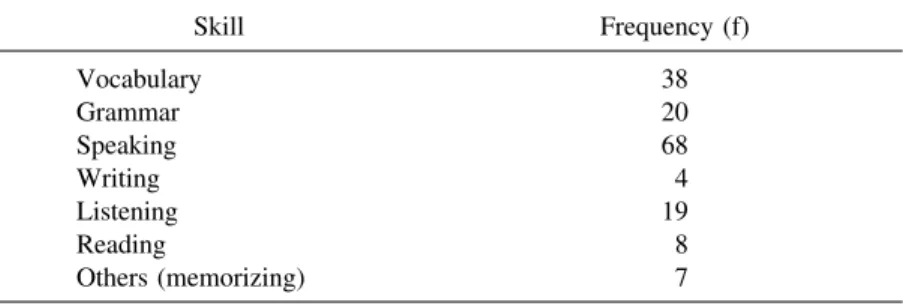
As in Mynard and Almarzouqi’s (2006) research, students said that peer teaching helped them improve their English skills, particularly speaking and vocabulary (see Table 1). In preparing their lessons, they had to find materials that they could master and teach to their peers in comprehensible English. By teaching
Table 1 Perceived Improvement in English Skills through Peer Teaching
Skill Frequency (f) Vocabulary Grammar Speaking Writing Listening Reading Others (memorizing) 38 20 68 4 19 8 7
the material, they could confirm whether or not they had understood the concepts well enough to teach their peers. Therefore, the passive learning of the material was transferred into an active learning by their teaching of the material. As one student reported, “I can have the time to think in English which is not passive but which is active. English to let people understood is very useful.”
Students felt that they were able to practice their public speaking skills when they spoke in front of their peers. Although this may not necessarily be linked to improved English skills, students felt that by speaking in front of their peers, they were able to use public speaking techniques such as speaking clearly, pronouncing words properly, pausing appropriately, and adjusting their speed or volume to engage their peers to participate in their lessons. These techniques were highlighted by one student who said, “We could speak English differently like not speaking to our friends because we had to teach and lead the class.”
The preparation of the lessons helped students improve their vocabulary. Through researching online or reviewing their textbooks, peer teachers were able to choose and look up words that they wanted students to learn or predict words that students would not be able to understand. They often created vocabulary activities that would require their peers to give definitions, synonyms or examples.
The final question in Part One of the questionnaire focused on the difficulties students experienced in peer teaching. Although peer teaching helped some students practice their public speaking skills and enhance their vocabulary, many students felt that peer teaching was challenging, particularly because they were not accustomed to teaching their peers material that they had learned.
Teaching and Being Understood
Most students succeeded in synthesizing material and making interesting activities for their peers. However, problems arose when students had to explain key grammatical concepts, define vocabulary or respond to questions in English. Grammar concepts posed some of the biggest obstacles for students. “Even if I know the theme and what I’m teaching, I can’t explain these things in simple and easy English, especially, grammar section.” Another student had the same concern. “When I taught grammar, everyone can’t understand it. But I didn’t know how to make them understand.” Some students felt that the reason they could not give clear explanations or responses was because they did not have enough vocabulary or could not come up with the right words to explain important concepts because their minds drew a blank. “I prepared for the presentation, and I knew the things which I should convey. In that time, I couldn’t come up with English words.” The question and answer sessions after the peer teaching activities frustrated student teachers. When their peers gave responses that they had not anticipated, student teachers
Hector LUK, Marian WANG
hesitated. When their peers could not respond to their questions, they felt disappointed. Finally, if peers did ask questions, they could not always respond to the questions immediately or give suitable answers. These challenges made student teachers realize that they needed to have a deeper grasp of the grammatical concepts or content and be able to give explanations or responses using simple vocabulary to their peers.
(ii) Part Two (Being Taught by Peers)
In Part Two, students responded to questions about their peers as teachers. Out of 88 students, 79 students said they had never been taught by peers in English. When asked how much they enjoyed having their peers as teachers, 38 students said “very enjoyable,” 32 students chose “quite enjoyable,” 14 students thought it was “OK,” and 4 students picked “quite boring.”
Different Way of Learning
Students found that the lessons by their peer teachers were “interesting,” “unique,” “fresh,” and “fun.” They enjoyed the variety in which linguistic functions were explained through quizzes, gap fills, speed reading, listening or reading comprehension questions, pair conversations, and games. They were pleasantly surprised at how good their classmates were and felt inspired by their unique teaching ideas. The activities that students did in class often fostered discussion between students, and students enjoyed talking with their peers and learning new ideas from them.
Previously in Part One, the peer teachers described their struggle with giving simple explanations and instructions in English, especially concerning grammar. Nonetheless, many of the students participating in the lessons said they were able to understand their peers’ lessons because the English used was “easy to understand for me because they use easy words.” Another student said that it was not difficult to understand the lesson because “when people spoke comparatively slowly it is easy to understand statement.”
Even though many of the students explained the benefits of having peers teach them, there were a few students who said that their peers could have been better teachers if they had explained important concepts more clearly and prepared more diligently for their lessons. Moreover, they felt that once one teaching method was adopted by the first group of students, others tended to replicate it. “Almost all of the students did the same pattern. We had to study with a textbook but I wanted them to do in each different ways.”
Students were also asked if they would like more opportunities for their peers to teach them. Among the 88 students, 65 answered “yes” and 23 said “no.”
Learn by Example
The main reason why students wanted at least another chance to be taught by their peers was to see more examples of their peers giving effective presentations, creating fun and useful activities, and providing comprehensible explanations. “When I taught something by my classmates is very meaningful for me and classmates too. I think that I can learn skills of presentation or teaching something to someone from presentation of classmates. So, I want to get some opportunities.” Therefore, positive peer role models helped them realize what they might be capable of accomplishing even if they were not seasoned instructors of English. In contrast, peers who were not successful teachers provided negative examples of teaching in a language classroom such as mumbling, speaking too quickly, not making eye contact, not speaking loud enough, appearing unprepared or unenthusiastic, and giving unclear explanations or instructions. One student observed, “If a teacher mumbles to students, they would stop listening before long. I should speak with more pronounced intonation.”
The last question of Part Two asked students to explain the difficulties they had with their peers’ teaching. When students used complicated vocabulary in their presentations and language activities, their peers could not understand them. Students also commented on the challenges of participating in their peers’ lessons when their peers spoke using a “small voice.” This student summarized the main problem of some of the less effective peer teachers. “I couldn’t understand their English because they used difficult words and I couldn’t hear their voice.”
(iii) Part Three (Suggestions for Improvement)
In Part Three of the questionnaire, students wrote suggestions on how to improve the teaching activity. Some students felt that if they were given more time to prepare for their teaching activity, they could have done a better job. “The time to prepare for the activity was needed more. There were some troubles in our class’s activities. If they could do smoothly, we could concentrate more, I think.” Students also wanted more time to do their actual peer teaching activity. One student said “I think if we had more time to teach, for example 90−110 minutes, it makes us easy to think about the structure of teaching.” Other students had specific suggestions such as having students use a microphone, use the blackboard to clarify key concepts, consult the teacher’s edition of the textbook manual for students to get more teaching ideas, and include discussions and debates. Finally, some students said they wanted more feedback from their classmates and their teacher on their presentation and lesson as one student made the suggestion that “it might be useful if we could have a discussion time afterward, whether it was good or not, how to improve.”
Hector LUK, Marian WANG
7. Discussion
Although students in this study viewed peer teaching in the language classroom favorably, peer teaching may nonetheless be a daunting task for students who are not natural teachers. Therefore, language teachers can reduce the anxiety their students may feel towards peer teaching by introducing peer teaching after students have become accustomed to speaking in front of their peers. In this study, the researchers had students give presentations to their peers before they embarked on the peer teaching activity so that students may perceive the language lesson as something “extra” or “fun” to encourage the active participation of their peers, and they could focus more on creating interesting lessons for their classmates rather than worrying about speaking in front of their peers.
When students are choosing materials for their lessons, it behooves the language teacher to make sure that the students have chosen materials and activities suitable for the students’ English level and interests. Student teachers are not substitutes for the actual language teacher. According to Tan (2009), getting the students to teach does not negate the role and duty of the teacher. In fact, the language teacher must play an additional role of a consultant or a manager to make sure that students are prepared for their presentations and lessons. In this study, the researchers asked students to fill out a lesson plan with the aim of the lesson, lesson procedure, potential problems, potential solutions, materials needed for the lesson, preparation students need to do before the lesson, and a self-evaluation (see Appendix B). A week before the actual lesson, the researchers looked over the lesson plan to make sure that the students had prepared a useful lesson for their peers. The researchers and peer teachers discussed possible changes that could be made to enhance the quality of the lesson. After the lesson, the other students were asked to fill out feedback forms (see Appendix C), which were later given to the peer teachers for their perusal. In this way, the researchers ensured the quality of the lessons and supported their students from creation to reflection of the lesson.
Many students in this study said that peer teaching would have been more beneficial if it were done more than once. That being said, it is not clear how often and how many times peer teaching should be done. Teachers should note that peer teaching requires a significant investment of class time. While most students in this study rose to the challenge of peer teaching, some students did feel that they were not given enough time to prepare for their lessons. Unfortunately, it is difficult for teachers to allow for many classes to be devoted to preparation and practice because the peer teaching activity alone may take up a lot of classroom time. Thus, peer teaching may not be easily implemented in classes that do not have many contact hours or in large classes with many students.
It may be worthwhile if future research were conducted to see how student teachers evolved over time. If peer teaching were done more than once, would all the students simply replicate the most successful peer teaching models, thereby reducing the overall effectiveness of having a variety of teaching approaches to accomplish diverse linguistic goals? Or would students venture to try new approaches to teaching in subsequent lessons? These questions could be addressed in future studies to see if peer teaching has long-term benefits in the language classroom. Models from Assinder (1991), Longaretti et al. (2002), and Johnson and Johnson (1994) should be considered.
8. Conclusion
Peer teaching was beneficial because students appreciated this opportunity, which they do not have in other courses including their Japanese courses. It allowed them to be responsible for their learning by choosing material and cooperating with their partner and motivated them to create lessons that were fun for their peers who responded positively to these lessons. The interaction between peer teachers and students led to dynamic discussions about the theme of the lessons. Students were impressed by their peer teachers’ effort and felt that the discussions allowed them to explore new ideas and concepts. Difficulties during the peer teaching raised the students’ awareness that they needed to improve their vocabulary and speaking skills, and take more responsibility for their own learning to become better peer teachers and language learners in the future.
References
Anderson, G. & Boud, D. (1996). Extending the role of peer learning in university courses. Research
and Development in Higher Education, 19, 15−19.
Assinder, W. (1991). Peer teaching, peer learning: One model. ELT Journal, 45(3), 218−229. Barnett, H. (1973). Peer teaching. Hispania, 56(3), 635−638.
Boud, D., Cohen, R., & Sampson, J. (Eds.) (2001). Peer learning in higher education: Learning
from & with each other. London: Kogan Page.
Celani, M. A. A. (1979). Peer teaching as a motivating factor in developing communicative skills.
English Language Teaching Journal, 33(3), 197−199.
Delacôte, G. (1998). Putting science in the hands of the public. Science, 280(5372), 2054−2055. Depaz, I. & Moni, R. W. (2008). Using peer teaching to support co-operative learning in
undergraduate pharmacology. Bioscience Education, 11(8). doi: 10.3108/beej.11.8
Gartner, A., Kohler, M. C., & Riessman, F. (1971). Children teach children: Learning by teaching. New York, NY: Harper & Row.
Hoover, R. M. (1972). Experiments in peer teaching. College composition and communication, 23
Hector LUK, Marian WANG
(5), 421−425.
Johnson, D. W., & Johnson, R. T. (1994). Learning together and alone: Cooperative, competitive
and individualistic learning. Boston: Allyn and Bacon.
Lehr, F. (1984). Peer teaching. The Reading Teacher, 37(7), 636−639.
Longaretti, L., Godinho, S., Parr, G., & Wilson J. (2002, May). Rethinking peer teaching. Paper presented at conference of Australian Association for Research in Education, Brisbane.
Milan, D. (2004). ‘The best way to learn is to teach something yourself’: An experiment for teaching fluvial geomorphology. In M. Healey & J. Roberts (Eds.), Engaging students in active learning:
case studies in geography, environment and related disciplines (pp.38−41). Cheltenham:
University of Gloucestershire.
Mynard, J. & Almarzouqi, I. (2006). Investigating peer tutoring. ELT Journal, 60(1), 13−22.
Rayman, R. (1981). Joseph Lancaster’s Monitorial System of instruction and American Indian Education, 1815−1838. History of Education Quarterly, 21(4), 395−409.
Rizzo, B. (1975). Teaching in English 1. College composition and communication, 26(4), 394−396. Seneca, L. A. (1917). Epistulae morales ad Lucilium. (R. M. Gummere, Trans.). Cambridge, MA:
Loeb Classical Library. (Original work published 64).
Tan, T. W. (2009). Student peer teaching strategy, Malaysia. Bangkok: UNESCO Bangkok.
Vasay, E. T. (2010). The effects of peer teaching in the performance of students in mathematics.
E-International Scientific Research Journal, 2(2), 161−171.
Appendix A Peer Teaching Questionnaire Peer Teaching and Student Responsibility
Major: Circle one: MALE or FEMALE
PART ONE: TEACHING YOUR CLASSMATES (You──! Class) Q 1. Was this the first time for you to teach your classmates in English?
1. Yes 2. No
Q 2. How did you find (like) teaching your classmates? 5. Very enjoyable
4. Quite enjoyable 3. OK
2. Quite boring 1. Very boring
* Others (please describe.)
Q 3. If your answer for Q 2 is 5−3, please describe the reasons why you found it enjoyable. If your answer for Q 2 is 1 or 2, please describe the reasons why you found it boring.
Q 4. Would you like to have more opportunities to teach your classmates? 1. Yes 2. No
Q 5. If the answer for Q 4 is “yes,” please tell us the benefits it had for you.
Q 6. Did you have any difficulties when you taught your classmates?
Q 7. Which skill do you think peer teaching can help to improve? 7. Vocabulary 6. Grammar 5. Speaking 4. Writing 3. Listening 2. Reading 1. Others
Hector LUK, Marian WANG
Q 8. In order to be a better teacher to your classmates, what skills do you need to improve?
PART TWO: CLASSMATES TEACHING YOU (Classmates──! You) Q 1. Was this the first time being taught by your classmates in English?
1. Yes 2. No
Q 2. How were your classmates as teachers? 5. Very enjoyable
4. Quite enjoyable 3. OK
2. Quite boring 1. Very boring
* Others (please describe.)
Q 3. If your answer for Q 2 is 5−3, please describe the reasons why you found it enjoyable. If your answer for Q 2 is 1 or 2, please describe the reasons why you found it boring.
Q 4. Would you like to have more opportunities for your classmates to teach you? 1. Yes 2. No
Q 5. If the answer for Q 4 is “yes,” please tell us the benefits it had for you.
Q 6. Did you have any difficulties being taught by your classmates?
PART THREE: CHANGES FOR THE FUTURE
Q 1. Do you have any suggestions to make the teaching activity more useful?
Thank you very much for your cooperation.
Appendix B Peer Teaching Lesson Plan
Intermediate English II−Teaching Presentation
Lesson date:
Name:
Partner’s name: Partner’s contact: Partner’s name: Partner’s contact:
┉┉┉┉┉┉┉┉┉┉┉┉┉┉┉┉┉┉┉┉┉┉┉┉┉┉┉┉┉┉┉┉┉┉┉┉ Unit:
Section for lesson (include page number(s)):
Aim of the lesson Grammar structure:
Communication function:
Skill(s): speaking listening reading writing
Lesson procedure Time Activity
Hector LUK, Marian WANG
Potential problems:
Potential solutions:
Materials needed for lesson:
Preparations students need to do before the lesson (homework, vocabulary, materials from the internet etc.):
┉┉┉┉┉┉┉┉┉┉┉┉┉┉┉┉┉┉┉┉┉┉┉┉┉┉┉┉┉┉┉┉┉┉┉┉ Self-evaluation
┉┉┉┉┉┉┉┉┉┉┉┉┉┉┉┉┉┉┉┉┉┉┉┉┉┉┉┉┉┉┉┉┉┉┉┉
Appendix C Peer Teaching Feedback
Intermediate English II−Teaching Presentation Lesson date:
Presenter’s name: Presenter’s name: Presenter’s name: Unit:
1. How easy was the lesson to understand?
Very easy Easy Difficult Very difficult
2. What did you like about the lesson?
3. Which activity was useful? How was it useful?
4. What did you learn from this lesson?
5. What suggestions do you have for the presenters?
Hector LUK, Marian WANG