緒 言
2010
年7
月 か ら 頭 蓋 内 血 管 用 の ス テ ン ト で あ る EnterpriseTM VRD(Johnson&Johnson Codman, Miami, FL, USA)が脳動脈瘤に対するコイル塞栓術に限り国内 で使用可能になった.これまで治療困難であった wide neck な動脈瘤に対する治療適応が拡大する期待がもた れ,現在まで,いくつかの使用成績が報告されている6,7,14,15).EnterpriseTM VRD を使用した脳動脈瘤塞栓術
と初期成績,合併症,使用時の注意点などについて我々 の症例をまとめ,従来の報告と比較して考察を加えた.
対象と方法
我々は
2010
年7
月から2011
年5
月までに最大径7
mm 以上の未破裂脳動脈瘤31
例に対して EnterpriseTM VRD を併用したコイル塞栓術を行った.平均年齢は62.2
歳(42Enterprise VRDを用いた脳動脈瘤コイル塞栓術 の初期成績
内田貴範 兵頭明夫 鈴木亮太郎 岩楯兼尚 木幡一磨 高野一成 滝川知司 田中喜展 鈴木謙介
Initial experience of coil embolization of unruptured aneurysm using Enterprise VRD
Takanori UCHIDA Akio HYODO Ryotaro SUZUKI Kensho IWATATE Kazuma KOWATA Issei TAKANO Tomoji TAKIGAWA Yoshihiro TANAKA Kensuke SUZUKI
Department of Neurosurgery, Dokkyo Medical University Koshigaya Hospital
●Abstract●
Object: We report initial results of our experiences in stent-assisted coil embolization for unruptured cerebral aneurysms using the Enterprise vascular reconstruction device
(
VRD)
.Method: Retrospective analysis of the clinical and angiographic results, complications and outcomes was performed on
31
consecutive patients during the period between July2010
and May2011
.Result: The patients
(8
male and23
female)
were on average62
.2
years old(
range42
〜83)
. Twenty aneurysms were in the anterior circulation(
internal carotid artery18
, anterior communicating artery2)
, and11
were in the posterior circulation(
posterior cerebral artery1
, basilar artery6
, vertebral artery4)
. In31
aneurysms,26
were the saccular type and5
were the fusiform type. Mean diameter of the aneurysms was12
.5
±5
.2
mm. The jailing technique was used in8
cases and balloon-assisted technique in23
cases. The angiographic result of embolization was complete occlusion in5
(16
.2
%)
, neck remnant in25
(80
.6
%)
, and body filling in1
(3
.2
%)
. The average volume embolization rate was29
.3
±9
.0
%. Two patients(6
.5
%)
presented transient ischemic attack in the post- treatment period, though both of them showed complete recovery without any permanent morbidity.Conclusion: Our initial experiences reveal that stent-assisted coil embolization using the Enterprise VRD appears useful in the treatment of certain cases of wide-neck aneurysm, which are intractable by conventional endovascular techniques, though a long-term follow-up is mandatory to prove its actual usefulness.
●Key Words●
coil embolization, Enterprise VRD, stent-assist, unruptured aneurysm
(Received September 25, 2011:Accepted February 7, 2012) 獨協医科大学越谷病院 脳神経外科
<連絡先:内田貴範 〒343-0845 埼玉県越谷市南越谷2-1-50 E-mail:[email protected] >
〜
83
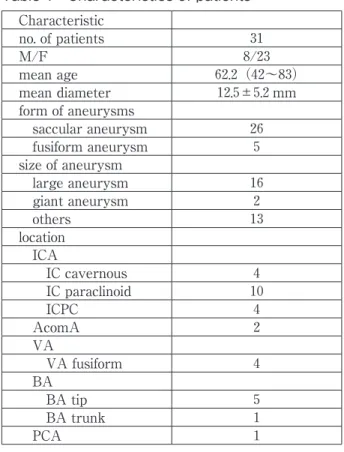
歳),男性:女性は8
:23
であった(Table 1).動 脈瘤部位の内訳はTable 1の通りで,前方循環20
例,後方循環が
11
例であった.動脈瘤の形状は saccular26,fusiform 5, 瘤 径 は 平 均 12.5
±5.2
mm(7.0〜28.8
mm)であり,大径(12〜24mm)16
例,巨大(25mm 以上)2
例であった.症候については,無症候性28
例,症候性
3
例であり,症候の内訳は複視を生じた内頚動脈 瘤2
例,脳梗塞を生じた脳底動脈本幹部動脈瘤1
例であ った.EnterpriseTM VRD を使用する症例は全例,術前5
日からアスピリン100
mg/ 日,クロピドグレル75
mg/日を内服しており,ガイディングカテーテル留置後は activated clotting time が
300
前後になるようヘパリンを 投与した.術翌日には全例 MRI 拡散強調画像(diffusion weighted image;DWI)を撮り,虚血合併症の有無を確 認した.結 果
EnterpriseTM VRD の展開とコイル塞栓の方法として は balloon assist technique を使用しない jailing technique が
8
例,balloon assist technique で塞栓してから最後に EnterpriseTM VRD を 展 開 し た も の が15
例,balloon assist technique で塞栓後 EnterpriseTM VRD を展開して さらにコイルを追加したものが8
例であった.EnterpriseTM VRD 展開の操作自体においてトラブル を生じたものはなかった.ステント展開後にコイルが
1
本アンラベルしたためスネアで回収した症例,および,ステント展開後に PROWLERTM Select Plus
150
cm/90
°(Johnson&Johnson Codman, Miami, FL, USA)を HyperFormTM(ev
3
Covidien, Irvine, CA, USA)に exchange しようとした際に,屈曲部に留置されていた ステントがずれてしまい,ステントをスネアで回収した 症例を各1
例経験したが,いずれも症状の出現はなかっ た.塞栓結果は Raymond 分類に準じて行い,多方向か らの血管撮影において,動脈瘤体部および頚部に造影剤 の流入が認められないものを complete occlusion(CO),造影剤の流入が頚部にのみ認められるものを neck remnant(NR),体部にまで造影剤の流入が認められる ものを body filling(BF)とした15).終了時の血管撮影 では CO が
5
(16
.2
%),NR が25
(80
.6
%),BF が1
(3
.2
%)で,平均体積塞栓率(volume embolization ratio;
VER)は
29
.3
±9
.0
%であった(Table 2).術翌日の DWI にて微小な所見を含めて,高信号が見られたもの は15
例(48.4%)であったが,そのうち症候性のものは 軽度の運動麻痺を呈した一過性脳虚血の2
例(6.5%)の みであり,速やかに改善した.それらは内頚動脈傍床突 起部の未破裂瘤の clipping 後の再発および内頚動脈 C2 Table 1 Characteristics of patientsCharacteristic
no. of patients 31
M/F 8/23
mean age 62.2(42〜83)
mean diameter 12.5±5.2mm form of aneurysms
saccular aneurysm 26
fusiform aneurysm 5
size of aneurysm
large aneurysm 16
giant aneurysm 2
others 13
location ICA
IC cavernous 4
IC paraclinoid 10
ICPC 4
AcomA 2
VA
VA fusiform 4
BA
BA tip 5
BA trunk 1
PCA 1
AcomA:anterior communicating artery BA:basilar artery
ICA:internal carotid artery
ICPC:internal carotid artery-posterior communicating artery PCA:posterior cerebral artery
VA:vertebral artery
Table 2 Result of embolization Result
mean VER 29.3±9.0%
Complete Occlusion 5(16.2%)
Neck Remnant 25(80.6%)
Body Filling 1(3.2%)
Complication
transient ischemia 2(6.5%) anemia due to hematoma 3(9.7%) DWI positive 15(48.4%) DWI:diffusion weighted image
VER:volume embolization ratio
部前壁の動脈瘤であり,balloon assist technique で塞栓 しておいてから EnterpriseTM VRD を展開し,その後さ らにコイルを追加した.いずれもマイクロカテーテルの 安定性が悪く,操作に難渋した症例であったため脳梗塞 のリスクが高まった可能性が考えられる.また穿刺部に 血腫を形成し,貧血を生じたものが
3
例(9
.7
%)で見ら れた.症例呈示
1.症例 1
患者は
45
歳,女性.脳ドックにて診断された最大径8.7
mm,neck 6mm の右内頚動脈傍床突起部の動脈瘤 で あ る.7Fr Shuttle sheathTM 90cm(Cook Medical, Bloomington, IN, USA) を 右 内 頚 動 脈 に 留 置 し た.3D-DSA を行い working angle を決め(Fig. 1A),次い
で HyperGlideTM 4mm/15mm(ev3 Covidien, Irvine, CA, USA) に よ る balloon assist technique を 併 用 し て ExcelsiorTM SL-10 150cm/45°(Boston Scientific, Natick, MA, USA),EchelonTM 14
150
cm/90°(ev3 Covidien, Irvine CA, USA)の double catheter 法で塞栓を行った.計
8
本のコイルを使用したが,コイルが親血管に一部逸 脱してきたため,balloon assist technique のみでは治療 困難と判断して PROWLERTM Select Plus150
cm/90
°を 留置し,EnterpriseTM VRD4
.5
×28
mm を展開した(Fig.1B, C).親血管の狭窄もなく VER
21
.8
%で終了した.術後神経学的脱落症状なく,術翌日の DWI でも高信号 所見は見られなかった.
2.症例 2
患者は
55
歳,女性.右動眼神経麻痺による複視で発 症した最大径18
mm の右内頚動脈海綿静脈洞部の動脈 CA B
Fig. 1
A:A working angle view of the right internal carotid angiogram (A) showing an internal carotid artery aneurysm (8.7 mm in diameter) in the paraclinoid portion.
B, C:The right carotid angiograms (B:
subtracted, C:not subtracted) after deployment of the Enterprise VRD (4.5 mm / 28 mm) followed by coil embolization of the aneurysm with eight coils using the balloon- assisted technique. Note the markers of the Enterprise VRD in Fig. 2C (arrow).
瘤である.balloon assist technique のみでは治療不可能と 考え,EnterpriseTM VRD を併用した double catheter 法 を選択した.
6
Fr Shuttle sheathTM90
cm を右 ICA に留 置 し,working angle を 設 定 し た(Fig. 2A).PROWLERTM Select Plus を右中大脳動脈に留置してお き,ExcelsiorTM
1018 150
cm/90°,EchelonTM14 150
cm/90°を 瘤 内 に 留 置 後,jailing technique でEnterpriseTM VDR
4
.5
mm/28
mm を展開した(Fig. 2B).PRESIDIOTM
18
12
mm ×40
cm(Johnson&Johnson Codman, Miami, FL, USA)で framing し,計16
本のコ イルを使用して VER 27.7%で終了した(Fig. 2C).術 翌日の DWI では右頭頂葉に無症候性の微小な高信号点 状影が見られたが無症状で経過した.ステント内へのコ イルの迷入の有無を確認するのに down the barrelA B
C D
Fig. 2
A:A working angle view of the right internal carotid angiogram (A) showing an internal carotid artery aneurysm (18mm in diameter) in the cavernous portion.
B:A fluoroscopic view after deployment of the Enterprise VRD (4.5mm / 28mm) (B). Note the markers of the Enterprise VRD (arrow), Excelsior 1018 (150cm/90°) (white arrowheads), and Echelon14 (150cm/90°)(black arrowheads),
C:A right internal carotid angiogram after coil embolization (C) with 16 coils using the jailing technique showing more complete obliteration (volume embolization ratio: 27.7%)
D:A down-the-barrel view of the right internal carotid angiogram after the treatment (D) clearly demonstrates complete preservation of the parent artery by the Enterprise VRD.
view が有用であった(Fig. 2D).
考 察
EnterpriseTM VRD の使用により従来の balloonassist technique や double catheter technique などの adjunctive technique だけでは治療困難と思われるものにも治療適 応が広がった1-5,8,9,12,13,15).先行して使用されている海外 の報告のうち,
2008
年の Peluso らによれば30
例31
個 の動脈瘤に対する EnterpriseTM VRD の使用成績におい ては1
例で in-stent stenosis を生じて片麻痺が出現して おり(3
.3
%),塞栓の結果は complete occlusion6
/31
(19
.3
%),neck remnant
18
/31
(58
.0
%),residual aneurysm7
/31
(22
.6
%)であった7).Mocco らによる141
名,142
個の動脈瘤に対する EnterpriseTM VRD の使用成績では Morbidity は永続性2.8%,一過性 6%であり,Mortality
は
2%で未破裂瘤では 0.8%,破裂瘤では 12%であっ
た13).また,EnterpriseTM VRD を留置した同側の半球 に DWI の高信号所見がどのくらい検出されたかを検討 した報告では,33例中
15
例(45%)で高信号が見られ たと示されている14).我々も全例で DWI を撮影してい るが,微小で淡い所見でも陽性として判定した結果,高 信号が見られたものは31
例中15
例(48
.4
%)であった.我々は
31
例中23
例で balloon assist technique を併用し ているが,balloon の併用がとくに DWI 陽性所見を誘発 しているとは考えにくく,ステント留置そのものに塞栓 性合併症のリスクが付随するものと思われる.EnterpriseTM VRD は頭蓋内に誘導しやすく,展開が 容易である点で優れているが,透視による可視性の問題 が提起されている7,11).さらに展開時にはステントが予 定した部位よりもやや proximal にずれやすい印象であ った.このため展開する際にはデリバリーワイヤーをや や 押 し こ む 意 識 を 持 っ て 行 っ て い る. ま た,
EnterpriseTM VRD の径は
4
.5
mm のみであるため,動脈 瘤の径,形状だけではなく血管径の計測や留置する範囲 などに関する術前検討も重要である.Lobotesis らは脳 底動脈本幹部の破裂動脈瘤に対して EnterpriseTM VRD を使用してコイル塞栓術を行い,その2
日後の血管撮影 でステントが近位にずれていた症例を報告している10). 適した径であることは必須であるが径が適していたとし ても closed cell stent は血管壁への圧着が弱く,近位に ずれる可能性があることを念頭に置く必要がある.具体 的には術前に親動脈の血管径の測定を入念に行い,さらに治療後の follow up の際にもステントがずれていない か注意すべきである.また屈曲が急峻な部位に留置する 場合はステントが血管壁に沿わずに折れ曲がってしまう 恐れがある.我々の経験でも,EnterpriseTM VRD を留 置した部分が屈曲して内腔が狭くなった状態で,ステン ト内にガイドワイヤーやマイクロカテーテルを通してい く操作が困難であった症例が存在した.無理な操作によ ってステントがずれる可能性を念頭に置き,このような 操作は原則避けるべきであろう.
我々は結果的に EnterpriseTM VRD を使用した症例に お い て も balloon assist technique を 多 用 し て い る.
balloon assist technique を 併 用 せ ず に 最 初 に EnterpriseTM VRD を留置し,jailing technique でコイル 塞栓を行ったものは
31
例中8
例のみであった.他はス テント留置後の抗血小板療法の問題などを考慮し,balloon assist technique のみで塞栓できるならばその方 が 望 ま し い と 考 え, 多 く の 症 例 で は 初 め か ら EnterpriseTM VRD を展開する方法を第一選択としてい ない.動脈瘤の大きさ,形状,dome/neck 比などから EnterpriseTM VRD を展開するタイミングやバルーンカ テーテルの併用などについては症例ごとに検討してい る.大,巨大瘤やかなり wide neck なもので balloon assist technique のみでは困難と判断したものに対しては EnterpriseTM VRD をはじめに展開する方法を選択して いる.
周術期虚血合併症は
2
例(6
.5
%)で見られたが微小な 脳梗塞でありいずれも一過性の軽度の片麻痺であった.頭蓋内の出血性合併症はなく,またカテーテル留置やス テント展開における手技上のトラブルもなかった.
EnterpriseTM VRD 使用開始初期に穿刺部に血腫を形成 し貧血になったものが
3
例あったが,抗血小板薬2
剤,ヘパリンを投与し,太いガイディングカテーテルを留置 する以上,これらについては十分に気を付けなければな らない.このように,ステント留置に伴い血栓形成のリ スクが高まること,周術期や経過観察中の抗血小板薬の 必要性など,EnterpriseTM VRD の使用によりリスクが 高まる要素はあるが,先述したこれまで報告されている 初期成績に比し,balloon の使用頻度が高く,カテーテ ルの exchange なども多用しているものの,同等の成績 を得られていると思われる6,7,14-16).
結 語
EnterpriseTM VRD の使用によって大,巨大動脈瘤や wide neck な動脈瘤に対するコイル塞栓術の適応は広が り,従来治療困難と考えられていた症例に対しても安全 に治療が施行できた.今後はさらに術後の DWI 陽性症 例を減少させて安全性を高めることを念頭に置くととも に,coil compaction の有無など,長期成績を評価してい く必要がある.
文 献
1) Akpek S, Arat A, Morsi H, et al: Self-expandable stent- assisted coiling of widenecked intracranial aneurysms: a single-center experience. 26:1223-1231, 2005. 2) Benitez RP, Silva MT, Klem J, et al: Endovascular
occlusion of wide-necked aneurysms with a new intracranial microstent (Neuroform) and detachable coils. 54:1359-1368, 2004.
3) Biondi A, Janardhan V, Katz JM, et al: Neuroform stent- assisted coil embolization of wide-neck intracranial aneurysms: strategies in stent deployment and midterm follow-up. 61:460-469, 2007.
4) Fiorella D, Albuquerque FC, Han P, et al: Preliminary experience using the Neuroform stent for the treatment of cerebral aneurysms. 54:6-17, 2004. 5) Fiorella D, Albuquerque FC, Deshmukh VR, et al:
Usefulness of the Neuroform stent for the treatment of cerebral aneurysms: results at initial (3-6-mo) follow- up. 56:1191-1202, 2005.
6) Higashida RT, Halbach VV, Dowd CF, et al: Initial clinical experience with a new self-expanding nitinol stent for the treatment of intracranial cerebral aneurysms: the Cordis Enterprise stent. 26:1751-1756, 2005. 7) Peluso JP, van Rooji WJ, Sluzewski M, et al:A new self-
expandable nitinol stent for the treatment of wide-neck aneurysms: initial clinical experience. 29:1405- 1408, 2008.
8) Katsaridis V, Papagiannaki C, Violaris C: Embolization of acutely ruptured and unruptured wide-necked cerebral aneurysms using the neuroform2 stent without pretreatment with antiplatelets: a single center experience. 27:1123-1128, 2006.
9) Lee YJ, Kim DJ, Suh SH, et al: Stent-assisted coil embolization of intracranial wide-necked aneurysms.
47:680-689, 2005.
10)Lobotesis K, Gholkar A, Jayakrishnan V: Early migration of a self expanding intracranial stent: case report.
67:E516-517, 2010.
11) Lubicz B, Fran-ois O, Levivier M, et al: Preliminary experience with the enterprise stent for endovascular treatment of complex intracranial aneurysms: potential advantages and limiting characteristics.
62:1063-1069, 2008.
12) Lylyk P, Ferrario A, Pasbon B, et al: Buenos Aires experience with the Neuroform self-expanding stent for the treatment of intracranial aneurysms.
102:235-241, 2005.
13) Mocco J, Snyder KV, Albuquerque FC, et al: Treatment of intracranial aneurysms with the Enterprise stent: a multicenter registry. 110:35-39, 2009. 14) Heller RS, Miele WR, Do-Dai DD, et al: Crescent sign on
magnetic resonance angiography revealing incomplete stent apposition: correlation with diffusion-weighted changes in stent-mediated coil embolization of aneurysms.
115:624-632, 2011.
15) Roy D, Milot G, Raymond J: Endovascular treatment of unruptured aneurysms. 32:1998-2004, 2001. 16) Weber W, Bendszus M, Kis B, et al: A new self-expanding
nitinol stent (Enterprise) for the treatment of wide-necked intracranial aneurysms: initial clinical and angiographic results in 31 aneurysms. 49:555-561, 2007.
JNET 5:161-166, 2012
要 旨
【目的】当院で施行した Enterprise VRD を併用した動脈瘤コイル塞栓術についてその初期成績を検証する.【方
法】2010年7月から2011年5月の間に31例の Enterprise を併用した未破裂脳動脈瘤コイル塞栓術を行ってお り,その成績を検討した.【結果】平均年齢62.2歳,男女比8:23,動脈瘤部位は前方循環20例(内頚動脈18, 前交通動脈2),後方循環11例(後大脳動脈1,脳底動脈6,椎骨動脈4),形状は saccular 26例,fusiform 5例,
瘤径は平均12.5±5.2mm であった.手技は jailing technique が8例,balloon assist technique の併用が23例であり,
治療結果は complete occlusion が5(16.2%),neck remnant が25(80.6%),body filling が1(3.2%),平均体積塞栓率 は29.3±9.0% であった.術後に一過性脳虚血が2例(6.5%)で見られたが永続的なものはなかった.【結論】
Enterprise VRD の使用により従来の方法では治療困難と思われた症例のいくつかに対しても塞栓術を施行でき,
良い結果を得ている.今後はさらに長期成績を検証する必要がある.