氏 名
か けいゆ
何 敬愉
学 位 の 種 類 博士(薬学)
学 位 記 番 号 富医薬博甲第 117 号
学位授与年月日 平成 25 年 12 月 18 日
学位授与の要件 富山大学学位規則第 3 条第 3 項該当
教 育 部 名 富山大学大学院医学薬学教育部 薬学領域 博士課程 生命薬科学専攻
学 位 論 文 題 目 Genetic and chemical polymorphism of medicinally-used Codonopsis species and its application to evaluate Codonopsis Radix
(薬用 Codonopsis属植物の遺伝的・成分的多様性と「党参」の
品質評価への応用)
論 文 審 査 委 員
(主査) 教 授 小松 かつ子 (指導教員)
(副査) 教 授 黒崎 文也
(副査) 教 授 森田 洋行
Codonopsis Radix, called as “Dangshen” in Chinese and “Tojin” in Japanese, has been used in traditional Chinese medicine for replenishing deficiency of qi (vital energy) and blood, strengthening immune system, decreasing blood pressure and remedying poor gastrointestinal function. This crude drug has been in high demand in China, and recently the demand is increasing in Japan. It is prescribed as the roots of Codonopsis pilosula (Franch.) Nannf., C.
pilosula var. modesta (Nannf.) L. D. Shen and C. tangshen Oliv. in Chinese Pharmacopoeia.
Phytochemical researches revealed that Codonopsis Radix contained polyacetylenes, phenylpropanoids, alkaloids and triterpenoids, and pharmacological studies showed that lobetyolin, a polyacetylene component played a protective role in gastric mucosa injury, total alkaloids caused a significant enhancement of nerve growth factor-induced neurite outgrowth in PC12 cells, and total saponins had protective effect on ischemia-reperfusion injury in rats.
Most of the researches used the unidentified crude drug of Codonopsis Radix as experimental materials, because there is no developed method for exact identification. Moreover, the quality evaluation of Codonopsis Radix was limited to quantitation of lobetyolin and HPLC fingerprint, but not simultaneous evaluation of multiple bioactive components. Therefore, this study aims to clarify the genetic and phytochemical polymorphism of the three medicinally-used Codonopsis taxa, and further to find out the genetic and chemical markers for identification and standardization of Codonopsis Radix.
1. Genetic polymorphism of medicinally-used Codonopsis species in an internal transcribed spacer (ITS) sequence of nuclear ribosomal DNA
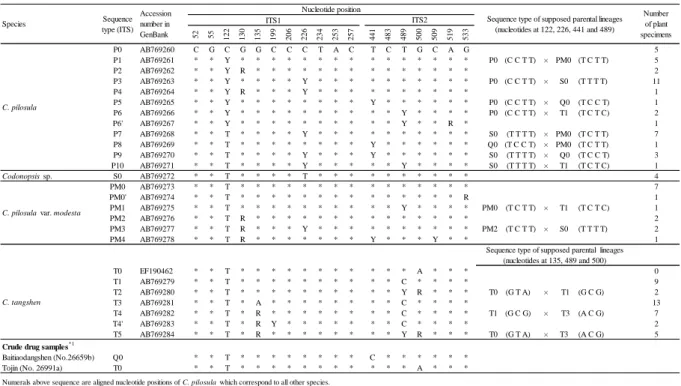
The genetic analysis of ITS sequences which has been widely used for species-level phylogenetic studies was conducted on 96 specimens of three medicinally-used Codonopsis taxa collected widely from Gansu Prov., Chongqing city and Hubei Prov. of China, the main producing areas of Codonopsis Radix (Fig. 1). The length of ITS1, 5.8S rDNA and ITS2 regions were 257 bp, 163 bp and 235 bp, respectively, in all Codonopsis specimens. Significantly genetic polymorphism was observed, representing by 11 types of ITS sequences in C. pilosula, 5 types in C. pilosula var. modesta and 5 types in C. tangshen (Table 1). The informative sites for discriminating the three taxa were detected at the nucleotide positions 122nd, 226th, 441st and 489th from upstream of ITS sequence. For discrimination of the types of C. tangshen, the nucleotides at positions 135th, 489th and 500th were informative. The nucleotide additivity detected in ITS sequence indicated hybridization occurred in these species. Among the determined sequences, 1, 1 and 2 types were thought to be of pure lines of C. pilosula, C.
pilosula var. modesta and C. tangshen, respectively, designated as types P0, PM0, T1 and T3,
論 文 内 容 の 要 旨
and the rest might be derived from hybridization. Moreover, three pure lines with types S0, Q0 and T0 sequences were also observed in Codonopsis sp., Codonopsis Radix sample produced in Gansu Prov. and that produced in Henan Prov., respectively. Hybrids were inferred to be resulted from the combination of the pure lines (Table 1). Cloning analysis of the samples with additive nucleotides supported such inference, in which each pure line sequence was clearly separated and detected in respective clones. Among the three taxa, C. pilosula had various hybrid lines which were growing widely in all of the cultivation areas of Gansu Prov. Based on the sequences of the 6 informative sites, botanical sources of Codonopsis Radix were identified:
those produced in a wide range of southeast Gansu Prov. were C. pilosula, just those from Wenxian county of Gansu Prov. were C. pilosula var. modesta, and those produced in Chongqing city and Hubei Prov. were derived from C. tangshen.
2. Development of HPLC-UV method for analysis of polyacetylenes, phenylpropanoid and pyrrolidine alkaloids
Large scale methanol extraction of Codonopsis Radix (C. tangshen) followed by chromatographic separation and semipreparative HPLC, 13 compounds were isolated and identified by comparing their spectral data (MS, 1H NMR and 13C NMR) with those reported in the literatures. Among them, 7 compounds, codonopyrrolidium B (1), codonopyrrolidium A (2), tangshenoside I (3), cordifolioidyne B (4), lobetyolinin (5), lobetyolin (6) and lobetyol (7) were selected as standards for quantitation.
Ultrasound-assisted methanol extracts of samples were analyzed using reversed phase HPLC on a YMC-Pack Pro-C18 column with a gradient eluent of acetonitrile and 0.1% (v/v) phosphoric acid and monitoring at 215 nm. The developed HPLC-UV method allowed efficient separation of the 7 compounds. All calibration curves showed good linearities (r > 0.9993) within the test ranges, and the detection and quantitation limits of the 7 compounds were 0.10-0.32 µg/mL and 0.35-1.07 µg/mL, respectively. Intraday and interday precisions were good with RSD less than 2.84%. The recoveries of all compounds ranged from 95.8 to 104.7%.
3. Quality evaluation of medicinally-used Codonopsis species and Codonopsis Radix based on 7 components
A comparative study on 56 specimens of three medicinally-used Codonopsis taxa collected from China and 54 commercial samples of Codonopsis Radix available in Chinese, Japanese and Korean markets was carried out by quantitative analysis of 7 components (1-7). The quantitative results indicated that the contents of these 7 compounds were considerably variable among the samples not only inter-species but also intra-species. C. pilosula and C. pilosula var.
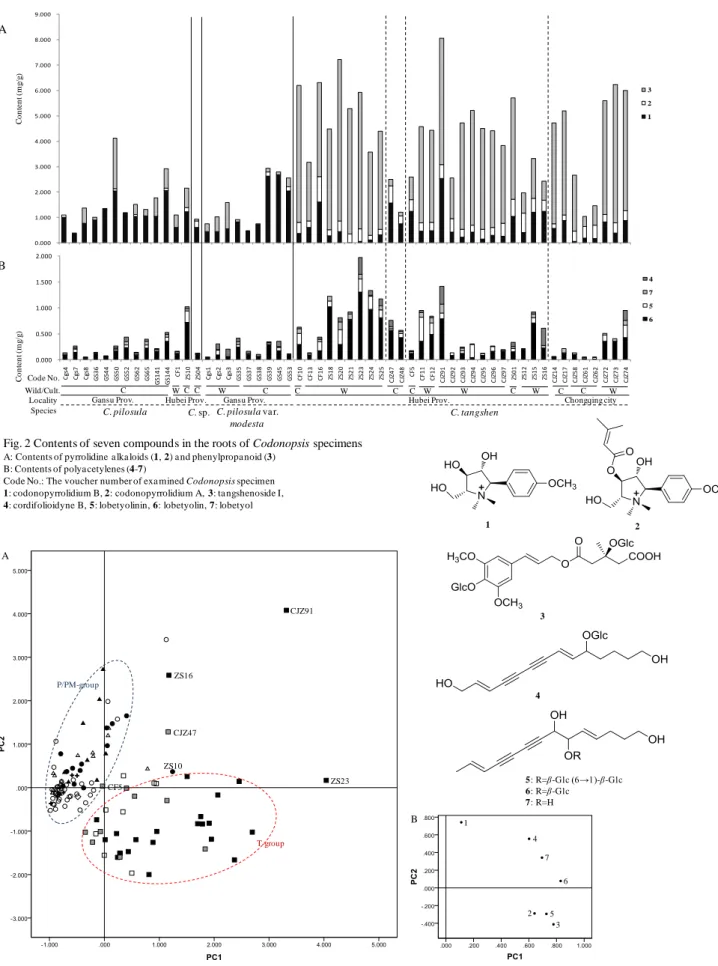
modesta showed similar chemical composition, while C. tangshen considerably differed from these two in chemical composition (Fig. 2). Codonopyrrolidium B (1) was the main component in the roots of C. pilosula and C. pilosula var. modesta, while tangshenoside I (3) and
codonopyrrolidium A (2) were with relatively high contents in the roots of C. tangshen. The crude drugs derived from C. pilosula and C. pilosula var. modesta showed relatively high content of 1 among the 7 components, consisting with the result obtained from the plant specimens. In addition, most of crude drugs derived from C. tangshen showed characteristic chemical composition as C. tangshen. The results of principal component analysis (PCA) indicated that two main groups were classified (Fig. 3); one group mainly included C. pilosula, C. pilosula var. modesta and the crude drugs derived from these two species; the other group was composed of C. tangshen and its derived crude drugs. Therefore, 3, 2 and 1 could be the chemical markers to differentiate C. tangshen from C. pilosula and C. pilosula var. modesta. In addition, lobetyolin (6) was widely existed in the roots of the three Codonopsis taxa as well as Codonopsis Radix.
Conclusion
This study assessed the quality of the three medicinally-used Codonopsis taxa and crude drugs of Codonopsis Radix based on genetic and chemical analyses. The results of genetic analysis indicated that the ITS sequences were useful markers allowing identification of the three taxa and authentication of Codonopsis Radix. Significant genetic polymorphism in the ITS sequences of the three medicinally-used Codonopsis taxa might be induced by a wide range of hybridization among the pure lines, and from their sequences the lineages involved in hybridization could be further inferred. The chemical profiles of the three medicinally-used Codonopsis taxa were elucidated by quantitation of the seven compounds. The quantitative analysis indicated the composition of tangshenoside I, codonopyrrolidium A and codonopyrrolidium B could be applied to differentiate C. tangshen from C. pilosula and C.
pilosula var. modesta. This study provided the fundamental information benefiting not only identification and standardization but also efficient use of Codonopsis Radix.
References
1. Jingyu HE, Shu ZHU, Katsuko KOMATSU,Yukihiro GODA, Shaoqing CAI. Genetic polymorphism of medicinally-used Codonopsis species in an internal transcribed spacer sequence of nuclear ribosomal DNA and its application to authenticate Codonopsis Radix. J Nat Med, 68: 112-124, 2014.
2. Jingyu HE, Shu ZHU, Yukihiro GODA, Shaoqing CAI, Katsuko KOMATSU. Quality evaluation of medicinally-used Codonopsis species and Codonopsis Radix based on the contents of pyrrolidine alkaloids, phenylpropanoid and polyacetylenes. J Nat Med, 68: 326-339, 2014.
3. Jingyu HE, Shu ZHU, Katsuko KOMATSU. HPLC-UV analysis of polyacetylenes, phenylpropanoid and pyrrolidine alkaloids in medicinally-used Codonopsis species. Phytochem Anal, 25: 213-219, 2014.
Gansu Prov.
Wenxian Wudu Minxian
Longxi
104 ° 105°
33°
34°
35°
Longitude (E) Latitude (N)
50 km
Sichuan Prov.
Tanchang P3, P7, P1
P3, S0
P0, P3
P9, P0
P1, P3, P5, P6, P8, P9, P10, PM0, S0
P1, P3
P3, P4, P6’, P7
PM0, P7, P2, PM3, P1, P6, PM0’, PM2, PM4 PM0, PM1, PM2
Wufeng
Chongqing city
Yichang
Hubei Prov.
Sichuan Prov.
Longitude (E) 106°
Latitude (N)
100 km 31°
30°
29°
107° 108° 109° 110° 112°
Wuxi
T4’ T3
T2, T3,
T4, T5 T3
S0, P0, T1 T5
T1, T3, T4 T1, T4
T1, T4 P3 T3, T4, T1, T5
P7 T3, T5
Enshi T2
Fig. 1 Collection localities ofCodonopsisspecimens in China (2008 – 2010)
The marks in the collection localities indicate the collected species, together with ITS sequence types: ●: C. pilosula, ▲: C. pilosulavar. modesta;
■:C. tangshen, : C. pilosulaand C. pilosulavar. modesta, :C. pilosulaand C. tangshen.
The sequence type with underline indicates the most detected type in the respective locality.
CHINA
52 55 122 130 135 199 206 226 234 253 257 441 483 489 500 509 519 533
P0 AB769260 C G C G G C C C T A C T C T G C A G 5
P1 AB769261 * * Y * * * * * * * * * * * * * * * P0 (C C T T) × PM0 (T C T T) 5
P2 AB769262 * * Y R * * * * * * * * * * * * * * 2
P3 AB769263 * * Y * * * * Y * * * * * * * * * * P0 (C C T T) × S0 (T T T T) 11
P4 AB769264 * * Y R * * * Y * * * * * * * * * * 1
P5 AB769265 * * Y * * * * * * * * Y * * * * * * P0 (C C T T) × Q0 (T C C T) 1
P6 AB769266 * * Y * * * * * * * * * * Y * * * * P0 (C C T T) × T1 (T C T C) 2
P6' AB769267 * * Y * * * * * * * * * * Y * * R * 1
P7 AB769268 * * T * * * * Y * * * * * * * * * * S0 (T T T T) × PM0 (T C T T) 7
P8 AB769269 * * T * * * * * * * * Y * * * * * * Q0 (T C C T) × PM0 (T C T T) 1
P9 AB769270 * * T * * * * Y * * * Y * * * * * * S0 (T T T T) × Q0 (T C C T) 3
P10 AB769271 * * T * * * * Y * * * * * Y * * * * S0 (T T T T) × T1 (T C T C) 1
Codonopsis sp. S0 AB769272 * * T * * * * T * * * * * * * * * * 4
PM0 AB769273 * * T * * * * * * * * * * * * * * * 7
PM0' AB769274 * * T * * * * * * * * * * * * * * R 1
PM1 AB769275 * * T * * * * * * * * * * Y * * * * PM0 (T C T T) × T1 (T C T C) 1
PM2 AB769276 * * T R * * * * * * * * * * * * * * 2
PM3 AB769277 * * T R * * * Y * * * * * * * * * * PM2 (T C T T) × S0 (T T T T) 2
PM4 AB769278 * * T R * * * * * * * Y * * * Y * * 1
T0 EF190462 * * T * * * * * * * * * * * A * * * 0
T1 AB769279 * * T * * * * * * * * * * C * * * * 9
T2 AB769280 * * T * * * * * * * * * * Y R * * * T0 (G T A) × T1 (G C G) 2
T3 AB769281 * * T * A * * * * * * * * C * * * * 13
T4 AB769282 * * T * R * * * * * * * * C * * * * T1 (G C G) × T3 (A C G) 7
T4' AB769283 * * T * R Y * * * * * * * C * * * * 2
T5 AB769284 * * T * R * * * * * * * * Y R * * * T0 (G T A) × T3 (A C G) 5
Crude drug samples*1
Baitiaodangshen (No.26659b) Q0 * * T * * * * * * * * C * * * * * *
Tojin (No. 26991a) T0 * * T * * * * * * * * * * * A * * *
Numerals above sequence are aligned nucleotide positions of C. pilosula which correspond to all other species.
Asterisk indicates the identical nucleotide to which of C. pilosula (accession No. AB769260). Y = C and T, R = A and G, M = A and C
Table 1 Types of ITS sequences of Codonopsis species and the assumed lineages related to hybridization
Species Sequence
type (ITS) Accession number in GenBank
Nucleotide position ITS1
C. tangshen
*1 The nucleotide sequence is only found in crude drug samples. Parenthesis numerals show specimen reference number of Museum of Material Medica, Institute of Natural Medicine, University of Toyama (TMPW No.).
Number of plant specimens ITS2
C. pilosula
C. pilosula var. modesta
Sequence type of supposed parental lineages (nucleotides at 135, 489 and 500) Sequence type of supposed parental lineages
(nucleotides at 122, 226, 441 and 489)
1 2
3
4
5: R=β-Glc (6→1)-β-Glc 6: R=β-Glc
7: R=H
Fig. 2 Contents of seven compounds in the roots of Codonopsisspecimens
A: Contents of pyrrolidine a lka loids (1, 2) a nd phenylpropa noid (3) B: Contents of polya cetylenes (4-7)
Code No.: The voucher number of exa mined Codonopsisspecimen 1: codonopyrrolidium B, 2: codonopyrrolidium A, 3: ta ngshenoside I, 4: cordifolioidyne B, 5: lobetyolinin, 6: lobetyolin, 7: lobetyol
0.000 0.500 1.000 1.500 2.000
Cgs4 Cgs7 Cgs8 GS36 GS44 GS50 GS52 GS62 GS65 GS141 GS144 CF1 ZS10 ZS04 Cgs1 Cgs2 Cgs3 GS35 GS37 GS38 GS39 GS45 GS53 CF10 CF13 CF16 ZS18 ZS20 ZS21 ZS23 ZS24 ZS25 CJZ47 CJZ48 CF5 CF11 CF12 CJZ91 CJZ92 CJZ93 CJZ94 CJZ95 CJZ96 CJZ97 ZS01 ZS12 ZS15 ZS16 CJZ14 CJZ17 CJZ58 CJZ61 CJZ62 CJZ72 CJZ73 CJZ74
0.000 1.000 2.000 3.000 4.000 5.000 6.000 7.000 8.000 9.000
Cgs4 Cgs7 Cgs8 GS36 GS44 GS50 GS52 GS62 GS65 GS141 GS144 CF1 ZS10 ZS04 Cgs1 Cgs2 Cgs3 GS35 GS37 GS38 GS39 GS45 GS53 CF10 CF13 CF16 ZS18 ZS20 ZS21 ZS23 ZS24 ZS25 CJZ47 CJZ48 CF5 CF11 CF12 CJZ91 CJZ92 CJZ93 CJZ94 CJZ95 CJZ96 CJZ97 ZS01 ZS12 ZS15 ZS16 CJZ14 CJZ17 CJZ58 CJZ61 CJZ62 CJZ72 CJZ73 CJZ74
3 2 1
0.000 0.500 1.000 1.500 2.000
Cgs4 Cgs7 Cgs8 GS36 GS44 GS50 GS52 GS62 GS65 GS1… GS1… CF1 ZS10 ZS04 Cgs1 Cgs2 Cgs3 GS35 GS37 GS38 GS39 GS45 GS53 CF10 CF13 CF16 ZS18 ZS20 ZS21 ZS23 ZS24 ZS25 CJZ47 CJZ48 CF5 CF11 CF12 CJZ91 CJZ92 CJZ93 CJZ94 CJZ95 CJZ96 CJZ97 ZS01 ZS12 ZS15 ZS16 CJZ14 CJZ17 CJZ58 CJZ61 CJZ62 CJZ72 CJZ73 CJZ74W CC W C C W C C CW C W W C C W C. pilosula C.sp. C. pilosulava r.
modesta
C. tangshen
Gansu Prov. Hubei Prov. Gansu Prov. Hubei Prov. Chongqing city
Content (mg/g)
A
B
Code No.
Wild/Cult.
Locality Species
0.000 1.000 2.000 3.000 4.000 5.000 6.000 7.000 8.000
1 a 2 a 3 b 4 a 4 b 5 a5 b 6 a 6 b 7 b 8 a 9 a 9 b 1 0 1 1 1 2 1 3 1 4 1 5 1 6 1 7 1 8 1 9 2 0 2 1 2 2 2 3 2 4 2 5 2 6 2 7 a 1 b 2 b 2 8 a2 9 b3 0 a 3 1 3 2 b3 3 a 3 4 3 5 3 6 3 7 3 8 7 a3 2 a3 3 b 3 9 a3 9 b4 0 a4 1 a 4 2 4 3 b4 4 a 4 5 a4 6 4 7 a4 7 b 4 8 b4 9 a 5 0 5 1 b5 2 a 5 35 1 a 5 4
3 2 1
0.000 0.100 0.200 0.300 0.400 0.500 0.600 0.700
1a 2a 3b 4a 4b 5a 5b 6a 6b 7b 8a 9a 9b 10 11 12 13 14 15 16 17 18 19 20 21 22 23 24 25 26 27a 1b 2b 28a 29b 30a 31 32b 33a 34 35 36 37 38 7a 32a 33b 39a 39b 40a 41a 42 43b 44a 45a 46 47a 47b 48b 49a 50 51b 52a 53 51a 54
4 7 5 6 0.000
1.000 2.000 3.000 4.000 5.000 6.000 7.000 8.000
1 a 2 a 3 b 4 a 4 b 5 a 5 b 6 a 6 b 7 b 8 a 9 a9 b 1 0 1 1 1 2 1 3 1 4 1 5 1 6 1 7 1 8 1 9 2 0 2 1 2 2 2 3 2 4 2 5 2 62 7 a 1 b 2 b2 8 a 2 9 b3 0 a3 1 3 2 b3 3 a3 4 3 5 3 6 3 7 3 8 7 a3 2 a 3 3 b3 9 a3 9 b4 0 a4 1 a4 2 4 3 b4 4 a4 5 a 4 64 7 a4 7 b4 8 b 4 9 a5 0 5 1 b5 2 a5 3 5 1 a5 4
3 2 1
0.000 0.100 0.200 0.300 0.400 0.500 0.600 0.700
1a 2a 3b 4a 4b 5a 5b 6a 6b 7b 8a 9a 9b 10 11 12 13 14 15 16 17 18 19 20 21 22 23 24 25 26 27a 1b 2b 28a 29b 30a 31 32b 33a 34 35 36 37 38 7a 32a 33b 39a 39b 40a 41a 42 43b 44a 45a 46 47a 47b 48b 49a 50 51b 52a 53 51a 54
4 7 5 6
Content (mg/g)
Fig. 3 Principal component analysis of chemical component data from 56 Codonopsisspecimens and 54 Codonopsis Radix samples A: Score plots, B: Loa ding plots
Pla nt specimens: ●: C. pilosula, ▲:C. pilosulava r. modesta, ■: C. tangshen(Wild), : C. tangshen(Cult.), ◇:Codonopsissp. (type S0)
Crude drug sa mples identified a s following ta xa : ○: C. pilosula, △: C. pilosulava r. modesta, □: C. tangshen, ✚: Mixture of C. pilosulaa nd C. pilosulava r.
modesta, ×: Mixture of C. tangshena ndC. pilosula.
B 1
6
3 2
7 4
5 CJZ91
ZS23 ZS16
CJZ47
ZS10 CF5
P/PM-group
T-group A
学 位 論 文 審 査 の 要 旨
漢薬「党参」は、薬用人参と同様に強壮補気薬として東アジアで汎用され、日 本でもその需要が増加していることから、医薬品として『日本薬局方』に収載し、
安全性と有効性を担保することが決まっている。しかし、「党参」の医薬品基準を 定めるために必要な基原と品質に関する研究は不十分であり、党参産出地の広域に わたる資源植物の基原種の状況と、日本を含む東アジアに流通する党参市場品の品 質に関して、客観的な研究結果が求められていた。
申請者 何 敬愉は、党参の資源並びに市場調査を中国で実施した後、収集品を 用いて、薬用Codonopsis属植物の核DNAのInternal transcribed spacer (ITS) 領域における遺伝的多様性を明らかにし、同時に基原種の客観的同定法を開発する こと、及び胃粘膜保護・NGF 作用増強・がん転移抑制作用などが報告されている 化合物群を同時定量する方法を開発して、党参市場品の品質評価を行うことを目的 にした研究を行い、次に示すような新たな知見を得た。
1. 薬用Codonopsis属植物のITS領域における遺伝子多型と党参の同定への応用 Codonopsis属2種1変種の96検体についてITS領域の塩基配列をダイレクトシー クエンスで解析した結果、ITS1-5.8S rDNA-ITS2領域は全て655bpであったが、種内 多型が認められ、C. pilosulaに11タイプ、C. pilosula var. modestaに5タイプ、C.
tangshenに6タイプがあった。上流から122番目、226番目、441番目及び489番目 の塩基は、3分類群を鑑別できるマーカー配列であった。これら4箇所及び130番目の 塩基によりC. pilosulaとその変種が各々タイプ分類され、一方、C. tangshenは135
番目、489番目及び500番目の塩基でタイプ分類された。これらの塩基置換位置には両 親由来の塩基の混合による2重ピーク(ヘテロ塩基)が検出される場合が多く、交雑が 示唆された。すべてがホモ塩基である植物は、C. pilosula とその変種で各1タイプ(P0, PM0)、C. tangshenで3タイプ(T0, T1, T3)のみであり、さらにC. pilosulaの近 縁種及び生薬中にも2タイプ(S0, Q0)が存在した。C. pilosulaの種内多型は主にP0, PM0, S0, Q0, T1を示す植物間の交雑により、またC. tangshenの種内多型は T0, T1, T3 を示す植物間の交雑により生じたものであると考察した。クローニングによる解析 もこの結果を支持した。甘粛省南東部の栽培品ではC. pilosulaの交雑タイプが混在し ており、同省文県ではC. pilosula var. modestaの純系タイプが主であった。湖北省と 重慶市の野生または栽培品はC. tangshenの純系または交雑タイプであった。
2. Pyrrolidine alkaloids、Phenylpropanoid及びPolyacetylenesの分析法の開発
C. tangshen の根から 12 成分を単離・同定し、その内 Pyrrolidine alkaloids 2 成分
(codonopyrrolidium A、codonopyrrolidium B)、Phenylpropanoid 1成分(tangshenoside I)及びPolyacetylenes 4成分(cordifolioidyne B、lobetyolinin、lobetyolin、lobetyol)を 同時定量できるHPLC-UV法を開発した。
3. Pyrrolidine alkaloids、Phenylpropanoid及びPolyacetylenesに基づく薬用Codonopsis 属植物及び党参の品質評価
基原を同定したCodonopsis属植物56検体及び党参市場品54点をHPLC-UV法で定量 分 析 し た 結 果 、C. pilosula 及 び C. pilosula var. modesta の 根 の 主 な 成 分 は
codonopyrrolidium B であり、同種に由来する党参市場品も同様であった。一方、C.
tangshenの根はtangshenoside I及びcodonopyrrolidium Aの含量が他種に比べて有意に
高く、この特徴は野生品で明らかであった。従来、品質評価の指標成分とされたLobetyolin は2種1 変種に共通して含まれていたが、党参市場品で含量が低く、生薬の保存状態の影 響が考えられた。
以上、Codonopsis属2種1変種について分類群固有のITS領域の塩基配列を明らかにし、
党参の基原種を同定する方法を開発した。また、2 種の特徴的な成分組成を明らかにした。
党 参 市 場 品 は codonopyrrolidium B を 主 と す る C. pilosula が 主 流 品 で あ り 、 codonopyrrolidium A を含み、tangshenoside I の含量及び 7 成分の総含量が高い C.
tangshenは限られた市場でのみ流通していた。Lobetyolin及びPyrrolidine alkaloidsの存 在では2種に類似性が見られるが、tangshenoside Iの多寡では違いがあり、今後この成分 の薬理作用の検討が必要である。本研究は、同属植物の遺伝的多様化の現象を証明し、ま た2種1 変種の分類学的関連性を遺伝子及び成分組成から明らかにした。さらに、党参の 標準化に寄与できる重要な知見を見出した。これらの研究成果は、学位論文として十分に 評価し得るものである。
主査及び副査は、申請者 何 敬愉 の論文内容について審査を行うとともに面接試験 を行い、博士 (薬学) を授けるに値するものと判定した。