Japanese Joumal of Tropical Medicine and Hygiene
第17巻第3号 平成元年9月15日
内 容
原 著
マレーシア,キナバル山のウツボカズラより採集されたクシヒゲカと オオカの2新種(英文) …一………・…………一一…・……塚本 増久 寄生虫病薬の7年間の治療成績の検討
一稀用薬の入手緩和を求めて一(英文)
・田辺 清勝,尾辻 義人,中林 敏夫,
大友 弘士,田中 寛
マンソン孤虫に対する硫酸パロモマイシン,ビチオノール,メベンダゾール およびフルベンダゾールの駆虫効果に関する実験的研究(英文)
一牧 純,柳沢十四男 ミャンマー(ビルマ)のブユについて(英文)
一高岡 宏行 P伽吻04∫%吻加惚h切のsporogonyについて,蚊の飼育温度と純化ookinete の発育に対するmembrane feeding液の影響(英文)
一矢野健一,Karl Maramorosch,
Albina Kozlowska 研究ノート
Survey of P伽吻o伽吻翅吻α郷郷in Makurdi,Nigeria
−Annie John 症例報告
膵臓およびリンパ節内に存在するB型肝炎ウイルス表層抗原(英文)
一千馬 正敬,山下 裕人,板倉 英吾 会 報
平成元年度第1回幹事会記録 投稿規定
215−228
229−236
237−241
243−257
259−267
269−271
273−276
277−278
日熱医会誌
Japan.」.TrOP.
Med.Hyg.
日本熱帯医学会
Japan. J. Trop. Med. Hyg., Vol. 17, No. 3, 1989, pp. 215 228 215
TWO NEW MOSQUITO SPECIES FROM A PITCHER PLANT OF MT. KINABALU, SABAH, MALAYSIA=
CULEX RAJAH A N D TOXORHYNCHITES RAJAH
(DIPTERA= CULICIDAE)
MASUHISA TSUKAMOTO
Received March 20 1989/Accepted April 21 1989
Abstract: Culex (Culiciomyia) rajah n. sp. and Toxorhynchites ( Toxorhynchites) rajah n. sp. were collected from the pitcher plant Nepenthes rajah at high elevations of Mt.
Kinabalu, northern Borneo. Cx. rajah n. sp. is characterized by: adults with a dark stripe on upper parts of the pleura and a distinct pale basal band on terga II‑VII; pupa with single 4‑VIII setae and broad paddles; and larvae with short setae, 7‑C and 8‑P, a slender siphon with usually 5 pairs of 4‑6 branched 1‑S tufts, and long gills. Tx. rajah n. sp. is characterized by: adults with a combination of long rm crossvein of wings, absence of brown fusiform scales on mesokatepisternum of thorax; and absence of well‑developed caudal tufts on terga VI‑VIII; pupae with setae 11,12‑CT single, 1‑II single, 6‑1‑VII Iong and single, and broad shape of paddles; and larvae with 2‑branched setae 1‑III,IV, single 4‑VI, single 6‑P and 7‑M, single 11‑V, and a long siphon with 2‑branched 1‑S.
INTRODUCTION
During mosquito surveys in Malaysia in 1986, mosquitoe larvae were collected from water in pitchers of Nepenthes rajah Hooker f. on Mt. Kinabalu, Sabah, Malaysia. According to Kurata (1976) , this species of pitcher plant is endemic to this mountain and it occurs at high elevations (1,650‑2,650 m). Together with several known mosquito species, Iarvae of two unknown species belonging to subgenus Culiciomyia of the genus Culex and to the genus
Toxorhynchites, respectively, were also collected.
The former was initially thought to be Cx. shebbearei because of a previous record by Edwards (1931) and a citation by Barraud (1934), Knight and Stone (1977) and Beaver (1983) . According to the redescription of Cx. shebbearei by Sirivanakarn (1977), the larval characters illustrated for this species are notably different in morphology from the newly collected Culiciomyia larvae from Mt. Kinabalu.
Department of Medical Zoology, School of Medicine, University of Occupational and Environmen‑
tal Health, Kitakyushu 807, Japan
This study is a part of the research project supported by a Grant‑in‑Aid for Overseas Scientific Survey in 1986 (No. 61041070) from the Ministry of Education, Science and Culture of the Japanese Government. The surveys were carried out with the permission of the Socio‑Economic Research Unit, Prime Minister's Department of the Malaysian Government.
Another species of Culiciomyia recorded from the same mountain is Cx. javanensis, and larvae of these recorded species are similar to each other. However, adults of Cx. javanensis are distinctly different from those of Cx. shebbearei and from the present new materials, and there is no fear of confusion in identification, as will be discussed later. Results of further taxonomic examinations on the new materials led to the conclusion that this must be a new species, although it has been misidentified as Cx. shebbearei for many years.
From the morphology of adults, pupae and larvae of Toxorhynchites. Steffan and Even‑
huis (1985) classified 36 known Asian species into 7 species‑groups. The newly available specimens of Toxorhynchites reared from the collected larvae, however, does not coincide with any of the known species, indicating a possibility of another new species.
MATERIALS AND METHODS
Mosquito larvae were collected by the author together with Dr. Motoyoshi Mogi on 24 September 1986 on Mt. Kinabalu at elevations of about 1,600 m to 1,800 m. Larval collection was carried out carefully in order not to destroy any pitcher plants, with the permission of and regulated by the Department of Saba National Park, Kota Kinabalu, Saba, Malaysia, some of whose staff members accompanied us.
Some of the larvae collected were used to study biochemical systematics by means of electrophoresis (Tsukamoto et al.. 1989), but to obtain pupae and adults for further identification, some larvae were reared under laboratory conditions in the University of Malaya, Kuala Lumpur, Peninsular Malaysia. Probably due to sudden changes of environ‑
mental conditions during the transportation, such as shaking, temperature and/or air pres‑
sure, some adults of Toxorhynchites failed to emerge from pupae. Both larval and pupal skins of the holotype of Cx. rajah n. sp. were lost in an accident. Therefore, description of pupa and larva was based on whole body paratypes preserved in a 70% ethanol solution.
The descriptions of the new species are based mainly on the format used by Bram (1967) and by Sirivanakarn (1977) for Culex, and by Steffan and Evenhuis (1985) for Toxorhynchites.
With slight modifications, tables for pupal and larval chaetotaxy are also based on the form used by Evenhuis and Steffan (1986) and Tanaka et al. (1979).
Abbreviation of generic and subgeneric names of mosquitoes followed the proposal by Reinert (1985) .
DESCRIPTIONS
Culex (Culiciomyia) rajah, n. sp.
(Figures la, 2; Table 1)
The 4th instar larvae are characterized by a combination of I ) a short 7‑C hair, 2 ) a very short 8‑P hair with 2‑4 branches, 3 ) a slender siphon with usually 5 pairs of 4‑6 branched hair tufts, and 4 ) Iong gills. In the adult, thorax shows an indistinct dark stripe at upper pleura and a dark spot in middle of sternopleuron. Abdominal terga II‑VII have broad pale basal bands.
MALE. Wing: 3.6‑3.8 mm. Head: Proboscis entirely dark with scanty median ventral tuft; palpus dark, about 1.2 times length of proboscis, segment 111 at the apical half with a distinct ventral row of about 5 Iong translucent scales. Thorax: Integument of pleuron tan
217
Cul ex ( Cul iciom yia)
n. sp.
raiah Toxorh ynchttes n. sp.
( Tox. ) raiah
9 4
.l
VIII
. J ,.
a
E:
o H
9
VIII
,,
,
'l
V
Paddles of pupae of two new species.
a: Culex rajah, b: Toxorhynchites rajah.
, , ,
e.
, .
b
Figure 1
E:
cD
H
with a typical dark upper stripe, and another isolated dark spot on middle of sternopleuron.
Wing with cell R2 (forked celD 1.7‑1.9 times length of vein r2+3 (stem) . Abdomen: Terga II‑VII dark with distinct broad basal pale band covering an area about equal to dark portion of each tergum II‑V or more than half of each tergum VI‑VII. Male genitalia: Not described.
FEMALE. Wing: 4.1‑4.3 mm. Generally similar to male. Head: Segment IV of palpus longer than (or about) twice length of segment 111. Thorax: Wing with cell R2 2.35‑2.5 times length of vein r2 + 3. Abdomen: Terga II‑VII with pale basal bands covering less than half length of each tergum.
PUPA. Seta 4‑VIII single, 9‑VIII 3‑8 branched. Paddle, 0.9 mm length, broad and deformed oval, index (length/width) about 1.2, apex slightly projected (Figure la) .
LARVA (Figure 2, Table l). Head: Width about 1.3 mm. Antennal tuft 1‑A 13‑15 branched, attached at 2/5 Iength of the shaft from base; seta 1‑C fine and simple; 4‑C single;
5‑C 3,4 branched; 6‑C 3 branched; 7‑C short (about 1/2 Iength of 5,6‑O , 4 branched; 8,lO‑C single; 9‑C short, 2‑3 branched. Thorax: Seta O‑P minute, about 9 branched; 1‑P double; 2,3‑P single; 4‑P double; 5,6‑P single; 7‑P 3‑4 branched; 8‑P very short (1/6 to 1/4 Iength of 7‑P) forked with 2‑4 branches, scarsely single; 14‑P single. Seta 1‑M shorter than 3,4・M.
Abdomen: Setae 6‑1,II Iong, 3‑4 branched, 6‑III,IV,V,VI Iong, 2‑5 branched; 7‑1 Iong, single or 2 branched; 7‑II,III,IV,V very short, 2‑6 branched; 1‑1,II,III,VI minute or short, 1‑IV,V Iong, single or 2 branched, 1‑VII single, about the same as length of segment VII, 1‑VIII 3,4 branched; 2,4‑VIII single; 3‑VIII 6‑8 branched; 5‑VIII double; comb consisting of 45‑60 narrow fringed scales. Saddle shorter; caudal margin with many strong spicules; l‑X single;
2,3‑X single slightly less than length of siphon or gills; 4‑X 4 pairs, weak and short, especially a precratal pair shortest and usually single, other 3 pairs 2‑4 forked. Siphon slender, 1.7‑
1.8 mm length (n= 17) , not inflated in middle but gradually tapering to apical; siphon index
、
.℃㊤ぢ80℃一〇g
一8の﹄邸 ﹄O
︑①おε目 藝︑一罵gの一の︑bのgo﹁一
口昌
︵超雪寸︶
寸IH 図−寸 一H 図−の
■H 図IN H 図−H
︵のとεゆ︶
O−寸 の−一 ゆHIooH <∴
N一一〇
.﹇
寸あ
目鵡の昌の昌日昌εωの尋一一一1−1ゆIo1一一HI いq − H − c『
目田IOH の一
目員
の一
の一
の一 の一 一〇っ因
gN
ののIN ω一
目H
111110りIH−HN−I
HHひqド峠一 』ゆ c団 NN。うNoq←〕oののの目Ei寸一ののω9 の の IllINII一一HN−oり一【Ncq cqN 器呂塁昌9♂昌のωの9∈の ωNI一のヨ目。り昌のののωの蔑9のN−NIIIゆHのHI−oo 一▼一{c、q F→
恥器爵一のεε目 1−IINIIH一一NN①
cq eq− cつcq H贈細冒1旱、昌講
eq 一鋸ω昌謁の闘一∈の9NOり111−t1ゆ一一HO● 一〇つcつ oo目目呂9 一■■ ■9一昌昌HNI−H−N頃〇一NHll − o●つヨー一一一碍のω昌一畠の①NH−N−HII−HIHI− cつcq N O三1旦塁鞠糖糖錦鞠1
00 0う cq oうcqOq oq。 H N 。つ 寸 。 o 卜 。o o 自 = 日 曽 コ 巴
=> 自一>
> H>
>︻
H一一
自
一
←Σ
山
gOgo℃ρ<
図田o﹄↑
Q
℃邸o=
.o宕 一〇の
219
Culex (Cuticiomyia) ralah n. sp.
.5 2 1
8
7 6
7 6
4 3
8 9
='1 ¥
=
, '*
to
12
g
t 1
2 3
IQ
P / l9
} M p 18
;21T 41
10 al
6
11
8
d ・ 12 13 11
IQ 13 11
Illl 543 / I I 12
IA 1 I f
6
12
10 IO
9
8 5Y la3 A
8
8
7 7 6 4 13 5 14
:' , ....' 15
8 1 2 (:.. C
11
u 9
2 u 13/ 111= 7 r
ro
6
9
c
5"/ Tm 13Tk;1 12
/1
/
2 12 1 tl
f5" f 9 7 rv 13lr r
1 ¥' Iro
12
! 11
8 v 13l/
' 't !A !ro
f:,3
VI Vl 13
4 /1 u. 2 ro 9
7
E E
e
8
9
7
3
1
2
x
,o
13a 8VII 2
111 4 ¥ 19
ro ,2/7 4 5//
6 'll3
5' l
4 32
Ei
S
e ,
d
CS PT
1
s
2
)VI . 1.uCr;・L,1cT.
Figure 2 Larva of Culex rajah.
A: antenna, C: head, P: prothorax, M: mesothorax, T: metathorax, S: siphon, CS: comb scale, PT: pecten.
4.0‑5.5, 1‑S mostly 5 pairs (occationally 4 or 4.5 pairs) , individual tuft hair 4‑6 branched and as short as 0.4‑0.5 of the width of siphon at the point of attachment; pecten teeth 10‑12, each tooth short and wide with a strong distal spine and 4‑5 strong lateral denticles. Upper anal gill about the same as length of siphon, Iower gill slightly shorter than upper gill. Larval chaetotaxy is given in more detail in Table 1.
TYPE DATA. Holotype male reared from a 4th instar larva collected on 24 September 1986 by M. Tsukamoto, from a pitcher of Nepenthes rajah in Mt. Kinabalu. Sabah, Malaysia.
Paratypes: 5 males, 6 females reared from larvae, and 15 Iarvae collected by M. Tsukamoto;
lO pupae (4 females, 5 males and I skin with a half‑emerged male from it) and 30 Iarvae collected by Dr. M. Mogi on the same date at the same place. Holotype and some of paratypes will be deposited in the National Museum, Tokyo, Japan.
DISTRIBUTION. Known only from the type locality, Mt. Kinabalu, Sabah, Malaysia.
BIONOMICS. Larvae of Cx. rajah n. sp. occur in pitchers of Nepenthes rajah at high elevations in association with larvae of Culex (Lophoceraomyia) jenseni (De Meijere) , Tripteroides (Rachionotomyia) sp. No. 2 of Mattingly (1981), Uranotaenia (Pseudoficalbia) moultoni Edwards, and Toxorhynchites ( Toxorhynchites) rajah n. sp. ' Body surface of most larvae are covered by Vorticella‑like protozoa. Nothing is known of their adult biology, habitat, or medical importance as a vector of diseases.
TAXONOMIC DISCUSSION. About 30 species of mosquitoes belonging to subgenus
Culiciomyira of the genus Culex are known in Asian countries (King, 1946; Sirivanakarn, 1973, 1977; Sirivanakarn and Kurihara, 1973; Knight and Stone, 1977; Toma et al.. 1984; Apiwath‑
nasorn, 1987; Harrison, 1987). From North Borneo 6 species are so far known of this subgenus: Cx. fragilis Ludlow, Cx. nigropunctatus Edwards, Cx. shebbearei Barraud, Cx.
spathlfurca (Edwards) , Cx. papuensis (Taylor) , and Cx. javanensis Bonne・Wepster.
The original record of Cx. shebbearei by Edwards (1931) is based on the collection by Mr.
H. M. Pendlebury in 1929 from a giant pitcher plant, Nepenthes rajah, on Mt. Kinabalu as follows: "The adults reared from these larvae were Culex shebbearei. Barraud, a species which had been found on one previous occasion only, when Barraud obtained larvae in the water in a hollow tree in the eastern Himalayas". At that time neither taxonomic discussion nor basis for this identification was given by him. However, this record was cited by Barraud (1934), Knight and Stone (1977), Beaver (1983) and Apiwathnasorn (1986) without any further evidence, although Sirivanakarn (1977) mentioned that the record of Cx. shebbearei from Borneo was doubtful.
According to the redescription based on the type specimens and illustration of Cx.
shebbearei by Sirivanakarn (1977) , Iarvae of this species have 4 pairs of siphonal hair tufts (1‑S) , "first proximal pair double; second proximal pair triple; 2 distal pairs double, 1.5‑2.0 times as long as siphonal width at point of attachment". However, Iarvae of Cx. rajah n. sp.
possess 5 pairs (occasionally 4 pairs in either one or both sides) of the siphonal hair tufts, and each hair is short (about 1/2 width of siphon at point of attachment) and has a different number of branches (4‑6). Relatively long anal gills and broad shape of pecten teeth are also different from those illustrated by Sirivanakarn (1977) for a larva of Cx. shebbearei.
From the morphology of larvae described above and from these situations about the present species, therefore, it seems more likely to conclude that the species is a new species which has been misidentified as Cx. shebbearei for a long time, rather than to think that both Cx, shebbearei and Cx. rajah n. sp. are living in pitchers of Nepenthes rajah on Mt. Kinabalu.
221 Culex javanensis was also recorded from Mt. Kinabalu by Sirivanakarn (1977), but this species can be readily distinguished from the new species in having fewer number (4 pairs) and fewer branches (2‑3) of siphonal tufts in larvae, and by absence of basal pale bands on terga in adults.
Some important larval characters among known east and southeast Asian species of Culiciomyia are compared in Table 2, where Cx. azurini (with a single short seta 1‑A and an incomplete saddle) and Cx. termi (with an unusually long siphon) are not included because they are easily distinguishable from other members by their peculiar morphology (Toma et al., 1984; Thurman, 1955). Cx. (Thaiomyia) dispectus Bram and Cx. (Thaiomyia) hainanensis Chen are also excluded, although Harrison (1987) proposed to include the subgenus Thaiomyia into the subgenus Culiciomyia. Culex harrison Sirivanakarn, Cx. ceramensis Sirivanakarn and Kurihara, and sometimes Cx. nailoni King and Hoogstraal also have 5 pairs of the siphonal tufts, but they differ from Cx. rajah n. sp. in having double branched 2,3‑P, 3,4‑branched 4‑P and 5‑VIII, respectively. In addition, Iarvae of both Cx. ceramensis and Cx.
nailoni have double 5,6‑C hairs, and the shape of the siphon in the former species is not slender but more or less elliptical. Culex harrisoni resembles the present new species in having a minute hair 8‑P, Iong gills, branch numbers of several setae and tufts, but distinguish‑
able by length of anntenna (longer in Cx. rajah n. sp.) , branches of 7‑C (fewer in Cx. rajah) , 2,3‑P and 5‑VIII hairs.
Regardless of subgenera, only limited members of the genus Culex have minute or short hair 8‑P: for example, Cx. (Cux.) alis. Cx. (Eum.) tenuipalpls. Cx. (Lop.) curtipalpis. Cx.
(Lop.) pholeter. Cx. (Lop.) umformis, etc. Especially in the subgenus Culiciomyia, only harrisoni. rajah n. sp., dispectus and hainanensis fall into this category in Asia. Therefore, the length of the hair 8‑P must be a good feature quite helpful in confirming a particular species.
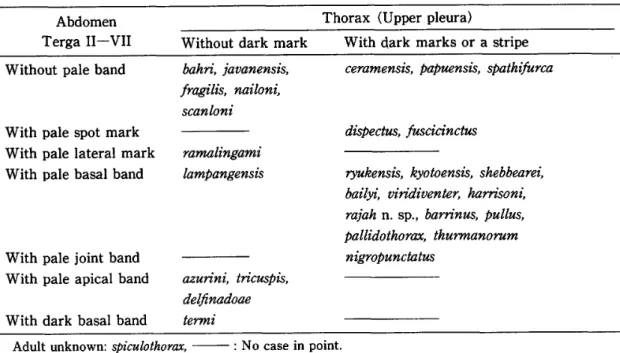
In adults, Cx. rajah n. sp., Cx. harrisoni. Cx. shebbearei. Cx. viridiventer, and Cx. bailyi are rather similar, all having dark marks or a distinct stripe on upper pleura of the thorax and distinct pale basal bands on terga II‑VII of the abdomen. However, these basal bands are narrow in Cx. shebbearei but broad in Cx. rajah n. sp. Table 3 compares taxonomically important characters in adults of several known species in Asia.
Toxorhynchites (Toxorhynchites) rajah, n. sp.
(Figures lb and 3; Tables 4,5)
Adults are characterized by a combination of I ) absence of well‑developed lateral tufts on terga VI‑VIII, 2 ) absence of brown fusiform scales on mesokatepisternum, 3 ) absence of pale greenish lateral scale portion of scutum, and 4 ) Iong rm crossvein of wings. Larva is characterized by I ) a single and long 6‑P hair, 2 ) bristles 7‑P, 13‑M and 7‑T 2 branched and 3 ) Iong siphon and saddle.
MALE. Wing: 5.5‑6.5 mm. He,ad: Proboscis dark without pale or lighter marking, maxillary palpus‑1 dark purple, with a small spot of silvery‑white scales at the apex of segment I, segments II‑V without dorsal lighter marking. Thorax: Scutum with metallic greenish blue scales, without pale green lateral stripe zones, anterolateral portion of meso‑
katepisternum bare. Wings with long rm crossveins. Legs practically without white scales on all tibiae and tarsi except faint lighter scales on baso‑ventral portions of midtarsi 1‑II.
Abdomen: Terga bluish purple, with yellowish lateral markings on I, and small baso‑lateral light marks on terga 111‑VII. Terga VI‑VIII with only poor black lateral setae not forming
.々量ぶミ嘱 .淋︾℃9応蝕唱O憶ミS効旭 ︒む .§嘱Qミ矯9旭9愚.δ
︐8慧おのヨ=oぎ琶冥8省竈窃哨室呂目oと
︑黛ぺ譜 .燕︾ 一qンPQ属出9コ邸>﹄
﹂﹇
ω五≦罵>¢りog口o咽駕ε﹄o岩H一
8目眉目︑H・H#ε03の一酒ε三go且筑
一〇自咽一の咽℃H一.H・一 q咽O旧Oの一
旧 一咽3信O O咽の
ρ鵠2邸鴇ρ遍−⁝oヒ岩8ω£三εoε8一8自
℃O﹄09吋﹄﹄マ︑b心目O﹄一ω↑︑Σ︐一川boOO一嵩﹄㊤>のり︸コリの︐一 〇一倒︻一〇〇ω①邸ゼ㊤の 切口〇一ω一︸﹃耳の・一 bρqO一︼﹀﹇・一 ︑山・oD H一H・⇔.≦・⇔りのにb心目〇一の而一一H−H.霞・H
﹄Oり﹄O のの一唱切︷〇一b心目哨の℃自吋bo目〇一一H㌧r.㌧r.>一︐一
℃o﹄o鱈邸お−口邸据o場昌>−H目︐一 宕2曇薯£峯.5=o診琴琶窃
一﹄O の﹄O①リコ¢嘱且日一H一︐一軋Σ階一
ヒo唱〇一の一︸コρの了一 ヒの目O︻の電ゴ一の1一 qO=Oきの信O謂α咽ω 属O=Oきの90 O刑の
ω一唱図bo口〇一 ×・寸℃ロコO﹄邸㊤一〇q咽b心﹄㊦9ω〇一℃℃邸の 一コ〇一ωQ−H隔90自O簿ω90 α咽ω
出﹄ω℃Q・一棉目O=O琴の目O α咽の
一hO﹄ω﹄﹄O︾山・oo ㊤お渥g山︐oo ℃〇一邸一コO唱αの図吋﹄O
HH㎝一NINNNI−NOりNOりINN寸的NIN H Cつ 一 H c r♂ σつ oq N 一一H−1一一一〇り一一NφH−HH一一⇔一一一 oり 一
頃寸 oり oりの oり oり のN品。り駄N品1山。。N{一一N。。N山。q
寸 cつ NN−IN−NあIINNNNNNN炉N∴N cqぐつoつ oつ uつ一一N。りN∴品目N。り一㌔N一㌔一一一一N−HHH一一HII一一一一一一一一一一一一 cq oつNNN的的NNNI口IN一一NNNN一一一・ 一 eq で })寸寸寸 的 OO 頃マ LΩO 寸的loウIIIIINNOり1㎝IoうlloりII㎝1●Q oo ののNOON N 頃 Nの マ嶋 的 ゆ寸 寸寸的 σう oo o} oo 助のIINOうIIINN寸1㎝IOOIIoりIIのloり のoり NOり㎝ N 鴫 Nφり ゆ頃 の o嶋めo頃Ho ooマの頃寸的 寸国φり o oりIIIIllNIIIIIII−IIIHININ のφ}マ}N N寸的NOり的N 一一N 寸 H寸9§寸や㊤の寸め早マ寸▽ωoo寸め§oりマ的oりoり ぱ⊃uつ 『寸・寸 「J Cつ r寸 頃 uつu⇒u⇒ooσ} 軋』⇒ uつ ゆゆ ・ ・oo一寸寸 の寸頃頃鴫o ・・oooトト 00H一一一1マllIIII嶋め頃ゆIIIII卜IIll1の ママ寸Oト寸 のゆLΩOの トO頃OO 一的 rぜ寸 o ①
き幅ミ飛
寒
嘱燵り§醤黛o景愚ミ ミミミSの
ミきミミミ
ミミoミ§醤繋
舵寒軸ミ蕗爲唱︑
§︑S 的矯簑鋤O嘱O&
弩N鳶避碁 超︑寒 §ミ黛﹄ミ
k恥蝸ミ旬為㎞噂・§塙
︑ミ竃ミミリ 違ミ遠ミ 聡雲恥§ミ塁 藝§鳶隠騒ミ飛 憩整超ミ冒 ︑暴 著簑§魯軋 々雲効動貸§唱閏 .αω.9ぺ唱誉N
箋o繋ミ
§疑Oぺ︑O略醤勉︑魯
着にgo出
一H一>︐鴫 ×︐H
山︑卜 山ーマ
N 山︐oっ
一Q︐O
Q・の の︐H
国一3︸O ﹄Oρ∈コ9 ﹄〇一口吋﹄的
泊匿
の︐H 図㊤℃ε
自o畳あ のo℃aω
Oり哨⇒σのOΣ
223
Table 3 Grouping of adult mosquitoes of subgenus ( Culiciomyia) s pp. in Asia
Abdomen
Terga II‑VII
Thorax (Upper pleura)
Without dark mark With d.ark marks or a stripe Without pale band
With pale spot mark With pale lateral mark With pale basal band
bahri, javanensis, fragilis, nailoni.
scanloni
ramalingami lam pangensis
ceramensis. pa puensis,
dispectus, fusctctn ctus
s pathtfurca
With pale joint band With pale apical band
With dark basal band
azurini, tricuspis, d elfinad oae termi
ryukensis, kyotoensis, shebbearei, bail ri:, viridiventer, harrisoni.
rajah n. sp., barrinus, pullus, pallidothorax, thurmanorum
nigropunctatus
Adult unknown: spiculothorax, No case in point.
either well‑defined lateral or caudal tufts. Male genitalia: Not described.
FEMALE. Head: Apex of maxillary pulpus silvery‑white scaled. Thorax: Generally similar to males. Forelegs without distinguishable marks. Midlegs with light scaled marks on basal 1/2 to 2/3 of T‑1, almost all T‑II yellowish white except dark scales at dorso‑apical portion, T‑III, IV, and V entirely dark scaled. Hind T・II with light scaled marking at baso‑ventral portion.
PUPA (Figure lb, Table 4). Setae lO‑CT 3 forked, 11,12‑CT single; 1・1 multibranched (about lO) , 2,4,5,9‑1 single, short, 3,6‑1 single, Iong; 1,3,5‑II single (length of 5‑II about 1.6 times length of 1‑ID , 2‑II single, minute, 4‑II 3 branched, short; 1,3,5‑III single, Iong, 4‑III 3 single short; 1,5‑IV single, Iong, 2,3‑IV single, short, 4‑IV 2 branched short; 1,5‑V single, Iong, 2,3‑V short, single; 4‑V 3 branched short; 1,2,4‑VI single, short, 3‑VI 2 branched short, 5‑VI single, long; 1,2,3,4‑VII single, short, 5‑VII single, Iong; 4,9‑VIII single, short. Paddle (Figure lb) broad and subrhomboid‑ovate, Iength 2.4 mm, width 1.4 mm; with scattered dark spots or subbasal mottling line; slightly emarginated at apex of midlib; with minute marginal spicules near apex of lobe.
LARVA (Figure 3, Table 5) . Head: Integument brown without special dark dorsal mark;
setae 9,lO‑C single. Thorax: Satae 1,2,3‑P single, 1‑P Ionger than 2‑P on the same tubercle, 3‑P isolated, very short, 4‑P isolated, forked with 7 branches, 5‑P stout, single, 6‑P Iong, single, 7‑P strong, 2 branched, 10‑P Iong, single; 1,2‑M isolated and very short, 3‑7・M single on the same sclerotized plate, 6‑M stout, 7‑M minute, 10‑M single, Iong, 13‑M stout 2 branched; 1‑T Iong, single, 2‑T short, single, 3,4‑T small, separated, 6‑T stout, single, 7‑T stout, 2 branched, 8‑T minute, 4 branched, 9,13‑T stout, single, 10‑T slender, single. Abdomen: Setae 1‑1,II,V,VI,VII single, 1‑III,IV 2 branched, 3,4‑1 strong, 2 branched; 2‑1 minute, single and isolated; 2‑II‑VI short, isolated; 4‑1,II 2 branched; 4‑Ill‑VII single; 10‑1 short, single; 10‑II‑V, 2 branched;
lO‑VI small, single; lO‑VII short; single; Il‑1‑IV 2 branched; 11‑V‑VII single; 12‑1 minute, branched; 12‑II‑VII minute or short, single; 13‑1‑VI Iong, single; 1‑VIII small, single and
Table 4 Chaetotaxy of the pupae of Toxorhynchites (Toxorhynchites) rajah n. sp.
Seta Cephalo‑
No. thorax
Abdomen
I II III IV V VI VII VIII
O l 2 3 4 5 6 7 8 9 10 11 12
IL Im Im Im Im
l
IL IL
1 3 1 1
lO
Im IL Im Im IL
1
1
1
Im IL
3‑4
IL IL
1
Im Im
l
Im
IL Im
1 l
IL IL
1
Im Im
1
Im
IL Im
2
IL IL Im Im Im
Im
1?
Im Im
2‑3
IL IL Im Im Im Im Im
Im Im 2m
1
IL IL Im Im Im Im Im
Im
1
Im
1 1
IL IL Im Im 1‑2m Im Im
Im
1
l
L: Iong, m: minute, ‑ : absent, ? : Iacked.
Specimen examined: a single pupal skin associated with a larval skin.
isolated; 2,3‑VIII small, single; 4,5‑VIII stout, single. Siphon long, 1.3 mm, siphon index about 2.5; 1‑S stout and 2 branched. Saddle narrow, about same as length of siphon, 2 times length of basal width; 1‑X single, stout; 2・X 6 branched, one of them longer than others (about 2 times length of the shortest) ; 3‑X Iong (about 2.8 times length of siphon) , 3 branched; 4‑X 6 pairs on grid, their length ranging from I to 1.4 Iength of saddle. Gills very short.
TYPE DATA. Holotype male reared from a larva collected in Mt. Kinabalu, Sabah, Malaysia, by M. Tsukamoto on 24 September, 1986. Paratype I male, 2 females, 2 pupal skins, and I Iarval skin, collected by M. Tsukamoto and M. Mogi on the same date.
DISTRIBUTION. Known only from the type locality, Mt. Kinabalu, Sabah, Malaysia.
BIONOMICS. Larvae of this species were collected in water of Nepenthes rajah, in association with larvae of Cx. (Cui.) rajah n. sp., Cx. (Lop.) jenseni. and Ur. (J {c.) moultoni.
Adult do not suck blood but other biology is unknown.
TAXONOMIC DISCUSSION. In Asia at least 40 spp. of mosquitoes belonging to the genus Toxorhynchites are counted. Steffan and Evenhuis (1985) assigned 36 known species (at that time) into 7 species‑groups by the combination of various morphological characters.
Based on one female from Mt. Kinabalu, at about 1,300 m elevation, Tx. pendleburyi was described by Edwards (1930) . This species possesses well‑developed caudal tufts on terga VI, VII and VIII, belonging to the splendens species‑group of Steffan and Evenhuis (1985) . Since the present new species has poor caudal tufts, this cannot be Tx. pendleburyi. The acaudatus group is characterized by I ) absence of well‑developed caudal tufts, 2 ) Iong rm crossvein of wings, 3 ) presence (in some species) of brown fusiform scales on anterolateral region of mesokatepisternum in adults, 4 ) presence (in some species) of subbasal mottling on paddles of pupae, and 5 ) pitcher plant dwelling immatures. The present new species, Tx. rajah, have long rm crossvein of wings, without distinct lateral tuft on terga VI‑VIII; this tends toward acaudatus group, but the new species does not have brown fusiform scales in anterolateral
¥ G 6
6
6
6
6 7
6 6
13 7
7 6
5
;
5
5
TOxorhynchites ( Tox
10
9
J3p / t2 lg
r"I:11 /
3fo j 9 ro 12
2V1 M 1 1
! ;: 8
l 13 7
r ¥
3 Io 11 T21 T ":1 8
2
I / Io]3 11 21 l
o 11
) raiah n. sp .
3
/
786
9 10
ll
7
vn '* : 8
7 T3 '21 11 VIH
" ' il tt;: " :1" ' i
13 12 :: ' 2il
: " :1
E :'1 ̲d, '!
10 ' e
13 11
1 2 ‑t':Is ' :"I" 'i }i :":
i'l" 'It$ : *T" :';: ; 1'i:': : ::"I t'
13 12 11 ¥ 1 ro 3 71
9
¥
13 12 IQ 11
F: ) ;115 x:T:' 'o)¥
1:
Toxorhynchites rajah'
C: head' P: Prothorax' M: mesothorax : siPhon'
f
g
C
3 1
¥ 15
1
2
225
A
12 13 '
3 2
J
5 12 I
5 ¥2 3 T In
8 5
3
rv
8 5
1
5 2 v
3
N 1
2
3
:'y:
'1 ::: t.̲ .:.
1 ::‑:‑::;1:= : . i
Vl
3
Figure 3 Larva of A: antenna, T: metathorax, S
Table 5 Chaetotaxy of the 4th instar larva of Tonorh nchites ( Tonorhvnchites) rajah n. sp.
Seta Head Thorax Abdomen
No. C p M T V VI VII O II 111 IV VIII
2 3 4 5 6 7 8 9 10 11 12 13 14 15
Im
1
1 1
5m
1
Im
1 1 1
l 2
Im
2
Im
7
IS 2S
?
IS IL Im
6m Im
1
IS Im 5m
IS IL Im
2S Im
4
4m
IS 2S
4m
IS IL Im
IS Im 2L
2
Im 2L 2L Im Im 2L 3m IL
1
Im 2L 2L Im 2L 2L Im Im 2L 2L Im IL
?.
2
Im 2L IL Im 2L 2L Im Im 2L 2L Im IL
2
Im 2L IL Im 2L 2L Im Im 2L 2L Im IL
1?
l
Im
1‑2 L
1
Im IL IL 2m Im
2
IL Im IL
1?
l
Im
1 1
IL IL 2m Im
1
IL
l
1?
l
Im
1
Im
1
5m IL 7m Im
1
IL
l
IL
1?
?
l
Im Im IS IS 1‑A
1‑ S
1‑X
2‑ X 3‑ X 4‑ X
2S IS 6L 3L IL
(6 pairs)
L: Iarge, S: stout, m: minute, ‑: absent, ? : not detected.
Specimen examined: a single larval skin associated with the pupal skin.
region of thorax. More recently Evenhuis and Steffan (1986) have described Tx. angustiplatus from the Malay Peninsula as a new species which also does not have the brown fusiform scales. Pupae of the latter species, however, can be easily distinguished from those of the present new species because Tx. rajah has paddles with subrhomboid‑ovate shape and single setae 11,12‑CT and 1‑II (like in Tx. nepenthis) instead of elongate paddles of Tx. angustiplatus pupae and the branched setae in question. Pupa of Tx. rajah is also distinguished from that of Tx. nepenthis by a branched seta lO‑CT and a single long seta 6‑VII. In addition, Iarvae of the present new species are unique by showing elongate siphon and saddle, and by chaetotaxy completely different from that of Tx. nepenthis by long and stout setae 5,7,9‑P, 6,9,13‑M, 6,7,9,13‑T, 4,5‑VIII and l‑S. Number in branches of these setae also different. Larval chaetotaxy of Tx. rajah is shown in Table 5 in more detail.
ACKNOWLEDGMENTS
I am grateful to Professor I. Miyagi, University of the Ryukyus, Okinawa, and Professor Yong Hoi‑Sen, University of Malaya, Kuala Lumpur, for their support, encouragement and arrangement for the survey to Mt. Kinabalu. Permission and local guiding by Mr. Thomas Yussop, Park Naturalist, and his staff, for collecting mosquito larvae from pitcher plants in the Mt. Kinabalu National Park, are also deeply appreciated. Dr. M. Mogi, Saga Medical College, Sagzi, offered many valuable suggestions and cooperation in giving paratype mate‑
rials. Sincere appreciation is also due to Dr. M. Horio, University of Occupational and
227
Environmental Health, Kitakyushu, for preparing the type specimens, and to Dr. T. Toma, University of the Ryukyus, Okinawa, for her useful suggestion and taxonomic discussion. I also thank Professor T. Kurihara, Teikyo University, Tokyo, for his kindly sending a reprint of the useful literature.
R ERENCES
l ) Apiwathnasorn, C. (l 86) : A List of Mosquito Species in Southeast Asia. Museum and Reference Centre, SEAMEO‑TROPMED National Centre of Thailand, Mahidol University, Bangkok, pp. 74
2 ) Barraud, P.J. (1934): The Fauna of British India, including Ceylon and Burma. Diptera, Vol.
V, Family Culicidae. Subgenus Culiciomyia Theobald, 1907, 376‑387, Taylor and Francis, London
3 ) Beaver, R.A. (1983): The communities living in Nepenthes pitcher plants: Fauna and food webs. In: Phytotelmata: Terrestrial Plants as Hosts of Aquatic Insect Communities, (Frank, J.H. and Lounibos, L.P. ed.), 129‑159, Plexus Publ., Marlton, New Jersey
4 ) Belkin, J.N. (1962): The Mosquitoes of the South Pacific (Diptera, Culicidae) . Vol. I.
Subgenus Culiciomyia Theobald, 228‑234. University of California Press, Berkeley
5 ) Bram, R.A. (1967): Contributions to the mosquito fauna of Southeast Asia. ‑ II. The genus Culex in Thailand (Diptera: Culicidae) . Subgenus Culidomyia Theobald 1907, Contrib. Amer.
Entomol. Inst., 2(1) , I13‑180
6 ) Chen, H.‑P. (1977) : A new species of Culex (Diptera: Culicidae), Acta Entomol. Sinica, 20, 95‑98 (in Chinese with English summary)
7 ) Edwards, F.W. (1931): Mosquitoes breeding in plant pitchers, Natur. Hist. Mag., 3, 25‑28 8 ) Evenhuis, N.L. and Steffan, W.A. (1986): Classification of the subgenus Toxorhynchites
(Diptera: Culicidae), II. Revision of the Toxorhynchites acaudatus group, J. Med. Entomol., 23 (5) , 538‑574
9 ) Harrison, B.A. (1987): Culex subgenus Thaiomyla Bram, a synonym of Culex subgenus Culiciomyia Theobald (Diptera: Culicidae) , Mosq. Syst., 19(1) , I11‑116
10) King W.V. (1946) : The New Guinea species of Culex (Culiciomyia) , with descriptions of two new species, Proc. Biol. Soc. Washington, 59, 143‑154
lD Knight, K.L. and Stone, A. (1977): A Catalog of the Mosquitoes of the World (Diptera:
Culicidae) , 2nd Ed. Thomas Say Foundation, Vol. VI, Entomol. Soc. Amer., College Park, pp.
611
12) Kurata, S. (1976): Nepenthes of Mount Kinabalu. Sabah National Parks Publications No. 2, Sabah National Parks Trustees, Kota Kinabalu, pp. 80
13) Mattingly, P.F. (198D: Medical Entomology Studies ‑ XIV. The subgenera Rachionotomyia.
Tricholeptomyia and Trip'teroides (Mabini group) of genus Tripteroides in the Oriental Region (Diptera: Culicidae) , Contrib. Amer. Entomol. Inst., 17(5), 1‑147
14) Miyagi, I., Toma, T., Tsukamoto, M., Mogi, M., Horio, M., Cabrera, B.D. and Rivera, D.G.
(1985) : A survey of the mosquito fauna in Palawan, Mindanao and North Luzon, Republic of the Philippines, Mosq. Syst., 17(2), 133‑145
15) Reinert, J.F. (1975): Mosquito generic and subgeneric abbreviations (Diptera: Culicidae), Mosq. Syst., 7(2) , 105‑llO
16) Sirivanakarn, S. (1973): Three new species of Culex subgenus Culiciomyia Theobald from Southeast Asia and a redescription of the type of C. tricuspis Edwards from Alor, Lesser Sunda Island, Indonesia (Diptera: Culicidae) , Proc. Entomol. Soc. Washington, 75(1) , I12‑124 17) Sirivanakarn, S. (1977): Redescription of four Oriental species of Culex (Culitiomyia) and the
description of a new species from Thailand(Diptera:Culicidae),Mosq.Syst,9(2),93−111 18)Sirivanakam,S.and Kurihara,T.(1973):A new species of Culex,subgenus Culiciomyia
Theobald from Ceram,Indonesia(Diptera:Culicidae),Proc.Entomol.Soc.Washington,75(2),
220−224
19)Steffan,W.A.and Evenhuis,N.L.(1985):Classi丘cation of the subgenus To蜘名h翅oh漉s (Diptera:Culicidae).1.Australasian,eastem Palaearctic,and Oriental specie3groups,J・Med.
Entomol.,22(4),421−446
20)Tanaka,K.,Mizusawa,K.and Saugstad,E.S.(1979):A revision of the adult and larval mosquitoes of Japan(including the Ryukyu Archipelago and the Ogasawara Islands)and Korea(Diptera:Culicidae),Contrib.Amer.Entomol.lnst.,16,1−987
21)Thu㎜an,D.C.(1955):C燃(C%伽御吻)孟8甑an unusual new mosquito from Thailand,
Proc.Entomol.Soc.Washington,57,13−23
22)Toma,T.,Miyagi,1.and Cabrera,B.D.(1984):C%伽(C擁吻吻卿)σ鍬吻4a new crab hole mosquito species from the Philippines,Mosq.Syst.,16(2),172−182
23)Tsukamoto,M.,Horio,M.,Rivera,D.G.,Sucharit,S.,Khamboonruang,C.and Yong,H.S.
(1989):Zymogram comparison of Southeast Asian mosquito larvae.1.Lactate dehydrogenase and malic enzyme,Trop.Biomed.,6(in press)
マレーシア,キナバル山のウツボカズラより採集された クシヒゲカとオオカの2新種
塚本 増久
1986年度文部省科学研究費による海外調査でマレーシアの蚊相を調べた際,ボルネオ島キナバ ル山の高所に自生する,食虫植物ウツボカズラの壺から数種の蚊幼虫を採集する機会があったの で,その系統分類学的研究を行った。それらのうちのクシヒゲカの1種は1929年に採集され,
C%伽s加ゐ66α勉として記録されていたものであったが,これを精査したところ東ヒマラヤ原産 のこの学名の種とは全く異なり,新種であることが判明したので,C%嬬(C%」麺o吻釦)吻αhオ ウサマクシヒゲカ(新称)と命名して詳しい記載を与えた。また,同種のウツボカズラから発生 するオオカも未記載の新種であることが確認されたので,これも7bκoz勿解hJ趣 (710∬oz勿n−
oh吻s)吻αhオウサマオオカ(新称)と命名し,成虫,蠣,幼虫などの形態について記載を行っ た。学名および和名は,これらの蚊が採集された巨大なウツボカズラ漉餌窺h召s吻αhの種小名
(王様の意)に基づくものである。なお,同じ水域にはC銘伽 (Loρho68耀o吻吻)ノ6%s佛4 U昭no吻n∫o(R6%4φoα」伽)吻oπ」 on4丁吻伽o漉5(Rαoh勿no伽n吻)sp.No.2などの蚊幼虫 も発生していた。
産業医科大学医動物学教室
Japan. J. Trop. M ed . Hyg ., Vol. 17, No. 3, 1989, pp. 229 236 229
MANAGEMENT AND UTILIZATION OF ORPHAN DRUGS AGAlNST PARASITIC INFECTIONS
IN RECENT 7 YEARS IN JAPAN
KIYOKATSU TANABE*, YOSHIHITO OTSUJ12, TOSHIO NAKABAYASHI' HIROSHI OHTOMO' AND HIROSHI TANAKA5
Received March 22 1989/Accepted May 8 1989
,
Abstract: Since many important antiparasitic drugs are not registered in Japan, a research group, for the past 7 years, has managed the use of non‑registered orphan drugs.
Initially there were 16 orphan drugs under control of the group, these were as follows;
chloroquine, Fansidar, Fansimef, quinine (iv), primaquine, mebendazole, praziquantel, thiabendazole, quinacrine, dehydroemetine (iv) , pentamidine, Pentostam, suramin, stibo‑
phen, nifurtimox and pyrimethamine. Of these drugs, Fansidar, thiabendazole, mebend‑
azole and praziquantel were recently registered. The number of cases treated with these drugs was nearly one thousand (920) . The number of malaria cases treated in this group was 201, corresponding to 22% of the total cases treated with orphan drugs. Mebendazole was used in 210 cases, praziquantel in 163, thiabendazole in 120, quinacrine in 125, pentamidine in 67, dehydroemetin in 28, Pentostam in 5 and suramin in l. Most drugs were evaluated as effective in their antiparasitic actions but severe adverse reactions occurred at relatively high incidences.
INTRODUCTION
Tropical diseases are not endemic in Japan because of its geographical location in the temperate zone. In addition, helminthic diseases, which prevailed in Japan for 2 decades after World War II, have reduced incidence due to a change from use of night soil to chemical fertilizer in agriculture, and due to improvements of public health and environmental hygiene.
Recent economical growth in Japan has created an urbanized life style for most people. On the other hand, an increase of international relations has caused an irnportation of parasitic diseases. In connection with the latter problem, effective antiparasitic drugs are necessary.
At the start of the present study, only a limited number of drugs effective against parasitic infections were available on the market. Those were pyrantel pamoate, pyrvinium
1
2 3
4 5
Department of Infectious Diseases, Institute of Medical Science, The University of Tokyo, Tokyo 108, Japan (Present address: Department of Medical Zoology, Faculty of Medicine, Kagoshima University, Kagoshima 890, Japan)
Second Department of Internal Medicine, Kagoshima University, Kagoshima 890, Japan Department of Parasitology, Research Institute for Microbial Diseases, Osaka University, Osaka 553, Japan
Department of Parasitology, Gifu University School of Medicine, Gifu 500, Japan
Department of Parasitology, Institute of Medical Science, The University of Tokyo, Tokyo l08, Japan
pamoate, metronidazole, tinidazole, diethylcarbamazine, bithionol and quinine chloride (po, powder) , paromomycin and so on. Other drugs were not registered in Pharmacopoeia Japonica, so‑called "orphan drugs". Although many antiparasitic drugs have been developed in recent years and used widely in the world, pharmaceutical companies were not willing to register the drugs in Japan, on account of the cost in application for approval, Iimited business benefits and the occurrence of adverse reactions to these drugs. In order to collect clinical data on the orphan drugs, the Ministry of Health and Welfare in Japan (MOHW) set up a research group for orphan drugs in 1980 and the members stored, managed and studied 16 different drugs. The clinical trials began in 1981 and the orphan drugs have been supplied for use for 7 years. The present study deals with the results of the clinical trials and the present management of orphan drugs against parasitic diseases in Japan.
METHODS
Our research group managed non‑registered drugs and advertised the drug list. Each member of the group stored a set of drugs for distribution in accordance with the legal responsibility of the member. An individual physician who wishes to use a particular drug, contacts any member of the research group by telephone. The member sends out the requested drug along with prepared forms and guidelines for use of the drug. The doctor sends back a form of ofricial request and an informed consent signed by the patient. The doctor is obligated to make a report of the results of the trial. All drugs used in this study were purchased from pharmaceutical companies in foreign countries.
The following drugs have been managed in stock: antimalarial drugs; (1) chloroquine phosphate (Aralen, Resochin) , (2) sulfadoxine‑pyrimethamine (Fansidar), (3) mefloquine hydrochloride in Fansidar (Fansimef) , (4) quinine dihydrochloride (parenteral, Quinimax) , (5) primaquine phosphate (Primaquine) ; and other antiparasitic drugs, (6) mebendazole (Vermox), (7) praziquantel (Biltricide) , (8) thiabendazole (MintezoD, (9) quinacrine hydro‑
chloride (Atabrine) , GO) dehydroemetine dihydrochloride (Dehydroemetine) , GD pentamidine isothionate, pentamidine methanesulfonate (Lomidine), u2) sodium stibogluconate (Pentos‑
tam) , a3) suramin (Germanin) , u stibophen (Fouadin or Neo‑Antimosan) , a5) nifurtimox (Lampit) and a6) pyrimethamine (Daraprim) .
RESULTS
Clinical data on the use of orphan drugs have been collected for 7 years from April, 1981 to March, 1988, and are shown in Table I for malaria cases, in Table 2 for cases treated with mebendazole, praziquantel and thiabendazole and in Table 3 for parasitic infections treated with other anthelmintics.
Antimalarial drugs
Clinical trials of antimalarial drugs were carried out in 189 cases, out of which 158 cases were reported to this group as shown in Table 1. 106/158 (67%) cases were Plasmodium vivax infections, 50 (32%) were P. falciparum, 2 (1%) were P. malariae, and in the other 26 cases malaria species were not identified. The relationships of the species and antimalarial drugs are shown in Table 1.