西 南 交 通 大 学 学 报
第 55 卷 第 3 期
2020 年 6 月
JOURNAL OF SOUTHWEST JIAOTONG UNIVERSITY
Vol. 55 No. 3
June 2020
ISSN: 0258-2724 DOI:10.35741/issn.0258-2724.55.3.6
Regular articleEngineering
A
RGON
F
LOW
R
ATE
E
FFECT ON
H
ARDNESS OF
C
ARBON
T
HIN
F
ILMS ON
SKD11
S
TEEL
U
SING
T
ARGET
M
ATERIAL FROM
B
ATTERY
C
ARBON
R
ODS WITH
P
LASMA
S
PUTTERING
M
ETHOD
用等离子溅射法从电池碳棒靶材上研究氩气流速对 SKD11 钢上碳
薄膜硬度的影响
Aladin Eko Purkuncoro a, Rudy Soenoko b, D.J.S. Djoko Herry c, Yudy Surya Irawan b
a Department of Mechanical Engineering, Nasional Institute of Technology
Bendungan Sigura-gura St., Malang, 65145, Indonesia, [email protected]
b Department of Mechanical Engineering, Brawijaya University
Mayjen Haryono St. 167, Malang, 65145, Indonesia, [email protected], [email protected]
c Department of Physics, Brawijaya University
Mayjen Haryono St. 167, Malang, 65145, Indonesia, [email protected]
Received: March 2, 2020 ▪ Review: May 16, 2020 ▪ Accepted: May 30, 2020
This article is an open access article distributed under the terms and conditions of the Creative Commons Attribution License (http://creativecommons.org/licenses/by/4.0)
Abstract
Processes for increasing the hardness value of steel are among the most challenging in industrial applications. SKD11 steel is one of the steels that is commonly used in industry (building, transportation facility construction, and production of various kinds of scissors such as knife-edge mold, scissors, circular saw blades, and metal stamping mold). However, SKD11 steel has a hardness value of only around 58–60 HV. Even though it is often used for building and transportation facility construction, which requires material with a high hardness performance. It will be better if the hardness performance is increased. The deposition of carbon thin films with plasma sputtering is a physical vapor deposition method that is effective for improving the hardness value of material. The purpose of this study is to obtain the maximum average hardness value of carbon thin films on SKD11 through the optimization of the argon gas flow rate parameter on plasma sputtering. The effect of the argon gas flow rate parameter on the hardness value of carbon thin films for SKD11 steel is investigated using a Vickers hardness tester. The research method involves the use of target material from battery waste (carbon rods) using argon gas low-frequency plasma sputtering with variations in the argon gas flow rate of 20, 40, 60, 80, and 100 mL/min for 2 hours at 300˚C. The method allows for the improvement of the hardness performance of carbon thin films because the argon gas flow rate affects the probability of carbon atom collision with particles in the chamber and the number of argon ions formed. This can cause different structures and hardness values of thin films. Based on the results, it can be concluded that the optimum argon gas flow rate parameter is 80 mL/min, which is associated with the highest average hardness value of 335.9 HV.
摘要 提高钢的硬度值的方法是工业应用中最具挑战性的方法。SKD11 钢是工业(建筑,运输设施 建设以及生产各种剪刀,如刀口模具,剪刀,圆锯片和金属冲压模具)中常用的一种钢。但是, SKD11 钢的硬度值仅为 58–60 高压。即使它经常用于建筑和运输设施的建设中,也需要具有高硬 度性能的材料。如果提高硬度性能会更好。用等离子体溅射沉积碳薄膜是一种物理气相沉积方法 ,对于提高材料的硬度值是有效的。这项研究的目的是通过优化等离子溅射中的氩气流量参数来 获得 SKD11 上碳薄膜的最大平均硬度值。使用维氏硬度计研究了氩气流量参数对 SKD11 钢碳薄 膜硬度值的影响。该研究方法涉及使用氩气低频等离子溅射,以 20、40、60、80 和 100 毫升/分 钟的氩气流速在 20℃/小时变化的电池废料(碳棒)中的目标材料 2 小时。300°摄氏度。该方法允 许改善碳薄膜的硬度性能,因为氩气流速影响碳原子与腔室中的粒子碰撞的可能性以及形成的氩 离子的数量。这会导致薄膜的结构和硬度值不同。根据结果可以得出结论,最佳氩气流速参数为 80 毫升/分钟,这与 335.9 高压的最高平均硬度值有关。 关键词: SKD11,等离子溅射,电池棒,流量,硬度
I. I
NTRODUCTIONThe zinc–carbon battery has been used extensively for energy source for electronic devices such as radio, camera, and remote control. However, the increasing use of batteries causes battery waste to increase [1], [2], and battery waste causes environmental pollution. It is important to reuse waste of battery parts. One of method that can be used to reuse waste of battery parts is to use carbon rods as a target material for deposition thin films with plasma sputtering, thus it will reduce pollution of battery waste.
The battery carbon rod is a battery component that contains carbon [3]. Methods for the utilization of carbon rods from zinc–carbon waste have been developed that include recycling as biogas desulfurizer [4]. Methods are also being developed to improve the hardness performance of steel [5]. SKD11 steel is one of the steels that is commonly used in the industrial world [6]. However, the steel has a limited hardness performance. SKD11 steel has a hardness value of only around 58–60 HV [7], even though it is often used for building and transportation facility construction, which requires material with a high hardness performance. It will be better if the hardness performance is increased [6], [7], [8]. This is possible, if SKD11 steel had a higher hardness value. One of the methods that can increase the hardness value is deposition thin films on SKD11 steel with plasma sputtering method. Based on this problem, the hardness performance of SKD11 steel needs to be improved. In other studies, the hardness of SKD11 steel was improved through changes in the microstructural properties of SKD11 steel during carbide dispersion carburizing. Research
results show that the carbon content of the surface region in SKD11 increased by up to 3 %. The higher the carbon content of a material, the higher the hardness value. As the carbide dispersion carburizing process is generally performed at 980˚C for 120 minutes, the process requires high temperatures, consumes a lot of power, and involves a high cost [8]. Plasma sputtering is another method to increase the hardness of SKD11, but it is simpler and cheaper than carburizing [8], [9], [10].
Plasma sputtering has several advantages, such as a high deposition rate and high-quality synthesis of carbon thin films [11]. It is initiated by the bombardment of energetic ions at the target [12] (Previous research reference were conducted in laboratory with magnetron plasma sputtering.). Battery waste from carbon rods can be used as a target material for the synthesis of thin films on the substrate with plasma sputtering [11]. One gas that is suitable for plasma sputtering is argon gas because argon atoms are heavy with low reactive properties and high levels of physical reaction [13]. It could be more effective than other gases for the deposition of carbon thin films [14].
In other work, the deposition of carbon thin films on glass substrate through the use low-frequency plasma sputtering with battery carbon rods as a target material has been characterized by Fourier-transform infrared spectroscopy (FTIR). The FTIR results show C–C and C=C bonds, thus proving that carbon from battery waste (carbon rods) could be used as a target material to be successfully deposited on glass substrate [11]. In this study, carbon rods from zinc–carbon battery waste were used as a target material for the deposition of carbon thin films
3
on SKD11 steel through argon plasma sputtering generated by a low-frequency generator at 40 kHz. The characterization of carbon thin films on SKD11 steel was carried out by using a Vickers hardness tester. The goal of this research is to obtain the maximum average hardness value of carbon thin films on SKD11 through the optimization of the argon gas flow rate parameter on plasma sputtering.
II. M
ATERIAL ANDM
ETHODS A. MaterialSKD11 steel without treatment was prepared for the experiment as substrate material. It has a 60 HV average hardness value and a chemical composition of Fe = 1.58 wt%, C = 11.4 wt%, Cr = 0.8 wt%, and Mo = 0.25 wt%. Carbon rods from zinc–carbon ABC battery waste (ABC batteries are manufactured by PT. Everbright Manufacturing and Distribution Company at Binjai Km 9.5, 20127, Lalang Island, North Sumatra, Indonesia. The maker of the battery has an effect on the outcome of the experiment if the chemical composition of the battery is different with the maker of the battery. Different manufacturer perform differently of the chemical composition of the battery is different.) were used as the target material in this research. The experiment was carried out using 9 carbon rods in plasma sputtering system from the same batteries that manufactured by the above-mentioned company for test at various flow rates. The carbon purity level of the carbon rods is 72.81 wt%. Each carbon rod was cut into a diameter of 8 mm and a length of 55 mm. Then, the carbon rod was cleaned by ultrasonication in soap solution for 1 minute. The cleaned carbon rod was dried in the oven at 300˚C for 2 hours. B. Methods
Carbon films were deposited using plasma sputtering. Figure 1a shows the details of the plasma sputtering system with a carbon rod target. Plasma is generated by a low-frequency generator (LFG) at 40 KHz. The plasma system has a chamber diameter of 250 mm. The carbon rod as the target material was placed at the electrode, and the distance between the target material and SKD11 steel was kept at 1.7 cm. A vacuum was applied in the chamber for 1.5 hours. Argon gas then flowed into the chamber with a flow rate 20, 40, 60, 80, and 100 mL/min. There was time in between each flow rate with new rod. The deposition was done for 2 hours, keeping the temperature at 300˚C. The procedure
for the deposition of carbon thin films is developed in several steps, as described below.
1. The plasma chamber is opened and then cleaned with technical alcohol (the same with regular rubbing alcohol, because the alcohol that used in this study consisting of roughly 70% pure ethanol or isopropyl alcohol in its concentrated form). SKD11 steel as substrate is inserted.
2. Plasma chamber is closed and vacuumed for 30 minutes with an initial temperature of 27oC
3. The temperature indicator is changed to 300oC and awaited until it reaches 300oC. Then, vacuum again for 30 minutes.
4. Flow rate of argon gas is turned on by several variations, 20, 40, 60, 80 and 100 mL/min for 30 minutes in vacuum condition.
5. The power parameter is set at 340 Watt for one hour until glow discharge appears as shown in Figure 1b and the deposition process is carried out for 2 hours.
6. The parameters of power, flow rate, temperature, vacuum pump are turned off. Then the deposited thin films on SKD11 steel is removed from plasma sputtering system.
(a) (b) LFG 40 kHz Electrode Carbon rods Vacuum pomp Argon gas Flow meter Power meter Temperature meter Glow discharge
Figure 1. (a) Schematic illustration of plasma sputtering with carbon rods-target, (b) Plasma sputtering process
C. Characterization
The content of the carbon rod and SKD11 steel was measured using SEM-EDX, Fei, Type Inspet-21. The hardness value of SKD11 steel, which has been deposited with carbon thin films with flow rate treatment and without said treatment, was tested using micro hardness Vickers at three different test points, as shown in Figure 2. SKD11 steel hardness is obtained by taking the average hardness value from measurements at three test points, which have been conducted previously.
Figure 2. Point of hardness test observation
III. R
ESULTS ANDD
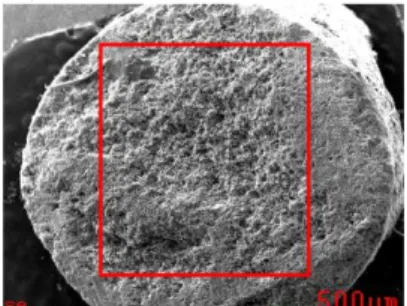
ISCUSSIONRed square shown in Figure 3, is the area that was observed to find out compositions of battery carbon rods, shown as Table 1.
Figure 3. SEM imaging of carbon rods outer layer
Table 1.
Compositions of battery carbon rods based on SEM-EDX results Element Wt % C 72.81 O 16.54 Al 1.95 Si 2.41 Cl 1.42 K 0.99 Ca 1.29 Fe 2.59
Based on SEM-EDX results, the carbon purities level of carbon rods was relatively small (72.81 Wt %). It shows that carbon of battery carbon rods has impurities. The hardness value of SKD11 without treatment, based on the microhardness Vickers test shown in Table 2, has a relatively small hardness value.
Table 2.
The hardness value of SKD11 steel without plasma sputtering treatment based on the microhardness Vickers test
Test point Hardness value (HV) of SKD11 steel
without plasma sputtering treatment
1 60.10 2 58.20 3 59.20 Average of hardness value 59.16
The hardness value of thin films on SKD11 steel, with variation of flow rate treatment, show different hardness values at each flow rate parameter, as shown in Table 3.
Table 3.
The hardness value of thin films on SKD11 steel with flow rate treatment based on the microhardness Vickers test
Test point
Hardness value (HV) carbon thin film with argon flow rate (mL/min)
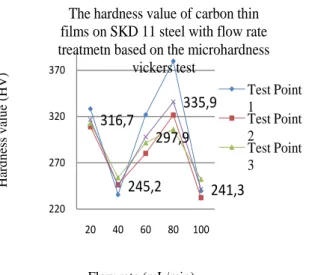
20 40 60 80 100 1 328.3 235.6 321.9 379.9 239.6 2 309.1 246.3 280.1 321.6 232.3 3 312.7 253.8 291.6 306.3 252.2 Average of hardness 316.7 245.2 297.9 335.9 241.3
Based on Tables 2 and 3, the average of hardness value of SKD11 steel without plasma sputtering treatment was relatively small when compared to carbon thin film with argon flow rate treatment. It indicates that the hardness value of SKD11 increases after argon flow rate on plasma sputtering treatment. Based on the results of the hardness test using micro hardness Vickers, as shown in Table 3, the treatment of flow rates with highest hardness values is obtained at a flow rate of 80 mL/ min, with average hardness values of 335.9 HV. This is caused by the probability of carbon atoms colliding with particles in the chamber and the amount of argon ions formed on plasma sputtering. The amount of argon ions has an important role in the bombardment of target material. The optimum flow rate at 80 mL/min has the highest probability of collision and the highest ion density bombarding the target material. It causes the number of carbon atoms deposited in the SKD11 to increase. As a result, the hardness value of carbon thin films increases. The line graph of hardness value of carbon thin films with variation of flow rates, as shown in Figure 3, show non-linier patterns.
5 316,7 245,2 297,9 335,9 241,3 220 270 320 370 20 40 60 80 100
The hardness value of carbon thin films on SKD 11 steel with flow rate treatmetn based on the microhardness
vickers test Test Point 1 Test Point 2 Test Point 3
Figure 3. Line graph of hardness with flow rate
IV. C
ONCLUSIONSBased on the results, it can be concluded that the optimum argon gas flow rate parameters are at 80 mL/min, having the highest average hardness of 335.9 HV. The hardness value of SKD11 steel without treatment was increased after argon flow rate on plasma sputtering treatment.
A
CKNOWLEDGEMENTSThe authors are very thankful to the Education, Research and Technology Ministry, Indonesia for supporting the doctoral program scholarship funding. Also many thanks to the Mechanical Engineering Department, Brawijaya University.
R
EFERENCES[1]
VLEK, C. and STEG, L. (2007)
Human
Behavior
and
Environmental
Sustainability: Problems, Driving Forces, and
Research Topics. Journal of Social Issues, 63
(1), pp. 1-19.
[2]
TAM, V.W.Y. (2011) Rate of
Reusable
and
Recyclable
Waste
in
Construction. Open Waste Management
Journal, 4 (1), pp. 28-32.
[3]
GDE, T., NINDHIA, T., SURATA,
I.W., GEDE, I.D., SWASTIKA, P., and
WAHYUDI, I.M. (2016) Reuse of Carbon
Paste from Used Zinc-Carbon Battery for
Biogas Desulfurizer with Clay as a Binder.
International Journal of Environmental
Science and Development, 7 (3), pp. 203-206.
[4]
NINDHIA, T.G.T., SURATA, I.W.,
ATMIKA, I.K.A., NEGARA, D.N.K.P., and
ARTANA, I.P.G. (2014) Processing Carbon
Rod from Waste of Zing-Carbon Battery for
Biogas Desulfurizer. Journal of Clean
Energy Technologies, 3 (2), pp. 119-122.
[5]
CALIK, A., DUZGUN, A., SAHIN,
O., and UCAR, N. (2010) Effect of carbon
content on the mechanical properties of
medium carbon steels. Zeitschrift fur
Naturforschung - Section A Journal of
Physical Sciences, 65 (5), pp. 468-472.
[6]
AIZAWA, T. and FUKUDA, T.
(2013) Oxygen plasma etching of
diamond-like carbon coated mold-die for
micro-texturing. Surface and Coatings Technology,
215, pp. 364-368.
[7]
LIN, X. (2015) General Catalog of
YSS Tool Steels. Hitachi Metals, Ltd.
[8]
KONG, J.H., SUNG, J.H., KIM, S.G.,
and KIM, S.W. (2006) Microstructural
changes of SKD11 steel during carbide
dispersion carburizing and subzero treatment.
Solid State Phenomena, 118, pp. 115-120.
[9]
ABDELRAHMAN,
M.M.
(2015)
Study of Plasma and Ion Beam Sputtering
Processes. Journal of Physical Science and
Application, 5 (2), pp. 128-142.
[10]
HAMMADI,
O.
(2018)
Fundamentals
of
Plasma
Sputtering.
Baghdad: Al-Iraqia University.
[11]
PURKUNCORO, A.E., SANTJOJO,
D.J.D.H., IRAWAN, Y.S., and SOENOKO,
R. (2019) Deposition of Carbon Thin Film by
Means
of
a
Low-Frequency
Plasma
Sputtering Using Battery Carbon Rods as a
Target. IOP Conference Series: Materials
Science and Engineering, 515, 012041.
[12]
DAI, H.Y., DU, J., and ZHAN, C.
(2015) Role of target-substrate distance on
the structural, mechanical and electrical
properties of amorphous carbon films.
Journal of Materials Science: Materials in
Electronics, 26 (9), pp. 6552-6556.
[13]
MIOTK,
R.,
HRYCAK,
B.,
JASIŃSKI, M., and MIZERACZYK, J.
(2017) Characterization of an
Atmospheric-Pressure Argon Plasma Generated by 915
MHz Microwaves Using Optical Emission
Spectroscopy. Journal of Spectroscopy, 2017,
6359107.
[14]
CAO, H., DE HOSSON, J.T.M., and
PEI,
Y.
(2017)
Effect
of
carbon
concentration and argon flow rate on the
microstructure and triboperformance of
Ha rd n ess v alu e (HV )