Pressure dependence of the diffusivity of liquid ZnCl
2at high temperature by ab initio molecular-dynamics study
Akihide Koura
1, Satoshi Ohmura
2, and Fuyuki Shimojo
11)
Department of Physics, Kumamoto University, Kumamoto 860-8555
2)
Department of Physics, Kyoto University, Kyoto 606-8502
(Received November 30, 2012)
We investigate the isothermal pressure dependence of the diffusion properties of liquid ZnCl2 at 1650 K by means of ab initiomolecular-dynamics simulations. With increasing pressure, the self-diffusion coefficient of Zn atoms, DZn, decreases slower than that of Cl atoms,DCl. As a result, the difference betweenDZnandDClbecomes larger with increasing pressure up to about 10 GPa. Under further compression, the difference becomes smaller.
The microscopic origin of the dynamic asymmetry under pressure is discussed.
§
1. Introduction
Many scientists believed crystalline ZnCl
2has three structure phases at ambient pressure until recent years.
1), 2)However, it is known that the complicated phases are caused by the hygroscopicity, i.e., the water in the air. In the desiccated state, crystallized ZnCl
2is in an orthorhombic phase.
3), 4)In recent studies, the desiccated ZnCl
2is used for the experimental studies to clarify the static structure in crystalline, glassy, and liquid state.
5)–7)The all phases of them consist of ZnCl
4tetrahedra, a centered Zn atom and four neighboring Cl atoms in common. The ZnCl
4tetrahedra are connected by Cl atoms with corner-sharing to next ZnCl
4unit.
7)ZnCl
4tetrahedra remain in the liquid state also.
5), 6)Unlike in the crystalline state, some of the tetrahedra are connected by the edge-sharing in the liquid state.
In the static structure factor S(k), there is a first sharp diffraction peak (FSDP) at about k = 1 ˚ A
−1, which indicates intermediate range order. The FSDP is mainly constructed by the correlation of Zn-Zn atoms, S
ZnZn(k), that is, the FSDP originates from the connection between the centered Zn atoms in ZnCl
4tetrahedral units.
Under compression, the decrease of the hight of the FSDP and the break down of the short and middle range structures are suggested. While, the diffusion coefficients of Zn atoms, D
Zn, and that of Cl atoms, D
Cl, are almost similar from empirical molecular-dynamics (MD) simulation.
8), 9)However, it is not clear about dynamic properties under pressure and the diffusion mechanism.
In this paper, we investigate the isothermal pressure dependence of the dynamic
properties of liquid ZnCl
2at high temperature from ab initio molecular-dynamics
simulations, which in isobaric-isothermal ensemble are carried out using quantum
mechanically in the framework of the density functional theory (DFT). The pressure
covers from ambient to 79.1 GPa. The temperatures at all pressure ranges are at
1650 K.
§
2. Method of calculation
The calculations were carried out by using ab initio molecular-dynamics simu- lations. The electronic states were calculated by projector-augmented-wave (PAW) method
10), 11)within the framework of DFT in which the generalized gradient ap- proximation (GGA)
12)was used. The energy functional was minimized using an iterative scheme.
13), 14)The plane wave cutoff energies are 19 Ry and 120 Ry for the electronic pseudo-wave functions and for the pseudo-charge densities, respectively.
We use the Γ point for Brillouin-zone sampling. Projector functions of the s, p, and d types are generated for the 3s, 3p, and 4d states of Cl, and the 4s, 4p, and 4d states of Zn. The cutoff radii r
cl, beyond which the pseudo-wave functions coincide with the all-electron wave functions, are chosen as r
cl= 2.0 and 2.6 a.u. for Cl and Zn, respectively. Two reference energies are used except for the 4d state of Cl and 4d state of Zn in the construction of the PAW data sets. By investigating the energy dependence of the logarithmic derivatives of the pseudo-wave functions, we verify that our data sets have good transferability, and do not possess any ghost states in the energy range considered.
Molecular-dynamics simulations were carried out at pressures P from 0.3 GPa to 79.1 GPa and the atomic number densities ρ, which were obtained from the isobaric- isothermal ensemble simulation for 1000 or 1500 steps at each pressure, were listed in table I. All of them were calculated at temperatures T =1650 K. We use 108 atoms, i.e., 36 Zn atoms and 72 Cl atoms, in a cubic supercell with periodic boundary conditions. Using Nos´ e-Hoover thermostat technique,
15), 16)the equations of motion are solved via an explicit reversible integrator
17)with a time step of ∆t = 1.8 fs for 0.3 and 4.5 GPa, and 2.4 fs for 10.6, 19.8, 39.4, and 79.1 GPa. The quantities of interest were obtained by averaging more over 6000 steps after an initial equilibration taking at least 500 steps.
Table I. PressuresP (GPa) and number densitiesρ(˚A−3) at 1650 K used in MD simulation.
P (GPa) ρ(˚A−3) 0.3 0.0346 4.5 0.0439 10.6 0.0517 19.8 0.0589 39.4 0.0688 79.1 0.0817
§
3. Results and discussion
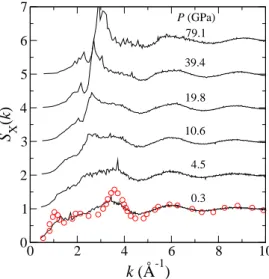
Figure 1 shows the pressure dependence of the X-ray static structure factors
using X-ray form factors. The bottom line and the symbol shows the result of
our calculation and that of experiment at ambient,
5)respectively. In spite of the
temperature difference between the theoretical result and the experimental result,
they have similar positions of the FSDP at about 1.0 ˚ A
−1and that of main peak
at about 3.8 ˚ A
−1. With increasing pressure, the hight of the FSDP decreases and the FSDP disappears at about 10 GPa. The disappearance of the FSDP indicates the break down of the intermediate range order, i.e., the tetrahedral corner-sharing network structure vanishes at about 10 GPa. At about 40 GPa or more, S
X(k) have a spiky main peak at about 3 ˚ A
−1. In these pressure ranges, liquid ZnCl
2becomes to solid state.
0 2 4 6 8 10
k (Å
-1)
01 2 3 4 5 6 7
S
X(k )
0.3 4.5 10.6 19.8 39.4 79.1 P (GPa)
Fig. 1. The pressure dependence of X-ray static structure factors of liquid ZnCl2. The solid lines are our calculated results and the circles are experimental results.
Figure 2 shows the pressure dependence of the self-diffusion coefficients for Zn atoms, D
Zn, and Cl atoms, D
Cl, estimated by slope of the mean square displacements of Zn atoms and Cl atoms as follows:
D
α= lim
t→∞
1 6t
1 N
α∑
i
⟨r
i(t) − r
i(0)⟩ (3.1)
where the bracket means average of time evolution.
At ambient pressure, D
Znand D
Clare similar. With increasing pressure, D
Cldecreases monotonically from ambient to about 40 GPa. On the other hand, D
Zndecreases slower than D
Cl. As a result, D
Znbecomes two times larger than D
Clbetween about 5 and about 10 GPa. The difference between D
Znand D
Cldecreases to almost the same under further compression. Therefore the dynamic asymmetry occurs like covalent liquid B
2O
3under pressure.
18)Under ultra high pressure, the phase transition from liquid state to solid state occurs in this temperature.
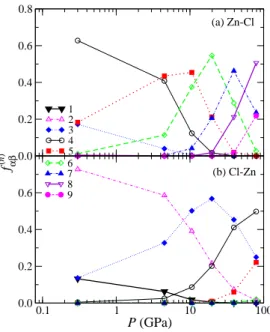
The origin of the difference between the diffusion coefficients is suggested by
fig. 3, which is the pressure dependence of the distributions of the coordination
numbers of α-type atoms connected to β-type atoms f
αβ(n)(α, β=Zn, Cl). At ambient
pressure, almost all Zn atoms have the fourfold-coordination to Cl atoms. With
increasing pressure, the number of the fourfold-coordinated Zn atoms decreases and
the fivefold- and sixfold-coordinated Zn atoms increase. At 5 GPa, the distributions
0.1 1 10 100 P (GPa)
0.1 1 10
Dα (10-9 m2 /s) Zn
Cl
Fig. 2. The pressure dependence of the self-diffusion coefficients of Zn atoms and Cl atoms. The circle symbols and the square symbols indicate the self-diffusion coefficients of Zn atoms and Cl atoms, respectively.
f
ZnCl(4)and f
ZnCl(5)are almost the same, and at 10 GPa, there is almost no fourfold- coordinated Zn atoms but fivefold- and sixfold-coordinated. While, almost all Cl atoms have twofold-coordination to Zn atoms at ambient condition. As the pressure increases, however the number of threefold-coordination increases, the distribution of the number of twofold-coordinated Cl atoms, f
ClZn(2), decreases slower than f
ZnCl(4). As a result, twofold-coordinated Cl atoms remain below 20 GPa. Hence, fourfold- coordinated Zn atoms can move toward twofold-coordinated Cl atoms, i.e., diffusing α-type atoms need lower coordinated β-type atoms.
§
4. Summary
We clarified the pressure dependence of the diffusion properties of molten ZnCl
2at high temperature. At ambient pressure, the diffusion coefficient of Zn atoms D
Znand that of Cl atoms D
Clare almost the same. With increasing pressure, D
Znbecomes about two times larger than D
Clbetween 5 and 10 GPa, the difference between D
Znand D
Cloccurs. The difference decreases under further compression.
The origin of the dynamic asymmetry was discussed.
Acknowledgements
We would like to thank the Supercomputer Center, Institute for Solid State Physics, University of Tokyo for the use of facilities. The computations were also carried out using the computer facilities at the Research Institute for Information Technology, Kyushu University.
References 1) B. Brehler, Z. Kristallogr.115, 373 (1961).
0.0 0.2 0.4 0.6 0.8
6 7 8 9
0.1 1 10 100
P (GPa) 0.0
0.2 0.4 0.6 fαβ
1 2 3 4 5
(a) Zn-Cl
(b) Cl-Zn
(n)
Fig. 3. The pressure dependence of the distributions of the coordination numbers between Zn atoms and Cl atoms. The upper figure shows the distribution of the number of Cl atoms surrounding Zn atoms, and the lower shows that of Zn atoms surrounding Cl atoms.
2) H. R. Oswald and H. Jaggi, Helv. Chim. Acta43, 72 (1960).
3) J. Brynestad and H. L. Yakel, Inorg. Chem.17, 1376 (1978).
4) H. L. Yakel and J. Brynestad, Inorg. Chem.17, 3279 (1978).
5) A. Zeidler, P. S. Salmon, R. A. Martin, T. Usuki, P. E. Mason, G. J. Cuello, S. Kohara, and H. E. Fischer, Phys. Rev. B82, 104208 (2010).
6) V. V. Brazhkin, A. G. Lyapin, S. V. Popova, Y. Katayama, H. Saitoh and W. Utsumi, J.
Phys.: Condens. Matter19, 246104 (2007).
7) A. Sen, M. N. Rao, R. Mittal and S. L. Chaplot, J. Phys.: Condens. Matter 17, 6179 (2005).
8) R. Ruberto, G. Pastore, andM. P. Tosi, Phys. Lett. A373, 1083 (2009).
9) R. Ruberto, G. Pastore, andM. P. Tosi, Physica B405, 974 (2010).
10) P. E. Bl¨ochl, Phys. Rev. B50, 17953 (1994).
11) G. Kresse and D. Joubert, Phys. Rev. B59,1758 (1999).
12) J. P. Perdew, K. Burke, and M. Ernzerhof, Phys. Rev. Lett.77, 3865 (1996).
13) G. Kresse and J. Hafner, Phys. Rev. B49, 14251 (1994).
14) F. Shimojo, R. K. Kalia, A. Nakano, and P. Vashishta, Comput. Phys. Commun.140, 303 (2001).
15) S. Nos´e, Mol. Phys.52, 255 (1984).
16) W. G. Hoover, Phys. Rev. A31, 1695 (1985).
17) M. Tuckerman, B. J. Berne, and G. J. Martyna, J. Chem. Phys.97, 1990 (1992).
18) S. Ohmura and F. Shimojo, Phys. Rev. B80, 020202 (2009).