Soliton‑to‑band optical absorption in a quasi one‑dimensional PtII‑PtIV mixed valence
complex under hydrostatic pressure
journal or
publication title
Physical Review Letters
volume 58
number 20
page range 2122‑2125
year 1987‑05‑18
その他の言語のタイ トル
静水圧下における擬一次元混合原子価白金錯体のソ リトン‑電子帯間光吸収
URL http://hdl.handle.net/2298/9612
doi: 10.1103/PhysRevLett.58.2122
Soliton-to-Band Optical Absorption in a Quasi One-Dimensional Ptn-PtIV
Mixed-Valence Complex under Hydrostatic Pressure N. Kuroda, M. Sakai, and Y. Nishina
The Research Institute for Iron, Steel and Other Metals, Tohoku University, Katahira, Sendai 980, Japan and
M. Tanaka and S. Kurita
Laboratory ofApplied Physics, Faculty of Engineering, Yokohama National University, Hodogaya-ku, Yokohama 240, Japan
(Received 7 October 1986)
A midgap absorption band is observed in the quasi one-dimensional semiconductor
[Pt(en ^Chl (0104)4 under hydrostatic pressures at room temperature, where en is ethylenediamine.
The transition is allowed only for the polarization parallel to the — Cl—Pt11— Cl— PtIV— chain. The peak position remains near the middle of the Peierls gap at any pressure up to 2.2 GPa. The intensity in creases exponentially with the peak shift. The gap states responsible for this band are attributed to soli- ton excitations corresponding to kinks of the charge-density wave.
PACS numbers: 71.38.+i, 78.40.Ha
The commensurate and nearly commensurate charge- density wave (CDW) systems support a soliton excita tion which corresponds to the formation of a domain wall connecting two degenerate phases of periodic distortion of lattice and electron density. Su, Schrieffer, and Heeger have developed a theory of such a kink soliton in long-chain polyenes with the commensurability index of 2.{ They have evaluated the energy of formation, width, mass, and activation energy for motion of the soliton by the Green's function method taking the lattice discrete ness into account explicitly. Subsequently, Takayama, Lin-Liu, and Maki have extended the discrete model to the continuum case which is valid in the limit of weak electron-lattice coupling.2 These theories show that the soliton state may be described in terms of the order pa rameter A(x)=Aotanh(x/^), where 2A0 is the Peierls energy gap and § measures the width of the domain wall.
The electronic level of the soliton lies at Ao, i.e., right at the middle of the Peierls gap. This unique property has been investigated through optical absorption experiments in fra/w-polyacetylene films doped lightly with impuri ties.3 Orenstein and Baker have observed the transient optical absorption due to photoexcited solitons in un- doped polyacetylene fibrils.4 This observation has led them to study the recovery kinetics of thermally inequili- brated solitons.5
The energy of formation, Es, of a soliton is shown to be O.6Ao in the discrete model,1 and 2Ao/^—O.64Ao in the continuum model.2 The energy of formation is a
fundamental parameter for the characterization of a soli ton since it is crucial to statistical properties. Very little experimental verification, however, has been reported on the formation of a kink soliton in an intrinsic material where its physical properties can be controlled by exter nal parameters such as pressure. The significance of ex
citing a soliton in an intrinsic material lies in the fact that it can be formed anywhere in the medium, and can propagate indefinitely unless it encounters some structur al irregularities due to size and/or imperfections such as is the case with /ra/w-polyacetylene. In this Letter, we report experimental results of optical absorption which show the presence of solitons in single crystal of [Pt(en)2][Pt(en)2Cl2](ClO4)4. Here, en refers to the ethylenediamine molecule. A midgap absorption band appears upon the onset of hydrostatic pressure, and its intensity increases markedly with pressure. This new effect is interpreted to arise from an increase in the soli ton density due to the decrease in the order parameter, and thus in Es.
[Pt(en)2][Pt(en)2Cl2](ClO4)4 is one of halogen- bridged mixed-valence platinum complexes (hereafter abbreviated as HMPC). Valence electrons in HMPC form a linear-chain CDW with its commensurability in dex of 2 in accordance with /ra/w-polyacetylene. Pt and Cl ions form either — Pt^L 1—Cl— Pt^v— Cl— PtiV 1—
or —Pt^-i—Cl—Pt^1—Cl—Pt^\i— chains which are
degenerate in energy. These chains are oriented along the crystallographic b axis. They are separated from each other by 8.3 and 9.7 A towards the (101) and the c directions, respectively,6 so that the interaction between
chains is very weak. The electron-lattice interaction within the chain consists of coupling of Pt ions with in tervening Cl ions: The charge transfer between neigh boring Pt ions is induced by the displacement of the Cl ion from the midpoint of two Pt ions. This is in contrast
to the electron-lattice coupling in fra/w-poiyacetylene, in which the coupling originates from the mutual displace ment of adjacent C atoms. Ichinose has proposed the
possibility of the soliton formation in HMPC.7 Recent
ly, Onodera has examined the physical implication of the
difference in the electron-lattice coupling mechanism be
tween trans-polyacetylene and HMPC.8 According to
their theoretical arguments, the Hamiltonian for the halogen-bridged Pt chain becomes equivalent to that for the (CH)X chain in fra/w-polyacetylene in the continuum limit. This result assures that the soliton state in HMPC can be described in terms of a model similar to that of /ra/w-polyacetylene as far as energetic aspects are con cerned. The Peierls gap in [Pt(en)2][Pt(en)2Cl2]-
(004)4 is expected to be some 3 eV with reference to the energy 2.8 eV of the charge-transfer exciton associat ed with this gap.9*10 Consequently, the soliton state is expected to lie near 1.5 eV above the maximum of the valence band.
The experiment is made by the optical absorption of single crystals subjected to hydrostatic pressure. The sin gle crystal is synthesized by the procedure described else where.9 The hydrostatic pressure is generated by the use of a diamond-anvil apparatus. The sample is cut into an area of 50x150 //m2 and cleaved into a thickness of 10-20 /im. It is immersed in the pressure-transmitting fluid in the hole of a metal gasket together with a 10- /im-thick bare sheet of Polaroid linear polarizer. The polarizer is pasted by silicon grease on the culet of the upper diamond anvil, so that the direction of polarization with respect to the crystal orientation can be adjusted by rotation of the upper diamond anvil. The absorption spectrum is measured by a microspectroscopy technique with the spot size of 20 ^m in diameter. The radiation from a microscope is fed to a spectrometer through an optical fiber. This technique allows us to make the sample-in, sample-out measurement without any change in the experimental situation. In particular, the spec trum obtained by this method is not influenced by the depolarization effect due to strain in the diamond at any pressure. All the measurements are performed at room temperature.
We measure the spectrum of the optical density, i.e., -logr, for the EWb polarization, where T refers to the transmittance and E to the electric field of radiation.
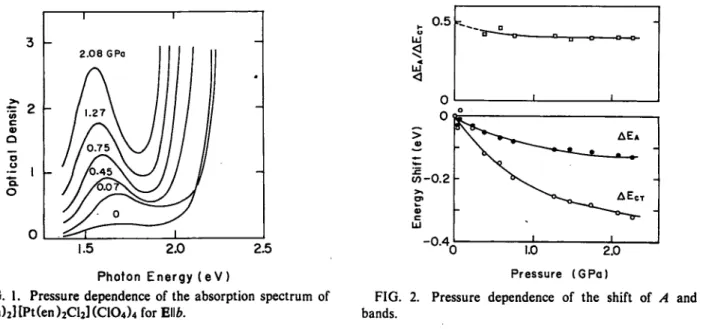
There is a leakage of about 0.8% of the incident radia tion throughout any selected area of the sample with no regard to the wavelength. The leakage is independent of pressure. This phenomenon is probably due to the opti cal inhomogeneity which seems common to many HMPC crystals.10 Hence we make correction for this leakage to obtain the net spectrum for EWb. The results obtained for the sample with a thickness of 20 jum is shown in Fig. 1.
At atmospheric pressure, the spectrum is dominated by the intense absorption band (CT.band) due to the creation of the charge-transfer exciton mentioned above.
In addition, a subsidiary structure 04 band) is observed below the CT band. The A band is intensified by several times upon the onset of a very low pressure (;S0.1 GPa).
The spectral peak lies at the photon energy of 1.67 eV.
Then, its intensity increases continuously as the pressure increases. At the same time, it shifts towards lower en ergies. The absorption edge of the CT band is displaced towards the higher-energy side by 20 meV in coincidence with the discontinuous increase in the intensity of the A band. Then it shifts continuously towards lower energies with pressure. On release of the pressure, the continuous changes take place reversibly. The A band remains un- removed, however, even if the pressure is completely released: It is gradually removed if the sample is kept at ambient conditions for a few weeks.
Figure 2 shows the pressure dependence of the shift of the peak position of the A band and of the photon energy at the optical density of 2.20 of the CT band. Both bands shift nonlinearly with pressure. The magnitude of the shift of the A band is about 0.4 times that of the CT band in the whole pressure range of the present experi ment. It is known that the oscillator strength of the CT
3 -
Photon Energy (eV)
FIG. 1. Pressure dependence of the absorption spectrum of
[Pt(en)2l[Pt(en)2Cl2](ClO4)4 for EII&.
„ 0.5
o
4
0 o <
w-0.2
-0.4c
o
■ V
) 1.0
Pressure
-
AEa
„ AEct
^^-^ -
2.0 (GPa)
FIG. 2. Pressure dependence of the shift of A and CT bands.
2123
band increases considerably as the Peierls gap de
creases.10 This effect would raise the apparent rate of
the shift of the absorption edge. Consequently, one may safely say that the energy of the A band remains near the middle of the Peierls gap regardless of their varia tions. Moreover, both bands disappear in the E±b po larization. These characteristic behaviors can be ex plained in terms of the soliton model that the A band arises from the optical transition from (to) the occupied (unoccupied) mid-gap level to (from) the conduction (valence) band. Besides, we notice that the spectral line shape is asymmetric with a tail on the higher-energy side if the contribution from the CT band is subtracted. This aspect is also characteristic of the soliton spectrum.n'12
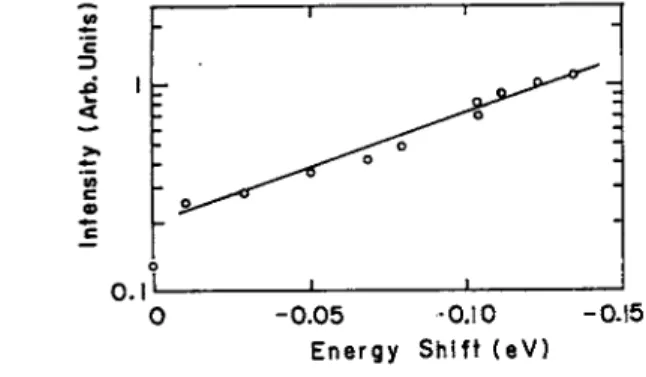
The intensity of the A band is very sensitive to pres sure. The integrated intensity increases rather exponen tially as a function of the energy shift as shown in Fig. 3.
The oscillator strength amounts to 1.2xlO~*2 at 2 GPa, which corresponds to 0.4% of the oscillator strength, 3.0, of the CT band at the atmospheric pressure.10 Accord
ing to theory of the optical absorption in trans- polyacetylene, the oscillator strength fs of the soliton ab
sorption is approximately given by11'12
/1-2.82(5//)nJ/o, (1)
if the normalized soliton density ns is sufficiently low, where / represents the distance between two adjacent CH groups along the chain direction and /o the oscillator strength of the interband absorption in the absence of a soliton. In HMPC, / corresponds to the distance be tween adjacent Pt11 and PtIV ions. Applying Eq. (1) to
(/) 4
our experimental results, we have (£/l)ns — 3x 10 "4 atj atmospheric pressure.
The Peierls gap opens between dzi states of Pt11 and
PtIV which have bonding and antibonding characters in
connection with the p2 states of Cl, respectively.9 The
dimerization is driven by the collaboration of the electron-electron repulsion between the neighboring Pt ions and the electron-lattice coupling. The kinetic ener gy and the on-site electron-electron repulsion compete with these interactions. Nasu has developed a mean-field theory of this system, and discussed its optical proper-
0 -O.O5 -O.IO -0.15
Energy Shift (eV)
FIG. 3. Plot of the integrated intensity vs the shift of the A band.
ties.13 According to his results, the energy gap decreases quadratically with the transfer energy, /o, of the dzi orbit between Pt ions. The transfer energy increases upon contraction of the chain, causing the system to be more metallic. Therefore the energy gap and Ao decrease with pressure. Tanino et al have also observed a pressure- induced red shift of the charge-transfer absorption edge in Walffram's red salt, which is another member of HMPC.14
£// in Eq. (1) can be rewritten in the Takayama-Lin- Liu-Maki model as 2/oMo. The fractional decrease in Ao can be estimated to be —7% at 2 GPa from Fig. 2. A similar amount of increase in to is expected in the first- order approximation. Consequently, the fractional in crease in £// is expected to be (10-20)% at 2 GPa, which is negligibly small in comparison with the increase in fs. It follows from these estimates that the change in fs induced by pressure arises primarily from the change in the soliton density. The behavior of the integrated in tensity of the A band (Fig. 3) suggests that the density is limited by an activation energy which decreases as Ao under pressure. If the activation energy is assumed to correspond to the formation energy, the slope of the ex perimental points of Fig. 3 yields £^0=0.32, which is comparable with theoretical values (—0.6) mentioned at the beginning of this Letter.
There are two mechanisms of the thermal excitation of solitons. One is the ordinary soliton-antisoliton pair ex citation on the uniform part of a chain, where a single soliton cannot be created because of topological restric
tions. lltI2 The other is the injection of a single soliton
from an edge of the chain. A soliton and its antisoliton can be created individually but alternately at the edge because the topological restriction is lifted by the discon tinuity of bonding. Though it is difficult to determine which is the case from our experimental results, one can not neglect the single-excitation process because the
crystal of [Ptten^HPUen^ChKClO^ consists of
columnar structures with a length of 5 to 8 jim and a
thickness of about 1 /im.15 We recall here that the A
band appears discontinuously at a very low pressure.
This fact indicates that the midgap absorption is promot ed by a slight modification of lattice. It is likely that the initial compression of the crystal induces a modification of the atomic arrangement near the edge of each colum nar structure such as to diminish the potential barrier against the injection of a soliton. The A band is oc casionally observed even for virgin samples. It does not disappear if the sample is cooled down to liquid-nitrogen
temperatures.9 This fact implies that solitons are
confined within chains. This is plausible because the re sidual potential barrier and/or the activation energy for motion of a soliton could be significantly large in com parison with thermal energies at low temperatures.
In conclusion, the optical absorption band which ap pears within the Peierls gap in
(004)4 exhibits a unique behavior under hydrostatic pressure. The peak position, the spectral line shape, the polarization property, and the pressure dependences of the intensity and the peak position are consistently ex plained in terms of the soliton model which is similar to the case of /raAw-polyacetylene. The pressure depen dence of the intensity suggests that the kink solitons are created predominantly at the edge of the halogen- bridged Pt chain. The detail of the excitation mecha nism is not, however, clear yet because we have very lit tle information on crystallographic properties involving the lattice imperfections in this material. A firm identification must, therefore, await experimental studies of the microscopic structure under pressure.
A preliminary measurement was performed at The In stitute for Solid State Physics of Tokyo University using equipment offered by Professor S. Akimoto. The authors thank Professor Y. Onodera of Tokyo Metropolitan Uni versity for informing them of the results of his theoreti cal work (Ref. 8) prior to publication. This work was supported in part by a Grant-in-Aid for Scientific Research from the Ministry of Education, Science, and Culture of Japan.
!W. P. Su, J. R. Schrieffer, and A. J. Heeger, Phys. Rev.
Lett. 42, 1698 (1979), and Phys. Rev. B 22, 2099 (1980), and 28, 1138(E) (1983).
2H. Takayama, Y. R. Lin-Liu, and K. Maki, Phys. Rev. B 21,2388 (1980).
3K. Suzuki, M. Ozaki, S. Etemad, A. J. Heeger, and A. G.
MacDiarmid, Phys. Rev. Lett. 45, 1209 (1980).
4J. Orenstein and G. L. Baker, Phys. Rev. Lett. 49, 1043 (1982).
5C. V. Shank, R. Yen, R. L. Fork, J. Orenstein, and G. L.
Baker, Phys. Rev. Lett. 49, 1660 (1982); A. G. MacDiarmid, Phys. Rev. Lett. 45, 1209 (1980).
6N. Matsumoto, M. Yamashita, and S. Kida, Mem. Fac.
Sci. Kyushu Univ. Ser. C 11, 209 (1978).
7S. Ichinose, Solid State Commun. 50, 137 (1984).
8Y. Onodera, J. Phys. Soc. Jpn. 56, 250 (1987).
9M. Tanaka, S. Kurita, T. Kojima, and Y. Yamada, Chem.
Phys. 91, 257 (1984).
I0Y. Wada, T. Mitani, M. Yamashita, and T. Koda, J. Phys.
Soc. Jpn. 54, 3134(1985).
nK. Maki and M. Nakahara, Phys. Rev. B 23, 5005 (1981).
I2K. Fesser, A. R. Bishop, and D. K. Campbell, Phys. Rev. B 27,4804(1983).
13K. Nasu, J. Phys. Soc. Jpn. 52, 3865 (1984), and 53, 302 (1984), and 53, 427 (1984).
I4H. Tanino, N. Koshizuka, K. Kobayashi, M. Yamashita, and K. Hoh, J. Phys. Soc. Jpn. 54, 483 (1985).
I5A. Kawamori, R. Aoki, and M. Yamashita, J. Phys. C 18, 5487 (1985).
2125