• 検索結果がありません。

Development of High Performance Aluminum-Iron Alloys by High-Pressure Torsion

N/A
N/A
Protected

Academic year: 2021

シェア "Development of High Performance Aluminum-Iron Alloys by High-Pressure Torsion"

Copied!
148
0
0

読み込み中.... (全文を見る)

全文

(1)

九州大学学術情報リポジトリ

Kyushu University Institutional Repository

Development of High Performance Aluminum-Iron Alloys by High-Pressure Torsion

ホルヘ マウリシオ クベロ セシン

https://doi.org/10.15017/1398352

出版情報:九州大学, 2013, 博士(工学), 課程博士 バージョン:

権利関係:全文ファイル公表済

(2)

Development of High Performance Aluminum-Iron Alloys by High-Pressure Torsion

By:

Jorge Mauricio Cubero-Sesin

Supervisor:

Prof. Zenji Horita

A Thesis Submitted to the Graduate Studies Office in Fulfillment of the Requirements for the Degree of Doctor of Engineering

Department of Materials Science and Engineering Kyushu University

Fukuoka, Japan

July 2013

(3)

Certificate

The undersigned reviewing committee members hereby certify that Jorge Mauricio CUBERO-SESIN defended the thesis entitled “Development of High Performance Aluminum-Iron Alloys by High-Pressure Torsion” in June 2013 and it was accepted in fulfillment of the requirement for the degree of Doctor of Engineering at Kyushu University.

Zenji HORITA

(Professor, Faculty of Engineering, Kyushu University)

Kenji HIGASHIDA

(Professor, Faculty of Engineering, Kyushu University)

Minoru NISHIDA

(Professor, Faculty of Engineering Sciences, Kyushu University)

(4)

Acknowledgements

First I would like to express my deepest gratitude to my supervisor, Prof. Zenji Horita, for his guidance, dedication and support throughout my experience as a student in Japan, as well as for the multiple opportunities to attend scientific conferences and to publish my work. His insightful discussions prompted my interest to pursue the research enthusiastically.

Secondly I would like to thank the reviewers of this thesis, Prof. Kenji Higashida and Prof. Minoru Nishida, for taking the time to review the manuscript as well as for their invaluable questions and comments.

I would also like to thank Dr. Seungwon Lee, Dr. Kaveh Edalati, Prof. Makoto Arita Prof. Yoshifumi Ikoma and Mr. Hideaki Iwaoka, as well as the rest of the members of Horita Laboratory for their assistance, comments and support. Deep appreciation is expressed to Prof.

Masashi Watanabe, Dr. Qian He and Dr. Austin Wade in Lehigh University for their time and valuable inputs which made possible to carry out the high-resolution electron microscopy studies in this work.

Finally I would like to acknowledge the Ministry of Education, Culture, Sports,

Science and Technology (MEXT) of Japan for my scholarship and the Japan Aluminum

Association for providing the bulk material utilized in this work.

(5)

Abstract

This thesis examined the mechanical properties and microstructures, as well as the aging behavior and precipitation characteristics of Al-Fe alloys processed by High-Pressure Torsion (HPT), as a method to control the microstructures and achieve high strength and ductility, superior to the high performance commercial Al alloys, using Fe -their most common impurity- as the single alloying element.

Al-rich Al-Fe alloys with increasing Fe concentrations and initial states of the microstructures prepared by combinations of casting, hot-extrusion and annealing, as well as elemental powder mixtures were processed by HPT at room temperature. It is shown that there is an effect of the initial state of the microstructure on the microstructure evolution after HPT. Unlike pure metals, where the initial grain size has been shown to have less effect, the nature and morphology of the secondary phases play a significant role in the case of the multiphase alloys in this study. The evolution of microstructure and mechanical properties are enhanced when processing by HPT from the as-cast state, since the intermetallic phases in eutectic structures are fragmented into irregularly shaped particles, which are more effective for grain refinement when processing at the low temperatures. However it is also shown that the mechanical properties saturate to similar levels at equal Fe concentration regardless of the initial state of the microstructure, when sufficient strain is introduced to the material. The coarse intermetallic phases in the hypereutectic samples have less effect on the strength and lower the total elongation to failure because only partial fragmentation of this phase can be achieved even after extensive HPT straining.

It is shown by microstructure observation and analysis using high-resolution electron

microscopy and X-ray diffraction, that the high strength and uniform elongation is the result

of the formation of a close-to nanograined microstructure in the Al matrix, a uniform

dispersion of the existing intermetallic phases and precipitation of coherent metastable

particles from the supersaturated solid solution of Fe in Al, all of which can be achieved in the

solid-state by HPT.

(6)

Contents

Chapter 1. Introduction

1.1. Background ... 1

1.1.1. The Al-Fe binary system ... 1

1.1.2. Out-of-equilibrium processing and effect of the cooling rate... 2

1.2. Microstructure control of Al-Fe alloys by High-Pressure Torsion ... 3

1.3. Objectives ... 5

1.4. References ... 6

Chapter 2. Evolution of microstructures and mechanical properties with different initial states 2.1. Introduction ... 8

2.2. Experimental Materials and Procedures ... 9

2.3. Results and Discussions ... 12

2.3.1. Density of powder-consolidated samples ... 12

2.3.2. Microhardness of the samples after processing by HPT ... 13

2.3.3. TEM observations of the microstructures before and after HPT ... 17

2.3.4. Grain size distributions in samples after HPT ... 19

2.3.5. Tensile tests and fractography... 19

2.3.6. Basic characterization of the Fe-containing phases after HPT ... 23

2.4. Summary and Conclusions ... 26

2.5. References ... 27

Chapter 3. Processing of bulk materials up to high strains 3.1. Introduction ... 29

3.2. Experimental Materials and Procedures ... 30

3.3. Results and Discussions ... 31

3.3.1. Microstructures of the as-cast materials ... 31

3.3.2. Microstructures of the extruded and annealed materials ... 33

3.3.3. Microhardness distribution and evolution in the HPT-processed disks ... 34

3.3.4. Microstructure comparison after HPT by TEM ... 36

3.3.5. Grain size distributions in the cast samples after HPT ... 39

3.3.6. Intermetallic particle fragmentation by HPT ... 40

(7)

3.3.7. Tensile tests and fractography... 44

3.3.8. XRD analysis and Fe solubility ... 47

3.3.9. Evolution of microhardness and microstructural features with HPT ... 48

3.4. Summary and Conclusions ... 49

3.5. References ... 51

Chapter 4. Processing of powder materials up to high strains 4.1. Introduction ... 53

4.2. Experimental Materials and Procedures ... 54

4.3. Results and Discussions ... 55

4.3.1. Degree of consolidation with HPT straining ... 55

4.3.2. Microhardness evolution and distribution in the HPT-processed disks ... 56

4.3.3. Distribution of the Fe particle dispersion after HPT ... 60

4.3.4. Microstructure evolution after HPT by TEM ... 63

4.3.5. Grain size distributions in the center and the edge of the consolidated disk ... 64

4.3.6. Tensile tests and fractography... 64

4.3.7. Evolution of microhardness and microstructural features with HPT ... 69

4.4. Summary and Conclusions ... 71

4.5. References ... 72

Chapter 5. Aging behavior after straining by HPT 5.1. Introduction ... 75

5.2. Experimental Materials and Procedures ... 77

5.3. Results and Discussions ... 77

5.3.1. Optical microscopy ... 77

5.3.2. Microhardness evolution with imposed strain and isothermal aging ... 79

5.3.3. Aging behavior ... 80

5.3.4. XRD analysis of Fe dissolution and precipitation ... 82

5.3.5. Microstructure observations by TEM ... 88

5.3.6. TEM observations and analyses of precipitates ... 92

5.3.7. Tensile tests and fractography... 95

5.4. Summary and Conclusions ... 99

5.5. References ... 101

(8)

Chapter 6. High-resolution electron microscopy of HPT-processed and aged samples

6.1. Introduction ... 104

6.2. Experimental Materials and Procedures ... 106

6.3. Results and Discussions ... 107

6.3.1. TEM analysis of the eutectic phases in the as-cast material ... 107

6.3.2. Characterization of the Fe-containing phases by STEM/EDS ... 112

6.3.3. HR-TEM observation and analyses of the as-HPT microstructures ... 118

6.3.4. HR-S/TEM observation of precipitates after aging ... 128

6.4. Summary and Conclusions ... 134

6.5. References ... 135

Chapter 7. General Summary and Concluding Remarks ... 137

(9)

1

Chapter 1

Introduction

1.1. Background

Aluminum (Al) alloys have gained widespread use in modern engineering applications due to several advantages, such as weight reduction and good ductility, but especially due to the increase in strength when combined with other elements as Mg, Si, Cu and Zn. This has been possible by the use of traditional methods such as work (deformation) hardening, solid solution hardening, grain refinement and fine dispersion of precipitate particles [1,2].

However, for the case of iron (Fe), its application to commercial Al alloys is limited. Often considered one of the most common impurities due to its general abundance, Fe appears as a leftover during production, casting and other processing techniques [3]. Its common use in devices and components increases the contamination of Al with Fe during recycling [3,4].

1.1.1. The Al-Fe binary system

The Al-rich side of the Al-Fe phase diagram is shown in Fig. 1.1. According to the equilibrium condition, the solubility of Fe in Al is very low (<0.052 wt%), [3,5,6] which leads to the formation of hard, brittle intermetallics and a subsequent reduction in formability.

Besides the early nucleation of intermetallic second phases, there is a eutectic reaction

between Al (solid solution) and the Al 3 Fe compound. It is said that the eutectic composition

ranges from 1.7 - 2.2 wt% Fe [1-3]. Fig. 1.2 presents the summary of phase formation in

castings with a wide range of cooling rates with respect to the Fe content. It can be seen from

this figure that increasing the cooling rate results not only in the formation of the Al 6 Fe

metastable phase, but also the extension of the solubility limit to higher fractions of Fe. The

word ‘eutectics’ is used to describe a group of several intermetallic phases, e.g., Al m Fe.

(10)

2 Fig. 1.1 Al-rich side of equilibrium Al-Fe phase diagram [3]

Fig. 1.2 Phase formation in castings of Al-Fe binary alloys [3]

1.1.2. Out-of-equilibrium processing and effect of the cooling rate

The solidification of the Al rich Al-Fe system under several cooling rates and its deviation from equilibrium was studied using methods such as Rapid Quenching (RQ) [7-9], Mechanical Alloying (MA) [7,8,10-12] and Severe Plastic Deformation (SPD) [7-9,13-15].

The application of such out-of-equilibrium methods documented the attainment of a

(11)

3 supersaturated solid solution as well as the formation of several stable and meta-stable phases, and it was shown that Fe in solid solution and/or finely dispersed particles may provide a potential for higher strength.

1.2. Microstructure control of Al-Fe alloys by High-Pressure Torsion

High-Pressure Torsion (HPT) is now well known as a typical processing procedure of SPD, where a sample in a form of a disk or a ring is placed between two anvils and shear strain is introduced in the sample by rotating the anvils with respect to each other under a high compressive load [16]. It was shown that significant grain refinement occurs through the application of HPT and considerable increase in strength is attained [17]. HPT is also capable of consolidating powder mixtures consisting of different elements and/or metal-ceramic composites so that in-situ production of bulk metallic alloys and/or composites is feasible at lower temperatures through solid state reactions, often without requiring sintering process [16-27].

Fig. 1.3 shows a schematic illustration of the modern HPT process.

Fig. 1.3 Schematic illustration of HPT process [28]

It was reported [14] that an Al-11 wt% Fe alloy increased its strength by processing with

(12)

4 HPT and the subsequent aging led to a further increase in strength. It was suggested that not only the grain refinement but also dissolution of Fe occurred. Another study [7] employed a combination of RQ and HPT and obtained significant strengthening in an Al-8 wt% Fe alloy with increased solid solubility. Subsequent work by the same group [8,9] reported additional results by applying RQ and HPT to Al-Fe alloys with different Fe concentrations (2, 8 and 10 wt%) to show an increase in microhardness with aging. Another study employing equal-channel angular pressing (ECAP) to process a cast Al-5 wt% Fe alloy [15] reported grain refinement of the Al matrix and dispersion of second phase particles so that the process led to improvement of not only the microhardness but also the tensile strength and ductility.

This study also indicates the importance of backpressure in ECAP processing so that fragmentation of the particles well proceeds to give rise to additional increase in the strength.

Because higher pressure can be applied by using HPT compared to ECAP, it is anticipated

that finer fragmentation may be achieved. It is also anticipated that the initial state of the

sample may affect the fragmentation of the particles.

(13)

5 1.3. Objectives

The previous reports have demonstrated great potential to increase the strength of Al by alloying with Fe and processing by severe plastic deformation.

It was shown that modification of the initial state of the microstructure by means of rapid quenching, and in some degree by mechanical alloying of elemental powders, plays an important role in the final properties after HPT, related to the size, shape and the phase of the Fe-rich particles [7-9]. However, the fabrication of such initial microstructures at hypereutectic concentrations usually requires extremely high cooling rates (or milling times), as can be appreciated from Fig. 1.2. According to reports of multiphase alloys after HPT [17]

there is an effect of the initial state of the microstructure in the final microstructure after HPT.

Unlike pure metals, where the initial grain size has been shown to have little effect in the microstructure after HPT, the nature and morphology of the secondary phases play a significant role related to the size, shape and the phase of the Fe-rich particles.

Additionally, the combined effect of the Fe addition and initial state with imposed strain has not been studied systematically, and no investigations have been carried out on the aging behavior and precipitation characteristics in this system after HPT.

The objective of this thesis is to optimize the Fe content and the initial state of the

microstructure to produce a high performance Al-rich, Al-Fe alloy, which can combine good

characteristics of strength and ductility. An approach toward an industrial application of this

material is taken by selecting lower contents of Fe and common industrial processes such as

casting, extrusion, annealing and powder metallurgy, as the initial microstructures.

(14)

6 1.4. References

[1] Hatch JE (Ed.) (1984) Aluminum: Properties and Physical Metallurgy, 1st ed. American Society for Metals, Materials Park, OH, p. 25-57.

[2] Totten GE, MacKenzie DS (Eds.) (2003) Handbook of Aluminum, Volume I: Physical Metallurgy and Processes, 1st ed. Marcel Dekker, Inc., p. 81-210.

[3] Belov NA, Aksenov AA, Eskin DG (2002) Iron in Aluminum Alloys: Impurity and Alloying Element, 1st ed. Taylor and Francis, London, p. 1-7.

[4] Schlesinger ME (2007) Aluminum Recycling, 1st ed., CRC Press, Boca Raton, FL, p. 1-8.

[5] Kattner UR, Burton BP (1993) In: Baker H (Ed.) ASM Handbook Vol. 03 - Alloy Phase Diagrams. ASM International, Materials Park, OH, p. 2-44

[6] Lendvai A (1986) J. Mater. Sci. Lett. 5:1219

[7] Kaloshkin SD, Tcherdyntsev VV, Tomilin IA, Gunderov DV, Stolyarov VV, Baldokhin YV, Brodova, IG, Shelekhov EV (2002) Mater. Trans. 43:2031

[8] Tcherdyntsev VV, Kaloshkin S, Afonina EA, Tomilin IA, Baldokhin YV, Shelekhov EV, Gunderov DV, Brodova IG, Stolyarov VV (2003) Defect Diffus. Forum 216:313

[9] Tcherdyntsev VV, Kaloshkin SD, Gunderov DV, Afonina EA, Brodova IG, Stolyarov VV, Baldokhin YV, Shelekhov EV, Tomilin IA (2004) Mater. Sci. Eng. A 375:888

[10] Mukhopadhyay DK, Suryanarayana C, Froes FH (1995) Metall. Mater. Trans. A 26:1939

[11] Cardellini F, Contini V, Mazzone G (1996) J. Mater. Sci. 31:4175

[12] Cardellini F, Contini V, Gupta R, Mazzone G, Montone A, Perin A, Principi G (1998) J.

Mater. Sci. 33:2519

[13] Senkov ON, Froes FH, Stolyarov VV, Valiev RZ, Liu J (1998) Scripta Mater. 38:1511

[14] Senkov ON, Froes FH, Stolyarov VV, Valiev RZ, Liu J (1998) Nanostruct. Mater. 10:691

[15] Stolyarov VV, Lapovok R, Brodova IG, Thomson PF (2003) Mater. Sci. Eng. A 357:159

(15)

7 [16] Valiev RZ, Estrin Y, Horita Z, Langdon TG, Zehetbauer MJ, Zhu YT (2006) JOM - J.

Min. Met. Mat. 58:33

[17] Valiev RZ, Islamgaliev RK, Alexandrov IV (2000) Prog. Mater. Sci. 45:103

[18] Korznikov AV, Safarov I, Laptionok DV, Valiev RZ (1991) Acta Metall. Mater. 39: 3193 [19] Shen H, Guenther B, Koanikov AV, Valiev RZ (1995) Nanostruct. Mater. 6:385

[20] Valiev RZ, Mishra RS, Groza J, Mukherjee AK (1996) Scripta Mater. 34:1443

[21] Sort J, Zhilyaev AP, Zielinska M, Nogues J, Surinach S, Thibault J, Baro MD (2003) Acta Mater. 51:6385

[22] Lee Z, Zhou F, Valiev RZ, Lavernia EJ, Nutt SR (2004) Scripta Mater. 51:209.

[23] Alexandrov IV, Zhu YT, Lowe TC, Islamgaliev RK, Valiev RZ (1998) Nanostruct. Mater.

10:45.

[24] Alexandrov IV, Zhu YT, Lowe TC, Valiev RZ (1998) Powder Metall. 41:11

[25] Alexandrov IV, Zhu YT, Lowe TC, Islamgaliev RK, Valiev RZ (1998) Metall. Mater.

Trans. A 29:2253

[26] Stolyarov VV, Zhu YT, Lowe TC, Islamgaliev RK, Valiev RZ (2000) Mater. Sci. Eng. A 282:78

[27] Edalati K, Horita Z, Fujiwara H, Ameyama K (2010) Metall. Mater. Trans. A, 41:3308

(16)

8

Chapter 2

Evolution of microstructures and mechanical properties with different initial states

2.1. Introduction

Due to its negligible solid solubility at room temperature, the use of Fe as an alloying element in Al has been limited because it forms brittle intermetallics [1-5]. However their often complex crystalline structures give them unique properties such as high strength even at higher temperatures [6,7]. Therefore, there can be good potential to increase the strength of Al-Fe alloys without greatly compromising ductility if the Fe-containing intermetallics are present in finely dispersed states. It is also possible to improve other properties such as temperature and corrosion resistance with a fine dispersion of the Fe-bearing intermetallics.

Intermetallics in the form of fine structures help to stabilize the Al matrix and inhibit the movement of dislocations. The presence of Fe could then increase hardness levels at the steady state attained during severe plastic deformation (SPD) of pure Al and some Al alloys [8-12]. Therefore, in recent years, research of different techniques has been attempted to refine secondary phases. Cast Al-Fe alloys have been studied to some extent by SPD through high-pressure torsion (HPT) and equal-channel angular pressing (ECAP) [13-15], especially emphasizing the role of supersaturation of Fe and dispersion of intermetallic phases. The study by Senkov et al [13] applied HPT to a cast Al-11 wt% Fe alloy and reported the formation of a nanocrystalline structure in the Al matrix and dispersion of intermetallics with

< ~1 μm in size. The report by Stolyarov et al [15] presented the results from an Al-5 wt% Fe

alloy processed by ECAP including the formation of an ultrafine-grained structure. The

importance of backpressure to facilitate the fragmentation of intermetallics and to improve

ductility was also mentioned. Some other studies have applied HPT to Al-Fe alloys prepared

(17)

9 by mechanical alloying (MA) or rapid quenching (RQ) [16-18] and highlighted the use of HPT to refine and dissolve different stable and metastable intermetallic phases. However, there have been no systematic studies concerning the evolution of microstructures and mechanical properties with intense straining by HPT.

In this chapter, HPT was applied to Al-Fe alloys with four different compositions having different microstructural states after extrusion and annealing including mixtures of Al and Fe powders. The purpose of annealing was to provide a homogenized microstructure when compared to the as-extruded condition. The evolutions of microstructure and mechanical properties with straining by HPT are examined to obtain an optimum state of the initial microstructure for HPT processing.

2.2. Experimental Materials and Procedures

In this chapter samples in the form of bulk and powder were compared. Powder mixtures were first prepared from powders of high-purity Al (99.99%) sieved through 75μm mesh and of Fe (> 99.9%) through 53μm mesh and then they were manually agitated for 5 min.

Designated compositions of the powders were determined by using an electronic scale with the following Fe contents: 0.5%, 1%, 2% and 5%. A sufficient amount of the powder mixtures was then placed between the upper and lower anvils in the HPT facility for direct consolidation at room temperature. Each anvil has a shallow circular cavity with 10 mm in diameter and 0.25 mm in depth at the center of the anvil. Fig. 2.1 shows the appearance of a disk sample consolidated after HPT processing for 1 revolution.

Density measurements were carried out to validate the effectiveness of the consolidation

process. The thickness of the samples after HPT is 0.7 ± 0.1 mm, given that some material

flows out of the cavity during the HPT processing. The density of the consolidated disks was

measured by Archimedes' principle with a Mettler Toledo XS204 analytical balance using

water at room temperature as the reference.

(18)

10 Fig. 2.1 Appearance of powder sample after HPT processing for N=1 revolution.

Bulk material was supplied by Kobe Steel, Ltd. in the form of extruded rods having 20 mm in diameter. These rods were obtained by extrusion from cast ingots with 155 mm in diameter and 200 mm in length at an extrusion speed of 2 mm/min. at 723 K (450°C). The ingots have four different nominal weight fractions as 0.5%, 1%, 2% and 5% Fe and they were verified using inductively coupled plasma atomic emission spectroscopy (ICP-AES), including the analysis of other impurities. Table 1.1 summarizes the chemical compositions of the cast samples used in this study. The presence of other impurities was estimated to be low enough to be considered in this study. The 0.5% and 1% samples are hypoeutectic, whereas the 2% appears to be well within the eutectic composition [3]. The Al-5% Fe material had a final composition of 3.72%, which is below the nominal value. However, this sample is well in the hypereutectic range, and for practical purposes it will be compared to its powder counterpart, taking into account the slight difference in the Fe content. Hence, the composition of the alloy is referred to as a nominal fraction of 4% Fe.

Table 1.1 Chemical composition of Al-Fe bulk samples after casting (in wt%)

Material Fe Si Mn Mg Cr Zn Ti Ni

Al-0.5% Fe 0.50 < 0.003 0.006 < 0.172 0.004 0.004 < 0.001 < 0.022

Al-1% Fe 0.98 < 0.003 0.008 < 0.178 0.004 0.004 < 0.001 < 0.022

Al-2% Fe 1.99 < 0.004 0.012 < 0.189 0.003 0.002 < 0.001 < 0.041

Al-4% Fe 3.72 < 0.008 0.022 < 0.220 0.004 0.002 < 0.001 < 0.041

(19)

11 For HPT processing, the rods were first sliced into disks with 0.9 mm thicknesses using a metal cutting wheel. Thereafter, a wire-cutting electrical discharge machine (EDM) was used to extract the 10 mm diameter disks. A set of disk samples, containing each of the above mentioned compositions, was annealed at 773 K (500°C) for 1 hour, whereas a separate set was left as-received, to evaluate the effect of the previous extrusion process. Annealing was conducted in air and the samples were left inside the furnace to cool to room temperature.

Both sets of the heat-treated and as-received disks were processed by HPT. The physical appearance of the bulk samples after HPT is very similar to the powder sample in Fig. 2.1.

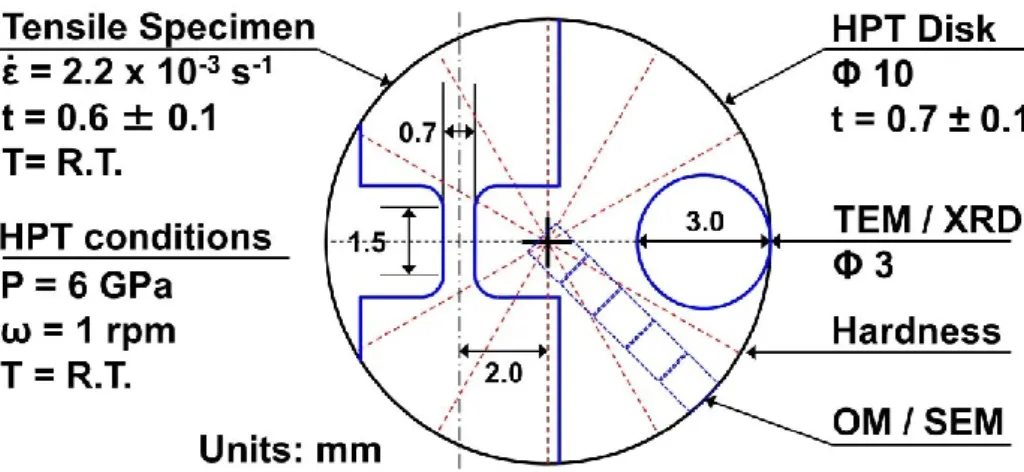
HPT was conducted on the powder and bulk samples at room temperature under an applied pressure of 6 GPa with a rotation speed of 1 rpm for different numbers of revolutions as N = 1, 5, 10. Basic mechanical properties such as Vickers microhardness (H v ), tensile strength and ductility were evaluated. Fig. 2.2 illustrates the dimensions of specimens for evaluation of mechanical properties. HPT-processed disks are polished using papers with 320-1000-2000 grits and mechanically buffed with an alumina powder solution to obtain a mirror-like surface for hardness testing. The measurements were made along 30º-spaced radial directions in the surface of the disks, for a total of 12 radii. The first indentation was done at 0.1 mm from center and the following by every 0.5 mm up to 4.5 mm, for a total of 120 indentations. Measurements were averaged at equal distances from the center. The hardness measurements were performed using an Akashi MVK-E3 tester or a Mitutoyo HM-102 tester with selected loads of 50, 100 and 200 g for 15 s.

Tensile specimens having dimensions of 1.5 mm long, 0.7 mm wide and 0.6 ± 0.1 mm

thick were extracted from the disks as shown in Fig. 2.2. They were pulled at room

temperature with an initial strain rate of 2.2 x 10 -3 s -1 using a Shimadzu AG-10kNE tester. It

should be noted that the thickness of each tensile specimen was measured before tensile

testing. Additionally, due to the miniature-size specimens certain care should be taken,

(20)

12 especially when comparing with results from other studies using specimens with different dimensions, as it was described by Zhao et al. [19]. Thus tensile tests from specimens of high-purity Al processed by HPT, both from powder and bulk, were carried out for comparison. Fractographs of the failed surfaces were observed with a Hitachi S-4300SE scanning electron microscope (SEM) operating at 20 kV.

Fig. 2.2 Schematic illustration of HPT sample and dimensions of extracted specimens for evaluation of mechanical properties and microstructural analysis.

For transmission electron microscopy (TEM) and X-ray diffraction (XRD) analysis, disks with 3 mm in diameter were punched out from the edge of the HPT disks at 3.5 mm from the center, as shown in Fig. 2.2. X-ray profiles were obtained from these disks with a Rigaku X-ray diffractometer using the Cu-target Kα radiation. These disks are later ground mechanically to 0.15mm thickness and further thinned for TEM using a solution of 20%

H 2 SO 4 and 80% CH 3 OH in a twin-jet electropolishing apparatus. TEM was undertaken using

a Hitachi H8100 microscope operating at 200 kV. Selected area electron diffraction (SAED)

patterns were obtained from areas covering ~6.3 μm in diameter. For observation in the

optical microscope (OM), samples were electro-polished with the same solution as the TEM

samples mentioned above and then electro-etched using a solution of 5% HF + 95% H 2 O.

(21)

13 2.3. Results and Discussion

2.3.1. Density of powder-consolidated samples

The results from the density measurements as a function of Fe content are shown in Fig. 2.3, for powder samples after HPT processing for N=1 and N=10 revolutions. Theoretical densities of the alloys were calculated using the Vegard’s Law [20] where a linear relationship exists with the concentration as:

) 1 ( x x Al

Fe Fe

Al     

 (1)

where x is the volume fraction of Fe, and  Al-Fe ,  Al and  Fe are the densities of the alloy, pure Al and pure Fe, respectively. The alloy density calculated using eq. (1) is drawn as a solid line in Fig. 2.3. Comparison between the measured and calculated densities shows that all measured densities reasonably follow the Vegard’s Law. The maximum deviation of the data points in Fig. 2.3 from Vegard’s Law corresponds to a relative density of 99.34%. This agreement suggests that consolidation of powder samples was sufficiently achieved by HPT processing, already after N=1 revolution.

Fig. 2.3 Density measurements obtained from powder samples after HPT.

2.3.2. Microhardness of the samples after processing by HPT

Fig. 2.4 shows the measured values of Vickers microhardness (H v ) plotted against the

(22)

14 distance from the disk center. Each point represents the average of the measured values at equal spacing in the disk, while the error bars indicate the standard deviation between these values. Thus, the graphs plotted against the distance from the disk center provide a straightforward interpretation of the variation of hardness along the radial direction. Fig.

2.4(a)-(d) correspond to plots of the extruded (EXT+HPT) bulk samples, the annealed (EXT+ANN+HPT) bulk samples and mixed powder (POW+HPT) samples for each Fe content. The initial levels of hardness in the as-extruded and annealed conditions are plotted in each figure accordingly. Hardness increases in general with increasing distance from the disk center and with increasing content of Fe. Such increases in hardness are most prominent in the as-extruded samples, although the trends are similar between the two types of the bulk samples. For the powder samples, the hardness levels as well as the effect of Fe addition appears to be low when compared with the two types of the bulk samples.

Fig. 2.4 Plots of Vickers microhardness against distance from disk center for samples with Fe

contents of a) 0.5% Fe, b) 1% Fe, c) 2% Fe and d) 4% Fe

(23)

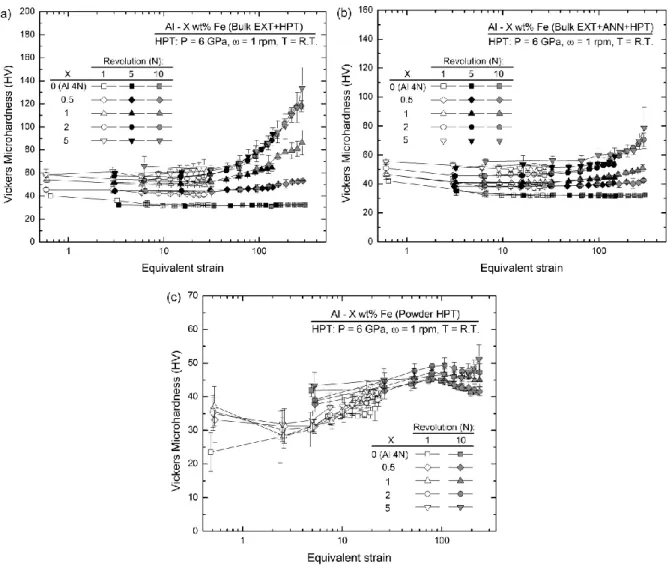
15 The hardness results suggest that there is a difference in the state of Fe in which the presence of Fe as an elemental state is less effective for hardening within the strain imposed by HPT. The difference in the trends is more clearly demonstrated when the hardness is plotted against the equivalent strain in Fig. 2.5(a)-(c) for the corresponding samples. Here, the equivalent strain  is given by the following functional form with the distance from the disk center r, the number of revolutions N and the sample thickness t [8]:

t rN 3 2 

  (2)

High-purity Al (99.99%) samples in bulk and powder forms processed under the same conditions are also plotted for comparison purposes. For the samples of pure Al and of lower contents of Fe, the hardness saturates to constant levels with straining. Presence of the constant hardness level was reported in many pure metals and alloys [8-12] when they were subjected to HPT processing. In the case of Al, it was considered that the appearance of the constant hardness is due to a balance between hardening by the generation of dislocations and softening by the recovery of dislocations. With the increasing addition of Fe, however, the constant level no longer appears as in Fig. 2.5(a) and Fig. 2.5(b) but the hardness increases continuously with strain. This increase is more intense for higher contents of Fe and is more prominent in the bulk samples. It is suggested that the microstructure is still changing even after N=10 revolutions probably because intermetallic phases are fragmented into small pieces of particles as described below.

There is also an important aspect to be highlighted, which is that the hardness levels for the bulk 2% and 4% Fe alloys are similar. Two reasons are considered for this similarity. First, the actual Fe content between these two samples, as stated in Table 1.1, just differs by 1.73%.

Second, in the solidification of the hypereutectic Fe alloy, the excess Fe is originally present

as a coarse intermetallic phase, whereas in the close-to-eutectic 2% Fe alloy most of Fe exists

(24)

16 in a finer intermetallic phase, forming a lamellar structure. After HPT processing the finer intermetallic phase is easier to disperse in the Al matrix in contrast to the hypereutectic case.

It seems that the coarse intermetallic phase is not sufficiently refined, by the extent of strain imparted by HPT in this study, to a size for the enhancement of the overall hardness level.

Fig. 2.5 Plots of Vickers microhardness against equivalent strain for samples of (a) Bulk EXT+HPT, (b) Bulk EXT+ANN+HPT and (c) Powder HPT samples.

The effect of finer Fe-containing phases on the hardness increase can be supported from

the data for powder samples in Fig. 2.4(c) and Fig. 2.5(c), since no intermetallic phase exists,

at least at the initial state. The powder samples show an initial sharp increase in hardness with

imposed strain. However, the plateau-like trend observed after N=10 revolutions seems to

resemble the saturation phenomena stated before for the bulk samples with the lower Fe

contents less than 2%. The overall lower hardness levels in the powder samples when

(25)

17 compared to the bulk indicate that a large fraction of the Fe remains in the form of elemental particles from the initial mixtures of powders.

Table 1.2 summarizes the mechanical properties of the samples processed by HPT for N=1 and N=10 revolutions. Maximum hardness values obtained from each of the curves in Fig. 2.4 and Fig. 2.5 are presented in the first column for each of the types of samples.

Table 1.2 Summary of mechanical properties.

Bulk EXT+HPT Bulk EXT+ANN+HPT Powder HPT*

Sample N (rev)

H v

Max.

YS (MPa)

UTS (MPa)

ε (%)

H v

Max.

YS (MPa)

UTS (MPa)

ε (%)

H v

Max.

YS (MPa)

UTS (MPa)

ε (%) Al 4N

(99.99%)

1 40 105 111 26 42 102 105 34 36 95 104 28

10 33 95 101 22 33 88 92 20 45 120 157 53

Al-0.5% Fe

1 46 144 154 32 46 107 113 35 42 103 105 32

10 53 167 194 28 43 128 146 25 45 110 148 48

Al-1% Fe 1 54 155 176 34 46 115 125 25 40 109 112 35

10 86 230 292 20 51 120 138 22 47 109 152 50

Al-2% Fe

1 58 145 172 33 51 122 140 26 40 110 114 33

10 119 330 393 10 70 140 202 20 50 109 146 60

Al-4% Fe

*(5%Fe)

1 64 190 218 17 55 151 171 15 42 114 120 19

10 134 310 378 7 79 195 212 13 51 114 166 42

2.3.3. TEM observations of the microstructures before and after HPT

TEM observations may be helpful for understanding the difference in the strengthening behavior between the EXT samples and the EXT+ANN samples shown in Fig.

2.5(a) and Fig. 2.5(b). This difference is prominent on the samples containing 4% Fe and thus,

TEM micrographs are shown in Fig. 2.6(a) and Fig. 2.6(b) from the two samples with 4% Fe

before HPT. At this magnification, both the fine intermetallics in eutectic nature and the

matrix grain structure are visible. It is apparent that the EXT sample consists of a finer

structure than the EXT+ANN sample: finer dispersion of smaller intermetallic particles in the

(26)

18 fine grain matrix in the former samples when compared with the latter samples. The annealed microstructure consisted of a more homogeneous distribution of coarser grains and Fe-rich particles. It is found that the finer microstructures, in terms of particle size and dispersion including grain size evolve more efficiently during application of HPT.

Fig. 2.6 TEM micrographs of Bulk Al-4% Fe (a) EXT sample and (b) EXT+ANN sample Fig. 2.7 shows TEM micrographs from four representative samples after HPT. Fig.

2.7(a) shows a bright field image as well as a dark field image of the Al-0.5% Fe bulk sample

without prior annealing, processed for N=1 revolution. In this condition, the average grain

size was d ≈ 900 nm, which corresponds to a hardness level of 41 HV. Few dislocations are

observed within grains and the grain boundaries are well-defined. However, the

microstructure is not homogeneous: smaller grains with the size of ~300 nm are observed in

the upper left corner of the dark field image, which was obtained from the diffracted beam

indicated by the arrow in the innermost Al fundamental ring in the SAED pattern. Fig. 2.7(b)

shows a micrograph from a sample with the Fe content of 4% after processing for N=10

revolutions. A finer microstructure is appreciated, both from the abundance of diffracted

beams with the form of rings in the SAED pattern and from the dark field image. The average

grain size is of d ≈ 240 nm yielding the highest hardness level, 134 HV, in all measured

samples. The formation of ill-shaped boundaries, which are characteristic of the samples

processed by severe plastic deformation, is also observed from the micrograph. The

(27)

19 microstructure of the HPT-processed sample for the annealed counterpart is shown in Fig.

2.7(c). In this case the average grain size reached d ≈ 590 nm and this confirms that the prior annealing treatment modified the originally extruded microstructure to retard the grain refinement, leading to a lower hardness level as 79 HV in this sample. For this case, the dark field image reveals that the grain size distribution is inhomogeneous. Fig. 2.7(d) shows micrographs for a powder sample with the Fe content of 5% and the level of imposed strain equivalent to N=10 revolutions. Grain refinement was achieved when compared to the annealed bulk sample, as d ≈ 410 nm, but with a lower hardness level of only 51 HV. This is an indication that not only grain refinement but also other mechanisms related to the presence of Fe and second phases play an important role in the higher hardness of the bulk samples.

2.3.4. Grain size distributions in samples after HPT

The grain size distributions are documented in Fig. 2.8(a)-(c) from the TEM observations shown in Fig. 2.7(a)-(d). A total of 75 grains were counted from the dark field images. The grain size varies in a wide range for each sample but it is confirmed that the extruded sample exhibits the smaller grain size with a reduced range.

2.3.5. Tensile tests and fractography

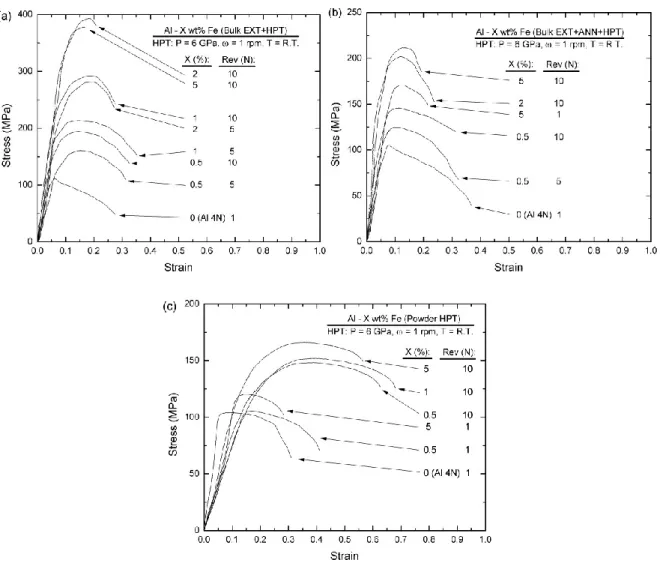
Fig. 2.9(a) shows the stress-strain curves for bulk samples without prior annealing.

Yield strength (YS) and ultimate tensile strength (UTS) increase with increasing Fe content and with imposed strain. A decrease in ductility is observed with imposed strain for higher Fe content, but still 7-10% elongation to failure is maintained for the highly strained samples.

The stress-strain curves of the annealed bulk and powder samples are shown in Fig. 2.9(b)

and Fig. 2.9(c), respectively. The trend is similar to the one observed in Fig. 2.9(a), but the

tensile strength is lower and the ductility is higher, especially for the powder samples, for

which the ductility increased with imposed strain even in samples with lower Fe content. This

effect has been observed in pure Al processed by high-pressure sliding similar to HPT [21].

(28)

20 (a)

(b)

(c)

(d)

Fig. 2.7 TEM bright field images (left) taken from samples of a) Al-0.5% Fe Bulk EXT+HPT

for N=1, b) Al-4% Fe EXT+HPT for N=10, c) Al-4% Fe EXT+ANN+HPT for N=10 and d)

an Al-5% Fe Powder HPT for N=10. Dark field images (right) were obtained from diffracted

beams indicated by arrows in corresponding SAED patterns (as insets in bright field images).

(29)

21 Fig. 2.8 Grain size distributions of (a) Al-0.5%Fe Bulk EXT+HPT for N=1, (b) Al-4%Fe Bulk

EXT+HPT and EXT+ANN+HPT for N=10, and (c) Al-5% Fe Powder HPT for N=10.

Table 1.2 includes the tensile properties such as the yield strength (YS), the ultimate

tensile strength (UTS) and the elongation to failure (ε). The value of UTS is ~3 times the

maximum value of H v , which follows a common empirical rule in metallurgy. The trend in

ductility discussed above can also be observed from the values of elongation to failure. It is

worthwhile to mention the similarity of tensile properties between the bulk 2% and 4% Fe

samples after N=10 revolutions. Even, the 2% Fe sample exhibits slightly higher tensile

strength and elongation in the EXT+HPT case, as shown in Fig. 2.9(a). This behavior can be

explained from the perspective of the intermetallic phases which are coarser in the

hypereutectic 4% sample and therefore, such phases accelerate localized fracture due to their

brittle nature. This explanation could also account for the increased ductility with strain

observed in the powder samples shown in Fig. 2.9(c) since no intermetallic compounds are

(30)

22 expected to be present in this state, at least in a coarse phase.

Fig. 2.10 shows SEM images from the fracture surfaces of selected samples. In Fig.

2.10(a) a ductile fracture with clear necking is observed in the 0.5% Fe Bulk EXT+ANN sample after HPT processing for N=1 revolution. Fig. 2.10(b) displays a fracture surface of the 4% Fe Bulk EXT sample after HPT processing for N=10 revolutions, exhibiting a smooth brittle-type surface in the low magnification view. However, at a higher magnification view many fine dimples formed on the surface as indicated by arrows, as well as tearing in the areas surrounding intermetallic particles. In Fig. 2.10(c) a 2% Fe powder sample processed by HPT for N=10 revolutions exhibits multiple dimples throughout the fracture surface, which is consistent with the higher ductility observed in the powder samples.

Fig. 2.9 Stress-strain curves for samples of (a) Bulk EXT+HPT, (b) Bulk EXT+ANN+HPT

and (c) Powder HPT at different Fe contents and different numbers of revolutions.

(31)

23

(a) (b) (c)

Fig. 2.10 SEM images of fractured specimens after tensile test. (a) Al-0.5% Fe Bulk EXT+ANN+HPT for N=1 (b) Al-4% Fe Bulk EXT+HPT for N=10 (c) Al-2% Fe Powder HPT

for N=10. Magnified views from marked regions are shown in subsequent rows 2.3.6. Basic characterization of the Fe-containing phases after HPT

In order to complement the microstructural observations, it should be appropriate to

analyze XRD profiles for identification of the Fe containing phases in the alloys. Fig. 2.11

shows the XRD spectra for powder samples of high-purity Al, high-purity Fe and Al-5% Fe,

as well as for the Al-4% Fe Bulk EXT+HPT sample processed for N=1 revolution. First, it is

found that there is no isolated Fe peak, but all Fe peaks superimpose with Al peaks and only

Al (111) and (311) peaks are present without superposition. Information is limited for a

precise identification of Fe-containing phases, since the highest intensity reflections of the

most common Al-Fe intermetallic phases lie in the vicinity of these superimposed peaks and

(32)

24 in certain cases within each other. Close observation reveals that some weak reflections appear between the first and second Al fundamental peaks, (111) and (200), as shown in the inset of Fig. 2.11. These peaks are associated with the intermetallic phases: Al 3 Fe (monoclinic Al 13 Fe 4 ) and orthorhombic Al 6 Fe. Orthorhombic Al 5 Fe 2 could be present as well. These intermetallics usually exhibit more complex crystalline structures than cubic Al and Fe [6, 7];

their higher strength and stability proved to be much more efficient than Fe for dispersion strengthening. On the contrary, no reflections besides the fundamental can be observed in the powder spectrum. This indicates that no intermetallics were formed in the powder samples within the detectable limit of the present XRD analysis. Thus most of their Fe content must remain in elemental form, superimposed with Al peaks in the result of Fig. 2.11. No appreciable formation of intermetallic phases in the powder samples is compatible with the lower hardness and tensile strength in comparison with the bulk samples despite the same compositions.

.

Fig. 2.11 XRD profiles of Al-4% Fe Bulk and 5%Fe Powder samples after HPT for N=1 revolution. High-purity Al (99.99%) and Fe (>99.9%) powder spectra after HPT for N=1

revolution are also provided for comparison.

(33)

25 Fig. 2.12 shows an optical micrograph of the Al-4% Fe Bulk EXT sample processed for N=10 revolutions. The presence of a relatively coarse second phase particle is clear, embedded within the already fine Al matrix. The strain introduced by HPT is evident through cracks propagating across the particle as seen by lines with dark contrasts. A dispersion of smaller size fragments is also visible as direct outcome of the HPT processing. Close observation reveals that even smaller sizes of second particles appear to be dispersed throughout the matrix. The micrograph was obtained from a region at ~4.5 mm from the disk center, which is subjected to the highest level of imposed strain. This suggests not only the high strength due to these intermetallics but also further potential for strengthening by effective refinement and dispersion through HPT.

Fig. 2.12. Optical micrograph of Al-4% Fe Bulk EXT+HPT for N=10 at ~4.5 mm from disk

center. The second phase is subjected to fragmentation and dispersion in Al matrix.

(34)

26 2.4. Summary and Conclusions

This chapter examined the mechanical properties and microstructures of Al-Fe alloys processed by High-Pressure Torsion (HPT), as a method of controlling the microstructures through Severe Plastic Deformation (SPD) and employ a common impurity such as Fe. The following conclusions can be drawn from the results obtained in this chapter:

1. The submicrometer grain size was achieved in the Al-Fe alloys by HPT processing.

Typically, the grain size of the bulk Al-4%Fe samples without prior annealing was reduced to ~240 nm after 10 revolutions, whereas with the prior annealing it reached to

~590 nm.

2. Fragmentation and dispersion of second-phase intermetallics were observed in the bulk samples. Powder samples were successfully consolidated at room temperature through HPT. The powder samples reached a grain size of ~410 nm after 10 revolutions.

3. After processing by HPT, there was a clear difference in mechanical properties; the hardness and tensile strength increased in the following order: higher in the as-extruded bulk samples, followed by the extruded and annealed samples and lower in the powder-consolidated samples.

4. Hardness and tensile strength also increased with increasing strain and Fe content for bulk samples with ductility still appreciable at the higher levels of imposed strain.

Powder samples offer a good compromise of increased strength with higher ductility.

5. Microstructure was not saturated at the level of imposed strain used in the present work.

Thus, it is expected that additional improvement by fragmentation and dissolution of

Fe-containing particles may be achieved through further straining by HPT.

(35)

27 2.5. References

[1] Hatch JE (Ed.) (1984) Aluminum: Properties and Physical Metallurgy, 1st ed. American Society for Metals, Materials Park, OH, p. 25-57.

[2] Totten GE, MacKenzie DS (Eds.) (2003) Handbook of Aluminum, Volume I: Physical Metallurgy and Processes, 1st ed. Marcel Dekker, Inc., p. 81-210.

[3] Belov NA, Aksenov AA, Eskin DG (2002) Iron in Aluminum Alloys: Impurity and Alloying Element, 1st ed. Taylor and Francis, London, p. 1-7.

[4] Kattner UR, Burton BP (1993) In: Baker H (Ed.) ASM Handbook Vol. 03 - Alloy Phase Diagrams. ASM International, Materials Park, OH, p. 2-44

[5] Lendvai A (1986) J. Mater. Sci. Lett. 5:1219

[6] Villars P (1997) Pearson's Handbook of Crystallographic Data for Intermetallic Phases.

ASM International, Materials Park, OH, p. 371-373.

[7] Black PJ (1955) Acta Crystallogr. 8:43

[8] Edalati K, Ito Y, Suehiro K. Horita Z (2009) Int. J. Mat. Res. 100:1668 [9] Xu C, Horita Z, Langdon TG (2010) Mater. Trans. 51:2

[10] Straumal BB, Baretzky B, Mazilkin AA, Phillipp F, Kogtenkova OA, Volkov MN, Valiev RZ (2004) Acta Mater. 52:4469

[11] Mazilkin AA, Straumal BB, Rabkin E, Baretzky B, Enders S, Protasova SG, Kogtenkova OA, Valiev RZ (2006) Acta Mater. 54:3933

[12] Harai Y, Ito Y, Horita Z (2008) Scripta Mater. 58:469

[13] Senkov ON, Froes FH, Stolyarov VV, Valiev RZ, Liu J (1998) Nanostruct. Mater 10:691 [14] Senkov ON, Froes FH, Stolyarov VV, Valiev RZ, Liu J (1998) Scripta Mater. 38:1511 [15] Stolyarov VV, Lapovok R, Brodova IG, Thomson, PF (2003) Mater. Sci. Eng. A 357:159 [16] Kaloshkin SD, Tcherdyntsev VV, Tomilin IA, Gunderov DV, Stolyarov VV, Baldokhin

YV, Brodova, IG, Shelekhov EV (2002) Mater. Trans. 43:2031

(36)

28 [17] Tcherdyntsev VV, Kaloshkin S, Afonina EA, Tomilin IA, Baldokhin YV, Shelekhov EV,

Gunderov DV, Brodova IG, Stolyarov VV (2003) Defect Diffus. Forum 216:313

[18] Tcherdyntsev VV, Kaloshkin SD, Gunderov DV, Afonina EA, Brodova IG, Stolyarov VV, Baldokhin YV, Shelekhov EV, Tomilin IA (2004) Mater. Sci. Eng. A 375:888

[19] Zhao YH, Guo YZ, Wei Q, Dangelewicz AM, Xu C, Zhu YT, Langdon TG, Zhou YZ, Lavernia EJ (2008) Scripta Mater. 59:627

[20] Vegard L (1921) Z. Phys. 5:17

[21] Fujioka T, Horita Z (2009) Mater. Trans. 50:930

(37)

29

Chapter 3

Processing of bulk material up to high strains

3.1. Introduction

High-Pressure Torsion (HPT) has been proven to be an efficient processing technique to refine the microstructures of metals and alloys to ultrafine and even to nanocrystalline levels, thus developing very interesting and novel properties in contrast with the ones achievable by traditional processing methods [1-3]. The use of Fe as an alloying element in Al presents a good example of this situation. In the Al-rich side, there is very limited equilibrium solid solubility of Fe in Al, which is almost none at room temperature. Thus, there is presence of hard intermetallic phases at very low fractions of Fe, often in the form of eutectics over a wide range of cooling rates [4,5]. This presents large potential for enhanced strength and resistance to high-temperature deformation. However, the brittle nature of intermetallics reduces the formability of Al-Fe alloys, especially when coarse phases form at hypereutectic compositions. Hence, the Fe additions are kept low when compared to other alloying elements [4,6]. So it becomes interesting if the Fe content, as a leftover from industrial processing of Al, can be utilized to increase the strength through proper microstructure control by HPT processing.

So far the reports of the mechanical properties of cast Al-Fe alloys have used

hypereutectic compositions: Senkov et al. [7,8] used Al-7.5%, 11% and 16% Fe and stated

that significant grain refinement to ~100 nm and intermetallic particles below 1 µm, as well as

supersaturation of Fe well over the solubility limit to a maximum of 2.2%, were achieved by

HPT processing. Stolyarov et al. [9] reported a grain size of 325 nm and particles below 10

µm in Al-5% Fe processed by ECAP, and a maximum dissolution of Fe of 0.6%. Other reports

have shown results of HPT with higher dissolution of Fe, however dealing with metastable

(38)

30 phases such as Al 6 Fe, Al m Fe and Al 9 Fe 2 in the form of quasi-eutectics produced by rapid solidification or mechanical alloying [10-13]. It was shown that these structures could be more readily dissolved by HPT. Shabashov et al. [14] demonstrated by Mössbauer spectroscopy studies that dissolution of metastable Al 6 Fe in the Al matrix was more favored compared to the stable phase Al 13 Fe 4 (Al 3 Fe) during compression shear in Bridgman anvils, which is a very similar process to HPT.

In this study, HPT was used to process Al-Fe alloys with lower Fe contents and different initial states such as casting, extrusion and annealing to evaluate the potential strengthening through similar mechanisms as explored in the previous reports, but with emphasis on the effect of the different initial states and the type of intermetallic phases around the eutectic point. Special attention is paid to the refinement of the coarse intermetallics by HPT in the Al-4%Fe alloy and its effect on the mechanical properties.

3.2. Experimental Materials and Procedures

The original material provided by Kobe Steel, Ltd. in the forms of truncated cast ingots was used starting from this chapter onward. The additions of Fe (X wt%) were selected to be 2% and 4%, designated hereafter as Al-2Fe CAST and Al-4Fe CAST, respectively. Different disks were processed by HPT for a selected numbers of revolutions (N) up to a total of 75.

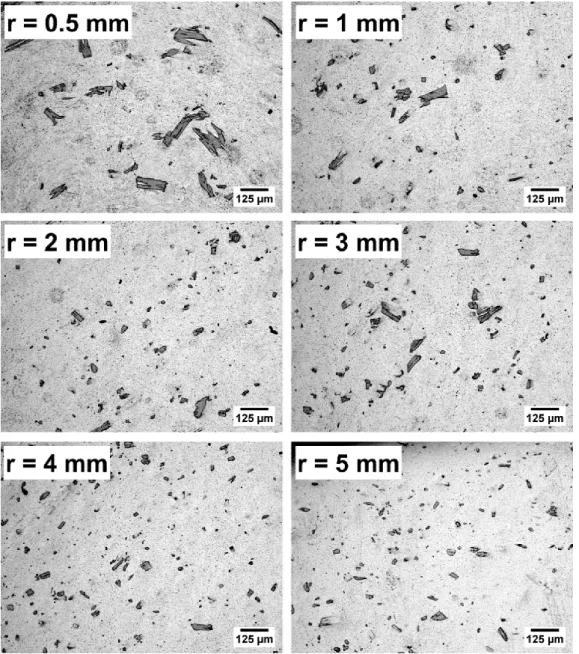
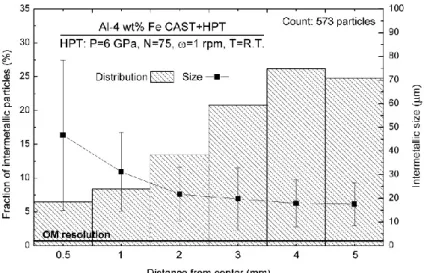
OM observations were performed using a Nikon LV150 optical microscope equipped with

a digital image capture system. To measure the intermetallic particles in the samples after

HPT, several micrographs were recorded at a lower magnification at different distances from

the center of the disks, ensuring that an entire area of each disk was covered. The size of each

particle was calculated by fitting an ellipse and averaging the major and minor axes, which

were measured manually. The state of the intermetallic particles prior to HPT was measured

in a similar way from representative micrographs, and computed by recognition of dark

(39)

31 contrast using an image recognition software. The aspect ratio of the particles was also computed as the ratio of the major to the minor axis.

The microstructure was further characterized by X-ray diffraction (XRD) analysis using the Cu Kα radiation and correcting for instrumental shift with LaB 6 powders. An estimation of the Fe dissolution in the Al matrix was carried out through quantification of the change in the lattice constant of Al, which results in the effective shift in the fundamental peaks to higher values of 2θ, as employed by previous work in rapid solidification [15-17] and severe plastic deformation [9, 11-13]. The lattice constant of each of the HPT-processed samples was determined with the Nelson-Riley extrapolation method using the Al fundamental reflections (111), (200), (220) and (311). The amount of Fe in solid solution was estimated from its linear relationship with the lattice constant as described by Jones [17]. Further details of these procedures will be covered in Chapter 5.

3.3. Results and Discussion

3.3.1. Microstructures of the as-cast materials

Fig. 3.1 shows a series of observations for the microstructure of the as-cast material

used in this chapter. Fig. 3.1(a) and Fig. 3.1(b) correspond to optical micrographs from

samples of Al-2Fe and Al-4Fe, respectively. For both alloys, an Al-rich phase is visible in

bright contrast. When the Fe content is increased from 2% to 4%, a coarse intermetallic phase

appears as dark contrast in the form of elongated plate-like and dendritic structures with sharp

edges as shown in Fig. 3.1(b). According to the Al-Fe phase diagram (Fig. 1.1) this phase

corresponds to the stable intermetallic Al 3 Fe, which has a complex monoclinic structure

[18,19] and a hard and brittle nature [4]. An average particle size of 36±27 μm and a fraction

of ~4 vol.% was estimated for this phase by image processing.

(40)

32

Fig. 3.1 Microstructure of as-cast material a) Al-2Fe OM b) Al-4Fe OM c) Al-4Fe TEM bright-field image showing eutectic structures d) Al-4Fe OM from interior of cast ingot

Close inspection of the microstructure reveals that there are areas with a grey contrast composed of a eutectic structure as shown in the TEM bright-field micrograph of Fig.

3.1(c). The eutectics consist of a network of discontinuous lamellae with average widths of 150-200 nm and ellipsoidal particles with sizes not larger than ~1.5 μm. The fraction of these structures in the Al-2Fe and Al-4Fe alloys was estimated to be similar after inspection of several micrographs, which confirmed that the Al-2Fe sample is closer to eutectic composition [4] and thus with the higher fraction of eutectic within the casting conditions of this material. Although the equilibrium eutectic condition of the Al-Fe system is composed only of Al and Al 3 Fe [4,5], the ratio of the eutectic to the Al-rich dendrites in Fig. 3.1(a) and Fig. 3.1(b) was estimated to be about 1:1. It is known that the fraction of eutectics is strongly influenced by the effective cooling rate in the casting process [4,20,21]. It is appreciated from

a)

c)

(41)

33 Fig. 3.1(d) that at the interior regions of the ingot, the fraction of eutectic becomes more prominent, limiting the Al phase to the surroundings of the coarse intermetallic.

3.3.2. Microstructures of the extruded and annealed materials

Microstructural observations of the extruded material and after the annealing treatment were performed in a similar way using OM and TEM. The microstructures in the Al-4Fe alloy were introduced in Fig. 2.6. It was shown that a fine-grained structure was produced during the extrusion process with an average grain size of 1.4±0.2 μm. A network of spheroidal dispersed particles in eutectic nature was observed with an average particle size of 180±50 nm.

After annealing the extruded samples the grains coarsened to 2.8±0.3 μm and coalescence of the particles occurred to slightly larger globular or ellipsoidal structures with a size of 290±130 nm. Thus, the extruded state is about half the size of the annealed state. To understand the effect of the presence of Fe and the extent of the annealing, a sample from an extruded rod of pure Al was observed by optical microscopy and then annealed under the same conditions as the Al-4% Fe alloy. The average grain size from the extruded material increased from ~150 μm to ~550 μm by annealing, i.e. almost by a factor of 4, compared with a factor of 2 when Fe is present in the material. It is suggested then that the intermetallic particles greatly assist the refinement of the Al matrix and restrict the grain growth during annealing.

It should be noted that no significant differences in the morphology of the coarse

intermetallic phase in the Al-4Fe alloy were observed between the states after the extrusion

and after the subsequent annealing. The average size of these particles is similar to the result

from the as-cast case. The aspect ratio of the as-cast is also slightly larger (~2.5) compared

with the as-extruded case (~2) due to a few very long particles, most likely fragmented after

extrusion. It should be also noted that the microstructure after the extrusion was not

completely homogeneous; some areas resembled the annealed microstructure, presumably due

(42)

34 to exposure to similar temperatures during the hot extrusion. XRD analysis showed that there was a preferred orientation in the extruded material which was not altered significantly by the subsequent annealing treatment.

3.3.3. Microhardness distribution and evolution in the HPT-processed disks

The hardness measurements from the disks processed with the different initial states are plotted in Fig. 3.2 against the distance from the disk center at two levels of imposed strain:

after N=10 revolutions in Fig. 3.2(a) and N=75 revolutions in Fig. 3.2(b).

Fig. 3.2 Vickers microhardness plotted against distance from disk center for Al-2Fe and Al-4Fe processed by HPT for a) N=10 and b) N=75 revolutions

The initial levels of microhardness before HPT are delineated with solid and dashed

straight lines for the Al-4Fe alloy and for the Al-2Fe alloy, respectively. The difference in the

initial hardness levels is not very significant, ~15 HV between extremes. More importantly,

two results are inferred from Fig. 3.2(a). First, the cast material has a faster evolution in

hardness during HPT when compared to the extruded and the annealed materials. This

indicates that the refined intermetallic phases, especially of eutectic morphology in the cast

condition have a strong effect on the increase in hardness with strain. Second, there is

similarity in the hardness values among the Al-2Fe and Al-4Fe samples regardless of the

initial state. This suggests that large intermetallic particles have less contribution to the overall

hardness level at this stage of imposed strain. When examining the condition in Fig. 3.2(b),

(43)

35 the cast and the extruded disks are almost at a saturated state of microhardness, and the level of saturated hardness is essentially the same between the two types of disks at the equal Fe contents: ~200 HV for Al-4Fe and ~180 HV for Al-2Fe.

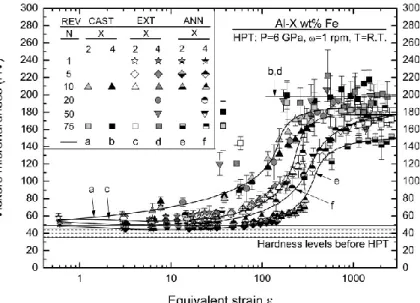
Fig. 3.3 shows the values of microhardness plotted against the equivalent strain.

Application of HPT leads to significant increases in hardness above the initial states, where the hardness evolution of each type of sample is delineated along continuous curves labeled from a-f. The increase in the hardness with equivalent strain of cast samples can be appreciated from the trend of curve a, which was more pronounced when compared to the case of the extruded samples, as shown by curve c. However, the rather similar levels of saturated hardness were obtained at high equivalent strains for Al-4Fe in both cast and extruded samples, as shown by curve b and by curve d, respectively. As stated earlier, the saturated levels of Al-2Fe, as shown by the similar plateau level of hardness in curves a and c at high equivalent strains, are ~20 HV below the respective levels of saturated hardness of Al-4Fe. The evolution of the annealed samples was more gradual, as represented by the trend shown by curves e and f for Al-2Fe and Al-4Fe, respectively. The differences in the evolution of these three states can be attributed to their different initial microstructures.

Fig. 3.3 Vickers microhardness plotted against equivalent strain for Al-2Fe and Al-4Fe at

different initial states

(44)

36 3.3.4. Microstructure comparison after HPT by TEM

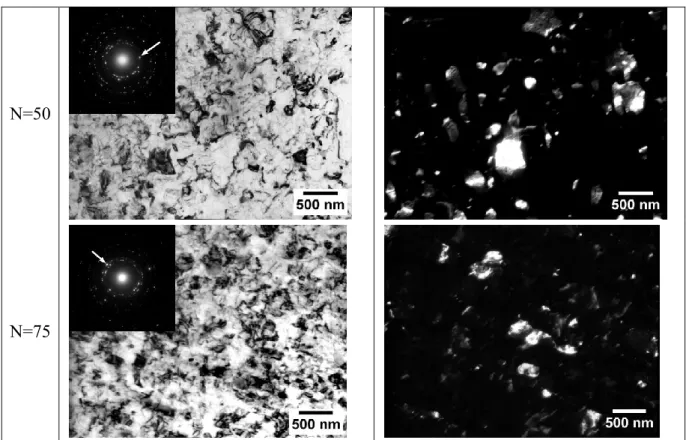
The evolution of the microstructure with straining by HPT for the Al-4Fe EXT+HPT samples (curve d in Fig. 3.3) was examined through the analysis of TEM micrographs as shown in Fig. 3.4. The grain size of the Al matrix was measured systematically from the dark field images obtained from fundamental Al (111) or (200) reflections as pointed in the inset SAED patterns. It can be observed from the dark field images that the grain size is efficiently refined from the early stages of deformation. After processing for only 1 revolution the average grain size was refined from the as-extruded size of d≈1370 nm (1.4 µm) to d≈370 nm and after N=5 to d≈285 nm. The microstructure is then gradually refined at the higher stages of deformation: d≈240 nm at N=10, d≈175 nm at N=20, d≈170 nm at N=50 and d≈160 nm at N=75 revolutions. These results suggest that the microstructure is saturated at this level of imposed strain. It should be noted that the grain size of the EXT+ANN sample was 2760 nm (2.8 µm) but it was reduced to d≈590 nm at N=10 and d≈210 nm at N=75 revolutions. The refinement of the grain size occurs in a similar way as the EXT samples although the grain size is invariably larger.

The refinement in the Al matrix grains and dispersion of intermetallic particles in the CAST+HPT are shown in Fig. 3.5 from the Al-4Fe sample processed for N=75 revolutions.

For Fig. 3.5(a), a dark-field image was taken using the Al (111) diffracted beam pointed by an

arrow in the SAED pattern, showing that an ultrafine-grained structure was attained by HPT

with an average grain size of ~125 nm. It is noted, for comparison, that the grain size of the

Al-4Fe alloy reached ~160 nm for the extruded sample and ~210 nm for the annealed sample

at a similar level of imposed strain.

(45)

37 N=1

N=5

N=10

N=20

Fig. 3.4 TEM micrographs showing Al-4% Fe EXT+HPT microstructure evolution. Dark field images obtained from diffracted beams indicated by arrows in corresponding SAED

patterns (as insets in bright field images)

(46)

38 N=50

N=75

Fig. 3.4 (cont.) TEM micrographs showing Al-4% Fe EXT+HPT microstructure evolution.

Fig. 3.5 TEM micrographs of Al-4Fe CAST+HPT processed for N=75 revolutions: a)

fundamental (111) reflection and b) intermetallic reflection

Fig. 1.2 Phase formation in castings of Al-Fe binary alloys [3]
Fig. 2.2 Schematic illustration of HPT sample and dimensions of extracted specimens for  evaluation of mechanical properties and microstructural analysis
Fig. 2.5 Plots of Vickers microhardness against equivalent strain for samples of (a) Bulk  EXT+HPT, (b) Bulk EXT+ANN+HPT and (c) Powder HPT samples
Table  1.2  includes  the  tensile  properties  such  as  the  yield  strength  (YS),  the  ultimate  tensile  strength  (UTS)  and  the  elongation  to  failure  (ε)
+7

参照

関連したドキュメント

We hypothesized that the cause for this high incidence is as follows:(1)High pressure is placed on the bony areas of the body when the patientg s body is fixed on the Hall frame and

まず,PREG 及び PROG の重水素標識体をアルカリ条 件下での交換反応により合成し,それぞれを IS として Fig.. 7) .コント

The resulting nonlinear model contains a set of reaction-drift-diffusion equations for the point defects and pairs, reaction equations for the immobile dopants and clusters as well as

Global transformations of the kind (1) may serve for investigation of oscilatory behavior of solutions from certain classes of linear differential equations because each of

The reason for not using the perhaps more familiar high peak statistics in the definition of the main production matrix is that the joint distribution of number of high peaks and

 Adjustable soft--start: Every time the controller starts to operate (power on), the switching frequency is pushed to the programmed maximum value and slowly moves down toward

High Disease Pressure: Where a product rate range is listed, use the higher rate of EQUATION and/or reduced spray interval when disease pressure is high and/or conditions are

The analog current sense pin in such an event will output the fault state current−typically higher than the currents sensed during normal operation and a high fault−state sense