熊本大学学術リポジトリ
Pressure dependence of hole‑Mn and Mn‑Mn exchange interactions in Cd0.95Mn0.05Se
journal or
publication title
Physical Review Letters
volume 77
number 6
page range 1111‑1114
year 1996‑08‑05
その他の言語のタイ トル
Cd0.95Mn0.05Seにおける正孔‑MnおよびMn‑Mn交換相 互作用の圧力依存性
URL http://hdl.handle.net/2298/9628
doi: 10.1103/PhysRevLett.77.1111
Physical Review LETTERS
PRESSURE DEPENDENCE OF HOLE-Mn AND Mn-Mn EXCHANGE INTERACTIONS IN Cd095Mn005Se
Noritaka Kuroda and Yasuhiro Matsuda
Volume 77, Number 6, 5 August 1996 1111-1114
Published by
THE AMERICAN PHYSICAL SOCIETY
Volume 77, Number 6 PHYSICAL REVIEW LETTERS 5 August 1996
Pressure Dependence of Hole-Mn and Mn-Mn Exchange Interactions in Cdo.95Mno.o5Se
Noritaka Kuroda and Yasuhiro Matsuda
Institute for Materials Research, Tohoku University, Katahira 2-1-1, Sendai 980-77, Japan (Received 4 December 1995)
Magnetophotoluminescence due to the A exciton has been studied in a diluted magnetic semiconduc tor Cdo.95Mno.o5Se under hydrostatic pressures of 0-2 GPa at 1.4 K. The experimental data on the pressure dependencies of the hole-Mn p-d and Mn-Mn d-d exchange interactions suggest that in concurrence with an increase in the p-d transfer integral the on-site Coulomb energy U and p-d charge-transfer energy A decrease with increasing pressure. The deduced value, d In U/dP = -2.5 X 10~2 GPa"1, of the relative pressure coefficient of U is about,4 times in magnitude as great as the linear compressibility of lattice. [S003 l-9007(96)00840-X]
PACS numbers: 71.45.Gm, 75.30.Et, 75.50.Pp, 78.20.Ls
Electron correlation is one of the most important mat ters in understanding the nature of transition-metal (TM) compounds. In the case of diluted magnetic semiconduc tors (DMSs), TM ions are substituted for cations of the host semiconductors. The holes of the topmost valence band consisting of anion p orbitals have a strong antiferro- magnetic exchange interaction with the d electrons of TM ions, giving rise to enormous magneto-optical effects. In addition, TM ions settled on the nearest-neighbor cation sites couple one another antiferromagnetically. Taking account of the d-d Coulomb interaction, Larson et al. [1]
and Bhattacharjee and co-workers [2| have made pertur- bative approaches to these exchange interactions. They have shown that the p-d and d-d exchange interactions are second and fourth order perturbations, respectively, by the transfer, viz., real-space hopping, of an electron be tween p and d orbitals. The hopping of an electron causes a change in the number of electrons of TM ions. Results of the perturbative approaches show that such charge fluc tuations, whether real or virtual, bring about strong corre lation effects.
As emerged from magnetophotoluminescence experi ments on the A exciton in Cdi-^Mn^Se and Cdi-*- CojfSe, the p-d exchange interaction is strengthened markedly by hydrostatic pressure. A large part of this change arises from a change in the transfer integral caused by the contraction of the Mn(Co)-Se bonds [3-5]. How ever, the degree of the observed enhancement of the p-d exchange interaction is too large to be explained in terms of the transfer integral alone [6]. It is suggested, there fore, that the on-site Coulomb energy U and the charge- transfer energy A are also changed by pressure. Since an inequality relationship of U > A holds, in Zaanen- Sawatzky-Allen's classification of TM compounds [7] II- VI DMSs belong to the same regime as semiconductors such as CuO. Many of those compounds are antiferro- magnetic. MnTe, for instance, is an antiferromagnetic semiconductor with Neel temperature T^ of 307 K and an energy gap of 1.3 eV. Interestingly, 7# increases with pressure [8]. To understand this phenomenon, knowledge
of the behavior of U and A under pressure would be cru cial. However, in neither DMSs nor TM compounds is reliable experimental information available on the pres sure dependencies of U and A.
In this Letter we report on experimental studies of the magnetophotoluminescence due to the A exciton in CdO95MnOO5Se under high hydrostatic pressures at 1.4 K.
If the mole fraction of TM ions is raised to the order of 0.05, a significant amount of the ions is settled on the nearest-neighbor cation sites to form antiferromagnetic spin pairs. These ions manifest themselves as a series of weak and stepwise anomalies of magnetization under high magnetic fields and low temperatures. In Cdo.95Mno.o5Se the stepwise anomalies are known to appear around 13 and 24 T at 1 atm [9]. The present study focuses attention on the pressure dependence of these stepwise anomalies as well as the paramagnetic background due to isolated Mn ions. The results show that the anomalies shift rapidly toward higher magnetic fields with increasing pressure.
This observation permits us for the first time to look closely into the variation of U and A caused by a change in the bond lengths in a highly correlated material.
A homemade cryogenic optical system [10] consisting of a clamp-type diamond anvil cell and optical fibers is used to measure the photoluminescence. Condensed ar gon is employed as the pressure-transmitting medium.
The maximum pressure is limited to 2.0 GPa because a pressure-induced phase transition to a rocksalt structure occurs irreversibly around 2.5 GPa. A magnetic field up to 23 T is generated with a hybrid magnet and is applied parallel to the c axis of the wurtzite structure of the sam ple. The 514.5 nm line of an Ar-ion laser is used to ex cite photoluminescence. The optical system is immersed in pumped superfluid He. All the measurements are per formed at 1.4 K.
Figure 1 shows the photoluminescence spectra due to the A exciton under various magnetic fields at a pressure of —0.02 GPa. If the external magnetic field is lower than 0.1 T, the spectrum is dominated by a rather broad line {B) due to excitons bound by lattice defects. As the 0031-9007/96/77(6)/llll(4)$10.00 © 1996 The American Physical Society 1111
w
3c
i
23
15
«
5 "
iiiiiiii
• Cdo.95Mno.o5Se
T IIA 1.4 K 0 GPa
— lrT~
2 T -> VJ
OT X
1.80 1.85 1.90
Photon Energy (eV)
FIG. 1. Photoluminescence spectra in Cdo.95Mno.o5Se under various magnetic fields at 1.4 K and 0 GPa. The magnetic field is applied parallel to the c axis of the crystal. The features denoted as B and F are due to bound and free excitons, respectively.
magnetic field increases the bound exciton line is rapidly suppressed and a sharp free exciton line (F) appears. This behavior of the photoluminescence is almost identical with the behavior observed at 2 K [11] and 4.2 K [3,6].
The free exciton line appearing under a magnetic field is due to the radiative recombination of excitons in the lower Zeeman sublevel formed by an electron in the lower magnetic sublevel of the lowest conduction band and a hole in the upper magnetic sublevel of the A valence band. Figure 2 shows a plot of the field-induced shift SEA of the peak energy Ea of the free exciton line at several pressures: The value of Ea at 0 T is obtained from the energy of the bound exciton line assuming that the binding energy of 4 meV is independent of magnetic field. At any pressure the magnitude of SEa increases rapidly with increasing external magnetic field but almost levels off above about 6 T.
The shift of the exciton energy is proportional to the strength of the mean exchange field due to TM ions [12].
The external-field dependence shown in Fig. 2 indicates that the magnetization of isolated Mn ions is saturated above about 6 T. Moreover, the saturated value of SEa is enlarged by hydrostatic pressure. This is due to the enhancement of the exchange interaction between TM ions and the A exciton by pressure [3-6]. One may also note that the shift undulates slightly over the field region between 6 and 23 T. The inset of Fig. 2 shows the derivative -dEA/dH of the peak energy with respect to the external magnetic field H. At 0 GPa the derivative curve exhibits peaks at 13 T and around 24 T, showing 1112
I
I -20
1 *
o us
-40 LJ
s
-60
I I I I I I I I I I I I I I I
9 Cdo.95Mno.o5Se 1.4 K H II c
1.9 GPa
1.3 GPa"
0.7 GPa 0 GPa
10 20 30
Magnetic Field (T) 0 GPa 0.71.3 1.9
0 10 20 30
Magnetic Field (T)
FIG. 2. Energy shift of the free exciton line in Cdo.95Mno.o5Se induced by the external magnetic field under 0 (O), 0.7 (V), 1.3 (□), and 1.9 (A) GPa at 1.4 K. The inset shows the derivative of the exciton energy with respect to the external magnetic field under 0 (O), 0.7 (V), 1.3 (□), and 1.9 (A) GPa. Solid lines are guides for the eye. Arrows show the field positions Hi and
that Ea undergoes a stepwise shift at these magnetic fields. (We have confirmed by other experiments with magnetic fields increased to 25 T that the second peak occurs at 24 T.) This observation agrees well with the magnetization data at 1.4 K reported by Foner et al. [9].
There is no doubt that the peaks of -dEA/dH are due to the magnetization of paired Mn ions. Furthermore, the present observation shows that the peak positions shift toward higher magnetic fields with increasing pressure.
Figure 3 shows the single-particle scheme of the den sity of states of electrons in Cdi-^Mn^Se. The ground state of the d electron of Mn ions is the so-called lower Hubbard state. It consists of three ds and two dy elec trons, of which the ds electrons hybridize with the Se 4p electrons of valence band [13]. In this state every Mn is ionized into Mn2+. The valence band edge is located below the upper Hubbard state, since the Mott-Hubbard gap U is greater than the energy A required to promote an electron from a Mn2+ ion to an anion to annihilate a hole in the valence band. In this scheme the charge-transfer energy A, which is the energy for a reverse process to the A transfer and has been introduced by Zaanen, Sawatzky, and Allen [7], equals U — A. The present sit uation, where U > A, corresponds to the charge-transfer- semiconductor regime of Zaanen, Sawatzky, and Allen's classification of TM compounds. Here we consider the p states near the topmost edge of the valence band
Volume 77, Number 6 PHYSICAL REVIEW LETTERS 5 August 1996
Energy
CB
VB
upper Hubbard state
u
lower Hubbard state
►
Density of States
FIG. 3. Schematic representation of the single-particle density of states in II-VI DMSs. CB and VB denote the conduction and valence bands, respectively. The density of states of the lower and upper Hubbard states are exaggerated.
according to the three-level model of Larson et al. [1], Then at 1 atm we have U = 7.6 eV, A = 3.4 eV [1], and A = 4.2 eV.
In general, the ordinary potential term of the exchange interaction of the electron of an exciton with Mn ions almost cancels that of the hole, and therefore the exciton- Mn exchange is dominated by the hole-Mn kinetic spin interaction. Thus according to the scheme shown in Fig. 3, the exciton-Mn exchange constant is given to a good approximation by [1,2]
Jpd = -l6t2pdU/SA(U - A), (1)
where S = 5/2 is the total spin of the lower Hubbard state 6S of a Mn ion and tpd is the transfer integral between the
p and d orbitals. The field position H\ of the first peak of -dEA/dH, on the other hand, is related to the nearest- neighbor d-d exchange constant 7nn of a Mn-Mn pair and the g parameter, g = 2.0, of the Mn spins by H\ =
2\JNN\(gV<B)~l + Hd [9], where /ulb is the Bohr magneton
and Hd « 1.5 T is a correction due to the distant-neighbor interactions. The d-d interaction is dominated by the kinetic superexchange interaction mediated by p-d bonds.
In light of the treatments of Larson et al. [1] and Gorska and Anderson [14], Jnn is given by
'nn = -t4pd(2U - A)/2S2U(U - A)3. (2)
An identical expression has been obtained by Zaanen and Sawatzky [15] from a configuration-interaction approach to Tn in TM mono-oxides.
In Fig. 4 8EA(P)/SEA(0) are plotted, obtained from experimental values of SEa at 10 T and /nnCP)/^nn(0)
determined from H\ as a function of pressure P. The val ues of 5 Ea at 10 T are chosen because, as evident from Fig. 2, they function as a good probe for the pressure de pendence of Jpd. We see from Fig. 4 that both \JPd\ and UnnI increase with increasing pressure. Their increasing rates are found to be dln\Jpd\/dP = (7.0 ± 1) X 10"2 and dln\Jm\/dP = (21.0 ± 5) X 10~2 GPa"1. As a test of the universality of this value of dln\Jpd\/dP we have measured 8Ea(P)/8Ea(0) for CdO99Mno.oiSe, in which the Mn content is so small that Mn ions are mostly isolated. The result agrees well with that for Cdo.95MnOO5Se, as shown in Fig. 4.
Because of the difference in the tetrahedral radius be tween Mn and Cd ions, there should be a local distortion of lattice around Mn ions. The nonhydrostaticity of pres sure due to freezing of argon, which is used as the pressure medium, might cause additional distortion. However, the distortion would be random since Mn ions are substituted for Cd ions randomly in the crystal. The present study deals with the mean value of SEa and the central position of the anomaly of -dEA/dH. Therefore, in the follow ing discussion the compression of MnSe4 configurations is assumed to be uniform, with the bond angles unchanged, throughout the crystal.
According to Harrison, the transfer integral tpd scales
with the Mn-Se bond length I as /~7/2 [16]. At 1 atm, since we have Jpd = -1.37 eV and 7NN = -6.4 X 10"4 eV, Eqs. (1) and (2) give tpd = 0.64 and 0.79 eV, respec tively, which agree rather well with one another. On account of the isostructural and isovalent nature of CdSe and MnSe, it may be reasonable to expect that the compressibility of the Mn-Se bond is similar to the compressibility of the host CdSe lattice. In fact the bulk modulus of Cdi-^Mn^Te obtained by Strossner et al. [17] indicates that the compressibility of the Mn-Se bonds is almost equal to the compressibility
1 1-6
COwc oo
§>1"4
cCO
x 1.2 UJ
(1)
3 1
• • I • 1 • • • • 1 • •
Cd, Mn Se1-X X
' —Q_ JMN(x=0.05) -Q-6EA(x=0.05)
. .-h<>..5Ea(x=0.01) e
y\
■
'_
r . ."
Pressure(GPa)
FIG. 4. Pressure dependencies of 8EA at 10 T (□) and JNN (O) in Cdo.95Mno.o5Se, and of 8EA at 10 T (o) in Cdo.99Mno.o1Se. All data are normalized by the values at 0 GPa.
The solid iines are the linear fits to the experimental data.
1113
1 2 3
Pressure (GPa)
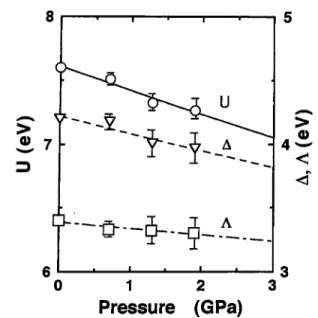
FIG. 5. Pressure dependencies of U (O), A (V), and A (□) in Cdo.95Mno.o5Se. The solid, dashed, and dot-dashed lines are the linear fits to the experimental data of U, A, and A, respectively.
0.62 X 10~2 GPa"1 of the Cd-Se bonds. Hence Hani- son's formula gives d\nt2pd/dP « 4.3 X 10~2 GPa"1 and d In tpd/dP « 8.7 X 10"2 GPa"1. Note that these values can explain only halves of the ex perimental values dln\Jpd\/dP «7X 10~2 and dhktfiwl/dP * 21 X 10"2 GPa"1, respectively. More over, d1n\Jfw\/dP is 3 times as large as dln\Jpd\/dP.
These facts suggest that U9 A, and/or A depend on
pressure.
Substituting the pressure coefficients of t2pd, tpd, Jpd,
and Jnn into Eqs. (1) and (2) one may evaluate the pres sure dependencies of U, A, and A. The results are shown in Fig. 5. We see from Fig. 5 that £/, A, and A de crease pronouncedly with increasing pressure. Their pres sure coefficients are -0.19 ± 0.04, -0.13 ± 0.04, and -0.06 ± 0.04 eV/GPa, respectively. It is worth not ing that the relative pressure coefficient \d In U/dP\ = 2.5 X 10~2 GPa"1 of U is about 4 times as great as the linear compressibility of lattice. This is the same or der as the increasing rate of the transfer integral, that is, d In tpd/dP « 2.2 X 10"2 GPa"1. Concerning the quan tity U/tpdi which is a key parameter for characterizing the effects of electron correlation in a substance [7], a half of its reduction can be attributed to U in the present sub stance. The positive value of din tpd/dP means that the p-d hybridization is enhanced by compression of lattice.
Presumably, therefore, the observed reduction of U is in duced by the enhancement of the screening effect due to the valence electrons. The changes of A and A are the re sults of the reduction of U and relative shifts of the lower Hubbard state and valence band.
In conclusion, the magnetophotoluminescence due to the A exciton in Cdo.95Mno.o5Se under high hydrostatic pressures at 1.4 K has been interpreted in terms of the kinetic exchange theory. The results suggest that the on-
1114
site Coulomb repulsion energy U of Mn ions and the p-d charge-transfer energy A are reduced by pressure.
The relative pressure coefficient \d In U/dP\ is about 4 times as great as the linear compressibility of lattice and is comparable to the pressure coefficient for the increase in the transfer integral. Therefore, not only the transfer but also the electron correlation in solids should generally depend on bond lengths. This finding will give us an insight into various electronic properties of correlated systems, particularly under high pressures.
Single crystals employed in this study were kindly provided by J.R. Anderson and W. Giriat. We thank T. Yao for valuable discussions and I. Mogi for helpful technical advice during the course of the experiments at the High Field Laboratory for Superconducting Materials of Tohoku University. N. K. acknowledges M. Kataoka and S. Anzai for illuminating discussions and D. Bagnall for critical reading of the manuscript. The work of Y. M. was supported partly by the Fellowship for Junior Scientists of the Japan Society for Promotion of Science.
[1] B.E. Larson, K.C. Hass, H. Ehrenreich, and A.E. Carls- son, Phys. Rev. B 37, 4137 (1988).
[2] A.K. Bhattacharjee, Phys. Rev. B 46, 5266 (1992); F.
Hamdani, J.P. Lascaray, D. Coquillat, A.K. Bhattachar jee, M. Nawrocki, and Z. Golacki, Phys. Rev. B 45, 13 298 (1992).
[3] Y. Matsuda, N. Kuroda, and I. Mogi, in Proceedings of the 22nd International Conference on the Physics of Semiconductors, Vancouver, 1994, edited by D.J.
Lockwood (World Scientific, Singapore, 1995), Vol. 3, p. 2513.
[4] Y. Matsuda, N. Kuroda, I. Mogi, G. Kido, and Y. Nishina, Physica (Amsterdam) 201B, 411 (1994).
[5] R. Meyer, M. Dahl, G. Schaack, A. Waag, and R. Boehler, Solid State Commun. 96, 271 (1995).
[6] Y. Matsuda and N. Kuroda, Phys. Rev. B 53, 4471 (1996).
[7] J. Zaanen, G.A. Sawatzky, and J.W. Allen, Phys. Rev.
Lett. 55, 418 (1985).
[8] H. Sugiura, A. Sawaoka, S. Saito, and K. Inoue, J. Phys.
Chem. Solids 40, 701 (1979).
[9] S. Foner, Y. Shapira, D. Heiman, P. Becla, R. Kershaw, K. Dwight, and A. Wold, Phys. Rev. B 39, 11793 (1989).
[10] Y. Matsuda, N. Kuroda, and Y. Nishina, Rev. Sci. Instrum.
63, 5764 (1992).
[11] D. Heiman, P. Becla, R. Kershaw, D. Ridgley, K. Dwight, A. Wold, and R.R. Galazka, Phys. Rev. B 34, 3961 (1986).
[12] J.K. Furdyna, J. Appl. Phys. 64, R29 (1988).
[13] S.H. Wei and A. Zunger, Phys. Rev. B 35, 2340 (1987).
[14] M. Gorska and J.R. Anderson, Phys. Rev. B 38, 9120 (1988).
[15] J. Zaanen and G.A. Sawatzky, Can. J. Phys. 65, 1262 (1987).
[16] W. A. Harrison, Electronic Structure and the Properties of Solids (Freeman, San Francisco, 1980), p. 451.
[17] K. Strossner, S. Ves, W. Dieterich, W. Gebhardt, and M.
Cardona, Solid State Commun. 56, 563 (1985).