ミクフロィラリア末梢血内出現の季節的消長に関する研究
‑特に環境温度の仔虫出現に及ぼす影響‑
青木克己
長崎大学熱帯医学研究所寄生虫学部門(主任:片棒大助教授)
(Receiヽred for publication February 2, 1971)
Studies on Seasonal Change in the Population of Microfilaria
Emigrating into the Peripheral CirculationEffect of Atmospheric Temperature on Emigration of Microfilaria
Yoshiki AOKI
Department of Parasitology, Institute for Tropical Medicine, Naga∫aki University (Director : Prof. Daisuke KATAMINE)
Abstract
Many investigators of the past discussed on the seasonal fluctuation in the number of microfilaria emigrating into the peripheral circulation. To study this seasonal change, the author calculated monthly the exact population density of D. immitis microfilaria. Micro‑
filaria density was expressed by a total number of the larva in the blood which was taken at every two hour for 24 hours.
Monthly fluctuation pattern of the population showed a peak count in the summer season, usually around July and August, and then it gradually went down to the minimum at the coldest winter season, in January and February, approximately one‑tenth or one‑
twentieth of the maximum count. It was confirmed, therefore, that microfilaria density in the peripheral blood markedly varied according to the season as other investigators already reported. However, the reasonable explanation for this phenomenon has not appeared in the past. In this observation, increase and decrease in the number of microfilaria seemed to depend on the atmospheric temperature.
As part of studies on this subject, therefore, the influence of environmental temperature
長崎大学熱帯医学研究所業績 第560号
8
青 木 克 己
to the density of emigrating microfilaria was experimentally investigated by changing the temperature of the room where the animals were kept. When the room temperature was suddenly raised and maintained at 25.0℃ for about one month in winter, microfilaria in‑
creased in the number as many as several times of the initial count within two weeks and continued the same high level throughout the period of exposure to the temperature, when
the temperature was lowered from 25.0℃ to 5.0℃, the microfilaria density rapidly dropped
down to the initial level.
The animals always maintained their normal body temperature without regard to change of the room temperature. On the other hand, raising of the room temperature has brought a significant increase of respiratory rate of animals being about twenty to thirty per minutes. Increase in the number of microfilaria caused by raising of temperature was more significant at night and the nocturnal periodicity seemed to be rather distinct.
Blood of the infected dog containing the numerous larva was transfused intravenously into some non‑infected dogs and rabbits in which the microfilaria could survive for long time showing a nocturnal periodicity. On this fresh hosts, there was also demonstrated a similar effect of the atmospheric temperature upon the number of emigrating microfilaria.
These findings may indicate that raising of the atmospheric temperature stimulates the emigration of microfilaria into the peripheral circulation from lung capillaries and the seasonal variation in the number of microfilaria is attributed to the seasonal change of
atmospheric temperature.
緒 言
犬糸状虫D. immitis仔虫の末梢血内の出現は所謂 Sub‑periodic form と言われるように夜間にその最 高値があり,出現仔虫数が多いが,昼間にもかなりの仔 虫が検出される.バンクロフト仔虫と比べてその周期 性が不完全で.最高値を示す時刻も巾がみられる、この ミクロフィラリアの周期性についてはManson(1879) 以来多くの研究者により色々興味ある知見が報告され ているが,その機序は未だ明かにされていない.しか し,その周期性の本態は仔虫が昼間は肺毛細管内に集 積さる夜になると末梢血内に放出されることに由来 するものと思われる.
久保ら(1938),Morris(1935),又板垣ら(1938)はこ の仔虫の日内の周期性の他に出現仔虫数が季節によっ
て変動し,一般に夏に多く,冬に少いことを発見し, これを季節的周期性と呼んでいる.大石(1961)も犬 の剖検による成虫の発見率は夏冬に差がみられないに もかかわらず,厚層標本にて仔虫の検出率を較べると, その率は明らかに夏に高いことを認め,冬は末梢血に 出現する仔虫数の少いことを想像している.又バンク ロフト糸状虫の場合でも冬に検出率が落ちることが報 ぜられている・このような季節による出現仔虫数の変 動は日.内の周期性とも関連して重要な現象と考えられ る・著者ほD.immiti∫感染犬を用いて1ケ年に亘り 仔虫数の季節的消長を観察すると共に,先ず環境温度 との執系を追究するため, 2, 3の実験を行った・
実験材料及び方法
実験に用いられた動物は D.immitis 感染犬のはか 仔虫の移注実験の目的で体重o kg内外の未感染犬及び
0 kg前後の家兎が用いられたⅠ
仔虫数の算定は犬の耳柔から,家兎では耳静脈から 午前10時から翌日の午后2暗まで2時間毎に採血し,
60cmm又はSQcmm中の仔虫を数え, 24時間内の総仔
虫数をもって仔虫数を表わした、又24時間内の周期性 は片峰ら(1959)が報告した2次曲線を用いて比較し た7即ち各2時間毎の仔虫数で画いた一次仔虫出現曲 線で各2時間が占める面積が,曲線でかこまれる絵面 積に対す\る百分比を求め, 2次曲線を画いた.
環境温度の影響をみるために5 oCから25oCまで自
由に変温できる恒温室を用い,その中に実験犬をつな いで最高2ケ月間観察を行った.恒温室内の犬は約1 mの鎖でつなぎ,自由に軽い運動を行うことが出来る ように考慮した.恒温室内の照明は60Wの蛍光灯を用 い午前六時から午后七時まで点燈した. 4時間毎に犬 の体温(直腸温)と呼吸数を計測したが,犬の興奮を さけるため室内にテレビカメラを備えて自然の状態で
呼吸数を測定した.
仔虫の実験動物への移注は兼感染犬及び家兎を先ず ネンブタ「ルで軽く麻酔し,給血犬の血液約50ccを仔 犬の股静脈から,約20ccを家兎耳静脈から輪注した.
月別の大気温は長崎海洋気象台発表データを使用 し,室温は自記温度計を用いて日々の最高,最低及び 平均気温を記録した.
実 験 成 績
I)D.immiti∫仔虫の末棉血内出現態度の季節的変動.
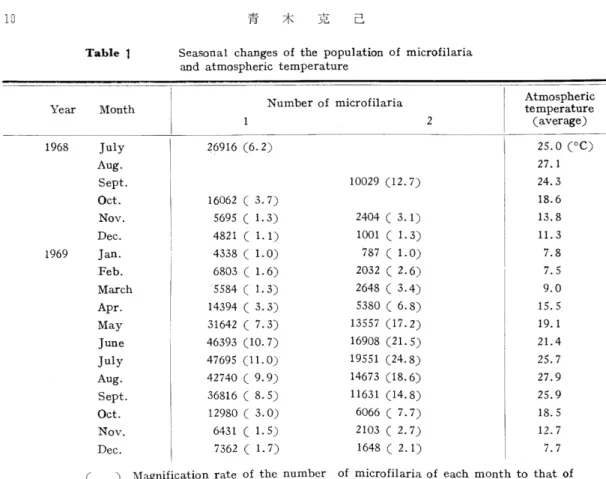
i96&年ワ月から1969年12月まで2頭の感染犬で毎月 一回中旬に24時間採血を行い,出現仔虫数の変動を観 察した.出現仔虫数を24時間の総和で示すと,Fig・1, Tablelに示すように出現仔虫数は季節により大きな 差があることが認められる.即ち両犬共に気温の低い 1月に仔虫数が最も少く,30cmm中の仔虫数は夫々 4338,ワ87隻を示しているが,その後暖かくなると共 に除々に増加し,0月では5584,2648隻,5月31642, 13557隻を数え,夫々1月の仔虫数に比べると7.0倍, Fig.1Monthlyfluctuationinthepopulation ofmicrofilariaofD.immitis.
max.temp, aver.temp.
min.temp.
&3‑<¥¥¥¥
¥x¥
JUL.SEP.NOV.JAN.MAR.MAY.JUL.SEP.NOV.
19681969
17.2f」itiMteアillp」‑^LTp」.^ゥmt>TOM^
の上昇と共に増加し,7月には47695,19551隻となり 最高値を示している.その数は1月の夫々11倍,24.8倍 になる.8月より以降は逆に次第に減少し,9月56816, 11631隻,11月には6451,2103隻に減少している.こ れは盛夏時の7月のそれと比べるとその13.5#サ10.8
%にすぎない・仔虫の増加は0月から5月にかけて最 もその率が高く, 9月から11月にかけての減少が目立 っている、
Table lに示すようにこれは気温の上昇,下降が 最もはげしい時期と一致している.
要するに犬糸状虫 D.immitisの仔虫の末梢血内出 現数はきわめて著明な季節的変動があり,最も寒い1 月, 2月に最も少く,盛夏のり, 8月に最高を示し, その数は1月の数の10及至20倍に達する.
24時間内の仔虫の日周性をみると,各月ともに常に 夜間にその数が多く,昼間に少い.最高値を示す時刻 は巾があるが,常に夜間に最高値を示す所謂夜間出現 性を示している.季節による仔虫数の増減ほ昼夜間共 に見られるが,夏季に於ける仔虫増加は夜間に著しく, どちらかと言えば夏に周期性がはっきりするような傾 向がみられる.
Ⅱ)環境温度と出現仔虫数との関係
一年間を通じての観察で,仔虫の出現にきわめて著 明な季節的の変動があることが明かとなったが,環境 気温が仔虫の末梢血内出現に及ぼす影響を観察するた め以下の実験を行った.
1)自然感染犬における観察
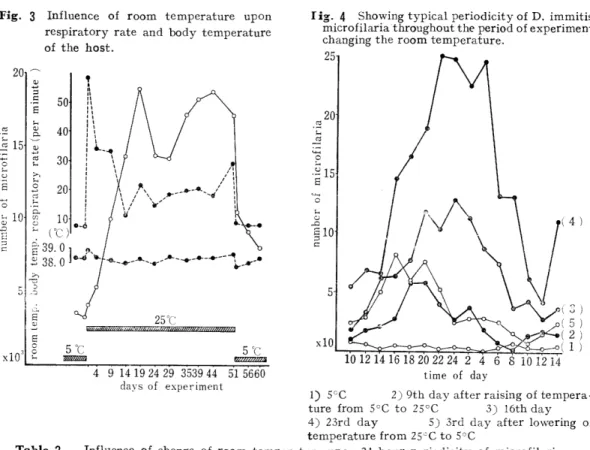
o頭の感染犬を5oCの恒温主に入れて約1週間飼育 した後室温を25oCまで急激に上昇させ, 27日及至51 日間保った。その後再び室温を5oCに低下させて,そ の間に於ける出現仔虫数の変動,目内周期性について 観察した、その成績はFig.2,Fig.3,に示してあるが,
7日間5oCに置いた時の24時間に出現した仔虫の総数
は第1例,第2例で夫々07隻,4559隻であったものが,
25‑Cに室温を上昇させると,次第に仔虫数が増加し,
それから9日目には夫々318, 11713隻となり, 5。Cの
時の8.6倍,2.6倍に増加している. 16日目には9D7隻,
21716隻,次いで20日目には191ワ隻, 31014隻に達し,
51、8, 6、8倍の著明な増加がみられる. 2ワ目目に5oC
にもどしてみると,第一例でほその0日目には488隻
青 木 克 己
Table 1 Seasonal changes of the population of microfilaria at】d atmospheric temperature
Year Month Number of microfilaria
IAtmospheric temperature
(average)
1968 July
Aug.
Sept.
Oct.
Nov.
Dec.
1969 Jan.
Feb.
March Apr.
May J une July
Aug.
Sept
Oct.
Nov.
Dec.
26916 (6.2)
16062 ( 3.7)
5695 ( 1.3)
4821 ( 1.1)
4338 ( 1.0)
6803 ( 1.6)
5584 ( 1.3)
14394 ( 3.3)
31642 ( 7.3)
46393 (10.7) 47695 (ll.0)
42740 ( 9.9)
36816 ( 8.5)
12980 ( 3.0)
6431 ( 1.5)
7362 ( 1.7)
10029 (12.7)
2404 ( 3.1)
1001 ( 1.3)
787 ( 1.0)
2032 ( 2.6)
2648 ( 3.4)
5380 ( 6.8)
13S57 (17.2) 16908 (21.5) 19551 (24.8) 14673 (18.6) 11631 (14.8)
6066 ( 7.7)
2103 ( 2.7)
1648 ( 2.1)
25.0 (°C)
27.1 24.3 18.6 13.8 ll.3 7.8 7.5 9.0 15.5 19.1 21.4 25.7 27.9 25.9 18.5 12.7 7.7
) Magnification rate of the number of microfilaria of each month to that of January, 1969
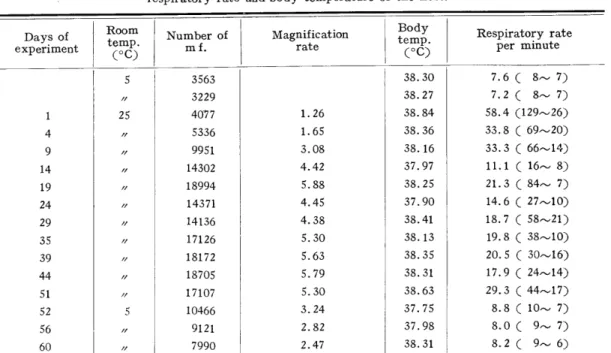
に減少,第二例では2日目に16542隻,4日目に9282 隻となり,二例とも最高値の約00%に急激に減少し, 次第に5。Cの時の仔虫数にもどる傾向がある、(Fig‑2) 第三例では最初の5oCで仔虫数3229隻であったが, 25。Cに室温を上げると,第一例,第二例と同様仔虫 数が増加し9日目でその0.1倍,14日目で4.4倍,19日目 で5.9倍に達している.その後約1ケ月25oCの室温で 飼育をつづけると,それ以上著明な増加はなく略々安 定した仔虫数を維持することが出来る.5oCに下げる と5日目には9121隻に急激に減少している.これは 25oCの最後の採血時の50%に当る.(Fig‑3)
この様に実験的に環境温度を変えてゆくと,仔虫の 出現はきわめて鋭敏に影響をうけ,短期間に仔虫数に 大きな変動がおこることが確認される.その間数回に わたり仔虫出現の口内周期性を観察したが,いづれの 温度でも夜間に最高値を示す周期性はよく保たれてい るが,高温で仔虫数が増加した時の方が周姻性がはっ きりするように思われる、(Fig.4,Table2)
第三例について測定された犬の体温は環境温度の変 化とはかかわりな(l常に一定で,概ね3C‑r
3.0v>の体温
が保たれている.呼吸数は5oCでは7‑8/min、で規 則正しい安定した呼吸数を示しているが,25‑Cに宝
Fig. 2 Increase in the number of microfilaria caused by raising of room temperature.
50
o
*H
oaoeM
cd
^a a
à""÷T5¢/uP”1"÷W
cs o t- o
'e
40 o-o 2
^ g 5°C
20
10
25°C
xPxr "
X
-* *à"&
-£f
t;
5 °C
o
2 5 9 15 23 2830
davs of exoerirrer.t
Fig. 3 Influence of room temperature upon respiratory rate and body temperature of the host.
20r
£15
10
5
xlO
OJ c
's
à"-H
O) n.
OJ ni t<
>>
(H O C3 SH O.
t/1 O
C OJ
^ 3 -3
E"
| O JH
50 40 30 20
)r'
a
,*--«-
-rf
»
4 -
>
-à"
39.0
38.0 ,-*--^--1
25"C
5 °C 5°C
'fff/W/tfft fHJJ/fffflffi
9 14192429 353944 515660
days of experiment
lig. 4 Showing typical periodicityof D. immitis microfilaria throughout the period of experiment changing the room temperature.
25i f-
ra 20 in a p o 's
o
IH o _Q s 3 c
15
10
5
xlO
-A 4)
5) 2) 1) 10121416182022242 4 6 8101214
time of day
1) 5°C 2) 9th day after raising of tempera-
ture from S°C to 2S°C 3) 16thday
4) 23rd day 5) 3rd day after lowering of
temperature from 25°C to 5°C
T able 2 Influence of change of room temperature upon 24 hour periodicity of microfilariae
Days of Room
experiment temp.
C°C)
10 12
S 7
2 25 I 3
1) 9 " I 9
16 // | 18
23 // I 53
30 5 ' 23
2) 2 9 16 23 30
5
25
//
//
//
5
Time of day
14 16 18 20 22 24
Number of microfilaria
12
21 61
4 9 27 63
65 146
49 81
3 6
58 s:
2
14 40
76 118 102
165 189 250
59 76 52
39
26 128 248 24
10 12
03
18 87
224 246 131
28 28 25
1 2 1 36 132 IS
3 1 13 42 61
14
4 1 14 36 110
23
506 389 343 347 352 313 310 340 368 460 422 389
301 257 433 299 465 357 415 451 472 356 452 394
691 783 1199 1741 1522 1095 901 826 836 793 630 696
308 391 313
369 455 412
649 1186 1345
2104 2164 2450 3129 2997 1159 1411 1688 1298 1110 1013 1196 2161 1106 2572
2308 2650 2877 2762 2538 2312 2844 2503 1952 2824 2733 3071 2359 3493 2325
712 764 857 1252 632 778 784 519 920 778 449 837 467 570 897
3) 4 9 19 51 59
5
25
S
163 205 123 243 290 611 273 285 236 268 362 170 146 124 109
160 318 229 230 377 544 384 446 335 570 429 428 657 502 527
537 602 536 450 588 647 638 862 1115 1483 1534 959 665 723 663
883 788 914 1215 2187 2063 2078 2233 1839 1816 1530 1094 1005
896 929 1063 1580 1222 1864 1556 2425 1577 1573 1775 968 954
189 162 449 1005 1408 1166 1372 1161 939 784 504 232 193
Room temperature was raised to 25°C after incubation at S°C for 1 week,
and lowered again to S°C at 28th, 27th, and 52nd day respectively.
青 木 克 己
温が上昇すると呼吸数はにわかに増加し,直後ほ00乃 至50/min・にも達する不規則な呼吸がみられるが,吹 第に落着き,25oCの期間中概ね20/min.前後の頻数な 呼吸となる.再び5oCに落すとその直後にほ一過性の 呼吸の乱れがみられるが,次第に減少し, 7‑8/min.
の規則正しい呼吸を示すようになる・即ち室温の上昇 によって呼吸数は増加する・ (TaやIe 3)
2) ‑D. immitis仔虫を未感染犬,家兎に移注した 実験.
未感染犬又は家兎にD. immitis仔虫を移注し,母虫
Table 3 Influence of room temperature upon the number of microfilaria, respiratory rate and body temperature of the host.
Days of experiment
Room temp.
C°C)
N umber of mf. M agnification rate
B ody
temp.
C°C)
Respiratory rate per minute
1
49
14 19 24 29 35 39 44 51 52 56 60
s
//
25
//
//
//
//
//
//
//
5
//
3563 3229 407 7 5336 9951 14302 18994 14371 14136 17126 18172 18705 17107 10466 9121 7990
1 .26 1.65 3.08 4.42 5.88 4.45 4.38 5.30 5.63 5.79 5.30 3.24 2.82 2.47
38.30 38.27
38. 84
38.36 38.16 37.97 38.25 37.90 38.41 38.13 38.35 38.31 38.63 37.75 37.98 38.31
7 .6( 8-
7.2( 8-
58.4 (129-
33.8 ( 69-
33.3 ( 66-
11.1 (16-
21.3 (84-
14.6 ( 27-
18.7 (58-
19.8 ( 38-
20.5 ( 30-
17.9 ( 24-
29.3 (44-
8.8( 10-
8.0( 9-
8.2( 9-
R oom temperature was raised to 25°C after incubation at 5°C for 1 week, lowered again to S°C at 52nd day.
Number of microfilaria was expressed by the total number for 24 hours.
はない状態のもとで仔虫の出現に及ぼす環境温度の影 響を観察した.
先づ体重0 kgの末感染犬に仔虫を含む感染犬血液約 55cc, (推定仔虫数92万隻)を股静脈より輸血し,室 温(20oC)で仔虫が末梢血より自然に減少,消失す る過程を観察した.輸血後4日目の仔虫数は8D6隻を 数えたが,その後9日目にはその数は殆んど変らず, o1日目でもその81%が末梢血中に出現している.しか し1ケ月を過ぎると急激に仔虫数は減少し, 08日目に o17隻, 51日目にほわずか0隻が発見され, 58日目以 降末梢血から消失している.この成描からみると末感 染犬に移注されたD. immiti∫仔虫は移注後1週間乃至 1ケ月以内でほ仔虫の著明な減少はないものと思われ る.
Fig. 5 Influence of the room temperature upon the appearance of microfilariae transfused into fresh dog.
2or
2
!M CO
^-M O à"_
O
's o
OJ _o
S 3
25 °C 5°C
20°C
lOOi T° V -°v »-°control
80 60 40 20
%]
.A
i nitial count 806 2110 940 2736
49 56
2 7 1216 21 27 34 43
days after transfusion of microfilariae
Control dog was kept in constant room tempe-
rature of about 20°C
Fig. 6 Showing typical periodicity of micro- filariae transfused into fresh dog throughout the period of experiment changing the room temperature.
25
.2 20
S 15
10-
5
xlO
(3) (1)
2)
10121416182022242 4 6 8101214
time of day 1) 20°C
2) Sth day after lowering of temperature from
20°C to S°C
3) 4th day after raising of temperature from
S°C to 25°C
IB (H
JH o
S-, O
"s o
!H 0) -Q S 3 C
Fig. 7 Influence of the room temperature upon the appearance of microfilariae transfused into rabbits.
20°C "%/???£$
15, 9
"I
IIk
5
xlO
5 °C
Nx>-
25°C
o o control
4 9 14 17 20 29
days after transfusion of microfilariae
Control rabbit was kept in constant room temperature of about 20°C
T able 4 Influence of change of room temperature upon 24 hour periodicity of microfilariae transfused into fresh dog.
Days after transfusion
4
1) 17
31
R oom temp.
(°C)
Time of day
10 12 14 16 18 20 22 24 2
Number of microfilaria
10 12 14
32 42 26
37 36 36
55 30 52
72 60 60
91 72 70
85 92
95 104
70 51
87 115
65 74
72 57
57 50 44
53 23
31 40 38
31 30 17
26 22 30
49 40 34
91 76 131 160 206 223 233 271 211 193 177 140 89 115
16 7 16 21 29 30 ll ll IS 2 3 5 4 14
36 55 105 103 74 131 98 66 33 13 18 ll 28 51
87 9 96
2
2) 7
16
20 5 25 20 5 25
2
4) 7
16
20 5 25
13 6 13
10 4 14
34 38 79
59 101 107 107 127 146 131 54 61 28 20
8 20 21 15 8 8 14 7 0 1 6
88 78 65 61 24 19 27 15 16 19 41
34 13 67
56 57 131 242
ll 15 30 47
3 20 85 82
345 304 325 384 351 260 132 123 82 78 145
52 29 25 ll 10 6 0 1 8 7 18
126 128 156 155 65 45 38 18 14 26 82
R oomtemperature was lowered from 20°C to 5°C at 3rd day after transfusion,
and maintained at 5°C for 10 days, and raised again to 25°C at 13th day
1) kept in constant room temperature of about 20°C
吉IトーI‑''Li己
次いで体重2.8/2ァ>,3の0頭の未感染犬に 夫‑々推定仔虫数180万,106万,394万を含むと思われ る感染犬血液58cc,40cc,45ccを静注,24時間室温に て放置した後,24時間採血を行い,5oCの恒温室に 移し5日目,1D日日に採血,輸血後10日目に25‑Cまで, 室温を上昇させ,約1ケ月間観察し室温にもどした. 最初の室温での仔虫数は夫々2110,940,2736隻で あった.これを5oCにさらすとその5日目にほ夫々 最初の仔虫数のワ3‑1noO iiZ.o,o、6%に急激に減少する. 10日目にほ更に減少し6・5,7.に当る仔虫が 出現するにすぎない.5oCから25oCに恒温室の温度 を上げると4日目には仔虫数は夫々ワ05隻,529隻, 902隻に回復する.その数は最初の仔虫数の04、8,56.3, o4、1%に当る。25oCの室温に1ケ月おかれても目立 った増加はなく,概ね5oCの時よりも数倍高い値を
保っている.室温(20‑C)にもどすと再び減少し, 8日目をすぎると仔虫数は最初の数の5%から20%以 下を示すようになる. (Fig.5)以後対照実験と同様次 第に減少,消失する.その全期間を通じて,仔虫の出 現は給血犬に見られると同様,定型的な日周期性が保 たれている. (Fig.6, Table 4)
家兎に移注した場合にも Fig.7 に示すように略々 同様の成績が得られているが,室温においた場合でも 仔虫の消失の経過は犬に比べて速かで,概ね1ケ月以 内に末梢血に見られなくなる. 5oCにうつすと更に急 速に減少し25oCでは明らかな一過性の増加がみられ る.このように新しい宿主に移注された仔虫の出現も 環境温度によって著しい影響をうけることが確認され
た.
総 括 と 考 察
著者はD、 iminiti∫感染犬について1ケ年を通じ毎 月1臥24時間採血を行って末梢血内に出現する仔虫 数を観察したが,その結果仔虫数は冬に減少し夏期に は増加する、その数は冬の10乃至20倍に達するきわめ て著しい季節的消長があることが確認された.この季 節的消長は既に二,三の研究者によって脂摘されてい るところであるが,その原因はまだ明らかでない.村田 (1939)ほ紫外線の影響を考え,坂垣,久米ら(1938) は母虫子宮内に於ける卵子並びに仔虫の季節的変化を 認めて,寄生母虫の仔虫産生能力に季節的差異がある ことを報告している.又久保ら(1959)は季節による蚊 の刺嘆の頻度の差にその原因をもとめている. Eyles, D.E.(1954)らは環境気温との関係を論じている・し かしいづれも推測の域を脱せず,その裏付けとなる実 験的根拠は少ない様である.しかし仔虫数の季節的 変動が気温の高い盛夏に増加し・厳寒の1, 2月に 最低値を示すことば気温との関係が先づ推測される.
D. immiti∫感染犬を恒温室に入れ,実験的に環境温度 を変えると出現仔虫数がきわめて敏感に影響をうけ,
5 oCから25oCに上昇することで仔虫数は1‑2週の 短期間のうちに数倍から50倍に達する増加を示し,又 逆に再び室温を5 oCまで降下させると急激に仔虫数 の減少がおこり,もとの値にかえる傾向がみられる.
このことは宿主のおかれた環境の温度の変化が出現仔 虫数に直接的な関係をもつことを示すもので,その季
節的消長の原因ほ季節による気温の変化に求められる ものであろうと考えられる.
著者は又次の実験にてD. immitis仔虫を移注した 未感染犬や家兎でも環境気温の実験的上昇が同様著明 な一過性の仔虫の増加をもたらすことを見ている.元 栄,仔虫は常に肺毛細管内に蓄積され,夜間になると末 梢血中に放出されることば先人の業績により明らかで あるが,環境温度の変化ば母虫の仔虫産生とは関係な く,肺毛細管から末梢血‑の仔虫の放出機構に影響を 与えるものと考えられる.言葉をかえると,環境気温
が放出される仔虫の数をcontrolする役割を果してい るのかもしれない、しかしいかなる温度でも仔虫出現 の日内のリズムば正常に保たれていることば注目され ねばならない.
恒温室内での室温の上昇,降下実験に際して宿主側 におこる反応として体温は常に 3.5oC前後の正常体 温が維持されているが,呼吸数は低温時ほ少く,室温 が上昇すると著明な増加がみられる.これは外界気温 の変化に順応して体温その他の宿主の内部環境を正常 に保とうとする生体適応反応と受け取られる.
環境温度の出現仔虫数に及ぼす影響は,こういった
生体の生理作用の適応反応の過程のなかに求められる
べきものか,或は仔虫に対する直接の作用によるもの
か,その解明は今後の課題である.
摘 要
著者は1ケ年に亘り,末梢血内に出現するD. immitis 仔虫の数の季節的消長と日内周期性を観察し,更に自 然感染犬,仔虫を移注した未感染犬,家兎について出 現仔虫数と環境温度との関係を実験的に追究した.
自然感染犬での出現仔虫数は季節により,著明な差 がみられ,1,2月に最も少く,7,8月にはその約10 乃至20倍に激増する.自然感染犬を入れた室温を5℃
から25℃に上昇させると仔虫数はすみやかに増加し, 20日前後のきわめて短期間に5℃の時の約6〜50倍に
増加する.再び室温を5℃に下げると仔虫数は急激な 減少を示し,5℃の時の値にかえる傾向がみられる.
しかしこの間,24時間内の仔虫の出現は常に正常の夜 間出現性が認められる.室温の上昇で犬の呼吸数は著
明に増加するが,体温は一定に保たれている.
仔虫を移注した未感染犬や家兎でも同様の仔虫数に 対する環境気温の影響がみられる.
以上の実験結果から, D. immitis仔虫の数の季節的 変動は環境温度の変動に原因することが確証された.
稿を終るに当り御指導,和枝閲をいただいた恩師片峰大助教授に深甚の謝意を表します.
文 献
1〕江良栄一:ミクロフィラリアの定期出現性に関する 冥験的研究,長大風土病紀要, 1(3) : 2、"‑277, 1959.
2) Eyles, D. E、 prevalence of Dirofilaria immitis in MEMPHIS, TENNESSEE., J. Parasit.
40 : 216, 1954.
3) Hawking, F. & Thurst」 J p. The periodicity of microfilariae、
H) The explanation of its production̲ Trans.
Roy. Soc、 Trop. Med. & Hyg̲ 45 : 329, 195†.
4) Hawking, F., Pattanayak, S. & Sharma, H. L. : The periodicity of microfilariae. xT.
The effect of body temperature and other stimuli upon the eyeles of Wuchereria bancrofti, Brugia malayi, B. ceylonensis and Dirofilaria repens., Trans. Roy. Soc. Trop、 Med. & Hyg̲ 60 : 497, 1966.
5) Hawking, F. : The 24、hour periodicity of microfilariae、 Biological mechanisms responsible for its production and control., Proc. Roy・ Soc.
a, 196:59‑ 76, 1967.
Hin‑an, E. H. : Experimental studies on filarial periodicity., J. Trop. Med. & Hyg., 38 : 265, 1935.
7)板垣四郎,久米精治:犬糸状虫 Dirofilaria immitisの研究̲中央獣医学雑誌り第51年: 1059,193