総 説
Pick 病の臨床と病理
横田
修
1)2)4)*土谷 邦秋
1)3)要旨:現在 Pick 病は病理学的には Pick 球の存在で定義される.Pick 球を有す Pick 病とそれを欠く葉性萎縮例 の間で組織変性の分布や臨床像はことならないとの見解が歴史的に支持されてきたが,最近の研究では Pick 病と TDP-43 陽性封入体を持つ前頭側頭葉変性症の初期症状,症候群の進展形式,更に大脳皮質,基底核,錐体路の変性 はことなる可能性が示されている.背景病理の生前予測と将来の疾患特異的治療の方針決定に寄与する前頭側頭葉 変性症の臨床情報の蓄積が必要である. (臨床神経,49:235―248, 2009) Key words:ピック病,タウ,TDP-43,臨床診断 I.はじめに Pick 病は Pick 球の扱いを巡って複雑な歴史を持つ.最初 の Pick 病 の 報 告 は 1892 年 に Arnold Pick が 記 載 し た 症 例 August H.である1)2).まずこの例が Pick 球を有していたかど う か が 不 明 で あ る.約 100 年 後 の 1994 年 に Lund-Manchester グループが提唱した前頭側頭型認知症(Fronto-temporal dementia:FTD)の概念でも,Pick 球の有無の意義 は病理分類に厳密に反映されず3),結果的に前頭側頭葉に限局 性萎縮を有す例の病理像は Pick 球の有無によって影響を受 けないという歴史的見解が踏襲された.1998 年には FTD に 進行性失語(progressive aphasia:PA)と意味認知症(seman-tic dementia:SD)という臨床概念を加えた前頭側頭葉変性 症(Frontotemporal lobar degeneration:FTLD)が提唱され た4).すなわち FTLD は臨床症候群の概念であり,その診断基 準は病理学的に均一な患者を抽出するためのものではない. よって疾患特異的病変(老人斑やレビー小体)によって定義さ れたアルツハイマー病(AD)やレビー小体型認知症(DLB) の臨床診断基準と,FTLD の診断基準は本質的に意味がこと なる.現在,臨床研究では FTLD の診断基準を満たす患者群 は AD 群や DLB 群と同水準に扱われるが,これは FTLD の 病理は幾つかあってもその間に臨床的な差がないと考えられ てきた事による.今から 約 80 年 前 に 発 表 さ れ た Onari と Spatz の論文5)は Pick 病を論じる際に必ず引用される重要な ものだが, Pick 球の有無に関する問題でもよく言及される. 彼らは側頭葉と前頭葉に限局性萎縮を有す病理学的に不均一 な少数例(Pick 球有り 2 例,無し 2 例,不明 1 例)における 共通の病理特徴を①側頭・前頭葉の肉眼的萎縮,②萎縮部位 の皮質における表層優位の神経細胞脱落,③動脈硬化症の血 管変化は軽度ないし欠如,④炎症性変化の欠如,⑤老人斑と神 経原線維変化の欠如とし,次いで論文の末尾三行に「Die ar-gentophilen Kugeln Alzheimers kommen sowohl bei der Schläfenlappen- als bei der Stirnhirnatrophie vor,sie können aber auch völlig fehlen,ohne daβ das Gesamtbild hierdurch verändert würde(アルツハイマーの(述べた)嗜銀球は側頭 葉にも前頭葉にも現れ,しかしその全体像を変えることなく 嗜銀球をまったく欠くことがある)」と記している.
現在の FTLD の病理学的分類は,異常に蓄積する蛋白の種 類に基づく(Table 1)6)7).そして Pick 病の診断はタウ蛋白陽
性の Pick 球(Fig. 1a)を持つ症例に対して下される.臨床像 や脳萎縮の分布は少なくとも病理診断において考慮されな い.認知症の治療法開発は異常蛋白に対するアプローチが追 求されているが,疾患の分類は治療方針(まだ未確立だが)を 決定するための手続きであると考えると,異常蛋白に基づく 分類は合理的かつ実際的である.ただ,本来臨床診断は病理診 断に連続することで治療に寄与すべきであり,両者の乖離し た状態は解消されることが望ましい.さもなければ,将来の FTLD 診断は生体イメージングなどによる異常蛋白の同定 だけに依存し,患者の観察や症候学とは距離を置いた一面的 で危ういものになりかねない. 本稿では Pick 球を持つ症例を Pick 病と呼ぶ.その上で Pick 病の病理学的位置付けと疫学的事項を述べ,更に FTLD の臨床診断で一般に問題となりやすい症候を挙げる.次いで, * Corresponding author: 岡山大学大学院医歯薬学総合研究科精神神経病態学〔〒700―8558 岡山市北区鹿田町 2―5―1〕 1) 東京都精神医学総合研究所高齢社会プロジェクト老年期精神疾患研究チーム(神経病理) 2) 岡山大学大学院医歯薬学総合研究科精神神経病態学 3) 東京都立松沢病院検査科 4) 現 マンチェスター大学臨床神経科学研究グループ (受付日:2009 年 2 月 6 日)
Table 1 Neuropathologicalclassification ofFTLD
1.Tauopathy (with associated neuron lossand gliosis)and insoluble tau with a predominance of3R tau,the mostlikely diagnosesare:
・FTLD with Pick bodiesa)
・FTLD with MAPT mutation
2.Tauopathy (with associated neuron lossand gliosis)and insoluble tau with a predominance of4R tau,the mostlikely diagnosesare:
・Corticobasaldegeneration (CBD) ・Progressive supranuclearpalsy (PSP) ・Argyrophilicgrain disease (AGD)
・Sporadicmultiple system tauopathy with dementia ・FTLD with MAPT mutation
3.Tauopathy (with associated neuron lossand gliosis)and insoluble tau,with a predominance of3R and 4R tau,the most likely diagnosesare:
・Neurofibrillary tangle dementia ・FTLD with MAPT mutation
4.Frontotemporalneuronallossand gliosiswithouttau-orubiquitin/P62-positive inclusions,the mostlikely diagnosisis: ・FTLD (also known asdementia lacking distinctive histologicfeatures:DLDH)
5.TDP-43 proteinopathy with associated neuronallossand ubiquitin-positive/P62-positive,tau-negative inclusions,with MND orwithoutMND butwith MND-type inclusions,the mostlikely diagnosesare:
・FTLD-U with MND (FTLD-U types1-3) ・FTLD-U butwithoutMND (FTLD-U types1-3)b)
・FTLD-U with PGRN mutation (FTLD-U type 3) ・FTLD-U with VCP mutation (FTLD-U type 4) ・FTLD-U linked to chromosome 9p (FTLD-U type 2) ・Otherasyetunidentified TDP-43 proteinopathies
6.Frontotemporalneuronallossand gliosiswith ubiquitin-positive/P62-positive,TDP-43-and tau-negative inclusions, the mostlikely diagnosesare:
・FTLD-U with CHMP2B mutation ・Basophilicinclusion body disease (BIBD)
・Otherasyetunidentified FTLD-U,non-TDP-43 proteinopathies
7.Frontotemporalneuronallossand gliosiswith ubiquitin/P62 and α-internexin-positive inclusions,the mostlikely di ag-nosisis:
・Neuronalintermediate filamentinclusion disease (NIFID)
a)Pick’ sdisease casescorrespond to FTLD with Pick bodies.b)SporadicFTLD-TDP casesin thispapercorrespond to
FTLD-U butwithoutMND.CHMP2B charged multivesicularbody protein 2B gene,FTLD frontotemporallobar degen-eration,FTLD-U FTLD with ubiquitin-positive,tau-,α-synuclein-,TDP-43-,and neuronalintermediate filamentprotei n-negative inclusions,MAPT microtubule-associated protein tau gene,MND motorneuron disease,neurofibrillary tangle dementia,also called tangle predominantform ofsenile dementia,PGRN progranulin gene,TDP-43 TAR DNA-binding protein 43,VCP valosin-containing protein gene,DNTC diffuse neurofibrillary tangleswith calcification,SD-NFT Senile dementia ofthe neurofibrillary tangle type.Reprinted with permission from Ref.6).
Pick 球のない Pick 病と歴史的に呼ばれてきた症例のかなり の部分を占め,現在 TAR DNA-binding protein 43(TDP-43) 陽性封入体を持つ FTLD(FTLD-TDP)と分類される一群と Pick 病の臨床病理学的差異に関する知見をまとめる.
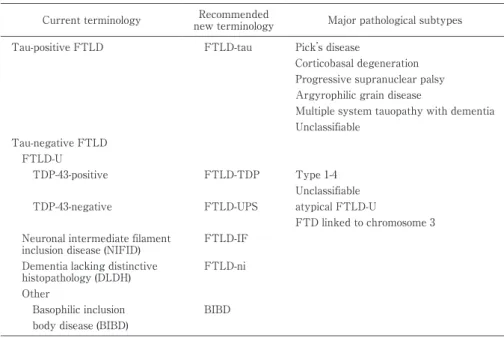
II.FTLD の病理学的分類における Pick 病の位置づけ 2007 年に発表された FTLD の病理学的分類を Table 1 に 示す6).ユビキチン陽性タウ陰性封入体を持つ FTLD(FTLD
with ubiquitin-positive,and tau- andα-synuclenegative in-clusions:FTLD-U)は頻度の高い FTLD である.この時点で は charged multivesicular body protein 2B(CHMP2B)遺伝子 変異を有す例を除けば,ユビキチン陽性だが TDP-43 陰性の 封入体を有す具体的な症例群は知られていなかった.しかし 後に FTLD-U には TDP-43 陰性例が一定数存在するとわか り8),2009 年に発表された用語案では,Pick 球を持つ例は ‘FTLD-tau(Pick s disease)’,タウ陰性 TDP-43 陽性封入体を 持つ例は‘FTLD-TDP’と記すことが提唱された(Table 2)9). もっとも多い FTLD の病理はユビキチン陽性,TDP-43 陽 性,タウ陰性,シヌクレイン陰性の変性神経突起,神経細胞胞 体内封入体,あるいは神経細胞核内封入体を有す FTLD-TDP である6).4 つの組織学的亜型があり,比較的長くて太い変性 神経突起が多いばあいを type 1(Fig. 1b),胞体内封入体が多 いばあいを type 2(Fig. 1c),比較的短い変性神経突起と胞体 内封入体を同程度有すばあいを type 3(Fig. 1d)とする.Pro-granulin(PGRN)遺 伝 子 変 異 を 持 つ FTLD-TDP は type 3 でかつレンズ型の核内封入体が出現するとされる.Type 4 は valosin-containing protein(VCP)遺伝子変異を持つ例でみ られ,核内封入体が多く,胞体内封入体と変性神経突起は少な い.
Fig. 1 PathologicalhallmarksofPick’ sdisease and FTLD-TDP.
(a)Pick bodiesin the temporalcortex.(b)Type 1 histology ofFTLD-TDP.Relatively thick and long TDP-43-positive dystrophic neurites with few or no neuronal inclusions are seen. The temporal cortex.(c)Type 2 histology ofFTLD-TDP.Many TDP-43-positive intracytoplasmicinclusionswith few orno dystrophicneuritesare visible.The temporalcortex in a case ofALS with dementia.(d) Type 3 histology ofFTLD-TDP.Both many shortdystrophicneuritesand intracytoplasmicincl u-sionsare noted.The temporalcortex.
(a)Tau immunohistochemistry,(b-d)Phosphorylated TDP-43 immunohistochemistry.(a)Scale bars= (a)50 μm and (b-d)100 μm. III.Pick 病の疫学 臨床症候群としての FTLD は AD,DLB に次いで三番目に 多い変性性認知症であり,早期発症例の中では AD に次ぐと される10)11).しかしながら Pick 病はまれな疾患というべきで ある.たとえば都立松沢病院の 1978 年以降の連続剖検 730 例中(それ以前は現在検索不能)Pick 病は 3 例(0.4%),岡山 大 学 精 神 科 の 1924 年 か ら の 連 続 剖 検 994 例 中 で も 3 例 (0.3%)である.非典型な症例が解剖されやすい剖検バイアス を考えると,なおさらこの頻度は低いといえる. FTLD-U あ る い は FTLD-TDP は 臨 床 FTLD の 30∼62% を占め,もっとも頻度が高い.FTLD-U における FTLD-TDP の頻度は,U40 例中(臨床診断 FTD)85% が FTLD-TDP との報告がある8).臨床 FTLD における Pick 病の頻度 は 10∼30% で,corticobasal degeneration(CBD)(0∼24%)と 前後して 2 番目か 3 番目の頻度との報告が多い12)∼16).AD と FTLD の区別を難しいと主張する北米には AD を高率(15∼ 21%)にふくむ臨床 FTLD シリーズがあるが14)15),これが普遍 的事実か各施設の正診率の問題なのかは不明である. 欧米では Pick 病と FTLD-U の頻度比は 1:3 程度,都立松 沢病院例では 3:9,岡山大学精神科例では 3:2 である.欧米 では家族性 FTLD,あるいは家族性 FTLD-U や FTLD-TDP が非常に多い.たとえば Manchester 大の FTLD300 臨床例 の約 50% は家族歴を有す17).Mayo Clinic にお け る U42 例中,家族性症例は 68% に達し,PGRN 変異は全 FTLD-U の 43% にみとめられ,更に PGRN 変異を欠く残りの 57% の FTLD-U 例でも 55% は家族歴を有す18).対して本邦では Ikeda らが FTLD42 臨床例について家族歴はなかったと述 べている19).これらは Pick 病,FTLD-TDP,更に臨床 FTLD に関する疫学データは欧米と本邦とでことなるだろう事を推 測させる. IV.FTLD の精神症状 FTLD の症状は数字で表せない抽象的な項目が多く,拡大 解釈,診断基準の文言との操作的な字面合わせ,症候の過度の 重み付けによる誤診がおこりやすい.Pick 病の症候を述べる 前に FTLD で一般に問題になる点を挙げる. (1)反社会的行動,自己中心的行動,人格変化 FTLD を強く示唆するという意味でもちいられるにもか かわらず拡大解釈しやすい代表的な言葉である.たとえば施
Table 2 Nomenclature forneuropathologicsubtypesofFTLD
Majorpathologicalsubtypes Recommended
new terminology Currentterminology
Pick’ sdisease FTLD-tau
Tau-positive FTLD
Corticobasaldegeneration Progressive supranuclearpalsy Argyrophilicgrain disease
Multiple system tauopathy with dementia Unclassifiable Tau-negative FTLD FTLD-U Type 1-4 FTLD-TDP TDP-43-positive Unclassifiable atypicalFTLD-U FTLD-UPS TDP-43-negative
FTD linked to chromosome 3 FTLD-IF
Neuronalintermediate filament inclusion disease (NIFID)
FTLD-ni Dementia lacking distinctive
histopathology (DLDH) Other
BIBD Basophilicinclusion
body disease (BIBD)
Reprinted with permission from Ref.9).
設ケアの場で入浴,食事,排泄などを時間通りに強制すると誘 発される暴言・暴力は疾患非特異的な現象である20).FTLD らしい反社会性・自己中心性とは表面的な易怒性,拒否的態 度,暴力の程度よりも,「他人の家の仏壇の供物を食べる」「庭 に入り込んで花を摘む」「店から欲しい物を持って行く」など 脱抑制や常同行動に基づく社会常識・倫理規範からの逸脱 と,暴力はそれを制した際に現れやすい事を重視すべきであ ろう.店から物を持って行く時はコソコソせず,いわゆる万引 きとはことなる. (2)抑うつ状態 精神医学でいう抑うつ状態は,悲哀感,寂寥感をともなった 抑うつ気分,「今後うまくいく可能性は無い」「取り返しのつか ない失敗をした」といった取り越し苦労や後悔のめだつ悲観 的思考,意欲・活動性の低下,「皆に迷惑を掛けて申し訳ない」 という自責的思考,希死念慮,心気傾向,食欲低下,浅眠多夢・ 早朝覚醒傾向の睡眠障害などからなる症候群である.本人は 周囲に迷惑を掛けぬよう,自分に鞭打って頑張り,自己の状態 を辛いと述べる.SD や PA 患者で病識のあるごく初期ならう つ状態を呈すかもしれないが,筆者はこのような心理的に深 みのある苦痛に耐える FTLD 患者を診た事がないし,故田邉 敬貴先生も FTLD の抑うつ状態に疑問を呈している21).一 方,自発性低下は経過中ほぼ必発する. (3)常同 行動面では,一つの(あるいは決まった複数の)コースに散 歩に行って帰ることを毎日,一日に何回もくりかえすという 複雑なひとまとまりの動きから,廊下の往復,戸の開閉の反 復,物の収集,時刻の頻繁な確認,物の数を数える,コップで コンコンと机を叩く,手で膝を擦るといった単純なくりかえ し動作まである.言語面では同じ歌,フレーズ,高笑い,単語 の反復などがある.AD でも常同のみられることは重要で,時 刻へのとらわれ(3.6%),日課への固執(14%),強迫的な物 の収集(14%),保続(11%),決まったフレーズの使用(21%) が報告されている22).AD の常同は低頻度だが,AD 自体が高 頻度な疾患なため臨床的には遭遇する可能性が高い. (4)無関心,考え不精 FTLD 患者は周囲のすべてに無関心なわけではない.医師 の診察には無関心だが,注意転導性亢進や被影響性亢進のた め,病棟では常にキョロキョロと視線を動かして周囲に関心 が向き,物や人をつかむことは多く,一方的に人に近寄って叩 く事もある.病棟で数名しか FTLD 患者がいなくとも彼らと は遠くから目が合いやすい.自発性が低下しても周囲をじっ と見ている.鋭いスタッフは AD 患者より視線を感じると述 べる.FTLD の無関心とは「状況からすると注意を向けて当 然と思う点に注意が留まらない状態」といえる.筆者の私見だ が多くの AD 患者は(むしろ FTLD 患者より)いくらか注意 散漫でぼんやりとしているので,単に無関心な所が患者にあ るかと考えると,AD でも FTLD でも当てはまってしまう. 考え不精は「よく考えずに即答する」というよりも,「ハイ, イイエで答えられる質問には正誤はともかくハイ,イイエ,開 かれた質問にはワカリマセンと最小限の言葉で即答し,拒否 や怒りはない」と考えた方が正確である.英語の economy of effort との表現はいいえて妙である. V.Pick 病と孤発性 FTLD-TDP の臨床像 Pick 病と孤発性 FTLD-TDP の臨床像を比較した検討は, 最近のわれわれの報告がおそらく唯一である23).対象は東京 都精神医学総合研究所(1974 年以降)と岡山大学精神科(1924 年以降)において病理学的検索をおこない,現在も追加の病理 検索が可能な Pick 病 19 例と FTLD-TDP20 例である(Table
Table 3 Demographicdata ofPick’ sdisease,FTLD-TDP,and FTLD-MND cases FTLD-MND FTLD-TDP Pick’ s disease FTLD- TDP-PLS (ne) FTLD- TDP-PLS (- ) FTLD- TDP-PLS (+ ) All FTLD-TDP 9 (2/7) 2 (1/1) 4 (3/1) 14 (10/4) 20 (14/6) 19 (9/10)
N (male/female)
63.6 ± 10.3 52.0 ± 11.3 62.7 ± 7.2 52.9 ± 7.4 54.5 ± 8.2 55.9 ± 7.5 Age atonset(y) 65.6 ± 9.4 60.5 ± 17.7 64.2 ± 11.3 63.2 ± 8.2 63.1 ± 9.2 66.2 ± 8.3 Age atdeath (y) 2.1 ± 1.2 8.9 ± 5.9 6.3 ± 2.5 10.6 ± 5.8 9.7 ± 5.4 8.6 ± 5.0 Duration (y) 0 0 0 0 0 0 Family history (n) 1,251 ± 105 1,150a) 1,170 ± 314 1,016 ± 189 1,049 ± 207 1,012 ± 216 Brain weight(g) TDP-43 pathology
0 (0.0) 1 (50.0) 2 (50.0) 8 (57.1) 11 (55.0) ― Type 1 [n (%)] 9 (100.0) 1 (50.0) 1 (25.0) 3 (21.4) 5 (25.0) ― Type 2 [n (%)] 0 (0.0) 0 (0.0) 1 (25.0) 3 (21.4) 4 (20.0) ― Type 3 [n (%)] 0 (0.0) 0 (0.0) 0 (0.0) 0 (0.0) 0 (0.0) ― Type 4 [n (%)]
The age atonset,age atdeath,duration,and brain weightwere mean ± standard deviation. FTLD-TDP-PLS (+ ),FTLD-TDP with PLS-like corticospinaltractdegeneration;
FTLD-TDP-PLS (- ),FTLD-TDP withoutPLS-like corticospinaltractdegeneration;
FTLD-TDP-PLS (ne),FTLD-TDP casesofwhich medulla oblongata orspinalcord tissue could notbe histopathologically examined.a)The brain weightin one case ofFTLD-TDP-PLS (ne)wasnotavailable.Reprinted with permission from Ref.23).
3).すべて孤発例である.FTLD-TDP は,primary lateral scle-rosis 様の錐体路変性を有す FTLD-TDP-PLS(+)群,錐体路 変性を欠く FTLD-TDP-PLS(−)群,錐体路が検索不能の FTLD-TDP-PLS(ne)群に分けた.TDP-43 病理の対照として FTLD-MND9 例(上位・下位運動ニューロン変性,Bunina 小体,ユビキチン陽性封入体を有す)ももちいた. 臨床情報の不十分な FTLD-TDP2 例と Pick 病 5 例を臨床 検討からは除外した.病理情報を伏せ,臨床記録から精神・行 動の症状(焦燥,多幸,脱抑制,自己中心的人格変化,常同, 口唇傾向,異食),言語・意味記憶障害(呼称障害,聴理解障 害,発語の減少,非流暢性失語,発語失行,一般物品・近しい 人の顔・書字の視覚認知と聴理解の障害),非対称性の運動障 害(錐体路徴候,パーキンソニズム,拘縮,下位運動ニューロ ン徴候),その他(ものわすれ,記憶障害,失行,半側空間無 視)を抽出した(OY).これを基に両疾患の初期症状(発症か ら一年以内の全症状と定義),全経過中の症状頻度,FTLD の臨床的下位分類(診断基準4)にしたがい FTD は人格変化, 脱抑制,自己中心的行動,常同で特徴付けられる進行性の行動 障害,PA は進行性非流暢性の失語,SD は流暢な発語と,単 語の意味の理解障害,相貌・物品・書字の認識の障害,聴理解 の障害で特徴付けられる意味記憶の障害と定義)の出現順序 を決定した.分類不能の時期はもっともめだつ症候名で表し た.以上を神経心理学者(MK)が検証した後,各変数につい てχ2検 定 と Mann-Whitney U 検 定 を も ち い て 統 計 解 析 し p<0.05 を有意とした. Pick 病群と FTLD-TDP 群間に性比,発症年齢,罹病期間, 脳重に有意差はなかった.しかし FTLD-TDP-PLS(+)の平 均罹病期間は TLD-TDP-PLS(−)より長い傾向があった(10.6 年と 6.3 年). (1)初期症状(Table 4) 初期症状を FTLD-TDP で頻度が高い順に示した.二疾患 の初期症状スペクトラムは言語面でことなっていた.意味記 憶障害は FTLD-TDP の約 40% が呈し,Pick 病ではみられず 有意差があった.呼称障害,記憶障害,聴理解障害も FTLD-TDP で Pick 病より 2∼4 倍高頻度であった(意味記憶障害を 見落とされた可能性はある).Pick 病では何らかの発語の障 害(非流暢性の自発語,発語失行,音韻性錯語,発語の際に躊 躇する,どもるなどの記載すべて)が FTLD-TDP に比して 5 倍高頻度であった. 初期の常同や脱抑制は二疾患で差がなく,自発性低下は FTLD-TDP で 2 倍高頻度であった.FTLD-TDP-PLS(+)と FTLD-TDP-PLS(−)の初期症状スペクトラムはほぼ同様で あった.FTLD-TDP でのみ歩行障害や不全片麻痺といった運 動障害を初期に呈す例があった.統合失調症様の被害妄想の 先行を両疾患でまれにみとめた. (2)全経過を通じての症状頻度(Table 4) (2-1)精神・行動の症状 自発性低下,多幸,口唇傾向は FTLD-TDP で,常同は Pick 病で多かった.これらは両疾患共に高頻度で,経過中に出現し たか否かは鑑別点にならないと思われた. (2-2)言語および意味記憶障害 二疾患で明らかにことなり,FTLD-TDP の約 4 割で出現し た意味記憶障害は,Pick 病ではみとめず有意差があった.聴 理解障害は FTLD-TDP で 4 倍高頻度で,非流暢性失語と発 語失行を合わせた頻度は Pick 病で 5 倍高かった. (2-3)左右差のある運動障害 二疾患で明らかにことなり,左右差のある何らかの運動障 害は FTLD-TDP の 78%(右優位 9 例,左優位 5 例)が呈す一 方,Pick 病では 14% のみで有意差があった.内容は固縮,上 位運動ニューロン徴候,性質の記載のない拘縮や片麻痺で, FTLD-TDP で 2∼4 倍高頻度であった.FTLD-TDP-PLS(+) の 85% は何らかの非対称性の運動障害を呈し,左右差のある
錐体路徴候は FTLD-TDP-PLS(+)のみでみとめた.FTLD-TDP-PLS(−)でも左右差のあるパーキンソニズムを 67% に みとめた.発症から左右差のある運動障害出現まで平均 6 年, その後死亡までは平均 2.5 年であった. (2-4)半側空間無視 FTLD の頭頂葉症状はほとんど注目されていない.半側空 間無視は左右差のある運動障害を呈 し た FTLD-TDP-PLS (+)14 例中 2 例(14%)に記載があり,運動障害と同側に出 現した.これは,患側の反対側をいつも見ている,患側から近 づくと認識しない,麻痺は無いにもかかわらず患側上肢をも ちいない事などで気付かれた.Pick 病に半側無視の記載はな かったが,1 例(5%)で肢節運動失行をみとめた. (3)FTLD 症候群の展開パターン(Table 5) FTLD 患者は通常 FTD,SD,PA の幾つかを順に呈す.そ の展開パターンは組織変性の進展を反映するはずである.わ れわれの検討では Pick 病と FTLD-TDP の症候群の展開パ ターンにはそれぞれ規則性があり,互いにほとんど重複しな かった. Pick 病でもっとも多い最初の症候群(第一症候群)は FTD (64%),次いで PA か発語失行(計 21%)であった.経過中 FTD のみに終始する FTD 単独型(脱抑制や常同の行動障害 で発症し SD や PA や非対称性の運動障害を呈さずしだいに
Table 5 Evolving patternsofclinicalpresentation in FTLD-TDP and Pick’ sdisease groups FTLD-TDP Pick’ sdisease Clinicalcourse (n= 18) (n= 14) Clinicaldiagnosis Cerebral TDP-43 Clinicaldiagnosis Cerebral (yearofdeath) atrophy subtype (yearofdeath) atrophy ― ― ― Schizophrenia (1981) None
(1)Schizophrenia (subclinicalFTLD)
― ― ― PPApraxia (1994) F> Tlt (2)AOS> AMD (rt) ― ― ― PPAphasia (n.a.) F> Tlt (3)PA ― ― ― Pick (1971) Flt= T (4)PA> FTD ― ― ― Presenile dem.(1993) T> Flt
(5)Delusionalstate> FTD> AMD (lt)
― ― ― Pick (1964) T> Frt (6)FTD> IAC ― ― ― Presenile dem.(1993) T> Flt (7)FTD ― ― ― Pick (1983) T> Flt (8)FTD ― ― ― Pick (1974) Frt= T (9)FTD ― ― ― n.a. F= T (10)FTD ― ― ― Pick (1995) F= T (11)FTD ― ― ― Pick (1968) F> Trt (12)FTD ― ― ― AD (1976) F> T (13)FTD AD (2000) Fc 3 Depressive state (1992) F (14)FTD Pick (1988) T> F 1 ― ― (15)FTD> AMD (lt) Pick (2003) T> Flt 1 ― ― (16)FTD> SD> AMD (rt) Pick (1979) F= T 1 ― ― (17)FTD> IAC> AMD (lt)> SA (lt) SD?(1995) T> Flt 3 ― ― (18)FTD> IAC> AMD (rt)> SA (rt) Pick (1973) T= F 3 ― ― (19)Delusionalstate> IAC> FTD> AMD (lt)
Pick (1986) T> F
2 ―
― (20)Gaitdisturbance> FTD> AMD (lt)
Pick (1974) Trt
1a
― ―
(21)Memory impairment> FTD> AMD (lt)
CBD (2006) F= Tlt
3a
― ―
(22)Memory impairment> AMD (rt)
VaD (1977) Flt= T 2 ― ― (23)IAC> FTD> AMD (rt) Pick (1975) F> Tlt 2 ― ― (24)IAC> FTD> AMD (lt) SPA (1998) T> Flt 2b ― ― (25)SD> AMD (rt) Pick (1985) Tlt 1b ― ― (26)SD Pick (1983) T> F 1 ― ― (27)SD> FTD VaD (1991) T> F 1a ― ― (28)SD> FTD SPA (2000) T> Flt 1 ― ― (29)SD> FTD> AMD (rt) Pick (2000) T> Flt 1 ― ― (30)SD> FTD> AMD (rt) Pick (1974) T> F 1 ― ― (31)SD> FTD> AMD (rt)
One FTLD-TDP-PLS (+ )case,one FTLD-TDP-PLS (- )case,and five Pick’ sdisease caseswere excluded because the clinical information wasnotadequate.The percentagesof18 FTLD-TDP and 14 Pick’ sdisease casesforwhich clinicalinformation wasavailable,respectively,are indicated.T> F,temporal-predominantatrophy;F> T,frontal-predominantatrophy;T=F, temporaland frontallobeswere equally atrophic;lt,leftside-predominantatrophy;rt,rightside-predominantatrophy.a) FTLD-TDP-PLS (- )cases.b)FTLD-TDP-PLS (ne)cases.The othercasesofFTLD-TDP were FTLD-TDP-PLS (+ ).c)Micr o-scopically,the frontaland temporalcorticeswere equally degenerated.FTD,frontotemporaldementia;SD,semantic demen-tia;PA,progressive non-fluentaphasia;AOS,apraxia ofspeech;IAC,impairmentofauditory comprehension;AMD (rt),right side-predominantasymmetricmotordisturbance;AMD (lt),leftside-predominantasymmetricmotordisturbance;SA,unilat -eralspatialagnosia;SPA,slowly progressive aphasia;PPAphasia,primary progressive aphasia;PPApraxia,primary progres -sive apraxia;Pick,Pick’ sdisease;AD,Alzheimer’ sdisease;CBD,corticobasaldegeneration;VaD,vasculardementia;sd,st an-dard deviation;n.a.,notavailable.Reprinted with permission from Ref.23).
自発性が低下し寝たきりとなって死亡する経過.経過番号 7∼14)が 57% でもっとも多かった.FTLD-TDP で多い第一 症候群は SD(39%),次いで FTD(28%)であった.初期像 が SD と聴理解障害の例を合わせると FTLD-TDP の 50% を 占めた(経過番号 23∼31).第一症候群が SD でもその 71% は第二症候群として FTD を呈した. 非対称性の運動障害(Table 5 の AMD)は第二症候群以降 の状態としてほとんど FTLD-TDP の経過としてみとめ,一 部は更に半側無視を呈した.FTD 単独型は両疾患で共通にみ られた唯一の経過だが,FTLD-TDP におけ る 頻 度 は 僅 か 5.6%(経過番号 14)で Pick 病の 10 分の 1 であった.第一症 候群が FTD であった FTLD-TDP5 例と Pick 病 9 例の初期 鑑別は行動障害に注目しても困難と思われるが,FTLD-TDP では後に意味記憶障害,聴理解障害,非対称性の運動障害が高 頻度に現れ,Pick 病とことなった.
Fig. 2 Distribution ofneuronallossin Pick’ sdisease and sporadicFTD-TDP.
Neuronallossin the frontalcortex in Pick’ sdisease ismore severe than thatin sporadicFTLD-TDP, while neuronallossin the temporalcortex in sporadicFTLD-TDP ismore severe than thatin Pick’ s disease.Degeneration in the superiortemporalgyrus,caudate nucleus,putamen,globuspallidus,s ub-stantia nigra,and corticospinaltract(CST)in sporadicFTLD-TDP issignificantly more severe than thatin Pick’ sdisease.Reprinted with permission from Ref.23).
Superior frontal gyrus Medial frontal gyrus
FTLD-TDP (p value) Pick’s disease
Inferior frontal gyrus Orbital gyrus Primary motor cortex Superior temporal gyrus Medial temporal gyrus Inferior temporal gyrus parietal cortex Insula cortex Cingulate gyrus Amygdala Hippocampal CA1 Hippocampal dentate gyrus
Severe neuronal loss 0.1908 0.1579 0.4842 0.2804 0.7216 0.0218 0.1836 0.4962 0.9811 >0.9999 0.9485 0.7999 0.8443 0.0744 0.8907 0.1937 0.8682 0.0022 0.0018 0.0044 0.2725 >0.9999 >0.9999 0.3035 0.0026 0.3037 >0.9999 >0.9999 0.2980 0.4718 0.0003 0.0056 0% 20% 40% 60% 80% 100% 0% 20% 40% 60% 80% 100%
Moderate neuronal loss Mild neuronal loss No neuronal loss Subiculum Entorhinal cortex Parahippocampal gyrus Caudate Putamen Globus pallidus Thalamus Subthal nucl. Nucl. basalis of Meynert Dentate nucl. Substantia nigra Locus coeruleus Pontine nucl. Dorsal vagal nucl. Hypoglossal nucl. Frontopontine tract CST cerebral peduncle CST medulla oblongata VI.Pick 病と FTLD-TDP の神経細胞脱落の分布 組織変性(神経細胞脱落)の分布は封入体のそれより臨床症 状と密接に関係する.そこで Pick 病 19 例と FTLD-TDP20 例について,臨床情報を伏せて二人の研究者(OY,KT)が別々 に各解剖学的部位の組織変性を高度,中等度,軽度,変性なし にすでに報告した方法で半定量的に評価し23)∼31),結果がこと なるばあいは再検討の後,両疾患で比較した.その結果,大脳 皮質,基底核,motor system の変性は二疾患で有意にことな り(Fig. 2),臨床像の違いをよく説明していた. (1)大脳皮質の変性の分布 前頭葉と側頭葉は極と側坐核を通る 2 切片を評価し,より 高度な病変を結果とした.前頭葉皮質はすべての部位で Pick 病の方が変性が強く,下前頭回皮質に肉眼でわかる程強い変 性を有す例があった(Fig. 3e-3j).側頭葉ではすべての部位で FTLD-TDP の方が変性が強く,上側頭回で有意差があった. 昔から「Pick 病では上側頭回は保たれる」というが,組織学 的には FTLD-TDP の全例で中等度から高度の変性をとくに その内側にしばしばみとめた.以上は Pick 病で発語や行動の 障害が多く,FTLD-TDP で意味記憶や聴理解の障害の多い事 に一致していた.頭頂葉における中等度の変性は両疾患共に 3 例ずつみとめ,FTLD-TDP の 2 例は半側無視を呈した.島 回,帯状回,内嗅野皮質,海馬傍回,海馬支脚は両疾患で変性 が強かった. 前頭葉と側頭葉の極を評価できた Pick 病 14 例と FTLD-TDP 18 例において,FTLD-FTLD-TDP の 75% は側頭葉優位の神 経細胞脱落を呈し,前頭葉優位は 0%,両葉同程度は 25% で あった一方,Pick 病では側頭葉優位 44%,前頭葉優位 25%, 両葉同程度 31% で FTLD-TDP とことなった.切片上の肉眼 的萎縮は罹病期間と驚くほど平行し,Pick 病では変性が前頭 葉から側頭葉に(Fig. 3a-3j),FTLD-TDP では側頭葉から前頭 葉に進行する傾向をみとめた(Fig. 4a-4j).罹病期間で 3 群に 分けると(Fig. 5),Pick 病では発症後 5 年までは前頭葉と側
Fig. 3 Coronalsectionsatthe levelofthe nucleusaccumbensoramygdala in Pick’ sdisease cases. Casesare shown in orderofdisease duration.The upperlayer:Klüver-Barrera (KB)stain (myelin stain);the lowerlayer:Holzerstain demonstrating fibrillary gliosis.(a,b)A case with a disease dur a-tion of1.5 years.Gliosisisfound only in the frontalconvexity (arrow).The width ofthe corticalribbon in the site isnarrowerthan thatin the surroundings.(c,d)The same case shown in (a,b).No remar k-able change exceptforslightgliosisin the amygdala isnoted in the frontaland temporalcortices. Thispatientinitially showed reduction ofutterance and apathy,and died suddenly afteradmission. No behavioralproblem wasnoticed.(e,f)A case with a duration of7 years.The width ofthe cortical ribbon in the inferiorfrontalgyrusisseverely reduced,and gliosisin the site isalso remarkable (arrows).Thissite correspondsto the parsopercularis.In contrast,the temporalcortex appearsto be relatively wellspared.Subcorticalgliosisin the frontallobe ismore severe than thatin the temporal lobe.Thispatientfirstshowed FTD,and subsequently impairmentofspeech outputwasnoted.(g,h) A case with a duration of8 years.Thiscase also had severe corticalatrophy and gliosisin the inf e-riorfrontalgyrus(arrows).Subcorticalgliosisin the frontallobe ismore severe than thatin the t em-porallobe.The firstsyndrome ofthispatientwasapraxia ofspeech,while no behavioraldisturbance wasnoticed during the course.(i,j)A case with a duration of12 years.In thiscase also,the mosts e-verely affected isthe inferiorfrontalgyrus(arrows).Thispatientinitially developed impairmentof speech output.Later,limb apraxia and ideomotorapraxia occurred.Itisnoteworthy thatin allPick’ s disease casespresented here,the atrophy ofthe basalganglia wasmild and a severe reduction of theirvolume,asevidenced by a concavity ofthe ventricularsurface,wasnotnoted.
頭葉が同程度に変性する例はないが,6∼10 年で両葉が同程 度に変性した例が現れ,罹病期間が 10 年を超えるとその率は 50% に達し最多となった.また前頭葉優位例は罹病期間にか かわらず 20∼30% 存在した.一方 FTLD-TDP では罹病期間 に関係なく側頭葉優位の変性の傾向が保たれた(Fig. 5).以上 は(i)大脳皮質の萎縮の分布は背景病理を推測する手掛かり になる事,(ii)すべての剖検例は疾患の終末像を有すと考えが ちだが,実際には経過途中で死亡する例が多数あり,とくに Pick 病の萎縮の分布パターンの比率は罹病期間の影響を強 く受ける事を示している. (2)基底核・脳幹の変性の分布 被殻と尾状核は側坐核と前方海馬を通る 2 切片を評価し, より高度な病変を結果とした.尾状核,被殻,淡蒼球,黒質の 変 性 は Pick 病 よ り FTLD-TDP で 有 意 に 強 く(Fig. 2), FTLD-TDP で運動障害の頻度が高い事と関係すると思われ た. 尾状核頭部付近の前額断切片での肉眼的な基底核萎縮を, 尾状核の萎縮はあるが膨らみを残す stage 1(Fig. 3e,4a),尾 状核の形状が平坦化(直線化)した stage 2(Fig. 3g,4c),側 脳室に面する形状が軽度の凹みを有す stage 3(Fig. 4e),凹み がいちじるしい stage 4(Fig. 4i)と定義し評価した所,側脳 室が外向きに凸となる stage 3 以上は,評価可能であった Pick 病 16 例中 13%,FTLD-TDP 17 例中 29% であった.罹 病期間で 3 群に分けると,Pick 病では尾状核平坦化は発症 5 年以内にはみとめず,6∼10 年経過した例では尾状核平坦化 を約 40% にみとめたが凹みは 15% にしかみとめなかった
Fig. 4 Coronalsectionsatthe levelofthe nucleusaccumbensoramygdala in sporadicFTLD-TDP cases.
Casesare shown in orderofdisease duration.The upperlayer:Klüver-Barrera (KB)stain (myelin stain);the lowerlayer:Holzerstain,which revealsfibrillary gliosis.(a,b)A case with a disease dur a-tion of9.5 years.Lossofmyelin and mild gliosisare found in the temporallobe (arrows),while the frontallobe appearsto be spared.The caudate nucleusisslightly atrophic,butitsstructure isnot flattened.Thispatientinitially developed impairmentofsemanticmemory,and disinhibited behav-iorsbegan two yearslater.Nine yearsafterthe onset,tremor,rigidity,contracture,and Babinski sign in the rightside extremitiesdeveloped.(c,d)A case with a duration of11 years.In contrastto the relatively preserved frontallobe,severe lossofmyelin and gliosisisnoted in the temporallobe (arrows).The structure ofthe caudate nucleusisflattened.The initialsymptomsofthiscase were irritability and apathy. Ten years after the onset, clumsiness in the left-side extremities also developed.(e,f)A case with a duration of12 years.Severe corticalatrophy with subcorticalgliosis wasnoted in the temporallobe,and to a lesserdegree,in the frontallobe also (long arrows).The caudate nucleusismildly concave (shortarrow).Thiscase initially showed reduced utterance and impaired recognition offriends'facesand common objects,and developed stereotypicbehaviors6 yearslater.(g,h)A case with a duration of13 years.Severe temporaldegeneration and milderfr on-talatrophy are found.The firstsyndrome ofthispatientwassemanticdementia.(i,j)A case with a duration of21 years.Although both the temporaland frontallobesare severely degenerated (long arrows),subcorticalgliosisand the reduction ofthe width ofthe corticalribbon are the most remarkable in the temporallobe.The basalganglia show remarkable reduction ofvolume,which is evidenced by an overtconcavity ofthe ventricularsurface (shortarrow).Thispatientinitially showed delusionalstate,and subsequently,impaired comprehension,disinhibited behaviors,and oraltendency occurred.Six yearsafterthe onset,Babinskisign,increased deep tendon reflex,and contracture in the rightside extremitieswere observed.
(Fig. 6).一方,FTLD-TDP はすでに発症 5 年以内に約 30% の症例で尾状核が平坦化し,6∼10 年経過した例の 50% は凹 みを呈した(Fig. 6).すなわち基底核萎縮は FTLD-TDP の方 が強い傾向があり,MRI 冠状断画像では基底核の形態と罹病 期間のバランスに注意すべきと思われた. (3)Motor system の変性の分布 両疾患の少数例で一次運動野に中等度病変をみとめたが有 意差はなかった.大脳脚および延髄レベルの錐体路変性は FTLD-TDP で Pick 病より有意に強かった(Fig. 2).FTLD-TDP の約 30% は延髄錐体の明らかな萎縮をともなう高度変 性を有し,大脳脚レベルで錐体路変性を有したのは FTLD-TDP のみであった.これらは FTLD-FTLD-TDP で運動障害の好発 する事と矛盾しなかった.舌下神経核の細胞脱落は両群でみ とめなかった.FTLD-TDP-PLS(+)は FTLD-TDP-PLS(−) より罹病期間が長く,脳重は軽く,その錐体路徴候は末期に現 れやすかった.また後述のように FTLD-TDP-PLS(+)と FTLD-TDP-PLS(−)の TDP-43 病理サブタイプの内容は似 るが,FTLD-MND とはまったくことなっていた.これらは
Fig. 5 Distribution ofneuronallossin frontaland temporal corticesin Pick’ sdisease and sporadicFTLD-TDP by dis -ease duration.In a Pick’sdisease group with a disease du-ration of5 yearsorless,temporal-predominantcasesand frontal-predominantcasesare included,butno case had equaldegeneration in the frontaland temporalcortices.In a Pick’ sdisease group with a duration of11 yearsormore, however,the frontaland temporalcorticesare equally de-generated in 50% ofcases.In contrast,in sporadic FTLD-TDP,the temporalcortex isconsistently more degener -ated than the frontal cortex regardless of the disease duration.F< T,temporal-predominantneuronalloss;F= T,equaldegeneration in the frontaland temporalcortices; F> T,frontal-predominantneuronalloss.
FTLD-TDP Pick’s disease F<T F=T F>T 100% 90% 80% 70% 60% 50% 40% 30% 20% 10% 0% F<T F=T F>T 100% 90% 80% 70% 60% 50% 40% 30% 20% 10% 0% 0 y ∼ 5 y (n=3) 6 y ∼ 10 y (n=7) 11 y ∼ 19 y (n=4) 0 y ∼ 5 y (n=6) 6 y ∼ 10 y (n=5) 11 y ∼ 21 y (n=7)
Fig. 6 Severity ofmacroscopicatrophy in basalganglia in Pick’ s disease and sporadic FTLD-TDP by disease duration.In a Pick’ sdisease group with a disease duration of5 yearsorless,no case showsa flattened structure of the caudate nucleus.Likewise,in a Pick’ sdisease group with a duration of 6 to 10 years, only 15% cases show slightconcavity.In contrast,about35% ofsporadic FTLD-TDP caseswith a disease duration of5 yearsorlessshow the flattened caudate nucleus,and 50% ofsporadic FTLD-TDP caseswith a duration of6 to 10 yearsexhibitconc av-ity ofthe caudate nucleus.
FTLD-TDP Pick’s disease stage 4 stage 3 stage 2 stage 1 stage 4 stage 3 stage 2 stage 1 100% 90% 80% 70% 60% 50% 40% 30% 20% 10% 0% 100% 90% 80% 70% 60% 50% 40% 30% 20% 10% 0% 0 y ∼ 5 y (n=4) 6 y ∼ 10 y (n=7) 11 y ∼ 19 y (n=5) 0 y ∼ 5 y (n=6) 6 y ∼ 10 y (n=4) 11 y ∼ 21 y (n=7) FTLD-TDP で錐体路変性を有す例と欠く例は臨床病理学的 に連続し,錐体路変性を有す例は FTLD-TDP の末期像であ る可能性を示唆していた. (4)FTLD-TDP と FTLD-MND に お け る TDP-43 病 理 サ ブタイプ FTLD-TDP20 例と FTLD-MND9 例の TDP-43 病理サブタ イプを,臨床と病理の情報を伏せた状態で二人の研究者(OY, TA)が独立して判定し,一致しない例は協議後決定した. FTLD-MND は全例 type 2 であった.FTLD-TDP 全体では type 1 がもっとも多く,type 2,type 3
が続いた.FTLD-TDP-PLS(+)でも FTLD-TDP-PLS(−)でも type 1 がもっとも 多く,第一症候群が SD であった 7 例中,6 例は type 1,1 例は type 2 であった.核内封入体を有す例はなく,全例孤発例であ る事と矛盾しなかった.PLS(+)と FTLD-TDP-PLS(−)の サ ブ タ イ プ の 分 布 は 類 似 し,FTLD-MND と FTLD-TDP-PLS(+)に類似性はなかった. VI.Pick 病の臨床病理特徴のまとめ われわれの症例に基づくと Pick 病の経過は次のように要 約される.発症一年以内に何らかの行動障害(常同か脱抑制) か発語の障害(非流暢性失語や発語失行)が現れ,約 6 割の例 は発症数年で第一症候群として FTD を呈す.そのほとんど
は PA や SD が後に追加されず自発性が低下して死亡する FTD 単独型の経過をとる.約 2 割の Pick 病は行動障害がめ だたず第一症候群は PA と認識される.経過を通して意味記 憶や聴理解の障害,左右非対称の運動障害(錐体路徴候,パー キンソニズム,拘縮)はほとんどみられない.まれに被害妄想 で発症する. われわれの例で第一症候群に FTD,次いで PA が多かった 事は,最近の幾つかの報告と一致する.Hodges らの Pick 病 20 例では FTD55%,PA30% だが,SD は 15% のみであっ た32).Kertesz らの Pick 病 6 例では FTD と PA が 3 例ずつ で SD はおらず15).Manchester 大の Pick 病 14 例でも FTD 71%,PA7% で,SD はいない16).これらは Pick 病は前頭葉が より強く変性するというわれわれの結果と矛盾しない. われわれの 1 例で肢節運動失行をみとめたが,半側空間無 視の記載された例はなかった.ただ頭頂葉における中等度の 変性は FTLD-TDP と Pick 病は同頻度で,FTLD-TDP では それらは半側無視を呈した事から,Pick 病の方が半側無視が まれなのかは不明としたい.尚,過去には失行を呈した Pick 病の報告があり33)34),Manchester 大例の 21% で進行性失行 をみとめている16). VII.孤発性 FTLD-TDP の臨床病理特徴のまとめ われわれの症例に基づくと孤発性 FTLD-TDP の経過は次 のように要約される.約 4 割の例は発症一年以内に意味記憶 障害が現れて第一症候群として SD を呈す.初期に聴理解障 害や記憶障害しか捉えられていない例もある.約 3 割は行動 障害が初期からめだつため第一症候群は FTD と認識される が,後に聴理解や意味記憶の障害,非対称性の運動障害(錐体 路徴候,パーキンソニズム,拘縮)が高頻度に続発する.経過 を通じ非流暢性の言語障害はまれである.まれに被害妄想や 歩行障害で発症し,精神疾患や CBD と診断されうる. 家 族 性 FTLD-TDP の 知 見 が 蓄 積 さ れ る 一 方,孤 発 性 FTLD-TDP の臨床像に関するまとまった知見は乏しい.家族 性 FTLD-TDP の大脳皮質病変分布に関しては,Mayo Clinic の PGRN 変異を有す FTLD-TDP18 例で前頭葉の変性が側頭 葉より強く,PGRN 変異のない FTLD-TDP24 例(この 55% に家族歴有)では側頭葉の変性がより強かった18) .Manches-ter 大 の PGRN 変 異 を 持 つ FTLD14 臨 床 例 で は FTD が 57%,PA+進行性失行が 36% で,驚いた事に SD は一例もお らず35),Le Ber ら36)の PGRN 変異を有す FTLD 32 臨床例で も FTD と PA が 63% と 16% と高頻度だが SD はいない.こ れらの結果は PGRN 変異を有す FTLD-TDP では前頭葉が優 位に変性し,臨床的には FTD や PA が多い事を示す.これは 側頭葉が優位に変性して SD の多い孤発性 FTLD-TDP と対 照的だが,Pick 病の特徴とは類似する.PGRN 変異が未知の 頃,Manchester 大から FTLD-U(多くが FTLD-TDP と推測 される)の臨床像は FTD50%,SD21%,PA21% と報告さ れ16),Kertesz ら も FTLD-U の 第 一 症 候 群 は FTD が 最 多 (78%)としたが15),これらの報告には家族歴の情報がなかっ た.Manchester 大をふくめ欧米のシリーズは普通驚くほど 家族性症例の比率が高いが,そうであれば FTD の頻度は高 くなるだろう.Davies ら37)の報告した SD18 例では 13 例が
FTLD-U で(残りは Pick 病 3 例,AD2 例)で,そのうち孤発 例が 9 例(69%)であり,これも U あるいは FTLD-TDP で SD を呈すのは孤発例の多い事を示す.さしあたり臨 床家は,FTLD-TDP の臨床特徴を家族歴の有無で分けて理解 すべきであろう. VII.結 語 われわれの検討では,孤発性 FTLD の代表的病理である Pick 病と FTLD-TDP の臨床像の傾向は初期から末期までこ となっており,古典的病理所見もそれと良く一致していた. FTLD 患者の血液や髄液における生化学的異常の検出はも ちろん意義深いが38)39),患者の丁寧な観察もまた背景病理の 予測に無力ではないと思われる.FTLD においても他の疾患 と同様,多面的な情報に基づいた背景病理と経過の予測,それ に基づく家族への的確な説明,病態に応じた治療・ケアの方 針決定といった臨床の流れがあってしかるべきであり40)∼42), これらに寄与する新しい FTLD の症候学構築が求められて いる. 謝辞:稿を終えるに当たり,研究に御協力いただいた東京都精 神医学総合研究所 老年期精神疾患研究チーム 新井哲明先生 (TDP-43 病理サブタイプ判定を検証いただいた), 秋山治彦先生, 岡山大学大学院 医歯薬学総合研究科 精神神経病態学 黒田 重利先生,石津秀樹先生,寺田整司先生,吉田英統先生,防衛医科 大学校 病態病理学講座 松原 修先生,神奈川県総合リハビリ テーションセンター 柳下三郎先生,筑波大学大学院 人間総合 科学研究科 疾患制御医学専攻 玉岡 晃先生,筑波大学大学院 人間総合科学研究科 生命システム医学専攻 望月昭英先生,昭 和大学 神経内科 河村 満先生(各症例の神経心理学的評価を 検証いただいた),そしてすべての剖検症例の御家族,主治医と看 護スタッフ諸氏に深く感謝いたします. 文 献
1)Pick A: Ueber die Beziehungen der senilen Hirnatrophie zur Aphasie. Prag Med Wochenschr 1892; 17: 165―167 2)土 谷 邦 秋:Pick 病 の 歴 史 と 概 念 の 変 遷.神 経 内 科
1999;50:321―328
3)The Lund and Manchester Groups: Clinical and neuropa-thological criteria for frontotemporal dementia. J Neurol Neurosurg Psychiatry 1994; 57: 416―418
4)Neary D, Snowden JS, Gustafson L, et al: Frontotemporal lobar degeneration: a consensus on clinical diagnostic cri-teria. Neurology 1998; 51: 1546―1554
5)Onari K, Spatz H: Anatomische Beiträge zur Lehre von Pickschen umschriebenen Gröβhirnrinden Atrophie (Picksche Krankheit). Z Ges Neurol Psychiatr 1926; 101: 470―511
6)Cairns NJ, Bigio EH, Mackenzie IR, et al: Neuropathologic diagnostic and nosologic criteria for frontotemporal lobar degeneration: consensus of the Consortium for Fronto-temporal Lobar Degeneration. Acta Neuropathol 2007 ; 114: 5―22
7)Uchihara T, Tsuchiya K: Neuropathology of Pick body disease. In Handbook of Clinical Neurology, Vol. 89 (Third series ) , Dementias, ed by Duyckaerts C, Litvan I, Elsevier, Amsterdam, 2008, pp 415―430
8)Mackenzie IR, Foti D, Woulfe J, et al: Atypical frontotem-poral lobar degeneration with ubiquitin-positive, TDP-43-negative neuronal inclusions. Brain 2008; 131: 1282―1293 9)Mackenzie IR, Neumann M, Bigio EH, et al:
Nomencla-ture for neuropathologic subtypes of frontotemporal lo-bar degeneration : consensus recommendations. Acta Neuropathol 2009; 117: 15―18
10)Ratnavalli E, Brayne C, Dawson K, et al: The prevalence of frontotemporal dementia. Neurology 2002; 58: 1615― 1621
11)Yokota O, Sasaki K, Fujisawa Y, et al: Frequency of early and late-onset dementias in a Japanese memory disorders clinic. Eur J Neurol 2005; 12: 782―790
12)Munoz DG, Dickson DW, Bergeron C, et al: The neuropa-thology and biochemistry of frontotemporal dementia. Ann Neurol 2003; 54 (Suppl 5): S24―S28
13)Josephs KA, Holton JL, Rossor MN, et al: Frontotemporal lobar degeneration and ubiquitin immunohistochemistry. Neuropathol Appl Neurobiol 2004; 30: 369―373
14)Forman MS, Farmer J, Johnson JK, et al: Frontotemporal dementia : clinicopathological correlations. Ann Neurol 2006; 59: 952―962
15)Kertesz A, McMonagle P, Blair M, et al: The evolution and pathology of frontotemporal dementia. Brain 2005 ; 128: 1996―2005
16)Shi J, Shaw CL, Du Plessis D, et al: Histopathological changes underlying frontotemporal lobar degeneration with clinicopathological correlation. Acta Neuropathol 2005; 110: 501―512
17)Snowden JS, Neary D, Mann DM : Frontotemporal de-mentia. Br J Psychiatry 2002; 180: 140―143
18)Josephs KA, Ahmed Z, Katsuse O, et al: Neuropathologic features of frontotemporal lobar degeneration with ubiquitin-positive inclusions with progranulin gene (PGRN) mutations. J Neuropathol Exp Neurol 2007; 66: 142―151
19)Ikeda M, Ishikawa T, Tanabe H: Epidemiology of fronto-temporal lobar degeneration. Dement Geriatr Cogn Dis-ord 2004; 17: 265―268 20)藤沢嘉勝,横田 修:グループホームにおける BPSD へ の 対 応 と 課 題.老 年 精 神 医 学 雑 誌 2007;18:1309― 1317 21)松下正明,田辺敬貴:ピック病―二人のアウグスト,医学 書院,東京,2008,pp 55―56
22)Nyatsanza S, Shetty T, Gregory C, et al: A study of stereotypic behaviours in Alzheimer s disease and frontal and temporal variant frontotemporal dementia. J Neurol Neurosurg Psychiatry 2003; 74: 1398―1402
23)Yokota O, Tsuchiya K, Arai T, et al: Clinicopathological characterization of Pick s disease versus frontotemporal lobar degeneration with ubiquitin!TDP-43-positive
inclu-sions. Acta Neuropathol (In press)
24)Tsuchiya K, Nakayama H, Haga C, et al: Distribution of cerebral cortical lesions in diffuse neurofibrillary tangles with calcification : a clinicopathological study of four autopsy cases showing prominent parietal lobe involve-ment. Acta Neuropathol 2005; 110: 57―68
25)Tsuchiya K, Arima K, Fukui T, et al: Distribution of basal ganglia lesions in Pick s disease with Pick bodies: a topog-raphical neuropathological study of eight autopsy cases. Neuropathology 1999; 19: 370―379
26)Tsuchiya K, Ishizu H, Nakano I, et al: Distribution of basal ganglia lesions in generalized variant of Pick s disease: a clinicopathological study of four autopsy cases. Acta Neu-ropathol 2001; 102: 441―448
27)Tsuchiya K, Ikeda M, Hasegawa K, et al: Distribution of cerebral cortical lesions in Pick s disease with Pick bodies: a clinicopathological study of six autopsy cases showing unusual clinical presentations. Acta Neuropathol 2001 ; 102: 553―571
28)Tsuchiya K, Piao YS, Oda T, et al: Pathological heteroge-neity of the precentral gyrus in Pick s disease: a study of 16 autopsy cases. Acta Neuropathol 2006; 112: 29―42 29)Yokota O, Tsuchiya K, Uchihara T, et al: Lewy body
vari-ant of Alzheimer s disease or cerebral type Lewy body disease?: two autopsy cases of presenile onset with mini-mal involvement of the brainstem. Neuropathology 2007; 27: 21―35
30)Yokota O, Tsuchiya K, Oda T, et al: Amyotrophic lateral sclerosis with dementia: an autopsy case showing many Bunina bodies, tau-positive neuronal and astrocytic plaque-like pathologies, and pallido-nigral degeneration. Acta Neuropathol 2006; 112: 633―645
31)Yokota O, Tsuchiya K, Terada S, et al: Basophilic inclu-sion body disease and neuronal intermediate filament in-clusion disease: a comparative clinicopathological study. Acta Neuropathol 2008; 115: 561―575
32)Hodges JR, Davies RR, Xuereb JH, et al: Clinicopathologi-cal correlates in frontotemporal dementia. Ann Neurol
2004; 56: 399―406
33)Fukui T, Sugita K, Kawamura M, et al: Primary progres-sive apraxia in Pick s disease: a clinicopathologic study. Neurology 1996; 47: 467―473
34)Kawamura M, Mochizuki S: Primary progressive apraxia. Neuropathology 1999; 19: 249―258
35)Pickering-Brown SM, Rollinson S, Du Plessis D, et al: Fre-quency and clinical characteristics of progranulin muta-tion carriers in the Manchester frontotemporal lobar de-generation cohort: comparison with patients with MAPT and no known mutations. Brain 2008; 131: 721―731 36)Le Ber I, Camuzat A, Hannequin D, et al: Phenotype
vari-ability in progranulin mutation carriers : a clinical, neu-ropsychological, imaging and genetic study. Brain 2008; 131: 732―746
37)Davies RR, Hodges JR, Kril JJ, et al: The pathological ba-sis of semantic dementia. Brain 2005; 128: 1984―1995
38)Ghidoni R, Benussi L, Glionna M, et al: Low plasma pro-granulin levels predict propro-granulin mutations in fronto-temporal lobar degeneration. Neurology 2008; 71: 1235― 1239
39)Steinacker P, Hendrich C, Sperfeld AD, et al: TDP-43 in cerebrospinal fluid of patients with frontotemporal lobar degeneration and amyotrophic lateral sclerosis. Arch Neurol 2008; 65: 1481―1487
40)藤沢嘉勝,横田 修:前頭側頭型認知症の治療―グルー プホームでの経験から―.老年精神医学雑誌 2007; 18:616―625
41)Higaki F, Yokota O, Ohishi M: Factors predictive of sur-vival after percutaneous endoscopic gastrostomy in the elderly: Is dementia really a risk factor? Am J Gastroen-terol 2008; 103: 1011―1016
42)Yokota O, Higaki F, Ohishi M: Response to the letter by Leeds et al. Am J Gastroenterol 2008; 103: 2143―2144
Abstract
Pick s disease: clinicopathological features for antemortem diagnosis
Osamu Yokota, M.D.1)2)4)
and Kuniaki Tsuchiya, M.D.1)3) 1)
Department of Neuropathology, Tokyo Institute of Psychiatry
2)
Department of Department of Neuropsychiatry, Okayama University Graduate School of Medicine, Dentistry and Pharmaceutical Sciences
3)
Department of Laboratory Medicine and Pathology, Tokyo Metropolitan Matsuzawa Hospital
4)
Present Address: Clinical Neuroscience Research Group, Greater Manchester Neurosciences Centre, Hope Hospital, University of Manchester
Frontotemporal lobar degeneration ( FTLD ) with ubiquitin!TDP-43-positive inclusions ( FTLD-TDP ) and Pick s disease are two major pathological substrates in sporadic FTLD patients. Although identifying these under-lying pathologies during the life of the patient is crucial for specific pathology-based treatment in the future, ade-quate clinical data to infer pathologies are not available. Several recent studies demonstrated that Pick s disease cases tend to present clinically with frontotemporal dementia (FTD) or progressive non-fluent aphasia as the first syndrome, while sporadic FTLD-TDP cases frequently show semantic dementia. Some asymmetric motor distur-bances (e.g., pyramidal signs, parkinsonism, and contracture) are frequent in sporadic FTLD-TDP during the course, but rare in Pick s disease. On the other hand, several previous studies have demonstrated that the most frequent first syndrome of FTLD-TDP with progranulin gene (PGRN) mutations is FTD and that neuronal loss in the frontal cortex is more severe than that in the temporal cortex. Therefore, it is plausible that the clinicopa-thological features of sporadic FTLD-TDP are different from those of Pick s disease and FTLD-TDP with PGRN mutations. Given that in vivo Aβ imaging will soon be put to practical use, clinical data useful for clinical differen-tiation of pathological subtypes of FTLD besides AD with atypical cerebral atrophy will be essential in the future.
(Clin Neurol, 49: 235―248, 2009)