九州大学学術情報リポジトリ
Kyushu University Institutional Repository
大腸菌を利用した希土類金属及び貴金属の環境調和 型高効率分離技術の開発
細樅, 侑貴穂
http://hdl.handle.net/2324/1807003
出版情報:Kyushu University, 2016, 博士(工学), 課程博士 バージョン:
権利関係:
29 1
1
1-1. 1
1-2.
1-2-1.
1-2-2.
1-2-3.
2 2 3 5
1-3.
1-3-1.
1-3-2.
1-3-3.
1-3-4.
7 7 8 8 8
1-4.
1-4-1.
1-4-2.
1-4-3.
9 9 9 13
1-5. 14
1-6. 16
20 2-1.
2-1-1.
2-1-2.
2-1-3.
2-1-4.
2-1-5.
20 20 20 21 22 24
2-2.
2-2-1.
2-2-2.
2-2-3.
25 25 25 26
2-3.
2-3-1.
2-3-2. pH
2-3-3. FT-IR
2-3-4. FT-IR
2-3-5.
2-3-6. (Qmax)
28 28 29 31 32 34 35
2-4. 37
2-5. 38
40 3-1.
3-1-1.
3-1-1-1.
3-1-1-2.
3-1-2.
3-1-3.
40 40 41 45 47 48
3-2.
3-2-1.
3-2-1-1.
3-2-1-2. FT-IR 3-2-1-3.
49 49 49 50 50 3-2-2.
3-2-2-1. FT-IR
3-2-2-2. pH
3-2-2-3. (Qmax)
51 51 52 55
3-2-3. 57
3-3. 58 3-3-1.
3-3-1-1.
3-3-1-2.
3-3-1-3.
3-3-1-4.
59 59 60 61 61
3-3-2.
3-3-2-1.
3-3-2-2.
3-3-2-3. pH
3-3-2-4. FT-IR 3-3-2-5.
3-3-2-6.
62 62 64 65 67 68 70
3-3-3. 71
3-4.
3-5.
72 73
76
4-1.
4-1-1.
4-1-1-1.
4-1-1-2.
4-1-1-3.
4-1-2.
4-1-2-1. pG-BsGLD-H6C 4-1-2-2. NADH
76 76 76 77 78 79 80 81
4-2.
4-2-1.
4-2-2. pG-BsGLD-H6C 4-2-3. pG-BsGLD-H6C
82 82 82 83
4-2-5. pG-BsGLD-H6C
4-2-6. ELISA pG
83 84
4-3.
4-3-1. pG-BsGLD-H6C
4-3-2. pG-BsGLD-H6C
4-3-3. TEM
4-3-4. pG-BsGLD-H6C
4-3-5. ELISA pG
85 85 85 87 87 89
4-4. 90
4-5. 91
93
1 1-1.
Dy Nd
In Au
[1]
2000
[2]
[3–5]
[6]
2 1-2.
1-2-1.
Fe
Al Au Ag
[7]
Figure 1-1
31 [8]
Au Ag PGMs Platinum group metals
PGMs Pt Pd Rh Ir Ru
Os 6 Pt Pd
3
Fig. 1-1
1-2-2.
IT
[9]
! Si, Ge, Ga, As
! Nd, Dy, Sm, Co
! In, Ta, Li, Ba, Sr
! W, Co, Ta, Sc
! V, Cr, Mo, Nb, Ni, Ti, Sc
4
! Ti, Ni , Al-Sc , ,
! Mo, V, Nb, Ti
! Nd, Dy, Sm, Co
! Pt, Pd, Rh
! Si, Ru, Ga, In
! U, Pr
! Zr, Hf
! Ti
! Ti, Nb, Ta
! Pt, Co
5 1-2-3.
3
[9]
PGMs PGMs
Ti Ti
[8]
4
[10]
6
1983 Ni Cr Co Mn
W Mo V
7 2009 In Ga
[11]
2007
In Dy W PGMs Ce
Tb Eu
2008
[12]
Au 16 % PGMs 3.6 % In 16 %
2001
2013
[13]
7 1-3.
1-3-1.
[1]
D2EHPA di-2-ethylhexylphosphoric acid PC88A 2-ethylhexylphosphonic acid mono-2-ethylhexyl ester Cyanex 272 bis(2,4,4-trimethylpentyl)
phosphinic acid Versatic 10 dodecanoic acid
Fig. 1-2 Fe Al Sc [14]
Co Cu Mn [15] [16–18]
Fig. 1-2
(a) D2EHPA, (b) PC88A, (c) Cyanex 272, (d) Versatic 10
8
IL
[C4mim][Tf2N] [19]
betainium bis-(trifluoromethylsulfonyl)imide [Hbet][Tf2N]
[20]
1-3-2.
[1]
[21] D2EHPA
[22] Au [23]
[24–26]
1-3-3.
[1]
1-3-4.
9 1-4.
1-4-1.
[27]
[28]
Bio-hydrometallurgy
[29-31]
1-4-2.
K.
Vijayaraghavan (La3+ Ce3+ Eu3+ Yb3+) [32]
pH
[33]
pKa 6.2–7
[34]
[35–37]
HSAB [38, 39]
10 HSAB Hard and Soft Acids and Bases principle
hard acid soft acid border acid
hard base soft base border base
Table 1-1 [40, 41]
Table 1-1 HSAB [40, 41](R: )
[42]
Table 1-2 [29]
Hard acid Hard base
Li
+, Be
2+, Na
+, Mg
2+, K
+, Ca
2+, Sc
3+, Y
3+, Al
3+Lanthanides, Actinides
F
-, O
2-, OH
-, CO
32-, SO
4-, ROSO
3-, NO
3-, HPO
42-, PO
43-, ROH, RCOO
-, C=O, R-O-R
Border acid Border base
Fe
2+, Co
2+, Ni
2+, Cu
2+, Zn
2+, Ir
3+, Sn
2+, Sb
3+Cl
-, Br
-, N
3-, NO
2-, SO
32-, NH
2, N
2, RNH
2, R
2NH, R
3N, =N-
Soft acid Soft base
Pd
2+, Ag
+, Pt
2+, Au
+, Hg
2+, Pt
4+H
-, I
-, R
-,CN
-, CO, S
2-, RS
-, R
2S
11
Table 1-2 (R: )
[29]
1.1–1.5 µm 2.0–6.0 µm
[29, 43]
Fig. 1-3
12 Fig. 1-3
(a) , (b) [29]
20–80 nm
[29]
N- N-
[29]
[29, 44] Fig. 1-4
[29, 45]
Fig. 1-4 (a) , (b) [29 , 44]
(R1, R2, R: = N- D- )
13
2–7nm [29]
7–8 nm [29]
A
Figure 1-5
A [46]
[47]
O N P
1-4-3.
Shewanella
Fe3+ Shewanella
Fe3+ Pd2+ Rh2+
[48, 49] Shewanella
Pd2+
[48]
O O
O NH
OH O
O P
OH O HO
O
O
O O
O
HO O O
NHO O
HO
O
HO
P O
OH OH
Fig. 1-5 A [46]
14
1-5.
Fig. 1-6
Fig. 1-6
1
2
3
!
( ) ( )
!
15
Al3+ Cu2+
Al3+ Cu2+
4 Au3+
Au3+
5
16 1-6.
[1] , (2007)
[2] 2012 8 20
[3] Y. A. EI-Nadi, Lanthanum and neodymium from Egyptian monazite: Synergistic Extractive separation using organophosphorus reagents, Hydrometallurgy, 119–120, 23–29 (2012)
[4] Z. Zhao, Y. Baba, W. Yoshida, F. Kubota, M. Goto, Development of novel adsorbent bearing aminocarbonylmethylglycine and its application to scandium separation, J. Chem. Technol Biotechnol., 91, 2779–784 (2016)
[5] V. Innocenzi, F. Vegliò , Recovery of rare earths and base metals from spent nickel-metal hydride batteries by sequential sulphuric acid leaching and selective precipitations, J. Power Sources, 211,184–
191 (2012)
[6] D. Park, Y.-S. Yun, J.M. Park, The past, present, and future trends of biosorption, Biotechnol. Bioprocess Eng., 15, 86–102 (2010)
[7] , -
-, Synthesiology, 9, 15–25 (2016)
[8] , , , , , , Journal of MMIJ, 131,
649–655 (2015)
[9] , , , , 83, 943–949 (2013)
[10] Y. Kato, K. Fujinaga, K. Nakamura, Y. Takaya, K. Kitamura, J. Ohta, R. Toda, T.Nakashima, H.
Iwamori, Deep-sea mud in the Pacific Ocean as a potential resource for rare-earth elements, Nat. Geosci., 4, 535–539 (2011)
[11] , , , , 22, 28–21
(2011)
[12] , , , 63, 606–611 (2012)
[13] , , , 52, 173–178 (2013)
[14] W. Wang, Y. Pranolo, C. Y. Cheng , Recovery of scandium from synthetic red mud leach solutions by solvent extraction with D2EHPA, Sep. Puri. Technol., 108, 96–102 (2013)
[15] F. Wang, F. He, J. Zhao, N. Sui, L. Xu, H. Liu, Extraction and separation of cobalt(II), copper(II) and manganese(II) by Cyanex272, PC-88A and their mixtures, Sep. Puri. Technol., 93, 8–14 (2012)
[16] D. K. Singh, H. Singh, J. N. Mathur, Extraction of rare earths and yttrium with high molecular weight carboxylic acids, Hydrometallurgy, 81, 174–181 (2006)
[17] HC. Kao, P. Yen, R. Juang, Solvent extraction of La(III) and Nd(III) from nitrate solutions with
17
2-ethylhexylphosphonic acid mono-2-ethylhexyl ester, Chem. Eng. J., 119, 167–174 (2006)
[18] C.A. Moraisa, V.S.T. Ciminelli, Process development for the recovery of high-grade lanthanum by solvent extraction, Hydrometallurgy, 73, 237–244 (2004)
[19] F. Yang, F. Kubota, Y. Baba, N. Kamiya, M. Goto, Selective extraction and recovery of rare earth metals from phosphor powders in waste fluorescent lamps using an ionic liquid system, J. Hazard. Mater., 254–
255, 79–88 (2013)
[20] T. V. Hoogerstraete, B. Onghena, K. Binnemans, Homogeneous Liquid−Liquid Extraction of Metal Ions with a Functionalized Ionic Liquid, J. Phys. Chem. Lett., 4, 1659−1663 (2013)
[21] W. Wang, C. Y. Cheng, Separation and purification of scandium by solvent extraction and related technologies: a review , J. Chem. Technol. Biotechnol., 86, 1237–1246 (2011)
[22] G. S. Lee, M. Uchikoshi, K. Mimura, M. Isshiki , Separation of major impurities Ce, Pr, Nd, Sm, Al, Ca, Fe, and Zn from La using bis(2-ethylhexyl)phosphoric acid (D2EHPA)-impregnated resin in a hydrochloric acid medium, Sep. Puri. Technol., 71, 186–191 (2010)
[23] S. Syed , Recovery of gold from secondary sources—A review, Hydrometallurgy, 115-116, 30–51 (2012)
[24] F. N. Behdani, A. T. Rafsanjani, M. Torab-Mostaedi, S. M. A. K. Mohammadpour, Adsorption ability of oxidized multiwalled carbon nanotubes towards aqueous Ce(III) and Sm(III), Korean J. Chem. Eng., 30, 448–455 (2013)
[25] E. P. Legaria, S. D. Topel, V. G. Kessler, G. A. Seisenbaeva, Molecular insights into the selective action of a magnetically removable complexone-grafted adsorbent, Dalton Trans., 44, 1273–1282 (2015) [26] X. Zheng, C. Wang, J. Dai, W. Shi, Y. Yan, Design of mesoporous silica hybrid materials as sorbents for
the selective recovery of rare earth metals, J. Mater. Chem. A, 3, 10327–10335 (2015)
[27] T. Hennebel, N. Boon, S. Maes, M. Lenz, Biotechnologies for critical raw material recovery from primary and secondary sources: R&D priorities and future perspectives, New Biotechnology, 32, 121–
127 (2015)
[28] W.-Q. Zhuang, J. P Fitts, C. M A.-Franklin, S. Maes, Lisa A.-Cohen, T. Hennebel, Recovery of critical metals using biometallurgy, Curr. Opin. Biotech., 33, 327–335 (2015)
[29] J. Wang, C. Chen, Biosorbents for heavy metals removal and their future, Biotechnol. Adv., 27, 195–226 (2009)
[30] S. O. Lesmana, N. Febriana, F. E. Soetaredjo, J, Sunarso, S.Ismadji, Studies on potential applications of biomass for the separation of heavy metals from water and wastewater, Biochem. Eng. J., 44, 19–41 (2009)
18
[31] M. Kuroda, E. Natagushi, A. Sato, M. Yoshioka, A. Hasegawa, T. Kagami, M. Yamashita, K. Sei, S.
Soda, M, Ike, Characterization of Pseudomonas stutzeri NT-I capable of removing soluble selenium from the aqueous phase under aerobic conditions, J. Biosci. Bioeng., 112, 259–264 (2011)
[32] K. Vijayaraghavan, M. Sathishkumar, R. Balasubramanian, Ind. Eng. Chem. Res., 49, 4405–4411 (2010) [33] J. Cui, L. Zhang, Metallurgical recovery of metals from electronic waste: A review, J. Hazard. Mater.,
158, 228–256 (2008)
[34] M. L. Arrascue, H. M. Garcia, O. Horna, Eric Guibal, Gold sorption on chitosan derivatives, Hydrometallurgy, 71, 191–200 (2003)
[35] Q. Zhou, C. Yan, W. Luo, Preparation of a novel carboxylate-rich wheat straw through surface graft modification for efficient separation of Ce(III) from wastewater, Materials and Design, 97, 195–203 (2016)
[36] W. D. Bonificio, D. R. Clarke, Rare-Earth Separation Using Bacteria, Environ. Sci. Technol. Lett., 3, 180−184 (2016)
[37] S. Kim, Y.-E Choi, Y.-S. Yun, Ruthenium recovery from acetic acid industrial effluent using chemically stable and high-performance polyethylenimine-coated polysulfone-Escherichia coli biomass composite fibers, J. Hazard. Mater., 313, 29–36 (2016)
[38] R. G. Pearson, Hard and soft acids and bases, HSAB, part I: Fundamental principles, J. Chem. Educ., 45, 581–587 (1968)
[39] R. G. Pearson, Hard and soft acids and bases, HSAB, part II: Underlying theories, J. Chem. Educ., 45, 643–648 (1968)
[40] R. G. Pearson, Hard and soft acids and bases, J. Am. Chem. Soc., 85, 3533–3539 (1963)
[41] E. Nieboer, D. H. S. Richardson, The replacement of the nondescript term ‘heavy metals’ by a biologically and chemically significant classification of metal ions, Environ. Pollut. Series B, 1, 3–26 (1980)
[42] B. Volesky, Z. R. Holan, Biosorption ofHeavy Metals, Biotechnol. Prog., 11, 235–250 (1995)
[43] K. Vijayaraghavan, Y.-S. Yun, Bacterial biosorbents and biosorption, Biotechnol. Adv., 26, 266–291 (2008)
[44] M. Pierre, C. Chartier, Interactions of the cell-wall glycopolymers of lactic acid bacteria with their bacteriophages, Frontiers in Microbiology, doi: 10.3389/fmicb.2014.00236 (2014)
[45] H. Moriwaki, R. Koide, R. Yoshikawa, Y. Warabino, H. Yamamoto, Adsorption of rare earth ions onto the cell walls of wild-type and lipoteichoic acid-defective strains of Bacillus subtilis, Appl. Microbiol.
Biotech., 97, 3721–3728 (2013)
19
[46] C. R. H. Raetz, Z. Guan, B. O. Ingram, D. A. Six, F. Song, X. Wang, J. Zhao, Discovery of new biosynthetic pathways: the lipid A story, J. Lipid Res., 50, S103–108 (2009)
[47] T. Ogi, Y. Sakamoto, A.Bayu D. Nandiyanto, K. Okuyama, Biosorption of Tungsten by Escherichia coli for an Environmentally Friendly Recycling System, Ind. Eng. Chem. Res., 52, 14441–14448 (2013) [48] T. Ogi, R. Honda, K. Tamaoki, N. Saitoh, Y. Konishi, Direct room-temperature synthesis of a highly
dispersed Pd nanoparticle catalyst and its electrical properties in a fuel cell, Powder Technol., 205, 143–
148 (2011)
[49] K. Tamaoki, N. Saito, T. Nomura, Y. Konishi, Microbial recovery of rhodium from dilute solutions by the metal ion–reducing bacterium Shewanella algae, Hydrometallurgy, 139, 26–29 (2013)
20 2
2-1.
2-1-1.
rare earth elements
21 Sc 39 Y 15
17 La Pm Sm Dy
Ho Lu 3 Fig. 2-1
Sc Y
Fig. 2-1
d1s2
+3 3
+3
s2p6 Table 2-1 4f
[1]
4f
2-1-2.
Table 2-2 [2] Eu
Dy Nd
Tb
Table 2-1
Sc 1s22s22p63s23p63d14s2
Y 1s22s22p63s23p63d104s24p64d15s2
La 1s22s22p63s23p63d104s24p64d104f05s25p65d16s2 Ce 1s22s22p63s23p63d104s24p64d104f15s25p65d16s2
2
21
Table 2-2 [2]
La
Ce UV
Pr Nd
Nd Nd
Sm Sm-Co
Eu
Gd
Tb
Dy Nd
Ho
Er Tm
Yb
Lu Sc
Y
2-1-3.
50% 90% [3]
90%
[1] 2011 2012
[4]
22 2-1-4.
1
Table 2-3
Y. Takahashi Bacillus subtilis B. subtilis
[5] Sc Pm pH
[51] B. subtilis
B. subtilis X
[6] B. subtilis
[7–9]
2
23 Table 2-3
24 2-1-5.
Porin
Lipoprotein Fig. 2-2 HSAB
Fig. 2-2
2
25 2-2.
2-2-1.
pET22b+ BL21 DE3 100
mg/L LB 10 mL 100 mg/L
LB 1 L 37ºC 200 rpm OD600= 0.5–0.6
4000g 20 Milli-Q 5800g 10
3 Fig. 2-3
Fig. 2-3
2-2-2. 大腸菌の化学修飾
(Scheme 2-1) (FT-IR)
0.2 g 0.5 mL 30 wt% 50 mL
60 ºC 12 [16]
[17] HCl pH 4.75 50
mL 100 mg 1-ethyl-3-(3-dimethylaminopropyl) carbodiimide
hydrochloride (EDC) 0.1 M glycine methyl ester hydrochloride 1 M
120 5800g 10
0.1 N HCl 5800g 10 3
培地 菌株
LB培地
BL 21 37 , 200 rpm
吸着剤
26
Scheme 2-1 : (a) , (b)
(R1-N=C=N-R2: EDC, R-NH2: glycine methyl ester)
[Adapted with permission from Journal of Chemical Engineering of Japan, 46, 450–454 (2013).
Copyright 2013 The Society of Chemical Engineers, Japan.]
2-2-3.
1000 ppm Wako Pure Chemical Industries (Osaka, Japan)
0.1M HEPES 0.1 M HNO3 1 M 10 M NaOH
pH Fig. 2-4
5 mL 10 mg 30 vortex mixer 30ºC
60 160 rpm 5800g 10
0.20 µm
pH pHeq pH HM-60 G, DKK-TOA Co.
ICP ICP-AES, Optima 5300 DV, PerkinElmer Inc.
Fig. 2-4
E. coli CH3OH
1 % HCl E. coli
E. coli
H+
E. coli
H2N R
E. coli + H+ +
(a)
(b)
+
+
2
27
(A) (Q: mg/g) Eq. (2-1) (2-2) Ci
ppm Ce ppm V: L M
g
2-2-4. FT-IRによる吸着残渣および化学修飾大腸菌の分析
Dy3+ 100 ppm pH 4
Dy pH 4
4 cm-1 4000–700 cm-1 FT-IR Spectrum 65, PerkinElmer Co.
FT-IR
Eq. (2-1) A= Ci – Ce
Ci
Eq. (2-2) Q= V(Ci – Ce)
M
28
2-3. 結果および考察
2-3-1. 吸着率の経時変化
Figure 2-5 Nd3+ Dy3+ Lu3+
30
60
Fig. 2-5 Nd3+, Dy3+ Lu3+ (A) (pH: 4.0, : 30 , Ci: 5 ppm)
0 0.2 0.4 0.6 0.8 1
0 10 20 30 40
A [-]
Time [min]
Nd Dy Lu
2
29
2-3-2. 吸着率に対するpHの影響
Figure 2-6 (Pm) pH
5 Figure 2-6
tetrad effect [18]
[19–, 21]
Sc3+ pH
Fig. 2-6 (A) pH
( : 30ºC, Ci: 5 ppm) 0
0.2 0.4 0.6 0.8 1
Sc Y La Ce Pr Nd Sm Eu Gd Tb Dy Ho Er Tm Yb Lu
A [-]
Rare earth elements
pH 0 pH 1 pH 2 pH 3 pH 4
30 Figure 2-7 Y3+ Nd3+ Dy3+ Lu3+ pH
pH 0–2
pH pH 4
pH pH
pH
(pKa) pKa
pH 0–1
Fig. 2-7 Y3+, Nd3+, Dy3+ Lu3+ (A) pH : 30ºC, Ci: 5 ppm
0 0.2 0.4 0.6 0.8 1
0 1 2 3 4 5
A [-]
pHeq
Y Nd Dy Lu
2
31 2-3-3. 吸着残渣のFT-IRによる分析
Dy3+ 100 ppm pH 4
Dy pH 4
FT-IR 4000 2000 cm-1 3700 3000 cm-1
3000 2800 cm-1 N-H O-H C-H
2000 700 cm-1 Fig. 2-8
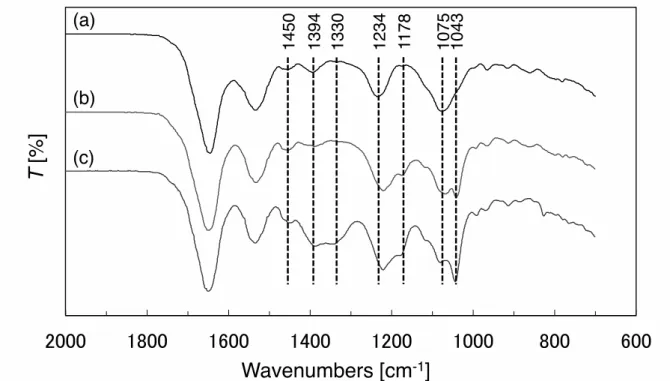
1654 cm-1 1540 cm-1 I
II 1450–1394 cm-1 C-O
O-H
1234 cm-1 1075 cm-1 pH 4
1178 cm-1 1043 cm-1
Fig. 2-8 (b) pH 4
pH 4 Dy
1400–1300 cm-1 C-O O-H
Fig. 2-8 (c) Dy3+
32
Fig. 2-8 FT-IR : (a) , (b) pH 4 , (c) pH 4 Dy
2-3-4. 大腸菌のカルボキシル基のエステル化およびアミド化のFT-IRによる確認
FT- IR
4000 2000 cm-1 3700 3000 cm-1 3000 2800 cm-1 N-H O-H C-H
2000 700 cm-1 Fig. 2-9
FT-IR Fig. 2-9 (a)
1654 cm-1
1540 cm-1 I II 1450–1394 cm-1
C-O O-H
1234 cm-1 1075 cm-1
FT-IR Fig. 2-9 (b) (c)
1450–1400 cm-1
1730 cm-1 C=O
T [%] !
Wavenumbers [cm
-1]
(a)(b) (c)
1450 1394 1330 1234 1075 10431178
2
33
Fig. 2-9 (b) Fig. 2-9 (b)
1450–1400 cm-1 Fig. 2-9 (c)
Fig. 2-9 FT-IR : (a) , (b) , (c)
600!
800!
1000!
1200!
1400!
1600!
1800!
2000!
T [%] !
Wavenumbers [cm
-1]
(a) (b)
(c)
1730 1394 1234 1075 1032
34
2-3-5. 大腸菌のカルボキシル基のエステル化およびアミド化の希土類金属の吸着に対する影響
Nd3+ Dy3+ Lu3+ 5 ppm
3 Dy3+ Fig. 2-10
pH Dy3+
Fig. 2-10 Esterification
pH 2-4 Fig. 2-10
Amidation
pH 0–1 pH 2–4
Fig. 2-10 Dy3+ ( : 30ºC, Ci: 5 ppm) 0
0.2 0.4 0.6 0.8 1
-1 0 1 2 3 4 5
A [-]
pHeq
Wild type Esterification Amidation
2
35 2-3-6. (Qmax)
Nd3+ Dy3+ Lu3+
1–300 ppm pH 4 Langmuir
Langmuir Eq. (2-3)
Fig. 2-11 Ce ppm Qeq
mg/g Qmax mg/g Kad : L/mg Nd3+ Dy3+
Lu3+ 30.9 32.7 43.8 mg/g
Table 2-4
Eq. (2-3)
Fig. 2-11 Nd Dy Lu ( : 30ºC, pHeq=4)
Q
eq= Q
maxK
adC
e1+ K
adC
e0 10 20 30 40 50
0 50 100 150 200 250
Q [mg/ g]
Ce [ppm]
Nd Dy Lu
36
Table 2-4 (Qmax)
Qmax (mg/g)
E. coli d3+ 30.9
E. coli Dy3+ 32.7
E. coli Lu3+ 43.8
Azacrown ether*
Amberlite XAD-4 resina Nd3+ 9.2 [22]
b Nd3+ 16.2 [23]
b Dy3+ 23.7 [23]
b Lu3+ 21.2 [23]
DTPA** c Nd3+ 28 [24]
*:monoaza dibenzo 18-crown-6 ether; **: diethylenetriaminepentaacetic acid a: pH 4.5; b: pH 1.0; c: pH 6
2
37 2-4.
pH pH 4
FT-IR
pH 0–1 pH 2–4
30
38 2-5.
[1] , , , (2008)
[2] JOGMEC NEWS, 27 (2011)
[3] U.S. Geological Survey, Mineral commodity summaries 2015, U.S. Geological Survey, 128–129 (2015) [4] U.S. Department of Energy, Critical Materials Strategy, U.S. Department of Energy, 44–48 (2011) [5] Y. Takahashi, X. Châtellier, K.H. Hattori, K. Kato, D. Fortin, Adsorption of rare earth elements onto
bacterial cell walls and its implication for REE sorption onto natural microbial mats, Chem. Geol., 219, 53–67 (2005)
[6] Y. Takahashi, M. Yamamoto, Y. Yamamoto, K. Tanaka, EXAFS study on the cause of enrichment of heavy REEs on bacterial cell surfaces, Geochim. Cosmochim. Ac., 74, 5443–5462 (2010)
[7] T. Tsuruta, Accumulation of rare earth elements in Various Microorganisms, J. Rare Eerth., 25, 526–532 (2007)
[8] N. Das, D. Das, Recovery of rare earth metals through biosorption: An overview, J. Rare Eerth., 31, 933–941 (2013)
[9] H. Moriwaki, H. Yamamoto, Interactions of microorganisms with rare earth ions and their utilization for separation and environmental technology, Appl. Microbiol. Biot., 97, 1–8 (2013)
[10] X. Shuxia, Z. Shimin, C. Ke, H. Jinfeng, L. Huashan, W. Kun, Biosorption of La3+and Ce3+ by Agrobacterium sp. HN1, J. Rare Eerth., 29, 265–270 (2011)
[11] R. C. Oliveira, C. Jouannin, E. Guibal, O. G. Jr., Samarium(III) and praseodymium(III) biosorption on Sargassum sp.: Batch study, Process Biochem., 46, 736–744 (2011)
[12] E. I. Cadogan, C.-H. Lee, S. R. Popuri, Facile synthesis of chitosan derivatives and Arthrobacter sp.
biomass for the removal of europium(III) ions from aqueous solution through biosorption, Int. Biodeter.
Biodegr., 102, 286–297 (2015)
[13] H. Moriwaki, R. Masuda, Y. Yamazaki, K. Horiuchi, M. Miyashita, J. Kasahara, T. Tanaka, H.
Yamamoto, Application of freeze-dried powders of genetically engineered microbial strains as adsorbents for rare earth metal ions, ACS Appl. Mater. Interfaces, 8, 26524–26531 (2016)
[14] D. Sadovsky, A. Brenner, B. Astrachan, B. Asaf, R. Gonen, Biosorption potential of cerium ions using Spirulina biomass, J. Rare Eerth., 34, 644–652 (2016)
[15] X. Pan, W. Wu, J. Lü, Z. Chen L. Li, W. Rao, X. Guan, Biosorption and extraction of europium by Bacillus thuringiensis strain, Inorg. Chem. Commun., 75, 21–24 (2017)
[16] S. Lin, G. D. Rayson, Impact of surface modification on binding affinity distributions of datura innoxia biomass to metal ions, Environ. Sci. Technol., 32, 1488–1493 (1998)
2
39
[17] D. G. Hoare, D. E. Koshland Jr., A method for the quantitative modification and estimation of carboxylic acid groups in proteins, J. Biol. Chem., 242, 2447–2453 (1967)
[18] , , (2010)
[19] J. S. Preston, Solvent extraction of metals by carboxylic acids, Hydrometallurgy, 14, 171–188 (1985) [20] F. Kubota, M. Goto, F. Nakashio, Extraction of rare earth metals with 2-ethylhexyl phosphonic acid
mono-2-ethylhexyl ester in the presence of diethylenetriaminepentaacetic acid in aqueous phase, Solvent Extr. Ion Exch., 11, 437–453 (1993)
[21] K. Shimojo, H. Naganawa, J. Noro, F. Kubota, M. Goto, Extraction behavior and separation of lanthanides with a diglycol amic acid derivative and a nitrogen-donor ligand, Anal. Sci., 23, 1427–1430 (2007)
[22] S. R. Dave, H. Kaur, S. K. Menon, Selective solid-phase extraction of rare earth elements by the chemically modified Amberlite XAD-4 resin with azacrown ether, React. Funct. Polym., 70, 692–698 (2010)
[23] T. Ogata, H. Narita, M. Tanaka, Adsorption behavior of rare earth elements on silica gel modified with diglycol amic acid, Hydrometallurgy, 152, 178–182 (2015)
[24] S. D. N. Almeida, H. E. Toma, Neodymium(III) and lanthanum(III) separation by magnetic nanohydrometallurgy using DTPA functionalized magnetite nanoparticles, Hydrometallurgy, 161, 22–28 (2016)
40 3
3-1.
3-1-1.
4 4 3
4
2 4
]
1 ]
4
3 Table 3-1 [1]
] 2]
3 4 3 [
] 2 4
Table 3-1 [1]
3
41 3-1-1-1.
] 3
] [ 4
HCl HNO32] H2SO4 ]
4 4
4 [2] NaOH2] NH4OH
4 4 4
4 [3] ] ]
3 ]
4
4 ]
4
] 2 4 Fig. 3-1 [1]
Fig. 3-1
(a) , (b)
42 (a)
1 ] 2]
] 4
] 4 Table 3-2
[4] glutaraldehyde epichlorohydrin
] [5, 6] 4
2 [ ] [ 4 [5, 6]
]
4 [7] ]
4 [8, 9]
Table 3-2 R:
[ 4
4
3
43
(b) ]
] 4
4 3
4 Fig. 3-1 4 ]
] 4
poly(allylamine)2] polyethylenimine poly(acrylic acid) 4 Fig. 3-2 [10–13]
Table 3-2 4 4 ]
] J. Mao 4
poly(allylamine) glutaraldehyde ]
PtCl62- 4 4.36 [10]
[ pyromellitic dianhydride thiourea [ [14]
]
Cd2+2] Pb2+ 4 15 2] 11 4
Fig. 3-2
(a) poly(allylamine), (b) polyethylenimine, (c) poly(acrylic acid)
Table 3-2 ]
4 ]
4 [15] ] 4 Cu2+2] Cd2+
] 4 3
44
] 4
4 Fig. 3-3 M.-H. Song polyethylenimine
] Ru [16] polyethylenimine
2 Ru
Ru(CO)3I3− Ru 4]
Ru 3
4 3 ]
4
] 4
Fig. 3-3
3
45 3-1-1-2.
Cr Mn Fe Co Cu Zn Mo 3
4
2] ] Fig. 3-2
C. Sousa 4 [17]
LamB 6 (His)6
Cd2+ (His)6 ]
4 2 2 (His)6
Cd2+ 11 4 3 3
]
4 (His)6 [
4 [18–20] ]
] 2]
[21]
ModE Fig. 3-2
46
Mo [22] ModE W ] ModE
] W 4 [23]
2 [
4 D. M. Park
[24] S RsaA
Lanthanide-binding tags peptide LBT peptide [25]
Caulobacter crescentus C. crescentus
LBT peptide 2]
2 2 Tb3+
Eu3+ 4 LBT peptide C.
crescentus[LBT peptide
8 ]
4
2 [ 4 ]
]
3
47 3-1-2.
2 2 4 [26] 3
4 4 3
] 4
8 [
4
3
] 4 [ 4
]
3 ]
Fig. 3-3
Fig. 3-3
48 3-1-3.
2007 K. Shimojo ]
N,N-dioctyldiglycol amic acid DODGAA; Fig. 3-4
4 pH 2–3 Fe3+ Al3+2]
Cu2+ 4 [27, 28]
DODGAA 3
] DODGAA
pH ]
[
DODGAA 4 4
P S 4
4 3 C N O H 3 4
] pH ]
4 C N O H 3 4
3 3
Fig. 3-4 DODGAA
C
8H
17C
8H
17N O
O
OH
O
3
49 3-2.
Scheme 3-1 ]
Scheme 3-1
[Reprinted from Biochemical Engineering Journal, 113, Y. Hosomomi, R. Wakabayashi, F. Kubota, N. Kamiya, M. Goto,102–106, Copyright (2016), with permission from Elsevier]
3-2-1.
3-2-1-1.
pET22b+ BL21 DE3 100
mg/L LB 10 mL 100 mg/L
LB 1 L 37ºC 200 rpm OD600= 0.5–0.6
4000g 20 25 mmol/L Tris-HCl pH 8.0
5800g 10 ] 3
300 mg 100 mM pH 9.0 30 mL
diglycolic anhydride Tokyo Chemical Industry Co. (Tokyo, Japan) 3.48 g
Diglycolic anhydride pH4 4
pH4pH 9.0 ] 10 M 5 M 4 diglycolic
anhydride Diglycolic anhydride 60
5800g 10 100 mmol/L pH 4.0 5800g
10 ] 3
]
50 3-2-1-2. FT-IR
100 mM pH 9.0 2]
4 cm-1 4000–700 cm-1 FT-IR Spectrum 65, PerkinElmer Co. ] ]
3-2-1-3.
1000 ppm Wako Pure Chemical Industries (Osaka, Japan)
0.1M HEPES ] 0.1 M HNO3 1 M 10 M NaOH
] pH 2.5 mL 5 mg
30 vortex mixer 38 30ºC 60 160 rpm
5800g 10 0.20 µm
pH pHeq pH HM-60 G, DKK-TOA Co.
ICP ICP-AES, Optima 5300 DV, PerkinElmer Inc.
(A)2] (Q: mg/g) Eq. (3-1) (3-2) Ci
ppm Ce ppm V: L M
g
Eq. (3-1) A= Ci – Ce
Ci
Eq. (3-2) Q= V(Ci – Ce)
M
3
51 3-2-2.
3-2-2-1. FT-IR
100 mM pH 9.0 2
] 4000 700 cm-1 FT-IR ]
Fig. 3-5 4000 2000 cm-1 3
3700 3000 cm-1 3000 2800 cm-1 N-H O-H2] C-H
4 2000 700 cm-1 ]
I2] II 41653 cm-12] 1540 cm-1 1460 cm-1 1410 cm-1
O-H 4
41240 cm-12] 1075 cm-1
2 1140 cm-1 C-O-C
4 Fig. 3-5 (c) 4
2] pH 9
FT-IR 3 ]
] 4
Fig. 3-5 FT-IR
(a) , (b) pH 9 , (c)
[Reprinted from Biochemical Engineering Journal, 113, Y. Hosomomi, R. Wakabayashi, F. Kubota, N. Kamiya, M. Goto,102–106, Copyright (2016), with permission from Elsevier]
52
3-2-2-2. pH
Nd3+ Dy3+ Lu3+ 2] Fe3+ Al3+ Cu2+ 5 ppm
2] pH
pH Fig. 3-6 Nd3+ Dy3+ Lu3+
3 Fe3+ Al3+ Cu2+ 2
2 2 4
2] pH 4
4 3 4 pH 2
4 4 3 DODGAA
[28]
3 4 pH1–2
4 ]
]
4 4 3 Al3+2] Cu2+
4 3
Fig. 3-6 pH 30 °C , Ci = 5 mg/L
(a) , (b)
[Reprinted from Biochemical Engineering Journal, 113, Y. Hosomomi, R. Wakabayashi, F.
Kubota, N. Kamiya, M. Goto,102–106, Copyright (2016), with permission from Elsevier]
3
53
2] 2 Fe3+4 4 3
4 Fe3+ 3
[29] 3 Fe3+ ] [30, 31]
D2EHPA Fe3+ Fe2+ 4
[30] 4 Fe3+ Fe2+ Fe
]
pH 28 Kd [32] Eq. (3-3)] Eq. (3-4)]
βREEs/Al2] βREEs/Cu
M1 M24
Kd βM1/M2 1 4 βM1/M2 4 1]
[ 0 M1 M2
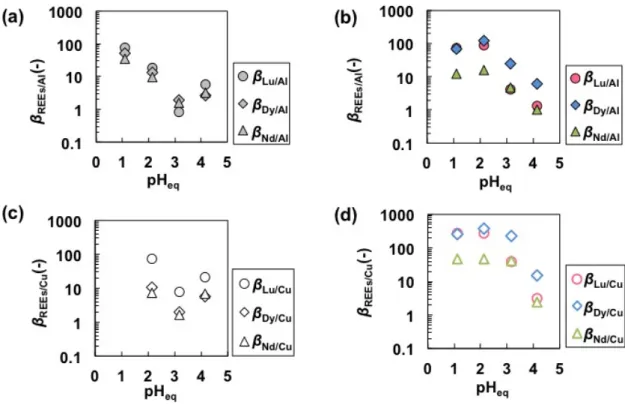
pH 28 βREEs/Al2] βREEs/Cu Fig. 3-7 ] pH 22] 3
2 βREEs/Al2] βREEs/Cu 4 [ ] 4 3
Equation (3-4)] β 41] 4
4 ] Cu2+ Al3+ ]
3 4
Eq. (3-3)
K
d= (C
i– C
e) V C
eM
β
REEs/(Al or Cu)= K
dREEsK
d (Al or Cu)Eq. (3-4)
54
Fig. 3-7 pH REEs/Al REEs/Cu
(a), (c): (b), (c):
[Reprinted from Biochemical Engineering Journal, 113, Y. Hosomomi, R. Wakabayashi, F. Kubota, N. Kamiya, M. Goto,102–106, Copyright (2016), with permission from Elsevier]
3
55 3-2-2-3. (Qmax)
Nd3+ Dy3+2] Lu3+
pH 3 Langmuir
Langmuir Eq. (3-5)
Qm mg/g KL : L/mg
] Fig. 3-8 Table 3-3 Langmuir
R2 2] Langmuir
] Nd3+ Dy3+2] Lu3+ 2 R2 40.97 3
4 Langmuir 4
KL [33] 2 KL
Lu3+ > Dy3+ > Nd3+ 3 4 [
4 DODGAA
4 3
Table 3-3 Langmuir R2
[Reprinted from Biochemical Engineering Journal, 113, Y. Hosomomi, R. Wakabayashi, F. Kubota, N. Kamiya, M. Goto,102–106, Copyright (2016), with permission from Elsevier]
Chemically modified E. coli Unmodified
E. coli [26]
R2 KL (L/mg) Qm (mg/g) Qm (mg/g)
Nd3+ 0.988 0.0197 81.3 30.9
Dy3+ 0.974 0.0392 70.2 32.7
Lu3+ 0.978 0.0494 70.5 42.7
Eq. (3-5)
Q = Q
mK
LC
e1+ K
LC
e
56
Nd3+ Dy3+2] Lu3+ Qm 81.3 70.22] 70.5 mg/g
2.63 2.152] 1.65 4 3
] ]
[ 4
Fig. 3-8 Nd3+ Dy3+ Lu3+ ( : 30ºC, pHeq= 3)
[Reprinted from Biochemical Engineering Journal, 113, Y. Hosomomi, R. Wakabayashi, F.
Kubota, N. Kamiya, M. Goto,102–106, Copyright (2016), with permission from Elsevier]
3
57 3-2-3.
4 4
]
Nd3+ Dy3+ Lu3+ 2] Fe3+ Al3+ Cu2+
pH
pH 2–3 4 DODGAA
4 4 pH 2–3
4 4
Al3+2] Cu2+ βREEs/Al2] βREEs/Cu
βREEs/Al2] βREEs/Cu ] 4 3
4 ]
4 3
2 Langmuir KL2] Qm
KL Lu3+ > Dy3+ > Nd3+
[ 4 DODGAA
4 Langmuir
2.5 4 3 4
]
58 3-3.
2
]
4 3
4 4
4 4 4
4 4 3
pKa 3.54 4
pH 3 4
4 pH 3
4 ]
4 8 pH ]
4 3 4
] Scheme 3-2
4
] ] ]
4
Nd3+ Dy3+2] Lu3+
Al3+ Cu2+ [
Scheme 3-2
H2N NH2
NH2 H2N
H2 C H
C CH2 HN
O O
OH O E.#coli#cell#surface
n
Physical coating, pH 3
H2 C H
C CH2 HN
O O
OH O H2
C H C CH2 HN
O O
OH O
NH2 NH2 E.#coli#cell#surface
m n-m
H2 C H
C CH2 HN
O O
OH O H2
C H C CH2 HN
O O
NH O
NH2 NH2
E.#coli#cell#surface
EDC m
n-m
3
59 3-3-1.
3-3-1-1.
(1) polyallylamine hydrochloride3 HCl
polyallylamine hydrochloride M. W.= 15000 50.3 wt%; Nittobo medical Co. Ltd. (Tokyo, Japan)
5.0 mL 15 mL Wako Pure Chemical Industries (Osaka,
Japan) pH413 1 MWCO= 3500 Da;
Spectra/Por3; Spectrum Laboratories, Inc. (California, USA) 2 L 72
72 HCl4 polyallylamine [35] polyallylamine
PAA 1H NMR ]
Polyallylamine (PAA): 1H NMR (300 MHz, D2O): δ 1.11–1.52 (3H, CH2CH(CH2NH2), δ 2.59 (2H, CH2CH(CH2NH2)
(2) polyallylamine
polyallylamine
1 step ] [27] Scheme 3-3
PAA 310.9 mg 5 mL 0.1 mol/L NaHCO3 (pH 8.0) 3 diglycolic anhydride Tokyo Chemical Industry Co. (Tokyo, Japan) 12.2 g 4 mL dimetylsulfoxide
4 Diglycolic anhydride
pH4 4 pH4pH 8.0 ] 10 M
4 8 MWCO= 3500 Da
72 72
polymer 1 1H NMR ]
Polymer 1: 1H NMR (300 MHz, D2O): δ 1.25–1.79 (3H, CH2CH(CH2NHCO), δ 3.22 (2H, CH2CH(CH2NHCO), δ 4.01 (2H, NHCOCH2O), δ 4.08 (2H, CH2COOH)
60 Scheme 3-3 polymer 1
3-3-1-2.
(1)
pET22b+ BL21 DE3 100
mg/L LB 10 mL 100 mg/L
LB 1 L 37ºC 200 rpm OD600= 0.5–0.6
4000g 20 5800g 10 ]
3 polymer
1
(2) polymer 1
45 mL 902.6 mg polymer 1 pH 3.0 ] 1 mol/L HCl
pH 454.7 mg 2
1-(3- dimethylaminopropyl)-3-ethylcarbodiimide hydrochloride (EDC; Tokyo Chemical Industry Co.)
4.99 g pH 4.75 1 mol/L NaOH 2
5800g 10 0.1 mol/L HCl pH 4.0 5800g 10
] 2 5800g 10 ]
] polymer 1
H2 C H
C CH2 HN
O O
OH O
n
H2 C H
C CH2 NH2 n
+
O O
O O
3
61 3-3-1-3.
1000 ppm Wako Pure Chemical Industries (Osaka, Japan) [ Nd3+
Dy3+2] Lu3+ Nd3+ Dy3+2] Lu3+ Nd(NO3)3 6H2O 99.9 ; Kishida Chemical Co., Ltd. (Osaka, Japan) Dy(NO3)3 5H2O 99.9%; Kishida Chemical Co., Ltd.
Lu(NO3)3 nH2O 99.5%, Wako Pure Chemical Industries 0.1M HEPES ]
0.1 M HNO3 1 M 10 M NaOH ] pH
2.5 mL 5 mg 30 vortex mixer 38 30ºC
60 160 rpm 5800g 10
0.20 µm
pH pHeq pH HM-60 G, DKK-TOA Co.
ICP ICP-AES, Optima 5300 DV, PerkinElmer Inc.
(A)2] (Q: mg/g) Eq. (3-1) (3-2)3
1 mol/L HNO3 5 mL
Eq. (3-6)3 Ci (ppm) Ce
(ppm) Cd (ppm)
3-3-1-4.
2] 4 cm-1 4000–700 cm-1 FT-IR
Spectrum 65, PerkinElmer Co. ] polymer 1
Dy3+ 100 ppm pH 3 2
] Dy pH 3 FT-IR ]
Pt
SEM SS550, Shimadzu Co., Ltd. (Kyoto, Japan) ] 20.0 kV 1000
Eq. (3-6)
D = C
i– C
eC
d
62 3-3-2.
3-3-2-1.
2] 4000–700 cm-1 FT-IR ]
polymer 1 Fig. 3-9(a)2] (b) 4000
2000 cm-1 2 3700 3000 cm-1 3000
2800 cm-1 N-H O-H2] C-H 4 2000 700 cm-1
]
I2] II 41655 cm-12] 1550 cm-1 1460
cm-1 1400 cm-1 O-H 4
41240 cm-12] 1075 cm-1
polymer 1 2 1140 cm-1
4 Fig. 3-9 (b)
4
] polymer 1 4
Fig. 3-9 FT-IR
(a) , (b) polymer 1 , (c) pH 3 , (d) pH 3
Dy
500 1000
1500 2000
2500 3000
3500 4000
T (%)
Wavenumber (cm-1)
(a)
(b)
(c) (d)
3
63
2] polymer 1 SEM ]
Fig. 3-10 2 2–5 µm 4
3 ] polymer 1 2
4
Fig. 3-10 SEM
(a) , (b) polymer 1
10 µm 10 µm
(a) (b)
64 3-3-2-2.
Figure 3-11 Dy3+ ] polymer 1
5 4 3 4
4 4 2
] 4 4 4
60
Fig. 3-11 Dy3+ A
(pH: 2.0, : 30 , Ci: 5 ppm)
0 0.2 0.4 0.6 0.8 1
0 10 20 30 40 50 60
A (-)
Time (min)
3
65
3-3-2-3. pH
Nd3+ Dy3+ Lu3+ 2] Al3+ Cu2+ 5 ppm
polymer 1 pH pH
Fig. 3-12 3
pH 4 pH 2–3 4
4 3 DODGAA
2] [28] polymer 1
4 3
pH 2–3 28 polymer 1
2] 4 3
38 4
Fig. 3-12 pH : 30ºC, Ci: 5 ppm
0 0.2 0.4 0.6 0.8 1
0 1 2 3 4 5
A(-)
pHeq
Lu3+
Dy3+
Nd3+
Al3+
Cu2+
Dy3+
Lu3+
Nd3+
Al3+
Cu2+
66
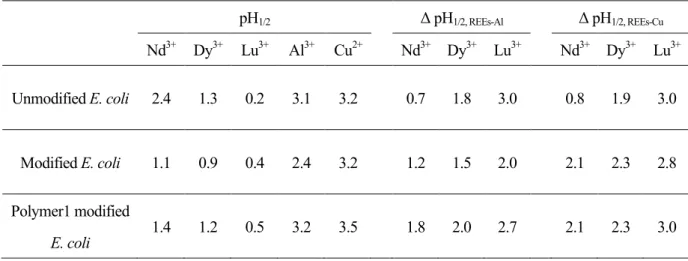
pH pH1/2 450% pH 2]
pH1/2 Δ pH1/2, REEs- (Al or Cu) Table 3-4 pH
polymer 1 4 3
] DODGAA Δ pH1/2
4 4
polymer 1 Δ pH1/2, REEs- (Al or Cu) 4
2] ] 4
3 4]
4 3
Table 3-4 pH1/2 Δ pH1/2
(Unmodified E. coli Modified E. coli polymer 1 modified
E. coli polymer 1 )
pH1/2 Δ pH1/2, REEs-Al Δ pH1/2, REEs-Cu
Nd3+ Dy3+ Lu3+ Al3+ Cu2+ Nd3+ Dy3+ Lu3+ Nd3+ Dy3+ Lu3+
Unmodified E. coli 2.4 1.3 0.2 3.1 3.2 0.7 1.8 3.0 0.8 1.9 3.0
Modified E. coli 1.1 0.9 0.4 2.4 3.2 1.2 1.5 2.0 2.1 2.3 2.8
Polymer1 modified
E. coli 1.4 1.2 0.5 3.2 3.5 1.8 2.0 2.7 2.1 2.3 3.0
3
67 3-3-2-4. FT-IR
Dy pH 3 2] Dy3+
100 ppm pH 3 FT-IR ]
Fig. 3-9 (c)2] (d) 2 2 4000 2000 cm-1
3700 3000 cm-1 3000 2800 cm-1 N-H O-H2] C-H 4
3 4 4 3 2000 700
cm-1
2 2] 4
] 1655 cm-12] 1540 cm-1
I2] II 4 1460 cm-12] 1400 cm-1 O-H
4 41234 cm-12] 1070 cm-1
pH 3 2 1043 cm-1
4 Fig. 3-9 (c) 4 pH 3 4
4 pH 3 2
C-O-C 1140 cm-1
pH 3 Dy 2 1400–1300 cm-1
C-O 4 Fig.
3-9 (d) C-O-C 41130 cm-1
4 4 polymer 1
4 [
4
68 3-3-2-5.
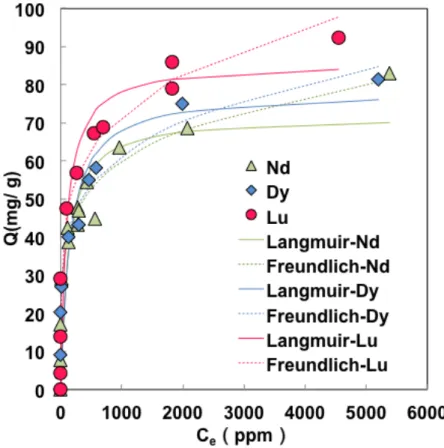
Polymer 1 Nd3+ Dy3+2] Lu3+
pH 3 Langmuir
Eq. (3-5) Freundlich
Freundlich Eq. (3-7) Q mg/g KF2] n: Freundlich
mg(1-1/n)g-1L1/n Ce ppm
] Fig. 3-13 Table 3-3 Langmuir
Freundlich R2 2]
] Nd3+ Dy3+2] Lu3+ 2 Freundlich R2
40.98 Langmuir ] 3 polymer 1
Freundlich 4 3
] 2] Langmuir
R2 3 Langmuir
4 4 polymer 1 2
4 Langmuir 4 Freundlich
4 [36] ] polymer 1
3 [
4
polymer 1 Langmuir Nd3+
Dy3+ Lu3+ Qm 71.7 78.4 2] 85.9 mg/g
1.8 2.4 2 ] 2.0
Eq. (3-7)
Q = K
FC
e1/n3
69
Fig. 3-13 Nd3+ Dy3+ Lu3+ polymer 1 ( : 30ºC, pHeq= 3)
Table 3-3 Langmuir Freundlich R2
Langmuir Freundlich
R2 KL (L/mg) Qm (mg/g) R2 KF (mg(1-1/n)g-1L1/n) n
Nd3+ 0.89 0.00815 71.7 0.98 16.77 5.43
Dy3+ 0.91 0.00650 78.4 0.98 15.98 5.13
Lu3+ 0.94 0.0101 85.9 0.98 17.96 4.97
70 3-3-2-6.
pH4 polymer 1 [ 4
3 3 ]
4 4 3 pH
4 ]
Dy3+ 30 ppm pH 3 1 M HNO3
3 ]
1 M HNO3 ] Dy3+
4 3 Fig. 3-14 3 [
3 4 ]
Fig. 3-14 Dy3+
( : 30ºC, pHeq= 3, Ci=30 ppm 1 M HNO3 )
0 0.2 0.4 0.6 0.8 1
1st-Adsorption
1st-Desorption 2nd-A
dsorption 2nd-D
esorption 3rd-A
dsorption 3rd-D
esorption
A (-) or D (-)
3
71 3-3-3.
4 4
Polymer 1 2]
]
Polymer 1 Nd3+ Dy3+ Lu3+ 2] Al3+ Cu2+
pH
pH 2–3 4 DODGAA
4 4 pH 2–3
4
Al3+2] Cu2+ pH Δ pH1/2, REEs- (Al or Cu)
polymer 1
Δ pH1/2, REEs- (Al or Cu) 2 4 3 4
3 4] 4
38 4
Polymer 1 Langmuir2] Freundlich
R2
polymer 1 Freundlich
] 4 3 ] polymer 1
3 [ 4
polymer 1 4Langmuir
2.4 4 3
polymer 1 3 [
4 3 4 ]
72 3-4.
4
4 2
N,N-dioctyldiglycol amic acid (DODGAA)4 4
Al3+ Cu2+ ]
] 4
4 3
2] ]
3
8 4 3
![Fig. 1-2 Fe Al Sc [14]](https://thumb-ap.123doks.com/thumbv2/123deta/9921232.1921107/13.892.192.690.752.1049/fig-fe-al-sc.webp)