Teachers through a One-day Workshop
Anthony C
RIPPSand Saori D
OI AbstractEffective pre-service and in-service training and support for teachers should be one of the cornerstones of any successful education system. This paper examines the issue of providing support for English teachers in Japan who are struggling to teach within the New Course of Study framework drawn up by the Japanese Ministry of Education, Sports, Science and Technology (MEXT). Initially, the authors briefly outline a series of intensive teacher-training workshops which were created to help improve teacher training for Japanese teachers of English at junior high schools and senior high schools in Japan. The main focus of the paper will be on a one-day workshop offered to pre-service English teachers (n=23) entitled ‘Transitioning from a learner to a teacher.’ The paper explicates the design of
the workshop after which it focuses on an analysis of the feedback given by the workshop participants.
1.Introduction
This paper provides an overview of a teacher-training workshop which was designed to help pre-service English teachers at Nanzan University as part of a Japan Society for the Promotion of Science (JSPS) Kaken project. The issue of teacher support is fundamental to any successful language program. Teachers need effective practical training before they start their careers and throughout the duration of their service (Scrivener, 2011). In Japan, English is being pushed as one of the keys to internationalization and a stronger economic future. According
senior high schools are meant to ‘teach English in English’ yet this is a target that few teachers can achieve. Demands on teachers are even starting to extend to earlier levels of the Japanese education system as April 2020 sees the introduction of formal English classes at elementary schools. With all these new mandates, now more than ever, teachers need support.
Initially, a brief overview of the critical need to support English teachers in Japan is provided, followed by a summary of previous in-service teacher training workshops. The authors then provide an outline of the pre-service workshop followed by an analysis of feedback from the participants (n=23).
2.The need for support
Teacher training is a vital field that is garnering increased domestic and international attention and fueling significant research. On a domestic level, never before has teacher training in Japan been so crucial (Cripps, 2016). The Japanese Ministry of Education, Sports, Science and Technology (MEXT) reforms to the examination system in Japan, as well as the additional changes that the NCoS has brought, have meant that support for novice and experienced teachers is essential if the policies are to succeed. Scholars agree that the lack of qualified English teachers in Japan is undesirable and that enhancing teacher-training programs can provide one solution to this problem (Fukushima, 2018; Steele & Zhang, 2016; Tahira, 2012). Insufficient teacher training at a national level has created “a complicated gap between educational policies and actual teaching practice in Japan” (Kikuchi & Browne, 2009). It is important for Japanese teachers to continue their professional development throughout their teaching careers (Kurosawa, 2011; Uno, 2013). For several years, countries in Asia have recognized the importance of learning English at elementary school level. In South Korea English became a mandatory subject in elementary school in 1997 followed by China in 2001. MEXT is trying to improve how English is taught in Japanese schools but many teachers feel ill-equipped to teach English in English (Oyabu, 2011; Tsukamoto & Tsujioka, 2013). On an international level, teacher training is at the forefront of research and pedagogical innovation. Teacher-training programs are being developed in parallel with new education policies throughout the world. The move towards the establishment of Teaching Excellence
Frameworks (TEF) in the UK, as well as coordinated pre-service and in-service professional development programs in Canada and the USA, demonstrate the importance of teacher education.
3.Previous in-service workshops
As part of a major research project (Kaken B No. 15H03481) funded by JSPS, five intensive one-day workshops were designed and run to help support teachers of English in Japan. The methodological grounding of this research lies in ‘action research.’ Action research aims to find answers to specific pedagogical problems and implement possible solutions (McNiff, 2013). The rigorous and open nature of the research process ensures that practical solutions can be found to existing problems. In order to determine the workshop topics, in-service teachers of English at junior high and senior high schools were contacted. Many of these teachers had been participants in Nanzan University’s teaching seminars. After each of the in-service teacher-training workshops, feedback was given by the participants through a paper-based feedback form, interviews, and an online questionnaire. The first four workshops were run to help support in-service teachers. The workshops topics were: ‘Motivation,’ ‘Teaching English in Japanese high schools,’ ‘Intercultural communication,’ and ‘Creativity in the classroom.’ (More details about these workshops and the Kaken project can be found in Cripps, 2019; Cripps, Miles, & O’Connell, 2017; 2018). The focus of this paper is on the final workshop which was designed for pre-service teachers of English.
4.‘Transitioning from a learner to a teacher’
For the final workshop of the Kaken project, as a response to the feedback gained from previous (in-service) participants, it was decided that the workshop should focus on the needs of pre-service teachers. Dr. Saori Doi from the University of Hawai‘i at Mānoa (UHM) was approached by the Principal investigator (Dr. Anthony Cripps) of the Kaken research team to see if she would be willing to lead the final workshop. Dr. Doi has a PhD in Educational Psychology, a Master of Arts (MA) in English as a second language, an
Education (BEd) in English education with teaching license. She is the Academic Coordinator of the 10-week NICE intensive English program run at UHM. After a number of e-mail exchanges Dr. Doi and Dr. Cripps agreed on the theme for the final workshop i.e., ‘Transitioning from a learner to a teacher.’ Dr. Doi divided her
workshop into three main sections; Part 1 – ‘An ideal learner; ’ Part 2 – ‘Getting to know your students; ’ and Part 3 – ‘Group management in class.’
Figure 1: The workshop gets underway
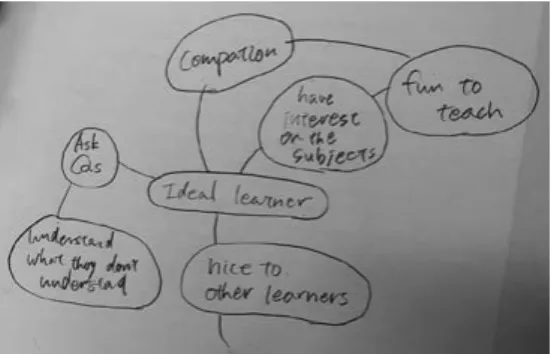
In Part 1 of the workshop, Dr. Doi focused on what the pre-service teachers think about being a student. To aid them in exploring this topic she asked them to draw a concept map of an ‘ideal learner.’ In a conference presentation about the workshop (Cripps & Doi, 2020), Dr. Doi described the purpose of this activity as “…tapping on their existing images of a good learner, various “good learner” characteristics were identified by the participants, followed by a brief PowerPoint presentation.” Examples of the characteristics of an ideal learner raised by the students were: ‘to be motivated,’ ‘to practice,’ ‘to ask questions,’ ‘not being afraid of making mistakes,’ ‘guessing,’ ‘trying to communicate,’ ‘monitoring their own progress’ and ‘focusing on meaning.’
Figure 2: Concept map of the ideal learner
In Part 2 of the workshop, Dr. Doi wanted to emphasize the point that learning about your students is critical for any teaching context. To help illustrate this she used a ‘Show and Tell’ activity. This involved distributing various unusual items which she had brought from Hawai‘i to show the participants. The students had to work in pairs to guess the purpose of the object. Apart from getting the students to experience the activity as a student, the activity was designed to, as Dr. Doi put it, get the students to understand that “teachers need to know who their students are, and what they know and don’t know.” The students enjoyed this activity very much and many commented that they would like to use the same activity when they become English teachers.
Figure 3: ‘Show and Tell’ activity
In Part 3 of the workshop, Dr. Doi focused on group management in class. She wanted the participants to experience how students feel when they do tasks, and to learn some key concepts of learning such as being ‘self-responsible, independent, individualistic, competitive’ and the difference between collaborative and interdependent learning. In order to do this, Dr. Doi used a ‘Find Triangles, Find Squares’ activity. For the ‘Find Triangles’ activity students were given a piece of paper (Figure 4). They were told to work by themselves and that they had only one minute to find the correct number of triangles. They were also told to work in silence and that they would have to share their answers with the class at the end of the activity. When watching this activity the tension was tangible and it was clear that some students felt a certain degree of stress. After one minute, Dr. Doi asked all the students for their answers and she wrote them on the whiteboard. She then called on one student to come to the front of the class and use the whiteboard to explain how she found her triangles. By contrast, in the ‘Finding Squares’ activity, the students were given a copy of Figure 5 and Dr. Doi explained that they would work in small groups of 3-4 people. There would be no time limit, however all the members had to agree on the number of squares in Figure 5. The difference in the atmosphere of the class was palpable and it was clear that the students felt more relaxed.
they did the individual activity and when they did group activity. She summarized (see Table 1) the pros and cons of individual and group work and explained some key concepts which underlie the respective activities.
Before the workshop finished, the students had the opportunity to ask Dr. Doi and Dr. Cripps questions about teaching and they took this opportunity to address many of their concerns about starting a teaching career. These concerns became evident in the end of workshop feedback that they provided.
Figure 4: ‘Find Triangles’ activity Figure 5: ‘Find Squares’ activity Table 1: Dr. Doi’s summary of the activities
Find Triangles Activity Find Squares Activity Instructions Individual work
One-minute time limit Must share own answer
Collaborative No time limit
All members need to agree
Pros Can focus on the task easily Can share their thoughts with each other
Teach each other/learn from each other
Cons Feel rushed
Cannot check answer with others Feel embarrassed if they have a different answer
Take more time
Need to be responsible for others’ performance in the group Sometimes hard to communicate due to different/limited language proficiency
Key concepts Self-responsible, independent,
5.Workshop feedback
After the workshop was over, a simple feedback form was given to the participants. Three basic items were included on this feedback form together with additional space for comments. The items were as follows: (1) What did you like best about this workshop?; (2) In your opinion what are the biggest challenges which Japanese teachers of English face when they first start teaching?; (3) What topics would you like to see covered in future workshops? In total, 18 feedback forms were completed (five of the 23 workshop participants had to leave early due to their personal obligations before the feedback forms were distributed). These forms were analyzed using grounded theory and distinct categories within each item arose from the rich data (Charmaz, 2014; Saldaña, 2013). A summary of the main categories is provided below.
Q1. What did you like best about this workshop?
The feedback was extremely positive with all participants stating that they enjoyed the workshop. The triangles and squares activity received a lot of encouraging comments. Three main categories arose from the participants’ feedback: (1) Individual vs group work; (2) Understanding the students’ position; (3) Getting students to use more English.
Individual work vs group work
The triangles and squares activity especially helped the participants to consider when to use individual work and when to use group work. The activity afforded them the opportunity to experience the activities as if they were a student and they could understand the pros and cons of both individual and group work (n.b., all comments below have not been edited).
Understanding the students’ position
The activities used throughout the workshop helped the participants understand how students think and feel while taking part in such activities. As one participant explained: “Learning from experience” was extremely useful. The
pre-service teachers could also comprehend the pedagogical justification for using such activities especially for reinforcing grammar patterns and to encourage
output. Explaining the purpose of an activity and ensuring its effectiveness were points which the participants found significant. Finally, the students “learned some tips for effective teaching” through participating in the activities and discussing their
effectiveness.
Table 2: Individual work vs group work
Theme Participants’ comments
Individual work vs group work
“I could learn the difference between individual and group work.”
“The importance of group work was made very clear.”
“Through many activities, I could think about the effect of individual work and group work.”
“By participating with each other, we were able to become one.”
Table 3: Understanding the students’ position
Theme Participants’ comments
Understanding the students’
position
“I learned that doing activities or giving quizzes are not only for students but also for teachers to know about students. But most students don’t understand the purpose of doing them, so teachers should always explain them first.”
“Every activities have reasons to do! I could learn how students can study from the activities we did in the class.”
“I learned that getting to know students & letting them know about myself.”
Getting students to use more English
The third main theme which the pre-service teachers seemed to like from participating in the workshop was that it helped them consider how to get students to use more English in class. Unfortunately, pre-service teacher-training in Japan almost completely ignores the practical side of teaching and the duration of teaching practicums (two weeks for junior high school teachers and three
The workshop provided a forum where the participants could think about the importance of designing classes and activities which encourage students to communicate with each other in English. They could understand that activities should not be seen as mere ‘fillers’ to use up time in class and that every activity should have a purpose and encourage output in English. The workshop activities highlighted the importance of reducing the affective filter by helping students relax.
Table 4: Getting students to use more English
Theme Participants’ comments
Getting students to
use more English
“I enjoyed both activities, show and tell, and finding triangle and square. I think English class in Japan lacks opportunity to communicate each other. I strongly think that teacher should make atmosphere which students can say their idea freely.”
“…‘guess game’, it’s really useful to give the chance to let students speak English in the class. I would like use this game in my future class.”
“[I enjoyed] the activity in 1st session. I was relaxed when I spoke English through this activity. It's easy to get rid of the students' affective filter in actual class.”
Q2. In your opinion what are the biggest challenges which Japanese teachers of English face when they first start teaching?
The workshop helped the participants understand some of the challenges that they may face when starting their teaching careers. From the analysis of their feedback six categories arose (see Table 5):
Some of the workshop attendees had already completed their English teaching practicums as part of the English teaching license course held at Nanzan University. It was apparent from the feedback we received that these students,
Table 5: Challenges
Connecting with the students Motivation Different ability levels Teaching only in English Teaching techniques Constraints
and in fact the majority of the participants, believe that ‘connecting with students’ was a major challenge that they would have to face. They wanted to know how to build a good relationship with their students and how to engender trust. One participant realized the importance of finding out about their students and their comments indicated a shift away from teacher-centered teaching: “To know about students (names, favourite things, levels…) Because teaching is not one-way style but student centered.” Another participant commented that teachers have to connect with
students in such a way that they can “…let their students be interested in English.” This
sentiment overlaps with the important issue of motivation which emerged as one of the ‘challenges’ categories. The pre-service teachers felt that they would have to face the challenge of “Reluctant students (no motivation, no understanding…) – how to make sense of them? Make them have motivation? ” This demonstrates a high level of
perception regarding the real challenges that they may face as teachers. As section two mentioned earlier in this paper, ‘Motivation’ was the main major concern of service teachers and this resulted in it being chosen as the theme for the first in-service teacher-training workshop that we held.
‘Teaching students with different levels of ability’ arose as one of the challenges categories. The students wanted to gain more knowledge about how to teach multi-level classes in order “To know what level and what kind of teaching styles are matching the class.” They recognized that each student has his or her own
ability level and this (in their opinion) can create problems: “Each students have different English level, so it is difficult to set the class level.” Obviously, the ability level of
the students will affect another challenge which the students mentioned namely teaching only in English. They understood that if a teacher decides to take a ‘teaching English only in English’ approach as encouraged by MEXT, then this could generate a number of problems, especially when teaching beginners or false beginners: “I think if the teacher decided to teach only in English, especially to first learners, it would take so much time and effort.”
The final two challenges categories which arose from the data were ‘teaching techniques’ and ‘constraints’ on their teaching. Two examples of the teaching techniques that the students wanted to learn were ‘finding a balance between teaching English for communication’ and ‘teaching English for passing exams’ as one student explains: “I’d like to introduce the more opportunities to interest in English,
on the other hand, some of students want to study English for just exam.” Other students
wanted to learn techniques to reduce their own nervousness when teaching. This is an important point as many seasoned teachers forget what it is like to teach a large group of students (sometimes as many as 40 in Japan) for the first time― especially considering the fact that these students often experience amotivation or have very low levels of motivation. Helping novice teachers learn how to relax and enjoy their teaching can go some way to reducing the attrition rates among novice teachers. Time management was a further technique that students felt will be a challenge that they will face when becoming teachers. This is salient point as teachers are under pressure to teach according to the guidelines they are given by MEXT. This pressure to teach specific content within a time limit and in a certain teaching style (although not explicitly articulated) is a reflection of the final challenges category i.e., ‘constraints’ on their teaching. Some of the participants explained that they want to teach in a certain way which reflects their own teaching style but realize that this may be difficult in reality: “Teachers wanna try new way to teach English such as class which is more communicative, but there is guideline and rules, so teachers may have big problems to do what they really want to.” One participant was
cognizant of the extra-curricular duties which teachers have and how this impinges on what they can do: “Only 10% of English teachers’ roles is teaching the subject. They have got to devote most of their time to supervision of club activities and character education…”
Naturally, after asking the participants of the workshop to share their thoughts on the challenges that teachers face, many of these themes also arose when they were asked to suggest possible topics for future workshops.
Q3. What topics would you like to see covered in future workshops? The participants suggested many possible topics for future workshops. The variety of topics suggested demonstrates the concerns which the students have and is also an indicator of the current failings of the pre-service teacher training they receive. The main suggestions for future workshop topics are shown in Table 6:
Table 6: Possible topics for future workshops
The ‘reality’ of teaching Teaching English in English How to teach grammar How to motivate students Teaching in other countries Effective activities
Understandably, the pre-service teachers were concerned about the ‘reality’ of being an English teacher in Japan and this, along with ‘how to motivate students,’ was the main suggested topic. One participant wanted to know the “important points of being a teacher” while another expressed an interest in attending a lecture
on being an “ideal teacher.” The participants were keen to learn about what a
“real English class” is like and how far it differs from an ‘ideal’ English class. With
regard to the reality of teaching English in Japan ‘teaching English in English’ was a popular topic as was ‘how to teach grammar with a focus on communication.’ As stated above, motivation was a concern and thus was a popular future topic, with one participant wanting to know “How to educate students who feels negative and difficulties about English?”
The participants had a healthy interest in English teaching outside of Japan: “I'd like to know how it is like to teach in junior high school or high school in Japan (or in other country)” and were keen to know more about “Reforms in English education system and its curriculum.” Micro-teaching accounted for the remainder of the suggestions for
possible topics such as; ‘creating and using effective and fun activities; ’ ‘lesson planning; ’ and ‘how to assess students “… so that both students and teachers agree.” ’
General comments
The final section of the feedback form provided space for the students to write some general comments about the workshop. One student noted that the activity where participants had to draw a concept map about an ‘ideal student’ was very useful for their future: “Drawing a concept map helped me a lot to prepare for my practicum.” All of the comments were extremely positive, and many students took
the opportunity to thank Dr. Doi for her inspirational workshop. The following comment epitomizes their sentiment; “Thank you for inviting such a great teacher.”
After analyzing the feedback from the workshop Dr. Doi identified three important takeaways; (1) Starting from the students’ own experiences as learners was helpful; (2) The activity-based workshop helped the students understand some key concepts of learning; (3) It seemed easier for the students to make a shift from a learner’s perspective to a teacher’s one through the activities. Reflecting on the success (or failure) of a workshop is one of the keys to professional development and the feedback from the students will certainly lead to more effective workshops
6.Future workshops
Professional development workshops are an economic and effective way of providing support to pre-service and in-service teachers of English. The feedback forms from the workshop outlined in this paper allowed the pre-service teachers to identify future workshop topics and this will certainly aid us when designing our workshops. We plan to design workshops which will concentrate on micro-teaching such as; how to plan lessons; how to design and run activities; and how to motivate students.
This paper has focused on a pre-service workshop which took place after four in-service workshops which targeted ‘Motivation,’ ‘Teaching English in Japanese high schools,’ ‘Intercultural communication,’ and ‘Creativity in the classroom.’ With significant
changes taking place in spring 2020 at Japanese elementary schools, support for elementary school teachers seems to be the next logical area on which to focus. From April 2020 elementary school teachers in Japan will have to teach English as a mandatory subject (5th & 6th grades) and ‘Foreign Language Activities’ (3rd & 4th
grades). A new project is being formulated which aims to research and support the practical English teaching needs of elementary school teachers in Japan. Through professional development workshops and online support, in-service elementary school teachers will have the opportunity to enhance their methodological knowledge and practical English teaching skills. The main source of support will be in the form of professional development workshops as outlined in this paper. If the necessary funding is secured from JSPS then five intensive English teaching workshops will be held focusing on topics such as; ‘Motivation,’ ‘Teaching methodology,’
‘Teaching skills,’ ‘English language use in the classroom,’ and ‘Teaching with technology.’ In
addition to these workshops, we intend to create an online ‘English Teaching Center’ (ETC) which will house useful audio and video files, as well as a host of other teaching support material such as lesson plans, and skills-based handouts. Finally, a series of professional development handbooks will be created based on the professional development workshops. According to our preliminary research, other areas in need of support are Technological and Pedagogical Content Knowledge (TPACK), material design, special needs education, and working with Assistant Language Teachers (ALTs).
7.Conclusion
Without doubt pre-service and in-service English teachers in Japan deserve a stronger support structure. Generally speaking, pre-service teacher training provided by Japanese universities is wholly inadequate. The current focus of pre-service courses on legal issues and the history of Japan’s education system dangerously overlooks the most important aspect of teaching namely ‘praxis.’ Pre-service teachers need to be taught how to teach and gain enough practical experience before they enter the classroom after graduating. The pre-service workshop outlined in this paper aimed to go some way towards meeting the needs and concerns of the student teachers who attended the workshop. The value of the pre-service workshop and the in-service workshops mentioned in this paper is that they directly address the needs of the participants. It is clear that there is a strong argument for the expansion of both pre-service and in-service workshops. If Japan truly wants to improve its English education system, the time has come to dispense with piecemeal changes and commit to a radical structuring of the existing pre-service and in-service teacher training and support structure.
Acknowledgements
The Kaken research team would like to thank Dr. Doi for leading the pre-service workshop. In addition, Dr. Cripps would like to acknowledge the assistance provided by the following professors throughout the duration of the Kaken project. Dr. Richard Pinner (Sophia University); Professor Marg Toronchuk (University of British Columbia); Professor Hatsuko Itaya (Hokkaido Musashi Women’s Junior College); Dr. Richard Miles (Nanzan University); and Dr. Sean O’Connell (Nanzan University).
Bibliography
Charmaz, K. (2014). Constructing Grounded Theory. Los Angeles, CA: Sage Publications.
Cripps, A. C. (2016). English language education in Japan: Problems and Solutions. In A. C. Cripps (Ed.), Perspectives on English language education in Japan (Vol. 1) (pp. 241―260).
Cripps, A. C. (2019). Perspectives on English language education in Japan (Vol. 2). Charleston: KD
Publishing.
Cripps, A. C., & Doi, S. (2020). “Find triangles, find squares”: Addressing the needs of pre-service students though a one-day workshop. 18thHawai‘i International Conference On Education. Honolulu, Hawai‘i.
Cripps, A. C., Miles, R., & O’Connell, S. (2017). Motivating instructors and learners of English: A teacher-training workshop. Academia No. 102, Nanzan University, pp. 105―124.
Cripps, A. C., Miles, R., & O’Connell, S. (2018). Integrating content with English language education in Japan: The perspectives of in-service and trainee teachers. Academia No. 103,
Nanzan University, pp. 259―267.
Fukushima, M. (2018). English for elementary school teachers in Japan: Ways of enriching teachers’ experience in Learning and using English. 富山国際大学子ども育成学部紀要 第 9 巻 第 2 号(2018.03)
Kikuchi, K., & Browne, C. (2009). English educational policy for high schools in Japan: Ideals vs. reality. RELC Journal, 40(2), pp. 172―191.
Kurosawa, J. (2011). Syougakou Gaikokugo Katsudou (Eigo Katsudou) ni okeru Mondai to Kyouin Kensyu Kouza no Teian (Issues related to English teaching in primary schools and suggestions on programs for teacher training). Journal of Naruto University of Education, 2,
29―38.
McNiff, J. (2013). Action Research: Principles and practice. London: Routledge.
Oyabu, K. (2011). Teaching college education in English: Analysis of teacher training courses on teaching English and their effectiveness in real classroom settings. Forum of Language Instructors, 5, pp. 62―81.
Saldaña, J. (2013). The Coding manual for Qualitative Researchers. Los Angeles, CA: Sage
Publications.
Scrivener, J. (2011). Learning Teaching: The Essential Guide to English Language Teaching. London:
Macmillan.
Steele, D., & Zhang, R. (2016). Enhancement of Teacher Training: Key to Improvement of English Education in Japan. Procedia - Social and Behavioral Sciences. 217. 16―25. 10.1016/
j.sbspro.2016.02.007.
Tahira, M. (2012). Behind MEXT’s new Course of Study Guidelines. The Language Teacher,
No. 36, pp. 3―9.
Tsukamoto, M., & Tsujioka, N. (2013). Teaching English through English to Senior High School Students in Japan: Towards the Implementation of the New Course of Study. The Bulletin of Shitennoji University Vol. 55, pp. 309―324.
Uno, N. (2013). Developing a teacher training program for English teachers in Japan: Enabling nonnative English speakers to teach solely in the target Language. Journal of Ibaraki Christian University, 47, 107―123.