はじめに
リンパ球が中枢神経に入る際には,リンパ球表面の VLA-4 (very late antigen-4)が血管内皮細胞表面に発現している VCAM-1 (vascular cell adhesion molecule-1)と結合した後に,接合帯 (tight junction)あるいは血管内皮細胞の細胞内を通過する. 多発性硬化症(multiple sclerosis; MS)の再発予防のために, 血管内皮細胞との接着を阻害する目的で VLA-4 を構成する α4 インテグリンに対するモノクローナル抗体(natalizumab; NTZ)が開発された1). 治療効果 NTZは遺伝子組み換えヒト化モノクローナル IgG4 抗体で, 10%を占める相補性決定部はマウス由来である.中止後,完 全に流血中から薬剤が消失するまで 2 ヵ月を要し,最後の投 与から 6 ヵ月間は脳脊髄液のリンパ球数は抑制される2). 2年間の第 III 相試験があり,プラセボを対照とした AFFIRM (Natalizumab Safety and Efficacy in Relapsing-Remitting MS)
試験3)では対照群に対して年間再発率を 67%(P < 0.001), 脳 MRI 造影病変数を 92%(P < 0.001)減少させ,41%で身 体障害度の進行を停止させた(P < 0.001).インターフェロン (IFN)β1a を対照薬とした SENTINEL(Safety and Efficacy of
Natalizumab in Combination with Avonex® [IFNβ-1a] in Patients with Relapsing-Remitting MS)試験4)では,IFNβ1a 併用群で 対照群に比して,年間再発率を 55%(P = 0.01),脳 MRI 造 影病変数を 89%(P = 0.001)減少させ,21%で障害度の進行 を停止させた(P = 0.02).また,脳萎縮の進行抑制もプラセ ボに対して有意にみとめられた(︲0.24% vs ︲0.43%)5).94 例 を対象とした 6 ヵ月間の国内第 2 相試験でも年間再発率は 69%低下(0.53 vs 1.73,P = 0.001)した6).
従来の “disease activity free status”(DAFS)(再発や脳 MRI
での造影病変あるいは T2病変の出現や拡大)7)では脳 MRI
による評価が中心であり,必ずしも臨床的な評価と一致しな かったり,観察頻度により評価が影響を受ける可能性がある ため,3 ヵ月以上持続する障害度の停止が追加されて NEDA (no evidence of disease activity)8)という評価法が提唱された.
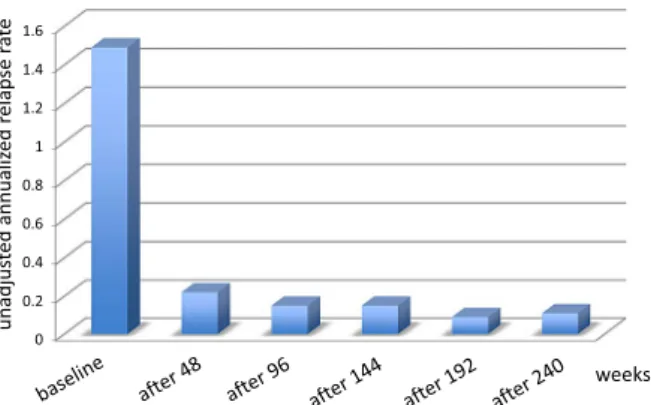
2~3 年の治験期間で NTZ の NEDA は 37%で,20%程度の IFNβ1a や glatiramer acetate(GA)に比して高く,33%の fingolimod と同程度である9). 治療開始後,効果発現までにほとんどの薬剤で 3 ヵ月程度 の時間を要するが,本剤では中枢神経内にすでに進入したリ ンパ球がアポトーシスをおこすか中枢神経から出て行くまで の時間が必要なためと考えられる.それゆえ,NTZ 治療初期 に再発したばあい,上記以外に中和抗体(後述)が産生され 薬効が減弱している可能性もある.リンパ球の VLA-4 飽和度 が 70%以上あれば治療効果があり,30%以下になると再発す る危険性があるとされ,治療効果の指標として飽和度が注目 されている10). 長期投与でも再発は抑制されることが STRATA(Safety of TYSABRI® Re-dosing and Treatment)試験11)で示されていて, 投与前の年間再発率の 1/10 に低下し,長期投与後も効果は安 定している(Fig. 1).
有害事象
SENTINEL試験の IFNβ1a 併用群で 2 例の進行性多巣性白 質脳症(progressive multifocal leukoencephalopathy; PML,後
総 説
多発性硬化症へのナタリツマブ治療
田中 正美
1)*
要旨: ナタリツマブはリンパ球の血管内皮細胞への結合を阻害することで,中枢神経への炎症性リンパ球流入 を阻害し,多発性硬化症の再発を予防することを目的に開発された.本剤の再発予防および身体障害進行停止作用 は強力であるが,進行性多巣性白質脳症(progressive multifocal leukoencephalopathy)の発現が投与を躊躇させ ている.有害事象を充分に理解して,適応を考える必要がある.本稿では現在までの研究成果を概観し,実地医療 での課題を明らかにしたい.
(臨床神経 2015;55:537-543)
Key words: 多発性硬化症,ナタリツマブ,進行性多巣性白質脳症
*Corresponding author: NHO宇多野病院多発性硬化症センター〔〒 616-8255 京都市右京区鳴滝音戸山 8〕
1)NHO宇多野病院多発性硬化症センター
(Received December 2, 2014; Accepted April 7, 2015; Published online in J-STAGE on July 7, 2015) doi: 10.5692/clinicalneurol.cn-000690
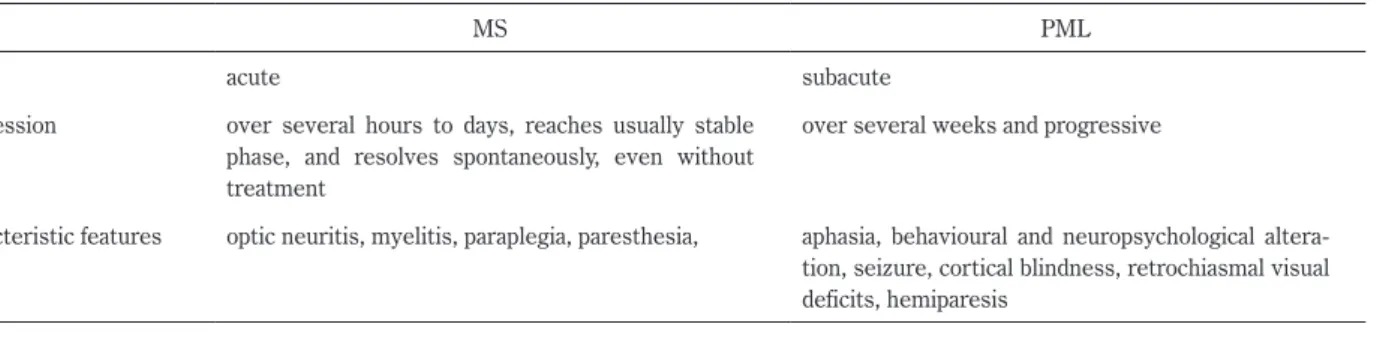
述)がみとめられたため,2005 年 2 月から発売が自粛された. その後,単剤治療として米国医薬品局(FDA)により 2006 年 6月に市販再開が認可された.2013 年 12 月に米国での薬剤情 報が改訂され,旧版の第二選択の薬剤という位置づけが削除 された.NTZ は再発寛解型に対する単剤治療としての適応は そのままだが,PML のリスクを越える治療効果が期待される か否かを考慮するべきとされた.また,ヘルペス脳炎・髄膜 炎のリスクが強調され,移植を必要とするほどの重篤な肝毒 性をおこす可能性があり,肝機能障害が出現したばあいは薬 剤を中止するべきとされた. 自己免疫性肝炎は IFNβ12)や GA13)で報告されているが, NTZでも報告された14). PML以外の日和見感染症としては,NTZ 治療中の単純ヘル ペス脳炎罹患率は 0.48%とされ,一般集団の 10 倍で,死亡例 も報告されているほか,ヘルペス髄膜炎も報告されている15). 中和抗体の 88%は投与開始 3 ヵ月以内に出現し,6 ヵ月以 降の出現率は低い.多くは α-4 integrin 認識部位に対する結合 阻害抗体なので血中濃度を低下させ,持続的な高力価の抗体 は再発の危険性を高めるが(オッズ比は 10.9,P = 0.008)16), 頻度は 6%程度で17),1 年以降での検出はきわめてまれであ る18).しかし,中和抗体陰性例でも NTZ 治療中にまれには再 発しうる19). 4%程度に蕁麻疹や発熱,めまい,皮疹,吐気,掻痒感など のアレルギー反応が遅発性に出現し,持続的な中和抗体陽性 患者ではアレルギー反応が出現しやすいとされた20)21)が,中 和抗体陰性でもアレルギー反応は出現し22),両者の関連は明 確ではない. 投与後の 2 時間以内でしばしば 2 回目のアナフィラキシー 反応が 1%以下にみいだされるが11)20)21),アナフラキシー 反応がみとめられた 54 例の HLA class II アリルの解析では, HLA-DRB1*13と HLA-DRB1*14 の頻度が優位に多いとされ23), 遺伝的背景の関与が示唆されている. NTZ 関連 PML 2014年 12 月末現在,世界で 13 万例以上に NTZ 投与され, 517例の PML が報告されている.死亡率は 23%である24).た とえ死亡しなくても重篤な後遺症が残る.血中の抗 John Cunninghamウイルス(JCV)抗体の存在,24 ヵ月以上の NTZ 治療期間と免疫抑制剤(ミトキサントロン,アザチオプリン, メトトレキサート,シクロホスファミドなど)の治療歴があ ると,PML(NTZ 関連 PML: NTZ-PML)発症リスクが高い,と されている(Table 1)25).北米に比して欧州の MS 患者で NTZ-PMLの頻度が高いことが知られていて(2013 年 6 月初めの 時点で PML 372 例中,米国が 127 例,欧州が 218 例),従来 は歴史的に欧州での免疫抑制剤の使用頻度が高かったことが 原因と考えられてきたが,免疫抑制剤使用歴自体は抗 JCV 抗 体陽性率を増加させないし26),免疫抑制剤投与中の視神経脊 髄炎患者と MS 患者では抗 JCV 抗体の陽性率に差異はない27). 2種類の抗 JCV 抗体の測定法が報告されているが,いずれ も JCV の VP1 蛋白由来ペプチドを抗原とした enzyme-linked immunosorbent assay(ELISA)で,抗体価の表現法がことな る28)29).血中の抗 JCV 抗体 index が 1.5 以上の患者では PML リスクが高い30). MSと PML との鑑別の要点を Table 2 に示す.PML では視 力障害を呈するばあいは視神経炎ではなく,大脳病変が原因 であり,脊髄炎による症状や MRI 所見を呈することがないこ とが MS との鑑別診断上,重要である. 脳 MRI で MS と PML を鑑別する(Table 3)上で有益な撮 影法は FLAIR 法と拡散強調画像であるが,両疾患の鑑別は必 ずしも容易ではないことがある.PML は白質病変がめだつが U繊維をふくめ皮質も傷害される(初期から 50%でみとめら れる)ことが特徴である.HIV で出現する PML では脳 MRI で 造影病変がみとめられることはないが,NTZ-PML では 30~ 40%でみとめられる.この本態は必ずしも明らかになって Fig. 1 Annualized relapse rate in STRATA study.
The annualized relapse rate in TOP (Tysabri Observational Program) study64) also decreased from 1.99 of baseline to 0.24 after 48–60 months treatment.
Table 1 The PML risks based on the duration of treatment and previous exposure to immunosuppression.
NTZ exposure No prior IS use Prior IS use
1–24 months <1 1.8
25–48 months 5.3 11.2
49–72 months 6.1 Insufficient data As of the 2nd September 2014 there have been 495 cases of natalizumab-associated PML. This represents an increase of 20 cases over the last 2 months. Over 129,100 MSers have been exposed to natalizumab65). The three risk factors including JCV serostatus, dura-tion of treatment, and previous exposure to immunosuppression, have been identified to develop PML in MS patients treated by NTZ. Table shows numbers of PML patients per 1000 MS patients with seropositive against JCV. PML risk in anti-JCV antibody positive MS patients increases if they treat with NTZ longer than 25-months. PML: progressive multifocal leukoencephalopathy, NTZ: natalizumab, IS: immunosuppressive drugs, JCV: John Cunningham virus, MS: multiple sclerosis.
はいないが,PML 発症時にリンパ球が浸潤して immune reconstitution inflammatory syndrome(IRIS)が同時におこっ ているためと考えられている31).IRIS は PML 治療のために NTZを中止して血漿交換することにより,薬剤の濃度が急激 に低下して免疫再構築がおき,JCV 感染細胞に対する免疫応 答が増強して,炎症(浮腫)が惹起された病態をいう.IRIS に対してステロイドパルスが施行されてきたが,JCV 特異的 CD8陽性 T 細胞の機能を低下させてしまうので,ウイルス除 去を阻害する危険性が指摘されている32). PML発症例では NTZ 治療中に低下していた CD62L+CD4+ が発症直前に急増するので,L-selectin(CD62L+)が pre-PML の指標になるという報告がある33)が,両者の関連は不明であ る.FTY 治療中の MS 患者でも末梢血の CD62L+CD4+は著減 している34). PMLの診断は症状と神経症状,脳 MRI 所見のほか,脳脊髄 液で JCV を PCR で検出することでおこなう35).しかし PCR の 感度は 60~95%といわれ,米国 NIH での測定では 10 copies/ml 以上で検出されるが,一般の検査業者では 200 copies/ml 以上 のウイルス量を必要とする.PML 発症時には 100 copies/ml 以 下のことが多いため,新たな診断法が必要であった.中枢神 経内での抗 JCV 抗体産生の有無で PML の診断が可能という 報告がある29).この方法の特異性は 100%で,100 copies/ml 以下でも PML を診断可能という.彼らは,PML がうたがわ れるばあいは,PCR だけでなくこの方法もしらべるべき,と 提案している. PMLのリスクのある患者は少なくとも6ヵ月ごとに脳MRI を撮影することにより36),偶然に PML 脳病変を発見するこ とがある(asymptomatic PML).この時点では PML の神経症 状はなく,NTZ を中止することで生存率も高いとされている が,脳脊髄液での PCR は陰性のことが多く37),脳 MRI での 皮質白質にまたがる病変の有無が重要である.うたがわしい ばあいは NTZ を中止するべきであろう.Giacomini らは重篤 Table 2 Clinical features of MS relapse and PML (modified from Lancet Neurol 2011;10:745-758, Curr Opin Neurol 2014;27:260-270).
MS PML
onset acute subacute
progression over several hours to days, reaches usually stable phase, and resolves spontaneously, even without treatment
over several weeks and progressive
characteristic features optic neuritis, myelitis, paraplegia, paresthesia, aphasia, behavioural and neuropsychological altera-tion, seizure, cortical blindness, retrochiasmal visual deficits, hemiparesis
Table 3 MRI findings for differential diagnosis of MS and PML31)66).
MS PML
aspect and location of new lesions
focal, periventricular, spinal cord diffuse and asymmetric, deep white matter extending to the subcortical involving the U-fibers as well as occasionally the adjacent cortical grey matter, post erior fossa frequently involved, rarely in spinal cord, 48% in the frontal, 20% in occipital, 12% in parietal lobe
borders sharp edge, mostly round or finger-like in sharp irregular T1-weighted images acute lesions are densely hypointense or isointense;
increasing signal intensity over time in 80%; decreasing signal intensity (axonal loss) in 20%
slightly hypointense at onset with signal intensity decreasing over time
with gadolinium enhancement
dense homogeneous enhancement and sharp edges,
rarely ring-like 30–40%; patchy
T2-weighted images homogenous hyperintense inside and adjacent to the main PML lesion, small punctiform lesions with an occasionally microcytic appearance in 72% (“milky way appearance”)
The lesions of NTZ-associated PML are not limited in the white matter, but extends to cortical grey matter with involving U-fibers (50%). Brain MRI lesions compatible to NTZ-associated PML may be accidentally found (asymptomatic PML)67), and brain MRI findings are similar to that of NTZ-associated PML although diffusion weighted images are not useful68).
な IRIS をともなった NTZ-PML 患者にステロイドパルスをせ ずに CCR5 拮抗薬である maraviroc を投与し,中枢神経への リンパ球流入を阻害したところ IRIS が改善され,10 ヵ月後 には脳脊髄液中の JCV が消失した 1 例を報告した38). そのほかの合併症を Table 4 に示す. 適応(薬剤の位置づけ) NTZの適応は概ね FTY と重なり39),IFNβ 治療で充分な再 発抑制がえられないか,疾患活動性がきわめて高いと考えら れる患者である.NTZ には PML のリスクがあるため,適応 は抗 JCV 抗体の有無で判断するという考え方もある40). 再発予防治療として,作用が弱いけれども有害事象の少な い IFNβ や GA から始め,効果がないばあいに第二選択の薬 剤をもちいる escalation therapy がある.これへの支持が衰え ない最大の理由は,長期投与の安全性と有害事象情報の充分 な蓄積があること,IFNβ や GA でも充分に再発予防が可能な ばあいがあるからである.ある第一選択の薬剤で効果がない ばあいに他の第一選択の薬剤に変更すると再発予防できるば あいもある41)42).しかし,一方で,すでに診断時から多くの
T2/ FLAIR病変や脳萎縮,数多くの black holes が存在している ようなばあい,あるいは短期間に再発を反復したり,脳 MRI で複数あるいは頻回にことなる部位に造影病変がみとめられ るなど,疾患活動性が高いばあいはすみやかに活動性を抑制 する必要がある.また,患者側の社会的な問題や希望により, 第二選択の薬剤から投与を始めることもあろう.
視神経脊髄炎(neuromyelitis optica; NMO)で NTZ 投与直 後の再発43)や seronegative NMO で投与直後の大脳病変出現
という報告44)があり,NTZ による B 細胞増加(後述)との
関連が示唆されているので,投与前に NMO を充分に鑑別し ておく必要がある.抗アクアポリン(AQP)4 抗体の測定に
ついては検査法の感度が問題であるし45),世界標準の検査法
である cell-based assay により陰性でも NMO は否定できない. 抗体価が検出以下などの理由で,seronegative NMO の中に抗 AQP4抗体陽性と同じ病態が存在しうるからである46). NTZ 中止後の対応 NTZを中止する理由は様々で,PML リスクのほか,再発, 有害事象,中和抗体出現などが挙げられている47).PML のリ スクをおさえるために,休薬も検討されたが,再発のリスク をともなう48).6~8 週間間隔での投与が試みられている49). NTZ治療 2 年以内に中止すると疾患活動性は治療前に戻るの で50),何らかの薬剤への変更が必要である.当初は変更薬と して IFNβ などが試みられたが,活動性を抑制できず,今日 では FTY がもちいられることが多い.FTY 開始まで 3 ヵ月以 上空けると,再発頻度が急上昇するため51),休薬期間は 3 ヵ 月以内にするべきだが19)52)53),FTY 開始 1 ヵ月以内の再発も 多く54),休薬期間を設けるべきではないという意見もある47). NTZから FTY へ変更した後に重篤な再発をきたしたという 報告が相次いだ55)56).FTY へ変更した後に再発するリスクが 高くなる原因としては,休薬期間が 6 ヵ月以上と長かったり, NTZ治療前の再発頻度が多かったこと,有害事象などで治療 が不充分なばあいなどが挙げられている47).NTZ 中止後に FTYで活動性を抑制できない52)機序として,NTZ 治療中の CD19+B細胞や CD19+CD10+pre-B細胞の著増57)のほか,末 梢血単核細胞の IFNγ や tumor necrosis factor(TNF)mRNA 増加58),抗 CD3 刺激による IFNγ や TNF,IL-17 といった炎
症性サイトカインを産生する CD4+細胞や刺激により IL-2 や
IL-17を産生する CD8+細胞の増加59)といった末梢血リンパ 球の活性化がみとめられるので,中止後に活性化したリンパ 球が中枢神経へ流入する可能性があるかもしれない. Table 4 Complications of natalizumab treatment other than PML in MS patients.
Complications References
Granule cell neuronopathy* Ann Neurol 2013;74:622-626; Neurology 2014;83:727-732. Ocular toxoplasmosis Neurology 2009;73:1418-1419,
Primary CNS lymphoma Ann Neurol 2009;66:403-406. Peripheral T cell lymphoma (intracranial extra-axial,
mass encircled the inner and outer tables of skull)
Acta Neuropathol 2012;123:751-752. Hepatosplenic T cell lymphoma Clin Gastroenterol Hepatol 2011;9:36-41.
Melanoma N Engl J Med 2006;354:899-910; N Engl J Med 2008;358:647-648; N Engl J Med 2008;359:399; Mult Scler 2009;15:1532-1533; J Neurol 2009;256:1771-1772: Neurol Sci 2011;32:181-182; Mult Scler 2010;17:255-256.
Erythroblastaemia Mult Scler 2014;20:1269-1272.
* Cerebellar atrophy is not pronounced at the onset of granule cell neuronopathy. Other neurological diseases not shown in Table 4 accompanied by JCV during NTZ treatment include encephalopathy and meningitis. CNS: central nervous system.
体重に依拠した投与法 FTYは投与間隔(24 時間)より半減時間 5.9 日(ただし, 1.25 mg内服時)の方が長く,体内で蓄積されるため,リン パ球減少により内服薬の継続が困難なばあいに週 1~2 日休 薬という投与法60)61)を提唱しているが,NTZ は投与間隔(4 週間)に比して半減時間(16.5 日)が短いため,投与間隔を 6~8 週と延長すると血中濃度が低下し,リンパ球の VLA-4 飽 和度が低下する危険性が高い.体重に注目されるようになっ たのは,欧州と米国での PML の頻度の差からである.米国 と Sweden の MS 患者の平均体重は各々 77,69 kg で62),治 験時の日本人 MS 患者では 55 kg であった.体重が増加する と飽和度が低下するが62),現在の 300 mg 均一投与の根拠は, 「50 kg 以上では 6 mg/kg を上回ることはなく,100 kg 以下で は 3 mg/kg を下回ることはない」(日本の PMDA への提出資 料)ためとされる.米国 MS 患者の平均体重では 4 mg/kg に 相当するが,体重が低い患者では飽和度が高くなる.筆者ら は,3~4 mg/kg を基準に 12~18 歳の小児例や体重の軽い日 本人患者に投与するべきではないか,と考えている.この投 与法63)により PML 発症リスクが抑制されるか否かは不明だ が,より安全性の高い治療法を目指すべきであろう. 結 語 日本人では欧米よりやや抗 JCV 抗体陽性率が高く27),欧米 患者より体重が軽いので飽和度が高いことが予想され,PML のリスクが欧米より高い可能性がある.今後,小柄なアジア 人への治療は検討する必要があろう.また,NTZ 治療後に抗 JCV抗体が陽転化したばあいと投与前から抗 JCV 抗体が陽性 だったばあいの PML リスクの差異などをふくめて,適応に ついての議論が深まることが期待される. ※本論文に関連し,開示すべき COI 状態にある企業,組織,団体 はいずれも有りません. 文 献
1) Rudick R, Polman C, Clifford D, et al. Natalizumab: bench to bedside and beyond. JAMA Neurol 2013;70:172-182.
2) Stüve O, Marra CM, Jerome KR, et al. Immune surveillance in multiple sclerosis patients treated with natalizumab. Ann Neurol 2006;59:743-747.
3) Polman CH, O’Connor PW, Havrdova E, et al. A randomized, placebo-controlled trial of natalizumab for relapsing multiple sclerosis. N Engl J Med 2006;354:899-910.
4) Rudick RA, Stuart WH, Calabresi PA, et al. Natalizumab plus interferon beta-1a for relapsing multiple sclerosis. N Engl J Med 2006;354:911-923.
5) Miller DH, Soon D, Fernando KT, et al. MRI outcomes in a placebo-controlled trial of natalizumab in relapsing MS. Neurology 2007;68:1390-1401.
6) 齊田孝彦,吉良潤一,糸山泰人ら.日本人多発性硬化症(MS)
での Natalizumab(NAT)の有効性と安全性.臨床神経 2013; 53:1531.
7) Bevan CJ, Cree BA. Disease activity free status: a new end point for a new era in multiple sclerosis clinical research? JAMA Neurol 2014;71:269-270.
8) Stangel M, Penner IK, Kallmann BA, et al. Towards the implementation of ‘no evidence of disease activity’ in multiple sclerosis treatment: the multiple sclerosis decision model. Ther Adv Neurol Disord 2015;8:3-13.
9) Imitola J, Racke MK. Is no evidence of disease activity a realistic goal for patients with multiple sclerosis? JAMA Neurol 2015;72:145–147.
10) Khatri BO, Man S, Giovannoni G, et al. Effect of plasma exchange in accelerating natalizumab clearance and restoring leukocyte function. Neurology 2009;72:402-409.
11) O’Connor P, Goodman A, Kappos L, et al. Long-term safety and effectiveness of natalizumab redosing and treatment in the STRATA MS Study. Neurology 2014;83:78-86.
12) Pulicken M, Koteish A, DeBusk K, Calabresi PA. Unmasking of autoimmune hepatitis in a patient with MS following interferon beta therapy. Neurology 2006;66:1954-1955.
13) Neumann H, Csepregi A, Sailer M, et al. Glatiramer acetate induced acute exacerbation of autoimmune hepatitis in a patient with multiple sclerosis. J Neurol 2007;254:816-817.
14) Martínez-Lapiscina EH, Lacruz F, Bolado-Concejo F, et al. Natalizumab-induced autoimmune hepatitis in a patient with multiple sclerosis. Mult Scler 2013;19:1234-1235.
15) Iaffaldano P, Lucchese G, Trojano M. Treating multiple sclerosis with natalizumab. Expert Rev Neurother 2011;11:1683-1692. 16) Vennegoor A, Rispens T, Strijbis EM, et al. Clinical relevance of
serum natalizumab concentration and anti-natalizumab antibodies in multiple sclerosis. Mult Scler 2013;19:593-600.
17) Calabresi PA, Giovannoni G, Confavreux C, et al. The incidence and significance of anti-natalizumab antibodies: results from AFFIRM and SENTINEL. Neurology 2007;69:1391-1403. 18) Buttmann M, Rieckmann P. Treating multiple sclerosis with
monoclonal antibodies. Expert Rev Neurotherapeutics 2008;8: 433-455.
19) 田中正美,田中惠子.ナタリズマブ治療 18 ヵ月後に中和抗 体陰性で再発した多発性硬化症.神経内科 2014;81:582-584. 20) Krumbholz M, Pellkofer H, Gold R, et al. Delayed allergic
reaction to natalizumab associated with early formation of neutralizing antibodies. Arch Neurol 2007;64:1331-1333. 21) Rudick RA, Panzara MA. Natalizumab for the treatment of
relapsing multiple sclerosis. Biologics 2008;2:189-199. 22) Killestein J, Jasperse B, Liedorp M, et al. Very late
delayed-allergic reaction to natalizumab not associated with neutralizing antibodies. Mult Scler 2009;15:525-526.
23) de la Hera B, Urcelay E, Brassat D, et al. Natalizumab-related anaphylactoid reactions in MS patients are associated with HLA class II alleles. Neurol Neuroimmunol Neuroinflamm 2014;1:e47. 24) BartsMS Blog [Internet]. London: Barts & The London; 2015
Jan [cited 16 Jun 2015]. Available from: http://multiple-sclerosis- research.blogspot.com/2015/01/clinicspeak-natalizumab-pml-update-q4.html.
natalizumab-associated progressive multifocal leukoencephalo-pathy. N Engl J Med 2012;366:1870-1880.
26) Bozic C1, Subramanyam M, Richman S, et al. Anti-JC virus (JCV) antibody prevalence in the JCV Epidemiology in MS (JEMS) trial. Eur J Neurol 2014;21:299-304.
27) Tanaka M, Kinoshita M, Tanaka K. Anti-JC virus index in Japanese patients with multiple sclerosis and neuromyelitis optica related disorder. Clin Exp Neuroimmunol, in press. 28) Lee P, Plavina T, Castro A, et al. A second-generation ELISA
(STRATIFY JCVTM DxSelectTM) for detection of JC virus antibodies in human serum and plasma to support progressive multifocal leukoencephalopathy risk stratification. J Clin Virol 2013;57:141-146.
29) Warnke C, von Geldern G, Markwerth P, et al. Cerebrospinal Fluid JC Virus Antibody Index for Diagnosis of Natalizumab-Associated Progressive Multifocal Leukoencephalopathy. Ann Neurol 2014;76:792-801.
30) Plavina T, Subramanyam M, Bloomgren G, et al. Anti-JC virus antibody levels in serum or plasma further define risk of natalizumab-associated progressive multifocal leukoencephalo-pathy. Ann Neurol 2014;76:802-812.
31) Wattjes MP, Barkhof F. Diagnosis of natalizumab-assiciated progressive multifocal leukoencephalopathy using MRI. Curr Opin Neurol 2014;27:260-270.
32) Antoniol C, Jilek S, Schluep M, et al. Impairment of JCV-specific T-cell response by corticotherapy: effect on PML-IRIS manage-ment? Neurology 2012;79:2258-2264.
33) Schwab N, Schneider-Hohendorf T, et al. L-selectin is a possible biomarker for individual PML risk in natalizumab-treated MS patients. Neurology 2013;81:865-871.
34) 田中正美,朴 貴瑛,本山りえら.フィンゴリモドを投与 した多発性硬化症患者における末梢血リンパ球の変化 ―CD62L 陽性細胞の著減―.神経内科 2012;77:109-113. 35) Berger JR, Aksamit AJ, Clifford DB, et al. PML diagnostic
criteria: consensus statement from the AAN Neuroinfectious Disease Section. Neurology 2013;80:1430-1438.
36) Phan-Ba R, Lommers E, Tshibanda L, et al. MRI preclinical detection and asymptomatic course of a progressive multifocal leucoencephalopathy (PML) under natalizumab therapy. J Neurol Neurosurg Psychiatry 2012;83:224-226.
37) Blair NF, Brew BJ, Halpern JP. Natalizumab-associated PML identified in the presymptomatic phase using MRI surveillance. Neurology 2012;78:507-508.
38) Giacomini PS, Rozenberg A, Metz I, et al. Maraviroc and JC Virus–Associated Immune Reconstitution Inflammatory Syndrome. N Engl J Med 2014;370:486-488.
39) 田中正美.フィンゴリモドは第一選択薬か 第一選択薬では ないという立場から.MS Frontier 2013;2:42-44.
40) Pelletier D, Hafler DA. Fingolimod for multiple sclerosis. N Engl J Med 2012;366:339-347.
41) Río J, Tintoré M, Sastre-Garriga J, et al. Change in the clinical activity of multiple sclerosis after treatment switch for suboptimal response. Eur J Neurol 2012;19:899-904.
42) Gajofatto A1, Bacchetti P, Grimes B, et al. Switching first-line disease-modifying therapy after failure: impact on the course of relapsing-remitting multiple sclerosis. Mult Scler 2009;15:50-58.
43) Jacob A, Hutchinson M, Elsone L, et al. Does natalizumab therapy worsen neuromyelitis optica? Neurology 2012;79:1065-1066.
44) Kitley J, Evangelou N, Küker W, et al. Catastrophic brain relapse in seronegative NMO after a single dose of natalizumab. J Neurol Sci 2014;339:223-225.
45) 田中正美,田中惠子.抗アクアポリン 4 抗体測定系の検討: cell-based assayと ELISA の比較.神経内科 2014;81:685-687. 46) 田中正美,田中恵子:NMO での抗アクアポリン 4 抗体の
false negativeについて.神経内科 2008;69:505-506.
47) Stangel M, Stüve O. Natalizumab to fingolimod-the washout whitewash. Nat Rev Neurol 2014;10:1-2.
48) Kerbrat A, Le Page E, Leray E, et al. Natalizumab and drug holiday in clinical practice: an observational study in very active relapsing remitting multiple sclerosis patients. J Neurol Sci 2011;308:98-102.
49) Bomprezzi R, Pawate S. Extended interval dosing of natalizumab: a two-center, 7-year experience. Ther Adv Neurol Disord 2014; 7:227-231.
50) Miravalle A, Jensen R, Kinkel RP. Immune reconstitution inflammatory syndrome in patients with multiple sclerosis following cessation of natalizumab therapy. Arch Neurol 2011; 68:186-191.
51) Rinaldi F, Seppi D, Calabrese M, et al. Switching therapy from natalizumab to fingolimod in relapsing-remitting multiple sclerosis: clinical and magnetic resonance imaging findings. Mult Scler 2012;18:1640-1643.
52) Jokubaitis VG, Li V, Kalincik T, Izquierdo G, et al. Fingolimod after natalizumab and the risk of short-term relapse. Neurology 2014;82:1204-1211.
53) Cohen M, Maillart E, Tourbah A, et al. Switching from natalizumab to fingolimod in multiple sclerosis: a French prospective study. JAMA Neurol 2014;71:436-441.
54) Comi G, Gold R, Dahlke F, et al. Relapses in patients treated with fingolimod after previous exposure to natalizumab. Mult Scler 2015;21:786-790.
55) Castrop F, Kowarik MC, Albrecht H, et al. Severe multiple sclerosis relapse under fingolimod therapy: incident or coincidence? Neurology 2012;78:928-930.
56) Centonze D, Rossi S, Rinaldi F, et al. Severe relapses under fingolimod treatment prescribed after natalizumab. Neurology 2012;79:2004-2005.
57) Krumbholz M, Meinl I, Kümpfel T, Hohlfeld R, Meinl E. et al. Natalizumab disproportionately increases circulating pre-B and B cells in multiple sclerosis. Neurology 2008;71:1350-1354. 58) Khademi M, Bornsen L, Rafatnia F, et al. The effects of
natalizumab on inflammatory mediators in multiple sclerosis: prospects for treatment-sensitive biomarkers. Eur J Neurol 2009;16:528-536.
59) Kivisäkk P, Healy BC, Viglietta V, et al. Natalizumab treatment is associated with peripheral sequestration of proinflammatory T cells. Neurology 2009;72:1922-1930.
60) Tanaka M, Park K, Tanaka K. Reduced fingolimod dosage treatment for patients with multiple sclerosis and lymphopenia or neutropenia. Mult Scler 2013;19:1244-1245.
Japanese patients with multiple sclerosis: 24-months experience. Clin Exp Neuroimmunol 2014;5:383-384.
62) Foley J, Gudesblatt M, Zarif M, et al. Low body weight as a potential surrogate risk factor for progressive multifocal leukoencephalopathy (Absr). In the 66th Annual Meeting of American Academy of Neurology (ed SM Pulst), Philadelphia, the USA, 26 April-3 May 2014. 2014;2.244.
63) Tanaka M, Kinoshita M, Foley JF, et al. Body weight based natalizumab treatment in adult patients with multiple sclerosis. J Neurol 2015;262:781–782.
64) Butzkueven H, Kappos L, Pellegrini F, et al. Efficacy and safety of natalizumab in multiple sclerosis: interim observational pro-gram results. J Neurol Neurosurg Psychiatry 2014;85:1190-1197. 65) BartsMS Blog [Internet]. London: Barts & The London; 2014
Oct [cited 1 Dec 2014]. Available from: http://multiple-sclerosis- research.blogspot.com/2014/10/clinicspeak-natalizumab-pml-update.html
66) Wattjes MP, Barkhof F. Diagnosis of natalizumab-associated progressive multifocal leukoencephalopathy using MRI. Curr Opin Neurol 2014;27:260-270.
67) Phan-Ba R, Lommers E, Tshibanda L, et al. MRI preclinical detection and asymptomatic course of a progressive multifocal leucoencephalopathy (PML) under natalizumab therapy. J Neurol Neurosurg Psychiatry 2012;83:224-226.
68) Wattjes MP, Vennegoor A, Steenwijk MD, et al. MRI pattern in asymptomatic natalizumab-associated PML. J Neurol Neurosurg Psychiatry, in press.
Abstract
Natalizumab treatment in multiple sclerosis
Masami Tanaka, M.D., Ph.D., F.A.A.N.
1)1)Multiple Sclerosis Center, National Hospital Organization, Utano National Hospital