Study on Development of
Novel Multi-Component Mg-Based Alloys
by Rapid Solidification Technology
Using of Twin Roll Casting
双ロール鋳造を用いた急冷凝固技術による
新規多成分 Mg 系合金の開発に関する研究
Zhipu Pei
Table of Contents
Preface ... I
Chapter 1 Introduction ...1
1.1 Background and history of metallic glasses and nanocrystalline alloys ... 2
1.1.1 Metallic glasses, nanocrystalline alloys and quasicrystals ... 2
1.1.2 Metallic glasses and nanocrystalline alloys ... 6
1.2 Rapid solidification techniques in producing metallic glasses ...14
1.2.1 Rapid solidification apparatuses ...14
1.2.2 Rapid solidification of twin roll strip casting technique ...20
1.3 Material selection and process determination ...25
1.3.1 Material selection ...26
1.3.2 Process determination ...31
1.4 Purpose of this thesis ...34
References ...37
Chapter 2 Kinetics of rapid solidification on microstructure and alloy composition design .... 49
2.1 Thermodynamics and kinetics of glass formation ...49
2.1.1 Thermodynamic stability of metallic glasses ...49
2.1.2 Kinetics of glass formation ...51
2.2 Evaluation of critical cooling rate ...52
2.2.1 Calculation of time reduced-temperature transformation and CCT diagrams ...54
2.2.2 Estimation of the critical cooling rates using CCT curves ...57
2.2.3 Process programming—transition from TTT diagram to CCT diagram ...59
2.3 Criteria of glass forming ability ...60
2.3.1 Characteristics of bulk metallic glasses ...60
2.3.2 Three empirical rules for estimating glass forming ability ...62
2.4 Topological models of bulk glass formers ...62
2.5 Alloy composition design ...67
2.6 Concluding remarks ...70
References ...72
Chapter 3 Simulation of solidification behavior during twin roll casting ... 75
3.1 Introduction...75
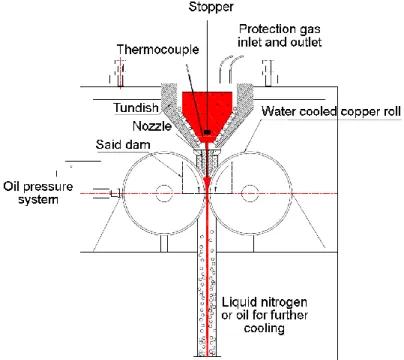
3.2 Pilot vertical type twin roll caster ...76
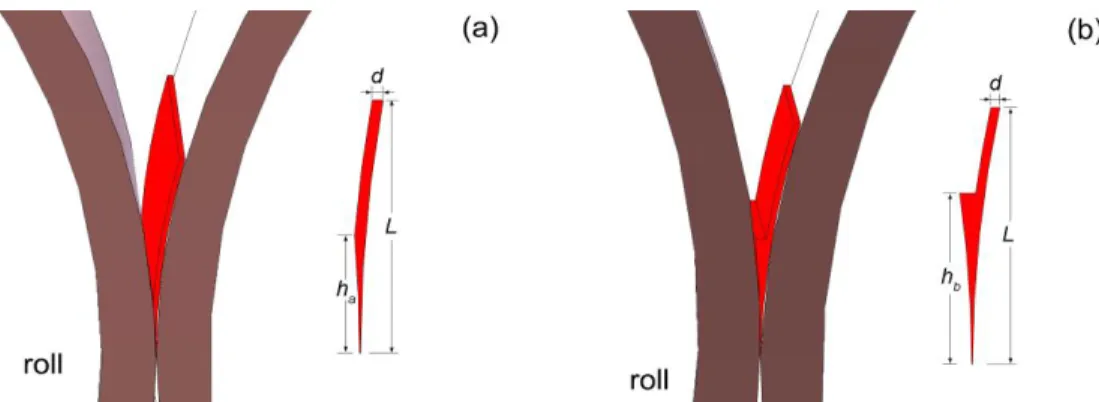
3.3 Simulation of twin roll strip casting ...80
3.3.2 Thermal flow simulation ...82
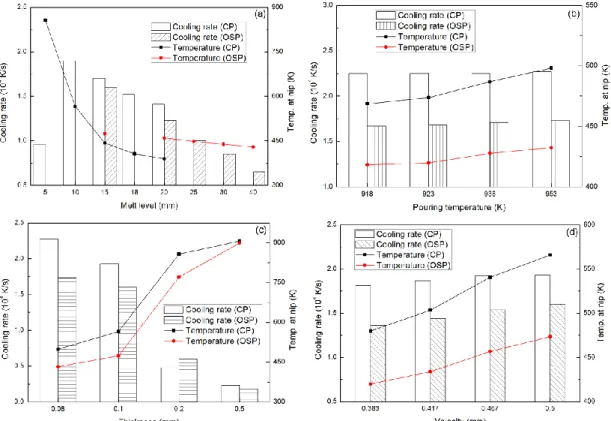
3.4 Results and discussion ...83
3.5 Concluding remarks ...89
References ...90
Chapter 4 TRC experiment and microstructure analyses ... 93
4.1 Experiment ...93
4.1.1 Enlightenment form normal TRC experiment ...94
4.1.2 Rapid solidification of TRC process ...96
4.2 X-ray diffraction analysis ...106
4.3 TEM analysis ... 110
4.3.1 Sample preparation by focused ion beam (FIB) milling technique ... 110
4.3.2 TEM analysis results ... 112
4.4 Corrosion properties ... 114
4.4.1 Surface morphology of the AZ31 Light sheet after corrosion ... 115
4.4.2 Surface morphology of the AZ31-In-Sn alloy sheet after corrosion ... 116
4.4.3 Surface morphology of the Mg-RE alloy sheet after corrosion ... 118
4.4.4 Corrosion mechanism exploration ...120
4.5 Mechanical properties of the dual phase Mg-RE alloy ...123
4.6 Concluding remarks ...126
References ...127
Chapter 5 Summary and prospect ... 129
their advantageous characteristics. However, their utilization is limited by the restricted plasticity and corrosion resistance. In recent years, metallic glass (metallic amorphous materials) has received great attention and made a lot of progress. However, the preparation technology of amorphous materials is complex, and the high processing cost is one of the major topics at present. In order to solve these problems, this paper mainly proposed a low cost, easy to achieve rapid solidification technology to prepare Mg-based amorphous or amorphous and fine grain mixed materials. This work has two main purposes: (i) proposing a new multi-component magnesium-based alloy design method and its theory and (ii) using twin-roll casting technology to prepare amorphous or amorphous and fine grain mixed materials. Improved ductility and better corrosion resistance are expected in our materials.
Chapter 1 firstly introduces the background of metallic glasses, nanocrystalline alloys and strip casting technology. Purpose of this thesis was proposed at the last of this chapter.
In Chapter 3, thermal-flow simulation was carried out to calculate the thermal and flow phenomena during twin roll casting (TRC) of magnesium alloys. Cooling rates with 3 to 4 orders of magnitude by the vertical type twin roll casting (VTRC) process under the current conditions can be attained, which shows that VTRC technique has a potential ability in continuous fabrication of Mg-based bulk amorphous or amorphous phase and fine crystalline phase dual-phase alloys in sheet form.
In Chapter 4, rapid solidification of TRC experiments were conducted. The Mg-RE alloy strip exhibited good corrosion resistance and higher ultimate tensile strength and elongation comparing to the as-cast AZ31 alloy strips. The elongation of Mg-RE alloy strip is also high than the AZ91 and ZK61 under powder metallurgy processing. These indicate that Mg-RE alloy produced by our method has a better ductility. Electron probe micro-analysis (EPMA) results and Transmission electron microscopy(TEM) analyses show that the quasi-amorphous phase has a high concentration in Al and RE element, which results in the fact that the quasi-amorphous phase has a better glass forming ability (GFA) than the matrix phase.
Finally, conclusions and expositions of the dissertation are given in Chapter 5, and some future research directions are also proposed.
Chapter 1 Introduction
Considering the impact of modern industry on environment and sustainable development, new materials and new processes are expected and many researchers devote themselves to these fields. It has been clarified that noncrystalline and nanocrystalline alloys have new alloy compositions and new atomic configurations which differ from those of crystalline alloys. These features have facilitated the appearance of various characteristics, such as good mechanical properties, useful physical properties and unique chemical properties which have not been obtained from conventional crystalline alloys [1]. This chapter is intended to introduce the development history of noncrystalline alloys (metallic glasses) and summarize recent works on nanocrystalline alloys. Their synthesis techniques with a focus on twin roll casting process were also pointed out. Taking aim at developing new Mg-based materials by rapid solidification techniques, the main purposes of this thesis are stated at last of this chapter.
To begin with this part, for the sake of avoiding ambiguity and confusion, the author would like to characterize several terms (noncrystalline, amorphous, glassy) which are being used in describing noncrystalline materials in literature [2]:
recognized that both glasses and amorphous solids are noncrystalline. In this thesis, the materials were produced by continuous cooling from the liquid state and if there was a noncrystalline phase, it should be called ―glass‖. In summary:
Glass is any noncrystalline solid obtained by continuous cooling from the liquid state, and amorphous solid is any noncrystalline material obtained by any other method, except by continuous cooling from the liquid state.
1.1 Background and history of metallic glasses and nanocrystalline alloys
1.1.1 Metallic glasses, nanocrystalline alloys and quasicrystals
A perfect crystal is a three-dimensional periodic or quasi-periodic array of atoms, which in a regular repeating structure of atoms and is infinite in extent [4]. Solids which are deviating from this perfectly ordered structure could be divided into two classes [5]: One is obtained by thermally disordering crystalline structure of a material and freezing-in the disordered state by means of quenching. A glass may be considered as a solid with frozen-in liquid structure [3]. A two-dimensional hard sphere model of a glass is shown in Fig. 1.1(a) in comparison to a perfect crystal of hard spheres (Fig. 1.1(b)). In most glassy materials, the density and the nearest neighbor coordination varies typically by a few percent relative to the perfect crystal [5].
As shown in Fig. 1.2, the other class of disordered materials deviated from the perfect crystal has a characteristic that the disorder is induced by incorporating defects (e.g., vacancies, dislocations and grain or interphase boundaries). Atomic density and coordination in the defect core region are significantly altered by atomic displacements associated with the incorporation of defects.
Fig. 1.2 Schematic drawing of various crystal lattice defects. (http://www.tf.uni-kiel.de/matwis/amat/def_en/)
material which contains such a high density of defects that 50% or more of the atoms are situated in the cores of defects, then the atomic structure of the entire material depends on the core structures of the defects. This is the basic idea of nanocrystalline materials. They have a common microstructural feature that a large volume fraction of defect cores which contain 50% or more atoms (molecules) are the main structure and (strained) crystal lattice regions are consisted in them. Fig. 1.3 shows the structure of a two-dimensional nanocrystalline material.
Fig. 1.3 Atomic structure of a two-dimensional nanocrystalline material. Atoms (hexagonal arrays) in the centers of the ―crystals‖ are indicated in filled circles. The ones in the boundary core regions
are represented by open circles [5].
electron microscopy [1].
*The equation is Dhkl K Bhklcos [9], where D
hkl is the crystallite size in the direction perpendicular to the lattice
planes, hkl are the Miller indices of the planes being analyzed, K is a numerical factor frequently referred to as the crystallite-shape factor, λ is the wavelength of the X-rays, Bhkl is the width (full-width at half-maximum) of the X-ray
diffraction peak in radians and θ is the Bragg angle. In addition to depending on the crystallite shape, the numerical factor K also depends on the definitions of the average crystallite size (for example, if the cube root of the crystallite volume is
used instead of the definition above) and the width (for example, if the integral line width is used, as in von Laue’s derivation of Scherrer’s formula, rather than the full width at half-maximum, which is usually easier to obtain from experimental data). The structure of the formula is not affected by these definitions, but the numerical value of K may change appreciably. Using the above definition of Dhkl, and in the absence of detailed shape information, K = 0.9 is a
good approximation. It is important to note that Scherrer’s equation can only be applied for average sizes up to about 100~200 nm (depending on the instrument, sample, and signal-to-noise ratio), because diffraction-peak broadening decreases with increasing crystallite size and it becomes difficult to separate the peak broadening due to crystallite size from the broadening due to other factors.
Different from the crystal (possessing long-range translational symmetry) and noncrystal (absence of long-range order), Shechtman et al. reported another type of solid in 1984 which is now referred to quasicrystal [10]. Quasicrystals constitute a new class of condensed matter characterized by a non-crystallographic orientational symmetry [11]. Most quasicrystals produced by non-equilibrium processes such as rapid quenching are metastable. About a decade later, after the discovery of quasicrystals, there were still numerous basic questions need to be answered [11]. Another decade past, in 2004, Inoue [12] wrote an article which mentioned quasicrystal and summarized the properties and application fields. Even in recent years [13-15], researches in this field are almost all based on the lattice structure models proposed in the early age. The basic questions still exist.
Table 1.1 Characteristics of metallic glasses, nanocrystalline materials and quasicrystals.
Characteristics Ref.
Metallic glasses
Atomic arrangement is random.
Lack of long-range atomic order and very similar to a frozen-in liquid.
Metastable state.
Absence of dislocation-mediated slip.
[16-19]
Nanocrystalline materials
Crystallite (grain) size below 100 nm.
Structurally characterized by a large volume fraction of grain boundaries.
Contain a high density of interfaces, a substantial fraction of atoms lie in the interfaces
[5, 20, 21]
Quasicrystals
A rotational symmetry structure, but no translational symmetry, exits over large distances.
Its diffraction spots are as sharp as those of crystals but cannot be indexed to any Bravais lattice.
The solid is metastable and forms from the melt by a first-order phase transition*.
[2, 10, 11]
*First-order phase transition (discontinuous phase transition): A transition in which the molar Gibbs energies or molar Helmholtz energies of the two phases (or chemical potentials of all components in the two phases) are equal at the transition temperature, but their first derivatives with respect to temperature and pressure (for example, specific enthalpy of transition and specific volume) are discontinuous at the transition point, as for two dissimilar phases that coexist and that can be transformed into one another by a change in a field variable such as pressure, temperature, magnetic or electric field. Example: The transition on heating CsCl to 752K at which it changes from the low-temperature, CsCl-type structure to the high-temperature NaCl-type structure [22].
1.1.2 Metallic glasses and nanocrystalline alloys
(1) Metallic glasses
those questions on the development, structure and physical properties of this new phase.
Glass-forming systems have been found in all major bonding classes, including covalent, ionic, van der Waals, hydrogen bond, and metallic [24]. The forming of metallic glasses (MGs) needs extremely high cooling rates (on the order of 105 to 106 K/s) due to the non-directional nature of metallic bonds and the fact that metals are comprised of individual spherical atoms, as opposed to non-spherical compounds such as SiO2 and other oxide glasses. Within metals, individual atoms can rearrange quickly
into lower energy configurations or crystalline phases, thus a higher cooling rate is required to avoid crystallization [25].
Pol Duwez and his colleagues at the California Institute of Technology (CalTech) were the first to successfully quench a binary Au–Si eutectic composition (Au75Si25)
fast enough to form a metallic glass upon cooling from the melt [26]. There is an interesting phenomenon that in most of the papers [24, 27-35], it is said that the first metallic glass phase was formed by continuous cooling from melt in 1960. This may be due to the fact that Duwez‘s group published their work in the year of 1960 [26]. Actually, in 1981 [36], a historical description about the discovery of metallic glasses was provided by Duwez himself, it points out that the very thin foil of the first metallic glass was obtained in September 1959. The amorphous foil was quite unstable and crystallization could have occurred during the 3 hours exposure in the Debey-Scherrer camera [36].
In 1961, Cohen and Turnbull pointed out that the glass-forming tendency (for a given cooling rate and for substances of a given molecular type) is greater the lower is the reduced melting temperature [37]:
where Tm is the thermodynamic crystallization temperature, and hv is the molecular heat of vaporization. In consulting a compilation of phase diagrams, Duwez found that quite a few binary alloys between a metal and a semimetal (similar to Au-Si) had a eutectic point at a rather low temperature compared to that of the metal. In the subsequent development of alloy systems susceptible to be quenched into glasses, Duwez group replaced the Au into Pd in considering the thermal instability of Au-Si amorphous alloys, because the metal Pd have a higher melting point (thermal stability) [36, 38]. Hot on the heels of the discovery of amorphous Pd-20 at.%Si alloy, Chen and Turnbull reported the existence of glass transition temperature for the first time [39, 40] in the late 1960s. It is worth to mention that Angell [41] pointed out that the presence of Tg is not essential for a material to be called a glass in 1995.
In 1965 AuCo metallic glass was initially investigated as a ferromagnetic material by Duwez group. As the ferromagnetic metallic glass was synthesized by vapor deposition, the thickness of the alloy films are in the range of 200~600Å [42]. In order to obtain stronger ferromagnetic metallic glassy materials, Fe-P alloy system was developed. In 1967, the first strongly ferromagnetic metallic glass Fe75P15C10 was
discovered by a scientific serendipity [43]. It was the prototype for all the ferromagnetic metallic glasses which have been extensively studied during the next decade.
comment on the ternary materials produced by Chen group that if one arbitrarily defines the millimeter scale as ―bulk‖, then these ternary glasses were perhaps the first examples of ―bulk‖ metallic glasses [45]
. These materials are opposed to ―traditional metallic glasses‖ where one sample dimension is very thin (~50 μm) due to the required high critical cooling rate (CCR).
Beginning in 1982, Turnbull and collaborators also developed a fluxing technique, which reduced heterogeneous nucleation at the sample surface, resulting in a much lower CCR [46, 47]. They carried out experiments on Pd-Ni-P alloys using boron oxide fluxing to dissolve heterogeneous nucleation centers into surface coating. The alloy Pd40Ni40P20 could be quenched from its molten to glass state in virtually bulk form at
cooling rates of only 1 K/s.
A significant development made by Inoue in the late 1980s was the production of La-based three- and four-component ―bulk metallic glass‖ (BMG) alloys with critical casting thickness of several millimeters [48, 49]. They produced 1.2 mm diameter rods of La55Al25Ni20 alloy in a fully glassy condition by water quenching (having a
solidification rate about 102~103 K/s) in 1989 [50]. This is the first time that glass formation was demonstrated in such size in an alloy without the presence of a noble metal.
In the early 1990s [51, 52], again at CalTech, Johnson and co-workers developed a number of five-component Zr-based series alloys (Zr41.2Ti13.8Cu12.5Ni10.0Be22.5), called
―Vitreloy‖. Bulk metallic glasses (BMGs) have indeed been difficult to obtain, and BMG-forming compositions mostly have been discovered only since 1990 [23]. From this period, metallic glassy materials are entering into the Bulk Age.
summary of these historical developments is presented in Table 1.2, which clearly illustrates the trends of increased alloy complexity and decreasing CCR.
Table 1.2 Chronology of metallic glass development illustrating increasing alloy complexity and decreasing CCR [25, 34].
Year Alloy Researcher
Critical cooling rate (K/s) Cooling method 1960s 1960 Au-Si Duwez group 105-106 1965 Pd-Si ―Gun quenching‖ or ―piston and anvil technique‖ [38, 43, 58] 1965 ferromagnetic materials Au-Co 1966 Pd-Co-Si, Pd-Ni-Si, Pd-Fe-Si 1967 (prototype) Fe75P15C10
1969 Pd-Si, Pd-Cu-Si Turnbulll,
Chen 10
5
1970s 1974 Pd-Cu-Si (BULK) Chen 103
1980s
1982 Pd-Ni-P (Fluxing Method) Greer,
Turnbull 10 The late 1980s La-Al-Ni, La-Al-Cu, La-Al-Cu-Ni Mg-Y-Cu, Mg-Y-Ni Zr-Cu-Ni-Al Inoue 102 Bulk Age (1990s~) 1989 La55Al25Ni20 Inoue 102~103 K/s 1991~1993
La55Al25Ni10Cu10 High-pressure die casting
Mg-Cu-Y Copper mold injection casting [59]
Zr-Ti-Cu-Ni-Be Peker,
Johnson 1
have been commercialized in applications for engineering, medicine, electronics, military, sports, jewelry making, etc. Despite the approaches have been made in this field, we are only in an early stage of exploiting the full potential of metallic glasses and there are many opportunities worth pursuing [23].
(2) Nanocrystalline alloys
Bulk nonequilibrium alloys, e.g., bulk amorphous, nanocrystalline and nanoquasicrystalline alloys, exhibit unique characteristics which cannot be obtained from conventional materials [60].
In the late of 1980s Gleiter and co-workers synthesized a new class of material called nanocrystalline material, it has grain sizes of 1~50 nm [5]. Many properties of this material are reported to be remarkably different from those of normal coarse-grained polycrystalline materials and glasses [61]. Rapid solidification, deposition techniques and solid state reaction method are the main ways of synthesizing nanocrystalline materials. Among the above methods, manufacturing these materials from their amorphous precursors is of high level of international scientific interest for researchers.
In 1990, K. Lu reported a method to prepare nanocrystalline alloys by crystallizing amorphous alloys [61]. Precursory ordered clusters formed during annealing of amorphous alloys and then followed by nucleation and growth of crystallites. As a raw material, the amorphous alloys were made by rapid solidification from liquid state and in the form of ribbon, string or particles. Fe-based, Ni-based and Pd-based nanometer-sized crystalline materials had been prepared by them. Annealing temperature and time were two crucial factors of this process.
ductility were prepared by annealing their amorphous counterpart alloys for different times in the temperature range between Tg and Tx ( Tg and Tx represent the glass-transition and crystallization temperature, respectively), followed by water quenching [62]. Pd was added into Zr60Al10Cu30 amorphous alloy for the formation of
nanostructure. The good mechanical properties of the bulk nanostructured alloys were presumably due to the remaining amorphous phase can contain a number of free volumes by water quenching process after annealing.
Effects of diffusion processes induced by heat treatment on modern bulk amorphous and nanocrystalline materials were studied by Konrad Gruszka [7]. Through controlled thermal treatment of base amorphous alloys, nanocrystalline grains in suitably small sizes which surrounded by amorphous matrix could be obtained. Changes in the phase structure of Fe62-xCo10Y8MexB20 (Me = Cr, Be or Cu; x = 0 or 1) alloy were
investigated. Fig. 1.4 and Fig. 1.5 show the X-ray diffraction patterns and electronograms of the above alloys before and after the thermal treatment, which indicate the glassy and crystalline states respectively.
Fig. 1.5 X-ray diffraction patterns and electronograms of four alloys studied by K. Gruszka, after annealing process [7].
It is said that most methods of producing stronger materials are based on controlling defects (such as dislocations) to impede their motion [63]. But such methods have their limitations when it comes to single-phase nanocrystalline alloys and single-phase metallic glasses because of the reverse Hall-Petch effct and shear-band formation, respectively [63-67]. A magnesium-based ‗supra-nanometre-sized dual-phase glass-crystal‘ material comprising MgCu2 grains of around 6 nm in diameter, uniformly
embedded in Mg-enriched amorphous shells which are around 2 nm thick was fabricated by magnetron sputtering technique. This material has a near-ideal strength of 3.3 GPa and a low Young‘s modulus of 65 GP.
obstacle for practical applications, especially in bulk forms. By adopting nanocrystalline phases, it provides an efficient way to improve the ductility of metallic glass materials and is important for future development of high-strength ductile material.
1.2 Rapid solidification techniques in producing metallic glasses
Metallic glasses have been produced by rapidly solidifying metallic melts at cooling rates of about 106 K∙s−1 more than half a century ago. This early excitement of being able to produce metallic materials in a glassy state with excellent mechanical, chemical, and magnetic properties, led to the development of a variety of techniques. And metallic glasses in different sizes and shapes (ribbons, wires, powders, etc.) were able to be produced. After that, commercial requirements of large-size sheets for different applications resulted in the development of the planar flow casting method, wherein rapidly solidified sheets of at least 30 cm in width could be produced [2]. It is said that once the potential of a material for any certain application was recognized, a scaling-up method was needed to deploy it commercially [69].
1.2.1 Rapid solidification apparatuses
material produced via cooling from the liquid state, in this thesis we put our focus on the rapid solidification techniques from liquid (and more rarely from gaseous) state.
Fig. 1.6 Schematic diagrams representing the various amorphization techniques: (a) energy is extracted from a vapor or liquid phase; (b) energy has to be added to the system [69].
Through the liquid to solid transition, rapid solidification with very high cooling rates was achieved by Pol Duwez. And it was found that high velocity impact of tiny droplets onto a chill substrate could achieve some novel metastable effects. These effects included retention of a single phase f.c.c. structure in an Ag-Cu alloy [76] that was two phases under equilibrium conditions, formation of a missing Hume-Rothery phase in an Ag-Ge alloy [77] and formation of a metallic glass in an Au–Si system [26]. New possibilities were opened up in 1960s followed the remarkable findings publicated by Duwez in 1960, and various improvements to the Duwez ‗gun‘ technique of rapid quenching from the melt were generated [29].
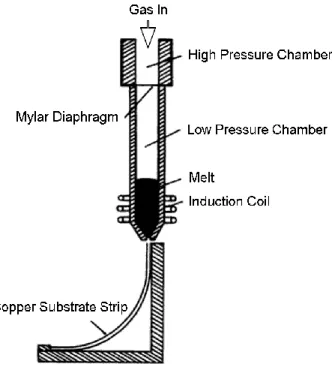
gun and the piston-and-anvil apparatus, as shown in Fig. 1.7 and Fig. 1.8, respectively.
Fig. 1.7 Gun technique of Duwez used for rapid solidification of melts.
In the gun, a high-pressure reservoir of inert gas is built up above a Mylar diaphragm, and when the compressed gas finally ruptures, a shock wave forms and breaks up the small melt drop into minute droplets which are propelled rapidly onto a polished copper substrate strip. It was possible to achieve cooling rates of ~106 K/s. The tiny flakes thus generated are ideal for X-ray diffraction and (as was found a little later) for TEM. In the piston-and-anvil device, later modified into a two-piston variant, a falling melt drop breaks a light beam and this releases a pneumatically operated piston that squashes the falling drop against the anvil piston, between two copper sheets (Fig. 1.8). This generates larger and thicker foils at a cooling rate of ~106 K/s, useful when physical properties such as resistivity are to be measured [29, 69].
from the Soviet Union since then.
Fig. 1.8 Illustration of Piston-and-Anvil apparatus.
In the 1970s [79-81], when Fe-based metallic glasses with improved soft-magnetic properties were discovered, continuous casting or melt spinning methods gained momentum in response to the requirement in commercial adoptions. These techniques facilitated the production of metallic ribbons cast onto a rotating copper wheel, as is shown in Fig. 1.9.
The key development that permitted single-roller melt spinning to become a major industrial production technique was its conversion into the process which has come to be known as ―planar flow casting‖. The Pond-Maddin-Masumoto version [82]
of single-roller melt spinning did not permit wide sheets to be made; the width limit was only a few millimeters. The new process, patented by Narasimhan [81], involves a jet orifice held very close to the rotating wheel so that the resultant melt puddle is physically constrained between the wheel and the lips of the nozzle. With this geometry it is possible to use nozzles in the form of long slits and hence to make wide sheet, more than simply a few centimeters across, of high uniformity in dimensions and properties. Relations between processing parameters and ribbon quality and dimensions have been discussed by some researchers in recent years [83-86], however, only a small fraction of the metallic glasses have so far been commercially deployed mainly due to the difficulty in obtaining good quality in such thin products. For applications in transformer cores, metallic glasses such as Metglas® Alloy 2605SA1 can reduce transformation losses by 70% compared to crystalline iron cores [69].
Fig. 1.10 Schematic illustration of a high-pressure die casting equipment [87].
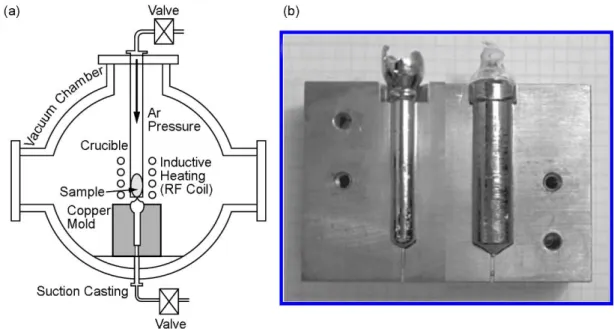
Fig. 1.11 (a) Schematic illustration of copper mold casting, samples are inductively heated and cast by either suction or pressure injection; (b) Copper mold with cast Zr-based bulk metallic glass
samples of diameters 5 and 10 mm [69].
Table 1.3 Rapid solidification techniques in producing metallic glasses.
Year Rapid solidification technique
Cooling
rates Production size Ref.
1960s Gun quenching ~106 K/s Thin foil, ϕ 1~4 cm,
Thickness of up to 50 μm
[69]
↓ Splat quenching ~106 K/s [69]
Year Rapid solidification technique
Cooling
rates Production size Ref.
↓ 15~50 μm thickness
Thickness of 10~40 μm, Width/thickness of 15~55
Mass/length of 0.05~0.24 mg/mm
1976 [79]
Few centimeters width 1979 [81]
1990s Copper mold
casting 10
2
~ K/s Bulk [87]
Apart from these synthesis methods, various processing methods for discovering new bulk metallic glass compositions have also been developed in recent years. The high-temperature centrifugation method [88, 89], for example, can in multicomponent alloys physically isolate deep eutectic compositions, which have a high potential for good glass-forming ability [69].
1.2.2 Rapid solidification of twin roll strip casting technique
The most significant milestone in the rapid solidification processing (RSP) field was the development of the chill block melt spinning technique in the 1970s and several of its variants (a rapid cooling technique that can routinely quench liquid alloys as 10~50 μm thick ribbons at cooling rates of 103
~106 K/s by impinging a melt stream on a spinning copper wheel [90]). The main advantages of the melt-spinning technique are: (1) it will be possible to produce ribbons of uniform cross section, (2) its process parameters have been optimized, and (3) melt spinners are commercially available [2].
increased much by any of the known melt-spinning methods (20~50 μm in common) [2]. In contrast, metallic ribbons or strips produced by twin roll casting technique are casted and hot rolled at the same time and a better surface quality is expected. The concept of continuous casting in a single stage dates back to Bessemer, in 1846, who envisioned using a twin roll technique to cast steel strips [29], but technical realization was more than a century later. A sketch of Bessemer‘s twin roll caster is shown in Fig. 1.12.
Fig. 1.12 Bessemer‘s twin roll caster.
In 1970, after Duwez‘s seminal discoveries, a twin roll casting (TRC) technique for preparing uniform films of metastable phases was taken out by Chen and Miller [93]. And to date, this technique in producing metallic glass ribbons is almost still limited to laboratory scale studies [94-100]. It turns out that TRC is an available process for producing amorphous alloy sheets with a wide range of cooling rates. Nevertheless, most of the studies so far are based on horizontal type twin-roll casters. Studies on TRC technique for produce metallic glasses are list in Table 1.4 [101].
Table 1.4 Papers on the research of TRC of metallic glasses. Year Type Cooling rate
(K/s) Speed (rpm) Ref.
1970 Vertical 105 100~5000 [93]
Year Type Cooling rate (K/s) Speed (rpm) Ref. 2005 Horizontal 102~103 1, 3 [95, 96, 102] 2007 Horizontal --- 0.75 m/s [98] 2010 Horizontal --- 1.7 m/min [100] 2013 Vertical 1~103 --- [99]
The apparatus proposed by Chen and Miller in 1970 is shown in Fig. 1.13. The rollers are 5 cm diam ×5 cm width and held together with pressure p which ranges from 20 to 90 kg. Rotation speed of the rollers can be varied from 100 to 5000 rpm (15.7~785.4 m/min). Amorphous solids could be formed in ribbon or oval shapes (5×50 mm2 with thickness 40~100 μm, 20×20 mm2 with thickness 10 μm). The thickness of the film decreased with increasing rotation speed and pressure on the rollers [93]. Quenching rate of the apparatus is in the order of 105 K/s.
Fig. 1.13 Schematic drawing of the quenching apparatus proposed by Chen and Miller [93].
Assuming the melt has solidified at the time of the exit from the rollers, they evaluated the quenching rate T with the following equation:
T T
v d tT
T t g (1-2)
∆t is the time duration of contact between the melt and the rollers, v is the linear velocity of the roller and d is the distance traveled by the melt during solidification. This apparatus was used for the preparation of uniform specimens of metastable phases for studies of the structure and properties of metastable materials including amorphous and supersaturated alloys [93].
Referring the twin roller device shown in Chen and Miller‘s work, Suzuki designed an apparatus in 1974 and 20 binary oxides were obtained as non-crystalline solid (NCS) for the first time by using their technique [94]. The vertical type caster has two steel rollers with both diameters of 55 mm and 20 mm in width. The foils made by the caster were found have thicknesses of 1~40 μm.
In 1981, Miyazawa and Szekely published a paper on simulation of the twin roll casting technique [103]. A mathematical model was developed to represent the heat and flow phenomena and pressure distribution in the solid phase. In the calculations, property values of aluminum were used. They considered roll spacing, feed rate and angular velocity of the rolls as main variables and got a conclusion that for a given material there exists only a narrow range of these parameters that affords stable operation. It also mentioned that the rapid solidification process has the ability of quenching metals or alloys into microcrystalline or amorphous structure.
casted into amorphous state with casting speed of 3 rpm. Microstructure of the sheet was amorphous matrix with a few polygonal crystalline particles. They got a conclusion that the twin-roll strip casting can be applied for the fabrication of bulk amorphous alloy sheets with a wide range of critical cooling rates [95].
There two papers published in 2007 which were both about twin roll casting of Fe-base glassy alloys [97, 98]. Some of the details are listed in Table 1.5.
Table 1.5 Twin roll casting of Fe-base glassy alloys.
Nack J. Kim group [97] Akihisa Inoue group [98] Caster type Horizontal Horizontal
Roller diameter (mm) 200 Upper : 100 Lower : 400
Roller width (mm) --- 200
Plate size Thickness of 1 mm Width of 70 mm, thickness of 0.5 mm, length of 150 mm
Rotating speed (m/min) 1.9 (3rpm) 45
Roll gap (mm) 1 ---
Materials Fe63B15Zr8Co6Mo7Al1 Fe36Co36B20Si4Nb4
Microstructure
Amorphous structure with some dendritic crystalline phase.
Small crystalline grains dispersed in the glassy matrix. Grain size is evaluated to be 20~100 μm and the crystalline grains were observed mainly in the center of the plate. Crystalline grains α-Fe phase α-Fe phase
Conclusion Possibility of continuously producing glassy plate.
In 2010 Daniel and coworkers fabricated magnesium sheet (Mg60Cu29Gd11) in
through careful selection of the casting speed and with which the exit temperature of the sheet remains within the supercooled liquid region. This conclusion is the same as which is mentioned in reference [95]. This work shows that twin roll sheet casting is a viable process for the production of magnesium-based bulk glassy sheet in a continuous manner and on an industrial scale [100].
A patent about twin roll casting of bulk metallic glasses was published in 2013. It is a vertical type caster and composited in an inert environment. It may produce thin, semi-continuous or continuous sheets of bulk metallic glasses (BMGs) and bulk metallic glass matrix composites (BMGMCs) with thickness between approximately 0.1 mm and 10 mm that are largely, or full, free of oxygen or other contamination caused by environmental casting conditions [99]. As far as the author concerned, despite how many advantages of a rapid solidification technique possesses, when it comes to vacuum, maybe it is no longer suitable for industrial application consider the economic aspect.
1.3 Material selection and process determination
plasticity [105, 106].
1.3.1 Material selection
Magnesium is 36% lighter per unit volume than aluminum and 78% lighter than iron. It is the lightest of all the engineering metals and the third most abundant structural metal following steel, aluminum. When alloyed, magnesium has the highest strength-to-weight ratio of all the structural metals. Due to the ease of recycling, magnesium has received global attention from the standpoint of environmental preservation. More and more weight-saving and energy-saving applications select magnesium as structural and non-structural materials by means of their high specific strength, high damping and good electromagnetic shield abilities. Fig. 1.14 shows some automotive components made from magnesium alloy. Due to their excellent properties of heat dissipation, electromagnetic shielding and ―metal feeling‖ sense comparing with plastics, magnesium alloys are also applied to the 3C market. The products cover computers, communications and consumer electronics such as notebook PCs, mobile phones, mini-disc players, cameras and other handhold devices [107]. Fig. 1.15 shows some applications of magnesium alloy on 3C products. In this work, we adopted magnesium alloys as the object considering the viewpoints stated above.
Fig. 1.15 Magnesium alloys applied to 3C products.
Magnesium is most commonly alloyed with other metals when being used in structural applications. Table 1.6 [108]displays a number of commonly used alloying elements accompanied with their effects upon the resulting metal. (Reference International Magnesium Association: http://intlmag.site-ym.com/?page=design_mag_all_ima)
Table 1.6 General effects of alloying elements on magnesium (I/M: ingot metallurgy). Alloying
element
Melting and casting behavior
Mechanical and technological properties
Corrosion behavior I/M produced
Ag
Improves elevated
temperature tensile and creep properties in the presence of rare earths Detrimental influence on corrosion behavior Al Improves castability, tendency to microporosity; average alloy contains about 2~9 wt.% of aluminum and can be heat treated with > 6 wt.%
Solid solution hardener, precipitation hardening at low temperature (< 393 K); increases hardness, strength and castability while only increasing density
minimally; increased amount of aluminum decreases the ductility of the alloy.
Minor influence
Be
Significantly reduces oxidation of melt surface at very low concentrations (< 30 ppm); lead to coarse
Alloying element
Melting and casting behavior
Mechanical and technological properties
Corrosion behavior I/M produced grains; included only in
very small quantities;
Ca
Effective grain refining effect, slight suppression of oxidation of the molten metal
Improves thermal and mechanical properties as well as assists in grain refinement and creep resistance; allows for better rollability of sheet metal; additions exceeding .3 wt.%, increases the risk of cracking during welding; reduces surface tension.
Detrimental influence on corrosion behavior
Cu
System with easily forming metallic glasses; improves castability;
Assists in increasing both room and high temperature strength; negatively impacts ductility.
Detrimental influence on corrosion behavior, limitation necessary
Fe Magnesium hardly reacts with mild steel crucibles
Detrimental influence on corrosion behavior, limitation necessary
Li
Increases evaporation and burning behavior, melting only in protected and sealed furnaces
Solid solution hardener at ambient temperatures, reduces density, enhances ductility
Decreases corrosion properties strongly, coating to protect from humidity is necessary Mn Control of Fe content by precipitating Fe-Mn compound, refinement of precipitates
Increases creep resistivity; reduces the adverse effects of iron, usually present in .2~4 wt.%
Improves corrosion behavior due to iron control effect; increases saltwater corrosion resistance within some aluminum containing alloys.
Ni System with easily forming metallic glasses
Increases both yield and ultimate strength at room temperature; negatively impacts ductility.
Alloying element
Melting and casting behavior
Mechanical and technological properties
Corrosion behavior I/M produced
Rare earths
Improve castability, reduce microporosity
Solid solution and precipitation hardening at ambient and elevated temperatures; improve elevated temperature tensile and creep properties; allows lower casting porosity and weld cracking in processing.
Improve corrosion behavior
Ce
Increases plastic deformation capability, magnesium elongation, and work hardening rates; reduces yield strength.
Improves corrosion resistance
Y Grain refining effect
Improves elevated
temperature tensile and creep properties
Improve corrosion behavior
Si
Decreases castability, forms stable silicide compounds with many other alloying elements, compatible with Al, Zn and Ag, weak grain refiner; can increase molten alloys‘ fluidity; only used in pressure die casting
Improves elevated temperature properties, especially creep resistance.
Detrimental influence on corrosion behavior
Sr
Used in conjunction with other elements to enhance creep performance
Sn
When used with aluminum it improves ductility, and reduces tendency to crack during processing.
Alloying element
Melting and casting behavior
Mechanical and technological properties
Corrosion behavior I/M produced temperature tensile and creep
properties, improves ductility, most efficient alloying element
behavior
Zn
Second most commonly used alloying metal with magnesium; increase fluidity of the melt, weak grain refiner, tendency to microporosity;
Precipitation hardening, improves strength at ambient temperature, tendency to brittleness and hot shortness unless Zr refined; additions of 2 wt.% or greater tend to be prone to hot cracking
Minor influence, when added to magnesium alloys with nickel and iron impurities, it can improve corrosion
resistance; sufficient Zn
content compensates for the detrimental effect of Cu
Zr
Most effective grain refiner, incompatible with Si, Al, and Mn, removes Fe, Al, and Si from the melt
Improves ambient temperature tensile properties slightly
Rare earth addition can improves creep strength at elevated temperatures. It was reported that adding RE elements can improve the properties of Mg-Al alloys at elevated temperature [109, 110]. Due to the formation of highly thermally stable Al11RE3
and Al2RE intermetallic phases, Mg17Al12 phase is suppressed and AE42 (Mg-4Al-2RE,
wt.%) exhibits major improvement in creep resistance. Jinghuai Zhang investigated the effect of Ce on high-pressure die-cast Mg-4Al-based alloy [109]. It was found that with addition of Ce, the grains of Mg-4Al-0.3Mg alloy are refined and corrosion resistance is improved. Al and Ce/La could form compact corrosion product film during the corrosion of Mg-4Al-4Ce/La-0.4Mn alloy and it exhibits good corrosion resistance [111].
RE in magnesium alloys has the characteristic of so-called ―scavenger effect‖ [112]. Impurity elements could form intermetallic compounds with RE and they are less cathodic. Simultaneously, the formation of β (Mg17Al12) phase is restrained by RE. The
micro-galvanic couples could be depressed which leading to an improvement of corrosion resistance of magnesium alloys. In the investigation of effect of rare earth element Ce and La on corrosion behavior of AM60 [112], it was found that the optimal content of Ce and La was 0.82 wt.% and 0.59 wt.%, respectively.
1.3.2 Process determination
found that GBS can occur at room temperature and its contribution to the total strain was 8% when the tensile test was performed at a strain rate of 10-3 s-1. As a consequence of introducing new deformation mechanisms, fine grained AZ31 alloy was found to exhibit 45% elongation at room temperature. This fact has raised a lot of interest in achieving grain refinement in magnesium alloys through various methods.
Usually grain refinement can be achieved through the addition of alloying elements (e.g., zirconium, calcium, rare earth elements) due to their grain growth restriction effects during solidification process [115-117]. Another grain refinement approach is processing control method including controlling parameters of solidification and consequent thermomechancial processing, such as mechanical and supersonic vibrations
[118-120]
, electromagnetic stirring [121], superheating treatment [122], FeCl3 addition [123],
carbon inoculation [124], severe plastic deformation (SPD) [125-127] andrapid solidification
[128, 129]
. Grain refinement also can be achieved by low temperature rolling process, in which dynamic recrystallization was promoted and grain growth was suppressed.
Sheet metal is one of the fundamental forms in industry and share more than 80% of metals and alloys products [95]. Application of magnesium alloy sheets with competitive cost is considered a real breakthrough of wrought magnesium. However, conventional magnesium sheet rolling process is high cost and low productivity, especially in the final rolling passes. In order to obtain crack-free surface, repeated rolling and reheating are necessary. It results in the fact that less than one percent of magnesium alloys were provided in the form of sheet or strip coil. Developing new forming process for magnesium sheets with excellent properties is expected to lower their cost and extend their applications.
alloys. Twin-roll strip casting process combines casting and hot rolling into a single step, having an advantage of one-step processing of flat rolled products. Magnesium sheet production R&D has been attracted global attention over the past years (CSIRO Australia, ThyssenKrupp Germany, POSCO Korea, Gonda Metal Industry and MITSUBISHI ALUMINUM Japan, Luoyang Copper Group Co. Ltd. and Wenxi Yinguang Magnesium Group Co. Ltd. China, CANMET Energy Technology Centre Canada, etc.). Generally, most of their casting processes are focused at producing strip width in the 500-700 mm, thickness in the 4~10 mm and casting speed at 1~6 m/min range by horizontal type twin roll casting process. For example, in Australia, CSIRO has developed a horizontal twin roll casting technology which is used extensively in the aluminum industry since 2000 [130]. The CSIRO Twin Roll Caster aims to produce as-cast magnesium sheet in commercial quantities using patented CSRIO systems which were specifically developed for handling molten magnesium. It has shown out that their technology is economically efficient and suitable for semi-continuous production of 100~200 kg coils of typically 3 mm thick magnesium sheet. As we mentioned in Section 1.2, the caster in CSRIO was also used for producing Mg-based metallic glasses in 2010 [100].
strengthening can also be utilized in twin-roll strip casting which is a semi-rapid solidification processing [131]. Because the influence of gravity, it shows that the casting speed of vertical type twin roll casting (VTRC) is higher than horizontal-type twin-roll casting (HTRC), and the heat transmission of the former is more effective [132-134]. In this study, twin roll strip casting technique was adopted as the processing method.
1.4 Purpose of this thesis
The term lightweight has been proposed for many years and it is still a hot topic in modern society, magnesium and its alloys as lightweight material are well accepted for many applications in automobile and aerospace industries. However, the applications of Mg alloys are very limited because of the restricted plasticity of Mg (owing to the hexagonal closed-packed crystal structure which possesses few slip systems) and their poor corrosion resistance (do not form a protective oxide film) comparing with other metals [8, 135]. In this work, we focused on developing a new kind of Mg-based alloy with proper mechanical performance and good corrosion resistance. Considering its application, we proposed a cost-competitive method to produce the new material in sheet-form. It is considered as an efficient mass-production technique.
By adopting nanocrystalline [7, 62, 63] or quasicrystalline [106] phases it provides an efficient way to improve the ductility of metallic glass materials and is important for future development of high-strength ductile material. This technique requires the initial synthesizing of amorphous phases, and the complex process brings two close-coupled reactors, i.e., difficult scale-up and high cost.
Recent development of new multicomponent alloys incorporating crystalline particles within an amorphous matrix has also shown a promise for improved plasticity
[105, 136]
. Only the materials with good glass forming abilities were appropriate and the available alloy systems are limited.
Rapid solidification extends the solid solubility limits, allowing the addition of novel alloying elements in larger contents than traditional ingot casting without gross segregation, and these results in a refinement of microstructures and the formation of new or metastable phases which are beneficial to improvement of product performance. Consider the twin roll strip casting process has a relatively high solidification rate ranging from 102 to 103 K/s, this technique is adopted in the current work.
The main target is to propose an effective rapid solidification method with low cost and high productivity to prepare amorphous or amorphous and fine grain mixed materials feasibly and practically. Improved ductility and better corrosion resistance are expected in our materials. The following aspects will be emphasized:
(I) Novel multi-component magnesium-based alloy design
As Tin has the potential of improve creep resistance and ductility of Mg-Al alloy
[137]
As rare earth (RE) element has a characteristic of so-called ―scavenger effect‖ in magnesium alloys [112], impurity elements could form less cathodic intermetallic compounds with RE, in order to improve the corrosion resistance of the product, Lanthanum and Cerium were adopted in our designment.
(II) Casting glassy + crystalline Mg-based alloy sheet by vertical twin roll casting technology
Twin roll casting is a rapid solidification process with high temperature gradient combined with thermal flow and rolling deformation in the casting region. Microstructure of as-cast alloy is sensitive to casting conditions, and it greatly affects the mechanical properties. Vertical twin roll casting of magnesium sheet technology was adopted in this research, since higher casting speed and thinner magnesium sheet can be achieved comparing with conventional horizontal twin roll casting process. Fig. 1.16 shows the cooling path by which a liquid may solidify. The pale yellow zone is an interesting transition region that it is easy to form a dual phase (amorphous and crystalline phase) material and the crystalline phase may have very fine grains. We intend to study this zone by rapid solidification of twin roll strip casting technique.
References
[1] Inoue A, Hashimoto K. Amorphous and nanocrystalline materials: Preparation, properties, and applications [M]. Springer-Verlag Berlin Heidelberg, 2001.
[2] Suryanarayana C, Inoue A. Bulk metallic glasses [M]. CRC Press, 2010. [3] Chen H S. Glassy metals [J]. Reports on Progress in Physics, 1980, 43(4):
353.
[4] Beeler Jr J R. OUTLINE OF DEFECT PROPERTIES COMPUTATIONS [M]. Radiation Effects Computer Experiments. Oxford; Elsevier. 1983: 113-159.
[5] Gleiter H. Nanocrystalline materials [J]. Progress in Materials Science, 1989, 33(4): 223-315.
[6] Gleiter H. On the structure of grain boundaries in metals [J]. Materials Science and Engineering, 1982, 52(2): 91-131.
[7] Gruszka K, Nabiałek M, Błoch K, et al. Analysis of the structure (XRD) and microstructure (TEM, SEM, AFM) of bulk amorphous and nanocrystalline alloys based on FeCoB [J]. International Journal of Materials Research, 2015, 106(7): 689-696.
[8] Xu W, Birbilis N, Sha G, et al. A high-specific-strength and corrosion-resistant magnesium alloy [J]. Nature materials, 2015, 14(12): 1229-1235.
[9] Holzwarth U, Gibson N. The Scherrer equation versus the 'Debye-Scherrer equation' [J]. Nature Nanotechnology, 2011, 6(9): 534. [10] Shechtman D, Blech I, Gratias D, et al. Metallic Phase with Long-Range
Orientational Order and No Translational Symmetry [J]. Physical Review Letters, 1984, 53(20): 1951-1953.
[11] Kelton K F. Quasicrystals: structure and stability [J]. International Materials Reviews, 1993, 38(3): 105-137.
[12] Inoue A, Takeuchi A. Recent progress in bulk glassy, nanoquasicrystalline and nanocrystalline alloys [J]. Materials Science and Engineering: A, 2004, 375-377(Supplement C): 16-30.
[13] Dotera T, Bekku S, Ziherl P. Bronze-mean hexagonal quasicrystal [J]. Nature materials, 2017, 16(10): 987.
Quasicrystal Growth [J]. Physical Review Letters, 2015, 115(7): 075501. [15] Verbin M, Zilberberg O, Lahini Y, et al. Topological pumping over a
photonic Fibonacci quasicrystal [J]. Physical Review B, 2015, 91(6): 064201.
[16] Turnbull D. Under what conditions can a glass be formed? [J]. Contemporary Physics, 1969, 10(5): 473-488.
[17] Uhlmann D R. Glass formation [J]. Journal of Non-Crystalline Solids, 1977, 25(1–3): 42-85.
[18] Suryanarayana C. Metallic glasses [J]. Bulletin of Materials Science, 1984, 6(3): 579-594.
[19] Greer A L. Metallic glasses…on the threshold [J]. Materials Today, 2009, 12(1): 14-22.
[20] Gleiter H. Nanocrystalline Materials [M]//BUNK W G J. Advanced Structural and Functional Materials: Proceedings of an International Seminar Organized by Deutsche Forschungsanstalt für Luft- und Raumfahrt (DLR), Köln, June 1991. Berlin, Heidelberg; Springer Berlin Heidelberg. 1991: 1-37.
[21] Meyers M A, Mishra A, Benson D J. Mechanical properties of nanocrystalline materials [J]. Progress in Materials Science, 2006, 51(4): 427-556.
[22] Clarke J B, Hastie J W, Kihlborg L H E, et al. Definitions of terms relating to phase transitions of the solid state (IUPAC Recommendations 1994) [M]. Pure and Applied Chemistry. 1994: 577.
[23] Greer A L, Ma E. Bulk Metallic Glasses: At the Cutting Edge of Metals Research [J]. MRS Bulletin, 2007, 32(08): 611-619.
[24] Susanne S. Bulk metallic glasses [J]. Journal of Physics: Condensed Matter, 2001, 13(34): 7723.
[25] Arata E R. High-temperature, ultrahigh-gravity centrifugal processing of metallic melts [D]; Citeseer, 2008.
[26] JUN. W K, Willens R H, Duwez P. Non-crystalline Structure in Solidified Gold-Silicon Alloys [J]. Nature, 1960, 187(4740): 869-870.
[27] Busch R. The thermophysical properties of bulk metallic glass-forming liquids [J]. JOM, 2000, 52(7): 39-42.
[28] Inoue A. Stabilization of metallic supercooled liquid and bulk amorphous alloys [J]. Acta Materialia, 2000, 48(1): 279-306.
nonequilibrium processing and its future [J]. Materials Science and Engineering: A, 2001, 304–306(1): 11-19.
[30] Wang W H, Dong C, Shek C H. Bulk metallic glasses [J]. Materials Science and Engineering: R: Reports, 2004, 44(2–3): 45-89.
[31] Miracle D B. The efficient cluster packing model – An atomic structural model for metallic glasses [J]. Acta Materialia, 2006, 54(16): 4317-4336. [32] Li Y, Poon S J, Shiflet G J, et al. Formation of Bulk Metallic Glasses and
Their Composites [J]. MRS Bulletin, 2007, 32(08): 624-628.
[33] Schroers J. Processing of Bulk Metallic Glass [J]. Advanced Materials, 2010, 22(14): 1566-1597.
[34] Aqida S N, Shah L H, Naher S, et al. Rapid Solidification Processing and Bulk Metallic Glass Casting [M]//BATALHA G F, TYNE C J V, YILBAS B. Comprehensive Materials Processing. Oxford; Elsevier. 2014: 69-88. [35] Davies H A. Chapter 2 - Metallic glass formation [M]//LUBORSKY F E.
Amorphous Metallic Alloys. Butterworth-Heinemann. 1983: 8-25.
[36] Duwez P. Metallic glasses-historical background [M]//GÜNTHERODT H-J, BECK H. Glassy Metals I: Ionic Structure, Electronic Transport, and Crystallization. Berlin, Heidelberg; Springer Berlin Heidelberg. 1981: 19-23.
[37] Cohen M H, Turnbull D. Composition Requirements for Glass Formation in Metallic and Ionic Systems [J]. Nature, 1961, 189(4759): 131-132. [38] Duwez P, Willens R H, Crewdson R C. Amorphous Phase in
Palladium—Silicon Alloys [J]. Journal of Applied Physics, 1965, 36(7): 2267-2269.
[39] Chen H S, Turnbull D. Evidence of a Glass–Liquid Transition in a Gold–Germanium–Silicon Alloy [J]. The Journal of Chemical Physics, 1968, 48(6): 2560-2571.
[40] Chen H S, Turnbull D. Formation, stability and structure of palladium-silicon based alloy glasses [J]. Acta Metallurgica, 1969, 17(8): 1021-1031.
[41] Angell C A. Formation of glasses from liquids and biopolymers [J]. Science, 1995, 267(5206): 1924-1935.
[42] Mader S, Nowick A S. METASTABLE Co–Au ALLOYS: EXAMPLE OF AN AMORPHOUS FERROMAGNET [J]. Applied Physics Letters, 1965, 7(3): 57-59.
Phosphorus Alloys [J]. Journal of Applied Physics, 1967, 38(10): 4096-4097.
[44] Chen H S. Thermodynamic considerations on the formation and stability of metallic glasses [J]. Acta Metallurgica, 1974, 22(12): 1505-1511.
[45] Johnson W L. Bulk Glass-Forming Metallic Alloys: Science and Technology [J]. MRS Bulletin, 1999, 24(10): 42-56.
[46] Drehman A J, Greer A L, Turnbull D. Bulk formation of a metallic glass: Pd40Ni40P20 [J]. Applied Physics Letters, 1982, 41(8): 716-717.
[47] Kui H W, Greer A L, Turnbull D. Formation of bulk metallic glass by fluxing [J]. Applied Physics Letters, 1984, 45(6): 615-616.
[48] Inoue A, Zhang T, Masumoto T. Glass-forming ability of alloys [J]. Journal of Non-Crystalline Solids, 1993, 156-158(Part 2): 473-480.
[49] Inoue A, Takeuchi A. Recent progress in bulk glassy alloys [J]. Materials Transactions, 2002, 43(8): 1892-1906.
[50] Inoue A, Kita K, Zhang T, et al. An Amorphous La55Al25Ni20 Alloy Prepared by Water Quenching [J]. Materials Transactions, JIM, 1989, 30(9): 722-725.
[51] Peker A, Johnson W L. A highly processable metallic glass: Zr41.2Ti13.8Cu12.5Ni10.0Be22.5 [J]. Applied Physics Letters, 1993, 63(17): 2342-2344.
[52] Lin X H, Johnson W L. Formation of Ti–Zr–Cu–Ni bulk metallic glasses [J]. Journal of Applied Physics, 1995, 78(11): 6514-6519.
[53] Jörg F L. Bulk metallic glasses [J]. Intermetallics, 2003, 11(6): 529-540. [54] JIANG Q, XU X, NIU H, et al. Packing Densities and Glass Forming Ability
of Alloys [J]. J Mater Sci Technol, 1996, 12(4): 299-302.
[55] Johnson W L. Bulk metallic glasses — a new engineering material [J]. Current Opinion in Solid State and Materials Science, 1996, 1(3): 383-386.
[56] Huang L, Pu C, Fisher R K, et al. A Zr-based bulk metallic glass for future stent applications: Materials properties, finite element modeling, and in vitro human vascular cell response [J]. Acta Biomaterialia, 2015, 25(C): 356-368.
Palladium‐Base Alloys [J]. Journal of Applied Physics, 1966, 37(1): 435-435.
[59] Inoue A, Kato A, Zhang T, et al. Mg-Cu-Y Amorphous Alloys with High Mechanical Strengths Produced by a Metallic Mold Casting Method [J]. Materials Transactions, JIM, 1991, 32(7): 609-616.
[60] Inoue A. Bulk amorphous and nanocrystalline alloys with high functional properties [J]. Materials Science and Engineering: A, 2001, 304-306(1): 1-10.
[61] Lu K, Wang J T, Wei W D. A new method for synthesizing nanocrystalline alloys [J]. Journal of Applied Physics, 1991, 69(1): 522-524.
[62] Fan C, Takeuchi A, Inoue A. Preparation and Mechanical Properties of Zr-based Bulk Nanocrystalline Alloys Containing Compound and Amorphous Phases [J]. Materials Transactions, JIM, 1999, 40(1): 42-51. [63] Wu G, Chan K-C, Zhu L, et al. Dual-phase nanostructuring as a route to
high-strength magnesium alloys [J]. Nature, 2017, 545(7652): 80-83. [64] Zhu L, Ruan H, Li X, et al. Modeling grain size dependent optimal twin
spacing for achieving ultimate high strength and related high ductility in nanotwinned metals [J]. Acta Materialia, 2011, 59(14): 5544-5557.
[65] Lu L, Chen X, Huang X, et al. Revealing the Maximum Strength in Nanotwinned Copper [J]. Science, 2009, 323(5914): 607-610.
[66] Wang W H. Correlations between elastic moduli and properties in bulk metallic glasses [J]. Journal of Applied Physics, 2006, 99(9): 093506. [67] Schiøtz J, Jacobsen K W. A Maximum in the Strength of Nanocrystalline
Copper [J]. Science, 2003, 301(5638): 1357-1359.
[68] Kou H, Lu J, Li Y. High‐Strength and High‐Ductility Nanostructured and Amorphous Metallic Materials [J]. Advanced Materials, 2014, 26(31): 5518-5524.
[69] Andreas A K, Jörg F L, Florian H D T. Rapid Solidification and Bulk Metallic Glasses - Processing and Properties [M]. Materials Processing Handbook. CRC Press. 2007: 17.11-17.44.
[70] Löffler J F. Recent progress in the area of bulk metallic glasses [J]. Zeitschrift für Metallkunde, 2006, 97(3): 225-233.
[71] Schwarz R B, Johnson W L. Formation of an Amorphous Alloy by Solid-State Reaction of the Pure Polycrystalline Metals [J]. Physical Review Letters, 1983, 51(5): 415-418.
Science, 1984, 28(3): 229-434.
[73] Ponyatovsky E G, Barkalov O I. Pressure—induced amorphous phases [J]. Materials Science Reports, 1992, 8(4): 147-191.
[74] Schultz L, Eckert J. Mechanically alloyed glassy metals [M]. Glassy Metals III: Amorphization Techniques, Catalysis, Electronic and Ionic Structure. Berlin, Heidelberg; Springer Berlin Heidelberg. 1994: 69-120. [75] Valiev R Z, Islamgaliev R K, Alexandrov I V. Bulk nanostructured
materials from severe plastic deformation [J]. Progress in Materials Science, 2000, 45(2): 103-189.
[76] Duwez P, Willens R H, Klement W. Continuous Series of Metastable Solid Solutions in Silver‐Copper Alloys [J]. Journal of Applied Physics, 1960, 31(6): 1136-1137.
[77] Duwez P, Willens R H, Jr. W K. Metastable Electron Compound in Ag‐ Ge Alloys [J]. Journal of Applied Physics, 1960, 31(6): 1137-1137.
[78] Anantharaman T R, Suryanarayana C. Review: A decade of quenching from the melt [J]. Journal of Materials Science, 1971, 6(8): 1111-1135. [79] Liebermann H, Graham C. Production of amorphous alloy ribbons and
effects of apparatus parameters on ribbon dimensions [J]. IEEE Transactions on Magnetics, 1976, 12(6): 921-923.
[80] Sheldon K. Method of forming metallic filament cast on interior surface of inclined annular quench roll [M]. Google Patents. 1975.
[81] Narasimhan M C. Continuous casting method for metallic strips [M]. U.S. Patent 4,142,571. 1979.
[82] Masumoto T, Maddin R. The mechanical properties of palladium 20 a/o silicon alloy quenched from the liquid state [J]. Acta Metallurgica, 1971, 19(7): 725-741.
[83] Huang S C, Fiedler H C. Amorphous ribbon formatin and the effects of casting velocity [J]. Materials Science and Engineering, 1981, 51(1): 39-46.
[84] Carpenter J, Steen P. Planar-flow spin-casting of molten metals: process behaviour [J]. Journal of materials science, 1992, 27(1): 215-225.
[85] Wilde P D, Matthys E F. Experimental investigation of the planar flow casting process: development and free surface characteristics of the solidification puddle [J]. Materials Science and Engineering: A, 1992, 150(2): 237-247.
Fe71Si13.5B9Nb3Cu1Al1.5Ge1 Ribbons [J]. Journal of Materials Engineering and Performance, 2013, 22(8): 2185-2190.
[87] Inoue A, Nakamura T, Sugita T, et al. Bulky La-Al-TM (TM=Transition Metal) Amorphous Alloys with High Tensile Strength Produced by a High-Pressure Die Casting Method [J]. Materials Transactions, JIM, 1993, 34(4): 351-358.
[88] Löffler J F, Bossuyt S, Peker A, et al. Eutectic isolation in Mg-Al-Cu-Li(-Y) alloys by centrifugal processing [J]. Philosophical Magazine, 2003, 83(24): 2797-2813.
[89] Löffler J F, Johnson W L. Crystallization of Mg–Al and Al-based metallic liquids under ultra-high gravity [J]. Intermetallics, 2002, 10(11): 1167-1175.
[90] Chen M. A brief overview of bulk metallic glasses [J]. NPG Asia Mater, 2011, 3(9): 82-90.
[91] Praisner T J, Chen J S, Tseng A A. An experimental study of process behavior in planar flow melt spinning [J]. Metallurgical and materials transactions B, 1995, 26(1): 1199-1208.
[92] Frommeyer G, Frech W. Continuous casting and rapid solidification of wires produced by a newly developed shape flow casting technique [J]. Materials Science and Engineering: A, 1997, 226-228(Supplement C): 1019-1024.
[93] Chen H S, Miller C E. A Rapid Quenching Technique for the Preparation of Thin Uniform Films of Amorphous Solids [J]. Review of Scientific Instruments, 1970, 41(8): 1237-1238.
[94] Suzuki T, Anthony A-M. Rapid quenching on the binary systems of high temperature oxides [J]. Materials Research Bulletin, 1974, 9(6): 745-753. [95] Lee J G, Park S S, Lee S B, et al. Sheet fabrication of bulk amorphous alloys by twin-roll strip casting [J]. Scripta Materialia, 2005, 53(6): 693-697.
[96] Lee J G, Lee H, Oh Y S, et al. Continuous fabrication of bulk amorphous alloy sheets by twin-roll strip casting [J]. Intermetallics, 2006, 14(8–9): 987-993.
[97] Oh Y S, Lee H, Lee J G, et al. Twin-Roll Strip Casting of Iron-Base Amorphous Alloys [J]. MATERIALS TRANSACTIONS, 2007, 48(7): 1584-1588.
![Fig. 1.4 X-ray diffraction patterns and electronograms of four alloys studied by K. Gruszka, before annealing process [7] .](https://thumb-ap.123doks.com/thumbv2/123deta/10124486.1958456/18.893.185.713.739.1064/diffraction-patterns-electronograms-alloys-studied-gruszka-annealing-process.webp)
![Fig. 1.5 X-ray diffraction patterns and electronograms of four alloys studied by K. Gruszka, after annealing process [7] .](https://thumb-ap.123doks.com/thumbv2/123deta/10124486.1958456/19.893.149.749.154.567/diffraction-patterns-electronograms-alloys-studied-gruszka-annealing-process.webp)

![Table 2.3 Atomic radii [18] of some common elements used in Mg alloys.](https://thumb-ap.123doks.com/thumbv2/123deta/10124486.1958456/74.893.127.753.425.655/table-atomic-radii-common-elements-used-mg-alloys.webp)