
図 1.2: 脂質二重膜の模式図。水-炭化水素鎖の境界面は、ほとんどすべての炭化水 素鎖が水に接触する面である。内外の境界面のほぼ中間には脂質二重膜の中立面が ある。 が存在するときを考える。N 個の脂質分子の自由エネルギーは、誘引的な疎水性 (hydrophobic) 相互作用と、反発的な親水性 (hydrophilic) 相互作用、反発的な炭化水 素鎖の立体 (steric) 相互作用に対応する自由エネルギーの和として表すことができる [20]。
F = fpho(a) + fphi(a) + fste(a). (1.2)
これら3つの相互作用は、頭部-炭化水素鎖の境界面における分子あたりの局所面積
a に依存する。この自由エネルギーのうち疎水的な部分は、
fpho(a) = γ(a− ap) (1.3)
としてモデル化することができる [2, 21]。ここで、ap は分子あたりの頭部における
排除領域の面積である。γ ≈ 35 erg/cm2 程度1 が水-炭化水素鎖界面の自由エネルギー
密度の典型である [2, 21]。一方、残る 2 つの反発的な部分は、
fphi(a) + fste(a) ∼= C/a (1.4)
のように合わせて表すことができ、一般に C ≈ 1.2 × 10⁻¹³erg/nm2 程度である [2]。
全体として、分子あたりの境界面の自由エネルギーは
f (a) ∼= γ(a− ap) + C/a (1.5)
なる形状は、面積を固定し、体積と自発曲率の関数とすることで系統的に調べられ た [28, 29]。その結果、観察される幅広い形状によく一致する形状が、それらのパラ メータを変えることで得られることが示された。 2つの脂質層それぞれの面積が保存された膜の形状も連続体モデルを用いて調べ られている。脂質層はか い乖離することがなく、側方の滑りが許される状況を考えていり る。この脂質層の間の面積差 ∆A に応じた保存力も考慮したモデルとして、面積差 弾性(ADE)モデル [30, 31, 21, 32] が提案された。このエネルギーは、 EADE= Eb+ ¯ κ 2 π
存在する膜の部分が、変形によって移動した先の位置を相対的に表している。この 変位ベクトルは、動径方向ベクトル ˆr に加えて、2つの角度方向のベクトル θ, ψ を 用いて、
3
モデルとシミュレーション技法
粒子を含んだベシクルの解析のために、図 3.1 のような2つのモデルを構築した。一 方は変形を制限した球状ベシクル(剛体球殻)を含む rigid spherical shell and particles (RSSP) モデルであり、他方は変形する流動膜ベシクルを含む triangular lattice adnd particles (TLP) モデルである。ここではそれぞれのモデルを説明する。 図 3.1: 2 つのモデルの模式図。(a) RSSP モデルは、半径と厚みが R と σ それぞれで ある剛体球殻内部に直径 σp の Np 粒子を含んだモデルである。(b) TLP モデルは、 それぞれが直径 σ の Nv 格子点で構成される流動膜ベシクル内部に直径 σp の Np 粒 子を含んだモデルである。
3.1
剛体球殻と内部粒子のモデル
剛体球殻は曲げ弾性係数 κ → ∞ のベシクルに対応している。膜の面積が一定な らば、ベシクルの形状は球である。直径 σp の Np 粒子が半径 Rshell、 厚み σ の球殻 に封入されている。 このモデルの全エネルギーは壁ポテンシャルエネルギー EW と粒子の反発ポテン シャルエネルギー ER である。 ERSSP= EW+ ER. (3.1) 球殻の中心を O とすると、i 番目の粒子の壁ポテンシャルエネルギーは、 VW(Pi) = 0 for ||Pi− O|| < Rshell−
繋留長の制限のためのポテンシャルエネルギーは、 ET = 1 2 Nv ∑ i=1 ∑ j(i) VT(ℓij), (3.9) VT(ℓij) = { 0 , if ℓij < ℓmax, ∞, otherwise , (3.10) ℓmax/σ ≤ √ 3 (3.11) である。ここで j(i) は i 番目の頂点の周りにある頂点を意味する。 脂質二重膜の曲げ弾性エネルギー Eb は、曲率の高次の項を無視して、 Eb = ∫ A dA [ κ 2(H− C0) 2 + κGK ] (3.12) である。トポロジーが変化しない場合、第二項の積分値は一定である。そして自発 曲率 C0 = 0 であるときを考えると、三角格子膜の曲げ弾性エネルギーは、 EB = κ 2 Nv ∑ i=1 Hi2bi. (3.13) と単純化して表すことができる。ここで Hi と biはそれぞれ i 番目の頂点周りの平 均曲率と小面積であり、 Hi = 1 bi ni· ∑ j(i) mij lij (Ri− Rj) (3.14) bi = 1 4 ∑ j(i) mijlij. (3.15) で与えられる。ni は i 番目の頂点の頂点法線であり、mij は繋留 (i, j) に交差するよ うなボロノイ辺の長さで mij = ℓij 2[cot(θij) + cot(ιij)] (3.16) と定められている (図 1.5)。 2つの脂質層の面積の差を意味する ∆A、その最適な量 ∆A0 に対応する面積差弾 性エネルギーは、 EADE= ¯ κ 2 π
である。この式は、無次元化した面積差 ∆a =∑Hibi/(8πRA) を導入することで、膜
の厚み ζ を消去することができる。ここで RA =
√
A/(4π) である。∆a を用いてエ
ネルギー (式 3.17) を、
EADE= 8π2¯κ(∆a− ∆a0)2 (3.19)
釣り合いの条件 (3.27) に従って状態をサンプリングする手法が提案されている [95]。 この手法では、ある状態 µ を基準に、次の状態の候補 ν をある提案分布に従って発 生させた候補の分布と、その候補から同様に生成される候補の分布は異なる。その ため、釣り合いの条件 (3.27) を満たすように候補を生成するための工夫が必要であ る [96]。 メトロポリス法では釣り合いの条件 (3.27) よりも厳しい制約、 Pµ(t)W (µ→ ν) = Pν(t)W (ν→ µ) (3.28) を課して遷移確率を定める。これは詳細釣り合いの条件として知られる。この条件 を課すことにより、状態のサンプリング(シミュレーション)を単純な手順で行う ことができる。 メトロポリス法の採択確率 正準分布 (3.22) に従うように状態を発生させるため、 Pµ Pν = W (ν → µ) W (µ→ ν)= e −β(Eµ−Eν) (3.29) の比を満たすように、 W (ν → µ) = 1 for Pµ ≥ Pν, (3.30) W (ν → µ) = Pµ/Pν for Pµ< Pν (3.31) として候補の状態を採用する。これは詳細釣り合いを満たしている。 三角格子膜のメトロポリス法では、状態 ν からランダムな格子点の位置を一定範 囲内でランダムに移動させることで新しい状態 µ を発生し、採択確率
Paccept(ν → µ) = min{1, exp[−β(Eµ− Eν)]} (3.32)
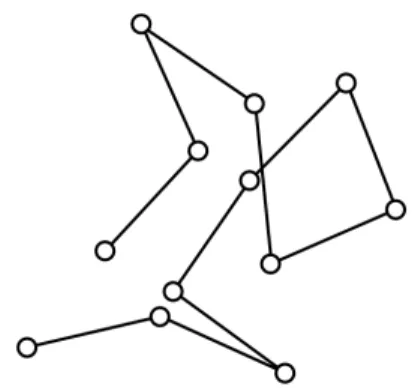
で次時刻の状態とする。 3.3.2 近接粒子登録法 流体膜の自己排除エネルギーを計算するとき、頂点数を N とすると頂点の全ペア の計算であるから計算量は O(N2) になる。しかし、頂点の排除体積領域は小さいた め、頂点 i についての自己排除エネルギーの計算は、頂点 i に近い頂点のみを対象 に行えば十分である。そのため、短距離相互作用を考慮する場合によく用いられる ベルレの近接リスト(Verlet neighbor list, VNL)法 [90] を用いる。
VNL は各頂点(もしくは各粒子)に対して作られ、定期的に更新される。VNL を 作成するために、相互作用のカットオフ半径 rc とは別に、SKIN と呼ばれる領域を
0.0e+00 5.0e+04 1.0e+05 1.5e+05 2.0e+05 2.5e+05 3.0e+05 3.5e+05 5 10 15 20 1/< ulm > l Model 図 4.1: n = 6, Np = 100 の条件で得られるデータと回帰曲線 (Model) 1/⟨ulm(l)⟩ =
κeff(l + 2)(l− 1)[l(l + 1) + Q], Q = γeffr20/κeff. この回帰曲線は l = [2 : 8] の区間のデー
タから得た。 計算ステップ t における、基準の球からの格子点 i の変位は、 ui(t) = [∥ri(t)∥ − r0]/r0 (4.6) のように表せる。そして、各モードの振幅は ulm(t) = 1 r0 Nv ∑ i=1 ui(t)Ylm∗ (Ω)dA (4.7) と求めることができる。ここで Ylm∗ は Ylm と複素共役な球面調和関数を意味する。 各モードについて振幅を算出し、 ⟨ulm(Ω)2⟩t = kBT κeff 1 (l + 2)(l− 1)[l(l + 1) + γeffr20/κeff] (4.8) に基づいて Levenberg-Marquardt 法 [100, 101] を用いた回帰解析を行い、実効的曲げ 弾性係数 κeff と 実効的表面張力 γeff を推定した (図 4.1)。具体的には、モデルを 1 ⟨ulm⟩ = κeff(l + 2)(l− 1)[l(l + 1) + Q] (4.9)
図 5.1: ∆µ− ∆a0 に対するベシクルの状態図(κ = ¯κ = 10 kBT )。(a) ∆µ を 0 から増
加させて得られる状態図。(b) ∆µ を減少させて得られる状態図。(c) もっともエネ ルギーの低い状態をもとに作成した状態図。丸の色と形状の対応は図 5.2 に示した。
図 5.7: n と Np を固定し、∆µ を段階的に増加させることで作成した状態図。それぞ
6.3
コロイド粒子内包ベシクルの膜の弾性係数
膜の揺らぎから推定した実効的曲げ弾性係数 κeff が κ よりも小さいことを示し た。この軟化は、すでに理論的に揺らぎのモード間の相互作用により説明されてい る [103, 104, 105]。そして類似したシミュレーション結果も報告されている [20]。球 面調和関数展開を用いた解析では、各モードにエネルギーが等分配されると仮定し ていたが、実際には l の大きなモードには分配されにくい。そのために、推定した 実効的曲げ弾性係数は設定した弾性係数よりも小さい。 2 つの Np の区間 [1 : 100] と [100 : 210] に分けて、Np の 1 次関数として κeff を解析 した結果から、[1 : 100] の区間では n とほぼ独立に κeff が決まることが示唆された。 一方 [100 : 210] の区間では、長距離斥力の条件 (n = 1, 2) では傾きが大きく、短距離 斥力の条件 (n = 6, 12) では傾きが非常に小さい。n に依存した κeff の増加が生じる 条件は、ある程度粒子数が大きい条件に限定されることが分かる。さらに、短距離 斥力(n = 6, 12)をもつ粒子の p0 m の位置や高さは Np > 100 の範囲でほぼ変化しな いこととから、膜の揺らぎを粒子が抑える効果のほとんどは、膜の近傍の粒子によ り決まることが示唆された。 実効的表面張力 γeff も同様に 2 つの区間に分けて解析を行った。こちらも [1 : 100] の範囲では n に依存した違いは見られない。一方、[100 : 210] の範囲では、長距離斥 力の条件 n = 1, 2 では傾きが小さく、短距離斥力の条件 n = 6, 12 では傾きが大き い。2つの硬さ κeff と γeff の結果を合わせると、長距離斥力を持つ粒子は比較的 κeff参考文献
[1] E. Sezgin, I. Levental, S. Mayor, and C. Eggeling. The mystery of membrane orga-nization: composition, regulation and roles of lipid rafts. Nature Reviews Molecular
cell biology, Vol. 18, No. 6, p. 361, 2017.
[2] J. N. Israelachvili, D. J. Michell, and B. W. Ninham. Theory of self-assembly of lipid bilayers and vesicles. Biochimica et Biophysica Acta, Vol. 470, pp. 185–201, 1977.
[3] L. S. King, D. Kozono, and P. Agre. From structure to disease: the evolving tale of aquaporin biology. Nature Reviews Molecular Cell Biology, Vol. 5, No. 9, pp. 687–698, 2004.
[4] J. E. Rothman and E. A. Dawidowicz. Asynnetric exchange of vesicle phospho-lipids catalyzed by the phosphatidylcholine exchange protein. measurment of inside ―outside transitions. Biochimica et Biophysica Acta, Vol. 14, No. 13, pp. 2809– 2816, 1977.
[5] R. C. Crain and D. B. Zilversmit. Two nonspecific phospholipid exchange proteins from beef liver. 2. use in studying the asymmetry and transbilayer movement of phosphatidylcholine, phosphatidylethanolamine, and sphingomyelin in intact rat erythrocytes. Biochemistry, Vol. 19, pp. 1440–1447, 1980.
[6] H. C. Berg, 訳 (寺本英, 佐藤俊輔). 生物学におけるランダムウォーク. 法政大学 出版局, 1989.
[7] Z. Korade and A. K. Kenworthy. Lipid rafts, cholesterol, and the brain.
Neurophar-macology, Vol. 55, No. 8, pp. 1265–1273, 2008.
[8] H. J. Risselada and S. J. Marrink. The molecular face of lipid rafts in model membranes. Proceedings of the National Academy of Sciences, Vol. 105, No. 45, pp. 17367–17372, 2008.
[9] D. Sadava, D. M. Hillis, and H. C. Heller. Life: The Science of Biology. Sinauer Associates, Inc, 10th edition, 2014.
[11] J. P. Ferris. Montmorillonite-catalysed formation of RNA oligomers: the possible role of catalysis in the origins of life. Philosophical Transactions of the Royal Society
B, Vol. 361, pp. 1777–1786, 2006.
[12] M. M. Hanczync, S. M. Fujikawa, and J. W. Szostak. Experimental models of primitive cellular compartments: Encapsulation, growth, and division. Science, Vol. 302, pp. 618–622, 2003.
[13] S. Lonchin, P. L. Luisi, P. Walde, and B. H. Robinson. A matrix effect in mixed phospholipid/fatty acid vesicle formation. The Journal of Physical Chemistry B, Vol. 103, pp. 10910–10916, 1999.
[14] T. F. Zhu and J. W. Szostak. Coupled growth and division of model protocell membranes. Journal of the American Chemical Society, Vol. 131, pp. 5705–5713, 2009.
[15] C. D. Keating. Aqueous phase separation as a possible route to compartmentaliza-tion of biological molecules. Accounts of Chemical Research, Vol. 45, pp. 2114–2124, 2012.
[16] H. Terasawa, K. Nishimura, H. Suzuki, T. Matsuura, and T. Yomo. Coupling of the fusion and budding of giant phospholipid vesicles containing macromolecules.
Proceedings of the National Academy of Sciences, Vol. 109, No. 16, pp. 5942–4947,
2012.
[17] K. Kurihara, M. Tamura, K. Shohda, T. Toyota, K. Suzuki, and T. Sugawara. Self-reproduction of supramolecular giant vesicles combined with the amplification of encapsulated DNA. Nature Chemistry, Vol. 3, pp. 775–781, 2011.
[18] I. A. Chen, R. W. Roberts, and J. W. Szostak. The emergence of competition between model protocells. Science, Vol. 305, pp. 1474–1476, 2004.
[19] 秋吉一成, 辻井薫. リポソーム応用の新展開: 人口細胞の開発に向けて. エヌ・ ティー・エス, 2005.
[20] D. R. Nelson, T. Piran, and S. Weinberg. Statistical Mechanics of Membranes and
Surfaces. World Scientific, second edition, 2004.
[21] L. Miao. Equilibrium Shapes and Shape Transitions of Fluid Lipid-Bilayer Vesicles. PhD thesis, Simon Fraser University, 1992.
[23] J. A. Coleman, M. C. M. Kwok, and R. S. Molday. Localization, purification, and functional reconstitution of the P4-ATPase Atp8a2, a phosphatidylserine flippase in photoreceptor disc membranes. Journal of Biological Chemistry, Vol. 284, No. 47, pp. 32670–32679, 2009.
[24] A. Sakashita, N. Urakami, P. Ziheri, and M. Imai. Three-dimensional analysis of lipid vesicle transformations. Soft Matter, Vol. 8, pp. 8569–8581, 2012.
[25] P. B. Canham. The minimum energy of bending as a possible explanation of the biconcave shape of the human red blood cell. Journal of Theoretical Biology, Vol. 26, pp. 61–81, 1970.
[26] W. Helfrich. Elastic properties of lipid bilayers: Theory and possible experiments.
Zeischrift f¨ur Naturforschung, Vol. 28c, pp. 693–703, 1973.
[27] E. A. Evans. Bending resistance and chemically induced moments in membrane bilayers. Biophysical Journal, Vol. 14, pp. 923–931, 1974.
[28] H. J. Deuling and W. Helfrich. Red blood cell shapes as explained on the basis of curvature elasticity. Biophysical Journal, Vol. 16, pp. 861–868, 1976.
[29] H. Deuling and W. Helfrich. The curvature elasticity of fluid membranes: A cata-logue of vesicle shapese. Journal de Physique, Vol. 37, pp. 1335–1345, 1976.
[30] S. Svetina, A. Ottova-Leitemannov´a, and R. Glaser. Membrane bending energy in relation to bilayer couples concept of red blood cell shape transformations. Journal
of Theoretical Biology, Vol. 94, pp. 13–23, 1982.
[31] S. Svetina and B. ˇZekˇs. Bilayer couple hypothesis of red cell shape transformations and osmotic hemolysis. Biomedica Biochimica Acta, Vol. 42, pp. 86–90, 1983. [32] L. Miao, B. Fourcade, M. Rao, M. Wortis, and R. K. P. Zia. Equilibrium budding
and vesiculation in the curvature model of fluid lipid vesicles. Physical Review A, Vol. 43, No. 12, pp. 6843–6856, 1991.
[33] S. Svetina and B. ˇZekˇs. Membrane bending energy and shape determination of phospholipid vesicles and red blood cells. European Biophysics Journal, Vol. 17, pp. 101–111, 1989.
[35] U. Seifert, K. Berndl, and R. Lipowsky. Shape transformations of vesicles: Phase diagram for spontaneous-curvature and bilayer-coupling models. Physical Review
A, Vol. 44, No. 2, pp. 1182–1202, 1991.
[36] H. W. G. Lim, M. Wortis, and R. Mukhopadhyay. Stomatocyte-discocyte-echinocyte sequence of the human red blood cell: Evidence for the bilayer-couple hypothe-sis from membrane mechanics. Proceedings of the National Academy of Sciences, Vol. 99, No. 26, pp. 16766–16769, 2002.
[37] Y. Kantor, M. Kardar, and D. R. Nelson. Statistical mechanics of tethered surface.
Physical Review Letters, Vol. 57, No. 7, pp. 791–794, 1986.
[38] Y. Kantor, M. Kardar, and D. R. Nelson. Tethered surfaces: Statics and dynamics.
Physical Review A, Vol. 35, pp. 3056–3071, 1987.
[39] Y. Kantor and D. R. Nelson. Phase transitions in flexible polymeric surfaces.
Phys-ical Review A, Vol. 36, pp. 4020–4032, 1987.
[40] Y. Kantor and D. R. Nelson. Crumpling transition in polymerized membranes.
Physical Review Letters, Vol. 58, No. 26, pp. 2774–2777, 1987.
[41] D. R. Nelson and L. Peliti. Fluctuations in membranes with crystalline and hexatic order. Journal de Physique, Vol. 48, pp. 1085–1092, 1987.
[42] H. S. Seung and D. R. Nelson. Defects in flexible membranes with crystalline order.
Physical Review A, Vol. 38, No. 2, pp. 1005–1018, 1988.
[43] G. Gompper and D. M. Kroll. Random surface discretizations and the renormaliza-tion of the bending rigidity. Journal de Physique I France, Vol. 6, pp. 1305–1320, 1996.
[44] C. Itzykson. Random geometry, lattices and fields. In XVI GIFT International
Seminar on Theoretical Physics: New Perspectives in Quantum Field Theory Jaca (Huesca), Spain, June 3-8, 1985, pp. 130–188, 1985.
[45] J.-S. Ho and A. Baumg¨artner. Simulations of fluid self-avoiding membranes.
Euro-physics Letters, Vol. 12, No. 4, pp. 295–300, 1990.
[46] J.-S. Ho and A. Baumg¨artner. Simulations of flexible manifolds. Molecular
Simu-lation, Vol. 6, pp. 163–173, 1991.
[48] G. Gompper and D. M. Kroll. Driven transport of fluid vesicles through narrow pores. Physical Review E, Vol. 52, No. 4, pp. 4198–4208, 1995.
[49] G. Gompper and D. M. Kroll. Phase diagram and scaling behaviour of fluid vesicles.
Physical Review E, Vol. 51, No. 1, pp. 514–525, 1995.
[50] P. B. S. Kumar, G. Gompper, and R. Lipowsky. Budding dynamics of multicom-ponent membranes. Physical Review Letters, Vol. 86, No. 17, pp. 3911–3914, 2001. [51] A. Einstein and A. D. Cowper (translation). Investigations on the Theory of the
Brownian Movement. Courier Corporation, 1956.
[52] C. C. Miller. The Stokes–Einstein law for diffusion in solution. Proceedings of the
Royal Society A, Vol. 106, pp. 724–749, 1924.
[53] R. Metzler and J. Klafter. The random walk’s guide to anomalous diffusion: A fractional dynamics approach. Physics Reports, Vol. 339, pp. 1–77, 2000.
[54] M. Weiss, H. Hashimoto, and T. Nilsson. Anomalous protein diffusion in living cells as seen by fluorescence correlation spectroscopy. Biophysical Journal, Vol. 84, pp. 4043–4052, 2003.
[55] D. S. Banks and C. Fradin. Anomalous diffusion of proteins due to molecular crowding. Biophysical Journal, Vol. 89, pp. 2960–2971, 2005.
[56] M. B. Isichenko. Percolation, statistical topography, and transport in random media.
Reviews of Modern Physics, Vol. 64, No. 4, pp. 961–1043, 1992.
[57] ド・ジャン. 高分子の物理学 –スケーリングを中心にして–. 吉岡書店, 1984. 監 修 久保亮五、訳 高野宏、中西秀.
[58] H. Yamakawa. Modern Theory of Polymer Solutions. Harper & Row, 1971.
[59] E. Trizac and J.-L. Raimbault. Long-range electrostatic interactions between like-charged colloids: steric and confinement effects. Physical Review E, Vol. 60, No. 6, pp. 6530–6533, 1999.
[60] M. Heni and H. L¨owen. Interfacial free energy of hard-sphere fluids and solids near a hard wall. Physical Review E, Vol. 60, No. 6, pp. 7057–7065, 1999.
[61] A. Fortini and M. Dijkstra. Phase behaviour of hard spheres confined between parallel hard plates: manipulation of colloidal crystal structures by confinement.
[62] B. V. R. Tata, D. Boda, D. Henderson, A. Nikolov, and D. T. Wasan. Structure of charged colloids under a wedge confinement. Physical Review E, Vol. 62, pp. 3875–3881, 2000.
[63] S. Asakura and F. Oosawa. On interaction between two bodies immersed in a solution of macromolecules. The Journal of Chemical Physics, Vol. 22, No. 7, pp. 1255–1256, 1954.
[64] S. Asakura and F. Oosawa. Interaction between particles suspended in solutions of macromolecules. Journal of Polymer Science, Vol. 33, No. 126, pp. 183–192, 1958. [65] J. C. Crocker, J. A. Matteo, A. D. Dinsmore, and A. G. Yodh. Entropic attraction
and repulsion in binary colloids probed with a line optical tweezer. Physical Review
Letters, Vol. 82, No. 21, pp. 4352–4355, 1999.
[66] A. D. Dinsmore, D. T. Wong, P. Nelson, and A. G. Yodh. Hard spheres in vesicles: Curvature-induced forces and particle-induced curvature. Physical Review Letters, Vol. 80, No. 2, pp. 409–412, 1998.
[67] Y. Natsume, O. Pravaz, H. Yoshida, and M. Imai. Shape deformation of giant vesicles encapsulating charged colloidal particles. Soft Matter, Vol. 6, pp. 5359– 5366, 2010.
[68] Y. Natsume and T. Toyoda. Asymmetrical polyhedral configuration of giant vesicles induced by orderly array of encapsulated colloidal particles. PLOS ONE, Vol. 11, No. 1, pp. e0146683(1–16), 2016.
[69] M. B. Schneider, J. T. Jenkins, and W. W. Webb. Thermal fluctuations of large quasi-spherical biomolecular phospholipid vesicles. Journal de Physique, Vol. 45, No. 9, pp. 1457–1472, 1984.
[70] S. T. Milner and S. A. Safran. Dynamical fluctuations of droplet microemulsions and vesicles. Physical Review A, Vol. 36, No. 9, pp. 4371–4379, 1987.
[71] H. Itoga, R. Morikawa, T. Miyakawa, H. Yamada, Y. Natsume, T. Ueta, and M. Takasu. Shape deformation of vesicles containing hard spheres. In Proceedings
of Computational Science Workshop 2014 (CSW2014), p. 011002, 2015.
[72] J. C. Mathai, S. Tristram-Nagle, J. F. Nagle, and M. L. Zeidel. Structural determi-nants of water permeability through the lipid membrane. The Journal of General
[73] A. Str¨omberg, F. Rytts´en, D. T. Chiu, M. Davidson, P. S. Eriksson, C. F. Wilson, O. Orwar, and R. N. Zare. Manipulating the genetic identity and biochemical surface properties of individual cells with electric-field-induced fusion. Proceedings
of the National Academy of Sciences, Vol. 97, No. 1, pp. 7–11, 2000.
[74] P. F. F. Almeida, W. L. C. Vaz, and T. E. Tompson. Lateral diffusion in the lipid phases of dimyristoylphosphatidylcholine/cholesterol lipid bilayers: A free volume analysis. Biochemistry, Vol. 31, pp. 6739–6747, 1992.
[75] F. Schneider, D. Waithe, M. P. Clausen, S. Galiani, T. Koller, G. Ozhan, C. Eggeling, and E. Sezgin. Diffusion of lipids and GPI-anchored protein in acting-free plasma membrane vesicles measured by STED-FCS. Molecular Biology of the
Cell, Vol. 28, No. 11, pp. 1507–1517, 2017.
[76] M. Javanien, H. Hammaren, L. Monticelli, J.-H Joen, M. S. Miettinen, H. Martinez-Seara, R. Metzler, and I. Vattulainen. Anomalous and normal diffusion of proteins and lipids in croweded lipid membranes. Faraday Discussions, Vol. 161, pp. 397–417, 2013.
[77] M. Burns, K. Wisser, J. Wu, I. Levental, and S. L. Veatch. Miscibility transition temperature scales with growth temperature in a zebrafish cell line. Biophysical
Journal, Vol. 113, pp. 1212–1222, 2017.
[78] B. Alberts, A. Johnson, J. Lewis, M. Raff, K. Roberts, and P. Walter. 細胞の分子 生物学. ニュートンプレス, 第 5 版, 2010.
[79] K. Tsukada, E. Sekizuka, C. Oshio, and H. Minamitani. Direct measurment of ery-throcyte deformability in diabetes mellitus with a transparent microchannel capil-lary model and high-speed video camera system. Microvascular Reserch, Vol. 61, pp. 231–239, 2001.
[80] K. Yang and Y.-Q. Ma. Computer simulation of the translocation of nanoparticles with different shapes across a lipid bilayer. Nature Nanotechnology, Vol. 5, pp. 579–583, 2010.
architectures. In Proceedings of the 2010 ACM/IEEE International Conference for
High Performance Computing, Networking, Storage and Analysis, pp. 1130–1140.
IEEE Computer Society, 2010.
[83] S.-J. Marrink and H. J. C. Berendsen. Simulation of water through a lipid mem-brane. The Journal of Physical Chemistry, Vol. 98, pp. 4155–4168, 1994.
[84] T. Mori, J. Jung, and Y. Sugita. Surface-tension replica-exchange molecular dy-namics method for enhanced sampling of biological membrane systems. Journal of
Chemical Theory and Computation, Vol. 9, pp. 5629–5640, 2013.
[85] A. Grafm¨uller, J. Shillcock, and R. Lipowsky. The fusion of membranes and vesi-cles: Pathway and energy barriers from dissipative particle dynamics. Biophysical
Journal, Vol. 96, pp. 2658–2675, 2009.
[86] H. Noguchi and M. Takasu. Structural changes of pulled vesicles: A Brownian dynamics simulation. Physical Review E, Vol. 65, No. 5, p. 051907, 2002.
[87] H. Noguchi and G. Gompper. Shape transitions of fluid vesicles and red blood cells in capillary flows. Proceedings of the National Academy of Sciences, Vol. 102, No. 40, pp. 14159–14164, 2005.
[88] Z.-J. Wang and M. Deserno. Systematic implicit solvent coarse-graining of bi-layer membranes: lipid and phase transferability of the force field. New Journal
of Physics, Vol. 12, No. 9, p. 095004, 2010.
[89] J. Barnes and P. Hut. A hierarchical O(N log N) force-calculation algorithm. Nature, Vol. 324, pp. 446–449, 1986.
[90] L. Verlet. Computer “experiments” on classical fluids. I. thermodynamical proper-ties of Lennard-Jones molecules.
[91] 淡路大輔. 短距離古典分子動力学法における加速化手法の系統的構築: 近接リ ストセル分割ハイブリッド法とリスト半径・セルサイズの最適化. 物性研究・ 電子版, Vol. 5, No. 2, p. 052601, 2016.
[92] J. Monterde. B´ezier surfaces of minimal area: The Dirichlet approach. Computer
Aided Geometric Design, Vol. 21, No. 2, pp. 117–136, 2004.
[94] M. L. Bellac, F. Mortessagne, G. G. Batrouni, 訳(鈴木増雄 ・豊田正・香取眞理 ・ 飯高敏晃・羽田野直). 統計物理学ハンドブック-熱平衡から非平衡まで-. 朝倉書 店, 2007.
[95] H. Suwa and S. Todo. Markov chain monte carlo method without detailed balance.
Phys. Rev. Lett., Vol. 105, p. 120603, 2010.
[96] 諏訪秀麿, 藤堂眞治. 詳細つりあいを満たさないマルコフ連鎖モンテカルロ法 とその一般化. 数理解析研究所講究録, Vol. 1848, pp. 93–107, 2013.
[97] D. Fincham and B. J. Ralston. Molecular dynamics simulation using the Cray-1 vector processing computer. Computer Physics Communications, Vol. 23, No. 2, pp. 127–134, 1981.
[98] M. P. Allen and D. J. Tildesley. Computer simulation of liquids. Oxford university press, 1989.
[99] R. L. Graham. An efficient algorith for determining the convex hull of a finite planar set. Information Processing Letters, Vol. 1, No. 4, pp. 132–133, 1972.
[100] K. Levenberg. A method for the solution of certain non-linear problems in least squares. Quarterly of applied mathematics, Vol. 2, pp. 164–168, 1944.
[101] D. W. Marquardt. An algorithm for least-squares estimation of nonlinear parame-ters. Journal of the Society for Industrial and Applied Mathematics, Vol. 11, No. 2, pp. 431–441, 1963.
[102] M. Matsumoto and T. Nishimura. Mersenne twister: a 623-dimensionally equidis-tributed uniform pseudo-random number generator. ACM Transactions on Modeling
and Computer Simulation, Vol. 8, pp. 3–30, 1998.
[103] W. Cai, T. Lubensky, P. Nelson, and T. Powers. Measure factors, tension, and correlations of fluid membranes. Journal de Physique II France, Vol. 4, pp. 931– 949, 1994.
[104] W. Helfrich. Effect of thermal undulations on the rigidity of fluid membranes and interfaces. Journal de Physique, Vol. 46, pp. 1263–1268, 1985.
![図 1.2: 脂質二重膜の模式図。水 - 炭化水素鎖の境界面は、ほとんどすべての炭化水 素鎖が水に接触する面である。内外の境界面のほぼ中間には脂質二重膜の中立面が ある。 が存在するときを考える。 N 個の脂質分子の自由エネルギーは、誘引的な疎水性 (hydrophobic) 相互作用と、反発的な親水性 (hydrophilic) 相互作用、反発的な炭化水 素鎖の立体 (steric) 相互作用に対応する自由エネルギーの和として表すことができる [20] 。](https://thumb-ap.123doks.com/thumbv2/123deta/10126618.1960570/7.892.310.580.125.399/ほとんどすべて中立面考えるエネルギーエネルギー和としてできる.webp)

![図 1.4: 三角格子膜と排除体積領域の例。 て、膜の大きさ L と慣性半径 R G の関係は、 R G ∼ √ ln L (λ < λ c ) (1.11) R G ∼ L (λ > λ c ) (1.12) であり、 λ に依存してスケール則が変わる [20, 40] 。この転移は λ c ≈ 1/3 で生じる。 各頂点に対する繋留の数が一様でないとき、例えば頂点周りの繋留の数が6であ る格子の中に5つの繋留がされている頂点が含まれているとき、その頂点周りは自 発的に ゆ が 歪む [41,](https://thumb-ap.123doks.com/thumbv2/123deta/10126618.1960570/11.892.345.550.124.331/三角格子排除体積領域大きさ√スケール変わる生じるに対する.webp)
![図 1.5: i 番目の頂点周りの模式図。三角格子を黒の実線、二重格子を破線で表した。 図 1.6: 繋留交換の模式図。 とは異なり繋留が固定されず形状変化の制限が少ないため、流体膜は大きな変形を 解析する場合にも有効である。管の中に膜が入り込むような状況 [48] や、陥入やく びれ、枝分かれ構造をもつ形状を調べる際 [49, 50] に使われる。 頂点あたりの接続の数が変化するためバックリングの影響が軽減される利点もあ る。閉じた三角格子では、オイラーの多面体公式から全ての繋留数を 6 にして多面 体を](https://thumb-ap.123doks.com/thumbv2/123deta/10126618.1960570/12.892.279.617.122.280/異なり少ない入り込むびれ調べるあたりバックリングオイラー.webp)
![図 1.8: 粒子と壁を含む系の模式図。 (a) 剛体球と剛体壁 [60] 。 (b) クーロンポテンシャ ルを考慮した粒子とくさび形の剛体壁 [62]。(c) 剛体球と剛体壁 [61]。 図 1.9: 枯渇相互作用の模式図。大粒子 ( 赤 ) まわりに生じる小粒子 ( 緑 ) の中心が入り 込めない排除体積領域 (オレンジ) を減らすように大粒子を凝集させるような引力が 生じる。 の大きさにより決まり、性質はそれぞれの形状と密度により決まる。ここでは、枯 渇力を説明する理論と関連する実験について説明する。](https://thumb-ap.123doks.com/thumbv2/123deta/10126618.1960570/17.892.225.674.122.261/含む系クーロンポテンシャオレンジ生じるそれぞれについて.webp)
![図 3.3: ベルレの近接粒子リストの模式図。 作成する (図 3.3)。そして、これとは別に VNL が作られてからの各粒子の累積移動度 を記録しておく。一般的には、 VNL に含まれていない粒子が半径 r c 以内に現れな いように更新したいので、もっとも移動した粒子の累積移動度 δ が 0.5 SKIN を超え るときに VNL を更新する [97] 。互いに向かって粒子が進み続ける状況は稀であるた め、更新間隔を長くするために 0.5 ではなく 1.0 が利用されることもある [98]。本研 究では](https://thumb-ap.123doks.com/thumbv2/123deta/10126618.1960570/34.892.308.584.119.405/ベルレ近接粒子リスト模式作成各粒子でもっとも向かっ進み続ける.webp)


![表 5.6: N p に依存した実効的表面張力 γ eff の傾き a と切片 b を、N p の区間 [1 : 100] と [100 : 210] に分けて解析した結果。 [1 : 100] [100 : 210] n a b a b 1 0.010 ± 0.002 0.48 ± 0.09 0.013 ± 0.002 0.1 ± 0.3 2 0.007 ± 0.001 0.61 ± 0.07 0.013 ± 0.002 0.1 ± 0.3 3 0.010 ± 0.001 0.51 ± 0.08 0.016](https://thumb-ap.123doks.com/thumbv2/123deta/10126618.1960570/45.892.183.694.189.363/N依存実効表面張力γ傾き切片N区間分け解析結果±±±.webp)
