口腔癌細胞における MALT1
(Mucosa-associated Lymphoid Tissue Lymphoma Translocation 1)
制御性遺伝子のマイクロアレイ解析及び舌癌における FABP(Fatty Acid-binding Protein) の発現について
大 山 嘉 人
明海大学大学院歯学研究科 歯学専攻
( 指導:坂下 英明 教授 )
Microarray Analysis for MALT1
( Mucosa-associated Lymphoid Tissue Lymphoma Translocation 1 ) -regulated Genes in Oral Carcinoma Cells and Expression of
FABP(Fatty Acid-binding Protein) in Tongue Carcinama
Yoshito OHYAMA
Meikai University Graduate School of Dentistry
(Mentor : Prof. Hideaki SAKASHITA)
本稿は下記の論文をもとにテーシス論文とした。
1. Inhibition of TGF-βand EGF pathway gene expression and migration of oral carcinoma cells by mucosa-associated lymphoid tissue 1
British Journal of Cancer 109,207–214, 2013
2. Differential expression of fatty acid-binding proteins and pathological implications in the progression of tongue carcinoma
Molecular and Clinical Oncology 2: 19-25, 2014
明 海 大 学 大 学 院
Abbreviation 一覧
ABC Avidin-biotin Complex
aRNA Amplified RNA
BCL10 B-cell Lymphoma/Leukemia 10
CARMA1 CARD-containing MAGUK Protein 1
CDH1 Cadherin Type 1
CDH2 Cadherin Type 2
DMEM Dulbecco’s Modified Eagle’s Medium DAB 3,3’-diaminobenziditetrahydrochloride
EGF Epidermal Growth Factor
EGFR Epidermal Growth Factor Receptor
EMT Epithelial-mesenchymal Transition
FABP4 Fatty Acid-binding Protein 4
FABP5 Fatty Acid-binding Protein 5
FABP6 Fatty Acid-binding Protein 6
FDR False Discovery Rate
FAK Focal Adhesion Kinase
GATA3 GATA Binding Protein 3
GO Gene Ontology
HMGA2 High Mobility Group AT-hook 2
RHAMM Hyaluronan-mediated Motility Receptor
PI3K Phosphoinositide 3-kinase
IPA Ingenuity Pathway Analysis
IL6ST Interleukin 6 Signal Transducer
IL11 Interleukin-11
LXN Latexin
LMO4 LIM Domain Only 4
MMP14 Matrix Metallopeptidase 14
MALT1 Mucosa- associated Lymphoid Tissue Lymphoma Translocation 1
mock Mock/HSC2
NRG1 Neuregulin-1
NF-κB Nuclear Factor-κB
PXN Paxillin
PVDF PolyVinylidene DiFluoride
PPAR Peroxisome Proliferator-activated Receptor
PKC Protein Kinase C
RPMI1640 Roswell Park Memorial Institute1640
SNAI2 Snail Family Zinc Finger 2
TGF-β Transforming Growth Factor-β
TFF1 Trefoil Factor Family 1
TP53 Tumor Protein 53
TWIST1 Twist Basic Helix-loop-helix Transcription Factor 1 VEGFC Vascular Endothelial Growth Factor C
VCL Vinculin
WNT3 Wingless-type MMTV Integration Site Family, Member 3
wtMALT1 WtMALT1/HSC2
ΔMALT1 ΔMALT1/HSC2
ZEB2 Zinc Finger E-box Binding Homeobox 2
要旨
リ ン パ 球 系 細 胞 に お い て 、 Mucosa-associated Lymphoid Tissue Lymphoma Translocation 1(MALT1)は Nuclear Factor-κB(NF-κB)シグナルを活性化させ悪 性腫瘍を進展させる。しかしながら、予後不良な口腔癌では MALT1 の発現が低下して いる。口腔癌における MALT1 によって影響を受ける遺伝子を解明することは、MALT1 の口腔癌における病理学的な役割を理解するうえでも必要な事であると考えられる。
本研究で、樹立した MALT1 安定発現細胞株を用いて MALT1 により発現量が変動する 遺伝子群をマイクロアレイ解析で分析し、その機能的役割について検討した。マイク ロアレイ解析の結果、MALT1 の発現により増加、あるいは低下した低下した遺伝子は 2,933 遺伝子であった。
パスウェイ解析したところ、Transforming Growth Factor-
(TGF-
)、Epidermal Growth Factor(EGF)のシグナル関連遺伝子の発現が抑制されていた。また細胞遊走能 に関しても MALT1 が強く関与することが示され、wound healing アッセイでは治癒速 度が野生型 MALT1 によって 66.4%にまで抑制された。タイムラプス解析では遊走速度 は 0.2 倍に抑制された。以上の結果より、MALT1 は口腔癌の表現型に大きく影響を与 えている可能性が示唆された。
また MALT1 の発現により脂質代謝に関与する Fatty Acid-binding Protein 4(FABP4)、
FABP5、FABP6 の発現も抑制されたことから、FABP4、FABP5、FABP6 の発現と癌進展と の関連性について 58 症例の舌癌を用いて免疫組織学的に検討した。FABP4 はほとんど の症例に認められたが、癌進展との明確な関連性は認められなかった。一方、FABP5 は進行癌において有意な染色性の上昇が認められた。FABP6 に関しては有意な染色結 果は得られなかった。
これらの結果から、MALT1 の発現は癌進展に関わる遺伝子の発現を抑制し、MALT1 の発現抑制が癌浸潤、転移に関与している可能性が示唆された。
牽引用語:トランスフォーミング増殖因子ベータ,マイクロアレイ,口腔癌,
粘膜関連リンパ組織リンパ腫転座1,脂肪酸結合タンパク質
欄外表題:MALT1 がもたらす口腔癌への影響
Abstract
In lymphocyte lineages, mucosa-associated lymphoid tissue lymphoma
translocation 1 (MALT1) mediates the nuclear factor-κB activation signal that stimulates progression of malignant tumors. However, its expression is
inactivated in oral carcinomas with the worse prognosis. Unveiling genes under the control of MALT1 is required for understanding the role in pathological processes.
In this study, we profiled gene datasets altered in response to MALT1
expression in oral carcinoma cells by the microarray analysis. Totally, 2,933 genes up-regulated or down-regulated in MALT1-expressing cells were identified.
Subsequent pathway analysis implicated the inhibition of epidermal growth factor and transforming growth factor- signaling gene expression.
Migratory ability of cells in response to MALT1 was determined by wound healing assay and time-lapse analysis, and highlighted the involvement in the cellular movement. Wound closure was suppressed by wild-type MALT1 (66.4%) and the velocities of cell migration were increased 0.2-fold by wild-type MALT1. These data demonstrated that MALT1 represses genes involved in aggressive
phenotypes and behaviors of oral carcinoma cells, and suggest that MALT1 acts tumor-suppressive and that the loss of expression stimulates oral carcinoma
progression.
Immunohistochemical expression of fatty acid-binding protein ( FABP)4,FABP5 and FABP6 in tongue carcinomas (n = 58) and its implications in the
clinicopathological parameters were also examined because MALT1 inhibition the expression of fatty acid-binding protein.
Cytoplasmic staining of FABP5 was increased in the carcinomas with advanced T-stage and clinical stage. Ectopic expression of FABP4 was detected in almost all carcinomas, but its implications in the disease progression were uncertain and FABP6 was not stained.
These data suggest the expression of MALT1 inhibition genes expression of invasion and metastasis in carcinomas.
Key words : transforming growth factor-, microarray, oral cancer,
mucosa-associated lymphoid tissue lymphoma translocation 1, fatty acid-binding protein
緒 言
扁平上皮癌は口腔に発生する悪性腫瘍の中で最も頻度の高い悪性腫瘍で、他の悪性 腫瘍と比較すると予後不良で、およそ 50%が再発しており今後も罹患数は増加すると 言われている
1、2)。癌細胞の表現型の変化は内因性や外因性要因の異常によってもた らされる。よって、癌進展のメカニズムを解明することは癌患者の予後を改善する上 で不可欠である。口腔癌細胞においても進行過程において腫瘍抑制因子を不活性化さ せる
1)。千葉ら
3、4)は Mucosa-associated Lymphoid Tissue Lymphoma Translocation 1 (MALT1)が口腔上皮細胞の核内に発現しており、ケラチンの発現に影響を与え、ま た遺伝子プロモーターのメチル化が MALT1の発現を抑制し、MALT1 の発現の喪失が患 者の予後を悪化させていると報告している。
しかし現在、癌の進行の過程で MALT1 の発現の喪失がどのような役割を果たしてい るかはよく知られていない。MALT1 は death domain、Ig-like domain、caspase-like domain の3つの domain から成り立っている。T 細胞抗原受容体シグナル、または B 細 胞 抗 原 受 容 体 シ グ ナ ル は CARD-containing MAGUK Protein 1 (CARMA1)-B-cell Lymphoma/Leukemia 10 (BCL10)-MALT1 複合体を形成させ、IκB-kinase を介して NF- κB を活性化する
5、6)。MALT1 によって制御される標的遺伝子を同定し、MALT1 が癌細 胞表現型に与える影響を明らかにすることは、患者予後の改善に貢献すると期待でき る。
癌細胞は成長過程で細胞構造やエネルギー代謝を劇的に変化させる
7、8)。 すなわち、
細胞膜脂質組成の変化や
9)脂質代謝の亢進
10)により癌の進展に働く。本研究で、MALT1 により発現が変動した脂肪酸結合タンパク質(Fatty Acid-binding Protein、FABP)
は長鎖脂肪酸と結合することで細胞内への脂肪酸の取り込み、代謝、リン脂質膜の構 成制御、シグナル伝達の制御、遺伝子転写制御に働く
11、12)。FABP ファミリーは表皮 型 FABP5 や脂肪細胞型 FABP4 の様に最初に単離された組織や細胞の名を冠して命名さ れており、9 種類の分子種がこれまでに同定されている
13)。
近年の研究では、悪性腫瘍を含む様々な疾患で FABP の異常発現と病態との関連が 報告されている
11、12)。FABP5 の発現は口腔癌で亢進することが知られているが、癌進 展との関連については一定の見解を得ていない
14-16)。また胃癌
17)や卵巣癌
18)での FABP4 の異所性発現は癌の進展を促進させるが、膀胱癌と乳癌では抑制的に働く
19-21)。 これらのデータは FABP の異所性発現が癌進展と密接な関連をもつ可能性を示唆して いるが、舌癌における発現と病態との関連については不明である。
本研究では口腔癌細胞において MALT1 で発現が変動する遺伝子群を DNA マイクロア
レイで網羅的に同定し、癌細胞表現型に与える影響を解析した。また、MALT1 により
発現量が変動した FABP4、FABP5、FABP6 の舌癌における発現とその意義を免疫組織化
学的に検討した。
材料と方法 1.細胞株
The Cell Resource Center for Biomedical Research Institute of Development, Aging and Cancer (東北大学、仙台、日本)から購入した口腔癌細胞株 HSC2 を 10%ウ シ 胎 仔 血 清 ( HyClone Laboratories 、 Mordialloc 、 Victoria 、 Australia ) と Penicillin‐Streptomycin Mixed Solution Wako、大阪) (100 units/ml)を含む Roswell Park Memorial Institute1640(RPMI1640)培地(Sigma-Aldrich、St. Louis、MO、USA) で 60 mm dish シャーレ(Greiner bio-one、Frickenhausen、Germany)で 37 ℃、5 % CO2 培養器で 80 – 90 %コンフェレントになるまで培養した。尚、すべての細胞培養は 37℃, 5% CO
2管理下で行われた。
野生型 MALT1(wtMALT1;1-824 amino acids)と N 末端を欠失させた MALT1(ΔMALT1;
333-824 amino acids)を pcDNA4-HisMaxB(Invitorogen、Carlsbad、CA、 USA)およ び pCMV-Tag 2A(Stratagene、La Jolla、CA、USA)で発現ベクターを構築した。これ らを wtMALT1 発現ベクター(wtMALT1 / pcDNA4-HisMaxB) 、ΔMALT1 発現ベクター(Δ MALT1 / pCMV-Tag 2A)とした。構築した発現ベクターを HSC2 細胞に FuGene(Roche Diagnostics、Mannheim、Germany)を用いて遺伝子導入した。さらに pcDNA4-HisMaxB のみ HSC2 細胞に遺伝子導入した。培養 72 時間後に 100 μg/mL の G418(Sigma-Aldrich)
を添加し、約2カ月間かけコロニー形成まで培養した。それぞれの遺伝子導入した HSC2 細胞からコロニー30 個づつを選択し、60 mm dish(Greiner Bio-One GmbH)で 80 %コンフェレントまで培養(2週間)した。ウエスタンブロット法で wtMALT1(His tag)とΔMALT1(Flag tag)の発現を確認し、最も発現量が高かったクローンを安定 株とした。HSC2 細胞に pcDNA4-HisMaxB のみ導入した MockHSC2 細胞
3)(mock)、野生型 WtMALT1HSC2 細胞(wtMALT1) 、N 末端を欠失させたΔMALT1HSC2 細胞(ΔMALT1)とした
22)
。
2.マイクロアレイ解析
遺伝子 解析 は RNeasy Mini Kit (QIAGEN K.K -Japan 、 東京 )を 用いて 10 cm dish(Greiner bio-one)で 80%コンフェレントまで培養した wtMALT1 と mock から抽出 した全 RNA から Amplified RNA(aRNA)合成し、ビオチン化標識後、Affymetrix 社製 GeneChip を用いて Array にハイブリダイズした(三菱メディエンス、東京) 。aRNA の ビオチン化には GeneChip 3'IVT Express Kit(Affymetrix Japan、東京)を用いた。
aRNA の断片化後、GeneChip Hybridization Oven 640(Affymetrix Japan)で 16 時間
以上、45 ℃で GeneChip Human Genome U133A 2.0(Affymetrix Japan)とハイブリダ
イズした。 GeneChip Fluidics Station 450(Affymetrix Japan)で洗浄および染色
後、GeneChip Scanner 3000(Affymetrix Japan)でスキャンし、GeneChip Command
Console Software(AGCC、Affymetrix Japan)によりシグナルを測定した。測定した
遺伝子発現量の標準化や統計的学的解析には GeneSpring GX10(version 11.5.1 、
Agilent Technologies 、東京)を用いた。wtMALT1 と mock で発現量が変化した遺伝
子の比較検定については、偽陽性を除去するために母集団に対して多重性の調整をし た Aspin-Welch の t 検定を用いた。検定の有意水準は両側 5%とし、多重性の調整に ついて は Holm の方 法を用 いた 。 また 、 多重補 正は Benjamini-Hochberg False Discovery Rate(FDR)により行った。発現量が 2 倍以上変動し、p<0.05 であるもの を変動遺伝子群とした。得られたデータは NCBI Gene Expression Omnibus に登録し た(accession number、GSE42335)。
3. 変動遺伝子群の機能およびパスウェイ解析
変動遺伝子のリストを fold change で表し、分子機能、細胞構成要素、生物学的プ ロセスなどのカテゴリーに従って比較した
23)。Ingenuity Pathway Analysis(IPA)
website(version 9.0、http://www.ingenuity.com)にアップロードし、変動遺伝子 群が関連するパスウェイを特定した。つまり、これまでに公表された分子間の相互作 用情報等に基づいたデータを、得られた P 値に従って順位づけた
24)。
4. リアルタイム RT-PCR
Mock と wtMALT1 を TRIZOL 試薬(Invitrogene)に可溶化し,フェノール抽出後,エ タノール沈殿を行った。沈殿物をミリ Q 水に溶解し,Gene Quant100(GE Healthcare、
Tokyo)にて吸光度を測定し全 RNA 濃度を調整した。全 RNA10 μg を MultiScribe Reverse Transcriptase(Applied Biosystems、東京)およびランダムプライマーを 用いて 37 ℃で 120 分間 cDNA 合成を行った。合成した cDNA、TaqMan Gene Expression Master Mix(Applied Biosystems)および以下の TaqMan specific probes(Applied Biosystems)を混合し,Step One Real-time PCR system(Applied Biosystems)で リアルタイム PCR を行った。95 ℃で 20 秒間処理し、95 ℃(1 秒)と 60 ℃(20 秒)
での増幅反応(計 40 サイクル)により遺伝子発現量を測定した。
Latexin LXN Hs00220138_m1
Trefoil Factor Family 1 TFF1 Hs00907239_m1
GATA Binding Protein 3 GATA3 Hs00231122_m1
Tumor Protein 53 TP53 Hs01034249_m1
Cadherin Type 1 CDH1 Hs00170423_m1
Fatty Acid Binding Protein 4 FABP4 Hs01086177_m1
Fatty Acid Binding Protein 6 FABP6 Hs01031183_m1
Vascular Endothelial Growth Factor C VEGFC Hs00153458_m1
Snail Family Zinc Finger 2 SNAI2 Hs00950344_m1
High Mobility Group AT-hook 2 HMGA2 Hs00171569_m1
Interleukin 6 Signal Transducer IL6ST Hs00174360_m1
Cadherin Type 2 CDH2 Hs00983062_m1
各遺伝子の発現量は Beta Actin(TaqMan Endogenous Control Human ACTB、Applied Biosystems)で標準化し、発現レベルの検討には 2
-∆∆Ctによるスタンダードカーブ法 を用いた
25)。
5. ウエスタンブロット
10 ㎝ dish 上に 10 %ウシ胎仔血清(HyClone Laboratories)と Penicillin‐
Streptomycin Mixed Solution (Wako) (100 units/ml)を含む Dulbecco's Modified Eagle's Medium(DMEM)培地(Sigma-Aldrich)中で 80 %コンフェレントまで培養した 細胞株の全ライセートを SDS Sample Buffer【0.1M Tris-HCl(pH 6.8)、4 %SDS、0.12 % β−メルカプトエタノール(Sigma-Aldrich)、20 %グリセロール、1 %Brome Phenol Blue 溶液数滴(Wako) 】で可溶化し,電気泳動試料とした。
10 %ポリアクリルアミドゲル電気泳動で分画し、PolyVinylidene DiFluoride(PVDF、
Wako)膜に転写し 3 % BSA 溶液(IVIC、Koube)でブロッキングした。転写膜を mouse monoclonal anti-human TFF1 (1:1000、Santa Cruz Biotechnology、Santa Cruz、
CA、USA)、mouse monoclonal anti-human GATA3(1:1000、Santa Cruz Biotechnology)、
goat polyclonal anti-human LXN(1:1000、R&D Systems、Minneapolis、MN、USA)、
rabbit polyclonal anti-human FABP4(1:1000、Abcam、Tokyo) 、rabbit monoclonal anti-human FABP6(1:1000、Sigma-AldrichA)、あるいは mouse monoclonal anti-human
-actin(1:1000、Sigma-Aldrich)に対する特異抗体とインキュベート後(4 ℃ overnight)、ビオチン標識2次抗体:rabbit biotinylated anti-goatIgG(H+L)(1:1000、
Vector Laboratories、Burlingame、CA、USA)、goat biotinylated anti-rabbit IgG(1:1000、DAKO、Glostrup、Denmark)、rabbit biotinylated anti-mouse IgG(1:1000、
DAKO)、と反応後(23℃、2h) 、Avidin-biotin Complex (ABC)(Vector Laboratories)
及び、3,3'-diaminobenziditetrahydrochloride(DAB) (Sigma-Aldrich)を用いてタン パク質レベルでの発色反応を検証した。
6. Wound healing アッセイと細胞遊走アッセイ
始めに、siRNA(50 nM;#18601 siRNA;Ambion、Austin、TX、USA)を用いて MALT1 をノックダウンし発現の低下を確認した。Negative Control には Silencer Negative Control #1 siRNA(Ambion)を使用した。24-well シャーレ(Phoenix science、Tokyo)
上に 80 %コンフェレント(37 ℃、5 %CO2)まで培養した wtMALT1、ΔMALT1、mock に Lipofectamine® RNAiMAX Reagent(Invitrogene)を用いて siRNA を導入しコンフ ェレント になるまで培養した。次いで MALT1siRNA 導入細胞を 200μl pipettman チ ップでスクラッチし、創部間の 24 時間後の閉鎖距離を測定した
25)。
Real-time sensing wound healing アッセイでは、E-Plate 16(Wako)上に先と同 Paxillin PXN Hs01104424_m1
Interleukin-11 IL11 Hs01055413_g1
じ条件でコンフェレントになるまで培養した wtMALT1、ΔMALT1、mock を 200 μl pipettman チップでスクラッチし、14 時間後までの経時的な電気インピーダンスを xCELLigence RTCA-DP(Roche Diagnostics)を用いて測定した。
また、35 ㎜ dish に1×10
3個の wtMALT1、ΔMALT1、mock を蒔き 12 時間培養後、
CellTracker Green Fluorescent Probe(Lonza、Walkersvill、MD、USA)で染色し、
共焦点レーザー顕微鏡(IMARIS、Carl Zeiss、Jena, Germany)により、培養 16 時間 の遊走をタイムラプス解析した(n=4)。細胞遊走速度は interactive tracking method
27)により算出した。
7. 舌癌組織
1990 年~2010 年に当科において生体組織検査や外科的切除などにより採取された 計 58 症例のパラフィン包埋舌癌組織切片を用いた。患者は男性 34 人、女性 24 人で 29 歳~92 歳の範囲であった(mean ± SD、62.8±14.9 years-old) 。組織学的悪性度 やステージ分類は International Union Against Cancer ( UICC )
28)に従って評価し た。本研究は明海大学歯学部倫理委員会の承認のもと実施した(承認番号:A0801)。
8. マウス皮膚創傷モデル
マウスの創傷組織は過去の研究
29)で作成した組織切片を用いた。すなわち、2 cm 長の切開を雌マウス(C57BL/6)の背部皮膚に加え、1、3、5、7、14 および 21 日後の 創傷部組織を各々1症例ずつ採取した。日本歯科大学動物実験委員会の承認後に実施 した組織を用いた。
9. 免疫組織染色
ヒト舌癌とマウス創傷部の 10 %中性ホルマリン固定パラフィン包埋切片(4 μm)
を脱パラフィンおよび水和処理後、0.01M クエン酸ナトリウム緩衝溶液(pH 6.0)中 でマイクロウェーブ処理(500 W)を行った。正常血清でブロッキング後、1次抗体 rabbit polyclonal anti-humann FABP4(1:150、Abcam)あるいは rat monoclonal anti-humann FABP5(1:800、 R&D Systems、MN、state of Minnesota 、USA)とイン キュベート後(4 ℃、overnight) 、ビオチン標識2次抗体 goat biotinylated anti-rabbit IgG(1:200、 DAKOG、lostrup、Denmark)、goat biotinylated
anti-ratIgG(H+L)(1:200、Vector Laboratories)と反応後(23 ℃、30 min)ABC (Vector Laboratories) 、DAB(Sigma-Aldrich)を用いて染色した。染色反応の評価は McCluggage WG ら
30)の方法に従い、目視で核および細胞質における陽性率を 0:totally negative、
1:< 10 %、2:10-40 %、3:41-60 %、4:> 61 %の 4 段階に評価し、染色強度は 1:
weak、2:moderate、3:strong の 3 段階とし、陽性率と染色強度の積(合計 0-12)
を染色スコアとし、正常上皮における有棘層の発現強度を moderate とし染色の基準
とした。尚、FABP6は希釈倍率調整の段階で有意な染色結果を得られなかった。また
陰性対照標本は一次抗体の代わりに正常血清を反応させ同様に染色させ非特異的な
免疫反応のないことを確認した。
10. 統計解析
創傷閉鎖と細胞遊走速度の統計学的有意差は JMP 7.0.1(SAS Institute Inc.、Cary、
USA ) を 用 い て Wilcoxon test で 解 析 し た 。 染 色 ス コ ア に つ い て は Pearson's
chi-square test あるいは Wilcoxon signed-rank test で解析した。
結 果 1.MALT1 標的遺伝子
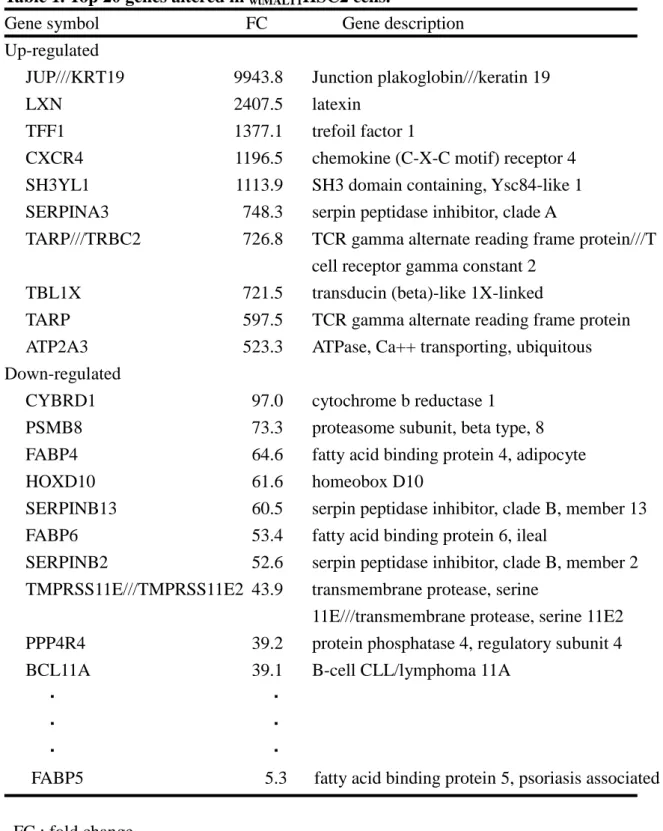
mock と wtMALT1 との間で発現が変動する遺伝子をマイクロアレイで網羅的に解析 したところ、発現量が 2 倍以上変動した 2,933 種類の遺伝子が得られた(Fig. 1-1) 。 そのうち、 1,433 遺伝子は wtMALT1 で発現が上昇し (赤) 、 1,500 遺伝子は低下した(緑) 。 10 倍以上の変動を示した遺伝子群では 415 種類が上昇(青) 、87 種類が低下(赤)を 示した(Fig. 1-2)。変動の大きかったものを Table 1 に示す。
2.マイクロアレイ解析データの検証
マイクロアレイ解析で変動が確認された癌関連遺伝子(LXN、TFF1、GATA3、FABP4、
FABP6 等)
31-34)を含む遺伝子の発現レベルをリアルタイム PCR 法で、タンパク質レベ ルでの発現をウエスタンブロット法で検証したところ、マイクロアレイ解析と同様の 結果が得られた(Fig.1-3、4)。他の遺伝子の発現については検証していないが、発 現が低下した遺伝子: Twist Basic Helix-loop-helix Transcription Factor 1(TWIST1)、
LIM Domain Only 4 ( LMO4 )、 Zinc Finger E-box Binding Homeobox 2 ( ZEB2 )、
Wingless-type MMTV Integration Site Family, Member 3(WNT3),
Matrix Metallopeptidase 14(MMP14)の多くは癌の進行と強く関連することが知ら
れている
35-39)。
3. GO 解析とパスウェイ解析
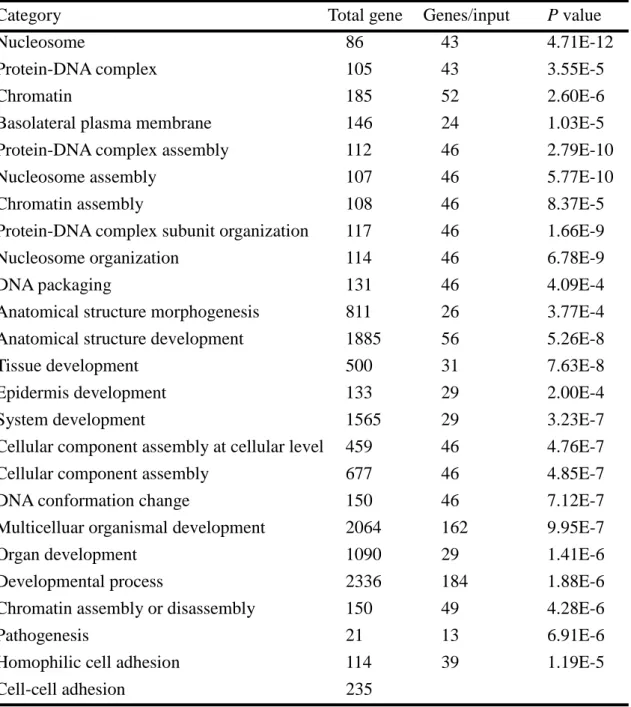
発現が変動した遺伝子の機能を分析するために Gene Ontology(GO)解析を行ったと こ ろ 、 Intra-cellular signaling 、 Cellular Organization 及 び Developmental processes(Table 2)に関与することが示されたが、MALT1 発現で変動が認められた FABP ファミリーの明確な Category は示すことができなかったが IPA での分析では細 胞機能での変化は Cancer、Cellular Movement、Gastrointestinal Disease に関連す ることが認められ、既知パスウェイでは HER2-signaling in Breast Cancer、Glioma Invasiveness Signaling、Role of Tissue Factor in Cancer に関連することが示さ れた(Fig.2) 。
また、GO 解析には含まれていないが癌進行に深く関連する細胞外マトリックス分解 酵素、Collagen、Laminin、Integrin などの細胞外マトリックス、表皮幹細胞マーカ ー、癌幹細胞マーカー、WNT パスウェイなどが影響を受けていた(Table 3) 。IAP で は変動遺伝子の多くが癌に密接に関連している事を示したが、MALT1 が具体的に与え ている影響を Molecular Mechanisms of Cancer で検証した。ネットワークの中心に 位置する RAS や SMAD を中心に発現量が低下していた(Fig.3) 。
また、ErbB signaling にリストされている ErbB1 とリガンド:AREG、TGF-
、EREG、
Neuregulin-1(NRG1) 、RAS、Phosphoinositide 3-Kinase(PI3K) 、Protein Kinase C
(PKC)が発現低下した(Fig.4A) 。
TGF パスウェイでは TGF-
、TGF-
受容体Ⅱ、Smad2/3/4(Fig.4B) 、Focal Adhesion
Kinase(FAK)シグナルでは ITGs、Epidermal Growth Factor Receptor(EGFR)、
Hyaluronan-mediated Motility Receptor(RHAMM)、Vinculin(VCL)、PXN、DOCKs な どの多くの遺伝子が発現を低下した(Fig. 5) 。MALT1 がリンパ球系細胞で NF-κB を 活性化することはよく知られているが
5)、本研究では明確な関連は認められなかった (Fig.6 )。
4.MALT1 発現の喪失と細胞遊走能の亢進
IPA の機能分析では MALT1 が Cellular Movement、すなわち細胞遊走能に影響する 可能性が示された(Fig.2) 。進行癌においては細胞遊走能が亢進することが知られて いる
7)。そこで、MALT1 が遊走能にどのような影響を与えているかを知るため、mock、
wtMALT1、 ΔMALT1 の細胞遊走能を比較した。 通常の wound healing アッセイにおいて、
創傷閉鎖は mock に対して wtMALT1 では 80.5 %に低下し、ΔMALT1 では 185 %上昇し た(Fig.7-1、2) 。MALT1 を siRNA(50 nM)によりノックダウンすると wtMALT1 の閉鎖 能の回復がみられたが(P =0.003;Fig.7-3 and Table 4) 、ΔMALT1 では siRNA の標 的配列が欠落しているため変化は認められなかった。
次に、より正確かつ連続的に測定するために RTCA-DP system を用いた real-time wound healing アッセイを行った。mock 対して wtMALT1 の創傷閉鎖は 66.4 %に低下 し、ΔMALT1 では 218.6 %に上昇した(Fig.7-4) 。上記の wound healing アッセイは 細胞の遊走、増殖、細胞間接着により大きく影響を受けるため
40)、タイムラプス解析 に よ る 単 一 細 胞 レ ベ ル で の 遊 走 能 を 測 定 し た ( Fig.7-5 )。 mock の 移 動 速 度 が 1.01±0.05 µm/h であったのに対し、ΔMALT1 では 3.06±0.60 µm/h(P = 0.021)ま で遊走速度を速め、wtMALT1 では殆ど動きが認められなかった(0.21±0.01 µm/h;P = 0.021) 。
5.正常舌組織における FABP の発現と局在
近年 FABP の異所性発現と悪性腫瘍との関連が報告されているが
11、12)、FABP4 及び FABP5 の反応特異性を正常舌組織を用いて検証したところ、表皮型である FABP5 は正 常上皮の有棘層に発現し(Fig.8A)、脂肪型である FABP4 の発現は認められなかった
(Fig.8B) 。癌細胞に隣接する上皮では FABP5 の比較的強い発現を基底細胞上層に認
めたが(Fig.8C) 、FABP4 は陰性であった(Fig.8D) 。 抗体の反応特異性については過
去の報告と一致して舌口底部よりの内皮細胞に FABP5 は陽性反応を示し (Fig.8E)
41)、
FABP4 は脂肪細胞に陽性であった(Fig.8F)
11)。
6.マウス創傷部皮膚における FABP の発現
58 症例で FABP5 の発現が癌細胞に隣接する上皮で上昇したことは、周囲組織由来の 因子または遺伝子変異が FABP5 の発現を活性化させる可能性が考えられる。そこで、
正常マウスの創傷部での FAB5P の発現を検証した。Fig.9 に示すように、FABP5 は切 開後 1 日目の創傷部表面の上皮細胞に陽性反応を認めた(Fig.9A)。その後 3 日目の 基底細胞の細胞質で発現が顕著になり徐々に低下していった。また創傷部に近接する 毛包の外毛根鞘の方が遠位に位置する外毛根鞘よりも FABP5 の発現が強かった。
(Fig.9E)
FABP4 は 3 日目の上皮でわずかに発現を認めるのに留まった。 上皮に限局する FABP5 の発現と皮下脂肪細胞での FABP4 の強い発現は、用いた抗体の反応特異性を示すもの である。
7.舌癌組織における FABP5 の発現
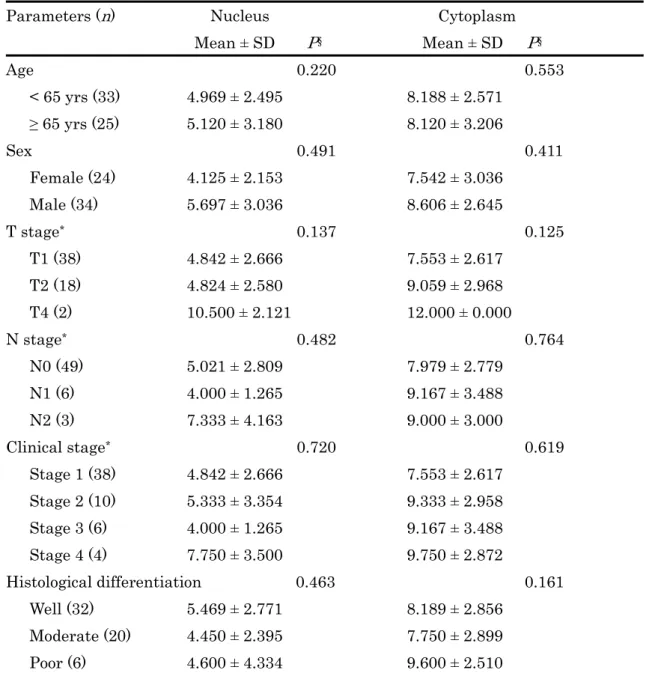
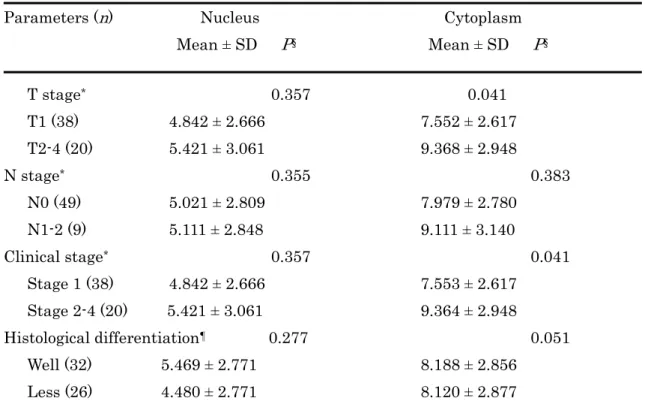
FABP5 は全ての癌組織で発現を認めたが、特に癌胞巣中心部に近い癌細胞の細胞質 で顕著であった(Fig.10A、10C)。また、核での発現は細胞質での発現に較べて低下 していた。細胞質での染色強度と陽性率が比較的に高値であったことは、舌癌細胞で FABP5 が中等度〜高度に発現することを示唆する。FABP5 染色スコアと臨床病理学的 因子には明らかな関連を認めなかった(Table 5) 。しかし、進行癌で染色スコアが増 加する傾向がみられたため、 初期癌と進行癌の 2 グループに分けて再評価したところ、
T-stages や clinical stages の進行癌で有意にスコアが上昇した(Table 6) 。 8.舌癌組織における FABP4 の発現
FABP4 の発現は FABP5 陰性の胞巣辺縁部癌細胞にも高頻度に認められた(Fig.10B) 。 細胞質での染色強度と陽性率は、FABP5 に比較して低かった。
核の染色では FABP4 と FABP5 はほぼ同等の結果となったが、FABP4 では核に限局して
発現しているのも認められた。この様な核に限局した発現は FABP5 では認められなか
ったが、核での FABP4 染色スコアと臨床病理学的因子との間には明らかな相関関係を
認めなかった(Table 7) 。
考 察
リンパ球系細胞において MALT1 は NF-κB を活性化し、進行した口腔癌では NF-κB が高頻度に活性化されることから、MALT1 は口腔癌の進行に働くと予想される
5) 42)。 しかし、MALT1 は正常な口腔上皮で発現し、MALT1 発現の喪失が口腔癌患者の予後の 悪化に密接に関連することが明らかになった
3)。これらのデータは上皮細胞とリンパ 球系細胞で MALT1 が異なる働きをしている可能性を示唆する。
本研究では、口腔癌細胞で MALT1 によって影響を受ける遺伝子を同定し、口腔癌の 進行に果たす MALT1 発現の意義の解明を目指した。IPA パスウェイデータベースで網 羅されている NF-κB シグナル関連遺伝子について検討したところ、それらは MALT1 によって全く影響を受けないか発現が抑制されていた。
MALT1 によって発現抑制される遺伝子の多くは EGF パスウェイ、TGF-
パスウェイ および細胞遊走能に関するものであり、そのことは MALT1 発現の喪失が口腔癌の進行 に促進的に働く可能性を示唆している。EGFR(ErbB1、HER-1)は頭頸部腫瘍に発現す る最も主要な EGF 受容体であり
43)、MALT1 はその発現量を低下させた。他の EGF 受容 体(ErbB2-4)は発現量が上昇したが、それらと頭頸部腫瘍進行との関連については 一定の見解を得ていない
44-46)。
マイクロアレイ解析の結果、EGFR のリガンドである AREG、TGF-
、EREG の発現は MALT1 により減少したが、これらの過剰発現は口腔癌細胞の増殖と密接に関係するこ とが報告されている
47-49)。また、MALT1 は EGF シグナル伝達分子である RAS(HRAS、
NRAS)や PKC(PKCA、PKCI、PKCQ)も発現低下させた。EGFR 遺伝子座の増幅は口腔癌 の発生・進行の要因であり
50)、EGFR 下流シグナルは予後が不良な口腔癌で強く活性 化される
51)。口腔癌と EGFR 遺伝子活性型変異との関連は明らかでないが
52、53)、MALT1 は活性型変異の有無にかかわらず、EGFR 遺伝子の発現を低下させることで癌の進行を 抑制し、逆に、MALT1 発現の喪失は EGF-EGFR パスウェイを活性化することで促進する 可能性を示している。また、EGF シグナルの抑制と並行し、MALT1 は TGF
2、TGF
R2、
SMAD2、SMAD3、および SMAD4 の発現を抑制した。これらの SMADs で形成される SMAD 複合体は TGF-
-TGFBR2 シグナル伝達に中心的役割を果たす
54)。
TGF-
は初期癌では抑制に働くが、癌進行に伴い細胞増殖、浸潤、転移、血管新生 などを促進させる
54)。MALT1 発現の喪失は口腔癌進行の後期過程に生じる
3)。また、
MALT1 は TGF-
パスウェイ下流で癌進行に働く gp130、 IL-11 を発現低下させた
55)。す なわち、MALT1 の発現喪失は TGF-
シグナルとパスウェイを活性化させて癌の進行を 強く促すと考えられる。
TGF-
パスウェイと EGF パスウェイは相互作用をすることで癌細胞の高度悪性型表
現型確立に働く
56-58)。そのため、どちらのパスウェイが wtMALT1 で発現する遺伝子の
制御により中心的に働くかを特定することは困難である。それらの中で、間葉系細胞
特異的転写因子で上皮間葉転換(Epithelial-mesenchymal Transition、EMT)を誘導
する High Mobility-group A2(HMGA2)は注目に値する
59、60癌細胞の EMT は浸潤能と
化学療法抵抗性をもたらす
7、40)。 HMGA2 は EMT を示す浸潤先端部の口腔癌細胞と予
後が不良な症例で強く発現し、MALT1 は浸潤先端部癌細胞で急速に発現を低下する
3、61)
。wtMALT1 で発現が低下した HMGA2 は、SNAI2、ZEB2、TWIST を介して E-cadherin の発現を抑制する
60、62)。 E-cadherin の発現抑制が癌の高度悪性型決定要因として働 くことから
7、63)MALT1 の発現動態が口腔癌の進行に極めて大きな影響を与ると予想で きる。
MALT1 は他の EMT 誘発因子 WNT3、Fibroblast Growth Factors、Platelet-derived Growth Factors、Interleukin-6 Receptor、Fibroblast Growth Factor Receptors)
と FAK シグナル(Integrin、Paxillin)や細胞外マトリックス分解酵素の Matrix Metalloproteinase、ADAMs、Plasminogen Activators、Kallikreins、Cathepsins)、
CD44、SPARC、Collagen、Laminin、Jagged2、Podpplanin といった EMT 関連遺伝子の 発現を抑制した。従って、MALT1 発現の喪失は癌細胞 EMT に働く様々な要因を活性化 すると予想できる。遊走能の亢進は EMT の特徴を示す代表的な指標の1つである
7、39)。
本研究で遊走能が MALT1 により強く抑制されたことは、MALT1 の機能がリンパ球系 細胞と口腔癌細胞では異なるという仮説を支持する。TGF-
と EGF パスウェイは相乗 的に癌細胞の EMT と遊走を促進することから、MALT1 による抑制からの逸脱は癌進行 に極めて大きな結果をもたらすと予想される。これらのパスウェイに対する MALT1 の 役割の詳細を更に分析することは、口腔癌進行のメカニズムの理解と新たな治療法の 開発に貢献するものと期待できる。
wtMALT1 で発現が大きく低下した遺伝子の中に、脂質代謝に重要な役割を果たす FABP が含まれていた(Table 1) 。癌細胞は脂質代謝を行うことで浸潤や増殖に必要な エネルギーを得する
10)。 FABP ファミリーは水に不溶な長鎖脂肪酸と結合し、脂肪酸 β酸化のための供給や転写因子である Peroxisome Proliferator-activated Receptor
(PPAR)の活性化等に様々な役割を担う
11、12)。FABP の発現は最初に同定された組織 や細胞に限局する場合が多いが、異所的な発現が癌進行に深く関与することが明らか になりつつある
11)。 本研究では、 口腔癌細胞において MALT1 発現により FABP4、 FABP5、
及び FABP6 の発現が低下したが、舌癌における FABP の発現と病態との関連性につい てはよく知られていない。
以上から舌癌における FABP4 と FABP5 の発現と舌癌との関連をマウス皮膚創傷治 癒モデルと比較しながら解析した。マウスの皮膚創傷端と癌細胞近接細胞における FABP5 の強い発現は過去の報告と一致した
64、65)。創傷端の上皮細胞は代謝経路を刺激 し
66)、その急速な細胞増殖と創傷部表面への遊走は治癒過程初期段階で鍵となる特徴
である
67、68)。FABP5 は増殖過程にあるケラチノサイトに多量に発現するとともに
69)、
口腔癌細胞の増殖と遊走を促す
14)。
本研究では、微弱ながら創傷1日目の細胞に FABP5 の発現を認め、創傷治癒の初期 過程と FABP5 の関連が示唆された。一方、FABP5 は上皮細胞の分化を促進するように
70)
、3 日目の創傷部基底細胞上層の角化過程にある細胞に強い陽性反応を示した。す なわち、これらの結果は、FABP5 が増殖過程にあるケラチノサイトでは発現が低下し、
細胞分裂後の細胞に強く発現するという報告と一致する
71)。角化過程にあるケラチノ
サイトでは細胞周期が停止していることが報告されており
72)、FABP5 は細胞増殖、分 化過程において多面的な役割を果たしている可能性を示唆している。
一方、癌に近接する細胞の多くは何らかの遺伝子変異をともなうことが知られてい るが
73)、上皮細胞が周囲組織との相互作用で FABP の発現にどの様な影響を与えてい るのかを、モデルとして遺伝子変異のないマウスの皮膚創傷部を用いて検証したとこ ろ、創傷部から離れた毛包の外毛根鞘と比較して近接している外毛根鞘で FABP5 の強 い染色反応が認められた。すなわち、FABP5 の発現は周囲組織などの環境因子の影響 を受けている可能性が示唆される。つまり癌細胞やそれに近接する上皮細胞は、組織 反応や遺伝子変異により FABP5 を発現させるものと予想される。
癌進行と創傷治癒を促進する EGF は
7、74)、FABP5 の発現を誘導する
75)。WNT
38)や TGF- β
76)など癌進行や創傷治癒を促進する成長因子によっても、FABP5 の発現は制御され
る
77、78)事が報告されている。
細胞外マトリックスタンパク質の分解が増殖因子の遊離に働くことからも
79)、 FABP5 の発現誘導に果たす癌細胞-周囲組織相互作用の役割を注意深く検討する必要 がある。さらに、マイクロアレイ解析の結果で MALT1 発現の有無が FABP の発現に影 響したことから、癌細胞を取り巻く遺伝的および環境的要因が FABP5 の発現誘導に働 くと考えられる。
本研究において、FABP5 の細胞質染色スコアは口腔癌の T-stage と clinical stage とともに増加した。FABP5 はミトコンドリアに長鎖脂肪酸を輸送することでエネルギ ー産生に働き
11、12)、エネルギー産生の増加は癌細胞高度悪性形質の発現を強力に推し 進める
10)。
癌の進行は腫瘍の増大(T-stage)と転移(N・M-stage)によって包括的に評価さ れる。癌の転移は様々な要因が複雑に絡み合った現象であることから
7)、FABP5 染色 スコアが N-stage と明らかな関連を持たなかったという今回の結果が、癌進行に果た す FABP5 の役割を否定するものではない。FABP5 によるエネルギー産生の亢進は癌細 胞の急速な増殖と腫瘍の増大に働くと予想できる。また FABP4 の病理学的役割は癌種 間で異なり、膀胱癌
20、80)と乳癌
21)では抑制的、胃癌
17)と卵巣癌
18)では促進的に働く。
本研究で FABP4 ほぼ全ての舌癌組織に発現していた。正常上皮では発現を認めなか ったが、受傷後 5 日目の創傷部基底細胞上層細胞に発現し、それ以前および以降の創 傷部皮膚には認められなかった。これらの結果から、組織由来因子がケラチノサイト における FABP4 の発現には大きな影響を与えないと思われる。
また FABP4 の発現と口腔癌の進行には相関を認めなかったが、FABP5 とは異なり、
FABP4 はしばしば核に限局して認められた。 FABP4 は核内に長鎖脂肪酸を輸送し、PPAR-
γと長鎖脂肪酸を介して複合体を形成する。PPAR-γは予後の良好な舌癌患者で強く
発現し
81)、PPAR-γ作動薬は舌癌の発生を阻害する
82)。しかし、in vitro で高度悪性
形質を示す口腔癌細胞は FABP4 の発現を亢進させることから
4)、FABP の異所的発現と
癌進行との関係を明確にするためにはより詳細な検討が必要である。FABP5 は進行し
た舌癌の細胞質に強く発現していた。FABP5 の発現亢進は、癌がステージを進行する
のに必要な十分量のエネルギー産生に働いている可能性を示唆する。
本研究では MALT1 の発現が FABP4、FABP5 の発現のメカニズムにどの様な影響を与 えているかを明確にすることは出来なかったが、口腔癌患者予後の改善に向けて、
FABP4 及び FABP5 発現亢進のメカニズムと口腔癌の病態に果たす役割を明らかにする
必要がある。
結 果
本研究で、MALT1 は癌進行に働く遺伝子の発現を低下させ、癌浸潤や転移を促進す る細胞遊走能を抑制することが明らかになった。すなわち、MALT1 は口腔癌細胞の高 度悪性型表現型に抑制的に機能している可能性を示した。
謝 辞
稿を終えるに臨み、ご指導ご高覧頂きました日本歯科大学生命歯学部生化学講座今 井一志教授ならびに千葉忠成准教授、同生化学講座の皆様、さらに明海大学歯学部病 態診断治療学講座口腔顎顔面外科学第二分野坂下英明教授に感謝致します。また舌癌 組織切片を賜りました明海大学歯学部病態診断治療学講座病理学分野菊池建太郎准 教授に厚く御礼申し上げます。
また審査にあたり御高閲頂いた明海大学歯学部病態診断治療学講座病理学分野草間
薫教授、形態機能成育学講座解剖学分野天野修教授、口腔生物再生医工学講座微生物
学分野大森喜弘教授に厚く御礼申し上げます。
引用文献
1) Choi S and Myers JN : Molecular pathogenesis of oral squamous cell carcinoma: implications for therapy. J Dent Res 87, 14–32, 2008
2) Siegel R, Naishadham D and Jemal A : Cancer statistics, 2012. CA Cancer JClin 62, 10–29, 2012
3) Chiba T, Maeda G, Kawashiri S, Kato K and Imai K : Epigenetic loss of mucosa-associated lymphoid tissue 1 expression in patients with oral carcinomas. Cancer Res 69, 7216–7223, 2009
4) Kawamoto Y, Ohyama Y, Chiba T, Yagishita H, Sakashita H and Imai K Proteomic identification of keratin alterations with enhanced proliferation of oral carcinoma cells by loss of mucosa-associated lymphoid tissue 1 expression. Int J Oncol 43, 729-736, 2013
5) McAllister-Lucas LM, Baens M and Lucas PC : MALT1 protease: a new therapeutic target in B lymphoma. Clin Cancer Res 17, 6623–6631, 2011 6) Thome M : Multifunctional roles of MALT1 in T-cell activation. Nat
Rev Immunol 8, 495–500, 2008
7) Hanahan D and Weinberg RA: Hallmarks of cancer: the next generation. Cell 144, 646-674, 2011
8) Cairns RA, Harris IS and Mak TW: Regulation of cancer cell metabolism. Nat Rev Cancer 11, 85-95, 2011
9) Fuchs E: Epidermal differentiation: the bare essentials. J Cell Biol 111, 2807-2814, 1990
10) Ward PS and Thompson CB: Metabolic reprogramming: a cancer hallmark even Warburg did not anticipate. Cancer Cell 21, 297-308, 2012
11) Furuhashi M and Hotamisligil GS: Fatty acid-binding proteins: role in metabolic diseases and potential as drug targets. Nat Rev Drug Discov 7, 489-503, 2008
12) Smathers RL and Petersen DR: The human fatty-acid binding protein family: evolutionary divergences and functions. Hum Genomics 5, 170-191, 2011
13) Siegenthaler G, Hotz R, Chatellard-Gruaz D, Jaconi S and Saurat JH:
Characterization and expression of a novel human fatty acid-binding protein: the epidermal type (E-FABP). Biochem Biophys Res Commun 190, 482-487, 1993
14) Fang LY, Wong TY, Chiang WF and Chen YL: Fatty-acid-binding protein 5 promotes cell proliferation and invasion in oral squamous cell carcinoma. J Oral Pathol Med 39, 342-348, 2010
15) Melle C, Ernst G, Winkler R, Schimmel B, Klussmann JP, Wittekindt C, Guntinas-Lichius O and von Eggeling F: Proteomic analysis of human papillomavirus-related oral squamous cell carcinoma: identification of thioredoxin and epidermal-fatty acid binding protein as upregulated protein markers in microdissected tumor tissue. Proteomics 9, 2193-2201, 2009
16) Uma RS, Naresh KN, D'Cruz AK, Mulherkar R and Borges AM: Metastasis of squamous cell carcinoma of the oral tongue is associated with down-regulation of epidermal fatty acid binding protein (E-FABP). Oral Oncol 43, 27-32, 2007
17) Hashimoto T, Kusakabe T, Sugino T, Fukuda T, Watanabe K, Sato Y, Nashimoto A, Honma K, Kimura H, Fujii H and Suzuki T: Expression of heart-type fatty acid-binding protein in human gastric carcinoma and its association with tumor aggressiveness, metastasis and poor prognosis.
Pathobiology 71, 267-273, 2004
18) Nieman KM, Kenny HA, Penicka CV, Ladanyi A, Buell-Gutbrod R, Zillhardt MR, Romero IL, Carey MS, Millis GB, Hotamisligil GS, Yamada SD, Peter ME, Gwin K and Lengyel E : Adipocytes promote ovarian cancer metastasis and provide energy for rapid tumor growth. Nat Med 17, 1498-1503, 2011 19) Celis JE, Ostergaard M, Basse B, Celis A, Lauridsen JB, Ratz GP, Andersen
I, Hein B, Wolf H, Orntoft TF and Rasmussen HH: Loss of adipocyte-type fatty acid binding protein and other protein biomarkers is associated with
progression of human bladder transitional cell carcinomas. Cancer Res 56, 4782-4790, 1996
20) Boiteux G, Lascombe I, Roche E, Plissonnier ML, Clairotte A, Bittard H and Fauconnet S: A-FABP, a candidate progression marker of human transitional cell carcinoma of the bladder, is differentially regulated by PPAR in urothelial cancer cells. Int J Cancer 124, 1820-1828, 2009
21) Hammamieh R, Chakraborty N, Barmada M, Das R and Jett M: Expression patterns of fatty acid binding proteins in breast cancer cells. J Exp Ther Oncol 5, 133-143, 2005
22) Che T, You Y, Wang D, Tanner MJ, Dixit VM and Lin X : MALT1/paracaspase is a signaling component down-stream of CARMA1 and mediates T cell receptor-induced NF-κB activation. J Biol Chem 279, 15870–15876, 2004 23) Ashburner M, Ball C, Blake J, Botstein D, Butler H, Cherry M, Tarver L,
Kasarskis A, Lewis S, Matese JC, Richardson JE, Ringwald M, Rubin GM and Sherlock G : Gene ontology: tool for the unification of biology. Nat
Genet 25, 25–29, 2000
24) Mori R, Xiong S, Wang Q, Tarabolous C, Shimada H, Panteris E, Danenberg KD, Danenberg PV and Pinski JK : Gene profiling and pathway analysis of neuroendocrine transdifferentiated prostate cancer cells. Prostate 69, 12–23, 2009
25)Schmittgen TD, Livak KJ:Analyzing real-time PCR data by the comparative CT method. Nat Protoc 6,1101–1108,2008
26) Sossey-Alaoui K, Li X, Ranalli TA and Cowell JK: WAVE3-mediated cell migration and lamellipodia formation are regulated downstream of phosphatidylinositol 3-kinase. J Biol Chem 280, 21748–21755, 2005
27) Zahm JM, Kaplan H, Herard AL, Doriot F, Pierrot D, Somelette P and Puchelle E : Cell migration and proliferation during the in vitro wound repair of the respiratory epithelium. Cell Motil Cytoskeleton 37, 33–43, 1997
28) Sobin, L.H and Wittekind,CH:HEAD AND NCK TUMOURS. In:TMM Classificaion of Malignant Tumours, Sixth Edition, Wiley-Liss, NewYork, pp22‐26,2002
29) Okuse T, Chiba T, Katsuumi I and Imai K: Differential expression and localization of WNTs in an animal model of skin wound healing. Wound Repair Regen 13, 491-497, 2005
30) McCluggage WG, Connolly LE, McBride HA, Kalloger S and Gilks CB:
HMGA2 is commonly expressed in uterine serous carcinomas and is a useful adjunct to diagnosis. Histopathology 60, 547-553, 2012
31) Ohmachi T, Inoue H, Mimori K, Tanaka F, Sasaki A, Kanda T, Fujii H,
Yanaga K and Mori M : Fatty acid binding protein 6 is overexpressed in colorectal cancer. Clin Cancer Res 12, 5090–5095, 2006
32) Kouros-Mehr H, Kim JW, Bechis SK and Werb Z : GATA-3 links tumor differentiation and dissemination in a luminal breast cancer model Cancer Cell 13, 141–152, 2008
33) Li Y, Basang Z, Ding H, Lu Z, Ning T, Wei H, Cai H and Ke Y : Latexin expression is downregulated in human gastric carcinomas and exhibits tumor suppressor potential. BMC Cancer 11, 121, 2011
34) Soutto M, Belkhiri A, Piazuelo MB, Schneider BG, Peng D, Jiang A,
Washington MK, Kokoye Y, Crowe SE, Zaika A, Correa A, Peek Jr RM and El-Rifai W : Loss of TFF1 is associated with activation of NF-kBmediated inflammation and gastric neoplasia in mice and human. J Clin Invest 121, 1753–1767, 2011
35) Shimada T, Nakamura H, Yamashita K, Kawata R, Murakami Y, Fujimoto N, Sato H, Seiki M and Okada Y: Enhanced production and activation of
progelatinase A mediated by membrane-type 1 matrix metalloproteinase in human oral squamous cell carcinomas: implications for lymph node metastasis. Clin Exp Metastasis 18, 179–188, 2000
36) Mizunuma H, Miyazawa J, Sanada K and Imai K : The LIM-only protein, LMO4, and the LIM domain-binding protein, LDB1, expression in
squamous cell carcinomas of the oral cavity. Br J Cancer 88, 1543–1548, 2003 37) Uraguchi M, Morikawa M, Shirakawa M, Sanada K and Imai K: Activation
of WNT family expression and signaling in squamous cell carcinomas of the oral cavity. J Dent Res 83, 327–332, 2004
38) Maeda G, Chiba T, Okazaki M, Satoh T, Taya Y, Aoba T, Kato K, Kawashiri S and Imai K : Expression of SIP1 in oral squamous cell carcinomas:
implications for E-cadherin expression and tumor progression. Int J Oncol 27, 1535–1541, 2005
39) Okamura H, Yoshida K and Haneji T : Negative regulation of TIMP1 is mediated by transcription factor TWIST1. Int J Oncol 35, 181–186, 2009 40) Yilmaz M and Christofori G : Mechanism of motility in metastasizing cells.
Mol Cancer Res 8, 629–642, 2010
41) Masouye I, Hagens G, Van Kuppevelt TH, Madsen P, Saurat JH, Veerkamp JH, Pepper MS and Siegenthaler G: Endothelial cells of the human microvasculature express epidermal fatty acid-binding protein. Circ Res 81, 297-303, 1997
42) Molinolo AA, Amornphimoltham P, Squarize CH, Castilho RM, Patel V and Gutkind JS : Dysregulated molecular networks in head and neck
carcinogenesis. Oral Oncol 45, 324–334, 2009
43) Bei R, Budillon A, Masuelli L, Cereda V, Vitolo D, DiGennaro E,
RipavecchiaV,Palumbo C, Ionna F, Losito S, Modesti A, Kraus MH and Muraro R:Frequent overexpression of multiple ErbB receptors by head and neck squamous cell carcinoma contrast with rare antibody immunity in patients.J Pathol 204, 317–325, 2004
44) Schoppmann SF, Jesch B, Friedrich J, Wrba F, Schultheis A, Pluschnig U,Maresch J, Hejna M and Birner P : Expression of Her-2 in carcinomas of the esophagus. Am J Surg Pathol 34, 1868–1873, 2010
45) Bussu F, Ranelletti FO, Gessi M, Graziani C, Lanza L, Paludetti G and Almadori G: Immunohistochemical expression patterns of the HER4 receptors in normal mucosa and in laryngeal squamous cell carcinomas:
antioncogenic significance of the HER4 protein in laryngeal squamous cell carcinoma. Laryngoscope 122, 1724–1733, 2012
46) Zanaruddin SN, Saleh A, Yang YH, Hamid S, Mustafa WM, Khairul Bariah AA, Zain RB, Lau SH and Cheong SC : Four-protein signature accurately predicts lymph node metastasis and survival in oral squamous
cell carcinoma. Hum Pathol 44, 417–426, 2013
47) Rubin Grandis J, Melhem MF, Barnes EL and Tweardy DJ : Quantitative immunohistochemical analysis of transforming growth factor-alpha and epidermal growth factor receptor in patients with squamous cell
carcinoma of the head and neck. Cancer 78, 1284–1292, 1996
48) Tsai ST, Yang KY, Jin YT, Lin YC, Chang MT and Wu LW: Amphiregulin as a tumor promoter for oral squamous cell carcinoma: involvement of cyclooxygenase 2. Oral Oncol 42, 381–390, 2006
49) Shigeishi H, Higashikawa K, Hiraoka M, Fujimoto S, Mitani Y, Ohta K, Takeichi M and Kamata N: Expression of epiregulin, a novel epidermal growth factor ligand associated with prognosis in human oral squamous cell carcinomas. Oncol Rep 19, 1557–1564, 2008
50) Sheu JJ, Hua CH, Wan L, Yj Lin, Lai MT, Tseng HC, Jinawath N, Tsai MF, Chang NW, Lin CF, Lin CC, Hsieh LJ, Wang TL, IeM Shih and Tsai FJ : Functional genomic analysis identified epidermal growth factor receptor activation as the most common genetic event in oral squamous cell carcinoma. Cancer Res 69, 2568–2576, 2009
51) Ang KK, Berkey BA, Tu X, Zhang HZ, Katz R, Hammond EH, Fu KK and Milas L: Impact of epidermal growth factor receptor expression on survival and pattern of relapse in patients with advanced head and neck carcinoma.
Cancer Res 62, 7350–7356, 2002
52) Hsieh CH, Chang JW, Hsieh JJ, Hsu T, Huang SF, Liao CT and Wang HM : Epidermal growth factor mutations in patients with oral cavity cancer in a betel nut chewing-prevalent area. Head Neck 33, 1758–1764, 2011
53) Mclntyre JB, Bose P, Klimowicz AC, Brockton NT, Petrillo S, Matthews W, Easaw J, Magliocco A and Dort JC : Specific and sensitive hydrolysis
probe-based real-time PCR detection of epidermal growth factor receptor variant III in oral squamous cell carcinoma. PLoS ONE 7, e31723, 2012 54) Roberts AB and Wakefield LM : The two facets of transforming growth
factor b in carcinogenesis. Proc Natl Acad Sci USA 100, 8621–8623, 2003 55) Calon A, Espinet E, Paloma-Pnnce S, Tauriello DVF, Iglesias M, Cespedes
MV, Sevillano M, Nadal C, Jung P, Zhang XHF, Byrom D, Riera A, Rossel D, Mangues R, Massague J, Sancho E and Batlle E: Dependency of colorectal cancer on a TGF-b-driven program in stromal cells of metastasis initiation.
Cancer Cell 22, 571–584, 2012
56) Wendt MK, Smith JA and Schiemann WP: Transforming growth
factor-binduced epithelial-mesenchymal transition facilitates epidermal growth factor-dependent breast cancer progression. Oncogene 29, 6485–6498, 2010
57) Kretzschamar M, Doody J and Massague J: Opposing BMP and EGF signaling pathways converge on the TGF-beta family mediator Smad1.
Nature 389, 618–622, 1997
58) Deharvengt S, Marmarelis M and Korc M : Concomitant targeting of EGF receptor, TGF-beta and SRC points to a novel therapeutic approach in pancreatic cancer. PLoS ONE 7, e39684 2012
59) Thuault S, Valcourt U, Petersen M, Manfioletti G, Heldin CH and
Moustakas A: Transforming growth factor-beta employs HMGA2 to elicit epithelial-mesenchymal transition. J Cell Biol 174, 175–183, 2006
60) Li D, Lin HH, McMahon M, Ma H and Ann DK: Oncogenic raf-1 induces the expression of non-histone chromosomal architectural protein HMGIC via a p44/p42 mitogen-activated protein kinase-dependent pathway in salivary epithelial cells. J Biol Chem 272, 25062–25070, 1997
61) Miyazawa J, Mitoro A, Kawashiri S, Chada KK and Imai K : Expression of mesenchyme-specific gene HMGA2 in squamous cell carcinomas of the oral cavity. Cancer Res 64, 2024–2029, 2004
62) Thuault S, Tan EJ, Peinado H, Cano A, Heldin CH and Moustakas A : HMGA2 and Smads co-regulate SNAIL1 expression during induction of epithelial-to-mesenchymal transition. J Biol Chem 283, 33437–33446, 2008 63) Hashimoto T, Soeno Y, Maeda G, Taya Y, Aoba T, Nasu M, Kawashiri S and
Imai K: Progression of oral squamous cell carcinoma accompanied
with reduced E-cadherin expression but not cadherin switch. PLoS ONE 7, e47899, 2012
64) Kusakari Y, Ogawa E, Owada Y, Kitanaka N, Watanabe H, Kimura M, Tagami H, Kondo H, Aiba S and Okuyama R: Decreased keratinocyte motility in skin wound on mice lacking the epidermal fatty acid binding protein gene. Mol Cell Biochem 284, 183-188, 2006
65) Han J, Kioi M, Chu WS, Kasperbauer JL, Strome SE and Puri RK:
Identification of potential therapeutic targets in human head and neck squamous cell carcinoma. Head Neck Oncol 1, 27, 2009
66) Chi C and Trinkaus-Randall V: New insights in wound response and repair of epithelium. J Cell Physiol 228, 925-929, 2013
67) Martin P: Wound healing - aiming for perfect skin regeneration. Science 276, 75-81, 1997
68) Singer AJ and Clark RA: Cutaneous wound healing. N Engl J Med 341, 738-746, 1999
69) Ogawa E, Owada Y, Ikawa S, Adachi Y, Egawa T, Nemoto K, Suzuki K, Hishinuma T, Kawashima H, Kondo H, MutoM, Aiba S and Okuyama R : Epidermal FABP (FABP5) regulates keratinocyte differentiation by 13(S)-HODE-mediated activation of the NF-κB signaling pathway. J Invest Dermatol 131, 604-612, 2011
70) Hagens G, Masouye I, Augsburger E, Hotz R, Saurat JH and Siegenthaler G:
Calcium-binding protein S100A7 and epidermal-type fatty acid-binding protein are associated in the cytosol of human keratinocytes. Biochem J 339, 419-427, 1999
71) Dallaglio K, Marconi A, Truzzi F, Lotti R, Palazzo E, Petrachi T, Saltari A, Coppini M and Pincelli C: E-FABP induces differentiation in normal human keratinocytes and modulates the differentiation process in psoriatic keratinocytes in vitro. Exp Dermatol 22, 255-261, 2013
72) Gandarillas A: The mysterious human epidermal cell cycle, or an oncogene-induced differentiation checkpoint. Cell Cycle 11, 4507-4516, 2012 73) Ashida S, Orloff MS, Bebek G, Zhang L, Zheng P, Peehl CM and Eng C:
Integrated analysis reveals critical genomic regions in prostate tumor microenvironment associated with clinicopathologic phenotypes. Clin Cancer Res 18, 1578-1587, 2012
74) Shirakata Y, Kimura R, Nanba D, Iwamoto R, Tokumaru S, Morimoto C, Yokota K, Nakamura M, Sayama K, Mekada E, Higashiyama H and Hashimoto K:Heparin-binding EGF-like growth factor accelerates
keratinocyte migration and skin wound healing. J Cell Sci 118, 2363-2370, 2005
75) Kannan-Thulasiraman P, Seachrist DD, Mahabeleshwar GH, Jain MK and Noy N: Fatty acid-binding protein 5 and PPAR-β/δ are critical mediators of epidermal growth factor receptor-induced carcinoma cell growth. J Biol Chem 285, 19106-19115, 2010
76) Bielefeld KA, Amini-Nik S and Alman BA: Cutaneous wound healing:
recruiting developmental pathways for regeneration. Cell Mol Life Sci 70, 2059-2081, 2013
77) Collins CA and Watt FM: Dynamic regulation of retinoic acid-binding proteins in developing, adult and neoplastic skin reveals roles for beta-catenin and Notch signalling. Dev Biol 324, 55-67, 2008
78) Knoferle J, Ramljak S, Koch JC, Tonges L, Asif AR, Michel U, Wouters FS, Heermann S, Krieglstein K, Zerr I, Bähr M and Lingor P: TGF-
β
1 enhances neurite outgrowth via regulation of proteasome function and EFABP. Neurobiol Dis 38, 395-404, 201079) Imai K, Hiramatsu A, Fukushima D, Pierschbacher PD and Okada Y:
Degradation of decorin by matrix metalloproteinases: identification of the cleavage sites, kinetic analyses and transforming growth factor-β1 release.
Biochem J 322, 809-814, 1997
80) Tuncman G, Erbay E, Hom X, De Vivo I, Campos H, Rimm EB and Hotamisligil GS: A genetic variant at the fatty acid-binding protein aP2 locus reduces the risk for hypertriglyceridemia, type 2 diabetes, and cardiovascular disease. Proc Natl Acad Sci USA 103, 6970-6975, 2006
81) Theocharis S, Klijanienko J, Giaginis C, Rodriguez J, Jouffroy T, Girod A, Point D, Tsourouflis G and Satre-Garau X: Peroxisome proliferator-activated receptor-γ in mobile tongue squamous cell carcinoma: associations with clinicopathological parameters and patients survival. J Cancer Res Clin Oncol 137, 251-259, 2011
82) Yoshida K, Hirose Y, Tanaka T, Yamada Y, Kuno T, Kohno H, Katayama H, Qiao Z, Sakata K, Sugie S, Shibata T and Mori H: Inhibitory effects of troglitazone, a peroxisome proliferator-activated receptor γ ligand, in rat tongue carcinogenesis initiated with 4-nitroquinoline 1-oxide. Cancer Sci 94, 365-371, 2003
Table 1. Top 20 genes altered in wtMALT1HSC2 cells.
Gene symbol FC Gene description
Up-regulated
JUP///KRT19 9943.8 Junction plakoglobin///keratin 19
LXN 2407.5 latexin
TFF1 1377.1 trefoil factor 1
CXCR4 1196.5 chemokine (C-X-C motif) receptor 4 SH3YL1 1113.9 SH3 domain containing, Ysc84-like 1 SERPINA3 748.3 serpin peptidase inhibitor, clade A
TARP///TRBC2 726.8 TCR gamma alternate reading frame protein///T cell receptor gamma constant 2
TBL1X 721.5 transducin (beta)-like 1X-linked
TARP 597.5 TCR gamma alternate reading frame protein ATP2A3 523.3 ATPase, Ca++ transporting, ubiquitous Down-regulated
CYBRD1 97.0 cytochrome b reductase 1
PSMB8 73.3 proteasome subunit, beta type, 8 FABP4 64.6 fatty acid binding protein 4, adipocyte
HOXD10 61.6 homeobox D10
SERPINB13 60.5 serpin peptidase inhibitor, clade B, member 13 FABP6 53.4 fatty acid binding protein 6, ileal
SERPINB2 52.6 serpin peptidase inhibitor, clade B, member 2 TMPRSS11E///TMPRSS11E2 43.9 transmembrane protease, serine
11E///transmembrane protease, serine 11E2 PPP4R4 39.2 protein phosphatase 4, regulatory subunit 4
BCL11A 39.1 B-cell CLL/lymphoma 11A
・ ・
・ ・
・ ・
FABP5
5.3 fatty acid binding protein 5, psoriasis associated FC : fold change
Table 2. Classification of gene sets by GO analysis
Category Total gene Genes/input P value
Nucleosome 86 43 4.71E-12
Protein-DNA complex 105 43 3.55E-5
Chromatin 185 52 2.60E-6
Basolateral plasma membrane 146 24 1.03E-5
Protein-DNA complex assembly 112 46 2.79E-10
Nucleosome assembly 107 46 5.77E-10
Chromatin assembly 108 46 8.37E-5
Protein-DNA complex subunit organization 117 46 1.66E-9
Nucleosome organization 114 46 6.78E-9
DNA packaging 131 46 4.09E-4
Anatomical structure morphogenesis 811 26 3.77E-4
Anatomical structure development 1885 56 5.26E-8
Tissue development 500 31 7.63E-8
Epidermis development 133 29 2.00E-4
System development 1565 29 3.23E-7
Cellular component assembly at cellular level 459 46 4.76E-7
Cellular component assembly 677 46 4.85E-7
DNA conformation change 150 46 7.12E-7
Multicelluar organismal development 2064 162 9.95E-7
Organ development 1090 29 1.41E-6
Developmental process 2336 184 1.88E-6
Chromatin assembly or disassembly 150 49 4.28E-6
Pathogenesis 21 13 6.91E-6
Homophilic cell adhesion 114 39 1.19E-5
Cell-cell adhesion