第19回欧州スポーツ医学会2014年7月2‑5日(アムス テルダム,オランダ)における研究発表 血流制限を 併用したレジスタンス運動が血管機能へ影響
著者 沖田 孝一, 高田 真吾, 門口 智泰, 森田 憲輝, 堀 内 雅弘, 絹川 真太郎, 筒井 裕之
雑誌名 北翔大学北方圏生涯スポーツ研究センター年報
巻 6
ページ 15‑17
発行年 2015
URL http://id.nii.ac.jp/1136/00002105/
北翔大学北方圏生涯スポーツ研究センター年報 第6号 2015
Bulletin of the Northern Regions Lifelong Sports Research Center Hokusho University Vol.6
第19回欧州スポーツ医学会2014年7月2−5日(アムステルダム, オランダ)に おける研究発表
血流制限を併用したレジスタンス運動が血管機能へ影響
19
thAnnual Congress of European College of Sports Science, July 2-5, 2014, Amsterdam, Holland.
Effect of Resistance Exercise with Blood Flow Restriction on Vascular Function
沖 田 孝 一 高 田 真 吾 門 口 智 泰 Koichi O
KITAShingo T
AKADATomoyasu K
ADOGUCHI森 田 憲 輝 堀 内 雅 弘 絹 川 真 太 郎 筒 井 裕 之
Noriteru M
ORITAMasahiro H
ORIUCHIShintaro K
INUGAWAHiroyuki T
SUTSUI─ ─15 北翔大学北方圏生涯スポーツ研究センター年報 第6号 (15〜17)
Bulletin of the Northern Regions Lifelong Sports Research Center Hokusho University Vol.6
2015年10月 October,2015
第19回欧州スポーツ医学会2014年7月2−5日(アムステルダム, オランダ)における 研究発表
血流制限を併用したレジスタンス運動が血管機能へ影響 19
thAnnual Congress of European College of Sports Science,
July 2-5, 2014, Amsterdam, Holland.
Effect of Resistance Exercise with Blood Flow Restriction on Vascular Function
沖 田 孝 一
1)高 田 真 吾
2)門 口 智 泰
2)森 田 憲 輝
3)堀 内 雅 弘
4)絹 川 真太郎
2)筒 井 裕 之
2)Koichi O
KITA1)Shingo T
AKADA2)Tomoyasu K
ADOGUCHI2)N
oriteruM
ORITA3)Masahiro H
ORIUCHI4)Shintaro K
INUGAWA2)Hiroyuki T
SUTSUI2)日本語要約:従来の高強度負荷を用いるレジスタンス運動では,血管機能を悪化させるとの報告が 散見される。近年,血流制限を併用したレジスタンス運動が,低強度負荷にもかかわらず,顕著な 筋肥大および筋力増加をもたらすことが報告された。しかしながら,同運動が血管機能にどのよう な影響を及ぼすのかは明確にされていない。本研究では,血流制限を併用した低強度レジスタンス 運動が筋量・筋力および血管機能に与える影響について検討した。健常男性14名にて,右下腿を対 象に,最大挙上重量(1 RM)の20%を用いた血流制限下仰臥位足関節底屈運動を,60収縮(30回 /分,2分間)を2セット,1日2回,週3回,4週間実施した。血流制限は,右大腿部に空気圧 式カフを装着し,安静時収縮期血圧の1.3倍にて施行した。トレーニング前後,血管機能の指標と して,CAVI(心臓足首血管指数),四肢血圧をそれぞれ,フクダ電子社製脈波検査装置(VaSera:
VS-1000)により,また,1 RMおよび最大筋横断面積(MCA)を測定した。トレーニング後,1 RMおよびMCAは有意に増加した(p<0.05)。血圧値は対象肢の収縮期血圧においてのみ有意に低 下した(p<0.05)。CAVI値はいずれの側においても変化が認められなかった。血流制限を併用し た低強度レジスタンス運動は,筋量および筋力を増加させるとともに,血管機能を改善する可能性 が示唆された。
キーワード:筋力トレーニング,血管機能,血流制限,血圧
Ⅰ.Background and aims
Resistance exercise with blood flow restriction (BFR) is a new training method providing significant training effects despite the use of low-intensity loads1)2)3)4)5)6). It is stated that it would be clinically useful in frail subjects or females for whom high-load exercise is not
indicated. Unexpectedly, a couple of recent studies7)8)9) reported that standard resistance exercise could have adverse effect on aortic stiffness. However, there is insufficient evidence regarding the impact of resistance exercise with BFR on vascular function. The aim of this study was to clarify the effect of low-intensity resistance exercise with BFR on vascular function as well as muscle mass and strength.
1)北翔大学生涯スポーツ学部スポーツ教育学科 2)北海道大学医学研究科循環病態内科学 3)北海道教育大学教育学部
4)山梨県環境科学研究所
第19回欧州スポーツ医学会2014年7月2‐5日(アムステルダム, オランダ)における研究発表 血流制限を併用したレジスタンス運動が血管機能へ影響
Ⅱ.Methods
Fourteen young males participated in this study.
For training, right calf plantar flexion exercise at 20% of 1-RM with BFR and a pressure of 1.3 times systolic blood pressure (SBP) was used. Training was conducted 3 days/week for 4 weeks. Muscle cross sectional area (MCA) by magnetic resonance imaging, 1-RM, blood pressures (bilateral brachial and ankle) and systemic vascular function assessed by cardio ankle vascular index (CAVI) were measured before and after 4-wk of training.
Ⅲ.Results and discussion
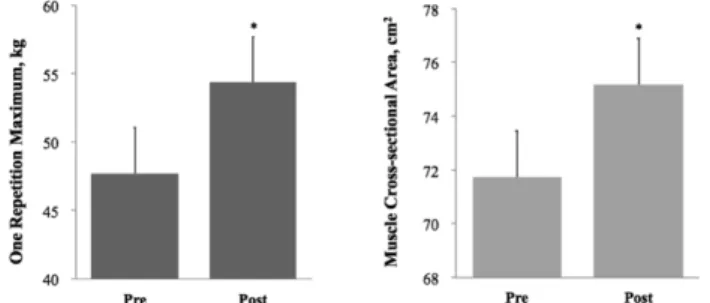
MCA and 1-RM increased significantly (Fig 1). Blood pressure decreased significantly only in the right ankle (Fig 2), while CAVI remained unaltered (Fig 3).
Decreased blood pressure might be due to reduced vascular tone and improved stiffness. Systemic parameter of CAVI could not reflect the functional change in local artery.
Recent meta-analysis (10) showed that resistance training might provide favorable effect on blood pressures, while its adverse effects could not be ignored. High-intensity resistance training has a possibility to impair vascular function (7-9). Therefore, BFR exercise and training seems to become novel method because BFR exercise and training can obtain muscle hypertrophy as well as high-intensity resistance training even if BFR exercise and training does not affect vascular function. Future studies should be conducted with the aim of elucidating the mechanisms of the influence of BFR training on vascular function, with careful selection of the influencing parameters and the potential therapeutic benefits for the elderly and for the rehabilitation of patients with cardiovascular disease and physical injury.
Ⅳ.Conclusion
Resistance exercise with BFR is a valuable method that can significantly increases muscle mass and strength, and might have favorable effect on vascular function.
Acknowledgments
This study was supported in part by a grant of Northern Regions Lifelong Sports Research Center (2014) and Mitsui Life Social Welfare Foundation (2013).
References
1)Okita K, Takada S: Application of Blood Flow Restriction in Resistance Exercise Assessed by Intramuscular Metabolic Stress. J Nov Physiother 3: 187, 2013.
2)Okita K, et al.: Effects of Blood Flow Restriction Fig 2. Changes in blood pressures. Mean±SE. *Pre
vs. Post, p<0.05.
Fig 1. Changes in muscle strength and volume. Mean
±SE. *Pre vs. Post, p<0.05.
Fig 3. Changes in cardio ankle vascular index.
─ ─17
北翔大学北方圏生涯スポーツ研究センター年報 第6号
on Intramuscular Energetic Metabolism During Resistance Exercise. Adv Exerc Sports Physiol, 15:
121-125, 2010.
3)Suga T, Okita K, Morita M, et al.: Intramuscular Metabolism during Low-Intensity Resistance Exercise with Blood Flow Restriction. J Appl Physiol, 106: 1119-24, 2009.
4)Suga T, Okita K, Morita M, et al.: Dose Effect on Intramuscular Metabolic Stress during Low- Intensity Resistance Exercise with Blood Flow Restriction. J Appl Physiol, 108:1563-1567, 2010.
5)Takada S, Okita K, Suga T, et al.: Blood Flow Restriction Exercise in Sprinters and Endurance Runners. Med Sci Sports Exerc, 44: 413-9, 2012.
6)Takada S, Okita K, Suga T, et al.: Low-intensity exercise can increase muscle mass and strength proportionally to enhanced metabolic stress under ischemic conditions. J Appl Physiol, 113: 199-205, 2012.
7)Bertovic DA, Waddell TK, Gatzka CD, et al.:
Muscular strength training is associated with low arterial compliance and high pulse pressure.
Hypertension, 33: 1385-91, 1999.
8)Miyachi M, Donato AJ, Yamamoto K, et al.:
Greater age-related reductions in central arterial compliance in resistance-trained men.
Hypertension, 41: 130-5, 2003.
9)Miyachi M, Kawano H, Sugawara J, et al.:
Unfavorable effects of resistance training on central arterial compliance: a randomized intervention study. Circulation, 110: 2858-63, 2004.
10)Cornelissen VA, Smart NA: Exercise training for blood pressure: a systematic review and meta- analysis. J Am Heart Assoc, 2: e004473, 2013.