Investigating Informal Approaches to
Assessment in a Japanese EFL Environment
journal or
publication title
Annual Research Report of the Language Center
number
21
page range
103-128
year
2018-03
Investigating Informal Approaches to Assessment
in a Japanese EFL Environment
Mark DONNELLAN and Kane LINTON
Current assessment frameworks for English as a Foreign Language (EFL) education used in Japan are narrow in scope, commonly limited to assessing knowledge via rote learning methods, and although Japanese students are considered to be diligent, logical and studious learners, pedagogical reform is slow to adapt to the changing requirements of learners. In this paper the authors challenge the standard approaches to EFL assessment by reviewing feedback gathered through approaches to assessment that are uncommon in Japanese education. This study will provide a perspective on how to reform Japanese educational assessment, and will examine ways in which educational assessment can better cater to all students, regardless of learning styles.
Formal standardized assessment is a useful tool in gauging student comprehension of topic knowledge (Snyder, 1999). However, in respect to English as a Foreign Language (EFL) instruction it invariably provides limited, unreliable feedback data that does not adequately represent the ability of the individual (Hamada, 2011). Therefore, it is necessary to develop formal assessment that does away with the standard model being used in Japanese pre-tertiary institutions and provide a more functional approach (Hui-ju & Ting-han, 2013). The focus of this paper will be to provide an alternative method of English language assessment in Japan that can address the issue of different learning styles in students and increase motivation, in the hope that students’ performance can improve. The research presented in this paper will address the question of possible alternative approaches to formalized assessment and will consider the application of these approaches. Therefore, this paper will demonstrate that student motivation, in line with developing structured assessment that caters to differentiated learning styles, is key to providing assessment pieces that are better able to cater to differing learning styles as outlined by Gardner’s Multiple Intelligences theory (Snyder, 2000). LITERATURE REVIEW
Although the Japanese Ministry of Education, Culture, Sports, Science and Technology (MEXT) recognizes that the standard testing procedures that
have been a key part of the educational establishment of Japan need to be assessed and redesigned to a certain degree, the Educational Reform Plan may not be enough to address the major weaknesses that have been raised in this paper (MEXT, 2014). This plan is the Japanese government’s response to the onset of globalization, and although globalization is in no way a new
phenomenon, ongoing educational reform is especially necessary to EFL instruction in schools. Furthermore, as Japan gears up to host the Olympics, more focus is being placed on the ability of Japanese citizens to effectively communicate in English.
MEXT’s plan aims to target three areas in EFL instruction; the issue of motivation in EFL instruction, the ability to effectively test English ability, and the best approaches to the development of curriculum in line with data collected from student assessment. This plan is due to be completed by the end of 2018, therefore, the effectiveness of these changes is yet to be seen.
However, the plans put forth by the MEXT initiative do not inherently address the issue of student motivation. Hamada (2011) & Ohmori (2014) have also recognized this issue in their assertions that the Japanese educational system lacks the effective implicit pedagogical motivation to get students interested in their learning. Hamada (2011) identifies some of the key factors affecting motivation for junior high and high school students in Japan and proposes three core questions in his study:
1. What are the differences between demotivators for junior high school learners and high school learners in Japan?
2. Which factors are ranked higher or lower as demotivators for junior high school learners and high school learners in Japan respectively? 3. How do the strong demotivators change over time in high school?
(Hamada, 2011, p. 15)
Hamada conducted a study utilizing 234 first year Japanese high school students and 217 freshmen Japanese university students. This study focused on the pedagogical methods used when teaching EFL and identifying the primary demotivating factors of Japanese students when studying English. The link between student motivation, independent learning and improved student
performance is the crux of Hamada’s research and supports the arguments made in this paper, that is, there needs to be a shift in not only language assessment but also in the pedagogical approach to EFL in Japan.
Identifying alternative pedagogical approaches to EFL in Japan In considering alternative approaches to EFL in Japan, one must examine EFL in other Confucian heritage countries (CHCs) since there are many parallels between traditional Japanese educational practices and those in CHC settings (Aubrey, Colpitts & Nowlan, 2015). This section will review the situation in other CHCs.
Hui-ju & Ting-han (2013) look further into the issues of student motivation by identifying factors affecting the anxiety of Taiwanese students preparing to complete their end of year examinations. Their paper draws correlations between anxieties in young learners, and multiple intelligences, learner attitudes and perceived competences. This study focused primarily on elementary school students studying EFL in Taiwan and came to the following conclusions in regard to the causes of anxiety: “failing English courses, feeling that other students have a better English speaking ability, feeling that other classmates have better English performance, being called on in English class, and not being prepared in advance when the teacher asks questions.” (Hui & Ting-han, 2013, p. 932). In addition to looking at the causes of anxiety, this study also looked at factors affecting student motivation and their importance to EFL acquisition. Hamada (2011) considers that motivation is important when learning EFL because as student inclination towards English improves, so too does their achievement in the language. The assertion that student performance correlates with a student’s ability to be a motivated, confident learner is linked to the teacher’s ability to utilize learning concepts that are adapted to an individual’s learning style (Snyder, 1999).
Gardner’s Theory of Multiple Intelligence puts forward the concept that intelligence is not a singular ability, but an individual set of modalities that affect the way in which an individual effectively processes information (Snyder, 1999). The proposal that multiple intelligence theory has a strong correlation to the correct implementation of EFL to students is reinforced by a qualitative study of 120 students conducted by Kartiah, Rahman, Rahman & Jabu (2014) examining the adaption of learning styles in Indonesian education. Their study looks to outline the importance of multiple intelligence theory and its
application in Indonesian junior high and senior high schools. Their research provides qualitative data to back their thesis. They argue it is not only necessary to work towards developing student motivation, but also to reconsider the preconceived notions of EFL pedagogy and assessment coming from educational experts, teachers and curriculum developers.
Kim (2015) reviewed alternative approaches to EFL by assessing the advantages of project-oriented learning in a Korean context. The structure of a project orientated course mirrors the expectations of this research paper in that it provides opportunities for learners to achieve in varying contexts of assessment. This study looked at the implementation of a project-oriented learning model in a Korean tertiary context. The author then interviewed teachers and students, who reflected on the efficacy of project-oriented learning and its application to English language learning in Korean schools. The following findings were presented from the collection of both qualitative and quantitative data:
(1) The project approach created resistance from both the students and the teacher; (2) Communication between the teacher and the students
eased the students’ frustrations; (3) The goal-oriented nature of project work encouraged students to construct linguistic and topic-related knowledge; (4) Group work promoted independent and collaborative learning; (5) The teacher’s role as a facilitator continued to confuse the teacher; and (6) Plagiarism seemed to limit student learning. (Kim, 2015, p.73)
As a result of these findings the primary conclusion was that with an approach such as project-oriented learning or assessment, especially in large groups of lower ability level students, there should be a concerted effort by the class teacher to facilitate student learning. Ohmori (2014) considers a similar approach; his article establishes the argument that Content and Language Integrated Learning or CLIL, a pedagogical concept that has become popular in European countries over the past 15 years, could assist in the globalization and international awareness of EFL in Japanese educational institutions. The author provides a framework on ways in which to implement CLIL in the classroom and outlines some of the benefits, interesting aspects and downfalls of this pedagogical approach to language instruction.
The integration of diverse content and methodologies inevitably leads to innovation (Kwek, 2011) and this is what exemplifies the concept of this study. The ability to create diverse, innovative and enticing approaches to language acquisition and its assessment is of great importance to providing an educational environment that caters to various learner types.
Following on from Ohmori (2014) & Kim (2015), Oga-Baldwin, Nakata, Parker & Ryan (2017) looked further into the requirement of self-motivation when considering academic success. This study looked at the importance of self-motivation by assessing the ongoing ability, needs and expectations of 515 elementary school Japanese students over the course of a school year. One of the main findings of this study is that effective teacher instruction is paramount to the beneficial development of student’s self-motivation and their attitudes to learning English.
Snyder (1999) looked at the relationship between learning styles
(LSs)/multiple intelligences and academic achievement of high school students. His study examined the connection between multiple intelligences in high school students and their academic achievements, and their prospective
achievements in the future. A survey was constructed to assess Auditory, Visual, Tactile/Kinesthetic, Analytical, and Global learning styles which consist of Linguistic, Logical, Spatial, Bodily/Kinesthetic, Musical, Interpersonal, and Intrapersonal intelligences. In addition, further consideration was also paid to the differentiation between male and female learning. Of note, as a conclusion of this study, positive correlation was found in regard to higher academic achievement and visual learning styles, with impetus on independent working and self-motivated learning.
Shortfalls of the Japanese test system
The majority of testing throughout the Japanese high school system is standardized (MEXT, 2014), the primary reason being that from a very young age, Japanese students are settled into an educational framework of annual assessment and examination. Students are expected to complete testing at several points in their academic careers. Successful completion of these rigorous series of tests during their schooling lives means the chance of acceptance at a good university is greatly improved. From this point students are on track to pursue their intended career path.
This cycle is endemic to the Japanese psyche (Hamada, 2014; Hui-Ju & Ting-han, 2013), it is all that they expect, and it is all they know. However, what happens to those students who are unable to follow this rigid path, or those who fall outside this fairly narrow scope? What happens to those that sit outside of this spectrum? Gardner’s Multiple Intelligences Theory is widely supported in educational frameworks in many countries (Kartiah, Rahman, Rahman & Jabu, 2014). However, in Japan educational institutions still only consider a narrow scope of testing and assessment to be of high importance.
The following section examines the considerations of developing a theoretical testing framework that is arguably better able to accommodate EFL learners with differing learning styles.
PROPOSED FRAMEWORK
Development and administration of testing process
In developing and administering an assessment for this study, an innovative approach was proposed. Less interest was invested in the students’ ability to regurgitate what they have learnt through classwork over the course of their studies and more focus was put on their ability to utilize what they have learnt and adapt that in order to complete a task. This outlook may be in opposition to the theories of CLIL integration into Japanese English education as proposed by Ohmori (2014), however, it does share his consideration that the ability to create diverse, innovative and enticing approaches to language content acquisition is of high importance. The first aspect of this study that was
considered was the end goal, in other words, what the authors of this paper wanted the students to accomplish. For the purposes of this study reference will be paid to a group of first-grade high school boys who were tasked with
designing and effectively building a bridge made of chopsticks. Once this aspect had been established attention was then paid to the scope of the task and how it could be arranged in a way to allow for a certain amount of freedom, whilst retaining the structure of a testing environment. Each student was given
identical parameters that needed to be adhered to, with failure to do so resulting in a penalty, materials and tools that they could use and a time limit (see
Appendix F). For this group two periods of class, totaling 100 minutes, were provided for the completion of this assessment. Students were free to ask any
questions in English in order to clarify the task, but were not allowed to ask for assistance from the teacher or any other students to complete the task. Students that followed the requirements and successfully built a bridge that could support 20 kilograms of weight, were given a mark of being at the expected level. Also, students were given credit for better execution of requirements, use of language and informal observations. The rubric in Appendix E was developed so that it could be adaptable to the nature of the test, as it assesses the success of the student in regard to their completion of the assigned task and also provides valid English assessment information to the teacher.
This method of language assessment suits the designated rubric
(Appendix E) that has been developed as a part of this program, as it allows for students to display the traits of learning educators look to nurture and inspire throughout the semester without forgoing the facets of testing that must be adhered to.
To be critical of some of the underpinnings of this style of testing one has to start by addressing the nature of the test itself. By removing the
limitations of standard assessment techniques and providing a more diversified basis for assessment the facilitator moves the assessment emphasis from knowledge retention to adaption of learning and effective use of knowledge. In the next section of this paper consideration will be paid to how assessments can be developed in line with these intentions.
Developing a non-standard method of formal assessment for Japanese high school students
The previous section looked to the methodology behind the adaption of this method of assessment and how it can be effectively implemented in a Japanese high school setting. This section describes the development of the testing structures themselves.
Purpose of the test
The purpose of this test was to create a unique approach to the issue of examining Japanese students of English in a formal environment by including thematic aspects of informal testing. To be more specific, what that means was to include the attributes of reading, writing, speaking and listening in a
composition that provides a certain degree of freedom to the student being assessed. By implementing an output activity that ties all these facets together and using the assessment as a shared focal point it separates students from the stresses of a standard EFL assessment.
Content of the test
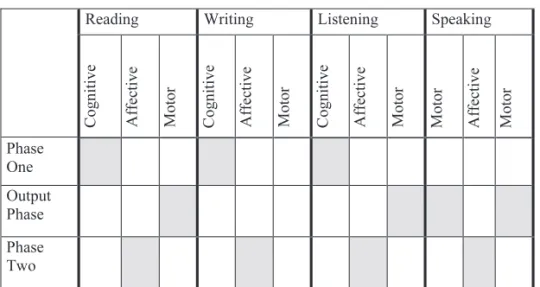
The content of the test provides a fairly solid basis for covering the 4 expected skills of an EFL assessment (reading, writing, speaking and listening). It was engineered so that it allows for the implementation to be completed in a way that promotes the three educational objectives of Bloom’s Taxonomy; affective, motor and cognitive. The test’s implementation should allow for
students to be able to relate the following domains of Bloom’s Taxonomy and the 4 assessable language skills of EFL:
TABLE 1 Structure of phases
This table illustrates that throughout the three phases it is expected there will be a fair coverage of the different skills. It should be noted that although connecting the higher order domains of Bloom’s Taxonomy and the four assessable goals of EFL is at first glance problematic and counter intuitive. However, if in the development of the test material both Bloom’s Taxonomy and the four assessable skills of EFL are considered as an impetus in the
creation of testing objectives, it can assist in developing unique approaches such as those found in this assessment. This was a primary focus from the outset of development of this research, that is, a test that innovates but still adheres to contemporary expectations of what a test should be able to accomplish.
Finally, it should be noted that although this table illustrates the relationship between the four major skills to be covered and the higher order aspects of Blooms Taxonomy, the complexity and level of amalgamation of the items varies. This is inherently due to the structure of the test and the disposition of the participants in the test themselves.
Description of the assessment task procedure
The following test structures, questions and content are based on the test specifications that can be viewed in Appendices A-G. The test itself was
primarily split into two phases, with a section of time allocated between the phases provided for students to complete an output construction activity. The test covered all the aspects of the principal language skills (listening, reading, speaking, writing and grammar). The phases of the project were as follows: Phase one
Reading Writing Listening Speaking
Cogniti
ve
Affective Motor Cogniti
ve
Affective Motor Cogniti
ve
Affective Motor Motor Affective Motor
Phase One Output Phase Phase Two
Phase one covered the application of the test from the outset until the enactment of the output activity. The first part of the test was a two paragraph summary that then needed to be paraphrased into four sentences. Students then needed to listen to oral instructions that provided the steps that needed to be followed to complete the output portion of the test; these instructions were recorded and then used as a guide in the output activity.
Output activity
The completion of a functioning water rocket was designed to be the focus of the assessment, in that it took the testing criteria from the first phase to complete the required output activity effectively and provided an impetus for students to be able to complete the work required in the second phase. Phase two
The second phase consisted of students orally reflecting on their ability to complete their tasks in the output activity and identifying what they were able to complete effectively and what they found to be difficult or beyond their ability. Following this, there was also be a short multiple-choice reading activity that also acted as a reflective testing device. It is important to note that this was a guided reflection and only formed a portion of the assessment.
Timing of the assessment task procedures.
As timing of the assessment was of paramount importance to maintain credible results when comparing other groups, students were made aware of the time limitations of each phase. A fair and useful timeframe is provided below. Phase one
Reading (5 minutes)
Read a two paragraph summary that contains all the relevant
information to complete the test. This information pertains to the whole test, not only the output activity.
Writing (5 minutes)
Students need to be able to read and review what was covered in the summary by writing four sentences that paraphrase the primary content. It is important that students rewrite the information in their own words whilst maintaining the information from the summary without changing the meaning of the text.
Listening & Writing (5-10 minutes).
Students will listen to the facilitator whilst he or she reads out a set of instructions related to the output activity. These instructions will be read through three times completely to allow for students to fully account for all steps to be recorded in the student testing paper.
Output activity
The output activity consists of students creating a water rocket from two plastic bottles. They will need materials and tools to complete this activity; these would be listed in the first phase. Students have one opportunity to grab the materials and tools they need without incurring a penalty.
Phase two
Listening & Speaking (15-20 minutes)
The facilitator will individually interview students. They will be required to listen to and reply to questions effectively. There will be no written information for this portion of the test, however a uniform script will be
provided to the facilitator or facilitators to maintain standardized results. As this portion of the test can be considered time intensive depending on the ratio of facilitators to students, interviews should last no longer than two minutes each. Reading and Writing (Concurrent with Listening and Speaking)
Whilst students are waiting to complete their interview they will work through the multiple-choice activity (Appendix D) that will reference what they have completed thus far. This will act as a secondary reflection to coincide with the interview and should in no way be deemed as a primary indication of academic assessment.
Appendices B, C & G refer to portions of the full booklet that will be provided to the facilitator and student that covers all the information required for the completion of the test.
In accordance with the expectations of this study this test is aimed at incorporating an output task that utilizes a hands-on or functional approach. There are two primary reasons for this, as opposed to a more traditional EFL testing approach:
Firstly, the question of motivation in EFL students (specifically in regard to the Japanese EFL system) means activities and tasks sometimes need to overcome a barrier of student interest. If a student can see the utility in the activity they are undertaking, then they are more absorbed and attentive to the requirements and expectations.
Secondly, the design of this test, although utilizing a fairly unique approach to EFL assessment, provides an equitable approach, with all students having a fair starting point.
Based on the results of this study the test is considered to adequately cover all aspects of the principal language skills. However, this assessment is dependent on a facilitator or facilitators who are able to proficiently implement a test that may not be uniformly standard in regard to other testing methods that are traditionally considered suitable to EFL. That being said however, the benefits of this testing method outweigh the prospective difficulties.
Between the beginning of development of the testing structure and the administration of the test to the volunteers there were several rounds of
consultation and review with peers and colleagues. The objective of this process was to isolate the specific aspects of the testing package that could act as buffers to differentiate the learners experience from year to year, essentially eliminating the opportunity for students to become familiar with the structures to be
implemented. Ongoing development of a bank of optional output activities that can be interchangeable from one year to the next is one way in which to provide
a unique experience to the test taker. This would only require minimal redevelopment of the rubric and teacher instruction programs. However, the teacher packages would need to be redesigned. Some of the expected output activities to be considered could be: water rockets, chopstick windmills, solar cooking, origami, and Lego robotics.
These output activity examples provide a suitable amount of variation, while at the same time remaining functional and in line with the aspects of differentiation of standard assessment structures that this paper looks to consider. These changes would allow for the integrity of the testing procedures to be maintained from year to year, and are not complex enough to pose difficulties to anyone unfamiliar with hands on activities such as these.
The following are the details of the students who made themselves available to volunteer for this study; attempts were made to find unique volunteers who would provide a variation in the recorded data.
TABLE 2
Details of volunteers for qualitative feedback.
Test specifications
As noted, the test incorporates a traditional paper-based testing method in phases one and three. Although the paper test is utilized as a reference in phase two, there is no writing to be completed. As with the other unique aspects of this test, this decision was made in the hope of promoting a higher order level of thinking and understanding of English so that rather than idly sitting and completing a test, students are mobile and engaged. Throughout the
implementation of the test with the two volunteer participants they related to the instructions recorded in phase one of the test during the output phase. One of the volunteers took longer to relate the instructions from phase one to the output phase, and thus took longer to complete the output phase than the other volunteer who continuously referred to the instructions and materials list.
Volunteer One. Volunteer Two. • High school 2nd year
• 16 years old. • Japanese.
• Low English Ability
• High school 2nd year
• 16 years old. • Half Japanese /
Half Filipino.
Instructions for candidates
The complexity of oral instruction was considered to be slightly above the expected level for this group of participants. However, during discussion with colleagues an agreement was made that although the oral instruction may seem difficult at first, the language used should not be unique to the test itself and should have been practiced and reviewed throughout the preceding term. This assumption was supported by the reported experience of the participants of the test. They noted in the post testing feedback interview that the language used did seem difficult at first, but they were able to refer back to what they learnt and remembered in their class work and this helped them to complete their tasks. Quality of individual test items
Overall the quality of the test items remained consistent. However, one repeated criticism was the inclusion of an output activity, because, although it provides the basis for the unique approach to this testing method, it is reliant upon the provision that a bank of non-specific output activities be developed. This provision is required in order to remove the opportunity for students to share their knowledge of previous testing standards to those students who have yet to receive the test.
Representativeness of the sample
The volunteers were suited to the English ability expected in the
development of the testing structures. Their English level and ability allowed for them to be challenged by the contents of the test without being overwhelmed by the language or procedures used.
Reliability and validity
The usefulness of the execution of this test is dependent on the ability of the test administrator to provide a uniform experience to each individual student who takes the test. This is requisite to providing a fair median to each individual and can be facilitated by a bi-yearly validation procedure with colleagues and a creation of a bank of output activities that can be used interchangeably to reduce the possibility for dishonesty.
Scoring procedures
Although a rubric was developed to assist in maintaining standardized scoring procedures, there was significant criticism and constructive advice provided from colleagues in regard to the fact that it did not go far enough in providing an adequate indication of grammar, syntax, accuracy and vocabulary. The best course of action would be to provide an example of standard expected phrases in the rubric, which would then allow for the rubric to be utilized in reference to the standard correct responses and compared to the student’s response. However, these scoring procedures, including the rubric, will need to go through a validation process from year to year, specifically in response to the inclusion of new differing output activities.
Aspects of moderation
The explicit testing procedures as detailed in the testing specifications allow for a refined approach to the moderation of the results. During the sample testing moderation of the volunteers (Appendix H) the feedback was as
expected, as the student with higher ability in English prior to the application of the test did better in all phases of the test. It is hoped that these results not act as only a minor suggestion, and that in a real world testing environment the
standards would maintain a similar curve and be an indicator of progress, not an indication of a student’s ability in completing the output activity.
Summary of testing procedures in this study
Overall the testing procedures held up very well when reviewed with colleagues and also during the volunteer testing phase. Only minor changes were required, and it is the consideration of this study that the majority of these changes, rather than reinterpret the crux of the innovative nature of this
approach, seek to enrich it further, by isolating key elements and improving upon them. Specifically of note to the test adjudicators was the implementation of unique output activities that allow for this procedure to move into multiple scenarios that keep it fresh for the test takers.
A notable criticism that was encountered, one that led to a major reconsideration of the rubric, was that the language used in the rubric itself was too vague. After trialing the testing procedures, the authors concluded that with further development and trialing the language could be much more thorough. For example, Phase Two consists of an oral interview and a written response portion, and the rubric would benefit from more defined language to prevent any miscommunication of the demonstrated skills expected to achieve a specified grade.
The primary additions to the rubrics that would be suggested when implementing this study again would be indicators of proper grammatical structures that should be adhered to when assessing the quality of the answers. One of the key criticisms encountered from colleagues was the language was fairly vague in the rubric and would need to be clarified to be of value. Results of testing
All students were able to complete the output task within the parameters outlined in the rubric (Appendix E); however, responses from students during the interview phase of the assessment greatly varied in length and complexity. The section that proved most difficult was the rewriting phase (Appendices A & E) with no students able to accurately synthesize the instructions read aloud by the tester.
CONCLUSION
Although there is no doubt that the function of objective assessment is an important part of learning, the testing model proposed here prove there are fairer and more comprehensive alternatives available. With planning,
assessment, review and development, alternative assessment approaches such as these can provide a practical measure for those students that may fall outside the realm of focus of a typical curriculum, such as that in Japan. However, as stated in the introduction to this study, this should not be considered a paradigm shift in common assessment programming. The findings of this study suggest that it could be a valid alternative in a narrow scope of application.
It works well for those students who are willing to try and adapt to the task, but as this approach is radically different to the other styles of testing that students in Japan are used to, it could alienate some students. Furthermore, because Gardner’s theory of Multiple Intelligences is a theory grounded in utilizing differing approaches to learning, it is fair to accuse this method of being too liberal with, and pandering to, those students with skills in woodworking, manual labor or those that have good hand eye co-ordination as opposed to those students who may primarily be interested in, or talented with English. In response to these two criticisms, firstly, it is important to state again that the test is a measure of the students speaking, listening, reading, writing and their ability to follow instructions. It is not a difficult task for this age group, and as long as students follow the instructions provided they should be successful in their task. Also, as already stated, it is very important to have a comprehensive assessment rubric that is able to be flexible yet fair to all students. Secondly, the argument that the current testing methods in Japan serve students fairly without any hint of bias to one group or another is a fallacy, as there will always be students who exist outside the subset target. The only difference with the method of testing proposed in this study is that the assessment focus has been shifted from the focus of reproducing memorized information to utilizing language knowledge in the expectation of outputting the desired concepts in pursuit of a goal.
The outcomes of this research accurately reflected the expectations of class performance, and students achieved at a level that was predicted of them prior to the application of testing. It is fair to say that although testing should reflect the knowledge presented throughout the course of study, there should be less emphasis on the use of testing data to guide pedagogical development, as testing has arguably done little for long term student development. However, if we look to unique ways of testing implementation, such as the concepts covered in this paper, it can provide more fulfilling and useful outcomes to students and educators alike.
After interviewing the volunteers and comparing the expectations of this research paper, the findings of this study can be summarized in two individual points:
1. Motivation is key. Allowing for students to bridge the gap of interest, and become self-motivated learners is paramount to providing valid opportunities for assessment to take place.
Intelligences provides learners with multi-faceted approaches to comprehension and understanding. It is not a new idea to pair language learning approaches to different areas of knowledge; however, it can be considered that in regard to assessment methods there is room for improvement.
It is the hope of this study that the future will see a shift away from the deterministic nature of Japanese educational pathways, where students are fast tracked at an early age and a move towards holistic education that looks to education as the enabling of students to seek fulfillment and not the element that deprives them from of their potential from an early age.
REFERENCES
Aubrey, S., Colpitts, B., & Nowlan, A. (2015). Barriers to English
Communication in Confucian Culture Heritage Countries: A Focus on Japan. Annual Research Report of the Language Center of Kwansei Gakuin University, (18), 3-10.
Hamada, Y. (2011). Different demotivators for Japanese junior high and high school learners. Journal of Pan-Pacific Association of Applied Linguistics, 15(1), 15-38.
Hui-ju, L., & Ting-han, C. (2013). Foreign language anxiety in young learners: how it relates to multiple intelligences, learner attitudes, and perceived competence. Journal of Language Teaching & Research, 4(5), 932-938. doi:10.4304/jltr.4.5.932-938
Kartiah, S. R., Rahman, M. A., Rahman, A. Q., & Jabu, B. (2014). The
portrayal of multiple intelligence theory in English teaching strategy for Indonesian secondary school. Journal of Language Teaching and Research, 5(5), 1052-1061.
Kim, M. K. (2015). Students’ and teacher’s reflections on project-oriented learning: A critical pedagogy for Korean ELT. English Teaching, 70(3). Kwek, S.H. (2011). Innovation in the Classroom: Design Thinking for 21st
Century Learning. (Master’s thesis). Retrieved from
www.stanford.edu/group/redlab/cgibin/publications_resources.php Ministry of Education, Culture, Sports, Science and Technology (MEXT).
(2014). English education reform plan corresponding to globalization. Retrieved from:
http://www.mext.go.jp/en/news/topics/detail/1372656.htm. Ohmori, A. (2014). Exploring the potential of CLIL in English language
teaching in Japanese universities: An innovation for the development of effective teaching and global awareness. The Journal of Rikkyo
University Language Center, (32), 39-51.
Oga-Baldwin, W.L.Q., Nakata, Y., Parker, P., & Ryan, R.M. (2017). Motivating young language learners: A longitudinal model of self-determined motivation in elementary school foreign language classes.
Contemporary Educational Psychology, 49, 140-150.
Snyder, R. F. (1999). The relationship between learning styles/multiple intelligences and academic achievement of high school students. The High School Journal, 83(2), 11-20.
APPENDIX
The following is an indication of the expected form, wording and length of the test materials to be provided to the facilitator and the student. A scoring rubric will follow the test material that covers phases one and two with a portion dedicated to informal assessment in the output activity.
APPENDIX A: Phase One – Summary
Phase One - Paraphrase INTRODUCTION
Today you will make a water rocket. To do this you will need to follow written instructions and listen to what the teacher tells you. Be careful to not make mistakes but ask questions if you need any help. It is important that you work quickly as you do not have a lot of time.
REWRITE
Rewrite the introduction information in 4 sentences. Make sure to include only the important information and try to use correct spelling and grammar.
APPENDIX B: Phase One – Listening & Writing
INSTRUCTIONS - TEACHER SCRIPT
Read these instructions to the class. Make sure to use a loud clear voice and repeat in full three times.
Materials:
1. A pair of scissors.
2. One roll of tape.
3. 2 plastic bottles that are the same size.
4. 3 square pieces of plastic.
Instructions:
1. Gather all materials.
2. Cut the bottom half off ONE of the bottles.
3. Tape the bottom of one of the bottles to the bottom of the other bottle.
4. Cut a triangle out of the three pieces of plastic.
5. Tape the triangle pieces to the bottom half of the water rocket.
INSTRUCTIONS Materials: 1. 2. 3. 4. Instructions: 1. 2. 3. 4.
APPENDIX C: Phase Two – Listening and Speaking INTERVIEW - TEACHER SCRIPT
Read these questions to each student during the interview. Answer any questions they have in reference to the interview questions and make certain to record all answers.
Questions:
1. Did you complete the activity?
2. Did you enjoy making a water rocket?
3. Do you remember the materials you used? What were they?
4. Do you remember the tools you used? What were they?
APPENDIX D: Phase Two – Reading and Writing
MULTIPLE CHOICE
1. How much time was there to complete the second part of the activity?
a. 15 minutes
b. 25 minutes
c. 35 minutes.
2. What did you use to cut the plastic?
a. Glue
b. Tape
c. Scissors
3. How many different materials were there?
a. 5
b. 4
c. 3
4. How many different instructional steps were there?
a. 3
b. 4
c. 5
5. What shape did you cut out of the plastic?
a. b. c.
APPENDIX E: Complete Rubric
The following is a basic rubric that can be used to convert the
representation of the student’s ability of the principal language skills through the phases of the test. These indicators should be reviewed prior to the engagement of the test and reviewed in accordance to the scoring procedures and moderation on an annual basis.
Phase One
Item Details
Rewrite Concerns the student’s ability to synthesize the provided information and summarize all important details succinctly. Above
Proficiency (3 points)
Accurately synthesize the details of the summary into four grammatically correct sentences.
Proficient (2 points)
Synthesize the majority of the details of the summary into sentences.
Below Proficiency (1 points)
Attempt to synthesize some of the details of the summary into sentences.
Instructions Concerns the student’s ability to accurately listen to and record the teacher’s verbal instruction.
Above Proficiency (3 points)
Record all details accurately and correctly.
Proficient (2 points)
Record details mostly accurately and correctly. Less than 5 errors.
Below Proficiency (1 points)
Output Phase Proficient (3 points)
As long as the student is able to follow the instructions accurately and build a water rocket they automatically receive 3 points. One point is deducted for an
incomplete water rocket and 1 additional point is deducted for needing to get more materials after the activity has begun.
Phase Two
Interview Concerns the student’s ability to answer the questions asked by the teacher.
Above Proficiency (3 points)
Answer all questions with little or no delay. Answer using full sentences that are verbally correct with correct pronunciation.
Proficient (2 points)
Answer more than 3 questions using full sentences.
Below Proficiency (1 points)
Attempt to answer at least 1 question.
Multiple Choice
Concerns the student’s ability to answer the multiple-choice questions that review the details of the activity. Above
Proficiency (3 points)
Answer all questions correctly.
Proficient (2 points)
Answer 3 of the 5 questions correctly. All 5 questions attempted.
Below Proficiency (1 points)
ENGLISH TEST
Name:Part One.
INTRODUCTION
Today you will make a water rocket. To do this you will need to follow written instructions and listen to what the teacher tells you. Be careful to not make mistakes and ask questions if you need any help. It is important that you work quickly as you do not have a lot of time.
The first part of the activity will be to listen to the teacher as he reads all the important information to you. Make sure you note down all the important steps to follow and the materials and tools you can use. The second part of the activity will be building your water rocket, be careful because you only have 15 minutes, so you should be careful to read the steps and follow them correctly. The final part of the activity will be a short interview. The teacher will ask you questions about how well you were able to build the water rocket and follow all the steps.
REWRITE
Rewrite the introduction information in 4 sentences. Make sure to include only the important information and try to use correct spelling and grammar.
APPENDIX F: Student Copy
What follows is the standard test form that would be provided to a student taking the test and also the information provided to the facilitator that would be running the test. The rubric has not been included in the facilitators’ copy as the facilitator may not be the individual who would be marking the test.
INSTRUCTIONS
Write down the materials and the instructions that your teacher will read. These instructions will be read 3 times. Materials: 1. 2. 3. 4. Instructions: 1. 2. 3. 4. 5. Part Two MULTIPLE CHOICE
1. How much time was there to complete the second part of the activity?
a. 15 minutes
b. 25 minutes
c. 35 minutes.
2. What did you use to cut the plastic?
a. Glue
b. Tape
c. Scissors
3. How many different materials were there? a. 5
b. 4 c. 3
4. How many different instructional steps were there? a. 3
b. 4 c. 5
5. What shape did you cut out of the plastic? a.
b. c.
APPENDIX G: Teacher Copy Phase One – Listening & Writing INSTRUCTIONS - TEACHER SCRIPT
Read these instructions to the class. Make sure to use a loud clear voice and repeat in full three times.
Materials:
1. A pair of scissors.
2. One roll of tape.
3. 2 plastic bottles that are the same size.
4. 3 square pieces of plastic. Instructions:
1. Gather all materials.
2. Cut the bottom half off ONE of the bottles.
3. Tape the bottom of one of the bottles to the bottom of the other bottle.
4. Cut a triangle out of the three pieces of plastic.
5. Tape the triangle pieces to the bottom half of the water rocket. Phase Two – Listening & Speaking
INTERVIEW - TEACHER SCRIPT
Read these questions to each student during the interview. Answer any questions they have in reference to the questions and make certain to record all answers.
Questions:
1. Did you complete the activity?
2. Did you enjoy making a water rocket?
3. Do you remember the materials you used? What were they?
4. Do you remember the tools you used? What were they?
APPENDIX H: Results of Qualitative feedback from volunteers.
This is an annotated version of the feedback provided to 3 questions asked by the teacher during the output phase of the assessment. The volunteers agreed to their responses being recorded.
Volunteer One. Volunteer Two. Question One.
Did you complete the activity?
I didn't finish. It was easy. I think I made some mistakes, but it was fun.
Question Two. Did you enjoy making the water rocket?
Hai. Yes, I like it. I really enjoy making water rockets. The water rocket has lots of power ha-ha.
Question Five. What was the hardest part of the activity?
The steps were hard. I think trying to follow the steps without Japanese was difficult. But not too difficult.