ISSN 1347-3948
No. 15 2017
平成29年 3 月
東 京 農 工 大 学 農 学 部 附 属 広 域 都 市 圏 フィールドサイエンス教育研究センター
東京農工大学農学部附属FSセンターJ. FIELD SCIENCENo.15 2017
フィールドサイエンス
フィールドサイエンス
Journal of Field Science
フィールドサイエンス 第 15 号
目 次
論 文
1 樹上性ヤマヨツボシオオアリの女王越冬生存における大型ワーカーと小型ワーカーの貢献/白戸亮 吉・廣田忠雄
7 東京都心部の赤坂御用地におけるタヌキのタメフン場における個体間関係/小泉璃々子・酒向貴 子・手塚牧人・小堀 睦・斎藤昌幸・金子弥生
15 動物園・水族館の展示を評価する─関東地方の動物園・水族館の調査─/武田庄平・榎本はるか・
小林大佑・福田早紀子・荒川直輝・安東幸志朗・原 祐菜・藤坂航大・盧 曦子
研究資料
29 DNA バーコーディングを用いた九州からの外来性ワラジムシ類 Porcellio scaber の発見/唐沢重 考・岩崎朝生・中島 淳
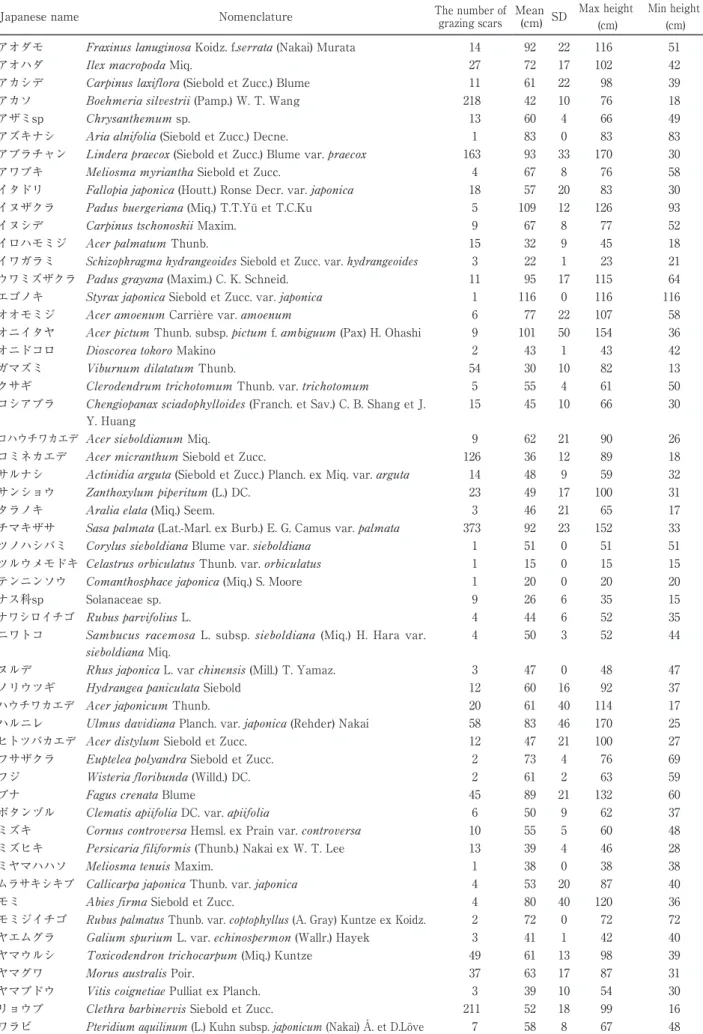
35 群馬県赤谷川上流域における有蹄類による食痕の地上高の分布とその植物種間差/篠田悠心・赤坂 宗光
41 ツキノワグマの冬眠行動研究における首輪内蔵型温度センサーの有効性の検討/長沼知子・横手里 美・宮田桂子・小島善則・小坂井千夏・中島亜美・山﨑晃司・小池伸介
49 カメラトラップを用いた赤坂御用地におけるホンドタヌキの個体数推定/岩﨑佳生理・斎藤昌幸・
酒向貴子・小泉璃々子・手塚牧人・金子弥生
論 文
2016.11.18受付;2017.2 .15受理
*1 日本医療科学大学 Nihon Institute of Medical Science
*2 山形大学理学部生物学科 Department of Biology, Faculty of Science, Yamagata University
Akiyoshi S
HIROTO*1, Tadao H
IROTA*2†Both major and minor workers enhance overwintering success of queens in the Japanese arboreal ant Camponotus yamaokai
白戸 亮吉
*1・廣田 忠雄
*2樹上性ヤマヨツボシオオアリの女王越冬生存における 大型ワーカーと小型ワーカーの貢献
The higher proportion of polygynous ant species in northern areas indicates that cold climates influence the number of queens per colony. However, the ecological and physiological factors allowing polygynous species to inhabit cold climates remain ambiguous. The facultatively polygynous ant Camponotus yamaokai inhabits colder areas compared to its monogynous sibling species, C. nawai. A previous study demonstrated that cohabitation by workers facilitated the overwintering success of C. yamaokai queens, whereas overwintering founding queens were solitary in C. nawai. Major workers of C. yamaokai are reported to play the role of honeypots in summer, and minor workers engage in foraging activity. Trophallaxis between workers was also observed under overwintering conditions. Therefore, trophallaxis is a possible proximate factor facilitating the overwintering success of queens. Here we investigated whether nutritional state of workers and queens influenced the survival of C. yamaokai queens under overwintering conditions.
Overwintering experiments revealed that queen survival was not affected by the nutritional state of workers.
Furthermore, even when queens cohabited only with unfed minor workers, queen survival was higher than solitary queen survival. Therefore, factors other than trophallaxis could explain how queen survival during winter is facilitated by cohabitation by workers. The other possible proximate factors are the roles of workers as temperature and moisture buffers.
Keywords:Hymenoptera, polygyny, queen survival, overwintering, trophallaxis
北方で多女王制のアリ種が高い比率で見られることから,寒冷な気候はコロニー内女王数に影響を与えて いることが示唆される。多女王制種の寒冷環境への生息を可能とする要因は未だ不明瞭である。条件的多女 王制種のヤマヨツボシオオアリ(Camponotus yamaokai)は単女王制の姉妹種であるナワヨツボシオオアリ
(C. nawai)よりも寒冷な地域に生息する。過去の研究から,ワーカーと共に越冬したヤマヨツボシオオア リ女王は単独のナワヨツボシオオアリ女王よりも越冬成功率が高いことが示されている。ヤマヨツボシオオ アリのメジャーワーカーは夏季には密壷としての役割を果たしており,マイナーワーカーは採餌活動に従事 していることが示唆されている。ワーカー間の栄養交換は越冬条件下でも観察されているため,栄養交換が 女王の越冬成功率を高めている可能性がある。本研究では,ヤマヨツボシオオアリの越冬条件下でワーカー,
女王の栄養状態が女王の越冬生存に与える影響を研究した。実験から,ワーカーの栄養状態は女王の生存に 影響しないことが明らかとなった。一方,飢餓状態のマイナーワーカーと共に越冬した女王は,単独の場合 よりも生存した。そのため,ワーカーの気温や湿度の緩衝材としての役割など,栄養交換以外の要因が女王 の冬季生存に影響していると考えられる。
キーワード:ハチ目,多女王制,女王生存,越冬,栄養交換
フィールドサイエンス(J. Field Science)15: 1 ‒ 6 ,2017 1
Introduction
In eusocial hymenopterans, queen number is an important factor influencing the social system and intracolonial relatedness. Phylogenetic studies have indicated that monogyny (a single queen per colo- ny) is an ancestral state (Hughes et al., 2008a, b).
However, polygyny (multiple queens per colony) has independently evolved in many phyletic lines of ants (Heinze & Foitzik, 2009). Therefore, increas- ing queen number should have advantages to offset disadvantages due to low relatedness. In Leptotho- rax (Heinze, 1993; Heinze & Hölldobler, 1994), Neiva- myrmex (Kronauer & Boomsma, 2007), and Cam- ponotus (Satoh, 1990), polygynous species occur in more northern areas than monogynous species.
Thus, high cold tolerance would be an advantage of polygyny. However, the ecological and physiologi- cal factors allowing polygynous species to inhabit cold climates remain ambiguous (Heinze & Foitzik, 2009).
In the present study, we investigated overwin- tering success of the polygynous arboreal ant Cam- ponotus yamaokai. The facultatively polygynous ant C. yamaokai inhabits colder areas compared to its related monogynous species, C. nawai (Satoh, 1989, 1990). C. nawai alate females leave their natal nests for the nuptial flight during summer, and overwinter solitarily without laying eggs until spring. In contrast, alate new queens of C. yama- okai do not perform nuptial flight but overwinter in their natal colony. C. yamaokai alate queens never overwinter alone without workers. Our previous study showed that the presence of workers signifi- cantly increased queen survival in both C. yama- okai and C. nawai (Shiroto et al., 2011). These results suggest that whether queens overwinter with or without workers would have some degree of influence on the geographical distributions of both species. However, the factors increasing queen survival remain ambiguous.
We speculate that trophallaxis from workers to queens plays a role of the proximate factor by which workers facilitate queen survival during winter (Shiroto et al., 2011). When colonies of C.
yamaokai starved, major workers actively fed nest- mates (Sanada et al., 1997). Major workers play the role of honeypots in the congeneric ant C. nipponi- cus (Hasegawa, 1993). In C. yamaokai, major work- ers performed trophallaxis even under overwinter- ing conditions (Shiroto et al., 2011). However, it is unclear whether the frequency of trophallaxis is sufficient to facilitate queen survival under over- wintering conditions when worker activity is gen- erally low. Here we investigated how the nutri- tional status of workers influences the overwintering survival of queens. If trophallaxis is important for enhancing queen survival, it is predicted that fed major workers would prolong queen survival more than starved major workers, whereas minor work- ers with a low honeypot ability would have a negli- gible influence.
Others, crowding by workers could decrease metabolic rates of queens by avoiding moisture loss during dry winters (Tanaka et al., 1988) or acting as a temperature buffer (Kaspari & Vargo, 1995). If these factors are more important than trophallaxis, minor workers would also enhance overwintering queen survival rate. Thus, the aims of the present study are to reveal 1) how starved and fed major workers influence overwintering success of queens and 2) whether minor workers influence queen survival.
Materials and Methods 1. Sample collection and maintenance
Colonies of C. yamaokai were collected during September 2009 and 2010 (40 and 25 colonies, respectively) at Iwaki (Japan, N37°03′, E140°53′).
Ant colonies occupying dead branches and stems of dead bamboo were transferred into plastic bags (Ziploc freezer bag, Asahi Kasei Home Products Corporation). In the laboratory, each colony was moved into a plastic box (8.4×8.4×4.6 cm, Nakaya Kagaku Sangyo). The colonies were maintained under light:dark conditions of 16 : 8 h and a tem- perature of 25℃±1℃. Red cellophane-coated plas- tic straws (diameter, 5 mm; length, 4 cm; Qlinp co., Ltd) were placed in the plastic boxes as nesting sites. FluonPTFE (Asahi glass co., ltd, Japan) was フィールドサイエンス 15号
2
Each treatment group was moved to a plastic box (8.5×6.6 ×3.1 cm, Nakaya Kagaku Sangyo). Red cellophane-coated plastic straws (diameter, 5 mm;
length, 4 cm; Qlinp) were placed in the plastic boxes as nesting sites. FluonPTFE was painted on the sides of the boxes to prevent ants from escaping.
We did not assign individuals derived from differ- ent colonies to the same boxes.
We transferred the samples collected in 2010 at Iwaki to new plastic boxes to isolate them from stock colonies (8.5×6.6×3.1 cm, Nakaya Kagaku Sangyo). Of the total 23 experimental colonies, ten were supplied food; ten were not supplied food; and for the remaining three colonies, half of the work- ers were supplied food, whereas the remainder was not. Feeding treatments were conducted outdoors at the same place that sample maintenance away from direct sunshine for a week. After feeding treatments, we prepared three types of treatment groups: 1) unfed queen, 2) unfed queen and five fed major workers, and 3) unfed queen and five unfed major workers (n=13 per group). Each treatment group comprised nestmates. We did not assign in- dividuals derived from different colonies to the same treatment groups. Each treatment group was moved to a plastic box (8.5×6.6×3.1 cm, Nakaya Kagaku Sangyo). Red cellophane-coated plastic straws (diameter, 5 mm; length, 4 cm; Qlinp) were placed in the plastic boxes as nesting sites.
FluonPTFE was painted on the sides of the boxes to prevent ants from escaping.
In feeding treatments, many workers were fre- quently observed on foods. The gasters of fed workers appeared to obviously bulge to a larger degree than those of unfed workers.
3. Wintering experiment
After feeding treatments, all treatment groups were maintained under light:dark conditions of 10:14 h. The room temperature was set at 5.0℃±1℃
during the light period, at 0.4℃±1℃ during the first 10 h, and at −3.3℃±1℃ during the remaining 4 h of the dark period, respectively. These tem- peratures relate to winter temperature of Shizu- gawa (N38°40′, E141°26′), which is the northern painted on the sides of the boxes to prevent ants
from escaping. For feeding, we placed an absorbent cotton containing yolk and honey in the plastic boxes for 24 h every seventh day. We also supplied a moist cotton containing no nutrients. This cotton was changed twice a week and was left in the plas- tic boxes until the feeding treatment. To approxi- mate overwintering condition, before the feeding treatments, each plastic box containing ants sam- pled during 2009 was maintained without foods under light:dark conditions of 10 : 14 h and a tem- perature of 15℃±1℃ for 4 weeks. Each plastic box containing ants sampled during 2010 was kept outdoors in Yamagata University away from direct sunshine for 6 weeks without food.
2. Feeding treatments
We transferred the samples collected in 2009 to new plastic boxes for isolating them from stock colonies (8.5×6.6×3.1 cm, Nakaya Kagaku Sangyo).
Red cellophane-coated plastic straws (diameter, 5 mm; length, 4 cm; Qlinp co., Ltd) were placed into the plastic boxes as nesting sites. FluonPTFE was painted on the sides of the boxes to prevent ants from escaping. We maintained queens and workers separately. We supplied an absorbent cotton con- taining yolk and honey daily to queens from 12 experimental colonies but not to queens from the remaining 28 experimental colonies. We supplied an absorbent cotton containing yolk and honey daily to workers from 13 experimental colonies but not to workers from the remaining 14 experimental colonies. Feeding treatments were conducted un- der light:dark conditions of 16:8 h and a tempera- ture of 25℃±1℃ for a week. After feeding treat- ments, we established six different treatment groups: 1) fed queen, 2) unfed queen, 3) unfed queen and five fed major workers, 4) unfed queens and five unfed major workers, 5) unfed queen and ten fed minor workers, and 6) unfed queen and ten unfed minor workers (n=12 per group). The five major workers had almost the same weight as the ten minor workers (mean of wet weight per capi- ta± standard error: major worker, 5.20±0.23 mg;
minor worker, 2.61±0.11 mg; n=26 per group).
Workers enhance queen overwintering success(SHIROTO・HIROTA) 3
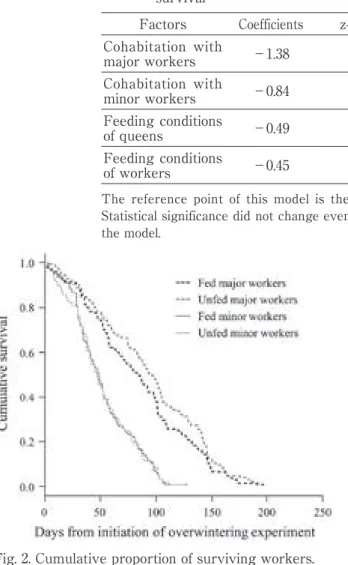
tion: P=0.98). Worker survivals were also independ- ent of workers’ feeding conditions (Fig. 2. major worker: P=0.33 and minor worker: P=0.73).
Discussion
Sanada et al. (1997) reported that major workers of C. yamaokai frequently exhibited trophallaxis under starved conditions. Trophallaxis was also observed under overwintering conditions (Shiroto et al., 2011). Therefore, we expected that fed work- ers, particularly major workers, would improve limit of C. yamaokai. During the light periods, the
number of surviving ants was recorded daily until all individuals were dead. Neither water nor food was provided to ants throughout the overwintering experiment.
4. Statistical analysis
The survival of individuals was analyzed with the Cox hazards random-effects model. Calculations were performed using “coxme” (ver. 2.1-3) in the statistical software R (ver. 2.14.1) (R Development Team, 2011). For all analyses, the duration from the first day of the wintering experiment to the last day observed alive was used as a dependent vari- able. Colonies from which individuals were derived were set as a random factor. Group composition (solitary queen, a queen with five major workers, and a queen with ten minor workers), feeding con- ditions of the queen, and feeding conditions of workers were set as independent variables. In both queens and major workers, we did not detect any significant differences between the collection years 2009 and 2010 and feeding conditions (P>0.05 in all cases). Therefore, we pooled the data of 2009 and 2010.
Results
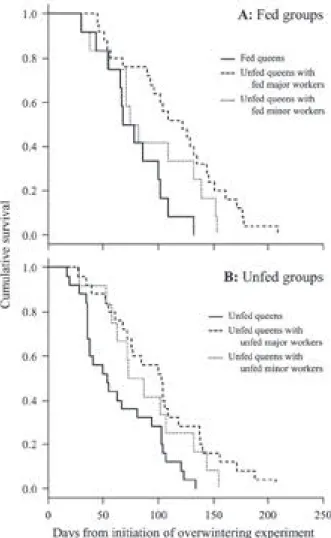
The Cox model indicated that queens cohabiting with workers survived longer compared to solitary queens regardless of the feeding conditions (Fig. 1., Table 1. cohabitation of major workers: P<0.001 and minor workers: P=0.036, no significant differ- ences between cohabitation of major workers and minor workers, P>0.05, used “survival” package).
Minor and major worker survived long period with extending queen survival (major workers: P=0.013 and minor workers: P=0.019).
Fed queens survived longer than unfed queens, and unfed queens with fed major workers survived longer than unfed queens with unfed major work- ers (Fig. 1). However, the cox model indicated that the feeding conditions of queens and workers had no significant influences on queen survival (queen’s feeding condition: P=0.32, major workers’ feeding condition: P=0.3, and minor workers’ feeding condi-
Fig. 1. Cumulative proportion of surviving queens.
(A) Groups including fed ant(s). The solid line represents a solitary fed queen (n=12). The broken line represents a single unfed queen with five fed major workers (n=25). The dotted line represents a single unfed queen with ten fed minor workers (n=12).
(B) Groups comprised unfed ant(s). The solid line represents a solitary unfed queen (n=25). The broken line represents a single unfed queen with five unfed major workers (n=25). The black dotted line represents a single unfed queen with ten unfed minor workers (n=12).
フィールドサイエンス 15号 4
overwintering success of queens. However, feeding conditions of major and minor workers did not influence queen survival under overwintering conditions. In addition, even when cohabiting with hungry minor workers who are poor donors during trophallaxis (Sanada et al., 1997), queens survived longer than their survival period under solitary conditions (Fig. 1, Table 1). These results indicated that trophallaxis of major workers to queens did not play an important role in enhancing the over- wintering survival of queens.
Therefore, some other proximate factors are re- sponsible for the link between the overwintering success of queens and cohabitation with workers.
Crowding by workers could decrease the metabolic rates of queens by preventing moisture loss during dry winters, as reported in the diapausing tropical beetle Stenotarsus rotundus (Tanaka et al., 1988).
Alternatively, Kaspari & Vargo (1995) suggested that workers surrounding a queen act as a tem- perature buffer. In social insects, many studies have also shown the positive influence of crowding on overwintering survival (Heinze, 1993; Heinze et al., 1996; Johnson, 2004; Kronauer & Boomsma, 2007; Shiroto et al., 2011; Tibbetts & Reeve, 2003).
However, not many studies have reported the proximate factors, and further studies are neces- sary to understand how crowding increases cold tolerance in social insects.
Feeding treatments for queens did not influence queen survival under the overwintering condition (Table 1). This result might be attributable to the life history of C. yamaokai. Because newly emerged queens remain in their natal colonies, queens al- ways cohabit with workers throughout their life history (Satoh, 1989). Therefore, C. yamaokai queens are always fed by workers like most ants.
There are no selection pressures acting to increase the foraging ability of queens. We rarely observed queens on foods during the feeding treatments.
Consequently, nutritional conditions of queens would not be different between starved and fed conditions.
In this study, we used queens, not alates. At its heart, we should have investigated the effects of workers on overwintering survival of virginal alates. However, in experimental overwintering Table 1. Results of the Cox proportional hazards random-effects model of queen
survival
Factors Coefficients z-values d.f. p-values Cohabitation with
major workers −1.38 −3.76 1 <0.001 Cohabitation with
minor workers −0.84 −2.09 1 0.04 Feeding conditions
of queens −0.49 −1.00 1 0.32 Feeding conditions
of workers −0.45 −1.25 1 0.20 The reference point of this model is the mean survival of solitary unfed queens.
Statistical significance did not change even when a random factor was removed from the model.
Fig. 2. Cumulative proportion of surviving workers.
The broken black line and grey line represent the fed major workers with a single unfed queen (n=125) and unfed major workers with a single unfed queen (n=125), respectively. The dotted black line and grey line represent the fed minor workers with a single unfed queen (n=120) and unfed minor workers with a single unfed queen (n=120), respectively.
Workers enhance queen overwintering success(SHIROTO・HIROTA) 5
queens : two routes to greater intracolonial genetic diversity in the eusocial Hymenoptera.
Journal of evolutionary biology 21(4) : 1090‒1095.
Johnson, R. A. (2004) Colony founding by pleomet- rosis in the semiclaustral seed-harvester ant Pogonomyrmex californicus (Hymenoptera : Formicidae). Animal behaviour 68 (5) : 1189‒
1200.
Kaspari, M. and E.L. Vargo (1995) Colony size as a buffer against seasonality: Bergmann’s rule in social insects. American Naturalist 145 (4) : 610‒632.
Kronauer, D. C. J. and J. J. Boomsma (2007) Multiple queens means fewer mates. Current Biology 17: 753‒755.
R Development Core Team. (2011) A Language and Environment for Statistical Computing. R Foundation for Statistical Computing, Vienna.
http://www.r-project.org/
Sanada, S., T. Satoh and Y. Obara (1997) Trophal- laxis and genetic relationships among workers in colonies of the polygynous ant Camponotus yamaokai. Ethology Ecology & Evolution 9 (2) : 149‒158.
Satoh, T. (1989) Comparisons between two appar- ently distinct forms of Camponotus nawai Ito.
Insectes Sociaux 36 (4) : 277‒292.
Satoh, T. (1990) Ecological studies on the ants, Cam- ponotus nawai complex with special reference to the polygyny. Doctoral thesis, University of Tsukuba.
Shiroto, A., T. Satoh and T. Hirota (2011) The Im- portance of Workers for Queen Hibernation Survival in Camponotus Ants. Zoological sci- ence 28 (5) : 327‒33.
Tanaka, S., H. Wolda and D.L. Denlinger (1988) Group size affects metabolic rate of a tropical beetle. Physiological Entomology 13 (2) : 239‒
241.
Tibbetts, E. A. and H. K. Reeve (2003) Benefits of foundress associations in the paper wasp Polistes dominulus : increased productivity and survival, but no assurance of fitness re- turns. Behavioral Ecology 14 (4) : 510‒514.
condition, there was no significant difference be- tween queen survival and alate survival (Shiroto, unpublished data). Therefore, regardless of queen's fertilization status, the present results are found to be useful for verify the effects of workers on over- wintering survival of C. yamaokai queens.
In feeding treatments, many workers were fre- quently observed on foods. The gasters of fed workers appeared to obviously bulge to a larger degree than those of unfed workers. Therefore, feeding treatments would change nutritional condi- tions of workers unlike those of queens. However, the feeding conditions of workers did not influence their own survival under the overwintering condi- tion (Fig. 2). Furthermore, minor and major worker survived long period with extending queen sur- vival. So, it is possible that the effect of intercolo- nial variance of constituent members was huger than variance due to nutritional conditions on de- termining overwintering success. Cold resistance may vary widely among colonies in C. yamaokai.
References
Hasegawa, E. (1993) Caste specialization in food storage in the dimorphic ant Colobopsis nipponicus (Wheeler) Insectes Sociaux 40 (3) : 261‒271.
Heinze, J. (1993) Life history strategies of subarctic ants. Arctic 46(4): 354‒358.
Heinze, J. and B. Hölldobler (1994) Ants in the cold.
Memorabilia Zoologica 48: 99‒108.
Heinze, J., M. Stahl and B. Holldobler (1996) Eco- physiology of hibernation in boreal Leptothorax ants (Hymenoptera : Formicidae). Ecoscience 3 (4) : 429–435.
Heinze, J. and S. Foitzik (2009) The Evolution of queen numbers in ants: from one to many and back. In : Organization of Insect Societies, from Genome to Sociocomplexity : 26‒50.
Hughes, W. O. H., B. P. Oldroyd, M. Beekman and F. L. W. Ratnieks (2008a) Ancestral monogamy shows kin selection is key to the evolution of eusociality. Science 320 : 1213‒1216.
Hughes, W. O. H., F. L. W. Ratnieks and B. P. Old- royd (2008b) Multiple paternity or multiple
フィールドサイエンス 15号 6
1 .はじめに
タヌキ Nyctereutes procyonoides はイヌ科の中型 食肉目動物であり,その社会構成単位は基本的にペ アと考えられている(谷地森ほか,1997; Kauhala and Saeki, 2004)。 日 本 の ホ ン ド タ ヌ キ N.p.
viverrinus の主な生息地は,奥山及び都市郊外から 里山・低地にかけての,緑地が連続している場所で ある(佐伯,2008)。タヌキはタメフンをすること が知られ,糞の匂いによって個体を区別することが できると 考 えられている(Yamamoto,1984)。ま た,タメフン場は特定のグループ内で共有される
論 文
Ririko K
OIZUMI*1, Takako S
AKO*2, Makito T
EDUKA*3, Mutsumi K
OBORI*4Masayuki U. S
AITO*5, 6, Yayoi K
ANEKO*5, 7Individual interaction at latrine sites of raccoon dogs in the Akasaka Imperial Grounds, central Tokyo
小泉璃々子
*1・酒向 貴子
*2・手塚 牧人
*3・小堀 睦
*4・斎藤 昌幸
*5, 6・金子 弥生
*5, 7東京都心部の赤坂御用地におけるタヌキのタメフン場における個体間関係
To reveal individual interaction at latrines in a raccoon dog population in an urban green area (Akasaka Imperial Grounds, 51ha) in central Tokyo, 6 individuals (4 adult males and 2 adult females) were radio- tracked from August to November 2012. In parallel, the radio-tagged individuals were observed at 11 latrines by camera traps. The tracked raccoon dogs were not recorded outside of the green area since home ranges were seemed as stable. Latrine usage and faece sniffing behavior increased in autumn, indicate that information exchange at latrine between individuals became active. In addition, 2 adult males and an adult female overlapped both in home ranges and core areas, as well as co-use a latrine in a core area, which imply the social unit may be not a pair.
Keywords:home range, latrine, monogamy, spatial organization, Nyctereutes procyonoides
都心部緑地に生息するタヌキのタメフン場における個体間関係を明らかにするために,2012年 8 月に赤坂 御用地内で捕獲した個体 6 頭(成獣オス 4 頭,成獣メス 2 頭)に首輪型発信機を装着し, 8 月から11月にか けて個体追跡を行った。また,同期間に調査地内のタメフン場11カ所にカメラを設置し,タメフン場におけ るタヌキの行動を記録した。追跡個体は,調査地から大きく出ることはなかったため,赤坂御用地の敷地内 を日常的な生息場所として利用しているものと考えられた。タメフン場の利用は秋に増加し,糞を嗅ぐ行動 も秋に増加した。このことから,秋にタメフン場における個体間の情報交換が活発になったと考えられる。
更に,成獣オス 2 頭と成獣メス 1 頭がタメフン場を共同利用し,かつ,行動圏およびコアエリアを大きく重 複させて生息していたことから,一般的な一夫一妻制の社会構造ではない可能性が示唆された。
キーワード:一夫一妻,空間配置,行動圏,タメフン, Nyctereutes procyonoides
2017.1 .31受付;2017.2 .17受理
*1 東京農工大学農学部 Faculty of Agriculture, Tokyo University of Agriculture and Technology
*2 宮内庁 Imperial Household Agency
*3 フィールドワークオフィス Field Work Office
*4 東京野生生物研究所 Tokyo Wildlife Research Centre
*5 東京農工大学大学院農学研究院 Institute of Agriculture, Tokyo University of Agriculture and Technology
*6 日本学術振興会 Japan Society for the Promotion of Science
*7 Corresponding author
フィールドサイエンス(J. Field Science)15: 7 ‒13,2017 7
(Ikeda,1984)。タヌキのタメフン場は,排泄の場 としてだけでなく,情報交換の場として利用されて おり,家族および隣接個体の確認や相互許容の機能 など,タヌキの 社 会 構 造 に 深 くかかわっている
(Ikeda,1984)。さらに,タメフン場は,採餌場と して利用されている可能性も指摘されている(手 塚・遠藤,2005)。九州の松浦島の餌マーク法を用 いた研究(Ikeda,1984)によると,タメフン場の 利用は季節的にまたは生活史にもとづき変化してい た。しかし,タメフン場におけるタヌキの詳細な訪 問時間や個体識別,排糞以外の行動に関する研究は 行われていない。
東京都においては,1950年代初頭まではタヌキの 捕獲例があったが,都市化の進行に伴い,都心部で の生存は1960年代後半に途絶えた(小原,1982)。
しかし,都心部緑地である東京都港区の赤坂御用地 では,1990年代前半からタヌキが目撃されるように なり,その後目撃例は増加傾向にある(手塚・遠 藤,2005)。このようにタヌキが近年,都市環境に も生息可能となった理由については,まだ調べられ ていない。本研究では,赤坂御用地に生息するタヌ キを対象として,行動圏の空間配置と行動圏内のタ メフン場における行動を明らかにし,赤坂御用地に 生息するタヌキの社会構造について考察することを 目的とした。
2 .方 法 2. 1 .調査地
調査地は,東京都港区北部に位置する赤坂御用地 である(図 1 )。調査地の面積は約51ha,標高約11
~34 m,気候は夏雨型の太平洋型気候で,年間降 水量1529 ㎜,年平均気温16.3℃である(気象庁ホー ムページ,2012)。赤坂御用地内には,東宮御所の
ほか,各宮家のご住居,芝生と池を配した庭園があ り,敷地の約 1 / 3 は広葉樹を主体とした雑木林と 針葉樹の植栽,梅林などが占める(大和田・武田,
2005)。人の出入りは制限されており,特に夜間は ほとんど人が見られない。
本調査地内では1990年代前半からタヌキが目撃さ れており,生後間もない幼獣が保護されるなど,定 着し繁殖しているものと考えられる(手塚・遠藤,
2005)。本調査と並行して行われた2012年から2013 年にかけての,カメラトラップを用いた標識再捕獲 法によるタヌキの個体数と生息密度の推定結果は,
それぞれ26.5頭 と0.52頭 /ha であった(岩 﨑 ほか,
2017)。調査地に生息する中型食肉目動物として,
タヌキのほか,ネコ Felis catus,およびハクビシン Paguma larvata が 確 認 されている(手 塚・遠 藤,
2005;酒向ほか,2012)。
2. 2 .捕獲と追跡
タヌキの 捕 獲 はソフトキャッチ17 台(VICTOR 社,ソフトキャッチ)および箱罠 5 台(サージミヤ ワキ株式会社,SMC アニマルトラップ NO. 1079ス トロング,片開き踏板式,長さ31.5×横26.0×長さ 81.5cm)を用いて2012年 8 月 2 日から 8 月 4 日にか けてのべ 2 日間行った。捕獲個体は塩酸ケタミンと 硫酸アトロピン,およびドミトールを用いて不動化 し(岸本・金子,2005),外部計測と首輪型発信機
(Biotrack 社 , TW-5 TRANSMITTER, 146- 147MHz, 150~180g)の装着を行った。捕獲個体は 十分に覚醒したことを確認し,捕獲地点付近に放遂 した。捕獲個体のうちメス 2 個体は,速やかに放遂 するため,アンチセダンを用いて覚醒させた。首輪 型発信機には個体識別のために蛍光テープや反射 テープを付けた。
個体の追跡は2012年 8 月から11月にかけて八木ア ンテナ(八木アンテナ株式会社製,H-4EL)と携 帯型受信機(YAESU 社,FT-290mkⅡ)を用いて 行い, 2 ~ 3 点から発信源の方向を求め,その交点 を個体の推定位置とした。手塚・遠藤(2005)より 調査地のタヌキの出現時間が夜間や日の出,日の入 り前後に多く,季節による日の出や日没時間の変化 に対しての活動時間の変化が認められなかったこと から,各個体の追跡は,17時から21時および17時か ら 7 時に行った。各個体の方探作業は最低15分間隔 で行った。追跡は17時から21時の行動追跡を 8 月に 2 回, 9 月に 2 回,10月に 3 回,17時から 7 時の行 図 1 .赤坂御用地と周辺の緑地
フィールドサイエンス 15号 8
用 いていることが 確 認 されたカメラ 1 台(No. 11)
を用いた(図 2 )。もう 1 台のカメラ(No. 5)を設 置した場所は,樹木の実生が密生していることから 過去にタメフン場として利用されていたと考えられ るが,調査期間中に排泄に用いられなかったため,
タメフン場利用状況の解析には含めず,個体間関係 を考察する補足資料とした。解析には捕獲作業によ る影響を低減させるため,捕獲期間および捕獲後 2 日間を除いた 8 月 7 日から11月 6 日までのデータを 用い, 8 月 7 日から 9 月21日を晩夏, 9 月22日から 11月 7 日を秋とした。また,10分以内に同一個体と 思われる個体が複数回撮影された場合は, 1 回のタ メフン場訪問として数えた。
カメラに映ったタヌキの行動は,排糞,糞を嗅ぐ,
探餌の 3 項目を記録した。各行動の定義は,
排糞:糞をする行動
糞を嗅ぐ:鼻先をタメフン場に近づける行動 探餌:前肢や鼻先で地面を掘る行動
とした。
3 .結 果 3. 1.行動圏とその空間配置
2012年 8 月 2 日, 3 日の捕獲調査ではオス成獣 4 個体(RM1,RM3,RM4,RM6),メス成獣 2 個体
(RF2,RF5),計 6 個体が捕獲された。メスは個 体 RF 2 ,RF 5 ともに泌乳が確認された(表 1 ).
しかし個体 RF 5 は 9 月中旬以降,発信が確認でき なくなったため、10月に赤坂御用地の外周や周辺の 動追跡を 9 月と11月に各 1 回行った。
また,調査地内で電波が確認できなくなった個体 について,10月に 1 回,ホイップアンテナおよび八 木アンテナと携帯型受信機を用いて赤坂御用地の外 周や周辺の緑地(明治神宮外苑,新宿御苑,皇居,
青山霊園)で受信を試みた。
2 . 3 .行動圏の解析
個 体 RM1,RF2,RM3,RM4,RM6について,
RANGE Ⅵ(Anatrack Ltd,UK)を用いて行動圏 サイズを 算 出 した。行 動 圏 サイズは,最 外 郭 法
(MCP)で 求 めた。先 行 研 究 と 比 較 するため,
100% 最外郭法を用いた。また,100% 最外郭法は 過大評価になりやすいため,95% 最外郭法による 行動圏サイズも求めた(尾崎・工藤,2002)。コア エリアは50% 固定カーネル法(FK)により算出し た(金子ほか,2008)。重複率は95% 最外郭法によ る行動圏と50% 固定カーネル法によるコアエリア について GIS(ArcView GIS 10 for windows)を用 いて計算した。個体 RF 5 は測位地点数が少なかっ たため,行動圏解析を行わなかった。
重複率(Iov)は,Herr et al.(2008)の重複率式 に100を乗じて求めた:
Iov= 2HRov
(HR1+ HR2)×100
HR1 ,HR2:各個体の行動圏面積 HRov :重複部分の面積
0 ≤ Iov ≤100
2. 4.タメフン場の利用状況調査
3 月および 4 月に赤坂御用地内をくまなく踏査 し,タメフン場の位置を記録した(図 2 )。確認さ れたタメフン場17カ所のうち11カ所に,個体識別,
行動などを記録するため,赤外線センサー付きカメ ラ(トロフィーカム XLT, Bushnell 製)を 設 置 し た。撮影は30秒の動画撮影とした。カメラは 8 月に 設置し, 2 週間ごとにデータの回収を行った。撮影 期間は 8 月 3 日から11月 6 日であった。
カメラによる調査はラジオテレメトリーによる行 動追跡と並行して行った。自動撮影によるタメフン 場利用の解析には設置した11台のうち首輪装着個体 3 頭の重複した行動圏内にある 2 台のうち,調査期 間中に排泄する行動が確認され,タメフン場として
図 2 . 赤坂御用地のタヌキの行動圏(2012. 8. ~2012. 11.)
行動圏の凡例記号はタヌキ各個体のID番号を示 す。
赤坂御用地のタヌキの個体間関係(小泉ら) 9
アエリアを重複させており,平均重複率は行動圏が 21.69±2.42(SD)%,コアエリアが13.6±3.32(SD)
% であった。
個体 RM1,RF2,RM3,RM6の95% 最外郭法の 行動圏は,すべて赤坂御用地の敷地内にあったが、
RM4は95% 最外郭法の行動圏が一部迎賓館(測定 地点51点のうち 1 点)にあり,目視によっても迎賓 館にいるところが確認された。敷地内の利用は行動 圏の配置により,敷地の全域に行動圏を持つ全域利 用型(RM4)と,敷地内の限られた箇所に行動圏 を持つ特定範囲利用型(RM1,RF2,RM3,RM6)
の 2 つのタイプがみられた。 また,RM1,RF2,
RM6は調査地東部の池付近の同様の場所に行動圏 が配置していた。
3. 2.タメフン場における個体間関係
カメラ No. 11で 撮 影 された 8 月 7 日 から11月 6 日の92日間の連続記録における合計タヌキ訪問頭数 はのべ221頭,日平均訪問頭数は2.4頭であった(表 3 )。カメラ No. 11を設置したタメフン場は,個体 RM1,RF2,RM4,RM6の 行 動 圏 及 びコアエリア の内部に位置し(図 2 )、個体 RM1,RF2,RM6が 撮影された。201回の撮影のうち, 1 頭で撮影され た回数が182回(90.5%),同時に 2 頭撮影された回 数は18回(9.0%),同時に 3 頭が撮影されたのが 1 回(0.5%)あった。季節ごとの全撮影回数に対する
2 頭 同 時 撮 影 回 数 の 割 合 は,晩 夏 が4.9%,秋 が 10.0% であり,秋に 2 頭が同時に撮影されることが 多かった。また,首輪装着個体 RM1,RF2,RM6 の他に,最大 2 頭の利用が確認された。首輪装着 3 個体の平均および各個体のタメフン場訪問回数は,
いずれも晩夏より秋の方が多く,首輪装着個体以外 も含むタメフン場を訪問した全タヌキのタメフン場 緑地(明治神宮外苑,新宿御苑,皇居,青山霊園)
を調査したが,受信することができなかった。
行動圏サイズは100% 最外郭法で平均13.80±12.49
(SD)ha,95% 最外郭法で平均10.18±11.86(SD)
ha であった。95% 最 外 郭 法 の 行 動 圏 の 最 大 は 33.86ha(RM4),最小は3.48ha(RM6)であった(表 1 )。コアエリア(50% 固定カーネル法)は95% 最 外 郭 法 の 行 動 圏 サイズの 平 均45.75%(4.57±5.35 SDha)だった。オス−オス間,オス−メス間で行 動圏の重複があった。オス−オス間の平均重複率は 22.14±23.91(SD)%,オス−メス間の平均重複率は 40.60 ±29.36(SD)% だった(表 2 )。個 体 RM1,
RF 2 ,RM 6 の行動圏及びコアエリアは重複率が高 く,平均重複率は行動圏が69.5±2.51(SD)%,コア エリアが60.43 ±8.35(SD)% だった。 個 体 RM1,
RF2,RM6と RM3の間に行動圏の重複は無かった。
また,個体 RM 4 はいずれの個体とも行動圏及びコ
表 1 .赤坂御用地のタヌキの捕獲個体情報(2012年 8 月捕獲)。MCPは最外郭法,FKは固定カーネル法。
個体ID 性別 成長段階 捕獲時
の体重(㎏) 追跡期間 (2012年) 地点数 (n) 100%MCP
(ha) 95%MCP
(ha) 50%FK
(ha)
RM1 ♂ 成獣 3.9 8 月13日−11月 7 日 58 16.14 4.03 2.98 RF2 ♀ 成獣 3.5 8 月13日−11月 7 日 56 6.58 5.49 1.53 RM3 ♂ 成獣 3.9 8 月13日−11月 7 日 63 5.27 4.06 2.15 RM4 ♂ 成獣 3.7 8 月13日−11月 7 日 53 37.23 33.86 15.19
RF5 ♀ 成獣 4.3 8 月13日− 9 月 3 日 11 − − −
RM6 ♂ 成獣 4.2 8 月13日−11月 7 日 60 3.76 3.48 1.00 表 2 . 赤坂御用地のタヌキの行動圏重複率
(2012. 8. ~2012. 11.)
個体ID 個体ID 重複率(%)
95%MCP* 50%FK**
オス−オス間
RM 1 RM 4 21.29 19.34 RM 1 RM 6 71.50 50.16 RM 3 RM 4 21.42 11.77 RM 4 RM 6 18.64 11.74
RM 3 RM 6 0 0
RM 1 RM 3 0 0
オス−メス間
RM 1 RF 2 65.96 60.50 RM 4 RF 2 25.41 11.55 RM 6 RF 2 71.04 70.62
RM 3 RF 2 0 0
*MCPは最外郭法,**FKは固定カーネル法
フィールドサイエンス 15号 10
れた。また,これらの個体間において,威嚇などの 敵対行動は見られなかった。カメラ No. 5 で非首輪 装着個体 4 頭が同時に撮影された。
更に,個体 RM1,RF2,RM6のタメフン場訪問 間隔は, 3 個体の季節ごとの平均が晩夏179.27±
127.73(SD)h,秋59.29 ±101.76(SD)h となった。首 輪装着 3 個体平均,個体 RM 1 ,RM6についてそれ ぞれ U 検 定(Mann-Whitney’s U-test)を 行ったと ころ,いずれも秋にタメフン場訪問間隔が有意に短 かった(首輪装着個体 3 個体平均 P=7.11e- 5 < 0.05,
RM 1 P=0.012<0.05,RM 6 P=0.015<0.05)。また,
個体 RF 2 はデータが少なく,検定を行うことがで きなかったが,晩夏より秋の方が短い同様の傾向を 示した(図 3 a,b,c)。
タメフン場におけるタヌキの行動のうち排糞の み,糞を嗅ぐ行動のみ,排糞および糞を嗅ぐ行動が カメラ No. 11のタメフン場でみられた回数は,季節 ごとに変化した(図 4 )。いずれの個体も排糞のみ 行われた回数は晩夏11回から秋26回に増加し,糞を 嗅ぐのみ行われた回数は晩夏 7 回から秋13回に増加 し,排糞および糞を嗅ぐ行動は晩夏21回から秋73回 へ3.5倍 になった。また,晩 夏 には 見 られなかった 探餌行動が,秋には計10回確認された。
4 .考 察 4. 1.行動圏と基本的社会単位
今回調査したタヌキの個体の行動圏は,大部分が 赤坂御用地の敷地内にあったことから,これらの個 体はほかの緑地を利用せず,赤坂御用地を主な生息 地としていると考えられる。従って,赤坂御用地内 訪問回数は秋の訪問回数は晩夏の訪問回数の約3.8
倍に及んだ。
個体ごとの訪問回数を比較すると,個体 RM1が 31回と最も多く,次いで RM6(25回),RF2(23回)
の順に回数が多かった。複数の首輪装着個体が同時 に撮影されることはなかった。
また,撮影された首輪装着個体 3 頭の平均訪問回 数で全個体訪問回数を除してこのタメフン場の利用 個体数を推定したところ,8.4頭となった。このほ か,個体数に関する情報としては,カメラ No. 5 に 4 頭(個体 RM 1 ,RF 2 を含む)が同時に撮影さ
図 3 . 赤坂御用地のカメラNo.11.のタヌキのタメフン場 訪問間隔(2012. 8. 7. ~2012. 11. 6.)
a)首輪装着 3 個体のタメフン場訪問間隔(h)
b)個体RM 1 のタメフン場訪問間隔(h)
c)個体RM 6 のタメフン場訪問間隔(h)
図 4 . 赤坂御用地におけるタヌキのタメフン場におけ る行動の季節的変化(2012. 8. 7. ~2012. 11. 6.)
赤坂御用地のタヌキの個体間関係(小泉ら) 11
体 を 区 別 できると 考 えられている(Yamamoto,
1984)。そのため,タメフン場で利用個体などの個 体情報を積極的に得るために,タメフン場に頻繁に 訪れるようになった可能性がある。また,秋は果実 の利用が増加するなど,食性が変化する時期である ことから(Hirasawa et al., 2006),餌資源の情報を 得ていたことも考えられる。
秋にはタメフン場で探餌が行われるようになっ た。手塚・遠藤(2005)によると,赤坂御用地に生 息するタヌキの糞における昆虫類の出現頻度は11月 期, 1 月期, 6 月期のいずれにおいても非常に高い が,出現種や出現種数は季節により変化しており,
特に11月期にタメフン場のような環境を好むハネカ クシ類やコオロギ類といった昆虫類がフン内容物に 目立って出現する。したがって,タメフン場におけ る探餌は,秋に採餌の多いハネカクシ類などの昆虫 を採食する行動であったと考えられる。
今回カメラ No. 11を設置したタメフン場は,行動 圏の内部に位置して複数の個体が共同利用していた ことから,既存の知見と同様に,タメフン場は行動 圏の防衛のために利用されているのではないと考え られる。以上より,タメフン場は,排糞の場,個体 間の情報交換の場,採餌場として利用されていると 思われる。
赤坂御用地のタヌキは、主に敷地内で活動してお り,行動圏を大きく重複させることで,限られた緑 地内での生息を可能にしていた。更に,成獣のオス 2 頭とメス 1 頭がタメフン場で情報を共有しながら 行動圏およびコアエリアを大きく重複させて生息し ていたことから,孤立緑地内でのタヌキの社会構造 が一般的な一夫一妻制の社会構造ではない可能性が 示唆された。今後,通年の行動や血縁関係について も調査を行い,検証していく必要がある。
謝 辞
本研究をおこなうにあたり,秋篠宮文仁殿下に は,赤坂御用地のタヌキ調査についての必要性およ びプロジェクト開始についてご提案いただいた。現 地調査を実施するにあたり,国立科学博物館動物研 究部の川田伸一郎氏,宮内庁庭園課の皆様には,
様々な便宜を図っていただき , 殊に矢藤光三氏,田 川淳氏には,現地調査への付き添いをはじめ,多大 なご協力をいただいた。なお,本研究は国立科学博 物館のプロジェクト研究の一環として同館の館長支 援経費から一部支援を受けて実施した。また,本研 で休息や採餌などが行われていると考えられる。赤
坂御用地内のタヌキは,敷地内全体を利用する全域 利用型個体と,限られた箇所に行動圏をもつ特定範 囲利用型個体がいた。これは,餌や水場、ねぐらな どの資源の利用方法の違いによる可能性がある。特 定範囲利用型個体は資源密集地を集中的に利用して いると考えられる。一方,全域利用型個体は,コア エリアが大きかったことから,敷地内全域を利用す ることで餌との遭遇率を上げ,多様な餌を得ている と考えられる。単独のオス個体とペア形成個体で は,行動圏の配置や構造が異なると考えられている
(関谷,1998)。そのため,全域利用型個体は,ペ ア形成をしていない単独個体である可能性がある。
また,特定の行動圏を形成せずに移動を続けている 可能性もある。
また,行動圏重複率の高い 3 個体はいずれも成獣 であり,タメフン場を共有していた。タヌキと同様 に一夫一妻制の社会構造を持つアカギツネとシマハ イイロギツネについて,高密度生息地において一腹 に複数の父系が確認されており,タヌキにおいても 同様な条件ではその可能性があるといわれている
(佐伯,2008)。従って,赤坂御用地内に生息する タヌキの社会構造が,一般的な一夫一妻の社会構造 ではない可能性が示唆された。ただし,タヌキは分 散様式が多様であることから(佐伯,2008),仔が 分散期後も親と同様の行動圏内にとどまっている可 能性もある。そのため,社会構造を明らかにするに は,通年の行動や血縁関係など,さらなる調査と検 証が必要である。
4. 2.タメフン場における個体間関係
タメフン場訪問間隔は,雌雄ともに秋の方が晩夏 より短かった。これは,秋に頻繁にタメフン場を訪 れるようになることを示している。秋は,タメフン 場における糞の数が増加することから(野紫木,
1987),季節変化に伴う食性や摂食量の変化によっ て排糞量が増加し,排糞回数が増加した可能性があ る。また,秋にタメフン場訪問頻度だけでなく,糞 を嗅ぐ行動が増えたことから,秋にタメフン場にお ける個体間の情報交換が活発になったと考えられ る。秋は仔の独立・分散が起こる時期でもあること
(谷地森ほか,1997 ),ペア形成が始まる時期であ ること(福 江,1996;Saeki,2009)から,秋 のタ メフン場訪問頻度の増加は,個体の分散やペア形成 と関係があると考えられる。タヌキは糞によって個
フィールドサイエンス 15号 12
大和田守・武田正倫.2005.赤坂御用地と常盤松御 用邸の動物相.国立科学博物館専報 39:1-5.
尾崎研一・工藤琢磨.2002.行動圏─その推定法,
及び観察点間の自己相関の影響.日本生態学 会誌 52:233-242.
小原秀雄.1982.東京の哺乳類.東京の生物史 (沼 田真・小原秀雄編).紀伊國屋書店.65-73pp.
佐伯緑.2008.第12章 里山の動物の生態.日本の 哺乳類学②―中大型哺乳類・霊長類 (高槻成 紀・山極寿一編).東京大学出版会.321-345pp.
Saeki, M. 2009. Nyctereutes procyonoides (Gray, 1834). The Wild Mammals of Japan(Eds.
Ohdachi, S. D. Ishibashi, Y. Iwasa M. A. &
Saitoh, T.). Shoukadoh Book Sellers. 216- 217pp.
酒 向 貴 子・手 塚 牧 人・小 泉 璃々子・金 子 弥 生.
2012.東京都の都心部と里山のタヌキの体サ イズの比較.哺乳類学会2012年度大会要旨集.
130pp.
関谷圭史.1998.Ⅴ まとめ 1.タヌキの社会の構 造.信州のタヌキ.郷土出版社.123-128pp.
手塚牧人・遠藤秀紀.2005.赤坂御用地に生息する タヌキのタメフン場利用と食性について.国 立科学博物館専報 39:35-46.
谷地森秀二・山本祐治・高田豊行・吉川欣亮・今井 清.1997.「休息場」利用状況および分子生物 学技術による野生ホンドタヌキの家族関係推 定.哺乳類科学 36:153-164.
Yamamoto, I. 1984. Latrine utilization and feces recognition in the raccoon dog, Nyctereutes procyonoides. Journal of Ethology 2:47-54.
野紫木洋.1987.志賀高原におけるホンドタヌキの 生態について.信州大学教育学部付属志賀自 然教育研究施設研究業績 24:43-53.
究の一部は JSPS 科研費16H02996の助成を受けた。
ここにお礼を申し上げる。
引用文献
福江佑子.1996.エサ場におけるタヌキの社会グ ループの変遷と社会関係について.金沢大学 理学部付属植物園年報 19:13-18.
Herr, J., Schley, L. & Roper, T. J. 2008. Socio-spatial organization of urban stone martens. Journal of Zoology 277 : 1-9.
Hirasawa, M., Kanda, E. & Takatsuki, S. 2006.
Seasonal food habits of the raccoon dog at a western suburb of Tokyo. Mammal Study 31 : 9-14.
Ikeda, H. 1984. Raccoon dog scent marking by scats and its significance in social behaviour.
Journal of Ethology 2 : 77-84.
岩﨑佳生理・斎藤昌幸・酒向貴子・小泉璃々子・手 塚 牧 人・金 子 弥 生.2017.カメラトラップを 用いた赤坂御用地におけるホンドタヌキの個 体数推定.フィールドサイエンス 15:49-55.
金子賢太郎・丸山將吾・永野治.2008.国営昭和記 念公園周辺に生息するタヌキの生息地利用に ついて.ランドスケープ研究 71:859-864.
Kauhala, K. & Saeki, M. 2004. Raccoon dog. In Canids : Foxes, Wolves, Jackals and Dogs.
Status Survey and Conservation Action Plan
(Eds. Sillero-Zubiri, C., Hoffmann, M. &
Macdonald, D. W.) (IUCN, Gland) : 136-142.
(http://data.iucn.org/bdtw-wpd/edocs/
2004-041/CANID4.pdf).
岸本真弓・金子弥生.2005.食肉目調査にかかわる 保定技術.哺乳類科学 45:237-250.
気象庁ホームページ.2012. http://www.jma.go.jp/
jma/index.html(2012年12月18日取得).
赤坂御用地のタヌキの個体間関係(小泉ら) 13
はじめに
動物園や水族館は,世代を問わず人々が気軽に訪 れて楽しめるレクリエーション施設である。とりわ け動物園の多くは自治体が運営している施設が多 く,そのためか入園料も比較的安価で,ところに よっては無料の施設も少なからずあり,市民にとっ ては低予算で楽しめるレクリエーション施設である と言える。とは言え,動物園や水族館は単なるレク リエーション施設ではない。
日本にある動物園・水族館の多くが加盟している 日本動物園水族館協会(JAZA)(2016)によれば,
加盟している動物園・水族館には目標としている 4 つの役割があり,それらは「種の保存」「教育・環 境教育」「調査・研究」「レクリエーション」とされ る。これらの役割は,目標とはされているが,特に 拘束力もないようで,現実にはこれら役割を果たし ているとは言い難い動物園・水族館も見受けられ る。一方で,特に「レクリエーション」施設として の役割については,いろいろな動物園・水族館にお いて,規模の大小の差こそあれ,それぞれに努力工 夫されている様子がうかがわれる。その急先鋒が,
全国的に人気のある観光スポットである旭山動物園 であろうか。学術的評価はさておき,非常に熱心に
論 文
Shohei T
AKEDA*1, Haruka E
NOMOTO*2, Daisuke K
OBAYASHI*3, Sakiko F
UKUDA*3Naoki A
RAKAWA*4, Koshiro A
NDO*4, Yuna H
ARA*5, Kodai F
UJISAKA*5, and Xizi L
U*5Evaluating the Exhibitions of Zoos and Aquariums; Research on Zoos and Aquariums in Kanto region
武田 庄平
*1†・榎本はるか
*2・小林 大佑
*3・福田早紀子
*3・荒川 直輝
*4安東幸志朗
*4・原 祐菜
*5・藤坂 航大
*5・盧 曦子
*5動物園・水族館の展示を評価する
─関東地方の動物園・水族館の調査─
日本動物園水族館協会に加盟している東京都,神奈川県,埼玉県にある園館のうち,日本の動物園・水族 館で見かけることの多いシマウマ,ゾウ,インコ,ペンギン,ペリカン,アザラシ・アシカ,イルカなどの 同じ種類の生き物が飼育されている異なる園館を選定し,実地踏査し,動物の展示や施設の工夫を,来園者 の立場で評価し,各園館の展示の工夫を比較評価検討した。その結果,観覧者は生き物が至近距離で観られ て当然であると考えており,そうでない場合は評価が低い,また施設のきれいさを求める傾向も高く,個体 数の少ない展示に対しては低い評価を下しがちである傾向が示された。これらの観覧者の態度に対してうま く対応することで,エデュテインメント施設としての動物園・水族館は,エコツーリズム的ないし環境教育 的に効果的な展示を行うことが可能となり,またそのことを通じて動物園・水族館の存在意義を明示するこ とにつながると言える。
キーワード:動物園・水族館,展示方法,エデュテインメント,エコツーリズム,環境教育
2016.12.9 受付;2017.2 .15受理
*1 東京農工大学 大学院農学研究院共生持続社会学部門・農学部地域生態システム学科
*2 東京農工大学 農学部 生物生産学科
*3 東京農工大学 農学部 応用生物科学科
*4 東京農工大学 農学部 環境資源科学科
*5 東京農工大学 農学部 共同獣医学科
† 連絡担当著者: 武田庄平 東京農工大学大学院農学研究院共生持続社会学部門・農学部地域生態システム学科
比較心理学研究室 〒183-8509 東京都府中市幸町 3 - 5 - 8 メイルアドレス:[email protected]
フィールドサイエンス(J. Field Science)15:15‒27,2017 15
来園者に見せるための,また楽しませるための展示 方法に心血を注いでいる様は,評価するに余りある と言える。他の動物園でも,旭山動物園に触発され たかのように,それぞれに見せるための施設の工夫 が行われている。
日本の動物園・水族館は,見せることをかなり意 識して施設つくりを行い運営されていると言える。
これはこれで,「レクリエーション」施 設 としての 役割を強く意識し実行されているので,上述の役割 を具現化する努力として評価できる。ここで問題な のは,何のために見せるのかということである。単 に「レクリエーション」のためだけなのかと 言 え ば,そうではなく「教育・環境教育」の役割も意識 してのことであろうと推察できる。なぜなら,近年 多くの動物園・水族館は,上述のJAZAの提唱する 4 つの役割を単になぞって自身の園館の役割を示す のではなく,それら 4 つの内から特に「教育・環境 教育」と「レクリエーション」とに焦点を当てた役 割 を 表 現 する 造 語 であるエデュテインメント
(Edutainment)施設を標榜する園館が増えている からである。エデュテインメント(Edutainment)
とは,楽しみながら学習する手法を表現する用語と して 用 いられる,エデュケーション(Education,
教 育)とエンターテインメント(Entertainment,
娯楽)を組み合わせた合成語とされる。
では,エデュテインメント施設で,一体何を楽し く学ぶのであろうか。それはまさしくそこで飼育展 示されている生物であり,その生物の存在を通じて 知る野生や自然であり,野生や自然に対する私たち の態度であろう。つまり動物園・水族館におけるエ デュテインメントとはエコツーリズムであると言え る。
エコツーリズムとは何かと言えば,環境省自然環 境 局(2016)のホームページによると,「エコツー リズムとは,地域ぐるみで自然環境や歴史文化な ど,地域固有の魅力を観光客に伝えることにより,
その価値や大切さが理解され,保全につながってい くことを目指していく仕組み」であるとされる。そ して,「観光客に地域の資源を伝えることによって,
地域の住民も自分たちの資源の価値を再認識し,地 域の観光のオリジナリティが高まり,活性化させる だけでなく,地域のこのような一連の取り組みに よって地域社会そのものが活性化されていくと考え られ」るとされている。さらに,「取り組みを進め ていくことで,「私が変わる」;自然の美しさ・奥深
さに気づき自然を愛する心が芽生え,地球環境問題 や環境保全に関する行動につながっていく,「地域 が変わる」;地域固有の魅力を見直すことで,地元 に自信と誇りを持ち生き生きとした地域になる,
「そしてみんなが変わる」;私たちの自然や文化を 守り未来への遺産として引き継いでいく活力ある持 続的な地域となる, まさに今,私たちが,未来の ためにできる取り組みのひとつ」とされている。
JAZAが目標として提唱している 4 つの役割を総 合すれば,まさに上述のエコツーリズムそのものに なると言えないだろうか。つまり動物園・水族館は エコツーリズムの場であり,そのための拠点となる ことを目指すことで動物園・水族館は 4 つの役割を 具現化することができると言える。このような視点 は,日本の動物園・水族館ではそれほど明確ではな い。エコツーリズムに言及している園館も一部ある が,例外的であると言える。多くの園館ではそのこ とにはほとんど言及されてはいない。また研究者も あまり注目しておらず,多くの場合環境教育の場と しての動物園・水族館への言及にとどまっている
(例えば,増澤・丸尾,2005, 堀川・上甫木,2007,
菊田,2008)。一方欧米では,動物園・水族館は,
エコツーリズムの場として定着しており,そのあり 方等についても諸処議論されており,地球環境問題 や環境保全,あるいは自然環境保全や生物多様性保 全などの問題を観光という行為を通して学習する場 としての動物園・水族館の役割が明確に意識されて いると言える(例えば,Ryan & Saward, 2004, Catibog- Sinha, 2008, Frost, 2011, Rees, 2011,Fennell, 2013)。とは言え,エコツーリズムには環境教育的 視 点 が 内 包 されていると 言 えるので,あえてエコ ツーリズムを強調せずとも,環境教育的視点を示す ことで十分にエコツーリズム的であるとは言える。
要は,どのような概念や表現が,当該の文化に馴染 むかということであろう。
本研究では,エコツーリズムないし環境教育を標 榜したレクリエーションを具現化するエデュテイン メント施設としての動物園・水族館のそれぞれで工 夫を凝らしているはずの生き物の展示の仕方がどれ ほど観覧者を楽しませ,学ばせているのだろうかと いうことについて,観覧者の立場から展示を評価 し,観覧者にとって好ましい展示について探求した。
方 法
東京都,神奈川県,埼玉県にある園館のうち,日 フィールドサイエンス 15号
16
自然文化園,夢見ヶ崎動物公園,葛西臨海水族園が 挙げられる。それら園館の展示に対する印象・評価 は必ずしも一定ではなく,それぞれに異なるもので あったし,環境教育に関連する内容は見受けられな い。ただ,そこでしかみられない珍しい動物種の展 示やそこでしかみられない大規模な展示に対する評 価が示された園館─例えば,上野動物園や夢見ヶ崎 動物公園,葛西臨海水族園─が含まれていた。
上記以外の園館のコンセプトの多くは,アミュー ズメントないしエンターテインメントを意識したも のであった。その中でも,羽村市動物公園や埼玉県 こども動物自然公園などは,あきらかに子供を意識 した体験施設であることを明示しており,方向性が 明確に示されていると言える。また,それら園に対 する印象・評価も,子供を含む家族向けのイベント や施設のつくりに対する肯定的なものが多く示され ている。
本の動物園・水族館で見かけることの多いシマウ マ,ゾウ,インコ,ペンギン,ペリカン,アザラシ・
アシカ,イルカなどの同じ種類の生き物が飼育され ている異なる園館を選定し,実地踏査し,動物の展 示や施設の工夫を,観覧者の立場で評価し,各園館 の展示の工夫を比較評価検討した。
結 果
1 . 来園者の立場でみた各園館の展示に対する全体 的な印象と評価
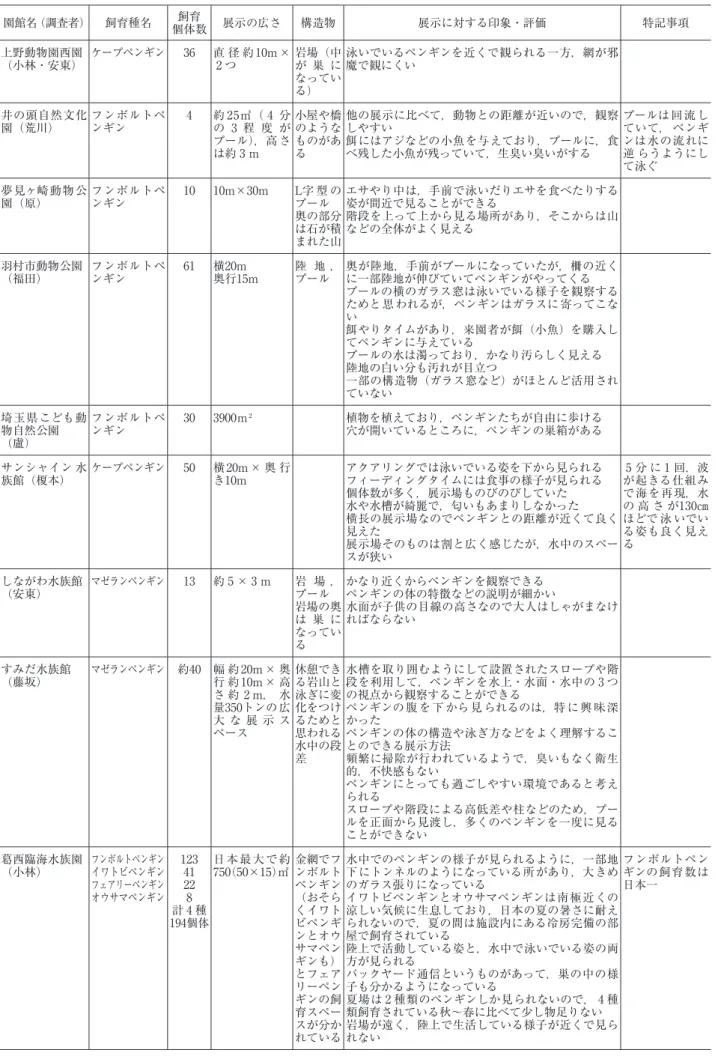
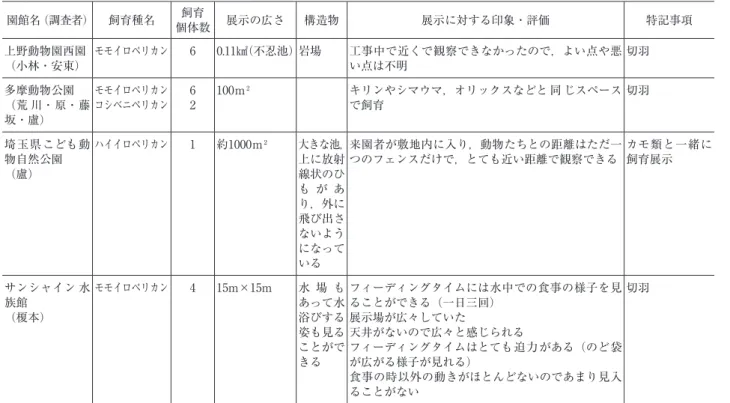
各担当者が,事前に各動物園・水族館のホーム ページに掲載されているコンセプトないしキャッチ フレーズ等を調べて,その内容を理解した上で, 1 人ないし複数人で実際に訪問した園館ごとの展示に 対する全体的な印象と評価をまとめたものが,表 1 である。
コンセプトに環境教育を掲げているあるいは内容 的に読み取れる園館としては,上野動物園,井の頭
表 1 .各動物園・水族館の概要と展示に対する全体的な印象・評価
園館名 概要 展示に対する感想
上野動物園 コンセプト:「環境動物園・エコズー」
夏に来園者が快適に動物を観察できるようにアス ファルトを剥したり,木陰を作るなどして,涼し く 観 覧 できるように 努 めていたが,ミストシャ ワーや扇風機などは猛暑日にはあまり機能しない のではないかと感じた
西園
両生爬虫類館は比較的近くで生物を観察するこ とができる/上野動物園でしかみることができな い動物(オカピ,アイアイ等)がいる/珍しい動 物が多い/屋外で飼育されている動物は柵からの 距離が遠く観察しにくい/係員,飼育員が表にほ とんどいないので,動物のことを詳しく聞くこと ができない/西園は,東園に比べて活気がなくメ ジャーな動物が少ない
東園
動物の種類が多い/休憩スペースが多い/展示 場が比較的広くゆとりがある/展示場は広いが観 覧場所が狭い/目を引くような工夫がされた展示 が少ない/動物との距離が遠い
多摩動物公園 コンセプト:「アリからゾウまで 出 会 えるとこ ろ」,多種多様な動物を見ることができるという ことを意味するようである
アジア園・オーストラリア園・アフリカ園・昆虫 園の 4 つに分かれており,約320種が飼育されて いる
約60haの広さを持つ,山を切り開いて作られてい る広大な動物園
動物園が広く,飼育動物種が135種類と多い/展 示は生息地域別/混合飼育展示もあり,大きな展 示場で飼育展示されているので,動物はより広い 面積を使え,来園者にとっても同所性の動物が分 かり易い/ライオンの寝室の建物が特色あり,と ても印象深い/鳥と人の共生エリアは,鳥が放し 飼いにされているところに入ることができ,鳥の 姿を身近に見ることができる/展示場所が道から 下の方にくぼんだ所にあり,動物の距離が離れて いる/道が蛇行していて歩く距離が長い
動物園・水族館の展示の評価(武田ら) 17