高い敏感性をもつ子ども (Highly Sensitive
Child) の理解 : 自閉症・高敏感者・エンパス・不 登校
その他のタイトル Understanding of "highly sensitive child" : Autism, highly senstive perosn, empath, and non‑attendence at school.
著者 串崎 真志
雑誌名 関西大学人権問題研究室紀要
巻 76
ページ 27‑55
発行年 2018‑11‑30
URL http://hdl.handle.net/10112/16393
(Highly Sensitive Child)の理解
―
自閉症・高敏感者・エンパス・不登校―
串 崎 真 志自閉症と感覚特異性
アメリカ精神医学会(American Psychiatric Association, 2013)の『精 神障害の診断と統計マニュアル第 5 版』(Diagnostic and Statistical Manual of Mental Disorders, Fifth edition)には、自閉スペクトラム症(autism spectrum disorder: 自閉症)の診断基準の項目の一つとして、非定型な感 覚行動(atypical sensory behaviors)が次のように記載されている。
感覚刺激に対する過敏さまたは鈍感さ、または環境の感覚的側面に対 する並外れた興味(例:痛みや体温に無関心のように見える、特定の 音、感覚に逆の反応をする、対象を過度に嗅いだり触れたりする、光 または動きを見ることに熱中する) Hyper- or hyporeactivity to sensory input or unusual interest in sensory aspects of the environment.
(e.g., apparent indifference to pain/temperature, adverse response to specific sounds or textures, excessive smelling or touching of objects, visual fascination with lights or movement.)
本論文では、聴覚・視覚・触覚・嗅覚・口腔感覚(oral sensory processing)・ 前庭感覚(vestibular sensory processing)などの通常でない感覚反応
(unusual sensory responses)を感覚特異性(sensory atypicalities)と呼 んでおく(Glod, Riby, Honey, & Rodgers, 2017)。特異という言葉は、医 学では specific の意味だが、ここでは atypical の訳語として使用したい。
DSM の改訂を契機に、自閉症の感覚特異性が改めて注目されるようになっ た。
例えば、Spain で自閉症と診断された45名(平均7.95歳)のうち、この ような非定型な感覚処理(atypical sensory processing)をもつ割合(正 確には、後述する 4 つの感覚プロファイルのうち、1 つでも 1 標準偏差の 範囲に入らなかった人の割合)は86.7%であった(Nieto, Lopez, & Gandia, 2017)。また、UK で自閉症と診断された 116 名(平均 11.6 歳)のうち 92
%、自閉症リスク(considered ‘at risk’)で特別支援教育を受けている児 童 72 名(12.7 歳)のうち 67%が、感覚過敏・感覚鈍麻・感覚的な関心
(hypersensitivity, hyposensitivity or a sensory interest)のいずれか(親 評定によるShort Seonsory Profileで測定)をもっていた(Green, Chandler, Charman, Simonoff, & Baird, 2016)。これらは、感覚特異性が自閉症に共 通する特性(common feature)であることを示している(Baum, Stevenson,
& Wallace, 2015)。
感覚特異性の測定方法としては、感覚過剰反応尺度(Sensory Over- Responsivity Scale: Schoen, Miller, & Green, 2008; Tavassoli, Miller, Schoen, Nielsen, & Baron-Cohen, 2014)、感覚知覚指数(Sensory Perception Quotient: Tavassoli, Hoekstra, & Baron-Cohen, 2014)、感覚行動質問紙
(Sensory Behavior Questionnaire: Neil, Green, & Pellicano, 2017)などが ある。グラスゴー感覚質問紙(Glasgow Sensory Questionnaire: Robertson
& Simmons, 2013; Takayama, 2014; Sapey-Triomphe, Moulin, Sonié, &
Schmitz, 2017)を用いた研究も増えているが(Horder, Wilson, Mendez,
& Murphy, 2014; Poole, Gowen, Warren, & Poliakoff, 2017; Robertson &
Simmons, 2016; Ward et al., 2017)、研究がもっとも盛んなのは、感覚プ ロファイル(sensory profile)だろう。これは、Winnie Dunn が作業療法
の領域で提唱した感覚処理モデル(Dunn’s model of sensory processing:
Dunn, 2001, 2007)を元にしている。彼女は、刺激に対する反応を低登録
(low registration: 鈍感)、感覚探求(sensation seeking)、感覚過敏(sensory sensitivity)、感覚回避(sensation avoidant)の 4 つの象限で捉えた。保護 者や観察者が記入する質問紙の他に、青年・成人感覚プロファイル
(Adolescent/Adult Sensory Profile: 辻井,2015)という自己記入式の質問 紙もある(Table 1)。
Table 1 青年・成人感覚プロファイル Adolescent/Adult Sensory Profile の項目例 低登録
low registration
I don’t notice when people come into a room.
I don’t smell things other people do smell.
I miss the street, building or room signs when trying to go somewhere new.
感覚探究
sensation seeking
I like how it feels to get my hair cut.
I like to visit places with bright lights and many colors.
I like to go to places that have bright lights and that are colorful.
感覚過敏
sensory sensitivity
I am bothered by the feeling in my mouth when I wake up in the morning.
I startle easily from unexpected or loud noises.
I am uncomfortable wearing certain fabrics.
感覚回避
sensation avoidant
I limit distractions when I am working.
I go to another department or leave a store if I smell a strong odor.
I avoid elevators and/or escalators because I dislike the movement.
例えば、San Diego で自閉症と診断された12名(平均15.5歳)のうち、
感覚プロファイルが顕著に特異(atypically high or low)だった割合は、
低登録が高い人58.3%、感覚探求が低い人58.3%、感覚過敏が高い人58.3
%、感覚回避が高い人 50.0%であった(Van Etten et al., 2017)。別の調 査では、Belgium で自閉症と診断された80名(平均13.91歳)は、統制群 に比べて低登録で、感覚回避が高かった(De la Marche, Steyaert, &
Noens, 2012)。このような傾向は一般においてもみられる。UK の大学生 580名(平均23.56歳)を対象にした調査では、自閉症指数(Adult Autism Spectrum Quotient で測定)が高いほど低登録で(r = .234)、感覚探求が 低く(r = -.275)、感覚過敏(r = .355)と感覚回避(r = .495)が高くな っていた(Mayer, 2017)。興味深いことに、UK で自閉症と診断された子 どもの親44名(平均41.43歳)も、定型発達(typical development)児童 の親30名(平均41.72歳)に比べて低登録で、感覚過敏と感覚回避が高く、
特 に 味 覚・嗅 覚(taste/smell modality)が 特 異 で あ っ た(Glod, Riby, Honey, & Rodgers, 2017)。
自 閉 症 の 常 道 的 あ る い は 反 復 的 な 行 動(Stereotyped or repetitive behavior)、同一性への固執(insistence on sameness)、習慣へのかたくな なこだわり(inflexible adherence to routines)、儀式的行動様式(ritualized patterns)などの背景に、このような感覚特異性があると考えられる。例 えば、Canada で自閉症と診断された子ども39名を調査したところ、感覚 プロファイル(Short Sensory Profile で測定)が高いほど反復的な行動
(Repetitive Behavior Questionnaire で 測 定 )が 高 か っ た(Black et al., 2017)。両者の間に、不確実性への不耐性(Intolerance of Uncertainty Scale で 測 定,項 目 例 when things happen suddenly, s/he gets very upset.)が媒介していたという UK の報告もある(Wigham, Rodgers, South, McConachie, & Freeston, 2015)。最近では、感覚特異性は社会的コミュニ ケーションの困難さ(persistent deficits in social communication)にも影 響すると考えられている(Thye, Bednarz, Herringshaw, Sartin, & Kana, 2018)。
精神疾患と感覚特異性
一方、感覚特異性は自閉症だけに限らないこともわかってきた。例えば、
注意欠如・多動症(attention deficit/hyperactivity disorder: ADHD)と診
断された子ども78名の感覚プロファイルは、自閉症と同様のパタンであっ た(Little, Dean, Tomchek, & Dunn, 2017)。また、Netherlands の ADHD をもつ成人116名(平均32.0歳)は、標準集団(norm group)に比べて低 登録で、感覚探求が低く、感覚過敏であり、ADHD をもつ成人女性の43.2 パーセント、成人男性の 22.2 パーセントが、感覚鈍麻か感覚過敏(hypo- or hypersensitive)の問題をもっていた(Bijlenga, Tjon-Ka-Jie, Schuijers,
& Kooij, 2017)。そして、Connecticut の一般922名(平均8.08歳)を調査 したところ、ADHD 傾向(Child Behavior Checklist で測定)の高い子ど もの約半分は、感覚過剰反応性(Sensory Over-Responsivity Inventory で 測定)を有していた(Ben-Sasson, Soto, Heberle, Carter, & Briggs-Gowan, 2017)。UK の一般 234 名(平均 33.6 歳)を調査したところ、ADHD 傾向
(Adult ADHD Self-Report Scale で 測 定 )の 高 い ほ ど、感 覚 敏 感 性
(Glasgow Sensory Questionnaire で 測 定 )を 有 し て い た(Panagiotidi, Overton, & Stafford, 2018)。
さらに、Italy で双極性障害(bipolar disorder)と診断された 60 名(平 均 32.03 歳)のうち、1 標準偏差の範囲に入らなかった人の割合は、低登 録(高い人) 30%、感覚探求(低い人) 51.6%、感覚過敏(高い人) 35%、
感覚回避(高い人) 31.7%であった(Serafini, Engel-Yeger, Vazquez, Pompili,
& Amore, 2017)。同じくItalyで双極性障害と診断された105名(56.75歳)
は、循環気質(cyclothymic)の程度(Temperament Evaluation of Memphis, Pisa, Paris and San Diego で測定)が高いほど低登録で(r = .32)、感覚 過敏(r = .41)と感覚回避(r = .38)が高くなっていた(Engel-Yeger et al., 2016)。同じく Italy で気分障害と診断された281名(47.4歳)は、抑う つの程度(Beck Depression Inventory で測定)が高いほど低登録で(r = .464)、感覚過敏(r = .454)と感覚回避(r = .362)が高くなっていた
(Serafini et al., 2017 )。New Mexico で 精 神 病 の 前 駆 症 状(prodromal symptoms: Structured Interview for Prodromal Syndromes で測定)が高 い青年(12-17 歳,18-25 歳)は、基準サンプル(normative samples)に
比べて低登録で、感覚探求が低く、感覚過敏と感覚回避が高かった
(Parham, Roush, Downing, Michael, & McFarlane, 2017)。Israel の非臨 床群 274 名(平均 33.6 歳)を調査したところ、強迫症傾向(Obsessive Compulsive Inventory で測定)の高い人の約 3 割は、高い感覚知覚指数
(Sensory Perception Quotient で 測 定 )を 有 し て い た(Ben-Sasson &
Podoly, 2017)。
このように、感覚特異性は自閉症だけでなく、さまざまな精神疾患と関 連する。これをどのように考えたらよいのだろうか。Italy で感情障害
(euthymic affective disorder)と診断された488名(平均47.82歳)を調査 した結果、軽躁状態(Hypomania Checklist で測定)が感覚プロファイル
(Adolescent/Adult Sensory Profile で測定)を媒介して、抑うつと絶望感
(Beck Depression Inventory, Beck Hopelessness Scale で測定)を増大さ せていた(Engel-Yeger et al., 2018)。また、UK で実施した調査によると、
感覚処理感受性(後述)は、不確実性への不耐性(Intolerance of Uncertainty Scale で測定,項目例 Uncertainty stops me from having a firm opinion.)
を媒介して、不安(Hospital Anxiety and Depression Scale で測定)を増 大させていた(Uljarević, Carrington, & Leekam, 2016)。そして、自閉症 の不安の増大は、感覚特異性と不確実への不耐性によって生じるというモ デルも提唱されている(South & Rodgers, 2017)。これらの知見から、感 覚特異性は自閉症やさまざまな精神疾患をより顕著にする要因(増悪因子)
と考えられる。
高い敏感性をもつ人(高敏感者)
感 覚 特 異 性・感 覚 敏 感 性(sensory sensitivity)・感 覚 過 敏(hyper- sensitivity)といった問題を、自閉症とは別の文脈から研究している人が いる。Elaine Aron (Aron, Aron, & Jagiellowicz, 2012)は、刺激に対す る深い認知的処理と高い情動的反応を感覚処理感受性(sensory-processing
sensitivity)と呼び、そのような高い敏感性をもつ人を高敏感者(highly sensitive person)と呼んだ。彼女(Aron, 1996, 2002)は、高敏感者が一 般に 15-20%いると考え、研究を積極的に進めると同時に、広く理解され るように活動を続けている。
感覚処理感受性の測定方法として、Aron & Aron (1997)は Highly Sensitive Person Scale (27 項目)を作成した。最近は、そこから 11 項目 を抽出した 1 次元の短縮版(Aron et al., 2010; Acevedo et al., 2014)を使 用することもあるようだ(Table 2 )。また、Aron & Aron (1997)の 27 項目版を元にした Highly Sensitive Person Scale 日本版[19 項目](髙橋,
2016)、Aron (2002)の Highly Sensitive Child Scale (23項目)を元にし た幼児用 Highly Sensitive Child Scale 日本語版[21 項目](鈴木,2017)、
そして項目を独自に集めた中学生用感覚感受性尺度[12項目](飯村,2016)
などもある。
例えば、平野(2012)は、Aron (1996)の Highly Sensitive Person Scale を元に、心理的敏感さ尺度[16項目]を作成し、適応感との相関が r = -.30 であることを報告した(適応感は、毎日が孤独でさびしい[逆転項目]、充 実した毎日を送っている、やる気が出ず、憂鬱な毎日を過ごしている[逆転 項目]、生きがいを持って毎日を送っている、味気ない毎日を送っている[逆 転 項 目 ]で 測 定 )。Listou Grimen & Diseth ( 2016 )は、Aron & Aron
(1997)の27項目版を元にした短縮版[13項目]を作成し、心理的健康愁訴 psychological health complaints のとの相関が r = .31であることを報告し ている(心理的健康愁訴は、気持ちの落ち込み feeling low、いらいら irritability、神経質 nervousness、疲労憔悴 tired and exhausted、おびえ ている scared で測定)。
また、社交不安症(social anxiety disorder)の人は、Highly Sensitive Person Scale 得 点 が 高 い ほ ど、そ の 症 状(Social Phobia and Anxiety Inventory で測定)が重かった(Hofmann & Bitran, 2007)。そして、矢 野・大石(Yano & Oishi, 2018)によると、感覚処理感受性の因子のうち、
低感覚閾で易興奮性が高いほど、大学生の運動習慣が少なくなり、それが 抑うつ(Self-rating Depression Scale で測定)の程度を高めていた(ただ し、美的感受性が高いほど抑うつが低いという直接効果もあった)。このよ うに、高敏感者は神経症傾向・抑うつ・不安をもちやすいといわれている
(串崎,2019の文献レビューを参照)。
Table 2 Highly Sensitive Person Scale 短縮版の項目(Aron et al., 2010)
1. Do you find it unpleasant to have a lot going on at once?
2. Do you find yourself needing to withdraw during busy days, into bed or into a darkened room or any place where you can have some privacy and relief from stimulation?
3. Are you easily overwhelmed by things like bright lights, strong smells, coarse fabrics or sirens close by?
4. Do you get rattled when you have a lot to do in a short amount of time?
5. Do changes in your life shake you up?
6. Are you bothered by intense stimuli, like loud noises or chaotic scenes?
7. Do other people’s moods affect you?
8. Are you made uncomfortable by loud noises?
9. Are you annoyed when people try to get you to do too many things at once?
10. Do you become unpleasantly aroused when a lot is going on around you?
11. When you must compete or be observed while performing a task, do you become so nervous or shaky that you do much worse than you would oth- erwise?
また、Pluess et al. (2018)は、12項目からなる Highly Sensitive Child Scale を作成している(Table 3)。UK で収集したデータ(8-19歳)を潜 在クラス分析(latent class analysis)したところ、高敏感群(highly sensitive group)の割合は、児童592名(平均12.06歳)のうち34.08%、青年1470 名(平均 17.06 歳)のうち 23.97%であった(Pluess et al., 2018)。また、
New YorkとUKの大学生906名(平均19.2歳)のデータ(Highly Sensitive Person Scale 27項目で測定)を潜在クラス分析したところ、高敏感群の割 合は 26.58%であった(Lionetti et al., 2018)。これらのことから、Erain Aron が見込んだように、高敏感者が一般に 2 割いる(児童においては 3 割いる)ことが明らかになった。
Table 3 Highly Sensitive Child Scale の項目(Pluess et al., 2018)
易興奮性
ease of excitation
I am annoyed when people try to get me to do too many things at once.
When someone observes me, I get nervous. This makes me perform worse than normal.
I get nervous when I have to do a lot in little time.
I find it unpleasant to have a lot going on at once.
I don’t like it when things change in my life.
低感覚閾
low sensory threshold I don’t like loud noises.
Loud noises make me feel uncomfortable.
I don’t like watching TV programs that have a lot of violence in them.
美的感受性
aesthetic sensitivity I love nice tastes.
Some music can make me really happy.
I love nice smells.
I notice it when small things have changed in my environment.
彼らは本当に繊細なのだろうか。Belgium で実施した親に対する調査
(Parent-Report Highly Sensitive Person Scale)によると、高い敏感性を もつ子ども(平均8.27歳)は、睡眠(寝つきが悪い)や食事(固形物を食 べにくい)の問題を抱えているという(Boterberg & Warreyn, 2016)。客 観的な指標もある。例えば、視覚探索課題(visual detection task)におけ る反応時間は、Highly Sensitive Person Scale 得点が高いほど短く、その エラーも少なかった(Gerstenberg, 2012)。脳活動を測定してみると、高 敏感者(Highly Sensitive Person Scale 27項目で測定)は、非敏感者に比 べて、写真の小さな変化(minor changes)を見ているときに、高次の視 覚処理を行う部位が反応していた(Jagiellowicz et al., 2010)。そして、
Highly Sensitive Person Scale 得点が高い人は、低い人に比べて、彩度の 高い色(high-chroma colors)を好まなかった(Pazda & Thorstenson, 2018)。また、Highly Sensitive Person Scale 得点が高いほど、配偶者(vs.
見知らぬ人)の悲しい顔を見ているときに、共感・痛みの部位(島皮質
insula)が活性化していた(Acevedo et al., 2014)。感覚処理感受性に関連 する遺伝子も見つかっている。ドーパミン作動性神経伝達(dopaminergic neurotransmission)に関連する10の遺伝子多型(polymorphisms)によっ て、Highly Sensitive Person Scale 得点の分散の15-16%を説明できるとい う(Chen et al., 2011; Chen et al., 2015)。セロトニン伝達遺伝子多型との 関連も示唆されている(Homberg, Schubert, Asan, & Aron, 2016)。
さらに、Wisconsin で行われた追跡調査によると、在胎期間 32 週未満
(very preterm)で出生した場合、2 歳時と 7 歳時の感覚過剰反応(Sensory Over-responsivity subscale で測定)の程度が(満期 fullterm 出生に比べ て)強く予測(相関)していた(Van Hulle, Lemery-Chalfant, & Goldsmith, 2015)。そして、感覚調整機能障害(sensory modulation dysfunction: Short Sensory Profile で測定)の子ども( 5-12 歳)は、定型発達(typically developing)の子どもに比べて、心臓の迷走神経緊張(cardiac vagal tone)
が低かったという(Schaaf et al., 2010)。また、 1 型糖尿病(diabetes mellitus type 1 )の青年(平均 16.06 歳)は、比較群に比べて、Highly Sensitive Person Scale 得点が高かった(Goldberg et al., 2017)。これら は、感覚特異性や感覚処理感受性が、神経系(nervous system)の成熟と 関連していることを示唆する。
対人感受性
上述したように、感覚特異性や感覚処理感受性は、基本的に聴覚・視覚・
触覚・嗅覚などの特異さを指す。それでは、人に対する繊細さはどうだろ うか。人のネガティブな情動や行動に対する敏感性を測定する方法として は、Boyce & Parker (1989)の Interpersonal Sensitivity Measure を元に した対人感受性尺度[39項目](江田・日高,2007)、拒絶敏感性尺度[27項 目](巣山・貝谷他,2014; 巣山・兼子他,2014)、さらに独自に項目を集め た 対 人 過 敏・自 己 優 先 尺 度(Interpersonal Sensitivity/Privileged Self
Scale)[25項目](村中・山川・坂本,2017)などがある。例えば、Konrad
& Herzberg (2017)が German の成人397名(平均39.01歳)に調査した 結果、Highly Sensitive Person Scale[German version 26項目]とInterpersonal Sensitivity (Brief Symptom Inventory の一部で測定)の相関は r = .49で あった。このように、高敏感者は対人感受性が高く、対人不安になりやす いと考えられる。
感覚処理感受性に、ポジティブな対人的側面はあるのだろうか。感覚処 理感受性は共感性に関連するという研究がある。Carney & Harrigan
(2003)は、対人感受性を I can usually tell when someone is angry from that person’s facial expressions. といった項目で測定し、その得点が高い ほど、友人の性質を正確に感じ取る(共感精度 empathic accuracy が高い)
ことを報告した。また、飯村(2016)によると、感覚感受性尺度[12項目]
の得点が高い(1 標準偏差以上)中学生は、それ以外の群に比べて、多次 元共感性尺度の得点が高かった(感覚処理感受性の研究では、1 標準偏差 以上の群とそれ以外の群を比較することがある。Gearhart, 2014を参照)。
そもそも、Elaine Aron が感覚処理感受性というとき、単なる感覚過敏 だけでなく、高敏感者がその感覚世界を深く豊かに経験することに注目し ている。Highly Sensitive Child Scale(Table 3)に美的感受性(aesthetic sensitivity)という因子があるのはそのためであり、感覚処理感受性と感 覚特異性(感覚プロファイル)との違いもここにある。ただし、美的感受 性と他の 2 因子との相関係数は低い。例えば、Lionetti et al.(2018)では 易興奮性 r = .08, 低感覚閾 r = .29、Pluess et al.(2018, Study 4)では易 興奮性 r = .29, 低感覚閾 r = .18、髙橋(2016)では易興奮性 r = .06, 低 感覚閾 r = .02 であった。したがって、Highly Sensitive Person Scale 短
縮版[11項目](Table 2)には、美的感受性は含まれていない。おそらく、
高敏感者だからといって即、感覚世界を深く豊かに経験するわけでないの だろう。彼らがどのような道筋で美的感受性を身につけていくのかは、今 後の重要な課題である。
感覚処理感受性の利点
感覚処理感受性の特徴をさらに見ていこう。Weeland, Van den Akker, Slagt, & Putnam (2017)は、Netherlands の平均9.27歳の子どもの表情模 倣(mimicry)を調べた結果、知覚感受性(perception sensitivity)が高い 子どもは、肯定的育児(You have a friendly talk with your child. You praise your child if he/she behaves well. で測定)の元では、笑顔に対す る大頬骨筋の反応(共感性)が高いことがわかった。また、Slagt, Dubas, van Aken, Ellis, & Deković (2018)は、Netherlands の平均 4.7 歳の親子 を 7 か月ごとに 3 回(T1-T3)追跡調査した結果、高い敏感性をもつ子ど もは、肯定的育児(I help my child when he/she has difficulties. I regularly encourage my child to explore things. で測定)が増えると外在化問題(か んしゃくや落ち着かなさ)が大きく減り、否定的育児が増えると外在化問 題も大きく増えることがわかった。さらに、Booth, Standage, & Fox (2015)
は、UK の成人185名(平均31歳)を対象に調査した結果、Highly Sensitive Person Scale の高い(1 標準偏差以上)群は、児童期の親との経験が否定 的であるほど(How often did a parent or guardian swear at you, insult you or put you down? で測定)、人生満足感(Satisfaction with Life Scale で測定)が低下していた。そして、Acevedo, Jagiellowicz, Aron, Marhenke,
& Aron (2017)によると、Highly Sensitive Person Scale の高い(上位25
%)女性(平均 19 歳)は、児童期の親との関係(quality of childhood parenting)が良いほど、ポジティブな表情(International Affective Picture System)を見たときに腹側被蓋野(ventral tegmental area)や島皮質
(insula)が活性化していた。すなわち、高敏感者は、良くも悪くも環境の 影響を受けやすい。実際、児童に対する抑うつ防止プログラム(SPARK Resilience Program)の効果が大きかったのは、Highly Sensitive Child Scale の高い(上位25%)群であった(Pluess & Boniwell, 2015)。これら の効果は、差次感受性(differential susceptibility)と呼ばれている(Belsky
& van IJzendoorn, 2017; Carr & Nielsen, 2017)。
Santa Barbara の Acevedo, Aron, Pospos, & Jessen (2018)は、感覚処 理感受性の脳研究をレビューし、高敏感者は(自閉症・統合失調症・PTSD に比べて)、共感の脳(self-other processing and empathy: IFG and insula)、
気づきとふりかえりの脳(awareness and reflective thinking: TPJ)、自己 制御の脳(self-control: PFC)が活性化していることを報告した。そして、
次のように結んでいる。
感覚処理感受性は共感、気づき、落ち着き、生理的・認知的な自己制 御を含む適応的な戦略であり、環境や社会の情報を深く統合し、記憶 を促すことで、人類に貢献しているかもしれない。それは最終的に、
生存と福祉と協力を育むだろう。(adaptive SPS strategies involving empathy, awareness, calmness and physiological and cognitive self- control may serve a species by facilitating deep integration and memory for environmental and social information, which may ultimately foster survival, well-being and cooperation.)
エンパス Empath
すでに述べたように、高敏感者は対人不安になりやすい。一方、高敏感 者は、人に対して不安と少し異なる感じをもつこともわかってきた。それ がエンパス(empath)である。エンパスは学術的に定義・研究されていな いので、さまざまな意味で用いられており、混乱も多い。ここでは California の精神科医 Judith Orloff (Orloff, 2017)にしたがって説明する。
Orloff (2017, p.2)によると、エンパスは真の超反応者(truly super responders)である。極度に反応的な神経系(extreamly reactive neurological system)をもっており、周囲にある肯定的なエネルギーもストレスフルな エネルギーも両方、自分の体に取り込んでしまう(absorb into our own
bodies both the positive and stressful energies around us)。人からは「繊 細すぎる」(overly sensitive)とか「皮膚が薄い」(get a thicker skin)と 評されることも多い。Orloff (2017, pp.5-6)は、エンパスを、Elaine Aron のいう感覚処理感受性が一歩進んだ(take futher)ものだと考えている。
エンパスが感じ取る微細なエネルギー(subtle energy)は、東洋の治療文 化でいう生命力(shakti or prana)である。エンパスはそれを極度に深く
(in extreamly deep ways)体験してしまうので、ときに人の不快感と自 分の不快感を区別することが難しい(have trouble distinguishing someone else’s discomfort from our own)。ま た、深 く 精 神 的 で 直 感 的 な 体 験
(profound spiritual and intuitive experiences) をする人もいる。高敏感者 だからといって、エンパスになるわけではないと、Orloff はいう。
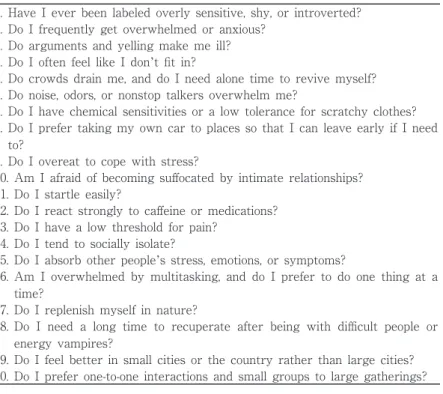
Orloff (2017, pp.14-15)は、エンパスのチェックリストを提案している
(Table 4 )。信頼性や妥当性は検討されていないが、mostly yes か mosly no で回答して 15 項目以上 yes があれば、本格的なエンパス(full-blown empath)となる。項目を見ると、感覚特異性や感覚処理感受性に共通する さまざまな感覚過敏に加えて、人や状況に対する独特の違和感、孤独や自 然を好む傾向などが特徴的だ。Orloff (2017, pp.107-128)によると、エン パスは人の悪いエネルギー(energy vampires)を取り込みやすいので、ま ずそれを防御し(shielding)、自分を保護(protection)できることが必要 だという。また、エンパスは疲れやすく(p.40)、嗜癖になりやすい(p.57)。
そうならないためには、「この感情は自分のものか他者のものか」(p.43)、
「ソーシャルなことにどれくらい時間を使いたいか」(p.94)と自問してみ る。ハグや握手は、エネルギーを取られることがあるので控える(p.45)
など、具体的にアドバイスしている。高敏感者が人に対して不安を感じや すいのに対して、エンパスは違和感・混乱・疲労を感じやすいといえるだ ろう。 Denmark の心理療法士 Ilse Sand (2018, p.43)は、高敏感者に、人 との接触から自分を守るように(screen yourself from too much social contact)アドバイスしている。
Table 4 Empath Self Assessment の項目(Orloff, 2017)
1. Have I ever been labeled overly sensitive, shy, or introverted?
2. Do I frequently get overwhelmed or anxious?
3. Do arguments and yelling make me ill?
4. Do I often feel like I don’t fit in?
5. Do crowds drain me, and do I need alone time to revive myself?
6. Do noise, odors, or nonstop talkers overwhelm me?
7. Do I have chemical sensitivities or a low tolerance for scratchy clothes?
8. Do I prefer taking my own car to places so that I can leave early if I need to?
9. Do I overeat to cope with stress?
10. Am I afraid of becoming suffocated by intimate relationships?
11. Do I startle easily?
12. Do I react strongly to caffeine or medications?
13. Do I have a low threshold for pain?
14. Do I tend to socially isolate?
15. Do I absorb other people’s stress, emotions, or symptoms?
16. Am I overwhelmed by multitasking, and do I prefer to do one thing at a time?
17. Do I replenish myself in nature?
18. Do I need a long time to recuperate after being with difficult people or energy vampires?
19. Do I feel better in small cities or the country rather than large cities?
20. Do I prefer one-to-one interactions and small groups to large gatherings?
境界の薄い人々
エンパスのこのような性質は、心理学でいうと、Ernest Hartmann
(Hartmann, 2011 )の 境 界(boudaries)の 概 念 を 思 い 起 こ さ せ る。
Hartmann は境界質問紙(Boundary Questionnaire: 児玉,2013)を作成 し、境界の薄い人々(thin boundaries)がいることを示唆した。境界質問 紙は100項目を超えるので、研究では短縮版[18項目](BQ-18: Kunzendorf, Hartmann, Cohen, & Cutler, 1997)がよく用いられる(Table 5 )。境界 の薄い人々は、自己の感覚を環境から分けることが難しく (have difficulty separating his or her sense of self from the environment)、結果的にと
ても強い情動(strong emotions)をもってしまう(Harrison & Singer, 2013)。これは、エンパスの体験とよく似ている。
Table 5 Boundary Questionnaire Short Form の項目(Kunzendorf et al., 1997)
1. My feelings blend into one another.
2. I am very close to my childhood feelings.
3. I am easily hurt.
4. I spend a lot of time daydreaming, fantasizing or in reverie.
5. I like stories that have a definite beginning, middle and end.
*6. A good organization is one in which all the lines of responsibility are precise and clearly established.
*7. There is a place for everything, and everything should be in its place.
*8. Sometimes it’s scary when one gets too involved with another person.
9. A good parent has to be a bit of a child, too.
10. I can easily imagine myself as an animal or what it might be like to be an animal.
11. When something happens to a friend of mine or to a lover, it is almost as if it happened to me.
12. When I work on a project, I don’t like to tie myself down to a definite outline. I rather like to let my mind wander.
13. In my dreams, people sometimes merge into each other or become other people.
14. I believe I am influenced by forces that no one can understand.
15. There are no sharp dividing lines between normal people, people with problems and people who are considered psychotic or crazy.
16. I am a down-to-earth no-nonsense kind of person.
*17. I think I would enjoy being some kind of creative artist.
18. I have had the experience of someone calling me or speaking my name and not being sure whether it was really happening or whether I was imagining it.
*は逆転項目
Hartmann はもともと夢の研究者だったので、境界の研究は夢見との関 連が多い。例えば、境界が薄いほど夢見の想起(dream recall frequency)
が多い(Aumann, Lahl, & Pietrowsky, 2012)。ナルコレプシー(narcolepsy with cataplexy)と 診 断 さ れ た 患 者 は、健 康 群 に 比 べ て 境 界 が 薄 い
(Wamsley, Donjacour, Scammell, Lammers, & Stickgold, 2014)。金縛り
体験(sleep paralysis)がある群は、ない群に比べて境界が薄い(Lišková, Janečková, Kráčmarová, Mladá, & Bušková, 2016)などである。また、境 界の薄い人々は超感覚的知覚(extrasensory perception)を信じる傾向
(Paranormal Belief and Experience Scale で測定)が強く(Spinelli, Reid,
& Norvilitis, 2002)、特異な経験(anomalous experiences, 項目例 I have had a psychic experience. I am able to communicate with the dead.)が あると回答する(Rabeyron & Watt, 2010; Parra, & Argibay, 2016)。こ のあたりは興味深いところだが、霊媒師(spiritualist mediums)と一般人 を比較した UK の調査では、境界得点の差はなかったらしい(Roxburgh &
Roe, 2011)。ちなみに、高敏感者(Highly Sensitive Person Scale 得点が 中央値以上の人)は、低敏感者に比べて神秘体験(Mystical Experience Scale で 測 定 )が 多 い と い う Sweden の 報 告(Kjellgren, Lindahl, &
Norlander, 2009)、同様に、Highly Sensitive Person Scale 得点が高いほ ど、特異な体験(Survey of Anomalous Experiences で測定)があるとい う UK の報告もある(Irwin, Schofield, & Baker, 2014)。
不登校と Highly Sensitive Child
さて、ここまでに登場した概念の包含関係を Figure 1 に示した。感覚特 異性と感覚処理感受性は、感覚過敏で不安が増大しやすいなどの共通点が あるものの、感覚特異性は発達障害に親和性があり、感覚処理感受性は美 的感受性など適応的側面を強調する点で異なる。また、感覚処理感受性の 高い人の一部はエンパスの性質も持ち合わせており、彼らは自他の境界が 薄く、違和感・疲労・混乱を感じやすい一方、深く精神的で直感的な体験 をする。
すでに述べたように、感覚処理感受性の高い人(高敏感者)は一般に 2-3 割いる。臨床心理学的には、不登校の児童・生徒のなかで、発達障害でも なく精神疾患もなく、いじめや受験など特定の出来事・ストレスがあるわ
けでもなく、家庭環境の問題もなく(もちろんそれらが併存する場合はあ る)、しかしなんらかの違和感で学校に行きづらくなった子どものなかに、
感覚処理感受性やエンパスの性質をもつ人、すなわち Highly Sensitive Child (HSC)がいると思われる。
本論文では、感覚処理感受性やエンパスを背景にもつ不登校を、HSC 型 不登校と呼んでおく。HSC 型不登校は、専門家のあいだでも理解されにく いのが現状である(石井,2018)。疫学的な調査は未見であるが、小児神経 科医の大野耕策(2017)によると、氏が担当した不登校105例のうち、Highly Sensitive Person と思われるものが 10 例(9.9%)あったという。10 例の うち 2 例は ADHD を合併しており、うつ状態との併存もあるようだ。他の 要因、つまり自閉症(23.8%)、ADHD (23.8%)、自閉症+ ADHD の並存
(32.3%)に比べると少数だが、不登校の児童・生徒の一部に HSC 型不登 校があることは間違いないだろう。
HSC 型不登校の児童・生徒は、周囲の人から誤解されやすい。最後に、
その特徴を私見として記載しておく。
Figure 1 本研究で登場した概念の整理
①.Highly Sensitive Child は定義上、神経系・生理的・内的リズムの影 響を受けやすく、心身の調子についても一日一日の変動が大きい。周囲の 人は、そのコンディションを心理的要因だけで理解しがちで、一喜一憂し てしまう。そして、本人を気分屋で怠けているように誤解しやすい。
②.Highly Sensitive Child は、人や状況に対して、いわば直感的な適合 感(違和感)で判断する。環境の小さな要因・変化に大きく左右されるた め、場面にたいへん慣れにくい。同じ人や状況でも、できるときとできな いときがある。本人はそれを言葉で説明しにくい。それゆえ周囲の人は、
わがままや無理を言っているように誤解しやすい。あるいは好き嫌いが多 い、関心が狭いとみなしやすい。
③.Highly Sensitive Child は、自分で制御できないほど、人の心に深く 入り込んだり、入り込まれたりする(と感じる)。学級のような集団は基本 的に不得手で疲れやすい。孤独を好む反面、人に関心をもちすぎてしまう こともある。周囲の人は、その様子を気難しい、心を閉ざしている、不安 症と誤解しやすい(ただし不安は実際にある)。過剰適応と呼ばれることも ある。
④.Highly Sensitive Child は、調子の良いときや直感的にフィットした 状況、好きなことや気の合う相手に対しては、集団であっても積極的に参 加し、共感的に交流できる。この点がいわゆる不安症と異なる。周囲の人 はとても普通な印象をもち、どうして不登校なのかと不思議に思う。ある いは「登校できるのでは」と期待しやすい。
⑤.Highly Sensitive Child は、文字通り感覚過敏な点が多々あり、発達 障害と間違えられやすい。また、自分の感覚中心で行動しやすい性質があ り、自己中心的、馴れ馴れしい、図々しいといった印象を与えることがあ る1)。さらに、一部の HSC は、思春期以降に思考優位になることがある2)。 この場合は、感覚よりも観念的に理屈で行動することが増えるため、本人 も HSC であることを見失いがちなようだ。Leanne Allen (2017)という Australia のカウンセラーは、不安症の人に「自分はエンパスかもしれな
い」と吟味することを勧めている。
このような観点から見直すと、これまで報告されてきた不登校の事例に も、HSC 型不登校はあったと思われる。「この子どもの不登校は、感覚処 理感受性がベースかもしれない」と思うと、支援も違ってくるだろう。本 人と周囲の人の理解が何よりも大切である。ただし、上述したように、
ADHD (不注意優勢型)との合併はありうるので3)、発達障害か高敏感者 かの判断は自分で行わず、専門家に相談することが望ましい。
注
1 )この傾向が強い高敏感者は、発達障害と区別しにくくなるかもしれない。仁平
(2018, p.25)はアスペルガー型の発達障害の特徴を、「人に関心がある・人とかかわ りたい」が、「自分の思い通りに遊びたい」「指示や注意されるのを嫌がる」「相手の 意向とは無関係に接近する」「会話を好む・一方的会話」「話が一方的で展開しやす い」「特定の興味に没入する・空想世界」「切り替えはそのときの状況次第」「変化に 敏感に反応する」「自分流の愛他的な行動をする」と整理している。また、彼らの共 感性について、次のように述べている(仁平,2018, pp.86-87)。
アスペルガー症候群の子どもに感情がない、人の感情がわからないという意味で はありません。むしろ、感情はそのときどきで強く溢れ出るのです。(中略)で は、どうして共感できないのでしょうか?「極端な自己中心性」の特質が、共感 という人と人との間の自然で本能的な心のはたらきをゆがめている可能性があり ます。相手の感情を察しても、自分の感情が中心になるのです。
2 )これに関連して、Denmark の心理療法士 Ilse Sand (Sand, 2016, p.37)は、高敏 感者が自分に高い要求(high standards)を課して、「すべき」というルールに縛ら れがちになることを指摘している。
3 )Aron (2010, p.14)や Ilse Sand (Sand, 2016, p.31)は、刺激を求める高敏感者
(sensation-seeking sensitive people)がいることを指摘している。
文献
Acevedo, B. P., Aron, E. N., Aron, A., Sangster, M. D., Collins, N., & Brown, L. L.
(2014). The highly sensitive brain: An fMRI study of sensory processing sensitivity and response to others’ emotions. Brain and Behavior, 4, 580-594.
Acevedo, B., Aron, E., Pospos, S., & Jessen, D. (2018). The functional highly sensitive brain: A review of the brain circuits underlying sensory processing sensitivity and seemingly related disorders. Philosophical Transactions of the Royal Society B: Biological Sciences, 373, 20170161. doi:10.1098/rstb.2017.0161 Acevedo, B. P., Jagiellowicz, J., Aron, E., Marhenke, R., & Aron, A. (2017). Sensory
processing sensitivity and childhood quality's effects on neural responses to emotional stimuli. Clinical Neuropsychiatry, 14, 359-373.
Allen, L. (2017). Anxiety being an empath. Great Health Guide eBook, Issue 4.
https://www.greathealthguide.com.au/anxiety-being-an-empath/
American Psychiatric Association. (2013). Diagnostic and statistical manual of mental disorders (5th ed.). Washington, DC: Author.
Aron, A., Ketay, S., Hedden, T., Aron, E. N., Rose Markus, H., & Gabrieli, J. D.
(2010). Temperament trait of sensory processing sensitivity moderates cultural differences in neural response. Social Cognitive and Affective Neuroscience, 5, 219-226.
Aron, E. N. (1996). The highly sensitive person: How to thrive when the world overwhelms you. New York: Broadway Books.
Aron, E. N. (2002). The highly sensitive child: Helping our children thrive when the world overwhelms them. New York: Broadway Books.
Aron, E. N. (2010). Psychotherapy and the highly sensitive person. New York:
Routledge.
Aron, E. N., & Aron, A. (1997). Sensory-processing sensitivity and its relation to introversion and emotionality. Journal of Personality and Social Psychology, 73, 345-368.
Aron, E. N., Aron, A., & Jagiellowicz, J. (2012). Sensory processing sensitivity: A review in the light of the evolution of biological responsivity. Personality and Social Psychology Review, 16, 262-282.
Aumann, C., Lahl, O., & Pietrowsky, R. (2012). Relationship between dream structure, boundary structure and the Big Five personality dimensions.
Dreaming, 22, 124-135.
Baum, S. H., Stevenson, R. A., & Wallace, M. T. (2015). Behavioral, perceptual, and neural alterations in sensory and multisensory function in autism spectrum disorder. Progress in Neurobiology, 134, 140-160.
Belsky, J., & van IJzendoorn, M. H. (2017). Genetic differential susceptibility to the effects of parenting. Current Opinion in Psychology, 15, 125-130.
Ben-Sasson, A., & Podoly, T. Y. (2017). Sensory over responsivity and obsessive
compulsive symptoms: A cluster analysis. Comprehensive Psychiatry, 73, 151-159.
Ben-Sasson, A., Soto, T. W., Heberle, A. E., Carter, A. S., & Briggs-Gowan, M. J.
(2017). Early and concurrent features of ADHD and sensory over-responsivity symptom clusters. Journal of Attention Disorders, 21, 835-845.
Bijlenga, D., Tjon-Ka-Jie, J. Y. M., Schuijers, F., & Kooij, J. J. S. (2017). Atypical sensory profiles as core features of adult ADHD, irrespective of autistic symptoms. European Psychiatry, 43, 51-57.
Black, K. R., Stevenson, R. A., Segers, M., Ncube, B. L., Sun, S. Z., Philipp-Muller, A., ...
Ferber, S. (2017). Linking anxiety and insistence on sameness in autistic children: The role of sensory hypersensitivity. Journal of Autism and Developmental Disorders, 47, 2459-2470.
Blaser, K., Zlabinger, M., Hautzinger, M., & Hinterberger, T. (2014). The relationship between mindfulness and the mental self-boundary: Validation of the Boundary Protection Scale-14 (BPS-14) and its correlation with the Freiburg Mindfulness Inventory (FMI). Journal of Educational and Developmental Psychology, 4, 155-162.
Booth, C., Standage, H., & Fox, E. (2015). Sensory-processing sensitivity moderates the association between childhood experiences and adult life satisfaction.
Personality and Individual Differences, 87, 24-29.
Boterberg, S., & Warreyn, P. (2016). Making sense of it all: The impact of sensory processing sensitivity on daily functioning of children. Personality and Individual Differences, 92, 80-86.
Boyce, P., & Parker, G. (1989). Development of a scale to measure interpersonal sensitivity. Australian and New Zealand Journal of Psychiatry, 23, 341-351.
Carney, D. R., & Harrigan, J. A. (2003). It takes one to know one: Interpersonal sensitivity is related to accurate assessments of others’ interpersonal sensitivity.
Emotion, 3, 194-200.
Carr, M., & Nielsen, T. (2017). A novel Differential Susceptibility framework for the study of nightmares: Evidence for trait sensory processing sensitivity.
Clinical Psychology Review, 58, 86-96.
Chen, C., Chen, C., Moyzis, R., Stern, H., He, Q., Li, H., ... Dong, Q. (2011).
Contributions of dopamine-related genes and environmental factors to highly sensitive personality: A multi-step neuronal system-level approach. PLOS ONE, 6, e21636. doi:10.1371/journal.pone.0133143
Chen, C., Xiu, D., Chen, C., Moyzis, R., Xia, M., He, Y., ... Wang, Y. (2015). Regional homogeneity of resting-state brain activity suppresses the effect of dopamine-
related genes on sensory processing sensitivity. PLOS ONE, 10, e0133143.
doi:10.1371/journal.pone.0021636
De la Marche, W., Steyaert, J., & Noens, I. (2012). Atypical sensory processing in adolescents with an autism spectrum disorder and their non-affected siblings.
Research in Autism Spectrum Disorders, 6, 639-645.
Dunn, W. (2001). The sensations of everyday life: Empirical, theoretical, and pragmatic considerations. American Journal of Occupational Therapy, 55, 608- 620.
Dunn, W. (2007). Supporting children to participate successfully in everyday life by using sensory processing knowledge. Infants and Young Children, 20, 84-101.
Engel-Yeger, B., Gonda, X., Canepa, G., Pompili, M., Rihmer, Z., Amore, M., &
Serafini, G. (2018). Sensory profiles as potential mediators of the association between hypomania and hopelessness in 488 major affective outpatients. Journal of Affective Disorders, 225, 466-473.
Engel-Yeger, B., Muzio, C., Rinosi, G., Solano, P., Geoffroy, P. A., Pompili, M., ...
Serafini, G. (2016). Extreme sensory processing patterns and their relation with clinical conditions among individuals with major affective disorders. Psychiatry Research, 236, 112-118.
Gearhart, C. C. (2014). Sensory-processing sensitivity and nonverbal decoding: The effect on listening ability and accuracy. International Journal of Listening, 28, 98-111.
Gerstenberg, F. X. (2012). Sensory-processing sensitivity predicts performance on a visual search task followed by an increase in perceived stress. Personality and Individual Differences, 53, 496-500.
Glod, M., Riby, D. M., Honey, E., & Rodgers, J. (2017). Sensory atypicalities in dyads of children with autism spectrum disorder (ASD) and their parents.
Autism Research, 10, 531-538.
Goldberg, A., Ebraheem, Z., Freiberg, C., Ferarro, R., Chai, S., & Gottfried, O. D.
(2017).Sweet and sensitive: Sensory processing sensitivity and type 1 diabetes.
Journal of Pediatric Nursing, 38, e35-e38.
Green, D., Chandler, S., Charman, T., Simonoff, E., & Baird, G. (2016). Brief report:
DSM-5 sensory behaviours in children with and without an autism spectrum disorder. Journal of Autism and Developmental Disorders, 46, 3597-3606.
Harrison, A., & Singer, J. (2013). Boundaries in the mind: Historical context and current research using the boundary questionnaire. Imagination, Cognition and Personality, 33, 205-215.
Hartmann, E. (2011). Boundaries: A new way to look at the world. Summerland, CA: CIRCC EverPress.
平野 真理(2012).心理的敏感さに対するレジリエンスの緩衝効果の検討―もともと の「弱さ」を後天的に補えるか― 教育心理学研究,60, 343-354.
Hofmann, S. G., & Bitran, S. (2007). Sensory-processing sensitivity in social anxiety disorder: Relationship to harm avoidance and diagnostic subtypes. Journal of Anxiety Disorders, 21, 944-954.
Homberg, J. R., Schubert, D., Asan, E., & Aron, E. N. (2016). Sensory processing sensitivity and serotonin gene variance: Insights into mechanisms shaping environmental sensitivity. Neuroscience and Biobehavioral Reviews, 71, 472-483.
Horder, J., Wilson, C. E., Mendez, M. A., & Murphy, D. G. (2014). Autistic traits and abnormal sensory experiences in adults. Journal of Autism and Developmental Disorders, 44, 1461-1469.
飯村 周平(2016).中学生用感覚感受性尺度(SSSI)作成の試み パーソナリティ研 究,25, 154-157.
Irwin, H., Schofield, M. B., & Baker, I. S. (2014). Dissociative tendencies, sensory processing sensitivity and aberrant salience as predictors of anomalous experiences and paranormal attributions. Journal for the Society of Psychical Research, 78, 193-206.
石井 志昴(2018).学校へ行けない人はなぜ増えた?不登校の歴史20年間をふり返る https://news.yahoo.co.jp/byline/ishiishiko/20180523-00085368/
Jagiellowicz, J., Xu, X., Aron, A., Aron, E., Cao, G., Feng, T., & Weng, X. (2010).
The trait of sensory processing sensitivity and neural responses to changes in visual scenes. Social Cognitive and Affective Neuroscience, 6, 38-47.
Kjellgren, A., Lindahl, A., & Norlander, T. (2009). Altered states of consciousness and mystical experiences during sensory isolation in flotation tank: Is the highly sensitive personality variable of importance? Imagination, Cognition and Personality, 29, 135-146.
江田 早紀・日高 三喜夫(2007).対人感受性尺度の作成―因子構造と信頼性,妥当性 の検討― 久留米大学心理学研究,6, 43-49.
児玉 恵美(2013).日本版境界尺度(JBQ)の作成および精神病理・創造性との関連の 検討 応用障害心理学研究,12, 1-11.
Konrad, S., & Herzberg, P. Y. (2017).Psychometric Properties and Validation of a German High Sensitive Person Scale (HSPS-G). European Journal of Psychological Assessment. [Advance Articles]
Kunzendorf, R. G., Hartmann, E., Cohen, R., & Cutler, J. (1997). Bizarreness of the
dreams and daydreams reported by individuals with thin and thick boundaries.
Dreaming, 7, 265-271.
串崎 真志(2019).感覚処理感受性が共感の正確性と動作の模倣に及ぼす効果 関西大 学心理学研究,10.
Lionetti, F., Aron, A., Aron, E. N., Burns, G. L., Jagiellowicz, J., & Pluess, M. (2018).
Dandelions, tulips and orchids: Evidence for the existence of low-sensitive, medium-sensitive and high-sensitive individuals. Translational Psychiatry, 8, 24.
doi:10.1038/s41398-017-0090-6
Lišková, M., Janečková, D., Kráčmarová, L. K., Mladá, K., & Bušková, J. (2016). The occurrence and predictive factors of sleep paralysis in university students.
Neuropsychiatric Disease and Treatment, 12, 2957-2962.
Listou Grimen, H., & Diseth, Å. (2016). Sensory processing sensitivity: Factors of the Highly Sensitive Person Scale and their relationships to personality and subjective health complaints. Perceptual and Motor Skills, 123, 637-653.
Little, L. M., Dean, E., Tomchek, S., & Dunn, W. (2017). Sensory processing patterns in autism, attention deficit hyperactivity disorder, and typical development. Physical & Occupational Therapy in Pediatrics, 38, 243-254.
Mayer, J. L. ( 2017).The relationship between autistic traits and atypical sensory functioning in neurotypical and ASD adults: A spectrum approach. Journal of Autism and Developmental Disorders, 47, 316-327.
村中 昌紀・山川 樹・坂本 真士(2018).対人過敏・自己優先尺度の作成―「新型う つ」の心理学的特徴の測定― 心理学研究,87, 622-632.
Neil, L., Green, D., & Pellicano, E. (2017). The psychometric properties of a new measure of sensory behaviors in autistic children. Journal of Autism and Developmental Disorders, 47, 1261-1268.
Nieto, C., Lopez, B., & Gandia, H. (2017). Relationships between atypical sensory processing patterns, maladaptive behaviour and maternal stress in Spanish children with autism spectrum disorder. Journal of Intellectual Disability Research, 61, 1140-1150.
仁平 説子(2018).自閉症とアスペルガー症候群対応ハンドブック 東北大学出版会 大野 耕策(2017).不登校と子どものうつ病の背景にあるもの 山陰労災病院健康講話
http://www.saninh.johas.go.jp/info/soyokaze/201705.pdf
Orloff, J. (2017). The empath’s survival guide: Life strategies for sensitive people.
Boulder, CO: Sounds True.
Panagiotidi, M., Overton, P. G., & Stafford, T. (2018). The relationship between ADHD traits and sensory sensitivity in the general population. Comprehensive
Psychiatry, 80, 179-185.
Parham, L. D., Roush, S., Downing, D. T., Michael, P. G., & McFarlane, W. R.
(2017). Sensory characteristics of youth at clinical high risk for psychosis. Early Intervention in Psychiatry. [Epub ahead of print]
Parra, A., & Argibay, J. C. (2016). The boundary construct and anomalous experiences in psychics. Journal of the Society for Psychical Research, 80, 13-23.
Pazda, A. D., & Thorstenson, C. A. (2018). Extraversion predicts a preference for high-chroma colors. Personality and Individual Differences, 127, 133-138.
Pluess, M., Assary, E., Lionetti, F., Lester, K. J., Krapohl, E., Aron, E. N., & Aron, A. (2018). Environmental sensitivity in children: Development of the Highly Sensitive Child Scale and identification of sensitivity groups. Developmental Psychology, 54, 51-70.
Pluess, M., & Boniwell, I. (2015). Sensory-processing sensitivity predicts treatment response to a school-based depression prevention program: Evidence of vantage sensitivity. Personality and Individual Differences, 82, 40-45.
Poole, D., Gowen, E., Warren, P. A., & Poliakoff, E. (2017). Brief Report: Which came first? Exploring crossmodal temporal order judgements and their relationship with sensory reactivity in autism and neurotypicals. Journal of Autism and Developmental Disorders, 47, 215-223.
Rabeyron, T., & Watt, C. (2010). Paranormal experiences, mental health and mental boundaries, and psi. Personality and Individual Differences, 48, 487-492.
Robertson, A. E., & Simmons, D. R. (2013). The relationship between sensory sensitivity and autistic traits in the general population. Journal of Autism and Developmental Disorders, 43, 775-784.
Robertson, A. E., & Simmons, D. R. (2016). The relationship between self-reported sensory experiences and autistic traits in the general population: A mixed methods analysis. Focus on Autism and Other Developmental Disabilities.
doi:10.1177/1088357616667589
Roxburgh, E. C., & Roe, C. A. (2011). A survey of dissociation, boundary-thinness, and psychological wellbeing in spiritualist mental mediumship. Journal of Parapsychology, 75, 279299.
Sand, I. (2016). Highly sensitive people in an insensitive world: How to create a happy life. London: Jessica Kingsley.
Sand, I. (2018). On being an introvert or highly sensitive person: A guide to boundaries, joy, and meaning. London: Jessica Kingsley.
Sapey-Triomphe, L. A., Moulin, A., Sonié, S., & Schmitz, C. (2017). The Glasgow
sensory questionnaire: Validation of a French language version and refinement of sensory profiles of people with high autism-spectrum quotient. Journal of Autism and Developmental Disorders. [Epub ahead of print]
Schaaf, R. C., Benevides, T. W., Blanche, E., Brett-Green, B. A., Burke, J., Cohn, E., ...
Parham, D. (2010). Parasympathetic functions in children with sensory processing disorder. Frontiers in Integrative Neuroscience, 4, 4. doi: 10.3389/
fnint.2010.00004
Schoen, S. A., Miller, L. J., & Green, K. E. (2008).Pilot study of the sensory over- responsivity scales: Assessment and inventory. American Journal of Occupational Therapy, 62, 393-406.
Serafini, G., Engel-Yeger, B., Vazquez, G. H., Pompili, M., & Amore, M. (2017).
Sensory processing disorders are associated with duration of current episode and severity of side effects. Psychiatry Investigation, 14, 51-57.
Serafini, G., Gonda, X., Canepa, G., Pompili, M., Rihmer, Z., Amore, M., & Engel- Yeger, B. (2017). Extreme sensory processing patterns show a complex association with depression, and impulsivity, alexithymia, and hopelessness.
Journal of Affective Disorders, 210, 249-257.
Slagt, M., Dubas, J. S., van Aken, M. G., Ellis, B. J., & Deković, M. (2018).Sensory processing sensitivity as a marker of differential susceptibility to parenting.
Developmental Psychology, 54, 543-558.
South, M., & Rodgers, J. (2017). Sensory, emotional and cognitive contributions to anxiety in autism spectrum disorders. Frontiers in Human Neuroscience, 11, 20.
doi:10.3389/fnhum.2017.00020
Spinelli, S. N., Reid, H. M., & Norvilitis, J. M. (2002).Belief in and experience with the paranormal: Relations between personality boundaries, executive functioning, gender role, and academic variables. Imagination, Cognition and Personality, 21, 333-346.
巣山 晴菜・貝谷 久宣・小川 祐子・小関 俊祐・小関 真実・兼子 唯・伊藤 理紗・横 山 仁史・伊藤 大輔・鈴木 伸一(2014).本邦における対人拒絶に対する過敏性の特 徴の検討―非定型うつ病における所見― 心身医学,54, 422-430.
巣山 晴菜・兼子 唯・伊藤 理紗・横山 仁史・伊藤 大輔・国里 愛彦・貝谷 久宣・鈴 木 伸一(2014).重症社交不安障害患者における拒絶に対する過敏性と うつ症状が 社交不安症状に与える影響性の検討 不安障害研究,6, 7-16.
鈴木 亜由美(2017).幼児用 Highly Sensitive Child Scale 日本語版作成の試み 日本 教育心理学会第59回総会発表論文集,353.
髙橋 亜希(2016).Highly Sensitive Person Scale日本版(HSPS-J19)の作成 感情心
理学研究,23, 68-77.
Takayama, Y., Hashimoto, R., Tani, M., Kanai, C., Yamada, T., Watanabe, H., ...
Iwanami, A. (2014). Standardization of the Japanese version of the Glasgow Sensory Questionnaire (GSQ). Research in Autism Spectrum Disorders, 8, 347- 353.
Tavassoli, T., Hoekstra, R. A., & Baron-Cohen, S. (2014). The Sensory Perception Quotient (SPQ): Development and validation of a new sensory questionnaire for adults with and without autism. Molecular Autism, 5, 29. doi:10.1186/2040-2392- 5-29
Tavassoli, T., Miller, L. J., Schoen, S. A., Nielsen, D. M., & Baron-Cohen, S. (2014).
Sensory over-responsivity in adults with autism spectrum conditions. Autism, 18, 428-432.
Thye, M. D., Bednarz, H. M., Herringshaw, A. J., Sartin, E. B., & Kana, R. K.
(2018). The impact of atypical sensory processing on social impairments in autism spectrum disorder. Developmental Cognitive Neuroscience, 29, 151-167.
辻井 正次(監修),萩原 拓・岩永 竜一郎・伊藤 大幸・谷 伊織(2015).AASP青年・
成人感覚プロファイル 日本文化科学社.
Uljarević, M., Carrington, S., & Leekam, S. (2016). Brief report: Effects of sensory sensitivity and intolerance of uncertainty on anxiety in mothers of children with autism spectrum disorder. Journal of Autism and Developmental Disorders, 46, 315-319.
Van Etten, H. M., Kaur, M., Srinivasan, S. M., Cohen, S. J., Bhat, A., & Dobkins, K.
R. (2017). Increased prevalence of unusual sensory behaviors in infants at risk for, and teens with, autism spectrum disorder. Journal of Autism and Developmental Disorders, 47, 3431-3445.
Van Hulle, C., Lemery-Chalfant, K., & Goldsmith, H. H. (2015). Trajectories of sensory over-responsivity from early to middle childhood: Birth and temperament risk factors. PLOS ONE, 10, e0129968. doi:10.1371/journal.pone.0129968
Wamsley, E., Donjacour, C. E., Scammell, T. E., Lammers, G. J., & Stickgold, R.
(2014). Delusional confusion of dreaming and reality in narcolepsy. Sleep, 37, 419-422.
Ward, J., Hoadley, C., Hughes, J. E., Smith, P., Allison, C., Baron-Cohen, S., &
Simner, J. (2017). Atypical sensory sensitivity as a shared feature between synaesthesia and autism. Scientific Reports, 7, 41155. doi:10.1038/srep41155 Weeland, J., Van den Akker, A., Slagt, M., & Putnam, S. (2017).Perception is key?
Does perceptual sensitivity and parenting behavior predict children’s reactivity to
others’ emotions? Journal of Experimental Child Psychology, 163, 53-68.
Wigham, S., Rodgers, J., South, M., McConachie, H., & Freeston, M. (2015). The interplay between sensory processing abnormalities, intolerance of uncertainty, anxiety and restricted and repetitive behaviours in autism spectrum disorder.
Journal of Autism and Developmental Disorders, 45, 943-952.
Yano, K., & Oishi, K. (2018). The relationships among daily exercise, sensory- processing sensitivity, and depressive tendency in Japanese university students.
Personality and Individual Differences, 127, 49-53.