page range
1-26
year
2021-03
Introduction
As a working manga addresses business, working life, workplaces, and careers, it must contain a certain amount of social realities to grasp the interest and attention of working people (Ito, 2014; Shinjitsu, 2010). As a result, some pioneering studies supported the belief that these manga have the potential to be used a research material (Matsumoto, 2018; McCloud, 1993; Kinsella, 2000; Shinjitsu, 2010) and some researchers have indeed applied them as research documents (cf. Matanle et al., 2008). In fact, manga, as an original form of expression (Groensteen, 1999), can and must accessibly convey social realities (Cohn, 2013) to share various information with a wide array of people and enlighten social problems (Matsuda and Takemiya, 2012; Takemiya, 2020). However, manga are largely fictional and in most, this fictitiousness is almost instantaneously noticeable through the exaggerated expressions. Although this may also apply to working manga, some include a certain
What Do Working Manga Reflect about Society?
Yuichi MATSUMOTO*1
Abstract
Addressing business, working life, careers and workplaces, working manga reflect a certain amount of social realities in their descriptions, and attempt to grasp working people’s interests and attention. Although manga are substantially fiction, some working manga include social realities by collecting practical business information and materials, and as a result, could potentially be used as research materials and example business cases. To reveal how one can use working manga as materials for social science research and to resolve this fiction/reality contradiction, this paper aims to build a framework by answering the following question: What do working manga reflect about society? To achieve this aim, I defined working manga and introduced a comprehensive framework to contemplate its surrounding social environment, the authors, and the readers. To understand the topic from a different point of view, I introduced and explained learning manga that contain many facts for learning and educating. Then, I reviewed subculture studies to understand the surrounding social environments, and discussed and classified these social realities to suggest some implications for the new framework.
Keywords: working manga, subculture, learning manga, anonymized social realities, dramatization
amount of social realities, through collected practical business information and materials, which gives rise to the question, how can this contradiction be resolved? In this paper, I aim to build a framework to determine whether or not it is possible to use working manga as research materials in the social sciences by analyzing the ways in which this art form reflects society.
To fulfill this aim, I defined working manga and considered the possibility of using them as research materials. Next, I introduced a comprehensive framework to examine the social environment surrounding the working manga, authors, and readers. I also investigated how authors express social realities by considering cases in which both story writers and illustrators cooperated to produce a manga. Then, I addressed the learning manga to offer a different, yet relevant perspective, as this genre includes many facts that serve to educate and help the learning process. Additionally, I reviewed some subculture studies to consider a working manga’s social environment. Finally, I discussed and classified these working manga social realities, and suggested some implications through modifications of the initial framework.
What are working manga?
Defining working manga
Defining manga itself is quite difficult, as it is often viewed through a broad and abstract perspective: “juxtaposed pictorial and other images in deliberate sequence, intended to convey information and/or to produce an aesthetic response in the viewer” (McCloud, 1993, p. 9). Specifically in the context of this paper, the comics addressed are “manga products” that are published as commercial products and are obtainable at present. As a starting point, working manga can be defined as (a) manga products in which working people and working situations are described (narrow definition), and (b) manga products that working people read (broad definition). However, many manga products that working people read do not include descriptions on working people and situations. In fact, within the top online search result for “business person manga” (https://careersupli.jp/career/sigoto/2020/2/17), six of the top 10 titles are not mainly concerned with working people and situations. Thus, the former definition does not accurately encompass the genre nor the readership. Additionally, there are many manga product genres in Japan, such as the learning manga, that share knowledge and skills using the manga art form. Accordingly, when I searched for “business person manga” on a Japanese bookstore website, I found many learning manga that working people read frequently. I do not include these manga in the analysis, although I do offer a brief review. Instead, I focus on the manga incorporate under definition (a) and partially definition (b).
Working manga and social realities
As classified above, there are various types of working and similar manga, but they all include social realities by their own account. Specifically, there are two types of working manga that contain social realities: (1) the authors have working experiences in a company, and apply that experience and knowledge to producing the manga (e.g., in Hirokane’s (1983 -) Kosaku Shima series, the author and the main characters worked in an electric company in Japan), and (2) the authors, story writers, publishers, and/or other related persons collect relevant materials to produce a manga (e.g., professional manga contain industry or job-specific descriptions and tend to involve other persons).
Moreover, working manga must put in a lot of effort to include social realities to increase commercial success and sales. Specifically, Shinjitsu (2010) classified the entire working manga history into four periods: (1) the 1950s and 1960s-before the economic growth, (2) the 1970s and early 1980s-the economic growth period, (3) the latter part of the 1980s and the 1990s- until the end of the bubble economy, and (4) after the 2000s-after the end of the bubble economy. Then, he noted that working manga reflected citizens’ feelings and social realities in order to spark readers’ interests, attention, and sympathy. For example, they communicated the sadness and solitude of working in a company in the 1950s and the 1960s through references to simple machine gears, the self-realization of desire in the 1970s and the early 1980s, the sense of loss and depression after the bubble economy’s collapse in the latter part of the 1980s and the 1990s, and the losses in company loyalty after the 2000s. Thus, it appears necessary for working manga to reflect social realities to gain popularity. In the following sections, I will address how working manga reflect society and what aspects are the targeted focus.
Working manga as materials for documentary research
Working manga research is thought to be a form of documentary study, but as May (2001) noted, research reports based on these sources might cause misunderstandings, despite the documents’ provision of rich insights (p. 176). May (2001) suggested that we have much to learn from such sources, and that we could combine the contents of mass media, novels, plays, maps, drawings, books, the Internet, and personal documents to further grasp the meaning of the initially chosen source. He further classified documents into three main groups: (1) primary, secondary, and tertiary documents; (2) public and private documents; and (3) unsolicited and solicited sources. Primary sources refer to materials that are written or collected by those who actually witnessed the described events. Secondary documents are written after an event that the author did not personally witness, and tertiary sources use other references, such as indexes, abstracts, and other bibliographies (p. 180). Based on this classification, most manga are secondary documents that are often
complemented by tertiary documents. Similarly, most manga are private and unsolicited documents. However, publishers do solicit some types of manga, such as “comicalizations” (republication through comic form) of other artistic expressions like novels, movies, animations, games, etc (cf. Isaacson and Yamazaki, 2013-2017).
To consider manga as documents, we must view them from the perspective of authenticity, credibility, representativeness, and meaning (May, 2001, pp. 189-190). In this regard, most manga are fiction, neither entirely true nor false, but they still contain a certain amount of social reality (McCloud, 1993; Kinsella, 2000), especially true for working manga. This is an important point to consider when treating manga as research documents, as it increases the validity of the process. As noted above, working manga can be used as examples of business cases (Matsumoto, 2018), but it is important to exclude manga in which the main characters: (1) do not engage in business activities, (2) take part in illegal jobs, (3) and/or do not conduct business “ordinarily” or work extremely unconventionally. Although I did at times use some of these excluded working manga, I did consider and address these points.
Building a framework to analyze the relationship between working manga and society
If ambiguities emerge in a working manga’s reflections of the business scene, company, and society, it would be difficult to use it as a research document. Thus, to improve the accuracy and clarity of the research, I reviewed the literature on these topics and built a theoretical foundation. I mainly adopted Ito’s (2014) theory on the systematic relations between manga and social reality. Specifically, he examined the associations between manga products, authors (including publishers and various people who engage in manga production), readers, and social environments, and produced a useful framework to grasp these factors systematically. This research and the related framework were so significant that they had a great influence on Japanese manga research (Takeuchi, 2008).
As a starting point in his research, Ito (2014) highlighted that manga is becoming boring in Japan for multiple reasons, the first being its increased fractionalization over the past decades that has made it difficult for people with various types of interests to enjoy manga and share manga products across generations. Accordingly, Kinsella (2000) discussed manga’s entire history until the 2000s, indicating that some reader categories used to be divided by age (children and adults) and gender, but now, these primary categories are somewhat irrelevant, as bestselling manga, such as Gotoge (2016-2020), are being read across all reader categories. Similarly, the “major” and “minor” manga product classifications have also become unavailable.
Second, Ito (2014) pointed out the various ways of “reading” manga, including multiple possible interpretations as well as a variety of emotional responses stemming from different
manga stories and characters. Readers can have their own preferences and favorite elements within the same manga product: one can enjoy the story in which the characters conquer a crisis on their own and another can appreciate the beautiful character drawings. Regarding working-manga, readers’ favorite points are often more fractionalized. For instance, one can take an interest in a character’s behaviors aimed at solving the problems in their business, and another can enjoy reading about and sometimes learning from characters’ business activities. Ito (2014) suggested that to deal with these variations, one must not examine the differences between readers’ preferences or genders, but observe the division between readers who enjoy story lines and those who focus on the characters.
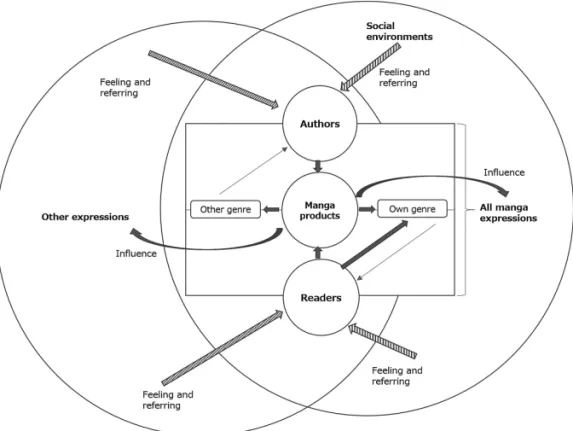
Third, manga are not the only “privileged” expressions of characters, as in fact, other artistic expressions, such as animation, games, and movies, have a greater influence and power. Simultaneously, manga are also not necessarily the “origin” of other expressions. For example, animations or games may be released first and the manga release would follow, as a form of “comicalization.” As all these differences indeed influence manga readers’ preferences in various ways, Ito (2014) suggested a reading manga framework to grasp the variations (Figure 1). 2 Ito (2014), p. 97.
In figure 1, authors who produce manga products are strictly the “senders,” although this grouping may also include other persons, such as coauthors, publishers, editors, etc. On the other hand, there are various types of readers: those who enjoy the stories, the characters, etc. The authors and readers interact with each other in that both sides’ intentions could differ for the same manga. Natsume (2004) similarly claimed that a manga is a collaborative product between authors and readers, whose perspectives may diverge. Furthermore, various factors may influence the authors and readers, such as the manga genre and categories. Genres often encompass a certain quality found within a manga topic/style and the manga products may also affect different genres, while categories are broader components, formed by generational or gender factors. In this paper, the working manga is the genre, and as most are published in magazines for adults, its category is for adults.
Ito (2014) noted that manga products are automatically placed into a certain genre and category. For example, if an author publishes a manga in a magazine that includes various working manga, that manga would automatically be put into the working manga genre, and the magazine readers would recognize it as such, despite it potentially being a little different from a typical working manga. Most readers might expect that the manga is suitable as a working manga and the authors would make the stories fit the genre, because the product is meant to be published in the working manga magazine. Overall, Figure 1 explains this interactive process among authors, readers, and manga products.
Second, manga products, authors, and readers also influence the creation of other manga genres. For example, Shinjitsu (2010) classified the history of Japanese working manga, highlighting that after the 1990s, the “professional manga” began taking precedence over the “general salaryman-manga” represented by Hirokane (1983-). This genre focuses on a certain industry or job, such as medicine (Nogizaka et al., 2002-2011; Sato, 2002-2006), comic editing (Matsuda, 2012-), Italian restaurant services (Sekiya, 2005-2009), public services (Kashiwagi, 2014-), the coast guard (Sato and Komori, 1998-2001), and educational tutoring (Mita, 2003-2007) among others. Subsequently, the emergence of this new genre influenced other genres and categories. For example, a manga on firefighting (Soda, 1995-1999) was initially published in a magazine for boys that contained other genres, such as sports manga. Afterwards, the author published another manga on ballet (Soda, 1999-2002) in a magazine for adults that focused on professional manga and applied the previous 1995-1999 manga’s themes to the ballet topic.
Third, as noted above, other artistic expressions, such as animation, games, movies, and novels, can affect the manga products, authors, and readers. Authors, including publishers, may form strategies to expand manga products to other expressions to gain further commercial income, but the readers would also expect that their favorite manga would consume them even further. Finally, authors and readers can perceive the manga product’s
various influences, stemming from the social environment as well as the entirety of manga and other expressions. Authors indirectly influence the production of manga products, readers indirectly influence the reading result or interpretation, and the social environment influences other factors, such as sales. Thus, manga reflect the social realities through two-way channels: authors’ production and readers’ reading interpretations. Ito’s (2014) system model suggests a meaning and interpretation interaction between authors’ producing and readers’ reading, but the model’s social environment must be pursued further, because in actuality, it is much more diverse.
Reflecting social realities in manga
Cooperation between story writers and illustrators
In this section, I tackle the main research problem by discussing cooperation between the story writer and illustrator as a form of mutual understanding. Broadly speaking, there are two types of methods that can produce manga. First, the author can act as the central leader, but must produce the manga with several staff members to lessen the workload. As the author plans to reflect social realities, he/she must play the role of a journalist or fieldworker to gather information and transform it into the manga. This process is obviously quite difficult to observe. Second, the story writer and illustrator can also be the central parties in the creation of the manga. In this case, the story writer first frames the stories and the illustrator subsequently transforms them into manga form. The stories can be presented in various forms, such as novels or manga drafts, and written in entirety by one story writer (Hotta and Obata, 1999-2003) or per episode by different story writers for each (Saito, 1968-). Sometimes, temporal story writers may participate in the creation and this involves dividing the task of reflecting social realities. This process is indeed more easily observable than when a sole author attempts to reflect social realities in the final product.
Kondo (1995) exemplified this relationship between story writers and illustrators. He firstly noted that authors were commonly not efficient at story writing or drawing, using the proverb “Heaven doesn’t grant a person more than one special gift.” Therefore, the division of work between both is a reasonable alternative to highlight the author’s preferences. Then, he explained the relationship between story writers and illustrators through an example in which he compared an actual story and the manga episode. For instance, in Kajiwara and Kawasaki (1966-1971), Kondo (1995) introduced Kajiwara’s (story writer) story in a novel form. There was no direction for an illustrator to transform the story into a manga, but Kawasaki (illustrator) managed to do so vividly. Here, Kondo (1995) evaluated Kawasaki’s good work and indicated the difficulty of this process. Specifically, Kajiwara used a particular figure of speech: “He (main character) experienced such a shock, it was like getting hit on the head with a hammer.” If Kawasaki transformed this figure of speech into
Figure 2. Manga and “invisible words”3
manga directly, it would have become quite a funny scene and would have diminished the serious mood. Instead, Kawasaki expressed the character’s shock using various manga symbols: sweat, breath, shaking, and thunder shaped “up fixes” (morphemes in visual language appearing above characters’ heads) (Cohn, 2013). Thus, as Kondo (1995) noted, transferring a story to manga does not necessarily result in a word-for-word translation. Some of the story writer’s character lines were transformed into the manga directly, but other story elements, such as plots or memos, were not reproduced exactly, but expressed in manga form (Figure 2).
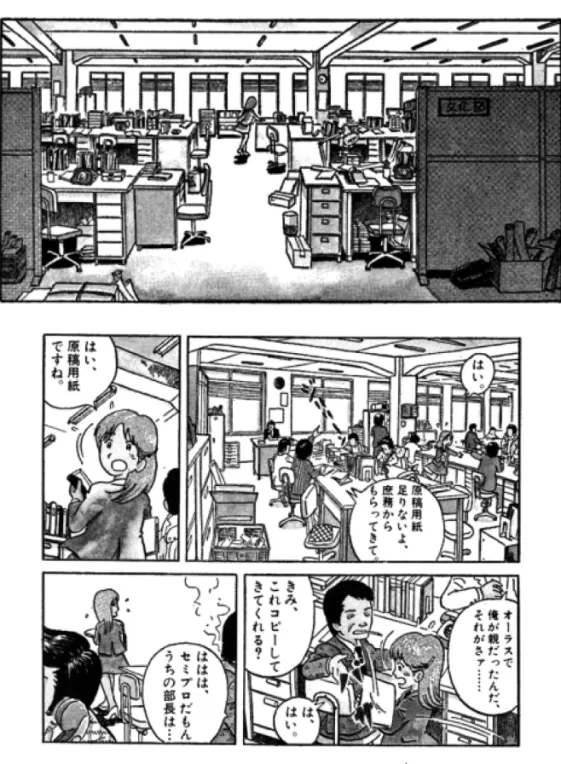
Moreover, social realities influence and are reflected in both the story writer’s and the illustrator’s artistic expressions. Although, story writers are mainly responsible for gathering information, when stories are transformed into manga form, the illustrators are the ones that reflect many aspects of social reality. For example, the following scene illustrates an office work space (Figure 3), as seen in Kariya and Hanasaki (1983). One of the main characters, Yuko Kurita, is working in the department of culture, specifically as a new employee for the Tozai newspaper company. As this scene was set in 1983, when this manga episode was published, it differs entirely from an office space in 2020: no PCs, no cellphones, and smoking in an office was permitted.
Thus, this scene preserved the authenticity of an office space at that time. Although the story writer may direct the illustrator to draw an office scene, it is the illustrator that decides how to present the office space in this period. Thus, it is both the story writers and illustrators that are responsible for reflecting social realities.
4 Kariya and Hanasaki (1983) Oishinbo, Vol.1, pp. 6, 10.
Ⓒ Tetsu Kariya/Akira Hanasaki, 1983.
The learning manga in Japan
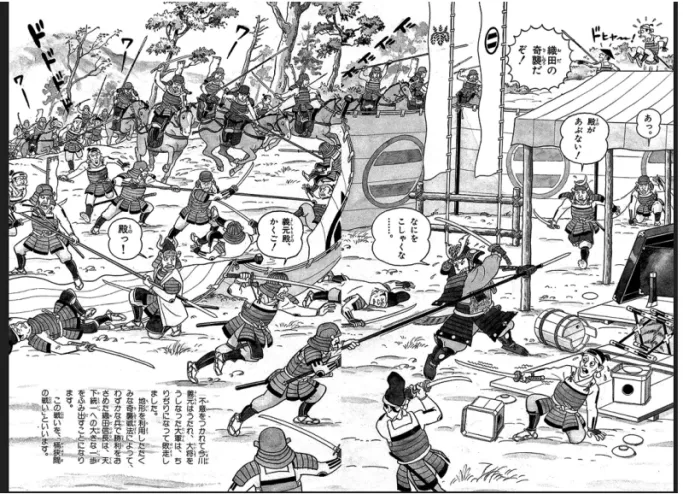
In this section, I address why manga, especially working manga, need to reflect social realities. On the one hand, readers recognize that manga is fiction. On the other hand, they also feel a certain sense of reality, especially when authors include real world descriptions. To solve this contradiction, I consider the learning manga, one of the unique genres that has maintained its original position in Japanese manga history for a long time. Since the 1960s, these manga were published to convey particular knowledge to readers, such as science, history, etc (Yoshimura, 2009). As a result, it is possible that learning manga have had a certain influence on other manga genres’ reflections of social reality. Specifically, people may accept the social realities and knowledge presented in some manga genres as true, to a certain extent, because learning manga offer many facts and knowledge. As an example of learning manga illustrations, Figure 4 represents the 1560 war of Okehazama between Oda
5 Kodama and Aomura (1982) Shonen Shojo Nihon no Rekishi. Vol. 10, pp. 124-125.
Ⓒ Kota Kodama/Jun Aomura, 1982.
and Imagawa, vividly describing Yoshimoto Imagawa’s death, attacked by Oda troops, that historically concluded this event.
Yoshimura (2009) claimed that the origins of learning manga can be classified into three points. First, although manga was considered detrimental for education at the time, school teachers began exploring “good manga” that were adequate for certain educational programs, which eventually led to alleviating the social prejudice surrounding manga. Second, some magazines started declaring themselves as adequate for children’s education and this increased the social recognition that not all manga were deleterious to education. Third and most importantly, this process led to the rise of the learning manga. Initially, learning manga were aimed toward children and most were supplied to school libraries to increase children’s familiarity with the educational product. These aspects were important for increasing learning manga popularity in Japanese society, and nowadays, they target both children and adults (Yoshimura, 2009). With regard to working manga, one particularly representative product is Ishinomori’s (1983) Manga Nippon Keizai Nyumon that aims to teach the Japanese history of economics and business.
As of late, Japanese learning manga can be classified into three categories: (1) previously written educational manga for children explaining many topics, including science, history, nature, and medicine (those on Japanese history are particularly influential and are still substantially supplied to elementary school libraries); (2) learning manga for adults reflecting expert knowledge, with titles that usually begin with “Manga de wakaru” meaning “we can understand...though manga,” and addressing numerous topics, such as statistics (Takigawa, 2015), bookkeeping (Kawada and Kawada, 1996), artificial intelligence (Miyake and Bizen, 2017), and psychological problems (Okada and Matsumoto, 2019); and (3) similar to the second category, the learning manga interpreting notable books, specialist books, and masterpieces. Regarding the latter, especially aimed at business persons, many notable books and masterpieces have been “comicalized:” Covey (1989), Franklin Covey Japan and Koyama (2013), Gratton and Scott (2016), Hoshii and Matsueda (2018), Carnegie (1948), Dale Carnegie Training Japan and Kato (2015), Keynes (1936), and Team banmikas (2015).
In Japan, using learning manga to learn or transfer knowledge is an effective replacement of textbooks, due to familiarity and accessibility. Familiarity is an important aspect for learning manga popularity in Japan, for both children and adults, and school libraries have helped its propagation. If people struggle with reading complex or abstruse books, they can instead try to read learning manga. Initially, manga snippets were sometimes inserted within textbooks to increase explanation capacity. In contrast, in learning manga, texts are inserted within the pictures for the same purpose. This reversal between picture and text priority is the core of learning manga development. Regarding accessibility, manga make it easier for
people to understand and retain knowledge. Indeed, texts have an essential role in logically transferring knowledge, but manga offer an additional “visual language” aid (Cohn, 2013). As Cohn (2013) highlighted, many legendary comic authors viewed drawing as a type of language or symbol, and he accordingly suggested that this “visual language” can involve either the creation of sounds, body movements, or graphic expressions. Cohn (2013) argued that people could understand the meaning of the communication system, graphic structures, and graphic schema of manga, which enabled manga to transfer stories and meaning. Thus, Japanese people, who are familiarized with and enjoy manga, can effectively interpret learning manga, draw meaning for them, and understand the evoked knowledge.
Learning, practical, and functional manga
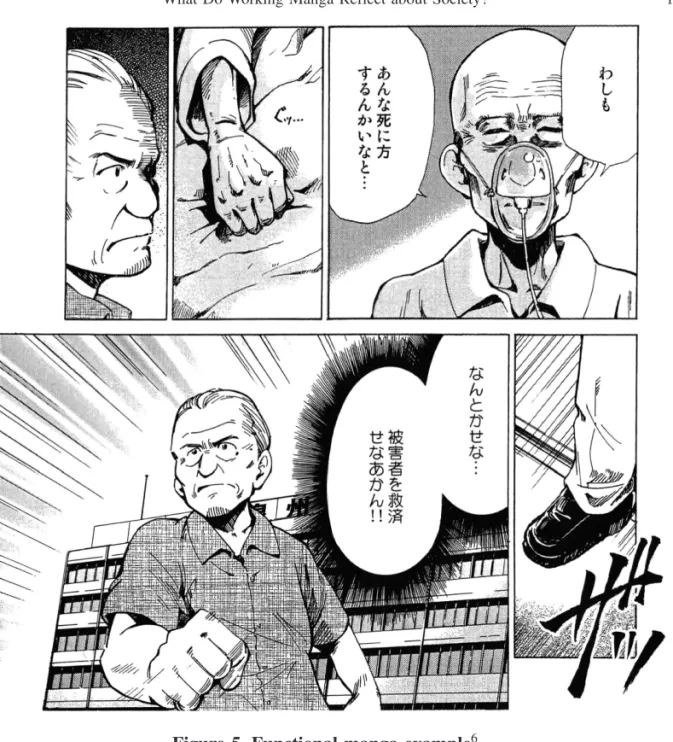
To understand learning manga, Takemiya’s (2020) classification is important and useful. She claimed that manga can be used as a tool to enlighten social problems and suggested three types of learning manga: practical (for adults), functional (entertainment and enlightenment), and learning manga (for children). Takemiya, who is also a famous manga author in Japan, criticized practical manga as being boring and too commercial, and positioned functional manga as the most significant, because they can enlighten social problems while being entertaining and appealing, increasing the chances of vivid memorization. As an additional aspect of functional manga, Ogawa and Tsuru (2011) included neutrality as an important element for transferring knowledge. Overall, it is clear that functional manga differ in many respects from typical learning and practical manga. As an example, Matsuda and Takemiya (2012) published a functional manga anthology to address environmental pollution problems in Japan (Figure 5). Both the researcher (Matsuda) and illustrator (Takemiya) took part in editing this manga, and many subsequent researchers, students, and illustrators analyzed this publication through transdisciplinary research.
As a result of reviewing these learning manga, I can draw two conclusions. First, there is a kind of intellectual tradition in which a certain amount of social reality is reflected in manga (especially learning manga), and people have a fundamental role in accepting knowledge and interpreting its meaning. Second, people often feel a sense of reality if the manga are drawn in a way that reflects a certain amount of social reality. Especially in terms of functional manga, people can uncover serious social problems from manga that have been edited and published by various people, including academic researchers. Although learning manga implies the transferring of information and enlightening problems, working manga can also include social realities for certain purposes.
6 Matsuda and Takemiya (2012) Ishi no wata. p. 141.
Ⓒ Takeshi Matsuda / Keiko Takemiya, 2012.
The relationship between society and manga from a subculture perspective
Working manga as subculture
Previously, I pointed out the necessity of expanding on the social environment in Ito’s (2014) framework. To do so, I consider theories of subculture. Generally, manga belong to subculture categories, despite the art’s huge influence on society in itself. Working manga especially have a subculture feature, because to stimulate working people’s empathy, they have to maintain a certain radical or problem-solving quality against the business “common sense” during a particular period. This aspect is similar to the subculture against main culture feature. Hebdige (1979) discussed subculture from a fashion perspective, highlighting that a particular style or form could not permanently dominate the landscape and that the challenge to hegemony, which subcultures represent, is expressed obliquely (Hebdige, 1979, pp. 16-17). This process is the same in manga as subculture. Hebdige (1979) also explained that style in subculture is highly significant and its transformations go “against nature,” interrupting the process of normalization. These can be gestures, movements, or speech that offend the “silent majority” (pp. 17-18). Overall, Hebdige (1979) grasped subculture as breaching our expectations and representing symbolic challenges to a symbolic order (p. 92). Similarly, Cohen (1997) researched young fashion and defined subculture as a “compromise solution between two contradictory needs: the need to create and express autonomy and difference from patients [...] and the need to maintain the parental identifications” (p. 59). The author also noted that the latent function of subculture is to express and resolve, albeit “magically,” the contradictions that remain hidden or unresolved in the parent culture (p. 57). Both studies claimed that subculture includes a challenge against existing culture or upper social structure. Although this is not exactly the case for manga, it is not enough to describe “ordinary” business or working life facts to grasp readers’ interests, as no one would read manga that introduce ordinary people’s ordinary working lives. Since the 1960s, even working cartoons in newspapers added comical aspects of working life in each era (cf. Shoji, 1969-).
On another note, Ina (1999) claimed that subcultures position themselves in lower factions of society, but form stably and autonomously, often influencing main culture and sometimes “taming” it. He also classified six dimensions of subculture as follows: (1) subordinateness (subordinate against the “highness,” but with an extending, spreading, and intertwining mutual influence); (2) peripherality (peripheral against central, in which the outsider makes the borders criticality clear and goes beyond them); (3) popularity (popular against high grade, involving the diffusion of a potentially low quality object among many people that some end up monopolizing); (4) flexibility (flexible against solid, often lacking evidence of determined value or autonomy, but adaptable and occasionally responsive to a
situation); (5) physicality (physical against logic, involving irrational language and symbols, such as emotions and impulses, but still grasping the significance of their existence and their limits); and (6) placeness (place against mind or subject, melting and spreading the borders of identity, while maintaining relationships or connections) (Ina, 1999, pp. 150). Overall, Ina (1999) suggested that these dimensions are useful for thinking about the concept of subculture. To understand them profoundly, I apply them to the manga Oishinbo.
The case of Oishinbo: Gourmet manga as subculture
Oishinbo (Kariya and Hanasaki, 1983-) is a representational “gourmet manga” set in
Japan. The main characters explore various aspects and issues of foods and dishes, and
7 Kariya and Hanasaki (1983) Oishinbo, Vol.1, p. 38.
Ⓒ Tetsu Kariya/Akira Hanasaki, 1983.
highlight multiple societal problems. It is a little difficult to view this manga as a working manga, because the main plot is not about working life, but about food and dishes, despite that the main character is working in a newspaper company and there are many office scenes. Nonetheless, some scenes and episodes are suitable for discussing working life. Overall, Oishinbo is a fitting manga for understanding subculture, as the main characters often face problems regarding food and dishes, warning Japanese society of the relevant issues, especially with regard to the boom of gourmet foods. They often challenge authorities, power, and luxury by exploring alternative foods and dishes. Regarding Ina’s classifications, in this sense, this manga belongs to the dimension of popularity.
For example, in Figure 6, Yamaoka, the main character, criticizes the gourmands that recklessly made much of the prized food. However, the other main characters take pride in
8 Kariya and Hanasaki (1983) Oishinbo, Vol.1, p. 93.
Ⓒ Tetsu Kariya/Akira Hanasaki, 1983.
pursuing high quality, skillful, traditional, and organic safety foods, but they also do not stop exploring even when criticized by authority. This point represents one of the dimensions of subculture, peripherality. They insisted that gourmet and good dishes were not confused. Furthermore, to challenge the incorrect common sense of foods, they often use a network of lower people. As shown in Figure 7, Yamaoka sought the assistance of a homeless person to find a high-quality restaurant, representing the dimension of subordinateness and implying a challenge against the prejudice of social structure. Other problems were also suggested with regard to the dimension of placeness. Specifically, Yamaoka and Kurita (the main character) acquired information about a recent high-quality Japanese restaurant from Tatsu-san, a homeless person who knew about the restaurant by working there as a janitor.
Moreover, the characters also sometimes try to destroy rigorous traditional thinking, normally following traditional manners, unless ossified thinking hinders innovation. For example, in Figure 8, Yamaoka breaks a traditional Japanese custom and suggests a cheap, but delicious way to eat. This episode represents the dimensions of flexibility and physicality. Others may find Yamaoka’s method strange and irrational, but they all
9 Kariya and Hanasaki (1985) Oishinbo, Vol. 3, p. 97.
Ⓒ Tetsu Kariya/Akira Hanasaki, 1985.
appreciate the deliciousness of the final result. Specifically, Yamaoka suggested eating sashimi with soy sauce and mayonnaise, but his real intention was to insist on respecting the food culture of other countries.
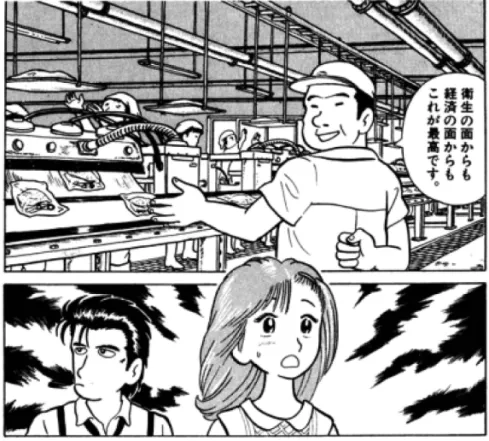
Oishinbo also highlights the existence of cultural problems related to real society. For
example, in Figure 9, the manga addresses the safety problems of chicken, playing a role as a subculture challenging a prominent cultural issue at the time that was taken for granted, and influencing people’s thinking about food safety and quality. The importance of paying attention to food safety has become common sense in present society and if similar problems were suggested today, people might take little interest, because it is a popular and common notion. In 1983, however, this problem had a high value and was considered as an important societal issue. In this scene, Kurita and Yamaoka face the reality of chicken production without factories. At the beginning of this episode, Kurita’s grandmother rejected chicken at her restaurant, because the taste was completely different from what she remembered. In fact, this restaurant’s chicken became low-quality.
10 Kariya and Hanasaki (1983) Oishinbo, Vol.1, p. 218.
Ⓒ Tetsu Kariya/Akira Hanasaki, 1983.
Upon reviewing subculture studies, I discovered several elements. First, working manga have to challenge the business common sense, such as working life, management, career, front line markets, and so on, to gather readers’ sympathy, increase popularity, raise value, and extend shelf life and relevance. Consequently, social realities that working manga include must be different, radical, cutting-edge, fashionable, problematic, and domain-specific. These features make working manga interesting, popular, and “tame” the main culture of business. To do so, working manga also employ the six dimensions of subculture. Second, working manga descriptions must be exaggerated compared to ordinary business realities to increase readers’ interests and empathy. However, readers avoid overly exaggerated artistic expressions, because of their lack of reality. Thus, manga authors must consider a significant trade-off between reality and fiction, and balancing is an important task, especially for working manga. Third, there is a temporality related to producing working manga. As explained above, to create working manga, authors have to consider six dimensions of subculture, but they must also ensure that their reflections are temporally present. For example, realities that have just begun to occur are familiar to most people, but rather commonplace. In other words, if the realities that working manga include are up-to-date, they could stimulate readers’ empathy, but may also become ordinary after a while. If the realities are cutting-edge, known by only a limited amount of people, the manga could arouse a strong interest, but its influence might be limited to a narrow range of individuals. Another big trade-off between cutting-edge and up-to-date is that temporality always flows backward, but this will be further addressed in the following section (Figure 10).
Discussion
In this final section, I discuss the main research question (What do working manga reflect about society?) and revisit Ito’s (2014) framework by adding author trade-offs and reader balances. Specifically, I modified this framework through a discussion on social realities in working manga. to resolve the previous framework’s issue: it lacked the concrete effects of the social environment.
First, this process involved adding temporality to the framework. Ito (2014) touched upon this point, but its definite inclusion is necessary, as manga products age after a while. When a manga is up-to-date at one moment, it will eventually and inevitably age and become out-of-date. Manga authors have to reflect social realities in their products to capture readers’ interests, empathy, and sympathy, but temporality and society always influence these interests. Especially for working manga, considering temporality is necessary, as social environments indirectly affect it. However, temporality does not always have a negative influence on manga products. Mostly, it pressures manga ageing, sometimes giving us a chance to reevaluate them later on. Second, the effects of social environments must also be considered, as this is related to the problem of why working manga reflect social realities. Simply put, it influences popularity among readers and commercial success. Accordingly, I considered concrete social environments influences on both authors and readers. Previously, I expressed the social environment’s influences on authors as two trade-offs: between reality and fiction, and between cutting edge and up-to-date. A certain exaggeration is allowed for entertainment and popularity purposes, but over-exaggerations may result in losing readers’ trust, even if manga is substantially fiction, and an over-faithfulness to social facts may also cause a manga to become commonplace, making it unpopular. Regarding the second trade-off, including cutting-edge facts and information often increases a manga’s value and attractiveness, but also its risk of narrowing the readers’ range, which decreases popularity. On the other hand, if a manga only includes up-to-date facts and information, readers might consider them too ordinary. Overall, the authors have to overcome these two trade-offs to produce manga. Regarding readers, authors’ thoughts and intentions do not affect the readers directly, but they interpret these thoughts and intentions by reading manga (Natsume, 2004). Therefore, the latter two balances, between reality and fiction, and cutting-edge and up-to-date, mutually affect each other. From these discussions, Figure 11 reveals the modified version of Ito’s (2014) framework.
What do working manga reflect about society?
Finally, we discuss the question above. What does working manga reflect in society? The process of answering the main research question is the same as overcoming the fiction/reality contradiction within manga. The key is the concept of “dramatization to
protect confidentiality.” For example, if as researchers we collected materials from informants, we could not publish the results without consent. If we obtain permission, we often use these materials under the condition of anonymity, ensuring that certain information remains anonymous. It is the same for manga, as authors cannot publish their collected facts without anonymity. Therefore, they often keep anonymity by the way of dramatization. In working manga, dramatized events impact dramatized characters, for dramatized reasons, in dramatized situations, for dramatized purposes. This dramatization also has the function of protecting confidentiality. Nevertheless, many readers often perceive social realities in the stylistic expressions of working manga, because they consider that working manga descriptions have a certain amount of real life evidence. There is the Japanese tradition of the learning manga, and readers believe that working manga similarly contain certain facts and information. The more authors collect materials, the more descriptions they offer, the more the readers believe in the realness of the content. Thus, fiction is not same as absurdity or impossibility. Rather, in this case, it reflects “anonymized realities through 11 Author’s adaptation of Ito (2014), p. 97.
Figure 12. Relationship between manga, authors, readers, and “anonymized social realities through dramatization”
dramatization.” In other words, working manga contain a certain amount of social realities, but readers cannot grasp them entirely, because they are anonymized by dramatization, although they can still enjoy reading them with a certain feeling of reality (Figure 12).
Conclusions
To answer the main research question, this paper considered the relationship between manga, especially working manga, and society, defined working manga, discussed its relevance as a research document, and introduced Ito’s (2014) comprehensive framework on the social environment surrounding working manga, authors, and readers. After examining story writers’ and illustrators’ cooperative production of manga, I discussed learning manga that include many real facts for learning and education purposes. Then, I reviewed some studies on subculture with regard to working manga and finally suggested two types of trade -offs: between reality and fiction, and between cutting-edge and up-to-date. Overall, the research showed that authors include social realities for commercial success, and to spark readers’ interests and empathy. Readers also enjoy the social realities of working manga, provided by the authors’ collected materials, but authors cannot publish their information without protecting the confidentiality of their sources. In fact, they must anonymize their materials through a form of dramatization to maintain anonymity and increase entertainment. Therefore, working manga reflect social realities through an anonymized form of dramatization.
Overall, this study confirmed that working manga are suitable research materials, as they are never absurd or fake, but include certain social realities stemming from the collected materials that are anonymized through dramatization. Despite this paper’s contributions, there are some limitations that need to be addressed by future research. The first involves determining the process of selecting an adequate working manga that is entirely suitable for research. Second, although one of the paper’s strengths lies in its suggested framework and indexes, further discussions are needed to confirm their general applicability. Specifically, future studies should consider applying the methodology to other working manga to solve any potential issues.
Acknowledgements
This work was supported by JSPS KAKENHI, Grant Number 18H00885. I would like to thank Akira Kitai (Konan University), Ryuta Suzuki (Kobe University), and Tatsuya Uenoyama (Osaka Prefectural University), the members of the manga research group, for their useful discussions and advice. The author takes sole responsibility for any errors in the text.
References
Manga Comics12
Dale Carnegie Training Japan and Kato, F. (2015). Komikku to zukai de wakaru “michi ha hirakeru” (Beginners’ guide to “How to stop worrying and start living”). Tokyo: Kadokawa/Chukei Shuppan. Franclin Covey Japan and Koyama, K. (2013). Manga de wakaru nanatsu no shukan (The seven habits of
highly effective people). Tokyo: Takarajimasha.
Gotoge, K. (2016-2020). Kimetsu no yaiba (Demon Slayer). Tokyo: Shueisha. Hirokane, H. (1983-). The series of Kosaku Shima. Tokyo: Kodansha.
Hoshii, H. and Matsueda, N. (2018). Manga de wakaru Life Shift (The 100-year life). Tokyo: Tokyo keizai shinposha.
Hotta, Y. and Obata, T. (1999-2003). Hikaru no go. Tokyo: Shueisha.
Ishinomori, S. (1983). Manga Nippon Keizai Nyumon (An introduction to Japanese economics). Tokyo: Nihon Keizai Shinubunsha.
Issacson, W. and Yamazaki, M. (2013-2017). Steve Jobs. Tokyo: Kodansha.
12 The publication year reflects the period when the authors illustrated the comic in a magazine format.
The first author is the primary artist who drew the manga and the others are the story writers or cooperators. If the manga has an English title on its printed cover, it is included here.
Kajiwara, I. and Kawasaki, N. (1966-1971). Kyojin no hoshi. Tokyo: Kodansha. Kariya, T. and Hanasaki, A. (1983-). Oishinbo. Tokyo: Shogakukan.
Kashiwagi, H. (2014-). Kenko de Bunka-teki na Saitei-gendo no Seikatsu (The minimum standards of wholesome and cultured living). Tokyo: Shogakukan.
Kawada, S. and Kawada, K. (1996). Manga de wakaru boki nyumon (Introduction to bookkeeping). Osaka: Seibunsha.
Kodama, K. and Aomura, J. (1982). Sengoku daimyo no arasoi. Shonen shojo Nihon no rekishi. Vol. 10, Tokyo: Shogakukan.
Matsuda, N. (2012-). Juhan-Shuttai. Tokyo: Shogakukan.
Matsuda, T. and Takemiya, K. (eds.) (2012). Ishinowata: Manga de yomu asbesto mondai. Kyoto: Kamogawa Shuppan.
Mita, N. (2003-2007). Doragonzakura. Tokyo: Kodansha.
Miyake, Y. and Bizen, Y. (2017). Manga de wakaru jinkouchinou (Introduction to artificial intelligence). Tokyo: Ikedashoten.
Nogizaka, T., Nagai, A., and Yoshizawa, M. (2002-2011). Iryu: Team Medical Dragon. Tokyo: Shogakukan.
Okada, T. and Matsumoto, M. (2019). Manga de wakaru aichaku shogai (Introduction to attachment disorder). Tokyo: Koubunsha.
Saito, T. (1968-). Golgo13. Tokyo: Shogakukan.
Sato, S. and Komori, Y. (1998-2001). Umizaru. Tokyo: Shogakukan. Sekiya, T. (2005-2009). Banbino! Tokyo: Shogakukan.
Shoji, S. (1969-). Salarie-man senka. Tokyo: Kodansha. Soda, M. (1995-1999). Megumi no Daigo. Tokyo: Shogakukan. Soda, M. (1999-2002). Subaru. Tokyo: Shogakukan.
Takigawa, Y. (2015). Manga de wakaru toukeigaku nyumon (Introduction to statistics). Tokyo: Shinseishuppansha.
Team banmikas (2015). Manga de dokuha: “The general theory of employment, interest and money.” Tokyo: East Press.
Articles and Book References
Carnegie, D. (1948). How to stop worrying and start living. New York: Simon and Schuster.
Cohen, P. (1997). Rethinking the youth question: Education, labour and cultural studies. Basingstoke: Macmillan.
Cohn, N. (2013). The visual language of comics: Introduction to the structure and cognition of sequential
images. London: Bloomsbury.
Covey, S. R. (1989). The seven habits of highly effective people: Restoring the character ethic. New York: Simon and Schuster.
Gratton, L. and Scott, A. (2016). The 100-year life: Living and working in an age of longevity. London: Bloomsbury Information.
Groensteen, T. (1999). Système de la bande dessinée. Paris: Presses universitaires de France. Hebdige, D. (1979). Subculture, the meaning of style. London: Routledge.
Ina, M. (1999). Subculture no Shakaigaku (Sociology of subculture, in Japanese). Kyoto: Sekaishisosha. Ito, T. (2014). Tezuka is dead (in Japanese). Tokyo: Seikaisha.
Keynes, J. M. (1936). The general theory of employment, interest and money. London: Macmillan.
Kinsella, S. (2000). Adult manga: Culture and power in contemporary Japanese society. New York: Routledge.
Kondo, T. (1995). Gensaku ha ika ni manga ni henkan sareruka? manga no haikei ni sonzaisuru “mienai kotoba” (How story is transformed to manga? The “invisible words” on the background of manga, in Japanese). In M. Inoue (ed.), Bessatsu Takarajima ex: Manga no yomikata (pp. 146-149). Tokyo: Takarajimasha, Inc.
Matanle, P., McCann, L., and Ashmore, D. (2008). Men under pressure: Representations of the “salaryman” and his organization in Japanese manga. Organization, Vol. 15, No. 5, pp. 639-664. Matsumoto, Y. (2018). A study of the suitability of Japanese “working manga” as a business case study.
International Review of Business, Vol. 18, pp. 29-86.
May, T. (2001). Social research: Issues, methods, and process. Buckingham: Open University Press. McCloud, S. (1993). Understanding comics: The invisible art. New York: Harper Perennial.
Natsume, F. (2004). Manga gaku eno chousen: Shinka suru hihyo chizu (in Japanese). Tokyo: NTT shuppan.
Ogawa, S. and Tsuru, D. (2011). Toward the establishment of functional manga: Joint research with Kobe University in the asbestos manga project (in Japanese). Journal of Kyoto Seika University, Vol. 39, pp. 76-101.
Shinjitsu, I. (2010). Salaryman-manga no Sengo-shi. (Japanese salaryman-manga history after WWII, in Japanese). Tokyo: Yosensha.
Takemiya, K. (2020). Manga no torae kata (How to grasp manga). In O. Maekawa and H. Okumur (eds.),
Manga: Junbungaku no shiten kara (Manga: From a view of humanities, in Japanese). Kobe: Kobe
University Press.
Takeuchi, O. (2008). Manga kenkyu handbook (Handbook for comics studies, in Japanese). Kyoto: Osamu Takeuchi laboratory.
Yoshimura, K. (2009). Manga to kyoiku. (Manga and education). In F. Natsume and O. Takeuchi (eds.),
Manga gaku nyumon (Introduction to manga studies, in Japanese) (pp. 158-162). Kyoto: Minerva