Constructing “development” A historical
discourse analysis of newspapers regarding the
creation of terminology and public discourse
on Autism and Hattatsu Shogai in Japan
著者(英)
Yasushi Miyazaki
学位名
博士(総合政策)
学位授与機関
関西学院大学
学位授与番号
34504甲第631号
関西学院大学審査博士学位申請論文
A Dissertation
for partial fulfilment for the requirement of
the degree of Doctor of Policy Studies
Constructing “development”
A historical discourse analysis of newspapers
regarding the creation of terminology and public
discourse on Autism and Hattatsu Shogai in Japan
指導教員
Supervisor
Professor Joseph DeChicchis
関西学院大学大学院総合政策研究科博士課程後期課程
2017 年 3 月修了
D4002 宮崎 康支
By Yasushi Miyazaki (D4002) Doctoral StudentGraduate School of Policy Studies Kwansei Gakuin University
Abstract
This dissertation analyzes the linguistic influence of public policies on public discourse on Autism and Hattatsu Shogai in Japanese newspapers. With respect to theoretical frameworks and methodologies of three frameworks, disability studies, Critical Discourse Analysis (CDA), and text mining, qualitative and quantitative analyses are employed.
With these analyses, two major discoveries were made. First, newspaper texts do not separately represent the two conflicting models of disability, medical model and social model. In other words, these two models are mutually represented for expressing characteristics, policies, and practices toward Hattatsu Shogai. Second, negation, for instance nai (“not”), has function both in the medical model for criticizing people’s ability and in the social model for criticizing the social barrier toward persons with disabilities. Thus, this finding shows the possibility of the application of theoretical models of disability for linguistic analysis. We can hypothesize that these conflicts occur as the consequence of global transition of disability policy represented by the United Nation’s Convention of Rights of the Persons with Disabilities, globalization of thoughts on disability in Japan, and progress in medicine and special education.
The author offers the outcome of this research for improvement of
professional education in journalism, education, and social work. Additional systemic analysis of individual words in conjunction with disability models, as well as other issues, is suggested for further analysis.
博士学位申請論文要旨 この論文は、日本における自閉症および発達障害に関する新聞記事を通じた 公的言説の形成における公共政策の言語的影響を分析するものである。3 つの理 論枠組みおよび方法論―障害学、批判的ディスコース分析、そしてテキス トマ イニング―をもとに、定量的・定性的分析をおこなった。 上記の分析により、主に2 点が明らかになった。1 点目は、対立的に扱われる 二つの障害モデル―医学モデルと社会モデル―が、新聞紙上においては切り分 けられていないことである。換言すれば、2 つのモデルは発達障害に関する特徴、 政策、そして支援実践を説明するにあたり相互作用的に用いられていることに なる。2 点目としては、否定表現―たとえばナイ助動詞―が、人間の能力を批判 するための医学モデル的用法と、社会的障壁を批判するための社会モデル的用 法の双方を持つことである。つまり、この点は言語分析において理論的障害モ デルを応用する可能性を示した。 仮説としては、以上2 点の背景には国際連合による障害者権利条約の制定に 象徴される国際的な障害者政策の転換、日本における障害に対するグローバリ ゼーションの影響、そして医療及び特別支援教育の進歩などが考えられる。 筆者は、この研究の成果を報道、教育、社会福祉などの専門家育成教育に応 用することを展望している。一方、個々の言語的表現と障害モデルの関係にお ける体系的な分析などが課題として残されている。
2017 © Yasushi Miyazaki All Rights Reserved
iv
Introductory notes
1. The number of words per line and of lines per page for this dissertation is organized accordingly to the rule that the Graduate School of Policy Studies at Kwansei Gakuin University specifies.
2. For English sources, the formatting rule of references for this dissertation follows Publication Manual of the American Psychological Association (6th. Ed), published by American Psychological Association (APA). Application of the APA rule for Japanese sources follows the guideline crafted by the University of British Colombia Library (n.d.).
3. This dissertation Romanizes Japanese terms and references with the Hepburn Romanization system unless specified.
4. Following the APA’s manual, which suggests authors to use person -first language, the author of this dissertation states “person(s) with disabi lity (disabilities)”, not “disabled person (people)”, unless specified. However, this action does not mean that the author totally endorse the person-first language movement based on the politically correctness culture of the U.S. The author makes this decision to use person-first language in order to demonstrate his understanding of a de-facto academic standard.
5. The Japanese word 新聞 that means “newspaper” is romanized as shinbun with the Hepburn Romanization system. This word is, however, romanized as shimbun in case a particular newspaper company uses this spelling for their company and product names as proper nouns.
6. Parts of this dissertation are adopted from the author’s earlier publications and presentations, as well as from the survey paper, whi ch the author of this dissertation submitted to the Graduate School of Policy Studies at Kwansei Gakuin University in 2014. The author modified formatting, style, and coherence particularly for this dissertation.
v
Table of contents
Acknowledgements ... 1 List of abbreviations ... 3 List of tables and figures ... 4 Introduction ... 5 1.Hattatsu Shogai ... 7 1.1 Background ... 7 1.2 Definition problems ... 10 1.3 Social problem ... 12 2.Theoretical framework and methodology ... 13 2.1 Disability Studies ... 13 2.1.1 Models of disability ... 15 2.1.1.1 Significance and framework ... 15 2.1.1.1.1 Significance ... 15 2.1.1.1.2 Framework for characterizing models ... 15 2.1.2 Traditional models of disability ... 16 2.1.2.1 Religious model ... 16 2.1.3 Medical model ... 17 2.1.4 Social model and nontraditional models of disability ... 18 2.1.5 Application of models: autism spectrum ... 21 2.1.6 Application of models: analyzing discourse ... 22 2.1.7 Discussion on disability models ... 23 2.2 Critical Discourse Analysis ... 25 2.3 Text mining ... 28 3.Analysis ... 31 3.1 Dataset ... 31 3.2 Quantitative analysis ... 33 3.2.1 Network analysis ... 33 3.2.1.1 Findings ... 33 3.2.1.2 Interim discussion ... 39 3.2.2 Hierarchical cluster analysis ... 40 3.2.2.1 Findings ... 40 3.2.2.2 Interim discussion ... 46 3.3 Qualitative analysis ... 46 3.3.1 Method ... 46 3.3.2 Findings ... 47 3.3.2.1 Until 1990 ... 47 3.3.2.2 From 1991 to 2004 ... 49 3.3.2.3 After 2004 ... 50 3.3.3 Interim discussion ... 51
vi 4. Case studies ... 53 4.1 Negation ... 53 4.1.1 Methods ... 53 4.1.1.1 Qualitative analysis ... 53 4.1.1.2 Quantitative analysis ... 54 4.1.2 Results ... 54 4.1.2.1 Qualitative analysis ... 54 4.1.2.2 Quantitative analysis ... 62 4.1.3 Interim discussion ... 63
4.2 Definition, independence, and labor ... 64
4.2.1 Scope ... 64 4.2.2 Method ... 65 4.2.3 Findings ... 65 4.2.3 Interim discussion ... 68 5.Discussion ... 69 6.Policy recommendations ... 71 7.Conclusion ... 72 References ... 74
1
Ackn owledgements
I have been faced with a lot of obstacles during my study, but now I am reaching to a decisive moment. I am sure that I would not have completed this doctoral dissertation without support from many colleagues, friends, and family members. Here I mention some of them with sincere appreciation.
Dr. Joseph DeChicchis has served as an academic supervisor at Kwansei Gakuin University (KGU) for my masters and doctoral programs. This academic
year marks the 11th anniversary of my relationship with him. Without his advice
and encouragement, I would not have completed this dissertation.
I shall mention some other professors who have supported my study. Two other readers in my doctoral dissertation committee have been helpful both for my research and for my composition. Dr. Mark Sawyer has given me detailed suggestions about English writing and a careful reading. Dr. Katsuhisa Matsuoka, who has been invited from the School of Human Welfare Studies at KGU to serve on my dissertation committee, has presented me with a lot of honest opinions on disability studies and on theories in social sciences. In addition, Professor Masaru Honda has supported me on language matters including interpretation and translation. Moreover, these professors are great mentors not only on dissertation writing, but also on professional development.
An uncountable number of scholars, teachers, and friends have been inspirational for my research. They gave me suggestive and fruitful comments on my research and career in many different occasions, including classes, conferences, informal meetings, and so on. In particular, my experience in institutions which I have affiliated with, including Kansai University of International Studies, Syracuse University, and Nihon Fukushi University, aside from KGU, have a big meaning for my life. Staff members at KGU have been almost always helpful and sincere. Experiences with people around me have been sometimes harsh and painful, but I cannot forget the lessons learned from those. Dear colleagues and friends around the world, I would be really happy to show my achievements to you, with whom I have shared a lot of joy and sadness.
Although limitations of space make it impossible to mention the names of all individuals, let me mention the name of one professor: Dr. Masataka Jin’nouichi. I studied under him for a small project when I was a master’s student in 2006. He was a really sincere reader and mentor for many graduate student s, including myself. I still remember one occasion when Dr. Jin’nouchi strongly encouraged me to continue my research on disabilities. Dr. Jin ’nouchi passed away in 2012, but I wish I could show this dissertation to him in heaven.
My studies at KGU’s doctoral program is made possible by institutional funding schemes for doctoral students, including the Bates Memorial Scholarships,
2
the Doctoral Research Fellowship, and the Overseas Research Grant. With the university’s funding, I have been able to overcome difficult financial circumstance of mine.
Finally, I shall show my highest level of gratitude for my family and relatives, especially to my parents, brother, and grandmother. I cannot remember how many times I cried and complained about my difficulty and troubles in my study and social life. Thanks to their patience and encouragement, I am finishing my doctoral program. I am looking forward to return contributions for them from now.
I shall not forget the gifts that have enabled my achievement.
9 February 2017 Yasushi Miyazaki
3
List of abb revi ations
APA: American Psychological AssociationCDA: Critical Discourse Analysis CO: Cabinet Office (Japan)
CRPD: The Convention on the Rights of Persons with Disabilities DHA: Discourse-Historical Approach
JSDS: Japan Society for Disability Studies KGU: Kwansei Gakuin University
MEXT: Ministry of Education, Culture, Sports, Science and Technology (Japan) MOJ: Ministry of Justice (Japan)
SDS: Society for Disability Studies SFL: Systematic Functional Linguistics SSE: Special Support Education
UPIAS: Union of the Physically Impaired Against Segregation UK: The United Kingdom of Great Britain and Northern Ireland UN: United Nations
U.S.: The United States of America
4
List of tabl es and f igures
Figure 1.1 Function triangle of discourse, public opinion, and policy action……10
Table 1.1 Definition of developmental disability in U.S. Federal law ………...11
Table 2.1 Features of models of disability……….16
Table 2.2 Distribution of features on models of dis ability………..24
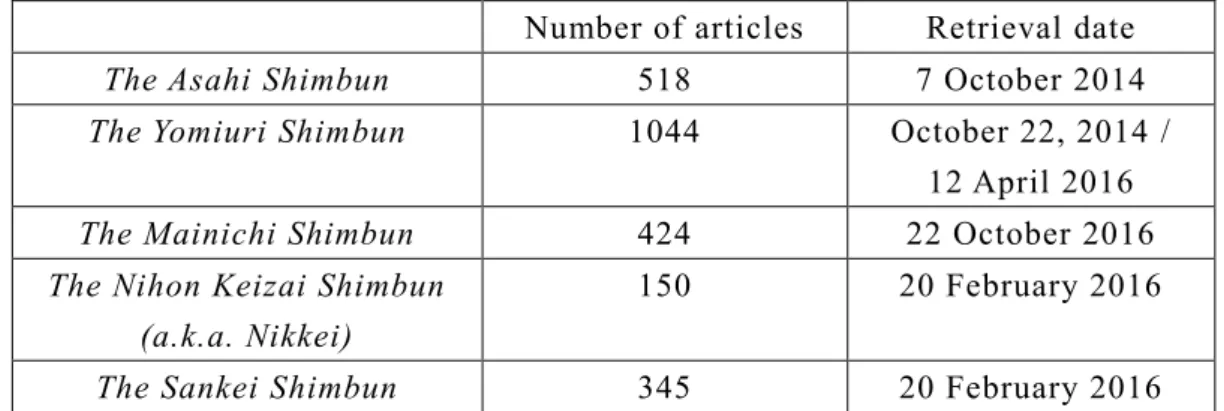
Table 3.1 Number of articles in newspaper corpora containing Hattatsu Shogai in on-line news databases ………31
Table 3.2 Number of words in newspaper corpora ………32
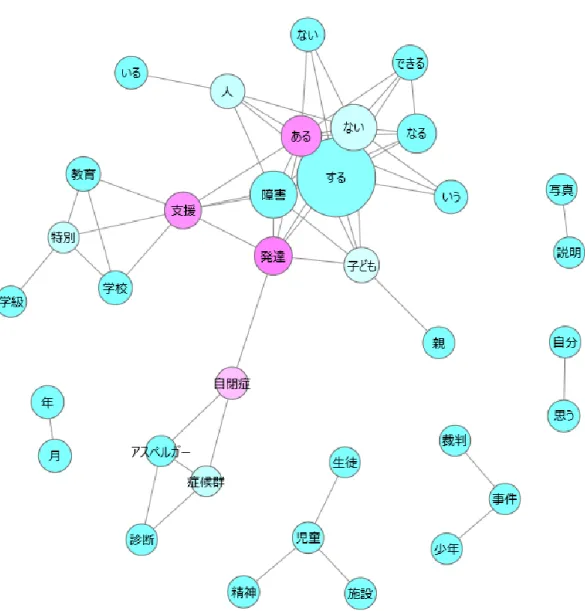
Figure 3.1 Yearly change of the number of articles referring to Hattatsu Shogai.32 Figure 3.2 Network graph of the Asahi Shimbun corpus ……….34
Figure 3.3 Network graph of the Yomiuri Shimbun corpus ……….35
Figure 3.4 Network graph of the Mainichi Shimbun corpus………36
Figure 3.5 Network graph of the Nihon Keizai Shimbun corpus……….37
Figure 3.6 Network graph of the Sankei Shimbun corpus………38
Figure 3.7 Cluster dendrogram for whole newspaper corpora ………41
Figure 3.8 The Asahi Shimbun dendrogram ………..43
Figure 3.9 The Yomiuri Shimbun dendrogram ……….……….43
Figure 3.10 The Mainichi Shimbun dendrogram ……….…….…….………...44
Figure 3.11 The Nihon Keizai Shimbun dendrogram ………...44
Figure 3.12 The Sankei Shimbun dendrogram ………..45
Figure 3.13 Sample of KWIC concordances from the Asahi Shimbun corpus…...47
Table 3.3 KWIC tokens for hattatsu in newspaper corpora ………..…….47
Table 4.1 Number of articles in sub-corpora ………..…….54
Table 4.2 Frequency of nai in the Asahi Shimbun ………62
Table 4.3 Frequency of nai in the Mainichi Shimbun ………..63
5
Introdu ction
This dissertation aims to examine the interaction of discourse, public opinion, and policy action. For the investigation, the author applied the se three frameworks: disability studies, Critical Discourse Analysis (CDA), and text mining. In other words, this research stands on a sociopolitical position for language study and its methodology is mixed -approach consisting of quantitative and qualitative perspectives.
In Chapter 1 “Hattatsu Shogai”, the background of research, focusing on law and policy, is outlined. Then problems of definitions, focusing on the chronological change and international difference, are stressed. Finally, this chapter mentions that Hattatsu Shogai is a social problem and reviews social science research, rather than medical research.
In Chapter 2 “Theoretical framework and methodology”, the author reviews exiting works of three frameworks/methodologies: disability studies, Critical Discourse Analysis (CDA), and text mining. In particular, this Chapter mentions the familiarity between disability studies and critical discourse analysis , focusing on critical perspective on social phenomenon and concepts with strong attention to language use and their common relationships to social theories, including Critical Theory. This chapter incorporates the further discussion on models of disability.
The author proposes six research questions extracted from the review of the Chapters 1 and 2. The questions are as follows:
(1) How does the Japanese society and politics affect the policy
about Hattatsu Shogai throughout the newspaper?
(2) What kind of ideology is behind the specific language ex pression
about Hattatsu Shogai?
(3) What kind of topics regarding Hattatsu Shogai are frequently
mentioned in print media?
(4) How has the frequency of mention of the subject of Hattatsu
Shogai changed?
(5) How has the definition of Hattatsu Shogai changed over recent
decades?
(6) What are the agents of changes?
With the above questions, the author attempts to investigate the public discourse focusing on language use.
In the Chapter 3 “Analysis”, the author conducted the whole-corpus analysis. In this study the digital text of newspaper articles from five major
6
newspapers in Japan are retrieved: the Asahi Shimbun, the Yomiuri Shimbun, the
Mainichi Shimbun, the Nihon Keizai Shimbun, and the Sankei Shimbun.This is a whole-corpus analysis of the function of linguistic devices and the relation of topics, using network analysis, hierarchical cluster analysis, and qualitative analysis of concordance lines.
In the Chapter 4 “Case studies”, the author investigates two issues. The former case study discusses the usage of negation and its relation with policy. Here the author focuses on the enactment of the Hattatsu shōgaisha shienhō, a special act for recognizing social support for persons with Hattatsu Shogai. The qualitative analysis reveals that the diversity of subject in sentences varies the meaning of negation. The quantitative analysis reveals that the act does not make any significant impact on the frequency of word usage of negation. Thus, the effect of policy action is observed in a qualitative sense, rather than in a quantitative sense. The latter case study on definition, independence, and labor attempts a qualitative analysis on editorials regarding Hattatsu shōgaisha shienhō. Here the logical flow to label persons with Hattatsu Shogai and encourage their independence based on such marginalization. However, the investigation about the encouragement of independence and work for the persons is reserved for further study
In Chapter 5 “Discussion”, the responses to each research question are outlined.
In Chapter 6 “Policy recommendation”, the author proposes the implication of discourse studies on disability, including this study. The focus of proposed implementation is social work, special education, and journalism. The challenges to be met are mentioned as well.
In Chapter 7 “Conclusion”, the author outlines both positive and negative impacts of marginalization via language use. Avenues of further investigation are also outlined.
7
1. H attatsu Shogai
1.1 Background
In Japan, Hattatsu Shogai is becoming one of the most critical issues of social welfare, education, and social policy. Hattatsu Shogai is defined as follows, by Japanese law (Hattatsu shogaisha shienho [December 10, 2004, Law No., 167; The Persons with Developmental Disorders Support Act], 2004):
第 二 条 この法律において「発達障害」とは、自閉症、アスペルガ
ー 症 候 群 そ の 他 の 広 汎 性 発 達 障 害 、 学 習 障 害 、 注 意 欠 陥 多 動 性 障 害 そ の 他 こ れ に 類 す る 脳 機 能 の 障 害 で あ っ て そ の 症 状 が 通 常 低 年 齢 に お い て 発 現 す る も の と し て 政 令 で 定 め る も の を い う 。
Article 2i
In this act Hattatsu Shogai refers to Autism, Asperger's Syndrome, other pervasive developmental disabilities, learning disorder, attention deficit hyperactivity disorders, or similar brain disorder, those symptoms usually appear on earlier age, as the cabinet order states.
In this act, the definition of Hattatsu Shogaisha (persons with developmental disorders/disabilities) follows. This definition is revised in 2016.
2 この法律において「発達障害者」とは、発達障害がある者であ っ て 発 達 障 害 及 び 社 会 的 障 壁 に よ り 日 常 生 活 又 は 社 会 生 活 に 制 限 を
受 け る も の を い い 、「 発 達 障 害 児 」と は 、発 達 障 害 者 の う ち 十 八 歳 未
満 の も の を い う 。
Article 2 Paragraph 2ii
In this act Hattatsu Shogaisha refers to a person with Hattatsu Shogai, and the person who bears limitation in daily and social lif e due to
Hattatsu Shogai and social barriers; Hattatsu Shogaiji means Hattatsu Shogaisha whose age is less than 18 years.
(Hattatsu Shogaisha Shienho [December 10, 2004, Law No., 167; The Persons with Developmental Disorders Support Act], 2004; Final revi sion on June 3, 2016 with Law No. 64)
The big trigger of this revision is that Japan has attempted to ratify the
Convention of Rights of Persons with Disabilities (CRPD; United Nations, 2006).
One of the main focuses of CRPD is the reasonable accommodati on for persons with disabilities in order to prevent them from social discrimination. As Japan
8
officially recognize Hattatsu Shogai as a disability, Hattatsu Shogaisha Shienho reflects the CRPD idea on social barrier. Shogaisha Kihonho (Act No. 84 of May 21, 1970; Basic Act for Persons with Disabilities) treats Hattatsu Shogai as a
subcategory of mental disability as followsiii:
第 二 条 こ の 法 律 に お い て 、 次 の 各 号 に 掲 げ る 用 語 の 意 義 は 、 そ れ ぞ れ 当 該 各 号 に 定 め る と こ ろ に よ る 。 一 障 害 者 身 体 障 害 、知 的 障 害 、精 神 障 害( 発 達 障 害 を 含 む 。)そ の 他 の 心 身 の 機 能 の 障 害( 以 下「 障 害 」と 総 称 す る 。)が あ る 者 で あ つ て 、 障 害 及 び 社 会 的 障 壁 に よ り 継 続 的 に 日 常 生 活 又 は 社 会 生 活 に 相 当 な 制 限 を 受 け る 状 態 に あ る も の を い う 。
Article 2 In this Act, the meanings of the terms listed in the following items are as prescribed in the respective items.
(i) "Person with a disability" refers to a person with a physical
disability, a person with an intellectual disability, a person with a mental disability (including developmental disabilities), and other persons with disabilities affecting the functions of the body or mind (hereinafter referred to collectively as "disabilities"), and who are in a state of facing substantial limitations in their continuous daily life or social life because of a disability or a social barrier.
This dissertation, however, begins with questioning the formation of this term. That is because, among the history of medicine and social policy, the definition has been created both medically and politically.
Hattatsu Shogai has been a problem in education and social policy. In the
context of education, a committee in the Ministry of Education, Culture, Sports, Science and Technology (MEXT, 2003) in Japan concluded that their survey, conducted in 2002, for general education classroom teachers responded that the ratio of students indicated as “showing significant difficulties either in learning aspects or in behavior aspects” was 6.3%. In 2015, similar survey conducted by
MEXT indicated the figure for the above item as 6.5% (MEXT, 2015)iv. Although
it is almost impossible to guarantee the accuracy of this survey, as debate is ongoing regarding the research design of this survey, it may be true that this survey triggered the political action including special needs education reform and activation of The Persons with Developmental Disorders Support Act in 2004.
Thanks to the above policy action, the people who used to be t reated as anxious people or children have been increasingly treated as people or children with special needs (Kosaka, 2009) calls this trend seisaku taishōka (the policy objectification). Those actions, however, look like the practices for modifying
9
persons’ weakness, rather than maximizing persons’ strength. Such a perspective, looking at persons’ medical deficit primarily, is named the “medical model” (Barnes & Mercer, 2010). Conversely, the perspective that claims the disability is caused by the social structure is named the “social model” (Ibid.).
The social-model-like thinking is not new, as I discuss later. Masayuki Shimizu, a pioneer of juvenile psychiatry in Japan, claims that persons who might be diagnosed as Asperger’s Syndrome used to avoid complex social interaction and polish their working skill in a workforce, such as a craftsman (Shimizu, 2005). Also, Shimizu claims that such diagnosis imported from the West might not benefit anyone. His suggestion connotes the difference of view for persons on Autism Spectrum, which we observe their characteristics in either way: positive
or negative. Below is Shimizu’s argument (Shimizu, 2005: 103)v:
Although being respectfully shunned and treated as lucid masters, as fastidious men, as persons who do not like socializing, as unreasonable men, they were trusted with respect to their jobs. Because of this, others distanced themselves from them, so that the pe rsons themselves might better concentrate on their principal occupations. As a result, they could improve their techniques as a master craftsman. I assume that there was such a story. … If we reason as though they are lacking “sociality,” being bad at “communication,” and having difficulty sharing sympathy, and if we use a foreign-made diagnosis, who could benefit and how so?
From the above observations as the author’s literature review suggests, this project aims to examine public discourse, questioning h ow the discourse, public opinion, and policy action have interacted (Figure 1.1).
10
Figure 1.1 Function triangle of discourse, public opinion, and policy action 1.2 Definition problems
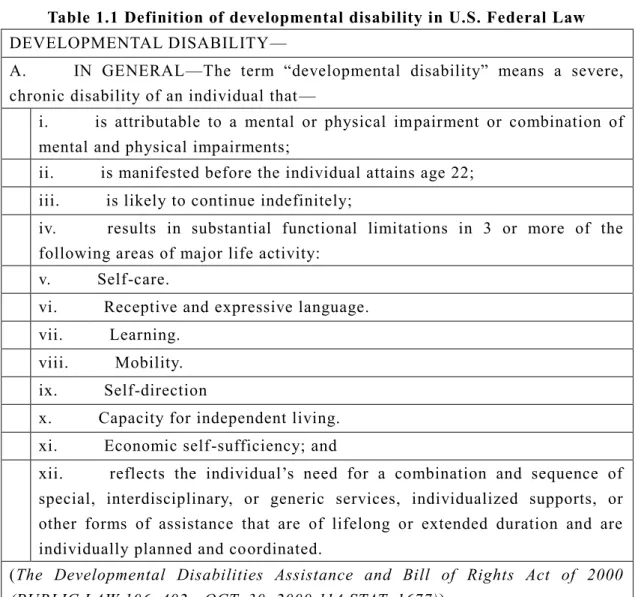
Definition of Hattatsu Shogai in international context often causes confusion. That is because Hattatsu Shogai is originally a translation of "developmental disabilities" of the educational policy in the United States, but Japanese law has set a different definition afterwards. Here I depict the definition difference. In the United States of America, according to The Developmental Disabilities Assistance and Bill of Rights Act of 2000 (PUBLIC LAW 106–402—OCT. 30, 2000 114 STAT. 1677), definition of developmental disability in U.S. federal law is as follows (Table 1.1):
11
Table 1.1 Definition of developmental disability in U.S. Federal Law
DEVELOPMENTAL DISABILITY—
A. IN GENERAL—The term “developmental disability” means a severe, chronic disability of an individual that—
i. is attributable to a mental or physical impairment or combination of mental and physical impairments;
ii. is manifested before the individual attains age 22; iii. is likely to continue indefinitely;
iv. results in substantial functional limitations in 3 or more of the following areas of major life activity:
v. Self-care.
vi. Receptive and expressive language. vii. Learning.
viii. Mobility. ix. Self-direction
x. Capacity for independent living. xi. Economic self-sufficiency; and
xii. reflects the individual’s need for a combination and sequence of special, interdisciplinary, or generic services, individualized supports, or other forms of assistance that are of lifelong or extended duration and are individually planned and coordinated.
(The Developmental Disabilities Assistance and Bill of Rights Act of 2000
(PUBLIC LAW 106–402—OCT. 30, 2000 114 STAT. 1677))
This legal definition of developmental disabilities is quite comprehensive. Several different disabilities such as intellectual disabilities, epilepsy, and cerebral palsy could be included.
The definition of developmental disabilities has been crafted in U.S. (Takahashi, 1991). In contrast, the Japanese definition of Hattatsu Shogai, which is written in medical jargon, is more concrete and less inclusive, as I stated above by citing the legal definition in Japan.
A few articles on Hattatsu Shogai in Japan translate this word in different ways. Goto (2008) translates Hattatsu Shogai as “developmental disabilities”. His way of handling the term in English is visible in his translation of Hattatsu
Shogaisha Shienho: “People with Developmental Disabilities Support Act
(hatatsushōgaisha shien hō)”. Aside from that, Teruyama (2009; 2014) expresses
Hattatsu Shogai with roman spelling of the original Japanese term; i.e. the title of
her essay: "Envisioning diversity: politics of the Hattatsu Shōgai movement in Japan”. My position is similar; we should use the original term when we discuss a
12
culture-dependent concept. Based on this position, the author mai nly uses Hattatsu Shogai for his further analysis and discussion for this dissertation.
1.3 Social problem
In Japan, sociologists and psychiatrists have provided critical perspectives on development of the social construction of Hattatsu Shogai in Japan. In the field of Sociology, Tateiwa (2014) has reviewed memoirs of Japanese persons with Hattatsu Shogai; his perspective is that, Hattatsu Shogai itself does not have to be necessarily problematized. Moreover, Tateiwa (2014)’s suggestion is that the persons with diagnoses strategically apply their diagnoses for easing their own blame for the life difficulties. Takenaka’s contribution (2008) is to analyze the communication behavior of persons on Autism Spectrum with Sociological theories. He tried understanding the characteristics of persons with Autism not as the deficit, but as cultural characteristics. One of the latest contributions to this debate is Kimura (2015), who discusses the inner conflict of therapists serving persons with Hattatsu Shogai; the therapists struggled between the therapeutic practice and learning/practicing knowledge of Hattatsu Shogai. Goto (2008) has discussed the social construction of Special Needs Education reform, targeting children with Hattatsu Shogai, and he urged the possibility of surveillance of those children for avoiding crimes. Sociology has played a critical role in analyzing the human relations of persons with Hattatsu Shogai. Suzuki (2013) also suggests that juvenile crime might have been reasoned with public discourse on Hattatsu Shogai. (Suzuki, 2013)
Interestingly, although it could be said that sociology should play a role in analyzing social system of Japan constructing Hattatsu Shogai, some Psychiatrists have delivered more critical opinion on this matter. N. Ishikawa (2005) strongly criticizes Hattatsu Shogaisha Shienho, saying that this act would segregate persons on Autism Spectrum with strengthened surveillance and overmedication.
With respect to the above review of literature, the author argues that social scientists and humanities scholars should import practitioners’’ perspectives either with literature or with field work, in order to conduct effective and influential research on social problems.
13
2. Th eoreti cal framework and meth od ology
This dissertation stands on multiple emerging fields of social sciences and humanities. These are interdependent and interdisciplinary. Here I review the theories which are the basis of the methodology used for this dissertation.
2.1 Disability Studies
Disability studies is an emerging field for observing and analyzing disability from the perspective of persons with disabilities. Society for Disability Studies (SDS) (n.d.) in the U.S., founded in 1982, defines the “Disability Studies” as follows in their official website:
Challenging the view of disability as an individual deficit or d efect that can be remedied solely through medical intervention or rehabilitation by "experts" and other service providers. Rather, a program in Disability Studies should explore models and theories that examine social, political, cultural, and economic factors that define disability and help determine personal and collective responses to difference. At the same time, Disability Studies should work to de-stigmatize disease, illness, and impairment, including those that cannot be measured or explained by biological science. Finally, while acknowledging that medical research and intervention can be useful, Disability Studies should interrogate the connections between medical practice and stigmatizing disability.
Studying national and international perspectives, policies, literature, culture, and history with an aim of placing current ideas of disability within their broadest possible context. Since attitudes toward disability have not been the same across times and places, much can be gained by learning from the se other experiences.
Encouraging participation by disabled students and faculty, and ensuring physical and intellectual access.
Prioritizing leadership positions held by disabled people; at the same time, it is important to create an environment where contributions from anyone who shares the above goals are welcome.
In Japan, 障 害 学 会 (Shōgai Gakkai, Japan Society for Disability Studies; JSDS) was founded in 2003. The by-law of JSDS defines 障 害 学 (shōgaigaku, Disability Studies) as follows (JSDS, 2012):
第 2 条 本 会 は 、 障 害 を 社 会 ・ 文 化 の 視 点 か ら 研 究 す る 障 害 学
14 は か る こ と を 目 的 と す る 。 Article 2:
This Society aims for developing and promoting Disability Studies, which researches disability from the social and cultural perspective, and for collaborating research by members.
Substantially, cultural/social perspective and subjective perspective to disability is not new in Japan at the time of the fou ndation of JSDS. Nagase (2008) and Tateiwa (2011) stress that a self-advocacy group of persons with cerebral palsy named 青 い 芝 の 会 [Aoi shiba no kai, “The society of green grass”] objected against paternalism toward themselves and their argument was the origin of the social model, discussed in latter sections.
Nevertheless, two critical points, which are shared between American Disability Studies and Japanese Disability Studies, should be noticed: (1) a respect for the critical perspective of disabled people themselves and (2) an interdisciplinary approach and academic diversity. Besides, Sugino (2007: 219-223) stresses that the big difference between Disability Studies in UK/U.S. and Japan is the distance between disability activism and academics. Moreover, Sugino’s argument focuses on the fact that disabled people have been underrepresented in Japanese higher education. Also, Ta ylor (2006: xiii) mentions: "neither Disability Studies nor Disability Studies in Education represents a unitary perspective". Taylor (Ibid.) also argues that "central to a Disability Studies perspective is the assumption that disability is a social construction or, if one prefers, creation". In other words, the strength of disability studies is not applying a particular and solid method and perspective of academic discipline, but diverse methods and disabled peoples' perspective. These authorities imply that disability studies is neither strongly united activism nor a concrete academic discipline. Disability Studies is, however, an emerging field which is open to theoretical controversy and methodological challenges.
One important characteristic is that disability studies apply models for analyzing disability. Models of disability is how or from where we see the disability. Moreover, disability studies have tried to make social change for claiming rights of disabled people. In fact, one of the oldest models of disability, called the "social model", is claimed by a disabled people's self-advocacy group, the Union of the Physically Impaired Against Segregation (UPIAS, 1975). However, because the social model was initiated by people with physical disabilities, one limitation is that its application to persons with other types of disabilities, especially to persons with Hattatsu Shogai, is underrepresented. The latter sections will discuss the application of models of disability to Autism
15
Spectrum. Consequently, one of possible contribution of this dissertation is to apply disability studies theory and empirical methods, which demonstrate social construction of Autism, and broadly Hattatsu Shogai in Japan.
2.1.1 Models of disabilityvi
This chapter describes the models of disability; it is appropriate to classify how the scholars and practitioners have observed the disabilities, as disability studies as one of theoretical frameworks, as well as CDA as discussed in Chapter 2, in this study respects the models of disa bility.
2.1.1.1 Significance and framework 2.1.1.1.1 Significance
It is still possible for practitioners and researchers to analyze disabilities with their experimental knowledge. The knowledge lacks, however, a clear perspective for evaluation. The models of disability provide us the measurement instrument. As we look at a mountain, the mountain looks differently from different location. Similarly, different perspective offers us to see the different shape of the mountain. This nature differentiates actio n toward persons with disabilities. Some models claim that disability is sorely caused by medical deficit. Some models claim that disability is caused by social system. Some models claim that disability is caused by interaction of both. Thus, it is extreme ly important to characterize the models of disability and to understand those differences and similarities. This paper offers some examples of analysis on models based on literature review.
2.1.1.1.2 Framework for characterizing models
The models mentioned in further subsections stress the nature of the support which a disabled person can be given. One way of comparing variant models of disability, suggested by Buntinx & Shalock (2010) and augmented by the author, is in terms of the features noted in the table 2.1. The author of this dissertation mentions additional features.
16
Table 2.1 Features of models of disability
(1) A clinical assessment, such as an International Classification of Functioning, Disability and Health (ICF) diagnosis, introduced by Wor ld Health Organization (WHO)
(2) The persons with disabilities’ selfness on his/her quality of life and revelation (merged with suggestion by Shakespeare, 2013)
(3) The need for and the availability of supports. (merged with suggestion by Miyazaki and DeChicchis, 2012)
(4) Attention to interpersonal relationships (5) Social oppression (Shakespeare, 2013)
(6) Relation between individual, the disability, and the functions of the individual (Liachowitz, 1988)
(7) Legislative attention (Smart, 2009)
Applying the aforementioned points, the following models will be characterized.
2.1.2 Traditional models of disability 2.1.2.1 Religious model
Smart (2009:4) states, “Only Moral/Religious Model has a longer history than the Biomedical Model”. In terms of this, upon reviewing the models of disability, it should be stressed that it would be difficult for many scholars to define the religious model per se. The tentative definition, however, could be the model that conceptualizes the disability accordingly to re ligious thought. Clapton and Fitzgerald (n.d.) suggests a Judeo-Christian perspective on disability as follows:
These embodied states were seen as the result of evil spirits, the devil, witchcraft or God's displeasure. Alternatively, such people were also signified as reflecting the “suffering Christ”, and were often perceived to be of angelic or beyond-human status to be a blessing for others. (Clapton & Fitzgerald, n.d., para. 6)
However, Miles (2002) argues that “Christian theologians have long pondered the meanings of disability without reaching definite answers” (Miles, 2002:121). Miles (2002) reviews perspectives on disabilities from several religions: Judaism, Christianity, Islam, Hinduism, and Buddhism. Quoting the words of a Muslim with disability, Miles suggests that Islamic thought gives people with disabilities a chance for challenge to himself/herself. Aside from that, Miles (2002) mentions the conflict between Western and Buddhist culture as “The cherished Western notion of the autonomous indi vidual self is challenged by those
17
parts of Buddhist thinking that stress the interdependence and intere xistence of all.” (Miles, 2002:122) In addition, Hinduism has a tradition of recommendation of charity. The most important point of Miles’s discussion, however, is that “Religion, culture, socialization, the communal life of your neighbourhood, were all closely interwoven.” (Miles, 2002:126) This means that, although a “religious model” could be designed per se by scholars, the model could not interpret disability solely in terms of religious thought. It could be characterized with (2) and (3). In addition, it is important that the religious thought for disability has justified the charitable attitude to persons with disabilities, as many hospitals and social service institutions have been established by religious groups.
2.1.3 Medical model
Medical practitioners and several scholars have applied the Medical Model for analyzing disabilities and practice toward the persons with disabilities. Those discussions are quite interdisciplinary; practitioners and scholars within several different fields have written about the model. Llewellyin and Hogan (2000) state, “The medical model views all disability as the result of some physiological impairment due to damage or to a disease process” (Llewellyin & Hogan, 2000: 158). Llewellyin and Hogan’s idea incorporates (1), but they are also interested in (3), as they state: “It should be borne in mind that the evaluation of the person’s present level of functioning might also play a role in shaping his or her future and thereby influence the course of lat er development”. (Llewellyin & Hogan, 2000: 159). According to Bricourt et al (2004), the medical model incorporates (1), (2), (3), and (6). With perspective of economics, Mitra (2006) mentions the Medical Model. The Medical Model incorporates (3).
There is a similar term: “biomedical model”. Similarly, Reindal (2008) applies the term “biomedical model”. Here it should be stressed that some reservation on criticizing biomedical model: the model exclusively focuses on individual factor of the person with disability. Smart (2009) also uses a similar term, “The biomedical model”, and it incorporates (1) and (3).
Although different models are introduced by several scholars, the two main opposing models are the medical model and the social model. “The medical model of disability is one rooted in an undue emphasis on clinical diagnosis, the very nature of which is destined to lead to a partial and inhibiting view of the disabled individual”. (Brisenden, 1998: 20).
In the context of discourse analysis, which will be mentioned in the next section, the medical model, mentioned by Grue (2011), incorporates (1) and (3).
Considering the above analysis of literature, the medical model o r a similar model mostly incorporates (1) and (3), clinical assessment and need for supports. The characteristic (3) could have some social aspects, but that could
18
connote that this characteristic requires a medical perspective.
2.1.4 Social model and nontraditional models of disability
Earlier research has identified problems with the “medical model” of disability. However, the distinction between a medical model and an alternative nonmedical model is not black and white. Rather, there are several alterna tives to the traditional medical model. Some alternatives stress the importance of the disabled person's quality of life. Here several scholarly literatures will be discussed accordingly to the authors.
Using the features mentioned earlier, we can easily compare the four
models described by Ziebland et al. (1993). Their “functional model” is characterized solely by (1) its reliance on clinical assessment. Their “subjective distress model” incorporates (2) the self-assessment of the disabled person. Their “comparative” model also relies on (1) a clinical assessment, in this case the older ICIDH (the International Classification of Impairments, Disabilities and Handicaps) diagnostic system. Their “dependence model” incorporates the measurement of the severity of disability using the ADL scale, which is (1) a clinical assessment; however, this “dependence model” is using the clinical assessment to determine (3) the need for supports.
In the context of social work, Llewellyin and Hogan (2000) describe four
models: medical model, social model, systems theory, and transactional model. The two earlier models have their basis on physical disabilities and the two latter ones have their basis on psychological theories. In addition, these of the medical model, the social model incorporates (5). However, both Shakespeare (2013) and Llewellyin and Hogan (2000) hereby mention that the social model lacks attention to the actual medical deficit of disabled people. The systems theory is hereby defined as “a systems approach to the study of children with physical disabilities involves examining the dynamics that can drive and accelerate the course of development by examining the synergistic influence of the features of the person, and of the environment that produces the behavior.” (Llewellyin and Hogan, 2000: 160). This model cooperates (1), (2), and (3), as that model keeps its attention to the psychological thinking. In addition, this model applies the ecological perspective. The last one, the transactional model, incorpora tes (2), (3), and (4). This model focuses on emotional attitude to the environment. In sum, Llewellyin and Hogan’s analysis do not deny medical and psychological thinking, even on discussing the social model that is sometimes argued for denying medical tho ught. Also in the context of social work, Bricourt et al (2004) examines four models: the medical model, the social model, the transactional model, and the systems model. The social model incorporates (5) and (7). This model is mentioned as a sort of synonym of the “minority model”. The transactional model
19
incorporates (2), (3), and (6). With the ecological approach, the systems model incorporates (1), (2), (3), (5), (6), and (7), as they mention this model as “putting it all together” on their paper's chapter title (Bricourt et al, 2004: 53). Bricourt et al (2004) mentions Llewellyin and Hogan (2000) as their use of systems analysis.
In the context of Norwegian special education, Reindal (2008) evaluates
four models: the social creationist model, the soci al constructionist model, the interactionist model, and the biomedical model. Recognizing criticism of special needs education, such as professionals’ disagreement and failing integration (Reindal, 2008: 135), Reindal’s perspective on disability models is a classification of models with materialist and idealist thoughts. We can not evaluate the features of each model in Reindal’s paper, because she does not provide us the details of each model in her English paper, which is in her Norwegian paper (cf. Reinda l, 2007); but I lack sufficient proficiency to fully understand her Norwegian paper. Importantly, Reindal urges: “All the four models acknowledge that there is some initial biomedical condition that causes reduced function by the individual.” (Reindal, 2008: 139) In other words, we cannot ignore medical factors when discussing, applying, and practicing even “social model” or closer ones, if the practitioners and scholars accept Reindal's argument.
In the context of American special education and with a philosophy of
education perspective, Danforth (2001) evaluates three models: the functional limitation model, the minority model, and the social constructionist model. The functional limitation model incorporates (1), (3), and (7). The minority model incorporates (5), (6), and (7). These two models have different perspectives on the characteristic (7). The former focuses on administrative function of the law on disability policy, and the latter focuses on civil rights. The social construction model incorporates (5).
Batavia & Schriner (2001) examines civil rights model or minority group
model and independent living model, related with the discussion of Americans with Disabilities Act (ADA). The civil rights model or minority group model incorporates (5) and (7). The independent living model incorporates (3) and (6). “However, both the civil rights and independent living models are also unduly oversimplified and do not adequately consider other substantial factors such as individual, family, and cultural variables, which are important in predicting the ability to live independently and productively” (Batavia & Beaulaurier, 2001, as cited in Batavia & Schriner, 2001: 692).
In the context of the self-advocacy of people with learning difficulties
(i.e. intellectual disabilities or developmental disabilities) in the United Kingdom, Goodley (1997) examines the individual model and the social model. The individual model incorporates (1), (2), and (3). The social model incorporates (2) and (5). Importantly, both models have attention to (2). However, they have
20
slightly different focus; the former focuses on applying “self -determination” for seeking support needs, although “Self-determination of people with learning difficulties is a concept that lies uneasily within t he dominant model of disability.” (Goodley, 1997: 369) Besides, the latter focuses on empowerment and its nuances are more political.
With the perspective of economics, Mitra (2006) examines four models:
the medical model, the social model, the Nagi mode l, and the International Classification of Functioning (ICF). The social model incorporates (2) and (5), the Nagi model incorporates (3) and (6). The Nagi model, which Mitra (2006) names, is based on Nagi’s (1965) functional limitation paradigm. It is impo rtant to stress that the Nagi model’s focus is the limitation of persons with disabilities. Still , Nagi (1965:102) also argues, “It should be noted that the degree of limitation is not dependent only on the type of impairment but also on the nature and requirements on these roles and activities.” His argument connotes the existence of interactionist perspective for observing disability. The International Classification of Functioning (ICF) means International Classification of Functioning, Disability and Health that is invented by World Health Organization (WHO). This incorporates (1) and (6). Mitra’s (2006) analysis applies Amartya Sen’s the Capability Approach (cf. Sen, 2002). Applying Sen's theory, disability is classified into potential disability and actual disability (Mitra, 2006: 242). More importantly, “the ICF does not cover circumstances that are not health related (Bickenbach, Chatterji, Badley, & Üstün, 1999), such as socioeconomic factors.” (Mitra, 2006: 242). This implies that WHO’s classificati on does not consider any sociopolitical factor.
Swain & French (2000) propose an affirmation model that was
sophisticated in the context of the disability arts movement. The affirmation model is contrasted with the personal tragedy model, which represent s the disability as the figure of pity. In the affirmative model “The affirmation of positive identity is necessarily collective as well as individual.” ( Swain & French, 2000: 577). Moreover, being contrasted with the social model, in the opinion of Swain and French (2000), the social model is oriented in the societal system and the affirmative model emphasizes the individual experience. The affirmative model incorporates (2), (3), (5), and (7). About this model, the characteristic (7) focuses on policy implication rather than legislation.
Harn (1988) is one of the first scholars to propose the Minority -Group
model. She expressed the thought on attitude towards persons with disabilities. Harn (1988: 43) opposes functional-limitations model, which focuses on medical deficits of persons, as “empirical studies based on functional -limitations model of disability have not identified existential anxiety as a single component of attitudes toward disabled persons”. The minority-group model incorporates (2), (5), (6),
21 and (7).
The social model of disability is emerged from the disability activism in
the UK (UPIAS, 1975) and claims they the cause of disability origins from the social system. Slightly differently, U.S. sees the disability as caused by interaction of individual and culture, presumably due to the civil -rights activism, including African-American and Feminism in the country (Sugino, 2007).
Other models are claimed in the history of rehabilitation research. Smart (2009) suggests three models: the biomedical model, the functional model, and the sociopolitical model. The functional model incorporates (3), (6), and (7). The Sociopolitical model incorporates (2), (3), (5) and (7). In particular, originality of the sociopolitical model is that policymakers and practitioners are included in the group of stakeholders for a particular problem. Moreover, in the context of the sociopolitical model, legislation aims at the protection of the rights of clients (Smart, 2009). For foreseeing the possibility of further de velopment of models of disabilities, the later sections briefly discuss two fields, which models of disabilities have rarely dealt with.
2.1.5 Application of models: autism spectrum
Different types of disability have been discussed outside these models. For instance, Autism spectrum has been rarely discussed in disability models in the social sciences and humanities. Metaphors such as "World Wide Web" (Blame, 2004), and “epitome” (Fromm, 1973) are critically analyzed as the result of medical epistemology toward the concept of Autism (Waltz, 2008). Broderick and Ne'eman (2008) criticize the medical -model and parent/professional oriented discourse on Autism metaphor as follows:
Metaphors of space, of geographic separateness, are common throughout many of the titles cited above, and have been common metaphors drawn upon for decades in autism discourse. Two common variations on this metaphor of there being a cultural/geographic space that is somehow traversed in autism are the notions of (1) the autis tic person arriving from a foreign space, the metaphor of the ‘alien’, and (2) the autistic person retreating or withdrawing behind a ‘wall’ or into a ‘shell’ (Broderick and Ne’eman, 2008: 463).
Autism and developmental disorders are the subjects that are rarely discussed with the social model. Probably because the social model has emerged from the activities for rights of persons with physical disabilities (UPIAS, 1975), the social model has nearly ignored the Autism and developmental disorders. My literature search did not find any literature regarding the correlation of the social
22
model and Autism. Several debates, however, are ongoing on the social construction of Autism and developmental disorders. On Asperger’s Syndrome (AS), reviewing medical literature, Molloy and Vasil (2002) argue that “academic scholarship and, consequently, educational practice in AS, and more broadly special education, must go beyond a deficit perspective, and incorporate and legitimize the experiences and understandings of the children t hat we are labelling.” (Molloy and Vasil, 2002: 668).
2.1.6 Application of models: analyzing discourse
Discourse provides practitioners the further understanding for persons with disabilities, which is significantly useful for planning intervention (Igara shi, 2008). The term “Discourse” is used slightly differently with linguistic view and with sociological one, but it is clearly important aspect to understand and develop the practice.
In the context of Critical Discourse Analysis ( CDA), Grue (2011) classifies four exclusive models of disability. Critical Discourse Analysis is a movement for linguistic social research on the text (e.g. Fairclough, 1995). Grue’s models are the social model, the minority model, the gap model, and the medical model. The social model incorporates (5). The minority model incorporates (7). The gap model incorporates (3) and (7). The focuses of (7) are different between that of the minority model and that of the gap model; the former focuses on the civil rights and the latter focuses on the administrative function of law.
Here I mention some points and critique of Grue’s analysis on the models of disability. First, Grue criticizes the social model as a fruit of Marxist Sociology. One of his critiques is that “A frequently raised cr iticism of the model is that it has been constructed around an ‘ideal’ disabled person – a male wheelchair user belonging to a dominant ethnic group, who suffers no significant health problems because of his impairment.” (Grue, 2011: 538). In fact, several scholars including Chris Bell, a “Black” (African-American) scholar and activist in Disability Studies, criticized the racist idea behind the social model ( C. Bell, 2010). Grue’s analysis should be examined carefully, but at least we should note that the disability model could be ideologically biased. Second, the minority model regards disability as a cultural group that should be embraced in a multicultural society. Third, the gap model is a majority model in Scandinavian countries. This critique is important in a Japanese context, as Japanese scholarship and bureaucracy admire Scandinavian policies as good practices of social policy in “The Welfare State”, regardless of critiques of Scandinavian innate eugenic ideas (e.g. Ichinokawa, 1999). In addition, for a scholar who employs thesis focusing on discourse on the emergence of Hattatsu Shogai [developmental disorders] as a
23
model is suggestive: “It is also an entry point into the f ourth and most problematic model.” (Grue, 2011: 540). Fourth, the medical model, as Brisenden (1998) argues, focuses on the medical deficit of the individual.
2.1.7 Discussion on disability models
Debate on models of disability often focuses on the nature of dichotomy between the two, between the medical model and the social model, but it is not simple. Sometimes, the social model has been criticized for its lack of medical attention and the medical model has been criticized of its lack of social attention . The hybrid models have been invented by several scholars and practitioners in several different field, including rehabilitation, social work, special education, and economics. These movements connote that medical deficit and social system are non-exclusive elements.
In this paper seven features of models of disability have been mentioned. The significance of emphasizing these models is the balancing between the responsibility of persons with disabilities and the society. As stated above, the social model is triggered by the resistance against oppression for persons with disabilities (cf. UPIAS, 1975).
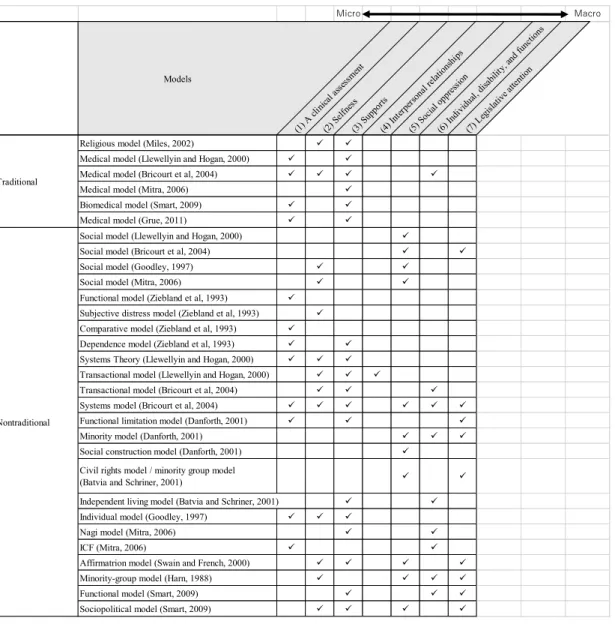
The table 2.2 visualizes the features of disability models mentioned above, with simpler division: the traditional and nontraditional models . From the left to right of the seven features, the focus moves from the micro-level to the macro-level.
24
Table 2.2 Distribution of features on models of disability
Micro Macro Models (1) A clini cal a ssess ment (2) Se lfne ss (3) Suppor ts (4) Int erpe rsona l rela tions hips (5) Soc ial oppr ession (6) Indi vidua l, dis abilit y, and func tions (7) L egisla tive at tention
Religious model (Miles, 2002) Medical model (Llewellyin and Hogan, 2000)
Medical model (Bricourt et al, 2004) Medical model (Mitra, 2006)
Biomedical model (Smart, 2009) Medical model (Grue, 2011)
Social model (Llewellyin and Hogan, 2000)
Social model (Bricourt et al, 2004) Social model (Goodley, 1997)
Social model (Mitra, 2006) Functional model (Ziebland et al, 1993)
Subjective distress model (Ziebland et al, 1993) Comparative model (Ziebland et al, 1993)
Dependence model (Ziebland et al, 1993) Systems Theory (Llewellyin and Hogan, 2000) Transactional model (Llewellyin and Hogan, 2000)
Transactional model (Bricourt et al, 2004) Systems model (Bricourt et al, 2004) Functional limitation model (Danforth, 2001) Minority model (Danforth, 2001) Social construction model (Danforth, 2001)
Civil rights model / minority group model
(Batvia and Schriner, 2001) Independent living model (Batvia and Schriner, 2001) Individual model (Goodley, 1997)
Nagi model (Mitra, 2006) ICF (Mitra, 2006) Affirmatrion model (Swain and French, 2000) Minority-group model (Harn, 1988) Functional model (Smart, 2009) Sociopolitical model (Smart, 2009) Traditional
Nontraditional
As the above table suggests, nontraditional models have accommodated both micro-and macro-level features. On the other hand, traditional models mainly stand on micro-levels. Such tendency is not changed drastically diachronically. Although classification is based on the author’s own interpretation of individual literature, the existence of complexity of medical and social thinking in nontraditional models is clear.
There is a difficulty in balancing regarding analyzing the well -being of persons with disabilities. For instance, imagine that there is a student with a deficit in his leg, who is not able to go upstairs in the school building. The medical model could argue that the student cannot go upstairs because he is injured. The social model could argue that the student cannot go to upstairs because the school building does not have an elevator. Is the re ality of his
25
situation a simple matter like those arguments? Such a question should be answered with “No.” If the student could rehabilitate himself well with learning how to use a stick, he could walk up the stairs. Here is the importance of application of medical diagnosis and therapy. If the building should get an elevator, who will pay for the installation? Here the significance of budget analysis could be claimed. What regulation should be applied for the installation? Here the legislative discussion could be applied. As just described, several different factors should be considered for discussing the well -being of persons with disabilities. Naturally, nontraditional models have considered solving the puzzles of analyzing the lives of persons with disab ilities.
The history of nontraditional models is the history of the trials and tribulations for seeking balance. It is important to note that the practices in many different disciplines are the basis of the development of nontraditional models. It is easy to ignore those models and to limit the models to the medical model and the social model. However, as civil society is developed further, learning from the development of nontraditional models, at least, is suggestive for the practitioners and scholars regarding their practices and research.
2.2 Critical Discourse Analysis
This dissertation applies methodologies of two research programs: Critical Discourse Analysis (CDA) and text mining. The former is for qualitative analysis and the other is for quantitative analysis. In this subsection I briefly discuss the theoretical background of CDA.
CDA is a large set of methods for analyzing text and social context, developed based on multiple disciplines, such as Philosophy, Linguistics, Sociology, and Psychology. It focuses on relation of power and language (Fairclough, 1995, 2013). This is developed based on diverse disciplines, such as “Rhetoric, Text linguistics, Anthropology, Philosophy, Socio -Psychology, Cognitive Science, Literary Studies and Sociolinguisti cs, as well as Applied Linguistics and Pragmatics.” (Wodak and Meyer, 2009: 1) Briefly, “CDA can be defined as being fundamentally interested in analyzing opaque as well as transparent structural relationships of dominance, discrimination, power and control as manifested in language.” (Wodak & Meyer, 2009: 10)
CDA per se is originated by European scholars gathered in Amsterdam for a symposium held in 1991 (Wodak & Meyer, 2009:3). However, the above does not mean methodological foundations had not existed be fore the emergence of CDA. Two Philosophers can be theoretical icon for early development of CDA.
Sociolinguistics is also a one of the foundational linguistic subfields for CDA. One of earlier linguistic research precedents on the print medi a is found in Allan Bell (1991). A. Bell (Ibid), trained as a journalist and then switched his
26
career to a sociolinguist, used corpora of radio speech language and newspaper articles mainly in New Zealand and analyzed language variation of their language usage. This research is sometimes cited as the earlier work related with CDA; however, Bell's work does not focus on politics of language, as CDA does, but on general language variation. Rather, Bell's contribution is demonstration of his critical perspective on process of news language production in media sectors. Consequently, this dissertation tries to analyze the process of formation of
Hattatsu Shogai concept, throughout the analysis in forthcoming chapters.
Here the author mentions two old intellectual figures as the foundation of CDA. One is a philosopher Mikhail Mikhailovich Bakhtin (1986), who wrote a piece “The Problem of the Text in Linguistics, Philology, and the Human Sciences: An Experiment in Philosophical Analysis”. Here Bakhtin stresses that social context is unavoidable for analyzing the text by stating: “units of speech communication—whole utterances—cannot be reproduced (although they can be quoted) and they are related to one another dialogical ly” (Bakhtin, 1986: 128). The other is Michael Halliday, who crafted Systematic Functional Linguistics (SFL) (Halliday, 1985). Halliday influenced the CDA with theorizing the function and meaning of words in context (Hashiuchi, 1999: 149). This dissertation does not use the SFL framework per se, but the author str esses that the foundation exists in earlier works respecting the attention not only to words themselves, but also to the context.
As noted above, a characteristic of CDA is to criticize the relation of text and context with systemic linguistic methods. I chose this methodology for my assumption that disability is a political problem. As I review latter, CDA has been applied for analyzing diversity of political problems. In the context of disability Studies, which observes disability as a social and politica l problem, the author would argue that CDA is a powerful analytic tool, as Grue (2015) employs his case studies on disability policy and discourse in Norway.
Besides, we need to be reminded of controversy toward CDA. Breeze (2011) classifies existing critiques, including ignorance toward linguistic theory, confusion on social theories, and lack of objectivity. In order to respond such critiques, the author employs this study with hybrid methods of qualitative and quantitative approaches, such as application of corpus linguistics (e.g. Baker, 2006).
Japanese scholars have developed notable CDA works on media discourse. To name a few, Japanese whaling (Murata 2007), imperialism (Satoh, 2001), bear problem (Knight, 2008), Women's rights movement in Japan Saito (1998) and nationalism on Olympic Games in 2008 Kanda, Yamane, and Takagi (2011) are examined with CDA methodology.