Pediatric Cardiology and Cardiac Surgery 35(1): 9‒17 (2019)
Review
QT 短縮と QT 短縮症候群
鈴木 博
新潟大学医歯学総合病院魚沼地域医療教育センター
Short QT Interval and Short QT Syndrome Hiroshi Suzuki
Uonuma Institute of Community Medicine, Niigata University Medical and Dental Hospital, Niigata, Japan
Short QT syndrome (SQTS) is a hereditary lethal arrhythmia; it was first described in 2000. SQTS is character- ized by an abnormal short QT interval on electrocardiogram (ECG), and causes arrhythmia, such as ventricular fibrillation and atrial fibrillation. Although clinical characteristics of SQTS have not been appropriately eluci- dated, several victims, individuals in the teenage and those in their 20s, have been reported. Therefore, SQTS diagnosis at an early age is important and is recognized as a concern in a school screening program for heart disease. According to an expert consensus statement published in 2013, even an asymptomatic individual with a short QT interval, who has neither a family history nor a pathogenic gene mutation, can be diagnosed with SQTS. Studies with various adult populations have identified individuals who met the SQTS diagnostic criteria;
however, these patients were asymptomatic and did not have a poor prognosis. Some asymptomatic children and adolescents with SQTS were also identified in our study, in which we mainly focused on a school screening program for heart disease. Risk stratification of SQTS is necessary because clinical characteristics of SQTS are variable, including no symptoms and sudden cardiac death. Hence, we compared the ECGs of asymptomatic individuals with a short QT interval in a school screening program for heart disease with those of previously reported symptomatic patients with SQTS, to screen for SQTS patients with a high risk. A prospective study thus needs to be conducted to elucidate the prognosis of asymptomatic patients with SQTS who are diagnosed in their childhood.
Keywords: short QT syndrome, QT interval, sudden cardiac death, lethal arrhythmia
QT
短縮症候群(short QT syndrome: SQTS
)は遺伝性の致死的不整脈である.2000
年に初めて報告 され,心電図上のQT
短縮を特徴とし,心室細動や心房細動などの不整脈を来す.臨床像は未だ不明 な点も多いが,10
〜20
歳台の突然死が多く報告されている.よって小児期での診断が重要であり,学 校心臓検診でも問題になる.2013
年の三大陸合同のExpert consensus statement
以降は,QTc
が一定 基準以下のものは,遺伝子異常も家族歴もない無症状例もSQTS
と診断される.一般成人集団よりQT
短縮例を抽出する検討では,SQTS
の診断基準を満たす例はあったが無症状で予後も良いと報告されて いる.我々の学校心臓検診の検討でもSQTS
は存在したが,有症状例はなかった.SQTS
の中でも高リ スクの既報例と検診・健診などで抽出される低リスク例には臨床像に大きな隔たりがあり,SQTS
のリ スク層別化が重要となる.そこで我々は,有症状のSQTS
既報例と学校心臓検診で抽出された無症状 で家族歴もないQT
短縮例の心電図を比較し,高リスクのSQTS
例の鑑別が可能か検討した.さらにSQTS
のリスク層別化を進めるには無症状のSQTS
小児例の中長期予後を知ることが求められる.2018年5月23日受付,2018年11月12日受理
著者連絡先:〒949‒7302 新潟県南魚沼市浦佐4132番地 新潟大学医歯学総合病院魚沼地域医療教育センター 鈴木 博 doi: 10.9794/jspccs.35.9
はじめに
QT
短縮症候群(short QT syndrome: SQTS
)は心 電図上のQT
短縮を特徴とし,心室細動や心房細動 を発症する.10
〜20
歳台の突然死が多く報告され,小児期での診断が重要である.近年,
3
大陸合同のExpert consensus statement
1)や欧州心臓病学会2)か ら発表された診断基準では心電図上のQT
短縮所見の みでもSQTS
と診断される.無症状から突然死まで臨 床像は幅広く,リスク層別化が求められる.学校心臓 検診でも,家族歴のない無症状のSQTS
例が抽出さ れ,その扱いが問題になっている.本稿では,まず診断の注意点や臨床像など
SQTS
全 般について述べ,次に学校心臓検診など,集団より抽 出されるQT
短縮例(SQTS
を含む)の頻度や特徴,さらに
SQTS
のリスク層別化について述べる.SQTS
とはSQTS
は心電図でのQT
短縮が特徴の致死的不整脈である.
2000
年に初めて報告され3),現在まで に約100
例の症例報告がある.心臓の形態異常は 伴わない.原因としてイオンチャネル遺伝子異常が 知られ,6
種類の責任遺伝子が報告されているが4)(
Fig.1
),遺伝子異常が同定されない症例が半数以上ある(
Fig. 2
).心室頻拍や心室細動,心房細動が惹起 され,失神や若年突然死の原因となる.臨床像はまだ 不明な点が多い.1.
SQTS
の病態生理イオンチャネル異常により,内向きカルシウム電流 の減弱や外向きカリウム電流の増強が起こり,再分極 が早まる.心筋細胞レベルでは活動電位は短縮し,心 電図上では
QT
間隔が短縮する(Fig. 1
).不均一な再 分極に伴うphase 2 reentry
が心室細動や心室頻拍の 引き金と考えられ,QT
延長症候群に似る5).2.
SQTS
の診断1
)診断基準2011
年にGollob
らが初めてSQTS
の診断基準をFig.
1
Mechanism of SQTS
(a) Electrocardiogram in a normal subject (upper panel) and a patient with SQTS (lower panel). The QT interval is abnor- mally shortened in a patient with SQTS. (b) Contributions of ionic currents to an action potential in a ventricular cardio- myocyte in a normal subject (upper panel) and a patient with SQTS (lower panel). Red and blue arrows indicate inward and outward currents, respectively. In a patient with SQTS, an abnormal decrease in the inward current or an abnormal increase in the outward current causes shortening of the action potential duration. In SQT1, SQT2, SQT3, and SQT4-6, IKr, IKs, IK1, and ICaL are affected, respectively. Double headed arrows indicate an allelic relationship. (c) Genes causing SQTS. IK1, background potassium; INa, fast inward sodium current; Ito, early transient outward potassium current; ICa, inward calcium current; IKr, rapid delayed rectifier potassium current; IKs, slow delayed rectifier potassium current; LQT1, 2, 7, and 8 indicate long QT syndrome types 1, 2, 7, and 8, respectively.
提唱した6).
QT
延長症候群のSchwartz
スコアのよ うにスコア化されている.QT
間隔に加え,Jpoint-
Tpeak
間隔,既往歴,家族歴,遺伝子検査の所見を加味し,診断する(
Table 1
).その後,診断基準は2013
年に3
大陸合同のExpert consensus statement
で発表 され1)(Table 2
),2015
年に欧州心臓病学会のガイド ラインで示された2)(Table 3
).この2
つではQT
短 縮所見のみでもSQTS
と診断しうる.Expert consen- sus statement
ではQTc ≦ 330 ms
,欧州心臓病学会で はQTc ≦ 340 ms
がSQTS
となる.この点以外は2
つ の診断基準はほぼ同じである.いずれの診断基準でもBazett
の心拍補正を用いている.2
)診断時の注意点診断にはいくつかの注意点がある.まず
2
次性のQT
短縮を除外しなければならない.様々な原因でQT
短縮が起こる7)(Table 4
).
QT
間隔の測定法や心拍補正法によりQTc
は異な る8).Bazett
補正では徐脈時はQT
間隔を過剰補正し てSQTS
を過剰診断,頻脈時にはQT
間隔を過小補正 してSQTS
を過小診断する懸念がある.一方Frideri- cia
補正では頻脈時に過剰診断する懸念がある.また 頻脈時には正常者とQT
間隔がoverlap
する可能性あ る9).このために心拍数60/
分前後での評価が推奨さ れている.しかし小児では心拍数60/
分前後での心電 図測定が困難なことが多いのが問題である.さらに洞機能不全例での評価には注意を要する.洞 機能不全があると交感神経刺激により
QT
間隔が短縮 しても,心拍数上昇(RR
間隔短縮)が伴わないためTable
1
SQTS diagnostic criteria presented by Gollob et al.
6)Point QTc (Bazett) ms
<370 1
<350 2
<330 3
Jpoint-Tpeak interval<120 ms 1
Clinical history
History of sudden cardiac arrest 2
Documented polymorphic VT or VF 2
Unexplained syncope 1
Atrial fibrillation 1
Family history
1st or 2nd -degree relative with high-probability SQTS
2
1st or 2nd -degree relative with autopsy-negative SCD
1
SIDS 1
Genotype
Genotype positive 2
Mutation of undetermined significance in a culprit gene 1 High-probability SQTS: ≥4 points, intermediate-probability SQTS: 3 points, low-probability SQTS: ≤2 points. Electro- cardiogram: must be recorded in the absence of modifiers known to shorten the QT interval. J point-T peak interval must be measured in the precordial lead with the greatest amplitude T-wave. Clinical history: events must occur in the absence of an identifiable etiology, including structural heart disease. Points can only be received for 1 of cardiac arrest, documented. polymorphic VT, or unexplained syn- cope. Family history: points can only be received once in this section. * A minimum of 1 point must be obtained in the electrocardiographic section in order to obtain additional points. VF; ventricular fibrillation, VT; ventricular tachycardia
Fig.
2 Genetic diagnosis of the reported cases with SQTS
The group of “genetic diagnosis (−)” comprised patients in whom the genetic test was not per- formed, indicated negative or was not reported.
Table
2
Expert consensus recommendations on SQTS diagnosis
1)SQTS is diagnosed;
QTc (Bazett)≦330 ms SQTS can be diagnosed;
QTc (Bazett)<360 ms
and one or more of the following:
① a pathogenic mutation
② family history of SQTS
③ family history of sudden death at age ≤40 years
④ survival of a VT/VF episode in the absence of heart disease
Red font indicates differences from the European Society of Cardiology guideline (Table 3).
QTc
が短縮する可能性がある10).3.
SQTS
既報例の臨床像過 去 の
SQTS
患 者 に つ い て の 報 告 で,1
) 有 症 状,2
)SQTS
または若年突然死の家族歴,3
)遺伝 子診断確定,のうち少なくとも一つを満す既報例を 対象として,臨床像をまとめた4, 6, 11‒24).対象患者は92
例だった.Bazett
補正QTc
は194
〜377 ms
であっ た.うちQTc
>360
の2
例は遺伝子診断され,突然死 の家族歴があった6).それ以外の症例は3
大陸合同のExpert consensus statement
の診断基準を満たしてい た.約6
割が遺伝子型不明であった(Fig. 2
).
男性が多く,男女比は
7 : 3
であった.診断時年齢 は0
〜80
歳と幅広いが,30
歳以下の若年者が3
分2
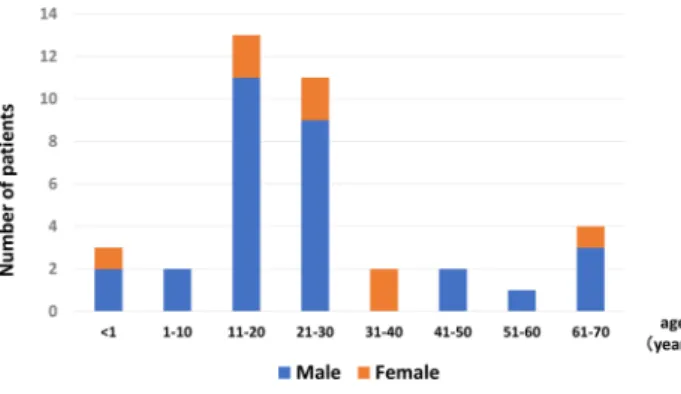
以上を占めた(Fig. 3
).心停止例は92
例中25
例(
27
%)で,うち30
歳以下が8
割以上を占め,若年 者がほとんどであった(Fig. 3
).発症年齢に性差が あった(Fig. 4
).男性では10
〜20
歳代での発症が殆 どだが,女性では発症年齢の偏りはなかった.思春期 以降の男性に発症する点はBrugada
症候群に似てお り,男性ホルモンの影響が推察される.しかし発症年 齢は30
〜40
歳代が多いBrugada
症候群に比しSQTS
は少し若い.その明確な理由はわからないが,これはBrugada
症候群と比べ加齢の影響が少ないのかもしれない.
心房細動は
17
例(18.5
%)に,洞機能不全は7
例(
7.6
%)に合併していた.心房細動はSQT1 − 4
に報 告があった.一方,洞機能不全合併7
例中6
例は胎 児期徐脈を契機に診断されたSQT2
,KCNQ1-V141M
変異例であった.この変異は胎児新生児期の徐脈と若 年発症心房細動が主体である点,QT
短縮を伴わない 洞機能不全例や心電図異常を認めない例もあり,型に 幅がある点など,他のSQTS
とは臨床像が異なった.無症状例は
47
例(51
%)であった.4.
検査1
)12
誘導心電図診断に最も重要である.
QT
間隔を評価するだけ でなく,T
波形も重要な所見である.T
波形は遺伝 子型で異なることが知られている(Fig. 5
).SQT1
では高く左右対称性なT
波形が多い.最も報告の多Table
4
Secondary causes of short QT interval
Hyperkalemia Hypercalcemia Hyperthermia Acidosis
Effect of catecholamine Activation of I K Ach Activation of I K ATP
Effects of drugs such of digitalis Carnitine deficiency
Modified based on reference 7.
Fig.
3
Age distribution of onset or diagnosis of the reported cases with SQTS
Age at the time of diagnosis is shown in asymp- tomatic patients with SQTS.
Table
3
Diagnosis of SQTS according to the Euro- pean Society of Cardiology guideline
2)SQTS is diagnosed;
QTc (Bazett)≦340 ms SQTS should be diagnosed;
QTc (Bazett)≦360 ms
and one or more of the following:
① a confirmed pathogenic mutation
② family history of SQTS
③ family history of sudden death at age<40 years
④ survival of a VT/VF episode in the absence of heart disease
Red font indicates differences from expert consensus rec- ommendations (Table 2).
Fig.
4
Age distribution according to sex in the
onset of the reported cases with SQTS
い
KCNH2-N588K
変異13, 25)や他の変異でも報告さ れている12).SQT2
は様々である.最も報告の多いKCNQ1-V141M
のT
波は高くないが24),高いT
波 を示す他の変異の報告もある14).SQT3
では左右非 対称なT
波の報告が多い.T
波が急峻に立ち上がる 例と17),逆にTpeak
から急峻に下降する例がある6).SQT4-5
はBrugada
型心電図を示す23).QT
短縮の程 度と重症度の関連は示されていない.12
誘導ECG
の 所見によるリスク層別化の試みは後述する.2
)運動負荷試験・ホルター心電図運動負荷試験やホルター心電図においては
QT
間隔 が短縮し,正常に比し心拍数の変化に伴うQT
間隔の 変化が乏しいのが特徴である9).ホルター心電図は心 房細動の合併評価にも有用である.3
)電気生理学検査心室細動や心室頻拍の誘発頻度は低いが,心室不応 期は短い.正常群と比較した検討では,右室流出路の 不応期
200 ms
未満を基準とすると感度86
%,特異度100
%と報告がある26).5.
生活管理と治療生活管理や治療に関するエビデンスは乏しく,運動 制限の有効性は示されていない.薬物治療も十分と言 えるエビデンスはないが,キニジンの有効性が報告さ れている.特に
SQT1
でQT
間隔が正常化する例があ り心イベント抑制効果が期待される25, 27)(Fig. 6
).ソタロールなどの
III
群薬はSQT1
に対するQT
延長効 果は乏しいが,他のサブタイプで効果が期待されてい る.Expert consensus statement
1)や欧州心臓病学会 のガイドライン2)では,「突然死の家族歴のある無症 状例に対してキニジンやソタロール投与を考慮しても 良いかもしれない」としている(class IIb
).
ICD
が突然死防止に有用と言えるが,QT
が極端 に短縮しているため,T
波をQRS
と認識し誤作動 する場合がある.Expert consensus statement
1)と欧 州心臓病学会2)のガイドラインではICD
植え込み を,1
)心停止既往例,2
)持続性心室頻拍の既往者(意 識の有無にかかわらず)に推奨している(class I
).さらに突然死の家族歴のある無症状例については,
Expert consensus statement
1)では考慮してもよいか もしれないとし(class IIb
),欧州心臓病学会のガイ ドライン2)では個々の症例での判断を勧めている.集団より抽出される
QT
短縮例これまで様々な集団から
QT
短縮例を抽出した報告がある8, 10, 28‒34).このなかには
SQTS
の診断基準を満たす症例も含まれていおり,
SQTS
の頻度や臨床像を 知ることにもつながる.報告により
QT
短縮例の頻度は異なり,QT
間隔の 測定方法の違いに加え,母集団の違いが頻度に影響し ていると推察される.成人の報告では人種,性別,年Fig.
5
Twelve-lead electrocardiograms of SQT1, 2, and 3
(a) SQT1; T waves are narrow, tall, and peaked in our case. (b) SQT2; T waves are neither tall nor peaked (data were kindly provided by Dr. Tateno, Chiba Cerebral and Cardiovascular Center, Ichihara, Japan). (c) SQT2; T waves are asym- metrical with a rapid ascending phase (data were kindly provided by Dr. Ehara, Osaka City Hospital, Osaka, Japan).
齢により頻度が異なると指摘している.男性,黒人に
QT
短縮例が多く,性ホルモン(テストステロン)の 影響が推察されている33).病院受診例を対象とした 報告では,男女共に10
〜20
歳代にかけてQT
短縮例 が多かったが,その理由は不明である32).さらに競 技スポーツ者にQT
短縮例が多かったという報告があ り,運動による再分極の変化が推察されている33). また成人QT
短縮例の長期予後は良好と報告されてい る28, 29, 33).
小児の報告はわずかであるが,シンシナティ小児病 院の心電図データベースを基にした報告がある34).
21
歳未満の心電図272,504
件を対象としてBazett
補 正 でQTc
<340 ms
を 抽 出 基 準 と し,45
例(0.05
%)が抽出された.平均
10.7
か月フォローし,2
例が死 亡したがいずれも不整脈死ではなかった.一方,我々は一般小児の
QT
短縮の頻度を知るた め,新潟市学校心臓検診の小学校1
年生(小1
)6,607
名と中学校1
年生(中1
)6,707
名を対象として研究 を行った.QTc
<330 ms
を抽出基準とした.抽出例数 は,Bazett
補正で小1
は男1
名(0.01
%)のみ,中1
は13
名(0.2
%,男9
名)であった.またFridericia
補正では小1
は20
名(0.3
%,男7
名),中1
は11
名(
0.16
%,男6
名)であった.我々の一般小児集団が 米国小児病院受診者集団より低い抽出基準であったの にもかかわらずQT
短縮例が高頻度であった.どちら の報告にも有症状のSQTS
例はなかった.以上より,様々な集団から抽出される
SQTS
のほと んどが無症状のようである.SQTS
のリスク層別化SQTS
のなかでも,高リスクの既報例と検診・健診 などで抽出される低リスク例には臨床像に大きな隔た りがあり,高リスク例の鑑別が重要である.これまで にも12
誘導心電図で鑑別を試みた報告がいくつかあ る.Anttonen
らはJpoint-Tpeak
間隔を鑑別の指標と して報告している35).彼らは心停止や心室頻拍の既 往のある高リスクの10
例(うちSQT1
が4
例)と集 団より抽出された無症状のSQTS12
例を比較した.Jpoint-Tpeak
間隔は高リスク群が有意に短く,2
群の 値が重ならなかった.しかし検診・健診では,Jpoint-
Tpeak
間隔を新たに測定する必要がある.Watanabe
らは早期再分極を鑑別の指標として報告している36).彼らは,心停止,心室頻拍,失神の 既往のある高リスクの
25
例と,SQTS
の家族歴や遺 伝子診断があるが無症状の低リスクの12
例を比較し た.高リスク例では22
例(88
%)に早期再分極を認 め,一方無症状例では2
例(17
%)であり,早期再 分極は,両者の鑑別に役立つとした.しかし集団から 抽出された家族歴も遺伝子診断もない無症状のSQTS
でも30
%に早期再分極を認め,検診・健診での高リ スク例抽出には向かない.Tulumen
らはPQ
部分の深さを指標として報告し ている37).基線から0.05 mV
以上深いPQ
部分をPQ
低下と定義し,無症状例も含めたSQTS64
例と対象 群を比較した.SQTS
群では81
%にPQ
低下を認め たが,対照群では21
%であり,頻度に有意差を認めFig.
6
Electrocardiogram showing the effects of quinidine (20 mg/kg/day) in an 11-year-old boy with SQT1
HR, heart rate; QTcB, the QT interval corrected by Bazettʼs formula
た.さらに心房細動を合併した
6
例全例にPQ
低下を 認めた.しかし心停止・失神症既往のSQTS
例とそ の他のSQTS
例とに差はなかった.またPQ
波の深さ 計測は簡便さに欠け,検診・健診での高リスクSQTS
例抽出には向かない.そこで我々は,既報の有症状
SQTS
症例と,学校 心臓検診で抽出された無症状のQT
短縮者の心電図所 見を比較検討した.既報のSQTS
はQTc
と心拍数が 確認できた症例42
例を対象とした.学校心臓検診群 では,自動診断のBazett
補正またはFridericia
補正がQTc
<360 ms
となった小1
と中1
の62
例を対象とし た.さらにJpoint-Tpeak
時間も確認できた例はこれ も検討した.またQT
時間は接線法で再測定した値を 採用した.QT
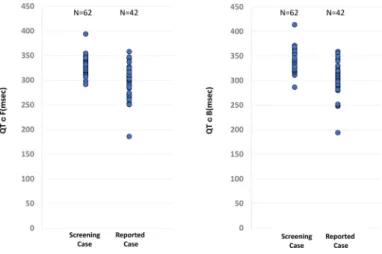
時間やQTc
では両群の重なりが多く(Fig. 7, 8
),鑑別の指標には適さなかったが,
Jpoint
‒Tpeak
<120 m
は検診群になく,この指標の特異度は高いと考えられ た(
Fig. 8
).しかしSQTS
ではTpeak
が遅い例もあり,感度は低い.
今後の課題
SQTS
の臨床像の解明は不十分であり,診断基準を 提示したExpert consensus statement
でもその基準に 議論の余地があると述べている.成人ではQT
短縮者 の予後は良好と報告されているが,SQTS
の心イベン トは10
〜20
歳代が多い.無症状例を含む小児SQTS
の中長期予後の解明が必須である.学校心臓検診で抽 出されたSQTS
の予後を知ることが,学校心臓検診で の抽出基準やSQTS
の診断基準の適正の評価に役立つ.また動物においては,カンガルーの
QT
間隔が短い ことが知られ,全身麻酔時に高率に心室細動が誘発さFig.
7
Distribution of corrected QT intervals between the study groups
The group of “Screening Case” comprised 1st and 7th grade children aged 6 and 12 years, respectively, who partici- pated in a school screening program for heart disease. QTcF and QTcB indicate the QT interval corrected by Fridericiaʼs and Bazettʼs formulas, respectively.
Fig.
8
Distribution of the QT interval and J point-T peak interval between the study groups
れた報告がある38).人間の
QT
短縮でも,特殊な状 況でのリスクについては検討の意義があるかもしれな い.さらに心房細動既往のQT
間隔が短いとの報告が ある39).QT
短縮者の将来の心房細動リスクも検討す べきかもしれない.謝 辞
症例情報を提供してくださった以下の先生方に深謝 申し上げます.
埼玉医科大学国際医療センター 住友直方 先生 大阪市立総合医療センター 江原英治 先生 滋賀医科大学 堀江稔 先生, 大野聖子 先生 埼玉県立小児医療センター 星野健司 先生 沖縄県立南部医療センター 高橋一浩 先生
独立行政法人国立病院機構 鹿児島医療センター 吉永正夫 先生
宮崎大学 高木純一 先生
千葉県循環器病センター 立野 滋 先生
利益相反
本論文について,開示すべき利益相反(COI)はない.
引用文献
1) Priori SG, Wilde AA, Horie M, et al: HRS/EHRA/APHRS expert consensus statement on the diagnosis on the diagnosis and management of patients with inherited primary arrhythmia syndromes. Heart Rhythm 2013; 10:
1932
‒1963
2) Priori SG, Blomstom-Lundqvist C, Mazzanti A, et al:
2015 ESC Guidelines for the management of patients with ventricular arrhythmias and the prevention of sudden cardiac Death: The task force for management of patients with ventricular arrhythmia and the prevention of sudden cardiac death of the European society of cardiology. Eur Heart J 2015; 36: 2793
‒2867
3) Gussak I, Brugada P, Brugada J, et al: Idiopathic short QT interval: A new clinical syndrome? Cardiology 2000; 94:
99
‒102
4) Templin C, Ghadri JR, Rougier JS, et al: Identification of a novel loss-of-function calcium channel gene mutation in short QT syndrome (SQTS6). Eur Heart J 2011; 32:
1077
‒1088
5) Antzelevitch C, Oliva A: Amplification of spatial disper- sion of repolarization underlies sudden cardiac death associated with catecholaminergic polymorphic VT, long QT, short QT and Brugada syndromes. J Intern Med 2006; 259: 48
‒58
6) Gollob MH, Redpath CJ, Roberts JD: The short QT syn- drome: Proposed diagnostic criteria. J Am Coll Cardiol 2011; 57: 802
‒812
7) Patel C, Yan GX, Antzelevitch C: Short QT syndrome:
From bench to bedside. Circ Arrhythm Electrophysiol
2010; 3: 401
‒408
8) Providência R, Karim N, Srinivasan N, et al: Impact of QTc formulae in the prevalence of short corrected QT interval and impact on probability and diagnosis of short QT syndrome. Heart 2018; 104: 502
‒508
9) Giustetto C, Scrocco C, Schimpf R, et al: Usefulness of exercise test in the diagnosis of short QT syndrome.
Europace 2015; 17: 628
‒634
10) Moriya M, Seto S, Yano K, et al: Two cases of short QT interval. Pacing Clin Electrophysiol 2007; 30: 1522
‒1526 11) Harrell DT, Ashihara T, Ishikawa T, et al: Genotype-de-
pendent differences in age of manifestation and arrhyth- mia complications in short QT syndrome. Int J Cardiol 2015; 190: 393
‒402
12) Sun Y, Quan XQ, Fromme S, et al: A novel mutation in the KCNH2 gene associated with short QT syndrome. J Mol Cell Cardiol 2011; 50: 433
‒441
13) Chinushi M, Sato A, Izumi D, et al: Nifekalant enlarged the transmural activation-recovery interval difference as well as the peak-to-end interval on surface ECG in a patient with short-QT syndrome. J Cardiovasc Electro- physiol 2012; 23: 877
‒880
14) Moreno C, Oliveras A, de la Cruz A, et al: A new KCNQ1 mutation at the S5 segment that impairs its association with KCNE1 is responsible for short QT syndrome. Car- diovasc Res 2015; 107: 613
‒623
15) Maltret A, Wiener-Vacher S, Denis C, et al: Type 2 short QT syndrome and vestibular dysfunction: Mirror of the Jervell and Lange-Nielsen syndrome? Int J Cardiol 2014;
171: 291‒