ISSN 1883-7840
JACET 関西支部ラ テ ング指導研究会紀要
第 11 号
2015 年 3 月
_____________________________________
目 次
序 文 研 究 論 文
An Error Analysis on English Articles in Learners’ TOEFL-type Essays:
A Focus on Generic and Non-generic Errors 〈〈〈〈〈〈〈〈〈〈〈〈〈〈〈〈〈〈〈〈〈〈〈〈 川西 慧
英語 ッセ ける語彙の再叙
―実行可能 coherence評価 向けての基礎研究― 〈〈〈〈〈〈〈〈〈〈〈〈〈 阿部 真
科学ラ テ ン けるEMI指導の効果
―C-test と ン ート結果 ら― 〈〈〈〈〈〈〈〈〈〈〈〈〈〈〈〈〈〈〈〈〈〈〈〈〈〈〈〈〈 尾鍋 智子
研 究 ノ ー ト
Training Student Writing Tutors from Sociocultural Perspectives 〈〈〈〈〈〈〈 大年 順子
_____________________________________
第 13 次 2013–2014 年 度 研 究 プ ロ ジ ト 大 学 英 語 教 育 学 会 JACET 関 西 支 部 ラ テ ン 指 導 研 究 会
ISSN 1883-7840
The Bulletin of the Writing Research Group,
JACET Kansai Chapter
Vol. 11
(March, 2015)
_____________________________________
Contents
[Preface] [Articles]
An Error Analysis on English Articles in Learners’ TOEFL-type Essays:
A Focus on Generic and Non-generic Errors 〈〈〈〈〈〈〈〈〈〈〈〈〈〈〈〈〈〈〈 KAWANISHI, Kei Lexical Reiteration in an English Essay:
A Fundamental Study toward Feasible Assessments of Coherence 〈〈〈〈〈〈〈〈〈 ABE, Makoto The Effect of English-Medium Instruction on Science Writing:
An Analysis of C-tests and Questionnaire 〈〈〈〈〈〈〈〈〈〈〈〈〈〈〈〈〈〈〈〈〈〈 ONABE, Tomoko [Research Note]
Training Student Writing Tutors from Sociocultural Perspectives 〈〈〈〈〈 OTOSHI, Junko
_____________________________________
The 13th (academic years 2013-2014) Research Project The Writing Research Group, JACET Kansai Chapter
― 紀 要 第 11 号 刊 行 あ ―
大学英語教育学会 JACET 関西支部ラ テ ン 指導研究会 ,2 年 研究 ジェ
成果 紀要 ま 出版し まし 。 第11号 ,第13次 ジェ
2013年度~2014年度 参加し 会員 研究成果 報告す す。
第11号 ,3 研究論文 1 研究ノー 掲載 います。 ,JACET関西
支部紀要 論文審査 踏襲し 方法 よ ,本研究会会員 2名 査読者 よ ラ ン ビ
ュー , 踏まえ 書 直し 行い,掲載 決定し 論文 研究ノー ます。
当研究会紀要 現在,国立国会図書館 保存 ,全国 いく 大学図書館 所
蔵 います。ま , ーム ージ (https://sites.google.com/site/jacetkansaiwrg/) い PDF
ァ 形 読 い け よう います。当研究会 研究成果 少し 多く 方
知 い ラ テ ン 指導 研究 一助 , 勝 幸い あ ませ 。
2015年3月
大学英語教育学会 JACET 関西支部
ラ テ ン 指導研究会 第13次研究 ジェ
______________________________________________________________________________________ JACET関西支部ラ テ ング指導研究会紀要 第11号 pp. 1–12. (2015)
An Error Analysis on English Articles in Learners’ TOEFL-type
Essays: A Focus on Generic and Non-generic Errors
KAWANISHI, Kei
Graduate School of Kyoto University
Abstract
The purpose of this study is to survey and explain the types of article errors in TOEFL-type essays written by Japanese university students. L2 article pedagogy and research have focused solely on the first mention and second mention use of articles, particularly in narrative text. However, the article errors in the author’s teaching context seemed to follow a different referential pattern. Attributing the difference in genre (narrative or academic) to be the key in identifying referential patterns, a further review of the literature and the data allowed for an assumption that reference may follow a generic/non-generic pattern in academic prose, prompted by reasoning involving generalization (e.g., sample to population). Based on this assumption, error analysis of keywords in learner writing identified that errors could be attributed to the difficulty in expressing generic reference, and distinguishing generic from non-generic reference. The findings suggest that when a generalization is made about a population from a sample, generic and non-generic references may be used respectively. Pedagogically, where only the first mention and second mention rule in narrative text were available, the implications from the findings offer a different set of rules for instruction of articles, namely, generic/nongeneric in academic prose containing generalization.
Key Words: error correction, articles, generic reference, non-generic reference
1. Article Errors in L2 Writing
In the context of second and foreign language (L2) writing instruction, it is not infrequent to encounter inaccuracies in learner writing. Errors can be a concern to instructors; treatment of errors through different kinds of feedback has been a topic of interest in both L2 writing classrooms as well as in research (e.g., Ferris, 1999).
Article errors in L2 writing may be especially relevant to research investigating the effectiveness of corrective feedback (CF). Articles have been the choice of grammar in examining the effectiveness of this pedagogical approach in a number of studies (Bitchener, 2008; Bitchener & Knoch, 2010; Sheen, 2007; Shintani & Ellis, 2013). Thus, it was not surprising when I, as an instructor who encountered article errors in the classroom, turned to the body of CF research on articles for implications. A problem, however, became
immediately apparent. The kinds of articles dealt in said research were of different variants from the ones in my context. In fact, L2 pedagogy has been criticized for solely focusing on what is called the first mention second mention (1M2M) rule of articles (Yoo, 2009). In my teaching context, learners were misusing generic and non-generic articles, rather than the familiar variants.
This paper reports on an exploratory investigation conducted on learners’ article errors in TOEFL-type essays at a Japanese university. Before analyzing actual errors from the classroom, the existing body of CF research on articles is reviewed. The review section will identify the focus of previous research, the 1M2M rule and its relationship to narrative text employed in the elicitation of those two types of articles. Since no L2 writing error studies were found on other types of article use, language acquisition research on articles will be reviewed in order to gain some insight into the generic and non-generic use of articles. After clarifying the difference between the existing body of research on 1M2M article errors and of those in the present study, an error analysis on articles in learner writing will be presented.
2. An Overview of Errors
Before further proceeding with analysis and discussion, the types of errors under discussion should be fully clarified. Since what prompted this study was anecdotal evidence encountered in the classroom, some assumptions were made regarding errors through analysis of learner writing.
Below are some sentences extracted from student essays written to the TOEFL prompt titled “Stay in Hometown or Move” in previous years in the same course as the participants of this study. Underlined sections indicate errors, and the corrections by a native-speaker of English (NS hereafter) are supplied in parentheses.
(1) We should live in a city (cities). (2) I want to live in cities (a city).
(3) When we graduate from our universities (university)…
While all examples may seem like errors in the singular-plural dimension upon first glance, the corrections in (1) and (3) contain important implications. When extracted from their original contexts, (1) and (3) are not ungrammatical. This prompted me to look at the difference between two versions of the sentence:
(1) We should live in a city. (1’) We should live in cities.
(3) When we graduate from our universities… (3’) When we graduate from university…
The difference between (1) and (1’) as well as (3) and (3’) is the type of reference, or more specifically what is known as generic and non-generic reference. That is, (1) indicates that
“we”, perhaps a family or a group of friends should live in an actual city, such as Kyoto,
while (1’) is an statement that denotes city life is preferable in general. Similarly, “we” and
“our universities” in (3) refer to specific (grammatically termed “non-generic”) people and their schools, while “we” and “university” in (3’) refer generically to people and universities in general (See 3.1 for generic and non-generic reference). Similarly, the correction in (1) also seems to contain a change in the type of reference being used. In this light, the error in (2) could also be attributed to the difficulty in selecting from among the generic referring expressions “cities,” “the city” and “a city” (See 3.1.2 for a review of generic use of articles) rather than to the difficulty counting the number of cities the writer wants to live in.
Sample errors like the above three cases allow for an assumption that the errors may concern generic and non-generic reference, like the one between “university” and “our universities”. While reference involves non-article forms like other determiners (e.g., “our”) and the countability of the noun (e.g., “university” vs. “our universities”), the literature on articles seems to cover the phenomenon of reference most effectively. With this in mind, the English article system, its pedagogy, and its acquisition are briefly reviewed in the section that follows.
3. Literature Review
3.1 The English Article System
A review of the English article system indicates that it contains a number of plurifunctional forms. Consider the following:
(4) The tiger is dangerous. (5) A tiger is dangerous. (6) Tigers are dangerous.
(7) The tiger escaped from the cage. (8) A tiger escaped from the cage. (9) Tigers escaped from the cage.
Examples (4)-(6) represent what is called generic reference, and (7)-(9) represent non-generic reference. The former three are about the tiger species, while in the latter three, the sentences are about one or more members of the species. As these examples demonstrate, the choice of an article may not immediately represent its meaning.
The article system is said to contain as many as five forms: a, the, and sm1, as well as two absences of articles: NULL, and ZERO2 (Chesterman, 1991; Quirk et al., 1985). The number of articles may range from the minimum of two (a, the) to the maximum of five, depending on the researcher. Part of the reason for this variability is that some researchers posit NULL and ZERO articles for what others may consider a mere absence of articles.
Different articles are used to denote meanings like countability, plurality, and definiteness (Quirk et al., 1985). In the following sections, two types of the non-generic use of articles (the first mention a and the second mention or anaphoric the) as well as the generic use of articles are reviewed.
3.1.1 The 1M2M use of articles
What is known as the 1M2M rule in pedagogy refers to two forms of non-generic reference. Consider the example below:
(10) There once lived a tiger. The tiger’s name was…
As the term first mention suggests, the article a introduces a subject, and the is used for the second mention of the same tiger. The two forms of reference are considered non-generic, as they refer to individual members of—in this case—the set of all tigers rather than to the species itself.
3.1.2 Generic use of articles
Generic use of articles, on the other hand, allows one to refer generically, in this case, to the species ‘tiger’. Consider examples (4)-(6). Notice three of the article forms (a, the and ZERO) can express more or less the same meaning. Definite singulars, indefinite singulars and plurals accompanied by the ZERO article (known as a bare plural3) can all express generic reference.
3.2 Pedagogy of Articles and the Role of Text Types
In L2 pedagogy concerning articles, researchers and teachers seem to agree that discourse plays an important role (e.g., Celce-Murcia & Larsen-Freeman, 1999; Hughes & McCarthy, 1998). The sections below will review the 1M2M use of articles in narrative text, and then move onto the use of generic articles in academic prose.
3.2.1 1M2M use of articles and narrative text
Celce-Murcia and Larsen-Freeman (1999) states that simple narratives like fables and folktales are the best for presenting the 1M2M rule. In fact, Aesop’s Fox and Crow used in Sheen’s (2007) corrective feedback study was also presented in Celce-Murcia and Olshtain (2000) as well as Celce-Murcia & Larsen-Freeman (1999). CF studies have also utilized such narrative tasks to elicit 1M2M article use and to encourage noticing in learners (Bitchener, 2008; Bitchener & Knoch, 2010; Sheen, 2007; Shintani & Ellis, 2013). As seen in this section, narrative text seems to provide an optimal context for the 1M2M use of articles. Noting this trend in L2 pedagogy, Yoo (2009) argues the emphasis on this single rule to be exaggerated, especially with regard to the frequency of actual article use. An interesting point to note is that the essays learners in my context wrote was not narrative; that is, they were writing TOEFL-type essays that were either argumentative or expository.
3.2.2 Generic use of articles and academic prose
Research linking the generic use of articles to argumentative and/or expository text (referred to as academic prose hereafter) is not as abundant as the 1M2M articles and narrative text. In academic writing, Swales and Feak (2004) indicates that generic reference serves a role in extended definitions.
While there are some materials indicating L2 learners how to differentiate between the generic and non-generic use of articles (e.g., Celce-Murcia & Larsen-Freeman, 1999; Quirk et al., 1985), little information was found on when to use the noun as generic or non-generic. On this topic, interesting insights can be gained by examining a series of acquisition studies.
Research has examined generics in children acquiring English monolingually and those acquiring it bilingually (Ionin & Montrul, 2009; Perez-Leroux et al., 2004). These linguists were interested in finding out whether genericity is coded as a definite plural such as in Spanish or a bare plural such as in English in children, and while their research aims are not directly relevant to L2 pedagogy, the tests used in their studies offer many implications for adult L2 learners engaged in academically-oriented writing.
In such an experiment, researchers present stories of unusual examples of animals that do not fit within the general nature of the species, in this case, two herbivorous tigers and two spotted zebras. Such exceptions do not contradict the facts that tigers are generally
carnivorous and zebras are striped. Children are then asked true or false questions about the unusual members as expressed by a non-generic reference (e.g., the tigers) and about the species expressed with a generic (e.g., tigers). See the questions following the passage below where article use is the sole difference between the references in a) to c).
In our zoo, we have two very unusual tigers. Most tigers eat meat all the time. But our two tigers are vegetarian: they love to eat carrots, and they hate meat.
a) The tigers like carrots. (TRUE) b) Tigers like meat. (TRUE) c) These tigers like meat. (FALSE)4
(Ionin & Montrul, 2009, p.159)
The experimental design like above seems to use reasoning, especially generalization to elicit generic/nongeneric pattern of reference. While these studies employ exceptional members rather than typical (i.e., the carnivorous majority), the parallel of sample-to-population type generalization with referential patterns may also be utilized in understanding L2 referential errors in essays requiring reasoning (See Figure 1 for the parallel of reference and reasoning).
Figure 1. Generic/non-generic reference and generalization 3.3 Error Analysis
The above sections have presented different uses of articles and their relationships to
discourse, and suggested a possible link between generic and non-generic types of reference and reasoning. The aim of the present study is to confirm what errors are present and how they can be explained. I will now turn to the review of the method of investigation and error analysis for some key points: what it means to be erroneous and how to define errors. James (2001) describes grammaticality as follows: “It is the grammar (not you or I) who decides whether something said by a learner is grammatical (p.65).” This is in line with Corder (1967/1974) who states that ungrammaticality involves “breaches of rules of the code (p.101).”
Another aspect the present study should be concerned with is acceptability. Acceptability is the term used when contexts rather than rules are concerned (James, 2001). Contexts such as the location of the sentence in the paragraph or the essay may be related to referential errors, such as in the case of syntactically correct examples like “our universities” being an error of “university.”
On defining errors, several researchers have held that errors should be labeled by corrections. James (2001) indicates that error analysis is target language oriented, and shows how having not said what is expected is the way error analysis has labeled errors (pp.93-95). This has been true since Burt and Kiparsky (1972) encouraged to the categorization of learner errors “according to what the person who says them has to learn about English (p.8).”
This means that in error analysis, corrections (e.g., not having said “university”) define errors (e.g., having said “our universities”). In the case of this study, corrections provide much insight into what function learners may be failing to express. Errors, on the other hand, are considered to indicate only what the learner is misusing in place of the correct form.
4. The Objective of the Investigation
Thus far, it has become clear that while there have been some acquisition studies of generic use of articles, L2 pedagogy and research have mostly focused on the 1M2M use of articles. When discussing the use of articles in L2 pedagogy, it has not been evident how the generic and non-generic use of articles can be contrasted. The present study is conducted to confirm the following two assumptions that were made based on the preliminary analysis of learner errors (1)-(3) and the review of the literature:
(i) The pattern of reference is affected by generalization in academic prose. (ii) Article errors in academic prose frequently involves generic reference.
5. Methods
5.1 Participants and Prompts
In order to confirm the assumptions made based on preliminary evidence, a systematic data collection and exploration of learner errors were necessary. In order to draw a sample similar to the learners errors as in (1)-(3), the writing data was drawn from the same course at the same school in a different year. Specifically, participants were recruited from the second year students at the research university. They had completed academic writing and reading courses in their first year, and were taking a course designed for takers of the TOEFL test. A
total of 57 and 56 students submitted their essays for the two topics below, yielding a total of 64 participants (Some students did not submit for both topics). Using the structure section from the TOEFL Practice Tests Workbook (Educational Testing Service, 1997), the students scored the average of 28.58 (SD = 5.08) out of 40, making their average estimate proficiency to be 520-540 TOEFL PBT points.
Writing topics that seemed to allow for the sample-to-population type generalization were selected from past TOEFL writing prompts available from ETS and ETS Criterion®.
Do you agree or disagree with the following statement? People always learn from their mistakes. Use specific reasons and details to support your answer.
http://www.ets.org/Media/Products/Criterion/topics/topics.htm
Many people have a close relationship with their pets. These people treat their birds, cats, or other animals as members of their family. In your opinion, are such relationships good? Why or why not? Use specific reasons and examples to support your answer.
http://web.binus.ac.id/els/file/TWE_topics_633786023742919255.pdf
These prompts were chosen for containing keywords that may behave in a sample-to-population manner in relation to generic and non-generic reference. For the first prompt, it was assumed that learners were likely to argue that a mistake they made before (non-generic) may have taught them something about learning from mistakes (generic). Similarly in the second prompt, it was thought that learners were likely to discuss the pets they own (non-generic) and generalize their experience to pet-human relationships. For this prompt, the hypernym animal as well as the hyponyms dog, cat, and any species and subspecies names (e.g., my Chihuahua) were considered.
5.2 Error Analysis
The literature has indicated corrections are more significant than errors. However, it is possible not to choose corrections over errors. In the analysis of learner errors, errors and corrections were both labeled and categorized into Table 2. A native-speaker collaborator error-corrected all the essays, and the errors as well as corrections were tagged onto a text file. For the categories, refer to Table 1 below for abbreviations and examples.
The errors and corrections were later counted. For instance, if a learner used the word mistakes but the native speaker corrected it to my mistakes it was BP*PP, using a “bare plural” form for the “possessive plural”. Some instances of error corrections were also extracted along with their contexts for a closer and more qualitative analysis. The 16 students whose writing was drawn as excerpts appear with arbitrary names, consisting of Student A to P.
Table 1 Categories of Errors, Their Abbreviations, and Examples
bare plural quantified plural possessive plural deictic plural definite plural
BP QP PP DEP DP
e.g., mistakes e.g., some mistakes e.g., our mistakes e.g., these mistakes e.g., the mistakes bare singular indefinite singular possessive singular deictic singular definite singular
BS IS PS DES DS
e.g., mistake e.g., a mistake e.g., their mistake e.g., this mistake e.g., the mistake Note. Bare singular is not singular, but termed so in comparison to bare plural.
6. Results and Discussion
6.1 Referential Patterns and Logical Structure
As for assumption i), excerpts such as the below indicate that the generic/non-generic referential pattern does seem to have a relationship to the sample-to-population pattern of generalization. The writer below provides an example with “my mistakes” and moves to a generalization using words and phrases like “mistakes” and “our own failure(s).”
Let me take an example of my mistakes in having a presentation. When I was a freshman, I had a chance to… Based on my experience of learning from mistakes, I strongly insist that we can always learn from our own failures. (Student A)
This writer moves from a more general idea of “pets” to his or her example, “my pets” and generalizes again with “one’s pets.”
Pets are very cute and they heal our heart. Though I’m very tired, when I feed my pets and look at them, I’m refreshed very much… From these reasons, I think one’s pets are necessary part of his or her family, and a relationship like this is wonderful. (Student B)
Yet another writer moves from the idea of “pets” to his or her personal example, “my pet.”
Pets do not speak, but I think we can communicate with them when we are eager to know what they think. I can guess my pet’s feelings, because I always… (Student C)
6.2 Generic and Non-generic Errors in Academic Prose
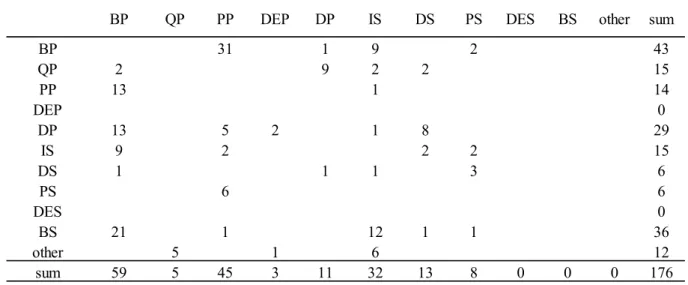
Regarding assumption ii), all the errors relating to keywords in the essays written to the two prompts were counted up and entered into Table 2.
The vertical column in Table 2 shows categories for errors (i.e., original forms) by the learners, while the horizontal rows show categories for corrections (i.e., changes made by the NS collaborator). For instance, if a learner wrote down mistakes (bare plural: BP)” for their mistakes (possessive plural: PP), one count of error was placed in the first row, third column, where 31 errors have been noted.
Based on the error count, four major types of errors emerged. They are 1) a tendency to use the bare singular in generic contexts, 2) errors among generics, 3) over-specification
errors, where generics are supposed to be used, and one non-generic error category, 4) overgeneralization. A clear and general tendency was that many of the errors and error categories established concerned generics, either among themselves or generics that were expressed with non-generics or vice versa. It may be worthy to note that the a/the errors related to the 1M2M rule do not make up many of the errors: two indefinite singulars for definite singulars, one definite singular for an indefinite singular; one bare plural for a definite plural, and perhaps the only relevant, 13 definite plurals for bare plurals (See 6.2.3 for more details).
Table 2 Errors as Defined by Corrections
BP QP PP DEP DP IS DS PS DES BS other sum
BP 31 1 9 2 43
QP 2 9 2 2 15
PP 13 1 14
DEP 0
DP 13 5 2 1 8 29
IS 9 2 2 2 15
DS 1 1 1 3 6
PS 6 6
DES 0
BS 21 1 12 1 1 36
other 5 1 6 12
sum 59 5 45 3 11 32 13 8 0 0 0 176
6.2.1 Use of the bare singular in generic contexts
Bare singular, a term given to the use of the bare form, occurred 36 times in the learners’ writing, with its overwhelming majority of 33 instances happening in generic contexts, (i.e., in place of bare plurals or indefinite singulars).
(11) But generally speaking, it is said that mistake (mistakes, BS*BP) is more impressive than success. (Student D)
(12) Finally, living with pet (pets, BS*BP) is very good for children's education. (Student E) (13) When you make mistake (a mistake, BS*IS)… (Student F)
(14) Firstly, pet (a pet, BS*IS) is a creature and it has feelings as well as us. (Student G)
The examples (11), (12), and (14) are all general statements, and (13) talks about a hypothetical situation with an unspecific a, also known as a conjured up5 instance.
6.2.2 Errors among generic forms
Another error type included learners using a bare plural in place of an indefinite singular (9 instances), or vice versa (9 instances).
(15) I sometimes make mistakes, but sometimes don’t notice that I make made mistakes (made a mistake, BP*IS) (Student H)
(16) If you have pets (a pet, BP*IS), you have to buy food and toys (Student I) (17) People often make a mistake (mistakes, IS*BP)… (Student J)
(18) One reason why people had better have a pet (pets, IS*BP) is that lives of people who have a pet can become rich. (Student K)
The examples (15) to (18) represent these errors. Hypothetical situations with conjured up instances of keywords like (15) and (16) are often misrepresented with bare plurals, and generic statements can be misrepresented with an unspecific a as in (17) and (18). While indefinite singular and bare plural may be synonymous in the subject position of a general statement, the object position might make the generic status difficult for the learners.
6.2.3 Over-specification in generic contexts
In addition to errors among generics, learners sometimes used overly specific expressions where a bare plural was called for, much like in the “our universities” for “university” example in (3). One of the error types was using a possessive plural in place of a bare plural, the other was using a definite plural for a bare plural.
(19) Today, many people have their pets (pets, PP*BP) and feel close to them as if they were real friends or members of their family. (Student L)
(20) For example, treating their pets (pets, PP*BP) with carefully makes children think the importance of life and how to deal with other animals. (Student M)
(21) If they fail in something, they give up trying to challenge them because they don’t know how to cope with the mistakes (mistakes, DP*PP). (Student N)
(22) For example, noise from the room and dirt at the road, made by the dogs or cats (dogs or cats, DP*PP). (Student O)
The examples (19) to (22) demonstrate that rather general statements expressing pets and mistakes in general were over-specified with possessives like their and the definite article the.
6.2.4 Overgeneralization in non-generic contexts
In contrast to the overspecification examples above, using the generic bare plural for a possessive plural in non-generic contexts was frequent, occurring 31 times. See the examples 23 and 24.
(23) I learned many things from mistakes (my mistakes, BP*PP). (Student K)
(24) However, when they have close relationships with pets (their pets, BP*PP) and treat them as members of their family… (Student P)
Contrary to 6.2.3, some errors were produced as a result of statements that should refer to concrete and/or specific ideas becoming expressed with generics.
7. Conclusion
The purpose of this study was to explore the extent to which Japanese university students misuse generic and non-generic reference in TOEFL-type academic prose, especially with regard to the two assumptions made at the beginning:
(i) The pattern of reference is affected by generalization in academic prose. (ii) Article errors in academic prose frequently involves generic reference.
The four types of errors that emerged in the results section reveal that the errors can be divided into two categories: those where generic reference is misused in generic contexts (6.2.1 and 6.2.2) and those where generic and non-generic reference are used in the wrong context (6.2.3 and 6.2.4). These tendencies suggest that the 1M2M rule of article use that is so often taken up in the L2 pedagogy and CF studies in L2 narrative text may not be so effective in academic prose. Rather, the findings suggest generic and non-generic dichotomy may be the key in understanding learner errors in academic prose. Though the analysis was limited to description, examining written product only, the error types imply the pedagogical possibility of dichotomous instruction of generic and non-generic use of articles in academic prose that employs generalization.
Notes
1. Some researchers consider sm, the unstressed variant of some to be an article.
2. A NULL article is definite (e.g., Italy, Mt.Fuji) and a ZERO article is indefinite (e.g., dogs, water). For further discussion, see Quirk et al. (1985) and Chesterman (1991).
3. The bare plural, as Carlson (1977) refers to it, is ZERO + plural. Researchers like Carlson and Chesterman consider the true plural equivalent of a to be sm, whereas a bare plural is inherently generic. See Carlson (1977) for a thorough discussion.
4. In this context, (1) the tigers and (3) these tigers are synonymous and non-generic in English, and only (2) tigers is generic among the three variants.
5. The generic reference made with a is sometimes called “conjured up” as the reference is made to a non-specific, arbitrary instance (e.g., See Langacker, 1999, p. 273-277).
Acknowledgement
This study was partially supported by a Grant-in-Aid for JSPS Fellows.
References
Bitchener, J. (2008). Evidence in support of written corrective feedback. Journal of Second Language Writing, 17, 102–118.
Bitchener, J., & Knoch, U. (2010). Raising the linguistic accuracy level of advanced L2 writers with written corrective feedback. Journal of Second Language Writing, 19, 207–217.
Burt, M. K., & Kiparsky, C. (1972). The Gooficon: A Repair Manual for English. Rowly,
Massachusetts: Newbury House Publishers, Inc.
Carlson, G. N. (1977). A unified analysis of the English bare plural. Linguistics and Philosophy, 1, 413–456.
Celce-Murcia, M., & Larsen-Freeman, D. (1999). The Grammar Book. New York: Heinle & Heinle.
Celce-Murcia, M., & Olshtain, E. (Eds.) (2000). Discourse and Context in Language Teaching. Cambridge: Cambridge University Press.
Chesterman, A. (1991). On Definiteness: A Study with Special Reference to English and Finnish. Cambridge: Cambridge University Press.
Corder, S. P. (1974). The significance of learners’ errors. In J.C. Richards (Ed.), Error Analysis: Perspectives on Second Language Acquisition (pp. 19–28). London: Longman. (Reprinted fromIRAL-International Review of Applied Linguistics in Language Teaching, 5, 161–170, 1967, Heidelberg: Julius Groos Verlag.)
Educational Testing Service. (1997). TOEFL® Practice Tests Workbook (Vol. 2). Princeton, NJ: Educational Testing Service.
Ferris, D. (1999). Treatment of Error in Second Language Student Writing. Ann Arbor, MI: The University of Michigan Press.
Hughes, R., & McCarthy, M. (1998). From sentence to discourse: Discourse grammar and English language teaching. TESOL Quarterly, 32, 263–287.
Ionin, T., & Montrul, S. (2009). Article use and generic reference: Parallels between L1- and L2-acquisition. In M. del Pilar Garcia Mayo, & R. Hawkins (Eds.), Second Language Acquisition of Articles: Empirical Findings and Theoretical Implications. Philadelphia: John Benjamins Publishing Company.
James, C. (2001). Errors in Language Learning and Use: Exploring Error Analysis. London: Routledge.
Langacker, R. (1999). Grammar and Conceptualization. New York: Mouton de Gruyter. Pérez-Leroux, A. T., Munn, A., Schmitt, C., & DeIrish, M. (2004). Learning definite
determiners: Genericity and definiteness in English and Spanish. In A. Brugos, L. Micciulla & C. Smith (Eds), BUCLD 28 Proceedings Supplement. Retrieved from http://www.bu.edu/linguistics/ APPLIED/BUCLD/supp.html
Quirk, R., Greenbaum, S., Leech, G., & Svatrvik, J. (1985). A Comprehensive Grammar of the English Language. London: Longman.
Sheen, Y. (2007). The effect of focused written corrective feedback and language aptitude on ESL learners’ acquisition of articles. TESOL Quarterly, 41, 255–283.
Shintani, N., & Ellis, R. (2013). The comparative effect of direct written corrective feedback and metalinguistic explanation on learners’ explicit and implicit knowledge of the English indefinite article. Journal of Second Language Writing, 22, 286–306.
Swales, J. M., & Feak, C. B. (2004). Academic Writing for Graduate Students: Essential Tasks and Skills (Vol. 1). Ann Arbor, MI: University of Michigan Press.
Yoo, I. W. (2009). The English definite article: What ESL/EFL grammars say and what corpus findings show. Journal of English for Academic Purposes, 8, 267–278.
______________________________________________________________________________________ JACET関西支部 ン 指導研究会紀要 第11号 pp. 13–21. (2015)
英 語 エ ッ セ イ お け る 語 彙 の 再 叙
― 実 行 可 能 coherence評 価 向 け て の 基 礎 研 究 ―
Lexical Reiteration in an English Essay:
A Fundamental Study toward Feasible Assessments of Coherence
ABE, Makoto
Dokkyo UniversityAbstract
In the field of L2 writing, coherence has been researched from the viewpoint of discourse analysis. However, cohesion, a linguistic aspect of coherence, deserves more attention in order to develop an objective method of assessing coherence. Thus, this study investigates the characteristics of lexical reiteration, a part of lexical cohesion, in an English essay written by a university student to explore the possibility of assessing coherence through cohesion. The data was one essay script responding to an argumentative essay task. The in-depth analysis involved segmenting the essay into sentences, identifying key concepts, and labeling them into eight categories of lexical reiteration, which are repetition, synonymy, antonymy, hyponymy, meronymy, co-hyponymy, co-meronymy, and metonymy. As a result, out of 171 pairs of sentences, 73 cases of lexical reiteration were observed and the most frequently used category was synonymy. The results also indicate certain sentences and paragraphs included more cases of lexical reiteration. The findings suggest pedagogical emphasis on discourse functional elements (e.g., thesis statement) may interfere with the lexical cohesion in learner writing.
Key Words: coherence, cohesion, lexical reiteration
1.
本 研 究 , 日 本 大 学 1 次 ン 指 導 い , 学 習 者 書 い 英 語 エ
coherence 内容的一貫性,整合性 様々 訳語 在 評価 実行 能 手法 開発
最終的 目標 基礎研究 あ 。 体的 ,著者 担当 ン 授
業 提出 エ cohesion 結束性 訳 多い う ,語彙 cohesion
一種 あ 再叙 lexical reiteration 分析 方法 能性 課題 考察 。本稿 前半 , coherence cohesion coherence 定着 訳語 見 い ,本稿 両者 英語 表
記 定義 理論的背景,coherence評価 先行研究 概観 , 要性 問題点 指
摘 ,後半 ,著者 担当 ン 授業 受講生 書い 1編 英語エ 用い
,語彙 再叙 一語句や類義語 異 文 文 あい 見 現象 分析 ,結
果 考察 。
2. 先 行 研 究
2.1 Coherence Cohesion
Coherence cohesion 外国語教育研究以外 ,談 分析, 言語学,心理言語学,認 知 言 語 学 各 分 広 使 用 概 念 あ 。 定 義 試 19 世 紀 遡 (Lee,
2002) ,応用言語学や外国語教育研究 い ,両概念 解釈 研究 目的 応 異 ,
用語や定義 厳密 統一 。 ,coherence cohesion ,解釈 い あ
,両者 顕わ 要素 相互 意味 いう点 共通 い 。
近 ,coherence 抽象的 知覚 い あ , 手や聞 手 主観的 断
あ 対 ,cohesion 客観的 言語的要素 確認 在
あ 区 (e.g., Bell, 1991; Hoey, 1991; Stotsky, 1983) 。 ,近 う coherence 定義 見直 試 見 。
Lee (2002) coherence研究 歴史的 概観 うえ ,coherence cohesion 文
展開や メン 構造,情報構造,メ ,1960 代以降 談
分 析 研 究 や 言 語 学 分 整 理 概 念 定 義 い 。Lee ,
coherence 文章 際 手 負担 軽減 あ 定義 紹 い ,
う 定義 あ 語句 (target) 認識 理解 発 , 先行 語句 土 (priming) い う 心 理 言 語 学 分 影 響 考 え e.g., Hoey, 2005 。Ruegg and
Sugiyama (2013) ,近 cohesion 留意 書 十分 coherent
い 批 多 ,メ う 手 得性 関
う 談 的要素 ,論述型 エ 特 必要 あ 述 い 。Cotton and Wilson (2011) IELTS ン 評価基準 1 あ “coherence and cohesion”
評価 い 調査 。 研究 論述型 エ ン ョン,
, ン ョン い 構成 一般的 あ い 文化的要因 考慮 要
あ 指摘 ,談 的 指標 用い , coherence 完全 明 訳
い , 限界 言及 い 。
2.2 Coherenceの 評 価 関 す る 先 行 研 究
Watson Todd et al. (2004) ,coherence 客観的 測定 ,操作的定義 能 topic-base
approach 注目 。 研究 先 , あ 英文エ T-unit 主節 従属節 組
合わ 分節 ,2 回以 使わ 詞, , 詞句 鍵概念 い 。 ,鍵
概念 度や鍵概念 士 関係 特定 , 動 計 的 分析 得 coherence 測
定値 教師 評価 強い相関 示 報告 い 。Knoch (2007) Watson Todd et al. (2004) coherence 評価方法 客観性,実行 能性 問題 あ 指摘 ,topical structure approach 基 coherence 評価手法 開発 試 。Topical structure approach 文 topic 主
主語 comment 述語 あ 動詞 修飾 要素 区 談 分析や 言
語学研究 見 theme rheme 区 実質的 似 い ,文 文 あい topic
comment 内容的 一 う coherence 種類 特定 う 。あ 文
topic 後続 文 topic 指 一 例 parallel progression 呼び,topic comment 一 sequential progression 呼ぶ 方法 ,coherence 種類 6種類 カ
分類 。 ,9段 ベ 評価尺度 各 ベ coherence 特徴 明
記述文 作成 , 尺度 使 得 評価 信 性 妥当性 従来 尺度 高
報告 い 。Knoch 研究参加者 あ 評価者 ,開発 尺度 coherence
全 明 い い メン 得 , 評価 客観性 実行 能性 高
時 ,coherence 過 足 明 評 価 基 準 作 示 唆 い 。Watson
Todd et al. (2004) や Knoch (2007) 要 先行研究 あ ,coherence 完全 知覚 い
扱 , 研究 coherence 評価 際 言語的 要素 再
分 析 必 要 性 示 唆 い う 見 え 。 実 際 ,Watson Todd et al. (2007) 文 章 全 体 coherence 研 究 connectedness い う 語 使 い 評 価 あ ,cohesion, propositional coherence 記 う theme rheme 関係 注目 , interactional coherence
機能 関 3種類 要素 分析 い 。 ,1
尺度 複数 要素 混在 う 弁 力 弱 う (Knoch, 2007) , 実
行 能 評価方法 開発 ン 限 側面 注目 必要 あ 。 ,
本研究 ,語彙 cohesion 一部 あ 再叙 注目 , 度 文章 coherence 高
結び 前提 い 分析 試 再叙 関 3.3.3 参照 。 ,本研究 い
,cohesion coherence , 文 文 あい 言語的 結び , 文 文,パ
パ , ,文章全体 い 見 意味や内容 や一貫性 定
義 。
3. 方 法
3.1 参 加 者
本研究 参加者 著者 2014 度 担当 ン 科目 Writing Skills II ,秋
学期開講科目 授業 受講 大学生 1 生 あ 。エ 分析事例 細 検討 目
的 ,受講者 1 ,研究目的 エ 使用 許 得 うえ 参加 依 。
,参加者 あ 大学生 ,習熟度 編制 い ,TOEIC 均 480点
所属 い 。
3.2 授 業
当 秋学期科目 成目標 カ 型的 良い 型 エ 書
う あ 。 前 春学期 単文 複文 文 文 種類や ン ン
部分 ,パ 内構成 基礎 学習 。受講生 1週目 5週目
,賛成 反対 自分 立場 明示 論 論述型 エ 学習 。 体的 ,1
週目 論述型エ 型的 構成,2 週目 4 週目 エ 主要 要素 あ
ン ョン, , ン ョン 書 方 学習 。 ,5 週目 再びエ
全体 構成 復習 活動 授業 行 。参加者 学生 全 週 出
席 ,エ 基本的 構成 学習済 あ 。
3.3 分 析
3.3.1 分 析 単
エ 授業 秋学期 5週目 出題 課題 宿題 あ 。エ
題目 “Some people insist that dangerous sports should be banned. To what extent do you agree or disagree with this statement?” あ ,大学1 生 あ 参加者 秋学期5週目 課 課題 あ
。課題 提出 1週間 費や ,辞書 使用 能 あ 。語数 250 語
前後 設定 ,参加者 あ 学生 19 文 247 語 エ 提出 。先行研究 一部
coherence 有無や種類 定 際 分析単 T-unit 主節 従属節 組 合わ 採
用 。 ,本研究 基 春学期 授業 ,文 種類 単文や複文 扱
週 あ ,文 種類 一種類 偏 い方 い 指導 。 ,本研究
い ,文 種類 書 手 意 在 いう前提 基 ,T-unit 文 分析単
。 ,エ 指導 い 採用 多い, ン ョン, ,
ン ョン 3 要素 エ 書 方 指導 中心 あ ,パ
内,パ 間 全 文 文 あい 語彙 再叙 対象 。 文間 171 所
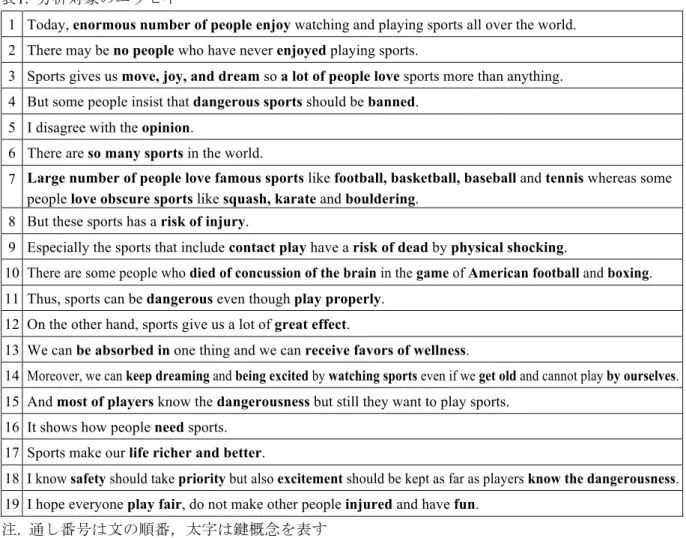
分析 再叙 種類 3.3.3参照 視覚的 確認 う 1参照 。
3.3.2 鍵 概 念 抽 出
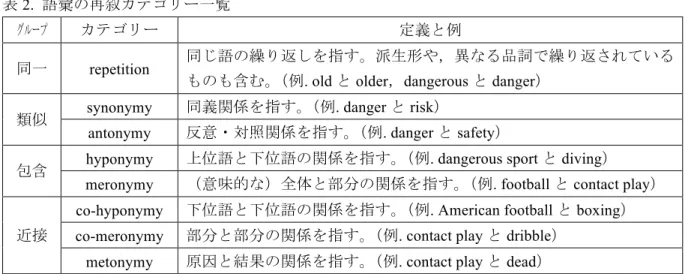
文 文 あい 語彙 再叙 見 箇所 特定 ,再叙 種類 定 ,文 中
定対象 語句, わ ,鍵概念 抽出 客観的 行う必要 あ 。Watson
Todd et al. (2004) 鍵概念 詞, , 詞句 。 ,本研究 ,談 的 指標 や文法的 cohesion ,語彙 cohesion 一種 あ 再叙 焦点 絞 coherence 分析
目的 ,鍵概念 内容語 詞,動詞,形容詞, 詞 構成 句構造 対
象 。 , エ 使 わ い 比 較 的 度 高 い 語 , 再 叙 語 彙
cohesion 生 出 い 見 い 多い 断 ,本研究 度 7 回以
度18回 sport,9回 people,7回 play 派生形 語 除外 dangerous sports
やa number of people 修飾語句 い 分析対象 含 。 , 度 限 ,
Lewis (1993) 提唱 7 基本動詞 あ have, take, get, make, go, come, give ,実質的
語 似 意味 使わ い 動詞 have 意味 使わ い include 除外 。
以 ,鍵概念抽出過程 言語的 操作 あ 。
本研究 , 談 的 要素 ,coherence 測 指標 ,鍵概念 抽出
作 業 応 用 。Paltridge (2006) Halliday (1994) 分 類 基 ,theme topical, textual, interpersonal 3 分類 , う ,interpersonal theme 文 要素 関係 規定
機能 担い,蓋然性,通常性, 型性,明白性,意見,了解, 得,推測,希望 分類
述 い , 近 盛 議 論 い メ 様 textual
interpersonal い 区 , 談 的 機 能 応 区 分 定 義 い 。 う
interpersonal theme 特定 ,例え ,in my opinion 意見 やsome people 型性。some
… others … 機能 再叙以外 内容語 語句 除外 。
う プ 経 ,分析対象 残 内容語 構成 句構造 表 1
い 太 表記 文 文 あい 比較 ,語彙 再叙 種類 定 わ あ ,
際,語 語,語 句,句 句 い 比較 。 ,あ 句 例え risk of injury あ 語 例え ,danger 比 時 , 句 含 い あ 語 (risk) 再び う
一方 語 (danger) 比較 。 ,比較 語句 士 異 品詞
比較 い場合,片方 両方 語句 詞化 ,再叙 定 行う 能 。