タイトル
Gesture
著者
FUKAYA, Ken-ichi; WATANABE,Atsushi
引用
北海学園大学工学部研究報告, 36: 143-151
Intuitive Manipulation to Mobile Robot by Hand Gesture
Ken−ichi F
UKAYA*and Atsushi W
ATANABE**Abstract
We developed the intuitive manipulation apparatus by which a mobile robot moves by hand gesture of an operator. Static and dynamic acceleration and rotational velocity derived from declination, swing and rotation of hand are measured by acceleration sensors and the gyro sensor. Data of sensors are analyzed by H8/3052F micro computer attached to the apparatus. The hand gesture type judged is sent to a mobile robot and the robot acts according to its gesture type with announcing its manipula-tion. Experiment shows the feasibility of intuitive hand gesture manipulation to a mobile robot.
1. Introduction
A service robot performing partially or fully autonomously the services useful to the well−being will become a part of life just as the automobile, television and mobile phones [1]. To realize such a service robot, it is necessary to develop communication technology between a robot and a person. Re-cently, in the field of home appliance terminals and mobile devices, nonverbal communication such as gesture of a body, hands and fingers has been eagerly proposed and tried in the real world [2]~[6]. Hand gesture has been also tried to manipulate robots [7]~[9]. In this case, a vision sensor with high level performance of image processing is normally utilized in order to extract gesture images from noisy background and recognize their meanings on real time. There is a problem about the camera on a mobile robot that it does not always face robot user and sometimes miss his gesture. An omni−di-rectional camera may give a solution to this problem, but its resolution is too poor to recognize cor-rectly the gesture. Another way to recognize hand gesture is to utilize a data glove which uses optical fibers and detects the bending of fingers, as is utilized in virtual reality research. But this apparatus is too expensive to manipulate a mobile robot by hand gesture. In recent years, there appear inexpensive acceleration sensors and gyro sensors. These are mainly applied to an airbag of an automobile and a camera image stabilizer, respectively. In this research, inexpensive acceleration sensors and a gyro sensor are utilized to catch the hand gesture. By using this hardware, a mobile robot is intuitively
ma-*Department of Electronics and Information Engineering, Faculty of Engineering, Hokkai−GakuenUniversity **Toyota Technical Development Corp.
Hand Gesture Apparatus
Wireless Communication 䋨Bluetooth) LCD
H8/3052F Micro Computer
Linux (Red Hat) PC Wireless Communication 䋨Bluetooth)
RS-232C Wireless Serial Communication Control Box Host Computer TCP/IP Communication Sound Board Speaker Wireless LAN
Emergency Stop Switch 2G Acceleration Sensor 20G Acceleration Sensor
Gyro Sensor
Pioneer3 Mobile Robot
Wireless LAN High Intensity LED
RS-232C
nipulated by recognizing the hand gesture.
2. System configuration
Fig.1 shows the system configuration for manipulating the robot by the hand gesture. This system consists of the hand gesture apparatus, the control box, the host computer and the mobile robot.
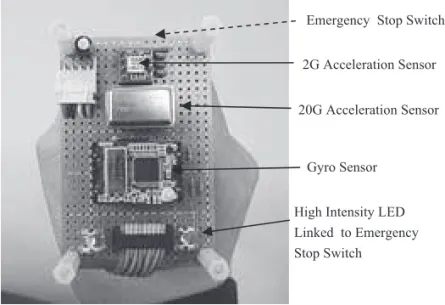
Actual hardwares of hand gesture apparatus and control box are shown in Fig.2 and Fig.3, respec-tively. The hand gesture apparatus has the two−dimensional 2G acceleration sensor (ADXL202JE by Analog Devices, Inc.) for hand declination, the three−dimensional 20G acceleration sensor (MA−3−20 Ac by MicroStone Corp.) for hand swing, the gyro sensor (MGQ1−01B by MicroStone Corp.) for hand rotation and a high light LED linked to an emergency switch. The control box is connected to the hand gesture apparatus, and has a micro computer (H8/3052 by Renesas Technology Corp.) which analyzes data from sensors and a switch built in the hand gesture apparatus. The analyzed result of hand gesture data is sent to the host computer via the Bluetooth serial communication module (Zeal− Z1by ADC Technology Inc.). Then, the host computer sends gesture information of a hand to the board computer mounted on the mobile robot (Pioneer3 by MobileRobots Inc. ) via connectionless process communication. Results of hand gesture are displayed on the LCD on the control box and at the same time, manipulation obeying to the kind of hand gesture is announced by the sound board
Fig.1 System configuration
Ken−ichi FUKAYA・Atsushi WATANABE
2G Acceleration Sensor Emergency Stop Switch
20G Acceleration Sensor
Gyro Sensor
High Intensity LED Linked to Emergency Stop Switch H8/3052F Micro Computer LCD Bluetooth
(SRM−10P by Alpha Project Co. Ltd.) mounted on the mobile robot.
3. Gesture Recognition
Three kinds of hand gesture (i.e. declination, swing and rotation) generate static acceleration (grav-ity), dynamic acceleration (vibration) and rotational speed, respectively, which are measured each by the 2G acceleration sensor, the 20G acceleration sensor and the gyro sensor (Fig.4).
Fig.5 is the flow chart to recognize hand gesture. By preparatory experiments, the threshold of each sensor has been estimated. When the 2G sensor detects the absolute value less than 0.6G, hand ges-ture is ignored and the processing is returned to start. When the 20G sensor detects the absolute value
Fig.2 Hand gesture apparatus
Fig.3 Control box
145 Intuitive Manipulation to Mobile Robot by Hand Gesture
Hand Declination Hand Swing Static Acceleration (2G Acceleration Sensor) Dynamic Acceleration (20G Acceleration Sensor) Rotation of Hand Rotational Velocity (Gyro Sensor) Start 20G Sensor > |2.0G|
Gyro Sensor >= | 1500[deg/sec]| 2G Sensor > | 0.6G| Rotational Velocity Dynamic Acceleration Static Acceleration YES YES YES NO NO NO
less than 2G, static acceleration is estimated. When the 20G sensor detects the absolute value greater than or equal to 2G, dynamic acceleration or rotational velocity is estimated. When the absolute value of angular velocity is greater than or equal to 1500[deg/s], rotation is estimated. In this case, the sign
Fig.4 Three kinds of hand gesture and sensors corresponding each
Fig.5 Flow chart of hand gesture recognition
Ken−ichi FUKAYA・Atsushi WATANABE
Accelerat ion [ G ] 㪇 㪇㪅㪉 㪇㪅㪋 㪇㪅㪍 㪇㪅㪏 㪈 㪇 㪉㪇 㪋㪇 㪍㪇 㪏㪇 㪈㪇㪇 Y axis X axis Sampling Number Average 0.80G Average 0.49G X axis Y axis 0.6[G] 2.0[G] 0.93[G] 59㫦 Forward Right Left Backward Oblique Oblique Oblique Oblique 0.49[G] 0.80[G]
of speed shows rotational direction. Finally, when the absolute value is less than 1500[deg/s], dy-namic acceleration is estimated.
In case of static acceleration, 100 sampling data of X and Y axes are averaged and the absolute value together with direction is calculated. For example, experimental data shown in Fig.6 gives us the average value of acceleration along X and Y axes to be 0.49G and 0.80G, respectively. This ex-perimental data also gives us the absolute static acceleration value 0.93G with direction 59 degree. Fig.7 shows that directions of 80~100, 250~290, 350~10 and 170~190 degrees are supposed to be
Fig.6 Example of static acceleration data
Fig.7 Classification of static acceleration
147 Intuitive Manipulation to Mobile Robot by Hand Gesture
Acceleration [G] Sampling Number Y axis X axis Z axis 㪄㪈㪌 㪄㪈㪇 㪄㪌 㪇 㪌 㪈㪇 㪈㪌 㪉㪇 㪇 㪉㪇 㪋㪇 㪍㪇 㪏㪇 㪈㪇㪇 㪄㪉㪌㪇㪇 㪄㪉㪇㪇㪇 㪄㪈㪌㪇㪇 㪄㪈㪇㪇㪇 㪄㪌㪇㪇 㪇 㪌㪇㪇 㪈㪇㪇㪇 㪈㪌㪇㪇 㪉㪇㪇㪇 㪉㪌㪇㪇 㪇 㪉㪇 㪋㪇 㪍㪇 㪏㪇 㪈㪇㪇 Sampling Number
Angular Velocity [deg/sec]
Clockwise Rotation
Counter Clockwise Rotation Forward Swing X Axis Y Axis Z Axis Counter Clockwise Rotation
forward, backward right and left, respectively. Other directions correspond oblique. In case of dy-namic acceleration shown Fig.8, the peak−to−peak values evaluated from 100 sampling data of X, Y and Z axes yield the swing axis and its positive or negative region which are judged by the order of maximum and minimum values. The data of rotational velocities are shown in Fig.9, and they show
Fig.8 Example of dynamic acceleration data
Fig.9 Rotational speed data obtained by gyro sensor and corresponding coordinate of the hand gesture
ap-pratus
Ken−ichi FUKAYA・Atsushi WATANABE
that the clockwise and counter clockwise rotations are different from the forward swing action. In order to estimate the sensor accuracy of static and dynamic acceleration, 4 persons tried 20 times to manipulate hand gesture with respect to X and Y axes. As a result, 95% correct answers were ob-tained in static acceleration, and 78% in dynamic acceleration. In this way, static acceleration gave the recognition rate better than dynamic one. This result means that, in case of static acceleration, there was no need of exercise but in dynamic acceleration, it was necessary to exercise further.
4. Performance of a mobile robot by hand gesture
It is desirable that the hand gesture corresponds one to one to mobile robot manipulation, because the user can intuitively manipulates the robot. To do this, correspondence between hand gesture and manipulation of the mobile robot was determined and is shown in table1, where coordinates of robot movement are fixed to a mobile robot. According to this correspondence, for example, when the user declines his hand forward, the robot moves forward, and swinging forward his hand gives speed up of the mobile robot.
5. Experiment
The experiments manipulating a mobile robot by utilizing the gesture apparatus were done. Hand gesture was recognized normally and then the robot operated according to kinds of gesture given. A combination of forward movement, rotation and circulation can freely move the mobile robot any-where. Fig.10 shows the robot moving forward according to forward declination of hand. As hand
Hand Gesture Manipulation of Mobile Robot
Declination
Forward (80−100degree) Forward Movement
Backward (250−290degree) Stop
Right (350−10degree) Low Speed Clockwise Rotation
Left (170−190degree) Low Speed Counter Clockwise Rotation
Oblique Circulation
Swing
Forward (Y+) Speed Up
Backward (Y−) Speed Down
Right (X+) 90Degree Clockwise Rotation
Left (X−) 90Degree Counter Clockwise Rotation
Above (Z+), Below (Z−) Speed Reset
Rotation
Clockwise High Speed Clockwise Rotation
Counter Clockwise High Speed Counter Clockwise Rotation
Table1 Correspondence between hand gesture and manipulation of mobile robot
149 Intuitive Manipulation to Mobile Robot by Hand Gesture
Hand Gesture Apparatus
Control Box
gesture corresponds to movement of a robot, the operator can intuitively recognize its movement. When the robot moves forward, ultrasonic distance sensors attached to the front panel of the robot can detect obstacles to stop automatically. When the sensors missed detection of obstacle, the operator pushes the emergency stop− switch and then the robot can stop in a moment. Also, the sound board mounted on the robot announces manipulation corresponding to hand gesture.
It is easy for an operator to recognize one’s gesture. The present hand gesture system utilizes a wireless communication apparatus and then, an operator is able to manipulate the robot when distance between an operator and a robot becomes large. This apparatus does not restrict relative angle be-tween an operator and a robot. It is also easy to carry the whole system.
6. Conclusions
Proposed apparatus can recognize hand gesture easily and correctly, and manipulate a mobile robot intuitively. By applying acceleration sensors and the gyro sensor to recognize hand gesture, we could construct an inexpensive apparatus of hand gesture recognition for a mobile robot. At the present time, 12 kinds of hand gesture are available to robot manipulation and are greater than 7 plus minus 2 (Mirror’s magic number[10]). Furthermore, we have to adopt more essential gesture to mobile robot manipulation. If it is available for a mobile robot to acquire relative position with respect to operator by using sensor arrays, more easy−to−understand gesture, such as beckoning will be able to realize by utilizing this apparatus.
Fig.10 Experiment of hand gesture manipulation to mobile robot
Ken−ichi FUKAYA・Atsushi WATANABE
Acknowledgement
We wish to thank Dr. Takai for his kind comments. This research is supported by a research pro-ject of High−Tech−Research Center, Hokkai−Gakuen University.
References
[1]R.D.Schraft and G..Schmierer, Service Robots, Products Scenarios Visions, A K Peters, 2000.
[2]S.Numazaki, A.Morishita, N.Umeki and M.Doi, “A Image Input Device for Gesture Interface and It’s Perform-ance of Detecting 3 − Dimentional Information ”, Journal of Information Processing Society of Japan, vol. 41, pp.1267−1275, 2000.
[3]K.Tsukada and M.Yasumura, “Ubi−Finger : Gesture Input Device for Mobile Use”, Journal of Information Proc-essing Society of Japan, vol.43, pp.3675−3684, 2002.
[4]K.Yatani, T.Kishimura, K.Tamura, M.Sugimoto and H.Hashizume, “Toss−It : Intuitive Information Transfer Techniques for Mobile Devices”, Technical report of IEICE, vol.104, pp.19−24, 2004.
[5]S. Iba, J.M.Vande Weghe, C.Paredis, and P.Khosla, “An Architecture for Gesture Based Control of Mobile Ro-bots”, Proceedings of the IEEE/RSJ International Conference on Intelligent Robots and Systems ( IROS’ 99 ) , pp.851−857, October, 1999.
[6]T.Murashima, Y.Kuno, N.Shimada and Y.Shirai, “Understanding and Learning of Gesture through Human−Ma-chine Interaction”, JRSJ, vol.18, pp.590−599, 2000.
[7]M.Strobel, J.Illmann, B.Kluge and F.Marrone, ”Gesture Recognition in a Spatial Context for Commanding a Do-mestic Service Robot”, In Proc. of the 33rd International Symposium on Robotics (ISR), 2002.
[8]K.Kojo, T.Inamura, K.Okada and M.Inaba, “Gesture Recognition by Humanoid robots using Proto−symbol Space”, The 24th Annual Conference of the Robot Society of Japan, 1M11, 2006.
[9]J.Richarz, A.Scheidig, C.Martin, S.Muller and H.Gross, “A Monocular Pointing Pose Estimator for Gesture In-struction of a Mobile Robot”, International Journal of Advanced Robotic Systems, vol.4, pp.139−150,“2007. [10]G.A.Killer, “The magical number seven plus or minus two : Some linits on our capacity for processing
informa-tion”, Psychol., Rev.63, pp.81−97, 1956.
151 Intuitive Manipulation to Mobile Robot by Hand Gesture