Protective role of lipid modifications of Src-family
kinases against chromosomal instability
(染色体不安定化を抑制するSrc型チロシンキナーゼの
脂質修飾に関する研究
)
2017
Takuya Honda
Laboratory of Molecular Cell Biology,
Graduate School of Medical and Pharmaceutical Sciences
(Frontier Medicine and Pharmacy),
Contents
Introduction
3
Material and Methods
6
Results
Section 1
Inducible Src-dependent inhibition of M-phase entry
11
Section 2
Induction of chromosome missegregation by NLS-Lyn expression
12
Section 3
Effect of lipid modifications of c-Src and Lyn on induction of
chromosome missegregation.
14
Discussion
17
Reference
20
Examiners
27
Acknowledgement
28
List of Publications
29
Introduction
Src-family kinases (SFKs), a family of non-receptor-type tyrosine kinases, are
expressed in a variety of cell types, tissues and organs, including epithelial,
hematopoietic and neuronal cells, and play critical roles in cell signalling at the cytoplasmic side of the plasma membrane (Brown & Cooper, 1996, Thomas & Brugge, 1997). SFKs include at least eight highly homologous members: c-Src, Lyn, c-Yes, Fyn, c-Fgr, Hck, Lck, and Blk. They are composed of: (i) a N-terminal Src homology (SH) 4 domain that contains lipid modification sites, (ii) a unique domain, (iii) a SH3 domain, which binds to proline-rich sequences, (iv) a SH2 domain that binds to a phosphotyrosine-containing motif, (v) a catalytic domain, and (vi) a C-terminal negative regulatory region (Brown & Cooper, 1996, Thomas & Brugge, 1997). In addition, v-Src is an oncogenic mutant of the cellular proto-oncogene c-Src owing to the lack of the C-terminal negative regulatory tyrosine residue (Martin, 2001, Frame, 2002).
All members of the SFKs, in which the initiating methionine (Met) is removed by methionine aminopeptidase, are cotranslationally myristoylated at glycine (Gly)-2 in the amino-terminal SH4 domain and, with the exception of c-Src and Blk, are also posttranslationally palmitoylated at cysteine (Cys)-3, Cys-5 or Cys-6 (Fig. 1). Lyn, a mono-myristoylated and mono-palmitoylated SFK, contains Gly-2 for myristoylation and Cys-3 for palmitoylation in the SH4 domain, both of which are necessary for membrane anchorage of Lyn (Resh, 1994, Resh 1999). Our laboratory showed that Lyn is exocytosed toward the plasma membrane via the Golgi region along the secretory pathway following its biosynthesis in the cytoplasm (Kasahara et al., 2004, Matsuda et al., 2006, Ikeda et al., 2009, Sato et al., 2009, Obata et al., 2010). In addition, palmitoylation of Lyn and Fyn at Cys-3
is important for their membrane localization and trafficking (Fig. 2) (Resh, 1994, Resh, 1999, Sato et al., 2009, Shenoy-Scaria et al., 1994, Kasahara et al 2007a, Kasahara et al., 2007b).
Although SFKs have crucial roles in cell signalling at the cytoplasmic side of the plasma membrane (Hubbard. & Till., 2000, Hunter. 2009), the roles of Src-mediated tyrosine phosphorylation in the nucleus have not been fully understood. Our laboratory has shown that at least four members of the SFKs, c-Src, Lyn, Fyn and c-Yes, are endogenously present in nuclei of HeLa cells and hematopoietic cells (Yamaguchi et al., 2001, Kuga et al., 2007, Ikeda et al., 2008, Takahashi et al., 2009). Recently, we uncovered that KRAB-associated protein 1 (KAP1) is tyrosine-phosphorylated by nuclear tyrosine kinases, including c-Src, and that tyrosine phosphorylation of KAP1 inhibits the association of KAP1 and heterochromatin protein 1α (HP1α) with heterochromatin (Kubota et al., 2013). Our laboratory also revealed that tyrosine phosphorylation of A-kinase anchoring protein 8 (AKAP8) by nuclear tyrosine kinases, including c-Src, dissociates AKAP8 from chromatin and the nuclear matrix (Kubota et al., 2015). These results demonstrate the significance of nucleus-localized SFKs in dynamic chromatin regulation. Furthermore, SFKs have been reported to regulate cell division (Roche et al., 1995, Tominaga et al., 2000, Ng et al., 2005). Our laboratory then found the roles of SFKs in cytokinesis abscission, spindle assembly and spindle orientation (Yamaguchi et al., 2001, Kasahara et al., 2007c, Nakayama et al., 2012, Okamoto et al., 2016). Despite the importance of membrane anchorage of SFKs, the role for their lipid modifications in cell division is largely unknown.
In my dissertation, I showed that the inability of SFKs to be modified with lipids is responsible for induction of chromosome missegregation, such as anaphase chromosome bridging and chromosome lagging. I further showed that the tyrosine
kinase activity of non-lipid-modified SFKs appearing from early prophase is deeply involved in induction of chromosome missegregation. These findings raise the intriguing possibility that membrane anchorage of SFKs via lipid modification may protect normal cell division from non-membrane-bound Src-induced
Material and Methods
Plasmids, transfection, and cells
Lyn-wt (wild-type Lyn), Lyn(G2A/C3A) [glycine at position 2 (glycine-2) to alanine, cysteine at position 3 (cysteine-3) to alanine], Lyn(G2A/C3A)-KD [Lyn(G2A/C3A/K275A)] (glycine-2 to alanine, cysteine-3 to alanine; kinase-dead, lysine at position 275 to alanine), Lyn(C3S) (cysteine-3 to serine), NLS-Lyn (nuclear localization signal-tagged Lyn), and NLS-Lyn(KD) [NLS-Lyn(kinase-dead)] (nuclear localization signal-tagged Lyn; kinase-dead, lysine at position 275 to arginine, tyrosine at position 508 to phenylalanine) were constructed from cDNA coding for human wild-type Lyn (Yamanashi et al., 1987) (provided by T. Yamamoto), as described previously (Kasahara et al., 2004, Sato et al., 2009, Kasahara et al., 2007a, Kuga et al., 2007, Ikeda et al., 2008, Kubota et al., 2013). For inducible protein expression, all constructs were subcloned into the pcDNA4/TO vector (Invitrogen) (Nakayama et al., 2009). pcDNA4/TO/FH-NLS-Lyn-wt (FLAG- and HA-tagged, nuclear localization signal-tagged, wild-type Lyn) and pcDNA4/TO/FH-NLS-Lyn(KD) [FH-tagged NLS-Lyn(kinase-dead)] were generated as follows. The FH-NLS-Lyn-wt fragment was created by PCR using
Lyn-wt or Lyn(KD) as a template with the sense primer
5’-ATAGAATTCCGTTGAACCATGGACTACAAGGACGACGATGACAAGC-3’
and the antisense primer
5’-GGAGCGGCCGCCCTGTGCTCTSSGGCTGCTGCTG-3’. The
FH-NLS-Lyn(KD) fragment was designed by PCR using the sense primer 5’- ATAGAATTCCGTTGAACCATGGACTACAAGGACGACGATGACAAGC-3’
5’-GGAGCGGCCGCCCTGTGCTCTSSGGCTGCTGCTGGAATTGCCCTTCCGT -3’. The EcoRI–NotI fragment of the PCR product was introduced into the EcoRI–
NotI sites of pcDNA4/TOneo (Nakayama et al., 2009). Green fluorescent protein
(GFP) was obtained from the pEGFP-C1 vector (Clontech Laboratories, Inc.) and subcloned into pcDNA4/TO (Kuga et al., 2008). v-Src-wt and v-Src(K295M) (kinase-dead, lysine at position 295 to methionine) (Ohnishi et al., 2001) (provided by H. Ohnishi) were subcloned into pcDNA4/TO (Soeda et al., 2013). c-Src-HA and c-Src(G2A)-HA were constructed from pcDNA3/c-Src-HA (Fessart et al., 2005) (provided by S.A. Laporte). pcDNA4/TO/c-Src-HA was constructed as described previously (Nakayama et al., 2012). The glycine to alanine mutation at position 2 in c-Src(G2A)-HA was created by site-directed mutagenesis with
c-Src-HA as a template using the sense primer
5’-GTGGAATTCCGACCACCATGGCTAGCAACAAGAGCAAGCCCAAGGATG
C-3’ and the antisense primer
5’-CTTGGGCTTGCTCTTGTTGCTAGCCATGGTGGTCGGAATTCCACCACAC -3’. The EcoRI–Xba1 fragment of the PCR product was introduced into the EcoRI–
Xba1 sites of pcDNA4/TO/neo (Nakayama et al., 2012). Transient and stable
transfection was performed using 25-kDa linear polyethylenimine (Polysciences, Inc.) (Fukumoto et al., 2010). To establish stable cell lines that inducibly express either NLS-Lyn or NLS-Lyn(KD), HeLa S3 cells (Japanese Collection of Research Bioresources, Osaka, Japan) were co-transfected with the pCAG vector encoding tetracycline repressor (TR) (Kuga et al., 2008) and a plasmid encoding the hygromycin resistance gene, and selected in 200 µg/ml hygromycin (HeLa S3/NLS-Lyn, HeLa S3/NLS-Lyn(KD)). Cells stably expressing TR (HeLa S3/TR) were transfected with pcDNA4/TO/NLS-Lyn or pcDNA4/TO/NLS-Lyn(KD), and cell clones inducibly expressing NLS-Lyn or NLS-Lyn(KD) were selected in 500
µg/ml G418.
Antibodies
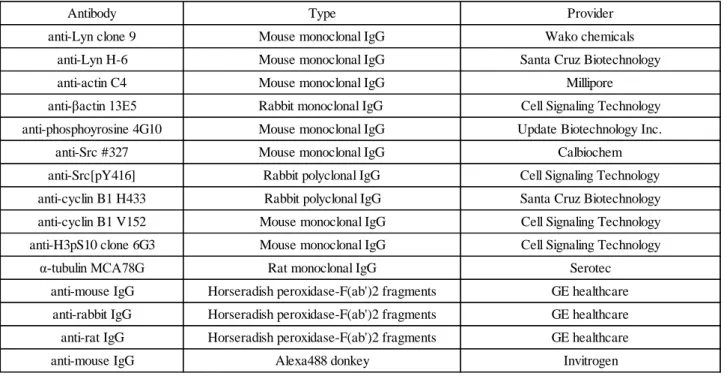
All antibodies used in this study are shown in table 1
Immunofluorescence microscopy
Immunofluorescence staining was performed as described (Obata et al., 2010, Soeda et al., 2013, Yamaguchi et al., 1995). In brief, cells were fixed with 4% paraformaldehyde in Dulbecco's phosphate-buffered saline (D-PBS) for 20 min, and permeabilized with 0.2% Triton X-100 in D-PBS for 5 min. Moreover, fixed cells were blocked with 3% bovine serum albumin in D-PBS containing 0.1% saponin, and then sequentially incubated with a primary and a secondary antibody for 1 hr each. DNA was stained with 20 µg/ml propidium iodide or 20 nM TO-PRO-3 (Molecular Probes) for 30 min after treatment with 200 µg/ml RNase A. Confocal and Nomarski differential-interference-contrast (DIC) images were obtained using a Fluoview Fv500 laser scanning microscope with 40 × 0.95 N.A. objective (Olympus, Tokyo, Japan). Composite figures were prepared using Photoshop 13.0 and Illustrator 16.0 software (Adobe).
Flow cytometry
Flow cytometric analysis was performed as described (Nakayama et al., 2012, Hasegawa et al., 2014, Kubota et al., 2014). In brief, cells detached by trypsinization were fixed in 4% paraformaldehyde for 1 hr, permeabilized with
70% ethanol for at least 1 hr at -30oC, and blocked with 3% bovine serum albumin
in D-PBS containing 0.1% saponin for 30 min at room temperature. After washing with D-PBS containing 0.1% Tween 20, cells were co-immunostained with
anti-H3pS10 and anti-cyclin B1 antibodies for 1 hr at room temperature, then stained with secondary antibodies. DNA staining was done by propidium iodide after treatment with RNase A. A minimum of 5,000 cells per sample was analyzed by flow cytometry using a Guava easyCyte (Millipore) equipped with a 488-nm laser and a 640-nm laser using Flowing Software version 2.5.0 (Perttu Terho, Centre for Biotechnology, Turku, Finland). Cell debris was excluded by gating on forward scatter and pulse-width profiles.
Western blotting
Cells were lysed in sample buffer, and cell lysates were subjected to SDS-PAGE and transferred onto polyvinylidene difluoride membranes (Millipore). To detect tyrosine phosphorylation of proteins, cell lysates were prepared with SDS-sample buffer containing 10 mM sodium orthovanadate, 20 mM ß-glycerophosphate, and 50 mM NaF. Immunodetection was performed by enhanced chemiluminescence and examined using an image analyzer ChemiDoc XRSplus (Bio-Rad) as reported previously (Obata et al., 2010, Nakayama et al., 2009). Sequential reprobing of membranes with various antibodies was performed after the removal of antibodies from the membranes or inactivation of HRP by 0.1% NaN3, according to the manufacturer’s instructions.
Cell cycle synchronization
HeLa S3/NLS-Lyn or HeLa S3/NLS-Lyn(KD) cells were arrested in G1/S phase with 4 mM thymidine for 24 hr. After 6 hr release from G1/S-phase arrest in thymidine-free fresh medium, the cells were incubated for further 6 hr in medium with or without 1 µg/ml doxycycline , a tetracycline derivative, for inducible expression. Cells were treated with the Src inhibitor PP2 (10 µM) and doxycycline
from the last 3 hr incubation (In my main publication, Fig. 2d). HeLa S3/TR cells were treated with 4 mM thymidine for 24 hr and arrested at G1/S phase (In my main publication, Fig. 2a). Subsequently, the cells were released for 4 hr. To synchronize cells in G2 phase, cells were treated with the cyclin-dependent kinase 1 (Cdk1) inhibitor RO-3306 (9 µM) (Calbiochem) for 8 hr with/without doxycycline (1 ng/ml~2 µg/ml). Cells arrested at the G2/M boundary were washed
with D-PBS containing Ca2+ and Mg2+ [D-PBS(+)], released into M phase, and
fixed at 1 hr from the release (Hasegawa et al., 2014). Cells were treated with 10 µM PP2 for the last 1hr incubation of RO-3306 and doxycycline (In my main publication, Fig. 4). Double thymidine block was performed as described previously (Nakayama et al., 2009, Kubota et al., 2014). Cells treated with 4 mM thymidine for 15 hr were incubated in complete medium without thymidine for 9 hr, and the cells were further treated with 4 mM thymidine for 15 hr (In my main publication Fig. 1).
Results
Section 1
Inducible Src-dependent inhibition of M-phase entry
Recently, we generated HCT116 and HeLa S3 cell lines stably expressing tetracycline-inducible v-Src (HCT116/v-Src and HeLa S3/v-Src), and showed that expression of v-Src inhibits cell proliferation in a kinase activity-dependent manner (Soeda et al., 2013). Also, we showed that inducible v-Src gives rise to a significant increase in chromosome bridge formation (Soeda et al., 2013). To analyze whether expression of v-Src affected cell cycle progression from G2 phase to M phase, HeLa S3/v-Src cells that were arrested at G1/S phase were further synchronized at the G2/M boundary in the presence of the cyclin-dependent kinase 1 (Cdk1) inhibitor RO-3306, and v-Src was induced by the addition of doxycycline in G2 phase. After release from cell cycle arrest at the G2/M boundary, cells were analyzed for cyclin B1 expression (a G2 and M phase marker) and phosphorylation of histone H3 at serine-10 (H3pS10, a mitotic marker) (In my main publication, Fig. 1a). Flow cytometric analysis showed that v-Src expression in G2 phase decreased the number of M-phase cells, thereby giving rise to inhibition of the onset of mitosis (In my main publication, Fig. 1b). However, inducible expression of a kinase-dead v-Src mutant [v-Src(K295M)] did not affect the onset of mitosis (In my main publication, Fig. 1c). Considering that activation of c-Src is found during M phase (Chackalaparampil, & Shalloway, 1988, Morgan et al., 1989), these results suggest that v-Src expression during G2 and M phases profoundly affects the onset of mitosis in a kinase activity-dependent manner, which may link to chromosome missegregation.
Section2
Induction of chromosome missegregation by NLS-Lyn expression.
v-Src, the viral oncogene product, lacks the negative regulatory tyrosine residue at the C-terminus and is a constitutively active form of its cellular counterpart c-Src (Martin, 2001). Our laboratory has shown that SFKs play important roles in mitosis (Kasahara et al., 2007b, Kuga et al., 2007, Kasahara et al., 2007c, Nakayama et al., 2012, Okamoto et al., 2016, Matsui et al., 2012). In particular, mitotic activation of c-Src, c-Yes, Lyn and Fyn, which are all co-expressed in HeLa cells, takes place downstream of Cdk1 activation during M phase (Kuga et al., 2007). Furthermore, SFKs, albeit small fractions, are definitely present in the nucleus (Kuga et al., 2007, Ikeda et al., 2008, Takahashi et al., 2009). To examine the effect of nuclear localized Lyn, a member of the Src family, on progression of cells from G2 phase into M phase, Lyn was tagged with a nuclear localization signal at the amino-terminus (NLS-Lyn) and the tetracycline-inducible expression of NLS-Lyn or a kinase-dead mutant of NLS-Lyn [NLS-Lyn(KD)] was generated in HeLa S3 cells [HeLa S3/NLS-Lyn and HeLa S3/NLS-Lyn(KD) cell lines]. Western blotting analysis showed that NLS-Lyn and NLS-Lyn(KD) were inducibly expressed by doxycycline addition and that autophosphorylation, which leads to activation of the kinase activity, was detected on NLS-Lyn but not NLS-Lyn(KD) (In my main publication, Fig. 2a), confirming that NLS-Lyn(KD) is deficient in the kinase activity. Intriguingly, upon induction of NLS-Lyn by doxycycline treatment, HeLa S3/NLS-Lyn cells showed the increased number of cells exhibiting anaphase lagging chromosomes and chromosome bridges (In my main publication, Fig. 2b, 2c), indicative of chromosomal instability and characteristics of chromosome missegregation (Gisselsson, 2003, Hoffelde et al., 2004, Burrell et al., 2013). In
contrast to NLS-Lyn, NLS-Lyn(KD) expression did not increase the frequency of lagging chromosomes and chromosome bridges (In my main publication, Fig. 2c). To further examine the role of the kinase activity of SFKs in induction of chromosome missegregation, I used the Src kinase inhibitor PP2. In fact, treatment of NLS-Lyn-expressing cells with PP2 inhibited the induction of chromosome missegregation (In my main publication, Fig. 2d). These results suggest that induction of chromosome missegregation is dependent on the kinase activity of NLS-Lyn.
Then, I examined the period of time when the kinase activity of NLS-Lyn acts on the induction of chromosome missegregation. Since the appearance of H3pS10 begins in early prophase at the onset of mitotic chromosome condensation (Sauvé et al., 1999), cells were found to enter prophase 11~12 hr after release from thymidine-synchronized G1/S arrest (In my main publication, Fig. 2e). The kinase activity of doxycycline -induced NLS-Lyn was inhibited by the treatment with PP2 for (ii) 6 hr, (iii) the last 3 hr, or (iv) the last 1 hr (In my main publication, Fig. 2f). Intriguingly, NLS-Lyn-induced chromosome missegregation was inhibited in any of these treatment times, indicating that treatment with PP2 for the last 1 hr was sufficient for inhibiting the induction of chromosome missegregation (In my main publication, Fig. 2f; see also in my main publication, Fig. 2e). These results suggest that nuclear tyrosine kinase activities in prophase with the onset of chromosome condensation may be critical for exacerbation of chromosome missegregation.
Section 3
Effect of lipid modifications of c-Src and Lyn on induction of chromosome missegregation.
Newly synthesized Lyn, in which the initiating methionine is removed by methionine aminopeptidase during translation, is myristoylated at glycine-2 by N-myristoyl transferase and subsequently palmitoylated at cysteine-3 by palmitoyl acyltransferase, and these lipid modifications are essential for membrane association of SFKs, including Lyn (Resh, 1994, Resh, 1999, Sato et al., 2009). I used Lyn(G2A/C3A), a non-lipid modified Lyn by replacing glycine-2 and cysteine-3 with alanine residues, because the double alanine mutation of glycine-2 and cysteine-3 completely blocks membrane anchorage of Lyn, thereby increasing the amount of Lyn within the nucleus (Ikeda et al., 2008). I then examined whether chromosome missegregation was induced by the expression of Lyn(G2A/C3A) in place of NLS-Lyn. To synchronize cells in M phase, HeLa S3/TR cells transiently expressing GFP (green fluorescent protein as a vector control), wild-type Lyn (Lyn-wt), or Lyn(G2A/C3A) were arrested at the G2/M boundary by treatment with RO-3306 for 8 hr and released into drug-free medium for 60 min to enter M phase (In my main publication, Fig. 3a-3c). Notably, the number of cells exhibiting chromosome missegregation was significantly increased upon expression of Lyn(G2A/C3A) compared to that of Lyn-wt or GFP (In my main publication, Fig. 3b, 3c). Western blotting analysis showed that strong autophosphorylation of Lyn(G2A/C3A) were detected during M phase (In my main publication, Fig. 3d). Considering that attachment of the NLS sequence to the amino-terminus of Lyn not only promotes nuclear localization of Lyn but also blocks its amino-terminal lipid modifications, these results suggest that, like NLS-Lyn, a lack of lipid
modifications of Lyn significantly increases the frequency of chromosome missegregation.
To examine the role of the kinase activity of Lyn(G2A/C3A) in induction of chromosome missegregation, we used Lyn(G2A/C3A)-KD (kinase-dead) and PP2. HeLa S3/TR cells transiently transfected with Lyn(G2A/C3A) were treated with doxycycline for inducible expression. Western blotting analysis showed that doxycycline -induced Lyn(G2A/C3A) was autophosphorylated in M phase (In my main publication, Fig. 3d) and that PP2 treatment decreased tyrosine phosphorylation levels of cellular proteins to some extent (In my main publication, Supplementary Figs S2b and S3). Treatment of Lyn(G2A/C3A)-expressing cells
with PP2 significantly inhibited Lyn(G2A/C3A)-induced chromosome
missegregation (In my main publication, Fig. 3e). Then, we confirmed by Western blotting analysis that Lyn(G2A/C3A)-KD is devoid of the kinase activity (In my main publication, Fig. 3d; Supplementary Fig.S2). It is of quite interest to note that expression of Lyn(G2A/C3A)-KD strongly inhibited chromosome missegregation (In my main publication, Fig. 3e), assuming that Lyn(G2A/C3A)-KD may act as a dominant-negative mutant form toward endogenous Lyn that fails in myristoylation and palmitoylation. On the other hand, Lyn(C3S), which can be myristoylated but not palmitoylated, did not exacerbate chromosome missegregation levels compared with Lyn(G2A/C3A). Furthermore, Lyn(G2A/C3A) was delocalized throughout the inside of a cell, whereas Lyn-wt was seen restrictedly at the plasma membrane in M phase (In my main publication, Fig. 3b). However, as the level of Lyn(G2A/C3A)-mediated tyrosine phosphorylation was not the highest among Lyn mutants (In my main publication, Supplementary Fig. S4), we consider that the levels of the kinase activity of Lyn mutants are not correlated with those of chromosome missegregation. These results suggest that non-membrane-bound Lyn,
such as Lyn(G2A/C3A) and NLS-Lyn, is associated with the induction of chromosome missegregation during M phase.
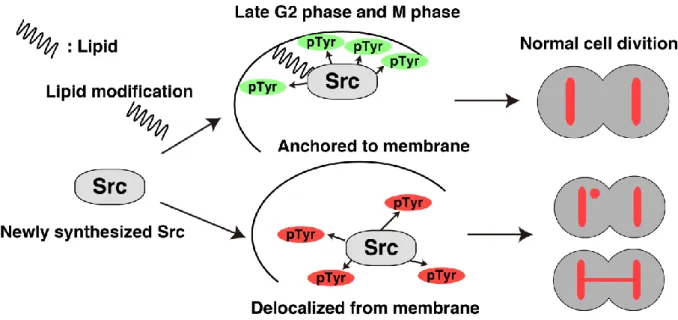
Whereas Lyn-wt is in general doubly myristoylated and palmitoylated, wild-type c-Src (c-Src-wt) is myristoylated but not palmitoylated because of the absence of the palmitoylation site in the entire amino acid sequence of c-Src (Resh, 1994, Resh, 1999, Sato et al., 2009). To examine whether the lack of myristoylation of c-Src resulted in exacerbating chromosome missegregation, we prepared c-c-Src(G2A), which lacks the myristoylation site resulting in production of non-lipid-modified c-Src. HeLa S3/TR cells transiently transfected with c-Src or c-Src(G2A) were synchronized as shown in Fig. 5a and compared the levels of chromosome missegregation between Src and Src(G2A) expressions. Expression of c-Src(G2A) increased the frequency of chromosome missegregation at a similar extent to that of Lyn(G2A/C3A) (In my main publication, Fig. 4a,b). Notably, c-Src(G2A) was delocalized to the nucleus and the cytoplasm in early prophase and to the cytoplasm in metaphase and anaphase, whereas c-Src-wt was largely localized to punctate structures (In my main publication, Fig. 4c,d). Considering that the level of c-Src(G2A)-mediated tyrosine phosphorylation was comparable to that of c-Src-wt (In my main publication, Supplementary Fig. S5), these results suggest that a lack of lipid modifications of Src-family kinases results in exacerbating chromosome missegregation owing to their delocalization. In other words, their membrane anchorage through lipid modifications from prophase to anaphase plays a protective role in induction of chromosome missegregation (Fig. 3).
Discussion
In this dissertation, I show that the defect in lipid modifications of Lyn and c-Src is significantly involved in induction of chromosome missegregation, such as formation of lagging chromosomes and anaphase chromosome bridges, in a kinase activity-dependent manner. Time course analysis with PP2 shows that the kinase activity of non-lipid-modified, non-membrane-bound Src during M phase is critical for giving rise to chromosome missegregation.
Our laboratory has shown that the way of lipid modifications of Src-family kinases plays an important role in their intracellular membrane trafficking and nuclear translocation (Kasahara et al., 2004, Sato et al., 2009, Kasahara et al., 2007a, Ikeda et al., 2008). Lyn’s myristoylation at glycine-2 and its subsequent palmitoylation at cysteine-3 and c-Src’s myristoylation at glycine-2 are needed for their association with the plasma membrane (Resh, 1994, Resh, 1999). In addition, Lyn mutants lacking the lipid modification sites are accumulated within the nucleus, suggesting that deletion of the lipid modification sites of Lyn enhances the accumulation of Lyn within the nucleus (Ikeda et al., 2008). Mutation of glycine-2 within Gα subunits, despite the preservation of cysteine-3, was reported to prevent not only myristoylation but also palmitoylation (Mumby et al., 1994). However, the double alanine mutation of glycine-2 and cysteine-3 on Lyn fully ensures inhibition of its membrane anchoring, thereby increasing the amounts of nuclear localization of Lyn. Like Lyn(G2A/C3A), c-Src(G2A) is non-lipid-modified c-Src and is accumulated in the nucleus because wild-type c-Src has a mono-myristoylation site at glycine-2 but not any palmitoylation sites (In my main publication, Fig. 4). Notably, previous study showed that approximately 16% of
newly synthesized c-Src and v-Src are normally not myristoylated and fail to anchor to the plasma membrane and organelle membranes (Buss et al., 1985). Indeed, our laboratory showed that Src-family members, c-Src, c-Yes, Lyn and Fyn, are endogenously present in the nucleus (Yamaguchi et al., 2001, Ikeda et al., 2008, Takahashi et al., 2009). These results suggest that the failure in lipid modifications of endogenous SFKs may result in their nuclear accumulation.
Not only c-Src but also Lyn, Fyn and c-Yes are all activated upon M phase entry by Cdk1-cyclin B1 and/or PTPα (Kuga et al., 2007, Roche et al., 1995, Chackalaparampil, & Shalloway, 1988, Morgan et al., 1989, Zheng, & Shalloway, 2001). Considering that expression of Lyn(G2A/C3A) results in the increased levels of chromosome missegregation similar to that of NLS-Lyn, which is incapable of being lipid modified owing to the addition of an NLS sequence at the N-terminus of Lyn (In my main publication, Figs. 2c and 3e), I assume that induction of chromosome missegregation may be attributable to the presence of the kinase activity in the nucleoplasm during prophase and in the cytoplasm after nuclear envelope breakdown. Provided that anaphase chromosome bridging is caused by pre-mitotic defects, such as DNA double-strand breaks (Gisselsson, 2008) or mitotic defects in securin or cohesin degradation (Chestukhin et al., 2003, Sotillo et al., 2007), the presence of non-lipid-modified, non-membrane-bound Src-family kinases during M phase may bring about chromosome missegregation through their increased accessibility to mitotic chromosome-associated proteins.
Chromosomal instability, defined as frequent changes in chromosome structure and number, is increasingly appreciated as a key component of tumorigenesis (Jallepalli, & Lengauer, 2001, Schvartzman et al., 2010). The process of chromosomal instability involves chromosome missegregation at anaphase in some or most instances (Jallepalli et al., 2001). Anaphase chromosome bridges are
associated with chromosome missegregation and have occasionally been observed in colorectal neoplasia and in sarcomas (Montgomery et al., 2003). Furthermore, anaphase chromosome bridges have been strongly linked to chromosomal instability in human tumor samples (Gisselsson, 2008, Montgomery et al., 2003, Fouladi et al., 2000) and tumorigenesis in mice (Rudolph et al., 2001). There is a strong correlation between multipolar mitoses and anaphase bridges, and the induction of dicentric chromosomes by gamma irradiation and telomerase inhibition leads to an elevated frequency of multipolar mitotic spindles, suggesting that multipolarity can result from polyploidization triggered by anaphase bridges. Moreover, anaphase bridges can arise from a variety of causes, including telomere dysfunction, cleavage defect of securin or cohesion (Chestukhin et al., 2003, Sotillo et al., 2007), or decatenation failure. Given that an excess amount of non-lipid-modified SFKs impairs correct chromosome segregation, lipid modifications of SFKs may be physically confined to their proper membrane-associated localization during mitosis, leading to prevent chromosome missegregation. Thus, a limited level of tyrosine phosphorylation during mitosis by non-membrane-bound SFKs may be important for proper processing of chromosome segregation.
In conclusion, I show that mitotic expression of non-lipid-modified SFKs significantly induces chromosome missegregation. Membrane association of SFKs plays a protective role against chromosome missegregation. Further studies will help us to understand the mechanism of Src-induced chromosome missegregation.
References
1. Brown, M. T. & Cooper, J. A. Regulation, substrates, and functions of Src.
Biochim. Biophys. Acta 1287, 121-149 (1996).
2. Thomas, S. M. & Brugge, J. S. Cellular functions regulated by Src family kinases. Annu. Rev. Cell Dev. Biol. 13, 513-609 (1997).
3. Martin, G. S. The hunting of the Src. Nat. Rev. Mol. Cell Biol. 2, 467-475 (2001).
4. Frame, M. C. Src in cancer: deregulation and consequences for cell behavior.
Biochim. Biophys. Acta 1602, 114-1130 (2002).
5. Resh, M. D. Myristylation and palmitylation of Src family members: the fats of the matter. Cell 76, 411-413 (1994).
6. Resh, M. D. Fatty acylation of proteins: new insights into membrane targeting of myristoylated and palmitoylated proteins. Biochim. Biophys. Acta 1451, 1-16 (1999).
7. Kasahara, K. et al. Trafficking of Lyn through the Golgi caveolin involves the charged residues on αE and αI helices in the kinase domain. J. Cell Biol. 165, 641-652 (2004).
8. Matsuda, D. et al. Involvement of Golgi-associated Lyn tyrosine kinase in the translocation of annexin II to the endoplasmic reticulum under oxidative stress. Exp. Cell Res. 312, 1205-1217 (2006).
9. Ikeda, K. et al. Requirement of the SH4 and tyrosine-kinase domains but not the kinase activity of Lyn for its biosynthetic targeting to caveloin-positive Golgi membranes. Biochim. Biophys. Acta 1790, 1345-1352 (2009).
the state of palmitoylation in the SH4 domain. J. Cell Sci. 122, 965–975 (2009).
11. Obata, Y. et al. The Lyn kinase C-lobe mediates Golgi export of Lyn through conformation-dependent ACSL3 association. J. Cell Sci. 123, 2649-2662 (2010).
12. Shenoy-Scaria, A. M., Dietzen, D. J., Kwong, J., Link, D. C. & Lublin, D. M. Cysteine 3 of Src family tyrosine kinases determines palmitoylation and localization in caveolae. J. Cell Biol. 126, 353-363 (1994).
13. Kasahara, K. et al. Role of Src-family kinases in formation and trafficking of macropinosomes. J. Cell. Physiol. 211, 220-232 (2007a).
14. Kasahara, K. et al. Rapid trafficking of c-Src, a non-palmitoylated Src-family kinase, between the plasma membrane and late endosomes/lysosomes. Exp.
Cell Res. 313, 2651-2666 (2007b).
15. Hubbard, S. R. & Till, J. H. Protein-tyrosine kinase structure and function.
Annu. Rev. Biochem. 69, 373-398 (2000).
16. Hunter, T. Tyrosine phosphorylation: thirty years and counting. Curr. Opin.
Cell Biol. 21, 140-146 (2009).
17. Yamaguchi, N. et al. Overexpression of the Csk homologous kinase (Chk tyrosine kinase) induces multinucleation: a possible role for chromosome-associated Chk in chromosome dynamics. J. Cell Sci. 114,1631-1641 (2001). 18. Kuga, T. et al. Differential mitotic activation of endogenous c-Src, c-Yes, and
Lyn in HeLa cells. Arch. Biochem. Biophys. 466, 116-124 (2007). 19. Ikeda, K. et al. Nuclear localization of Lyn tyrosine kinase mediated by
20. Takahashi, A. et al. Nuclear localization of Src-family tyrosine kinases is required for growth factor-induced euchromatinization. Exp. Cell Res. 315, 1117-1141 (2009).
21. Kubota, S. et al. Phosphorylation of KRAB-associated protein 1 (KAP1) at Tyr-449, Tyr-458, and Tyr-517 by nuclear tyrosine kinases inhibits the association of KAP1 and heterochromatin protein 1α (HP1α) with heterochromatin. J. Biol. Chem. 288, 17871-17883 (2013).
22. Kubota, S. et al. Role for tyrosine phosphorylation of A-kinase anchoring protein 8 (AKAP8) in its dissociation from chromatin and the nuclear matrix.
J. Biol. Chem. 290, 10891-10904 (2015).
23. Roche, S., Fumagalli, S. & Courtneidge, S. A. Requirement for Src family protein kinases in G2 for fibroblast cell division. Science 269, 1567-1569 (1995).
24. Tominaga, T. et al. Diaphanous-related formins bridge Rho GTPase and Src tyrosine kinase signaling. Mol. Cell 5, 13–25. (2000).
25. Ng, M. M., Chang, F. & Burgess, D. R. Movement of membrane domains and requirement of membrane signaling molecules for cytokinesis. Dev. Cell 9, 781–790 (2005).
26. Kasahara, K. et al. Src signaling regulates completion of abscission in cytokinesis through ERK/MAPK activation at the midbody. J. Biol. Chem.
282, 5327-5339 (2007c).
27. Nakayama, Y. et al. c-Src but not Fyn promotes proper spindle orientation in early prometaphase. J. Biol. Chem. 287, 24905-24915 (2012).
28. Okamoto, M. et al. Fyn accelerates M phase progression by promoting the assembly of mitotic spindle microtubules. J. Cell. Biochem. 117, 894-903 (2016).
29. Soeda, S. et al. v-Src causes delocalization of Mklp1, Aurora B, and INCENP from the spindle midzone during cytokinesis failure. Exp. Cell Res. 319, 1382-1397 (2013).
30. Chackalaparampil, I. & Shalloway, D. Altered phosphotylation and activation
of pp60c-src during fibroblast mitosis. Cell 52, 801-810 (1988).
31. Morgan, D. O., Kaplan, J. M., Bishop, J. M. & Varmus, H. E. Mitosis-specific
phosphorylation of p60c-src by p34cdc2-associated protein kinase. Cell 57,
775-786 (1989).
32. Matsui, Y., Nakayama, Y., Okamoto, M., Fukumoto, Y. & Yamaguchi, N. Enrichment of cell populations in metaphase, anaphase, and telophase by synchronization using nocodazole and blebbistatin: a novel method suitable for examining dynamic changes inproteins during mitotic progression. Eur. J.
Cell Biol. 91, 413–419 (2012).
33. Gisselsson, D. Chromosome instability in cancer: how, when, and why? Adv.
Cancer Res. 87, 1-29 (2003).
34. Hoffelder, D. R. et al. Resolution of anaphase bridges in cancer cells.
Chromosoma 112, 389-397 (2004).
35. Burrell, R. A. et al. Replication stress links structural and numerical cancer chromosomal instability. Nature 494, 492-449 (2013).
36. Sauvé, D. M., Anderson, H. J., Ray, J. M., James, W. M. & Roberge, M. Phosphorylation-induced rearrangement of the histone H3 NH2-terminal domain during mitotic chromosome condensation. J. Cell Biol. 145, 225-235 (1999).
37. Mumby, S. M., Kleuss, C. & Gilman, A. G. Receptor regulation of G-protein palmitoylation. Proc. Natl. Acad. Sci. USA 91, 2800-2804 (1994).
38. Buss, J. E. & Sefton, B. M. Myristic acid, a rare fatty acid, is the lipid attached to the transforming protein of Rous sarcoma virus and its cellular homolog. J.
Virol. 53, 7-12 (1985).
39. Zheng, X. M. & Shalloway, D. Two mechanisms activate PTPα during mitosis. EMBO J. 20, 6037-6049 (2001).
40. Gisselsson D. Classification of chromosome segregation errors in cancer.
Chromosoma 117, 511-519 (2008).
41. Chestukhin, A., Pfeffer, C., Milligan, S., DeCaprio, J. A. & Pellman, D. Processing, localization, and requirement of human separase for normal anaphase progression. Proc. Natl. Acad. Sci. USA 100, 4574-4579 (2003). 42. Sotillo, R. et al. Mad2 overexpression promotes aneuploidy and tumorigenesis
in mice. Cancer Cell 11, 9-23 (2007).
43. Jallepalli, P. V. & Lengauer, C. Chromosome segregation and cancer: cutting through the mystery. Nat. Rev. Cancer 1, 109-117 (2001).
44. Schvartzman, J. M., Sotillo, R. & Benezra, R. Mitotic chromosomal instability and cancer: mouse modelling of the human disease. Nat. Rev. Cancer 10, 102-115 (2010).
45. Jallepalli, P. V. et al. Securin is required for chromosomal stability in human cells. Cell 105, 445-457 (2001).
46. Montgomery, E. et al. Analysis of anaphase figures in routine histologic sections distinguishes chromosomally unstable from chromosomally stable malignancies. Cancer Biol. Ther. 2, 248-252 (2003).
47. Fouladi, B., Sabatier, L., Miller, D., Pottier, G. & Murnane, J. P. The
relationship between spontaneous telomere loss and chromosome instability in a human tumor cell line. Neoplasia 2, 540-554 (2000).
dysfunction and evolution of intestinal carcinoma in mice and humans. Nat.
Genet. 28, 155-159 (2001).
49. Yamanashi, Y. et al. The yes-related cellular gene lyn encodes a possible
tyrosine kinase similar to p56lck. Mol. Cell. Biol. 7, 237-243 (1987).
50. Nakayama, Y. et al. Bleomycin-induced over-replication involves sustained inhibition of mitotic entry through the ATM/ATR pathway. Exp. Cell Res. 315, 2515-2528 (2009).
51. Kuga, T. et al. Role of Src-family kinases in formation of the cortical actin cap at the dorsal cell surface. Exp. Cell Res. 314, 2040-2054 (2008).
52. Ohnishi, H. et al. A src family tyrosine kinase inhibits neurotransmitter release from neuronal cells. Proc. Natl. Acad. Sci. USA 98, 10930–10935 (2001). 53. Fessart, D., Simaan, M. & Laporte, S. A. c-Src regulates clathrin adaptor
protein 2 interaction between beta-arrestin and the angiotensin II type 1 receptor during clathrin-mediated internalization. Mol. Endocrinol. 19, 491-503 (2005).
54. Fukumoto, Y. et al. Cost-effective gene transfection by DNA compaction at pH 4.0 using acidified, long shelf-life polyethylenimine. Cytotechnology 62, 73-82 (2010).
55. Yamaguchi, N. & Fukuda, M. N. Golgi retention mechanism of β-1,4-galactosyltransferase: membrane-spanning domain-dependent
homodimerization and association with α- and β-tubulins. J. Biol. Chem. 270, 12170-12176 (1995).
56. Hasegawa, H. et al. Cdk1-mediated phosphorylation of human ATF7 at Thr-51 and Thr-53 promotes cell-cycle progression into M phase. PLoS One 9, e116048 (2014).
mimosine through reactive oxygen species-activated Ataxia telangiectasia mutated (ATM) protein without DNA damage. J. Biol. Chem. 289, 5730-5746 (2014).
Examiners
This thesis was reviewed by the following examiners authorized by the Graduate School of Pharmaceutical Sciences, Chiba University
Dr. Toshihiko Murayama, Ph.D. Professor of Chiba University (Graduate School of Pharmaceutical Sciences) Chief examiner
Dr. Atsushi Iwama, M.D. and Ph.D. Professor of Chiba University (Graduate School of Medicine)
Dr. Motoyuki Itoh, Ph.D. Professor of Chiba University (Graduate School of Pharmaceutical Sciences)
Dr. Ashfaq Mahmood, Ph.D. Professor of Chiba University (Graduate School of Pharmaceutical Sciences)
Acknowledgments
I would like to express my grateful thanks to Professor Naoto Yamaguchi of
the Laboratory of Molecular Cell Biology, Graduate School of Pharmaceutical Sciences, Chiba University for his invaluable guidance, kindness and continuous encouragement.
I am grateful to Professor Toshihiko Murayama, Professor Atsushi Iwama, Professor Motoyuki Itoh and Professor Ashfaq Mahmood for reviewing this thesis and grateful suggestion.
I am grateful to Professor Yuji Nakayama, Dr. Yasunori Fukumoto and Dr.
Noritaka Yamaguchi for helpful suggestion, patient and invaluable advice.
I thank to Ms. Mariko Morii and all of the students in this laboratory for their kindness, friendship, understanding and assistance during the course of this work.
I thank to Dr. Hiroshi Ohnishi, Dr. Stéphane A. Laporte, and Dr. Tadashi
List of Publications
[Main thesis publication]
Honda, T., Soeda, S., Tsuda, K., Yamaguchi, C., Aoyama, K., Morinaga, T., Yuki, R., Nakayama, Y., Yamaguchi, N., Yamaguchi, N.: Protective role for lipid
modifications of Src-family kinases against chromosome missegregation. Sci. Rep, 6: 38751, 2016.
Figures and Table
Table 1 all antibodies used in this study
Table 1
Antibody anti-Lyn clone 9
anti-Lyn H-6
Type Mouse monoclonal IgG Mouse monoclonal IgG
anti-βactin 13E5 Rabbit monoclonal IgG Cell Signaling Technology
anti-actin C4 Mouse monoclonal IgG Millipore
Provider Wako chemicals Santa Cruz Biotechnology
anti-Src #327 Mouse monoclonal IgG Calbiochem
anti-Src[pY416] Rabbit polyclonal IgG Cell Signaling Technology
anti-H3pS10 clone 6G3 Mouse monoclonal IgG Cell Signaling Technology
α-tubulin MCA78G Rat monoclonal IgG Serotec
anti-cyclin B1 H433 Rabbit polyclonal IgG Santa Cruz Biotechnology
anti-cyclin B1 V152 Mouse monoclonal IgG Cell Signaling Technology
anti-rat IgG Horseradish peroxidase-F(ab')2 fragments GE healthcare
anti-mouse IgG Alexa488 donkey Invitrogen
anti-mouse IgG Horseradish peroxidase-F(ab')2 fragments GE healthcare
anti-rabbit IgG Horseradish peroxidase-F(ab')2 fragments GE healthcare
Fig. 1. Lipid modification of Src-family kinases
Fig. 2. Traffic of Src-family kinases
Fig. 3. Graphical Abstract of this study