九州大学学術情報リポジトリ
Kyushu University Institutional Repository
敵対意図の帰属が集団間関係に及ぼす効果
黄, 麗華
https://doi.org/10.15017/1806788
出版情報:Kyushu University, 2016, 博士(心理学), 課程博士 バージョン:
権利関係:Fulltext available.
i
THE EFFECTS OF HOSTILE INTENT ATTRIBUTION ON
INTERGROUP RELATIONS
A dissertation
submitted to the Graduate of Human-Environment Studies, Kyushu University,
in partial fulfillment of requirements for the degree of Doctor of Philosophy in Psychology
by
LIHUA HUANG 黄 麗華
(Student ID 3HE12016N)
December, 2016 Kyushu University, JAPAN.
ii
APPROVAL
I, the undersigned, hereby approve the doctoral dissertation titled “the effects of hostile intent attribution on intergroup relations” submitted by
Lihua Huang
Dr. Hiroyuki Yamaguchi
Professor, Department of Psychology, Faculty of Human-Environment Studies,
Kyushu University, JAPAN.
iii
ACKNOWLEDGEMENT
This dissertation is the fruit of my seven-and-a-half-year study at Kyushu University, Japan. It is a genuine pleasure to express my deep sense of gratitude to all the people who have assisted me in completing this dissertation.
I owe a deep sense of gratitude to my academic advisor, Prof.
Hiroyuki Yamaguchi, who not only offered me the chance to study in Kyushu University but also has supported and encouraged me for seven-and-a-half-year. He guided me into the world of psychology; He taught me basic knowledge and useful skills; He supported me to attend scientific conferences that broadened my academic horizon; He helped me to get monetary supports including scholarships and grants. His timely advice, meticulous and rigorous approach have helped me to a very great extent to complete this dissertation. I would never forget his invaluable help.
I appreciate Dr. Kengo Nawata for his keen interest in my research at every stage. He taught me the basic knowledge of psychology, inspired me, provided me timely suggestions with kindness, and corrected my papers patiently and rapidly. I would not be able to complete this dissertation without his help.
I thank profusely the members, as well as the former members of Yamaguchi laboratory for their kind help and co-operation throughout my research period. Ryo Misawa, Satomi Mikami, Kazuo Nagaike, Takeru Miyajima, Ryouta Akiho, and Mie Ariyoshi, they helped me from every possible aspect and made my study life enjoyable.
iv
I extremely thank my dear friends who I encountered in Japan in these seven years: Jia Huang, Kewei Wang, Qin Fan, Hui Zhao, Jing Li, Jia Wang, Saifei Wang, Xin Ye, Bing Xu, Yu Liu, and Wenbo Luo, they gave me encouragement, and made my life colorful and pleasant.
I wish to express my sincere gratitude to the following organizations that provided me with research fund:
Fujixerox Setsutaro Kobayashi Memorial Fund Kohnan Asia Scholarship Foundation
Kyushu University
It is my privilege to thank my family and my closest friend. I want to thank my grandpa Zhongshan Huang, my parents Youlong Huang and Lianggu Ke for being patient with me and respecting my any choice I have made. I am grateful to my sister Dongxia Huang and my brother Weizhi Huang for giving me the chance to study in Japan and taking care of all things at home. I appreciate my closest friend Yinhuan Huang for providing moral support and encouragement to me.
I remember and appreciate all the people who helped, supported, or encouraged me during these eleven years. The period of my life in Japan is extremely valuable and I will never forget.
v
CONTENTS Chapter 1
Introduction : An overview on hostile intent attribution in intergroup conflicts / 1
1.1 Psychological mechanisms underlying hostile intent attribution / 5 1.1.1 Individual level mechanisms / 5
1.1.2 Collective level mechanisms / 7
1.2 Other social beliefs and hostile intent attribution / 11
1.2.1 Common characteristics among integrated threat theory, collective victimhood, and hostile intent attribution / 12
1.2.2 Integrated threat theory / 13
1.2.3 Integrated threat theory and hostile intent attribution / 14 1.2.4 Collective victimhood / 16
1.2.5 Collective victimhood and hostile intent attribution / 17 1.3 About the present study / 19
1.3.1 Closed-mindedness / 20 1.3.2 Intergroup contact / 22
1.3.3 Psychological functions of hostile intent attribution / 23 1.4 The context of the present study / 25
1.5 Contributions of the present study / 26 1.6 Structure of the present article / 27
Chapter 2
Study Ⅰ: The effects of hostile intent attribution on intergroup relations : The role of human values, perceived threat / 31
2.1 Introduction of study Ⅰ/ 33
2.1.1 Values as antecedents of hostile intent attribution / 33 2.1.2 The role of perceived threats / 36
2.2 Method / 40
2.2.1 Participants / 40 2.2.2 Measures / 41 2.3 Results / 44
2.4 Discussion / 47 2.4.1 Findings / 48
vi
2.4.2 Theoretical implications / 50 2.4.3 Practical implications / 51
2.4.4 Limitations and directions for future research / 52
Chapter 3
Study Ⅱ: Hostile intent attribution as mediator of the relation between nationalism and emotion / 54
3.1 Introduction of study Ⅱ / 56
3.1.1 Nationalism and inter-group emotions / 58 3.1.2 Hostile intent attribution as mediator / 59 3.2 Method / 61
3.2.1 Participants / 61 3.2.2 Measures / 62 3.3 Results / 64
3.4 Discussion / 67 3.4.1 Findings / 67
3.4.2 Theoretical implications / 70
3.4.3 Limitations and directions for future research / 71
Chapter 4
Study Ⅲ : The mediating effects of collective responsibility on the relation between hostile intent attribution and intergroup anger / 73
4.1 Introduction of study Ⅲ / 75 4.1.1 Responsibility judgment / 75
4.1.2 Hostile intent attribution and responsibility / 78 4.1.3 Intergroup anger and responsibility judgment / 79 4.2 Method / 81
4.2.1 Participants / 81 4.2.2 Measures / 81 4.3 Results / 82
4.3.1 Path model / 84 4.4 Discussion / 86
4.4.1 Theoretical implications / 86
4.4.2 Limitations and future research / 89
vii
Chapter 5
Study Ⅳ : The effects of intergroup contact on hostile intent attribution / 91 5.1 Introduction of study Ⅳ / 93
5.1.1 Hostile intent attribution as mediator / 93 5.1.2 Inter-group contact as antecedent / 93 5.1.3 Perspective taking as moderator / 95 5.2 Method / 98
5.2.1 Participants / 98 5.2.2 Measures / 98 5.3 Results / 100
5.3.1 Factor analysis / 100 5.4 Discussion / 105
5.4.1 Findings / 106
5.4.2 Theoretical implications / 108 5.4.3 Limitations / 109
5.4.4 Conclusions / 110
Chapter 6
General discussion : Views of hostile intent attribution / 111 6.1 The goals of present study / 113
6.2 The results of the present study / 114 6.3 Theoretical implications / 116
6.4 Practical Implications / 125
6.5 Limitations of the present study / 126 6.6 Directions for future research / 128
6.6.1 Other antecedents for hostile intent attribution / 128 6.6.2 Group dynamics / 131
6.6.3 Reducing inter-group hostile intent attribution / 131 6.7 Conclusion / 135
REFERENCES / 135 Appendix / 177
1
Chapter 1
Introduction
An overview on hostile intent attribution
in intergroup conflicts
2
Abstract of Chapter 1
Hostile intent attribution refers to a perception of others’ negative actions toward you as purposeful and hostile when their intention is unclear. In this chapter, I first present the mechanisms of hostile intent attribution that operate at the individual level, and then propose the mechanisms that operate at the group level. Second, I outline the characteristics of hostile intent attribution through comparison with other beliefs. Third, this chapter identifies biases that contribute to groups’ engagement in hostile intent attribution, and contend that hostile intent attribution serves various functions. Finally, the structure of the present study will be introduced.
3
Intergroup conflict refers to the conflicts happen between the groups.
Conflicts are an inseparable part of every inter-group relations and a domain of human interaction. Every day, countless conflicts, whether at the individual or group level, erupt when people perceive that their goals or interests are incompatible with other groups (Bar-Tal, 2000a; Michell, 1981;
Rubin, Pruitt, & Kim, 1994). For example the wars between the nations; the racial wars. Inter-group conflicts is characterized as being violent, existential, unsolvable, and of a zero-sum nature (Krisberg, 1995; Bar-Tal, 1998). About inter-group conflicts previous analyses has been primarily to shed light on specific historical and political contexts. In addition, throughout the past decades, socio-psychological researchers have developed many theories through enormous empirical research to help us understand what operate the social behavior and inter-group conflicts. Social beliefs is one of the most basic processes in the way that demonstrated how and why the inter-group conflicts occurred.
The term “social beliefs” refers to group members’ shared cognitions on social topics and issues that concern the group. The central themes and contents (such as group history, interests, goals, myths, etc.) form the social beliefs (Bar-Tal, 2000b). Beliefs about conflicts become psychological barriers that prevent intergroup resolution and underlie intergroup distrust and hostility. It contribute directly to inter-group prejudice and competition, even from which a single incident can give rise to inter-group conflicts. Thus, the present study considers the psychological bases of negative social beliefs and these social beliefs shape inter-group misunderstandings, and, ultimately,
4
conflict.
Hostile intent attribution as one of social beliefs which can lead to catastrophic consequences for interpersonal relations. Hostile intent attribution refers to a bias toward viewing others’ negative actions toward you as purposeful and hostile when their intention is unclear (Dodge, 1980).
Numerous previous studies have shown general support for hostile intent attribution theory, suggesting that hostile intent attribution typically leads to aggressive behavior (see Hudley & Graham, 1993; Yeager, Miu, & Powers,
& Dweck, 2013). It is an important element of the development of aggressive and antisocial behavior in theoretical accounts (Orobio de Castro, Veerman, Koops, Bosch, & Monshouwer, 2002), and a target for cognitive behavioral interventions to reduce antisocial behavior in interpersonal relations (Hudley & Graham, 1993; Lochman & Lenhart, 1993). Thus, the present study will examine hostile intent attribution for inter-group conflicts and seek to develop the concept of hostile intent attribution at the group level.
The present chapter will first briefly introduce the Individual and collective level mechanisms what may contribute to the collective motivation to engage in hostile intent attribution. Furthermore, the chapter will describe the psychological barriers of collective victimhood and perceived threats, and propose my study through the way of compare hostile intent attribution with collective victimhood and perceived threats. Then, it will present the research about hostile intent attribution to date. The focus will be mostly on what underlie hostile intent attribution and what results it lead.
Finally, the chapter will present the construction of the present study.
5
1.1 Psychological mechanisms underlying hostile intent attribution 1.1.1 Individual level mechanisms
Hostile attribution bias occurs in ambiguous situations wherein people interpret the intent of others as hostile in accordance with their expectations (Milich & Dodge, 1984). For example, imagine an adolescent who is walking down a school hallway. A peer runs down the hallway, knocking him over and spilling his books on the floor, then other peers laugh (Dodge, 2006). Does he perceive the behavior as an accident or on purpose?
How does the student respond? Hostile intent attribution is evoked by a behavioral experience of social exclusion. In particular, hostile schemas, which are stored in memory, lead to hostile intent attribution more easily when individuals make a judgment in an ambiguous situation. Dodge (2006) has theorized that hostile schemas are shaped by experiences of traumatic threat and insecurity situation, such as parents’ or peers’ violence. During social interactions, these schemas lead individuals to perceive others’ intent as hostile and therefore promote hostile intent attribution. Hostile intent attribution can be viewed as a kind of cognitive bias, or a general schema that leads to an understanding of social events from a perspective of hostility (Dill, Anderson, & Deuser, 1997; Spector & Fox, 2010).
Beside individuals’ experiences, Dodge (2006) also summarized three other mechanisms of socialization for the development of hostile intent attribution. The first mechanism is social learning. If a person who often interacts with children tends to display hostile intent attribution, the children are more likely to display hostile intent attribution. The second
6
mechanism is insecure attachment. Compared with the children with a secure attachment history, children with an insecure attachment history are more likely to attribute hostile intent (Ziv, Oppenheim, & Sagi-Schwartz, 2004). The third mechanism is social failure, which has a relationship with hostile intent attribution (Graham & Juvonen, 1998). In addition, hostile intent attribution is related to intelligence (Gomez & Hazeldine, 1996), age (Crick & Dodge, 1996), and individual traits (Yeager et al., 2013).
In sum, these mechanisms may underlie group members to perceive that out-groups have tendencies to harm in-group. Furthermore, they may lay the foundation of hostile intent attribution for the psychological mechanisms that promote group members to attribute out-groups’ tendency as hostility toward in-group. For example, one way that social learning that group members who inherit collective memory, this memory describe histories of the conflicts’ beginnings and course is likely to influence the group members’ perception about out-group.
Because previous studies on hostile intent attribution mainly focus on interpersonal relationships, which is relatively well understood, I will rely on theoretical and empirical evidence on the interpersonal level. In addition, the present analysis of hostile intent attribution focuses on the context of historical direct violence in which groups repeatedly aggress against each other with the intention of harming or killing each other. Such a context may leave the group members involved with a deep sense of hostility and a belief that competitive groups have the ongoing intention to harm in-group members.
7
1.1.2 Collective level mechanisms
1.1.2.1 Biased collective memory of intractable conflicts
In general, groups tend to evolve their extensive suffering into collective memory, and this memory in turn evolves to describe the conflicts to group members (Cairns & Roe, 2003; Wertsch, 2002), who ascribe meaning to the histories of the conflicts’ beginnings and courses (Devine-Wright, 2003).
Often, group members’ shared collective memory is supported by governmental institutions, which create a narrative that omits the facts and is biased, selective, and purposeful according to the group’s present goals (Bar-Tal, 2007). For example, to maintain positive group identity and a favorable image of the in-group (Bar-Tal, 2007), groups sometimes silence a shameful historical episode or cleanse the history by altering what is taught to members of the group, and dehumanize out-groups for defending their group and status quo. Thus, despite group members did not experience unjustness and be directly harmed, they also could label themselves as victims because of their fellow group’s suffering in the past conflicts (Bar-Tal, Chernyak-Hai, Schori, & Gundar, 2009).
These collective memory serve as a basis for construction of a common social beliefs (Noor, Shnable, Halabi, & Nadler, 2012). The narrative of collective memory legitimizes in-group behavior in the conflicts, delegitimizes the adversary, and places the in-group in the position of victim in the intractable conflicts in order to preserve a favorable image of the in-group (Bar-Tal, 2007). Thus, when group member’s memory about inter-group relation was constructed by inter-group conflicts, groups may
8
develop social beliefs to afford them with strategies for coping with the present inter-group relation. Furthermore, when these shared beliefs is about delegitimization of rival groups and in-group’s suffering, the group members will tend to express especially against related out-group in conflicts.
Thus, the formation of the sense of social beliefs is partly based on part of collective memory of conflicts, and these social beliefs well established the social-psychological barriers to last conflict.
1.1.2.2 Biased collective intergroup conflicts
In addition, the collective accounts of inter-group conflicts and transgression also can contribute the biases to social beliefs (Noor, et al., 2012). Nisbett and Cohen (1996) have proposed that social culture affects social-cognitive responding. Intergroup conflicts is often evolved to a culture and this culture may be manifested through groups’ religion, narrative, arts (Noor, et al., 2012). The culture as such conflicts tend to encourage the group members to classify the situation as “us vs. them,” and highlight “our”
suffering and “their” violence through dehumanizing out-groups (Lynch &
Galtung, 2010; Noor et al., 2012). When the culture of inter-group conflicts supply the basis for group members’ consciousness, the social beliefs which was developed by the culture of conflicts will make group members less likely to display empathy for competitive out-groups, even though sometimes out-groups may suffer greater than the in-group. When out-groups are labeled as vermin or insects and as aggressive, it may encourage group members’ hostile intent attributions by viewing the out-group as subhuman.
In sum, the biases in-groups’ collective memories, as well as in their
9
accounts of conflicts, may lay the foundation for hostile intent attribution.
These processes also encourage the group members who identify more strongly with the in-group to be more be likely to accept major socially shared beliefs (e.g., social beliefs of the ethos of conflicts). Thus, despite social identity providing the conditions to support the continuation of intergroup conflicts, these negative shared social beliefs predict the intergroup conflicts directly.
1.1.2.3 Social culture
Nisbett and Cohen (1996) have proposed that social culture affects social-cognitive responding. They argued that a culture that places value on respect and honor will encourage hostile intent attribution in response to personal threat and provocation. Social culture can affect people’s socio-cognitive processes and behaviors (Morris & Peng, 1994). For example, collectivist societies may be more sensitive to anything that could harm their group, and individualist societies may tend to support policies that promote social coexistence (Leong & Ward, 2006). Similarly, compared with other social cultures in which people do not emphasize group honor and respect, a culture that overemphasizes the value of group honor and respect may tend to more easily experience out-group exclusion when they come into contact with the in-group narrative about conflicts. Groups create a phenomenon that leads group members to perceive that their honor is harmed, and evokes emotions such as humiliation and helplessness through a narrative of collective trauma. Those narratives may encourage group members to attribute the competitive groups’ motivations as hostile; consequently, they
10
are likely to respond unkindly or with an aggressive attitude toward out-groups.
1.1.2.4 Self-categorization
Individuals perceive others’ personal acts to be carried out with an intention to harm because of personal experiences, and certain collectives such as nations or ethnic groups may also perceive hostile intent attribution.
This may be a result of intergroup transmitted narratives, which include many forms, such as violent conflicts between nations and groups, intergroup competition, terrorism, incidents, and occupations, even if not all group members experience the events directly. However, not all group members respond the same way to the negative narratives of the ingroup.
This is because whether individuals identify as members of the ingroup category or not leads to the different evaluations of intergroup events.
Considerable evidence has shown that the ways people perceive, think about, and evaluate intergroup relations are influenced by social categorization rather than individual qualities (e.g., Brewer, 1988; Fiske, Lin, & Neuberg, 1999). When the ingroup identity is salient, there is effectively no psychological separation between self and the group as a whole, and people tend to include other ingroup members in the self-concept and perceive every ingroup members as sharing the same feeling and beliefs (e.g., Doosje, Ellemers, & Spears, 1995).
A social psychological theory of self-categorization (Turner, Hogg, Oakes, Reicher, & Wetherell, 1987), which is a part of an individuals’
11
self-concept, suggests that individuals identify with and view themselves as a member of the group to which they belong (Jenkins, 1996; Reicher &
Hopkins, 2001). The process by which individuals cognitively assimilate the personal self into the collective self is referred to as depersonalization. This transformation brings group members’ self-perception and behaviors in line with the context-relevant ingroup, and equates group members’ self-interest with ingroup interests. Likewise, intergroup events that affect any member of the ingroup are experienced as though they affect the self. Moreover, group members subsequently adopt various beliefs, emotions, and attitudes based on experiences of their ingroup (Bar-Tel et al., 2009). Self-categorization is an important psychological mechanism that underlies the development of a collective sense of hostility among group members who do not experience negative events directly. The belief of hostile intent attribution is also based on and reflected in self-categorization. Thus, self-categorization provides a foundation for hostile intent attribution for group members.
1.2. Other social beliefs and hostile intent attribution
About social beliefs that the most notable models of these beliefs include integrated threat theory (Stephan & Stephan, 1993; Stephan &
Stephan, 1996) and collective victimhood, which have received great attention in the field of intergroup conflict. These two models of negative inter-group relation-supporting beliefs will be described and compared with hostile intent attribution in the next section.
12
1.2.1 Common characteristics among integrated threat theory, collective victimhood, and hostile intent attribution
Perceived threats, collective victimhood, and hostile intent attribution are beliefs that arise from collective memory of intergroup conflicts and account of inter-group negative events. They are perceived as social-psychological barriers. Bar-Tal (1998) suggests three functional characterizations of these beliefs. (1) They justify in-group goals in conflict, and can provide a set of reasons to support these goals. These beliefs justify the in-group’s aggressive policies or behavior in intergroup conflicts, and help them escape feelings of guilt for in-group misdeeds within intractable intergroup conflicts. (2) They delegitimize the adversary. The social beliefs are formed by intergroup conflict, and these beliefs delegitimize the adversary (Bar-Tal, 1990). Perceived threats, collective victimhood, and hostile intent attribution deny the humanity of competitive out-groups, describe out-groups in dehumanized terms, and involve negative trait characterization. (3) They create enemies for in-groups. These beliefs may encourage group members to see competitive out-groups as enemies when these social psychological barriers cannot be overcome. In addition to Bar-Tal’s above functions, it is possible to formulate an additional function of these three beliefs. By supporting conflicts, perceived threats, collective victimhood, and hostile intent attribution play important roles in preventing the resolution of harsh and lasting conflicts. They operate on the cognitive, emotional, and motivational processes that impede positive intergroup relationships. Finally, a trait characterization of these three beliefs can be
13
summarized as subjective; these three beliefs are group members’ subjective evaluations of the intergroup intractable conflict, regardless of whether or not their perceptions are “real”.
Due to differences in the content of social beliefs, perceived threats, collective victimhood, and hostile intent attribution have their own distinct characteristics. These are introduced in the following sections.
1.2.2 Integrated threat theory
Integrated threat theory describes four different types of threat:
realistic threats, symbolic threats, intergroup anxiety, and negative stereotypes. Realistic threats are described as the subjective perception held by a group that its political and economic power, and/or material or physical well-being are threatened by out-groups. Symbolic threats are based on perceived group differences in morals, values, and standards. Intergroup anxiety involves the negative feelings of in-group members who experience fear or uneasiness in connection with actual interactions with out-group members (Stephan & Stephan, 1985). Stereotype threats involve negative beliefs about out-group characteristics that create negative expectations concerning the behavior of out-group members. Field tests of the integrated threat theory model have found that ratings of realistic threats (Riek, Mania,
& Gaertner, 2006), symbolic threats (Curseu, Stoop, & Schalk, 2007), intergroup anxiety (Ho & Jackson, 2001; Voci & Hewstone, 2003) and negative stereotypes (Eagly & Mladinic, 1989; Spender-Rodgers & McGovern, 2002) predict negative out-group attitudes and biases.
14
1.2.3 Integrated threat theory and hostile intent attribution
Competitiveness. Integrated threat theory focuses on competitive intergroup relationships; specifically, realistic threats and symbolic threats.
The concept of realistic threats originates in realistic group conflict theory, which proposes that when two groups compete for scarce resources, the potential winner threatens the other group’s well-being (Sherif & Sherif, 1969). The concept of symbolic threats is derived from symbolic racism theory, which posits that racism results from conflicting values and beliefs (Kinder,
& Sears, 1981). Realistic threats and symbolic threats both imply a zero-sum situation in which one group’s gain means the other side’s loss. They enhance groups’ engagement in conflicts over competition for resources. In contrast to these two types of threats, hostile intent attribution addresses out-groups’
hostility toward the in-group, regardless of whether or not the groups are competing for resources. Hostile intent attribution does not imply a zero-sum situation.
Certainty. Hostile intent attribution involves certainty about the presence of negative out-group attitudes toward the in-group. It engenders definite certainty in in-group members that out-groups are engaging in hostile behavior towards them, and that out-groups’ behaviors toward the in-group are deliberate. On the contrary, perceived threats do not involve definite judgments about out-group attitudes; although out-groups may seem threatening, in-group members cannot be certain whether the out-group’s threatened behavior is deliberate. For example, an out-group’s market
15
expansion may harm an in-group’s interests, but it does not mean that the out-group intends harm to the in-group on purpose.
Definitely Targeted. Having perceived threats, individuals and groups cannot confirm whether or not the competing out-groups’ threatened behavior is targeted at the in-group. For example, stereotype threats are described as overall impressions of an out-group (such as “violent,” or “cold”), and these negative stereotypes reflect negative expectations about out-groups. These perceptions consist of descriptions of the out-groups’
general characteristics. Thus, those out-groups may behave based on negative attitudes toward any group, not only directly against the in-group.
Different with perceived threats, hostile intent attribution includes the perceptions that threats are directly targeted against the ingroup, this hostile attitude may be considered to be held only toward the ingroup, and when the hostile out-groups interact with other out-groups, they may exhibit friendly behavior.
Although many theory models of perceived threats elaborate on group members’ reactions to threat. For example, the Neuberg and Cottrell’s (2002) model theorized that different kinds of threats arouse different emotional response, which in turn lead to different attitude and behavior.
However, in fact, large of research have shown that threats are related to inter-group prejudice and emotional reaction, few studies provided the evidences to show that perceived threats predicted aggressive response to against the out-groups directly. Riek et al. (2006) have demonstrated that when the perceived activities of competition continued, inter-group hostility
16
became severe, in this case the aggressive behavior may be lead. For example, former British Prime Minister Tony Blair reported his perception about 9 / 11 that Iraq was trying to destroy the Western way of life, as a result, Blair demonstrated the Iraq’ hostile intention what promoted the people of UK to support the war with Iraq. Research on Terror Management Theory (Solomon, Greenberg, & Pyszczynski, 2004) also shown group members express aggressive attitude toward out-groups when group members feel an increased need to safeguard their worldview from threats.
Thus, I consider that only when group members feel that out-groups have the intention to deprive their resources or destroy their cultural worldview, the impact of such threats can become drastic. In other world, only when group members are led to consider that rival groups are attempting to harm them, in which their aggressive response may be led to against relative out-groups in the contexts of threats.
1.2.4 Collective victimhood
In recent years, many theoretical as well as empirical studies have focused on the social belief of collective victimhood (see, for example, Andrightto, Mari, Volpato, & Behluli, 2012; Nalder & Saguy, 2003; Noor, Brown, Gonzalez, Manzi, & Lewis, 2013). Collective victimhood is defined as a belief held by an in-group that the in-group is a victim within an intergroup conflict. The theory of collective victimhood provides a powerful framework for explaining aggressive intergroup behavior (Nawata &
Yamaguchi 2012), lasting conflicts (Halperin & Bar-Tal 2011), and failure of
17
intergroup conflict resolution (Myers, Hewstone, & Cairns 2009). Collective victimhood is thus considered a barrier to peacemaking.
1.2.5 Collective victimhood and hostile intent attribution
Collective victimhood and hostile intent attribution result from intractable conflicts, even those in the distant past. Collective victimhood mainly stresses the group’s suffering in past conflicts, in which they encountered injustice, discrimination, prolonged exploitation, and extensive harm (Bar-Tal, Chernyak-Hai, Schori, & Gundar, 2009). The collective sense of victimhood forms with traumatic experiences, and groups encode these experiences in their collective memory, which can help them see themselves as victims. The sense of collective victimhood can allow groups to provide explanations, delegate responsibility, gain other groups’ support, and escape feelings of guilt in intractable conflicts (Bar-Tal, Chernyak-Hai, Schori, &
Gundar, 2009).
Collective victimhood highlights the role that the in-group played in the conflicts (as the victim or the perpetrator), but it is not necessary to stress the role that the in-group played when engaging in hostile intent attribution. Indeed, when group members perceive themselves as the victim in intractable conflicts, it implies that competitive groups possess an ongoing potential for harm and the intergroup relationship may remain tense. On the other hand, when group members perceive their in-group as the perpetrators in intractable conflicts, they may worry about competitive groups taking revenge on the in-group, and this may result in group members believing
18
that rival groups maintain hostility toward them. It implies that the in-group has the potential to be harmed, and thus the in-group remains under continuous conditions of threat.
Furthermore, research has established that the victims tend to engage aggressive behavior against rival out-groups, and perpetrators make compensation and prosocial behavior for victims when they realize their group has deviated from the humanitarian moral norms. However, in the real world, the conflicts such as territories, natural resources, value still not be easy to resolve because of psychological barriers of social beliefs. As argued above, obviously, collective victimhood could not demonstrate the situation that why and how the perpetrators reduce their guilty to last or leave themselves involve into the situation of conflicts. In the context that victim group repeatedly express the attitude with intention to harm against perpetrator groups. As a result, the perpetrator groups’ members may tend to believe that relative out-groups carry out with the intention either to harm the group as a whole or some of group members. Such contexts may help the perpetrator escape from the guilty and leave themselves involve with a deep belief that they also suffer in the conflicts. This approach can work for both sides of victims and perpetrators, it leads to the behavioural intention such as the desire to support the aggressive policies and to avenge rival groups for in-group’s benefits.
Moreover, although hostile intent attribution and collective victimhood can be real or partly imagined, but usually collective victimhood is based on experienced events (Bar-Tal et al., 2009), yet hostile intent
19
attribution is not limited to these context. Definitely, collective memory of conflict and account of conflicts is a part of the socio-psychological basis for forming hostile intent attributions. However, in the situation that when inter-group relation is full of ambiguilty, uncertainty and risky, the side of group members’ fear is aroused by pointing out that their losses from the continuation of the present situation. In this situation such like would up the risk that group members attribute out-groups’ intention as hostility. In other word, it is a state where the group members did not experienced inter-group conflicts, the sense of hostile intent attribution still can be established in the ambiguilty situation.
As can be seen, several social beliefs that are related to inter-group relations have been discussed in social psychology. However, some limitations about these social beliefs yet not be discusses in the previous study. The goal of present study is to fill the gaps in the field of inter-group conflicts by using the theory of hostile intent attribution and analyzes its antecedents, functions, moderators, and consequences at the group level.
1.3 About the present study
The present study on the development of hostile intent attribution is centered on the group level. Throughout the present study, I will use human basic value, social identity and intergroup contact as predictors of the antecedents of hostile intent attribution to establish theoretical models.
Additionally, the functions of hostile intent attribution will be combined into the theoretical models.
20
1.3.1 Closed-mindedness
Closed-mindedness is a mechanism of human stagnation (Halperin &
Bar-Tal, 2011). Halperin and Bar-Tal (2011) have demonstrated that open-/closed-mindedness can play an important role in opinion formation.
Furthermore, closed-mindedness has shown a positive association with orientations such as intolerance, conversation, and authoritarianism (Jost, Glaser, Kruglanski, & Sulloway, 2003), which likely help to establish social-psychological barriers. Likewise, Nisnet, Hart, Myers, and Ellithorpe (2013) indicated that closed-mindedness lies at the core of false beliefs or misperceptions. Indeed, group members who are closed-minded are likely to seize on prior opinions and become resistant to change. All of this makes the process of intergroup trust and understanding more difficult. Likewise, closed-mindedness may incite a negative image of rival outgroups that favors hostility and violence. Thus, the present article will focus on closed-minded values and ideology that may result in the perception of hostile intent attribution.
1.3.1.1 Basic human values
Basic human values are criteria or standards that guide people to select and justify their actions, and to evaluate people or events (Schwartz, 1992). Individual attitudes and behaviors are associated with these values.
Different values motivate different attitudes or actions (Schwartz, 1996).
According to motivational characteristics or goals, Schwartz (1992) proposed
21
10 types of values to explain attitudes, behaviors, and perceptions. Although basic human values are associated with out-group attitudes, socio-political orientation, and perceptual domains, few studies have tried to demonstrate the effects of basic human values on the mechanisms of intergroup conflicts.
As mentioned above, values that overemphasize the group’s honor or respect may encourage hostile intent attributions. Thus, the first goal of the present study is to empirically validate the relationship between two different types of basic human values (traditionalism and universalism, which entail a social focus) and hostile intent attribution.
1.3.1.2 Social identity
As mentioned before, social identity provides a new approach to understanding intergroup relations. It promotes in-group similarity and out-group distinctiveness through the making of comparisons (Lemaine, 1974; Vanneman & Pettigrew, 1972). On the one hand, those comparisons can motivate group members’ uniformity with the in-group. On the other hand, social identity also encourages in-group members to make intergroup comparisons that can enhance intergroup distinctiveness. Social identity, as a kind of social glue, is the origin of group loyalty (Van Vugt, & Hart, 2004), and it is assumed that once group members identify themselves with a group, their goals or welfare become intertwined with the group’s goals or welfare (Brewer, 1979; Turner, Hogg, Oakes, Reicher, & Wetherell, 1987). The more one is identified with a group, the more likely one is to wish for retribution and revenge (Bar-Tal, 2003). Social identity is a source of intergroup conflicts.
22
However, previous experiments with minimal intergroup situations have provided evidence that in-group favoritism is not necessarily related to out-group hate. Social identity alone does not predict intergroup negative attitudes and aggressive behavior if the elements of intergroup distrust, active hostility, and hate for the out-group are lacking. Thus, in the present study, nationalism and patriotism are assessed to test the association between national identity and hostile intent attribution. Nationalism is an expression of national identity that emphasizes the authoritarian structures between a nation and the nation’s people and inspires authoritarian beliefs.
On the other hand, patriotism stresses a nation’s welfare, and is based on a universal humanist value system (Staub, 1997). It contributes to the rejection of authoritarian relations (Blank & Schmidt, 2003). Compared with patriotism, nationalism is more sensitive to intergroup relationships. The second goal of this study is to examine the relationship between nationalism and patriotism as antecedents of hostile intent attribution.
1.3.2 Intergroup contact
Intergroup contact permits the relationship between competitive groups to move forward, and forms the basis of theoretical models for reducing intergroup bias (Brown & Hewstone, 2005; Pettigrew, 1998;
Pettigrew & Tropp, 2006). A positive contact experience can facilitate intergroup understanding and reduce intergroup anxiety and negative social beliefs (Pettigrew & Tropp, 2008). More importantly, growing evidence shows that frequent and positive contact can increase intergroup trust (e.g., Cehajic,
23
Brown, & Castano, 2008; Hewstone, Cairns, Voci, Hamberger, & Niens, 2006). Intergroup trust encourages individuals to overcome the belief that out-groups have negative intentions toward the in-group (Mitchell, 2000).
Thus, the third goal of this study is to demonstrate how intergroup contact work on hostile intent attribution.
1.3.3 Psychological functions of hostile intent attribution
The functions of hostile intent attribution have been described above in comparison with the beliefs about perceived threats and collective victimhood. The present study proposes that hostile intent attribution can be viewed as a valuable psychological resource that serves several negative functions for promoting intergroup conflict. This study will investigate two functions of hostile intent attribution, namely the functions of justifying in-group aggressive behaviors and increasing negative inter-group emotions (here, mainly fear and anger).
1.3.3.1 Increasing negative group emotions
Society members are affected by shared cultural frameworks, and their emotional experiences take the form of a collective emotional orientation (Barbalet, 1998; Bar-Tel, 2001, 2007; Mackie & Smith, 2002).
Collective emotional orientations predominate in conflicts (Petersen, 2002;
Scheff, 1994; Bar-Tel, 2007). Collective emotions include anger, fear, pride, humility, and so on. These emotions arise when social members are in a particular situation or environment, and enable them to respond adaptively.
24
For example, Bar-Tal (2007) proposes that intractable conflict introduces threats and dangers. These threats and dangers are embedded into collective memory and ethos as beliefs; meanwhile, society members share this collective memory and ethos through mass media or educational institutions.
Society members may experience fear or anger, and their emotional experience take the form of a collective emotional orientation.
According to the Appraisal Model of Emotion, emotions arise from specific cognitive appraisals (Smith & Ellsworth, 1985). Perceiving that out-groups have hostility towards the in-group may be associated with intergroup distrust and various negative intergroup emotions. These negative intergroup emotions are action-oriented emotions, such as anger or fear (Mackie, Devos, & Smith, 2000), that are generally aroused by cognitive appraisals and response tendencies (Halperin, Sharvit, & Gross, 2008). Once again, evaluation of conflicts may lead to attributions of out-groups’ attitudes as hostility, and negative emotion may become an inherent part of the standing psychological context as a result.
1.3.3.2 Justifying in-group aggressive behavior
Generally, before intergroup violence can occur, it is necessary to justify the violence for the sake of group members’ support (Bandura, 1999).
Eidelson and Eidelson (2003) proposed that an exaggerated sense of in-group vulnerability, for example, collective victimhood (Nawata & Yamaguchi, 2012), can facilitate moral justification, which can arouse group members’
collective emotions such as anger (Smith, Cronin, & Kessler, 2008; Noor,
25
Shnabel, Halabi, & Nadler, 2012). The present study hypothesizes that stressing out-groups’ hostile motivation can also provide groups with a useful tool for instilling group members with a sense of threat and reminding them of out-groups’ attacks in order to justify violent strategies. Thus, hostile intent attribution may encourage group members to accept aggressive strategies as a means of self-defense.
1.4 The context of the present study
The present study is carried out in the context of the China–Japan relationship. China and Japan enjoy very close cultural and economic relations that stretch back to antiquity. Currently, China is Japan’s largest trading partner (Nishimura & Hirayama, 2013), while Japan is also one of China’s most important economic partners (Dean, Lovely, & Mora, 2009).
However, despite the critical importance of the cooperative partnership between these two nations, relations between their respective populations are strained because of contrasting viewpoints relating to the Second World War and associated political problems that remain unresolved (Qiu, 2006; He, 2007). For example, in 2012, striking and widespread anti-Japan demonstrations occurred in response to the Japanese government’s nationalization of the Diaoyu Islands (known as the Senkaku Islands in Japan; Nye, 2013). These events signaled a climax in the deteriorating relationship between these two nations. According to reports published by China Daily and by The Genron NPO of Japan, about 64.5 and 84 percent of the Chinese and Japanese populations, respectively, harbor negative
26
impressions of each other (Koh, 2012). In this study, I analyzed the relationship between China and Japan from a socio-psychological perspective.
1.5 Contributions of the present study
The present study attempts to propose a new conceptual framework of hostile intent attribution from a psychological perspective. Focusing on the role of hostile intent attribution in the inter-group relationship, the study makes some academic contributions to the hostile intent attribution literature. First, as argued above, through the years, a number of approach have been proposed to focus on the beliefs of group’s past and present suffering in the inter-group conflicts, and these beliefs about group’s past and present suffering were one of most contributors to successfully predicted conflicts. However, few approaches focus on social beliefs related to possible future suffering. Originally, of course, the belief of hostile intent attribution focus not only on the past and present the group’s losses, but also on the possible future losses. Thus, the present study demonstrates the role of hostile intent attribution in intergroup relationships, which can lead to a new socio-psychological perspective explaining intergroup conflicts and, furthermore, developing intergroup conflict theory.
Second, the hostile intent attribution approach is a perspective that aims to be a general theory about people’s negative emotion and aggressive behavior. It is assumed that hostile intent attribution express strong aspects of perceived others’ harmful intention and that aggressive behaviors are
27
acted. The theory of hostile intent attribution appear to be value in explaining inter-group conflicts. However, less attention has been given to analysis of hostile intent attribution at the group level. The present study aims to demonstrate that hostile intent attribution is an important elements of inter-group aggressive attitude. This study’s findings can advance our understanding of how group members react to hostile intent attribution.
Third, from a practical perspective, given the considerable impact of hostile intent attribution on the inter-group relationship, this study’s findings can provide some insight into methods of conflict resolution and promote inter-group relations. Through these three contributions, I expect this research to theoretically enrich the literature on hostile intent attribution through the examination of a different cultural context, and to practically enhance our understanding of China–Japan relations.
1.6 Structure of the present article
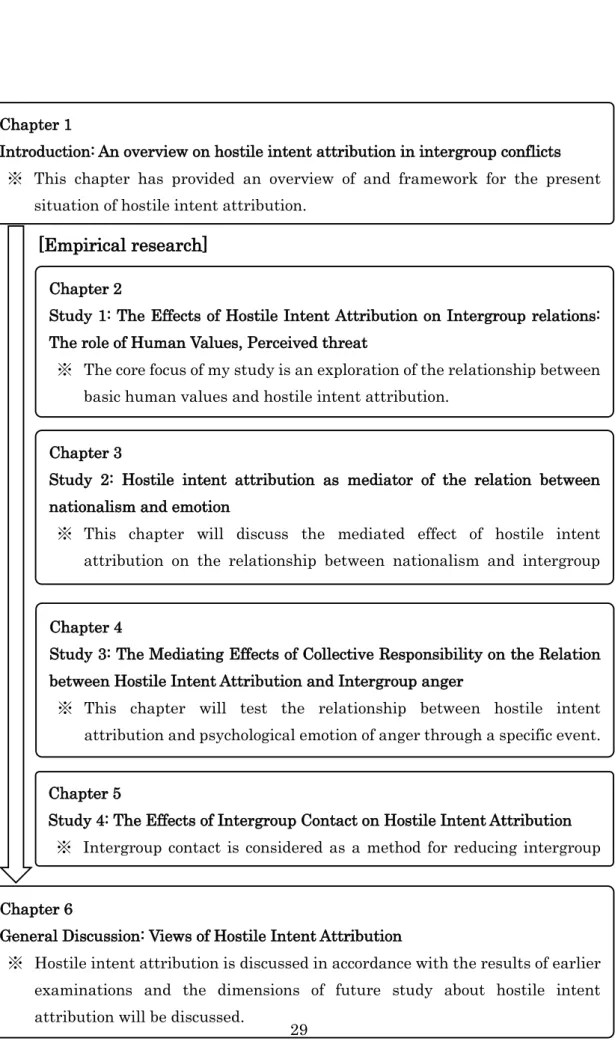
On the basis of the above argument of hostile intent attribution, the present study aims to test the role of hostile intent attribution in intergroup conflicts. Thus, this study examines the roles of basic human values, social identity, and intergroup contact in the psychological processes and functions of hostile intent attribution. The following is an overview of the present study.
The current chapter (Chapter 1) has presented the literature on hostile intent attribution and has stressed that hostile intent attribution arises from collective memory of intergroup conflicts as well as other
28
negative beliefs. This chapter has provided an overview of and framework for the present situation of hostile intent attribution. Chapters 2 through 4 will demonstrate and empirically validate the mechanisms of hostile intent attribution.
In Chapter 2, I review theories of hostile intent attribution, traditionalism, universalism, and perceived threats. Based on this theoretical review, I develop hypotheses on the relationship between basic human values and hostile intent attribution. I then test my hypotheses using the results of surveys conducted in China and Japan.
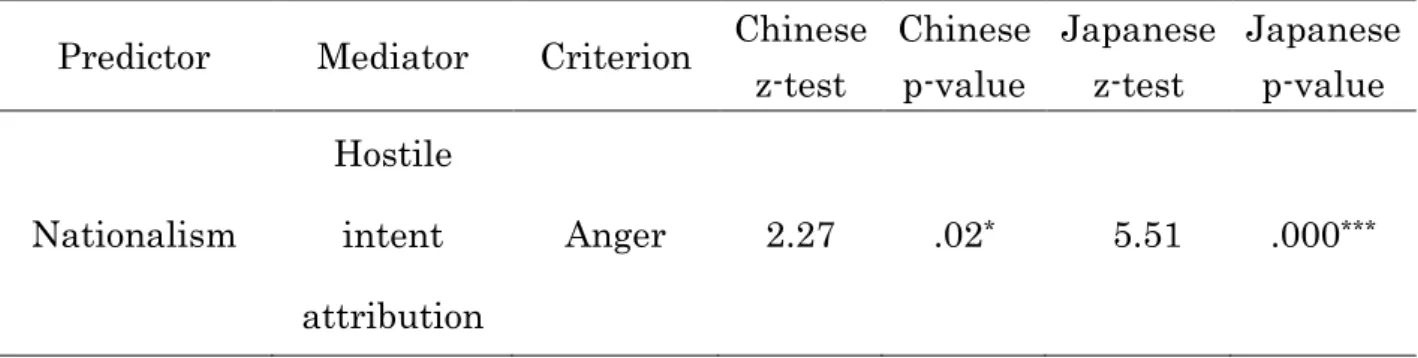
In Chapter 3, based on the theoretical review, I develop hypotheses on the relationship between nationalism and intergroup emotion, with hostile intent attribution as a mediator. I then test my hypotheses using the results of surveys conducted in China and Japan.
In Chapter 4, I first review theories of attribution responsibility, hostile intent attribution, and inter-group anger. Based on this theoretical review, I develop hypotheses on the relationship among the variables. I then test our hypotheses using the results of surveys conducted in Japan.
In Chapter 5, inter-group contact is considered as a method for reducing intergroup bias; therefore, I introduce the relationships between out-group contact and attitudes held by in-group members against out-groups as evidence for reducing hostile intent attribution.
In Chapter 6, combining the results of Chapters 2 through 5, I outline the mechanisms of hostile intent attribution. In particular, the dimensions of future study about hostile intent attribution will be discussed.
29 Chapter 1
Introduction: An overview on hostile intent attribution in intergroup conflicts
※ This chapter has provided an overview of and framework for the present situation of hostile intent attribution.
Chapter 2
Study 1: The Effects of Hostile Intent Attribution on Intergroup relations:
The role of Human Values, Perceived threat
※ The core focus of my study is an exploration of the relationship between basic human values and hostile intent attribution.
Chapter 3
Study 2: Hostile intent attribution as mediator of the relation between nationalism and emotion
※ This chapter will discuss the mediated effect of hostile intent attribution on the relationship between nationalism and intergroup emotion.
Chapter 4
Study 3: The Mediating Effects of Collective Responsibility on the Relation between Hostile Intent Attribution and Intergroup anger
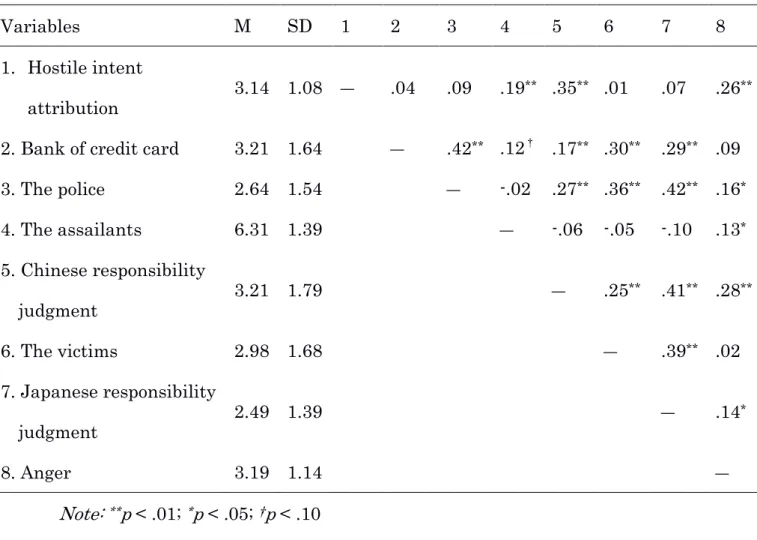
※ This chapter will test the relationship between hostile intent attribution and psychological emotion of anger through a specific event.
Chapter 5
Study 4: The Effects of Intergroup Contact on Hostile Intent Attribution
※ Intergroup contact is considered as a method for reducing intergroup
Chapter 6
General Discussion: Views of Hostile Intent Attribution
※ Hostile intent attribution is discussed in accordance with the results of earlier examinations and the dimensions of future study about hostile intent attribution will be discussed.
[Empirical research]
Figure 1-1: Structure of the present article
30
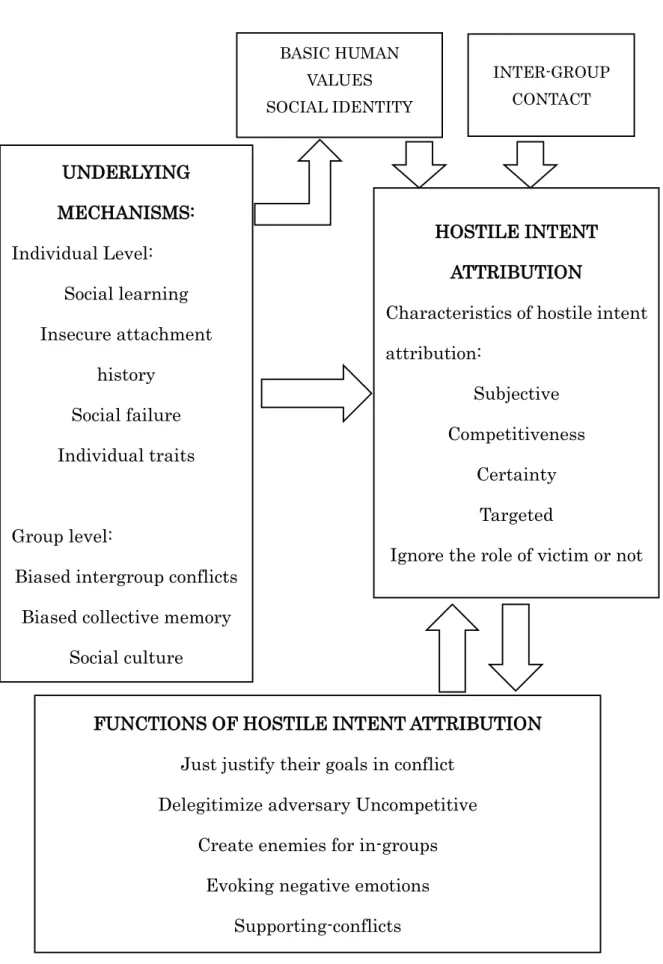
Figure 1-2: Antecedents and functions of hostile intent attribution
HOSTILE INTENT ATTRIBUTION
Characteristics of hostile intent attribution:
Subjective Competitiveness
Certainty Targeted
Ignore the role of victim or not UNDERLYING
MECHANISMS:
Individual Level:
Social learning Insecure attachment
history Social failure Individual traits
Group level:
Biased intergroup conflicts Biased collective memory
Social culture
FUNCTIONS OF HOSTILE INTENT ATTRIBUTION Just justify their goals in conflict
Delegitimize adversary Uncompetitive Create enemies for in-groups
Evoking negative emotions Supporting-conflicts
BASIC HUMAN VALUES SOCIAL IDENTITY
INTER-GROUP CONTACT
31
Chapter 2
Study Ⅰ
The effects of hostile intent attribution on
intergroup relations: The role of human
values, perceived threat
32
Abstract of Chapter 2
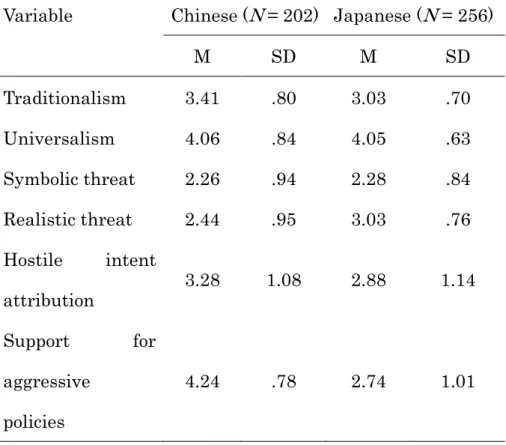
This study examines a specific effect of hostile intent attribution within intergroup relationships. Based on my application of integrated threat theory, I hypothesised that human value (traditionalism and universalism) predicted hostile intent attribution via different types of symbolic and realistic threats. I conducted a survey among two university population samples of Chinese and Japanese respondents. The results for our first sample of Chinese undergraduate students (N = 201) revealed that both traditionalism and universalism predicted hostile intent attribution and that these relations through symbolic threats, but not realistic threats. However, the results for the second sample of Japanese undergraduate students (N = 256) differed, indicating that traditionalism, but not universalism, predicted hostile intent attribution via symbolic and realistic threats. Furthermore, hostile intent attribution predicted support for aggressive polices directly in both samples. In conclusion, I discuss the theoretical and practical implications of these findings.
33
2.1 Introduction of study Ⅰ
The core focus of my study is an exploration of the relationship between basic human values and hostile intent attribution. Furthermore, I identified the psychological processes underlying the effects of traditionalism and universalism on hostile intent attribution through perceived threats. In this paper, I first review theories of hostile intent attribution, traditionalism, universalism and perceived threats. Based on this theoretical review, I develop hypotheses on the relationship between basic human values and hostile intent attribution. I then test our hypotheses using the results of surveys conducted in China and Japan. In the final section of this chapter, based on my statistical analysis and discussion of the survey results, I examine the study’s implications and propose a future research agenda.
2.1.1 Values as antecedents of hostile intent attribution
Values are criteria or standards that guide people in selecting and justifying their actions, as well as in evaluating people or events (Schwartz, 1992). Individual attitudes and behaviour are associated with these values. A study by Halperin and Bar-Tal (2011) has shown that the value of traditionalism is associated with the avoidance of intergroup compromise, while the value of universalism entails the promotion of positive intergroup relations. I consider values that have been long ignored to be important factors in relation to intergroup conflicts. Thus, an investigation of the effect of values on intergroup conflicts is pertinent.
34
Schwartz (1992) has identified ten types of basic values relating to people’s motivation. In the current study, I opted to examine the relationship of two of these values, namely, traditionalism and universalism, with hostile intent attribution for the following reasons. First, traditionalism has been found to be associated with negative attitudes towards out-groups (Schwartz, 2006a; Halperin & Bar-Tal, 2011). Second, compared with other values (for example, benevolence), universalism is more likely to promote acceptance of out-groups (Schwartz, 2007) and positive intergroup relations. I, therefore, selected traditionalism and universalism as the two antecedent variables in our study.
2.1.2.1 Traditionalism
Traditionalism entails an attitude of respect, commitment and acceptance towards the customs and ideas that represent shared group experiences and a collective fate (Schwartz, 1992). These experiences and fate symbolise a group’s unique and enduring ethos, promoting its solidarity and survival (Durkheim, 1912; Parsons, 1951; Schwartz, 1992; Halperin &
Bar-Tal, 2011).
This study posits that traditionalism is positively related to hostile intent attribution. Traditionalism may lead to cognition that is based on categorising, thereby providing a basis for a negative attitude held towards out-groups. Indeed, empirical studies have shown that traditionalism can induce detrimental effects such as a positive association with anti-immigrant behaviour (Schwartz, 2009), foreign military intervention (Schwartz, 2010)
35
and authoritarianism (Schwartz, 2003). An overemphasis on tradition may also result in feelings of unease, oppression and sensitivity pertaining to anything that could lead to changes in the group among in-group members.
These manifestations of anxiety may, in turn, promote a high level of traditionalism that results in avoidance of intergroup contact and induces attribution of negative traits to out-groups to justify this behaviour. The greater the degree of importance attached by people to the preservation of their own culture, the greater the likelihood that they will show heightened sensitivity towards anything that could harm their group (González, Verkuyten, Weesie, & Poppe, 2008). Furthermore, because traditionalism generates positive feelings towards the in-group, in an ambiguous situation requiring self-protection, it provides a basis for attributing wrongdoing to an out-group. Thus, we postulate in this study that traditionalism is likely to promote a perception of hostility attributed to out-groups and aimed at maintaining an in-group’s sense of unique features rooted in the past.
2.1.2.2 Universalism
Universalism has been defined as the motivation to understand, appreciate and tolerate different or even rival groups and to promote the welfare of all people by emphasising broadmindedness, social justice, equality, a peaceful and beautiful world, unity with nature and environmental protection (Schwartz, 1992). Universalism holds that there are no differences between people across the world and that everyone must be treated equally.
36
In my study, I posited that universalism has a positive effect on hostile intent attribution. Universalism is more likely to evoke positive perceptions and prosocial activity that benefit the world (Schwartz, 2007). It even motivates actions of self-sacrifice to promote the welfare of others (Schwartz, 2009). Indeed, several empirical studies have shown that universalism is a contributing factor in promoting a positive attitude towards out-groups (Halperin & Bar-Tal, 2011; Sagiv & Schwartz, 1995) and a tendency to accept out-groups (Schwartz, 2009). Contrasting with traditionalism, universalism does not induce anxiety over anything transformative and, therefore, advances the development of positive intragroup interactions. Furthermore, because universalism incorporates self-sacrifice as a characteristic feature, it is less likely to result in hostile intent being attributed to others to justify the behaviour of in-group members, even in ambiguous situations. Thus, it may be an important factor in decreasing hostile intent attribution.
2.1.2 The role of perceived threats
My study, which is based on integrated threat theory propounded by Stephen and Stephen (1996), incorporates several theoretical perspectives on intergroup attitudes. Integrated threat theory identifies four main types of threats: realistic threats, symbolic threats, intergroup anxiety and negative stereotypes (Stephan & Stephan, 1996). Although all four threat types contribute to negative attitudes held towards out-groups, this study focuses mainly on perceived realistic and symbolic threats, because these are the
37
most typical threat types evident in negative intergroup relations (Bobo, 1983; Esses, Jackson, & Armstrong, 1998; Falomir-Pichastor, Muñoz -Rojas, Invernizzi, & Mugny, 2004).
The conception of realistic threats, which originates in realistic group conflict theory, has been further expanded by Stephan, Stephan and Gudykunst (1999). In line with this expanded conception, a realistic threat, as applied in this study, refers to the subjective perception held by an in-group that its welfare is threatened by out-groups, regardless of whether or not the threat is “real”. I specifically focus on realistic threats emanating from market competition and from security, political power and material considerations.
Within integrated threat theory, symbolic threats relate to conflicts of value that can also have detrimental effects on intergroup relations (Riek, Mania, & Gaertner, 2006). The conception of symbolic threats is derived from symbolic racism which entails the desire to protect certain cultural symbols and arouses negative individual attitudes towards out-groups (McLaren, 2003). In accordance with symbolic racism theory, symbolic threats, as applied in my study, refer to the subjective perception that the in-group’s existing value system and culture are being threatened by out-groups.
I hypothesised that perceived threats may play an important role in relations between traditionalism and hostile intent attribution for two reasons. First, traditionalism entails the following conservative characteristics: resistance to change (Schwartz, 2006a), a desire to preserve habits and customs and belief in an immutable past (Schwartz, 2009). These
38
characteristics of traditionalism serve to sensitise in-group members, desiring to protect or maintain the group’s traditions, to anything that may affect their customs and ideas. Interactions with out-groups that have even slightly different cultures and values may affect the integrity of symbols, ideas and beliefs within the in-group, causing strongly traditionalistic members to feel easily threatened. Similarly, nationalism, which advocates the importance of maintaining cultural values, has been associated with perceived threats (Ljujic, Vedder, Dekker, & Geel, 2013). Second, several empirical studies have shown that perceptions of symbolic and realistic threats play important underlying roles in fostering prejudice against out-groups (Riek et al., 2006, Curseu, Stoop, & Schalk, 2007; Ljujic et al., 2013). Perceived threats readily induce psychological distress. Previous studies have shown that the perception that the in-group is under threat easily leads to negative feelings held by its members towards an out-group.
This includes characterisation of the out-group as being violent and intrusive (González et al., 2008; Sniderman, Hagendoorn, & Prior, 2004). Thus, when group members encounter a situation in which out-groups deprive them of their resources, security or values, or destroy these, they are likely to consider these groups as competitors with hostile intent towards their own group.
I also suggest that universalism reduce hostile intent attribution via perceived threats for the following reasons. As previously mentioned, those who uphold universalism easily accept others who differ from them (Schwartz, 2009), have positive perceptions of out-groups and promote