of agricultural cooperatives in the Republic
of Benin
著者
IBIKOULE Erasme Godfrid, LEE Jaehyeon
journal or
publication title
Bulletin of the Faculty of Agriculture,
Kagoshima University
volume
71
page range
31-40
year
2021-03-30
[鹿大農学術報告 第 71 号,p31-40,2021]
†: Correspondence author: Erasme IBIKOULE (Laboratory of Farm Business Management, Major in Agricultural Sciences and Natural Resources, Graduate school of Agriculture Forestry and Fisheries, Kagoshima University)
E-mail: [email protected]
Characteristics of trends and historical path of agricultural cooperatives in the Republic of
Benin
Erasme Godfrid IBIKOULE1)†, Jaehyeon LEE2)
1) Laboratory of Farm Business Management, Major in Agricultural Sciences and Natural Resources, Graduate school of
Agriculture Forestry and Fisheries, Kagoshima University
2) Laboratory of Farm Business Management, Department of Agricultural Science and Natural Resources, Faculty of
Agriculture, Kagoshima University.
Accepted January 20, 2021 Summary
This research provides an overview of agricultural cooperatives (ACs) in Benin's Republic (RB). It describes the history of ACs and provides statistics on their number across time, size of membership, and distribution across the country. The first generation of ACs in RB was developed during the time of colonization. With the advent of independence in 1960 arose the second generation of ACs, marked by poor performances, too much State involvement and compulsory membership.
Further, the early 90s marked a turning point in the movement, with the rise of the third generation of ACs in a freer environment. They were mainly made of village groups at the grassroots level, Unions at the communal and departmental echelons, and the Federation of Farmers Union (FUPRO) at the national level, which unfortunately was focused on cotton production for a long time. As a result, the third generation of ACs did not perform well because of inappropriate legal provisions and the considerable importance of the cotton sector, amongst other reasons.
However, due to the government's political will, from 2006, to promote new crops, and the entry into force of the nineteenth Uniform Act of the OHADA relating to the Law of Cooperative Societies in May 2011, ACs have gained momentum. The fourth generation of ACs started flourishing in the RB and reached 2439 ACs as of April 2019. Most ACs in RB are single-purpose cooperatives with small membership size and operating within their village limits. Due to the importance of ACs in RB nowadays, sustaining cooperatives' contributions to members and all community becomes essential and then deserves policymakers' attention.
Introduction
A cooperative is an autonomous association of women and men who unite voluntarily to meet their common economic, social, and cultural needs and aspirations through a jointly-owned and democratically-controlled enterprise (ICA, 1995). That definition is quite similar to the one in the 9th Uniform Act on the Law of Cooperative Societies (AUSCOOP) enacted
by the Organization of the Harmonization of Business Law in Africa (OHADA). It defines cooperatives as an autonomous group of individuals who willingly join together to fulfill their aspirations and meet their common economic, social, and cultural needs to form a corporate body whose ownership and management are collective and where power is exercised democratically and according to the cooperative basis (OHADA, 2010).
Agricultural cooperatives are essential organizations for farm households in both developed and developing markets and have been perceived by policymakers as fundamental institutions that increase economic welfare. Similarly, rural villages in Africa reported having at least one local agricultural cooperative (Francesconi and Wouterse, 2017). Several studies have reported on the importance of agricultural cooperatives in developing countries. Agricultural cooperatives have been identified as an appropriate institution that enables farmers to participate in competitive inputs and output markets, improve the quality and safety of agri-food, adopt advanced technologies, obtaining a strong position in the value chain, enhance farm economic performance, increase rural household welfare and contributing to the increase in the local development and the living standard in rural communities (Abebaw and Haile, 2013; Kumar et al., 2016; Wossen et al., 2017; Ma, Abdulai and Goetz, 2018). In this respect, the emergence of agricultural cooperatives is widely viewed as an essential institutional arrangement that can help overcome the constraints that impede smallholders in developing countries from taking advantage of agricultural production and marketing opportunities (World Bank, 2006). Although cooperatives are found across the globe, the African experience, with its distinct history and socio-political context, manifest idiosyncratic features that make it stick out compared to the Western cooperative movement (Holmén, 1990).
In most sub-Saharan African countries, agrarian cooperatives have a complex history. The "western" notion of the cooperative enterprise was introduced by a colonial power, but often it became a tool used by the decolonization governments to promote development in rural areas (Develtere, Wanyama and Pollet, 2008). Thus, In the Republic of Benin (RB), agricultural cooperatives have gone through different waves since its insertion. Several generations of cooperatives have come and gone over time with varying results. Then recently, within the framework of the OHADA, the AUSCOOP was enacted between the member States on December 15, 2010. Gning and Larue (2014) think that the new OHADA cooperative societies status can serve as a tool for revitalizing the farming sector if the conditions for involving all stakeholders (State, cooperatives, donors, and NGOs) at all levels are met. This research intends to review the development of ACs by using literature from academic journals and national and regional reports. Also, secondary data from the Office of Rural Legislation, in charge of support to interprofessional Organization and Agricultural Entrepreneurship (DLROPEA), were analyzed and interpreted to provide the empirical basis of the trends and status of primary cooperatives.
Importance and significance of this study
Cooperatives are often discussed as a possible means of economic development, especially in rural regions that rely on agriculture for their economy. The United Nations emphasized this in their literature on the 2012 year of cooperatives initiative. Despite RB's recent transition from a low-income to a middle-income country, the large majority of its regions are unindustrialized and underdeveloped. As mentioned in the country report of the World Bank in 2019, RB's economy relies heavily on the informal re-export and transit trade with Nigeria (estimated at approximately 20% of GDP) and on agriculture. Despite that recent upward trend of the economy, the poverty rate remains high, at 46.4% in 2018, with a poverty line of $1.90 a day in purchasing power parity. Also, the economic activity accelerated to 6.7% in 2018 from 5.8% in 2017 (a per capita GDP growth rate of 3.8%) and is driven by vibrant port activity (+8.5% in 2018) and a sound agricultural sector buoyed by record cotton production (+17% in 2018) coupled with the diversification of emerging export sectors (pineapple, cashew nuts). As shown by the dire statistics mentioned above, the country is still in need of rural and agricultural development, and cooperatives, particularly ACs in rural areas, could be a possible avenue for this development. With the political stability, the democratic government in charge of affairs, and the regional framework providing uniformed legal provisions and market opportunities, development through cooperatives is now more possible than before. Yet, cooperatives development is an ongoing process that needs to be clarified and analyzed.
Origin of cooperatives in Africa
Cooperative development in Africa did not originate from people's interests and motivations. Their origin in most African countries can be traced to the colonial period when colonial governments directed the formation of these organizations to achieve, not the interests of the co-operators, but the interests of the so-called administration (Develtere, 1994). The main intention of establishing these organizations was to have instruments for implementing their socio-economic policies. For instance, the British, particularly in their settler colonies, wished to promote and protect the interests of white settler farmers, to enhance their productivity, to generate the very much needed income to run the affairs of the
Agricultural cooperatives in Benin
33
colonies, and also export to Britain the cash crops that were required to fuel industrialization. Cooperative development, therefore, started among these white farmers as a means of improving their productivity, and the initial legal framework that guided the formation of these organizations excluded African participation until after the Second World War when African nationalism gained momentum (Hyden, 1973). As exclusive enterprises of the white farmers and mainly functioning under the whims of the colonial government that envisaged separate development in the colonies, cooperatives were then at variance with African interests.
On the other hand, the French wished to use cooperatives to implement their "assimilation" policy that sought to transform the African culture into a French one. Therefore, cooperatives were viewed as modern institutions that would go a long way to civilize and modernize Africans. For this reason, the French imperial government passed a decree on June 29, 1910, that prescribed the establishment of cooperatives in French West Africa, which were then known as provident societies (Münkner, 1989). To increase agricultural production in French West and Equatorial Africa, the so-called "Native Provident Societies", known in French as Sociétés Indigènes de Prévoyance (SIP), were established at the village level, together with tax and labor obligations. As peasants failed to join these societies, membership was made compulsory for every head of household. The social and economic roles of such cooperatives, however, remained limited, and their main impact was probably the perpetuation of social inequalities (Develtere, Wanyama and Pollet, 2008). Young C et al. (1981) argued that "not surprisingly, the French approach to cooperation in West and Sub-Saharan Africa resulted in the development among the native population of a general mistrust of government aid, specifically the application of cooperative methods" as cited in Holmén (1990).
As modernizing institutions, cooperatives were to play various roles like keeping a stock of selected goods, supplying farm implements, processing agricultural products, serving as insurance against disaster and accidents, granting loans, and improving production methods. The promotion of these organizations to champion development has seen the history of cooperative development in independent Africa generally phased into two eras: the first era running from the immediate post-colonial period in the 1960s to the mid-1990s and the second era occurring during the global economic reforms from the mid-1990s to the present, which has been characterized by the liberalization of the economy. The first era was characterized by stringent government control over cooperative development through enacting policies, legislation, and programs that promoted cooperatives as vehicles for accelerating national economic growth. Thus, the second era has been the sphere of freeing cooperatives from the State to enjoy autonomy and operate like business ventures responding to market demands (Wanyama, Develtere and Pollet, 2009).
Genesis of agricultural cooperatives in RB
Agricultural cooperatives' history in the Republic of Benin, formerly named Dahomey, is narrowly linked to its colonial past and the different political ideologies adopted by leaders of the period following the independence. Different authors (Acclassato, 1999; Dady, 1999) have divided that period into two eras, before the independences and after the independences or three eras (Sossou Biadja, 1988), that of colonization, after the independence and after the national conference in 1990. In addition to these waves, from 2011, a new era has come for ACs in RB along with the adoption of the 9th Uniform Act of OHADA between the member States. This research displays the cooperative movement in successive
generations from its inception to the present day. 1st Generation of ACs: colonization era
The cooperative movement started with creating provident societies (SIP), which were established in each West African subdivision and whose existence and activities were combined with some local cooperatives which purposes were: marketing, drilling of wells, and improvement of crops. Meanwhile, in 1931, a Central Agricultural Bank was established and later on became the Bank of Benin. The first group of cooperatives established around 1947, along with their unions, did not survive long, but others were established after that. Two regions were chosen in 1953 for some experiments in ACs. These included, on the one hand, the circle of Abomey (Société de Production Agricole "SOPA") covering Abomey, Zagnanado, and Kétou, which required a compulsory membership of 53,000 individual members, and on the other hand, the circle of Athiémé (Société de Production du Mono "SOPROMO"). In the aftermath of these experiences came the proper agricultural cooperatives that can be described into two waves.
The first wave was dominated by urban consumer cooperatives and rural marketing cooperatives in 1947-48. Later on, In 1952, these marketing cooperatives in Dahomey (now Benin) were grouped into the Union of Dahomey Cooperatives (UCODA), but unfortunately, a financial crisis drove them into bankruptcy.
The second wave was made possible by the law of 1947 and its decree of 1955 on the cooperative's status in Dahomey. There was an outbreak of cooperatives between 1958 and 1959, and these remained from 1960 the bunch of cooperatives left by the colonial administration after the independences (Acclassato, 1999).
In 1960 there were 52 cooperatives in Dahomey, which were mainly cooperatives for the joint cultivation of land. However, some of them had marketing activities, and three of them were fishing cooperatives whose members were owners of fishing vessels. The formation of these cooperatives was facilitated by the research institute of Paris's oils and oleaginous products. It is essential to mention that cooperatives' development was placed under the authority of a State Department for Rural Action and Cooperation, a section in the Ministry of Agriculture. At the end of 1960, the policy of Dahomey in
ACs was not clear. No training in cooperative had been organized in the country, but some citizens were sent to France to be trained. Some were assigned to positions of responsibility in the cooperative sector (Nation Unies, 1962). The colonial powers were driven mainly by the ambition to maximize benefits to the colonial State and the metropolitan economy by maintaining law and order and containing the local population. Cooperatives in this context were established as a government instrument for maintaining the existing socio-economic relations and only gradually introduce the natives to the extremely controlled export-oriented money economy that had been set up (Develtere, 1994)
2nd Generation of ACs: after the independence and revolution era
The second generation of ACs has developed over two successive political periods: after the independence from 1960 to 1975, which marked the debut of the revolution.
After the independence
During this period, the colonial administration was still present, as there was no political plan that could allow the State to function without permanent support. Besides, the country didn't have qualified human resources to undertake new agricultural policies even though agriculture was the region's main economic attraction.
Several cooperative development initiatives focused primarily on the rural area and leaned upon the para-cooperative structures bequeathed by the colonial administration. The form of cooperation that marked this wave is sometimes coercing (collective fields), sometimes interventionist (Rural development cooperative), sometimes incentive, and then voluntary (Ordinary Agricultural Cooperatives) (Dady, 1999).
Ordinary Agricultural Cooperatives (CAO), ruled by the government, dealt with the production, marketing of agricultural and craft commodities and the provision and supply of their members in staple commodities. In 1973, 67 CAO were operating, and the most famous in the south was the union of cooperatives in the district of Tori initiated with the Federal Republic of Germany's support. In 1965, it included 4756 members with a useable agricultural area of 2433 hectares. In the north of the country, their success was due to the Swiss mission's support based in the district of N'dali. It's noteworthy that in the same period, there were consumer cooperatives ("Amicale Coop") and vocational cooperative groups (Acclassato, 1999).
Other cooperatives, such as cultivation blocks initiated in 1957, were village groups dealing with production, marketing, supply, and management of production's equipment and facilities. As of December 1973, there were 834 village groups, including 830 operating in agriculture. Moreover, in the same period, particularly in 1967, there was an emergence of "4 D CLUB" (groups responsible for training and equipping rural youth). Also, around 1969, women's groups specialized in agricultural production, processing, marketing, and crafts were established along with some credit cooperative experiences. In total, the period of 1960-1975 is where the movement experienced the most challenges linked to the early life of the movement and its members' low participation level (Acclassato, 1999).
The revolution era
It is marked by a revolutionary political regime that initiated a revolution in the cooperative movement by extending its ideology. Suddenly, all the associations that existed on the cooperative chessboard took the political tone of scientific socialism based on Marxism-Leninism. From that moment on, there was an intense politicization of cooperatives with significant interference from the State. The post-revolution cooperatives are those that Benin experienced from 1975 to 1989. During this period, Benin embarked on an autonomous development process to ensure its national identity. Cooperatives were put on the front line to assert such an identity and consequently marked by an intense politicization.
The starting point of these cooperatives was on November 30, 1975, with the government's Keynote address. Through this political direction, a new range of cooperatives has emerged, based on a vertical and ascending structure of the cooperative outline as follows: The Revolutionary Groups with Cooperative Vocation (GRVC) considered as pre-cooperative structures after their creation evolved and became the Experimental Socialist Agricultural Cooperatives which then developed according to their "vitality" towards the Socialist Agricultural Cooperatives (Sossou Biadja, 1988).
Local Mutual Agricultural Credit Fund and Regional Banks (CLCAM AND CRCAM) were set up in 1977 under the responsibility of the National Agricultural Bank (CNCA) created to ensure the financing of agriculture along with the support of the Regional Centers for Rural Development (CARDER). CLCAM and CRCAM were cooperative associations under private law, with variable capital and members. Their essential functions were mobilizing rural domestic savings, particularly that of their members, and granting credits to members only. In 1987, when the CNCA was liquidated due to insolvency and illiquidity, it left behind 6 CRCAMs and 99 CLCAMs, which have been revitalized, and are thriving to this day (Acclassato, 1999). However, Borzaga and Galera1 (2014) mentioned that many traditional forms of cooperation had survived the impact of colonialism and the adverse consequences of the structural adjustment policies. In some instances, these organizations have paved the way for the emergence of modern unions and federations, resulting in the cooperative movement's structural reorganizations.
1 Quoted by (Navarra et al., 2015) ‘Agricultural Cooperatives in Africa Report on the mapping data of CDOs and their projects Agricultural
Agricultural cooperatives in Benin
35 3rd generation: democratic era
The "third-generation" of cooperatives rose after the National Conference of February 1990, where new guidelines for development were adopted, particularly the liberalization of the national economy and political pluralism. In this respect, the resizing of the State's role required the transfer of responsibilities to the farmers and their organizations so that rural people can become architects of their fortunes. Subsequently, the cooperative movement emerging from the 1990s tried to take the opposite course from the colonial heritage by creating structures placed under the seal of independence and volunteerism.
For instance, in the department of Borgou, the northern region of the Republic of Benin, after the disappointing results of the experience with the Revolutionary Cooperatives (GRVC), Experimental Socialist Cooperatives (CAETS), the 4D Rural Youth Clubs, attention is now focused on Village Groups (GV) (Tossou, 1993). Nationwide, the most important cooperatives were:
• Village Groups (GV)
• Communal, Sub-Prefectural and Departmental Unions of Producers (UCP, USPP, UDP) mainly in most cotton-growing areas, as to supply members with inputs and basic commodities;
• The Regional Unions of Saving Bank and the Mutual Fund of Agricultural Credit (URCLCAM),
• the Federation of Saving Bank, and the Mutual Fund of Agricultural Credit (FECECAM) for savings' mobilization and decentralized financing development. Their deposit was estimated to nearly 43 billion XOF2 in December 1997, with a granted amount of loans around 36 billion XOF,
• And women's groups (GF) as independent associative and economic entities supported by international agencies and non-governmental organizations (Acclassato, 1999).
Most of these cooperatives, except for URCLCAM and FECECAM, joined together and created the most important agricultural producers organization in Benin: the Federation of Farmers' Union in Benin (FUPRO). It has been founded in 1994 by the six departmental unions and established itself as the largest farmer group and the most organized. It's made of 77 communal unions of producers and 2500 village groups plus women groups. FUPRO is at the interface between the farmers and the community of stakeholders in development on the one hand and between farmers and the State on the other hand. The third generation of cooperatives had suffered different challenges and couldn't bear the hopes of producers. That was because of insufficient supervision due to the lack of human resources, a consequence of a structural adjustment program involving a downsizing of the civil service, and sometimes too vague legislation on cooperatives (Acclassato, 1999).
4th generation: cooperatives regulated by the 9th Uniform Act of OHADA
FIPA3 (2009) mentioned that with the world affected by market instability, agriculture is now more and more seen as a source of certainties, a way for people to renew with fundamental values. Farmer organizations can respond to society's various concerns by preserving the link to the land, local culture, food security, nutrition, the fight against poverty, job creation, the revitalization of the economy, and rural development.
However, the fact that the national laws are so different does not facilitate farmers' organizations in general and ACs. Then, The ninth Uniform Act of the Organization for Harmonization of Business Law in Africa (OHADA) impacting all sectors of the economy was created to harmonize the law regarding cooperatives and to improve the legal environment and economic development (Gning and Larue, 2014).
Although negotiations for its elaboration started in March 2001, the AUSCOOP was only applicable in the seventeen states that are part of the OHADA treaty after May 15, 2013, and is meant to replace national and statutory rules contrary to the OHADA requirements. This legal tool's advent made it possible, on the government and development partners' initiative, to establish a new generation of farmer cooperatives. The emergence of the 4th generation of agricultural
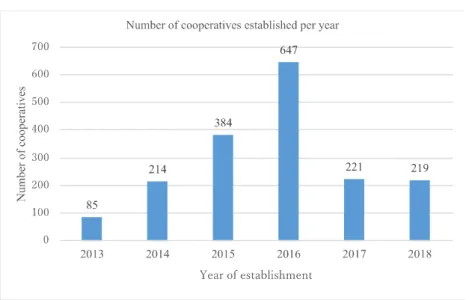
cooperatives started in 2011 in cotton-producing areas by transforming village groups into formal agricultural cooperatives. Between May 2011 and May 2013, about 800 village groups were officially registered and recognized as producer cooperatives (Gning and Larue, 2014). Meanwhile, a wave of new ACs also arose from 2013 ( Figure 1).
2XOF is the West African CFA franc, where CFA stand for Communauté Financière d’Afrique (Financial Community for Africa)
3Quoted by (Etobe, 2015) ‘Professionalisation of family farming: Tools for technical and organisational capacity-building of farmers’ organisations in
Figure 1: Number of agricultural cooperatives established per year Source: Computed based on data from DLROPEA (2019).
After enacting the AUSCOOP, the government and social and technical partners working along with producer organizations have encouraged and supported them in ACs establishment. From 2013 there was a gradual increase in the number of established cooperatives, with the highest record of 647 cooperatives observed in 2016. This dynamic reflects a revival of the cooperative movement with a renewed interest from producers of different agricultural production sectors.
Characteristics of Agricultural Cooperatives
In RB, agricultural cooperatives' main characteristics are the dual legal status, the sporadic nature of the economic purpose, the small membership size, and locality
.
Dual legal status
Firstly, the provisions of the AUSCOOP allow two legal forms of cooperatives: The Simplified Cooperative (SCOOP) and the Cooperative with a Board of Directors (COOP-CA). Gning and Larue (2014) believe that AUSCOOP is innovative in the African cooperative sector because it gives producer cooperatives a choice between two legal forms. Article 204 states that the simplified cooperative shall be formed by at least five natural persons or legal entities. While Article 267 states that a cooperative with a board of directors shall be made up of about fifteen natural persons at least or legal entities. In the RB, 51.68% of the cooperative's legal form is COOP-CA, and 48.32% are SCOOPS in RB. Different trends were recorded from one region to another and depending on the cooperative's business
Table 1 shows the legal form of ACs per department. More than half of its legal form is COOP-CA, except for the province of Donga in the north. It can be explained on the one hand by their business (Figure 2) mainly the production and marketing of cash crops. On the other hand, the number of members in these ACs generally above 20 implies the legal form with a Board of Directors. The extent of other cooperatives can explain the
Table 1: Dual legal form of agricultural cooperatives in the RB
Regions North Centre South
Departments Alibo ri B or go u D on ga A ta co ra Z ou C ol lin e A tl an tiq ue L it to ra l M on o C ou ff o Pl at ea u O ue m e
LEGAL FORM COOP-CA 388 126 36 198 N/A 145 18 4 N/A 43 36 20 SCOOPS 8 64 65 119 N/A 137 126 53 N/A 209 58 109
Agricultural cooperatives in Benin
37
Table 2: Summary of Agricultural Cooperatives in RB as of April 2019
Type of cooperatives Description Cooperatives
numbers (%) N=2439 Cash crops cooperative Cotton, Cashew nut, pineapple, and cocoa 847 (34.72)
Fruits and vegetables
cooperative Fruits and flower production and market gardening 456 (18.69) grain producer cooperative Production and marketing of Cereals (maize, rice,
and fonio (Digitaria Exilis)) and soy bean).
1185 (48.58) Breeding cooperative Broiler, small ruminants, cattle, and pig 115 (4.71) Fisheries cooperative Management, production, and marketing of fish
from aquaculture or fishing 44 1(.80)
Processing cooperative Cassava into flour or tapioca, fruits into juices, shea
nuts into shea butter, soybean into tofu or milk, 89 (3.65) Other cooperative Craft cooperatives, seeds producers cooperatives, 137 (5.62)
Source: Computed based on data from DLROPEA (2019).
particular case of Donga compared to cash crops cooperatives. Unlike the north, in the south, the dominant legal form of ACs is SCOOP. The limited number of members can explain this. The type of businesses (Figure 2) ruled in those cooperatives are mainly market gardening, fruit and vegetable production, and agricultural commodities processing. Sporadic economic purpose
Secondly, registered cooperatives are organized according to their economic purpose, directly linked to the production sector, and are single-purpose cooperatives. Table 2 describes the different types of ACs, number, and percentage.
The distribution of cooperatives by type of business reflects the structure of farming in RB. The dominant type of ACs are grain producers cooperatives, cash crops cooperatives, and fruit, and vegetable cooperatives, while sectors like breeding, fisheries, and processing are not well-organized into cooperatives. That is because the RB's leading productions are cereals, cash crops, and legumes, contributing 84% to the added value of agricultural output against 8% for animal production (Acclassato, 2013).
Two types of agricultural cooperatives are not included in Table 1: Farm Machinery Cooperatives (CUMA) and Rural Development Cooperatives, known as CAR. The first ones are 48 with a total membership of 262 farmers (CUMA BENIN 2019), and they are currently not in the records of DLROEPA. The second ones are 36 Rural Development Cooperatives (CAR) and were supposed to be agricultural and industrial production units. Still, unfortunately, since 2004, they have sunk into an institutional crisis and are in the grip of multiple conflicts. The government recently initiated a dialogue between stakeholders and tried to set some special provisions for the CARS governance.
small-size membership
Thirdly, most cooperatives' membership can be classified as small-size and is made of men and women. Thus, 77.44% of agricultural cooperatives members are men, and only 21.86% are women. Only in the provinces of Mono and Couffo, the proportion of women is above 50%. It is due to the type of business of those cooperatives. These are production and marketing cooperatives. The large part of their business is mainly market gardening or cassava processing into cassava flour and tapioca or palm nuts into palm oil. These two businesses are, most of the time, dominated by women in RB. The smallest number of members identified is five and is most of the time in market gardening or processing in a different province. The largest number of members identified is 572 and is a cotton-producer cooperative located in the village of Ouèrè in Alibori.
A small membership typically means that the members are fairly homogenous (Zeuli, 1999). Size is the factor most often blamed for dwindling member control of farmer cooperatives. In a small local cooperative, people are likely to know each other. A high level of interaction and communication exists among cooperative members and management. As the cooperative grows, it becomes bureaucratic. People lose the sense of "belonging" to the cooperative and become alienated. Participation in the cooperative decreases and member control may dwindle. However, recent research on cooperative member control has failed to support the belief that cooperative size alone undermines member control (e.g., The number of members does not significantly influence agricultural cooperative performances (Arcas, García and Guzmán, 2011). Although size alone does not preclude effective member control of agricultural cooperatives, factors often associated with size may have crucial effects on the effectiveness of a cooperative's membership structures (Butler, 1988).
Small and homogeneous agricultural cooperatives are more capable of combining social capital and democratic elements to achieve higher levels of vertical coordination. However, they face social capital and democracy dilemmas. On the other hand, large and heterogeneous cooperatives are more able to use hierarchical and market mechanisms to strengthen vertical coordination. They are, nonetheless, prone to the hierarchy dilemma. In practice, cooperatives combine
all of these mechanisms in different proportions. Their ability to achieve a higher degree of vertical coordination depends on the appropriateness of the combination they choose and their capacity to handle the dilemmas we described above. These dilemmas are major management challenges faced by cooperatives when engaging in higher levels of vertical coordination (Bijman et al., 2012).
The capital amount varies from one cooperative to another and is determined by the number of members and the business. The lowest minimum capitals recorded are in the south, mainly in Mono and Couffo, where cooperatives with less than ten members are dominant, mostly market gardening cooperatives that required less investment. In contrast, the highest maximum amounts of capital are recorded at various extent, both in the north and the south in the larger ACs involved in cash crops, grains production, or processing, which mobilize more members and subsequently more resources. Table 3 shows agricultural cooperatives capital and membership size by the department.
Table 3: Agricultural Cooperatives capital and membership size by department
Regions Departments Max CAPITAL (XOF) Min Average NUMBER OF MEMBERS Men Women Total
North
Alibori 8,400,000 33,000 956,134 17114 2227 19341
Borgou 4,460,000 62,000 734,763 7548 335 7883
Donga N/A N/A N/A 1388 191 1579
Atacora 9,800,000 50,000 530,423 9169 3223 12801
Centre
Zou N/A N/A N/A N/A N/A N/A
Colline 2,200,000 27,000 188,393 2720 1013 3733 South Atlantique 2,710,000 16,000 392,577 388 79 467 Littoral 5,000,000 35,000 490,807 613 317 930 Mono 10,000,000 10,000 249,484 1728 1873 3601 Couffo 12,600,000 10,800 288,950 1616 1845 3461 Plateau 2,000,000 40,000 414,904 901 548 1449
Oueme N/A N/A N/A 2583 1271 3854
Source: Computed based on data from DLROPEA (2019). Locality
Lastly, on top of the single-purpose nature of ACs and their small membership size, ACs are concentrated geographically within a village's limits. There are two main reasons why primary ACs are concentrated geographically at the village level and focus mainly on a single crop. Village groups, which are the most dominant form of farmer organizations and, for the large part, are becoming agricultural cooperatives in the future, are only operating mainly within the limits of their villages and generally bring together farmers who share the same interests. Secondly, the government's political will to promote other crops, in response to the cotton sector's dominance, led to strengthening farmers groups based on crops. Unfortunately, Geographic concentration augments the cooperative's systemic yield risk exposure since natural disasters and crop pestilence often affect contiguous areas. Therefore, a single catastrophic event such as a drought could damage the crops of most of the member suppliers of the cooperative (Zeuli, 1999).
Records show that, by April 2019, 2439 agricultural cooperative were registered officially in the Office of Rural Legislation, in charge of support to interprofessional Organization and Agricultural Entrepreneurship (DLROPEA) and are scattered in the different regions of the country (except for the missing data from the area of Zou). Figure 2 shows the distribution of agricultural cooperatives per region and business.
Agricultural cooperatives in Benin
39
Figure 2: Distribution of Agricultural cooperative per region and per sector of production Source: Computed based on data from DLROPEA (2019).
Conclusion
This research presents a review of Benin's republic's cooperative movement from its insertion in the colonial period to the current situation, emphasizing its characteristics and trends. In the aftermath of too much involvement of the State and the failure of specific initiatives guided by political ideologies and based on the top-down model, the cooperatives movement gained new momentum in the 90s with a debut of independence. Some room has been opened to exert some basic cooperative principles such as voluntariness and open membership. Nevertheless, ACs remained subject to different vagaries, notably the unsuitable legal framework and mixed performance.
This research has shown that cooperatives are now in their 4th generation. The enactment of a legal text at the regional level brought a new impetus to RB's cooperative movement, which formerly evolved in an environment not conducive to their development. The recent growing number of ACs nationwide in different production sectors shows a revival of cooperatives under a crop-based approach and geographic concentration. Legal prescriptions alone are a good start point but are not sufficient to guarantee good performances from ACs and a full benefit to the members. If appropriate public policies do not sufficiently support the current dynamic, the cooperative movement could be prone to the mistake of stumbling backward to past blunders, which left ACs with a lousy reputation and subsequently of less utility to farmers.
The evolution of the cooperative movement compared to that of the advanced countries and a look at the current situation, particularly the small membership size, the nature of its business, and the geographic limits of intervention, raise questions that could be future research subjects. In the absence of sizeable statistical data and in-depth scientific analysis on RB's agricultural cooperatives, it is urgent for the wide range of stakeholders to join efforts in relevant policies driven by research based on data of quality. It would ensure access to ACs' efficiency and the various problems related to their development in each sector of agriculture. Also, to identify the convenient membership and governance structure needed according to RB's socio-economic realities. Finally, it would also allow identifying the ideal form and role of agricultural cooperatives in Benin where because of different factors, the demand for agri-food products and the market is changing
.
Bibliography
Abebaw, D. and Haile, M. G. (2013) 'The impact of cooperatives on agricultural technology adoption: Empirical evidence from Ethiopia', Food Policy, 38(1), pp. 82–91. doi: 10.1016/j.foodpol.2012.10.003.
Acclassato, D. H. (1999) L’efficacite productive des paysans et performance des cooperatives agricoles de coton et de riz dans le departement du Borgou-Alibori.
Acclassato, D. H. (2013) Ten Yen After the Maputo Declaration on and Agriculture and Food Security : An Assessment of Progress in West Africa Structure and content of country studies, Réseau des organisations paysannes et de producteurs de l’Afrique de l’Ouest (ROPPA).
Arcas, N., García, D. and Guzmán, I. (2011) ‘Effect of size on performance of Spanish agricultural cooperatives’, Outlook on Agriculture, 40(3), pp. 201–206. doi: 10.5367/oa.2011.0051.
Bijman, J. et al. (2012) 'Agricultural Cooperatives and Value Chain Coordination', Value Chains Social Inclusion and Economic Development: Contrasting Theories and Realities, pp. 82–101. doi: 10.4324/9780203816806.
Butler, G. (1988) Designing Membership StrudurG for Large Agricultural Cooperatives. Dady, R. (1999) Cooperatives agricoles et developpement socio-economique au Benin : ... Develtere, P. (1994) 'Cooperation and Development', ACCO, Leuven.
Develtere, P., Wanyama, F. and Pollet, I. (2008) 'Cooperating out of Poverty: the Renaissance of the African Cooperative Movement', ILO/The World Bank Institute, Geneva.
Etobe, J. M. (2015) 'Professionalisation of family farming: Tools for technical and organisational capacity-building of farmers' organisations in sub-Saharan Africa', CTA, p. 54.
Francesconi, N. and Wouterse, F. (2017) 'A New Generation of Cooperatives for Africa', CIAT Policy Brief, (37), pp. 1–4. Available at: https://cgspace.cgiar.org/handle/10568/82562.
Gning, T. and Larue, F. (2014) ‘Le nouveau modèle coopératif dans l’espace OHADA : un outil pour la professionnalisation des organisations paysannes ?’, Etudes FARM.
Holmén, H. (1990) State, Cooperatives and Development in Africa. Uppsala.
Hyden, G. (1973) 'Efficiency versus Distribution in East African Cooperatives: A Study in Organizational Conflicts', East African Literature Bureau, NaiRBi.
ICA (1995) International Co-operative Alliance. Available at: https://www.ica.coop/en/cooperatives/cooperative-identity. Kumar, A. et al. (2016) 'Can contract farming increase farmersâ€TM income and enhance adoption of food safety practices?:
Evidence from remote areas of Nepal':, IFPRI discussion papers, (April).
Ma, W., Abdulai, A. and Goetz, R. (2018) 'Agricultural Cooperatives and Investment in Organic Soil Amendments and Chemical Fertilizer in China', American Journal of Agricultural Economics, 100(2), pp. 502–520. doi: 10.1093/ajae/aax079.
Münkner, H.-H. (1989) 'Comparative Study of Co-operative Law in Africa', Marburg Consult, Marburg. Nation Unies, C. economique pour l’Afrique (1962) Le mouvement cooperatif en Afrique. Addis Abeba.
Navarra, C. et al. (2015) 'Agricultural Cooperatives in Africa Report on the mapping data of CDOs and their projects Agricultural Cooperatives in Africa', pp. 1–32. Available at: http://www.euricse.eu/wp-content/uploads/2017/03/I-Mapping-survey.pdf.
OHADA (2010) ‘OHADA. Droit des sociétés coopératives - PDF.pdf’, pp. 1–72.
Sossou Biadja, C. (1988) ‘La législation coopérative au Bénin: Etat des lieux et propositions de réforme’, Memoire online. Tossou, R. C. (1993) ‘Le Groupement Villageois : un cadre de participation communautaire au développement ou un
instrument de réalisation d’intérêts individuels et conflictuels’, Bulletin de l’APAD, (5). doi: 10.4000/apad.3173. Wanyama, F. O., Develtere, P. and Pollet, I. (2009) 'Reinventing the wheel? African cooperatives in a liberalized economic
environment', Annals of Public and Cooperative Economics, 80(3), pp. 361–392. doi: 10.1111/j.1467-8292.2009.00390.x.
World Bank (2006) China-Farmers Professional Associations Review and Policy Recommendations. Washington, DC. Wossen, T. et al. (2017) 'Impacts of extension access and cooperative membership on technology adoption and household
welfare', Journal of Rural Studies. Elsevier Ltd, 54, pp. 223–233. doi: 10.1016/j.jrurstud.2017.06.022.
Zeuli, K. A. (1999) 'New Risk‐Management Strategies for Agricultural Cooperatives', American Journal of Agricultural Economics, 81(5), pp. 1234–1239. doi: 10.2307/1244113.