Chromosome Counts of Some Plants Collected
from West Sumatra
著者
OKADA Hiroshi
journal or
publication title
南太平洋海域調査研究報告=Occasional papers
volume
16
page range
11-14
URL
http://hdl.handle.net/10232/16618
CHROMOSOME COUNTS OF SOME PLANTS COLLECTED FROM WEST SUMATRA
H. Okada
College of General Education, Osaka University, Toyonaka, Osaka
Chromosome numbers of some species belonging to Araceae, Balsaminaceae, Gesneriaceae and Orchidaceae distributed at West Sumatra were counted newly as a subsequent study of the previous reports (Okada, 1984, 1986).
Materials and Methods
Fresh materials were collected from some areas of West Sumatra (Table 1). The identification of the species was mainly responded to Prof. Dr. M.
Hotta. Voucher specimens were deposited in KYO.
Root tips were pretreated by 0.05 - 0.2%, sometimes 0.4%, colchicine aqueous solution in fields. In the case of Impatiens gadutensis distrib uted at the summit of Gn. (Mt.) Gadut, ca. 1500 m altitude from sea level, root tips could be incubated at less than 20CC. But, in almost all cases, materials could not be cooled for no equipment in fields. This is the main reason of rather high concentrations of colchicine solution. They were fixed by the mixed solution of EtOH : chloroform : glacial acetic acid = 2:1:1, namely modified Calnoy's fluid, for more than one night. All of the materials were, then, transferred into 70% EtOH. Following
procedures for chromosome observations were almost the same as convention
al techniques, except for the case of Apostasia nuda*.
In the case of species of Monophyllaea, young flower buds were directly
fixed by modified Calnoy's fluid without any pretreatments, and then
transferred into 70% EtOH. Chromosome numbers were counted by pollen
mother cells (reproductive cell division) or anther wall cells (somatic
cell division).
Results and Discussion
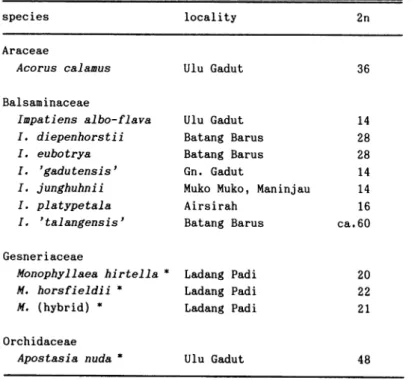
Results are summerized in the table 1. Aneuploid and polyploid chromosome numbers were reported for the species of the genus Acorus (Araceae), i.
e., 2n=22, 24, 36, 44, 48, 110 and etc. Some reports described
indivi-Table 1. Chromosome numbers of some species collected from West Sumatra.
species locality 2n
Araceae
Acorus calamus Ulu Gadut 36
Balsaminaceae
Impatiens albo-flava Ulu Gadut 14 I. diepenhorstii Batang Barus 28
I. eubotrya Batang Barus 28
I. 'gadutensis' Gn. Gadut 14
I. junghuhnii Muko Muko, Maninjau 14
I. platypetala Airsirah 16
I. 'talangensis' Batang Barus ca.60
Gesneriaceae
Monophyllaea hirtella* Ladang Padi 20
M. horsfieldii * Ladang Padi 22
M. (hybrid) * Ladang Padi 21
Orchidaceae
Apostasia nuda* Ulu Gadut 48
* The results on Apostasia and Monophyllaea were published
at the magazines, The Journal of Japanese Botany 63: 344-350
(1988) and Plant Systematics and Evolution (in press),
respectively.
dual belonging to Acorus calamus collected from Ulu Gadut was counted 36
chromosomes, which is a triploid level of x=12. Chromosomes at metaphase
are very small, about less than 1 urn. The chromosome counts in the genus Impatiens (Balsaminaceae) were reported for ca. 80 of 450 species in the world so far (for example, Khoshoo, 1955). According to those reports, it
appears that there are serial aneuploid variations within the genus, i. e.
x=3, 6, 7, 8, 9, 10, 11, 12, 13, 14, 16, 17, 18 and etc (Zinov'eva-Stahe-vitch and Grant, 1985; Govindarajan and Subramanian, 1986), and x=8 is a primary basic chromosome number for the genus (Rao et al., 1986). Tetra-ploids of x=7 and 8 were observed in some species. Species of Impatiens
at West Sumatra in this study showed both euploid and aneuploid changes,
that is diploid (2n=14) and tetraploid (2n=28) of x=7 and diploid (2n=16)
of x=8. The chromosome number of 2n=ca. 60 of I. 'talangensis' may be an
octoploid level of x=7.
It was one of the main objects for this expedition to analyze specia
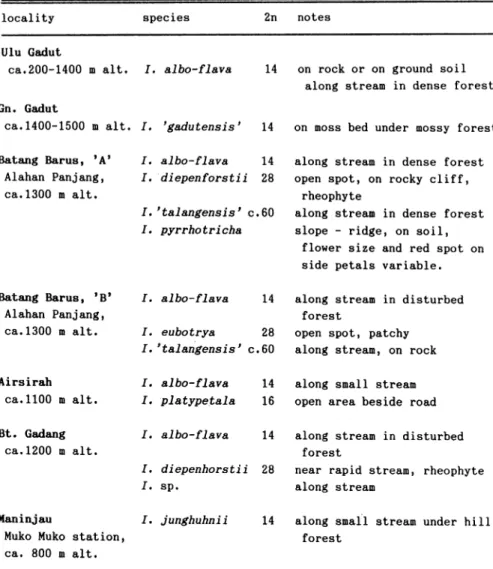
tion mechanisms of the genus of Impatiens at West Sumatra. West Sumatra has 16 species of Impatiens (Hotta, in this report, p. 59). 8 of these 16
species belong to I. albo-flava group. Common pollen vectors visited them
Table 2. Impatiens species distributed at cal notes.
locality species 2n
Ulu Gadut
ca.200-1400 m alt. I. albo-flava 14
Gn. Gadut
ca.1400-1500 m alt. I. 'gadutensis' 14
Batang Barus, 'A* Alahan Panjang, ca.1300 m alt. Batang Barus, 'B' Alahan Panjang, ca.1300 m alt. Airsirah ca.1100 m alt. Bt. Gadang ca.1200 m alt. Maninjau
Muko Muko station,
ca. 800 m alt. /. albo-flava 14 I. diepenforstii 28 J. 'talangensis' c.60 J. pyrrhotricha I. albo-flava 14 J. eubotrya 28 I. 'talangensis' c.60 I. albo-flava 14 /. platypetala 16 I. albo-flava 14 J. diepenhorstii 28 I. sp. J. junghuhnii 14
the same areas and its
ecologi-notes
on rock or on ground soil along stream in dense forest
on moss bed under mossy forest
along stream in dense forest open spot, on rocky cliff,
rheophyte
along stream in dense forest
slope - ridge, on soil, flower size and red spot on
side petals variable.
along stream in disturbed forest
open spot, patchy along stream, on rock
along small stream open area beside road
along stream in disturbed forest
near rapid stream, rheophyte
along stream
along small stream under hill forest
2). The natural interspecific hybrids were expected to find in the loca tions under these situations, however, sympatric species were in aneuploid and/or polyploid relation to each other, and seemed to prohibit gene ex change among the different species. For example, at surroundings of the water fall at Batang Barus, Alahan Panjang, the species with 2n=14 (I. albo-flava), 28 (I. diepenhorstii) and ca. 60 (I. cf. 'talangensis' were observed, which were a diploid, a tetraploid and maybe an octoploid level of x=7, respectively. The similar phenomena appeared among the species at the other ravine of Batang Barus, at Bt. Gadang and at Airsirah. The situation is, however, extremely different in case of the relationship between I. albo-flava and I. gadutensis, which were similarly a diploid level of x=7. Both species seemed to inhabit segregatively. I. gaduten
sis suddenly appeared in our view at higher altitude from about 1400 -1500 m of Gn. Gadut. Instead of former species, I. albo-flava is
distri-buted rather commonly along streams at lower altitude of the mountain. In any cases of Impatiens observed, the reproductive isolation systems by different chromosome numbers or by habitat segregation may take place
effectively among them. Further detailed analyses are required for clari
fication of the speciation mechanisms within Impatiens at West Sumatra.
References
Govindarajan, T. and D. Subramanian. 1986. Karyotaxonomy of South Indian
Balsaminaceae. Cytologia 51: 107-116.
Khoshoo, T. N. 1955. Cytology of Impatiens. Current Sci. 24: 423-424. Okada, H. 1984. Chromosome counts of some plants collected from W.
Sumatra. In: Hotta, M. (ed.) Forest Ecology and Flora of G. Gadut, West
Sumatra, p. 89-90. Sumatra Nature Study (Botany), Kyoto.
Okada, H. 1986. The cytotaxonomical observations of some plants collected from West Sumatra. In: Hotta, M. (ed.) Diversity and Dynamics of Plant
Life in Sumatra, p. 61-70, Sumatra Nature Study (Botany), Kyoto.
Rao, R. V. S., K. Rangaswami Ayyangar and R. Sampathkumar. 1986. On the karyological characteristics of some members of Balsaminaceae. Cytologia 51: 251-260.
Wulff, H. D. 1954. Zur Zytologie, geographischen Verbreitung und Morphorgie des Kalmus. Arch. Pharm. (Berlin) 287: 529-541.
Zinov'eva-Stahevitch, A. E. and W. F. Grant. 1985. Aberrant
microsporo-genesis in Impatiens L. (Balsaminaceae) and its bearing on the taxonomy