Profiles of Four Mandarins (Citrus reticulata
Blanco) Collected in West Sumatra, Indonesia
著者
YAMAMOTO Masashi, NASRIL Nasir, NINOMIYA
Takanori, KUBO Tatsuya, TOMINAGA Shigeto
journal or
publication title
南太平洋研究=South Pacific Study
volume
32
number
2
page range
59-69
Fruit Characteristics,
Chromosome
and DNA Profiles of
Four Mandarins
(Citrus reticulata Blanco) Collected in
West Sumatra,
Indonesia
YAMAMOTO
Masashi 1,
NASRIL
Nasir 2, NINOMIYA
Takanori
1, KUBO
Tatsuya
1
and TOMINAGA
Shigeto 1
1: Faculty
of Agriculture,
Kagoshima
University,
Korimoto,
Kagoshima
890-0065,
Japan,
e-mail:
[email protected]
2: Faculty
of Mathematics
and Natural
Science,
Andalas
University,
Kampus
Limau
Nanis
Padang,
25163,
West
Sumatra,
Indonesia
Abstract
Fruit
characteristics,
chromosome
and
DNA
profiles
were
analyzed
in four
mandarins
(Citrus
reticulata
Blanco),
`Jeruk
Brastagi',
`Jeruk
Keprok',
`Jeruk
Siem'
and
`Limau
Talang
Babungo',
collected
in West
Sumatra,
Indonesia.
In terms
of fruit
characteristics,
all four
mandarins
possessed
orange
rind
and
flesh
and
green
polyembryonic
seed.
The
fruit
diameter
of `Limau
Talang
Babungo'
was
the
smallest.
`Jeruk
Siem'
possesed
the
thinnest
rind.
The
brix
of juice
was
high
in `Jeruk
Brastagi'
and
`Limau
Talang
Babungo'.
The
number
of seeds
per
fruit
of `Jeruk
Siem'
was
small.
Fluorochrome
staining
with
chromomycin
A3,
(CMA)
was
used
to characterize
and
compare
the
CMA
banding
patterns
of chromosomes.
The
four
mandarins
of West
Sumatra
showed
identical
CMA
banding
patterns:
two
telomeric
and
one
proximal
positive
bands
were
detected
in one
chromosome,
one
telomeric
and
one
proximal
positive
bands
were
detected
in one
chromosome
and
one
telomeric
positive
band
was
detected
in eight
chromosomes.
In terms
of results
of sequence-related
amplified
polymorphism
(SRAP)
analysis
using
18
primer
pairs,
there
were
no differences
among
the
four
mandarins
of
West
Sumatra.
A close
relationship
between
mandarins
of West
Sumatra,
Chinese
mandarin
Sunki
and
Japanese
mandarin
Shiikuwasha
was
revealed.
On the other
hand,
the four
mandarins
of West
Sumatra
were
distinct
from
Indian
mandarin
(Ponkan
and
Cleopatra)
and
Japanese
mandarin
Tachibana.
Key
words:
chromomycin,
CMA,
fluorochrome,
genetic
relationship,
SRAP
Introduction
Citrus
is one of the most important
fruit crops
worldwide.
Although
the taxonomy
of
citrus
is complicated
because
of their wide cross-compatibility
and polyembryony,
recent
DNA and chromosome
analyses
revealed
various
new findings
(FEDERICI
et al. 1998,
GUERRA
1993,
NICOLOSI
et al. 2000,
YAMAMOTO
and TOMINAGA
2003,
YAMAMOTO
et al.
1993,
2007).
This
kind
of study
has been conducted
mainly
in citrus
grown
in temperate
and
subtropical
zones.
Recently,
DNA analysis
of tropical
citrus
has started
to be conducted
Received: 24 June, 2011 Accepted: 8 October, 2011
(AGISIMANTO et al. 2007, KARSINAH et al. 2002).
West Sumatra, Indonesia, is located in the tropical zone right on the equator. Many local citrus are cultivated in this area; however, their genetic characteristics have not been elucidated yet. Thus, in the present study, chromosome and DNA analyses were conducted to reveal the genetic profile of mandarins (Citrus reticulata Blanco) grown in West Sumatra. For chromosome analysis, we used guanine-cytosine (GC)-specific fluorochrome chromomycin A3 (CMA) which has been useful for detecting variations of chromosome structure of citrus (GUERRA 1993, YAMAMOTO and TOMINAGA 2003, YAMAMOTO et al. 2005, 2007). Sequence-related amplified polymorphism (SRAP) analysis, which provides useful information on the genetic relationships of citrus (UZUN et al. 2009), was conducted. In addition, fruit characteristics of mandarins of West Sumatra were also investigated. Here, we report the results of these analyses.
Materials and Methods Fruit characteristics
All fruit samples were collected at local markets with unclear origin of the trees in West Sumatra: `Jeruk Brastagi', `Jeruk Keprok' and `Jeruk Siem' were collected at Padang and `Limau Talang Babungo' was collected at Alahan Panjang. Just after collection, fruit characteristics were investigated at Andalas University. Five fruits were used as materials in each mandarin accession.
Chromosome analysis
Roots of young nucellar seedlings from the seed of the fruit collected from the markets with unclear origin of the trees of four mandarins were used as materials. Seeds were germinated in Petri dishes at 25 °C in the dark. Root tips about 1 cm long were excised, immersed in 2 mM 8-hydroxyquinoline at 10 °C for 4 h in the dark, fixed in methanol-acetic acid (3:1) and stored at -20 °C.
Enzymatic maceration and air-drying were performed as described by FUKUI (1996) with minor modifications. The root tips were washed in distilled water to remove the fixative and macerated in an enzyme mixture containing 1% Cellulase Onozuka RS, 0.75% Macerozyme R200 (Yakult, Japan), 0.15% Pectolyase Y-23 (Seishin Pharmaceutical Co., Ltd, Japan) and 1 mM EDTA, pH 4.2, at 37 °C for 55 min.
Chromosomes were stained with 2% Giemsa solution (Merck Co., Germany) in 1/30 M phosphate buffer (pH 6.8) for 15 min, rinsed with distilled water, air dried, and then mounted with xylene. After confirmation of each chromosome position on the slide glass, the chromosomes were de-stained with 70% methanol.
Chromosomes were also stained with 0.1 g • L -1 CMA according to HIZUME (1991) and observed under a fluorescence microscope (Nikon ECLIPSE 80i, Tokyo, Japan) with a BV filter cassette.
SRAP analysis
In the four mandarins of West Sumatra, three nucellar seedlings from the seed of the fruit collected from the markets with unclear origin of the trees of each accession were used as materials. Twelve mandarins, tangors and sweet oranges that originated in various regions were used as control accessions (Table 1). All control accessions grafted onto Poncirus trifoliata were preserved at the Faculty of Agriculture, Kagoshima University.
Total DNA was extracted from leaves using ISOPLANT II (Nippon Gene, Tokyo, Japan). All SRAP primer combinations used in this study were in accordance with UZUN et al. (2009) (Table 2, 3). PCR reactions were performed in a PC320 (Astec, Fukuoka, Japan) thermal cycler programmed as follows: initial heating at 95 °C for 10 min, then 5 cycles of denaturing at 94 °C for 1 min, annealing at 35 °C for 1 min and extension at 72 °C for 1 min. In the following 35 cycles, the annealing temperature was increased to 50 °C, with a final extension of 5 min at 72 °C. Amplified products were electrophoresed on 1.5% agarose gels and detected by staining with Mupid-Stain (Advance, Tokyo, Japan). The bands were recorded as 1 for present and as 0 for absent. Genetic distance was calculated between each pair of cultivars (NEI and Li 1979). For phylogenic analysis, a dendrogram was constructed with Molecular Evolutionary Genetic Analysis (MEGA, ver. 3.1) software (KUMAR et al. 2004) by applying the neighbor joining (NJ) method.
Table 1. The materials used in SRAP analysis and their distribution.
No. Common name
1-3 Jeruk Brastagi 4-6 Jeruk Keprok 7-9 Jeruk Siem
10-12 Limau Talang Babungo 13 Ponkan 'Yoshida Ponkan' 14 Cleopatra
15 Kunenbo 16 King 17 Sunki
18 Kinokuni `Sakurajima Komikan'
19 Satsuma mandarin `Unshiu Genboku' 20 Koji
21 Tachibana
22 Shiikuwasha `Shiikunin- Kara' 23 Tankan `Tarimizu 1 Gou' 24 Sweet orange 'Hamlin'
Latin name
Swingle system 1 Tanaka system 2
Citrus reticulata Blanco C. reticulata Blanco C. reticulata Blanco C. reticulata Blanco C. reticulata Blanco C. reticulata Blanco C. reticulata Blanco C. reticulata Blanco C. reticulata Blanco C. reticulata Blanco C. reticulata Blanco C. reticulata Blanco C. tachibana (Makino) Tanaka C. tachibana relative C. sinensis hybrid C. sinensis (L.) Osbeck C. sp. C. sp. C. sp. C. sp. C. reticulata Blanco C. reshni hort. ex Tanaka C. nobilis Lour. C. nobilis Lour.
C. sunki (Hayata) hart. ex Tanaka C. kinokuni hort. ex Tanaka C. unshiu Marcow. C. leiocarpa hort. ex Tanaka C. tachibana (Makino) Tanaka C. depressa Hayata C. tankan Hayata C. sinensis (L.) Osbeck
Distribution
West Sumatra, Indonesia West Sumatra, Indonesia West Sumatra, Indonesia West Sumatra, Indonesia
India India Vietnam Vietnam China China Japan Japan Japan Japan China China
1: Latin name by SWINGLE and REECE (1967). 2: Latin name by TANAKA system (1969, 1977).
Table 2. List of forward and reverse SRAP primers and their sequences used in this study.
Forward primers Reverse primers
Mel: 5'-TGAGTCCAAACCGGATA-3' Em l : 5'-GACTGCGTACGAATTAAT-3'
Me2: 51-TGAGTCCAAACCGGAGC-3' Em2: 5'-GACTGCGTACGAATTTGC-3'
Me3: 51-TGAGTCCAAACCGGAAT-3' Em3: 5'-GACTGCGTACGAATTGAC-3'
Me4: 5'-TGAGTCCAAACCGGACC-3' Em4: 5'-GACTGCGTACGAATTTGA-3'
MeS: 51-TGAGTCCAAACCGGAAG-3' Em5: 5'-GACTGCGTACGAATTAAC-3'
Me6: 51-TGAGTCCAAACCGGACA-3' Em6: 5'-GACTGCGTACGAATTGCA-3'
Me7: 5'-TGAGTCCAAACCGGACG-3' Em7: 5'-GACTGCGTACGAATTCAA-3'
Me8: 51-TGAGTCCAAACCGGACT-3' Em9: 5'-GACTGCGTACGAATTCAG-3'
Me9: 5'-TGAGTCCAAACCGGAGG-3' Em10: 5'-GACTGCGTACGAATTCAT-3'
Me11 : 5'-TGAGTCCAAACCGGAAC-3' Em11: 5'-GACTGCGTACGAATTCTA-3'
Me12: 51-TGAGTCCAAACCGGAGA-3' Em12: 5'-GACTGCGTACGAATTCTC-3'
Em13: 5'-GACTGCGTACGAATTCTG-3' Em14: 5'-GACTGCGTACGAATTCTT-3' Em15: 5'-GACTGCGTACGAATTGAT-3' Em16: 5'-GACTGCGTACGAATTGTC-3'
Table 3. SRAP primer combinations that obtained polymorphic fragments in this study.
Em 1 /Me4 Em7/Me9 Em2/Me3 Em9/Me3 Em2/Me5 Em9/Me11 Em2/Me8 Em10/Me11 Em3/Me3 Em11/Me1 Em4/Me5 Em13/Me4 Em4/Me6 Em14/Me1 Em5/Me12 Em15/Me6 Em7/Me8 Em16/Me12
Results
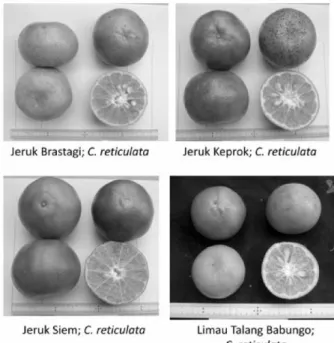
All four citrus accessions collected in West Sumatra shared mandarin (C. reticulata) characteristics (Fig. 1, Table 4). All accessions possessed orange rind and flesh and green polyembryonic seed. The fruit diameter of `Limau Talang Babungo' was smaller than that of the other three accessions. `Jeruk Siem' possessed the thinnest rind. The brix of juice was high in `Jeruk Brastagi' and `Limau Talang Babungo' and the pH of juice was low in `Limau Talang Babungo'. The number of seeds per fruit of `Jeruk Siem' was the smallest in the four accessions investigated.
Jeruk Brastagi; C. rericulcta Jeruk Keprok; C. reticulatc
Jeruk Siem; C. reticvlata Lirnau Talang Babungo; C. reticulate:
Fig. 1. Fruits of four mandarins collected in West Sumatra.
Table 4. Fruit characteristics of four mandarins collected in West Sumatra.
Accession Collected Collected place'Date Fruit diameter (mm) Fruit shape index` Rind color Flesh color Rind thick-ness (mm) Peeling Brix pH No. of Embryo Notes seedsPoly or per fruit Color Mono Jeruk Brastagi Jeruk Keprok Jeruk Siem Limau Talang Babungo Padang Jan. 6, 2010 Padang Jan. 6, 2010 Padang Jan. 6, 2010 Alahan J an. 9, 2010P anjang 68 68 70 50 127 123 118 118 Orange Orange Orange Orange Orange Orange Orange Orange 3.7 3.7 2.3 2.8 Easy Easy Easy Easy 11.5 9.8 8.0 11.2 4.5 3.8 4.7 2.8 10.0 Green Poly 13.8 Green Poly 5.0 Green Poly 11.2 Green Poly Fresh fruit use Fresh fruit use Fresh fruit use Fresh fruit use
1: All samples were collected at local markets. 2: (Diameter/length) x 100.
Fig. 2. CMA staining of somatic chromosomes in mandarins of West Sumatra. 1: Jeruk Brastagi, 2: Jeruk Keprok, 3: Jeruk Siem, 4: Limau Talang Babungo. Bar in 4 represents 5µm for all figures.
Fig. 3. Schmatic representation of CMA staining of somatic chromosomes in mandarins of West Sumatra. 1: Jeruk Brastagi, 2: Jeruk Keprok, 3: Jeruk Siem, 4: Limau Talang Babungo. A, B
and D: See Table 5. The black regions indicate CMA-positive bands.
All accessions had 2n=18 chromosomes and no variation in CMA banding patterns was found within the seedlings. Moreover, the four mandarins of West Sumatra showed identical CMA banding patterns. Two telomeric and one proximal positive bands were detected in one chromosome, one telomeric and one proximal positive bands were detected in one chromosome and one telomeric positive band was detected in eight chromosomes. No CMA-positive band was detected in the remaining eight chromosomes (Fig. 2, 3, Table 5).
Table 5. CMA banding patterns of somatic chromosomes of mandarins of West Sumatra and their control accessions.
Common name CMA banding pattern1 Reference
Jeruk Brastagi 1A+1B+8D+8E
Jeruk Keprok 1A+1B+8D+8E
Jeruk Siem 1A+1B+8D+8E
Limau Talang Babungo 1A+1B+8D+8E
Ponkan `Yoshida Ponkan' 1 B+1 C+10D+6E YAMAMOTO and TOMINAGA (2003)
Cleopatra 15D+3E YAMAMOTO and TOMINAGA (2003)
Kunenbo 1A+1B+2C+5D+9E YAMAMOTO and TOMINAGA (2003)
King 1A+1B+1C+8D+7E YAMAMOTO and TOMINAGA (2003)
Sunki 12D+6E YAMAMOTO and TOMINAGA (2003)
Kinokuni `Sakurajima Komikan' 1C+8D+9E YAMAMOTO and TOMINAGA (2003)
Satsuma mandarin `Okitsu Wase' 1A+1C+8D+8E YAMAMOTO and TOMINAGA (2003)
Koji 2B+1C+6D+9E YAMAMOTO and TOMINAGA (2003)
Tachibana 1C+10D+5E+2F YAMAMOTO and TOMINAGA (2003)
Shiikuwasha 1C+10D+6E+1 F YAMAMOTO and TOMINAGA (2003)
Tankan `Tarimizu 1 Gou' 1A+1B+1C+8D+7E YAMAMOTO et al. (2005)
Sweet orange `Comuna' 2B+2C+7D+7E YAMAMOTO et al. (2007)
1: A: two telomeric and one proximal band, B: one telomeric and one proximal band, C: two telomeric bands, D: one telomeric band, E: without band, F: one proximal band.
Fig. 4. DNA amplifications of mandarins of West Sumata and their controls using SRAP primers Em1/Me4. 1-3: Jeruk Brastagi, 4-6: Jeruk Keprok, 7-9: Jeruk Siem, 10-12: Limau Talang
Babungo, 13: Yoshida Ponkan, 14: Cleopatra, 15: Kunenbo, 16: King, 17: Sunki, 18:
Sakurajima Komikan, 19: Unshiu Genboku, 20: Koji, 21: Tachibana, 22: Shiikunin-Kara,
23: Tarumizu 1 Gou, 24: Hamlin, M: Molecular markers.
In SRAP analysis, every seedling that arose from the same accession always showed identical results in each mandarin of West Sumatra. Moreover, there were no differences in results of SRAP analysis using 18 kinds of primer pairs in the four mandarins of West Sumatra. One example of the results of agarose gel electrophoresis is shown in Fig. 4.
Fig. 5. Dendrogram of mandarins of West Sumata and their controls generated by neighbor joining method cluster analysis of SRAP data.
On the basis of the SRAP data, a dendrogram was constructed using NJ cluster analysis (Fig. 5). From this dendrogram, Sweet orange and Tankan (tangor) were distin-guished from all mandarins. Mandarins could be classified into two major clusters. The four mandarins of West Sumatra belonged to the same cluster as Japanese mandarins (Shiikuwasha, Satsuma mandarin and Koji), Chinese mandarin (Sunki and Kinokuni) and Vietnamese mandarin (Kunenbo and King). In particular, there was a close relationship between mandarins of West Sumatra and Sunki and Shiikuwasha. On the other hand, Indian mandarin (Ponkan and Cleopatra) and Japanese mandarin Tachibana were included in another cluster.
Discussion
We could detect no difference of results from chromosome and DNA analyses among four mandarins of West Sumatra investigated in the present study although some differences were observed in fruit morphological traits. In citrus, almost all accessions possessed characteristic CMA banding patterns (YAMAMOTO 2007) although CMA banding patterns were uniform in all Sweet orange cultivars that arose from mutation (PEDROSA et al. 2000). Moreover, all citrus accessions were distinguished from each other in SRAP analysis except for two Sweet orange cultivars (UZUN et al. 2009). Therefore, it can be considered that
differentiation of mandarins of West Sumatra has occurred by mutation. There is a possibility that `Jeruk Brastagi' and `Jeruk Keprok' are synonyms because their fruit characteristics are very similar.
CMA banding patterns of various citrus have been reported (YAMAMOTO 2007). Chromosomes could be classified into six types based on the number and position of CMA-positive bands: A: two telomeric and one proximal band, B: one telomeric and one proximal band, C: two telomeric bands, D: one telomeric band, E: without bands and F: one proximal band. According to this classification, the CMA banding pattern of four mandarins of West Sumatra was 1A+1B+8D+8E. GUERRA (2009) postulated that true mandarins possessed type C, D and E chromosomes and mandarins have type A or B chromosomes that arose from hybridization with other citrus. As shown in Table 5, true mandarin, Cleopatra, Sunki and Kinokuni, does not possess type A and B chromosomes whereas hybrid origin of Kunenbo and King possess those chromosomes. Type F is characteristic chromosome of Japanese mandarin (YAMAMOTO and TOMINAGA 2003). The mandarins of West Sumatra used in the present study seem to be hybrids between mandarin and other citrus because all have type A and B chromosomes.
However, the hybrid origin of mandarins of West Sumatra was not clarified in this SRAP analysis. There is a close relationship between mandarins of West Sumatra and both Sunki and Shiikuwasha, which are considered to be true mandarins (GUERRA 2009, TANAKA 1948). Genetic relationships between mandarins of West Sumatra and King, Kunenbo and Satsuma mandarin, which possess genetic features from Sweet orange, were not strong. Sweet orange was distinguished from mandarins of West Sumatra clearly. Moreover, genetic relationships between mandarins of West Sumatra and Indian mandarins were weak.
In conclusion, we investigated the genetic profile of four mandarins collected in West Sumatra, Indonesia. Since there are many local citrus accessions in this area, their genetic characteristics should be analyzed. Fruits purchased in local markets were used as materials in the present study. Environmental conditions probably affect the fruit characteristics in each accession. In addition, it has been well known that there is a wide variation in a given accessions; several types of `Jeruk Keprok' and `Jeruk Siem' are distributed in Indonesia. Thus, it is necessary to use standard accessions of each area as materials and investigate fruits produced under the same conditions.
Acknowledgements
We wish to thank Prof. SYAMSUARDI, A. of department chairman of Biology, Faculty of Mathematics and Natural Science, Andalas University, Indonesia, for cooperating collection of fruit and seed samples and providing seeds of four mandarins in West Sumatra. We are also grateful to Prof. YONEDA, T. of Faculty of Agriculture, Kagoshima University, Japan, for providing opportunities to conduct the present study.
References
AGISIMANTO, D., MARTASARI, C. and SUPRIYANTO, A. 2007. Differentiation between RAPD and ISSR Primer on Genetic Diversity Identification of Siam (Citrus
suhuniensis L. Tan) from Indonesia. Jurnal Hortikultura, 17: 101-110 (in Indonesian
with English Summary).
FEDERICI, C. T., FANG, D. Q., SCORA, R. W. and ROOSE, M. L. 1998. Phylogenic ships within the Genus Citrus (Rutaceae) and Related Genera as Revealed by RFLP
and RAPD Analysis. Theoretical and Applied Genetics, 96: 812-822.
FUKUI, K. 1996. Plant Chromosome at Mitosis. In: Plant Chromosome. Laboratory Methods (Eds. FUKUI, K. and NAKAYAMA, S.), 1-17, CRC press, Florida, USA.
GUERRA, M. 1993. Cytogenetics of Rutaceae. V. High Chromosomal Variability in Citrus Species Revealed by CMA/DAPI Staining. Heredity, 71: 234-241.
GUERRA, M. 2009. Chromosome Variability and the Origin of Citrus Species. In: Genetic Diversity (Eds. MAHONEY, C. L. and SPRINGER, D. G.), 51-68, Nova Science
Publisher, Inc., New York, USA.
HIZUME, M. 1991. Analysis of Plant Chromosomes Using a Fluorescent Banding Method. Plant Cell Technology, 3: 78-83 (in Japanese with English Summary).
KARSINAH, SUDARSONO, SETYOBUDI, L. and ASWIDINNOOR, H. 2002. Genetic Performance of Citrus Germplasm Based on RAPD Marker Analysis. Jurnal Bioteknologi Pertanian,
7: 8-16 (in Indonesian with English Summary).
KUMAR, S., TAMURA, K. and NEI, M. 2004. MEGA 3: Integrated Software for Molecular Evolutionary Genetic Analysis and Sequence Alignment. Briefings in Bioinformatics,
5: 150-163.
NEI, M. and Li, W. H. 1979. Mathematical Model for Studying Genetic Variation in Terms of Restriction Endonucleases. Proceedings of the National Academy of Science of the
United States of America, 76: 5269-5273.
NICOLOSI, E., DENG, Z. N., GENTILE, A., LA MALFA, S., CONTINELLA, G. and TRIBULATO,
E. 2000. Citrus Phylogeney and Genetic Origin of Important Species as Investigated by Molecular Markers. Theoretical and Applied Genetics, 100: 1155-1166.
PEDROSA, A., SCHWEIZER, D. and GUERRA, M. 2000. Cytological Heterozygosity and the Hybrid Origin of Sweet Orange (Citrus sinensis (L.) Osbeck). Theoretical and Applied
Genetics, 100: 361-367.
SWINGLE, W. T. and REECE, P. C. 1967. The Botany of Citrus and Its Wild Relatives. In: The Citrus Industry, Vol. 1 (Eds. REUTHER, W., WEBBER, H. J. and BATCHELOR,
L.D.), 190-430, University of California, Division of Agricultural Sciences, Berkeley,
USA.
TANAKA, T. 1969. Misunderstanding with Regards Citrus Classification and Nomenclature.
Bulletin of the University of Osaka Prefecture, Series B, 21: 139-145.
TANAKA, T. 1977. Fundamental Discussion of Citrus Classification. Studia Citrologia, 14: 1-6 (in Japanese).
TANAKA, Y. 1948. Iconograph of Japanese Citrus Fruits. Vol. II, 250-537 pp., Yokendo,
Tokyo (in Japanese).
UZUN, A., YESILOGLU, T., AKA-KACAR, Y., Tuzcu, O. and GULSEN, 0. 2009. Genetic Diversity and Relationships within Citrus and Related Genera Based on Sequence
Related Amplified Polymorphism Markers (SRAPs). Scientia Horticulturae, 121: 306-312.
YAMAMOTO, M. 2007. Application of Fluorescent Staining of Chromosomes to Genetic Studies in Citrus. Japanese Journal of Plant Science, 1: 12-19.
YAMAMOTO, M, ASADI ABKENAR, A., MATSUMOTO, R., NESUMI, H., YOSHIDA, T., KUNIGA, T., KUBO, T. and TOMINAGA, S. 2007. CMA Banding Patterns of Chromosomes in
Major Citrus Species. Journal of the Japanese Society for Horticultural Science, 76:
36-40.
YAMAMOTO, M., KOBAYASHI, S., NAKAMURA, Y. and YAMADA, Y. 1993. Phylogenic
Relationships of Citrus Revealed by RFLP Analysis of Mitochondrial and Chloroplast
DNA. Japanese Journal of Breeding, 43: 355-365.
YAMAMOTO, M., KUBO, T. and TOMINAGA, S. 2005. CMA Banding Patterns of Chromosome
of Mid- and Late-Maturing Citrus and Acid Citrus Growing in Japan. Journal of the Japanese Society for Horticultural Science, 74: 476-478.
YAMAMOTO, M. and TOMINAGA, S. 2003. High Chromosomal Variability of Mandarin