Local names of Rain Forest Trees in Ulu Gadut
Valley, West Sumatra
著者
HOTTA Mitsuru, KOHYAMA Takashi, TAMIN Rusjdi
journal or
publication title
南太平洋海域調査研究報告=Occasional papers
volume
16
page range
55-58
URL
http://hdl.handle.net/10232/16622
LOCAL NAMES OF RAIN FOREST TREES IN ULU GADUT VALLEY, WEST SUMATRA
M. Hotta1, T. Kohyama2 and R. Tamin3
1 Faculty of Science, Kagoshima University, Kagoshima 2 Faculty of Education, Kagoshima University, Kagoshima
3 Faculty of Science, Andalas University, Padang, West Sumatra
During the researches in permanent plots established in natural rain forests in Ulu Gadut Valley, Padang, West Sumatra, one of us, M.H., has asked local names of plot trees from our field guides, particularly the chief guide Mr. Satar. Though local plant names, or Minangkabau names (Minangkabau is the name of the traditional lace inhabiting West Sumatra), have not been standardized for botanical usage (cf. Bagian Botani Hutan, 1974), our collection of local names in Ulu Gadut will present a useful information for tree identification. Development of local names of plants is of course deeply related to the human usage of plants, and recording local plant names is interesting from the viewpoint of ethnobotany. Furthermore, results of such collection offer the basic data for standard izing botanical local names in West Sumatra.
Here we report on the local name of trees appearing in permanent plots in Ulu Gadut Valley. Local names in Airsirah Plot and G. Gadut Plot are excluded from the lists, because our field guides were not familiar to trees in these montane forests at higher elevations. We must confess that our knowledge on taxonomy of each tree is not yet complete and collected local name is sometimes misspelled. We hope further collection will be carried out by our colleagues in West Sumatra.
The local name of each plot tree can be seen in Appendix I. Appendix IV gives the species name-local name cross reference lists. In Minangkabau, a given tree of the same taxonomic category (in sense not of botany but of ethonology)is called by either one word or a few words. In the latter case, a general word meaning a higher category of ethonologic taxonomy often appears as the first word of the local name. Such general words (some are abbreviated in Appendices I and IV) are listed in Table 1.
Bagian Botani Hutan (1974) reported the reference list of local names of tree species in West Sumatra. It shows that various local names are used in different regions within West Sumatra. When we started the re search in Ulu Gadut area near Padang, local names were confused among the villagers. Mr. Kaidir and Mr. Satar, who were most familiar with local
-55-names among our field guides living in Kotabaru village of Ulu Gadut, often called the same tree by different local names. For example, Mr, Kaidir recognized all trees with white latex as relatives of "Rangeh", whereas Mr. Satar often distinguished "Balam" (trees of Sapotaceae) from "Rangeh". Such disagreement between them was thought to result from that (1) two of them were living in different geographic and cultural ranges, and that (2) their identification of trees was based on simple characters
such as the existence of latex and wood features.
However, there existed several taxonomic groups for which two of them used the same local names. Trees of Quercus and Lithocarpus (Fagaceae) were constantly called "Paniang paniang", while those of Castanopsis of the same family were rarely called "Paniang paniang". Subdivisions within "Paniang paniang" seemed to depend on colors of wood, and we could not find a clear relationship between botanical taxa and these subdivisions within it. An exception was "Paniang paniang gajah" which corresponded to a species with large leaves of Lithocarpus sp. (new species belonging to L. elegans group) distributing around the summit of Gunung Gadut. This local name was newly created one during our scientific research around this area. Trees of Macaranga (Euphorbiaceae) were called "Sapek", and this name was never used for trees of other genera. Subdivisions within "Sapek" did not necessarily correspond to species, as in "Paniang pan iang".
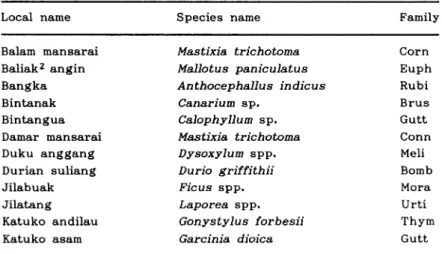
We found that several species corresponded to definite local names, which are shown in Table 2. All of these species have distinctive key characters such as wood feature, latex, resign, and edible fruits. It is interesting that Swintonia schwenckii, a leading emergent species in Ulu Gadut region, changes its local names from "Rangeh" in sapling stage to "Kalek abu" in emergent tree stage. The reason why local people cannot identify them to be the same species is presumably that this species exists as two discontinuous subpopulations of saplings and emergents, in
Ulu Gadut.
In Ulu Gadut area, the local names based on Indonesian words and those based on Minangkabau words are used together. It is often the case that people in Ulu Gadut do not distinguish difference between Indonesian and Minangkabau when they are used for tree names: for example, both "Madang telor" and "Madang talua" indicate the same tree, often Litsea spp., where both "telor" (Indonesian) and "talua" (Minangkabau) mean egg.
Reference
Bagian Botani Hutan. 1974. Dafter Nama Pohon-Pohonan Sumatra Barat (List of tree species of Westcoast of Sumatera). Laporan No. 187. Lembaga Penelitian Hutan, Bogor.
Table 1. General word for tree names in Ulu Gadut Valley
General word Note
(Abbreviation in Append. I & IV)
Akar Balam Kalek (Klk) Kayu Madang (Mdg) Paniang paniang (Png2) Rasak Sapek Bangsa (Bgs)
General word meaning lianas Often trees of Sapotaceae with
white latex
General word meaning trees with
hard and fine wood
Generally means trees, in particular, having useful and
not so hard wood
Trees with a smell of essential
oil, generally trees of
Lauraceae
Fagaceae trees with heavy wood excl. Castanopsis spp.
Generally trees of Shorea spp. Trees of Macaranga spp. Meaning "a relative of"; this
usage is not native, but introduced by the present research group for the convenience of plot study
Table 2. Selected list of local names in Ulu Gadut, of which bo tanical reference is generally clear
Local name Balam mansarai Baliak2 angin Bangka Bintanak Bintangua Damar mansarai Duku anggang Durian suliang Jilabuak Jilatang Katuko andilau Katuko asam Species name Mastixia trichotoma Mallotus paniculatus Anthocephallus indicus Canarium sp. Calophyllum sp. Mastixia trichotoma Dysoxylum spp. Durio griffithii Ficus spp. Laporea spp. Gonystylus forbesii Garcinia dioica -57-Family Corn Euph Rubi Brus Gutt Conn Meli Bomb Mora Urti Thym Gutt
Table 2, continued
Local name
Kayu asam Kayu hitam
Kayu klk banyak anak Kayu malam
Kayu manis Kayu mati rantiang Kayu pasak Kayu sakam Kalek abu Kalek asam
Kalek banyak anak Kalek bunga tanjuong Kalek hitam
Kalek inai Kalek jambu Kalek jambu
Kalek jambu kaliang Kalek kacang Kalek karamuntiang Kalek marapuyan Kalek mati rantiang Kalek minyak Kalek sakam Lasi Mandarahan Mandirawan Marapuyan Madang kumayan Madang poai Madang talua Rambutan rimbo Rangeh Rasak minyak Ribu2 Sikili batang Tabau
Species name Family
Syzygium sp. Myrt
Diospyros spp. Eben
Pternandra caerulescens Mela
Diospyros sp. Eben
Claoxylon longifolium Euph EUipanthus tomentosus Conn Memecylon laurinum Mela
Anisophyllea sp. Rhiz
Swintonia schwenckii (adult) Anac
Syzygium sp. Myrt
Pternandra caerulescens Mela
Syzygium sp. Myrt Diospyros sp. Eben Syzygium sp. Myrt Memecylon sp. Mela Syzygium spp. Myrt Syzygium sp. Myrt
Nyssa javanica Nyss
Xanthophyllum spp. Poly EUipanthus tomentosa Conn Memecylon laurinum Mela Phyllanthus cf. indicus Euph Cinnamomum javanicum Laur
Villeburnea rubescens Urti
Knema spp. Myri
Hopea mengarawan Dipt Rhodomnia sinerea Myrt Styrax paralleloneurum Styr
Phoeba spp. (often) Laur
Litsea spp. (often) Laur
Nephelium juglandifolium Sapi
Swintonia schwenckii (sapling) Anac Shorea sumatrana Dipt Diospyros buxifolia Eben
Grewia florida Tili