Establishment of Cooperatives Society Act in
1968
著者
YAMAO Masahiro
journal or
publication title
南太平洋研究=South Pacific Study
volume
13
number
2
page range
183-210
Cooperative Movement in Thailand: Towards the
Establishment of Cooperatives Society
Act in 1968
Masahiro Yamao*
ABSTRACT
The purpose of the argument which follows is to analyze the peculiar characteristics of development of policies for cooperatives up to 1968.
The Thai autocratical governments had long exerted efforts to expand cooperative systems throughout the country. Under the first and second Phibun administrations, vigorous efforts were made to establish small-scale credit cooperatives. Notably, there was need for a racialistic approach to expanding the cooperatives. The ideology of cooperatives was applied not only to the process of nation-building, but also to the anti-Chinese campaigns. Rather than economic organs, cooperatives were political units.
In the 1960s, the Sarit's authority reconsidered thoroughly the policies for the promotion of coopera tives. The majority of small-scale credit cooperatives had not yet achieved their initial objectives; they became dormant bodies which were unable to provide any favorable services to members. A pressing need for revolutionary changes in agricultural technology urged governments to abolish the ill-suited cooperative systems.
A transitional stage, at which a variety of trials were made to increase agricultural productivity and diversify crop production, occurred during the 1960s. The production credit cooperative was regarded the most appropriate model. This provided incentives to amend cooperative laws in 1968. At this point, cooperatives were to be transformed from organizations with paternalistic natures into those with economic ones. By passing through these transitional stages, cooperative began to develop in the 1970s. This study is an introductory part of a project which will focus on the peculiar characteristics of cooperative development from the 1970s onwards in Thailand.
Key words: credit cooperatives, anti-Chinese campaigns, Thai-ification, production-oriented coopera tives, agricultural development.
I. Introduction
Objectives
Cooperative movement in Thailand has passed through a long history. Unlike neighbor ing countries in Southeast Asia, its process cannot be divided roughly into the periods before and after World War II. Of course, the Thai cooperative movement has something in common with those of the neighboring countries. Immediately after their independence from colonialism, governments exerted efforts to organize their own set-up of cooperatives.
They regarded the encouragement of rural-based cooperatives as an effective manner in which to improve the socioeconomic conditions of the native peasants society. It was realized that the expansion of cooperative membership would give a great impetus to a plural society and a dual economy, under which the native society and economy had long been vulnerable. In this regard, those cooperatives established in the early periods were probably organized politically than economically. Governments may well have inflamed political enthusiasm through the encouragement of the cooperative movement. Policy for coopera tives placed great emphasis on 'political unity and stability'.
Meanwhile, agricultural modernization made rapid progress, which led to the rebuilding of the currently prevailing cooperative systems. The Green Revolution that began in the 1960s required small-scale farming to accord with technological changes. Governments created a workable framework of cooperative businesses which was conducive to agrarian transforma tion. The framework was to deliver some meaningful services, such as the extension of highly-yielding varieties and the massive supply of chemical fertilizers and pesticides, to which old-fashioned cooperatives had less access.
Agricultural transformation progressed rapidly from the 1970s onwards. This caused a vast differential in agricultural productivity, and brought a severe stratification among farmers. A sharp rise in production costs forced marginal farmers to go out of the agricultural sphere. A huge number of farmers, having been alienated from their means of production, migrated into urban areas and the industrialized sectors. Moreover, an in creasingly strong pressure of population over land-based resources deteriorated the lives and production of farmers. To ensure a sharp rise of agricultural productivity, governments provided the middle and lower stratum of farmers with subsidies and loans through coopera tive business. Rural-based cooperatives showed double profiles in their business operations. On one hand, they contributed largely to agricultural differentiation by extending new productive technology over wider areas. On the other hand, in order to alleviate farmers' suffering, they often acted as a welfare and relief agents of the governments.
The promulgation of the Cooperative Society Act of 1968 was a decisive turning point,
through which the Thai cooperative movement made a historical change. The act abolished old-fashioned cooperatives that had been introduced in the 1920s. The government was
attuned to the greater importance of agricultural development on a full-scale. Inevitably, the newly designed cooperatives took the more efficient forms of both business operation and
organization. In this way, they were able to develop the commercialization and diversifica tion of agricultural production. By contrast, before the enactment of cooperative laws in 1968, feverish economic nationalism containing Thai-ification and restrictions on aliens, brought a strong inducement to expanding the cooperative system.
The focus of the argument that follows will be on peculiar characteristics of the develop
ment of the Thai cooperative movement up to 1968. Much of the argument concerns the political economy and institutional framework for cooperatives in the early days of the movement. The government policy did not always place the economic effectiveness of cooperative business at the center, but applied the ideal of cooperatives bluntly to Thai-ification programs. It was realized that to further advance the native economy, there was a
need for the fostering of cooperatives. This was to be fertile ground for the growth of a
politically inspired system. The discussion which follows will also clarify the external forces
that steered the nation in the direction of cooperative development. Apparently, the new
direction was brought about by radical changes in political and economic conditions. A
rough division of the historical process of cooperatives will give a profound insight into the
substantial factors leading to their dynamic changes. This study concludes that there are a
number of basic reasons why the government policies for cooperatives needed a thorough
rethinking after the 1960s.
Historical Division of Development
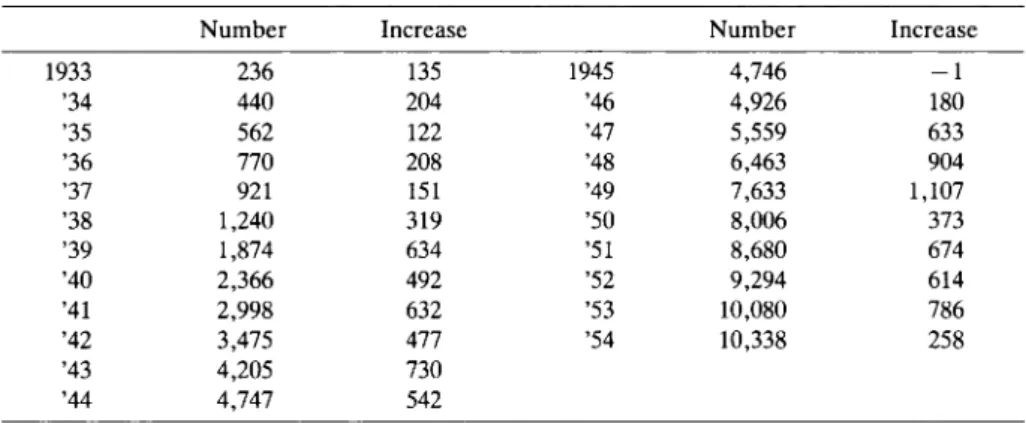
The figures of Table 1 show that the development process of Thai cooperatives can be
divided into approximately two stages. The first stage covers the period from 1916, when the first cooperative was established, to 1967. The second stage covers the period from 1968 to the present. The first stage may then be subdivided into two periods: the years before
and after 1960. In 1968, a new type of cooperative appeared to gradually take the place of
conventional types regulated by the first cooperative act.
The stage before the outset of 1960s may well consist of an embryonic phase and another two phases of full-scale development. Cooperatives remained in the embryonic stages until
the outset of 1930s. An absolute monarchy promulgated the Cooperative Societies Act B.E. 2471 in 1928, and began to prepare the support of the cooperative movement. However, early trials had not successfully provided a wider scope, as cooperatives were unable to extend their membership through the country as a whole.
The number of cooperatives registered, sharply increased during the years between 1933 and 1944, particularly after 1938. The number of cooperatives newly established per year
ranged from 500 to 700. This period was the first phase of full-scale development. The
second phase of development started shortly after the end of World War II. The total number of cooperatives reached 10,338 in 1954, twice as many as in 1945.
A turning point suddenly came in 1955. From then up to 1968, the total number of
cooperatives neither increased nor decreased. This period was characterized as being Table 1. Changes in number of cooperatives
Number Increase Number Increase
1933 236 135 1945 4,746 - 1 '34 440 204 '46 4,926 180 '35 562 122 '47 5,559 633 '36 770 208 '48 6,463 904 '37 921 151 '49 7,633 1,107 '38 1,240 319 '50 8,006 373 '39 1,874 634 '51 8,680 674 '40 2,366 492 '52 9,294 614 '41 2,998 632 '53 10,080 786 '42 3,475 477 '54 10,338 258 '43 4,205 730 '44 4,747 542
stagnant and transitional. In those days, any government agencies responsible for coopera tives were struggling with the disastrous failure of the cooperatives' administrations. They failed to improve the cooperative systems existing, and thus involved creating a new, model cooperative. A pressing need arose for the reconsideration of policies for cooperatives, which led to the promulgation of the Cooperative Societies Act B.E. 2511. In accordance with the framework of the new act, the government administration vigorously encouraged the amalgamation of small-scale cooperatives to organize a new, large-scale cooperative. The number of cooperatives drastically dropped down to 1,569 in 1971 and 966 in 1976.
The aforementioned rough divisions of period cannot be applied to any process of cooperative movement in other Southeast Asian countries. This is simply because Thailand
had not been under the direct rule of colonialism. In other countries, before World War II, colonial authorities took the most decisive stand for introducing cooperatives. They had to reduce social conflict and tension in the native peasants' societies to sustain the framework of colonialism. In Indonesia, after the 1920s, the Dutch colonial authority was trying to extend
a cooperative system in collaboration with the native followers1).
Opposing the government
organizations, nationalists voluntarily fostered their own cooperatives that were not regulated by the cooperative laws (Booke 1953). Both parties were in severe conflict. After World War II, therefore, the new regimes promulgated a new cooperative law with the ideal of
nationalism^, replacing the laws issued by the colonial authorities.
They needed the basic
value and principle of cooperatives to be distinguishable from those that the colonial authorities had accepted. The ideal of the cooperative movement had severely fluctuated
between nationalism and colonialism.
Thai political elites had always taken exceptional initiative in the cooperative movement, viewing cooperatives as a state-sponsored institution. The cooperative movement was not in conflict between different parties. However, as will be discussed in depth, this may well have prevented people from voluntarily participating in any cooperative activity. The autonomous cohesion among members was very fragile because of the heavy dependence on the leadership of bureaucrats and political elites. The principles that unified a wide array of members' behavior were probably on the basis of paternalistic state-sponsorship.
II. Before World War II: From Early Trials to Evolution
Promulgation of the First Cooperative Act
Thailand had opened itself to the West in 1855 by negotiating the Bowring Treaty with Britain. Since then, increased foreign demand for rice export had changed the Thai economy into a monetary and capitalistic one. Western capitalism forcibly incorporated the Thai economy into the social divisions of labor on a worldwide scale. Yet peasants continued to supply their own demand for rice, selling the surplus. A regular demand for rice gradually developed commercial production. Modern transportation, such as streams and railroads which were extended throughout the country between 1910 and 1930, gave a great impetus to regular sale. Rice mills increased greatly outside of Bangkok, along these
streams and railroads.
Commercialized farmers needed a considerable amount of capital, though they still used the same tools and techniques as self-sufficient farmers did. The major problems were the scarcity of money and the lack of modern financial institutions. The farmers necessarily
relied on the advance or repayment in kind by which traders charged exorbitant interest rates. The bulk of the agricultural debt in the 1930s was owed to relatives and friends
(Ingram 1971), but middlemen and money-lenders actively provided farmers with a large source of money as well. Political elites paid attention to the problems of the agricultural debt (Koramsam 1987; Ahatkonhang 1989). In 1902, Phraya Suriyanuwat proposed to
organize an agricultural credit bank. This plan, however, was not realized due to the lack of financial sources and the problem of default.
From 1910 to 1920, a pressing need arose for preparing agricultural credit institutions. Bad weather seriously damaged the farmers' economy in 1911. Moreover, in 1913, a commercial bank that actively financed rice mills found itself in financial trouble. This hit
the Siam Commercial Bank engaged in foreign exchange very badly, consequently a number of exporters could not raise enough funds to purchase rice. Thirty-four rice mills situated in Bangkok had to cease collecting paddy (Brown 1988). As a result, the price of paddies
dropped sharply3).
An attempt was made to establish a bank specializing in agricultural credit by the regime of absolute monarchy. First of all, the Ministry of Finance set up a section within the
Department of Commerce and Statistics, which was responsible for the introduction of the cooperative system, according to the suggestions of a foreign adviser. Barnard Hunter, who
was the president of Medullas Bank, made a proposal for the founding of a modern banking system including a national credit bank and cooperatives. His proposal was that coopera tives would be the most useful tools in which to watch and control those farmers who borrowed money from the national credit bank. He also suggested that the Siam Commer cial Bank should be transformed into a credit bank whose operation was based on land mortgage. Operators of rice mills and exporters were strongly opposed to his proposal in
that they increasingly depended on the bank's foreign exchange. As a result, Hunter's
proposal failed to materialize (Cooperative League of Thailand 1976; 1991). At this moment, Prince Phra Rachawankao, who held a position in the Ministry of Finance, introduced the term 'cooperative' to Thailand, translating it to 'sahakorn'. He invited J. C. Cable as his adviser in order to institute the modern credit association.
In 1916, the first cooperative was established in Phitsanulok Province to lend credence to
members. It was called the Wat Chan Cooperative. At the onset, its membership con sisted of 16 farmers, whose shares totaled only 80 Baht. The sums set aside were wholly inadequate for the credit purpose. The cooperative greatly depended on the part of
government financial aid. The Ministry of Finance guaranteed the Siam Commercial Bank which provided the cooperative with 3,000 Baht at 6 per cent annual interest. It refinanced the borrowed funds to members and charged 12 per cent annual interest. In 1917, the cooperative borrowed 1,700 Baht from the Siam Commercial Bank, and then provided 1,500 Baht to its members (Wat Chan Cooperative, unknown year; Ahatkonhang, 1989). By
doing this they repaid their old debt.
There were several reasons why the first cooperative emerged in Phitsanulok Province. Above all, the lack of financial institution made it very difficult for many of the farmers who had migrated there to settle down. To accomplish the smooth settlement of migration, local economic and political elites including the provincial governor purposefully encouraged farmers to participate in cooperative membership (Tomosugi 1973; Ministry of National Development 1967a).
Supported by the provision of low interest loans without any mortgage from the govern ment, cooperative membership gradually extended over Phitsanulok and Lop Buri Provinces. The number of cooperatives newly registered amounted to 12 (248 members) in 1919 and 35 (628 members) in 1920. The scale of membership was very small, ranging from 10 to 47 members on average. The cooperative membership comprised only a tiny minority of farmers in these provinces up to 1925. The early development of cooperatives remained in an experimental stage within a narrow locality.
In the initial stages, the Siam Commercial Bank financed 4,928 Baht per cooperative. In 1925, a cooperative borrowed 7,091 Baht, and held an outstanding debt of 3,348 Baht at the end of the year. There were only 8 cooperatives that received members' deposits. The reserve funds per cooperative were only 1,797 Baht. Therefore, many of the cooperatives acted as agents mediating the flow of money between the Siam Commercial Bank and their members, not creating their own financial circulation based on the members' reciprocity. Inevitably, the sums of funds allocated to cooperatives by the bank largely affected the further expansion of cooperative credit. No cooperative appeared during the years of 1920-1922. This was chiefly because the bank had already financed 303,669 Baht to the coopera
tives currently existing, exceeding the 300,000 Baht (Landon 1968). Another 18 coopera
tives were newly registered in Lop Buri Province as soon as the bank increased the funds earmarked for loans to cooperatives.
Between 1923 and 1925, by passing through the experimental stages, the government made preparations for the full-scale development of credit cooperatives. A great emphasis was placed on the proper manners of administration, such as inspection of members, to actively promote equality among members, and to keep accurate accounts. In 1928, the government decisively legitimated credit cooperatives by promulgating the Cooperative Societies Act B.E. 2471. Before its enactment, credit cooperatives had been regulated by the Associa tions Amendment Act B.E. 2459. With this new act, the government paved the way for further and fuller development of credit cooperatives (Ministry of National Development 1967e).
The Cooperative Societies Act regulated that 'cooperative' be distinguished from 'samakhom' (association), which was able to conduct economic activities and to benefit its members. The major form of cooperative was a credit one, forming distinctive approaches to matters of finance, quite different from those of banking systems. As did governments of other countries, the Thai authorities defined the area of cooperative membership. The sound operation of credit cooperative needed a well-defined locality. The cooperative became a financial foundation, having exclusive links to specific persons in an immediate
vicinity, though restrictions on membership became obstacles to further expansion.
Yet another distinction of the credit cooperatives was unlimited liability in business operation. Trials for establishing cooperatives were modeled on the German type of credit cooperatives which had adopted the Raiffeisen principles. To ensure that the cooperatives
could function effectively, the authorities decided on taking the form of joint and unlimited
liability among members. The operation scale of a credit cooperative was meager enough to keep the intimacy of its members. To avoid inadequate management, the Cooperative Societies Act strictly regulated the procedures to allocate net profit resulting from business operations. The Act prohibited the cooperatives to allocate any part of net profit to those
members who did not contribute to it.
Apart from credit cooperatives, central organizations and federations, whose membership consisted of primary cooperatives, adopted the form of limited liability. According to the
by-laws that they made for governing their own affairs, these organizations had to earmark a certain portion of net profit for reserved funds. The first priority was not to refund members
investments. If there was some net profit left, the members would receive patronage refund in proportion to their dealings with cooperative business or dividends on fully paid up
share-capital.
Distinctively, the Cooperative Societies Act introduced Nai Tabien system, being similar to
the registrar system widely accepted in the British colonies such as India and Malaya4).
This
system indicated that the government guidance and sponsorship should take the leadership in
the cooperative movement. The registrar exercised registration, guidance in terms of organization and administration, and inspection of financial affairs. In the case that a cooperative did not manage its business in proper way, the registrar would order it to
improve or dissolve. The registrar held a decisive role in the development of
government-sponsored cooperatives.
Apparently, the enactment of the Cooperative Societies Act gave a great impetus to cooperative membership. In 1927, the number of credit cooperatives increased by 157, and their members amounted to 2,157. The fact that the Siam Commercial Bank increased the loans earmarked for cooperatives from 300,000 Baht to 500,000 Baht brought about the further expansion of the credit business. The outstanding loans that the Bank lent to
cooperatives reached 510,000 Baht. During the period between 1926 and 1932, 110 coop eratives emerged. This was a significant turning point for the development of cooperatives:
membership extended over a far wider area (7 provinces).
During this growth period, Thai farmers had still remained at primitive levels of commer cial production. They had not become mature in economic terms. Farmers stood on a disadvantageous position vis-a-vis any type of middlemen. Those Chinese middlemen who stimulated farmers to evolve into commercial production were likely to preclude them from
encroaching upon agricultural markets. The middlemen gained a wide variety of opportu nity, whereby they could maximize profit of alienation. Rather than organizing the produc tion process of capital, they much preferred to trade commodity and to circulate money.
Generally speaking, in Southeast Asia, the shortage of money circulated in rural areas was a factor which caused serious agrarian problems. Few peasants adapted themselves to the
ethics of commodity production, though commercial economy infiltrated into subsistence
agricultural production. This was partly due to the lack of modern banking institutions. The peasants had to increase their dependency on middlemen-financiers. Given the condi tions that peasants had still stuck to the ethics of a subsistence economy, the
middlemen-financiers accumulated capital in one form or another. While trading agricultural produce,
they often acted as money-lenders. The ownership of agricultural land brought a reliable source of capital accumulation. The middlemen would organize a coherent commodity flow: from production to distribution. There was a marked tendency for one particular middle man to help peasants to establish links to various markets. This was a risk-spreading technique to help ensure steady income in their dealings with those peasants living close to
the margin (Scott 1976).
The patron-client relationship between middlemen and peasants was comprised both of
exploitation and reciprocity. A traditional reciprocity in villages may well have, to a certain extent, prevented excessive exploitation undertaken by the middlemen, however, the further
infiltration of a monetary and commercial economy into rural areas had a negative impact of
a paternalistic linkage between both parties. It is widely acknowledged that, after an
economic recession in the 1930s, the degree of middlemen's exploitation was often far beyond the disaster level, at which peasants found it difficult to survive. As a result, their financial situations were deteriorating, and they were often alienated from the possession of
means of production. This resulted in a severe agrarian differentiation.
Given the aforementioned conditions, Thai political elites viewed the promotion of credit cooperatives as a better-suited manner in which to relieve peasants. The organizing and
operating rules of cooperatives were primarily based on the normative ones of traditional villages. The elites probably believed that the informal social guarantees of villages could be
converted into workable forms of cooperative business. In particular, a reciprocal monetary circulation was considered crucial to the development of small-scale credit cooperatives. By adopting mutual, personal trust and reciprocal watch among members, the cooperatives were to generate a local money circulation in their immediate vicinities. This distinctive approach to matters of finance was to make peasants become more competitive.
First Period of Full-scale Development
Batson refers to two major areas in which the government of the Sixth Reign had taken an
active part in agricultural development. One was the promotion of irrigation projects, the other was the establishment of agricultural cooperatives. Both of these programs were continued in the early years of the Seventh Reign, however, the irrigation program found itself in financial difficulty arising from the large capital costs of irrigation projects. Even tually the main hopes of the government for agricultural development rested on the evolution of cooperatives (Batson 1984). The authorities began to concentrate on the promotion of
cooperatives. In the 1930s, cooperative membership enlarged rapidly. The number of
cooperatives registered rose sharply from 236 in 1933 to 921 in 1937. This period was the first stage of full-scale development in Thai cooperatives.
1944 Was nearly four times larger than in 1938. Newly registered cooperatives amounted to 547 per year.
There were several factors causing the rapid development of cooperatives, the greatest
being the government's active involvement in agricultural problems. In the 1930s, farmers
became more and more critically in debt and landless. To solve these problems, the
Ministry of Agriculture made efforts to improve the marketing conditions of farmers, by the encouragement of grading paddies for sale and the drawing up of plans for constructing silos in ports (Thompson 1967). More importantly, influenced by the enthusiastic upsurge of Thai
nationalism, leaders of ethnic groups waged a strong campaign of repression against those
Chinese who had long dominated both production and distribution in the agricultural sphere.
Just before and after the World Economic Crisis, Thai nationalists paid a considerable amount of attention to Chinese domination of upcountry commerce. They observed that
Chinese middlemen greatly exploited Thai peasants by taking the excessive profit on imported merchandise, by lending money at exorbitant interest rates, and by taking advan tages in paddy trading (Skinner 1957). There was, of course, disagreement over the exploitative nature of Chinese middlemen among Thai leaders and bureaucrats. Prince
Sithiporn stressed that Chinese middlemen were more useful than exploitative5).
It was
widely accepted that the lack of formal financial institutions as well as the lack of possession of means of production became important factors forcing Thai peasants in subordinate positions to their financier-traders who, in turn, subjected them to poverty. At this moment, the development of cooperatives was profoundly influenced by a series ofThai-ification policies and anti-Chinese campaigns.
Pridi Phanomyong drew up the post-revolutionary government's economic plan, as soon as
the 'People's Party' led successfully the June 1932coup. Pridi's economic plan was based on the cooperative possession of means of production and the control over the social divisions of
labor. It indicated industrialization which was designed to employ surplus labor freed from
the agricultural sector. Soviet socialism possibly affected his plan. It is noteworthy that the
construction of the cooperative sector became an important measure, through which the
government would provide meaningful services of social welfare and regulate effectively the
social divisions of labor. In the agricultural sphere, Pridi's plan had the object of changing
the ownership of land called Sakdina into a nationalistic one, although he neither expected to exclude capitalists, nor to preclude the inflow of foreign capital (Natasupha 1984). To raise agricultural productivity and eradicate poverty, those cooperatives consisting of peasants' membership were supposed to conduct collective cultivation and marketing.
The type of cooperative that Pridi drew up in his economic plan was a multi-purpose one conducting multifarious activities vital to both production and distribution sites. It would become a core of his socialistic plan. He proposed that the government would provide ethnic peasants with land and capital. The peasants would in turn offer a labor force, being responsible for the process of production. The authorities would distribute it effectively through the marketing channels regulated. Apart from these economic activities, coopera tives would direct social affairs such as primary health care, housing and education. They were to act as a center of social and economic life in rural areas (Araya 1984). Eventually,
Thai society no longer accepted his radical and communistic plan. The authorities, how ever, focussed attention on intervention in economic affairs, shifting from a subordinating colonial-style economy to independent one. Having rejected Pridi's plan, the government issued a statement on economic policy, calling for a silo-making scheme and the promotion of
cooperatives (Batson 1984).
Soon after the promulgation of the Cooperative Societies Act, the cooperative system currently prevailing had to consist of new aspects that would be able to support its future development. This was because most of the credit cooperatives could not achieve their initial objectives, and because the government was trying to solve the problems of deteriora tion of debt. Credit cooperatives were comprised only of a tiny minority of farmers, and they accounted for 2 per cent of farmers' debts. Moreover, they remained either dormant organizations that were unable to provide any services benefiting their members or captive
ones that vested in particular interest groups6). The decision taken by the government was
to rebuild the cooperative system, fitting it in with the solution of the agricultural problems. In 1934, the central government established the Ministry of Agriculture, to which the Department of Cooperatives was transferred from the Ministry of Commerce. The depart ment set up a new section which was to be in charge of the encouragement of cooperatives onregional levels. Moreover, cooperatives would have access to borrowed funds from com
mercial banks other than the Siam Commercial Bank. This would secure further develop
ment of credit business. They had used to act as conduits for the Bank's financial services;
its financial capacity had been a major obstacle to the further expansion of credit arrange ment. Furthermore, 90 per cent of net profit was to be saved as reserved funds to improve the financial capability of cooperatives. They had to allocate 5 per cent of the net profit for local development programs in their immediate vicinity, while contributing another 5 per cent
to the Department of Cooperatives7^
Guided by the government, many types of cooperatives emerged, such as consumers cooperatives, land improvement cooperatives, marketing cooperatives for paddy and sugar cane, and land settlement cooperatives. Clearly, these specific types rarely affected aspects of private ownership. They were, however, supposed to have a substantial role in the implementation of economic nationalism undertaken by the nationalistic regimes.
The first Phibun administration (1938-1944) persisted over "racism" and "fascism" (Brailey 1986). His administration dedicated itself to the rebuilding of the social divisions of labor, in which ethnic Thais had long been forced to stand in vulnerable position against
Chinese and their descendants. Under the regimes of semi-colonial economies, Chinese
constituted approximately 85 per cent of the commercial class, holding 90 per cent of the country's commerce and trade (Skinner 1957). This was strongly resented by Thai national ists, and thus they were forced to take oppressive measures against the Chinese in one form or another. The Phibun administration actively encouraged the establishment of all types of cooperatives, with the object of releasing ethnic peasants from the exploitation of Chinese financier-middlemen.
Premier Phibun proclaimed a series of Ratthaniyom (cultural mandates of the state), which
nation-building. The Ratthaniyom stressed that Thais had to evolve into commercial and industrial lives (Driravegin 1985) and compete with European and Chinese capitalists. He had, of course, recognized a clear sign of the transformation in the international balance, particularly in the Far East (Brailey 1986). To secure more independence in both political and economic terms, the Phibun administration aggressively adopted repression, in one way or another, against aliens, especially overseas Chinese. This was a preparation for the building of a military state, which was also affected by an apparent pro-Japanese swing in Thai foreign policy.
The government dedicated itself to nationalistic industrialization because the Chinese were still predominant in commerce, manufacturing, and even in commercialized agriculture. It decided to establish Thai state enterprises in key industries as a way of developing Thai entrepreneurship, while taking over the private enterprises owned by aliens. Moreover, the production and distribution of some important products such as tobacco, paper, sugar, mining resources and leather, would be controlled or monopolized by the state (Sang-praserit 1984). These efforts were to break down the traditional patterns of occupational specialization. Non-Thai nationals were prohibited to be involved in declared occupations
and could not receive specific licenses8).
A policy for cooperatives was influenced profoundly by anti-Chinese sentiment and nationalism. Chatthip and others point out that the Phibun government regarded coopera tives as social institutions which could help it to implement Thai-ification policies. While the cooperatives were in charge of solving agricultural debt, they also had to organize small-scale Thai farmers and create the effective distribution networks of agricultural produce.
Between 1938 and 1939, the number of cooperatives increased by 634. Since then, the number of cooperatives increased at an over greater pace; on average, 570 new cooperatives were registered per year. Establishment was flourishing in 1943 when the government set up the Bank for Cooperatives. Eventually, the total number reached 4,747 in 1944.
The Thai nationalistic authorities had positive effects on the development of cooperatives. Above all, it provided a wider scope for cooperatives to extend their membership throughout the country, in number to agricultural related ventures and also in other fields. Eco nomic repression against aliens, mainly Chinese, prompted the establishment of new
types of cooperatives. By obtaining a paternalistic government-sponsorship, marketing
cooperatives were organized to channel the flow of agricultural produce. They had an exclusive business link with the rice mills, 51 per cent of whose shares were held by the government. In collaboration with these government-owned mills, the marketing coopera tives purposed to encroach upon the distribution of rice dominated by Chinese middlemen at
local levels.
Yet another attempt was made to develop land settlement cooperative. Landless farmers enrolled as members were able to settle on undeveloped and forested land conserved by the government authorities. A land settlement cooperative emerged in Northern Thailand soon after the promulgation of the first cooperative act. In 1942, the government enacted laws to manage particular unprocessed areas situated in Chiang Mai, Samut Sakhon and Thonburi
had no land for cultivation, or whose land was insufficient to earn a living, were allowed to join in the membership of land settlement cooperatives. Naturally, they should be Thai-nationals, whose were greater than 20 years of age. Traditional customs of farmers' settlements on unprocessed land were modified into the procedures of land settlement
cooperatives. After passing through a certain defined period of settlement, members would
be able to acquire an exclusive right of cultivation. The cooperatives managed financial services mainly on long-term bases, in order for the members to purchase the land conserved
by the government. Clearly, the government had designed a system not only to intensify the
land ownership of Thai peasants, but also to strictly regulate migration onto unclaimed land. To further develop all of the types of cooperatives, the government prepared to set up a particular financial institution. In 1943, it proclaimed the act for the establishment of the Bank for Cooperatives. This was a central organization whose shares were held by all
cooperatives, while the government contributed 10 million Baht. An inducement to estab
lish the bank arose from the fact that cooperatives were dissatisfied with the financial services
delivered by the Siam Commercial Bank and other conventional banks. These banks often
hesitated to finance those cooperatives which depended heavily on paternalistic sponsorship
of government. By supplanting conventional commercial banks, the Bank for Cooperatives would adopt specific manners in which to make the cooperatives have easy access to its financial services. It was not until 1946, however, that the government stopped declaring operating procedures, and that the bank did not implement any banking services.
A great majority of cooperatives were grouped into the category of credit cooperative. Their business operations were very small, not affecting all aspects of production and
distribution. Though the total number of primary cooperatives increased rapidly, there
were few federations at national or regional levels.
Much contrary to the initial purposes
that the authorities had set up, the overall cooperatives could contribute a lesser share to the nationalistic process of economic development. A series of policies for cooperatives was still a dream: political elites and bureaucrats probably viewed the promotion of cooperatives as a
political maneuver, applying the ideal of cooperatives to the nationalistic, nation-building
which they headed.
III. The New Era of Cooperatives During Post-War Period
Political Changes in Policies for Cooperatives
After the end of World War II, the new regimes continued to develop cooperative systems throughout the country. They steered the cooperative movement, deviating from the initial
purposes of cooperatives.
Meanwhile, during the cold war period, the essential strategic configuration of Southeast Asia was separated into the growing communist forces and the nations belonging to 'Free World'. To a greater or lesser extent, Southeast Asian nations were in severe struggles of
Indochina conflicts. Thailand openly aligned itself with the United States and the 'Free
a result, Thailand became a strategic point in the American security commitment, providing
military bases for the American-Vietnam war. Thai authoritarian and nationalistic regimes
headed by the army leadership recognized that both anti-communism and partnership with
the United States would be very beneficial in both political and economic terms. The new
regimes felt that the nation's independence, and traditional, conservative political order was threatened by the growing communism inside and outside of Thailand (Randolph 1986).
The second Phibun administration, supported by the army leadership, legitimized itself by obtaining the American security commitment for Thailand, its military and economic aid. Premier Phibun hastily began with an anti-communism campaign to cut off the infiltration of communism into Thai society. He feared that the prestige and power of communist elements were steadily increasing in Thailand's Chinese society, influenced mainly by the
revolution of China (Skinner 1957). Local Chinese were forced to remain in the conven
tional framework of Thai politics, no matter what their political conviction might be. The sentiment of anti-communism and anti-Chinese were in accordance with Phibun's interna
tional commitments to the American strategy for Southeast Asia.
In those days, according to Girling, all political leaders and bureaucrats faced political and economic dilemmas: the Thai political 'superstructure' was not merely a reflection of economic foundations. In the process of nationalistic nation-building, they had to reduce the potential dangers of Chinese economic power. On the other hand, they had to obtain more funds from Chinese capitalists to have a greater influence over politics. These
dilemmas could only be solved with distinctive approaches, such as economic assistance to
ethnic Thai, economic restrictions on aliens, an expansion of the state's role in industry, and encouragement of semi-governmental 'Thai enterprises' in commerce and finance (Skinner 1957). In 1949, the government promulgated the Occupational Restriction Act which prohibited aliens to engage in 10 occupations. This was in addition to 27 occupations that had been conserved in 1942. In 1951, aliens were excluded from 6 more occupations. In 1952, those alien middlemen who engaged in the trade of fisheries produce, were prohibited to make any transactions in the jetties privately owned. Moreover, only Thai-nationals were
allowed to manage commercial fisheries (Yamao 1991).
To become more independent in economic terms, the new regimes began to make rapid progress in industrialization. The question was how to attain it. Without any restriction on
foreign capital, few Thai entrepreneurs would grow more competitive due to their poor
accumulation of capital. The decision made by the government was to establish state
enterprises in several substantial industries10), in order to initiate industrialization and ensure
Thai control of economic development11\
The state enterprises rapidly increased their
contribution to Thai economy. Motivated by opportunities for private gains, bureaucrat groups and military institutions monopolized special privileges given to the operation of state enterprises. Vigorous efforts to develop state enterprises were not ideological but practical: the Thai economy did not evolve into 'state capitalism', but into 'bureaucratic capitalism' (Yu1969)12).
State capitalism was accompanied by repressions against the Chinese society in Thailand.
replace-ment, and inclusion. The policy usually shifted from one emphasis to another. To put it in more concrete terms, the Phibun's first administration had focussed more attention on controlling Chinese business by proclamations of nationalistic laws for ownership and privileges. After the end of World War II, the authorities were much more concerned about exclusion and replacement.
Regarding the degree of the policies effects, there were many differences between the economic classes of the Chinese society, in which class struggle and differentiation had already become severe. Although the leaders of ethnic groups tried to destroy the social division of labor among races, lower classes of Chinese were responded more sensitively to the Thai-ification programs than did the upper classes. As native people grew to be laborers and small business owners in urban areas, they were in severe competition with the mass of Chinese grouped into the lower classes. The native people gradually, but steadily, en croached upon such fields as the government had proclaimed occupational restrictions on aliens. Clearly, the repression policy against lower classes of Chinese included both exclu sion and replacement.
By contrast, the consequences of the Thai-ification program urged upper classes to further assimilate into Thai society. Generally speaking, well-to-do Chinese had established lucra tive links, such as in patron-client relationships, with Thai political and military elites. This
provided special privileges in their business operations13).
Rather than to persist in their
own identity, they had much preferred to assimilate themselves in Thai society. Repression polices against upper classes of Chinese worked softly and effectively. In particular, the growing role of the government's investment in industries encouraged Chinese capitalists (engaged mainly in finance and trade) to join state enterprises. Skinner points out that the major corporations, newly established after the 1951 coup, were joint ventures between Chinese capitalists and Thai officials. The former supplied capital and entrepreneurial skills, while the latter provided protection and privileges (Skinner 1957). Those state enterprises which found themselves in managerial difficulties were eager to cooperate with Chinese entrepreneurs to have access to their managerial skills and distribution networks. In other cases, Chinese entrepreneurs often asked Thai officials to be on the boards of directors in their corporations.
A policy for the promotion of cooperatives was designed to provide a dual contribution to the aforementioned Thai-ification programs. Firstly, cooperative membership would consist of those peasants still remaining at primitive stages of commercial agriculture and those engaged in specific occupations reserved for Thai-nationals. Cooperatives played an impor tant role in the exclusion and replacement of lower classes of Chinese. Certain types of cooperatives managed special privileges and licenses given exclusively to ethnic Thais. Examples were cooperatives for taxi drivers, and fisheries cooperatives which monopolized fishing rights in particular inland waters. These cooperatives also conducted business activities to improve members' economic conditions.
The government accorded a high priority to the diffusion of the cooperative concept in connection with its strategies of rural development as well. This was because the Thai economy had been dependent heavily upon the cultivation and trade of rice. As Ingram
concluded in his description, almost all rice farmers, who were ethnic Thai, could participate in rice trade as growers (Ingram 1971). To improve the role of ethnic Thais in agricultural fields, the government decided on direct control over the rice trade by spreading of credit and marketing cooperatives. This was a result of the recognition that the rice trade was dominated by Chinese middlemen who inextricably linked rice farmers to the distribution networks and methods employed by them. These cooperatives would deliver financial or marketing services to members, thereby supplanting the Chinese financier-traders.
The second contribution to the Thai-ification programs, put cooperatives in close connec tion with state enterprises. As has already been mentioned, the government intended to dominate the production and distribution (including exports) of important commodities by state enterprises. For the agricultural fields, the Food Trade Promotion Committee was established to exclude Chinese traders from the distribution of foods and to encourage the formation of the trade association by Thais. At this point, cooperatives acted as govern ment agencies.
At local levels, cooperatives would organize those Thai farmers producing on a small-scale and collect their produce in proper ways. These rural cooperatives were connected with certain state enterprises. For example, paddy marketing cooperatives transacted with the
enterprises possessed by Thahan Samakkhi14).
Another example is in the dealings of
fisheries cooperatives with the Fish Marketing Organization (FMO), which was a state enterprise under the control of the Ministry of Agriculture. The FMO aimed at promoting commercial fisheries and operating fisheries-related facilities such as wholesale markets and landing places. This agency also planned to become a national federation of fisheries
cooperatives15).
Moreover, given particular privileges, the Thahan Samakkhi started with
the operation of wholesale trade in the FMO's Bangkok wholesale market. It collected fresh and dried-and-salted fish from the cooperatives. These state enterprises were to create their own financial and distribution networks on a nationwide scale, by dealing with primary cooperatives at local levels.
Policies for cooperatives were comprehensive, but the Phibun administration neither took account of the efficiency of business operation, nor tried to foster self-exertion coming from members. A cooperative was viewed as an effective means of accelerating economic nationalism and of strengthening their power base. Rather than an economic organization, it was a political set-up.
Full-scale Development of Cooperatives
Along with feverish economic nationalism, Thai cooperatives made rapid progress in many respects, due to the powerful leadership taken by the government authorities.
First of all, in 1946, the government promulgated an act regulating the banking services of the Bank for Cooperatives. The bank's membership consisted of all cooperatives. If a
cooperative wanted to raise more loans than the declared amount16), it was required to hold
additional shares. Moreover, the cooperative had to offer its assets as securities. In the case of a credit cooperative, the bank estimated the total value of members' land that could be mortgaged to secure loans. The cooperative was able to receive 60 per cent of the
estimated value of land. Of course, other types of cooperatives could raise loans from the bank for business activities such as marketing agricultural products and purchasing productive materials. These other types went through completely different legal channels; they submit ted their application to the bank and the Department of Cooperatives for approval, and then accepted the amount decided by both parties. The Bank for Cooperatives conducted savings and other substantial banking activities, which were extended over all types of cooperatives.
In 1951, the Department of Cooperatives, being under the Ministry of Agriculture, was elevated to the Ministry of Cooperatives. This provided incentives to rapidly expand cooperatives; the number of cooperatives sharply increased from 5,559 in 1947 to 10,338 in
1954.
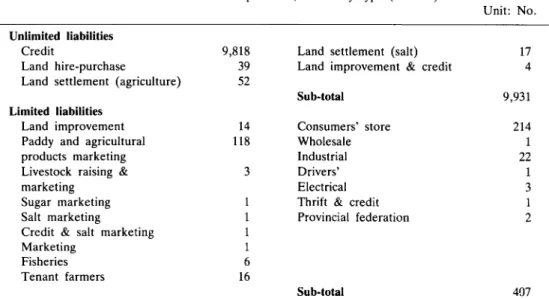
Almost all cooperatives were categorized as falling into the credit type, which accounted to 95 per cent of the total. Apart from this type, there existed a large number of different types; for example, in 1954, 22 different types were counted (see Table 2). A great part of these cooperatives were involved in the process of distribution. Above all, consumers' store cooperatives rapidly extended their businesses. There were also many cooperatives which purposed to maintain the ownership of land and to improve the economic conditions of tenant farmers. However, the government could not always regulate legitimately these cooperatives, because they were organized by different authorities (Ministry of National Development 1967b).
Table 2. Number of cooperatives, shown by type (in 1954)
Unit: No.
Unlimited liabilities
Credit 9,818 Land settlement (salt) 17
Land hire-purchase 39 Land improvement & credit 4
Land settlement (agriculture) 52
Sub-total 9,931
Limited liabilities
Land improvement 14 Consumers' store 214
Paddy and agricultural 118 Wholesale 1
products marketing Industrial 22
Livestock raising & 3 Drivers' 1
marketing Electrical 3
Sugar marketing 1 Thrift & credit 1
Salt marketing 1 Provincial federation 2
Credit & salt marketing 1
Marketing 1
Fisheries 6
Tenant farmers 16
Sub-total 407
Source: Ministry of Cooperatives.
Members of credit cooperatives were mainly rice farmers with possession of land within a defined narrow locality. The scale of membership was small, 17 members on average. Although this type had already extended its membership over 63 provinces, the farmers enrolled as members accounted for only 8 per cent of all farmers (USOM 1959). Naturally,
the scale of credit activities was very small; the increased volume of loans during a year amounted to 1,796 Baht in 1955 and 5,110 Baht in 1957.
Credit cooperatives financed mainly long-term and middle-term loans. The long-term
loans, repaid within 10 years, were for such specific purposes as refinancing old debts and
purchasing land (before 1954, these loans were repaid within 15 years). They accounted for 53.8 per cent of all loans in the 1960s. The middle-term loans, with periods of repayment being within 3 years, were financed mainly for the improvement of land and the purchase of livestock, water pumps and machines. This sort of loan made up more than 40 per cent of the total. The loans granted by credit cooperatives were more likely to be
consumption-oriented, rather than production-oriented.
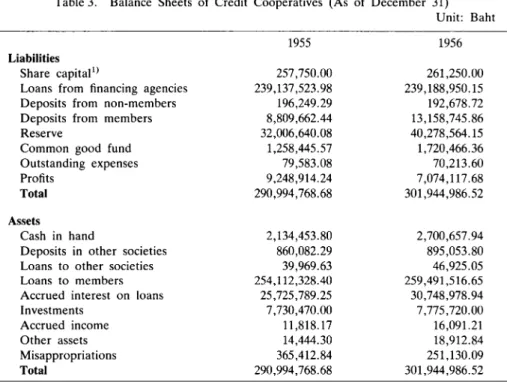
The figures of Table 3 indicate that credit cooperatives had used financing institutions to raise a considerable amount of funds. The loans from the institutions accounted for 82.1 per
cent of all liabilities. Deposits to debts ratio was only 3.8 per cent. Personal funds such as share capital and reserved funds accounted for a very small portion of all liabilities. The
value of loans each cooperative provided amounted to 25,850 Baht, while it received only 916 Baht of deposits from its members. The loans to deposits ratio remained extremely high. It was pointed out that credit cooperatives failed to create liquid financial circular at local levels because of disastrous over loan. In actuality, the cooperatives specialized their functions in mediating the funds which flowed from the Bank for Cooperatives.
At the outset of the 1960s, all credit cooperatives together financed 229.8 million Baht to their members. However, this accounted for only 7.5 per cent of all the debts that farmers
Table 3. Balance Sheets of Credit Cooperatives (As of December 31) Unit: Baht
Liabilities
Share capital1}
Loans from financing agencies Deposits from non-members Deposits from members
Reserve
Common good fund Outstanding expenses
Profits Total
Assets
Cash in hand
Deposits in other societies
Loans to other societies Loans to members Accrued interest on loans Investments Accrued income Other assets Misappropriations Total 1955 257,750.00 239,137,523.98 196,249.29 8,809,662.44 32,006,640.08 1,258,445.57 79,583.08 9,248,914.24 290,994,768.68 2,134,453.80 860,082.29 39,969.63 254,112,328.40 25,725,789.25 7,730,470.00 11,818.17 14,444.30 365,412.84 290,994,768.68 1956 261,250.00 239,188,950.15 192,678.72 13,158,745.86 40,278,564.15 1,720,466.36 70,213.60 7,074,117.68 301,944,986.52 2,700,657.94 895,053.80 46,925.05 259,491,516.65 30,748,978.94 7,775,720.00 16,091.21 18,912.84 251,130.09 301,944,986.52
Note 1) This is share capital for provincial federations in Chiang Mai and Uttaradit. Source: Ministry of Cooperatives.
had17). The value of land offered as security was estimated at 1,441.2 million Baht, 60 per
cent of which credit cooperatives financed to members (Ministry of National Development
1967c). Rather than formal lending, farmers depended more heavily on informal lending
such as relatives (39.3%), money lenders (36.5%) and neighbors (15.7%) (Thiswamondol et
al 1965)18).
Of course, there were great differences in terms of the shares of credit
cooperatives from region to region. The cooperatives in southern and northern parts of
Thailand accounted for 12.1 per cent and 10.3 per cent of farmers' debts, respectively.
Those in the central part indicated only 1.4 per cent.
In Chiang Mai and Uttaradit Provinces, provincial federations started with business operation in 1952. In the case of the Uttaradit federation, 74 credit cooperatives constituted its membership, individuals being enrolled as members. The federation was to create mutual finance among primary cooperatives, while borrowing funds from the Bank for Cooperatives. According to the balance sheet of the Uttaradit federation, however, the deposits from members showed 5 per cent of all liabilities: the loans from the bank accounted for 76 per cent. To increase its own funds, the federation required each member of the
credit cooperatives to deposit not less than 50 Baht per year19).
The capability of raising
funds was so restricted that the federation had difficulty in delivering financial services to
marketing cooperatives20).
Besides credit cooperatives, land and paddy marketing cooperatives attempted to organize financial services for their members. The volume of loans that a land cooperative financed during a year reached 7,602 Baht in 1954 and 8,218 Baht in 1957, both exceeding the
average volume of all credit cooperatives. Paddy marketing cooperatives began to offer a
specific credit scheme in 1951. This was called the 'controlled credit plan'. Relying on the
development aids of foreign countries, this scheme became feasible to finance the farmers
selling paddies to marketing cooperatives through credit ones. In 1955, 2 cooperatives were involved in the scheme, the volume of loans amounted to 370,000 Baht. By 1958, 14 cooperatives financed 2.24 million Baht.
In the 1950s, the government's strong intervention into rice trade gave incentives to the rapid development of paddy marketing cooperatives. In 1943, there were 41 cooperatives: after World war II, 59 cooperatives were newly established. In 1958, 114 cooperatives were engaged in paddy trade, and their membership covered over 44 provinces. Shown by the stock capacity of the paddies, many of these cooperatives were categorized as small-scale. Sixty-four cooperatives had capacities ranging from 120 to 300 metric tons, while 36 cooperatives ranged from 501 to 1,500 metric tons. Only 4 cooperatives had stock capacities over 1,500 tons, including provincial federations in Chiang Mai and Nakhon Rachasima (Usom 1959).
There can be little doubt that the Thai-ification programs of rice trade facilitated the cooperative marketing arrangement. The government succeeded in reducing the margin of middlemen's free activities, by controlling paddy trade and fixing the prices for rice. Moreover, the fact that the rice mills were increasingly located upcountry, made the paddy distribution stages effectively shorter. This enabled marketing cooperatives to evolve into more competitive business operations. Those involved in the development programs of
cooperatives tended to consider that the distribution systems Chinese middlemen had dominated were exploitative and ineffective. Of course, paddy trade was often under disadvantages for Thai farmers. In more accurate terms, the upsurge of economic national ism led the government officials to such a dogmatic understanding.
The main object of cooperative marketing was to collect paddies steadily and sell them at as a high price as possible. Its function specialized in the marketing of farmers' paddies to rice mills. To meet a demand for increasing production expenses coming from members,
the cooperatives advanced 70 per cent of the market value that farmers would sell.
However, as marketing cooperatives owned only 10 rice mills, they had difficulty in creating their own marketing channels. In Chiang Mai and Nakhon Rachasima, marketing federa tions were set up to conduct rice mill factories on a large-scale basis. The federation in Nakhon Rachasima was made up of 9 marketing cooperatives, 1 consumer one and 322 from individual farmers. It started with the operation of rice mills in 1957. In 1958, the federation purchased 7,821 metric tons of paddy, but the volume coming from non-members
contributed 88.2 per cent.
Little success was achieved by marketing cooperatives. They did not affect all aspects of
paddy markets. Immediately after the favorable supports of government came to an abrupt
end, many of the cooperatives became dormant bodies, unable to provide any meaningful
services.
Without any government-sponsorship, they hardly encroached upon the marketing
systems that the Chinese middlemen dominated. Vigorous efforts were made to create an interlocking business link between credit and marketing cooperatives. This link was de
signed to provide loan services secured on paddies through credit cooperatives, thus making
members lucratively transact with cooperatives.
In 1966, however, only 42 marketing
cooperatives had business links to 603 credit ones21).
In the 1950s, the Thai government succeeded in the expansion of cooperatives throughout the country. A large number of cooperatives, however, found it increasingly hard to
achieve the sound operation of cooperative business.
This became one of the greatest
obstacles to the development of cooperatives.
IV. Towards Economic Efficiency of Cooperatives
Changing Attitudes Towards Cooperatives
In the late 1950s, Thai cooperatives entered a transitional period that led them into the different stages of their historical development. The government began to strive not only to
set stagnant or deteriorating cooperatives upon the right path, but also to transform them
into more efficient organizations. Clearly, political attitudes towards cooperatives had to be
reconsidered. There were several basic reasons why policies for cooperatives that had been adopted so far needed a thorough rethinking.
The first reason was the consequence of reconsideration about anti-Chinese campaigns. As China grew up as a political super-power in the Far East, the Phibun administration needed a friendly relationship with it. It became increasingly disadvantageous for Thailand
to take further oppressive measures against local Chinese. Moreover, anti-Chinese cam
paigns forced local Chinese to assimilate quickly into Thai society, consequently, the Chinese
society became less risky in the respect of national security.
The decision taken by the government in the late 1950s was also a result of dissatisfaction
with nationalistic industrialization and Thai-ification projects. The disastrous deficit from
the state enterprises constituted a threat to the steady development of Thai economy, largely
because the Phibun administration based its power on patronage within the system of state
enterprises (Girling 1985).
The government's economic functions needed to be redefined
to prevent the wasteful use of government resources.
A strong inducement to steer the
economic policy in a new direction came from strengthened alliance with western capitalism,
particularly the United States, which became the largest donor of foreign aid to Thailand.
A great part of the aid was directed towards the military and police orders, to intensify the
power-base of Phibun's authority. At the same time, in many respects of economic policy,
the Thai government was criticized severely by foreign observers.
In 1957, the missions of the International Monetary Funds and the World Bank pointed
out that many of the state enterprises, badly managed, became a drain upon the treasury
instead of generating revenues for the government (Ingram 1971).
The missions criticized
that the exclusiveness of state capitalism had precluded industrialized countries from actively investing in the Thai economy. It also disturbed those local capitalists engaged in commerce
and trade to have to evolve into industrial ones. The government took 'laissez-faire' policies
to encourage both local and foreign investment on a private basis. The government was to
concentrate its function on constructing the public infrastructure vital to the capital accumula
tion of private enterprises. This, too, was based on the perception of political elites that state capitalism precluded Thailand from increasingly obtaining foreign loans and technical
assistance. Furthermore, it became more practical to stimulate Chinese capitalists to invest in substantial industries. The Thai economy much preferred to utilize all conceivable
resource of Chinese society as much as possible, rather than to restrict their economic roles. Eventually, the new regimes headed by the Sarit administration steered economic develop ment according to the suggestions of foreign advisers.
Such drastic changes in political and economic surroundings affected all aspects of policies for cooperatives. The rationale of government attitudes towards cooperatives had, to a considerable degree, been placed on the dogmatic statement of Thai-ification programs since the 1930s. During the period from the late 1940s to the early 1950s, cooperatives had held a great responsibility for helping Thai evolve into a more competitive economy. They played an important role in supplanting Chinese traders and financiers. Therefore, reconsideration about repressions against the members of Chinese society led to the lack of substantial 'social aims' which had encouraged the spreading of cooperative membership. Any policy for cooperatives were, ostensively, not associated with feverish Thai-ification programs from the late 1950s onwards, though the actual implementation of the policy was still attuned to the
sentiment of anti-Chinese middlemen.
The shift to a 'laissez-faire' economic policy had negative effect on the economic activities of the cooperatives. The state enterprises that set up an exclusive linkage with the
cooperatives lost special privileges and licenses which had been given by the government. The government ceased or softened control over the distribution of important commodities. As a result, under privatization programs, those cooperatives engaged in the marketing of the commodities encountered keen competition with private enterprises. Many built large
deficit and became dormant bodies.
Yet another force to reform the cooperative systems arose from the inefficiency of organization and business operation in cooperatives. Credit types as well as marketing ones found it difficult to maintain a healthy financial status. Members were more likely to view
cooperatives as government relief agencies. In fact, cooperatives were controlled and
guided by provincial and district officers. The members felt that cooperative credit was a paternalistic measure in which the authorities would help peasants. They were less responsi ble for the repayment of their debts in proper manners. The situation was aggravated by low productivity in agricultural production. In the 1950s, the actual repayment of members'
debts was, on average, only 15.4 per cent of the expected rate, and even in 1960, its rate was
14.0 per cent22).
The economic costs of credit cooperatives were tremendous.
As a consequence of bad management, the government had to reconsider the further encouragement of cooperatives and the delivering of paternalistic services. Given such a
situation, the United States Operation Mission to Thailand (USOM) devoted itself to the reform of cooperative systems. In the late 1950s, it strongly recommended that the Ministry of Cooperatives should be responsible for every respect of the cooperative systems, because government officials in other ministries had also caused many cooperatives to be organized. The USOM pinpointed that the cost of paternalism to farmers was not only great financially
but also time consuming (Usom 1959).
Attempts To Reform Cooperative Systems
In 1961, under the control of the Sarit administration, the First National Economic Development Plan started, giving a high priority to the raising of agricultural productivity and the development of import substitute industries. Inevitably, for import substitution to own, there needed to be a transfer of technology and an influx of capital from industrialized countries. Heavy dependence on these countries made the Thai economy become sub ordinate. A considerable amount of commitment to international specialization required Thailand, in particular, to expand its agricultural export capacity (Ingram 1971). A rice premium policy, while encouraging the increase of rice export, forced domestic prices of rice to lower levels. This provided a wide variety of opportunity whereby industrial sectors increased capital accumulation, in that cheaper prices of staple foods brought about a lower level of wages. Moreover, a shift from paddies to other commercial crops occurred because of comparatively lower prices of the paddies. In other words, crop diversification occurred.
Export-oriented upland crops were increasingly cultivated over a wider area.
The economic development led by Sarit authorities was integrated profoundly into Amer
ican military strategy in Indochina affairs. Thailand's commitment to the American Indo
china war became decisive, particularly after the Laos crisis. Along with the escalation policy for the Vietnamese War, the United States quickly increased military and economic
aids to Thailand. Based on the full-scale support of USOM, a community development plan
was implemented to protect from insurgency and prevent the infiltration of communism, especially in Northeast Thailand. From a military strategic point of view, the Thai govern ment organized Army Mobile Development Units (AMDU) which would concentrate on rural development in sensitive areas. Moreover, the Accelerated Development Program
was conducted mainly for the purpose of road construction.
To implement strategic rural development, the government burgeoned to rebuild coopera tive systems to harmonize with the development of commercial agriculture and with the regional specialization of particular products. It was not until 1968 that the government stopped enacting cooperative laws. However, early trials led to a complete change in the cooperative laws thus far promulgated.
First of all, the auditing of cooperatives was strengthened by the government. In the early 1960s, Nai Tabiens (those who registered the cooperatives) and the Department of Coopera tive Auditing began to strictly inspect credit cooperatives, in order to prevent them from committing mistakes in business operation. Distinctively, the local administrations had the authority to examine the financial status of cooperatives. At the same time, efforts were exercised to improve the financial abilities of credit cooperatives and to raise their repayment rate to the Bank for Cooperatives. In 1964, the bank dedicated 58.8 per cent of all liabilities of credit cooperatives. Therefore, the default of credit cooperatives seriously exacerbated the bank's financial status. In cases where the repayment rate of credit cooperatives revived to 45 per cent, the bank could increase the disbursement of loans during a year from 43.6
million Baht in 1961 to 61.4 million Baht in 1964.
Credit cooperatives had tended to concentrate on the provision of middle- and long-term loans, a great part of which probably had not been production-oriented, but consumption-purposed. They were guided to finance mainly short-term loans for production-oriented uses. To facilitate the provision of short-term loans, the procedures of business between the Bank for Cooperatives and credit cooperatives were simplified and expedited.
A large number of cooperatives engaged in commerce and trade lacked the qualifications for cooperatives. They rarely succeeded in expanding cooperative business. In the case of paddy marketing cooperatives, they stood at vulnerable positions vis-a-vis private traders, and some became dormant bodies which were unable to operate any marketing activities. In 1965, there were still 37 dormant bodies out of 119 cooperatives (including 2 federations) (Ministry of National Development 1967d). Only 27 cooperatives provided loans on the security of paddies to 2,599 farmers. In the mid 1960s, marketing cooperatives were newly organized, and rice mill factories were constructed in major producing areas. Efforts were made to establish a specific business link between credit and marketing cooperatives, as well. In addition, the government placed a great emphasis on 'cooperative education', by setting up training facilities and particular courses mainly for government officials and officers of the cooperatives.
Apart from the efforts to improve the cooperative systems, the authoritarian government grew to experiment on a new model for cooperatives. This was called production credit cooperative. Production credit cooperatives were probably designed according to the