The Impact of IFRS on FDI Indicators
著者(英)
Joshua M. Hudson
学位名
博士 (先端マネジメント)
学位授与機関
関西学院大学
学位授与番号
34504甲第613号
URL
http://hdl.handle.net/10236/00026307
0 | P a g e Abstract
The primary objectives of this research are to comprehensively evaluate the impact International Financial Reporting Standards (IFRS) implementation will has on key financial investment indicators for publically listed companies and identify if changes to financial reporting influence Gross Domestic Product (GDP) statistics, Foreign Direct Investment (FDI) and or financial ratios. The primary motivation for undertaking this research was to probe the realistic value and impact of IFRS at the macro level. I therefore undertook this research task to fill a large research gap in our knowledge of the macroeconomic impact of IFRS implementation. Another motivation was to understand the real impact IFRS might have if implemented for statutory information filing to include taxation. It is the author’s hope that better understanding this information could be beneficial to countries still contemplating or holding back from the shift to IFRS. This information will present a basis for analyzing the effect IFRS on macro economies and the shifts that could accompany full IFRS adoption by top global economies.
This research focuses on accomplishing three primary tasks. The first is to present the basis of the author’s theoretical model, hence forth referred to as multi-agency. The purpose and value of this model comes in helping to assess the relationships between investors, companies and governments. It is not a tool of calculation but rather a tool of analysis. While the theory of multi-agency is a tool of original creation based on game theory and classic agency, I later discovered interest theory, group theory and the Haber mas’ approach. While none of the three theories offer the comprehensiveness approach the multi-agency model, each individually does support one of the three pillars of the multi-multi-agency theory. The multi-agency model can be used to great effect as a reasoning tool that can help assess a countries’ investment worthiness as well as help clearly identify factors that may impede IFRS adoption or demonstrates a failure in its implementation.
Next, a historical analysis of the accounting systems of the sample selection is presented. It lays out the historical background of the economics and society that have shaped the more modern day accounting standards and helps to clarify the challenges faced by non-adopters. It further presents details about the
quality of the accounting systems, their level of transparency and enforcement. If viewed in conjunction with the multi-agency model, it is possible to analyze potential IFRS implementation failures and barriers to proper application that result from historical precedent. This helps to demonstrate why convergence tends to be the elected choice of implementation.
Finally, this research analyzes shifts in GDP, FDI and financial data for the top 10 global economies and their top 25 listed companies, in the years in and around IFRS the IFRS adoption period. A supplemental analysis of 2012 fiscal reporting is also analyzed to look for variations in relevant financial ratios. The aim in short is to determine whether IFRS based information, if utilized in statutory reporting can shift financial information such as GDP figures, and ratios and whether such shifts impact economic and corporate valuations and FDI inflows.
There have been few research studies which review the relationship between IFRS, GDP and financial ratios so a large information gap related to the impact IFRS will have on companies, investors, and economies in the macroeconomic environment is uncertain. The research examines the significance of changes potentially caused by IFRS. This study contributes to professionals around the world by providing in-depth information that can guide managerial decisions related to IFRS implementation, economic and corporate health valuations and investment indicators.
IFRS are designed to equalize reporting standards globally by bringing reporting transparency to FDI. This study attempts to identify; 1) implementation and influences on IFRS implementation by companies, 2) changes in reporting under IFRS, 3) the impact of IFRS on financial reporting through analysis of GDP, FDI and ratios as a means of observing shifts in leverage, and 4) better recognizing and understanding the impact of these changes on GDP statistics, and key economic indicators for FDI. In pursuing this research the author also demonstrates the inseparable relationship between investors, companies and governments entities and puts forth that the future success of IFRS requires a properly functioning multi-agent relationship.
Doctoral Dissertation
for Doctoral Degree
Kwansei Gakuin University
The Impact of IFRS on FDI Indicators
Advisor: Professor Noriaki Yamaji
June 2016
Graduate Department of Advanced Management (PhD)
Institute of Business and Accounting
Contents
CHAPTER 1: INTRODUCTION...1
1.1 Background ...1
1.2 Why Hasn’t the World Standardized ...3
(Figure 1.1: One World - One accounting-page 532) ...4
1.3 Objective ...4 1.4 Motivation ...4 1.5 Research Problems ...5 1.6 Research Questions ...5 1.7 Hypothesis ...6 1.8 Research Methodology ...7 1.9 Theoretical Framework ...7 1.10 Contribution ...9 1.11 Structure of Thesis...10
CHAPTER 2: AGENCY AND LITERATURE REVIEW ...13
2.1 The Role of Agency Theory ...13
Figure 2.1: Standard Principle-Agent Example ...14
2.2 AGENCY OR STEWARDSHIP ...15
2.3 Establishing the Principal-Agent Relationship ...16
2.4 Multiple-Agency ...17
Figure 2.2: Multi-Agent Example ...18
2.5 Modified Multiple-Agency ...18
2.6 Agency Costs ...19
2.7 Aligning Interests and Agent Remuneration ...21
2.8 Conflicting Interests: Simple Scenario ...22
2.9 Agency and Bureaucracy ...23
2.10 Corporate and Political Interest ...24
2.12 Introduction and Literature Review ...25
2.13 IFRS and the USERS of Financial Information ...26
2.14 IFRS and FDI ...28
2.15 IFRS and Economic Management ...30
CHAPTER 3: THE CONNECTION BETWEEN IFRS and FINANCIAL INDICATORS ...34
3.1 Introduction ...34
3.2 The effect of IFRS on Financial Ratios ...37
3.3 The Effect of IFRS on FDI ...40
3.4 The Effect of IFRS on GDP ...41
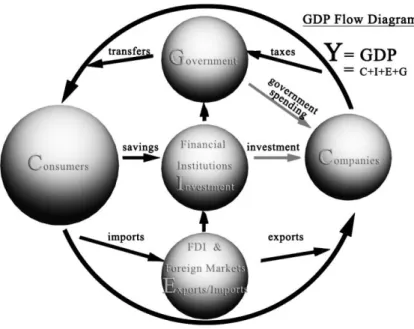
Figure 3.1: GDP Flow Diagram ...43
3.5 Conclusion...46
CHAPTER 4: IFRS IN A GLOBAL ECONOMY: ASIA ...47
4.1 THE IMPACT OF IFRS IN A GLOBAL ECONOMY: JAPANESE CASE ...47
4.11 Introduction to Japan ...47
4.12 Historic Accounting in Japan ...48
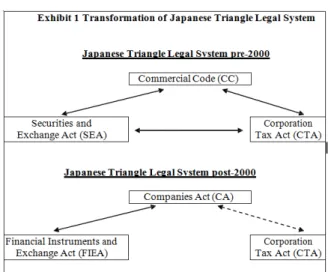
Figure 4.11: Pre and post 2000 Triangular Legal System ...50
4.13 IFRS Accounting in Japan ...51
Figure 4.12: Taki Graph ...52
4.15 Reporting Reliability in Japan ...53
4.16 Reporting Transparency in Japan ...54
4.17 Multi-Agency in Japan ...54
Figure 4.13: Multi-Agency Model for Japan ...55
4.18 Game Theory, Moral Hazard and Asymmetric Risk in Japan...55
4.19 Summary of Japan ...56
4.2 THE IMPACT OF IFRS IN A GLOBAL ECONOMY: CHINESE CASE ...58
4.21 Introduction to China...58
4.22 Historic Accounting in China ...59
4.23 IFRS Accounting in China ...60
Figure4.11: IFRS Foundation: Reporting Standard Utilization in China ...61
4.24 Reporting Quality in China...64
4.25 Reporting Reliability in China ...65
4.26 Reporting Transparency in China ...65
4.27 Multi-Agency in China ...66
Figure 4.22: Multi-Agency Model for China ...67
4.28 Game Theory, Moral Hazard and Asymmetric Risk in China ...67
Figure 4.23: Multi-Agency Model for China ...68
4.29 Summary of China...69
4.3 THE IMPACT OF IFRS IN A GLOBAL ECONOMY: RUSSIAN CASE ...71
4.31 Introduction to Russia...71
4.32 Historic Accounting in Russia ...72
4.33 IFRS Accounting in Russia ...73
4.34 Reporting Quality in Russia ...74
4.35 Reporting Reliability in Russia ...75
4.36 Reporting Transparency in Russia ...75
4.37 Multi-Agency in Russia ...76
4.38 Game Theory, Moral Hazard and Asymmetric Risk in Russia ...77
4.39 Summary of Russia ...79
4.4 THE IMPACT OF IFRS IN A GLOBAL ECONOMY: INDIAN CASE ...81
4.41 Introduction to India ...81
4.42 Historic Accounting in India ...81
4.43 IFRS Accounting in India ...83
4.4 Significant Carve-Outs ...84
4.45 Reporting Quality in India ...85
4.46 Reporting Reliability in India ...86
4.47 Reporting Transparency in India ...87
4.48 Multi-Agency in India ...88
4.49 Summary of India ...91
CHAPTER 5: IFRS IN A GLOBAL ECONOMY: AMERICAS ...93
5.1 THE IMPACT OF IFRS IN A GLOBAL ECONOMY: BRAZIL CASE ...93
5.11 Introduction to Brazil ...93
Figure 5.11: Brazil’s Economic Volatility – Commodity Economy ...93
5.12 Historic Accounting in Brazil ...95
5.13 IFRS Accounting in Brazil ...96
Figure 5.12: Brazil’s Inflation levels Rising – Hyperinflation coming? ...98
5.14 Reporting Quality in Brazil ...98
5.15 Reporting Reliability in Brazil...99
5.16 Reporting Transparency in Brazil ...100
5.17 Multi-Agency in Brazil...100
Figure 5.13: Standard Multi-Agency Model for Brazil...101
5.18 Game Theory, Moral Hazard and Asymmetric Risk in Brazil ...102
5.19 Summary of Brazil ...103
5.21 Introduction ...104
5.22 Historic Accounting in the US...105
Figure 5.21: Global Stock Markets by size...107
5.23 IFRS Accounting in the US ...108
Figure 5.22: World Capitalization by Accounting Standard ...108
5.24 Contentions between IFRS and US GAAP ...110
5.25 Reporting Quality ...111
5.26 Reporting Reliability ...112
5.27 Reporting Transparency ...113
5.28 Multi-Agency in the US ...113
Figure 5.23: Standard Multi-Agency Model for the US ...114
5.29 Game Theory, Moral Hazard and Asymmetric Risk in the US ...114
5.210 Summary – The US ...116
6.1 THE IMPACT OF IFRS IN A GLOBAL ECONOMY: EU CASE ...117
6.2 Introduction to the European Union ...117
Figure 6.1: Standard Methods of Accounting in the EU ...117
6.3 Historic Accounting in the UK ...119
6.4 Historic Accounting in Germany ...120
6.5 Historic Accounting in Italy ...121
6.6 Historic Accounting in France ...122
Figure 6.2: The Accounting Basis for EU and other Countries. ...124
6.7 IFRS Accounting in the EU ...125
6.8 Reporting Quality ...126
6.9 Reporting Reliability in the EU ...127
6.10 Reporting Transparency in the EU ...127
6.11 Multi-Agency in the EU ...128
Figure 6.3: Standard Multi-Agency for the EU ...129
6.12 Game Theory, Moral Hazard and Asymmetric Risk in the EU...130
6.13 Summary – the EU ...131
CHAPTER 7: THE IMPACT OF IFRS ON GDP AND FDI FIGURES ...133
7.1 Section Description ...133
Table 7.21 The Impact of IFRS Acceptance on GDP and FDI in the Japan ...135
Graph 7.21 The Impact of IFRS Acceptance on GDP and FDI in Japan ...136
7.2 Japan – Analysis of the Impact of IFRS Acceptance on GDP and FDI ...137
Table 7.31 The Impact of IFRS Convergence on GDP and FDI in China ...138
Graph 7.31 The impact of IFRS Convergence on GDP and FDI in Chinaa ...139
7.3 China - Analysis of the Impact of IFRS Convergence on GDP and FDI ...140
Table 7.4 The Impact of IFRS Acceptance on GDP and FDI in India ...142
Graph 7.4 The Impact of IFRS Acceptance on GDP and FDI in India ...143
Graph 7.4 The Impact of IFRS Acceptance on GDP and FDI in India ...143
7.4 India – Analysis of the Impact of IFRS Acceptance on GDP and FDI ...144
Graph 7.5 The Impact of IFRS Convergence on GDP and FDI in Russia ...146
7.5 Russia – Analysis of the Impact of IFRS Convergence on GDP and FDI ...147
Table 7.61 The results of GDP and FDI under an IFRS non-adopter, the US ...148
Graph 7.61 The Results of GDP and FDI under an IFRS non-adopter, the US ...149
7.6 US – Analysis of GDP and FDI under an IFRS non-adopter ...150
Table 7.71 The Impact of IFRS Convergence on GDP and FDI in Brazil ...152
Graph 7.71 The Impact of IFRS Convergence on GDP and FDI in Brazil ...153
7.7 Brazil – Analysis of the Impact of IFRS Convergence on GDP and FDI ...154
Table 7.81 The Impact of IFRS Adoption on GDP and FDI in Germany ...155
Graph 7.81 The Impact of IFRS Adoption on GDP and FDI in Germany ...156
7.8 Germany – Analysis of the Impact of IFRS Adoption on GDP and FDI ...157
Table 7.91 The Impact of IFRS Adoption on GDP and FDI in the UK ...158
Graph 7.91 The Impact of IFRS Adoption on GDP and FDI in the UK ...159
7.9 UK – Analysis of the Impact of IFRS Adoption on GDP and FDI ...160
Table 7.10 The Impact of IFRS Adoption on GDP and FDI in France ...161
Graph 7.10 The Impact of IFRS Adoption on GDP and FDI in France ...162
7.10 France – Analysis of the Impact of IFRS Adoption on GDP and FDI ...163
Table 7.11 The Impact of IFRS Adoption on GDP and FDI in Italy ...164
Graph 7.11 The Impact of IFRS Adoption on GDP and FDI in Italy ...165
7.11 Italy – Analysis of the Impact of IFRS Adoption on GDP and FDI...166
7.12 Summary ...167
CHAPTER 8: THE IMPACT OF IFRS ON FINANCIAL RATIOS and Conclusion ...168
8.1 Description ...168
8.2 Financial Ratios ...169
Current Ratio ...169
Quick Ratio ...170
Debt Equity Ratio...170
Return on Equity ...170
8.4 German Companies - IFRS and GAAP Financial Ratio Observations ...173
Figure 8.5 - Top 30 French Companies – IFRS and GAAP Ratio Change Comparison ...174
8.6 French Companies - IFRS and GAAP Financial Ratio Observations ...175
Figure 8.7 - Top 30 British Companies – IFRS and GAAP Ratio Change Comparison ...176
8.8 British Companies - IFRS and GAAP Financial Ratio Observations ...177
Figure 8.9 - Top 30 Italian Companies – IFRS and GAAP Ratio Change Comparison...178
8.9 Italian Companies - IFRS and GAAP Financial Ratio Observations ...179
8.10 Summary of Impact of IFRS on Financial Ratios ...180
8.11 Conclusion...181
8.16 Limitations of this Study and IFRS adoption...182
8.16 Future Research Opportunities ...184
Bibliography ...185
Appendix 1 World Bank – DataBank - Key Definitions ...207
Appendix 2 Financial Ratio Formulas ...226
Appendix 3 Top 30 Globally Listed Companies per Economy ...227
Appendix 3.1 Key Definitions for Top Listed Companies ...227
Appendix 3.2 Top Listed Companies in America (Global Rank 1) ...228
Appendix 3.3 Top Listed Companies in China (Global Rank 2) ...231
Appendix 3.4 Top Listed Companies in Japan (Global Rank 3) ...234
Appendix 3.5 Top Listed Companies in Germany (Global Rank 4) ...237
Appendix 3.6 Top Listed Companies in France (Global Rank 5) ...240
Appendix 3.7 Top Listed Companies in the UK (Global Rank 6) ...243
Appendix 3.8 Top Listed Companies in Brazil (Global Rank 7) ...246
Appendix 3.9 Top Listed Companies in Russia (Global Rank 8) ...249
Appendix 3.10 Top Listed Companies in Italy (Global Rank 9) ...252
1 | P a g e
CHAPTER 1: INTRODUCTION
1.1 Background
This chapter presents background information regarding global IFRS implementation. The chapter begins by discussing the history of IFRS and its ever growing popularity and continues on to discuss the necessity of a global set of standards and the benefits that may result from it. Additionally, the challenges of implementing global accounting standards are discussed and a case for the role of Agency Theory in establishing IFRS is presented. This chapter also alludes to my theory of multi-agency, a substantial relationship that underscores the development and establishment of a single set of accounting rules across countries which have long been governed by local or national GAAPs. This chapter brings to the forefront the main problems which are under investigation and presents essential data for analyzing other issues in later chapters such as the effects of IFRS at the macro-economic level. What will changes in reporting standards do to the data companies present to investors? If full adoption is the goal and were successfully achieved, including IFRS as a tax base, what would occur as the standards are implemented? How would company data be reinterpreted, what effect would this have on FDI? How would government tax revenue be affected? In turn, how would the combination of changes in FDI and tax revenue affect the health of the nation, or in a more simple term, how would GDP be affected? These are just some of the major concerns being addressed that will greatly enhance the highlight the significance of the study.
So what are IFRS, they’re a set of global international accounting standards designed to help equalize financial reporting globally. In the past several decades IFRS have continued to garner global support and have been implemented throughout the world. This accounting revolution began as an effort by industrialized nations to create a set of accounting standards that could be easily implemented by smaller nations that were unable to create their own. However, as the world became more global, regulators, investors, companies, and auditing firms began to realize the vital importance of a common set of accounting standards. (AICPA1)
2 | P a g e International accounting standards first came to prominence during the late 60s and early 70s but only really started to gain momentum in the last few decades. Since then there have been numerous attempts to implement some form of global harmonization or standardization in an attempt to simplify financial markets internationally and encourage capital investment. It is important to note that there is a significant difference between the term harmonization and standardization. Harmonization attempts to move away from diverse forms of accounting towards a common standard, while standardization on the other hand is agreement between various governing entities to utilize the same accounting standards (Ellwood, 2016). In either case the objective, in short, is to provide financial information that is useful in making decisions regarding buying and selling or holding equity and debt instruments, and providing or settling loans and other forms of credit (Ellwood, 2016). Additionally International Financial Reporting Standards (IFRS) reduce information asymmetry, reduce home country bias and thereby enhancing the appeal for foreign investors. With that in mind, simply attaching the label of IFRS is insufficient to procure foreign investors. The research of Hansen et al, shows a strong correlation between company transparency and foreign investment and further demonstrates that IFRS adoption can mitigate the extent of home bias when applied rigorously (Hansen et al., 2013).
“The objective of financial statements is to provide information, about the financial position, performance, and changes in financial position of an entity, that is useful to a wide range of users in making economic and investment decisions” (KMPG). The use of IFRS has the potential to reduce earnings manipulation and improve stock market efficiency. According to recent research, there is no question that IFRS adoption provides various benefits by enhancing comparability of financial statements, lowering transaction costs, providing access to international capital, and increasing international investment (Dunne et al., 2008). Higher quality accounting and transparency enable investors to make informed decisions, as they attempt to predict the firm’s future performance.
The information provided by annual reports is used for analysis and decision-making purposes. Due to variations among accounting methods, legal systems and cultures, the data is often presented in contrasting
3 | P a g e ways that can be misleading when comparing financial data between companies. Despite this challenge, a wealth of information is provided in these reports which enable useful comparisons to be made. In comparing these reports it is essential to insure that the accounting practices do not differ to an extent that the comparisons are meaningless. Though the trend toward globalization continues to hold sway and the move towards a single set of standards looks ever closer, regional accounting will continue to play a notable role.
Today, more than 174 jurisdictions throughout the world are utilizing some form of IFRS for accounting purposes. Many jurisdictions still utilize their own local GAAP. However, they claim that it is based on, similar to, or converged with IFRS. (Deloitte1) throughout most of Europe IFRS is the accounting standard utilized for both reporting and statutory filings. In other jurisdictions such as the US however, IFRS are used simply for reporting to investors and hold no bearing on statutory filings. While the United States is not formally adopted IFRS has stated that its accounting practices under US GAAP are equivalent to IFRS Via Convergence. Similarly other major economies such as Japan India and China have yet to fully adopt, however, they are steadily working towards convergence. (PriceWaterhouseCoopers1, 2014)
1.2 Why Hasn’t the World Standardized
The reason for the delay in implementing IFRS globally is that the standards have the potential to affect financial figures and reporting throughout companies, industries and economies. IFRS becomes extremely important when we consider common issues such as capital fundraising which has become a very international activity. Given that most nations utilize some form of local generally accepted accounting principles (GAAP), it is extremely challenging, for international investors to effectively evaluate the quality of a company and understand its financial position. By standardizing the reporting method, international investors are able to make more informed decisions and better understand the complex dealings of multinational corporations (PriceWaterhouseCoopers1, 2014). The research of Maines et al. provided a splendid example of the differences when investors compare companies via return on equity (ROE). If for example, Glasco SmithKline’s financial statements are prepared under GAAP and Smith and Nephew’s
4 | P a g e financial statements are prepared under IFRS, then GSK will show and an ROE of 12.9% as compared to a more attractive ROE of 34.3% for S&N. If we were to reverse the circumstances however, under IFRS, GSK’s ROE would be 58.6% versus 31.8% for S&N. (Maines et al., 2009)
(Figure 1.1: One World - One accounting-page 532)
1.3 Objective
IFRS are designed to equalize reporting standards globally by bringing reporting transparency to FDI. This study aims to identify; 1) implementation and IFRS compliance among companies, 2) changes in reporting under IFRS, 3) the impact of IFRS on financial ratios as a means of observing shifts in leverage, and 4) the impact of these changes on GDP statistics, and key economic indicators for FDI. In pursuing this research the author has also demonstrates the inseparable relationship between investors, companies and governments and puts forth that the future success of IFRS requires a properly functioning multi-agent relationship.
1.4 Motivation
My primary motivation was to identify the realistic value or impact of IFRS at the macro level. I undertook this research task to fill a large research gap in our knowledge of the macroeconomic impact of IFRS implementation. My second motivation is to understand the real impact IFRS might have if implemented for statutory information filing to include taxation. It is my hope that better understanding this information could
5 | P a g e be beneficial to countries still contemplating or holding back from the shift to IFRS. This information will present a basis for analyzing the effect IFRS on macro economies and the shifts that could potentially accompany full IFRS adoption by the top global economies.
1.5 Research Problems
What impact would IFRS implementation have on global economies, what would they do to the macroeconomic environment?
There have been few research studies which reviews the relationship between Financial Ratios and GDP, there is a large information gap related to the affect IFRS will have on companies, investors, and economies in the macroeconomic environment. My research aims to examine the changes IFRS adoption may cause on company reporting and GDP. My study contributes to professionals around the world by providing in-depth information that can influence managerial decisions related to IFRS implementation, economic and corporate health and indicators for Foreign Investors.
1.6 Research Questions
There are a number of questions that the topic of IFRS poses for any country contemplating adoption. But perhaps some of the most relevant would be to answer how IFRS affect financial indicators and would they have a notable impact on FDI? Even more specifically, if IFRS were implemented, how would the changes in financial reporting affect GDP? To reach these vital questions we might first have to discover and understand the factors which are limiting adoption and preventing implementation which leads the author to ask whether there is an Agency relationship. If we look at the effect of IFRS on national economic data, or rather if we analyze the macro-economic impact, will it be influenced by the implementation of IFRS? If both financial reporting figures as well as national macro-economic data are being affected by IFRS how might this shift the data present to and analyzed by the investors?
6 | P a g e If full adoption is the goal and were successfully achieved, what would occur as the standards are implemented? How would company data be reinterpreted, what effect would this have on FDI? How would government tax revenue be affected? In turn, how would the combination of changes in FDI and tax revenue affect the health of the nation, or in a more simple term, how would GDP be affected? These are just some of the major concerns being addressed that will greatly enhance the overall significance of the study.
1.7 Hypothesis
To address these questions and guide the research in an organized fashion, four hypotheses are put forth to be validated or disproven in turn. The first, H1: IFRS can alter financial ratios significantly. This is a primary one to consider as the influence of IFRS are financial reporting has the power to influence both management and investor decisions and therefore is a point worth clarifying before adoption is even considered. Next, H2: IFRS implementation applied to the largest companies, by revenue, within an economy can affect GDP significantly. If IFRS can affect the ratios to question whether they can impact the another major metric for investment considerations, a countries GDP. Assuming H2, then research seeks to address H3: IFRS implemented across a global economy for statutory filing can shift economic wealth. Finally, the author puts forth H4: Successful IFRS implementation needs cooperation from investors, companies & governments. This is essential to understanding the relationships between the primary actors in IFRS implementation and understanding what the influences at each level. Additionally, failure in the agency relationship would constitute a failure in the utilization of IFRS and ultimately endanger investors as they’ve drawn by the promise of transparency afforded by IFRS and a violation of agency would ultimately be a violation of investor considerations, a condition best identified quickly.
7 | P a g e
1.8 Research Methodology
This research focuses on accomplishing three primary tasks. The first is to present the basis of the author’s theoretical model, hence forth referred to as multi-agency. The purpose and value of this model comes in helping to assess the relationships between investors, companies and governments. It is not a tool of calculation but rather a tool of analysis. Though a tool of original creation based on game theory and classic agency, it was later found to encompass and combine interest theory, group theory and the Haber mas’ approach into one comprehensive reasoning tool that can help assess a countries’ investment worthiness as well as help clearly identify factors that may present challenges or barriers to IFRS adoption.
Next, a historical analysis of the accounting systems of the sample selection is presented. It presents the background and history of economics and society that have shaped the more modern day accounting standards and helps to clarify the challenges faced by non-adopters. It further presents details about the quality of the accounting systems, their level of transparency and enforcement as well as utilizes the multi-agency model to analyze potential IFRS implementation failures and barriers to proper application. This helps to establish proof as to why convergence tends to be the elected choice of implementation.
Finally, this research analyzes shifts in GDP and financial data for the top 10 global economies and their top 25 listed companies, in the years of IFRS adoption and the 2012 fiscal year. It attempts to determine whether IFRS based information, if utilized in statutory reporting could potentially shift financial ratios or GDP figures and ultimately impact economic and corporate valuations and FDI.
1.9 Theoretical Framework
This study is based on extensive literature review which supports the author’s assumptions on the effects of IFRS in a global economy as well as the existence of Multi-agent relationships which plays a key role in and the implementation of IFRS. The relationship at the microeconomic and macroeconomic levels is evaluated to
8 | P a g e determine the current level of accounting quality and the benefits IFRS may present. Moreover, the model empirically examines data collected from companies, global financial analysis data from organizations such as the World Bank and International Monetary Fund (IMF) as well as the data presented by IFRS development bodies.
The framework of this research assumes the implementation of IFRS will improve the quality of accounting information and that this will ultimately translate to increased foreign investment. The underlying assumption that undermines this possibility is the existence of the multi-agency relationship which demonstrates the difficulties that threaten foreign investment and standard adoption by government entities. The quality of financial information provided in financial statements is highly relevant to for both the investors and the governing agencies and unquestionably influential in relation to the user’s decisions as relevant information has confirmatory or predictive value as they demonstrate historical patterns for current and past market and corporate activities.
The analysis performed in this study demonstrates the effects of IFRS adoption following implementation and presents realistic demonstrations of the potentially likely outcomes of IFRS implementation. At the same time, it demonstrates to other financial users the pitfalls of the IFRS hype and presents proof that while ideally adoption should present primarily benefits, in some cases it can be used to the detriment of investors and other users of financial information. The data is not always presented appropriately and in good faith thus reducing the comparability, transparency, and relevance of the data.
Within the framework and conceptual issues presented in this study we will address the hypotheses are develop a clearer understanding of the relationship between the adoption of IFRS and the factors that influence the decision and adherence to the IFRS model. The first study will deals with establishing a viable basis for the existence of the multi-agency model and demonstrating the validity it presents in determining decisions for all parties involved in the process of IFRS adoption and usage. It focused on showing the relationships between the parties their overlapping interests as well as the asymmetric information problems
9 | P a g e that hinder IFRS adoption efforts. This is accomplished in conjunction with three pre-existing theories that support and validate the model created by the author. Though identified after the initial multi-agent model was presented, the three theories, if used in conjunction, can provide the same evaluation capabilities as the multi-agency model.
The second stage closely analyzes the regional economies and identifies the cultural, societal and political factors that make create a fertile environment for meaningful IFRS implementation or conversely highlight the shortcomings that might indicate and illegitimate attempt to implement IFRS. Specifically the historical accounting for each economy is looked at as well as the current practices and an evaluation of transparency practices. The aim of the section being is to show the realistic results and evaluate the effectiveness of implementation.
The third section focuses on historical proof to present proof that IFRS adoption has a notable impact on economic markets. By analyzing IMF data of a historical periods preceding and following he point of adoption , we are able to clearly see market trends and make reasonable assertions about the effect IFRS implementation played in the market results.
Finally, by comparing statutory financial ratio data present by Reuters and comparing it to IFRS based calculations we are able to present further proof of the substantial effect IFRS pose on markets and market players. It serves as a further support for the data presented in the World Bank data and demonstrates from a direct vantage point, that of the investors, the influential impact of IFRS on macroeconomic data used for investment and adoption decisions.
1.10 Contribution
Generally, the findings from this study contribute to the ongoing debate on whether the adoption of IFRS enhances the quality of financial reporting by providing evidence from a macroeconomic vantage point. The
10 | P a g e study examines the effect of implementing IFRS and could be useful to contribute to accounting harmonization literature in on a global level. The study provides insight into issues that influence policy makers and guide the decision making process. For instance, this study will demonstrate via the effects of IFRS implementation on the 2012 financial statements, disclosures and other accounting information.
The findings may also be relevant to international regulators and institutions involved in the process, since the results provide example of how firms required to applying IFRS have approached the process in specific country. The finding may be beneficial in meeting the IASB’s objective, particularly its third objective ‘to promote convergence between national accounting standards and IFRS’ has been accomplished in developing countries. The results of this study can also be used to better comprehend the extent of harmonization of IFRS among developed economies so that the IASB can devise more suitable strategies and apt accounting standards. In short, this research contributes to the global discussion on the effect of IFRS-based accounting standards in a macro setting.
1.11 Structure of Thesis
This dissertation is divided into e chapters. The remainder of Chapter 1 presents the author’s case for the role of Agency Theory in establishing accounting standards and implementing them. This chapter also alludes to the existence of a more substantial relationship, henceforth referred to as multi-agency, that underscores the development and establishment of a single set of accounting rules across countries which have long been governed by local or national GAAPs. This brings to the forefront the main problems which are under investigation. Chief among these being what affect will IFRS have at the macro-economic level. What will changes in reporting standards do to the data companies present to investors? If full adoption is the goal and were successfully achieved, what would occur as the standards are implemented? How would company data be reinterpreted, what effect would this have on FDI? How would government tax revenue be affected? In turn, how would the combination of changes in FDI and tax revenue affect the health of the nation, or in a
11 | P a g e more simple term, how would GDP be affected? These are just some of the major concerns being addressed that will greatly enhance the overall significance of the study.
Chapter 2 gives in-depth information which explains the need for international financial reporting standards, a review of studies which provide a basis for the construction of a model or theoretical framework, related to the effects of IFRS implementation on company financial reporting information, which will also serve as a basis for this study’s hypothesis, and finally the need for a well-defined understanding of the broad reaching affects IFRS will have on a global macroeconomic scale.
Chapter 3 discusses IFRS implementation and the affect it has on company financial reporting. It looks closely at the strongest publically listed companies within the top economies and demonstrates the varying effects of IFRS on financial figures in contrast to those prepared under traditional models such as US GAAP and other popular reporting standards. In each case the most influential IFRS for each company will be closely examined in order to assess the greatest impact on financial figures.
Chapter 4 analyzes the history of accounting in the China, Japan, Russia and India to better understand the factors to influence accounting methods.
Chapter 5 analyzes the history of accounting in the US and Brazil to better understand the factors to influence accounting methods.
Chapter 6 analyzes the history of accounting in the EU to better understand the factors to influence accounting methods.
12 | P a g e Chapter 7 analyzes the impact of IFRS on GDP, FDI and other Economic indicators among the sample economies in this study.
Chapter 8 contains a financial ratio comparison and analysis for the EU countries included in this study. It concludes with a final summary of the study’s findings and discloses conclusions drawn from the findings. A discussion of any challenges faced in pursuing this research as well as recommendations for further study will also be included.
13 | P a g e
CHAPTER 2: AGENCY AND LITERATURE REVIEW
2.1 The Role of Agency Theory
The theory of agency was developed independently by both Stephen Ross and Barry Mitnick in 1973. Ross is credited with originating the theory of agency in the area of economics. He clearly identified the agency problem as being generic to society. Ross's approach focused on the problems innate within agency relationships and identified significant existing problems and variables dealing with them as a decision based incentive problem, ignoring the components that wholly constituted the agency relationship. Mitnick concurrently developed the institutional theory of agency. His approach, while overlapping in areas, focused primarily on the relationships within institutions, specifically focusing upon the relationship between managers and employees. Their works are essentially parallels and both avenues of research stem from basic imperfections found in agency relationships (Mitnick, 2013). To fully understand the theory of agency it is important to consider both economic and institutional theories.
The theory of agency is a supposition that explains the relationship between principals and agents in business. Agency theory is primarily concerned with resolving problems that exist in agency relationships; that is, between principals (such as shareholders) and agents of the principals (for example, company executives).
Agency theory addresses two concerns: “the problems that arise when the desires or goals of the principal and agent are in conflict and the principal is unable to verify the agent's actions.’ and ‘the variance n risk tolerance which may lead the principal and agent to take different actions” (Caers DuBois, et al.2013).
14 | P a g e
Figure 2.1: Standard Principle-Agent Example
The theory of agency derives its basis from the law of agency which is defined as a consensual relationship created by contract or by law where one party, the principal, grants authority for another party, the agent, to act on behalf of and under the control of the principal to deal with a third party. An agency relationship is fiduciary in nature and the actions and words of an agent exchanged with a third party bind the principal (DeMott, 2003). One important factor to note is that in a simplistic agency model there is only one point of information asymmetry.
But perhaps we might more specifically define agency as a situation wherein an agent acts on behalf of a principal within the scope of his authority which has been granted to him expressly or can be implied from the circumstances. The Agent’s actions bind the principal and the third party unless it follows from the circumstances of the case that the agent under takes to bind himself only (Easley and Kleinberg, 2010). The theory of agency is plagued by the problem of information asymmetry; a situation in which one party in a transaction has more or superior information than another. This causes potentially harmful situations because one party can potentially take advantage of the other party's lack of knowledge (Akerlof, 1970). Management and investors are constantly in need of vast amounts of high quality data thus enabling them to make well informed decisions that minimize risk and maximize return. Time and cost constraints often make perfect information impossible and the pursuit of it unrealistic. Information asymmetry is inevitable. Even if two
15 | P a g e parties are granted access to the same information, there is generally private information which will not be shared. Even if both parties were to receive the private information, the interpretation and extraction of useful details from the information would be unlikely to yield equivalent results, ultimately leading to agency costs.
2.2 AGENCY OR STEWARDSHIP
For the purposes of this paper, explanation is limited to the examination of information asymmetry between companies, financial markets, and government, focusing on information asymmetry and assuming ‘There is goal conflict between the principal and the agent.’ “Agents have more information than principals, which can be exploited for self-gain” (Van Slyke, 2007). At this point, it is important to mention another viable theory as well. A case for the application of stewardship theory could be argued as an alternative to a standard principal-agency approach. Stewardship theory holds that managers, left on their own, will indeed act as responsible stewards of the assets they control. In American politics, an example of the stewardship theory might be a president governing based on their belief that their duty is to do whatever is necessary in national interest, as opposed to one group or body (Marguiles, 2014). Though it could be argued that bureaucracy is better approached by way of stewardship theory, an evolved principal-agent relationship often develops, which mirrors some of the practices put forth under stewardship theory (Van Slyke, 2007).
Both agency theory and stewardship theory deal largely with trust and a belief, one way or another, as to whether agents work for the benefit of the principal or whether they require more specific motivation. Agency theory, in its assumption that an agents' self-interest will interfere with principals agenda deals largely with incentive programs for aligning interests. Stewardship is more often than not applicable in instances where financial remunerations are not possible and the currency of incentive is instead, replaced by the status of reputation. This is most readily seen in the relationship between politicians and constituents.
Failure to adhere to the agenda of constituents can lead to significant and immediate consequences, perhaps chief among them being the destruction of reputation which acts as a sanction. This same incentive "scheme" can be applied in instances of evolved agency relationships. Agents achieve reward in the form of
16 | P a g e enhanced reputation and sanction in the form of damaged credibility. In instances such as bureaucratic oversight where market share maybe devoid of competition, diminished reputation may have no adverse effect on a provider's opportunity for continued contracting in the way that agency theory suggests that it should (Van Slyke, 2007).
2.3 Establishing the Principal-Agent Relationship
In a traditional principal-agent relationship, such as that observable between shareholders, i.e. investors, and the management of listed companies, shareholders act as the principal and invest in a company expecting an acceptable return on their investment in the form of dividends or similar remuneration. In contrast, managers are interested in maximizing their own gains which are most often achieved by maximizing the profit of the company. The contrasting interests are usually overcome by means of incentive plans. Examples include; the granting of stock, stock options, and bonuses to promote practices that align managers interests with of the investors (Zhang, et al. 2008).
It can be argued that a similar situation exists between investors and government or bureaucrats. Investors desire to maintain all of the benefits and protections of government. Taxes are levied against them in order to fund these efforts. The investors, i.e. constituents, expect government and their elected bureaucrats to work in their best interest. Individuals or groups prefer optimizing their own gains to sacrificing for the benefit of another individual or collective. Therefore agents will often pursue actions that benefit them, regardless of the consequences inherent to the principals (Meckling, 1976).
Although governments, or bureaucrats, act in the role of agents, history has repeatedly demonstrated that in the political arena, self-interest tends to prevail over principal interest. Additionally with so many elected bodies being pressured from various angles, it is difficult to ensure that a principal’s needs are met at all. Furthermore, the extent to which government works in the interest of principals often extends only as far as will secure the continued patronage of the principal while ensuring government interests are protected.
17 | P a g e It is here that we are forced to diverge from a standard principle-agent problem and advance to a multi-agent problem. Often you see government or companies mentioned as the principal in an agency problem. In contrast this multi-agent problem displays both as agents of investors. It clearly demonstrates that information asymmetry, agency cost, and conflicting interests; assert their presence in the equation.
2.4 Multiple-Agency
Agency relationships often have significant information asymmetry. Such relationships are at their most asymmetric point when basic agency theory breaks down. Preferences are unknown or go unsatisfied, contracts are not formulated, incentives are not fashioned, monitoring goes un-mobilized, and sanctions are not levied (Shapiro, 2005). In regards to a regulating body, investors are often left with the SEC or other similar agencies, to ensure their protection and uphold their expectations. However, the investors do have some control of the legislators that govern the SEC and can thereby influence matters in that way. As far as the selection of their other agent in this scenario, investors always have their choice of which company to entrust their investment to. Ultimately a successful principal-agent relationship should decrease uncertainty and Agency Cost and adhere to the interests of the principal.
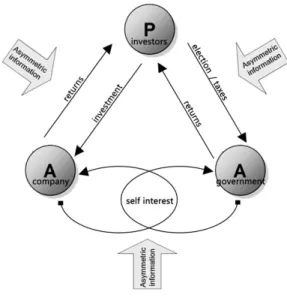
The difficulty that arises in a multiple-agent problem, especially in this example, is that agents often have competing interests. Companies are not necessarily eager, but are often willing to undertake actions, such as the adoption of IFRS. The potential increase in foreign investment is a significant incentive for them to do so. Companies do face the risk of increased taxation; however the benefits can potentially outweigh the drawbacks of open disclosure. An important variation point to note in the multi-agent model, is that unlike the standard agency model which has only one point of information asymmetry, the multi-agent model has no less than three points which drastically complicates any engagements between parties.
18 | P a g e
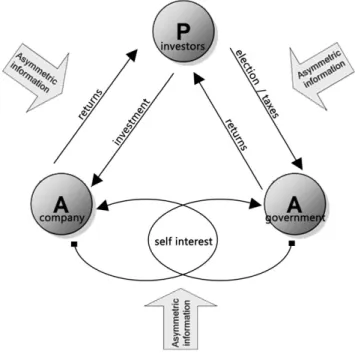
Figure 2.2: Multi-Agent Example
2.5 Modified Multiple-Agency
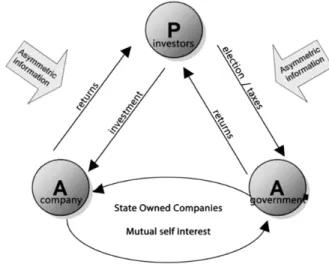
Agency relationships often have significant information asymmetry. Such relationships are at their most asymmetric point when basic agency theory breaks down. Preferences are unknown or go unsatisfied, contracts are not formulated, incentives are not fashioned, monitoring goes un-mobilized, and sanctions are not levied (Shapiro, 2005). In regards to a regulating body, investors are often left with the SEC or other similar agencies, to ensure their protection and uphold their expectations. However, the investors do have some control of the legislators that govern the SEC and can thereby influence matters in that way. As far as the selection of their other agent in this scenario, investors always have their choice of which company to entrust their investment to. Ultimately a successful principal-agent relationship should decrease uncertainty and Agency Cost and adhere to the interests of the principal.
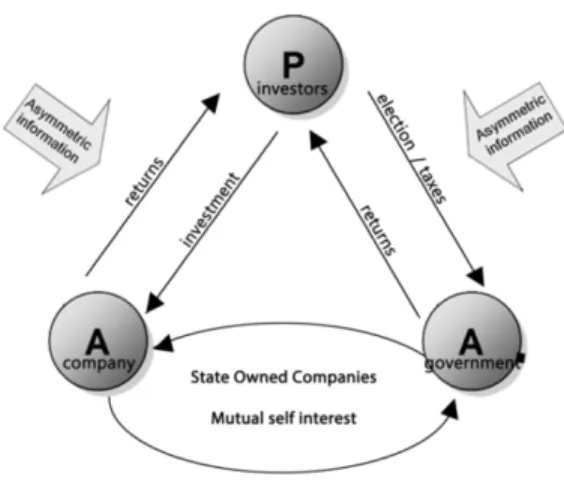
The difficulty that arises in a multiple-agent problem, especially in this example, is that agents often have competing interests. Companies are not necessarily eager, but are often willing to undertake actions, such as the adoption of IFRS. The potential increase in foreign investment is a significant incentive for them to do so. Companies do face the risk of increased taxation in the future; however the benefits can potentially outweigh the drawbacks of open disclosure. Important to note is the reduced information asymmetry present
19 | P a g e in a modified multi-agent model. As the interests of the state run enterprise and the state can general be said to coincide with one another’s agenda.
2.6 Agency Costs
We can at this point, readily identify a clear example of the potential costs involved. The adoption of IFRS would require governments to give up considerable control of their sovereign taxation rights, potentially reducing their income tax receipts. This is a strong disincentive for the official adoption of IFRS over a country's established GAAP.
All agency relationships are encumbered by agency costs. Agency costs are defined as a type of internal cost that arises from, or must be paid to, an agent acting on behalf of a principal. Agency costs arise because of core problems such as conflicts of interest between shareholders and management. Shareholders wish for management to run the company in a way that increases shareholder value. But management may wish to grow the company in ways that increase their personal power and wealth and are not necessarily in the best interests of shareholders (Meckling, 1976). It is important to realize that there will always be divergence between an agent’s decisions and those decisions which might benefit the welfare of the principal. This
20 | P a g e residual loss should always be expected and cannot be completely eliminated outside of a theoretical perfect principal-agent relationship.
Various agency costs exist, however, for the purpose of this article we will limit our mention to adverse selection and moral hazard, both of which deal with market failure. Adverse Selection may be defined as: A phenomenon wherein the one party is confronted with the probability of loss due to unknown risk which were not factored in at the time of sale (Young, et al. 2011). Moral Hazard may be defined as: The risk that a party to a transaction has not entered into the contract in good faith, has provided misleading information about its assets, liabilities or credit capacity, or has an incentive to take unusual risks in a desperate attempt to earn a profit before the contract settles (Research and Guidance Committee, 2013).
For our purposes we can say that adverse selection occurs when a party, most commonly the agent, has better information than the other party, generally the principal, prior to the establishment of an agency relationship. This allows the party with the better information, in this case the agent, to act opportunistically prior to the establishment of any binding obligation. In an instance of moral hazard the party would act opportunistically after the establishment of a binding obligation. A simple example which demonstrates adverse selection would be investors receiving information procured by the SEC. Such information would have been procured through independent audit demonstrating that a firm was adhering to GAAP and disclosing accurate details related to sales, assets, and earnings. Bad firms sometimes slant their information to improve the outlook to investors which in turn causes adverse selection for investors. That money could have been invested in a better firm if the investors possessed more accurate information.
An example of moral hazard on the other hand, can be shown in the form of a firm selling stock under the guise of investing in valuable assets but instead using those funds to pay off retirement debt. Without strong safeguards in place for both parties to enforce obligations, there is the strong possibility for deceit and misappropriation.
Figure 2 demonstrates the complexity of introducing a second agent to a relationship. The areas in-between principals and agents are where asymmetric information lies. The lower half of the figure
21 | P a g e demonstrates overlapping or competing interests between agents. Some examples of asymmetric information utilized in a multi-agent problem might be controversial legislation, or the leaking of information between agent and principal in regards to other agents (Shapiro, 2005).
2.7 Aligning Interests and Agent Remuneration
Where government involvement is concerned we are forced to consider the impact of International Financial Reporting Standards on tax revenues. Beyond tax revenue, governments do not have profits or monetary gains to distribute among public agencies or politicians for adhering to the interests of a principal. There are many metaphors which clearly demonstrate this fact. Politicians seek to obtain votes, bureaucrats need big budgets.
Policy commitments often undermine the expectation of goal conflict resolution between principals and agents (Shapiro, 2005). When dealing with political entities, remunerations are usually conferred in the form of reputation or sanction. Proof of the government interest in lost revenue can easily be seen in the current case being made against Caterpillar Inc. The US government is alleging that Caterpillar has deferred or avoided billions of dollars in tax liability over the past decade. This was accomplished by shifting profits from overseas replacement-part sales to a Swiss subsidiary (Hagerty, 2014).
Additionally the US government is currently scrutinizing Swiss banks participating in the U.S. Justice Department program and others outside of the program which have allegedly been hosting undeclared U.S. assets to help circumvent tax payments (Morse, 2014). Subsequently of interest is the fact that Switzerland began IFRS convergence in 2002 and full adoption in 2005, which includes IAS tax regulations for listed companies (Larson and Street, 2004).
22 | P a g e
2.8 Conflicting Interests: Simple Scenario
Recalling from our earlier mention that agents working for a principal often have varying or competing interests allows us to look more closely at figure two and acknowledge the potential for agency problems. The overlapping region at the bottom of figure two representing mutual interests between government and companies, the two primary agents mentioned in this article. These interests rarely align in a convenient manner. It is in the resolution of these competing interests that the strongest evidence of and most significant source of agency costs may be found. It is perhaps in the form of bureaucratic corruption that we can most clearly define this issue. Bureaucratic corruption can be defined as bureaucratic behavior that consciously deviates from the formal duties and accepted norms for private advantage (Gillespie, 2011). These actions may be found among both politicians and managers, however, for our purposes a simple example should suffice to see in what manner it applies.
A simple yet effective scenario may be crafted in relation to the adoption of International Financial Reporting Standards. Investors desire the use of International Standards to ensure that they are investing their funds in, what they believe to be, the best option, thus potentially alleviating agency costs and promoting a strong return on their investment. IFRS can be described as essentially “investor focused”. The rationale underlying this investor focus is that if the financial information produced satisfies the needs of investors, it should also, by definition, meet most of the needs of other users of the financial statements (PriceWaterhouseCoopers2, 2011).
In the current environment, companies are often happy to comply because by providing these statements they help promote foreign investment into the company, thereby increasing capital. In instances where IFRS have been fully implemented there are various examples of government passed legislation guaranteeing there will be no increase in taxation. This is significant because some studies have revealed that the use of IFRS for a tax base in Italy would increase the base tax rate by nearly 11% (Marenzi, et al., 2013). Regardless of whether IFRS increases the tax base it is still likely that companies would adhere to investor interests to ensure access to investor capital.
23 | P a g e Governments on the other hand are rarely as responsive to the acceptance of international standards due to beliefs that IFRS principles are too ‘investor focused’ to meet the requirements of taxpayers and tax authorities. It has been acknowledged that IFRS might be an appropriate place to design a common tax base (PriceWaterhouseCoopers3, 2008). The adoption of IFRS would require governments to waive considerable control of their sovereign taxation rights which is a considerable disincentive. Research performed in Australia has demonstrated that the application of IFRS in government reporting has shown a positive increase in both assets and liabilities (Manzurul and Kamran, 2012). It provides some evidence that suggests IFRS adoption would increase taxable assets for companies as well and thereby potentially increases tax revenues for the government. This same idea is reflected in the fore mentioned Italian study. If proven true, it would provide strong incentive for governments to adopt IFRS for various reasons. However, until it is proven, it is considered prudent to tote the status quo.
2.9 Agency and Bureaucracy
The scenario mentioned above provides a simplistic view of one agent working cohesively with the interests of the investor while the other does not. This scenario can become much more complex when one takes into consideration the method in which government legislation and politicians are influenced. It can be argued that government and bureaucrats cannot be considered as agents because they are not elected by any one individual and are not working for the interests of any select person, generally speaking. Though true it is also an erroneous view. Politicians are usually elected en masse by a collective of people to serve that single collective’s various interests. Therefore it is vital to consider that though investors are the majority in electing officials to represent them, companies are also comprised of individuals with the same rights and privilege. Even companies themselves are now empowered with the ability to elect officials to represent their interests.
24 | P a g e
2.10 Corporate and Political Interest
Prior to 2010 the Taft-Hartley Act of 1947 prohibited labor unions and corporations from spending money to influence federal elections and prohibited unions from contributing to campaigns. However, the Citizens United V. Federal Election Commission ruling, in 2010, brought to power a new political action committee known as a Super PAC (Columbia University, 2009). These committees may not make contributions directly to political campaigns or candidates however so long as they remain independent they may engage in unlimited political spending, can raise funds from individuals, corporations, unions, and other groups without any legal limit. These Super PACS have continued to gain traction and receive large cash flows in which to help support candidates of their choice. Companies are slowly becoming strong contributors (The Wall Street Journal, 2014).
In the 2012 US primary elections Super PACS spent nearly 40 million supporting Mitt Romney (Cillizza and Blake, 2012). Nearly 16 million was used to support Newt Gingrich (Masso and Gold, 2012). Companies are able to use their inflows of investor capital to help fund their support of candidates. This is an important consideration since the candidate selection may not be in alignment with the investors own personal wishes and would not have been considered an acceptable use of funds by the investors. Additionally the development of the Super PACS gives significant power to foreign companies who through localized subsidiaries are able to engage in the sovereign political election process of a nation, which under other circumstances would be illegal.
2.11 Conclusion
Despite the various topics this article was forced to address, the existence of complex multi-agent relationships, between government entities, companies, and investors has been demonstrated. Though this relationship is not tangible and could not easily be demonstrated through calculus, it suggests a viable relationship that must be taken into consideration. Accounting standards are not solely based on the laws of a country but on the society as well. The essential background information provided the theories involved and
25 | P a g e clarified their application in real world examples so that a plausible stance for assuming these agency relationships could be established and defended, thereby enabling future research to continue unimpeded. Though it must be acknowledged that the accounting systems in various countries differ, it should be sufficient to say that if such relationships can be identified in highly structured law and rule based societies such as the US, similar relationships exist in other law bound nations, and most certainly exist is less restrictive governments, thus permitting a base assumption that investors have an agency relationship with both companies and government.
2.12 Introduction and Literature Review
This section gives in-depth information which demonstrates the importance and influence of international financial reporting standards, and reviews studies which support the basis for the multi-agency model and the theoretical framework that is assumed when analyzing the effects of IFRS implementation on financial reporting information. This section serves to showcase supporting research in the three areas that comprise the multi-agent model, investment (investors), capital markets (companies) and economics and taxation (government). This chapter solidifies the underlying body of this study’s hypothesis, and clarifies the need for a thorough understanding of the broad reaching affects IFRS will have on a global macroeconomic scale. Furthermore, the research is presented in such a way as to demonstrate the close-knit multi-agency relationship that is assumed throughout this thesis. The fact that IFRS generally results in positive benefits is often presented in research papers on the subject. It is generally accepted that using a unified set of accounting standards throughout the world has the potential to improve the comparability and transparency of financial information, thus alleviating risk for the investors. By decreasing this information asymmetry the majority of research suggests that higher quality accounting standards will stimulate capital markets and allow cash to flow easily between international capital markets. Through these actions, economies grow allowing the government to collect more taxes which can then be reinvested to improve infrastructure. The creation of infrastructure will result in more jobs and an improved outlook on economic growth which will
26 | P a g e lead to yet further investment and self-reinforcing cycle. Whether the impact is positive or negative holds no bearing on this chapter except to reinforce the fact that IFRS are influential enough to impact economic conditions and investment opportunities.
2.13 IFRS and the USERS of Financial Information
This section of chapter 2 focuses on research centered around the relationship between investors and companies. Specifically it focuses on research involving investors and the financial information which they use to assess investment risk. It also takes a look at research involving the users of financial information such as financial analysts. One thing that should be readily identifiable through the literature review in this chapter is the relationship between the investor and company and or the relationship between the investor and government. The literature presented in the following sections presents examples which can be used to solidify the assumption of a multi-agent relationship and works as a precursor to the information, ideas and examples that will be presented in chapter 3.
(Khlif, et al., 2013) investigated the effect of IFRS on financial reporting. Specifically they focused on value relevance and earnings transparency in the form of financial discretionary accruals and capital market effects by way of looking at analyst earnings forecasts. Through analysis of factors such as value relevance for book value, equity and earnings they were able to quantitatively test the assertion made by standard setters and decision-makers. Their results demonstrated that book value of equity in earnings is statistically significant and is directly affected by legal origin and accounting and auditing enforcement as well as congruency between domestic GAAP and IFRS and the manner in which IFRS is implemented, i.e. adoption, convergence or harmonization. In total the results suggested that IFRS has practical value for investors researchers and standard setters (Khlif, et al., 2013).
A study conducted by (Welker, et al., 2011) sought to investigate how financial accounting harmonization affected one particular group of users, financial analysts. The study found that IFRS adoption attracts analysts from other countries which are simultaneously adopting IFRS as well as analyst from
27 | P a g e countries with broad exposure to IFRS. According to this study IFRS adoption improves foreign analysts’ forecasting accuracy. According to this study, the more extensively IFRS is implemented the better foreign analysts prediction becomes. Conversely though, the researchers state that local analyst forecasting accuracy is unaffected by IFRS adoption. This study suggests that there is no identifiable increase in forecasting accuracy for analysts from non-adopting countries. In summary their research provides evidence that widespread IFRS adoption increases the usefulness of accounting data for financial analysts and enhances the comparability of accounting data
In an attempt to identify corruption and political institutions and accounting environments (Monem and Houqe, 2013) investigated 166 countries over more than a decade to identify the role of accounting in reducing political corruption. The research goes against the common belief that those wishing to counter corruption should pursue higher quality accounting standards. By accessing investor protection and economic development data from the World Bank, they first analyzed whether or not a country was IFRS adopter; and then identified to what extent investors are protected by the disclosure of ownership and financial information. This is in keeping with the perceptions of this thesis, particularly in relation to corruption in China, Russia and Brazil where investor protections are often at the whim of a communist state, a political issue which may actually mislead or hinder the principals, i.e. the investors and financial data users, in the multi-agent relationship. Monem and Houqe’s research finds that IFRS do little to combat corruption and countries with strong political institutions will likely benefit the most from IFRS adoption, results which hold even with the inclusion of the Hofstede Cultural Dimension.
(Leung, 2015) investigated the legal enforcement of legal protection mechanisms in Canada as a means of controlling earnings management. He questions whether or not in countries will well established legal systems and high quality accounting standards, significant benefits may be obtained through changing accounting methods. Leung identified that discretionary accruals improved, but Manage Earnings towards Target (METT) did not, nor did Timely Loss Recognition (Leung, 2015). Furthermore, he states that firms issuing high volume equities are motivated to associate with lower earnings quality. According to his
28 | P a g e research, some firms are engaged in two distinct strategic directions (prospector vs. defender) both of which have systemically dissimilar effects on earnings quality in IFRS adoption. He summarizes his final point by stating IFRS adoption does indeed increase firm value, but the increase is achieved at the expense of lower accounting quality.
2.14 IFRS and FDI
So the fundamental question remains, do IFRS represent financial information to market participants in a way that is beneficial thereby making markets more efficient when financial data is used? We expected IFRS information provided by firms and market participants may differ significantly from information based on national GAAP. Due to differences between requirements of national standards and IFRS, the extent to which changes are judged is most readily be discerned is in the form of observable financial benefits within capital markets.
This section of chapter 2 focuses on the effects of voluntary IFRS implementation. It reviews research which demonstrates the impact of IFRS on adopters. Most research presented deals with the impact of IFRS in capital markets, i.e. giving the firm’s access to foreign cash. This essentially demonstrates the relationship between the investors in the companies. Other literature focuses on the tax benefits that may be gained by shifting profits to and IFRS tax base jurisdiction, via transfer pricing, or the effects of accounting enforcement and earnings management. Both of these examples provide examples of the relationship between companies and government.
(Othman and Kossentini) explored decisions to adopt by looking at institutional and economic network theories. They focused on country level effects and institutional pressures of isomorphic change as well as economic network pressures. The research confirmed mimetic isomorphism strongly affects the level of IFRS adoption. By implementing these new standards higher quality information was provided thus establishing international legitimization and attracting foreign investment (Othman, H.B. and Kossentini, A.). In summary, they showed that in the global economic system, it is essential for standard setters and market