1st Japan-Korea Joint Symposium on Network Robot Systems (JK-NRS2005)
Human Robot Interaction
in Home Robots
Dan, Byung Ju Yoo, Dong Hyun Kim, Kwan-sung and Choi, In-ho Digital Storage Lab, LG Elcetronics
[email protected] [email protected] [email protected] [email protected]
Abstract ⎯In this paper, we briefly introduce robot research activities in our lab. We are focusing on HRI as the most important thing on robot sale. We present HRI with very strong emphasis on Come and follow me at first. Then, we present attention, detection and following in detail. We introduce CRIF and it is shown how the application algorithm is applied to robot effectively.
Keywords ⎯ HRI, Long term relationship, Come and Follow Me, attention, detection, following, CRIF
1. Introduction
Recently, so many robots to apply in our daily life have been introduced in the exhibition and on sale. Many market reports have addressed that the robot market is going to be very huge in several years.[1]
In terms of what the most important factor in robots is on sale, we’d like to strongly point out that is a long term relationship between a human being and robot. It means how long people are interested in robots and how long robots give benefits to people. For example, thinking the price, we would be fine with that the toys just are enough for few days and weeks people are interested. But, let’s look at the case of robot? Strictly speaking, robot should be able to be lasting for more than several years at least.
If we look at the current status of robots precisely, we will easily find shortfalls to be a long-term relationship in many points. First of all, we’d like to mention about anonymity. You may feel you remain anonymous in your robot though you are owner of robot. If you buy a robot at thousands dollars, but the robot cannot recognize you at all and show nothing special for you, then you may throw it away. It is clear relationship can be started from knowing each other. Secondly, even though we know very well interaction is not just a button pressing, but many robots are forcing you to push the button many times whenever you want to interact with them. Sometimes it makes people confuse robots with a PC, especially in the case of providing the interface mainly depending on the touch screen with LCD. The one more thing we’d like to talk about is that Should we study hard with a manual of robot to understand what robots want to express?.
Basically, all these points we talked are the lack of natural interface, so we have to absolutely provide the natural interface with robots. Cynthia [2] introduced the framework to design and evaluate sociable robots from a HRI perspective. In addition, she also pointed out important similarities yet
significant differences between HRI and HCI (Human Computer Interaction).
If HRI is provided in the way people can satisfy with, robots can be a necessity of life as the companion or a partner in the long run.
The objective of this paper is to introduce the research activities in our lab. Currently, we are highly focusing on HRI with point of view previously mentioned. We will introduce HRI with very strong emphasis on “Come and follow me”. Then, attention, detection and following will be explained in detail. Lastly, CRIF will be introduced and it will be shown how the application algorithm is applied to the another robot effectively.
2. HRI - Come and Follow Me
We classified HRI into two main directions. One is for visual and auditory interface. The other is for touching and emotion both of recognizing and expressing interface.
At first, we are on the former research. The point we have researched can be expressed as “Come and follow me”. It needs many integrated technologies in two mains, visual and auditory interface parts, such as Human Identification, Human Following, Visual Attention, Sound Localization and etc.
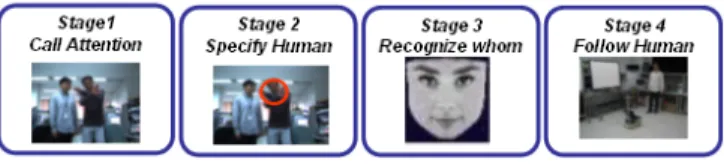
Come and follow me in this paper will be introduced by four steps as shown in figure 1. At the first step, if you want to bring to robot’s attention, you can do it by your hand motion or clapping and anything like that. Then, robots would find who wants to interact with them. It is to specify a person. At the third one, robots would try to recognize who you are, and lastly follow you if desired.
Figure 1 Steps for Come and Follow me
The very severe point we have to consider here would be the robot is moving. Now, if robots pay attention to someone, then they have to be able to detect and follow people while they are moving. It can be said that the mobility is the most powerful point in robots, but in the point of image and sound processing, it gives several severe problems we should take care of.
1st Japan-Korea Joint Symposium on Network Robot Systems (JK-NRS2005)
For example, illumination is severely changed, and people can turn around and also walk back and forth. No matter how complex in background it may be, robots must do their duties in very satisfactory way. The thing we cannot ignore in robot would be occlusion. Robots have to be able to get over occlusion and keep going on. You may think two typical examples for occlusion in FOV (Filed of View) and out of FOV. We assumed the application status for occlusion in FOV as a target is crossing with other person and passing by an obstacle for a short period (within camera view). As for the case of out of FOV, we assumed a target is turning at the corner and disappears in FOV.
Now, details in Come and follow me will be introduced as the followings.
1). Attention
In this section, we’d like to present visual attention we have developed for call attention described as stage 1 in figure 1. The final goal in this study is to make a saliency map and find the place the robot should pay attention to.
Itti[3] proposed a conceptually simple computational model for saliency-driven focal visual attention. With results of Itti, we are firstly developing the color feature map with skin tone and primary color such as red and blue. The color feature map can be used for motion extraction. By this motion extraction, one thing we should remind is that an area with only motion cannot be the focused area.
As results, we can obtain the saliency map and you can find the red circle in Figure 2 (b). That is a focused area.
(a) Input Image (b) Focused Area Figure 2 Visual Attention
It can be seen that this feature can be used for choosing a person who wants to interact with robot by hand motion such as waving and clapping motion.
Next thing related to attention is sound localization. Currently we are using the minimum number of microphones for sound localization and improving the reliability of its result. Finally we are going to combine visual and auditory attention as a multi-modal attention for making it sure.
2). Detection
We will introduce stage 2 and stage 3 to specify human and recognize whom as shown in figure 1.
The first thing we had to do was to set up how to detect human. Since we designed a face detection to specify human,
we needed a robust face detector fundamentally, and it detects faces very highly and shows low false positive rate.
We utilized AdaBoost algorithm for the face detection performance required. [4][5][6] For the features of classifiers, we firstly used rectangle features and a feature value is the intensity difference of the white region and the black region as illustrated in figure 3.
Figure 3 Features of classifiers
Then, the classifiers are trained with frontal face, half and full profile and non-face images. Figure 4 shows the result of face detection in this study, and you can find both of half and full profiles.
Figure 4 Result of face detection
After we detected a human, we needed to recognize who he is. We are developing a face recognition method in three main ways as described in figure 5. These are face registration, recognition and false classification.
In face registration, people normally want to register their faces in very natural way and unconsciously. With the results of face detection in previously introduced, we are able to make the very natural face registration. To register a face, all needed here is to just walk around robot and give a name. Then, robot would find a face and register the detected face automatically.
For face recognition, we have tried to evaluate FLD-based method [7] and SVM-based method [8][9] and binary tree to find a best matching person. As we mentioned earlier, it is getting rid of feeling anonymous.
Lastly, the false classification problem we can decide whether a face is in the database of face registration or not is underway. We have to be able to distinguish the non- registered face from registered faces of the database with a strong confidence.
1st Japan-Korea Joint Symposium on Network Robot Systems (JK-NRS2005)
Figure 5 Detection Flow Chart
3) Following
If detection has been done, we are going to be in the following as stage 4 in figure 1.
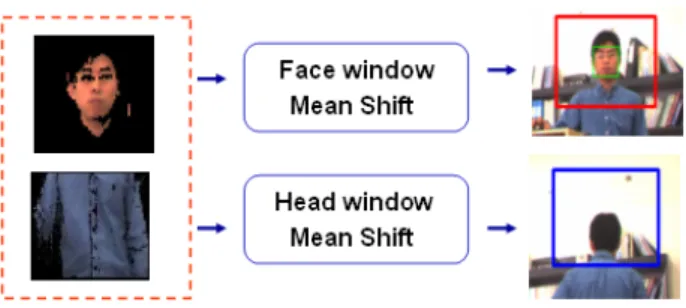
We start to follow a person by mean-shift algorithm [10]. When the face can be available to detect, skin-tone mean shift is applied. When it is impossible, hair color man shift can be used as illustrated in figure 6. The red window means skin-tone mean shift is working and blue window expresses hair color mean shift.
Figure 6 Mean shift for following
To follow person specified in stage 2&3, we use a cloth feature matching. The feature matching consists of the color histogram to be robust and texture information as shown in figure 7.
(a) Color Histogram (b) Cloth Texture Classes Figure 7 Color Histogram and Texture
We classified cloth texture into four classes as vertical, horizontal stripped, check, and plain. At every single frame, a cloth feature is extracted and matched in order to verify a person robot has followed. Our specific person following can process 8 to 12 frames per second and the processing rate is quite enough to follow the person very smoothly.
One thing that we are addressing here is occlusion. Color feature modeling also can be used for getting over occlusion both of in FOV and out of FOV. It is very clear that combination of face recognition and color feature modeling is very useful.
3. CRIF
In this section, we will introduce CRIF - common robot interface frame work. Its objective is to provide device abstraction layer for various robot platforms [11]. In details, it is to propose common interfaces and a framework for robot applications to reduce hardware dependency, to improve portability, and to provide a client-server communication framework as shown figure 8.
Figure 8 Concept of CRIF
ETRI (Electronics and Telecommunications Research Institute) suggested CRIF and we have applied and evaluated this to our robot development. It will be shown that how easily the application algorithm we developed can be applied to another robot.
Detection and following in Come and follow me introduced in section 2 have been developed on Buddy, it is a robot in our lab with CRIF. We tried to apply our algorithm to WEVER of ETRI as shown in figure 9.
(a)Buddy (b)WEVER Figure 9 Robots
1st Japan-Korea Joint Symposium on Network Robot Systems (JK-NRS2005)
Consequently, it only took a couple of days to completely apply our algorithm to WEVER with a few minor correction such as camera FOV and image frame rates.
4. Conclusion
The objective of this paper is to introduce the research activities in our lab. We are intensively focusing on HRI. We introduced HRI with very strong emphasis on “Come and follow me”. We explained attention, detection and following in detail. CRIF was also introduced and it was shown how the application algorithm is applied to another robot effectively.
REFERENCES [1] KAIRA, “Personal Robot Market,” 2004.
[2] Cynthia Breazeal, “Social Interactions in HRI : The Robot View”, Systems, Man and Cybernetics, Part C, IEEE Transactions on Volume 34, Issue 2, May 2004 Page(s):181 – 186.
[3] L. Itti, C. Koch, and E. Niebur, “A model of saliency-based visual attention for rapid scene analysis," IEEE Transactions on Pattern [4] P. Viola and M. Jones, “Rapid Object Detection using a Boosted Cascade
of Simple Features” , CVPR, pp. 511-518, 2001.
[5] P. Viola and M. Jones, Robust Real-Time Face Detection, International Journal of Computer Vision, pp. 137 – 154, 2004
[6] B. Wu, H. AI, C. Huang, Shihong Lao. "Fast Rotation Invariant Multi-View Face Detection Based on Real Adaboost," Sixth IEEE International Conference on Automatic Face and Gesture Recognition, pp. 79-84, 2004
[7] H. Xiong, M.N.S. Swamy, and M.O. Ahmad, Two-dimensional FLD for face recognition, Pattern Recognition, pp. 1121-1124, 2005
[8] G. Guo, S.Z. Li, and K. Chan, Face Recognition by Support Vector Machines, Proc. of the IEEE International Conference on Automatic Face and Gesture Recognition, 26-30 March 2000, Grenoble, France, pp. 196-201
[9] B. Heisele, P. Ho, and T. Poggio, Face Recognition with Support Vector Machines: Global versus Component-based Approach, Proc. of the Eighth IEEE International Conference on Computer Vision, ICCV 2001, Vol. 2, 09-12 July 2001, Vancouver, Canada, pp. 688-694
[10] D. Comaniciu and P. Meer , “ Mean Shift : A Robust Approach Toward Feature Space Analysis,” IEEE PAMI, pp. 603-619, Vol.24, No.5, 2002. [11] Lee, S., Kwon W., Kim D. and Kim J, “Common Robot Interface
Framework for Device Abstraction”, 2nd International Conference on