Assessing the Gap between Integrated Reporting
and Current Corporate Reporting: A Study in
the UK
journal or
publication title
International review of business
number
18
page range
137-157
year
2018-03
1. Introduction
Corporate reporting has undergone substantial changes in the last three decades (The IIRC, 2011). On the one hand, the length and complexity of financial statements have increased to fulfill regulatory requirements (Main and Hespenheide, 2012). On the other hand, demand for non-financial information has also increased that have led companies to engage in sustainability reporting (KPMG, 2017). However, these so-called sustainability reports are found to be disconnected from traditional financial reports and rarely link sustainability concerns with organizational strategies (Milne and Gray, 2013). The concept of integrated reporting (IR) has developed under these circumstances. Based on the existing financial reporting model, IR incorporates non-financial information that can help
Assessing the Gap between Integrated Reporting and
Current Corporate Reporting: A Study in the UK
Taslima AKHTER*, Toshihiko ISHIHARA**
Abstract
This study aims to evaluate integrated reports of some early adopting companies of the UK. For this purpose, the contents of integrated reports of five selected companies are assessed against a disclosure checklist based on the International Integrated Reporting Council (IIRC) Framework. We found that the disclosure rates vary from 51 percent to 70 percent. This range represents a moderate level of compliance in a regulatory environment where preparation of integrated reports, as per the IIRC, is not mandatory. In some Content Elements, the disclosure rate is high as long as disclosures are concerned with soft, generic information or there is a need to disclose for regulatory requirements. On the other hand, a small amount of information is disclosed in some areas such as, Future Outlook, Opportunities, or Material issues. In general, the reports lack Connectivity in varying degrees. To the best of our knowledge, this is an early attempt to examine the integrated reporting practice in the UK against the IIRC Framework. As an early study on integrated reporting in the UK, this study can inform different stakeholders and policymakers about the initial phase of this new reporting norm and how it is shaping corporate reporting in the UK.
Keywords: Integrated Reporting, Content Elements, The International Integrated Reporting Council, The UK
* Ph.D. Student, Institute of Business and Accounting, Kwansei Gakuin University ** Professor, Institute of Business and Accounting, Kwansei Gakuin University
stakeholders understand how a company creates and sustains value in the long term (The IIRC, 2013).
Although a number of companies including United Technologies, Sainsburys, Philips, Natura, BT, HSBC, Aviva, Novo Nordisk, and American Electrical Power have been practicing IR for a long period of time, this latest trend in corporate reporting has got significant global attention after the inception of the International Integrated Reporting Council (IIRC) in 2010 (Eccles and Saltzman, 2011). As “a global coalition of regulators, investors, companies, standard setters, the accounting professionals and non-governmental organizations,” it aims to “establish integrated reporting and thinking within mainstream business practice.” Following extensive consultation, in December 2013, IIRC published the International Integrated Reporting Framework (IIRC Framework). In 2011, South Africa became the first country in the world to mandate IR for listed companies. KPMG (2017) also observed significant increase in IR in other countries including Japan, Brazil, Mexico, and Spain.
Research on IR is still in the “embryonic” stage (de Villiers et al., 2014). Recently, academic interest in policies and practices of IR has increased significantly (Dumay et al., 2016; Oshika and Saka, 2017). These studies have concluded that there are “different ways in which integrated reporting is understood and enacted within institutions” (de Villiers et al., 2014, p. 1042). In particular, based on content analysis of early integrated reports, a number of studies observed wide variations in the content and structure of IR. However, most of these studies explained the South African context where IR is a regulatory requirement. In this regard, Ahmed Haji and Hossain (2016) call for more academic documentation from diverse geo-political environments to enhance our knowledge on the impact of IR on corporate reporting. In response, this study examined the IR practice in the UK. The UK context is important, as the country has a long history of practicing non-financial information reporting. In 1993, the Accounting Standard Board (ASB) had published voluntary guidance for narrative disclosure in the form of “Operating and Financial Review (OFR).” The Companies Act (2006) also requires a company’s Directors to prepare a “Business Review” report including the company’s business, principal risk and opportunities, future prospects, and social and environmental information. In 2013, the government further amended the Companies Act to include a requirement for larger companies to prepare a “Strategic Report” as part of their annual report. Accordingly, the regulatory body, the Financial Reporting Council (FRC), issued Guidance on the Strategic Report in 2014. This report “provides shareholders with a holistic and meaningful picture of an entity’s business model, strategy, development, performance, position and future prospects” (FRC, 2014). There is a significant crossover between the IIRC Framework and the Strategic Reporting Guidance (Deloitte, 2015). In short, although IR is not mandatory in
Taslima AKHTER, Toshihiko ISHIHARA 138
the UK, the regulatory environment encourages companies to adopt such a practice. In this context, the current study aims to evaluate integrated reports of some early adopting companies in the UK. For this purpose, the contents of integrated reports of five selected companies are assessed against a checklist based on the IIRC Framework. To the best of our knowledge, this is one of the early studies to examine the integrated reports against the Content Elements of the IIRC Framework. The rest of the study is organized as follows. The ensuing section reviews the related literature with the objective to find research gaps. Section 3 details the research method and Section 4 explains key findings of the research. The conclusion is presented in section 5.
2. Literature Review
As IR is still in its early stage of development, academic literature has just started to grow (de Villiers et al., 2014). Initial studies were largely normative in nature, examining concepts, benefits, and challenges of IR rather than empirically examining its various aspects (Adams, 2015; Adams and Simnett, 2011; Eccles and Saltzman, 2011). The growing empirical studies can be classified into two groups (Ahmed Haji and Anifowose, 2016, 2017): (1) studies that adopt qualitative approaches using in-depth case studies, interviews, or surveys and (2) studies based on content analysis of corporate reports. This study followed the second approach and the relevant studies are reviewed in this section.
In one of the earliest studies based on content analysis of annual reports, Solomon and Maroun (2012) compared disclosure practices before and after the introduction of IR in South Africa. The study revealed a significant improvement in social, environment, and ethical information after the regulatory changes in 2011. Despite the increase in quantity of disclosure, the authors conclude that IR is an evolutionary process and “companies are (still) unclear as to exactly what an integrated report ‘should’ look like and what it ‘should’ include.” Marx and Mohammadali-Haji (2014) expanded the scope of analysis by examining annual reports, integrated reports, and web-based reporting of the 40 largest South African companies. The authors found mixed results as some companies prepared excellent IR, while a number of others “merely renamed their annual report to an integrated annual report” to ensure regulatory compliance (p. 244).
Diversity in content and structure of integrated reports is also seen in companies around the world. Wild and van Staden (2013) examined early evidence of IR in 58 international companies listed in the IIRC Emerging Examples Database. Integrated reports were found to include more soft (general) disclosures, such as Company Strategy, Operating Context and Organizational Overview rather than hard (specific) information, such as Performance and Future Outlook. Significant lack in adherence to IR Guiding Principles was found. In particular, reports were lengthy and lacked stakeholder inclusiveness.
Ahmed Haji and other scholars, in a series of researches, investigated the initial trends of IR in South Africa (Ahmed Haji and Anifowose, 2016, 2017; Ahmed Haji and Hossain, 2016). In one study, Ahmed Haji and Anifowose (2016) observed significant improvement in connectivity of information, materiality determination process, and reliability and completeness of IR reports. Most of the disclosures, however, were seen to be generic in nature rather than company-specific and “exaggerate positive information whilst underplaying, or dismissing, negative outcomes” (p. 213).
The concept of IR has developed based on the multiple capitals framework. The importance of “capitals” therefore, encourages researchers to investigate this particular element of IR. Setia et al., (2015) analyzed corporate reports of the top 25 companies to understand changes in disclosure of capital, immediately before and after the regulation of IR in South Africa. Their content analysis, in general, revealed an increase in the extent of disclosure of all forms of capitals including human, social and relational, natural, and intellectual capital information. In a similar study, Ahmed Haji and Anifowose (2017) also found that corporate disclosure has increased substantially after the adoption IR in 2011. However, they observed variations in disclosing the types of capital. While reporting on intellectual and human capital has increased and institutionalized over the years, information on relational capital has decreased and varies across industries. Melloni (2015) further extended this research on international companies by examining the IR information available in the IIRC database. The findings, however, are largely consistent with the companies in South Africa.
In summary, extant literature largely explored the context of South Africa where publication of IR is mandatory. Although improvements were seen in the reporting practice, IR still lacks in quality in terms of applying the principles of conciseness, materiality, connectivity, reliability, and completeness. Based on the above studies, the current research extends the literature in a different regulatory environment. We investigated the IR practice in the UK, where publication of IR is not mandatory, but supportive.
3. Research Method
3.1 Sample Selection
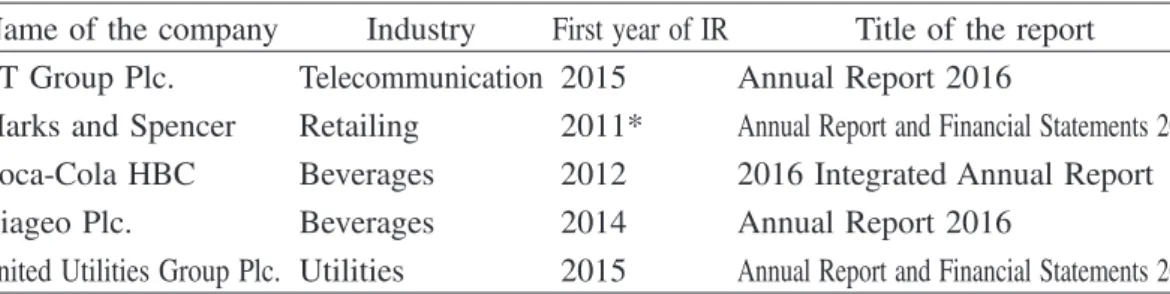
The sample of this study is chosen from the Financial Times Stock Exchange (FTSE) 100 list as on October 05, 2016. For each company, integrated report of the most recent year was selected to obtain the most refined one to examine. These reports are self-declared, integrated reports with reference to the IIRC Framework. As shown in Table 1, the five companies operate in different industries, thereby giving us an opportunity to observe the applicability of IR to different types of businesses and the innovativeness in preparing those reports.
Taslima AKHTER, Toshihiko ISHIHARA 140
Table 1. The selected companies in this study
Name of the company Industry First year of IR Title of the report BT Group Plc. Telecommunication 2015 Annual Report 2016
Marks and Spencer Retailing 2011* Annual Report and Financial Statements 2016 Coca-Cola HBC Beverages 2012 2016 Integrated Annual Report
Diageo Plc. Beverages 2014 Annual Report 2016
United Utilities Group Plc. Utilities 2015 Annual Report and Financial Statements 2016 Source: Compiled by the authors (from the individual companies’ websites). *Marks and Spencer joined the Integrated Reporting Pilot Program in 2011.
3.2 Content Analysis
Content analysis is the most commonly used method to evaluate the quantity and quality of corporate reports (Milne and Adler, 1999). The most critical function in content analysis is to develop an objective coding instrument against which, the extent and quality of disclosures are assessed. A well-specified coding instrument enhances the reliability of content analysis significantly. In our study, the coding instrument or Disclosure Checklist is developed based on the IIRC Framework’s “Content Elements.” As the IIRC Framework has taken a principle-based approach and does not prescribe disclosure of specific Key Performance Indicators or individual matters, we carefully read the narratives of “Content Elements” and constructed the individual disclosure items. In addition, we consulted extant literature extensively to make the Disclosure Checklist comprehensive. For example, our coding structure is highly influenced by the related studies of Ahmed Haji and Anifowose (2017, 2016), Stent and Dowler (2015), and Wild and van Staden (2013). However, we have adjusted individual disclosure items based on the objective of our study. The final Disclosure Checklist contains 43 items under eight Content Elements of the IIRC Framework. The checklist is shown in Appendix 1.
4. Findings
In this section, we have analyzed the research findings. A general overview, as well as, detailed analysis on disclosures regarding each Content Element in the checklist has been given.
The Disclosure Checklist showed that the sample companies’ scores are between 51 percent and 70 percent, approximately. BT Group ranked the top with 70.27 percent disclosure, while Marks and Spencer (M&S) and Coca Cola HBC scored 64.86 percent each. “Organizational Overview and External Environment” is the highest disclosed category with an 84 percent average disclosure rate. The lowest disclosed Element is “Basis of
Preparation and Presentation,” with 30 percent average disclosure only. Some other Content Elements with low levels of disclosure are “Business Model” (51.7 percent) and “Strategy and Resources Allocation” (60 percent).
There are some similarities in the overall structure of these reports, as they are operating within some common regulatory requirements. These five annual reports have three broad segments in general: Strategic Report, Governance Report or Director’s Report, and Financial Statements with supplementary information. BT Group reveals an interesting insight:
“IR is an initiative led by the International Integrated Reporting Council (IIRC). Its
principles and aims are consistent with UK regulatory developments in financial and corporate reporting.” (BT Group, Annual Report, 2016, p. 1).
FRC’s Communication Principles (included in the FRC’s Guidance on Strategic Report) have many similarities with the IR Framework’s Guiding Principles and both of them offer guidance for preparation and presentation of annual reports (Deloitte, 2016). However, this discussion is beyond the scope of this article. We analyzed the reports to understand what information they provide about the company, and to what extent these contents adhere to the IIRC’s guidelines. In the next few pages, we will discuss the IIRC guidance regarding each Content Element and our findings from this study.
4.1 Content Element One: Organizational Overview and External Environment
Every report in this study answered the basic question of the IIRC Framework for this Element: “What does the organization do and what are the circumstances in which it operates?” (The IIRC, 2013). Therefore, the awarded scores are almost identical in this Element. Each report described the company’s objectives, strategies and how to achieve those objectives, strengths and competitive advantages, threats from external environments, and performance.
Key Performance Indicators (KPIs) are important measures in understanding the performance and position of the business and for ensuring connectivity and value creation. The IIRC Framework does not prescribe any specific KPIs. It rather depends on the judgment of the preparers of IR and the organizational context (The IIRC, 2013). All reports presented their KPIs in the summary sections, mainly highlighting the financial KPIs to attract the readers’ and investors’ attentions. About the KPIs, the important thing is to understand the reasons for choosing them. An extract from the United Utilities Group’s (UUG) annual report is as follows:
“These KPIs are set for the five-year period of our short-term planning horizon and
encompass the important areas of customer service and environmental performance, as well as financial indicators, taking into consideration the interests of all of our stakeholders.”
Taslima AKHTER, Toshihiko ISHIHARA 142
(UUG, Annual Report, 2016, p. 28).
BT Group discussed the definitions of its four KPIs, linkages between these KPIs and strategy and remuneration, five-year comparatives, and target results for the next two years. In contrast, UUG selected five financial KPIs with five years comparative changes, and ten operational KPIs from three strategic themes of the group: the best service to customers, at the lowest sustainable cost, and in a responsible manner. M&S segmented its KPIs under three categories: financial, non-financial, and strategic objectives, showing four years comparative changes. The KPIs are connected with objectives and various types of capitals and have demonstrated each company’s concern for financial success, as well as for their employees, suppliers, customers, and the environment. Out of the 12 KPIs of Coca Cola HBC, two greenhouse gas emissions-related KPIs are chosen as part of the legal requirements to disclose. Three KPIs are chosen under two titles namely “key people in key positions” and “women in our Company.” The remaining are financial and operational KPIs. The purpose and definition of KPIs are provided with three years comparative changes. However, future targets or target-related narratives are not provided. Diageo has used 11 KPIs with five years comparative changes to measure their financial and non-financial performance against four specific strategic objectives. Out of 11, six financial indicators are linked with remuneration.
4.2 Content Element Two: Governance
The IR Framework requires an integrated report to disclose “How does the organization’s governance structure support its ability to create value in the short, medium and long term?” (The IIRC, 2013). As per the IIRC Framework, information on the leadership structure, skills, and expertise of leaders, and the influence of any applicable law on the governance structure of the business should be disclosed. The UK listed companies are required to disclose how they have applied the main principles of the UK Corporate Governance Code (The Code) and the Statement of Compliance with all relevant code provisions. They are also required to identify provisions that have not been complied with and provide good reasons for this non-compliance. The leadership structures, diversity, and skills are discussed in all five reports. M&S produced a well-integrated, cross-referenced Governance Report discussing its Board’s focus areas, such as strategy, governance and risk, stakeholder engagement, and the progresses that were made. The Board of Directors’ skills and experience are discussed and their full biographies are cross-referenced with links. It also provided details about succession planning for executive, non-executive, and senior leadership. Another IR requirement is whether the report has disclosed the processes used by the company to make strategic decisions and to establish and monitor the company’s culture, especially with regard to risk management. An extract from M&S stated:
“The Board agrees, and has collective responsibility for, the strategy of the Company.
The Board is responsible for ensuring that appropriate values, ethics and behaviours for the conduct of the Company are agreed and that appropriate procedures and training are in place to ensure that these are observed throughout the Company. Protecting the business from operational, financial and reputational risk is an essential part of the Board’s role.” (M&S, Annual Report, 2016).
Only M&S and UUG discussed about the importance of nurturing culture and values. The narratives of all the five reports provided information on actions taken to monitor strategic direction and risk management. Risk management issues are usually discussed in the Strategic Report sections of these reports. All reports provided information on Directors’ and employees’ remuneration policies and other details necessary to fulfill the legal requirements. M&S provided a table showing linkages between the KPIs and Directors’ incentive schemes, and how Director’s remuneration is aligned and motivated to deliver the strategy that made its Governance Report stand apart from others. UUG also provided with such a summary table showing how the incentive framework aligned with different business strategies creating long-term values.
4.3 Content Element Three: Business Model
An integrated report should incorporate a Business Model that is defined as the “system of transforming inputs, through its business activities, into outputs and outcomes that aims to fulfill the organization’s strategic purposes and create value over the short, medium and long term” (The IIRC, 2013, p. 25). The Companies Act (2006) and the Corporate Governance Code (2014) of UK also require the Strategic Report to include a description of the company’s business model as a key component. The organizations we studied provided their unique business models and value creation process depending on the nature, size, and complexity of their businesses. Key elements of the business model: input, business activities, outputs, and outcomes are discussed through diagrams and/or narratives. Diageo is one exception. It did not clearly identify the elements of its business model and the six types of capitals as suggested by the IIRC Framework. The six types of capitals as per the Framework include: financial, manufactured, intellectual, human, natural, and social and relationship. In another example, UUG disclosed only four key resources: natural, people, assets, and financing. BT Group, M&S, and also, Coca Cola HBC discussed about six capitals. However, all six types of capitals might not be relevant enough for each organization to include in its respective business model. “Not all capitals are equally relevant or applicable to all organizations” (The IIRC, 2013, p. 12). This finding is in line with Ahmed Haji and Anifowose (2017). One important drawback of these business models is that quantitative disclosures are occasionally found in the discussion. Only Coca Cola
Taslima AKHTER, Toshihiko ISHIHARA 144
HBC provided with some quantification of values created in their business model. Also, the interdependencies between or among capitals are rarely found. The task of linking business models with the organization’s strategy, performances, risks, and opportunities are performed with moderate importance. M&S’s effort in this respect is highly commendable. In one comprehensive chart (p. 12-13), it clearly linked strategic objectives, risks, KPIs, and other factors together. Few reports provided very general comments on the adaptability of their business models with the changing business environment, risks, and opportunities. For example, BT Group mentioned:
“We have a flexible and sustainable business model, enabling us to anticipate and respond to changes in our markets. It underpins our assessment of the future prospects and viability of the Group.” (Annual Report, 2016).
But this was not explained further. Finally, visual representation, cross-referencing, and relationship with other Content Elements are important for an integrated Business Model. In many of the above aspects, BT Group produced a well-integrated, connected business model and therefore, scored 75 percent, the highest under the “Business Model” Content Element.
4.4 Content Element Four: Risk and Opportunities
The apparent small gap in the disclosure percentages of the reports can be justified by the legal requirements for listed companies. FRC suggests that the description of risks should be entity-specific, the material ones, and might include a risk likelihood description, an indication of the circumstances in which the risk might be the most relevant to the entity, and its possible impacts. Risk mitigation procedures and significant changes from the prior year should also be disclosed (FRC, 2014). As per the IIRC Framework, an integrated report should include key risks and opportunities, specific to the organization and those that may affect the value creation process. Specific sources of risks and opportunities, the organization’s assessment of their likelihood, possible effects, mitigation procedures, and ways to exploit opportunities should also be mentioned. It is more important to create linkages between or among key risks and opportunities, and strategic objectives, strategies, policies, or KPIs (The IIRC, 2013). All five reports in this study showed innovativeness in providing information on principal risks of the respective businesses. Efforts to create linkages with other elements or business models are also evident along with cross-references to Long-term Viability Statements. BT Group discussed principal risks, narratively linking them with strategy and the business model. M&S showed high efficiency in presenting likelihood of risks using graphs and risk mapping. Coca Cola HBC mapped their 12 key risks using graphs to show their likelihood and impacts. Diageo linked their 11 key risks with strategies, while UUG linked their risks with principal objectives. Although much information is given on key risks, discussion related to future opportunities is rare. One such
extract from the Chairman’s Statement of Diageo is as follows:
“Our investment in United Spirits Limited (USL) in India offers Diageo a
transformational growth opportunity in one of the most attractive spirits markets in the world. India is set to become the second country after China with a population of more than one billion consumers of legal purchase age, with the expected growth of 18-19 million legal purchase age consumers per year.” (Annual Report, 2016, p. 11). Marx and Mohammadali-Haji (2014) also confirmed about low disclosure on future opportunities. The probable reason can be, however, the uncertainties involved in estimating the future and/or loss of competitive information.
4.5 Content Element Five: Strategy and Resources Allocation
This element mainly discusses about the organization’s short, medium and long-term strategic objectives, the strategies it has or intends to implement, the methods to achieve those strategic objectives, and the resource allocation plans needed to implement the strategies (The IIRC, 2013). The selected reports in this study discussed their strategies differently. For example, UUG structured its business into four distinct business areas and each area had shorter term, medium term, and longer-term planning, ranging from 1 year to 25 years. In another example, BT Group described its three pillars strategy in a comprehensive diagram linking with the organization’s purpose, goal, culture, and business activities. In a very similar way, Coca Cola HBC presented its strategy, linking it with objectives, KPIs, values, and specific initiatives to respond to local demographics, while working for the same company objectives in all 28 countries. Diageo structured their strategy into a 21-market business model with country specific strategies for each market. A company having specific strategies for each of its business segments should ensure that there is some link between the specific strategies and the company strategies. This was not always discussed in these reports. There were moderate disclosures on creating competitive advantages, sustainability issues, and stakeholder engagement. Stakeholder engagement was either in a separate section in the Strategic Report or in the Governance Report. Coca Cola HBC did well in stakeholder engagement disclosures. Their report separately discussed about the company’s strategy, investment or contribution, and also material issues in detail. The BT Group annual report identified their stakeholders as:
“As well as our people, our main stakeholders are: our customers; communities;
shareholders; lenders; our pension schemes; suppliers; government; and regulatory authorities.” (p. 38).
On the other hand, the M&S Chief Executive’s Strategic Update is very straightforward in this regard. The company set its strategies by classifying customers into three different groups based on their shopping habits. An extract from the annual report of M&S stated:
Taslima AKHTER, Toshihiko ISHIHARA 146
“We are at our best when we are completely focused on our customers. Our actions are
driven by listening to what customers tell us, not by what we think is right for them” (p. 6). “Our Customer Insight Unit (CIU) analyses responses from 60,000 customers per month. By
combining their views with detailed market research and customer analytics, we can identify what is influencing shopping behaviour and ensure we stay relevant to our customers.” (p. 14).
In short, the Disclosure Checklist revealed that companies have strategies, but these are not adequately linked with resource allocation plans.
4.6 Content Element Six: Performance
An integrated report should provide information on the extent the organization has achieved its strategic objectives for the period and the resulting effects on the capitals (The IIRC, 2013). All reports in this study used KPIs to measure the organization’s performance against strategic objectives. Information on positive effects on capital were disclosed mainly to improve the company’s impression. Disclosure on any negative information was rare. The following extract is from BT Group’s annual report:
“We’ve performed well against our three financial KPIs. But our customer service
performance was down 3.0%, and we want to do much better.” (p. 96).
In their study, Ahmed Haji and Anifowose (2016) confirm very low disclosure on negative information by firms. However, efforts are evident in creating linkages between past and current performances and few reports have done well in this regard, such as the ones by Coca Cola HBC or BT Group. An area that is almost absent in all these reports is KPIs that combine financial measures with other components. For example, the ratio of greenhouse gas emissions to sales or the impact of employee training on capital (The IIRC, 2013). Some non-financial KPIs are given in every report, but they are not linked with any related financial measures.
4.7 Content Element Seven: Outlook
Providing forward-looking information is a requirement of the Companies Act and one of the communication principles of the FRC. “Where appropriate, information in the strategic report should have a forward-looking orientation” (FRC, 2014, p. 17). On the other hand, IIRC (2013) suggests an integrated report should include challenges and uncertainties the organization is likely to face while pursuing its strategy, and the potential implications for its business model, and future performance (The IIRC, 2013). The IR Framework “goes beyond the Act’s requirement to include the main trends and factors likely to affect the future development, performance and position of the company’s business” (Deloitte, 2016, p. 74). As per the IIRC, Future Outlook generally discusses an organization’s expectations
on external environments in the short, medium, and long term, how these may affect, and how the organization will respond to these. The IR Framework is flexible here, in the way that Outlook disclosure may take into account the applicable laws under which the company is operating. The companies in the current study showed low level of concern on Outlook disclosure. BT Group’s Strategic Report contains a subsection named “Outlook.” The “Group Finance Director’s Introduction” summarizes the organization’s outlook and actual performance against the outlook. In a later section, outlooks for 2016/17 and 2017/18 are discussed against BT Group’s KPIs. Throughout the report, comparisons of actual performance to previously identified targets and also with previous years’ results are found. Other than BT Group, “Chief Executive’s Statement” of Diageo and the “Chairman and Chief Executive Officer’s Review” of UUG also included some discussions on outlook. The annual reports of M&S, Coca Cola HBC, and Diageo included sections titled “Market Place,” “Market Review,” or “Market Dynamics,” that discussed future economic trends of national and international markets. However, no discussion was found titled as Future Outlook or similar. We can conclude that every company produced an analysis of the market or industry trends with some factual information. However, how that information affected their future outlooks or targets, and how the company planned to respond to the trends are not discussed. What is expected from an integrated report is that through market analysis, a company should identify both potential risks to manage and possible opportunities to explore. In addition, these should be reflected in its future outlook on its performance.
4.8 Content Element Eight: Basis of Preparation and Presentation
The IR Framework requires an integrated report to disclose information on material issues along with the materiality determination process. It is important to determine what matters to include in an integrated report. Among the five reports under study, only Coca Cola HBC complied with the materiality requirements and created a good example of discussing its Materiality Matrix and the materiality determination process. Except Coca Cola HBC’s one, the four other reports discussed about financial statement materiality, generally located in the audit report. The BT Group annual report mentioned about materiality for non-financial and social matters only once, with no further details.
“Our Enterprise Risk Management framework (see page 46) helps us identify and
mitigate the challenges and risks we face. And we do an annual materiality review to understand the societal and environmental issues that are important to our stakeholders.” (p. 30).
Coca Cola HBC identified and discussed their principal risks and material issues including market, environmental, and economic factors that may affect the company’s value creation process. A detailed description has been given on determining material issues and
Taslima AKHTER, Toshihiko ISHIHARA 148
stakeholders’ engagement in the process, along with the role of those responsible for analyzing, reviewing, and endorsing the Materiality Matrix. However, the other four reports discussed in detail about principal risks and some opportunities. In our opinion, these are part of the material issues for the entity, but not a true reflection of the IIRC Framework’s requirement on “Materiality.” This was one of the major limitations of these reports.
5. Conclusion
This study has provided early evidence of the integrated reporting practice in the UK, mainly investigating into the contents and quality of the reports under study against the IIRC Framework. The IIRC Framework requires an integrated report to include eight Content Elements and the linkages between or among these elements are vital for an ideal report. We developed a checklist based on the Content Elements of the IIRC Framework and coded the contents of five integrated reports chosen. From the Disclosure Checklist, we found that the disclosure level varies from 51 percent to 70 percent: a moderate level of compliance in a regulatory environment where preparation of integrated reports as per the IIRC is not mandatory. There are two main limitations of these reports. On the one hand, these reports did not include some information necessary for an integrated report. On the other hand, the selected reports were not fully successful in creating linkages between or among the information provided in the report, which is the main essence of integrated reporting. In some areas, the disclosure rate was high as these were related with soft, generic information, or needed to be published in the reports for regulatory requirements. Therefore, the most disclosed areas are “Organizational overview and external environment” and “Governance” with 84 percent and 75.6 percent average disclosure, respectively. In some instances, the report contents were redundant or too generic, often referred to as “boilerplates” in the IR Framework. In one example, the strategic report of BT Group could have followed the principle of Consistency and Comparability without compromising with the principle of Conciseness, if the company had provided more connected, material information. Limiting repetition by using internal cross-references and linking to more detailed or external sources of information could have made the report concise. In contrast, M&S produced a concise and connected annual report. Linkages between the Content Elements, well-integrated governance reports, easy navigation, and cross-referencing made it a reader-friendly report. One of the main shortcomings of Coca Cola HBC’s report was its occasional failure to create linkages between the Content Elements. However, consistency in overall presentation, stakeholder orientation, clear navigation, and importantly, disclosure on risks and materiality has made it stand apart from the four other reports. All these five reports lacked connectivity in varying degrees. Two reports did not categorize their capitals under the six categories proposed by the IIRC. Categorization of capitals is important. In
addition, what is more important is to understand the roles of these capitals in each organization’s value creation process and linking the business model with other elements, such as strategy, risks, or opportunities. The current reporting practice lacks these linkages and that undermines the core essence of integrated reporting. Some other critical areas where the chosen reports lack, are providing information on Future Outlook, Opportunities, and Material Issues. In the opinion of the IIRC (2013), the uncertainty of future-oriented information cannot be the reason to exclude any material information. Along with uncertainty, loss of competitive advantage can be attributed to low disclosures on future opportunities. Reporters’ judgment is required here to offer a trade-off between loss of competitive advantage and materiality. Disclosing material issues is crucial for an integrated report, whether it is positive or negative, financial or non-financial, and represents risks or opportunities. It is also one of the main communication principles of FRC’s Guidance on Strategic Report. Companies should exercise due care to follow the principle of materiality of the IIRC Framework.
This study has several limitations. First, we focused on FTSE 100 companies and found only five companies preparing self-declared integrated reports. Therefore, the final analysis was conducted on these five reports only and it is difficult to generalize the findings of the study based on such a small sample. Future researches could extend the sample to obtain more comprehensive understanding. We investigated the integrated reports of the latest available year to get the most updated practices. However, longitudinal study over the years or comparative study before and after IIRC initiatives could give better insights on a company’s IR development process. Finally, our objective was to investigate the disclosure on the eight Content Elements of the IR Framework. In-depth research could be done focusing on important individual element such as, value creation process, disclosure on capitals, or materiality determination. Nevertheless, as an early study on integrated reporting in the UK, this study can inform different stakeholders and policymakers about the initial phase of this new reporting norm and how it is shaping corporate reporting.
References
Adams, C. (2015), Understanding Integrated Reporting: The Concise Guide to Integrated Thinking and the
Future of Corporate Reporting, Do¯Sustainability, Oxford.
Adams, S. and Simnett, R. (2011), “Integrated Reporting: An Opportunity for Australia’s Not-for-Profit Sector”, Australian Accounting Review, Vol. 21 No.3, pp. 292-301.
Ahmed Haji, A. and Anifowose, M. (2016), “The trend of integrated reporting practice in South Africa: ceremonial or substantive?”, Sustainability Accounting, Management and Policy Journal, Vol. 7 No. 2 pp.190-224.
Taslima AKHTER, Toshihiko ISHIHARA 150
Ahmed Haji, A. and Anifowose, M. (2017), “Initial Trends in Corporate Disclosures Following the Introduction of Integrated Reporting Practice in South Africa.” Journal of Intellectual Capital, Vol. 18 No. 2, pp.373-399.
Ahmed Haji, A. and Hossain, D. M. (2016), “Exploring the implications of integrated reporting on organizational reporting practice: evidences from highly regarded integrated reporters”. Qualitative
Research on Accounting & Management, Vol. 13 No. 4, pp. 415-444. BT Group plc (2016), Annual Report 2016, BT Group plc, London.
Coca Cola HBC (2016), Integrated Annual Report 2016, Coca Cola HBC, London.
de Villiers, C., Rinaldi, L. and Unerman, J. (2014),“Integrated Reporting: Insights, gaps and an agenda for future research”, Accounting, Auditing & Accountability Journal, Vol. 27 No. 7 pp. 1042-1067.
Deloitte (2015), Annual Report Insights-Building a Better Report, Deloitte, London. Deloitte (2016), Annual Report Insights 2016- A Clear Vision, Deloitte, London. Diageo (2016), Annual Report 2016, Diageo, London.
Dumay, J., Bernardi, C., Guthrie, J. and Demartini, P. (2016), “Integrated Reporting: A structured literature review”, Accounting Forum, Vol. 40 No. 2016, pp. 166-185.
Eccles, R.G. and Daniela Saltzman, D. (2011), “Achieving Sustainability Through Integrated Reporting”,
Stanford Social Innovation Review, Summer, pp. 56-61.
FRC (Financial Reporting Council (2014), Guidance on the Strategic Report, The Financial Reporting Council Limited, London.
KPMG (2017), The KPMG Survey of Corporate Responsibility Reporting 2017, KPMG International. Main, N. and Hespenheide, E. (2012), Integrated Reporting: The New Big Picture, Deloitte Review, Issue 10, pp. 125-137.
Marks and Spencer (2016), Annual Report and Financial Statements 2016, Marks and Spencer, London. Marx, B. and Mohammadali-Haji, A., (2014), “Emerging trends in reporting: an analysis of integrated reporting practices by South African top 40 listed companies”, Journal of Economic and Financial
Sciences, Vol. 7, pp. 231-250.
Melloni, G. (2015), “Intellectual capital disclosure in integrated reporting: an impression management analysis”, Journal of Intellectual Capital, Vol. 16 No. 3, pp. 661-680.
Milne, M.J. and Adler, R.W. (1999), “Exploring the reliability of social and environmental disclosures content analysis”, Accounting, Auditing & Accountability Journal, Vol. 12 No. 2, pp. 237-56.
Milne, M.J. and Gray, R. (2013), “W(h)ither Ecology? The Triple Bottom Line, the Global Reporting Initiative, and Corporate Sustainability Reporting”, Journal of Business Ethics, Vol. 118, No. 1, pp. 13-29. Oshika, T. and Saka, C. (2017) “Sustainability KPIs for integrated reporting”, Social Responsibility
Setia, N., Abhayawansa, S., Joshi, M. and Huynh, A.V. (2015), “Integrated reporting in South Africa: some initial evidence”, Sustainability Accounting, Management and Policy Journal, Vol. 6 No. 3, pp. 397-424. Solomon, J. and Maroun, W. (2012), Integrated Reporting: the Influence of King III on Social, Ethical and
Environmental Reporting, The Association of Chartered Certified Accountants, London.
Stent, W. and Dowler, T. (2015), “Early assessments of the gap between integrated reporting and current corporate reporting”, Meditari Accountancy Research, Vol. 23 No. 1 pp. 92-117.
The IIRC (International Integrated Reporting Council) (2011), Towards Integrated Reporting:
Communicating Value in the 21st Century, The IIRC.
The IIRC (International Integrated Reporting Council) (2013), The International <IR> Framework, The IIRC.
United Utilities Group (UUG) (2016), Annual Report and Financial Statements 2016, UUG, West Sussex. Wild, S. and van Staden, C. (2013), “Integrated reporting: an initial analysis of early reporters. Paper presented at the Massey University Accounting Research Seminar, Auckland, New Zealand.
Appendix 1. Disclosure Checklist
Disclosure Items Maximum
score BT M&S Coca ColaHBC Diageo UUG Averagedisclosure Content
Element 1 Organizational Overview and ExternalEnvironment 1 4.5 Organization’s mission, vision, values, and
culture (No disclosure=0, Disclosure=1) 1 1 1 1 1 1 2 4.5 Principal activities and markets
(No disclosure=0, Disclosure=1) 1 1 1 1 1 1
3 4.5 Ownership and operating structure (No disclosure=0, Disclosure=1)
1 1 1 1 1 1
4 4.5 Competitive landscape and market positioning (No disclosure=0, Disclosure=1)
1 1 1 1 1 1
5 4.5 Key quantitative information (for example, the number of employees, revenues, and number of countries operating, highlighting, in particular, significant changes from prior periods) (No disclosure=0, Financial KPIs only =1, Both financial and non-financial KPIs=2, KPIs linked with objectives and/or capital=3)
3 2 3 2 2 3
6 4.5 Significant factors affecting the external environment and the organization’s response (legal, commercial, social, environmental, and political context) (No disclosure=0, partial disclosure=1, company specific disclosure=2, company specific adequate disclosure=3)
3 2 2 2 2 2
Taslima AKHTER, Toshihiko ISHIHARA 152
Subtotal (Content Element 1) 10 8 9 8 8 9
% (Content Element 1) 100 80 90 80 80 90 84
Content
Element 2 Governance
7 4.9 Organization’s leadership structure (skills and diversity; e.g., range of backgrounds, gender, competence, and experience of BOD) (No disclosure=0, Members of the BOD/Committees are listed=1, Names, experience, and skills are also listed=2)
2 2 2 2 2 2
8 4.9 Role of highest governance body in setting purpose, values, and strategy (No disclosure =0, Disclosure=1)
1 1 1 1 1 1
9 4.9 Role of highest governance body in risk management (No disclosure=0, Disclosure=1)
1 1 1 1 1 1
10 4.9 Specific processes and particular actions used to make strategic decisions and risk management (No disclosure=0, Limited Disclosure=1, Adequate disclosure=2)
2 2 2 1 1 1
11 4.9 How remuneration and incentives are linked to value creation (No disclosure=0, General disclosure=1, Specific disclosure=2)
2 1 1 1 1 1
12 4.9 Actions taken to influence and monitor cultural environment and ethical values of the organization (No action determinable from narrative=0, Determinable actions=1)
1 0 1 0 0 1
Subtotal (Content Element 2) 9 7 8 6 6 7
% (Content Element 2) 100 77.78 88.89 66.67 66.67 77.78 75.6 Content
Element 3 Business Model
13 4.13 Explicit identification of the key elements of the business model (No disclosure=0, Disclosure=1)
1 1 1 1 0 1
14 4.13 A simple diagram highlighting key elements, supported by a clear explanation of the relevance of those elements to the organization (No disclosure=0, Disclosure with diagram or narrative=1, Disclosure with both diagram and narratives=2)
3 2 2 2 1 1
15 4.14 Relating and disclosing capitals with business model (No disclosure=0, Narrative disclosure only=1, Narrative with limited quantitative disclosure=2, Adequate
disclosure=3)
16 4.56 The interdependencies and trade-offs between the capitals: financial, manufactured, intellectual, human, social and relationship, and natural (No disclosure=0, Disclosure=1)
1 1 1 0 0 0
17 4.13 Connection to information covered by other content elements, such as strategy, risks and opportunities, and performance (including KPIs and financial considerations, such as cost containment and revenues) (No disclosure = 0, Limited disclosure = 1, Adequate disclosure=2)
2 2 2 0 0 1
18 4.16 Changes in organization’s strategy when, for instance, new risks and opportunities are identified or past performance is not as expected/aligning business model with changes in its external environment (No disclosure = 0, Limited disclosure = 1, Adequate disclosure=2)
2 1 1 1 1 1
Subtotal (Content Element 3) 12 9 8 6 3 5
%(Content Element 3) 100 75 66.67 50 25 41.67 51.7 Content
Element 4 Risks and Opportunities
19 4.25 The specific sources of risks and opportunities (No disclosure=0, Disclosing risks only=1, Disclosing both risk and opportunity=2)
2 2 2 2 2 2
20 4.25 Possible impacts of risk and opportunity on the organization (No disclosure=0, Disclosing risks impacts only=1, Disclosing both risk and opportunity=2)
2 1 1 1 1 1
21 4.25 The specific steps being taken to mitigate or manage key risks or to create value from key opportunities (No disclosure=0, Disclosure on risk mitigation only=1, Disclosure on risk mitigation mainly with limited on opportunity=2, Adequate disclosure both on risks and opportunity=3)
3 2 2 1 1 1
Subtotal (Content Element 4) 7 5 5 4 4 4
%(Content Element 4) 100 71.42 71.42 57.14 57.14 57.14 62.9 Content
Element 5 Strategy and Resources Allocation 22 4.28 The organization’s short, medium, and long
term strategic objectives (No disclosure = 0, Partial disclosure=1, Adequate disclosure=2)
2 1 1 1 1 1
23 4.28 The strategies it has in place, or intends to implement, to achieve those strategic objectives (No disclosure=0, Disclosure=1)
1 1 1 1 1 1
Taslima AKHTER, Toshihiko ISHIHARA 154
24 4.28 The resource allocation plans it has to implement its strategy (No disclosure=0, Limited disclosure=1, Adequate disclosure=2)
2 1 0 1 1 1
25 4.29 Linkage between the organization’s strategy and resource allocation plans, and organization’s business model (No disclosure=0, Partial Disclosure=1, Adequate Disclosure=2)
2 1 1 0 0 1
26 4.29 The extent to which environment and social considerations have been embedded into the organization’s strategy to give it a competitive advantage (No disclosure=0, Disclosure=1)
1 1 1 1 1 1
27 4.29 Stakeholder engagement in formulating strategies and resource plans (No disclosure =0, Identification of related stakeholders=1, Specific details on stakeholders=2)
2 2 2 2 1 1
Subtotal (Content Element 5) 10 7 6 6 5 6
%(Content Element 5) 100 70 60 60 50 60 60
Content
Element 6 Performance
28 4.31 Quantitative indicators with respect to targets and risks and opportunities (No disclosure=0, Disclosure=1, Disclosure with trends=2)
2 2 1 2 1 2
29 4.31 The Organization’s effects (both positive and negative) on the capitals (No disclosure=0, Mainly positive disclosure=1, Adequate disclosure=2)
2 1 1 1 1 1
30 4.31 The state of key stakeholder relationships and how the organization has responded to key stakeholders’ legitimate needs and interests (No disclosure=0, Limited disclosure=1, Adequate disclosure=2)
2 2 2 2 1 2
31 4.31 The linkages between past and current performance, and between current performance and the organization’s outlook ( No disclosure = 0, Limited disclosure = 1, Adequate disclosure=2)
2 2 1 1 2 2
32 4.32 KPIs that combine financial measures with other components or monetizing certain effects on the capitals (No disclosure=0, Limited disclosure=1, Company specific and innovative disclosure=2)
2 1 1 0 1 0
Subtotal (Content Element 6) 10 8 6 6 6 7
Content
Element 7 Outlook
33 4.35 Organization’s expectations about the external environment (No disclosure=0, General disclosure=1, Organization specific disclosure=2)
2 1 1 1 1 1
34 4.35 Organization’s preparedness for the future
uncertainties (No disclosure=0, Disclosure=1) 1 1 1 1 1 1 35 4.37 Potential implications on future financial and
other capitals (No disclosure=0, Partial Disclosure=1, Adequate Disclosure=2)
2 1 1 1 1 1
36 4.38 Ways for outlook: lead indicators, KPIs or objectives, relevant information from recognized external sources, and sensitivity analyses (No disclosure=0, General disclosure=1, Organization specific disclosure=2)
2 2 1 1 1 2
37 4.38 Comparisons of actual performance to previously identified targets further enable evaluation of the current outlook (No disclosure=0, Disclosure=1)
1 1 1 1 1 1
Subtotal (Content Element 7) 8 6 5 5 5 6
%(Content Element 7) 100 75 62.5 62.5 62.5 75 67.5 Content
Element 8 Basis of Preparation and Presentation 38 4.41 A description of the reporting boundary and
how it has been determined (No disclosure= 0, Disclosure=1)
1 1 1 1 1 1
39 4.41 Frameworks and methods used to quantify or evaluate material matters (No disclosure= 0, Disclosure=1)
1 0 0 1 0 0
40 4.42 Brief description of the process used to identify relevant matters, evaluate their importance and narrow them down to material matters (No disclosure=0, Limited disclosure=1, Adequate disclosure=2)
2 1 0 2 0 0
41 4.42 Identification of the role of those charged with governance and key personnel in the identification and prioritization of material matters (No disclosure=0, Disclosure=1)
1 0 0 0 0 0
42 3.21 Impact of material matters on the organization’s value creation process (No disclosure=0, Limited disclosure=1, Adequate disclosure=2)
2 0 0 2 0 0
43 3.20 Stakeholder engagement in materiality determination (No disclosure=0, Disclosure= 1)
1 0 0 1 0 0
Taslima AKHTER, Toshihiko ISHIHARA 156
Subtotal (Content Element 8) 8 2 1 7 1 1 %(Content Element 8) 100 25 12.5 87.5 12.5 12.5 30 Total 74 52 48 48 38 45 % of maximum 100 70.27 64.86 64.86 51.35 60.81