Transition from High School to University in
Japan
journal or
publication title
Kwansei Gakuin University humanities review
volume
20
page range
223-244
year
2016-03-31
Kwansei Gakuin University Humanities Review
Vol.20, 2015 Nishinomiya, Japan
Changes in Self-regulated Learning Behavior:
Transition from High School to University in Japan
Hitomi YOSHIDA1
Abstract
Yoshida (2013) has suggested that successful Japanese learners of English demonstrate strong self-regulated behaviors, especially in their first two years at university. This study aims to investigate to what extent university freshmen change and create opportunities to come into contact with English learning activities. To these ends, to provide a general overview and detailed description of students’ self-regulated behaviors in their first year at university, a questionnaire and small-scale interview survey were conducted. The results indicate that the environment structuring and help seeking aspects of self-regulation by students significantly improved in their first year at university. The study concludes with a discussion of how advanced students improve/demonstrate self-regulation in their own learning context.
Key words: self-regulated learning, learning opportunity, transition from high school to university
Ⅰ. Introduction
How do good language learners study and become so proficient in the target language? This is one of the most intriguing topics for every language learner and second language acquisition (SLA) researcher. Many studies have attempted to isolate factors by looking at frequently used strategies by good language learners. Therefore, language learning strategy has commonly been the focus of SLA studies during the last three decades. However, because of definitional ambiguity and unreliable instruments (Dörnyei, 2005), the concept of language learning strategy
1
has been replaced by self-regulation, as developed in the field of educational psychology. Following this paradigm shift, the notion of self-regulation was introduced and applied in some L2 studies (Tseng, Dörnyei, & Schmitt, 2006; Oxford, 2011; Rose, 2011). Self-regulation is more process-oriented, while language learning strategy is more product-oriented. Although the scope of self-regulation includes metacognitive strategy, it also extends beyond such strategic framework. For example, it covers certain aspects in the learning process such as motivation, goal setting, learning situation, self-efficacy, and individual differences. According to Vygotsky (1978, 1986), until children learn to use mental tools, their learning is largely shaped by the environment. With regard to the development of self-regulation, Kopp (1982) and Blair and Diamond (2008) explain that as children mature, their regulatory skills become gradually more sophisticated. Thus, to develop self-regulation skills, children need to encounter many opportunities for repetitive practice with adults through appropriate scaffolding and modeling. Bronson (2000) also expresses that when children routinely self-regulate without adult assistance, they have internalized self-regulation. Thus, children benefit from many opportunities for experience and practice. To summarize all of these views, self-regulation is not just a simple result that is magically attained, but rather a process involving complex phenomena structured in relation to each other over a long period of time. In foreign language (FL) settings, where the target language is not regularly used, effective self-regulatory strategies are increasingly important. This is because learning a target language in an FL environment generally provides less chance to practice. Learners are therefore required to make a considerable degree of effort to engage in their learning and to exploit learning opportunities outside of the language classroom. Yoshida (2013) conducted a case study to describe the learning trajectories of four successful language learners, revealing that their self-regulatory behaviors increased significantly after entry into university. These behaviors seem to have occurred due to their level of freedom in terms of managing time, money, and their own activities, over which they had had limited control as high school students. Typically, learning strategies as well as time spent on certain activities are restricted and explicitly defined by teachers at high school in Japan. In other words, students can only engage in self-regulated learning if the learning situation itself affords them with a sufficient level of freedom to independently pursue activities that require self-regulation (Sierens, Vansteenkiste, Goossens, Soenens, & Dochy, 2009). Götz, Nett and Hall (2013) stress the importance of allowing individuals sufficient choice in their learning situation, as this presents a critical element in learning. From the self-determination theory perspective, Deci and Ryan (1985) insist that autonomy is a core psychological need that must be
satisfied in order for optimal learning to occur. This study aims to investigate how university freshmen change their self-regulatory behavior in the first year of their school life by collecting quantitative data through a self-regulated learning questionnaire and qualitative data through a small-scale interview survey.
Ⅱ. Research background 2.1 Learning strategy research
The rationale for focusing on good language learners was that studying the habits of successful language learners is more insightful than studying those of learners who fossilize at an early stage (Zheng, 2013). It was thought that if the strategies of successful leaners could be determined, then such knowledge could help those learners who were not getting such good results. Original studies on good language learners were undertaken by Rubin (1975) and Stern (1975), and they both proposed a similar list of strategies that good language learners often use. On the basis of their studies, a large-scale study of 34 language learners with good learning habits was conducted at the Ontario Institute of Studies on Education (OISE). This study presents a list of six different strategies:
1. Good language learners find an appropriate style of learning.
2. Good language learners involve themselves in the language-learning process.
3. Good language learners develop an awareness of language as both system and communication.
4. Good language learners pay constant attention to expanding their language knowledge.
5. Good language learners develop the second language as a separate system. 6. Good language learners take into account the demands that second language
learning impose.
Although additional research on the topic has been carried out in recent years, much of it has focused on investigating language learning in classroom situations. It has been found that good language learners cannot be distinguished entirely on the basis of observable behavior inside the classroom, as personality and activities outside the classroom appear to have an effect. In spite of the burst of sudden interest in the good language learners in the mid- to late 70s, the 80s and 90s saw research interest gradually move in the direction of socio-cultural aspects and individual differences, while the development of the concept of communicative competence informed the increasingly popular communicative approach to language teaching. In more recent years, Norton and Toohey (2001) emphasized
the importance of beliefs that constrain learners from exercising their agency in different contexts as well as the corresponding limitations of the current strategic framework.
2.2 Replacing learning strategies with self-regulation
After nearly four decades of research on language learning strategies, it is now believed that the strategic framework should be replaced by self-regulated learning (Tseng, Dörnyei, & Schmitt, 2006; Rose, 2011; Dörnyei, 2005). These new perspectives emphasize the influence of situation, investment, and identity on successful language learning. Dörnyei (2000, 2005, 2008) suggests that learning a language is a long and often arduous process, in which motivation fluctuates over time and in response to events in the learner’s own learning context. As a result, he has questioned the instruments researchers use, which have mainly been tools of quantitative analysis based on the Strategy Inventory for Language Learning (SILL), as developed by Oxford (2011). More recently, qualitative approaches have become increasingly recognized as useful ways to observe the process of learning as a response to students’ learning situations—not only what good language learners do, but also how they manage their own learning. Griffiths (2008) provides a survey of a variety of factors, both internal and external, that enquire into being a successful language learner. Furthermore, she takes a broader view, presenting the good language learner as a highly complex being whose learning behavior is subject to many different variables, including age, gender, personality, learning style, belief, motivation, metacognition, and aptitude. In discussing language learning strategies and self-regulation, Dörnyei (2005) noted that “learning strategies constitute a useful kit for active and conscious learning [and] these strategies pave the way toward greater proficiency, learner autonomy, and self-regulation” (p. 195). He points out that the quality of the strategies employed is as important as their use; hence, he encourages the replacement of the construct of learning strategies with one of process-oriented self-regulation.
2.3 Different conceptualizations of self-regulation
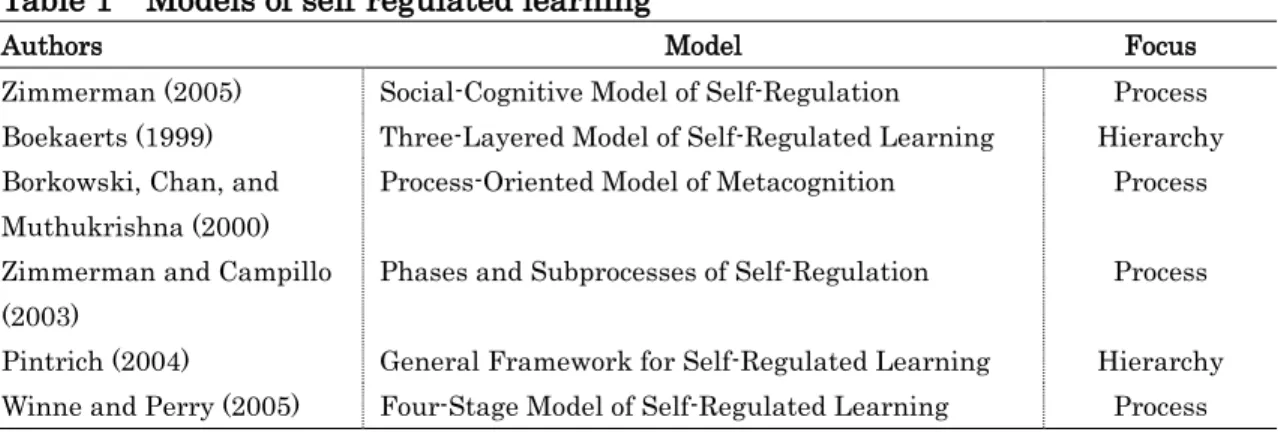
There are a number of different models of self-regulated learning proposing diverse constructs and varied conceptualizations (Boekaerts, Pintrich, & Zeidner, 2000). Some studies focus on the self-regulation process and others on the construct of the hierarchical control phase of self-regulated behavior. Nevertheless, all of these models share some general assumptions and features. Based on these assumptions, a general definition of self-regulated learning is that it is an active, constructive process in which learners set goals for their learning and then attempt to monitor, regulate, and control their cognition, motivation, and behavior,
as guided and constrained by their goals and the contextual features in their environment (Boekaerts, Pintrich, & Zeidner 2005, p. 453).
Table 1 Models of self-regulated learning
Authors Model Focus
Zimmerman (2005) Social-Cognitive Model of Self-Regulation Process
Boekaerts (1999) Three-Layered Model of Self-Regulated Learning Hierarchy
Borkowski, Chan, and Muthukrishna (2000)
Process-Oriented Model of Metacognition Process
Zimmerman and Campillo (2003)
Phases and Subprocesses of Self-Regulation Process
Pintrich (2004) General Framework for Self-Regulated Learning Hierarchy
Winne and Perry (2005) Four-Stage Model of Self-Regulated Learning Process
In the area of language learning, Dörnyei (2001) presents a new model of strategic learning based on the concept of self-regulation. Following the paradigm shift, he emphasizes the importance of self-motivating strategies, which correspond to research on self-regulatory processes, as both of these are underpinned by the belief that it is the learner who is responsible for his/her own learning in the first place. Dörnyei (2001) divided self-motivating strategies into five categories, namely: commitment control strategies, metacognitive control strategies, satiation control strategies, emotion control strategies, and environmental control strategies. Later, Oxford (2011) developed the strategic self-regulation model (S2R) of language learning, which is a dynamic interaction of strategies (cognitive, sociocultural-interactive, and affective) and metastrategies (metacognitive, meta-sociocultural-interactive, and meta-affective). Based on Pintrich’s (2004) theoretical framework of self-regulation, a number of researchers have gone on to suggest that measurement of self-regulation should be dynamic (see Ainley & Patrick, 2006; Turner, 2006).
2.4 Observational aspects of self-regulation
Despite the variety of models introduced, all share the central concept of self-regulation as a process in which learners take the initiative, with or without the guidance of others, in identifying their own needs, formulating goals, exploring resources, focusing on appropriate learning strategies, and evaluating learning outcomes (Zimmerman & Risemberg, 1997). Self-regulation includes goal setting, environment structuring, task strategies, time management, help seeking, and self-evaluation (Barnard et al., 2009). Some of these self-regulatory behaviors are more explicit, while others are more implicit; however, according to Barnard et al.
(2009), all of them are equally important for learners to achieve better performance.
(a) Goal setting
Goal setting is defined as learners’ general orientation toward completing a course (Pintrich, 2000). It is not only important in successfully completing courses and achieving better academic performance, but also outside of the classroom (Schrum & Hong, 2002).
(b) Environment structuring
Environment structuring refers to effective environmental management. With particular respect to distance education or student learning outside of class, Lynch and Dembo (2004) state that it involves students structuring and controlling their own physical learning environment, compared to that of the classroom context.
(c) Task strategies (Metacognition strategies)
In spite of many attempts to identify the components of self-regulation, task strategies, especially metacognitive strategies, have always been considered fundamental. Pintrich et al. (1991) explain that metacognitive self-regulation is composed of activities such as planning, monitoring, and regulation. With effective self-regulated behavior, learners can set relevant goals, monitor the effectiveness of their learning strategies, respond to their evaluation, and adjust their further learning (Zimmerman, 2005). In other words, if metacognition strategies are used appropriately, learners can avoid using inadequate learning strategies.
(d) Time management
Time management refers to “scheduling, planning, and managing one’s study time” (Chen, 2002: 14). Many other studies (Zimmerman et al., 1997, 2003) suggest that time planning and management help students to use their study time more effectively. This takes on greater importance for university students, especially outside of the classroom setting, where students have more control over their time management.
(e) Help seeking
Help seeking is the ability to pursue academic help in an “adaptive manner” (Lynch and Dembo, 2004: 4) and to receive appropriate assistance from others. Karabenick (1998) and Karabenick and Knapp (1991) state that this ability is extremely valuable for higher achievement.
(f) Self-evaluation
Self-evaluation is an essential facet, as it provides learners the scope to evaluate the effectiveness of their efforts in relation to a specific task. Winne
and Hadwin (1998) suggest that the more that learners can evaluate their own learning, the more they become self-regulated, and therefore proficient. Self-evaluation also helps to guide the learning process. According to Zimmerman (2005), teachers can boost students’ self-evaluation by guiding them on how best to monitor their learning objectives and strategy, and then on making the necessary modifications in these objectives.
Ⅲ. Objective 3.1 Aim of this paper
From the brief literature review above, it is clear how complex the research on learners’ strategies and self-regulation is. Although Pintrich (2000) mentions that “[t]here is a clear need for more descriptive, ethnographic, and observational research on how different features of the context can shape, facilitate, and constrain self-regulated learning” (p.493), most of the previous research has been based on questionnaire study, while qualitatively based studies are lacking. Hence, the purpose of this study is to explore, in the context of EFL in Japan, the changes of self-regulated behaviors in English learning during the transition from high school to university using quantitative and qualitative methods. The observation focus is on 1) the description of the learners’ self-regulatory systems and self-motivating strategies, and 2) identifying the sources of strategies used by the first-year students at university. In this research, the transition refers to participants’ first year at university, that is, a period of adjusting to entirely new learning and social environments.
3.2 Research questions
The research questions of this study are as follows:
(1) How do the Japanese first-year university students demonstrate self-regulatory behaviors in English learning?
(2) How does use of self-regulated behaviors shape their language learning? Ⅳ. Method
4.1 Participants
The study involved two steps: a questionnaire and interview survey. First, a total of 28 first-year students who were enrolled in reading classes taught by the author in 2014 participated in the questionnaire survey. Their English proficiency was relatively high, from higher intermediate to the advanced level. All of the participants were majoring in International Studies and were expected to join a 6 month to 1-year study abroad program in the following year. Since their English performance and achievement made a difference in the decision of which foreign
country and university they would be assigned to, many of them were highly motivated and invested a lot of time and energy in the learning of English during the year, both inside and outside of the classroom. Students had studied English for approximately 7 years at the time of the study. Second, for the interview survey, 3 advanced level students, Mika, Yuri and Hana (pseudonyms are used for all) continued to participate when they moved up into the second year. They were selected because they showed above average self-regulatory learning skills, and it was thought that further detailed observation would contribute to a more comprehensive picture of self-regulating learners.
4.2 Instruments
Quantitative data were collected through an adapted version of the Motivated Strategies for Learning Questionnaire (MSLQ) (Pintrich, Smith, Garcia, & McKeachie, 1991) and the Online Self-Regulated Learning Scale (OSLQ) (Barnard, Lan, To, Paton, & Lai, 2009). The MSLQ has often been used in self-regulated learning research. It consists of 81 items and measures cognitive and metacognitive strategy use in close connection to students’ motivational beliefs and their techniques for managing resources in face-to-face educational settings. Since this was developed for use in non-virtual settings, Bernard, Lan, To, Paton and Lai (2009) designed the OSLQ to assess self-regulated learning in the context of online learning, which consists of 24 items in six areas: (1) goal setting, (2) environment structuring, (3) task strategies, (4) time management, (5) help seeking, and (6) self-evaluation. Since the current study aimed to examine students’ self-regulated behavior not only in, but also beyond, the classroom setting, an adapted version of both the MSLQ and OSLQ was created. First, a tool to measure the metacognitive dimension that was not included in OSLQ was adapted for this paper. Second, since OSLQ was a research tool for distance learning students, necessary amendments in formulations were made, such as changing the phrase “for my online course” into “for my English class.” Third, some items that were found to be irrelevant were not used in order to reduce the number of items. In the end, a total of a 31-item scale with a 5-Likert type response format, ranging from strongly agree (5) to strongly disagree (1), was prepared (see Appendix). The reliability of the instrument is shown in Table 2. The Cronbach’s Alpha for each dimension ranged from .69 to .88 and was thus considered to represent a reasonable level of reliability. The same questionnaire was administered twice, as a pretest (May, 2014) and a posttest (January, 2015), and the responses of those who did not complete both tests were eliminated from the data analysis.
Table 2 Reliability analysis of the instrument á Number of items Goal setting Environment structuring Task strategies Time management Help seeking Self-evaluation .79 .88 .79 .69 .71 .86 5 4 9 5 4 4 Total .87 31
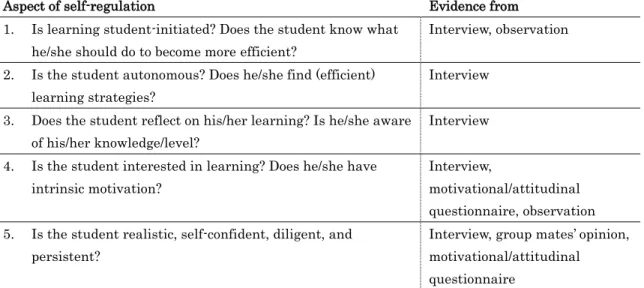
A follow-up interview in English was conducted in a form of group discussion with 3 advanced level students, Mika, Yuri and Hana, once they had moved up to the second year. The interview was scheduled during lunchtime on a day when they could all attend at the same time. A semi-structured interview was carried out along the lines of Molnár’s (2002) framework, adapted by Mezei (2008), which was used to gather qualitative data about self-regulated behavior embedded into the learners’ own contexts (see Table 3).
Table 3 Mezei’s (2008) adapted framework for data analysis and the sources of data to answer the questions
Aspect of self-regulation Evidence from
1. Is learning student-initiated? Does the student know what he/she should do to become more efficient?
Interview, observation 2. Is the student autonomous? Does he/she find (efficient)
learning strategies?
Interview 3. Does the student reflect on his/her learning? Is he/she aware
of his/her knowledge/level?
Interview 4. Is the student interested in learning? Does he/she have
intrinsic motivation?
Interview,
motivational/attitudinal questionnaire, observation 5. Is the student realistic, self-confident, diligent, and
persistent?
Interview, group mates’ opinion, motivational/attitudinal questionnaire
Ⅴ. Results and discussion
5.1 Results of quantitative survey: Pre- and post-questionnaires
In order to answer the first research question, “How do the Japanese first-year university students demonstrate self-regulatory behavior in English
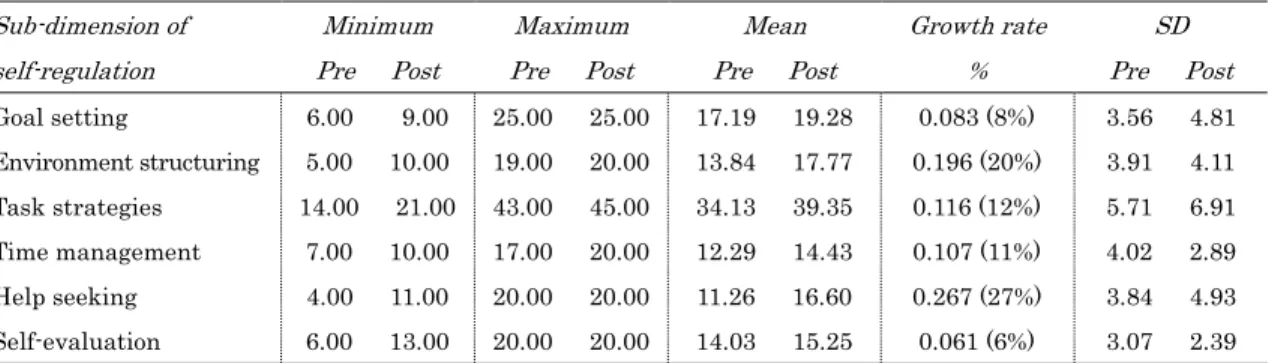
learning?”, a complete picture of the participants’ self-regulation level at the pre- and post-stages was obtained. Descriptive statistics for the six components are shown in Table 4. The results reveal that the participants scored relatively high on level of goal setting at both the pre- and post-stages (m=16.19 [pre], 19.28 [post], sd=3.56 [pre], 4.81 [post], growth rate=8%). The most significant improvements were found in terms of environment structuring (m=13.84 [pre], 17.77 [post], sd=3.91 [pre], 4.11 [post], growth rate=20%) and help seeking (m=11.26 [pre], 16.60 [post], sd=3.84 [pre], 4.93 [post], growth rate=27%). In terms of self-evaluation, there were no significant differences between the pre- and the post-stages (m=14.03 [pre], 15.25 [post], sd=3.07 [pre], 2.39 [post], growth rate=6%). As for task strategies (m=34.13 [pre], 39.35 [post], sd=5.71 [pre], 6.91 [post], growth rate=12%) and time management (m=12.29 [pre], 14.43 [post], sd=4.02 [pre], 2.89 [post], growth rate=11%), only modest growth rates were observed.
Table 4 Descriptive statistics for the components of self-regulation
Sub-dimension of self-regulation Minimum Pre Post Maximum Pre Post Mean Pre Post Growth rate % SD Pre Post Goal setting Environment structuring Task strategies Time management Help seeking Self-evaluation 6.00 9.00 5.00 10.00 14.00 21.00 7.00 10.00 4.00 11.00 6.00 13.00 25.00 25.00 19.00 20.00 43.00 45.00 17.00 20.00 20.00 20.00 20.00 20.00 17.19 19.28 13.84 17.77 34.13 39.35 12.29 14.43 11.26 16.60 14.03 15.25 0.083 (8%) 0.196 (20%) 0.116 (12%) 0.107 (11%) 0.267 (27%) 0.061 (6%) 3.56 4.81 3.91 4.11 5.71 6.91 4.02 2.89 3.84 4.93 3.07 2.39
5.2 Results of qualitative survey: Interview
In order to answer the second research question, “How does using self-regulated behaviors shape the students’ language learning?”, qualitative data were derived through an interview with 3 advanced level students regarding their self-regulated behavior. The interview was semi-structured, allowing the participants to discuss their learning experiences in more detail. In analyzing the interview data, Mezei’s (2008) adapted framework (see Table 3) was used to observe the way that participants self-regulated their learning.
Three participants had gained experience of studying English very hard to pass entrance exams, and they mentioned how boring their study had been at the time. Hana said, “I didn’t really like the way teachers taught us and how they forced us to do this and that.” However, they had no other choice than to follow the rules set by others because they believed that teachers would know better how other students succeeded. Thus, despite the fact that they were not happy about
their learning situation, their learning behaviors were dependent on the situation in which they were placed, due to their immediate goal of successfully entering a university.
5.2.1 Learning is student-initiated and the student knows what to do to become more efficient.
The participants' purpose, objectives, styles, and activities of learning English have changed since they achieved their goal. The fact that they are no longer forced into a learning situation is a good indicator of whether their English learning is characterized as self-initiated or not. Yuri clearly expressed her view about learning efficiency: “[At high school] we just couldn’t do it our own way, but I think I [now] can control the learning pace. Of course, each class has assignments and deadlines, but they are usually in the middle of the semester or at the end of it, so we do things our own way to complete the assignments on time. So, I make time for study, and sit and study when necessary.” Hana also added a comment on the same topic: “I [also] prefer having the feeling that I can study for myself and manage my learning, rather than being forced to do so. But actually, I usually work really hard only when the deadline is approaching. I know, I know, so I try to ask what my friends do and compare myself with better and more intelligent students around me. They study well and enjoy school life and club activities, too. Then, I feel that I also have to do it that way.” Their opinions indicated that although their approach to self-regulation is different, both Yuri and Hana self-initiated their learning toward a course goal without being forced to do so by others. While both participants appreciated the degree of freedom at university, Mika also valued the benefits of learning under the direction of others: “I am not good at doing something constantly. I am easily influenced by my friends or other interesting things. My motivation goes up and down very often. I can put a lot of effort into it once I am forced. Honestly, I don’t dislike it. I feel a sense of greater achievement if I do what my teacher says I should, and it works for me.” The 3 participants all demonstrated different views of learning at university; however, to some extent, they made it clear that they wanted to feel responsible for their own learning and seemed to be aware of what contributed to making them more efficient.
Considering another perspective of her learning environment at university, Mika’s comments on her language practice with exchange students were notable. She said, “The textbook teaches us right and good English, and I think that’s important, but I also want to study natural English conversation by socializing with people [in the International Circle].” In addition, she expressed how helpful and efficient it was to prepare herself for a study abroad program: “I heard from
my senpai that it is difficult to make local friends in a foreign country. I think I agree with this. If I can’t talk about interesting topics in English, not many people will want to become friends with me. But exchange students want to make friends with Japanese students. So, it is easier to make friendships.” This comment suggests that she wants to acquire both academic and social language skills in order to accomplish this, as she expressed her desire to be able to make stimulating conversation and a separate place to use the language in a social setting.
5.2.2 The student is autonomous and finds (efficient) learning strategies.
The 3 participants were classmates when they were freshmen. They were also very close friends and discussed what and how they engaged in learning throughout the interview. All of them were aware that their English proficiency was above average and were confident to share what they do outside of class.
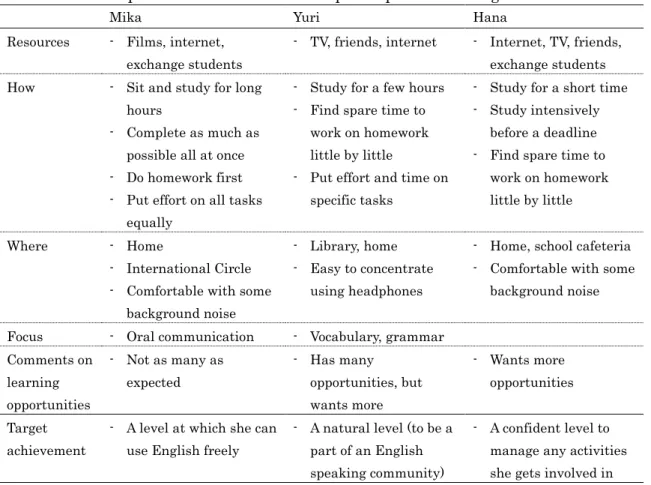
The question, “How do you study?” in the interview can shed light on the students’ autonomy. Table 5 illustrates that they find various common resources for regulating their English learning behavior, such as the internet, cable TV, films, and interaction with more proficient students and exchange students. While Mika preferred to sit and study for longer hours to complete her assignments, Yuri and Hana made it clear that studying for short times with regular breaks was more efficient and effective for themselves. Regarding balancing effort among tasks, Mika reported the she puts effort on all tasks equally, while Yuri explained that she changed the amount of time and effort according to the difficulty or ease of the task. Another aspect common to all of them was that they felt more comfortable with some background music/noise when they study. Yuri mentioned that she could not concentrate very well in a quiet place and had to use headphones while she studies in the library.
Table 5 Descriptive characteristics of the participants’ learning
Mika Yuri Hana
Resources - Films, internet,
exchange students
- TV, friends, internet - Internet, TV, friends,
exchange students
How - Sit and study for long
hours
- Complete as much as possible all at once - Do homework first - Put effort on all tasks
equally
- Study for a few hours - Find spare time to
work on homework little by little
- Put effort and time on specific tasks
- Study for a short time - Study intensively
before a deadline - Find spare time to
work on homework little by little
Where - Home
- International Circle - Comfortable with some
background noise
- Library, home - Easy to concentrate
using headphones
- Home, school cafeteria - Comfortable with some
background noise
Focus - Oral communication - Vocabulary, grammar
Comments on learning opportunities - Not as many as expected - Has many opportunities, but wants more - Wants more opportunities Target achievement
- A level at which she can use English freely
- A natural level (to be a part of an English speaking community)
- A confident level to manage any activities she gets involved in
5.2.3 The student is self-reflective and aware of his/her knowledge/level.
Mika discussed her expectation of English learning opportunities at university (see Table 5), saying: “I had mostly no conversation classes in the last 2 years of high school because we had to concentrate on studying vocabulary, grammar, and reading. I was actually expecting to have more chances to practice speaking, and not just in the classroom—I was thinking I could easily make international friends.” To create a more fruitful learning environment for herself, she decided to join the International Students Circle in the middle of the first year. She expressed that she is more satisfied now that she had extended her chances to use English in practical situations: “I do not say very difficult things, but I am happy that I can actually try to use what I have studied. I think that’s what I wanted and needed to do.” Hana likewise mentioned lack of opportunities to use English: “I actually want more chances to talk.” At the same time, she evaluated there to have been an improvement of some aspects: “I have many more English classes and teachers speak only English. I never experienced that in my high
school, so it was a big change for me and I feel my English…especially listening and writing, improved a lot. For example, I can produce sentences smoother than before. Maybe I need to study reading more to feel the improvement.”
Yuri brought up the fact that she had started to learn vocabulary and grammar on her own: “I studied and memorized a huge number of words for the entrance exam but I feel I am losing those words day by day, and grammar too. I realized this after several months. It’s started to happen often that I know the word but I cannot remember the meaning. So, I started to study by myself again. No one told me that I had to do so, but I felt that I should.” Thus, it was her fear derived from self-reflection of her knowledge that prompted Yuri’s self-regulating behavior. In addition, she seemed to be clear as to what she should do to improve her TOEIC score: “I need a higher score to apply for a study abroad program.” 5.2.4 The student is interested in learning and has intrinsic goals.
The 3 participants showed both intrinsic and extrinsic goals. As many previous studies on motivation suggest, intrinsic motivation helps support the students in learning for long periods of time and persevere with intricate problems. They expressed the ambiguous nature of their intrinsically oriented ultimate goals of language learning: “…not sure where I want to work, so I just want to prepare myself to go wherever I will want in the future. I think a high performance in English will help me someday” (Mika); “I want to work for an international organization, and want to be a part of international people” (Yuri); “I also want to work in an international environment or big Japanese company so that I may have the chance to move to an overseas branch” (Hana). A further interview question was, “What is your target level?”, which was intended to indicate their level of target achievement. The participants’ responses were all characterized by intrinsic orientation (see Table 5). For example, Yuri stated that she had a strong desire to improve English proficiency and wanted to work as a member of an English speaking community. Likewise, Hana mentioned the she wanted to acquire a confident level of English to manage any activities she would become involved in. What is interesting is that none of them described a clear image of future prospects. This suggests that their intrinsic goals are a fuzzy but powerful construct. In other words, a clear future image is not necessarily required to engage in long-term learning if the goal is well internalized.
Intrinsically motivated goals were to be found in the students’ immediate behaviors as well. For instance, Mika used expressions such as, “I was a little disappointed that I could not use English as much as I expected,” “I thought joining the International Circle would give me more chances for English speaking,” and “I want to do something with English native speakers.” These comments
explain her tenacious attitude about looking for the right place (the International Circle) to get what she needed (more chances to learn and experience activities in English), and provide strong evidence that she was passionate about learning and intrinsically oriented.
5.2.5 The student is realistic, self-confident, diligent, and persistent.
The 3 participants were clearly aware of the fact that their proficiency was above average. While they were confident about their overall English performance, they also mentioned feeling unsatisfied about specific aspects of their ability. Yuri said, “I make a lot of mistakes and what I don’t like is that I realize my mistakes…I don’t hesitate to make mistakes. I don’t think I am embarrassed because of classmates. It is just a very bad feeling about myself. I don’t know how to improve. Maybe practice and more practice helps...” Hana said, “[during class] I sometimes try to teach my friends, but I cannot explain very well. Even if I understand things I can’t explain those to other people. My speaking is not as good as reading.” Such notions of their own problem areas seemed to help the students critically evaluate their proficiency and identify areas to be focused on in their further studies. Also, in terms of learning persistence, as their target goal is characterized by intrinsic orientation, they are not likely to quit learning soon but to continue learning as long as they feel truly confident and judge their English knowledge to be good enough.
Ⅵ. Conclusion
Two types of survey were conducted and each revealed different aspects of self-regulation among first-year university students’ learning. First, the results of a questionnaire provided an overall picture of changes among the 28 participants’ self-regulation over a two-semester period. Within the six components of self-regulation, significant changes were observed in terms of environment structuring and help seeking at the pre- and post-testing stages, while only modest growth was seen in the area of self-evaluation. Second, interview surveys shed light on how the 3 participants went about structuring learning in their own individual contexts. These results illustrated some tendencies of good learners’ self-regulation: they know when, where, and why learning should take place to make their learning efficient. Although questionnaire data found the area of self-evaluation to have the least growth, reflective attitudes were often associated with self-regulated behavior in the interview. Participants reported not only reflecting on their immediate mistakes in a task or an activity, but also regularly monitoring changes in their proficiency (e.g., noticing increased/decreased vocabulary size), specific improvements (e.g., noticing a gap between what they
could not do and what they could), and needs (e.g., noticing what types of activities were necessary to meet their goals), which also suggests that they knew from whom to seek help. Interestingly, all participants shared similar learning environments at university in terms of access to learning resources. However, the difference seems to be that some learners had an improved ability to merge those available resources to make the most of their learning experiences. Indeed, the ability to appropriately allocate resources is essential to self-regulation.
Before concluding, several limitations of the current study must be pointed out. First of all, in this questionnaire study, only first-year students who enrolled in the author’s classes participated in the experiment, and the size of the sample was hence limited. Accordingly, excessive generalizations should be avoided. In addition, the interview was conducted with a small number of participants and on a limited schedule. A follow-up interview for each participant would have been helpful to understand individual backgrounds, beliefs, and recognition of learning in more detail. Despite these limitations, this study was a useful step toward understanding more about how first-year students at university regulate their learning. In the end, more studies are needed on the development of self-regulatory processes and especially on developmental changes over a transition period from high school to university, as it seems that a considerable amount of new learning opportunities become available to learners during this period. Overall, research should be directed to explore how to help students use their time and resources more effectively to become more successful self-regulated learners.
References
Ainley, M., & Patrick, L. (2006). Measuring self-regulated learning processes through tracking patterns of student interaction with achievement activities. Educational Psychology Review, 18, 267–286.
Barnard, L., Lan, W. Y., To, Y. M., Paton, V. O., & Lai, S. L. (2009). Measuring self-regulation in online and blended learning environments. The Internet and Higher Education, 12, 1–6.
Blair, C., & Diamond, A. (2008). Biological processes in prevention and intervention: The promotion of self-regulation as a means of preventing school failure. Development and Psychopathology, 20, 899–911.
Boekaerts, M. E. (1999). Self-regulated learning: Where we are today. International Journal of Educational Research, 31(6), 445–551.
Boekaerts, M. Pintrich, P. R., & Zeidner, M. (2000). Handbook of Self-Regulation: Theory, research, and applications. San Diego, CA: Academic Press.
Boekaerts, M., Pintrich, P. R., & Zeidner, M. (2005). Handbook of Self-Regulation. San Diego, Calif.: Academic Press.
Borkowski, J, G,. Chan, L.K. S.., & Muthukrishna, N. (2000). A Process-Oriented Model of Metacognition: Links Between Motivation and Executive Functioning. Issues in the Measurement of Metacognition, Paper 2, 1–41, Lincoln, NE: Buros Institute of Mental Measurements.
Bronson, M. B. (2000). Self-Regulation in Early Childhood: Nature and Nurture. New York: Guilford.
Chen, C. S. (2002). Self-regulated learning strategies and achievement in an introduction to information systems course. Information Technology, Learning, and Performance Journal, 20(1), 11–25.
Deci, E. L., & Ryan, R. M. (1985). Intrinsic Motivation and Self-Determination in Human Behavior. New York, NY: Plenum.
Dörnyei, Z. (2001). Motivational Strategies in the Language Classroom. Cambridge: Cambridge University Press.
Dörnyei, Z. (2005). The Psychology of the Language Learner: Individual Differences in Second Language Acquisition. Mahwah, NJ: Lawrence Erlbaum.
Dörnyei, Z. (2008). The L2 Motivational Self System. In Z. Dörnyei, & E. Ushioda (Eds.), Motivation, Language Identity and the L2 Self. Clevedon, UK: Multilingual Matters.
Griffiths, C. (2008). Lessons from Good Language Learners. Cambridge: Cambridge University Press.
Götz, T., Nett, U. E., & Hall, N. C. (2013). Self-Regulated Learning. In Hall, N.C., Götz, T. (Eds.), Emotion, Motivation, and Self-Regulation: A Handbook for Teachers (pp. 123–166). Bradford: Emerald Group.
Karabenick, S. (1998). Strategic Help Seeking: Implications for Teaching and Learning. Mahwah, NJ: Lawrence Erlbaum Associates.
Karabenick, S., & Knapp, J. (1991). Relationship of academic help seeking to the use of learning strategies and other instrumental achievement behavior in college students. Journal of Educational Psychology, 83, 221–230.
Kopp, C. B. (1982). Antecedents of Self-Regulation: A Developmental Perspective. Developmental Psychology, 18, 199–214.
Lynch R, & Dembo M. (2004). The relationship between self-regulation and online learning in a blended learning context. International Review of Research in Open and Distance Learning, 8(4), 1–16.
Mezei, G. (2008). Motivation and Self-Regulated Learning: A Case Study of a Pre-Intermediate and an Upper-Intermediate Adult Student. WoPaLP, 2, 79– 104.
Molnár, E. (2002). Az önszabályozó tanulás. Iskolakultúra, 12(9), 3-16.
Norton, B., & Toohey, K. (2001). Changing perspectives on good language learners. TESOL Quarterly, 35(2), 307–322.
Oxford, R. (2011). Teaching and Researching Language Learning Strategies. Upper Saddle River, NJ, USA: Longman.
Pintrich, P. R. (2004). A Conceptual Framework for Assessing Motivation and Self-Regulated Learning in College Students. Educational Psychology Review, 16(4), 385–407.
Pintrich, P. R. (2005). The role of goal orientation in self-regulated learning. In: Boekaerts, M., Pintrich, P. R. & Zeidner, M. (Eds.). Handbook of self-regulation. Burlington, MA: Elseiver Academic Press, 451-502.
Pintrich, P. R., Smith, D. A. F., Garcia, T., & McKeachie, W. J. (1991). A Manual for the Use of the Motivated Strategies for Learning. Michigan: School of Education Building, The University of Michigan.
Pintrich, P. R. (2000). The role of goal orientation in self-regulated learning. In M. Boekaerts, P. R. Pintrich, & M. Zeidner (Eds.), Handbook of Self-Regulation. (pp. 451–502). San Diego, CA: Elsevier Academic Press.
Rose, H. (2011). Reconceptualizing strategic learning in the face of self-regulation: Throwing language learning strategies out with the bathwater. Applied Linguistics, 1–8.
Rubin, J. (1975). What the "Good Language Learner" can teach us. TESOL Quarterly,9(1), 41–51.
Schrum, L., & Hong, S. (2002). Dimensions and strategies for online success: Voices from experienced educators. Journal of Asynchronous Learning Networks, 6(1), 57–67.
Sierens, E., Vansteenkiste, M., Goossens, L., Soenens, B., & Dochy, F. (2009). The synergistic relationship of perceived autonomy support and structure in the prediction of self-regulated learning. British Journal of Educational Psychology, 79(1), 57–68.
Stern, H. H. (1975). What can we learn from the good language learner? Canadian Modern Language Review, 31(4), 304–318.
Tseng, W. T., Dörnyei, Z., & Schmitt, N. (2006). A new approach to assessing strategic learning: The case of self-regulation in vocabulary acquisition. Applied Linguistics, 27(1), 78–102.
Turner, J. C. (2006). Measuring self-regulation: A focus on activity. Educational Psychology Review, 18, 293–296.
Vygotsky, L. (1978). Mind in Society. Cambridge: Harvard University Press. Vygotsky, L. (1986). Thought and Language. Cambridge: MIT Press.
Winne, P. H., & Hadwin, A. F. (1998). Studying as self-regulated learning. In D. J. Hacker & J. Dunlosky (Eds.), Metacognition in Educational Theory and Practice. (pp. 277–304). The educational psychology series. Mahwah, NJ: Erlbaum.
Winne, P. H., & Perry, N. E. (2005). Measuring self-regulated learning. In M. Boekaerts, P. R. Pintrich & M. Zeidner (Eds.), Handbook of self-regulation (pp. 531-566). San Diego, CA: Academic Press.
Yoshida, H. (2013). 『FL 環境の日本人英語学習成功者の学習経験トラジェクトリ― 自己調整学習の観点から― 』 2012 年度博士学位申請論文. 大阪大学.
Zheng, J. (2013). A survey of tuition-free English major students’ use of language learning strategies. International Education Studies, 6(7), 9–17.
Zimmerman, B. J. (2005). Attaining self-regulation: A social-cognitive perspective. In M. Boekaerts, P. R. Pintrich & M. Zeidner (Eds.), Handbook of self-regulation (pp. 13–39). San Diego, CA: Academic Press.
Zimmerman, B., J. & Campillo, M. (2003). Motivating self-regulated problem solvers. In J. E. Davidson & R. J. Sternberg (Eds.), The nature of problem solving. (pp. 233-262). New York: Cambridge University Press.
Zimmerman, B., & Risemberg, R. (1997). Becoming a self-regulated writer: A social cognitive perspective. Contemporary Educational Psychology, 22, 73– 101.
Appendix
Adapted version of MSLQ (Pintrich, Smith, Garcia, & McKeachie, 1991) and OSLQ (Bernard, Lan, To, Paton, & Lai, 2009)
Please give a mark between 1 and 5.
5=strongly agree 4=agree 3=neutral 2=disagree 1=strongly disagree Item Subscale 1. 2. 3. 4. 5.
I set standards for my assignments in English classes. 1 2 3 4 5 I set short-term (daily or weekly) goals as well as long-term goals (monthly or for the semester).
1 2 3 4 5 I keep a high standard for my learning English.
1 2 3 4 5 I set goals to help me manage study time for English learning.
1 2 3 4 5 I achieve goals I set for myself.
1 2 3 4 5 Goal setting 6. 7. 8. 9.
I choose the location where I study to avoid too much distraction. 1 2 3 4 5 I find a comfortable place to study.
1 2 3 4 5 I know where I can study English most efficiently.
1 2 3 4 5 I choose a time with few distractions for studying.
1 2 3 4 5 Environment structuring 10. 11. 12. 13. 14.
I allocate extra studying time for learning English because I know it is time demanding.
1 2 3 4 5
I try to schedule the same time everyday or every week to study English, and I observe the schedule.
1 2 3 4 5 I try to distribute my studying time evenly across days.
1 2 3 4 5 I prepare my questions before the discussion in the classroom.
1 2 3 4 5
Time management
I organize my time to complete class requirements in a timely manner. 1 2 3 4 5 15. 16. 17. 18.
I find someone who is knowledgeable in class content so that I can consult with him or her when I need help.
1 2 3 4 5 I share my problems with my classmates so we know what we are struggling with and how to solve our problems.
1 2 3 4 5 If needed, I try to meet my classmates after school/class.
1 2 3 4 5 I am persistent in getting help from the teacher.
1 2 3 4 5 Help seeking 19. 20. 21. 22.
I summarize my learning to examine my understanding of what I have learned.
1 2 3 4 5
I ask myself a lot of questions about the course material when studying for this class.
1 2 3 4 5
I communicate with my classmates to find out how I am doing in my class.
1 2 3 4 5
I communicate with my classmates to find out what I am learning that is different from what they are learning.
1 2 3 4 5 Self-evaluation 23. 24. 25. 26. 27. 28.
I am responsible for my own education; what I learn is ultimately my responsibility.
1 2 3 4 5 During class time, I’m highly concentrated on what is being done.
1 2 3 4 5
If course readings are difficult to understand, I change the way I study. 1 2 3 4 5
I ask myself questions to make sure that I understand the course materials.
1 2 3 4 5
I try to change the way I study in order to fit the course requirements. 1 2 3 4 5
I try to think through a topic and decide what I am supposed to learn from it rather than just reading it over when studying.
Task strategies (metacognition)
29.
30. 31.
1 2 3 4 5
When I study for this class, I set goals for myself in order to direct my activities in each study period.
1 2 3 4 5
I regulate and adjust my behavior to complete course requirements. 1 2 3 4 5
I understand the main ideas and important issues of readings without guidance from the instructor.
1 2 3 4 5