Classification
of
involutions
of lattices
with conditions
and
real
algebraic
curves
on a
hyperboloid
*(条件付き対合付き格子の分類と hyperboloid 上の実代数曲線)
Sachiko Saito
\dagger (齋藤幸子)\S 1.
IntroductionReal algebraic
curves
on a hyperboloid (i.e., $RP^{1}\cross RP^{1}$) or an $\mathrm{e}\dot{1}1\mathrm{i}_{\mathrm{P}^{\mathrm{S}\mathrm{o}}}\mathrm{i}\mathrm{d}$have been
stud-ied by several people, D. A. Gudkov ([5]), V. I. Zvonilov $(1^{23}],[24],125],[26])$, P. Gilmer ([4]),
G.
Mikhalkin $([14],[16],[15])$, the author $([12],[11],[10],[1\mathrm{s}],[21])$ and others. The author hasbeen studying especially
curves
of bidegree $(4,4)$ on a hyperboloid. The classification of $‘(\mathrm{r}\mathrm{e}\mathrm{a}\mathrm{l}$schemes” (i.e., isotopic classification on $RP^{1}\cross RP^{1}$) of nonsingular real algebraic
curves
ofbidegree $(4,4)$ on a hyperboloid was completed by Zvonilov ([25]) and the author ([13])
inde-pendently.
In thesame paper [25], Zvonilov also judged the “dividingness” (see
\S 6)
of each real schemeand the “complex orientation” of each dividing
curve.
He didthiswork by using ‘(Rokhlin typeformula” obtained by himself ([23]) and Gilmer’s results on the $\mathrm{r}\mathrm{o}\dot{\mathrm{t}}$
ation numbers of dividing
curves
([4]).In the meanwhile, after her work of the isotopic classification, the author started to apply
Nikulin’s theory of “involutions of lattices with conditions” (see [19]) to
curves
ofbidegree $(4,4)$on a hyperboloid. I. Itenberg $([6],[8],[7],[9])$ and A. Degtyarev $([2],[3])$ also have done similar
approaches for singular
curves
of degree 6 in $RP^{2}$ or singular surfaces of degree 4 in $RP^{3}$. In1995, the author finished enumerating up all the $‘(\mathrm{g}\mathrm{e}\mathrm{n}\mathrm{e}\mathrm{r}\mathrm{a}$
” ofour $\zeta(\mathrm{i}\mathrm{n}\mathrm{V}\mathrm{o}\mathrm{l}\mathrm{u}\mathrm{t}\mathrm{i}\mathrm{o}\mathrm{n}\mathrm{s}$of lattices with
our
condition”, i.e., the 2-dimensional cohomology groups of the double coverings of$P^{1}\cross P^{1}$branched along nonsingularreal algebraic
curves
of bidegree $(4,4)$. The result of that workwasfirst appeared in [21]. But “the table of allthe genera” in [21] has some mistypes, duplications
and a wrong topological interpretation. So the author distributed a revised table to some
peo-ple. (The present article also includes the revised table in
\S 5.)
Anyway, since then, the author has been investigating the topological properties of
curves
which realize each
genus,
where ‘topological properties’mean
real schemes, dividingness,com-plex orientations, e.t.c. In this article, the
author
will collect andarrange
theprocesses
and$*\mathrm{T}\mathrm{h}\mathrm{i}\mathrm{s}$ research is $\mathrm{p}\mathrm{a}\mathrm{r}\mathrm{t}\mathrm{i}\mathrm{a}\mathrm{u}_{\mathrm{y}}$ supported by $\dot{\mathrm{G}}\mathrm{r}\mathrm{a}\mathrm{n}\mathrm{t}$
-in-Aid for $\grave{\mathrm{S}}$
cientific Research $(\dot{\mathrm{N}}$0.08740043
$)$, Ministry of
Education, Science and Culture, Japan.
results of her investigationstatedabove, and
prove
some
knownor
unknown facts by using ‘thetable of
genera’.
Finally, she will indicatesome summarized
questions.Acknowledgment
The contents of this article
were
firstannounced
orally at the Workshop on Topology ofReal
Algebraic Varieties held at the Fields Institute, Toronto, Jan. 6- 10, ’97. After her talk,some
participants, especially Professors O. Viro, S.Finashin
and P. Gilmer, gave her kindlycomments.
At the reception,Professors
F. Mangolte and J.van
Hamel, who work for realEnriques surfaces, gave her
warm
advice and encouragement. And besides, she could listen tosome
stimulating talk about real algebraic varieties. She would like to thank the organizingcommittee, who invited her to that workshop.
\S 2.
Oursituation
(I)Let $A$ be a nonsingular real algebraic
curve
of bidegree$(4,4)$ in$P^{1}\cross P^{1}$ and $Y$ be the
double covering of $P^{1}\cross P^{1}$
branched
along $A$. Then the complex conjugation of$P^{1}\mathrm{x}P^{1}$ is
lifted into two anti-holomorphic
involutions
of$Y$, which aredenoted
by $T^{+}$ and $T^{-}$ (For thedetails,
see
$[12],[11],[13].)$We set $L=H^{2}(Y;^{z)}\cdot$ Since the bidegree is $(4,4)$, $Y$ is a $K3$
surface.
Andso
$L$ is
an even
unimodular
latticeof signature $(3,19)$. We set $e_{1}=\pi^{*}([\infty\cross P^{1}])$ and$e_{2}=\pi^{*}([P^{1}\cross\infty])$, where $\pi$ : $Yarrow P^{1}\cross P^{1}$ is the covering map. Then we see$e_{1}\cdot e_{1}=e_{2}\cdot e_{2}=0$ and $e_{1}\cdot e_{2}=2$. Let $T$
be $T^{+}$ or $T^{-}$. Then we see $T^{*}(e_{i})=-e_{i}(i=1,2)$
.
Let $S$ be the subgroup of$L$ generated by
$e_{1}$ and $e_{2}$. Then $S$ is a primitive subgroup of
$L$. We set $\varphi=T^{*}$ and $\theta=\varphi|s$
.
We
now
obtaintwo “lattices withinvolutions”
$(L, \varphi)$ and $(S, \theta)$.
Let $i$ denote the inclusionmap
:
$Sarrow L$, and we set $G=${id
$s$}.
Then$(L, \varphi, i)$
is
an
involutionof
a
lattice with condition $(S, \theta, G)$ in thesense
ofNikulin
[19]. We will giveprecise definitions inthe next section.
\S 3.
Definitions
Bya latticewe
mean
anondegeneratesymmetric
bilinear formover
$Z$. By a homomo$7phiSm$of
latticeswemean
a group homomorphismpreserving the bilinear form.By a condition (on
an
involution of a lattice) wemean
a triple $(S, \theta, G)$, where $S$ is anondegenerate lattice, $\theta$ is an involution of $S$, and $G$ is a distinguished subgroup of
$O(S, \theta)$,
where we set $o(S, \theta)=$
{
$f$ : automorphism $\mathrm{o}\mathrm{f}S|f\circ\theta=\theta\circ f$}.
In [19] $S$ is assumed to bepossibly degenerate, but in this article we
assume
that it is nondegenerate.By an involution (of a lattice) with condition $(S, \theta, G)$
we
mean
a triple $(L, \varphi, i),$ $L$ is alattice, $\varphi$is an involution of
$L$ and $i$ : $S\subset L$is a primitiveembedding oflattices which
satisfies
$\varphi\circ i=i\circ\theta$
.
Twoinvolutions
$(L, \varphi, i)$ and $(L’, \varphi’, i’)$with conditionif thereis
an
isomorphism $u:Larrow L’$ oflattices with involutions (that is, $\varphi’\circ u=u\circ\varphi$) suchthat $u$ preserves the condition $(S, \theta, G)$ (that is, $u\circ i=i’\circ g$ for some $g\in G$). Moreover,
we
introduce a weaker equivalence relation. We say two involutions $(L, \varphi, i)$ and ($L’,$$\varphi’,$il) with
condition $(S, \theta, G)$ belong to a
same
genvs if forevery
prime $p$ ($=2,3,5,7,$ $\cdots$,and $\infty$), thereexistsan $Z_{p}$-isomorphism$u:L\otimes_{z^{Z_{p}}}arrow L’\otimes_{Z^{Z_{p}}}$of induced lattices with induced involutions
(that is, $\overline{\varphi’}\circ u=u\circ\overline{\varphi}$) such that $u$ preserves the condition $(S, \theta, G)$ (that is, $u\mathrm{o}i=i’\mathrm{o}g$
for some $g\in G$). (We are refered to, for example, p.43 of [17] for the definition of ‘genus’.
The author could not find the clear definition of the genus ofan involution of alattice with a
condition in [19].)
In this article, as in [19],
we
treat only even lattices. If $M$ is a (nondegenarate) lattice, weset $A_{M}=M^{*}/M$, whichiscalledthe discriminantgroup$0,\mathrm{f}M$, and$q_{M}\mathrm{d}.$
enOt.e
$\mathrm{s}$the discriminant(quadratic)
form
of M. (For the details, see p.109 of [18].)For an involution ofalattice $(L, \varphi, i)$ with condition
$(S, \theta, G.)_{\mathrm{S}}.\mathrm{t}.\mathrm{a}\mathrm{t}.\mathrm{e}\mathrm{d}.\mathrm{a}\mathrm{b}\mathrm{o}\mathrm{V}\vee \mathrm{e}$, weconsider the
restricted lattices:
$L_{\pm}=\{X\in L|\varphi(X)=\pm x\}$
and
$S_{\pm}=\{_{X\in}s|\theta(_{X)\pm x\}}=$.
Since we see that the discriminant group $A_{L}+=L_{+}^{*}/L_{+}$ is isomorphic to thedirect
sum
ofsome
$Z/2’ \mathrm{s}$. Let $a$ denote the number of those $Z/2’ \mathrm{s}$
.
And let $(t_{(+)}, \iota_{(}-))$ denotes the signature of $L_{+}$.
We define the invariants $\delta_{\varphi}$ and $\delta_{\varphi S}$ as follows. $\delta_{\varphi}=\{$
$0$ if$x\cdot\varphi(x)\equiv 0$ (mod2) $\forall x\in L$
1 otherwise
$\delta_{\varphi S}=\{$
$0$ if$x\cdot\varphi(x)\equiv x\cdot s_{\varphi}$ (mod2) $\forall x\in L$
for
some
$s_{\varphi}$ in $S$1 otherwise
Then $(L, \varphi, i)$ is of
one
of the following3
types:Type$0$: $\delta_{\varphi}=0$ (then, $\delta_{\varphi S}=0$)
TypeIa: $\delta_{\varphi}=1$ and $\delta_{\varphi S}=0$
Type Ib: $\delta_{\varphi S}=1$
For the
elemen.ts
$x_{\pm}\in S_{\pm}$, we define theinvariant..
$\delta_{x}\pm=\{$
$0$ if $x_{\pm}\cdot L_{\pm}\equiv 0$ (mod2)
1 otherwise Then we get two functions $\delta_{\pm}:$ $x_{\pm}\mapsto\delta_{x}\pm$
’ and wedefine
We
see
they are contained in $( \frac{1}{2}S_{\pm}\cap S_{\pm}^{*})/S_{\pm}$. An another equivalent definition of $H_{\pm}$ is giveninp.105 of [19]. We
use
the above definition because ofthe importance oftopologicalinterpre-tations (see for example, [10] and Lemma
4
in\S 6)
of the invariants $\delta_{x}\pm\cdot$Finally, we define the group$H_{+}\oplus_{\gamma}H_{-}$ andtheembedding$\gamma_{r}$ : $H_{+}\oplus_{\gamma-}Harrow A_{L}\mathrm{a}\mathrm{s}+$ inp.105
of [19]. And we set $q_{r}=\gamma_{r}^{*}q_{L}+$
’ where $q_{L}+\mathrm{i}\mathrm{s}$ the discriminant form of $L_{+}$. Then $q_{r}$ is a ‘finite
quadratic form’ (see p.108 of [18] for the definition). And note that the form $q_{r}$ is possibly
degenerate. See also p.108 of [18] for the definition ofdegeneracy offinite quadratic forms.
We put $q=q_{L}+\mathrm{a}\mathrm{n}\mathrm{d}$ let $v_{q}(\in A_{L})+$ denote the characteristic element($\mathrm{s}\mathrm{e}\mathrm{e}$ p.108 of [19]) of
$q$
.
We see the following:$\delta_{\varphi}=0$ if and only if $v_{q}=0$
$\delta_{\varphi S}=0$ if and only if $v_{q}$ is contained in $\gamma_{r}(H_{+}\oplus_{\gamma}H_{-})$
Thus, for TypeIa,
we
denoteby $v$ the element of $H_{+}\oplus_{\gamma}H$-such that $\gamma_{r}(v)=vq$.
We callit the characteristic element
of
the embedding$\gamma_{r}$.\S 4.
Oursituation
(II)We return to
our
situation stated in\S 2.
We first remark that $t_{(+)}=1$ inour
case. (For thereason, see p.156 of [18].) Next, it is obvious that $S_{+}=\{0\}$ and $S_{-}=S$ because $\theta=-1$. We
see the discriminant group (recall
\S 3) As-
$=S_{-}^{*}/S_{-}=S^{*}/S$ is generated by $[e_{1}^{*}](=[ \frac{1}{2}e_{2}])$ and$[e_{2}^{*}](=[ \frac{1}{2}e_{1}])$, and hence it is isomorphic to $Z/2\oplus Z/2$, where $e_{i}^{*}(i=1,2)$ is the dual element
of $e_{i}$. While $As_{+}=H_{+}=\{0\},$ $H_{-}$ is a subgroup of $(S_{-}^{*} \cap(\frac{1}{2}S_{-}))/S-=A_{S_{-}}$, namely, one of
the following 5 subgroups:
$\{0\},$ $<[ \frac{1}{2}e_{1}]>,$ $<[ \frac{1}{2}e_{2}]>,$ $<[ \frac{1}{2}h]>$ and $A_{S_{-}}$,
where
we
set $h=e_{1}+e_{2}$.\S 5.
Applications ofNikulin’s results to oursituation
Wenowfixour condition $(S, \theta, G)$, namely, $S$is the lattice represented by
$,$
$\theta=-1$and $G=\{\mathrm{i}\mathrm{d}_{S}\}$
.
And we restrict ourselves to involutions of lattices $(L, \varphi, i)$ with the condition$(S, \theta, G)$, where $L$ is the even unimodular lattice of signature $(3,19)$ (so-called the $K3$ lattice)
and $t_{(+)}=1$
.
In
our
case, since $H_{+}=0$, we have $q_{r}=(-qs_{-)|H}-(\mathrm{r}\mathrm{e}\mathrm{c}\mathrm{a}\mathrm{l}1 \S 3)$, and hence, it is justde-termined by $H_{-}$
.
For the embedding $\gamma_{r}$:
$q_{r}arrow q$, we have $\gamma_{r}=\gamma_{H_{-}}=\gamma_{LS}+-(s\mathrm{e}\mathrm{e}$ p.105 of[19]$)$
.
And, in thecase
ofTypeIa, the characteristic element $v$ of the embedding $\gamma_{r}$ (recalI\S 3)
is contained in $H_{-}$.
We now apply the results ofTheorem
1.6.3
and Theorem 1.8.3 of [19] toour
situation. We(1) The genus of $(L, \varphi, i)$ is uniquely determined by the ‘type’ (Type$0$, Type Ia or Type Ib),
the invariants $a,$ $t_{(-)},$ $H_{-}$, and in the
case
ofTypeIa,
the characteristic element $v(\in H_{-})$ ofthe embedding $\gamma_{r}$.
(2) Two lists $H_{-}$ and $H_{-}’$ (with identical ‘type’ and invariants $a,$ $t_{(-)}$ ), and in the case of
TypeIa, $v(\in H_{-})$ and $v’(\in H_{-}’)$ give identical
genera
if and only if $H_{-}=H_{-}’$, and $v=v’\mathrm{f}\mathrm{o}\Gamma$Type Ia.
(3) There exists an involutionof a lattice $(L, \varphi,.i)$ with the condition $(S, \theta, G)$ (fixed as above)
with $L$ even unimodular of signature $(3,19)$, $\mathrm{t}(+)=1$, an designated ‘type’ (Type$0$, TypeIa or
TypeIb), invariants $a,$ $t_{(-)},$ $H_{-}$, and, for Type Ia, the characteristic element of the embedding
$\gamma_{r}$ being$v(\in H_{-})$ ifand only if the ‘type’ and these invariants $a,$ $t_{(-)},$
$H_{-}$, and $v(\in H_{-})$ (for
TypeIa) satisfy the Conditions 1.8.1 and 1.8.2 of [19].
Then let us enumerate up all the data of the invariants:
‘type’ (Type$0$, TypeIa or TypeIb), $a,$ $t_{(-)},$ $H_{-}$,
(andin the case of TypeIa, the characteristic element $v(\in H$-))
which satisfy the Conditions 1.8.1 and 1.8.2 of [19]. Actually, this is a hard and tedious task.
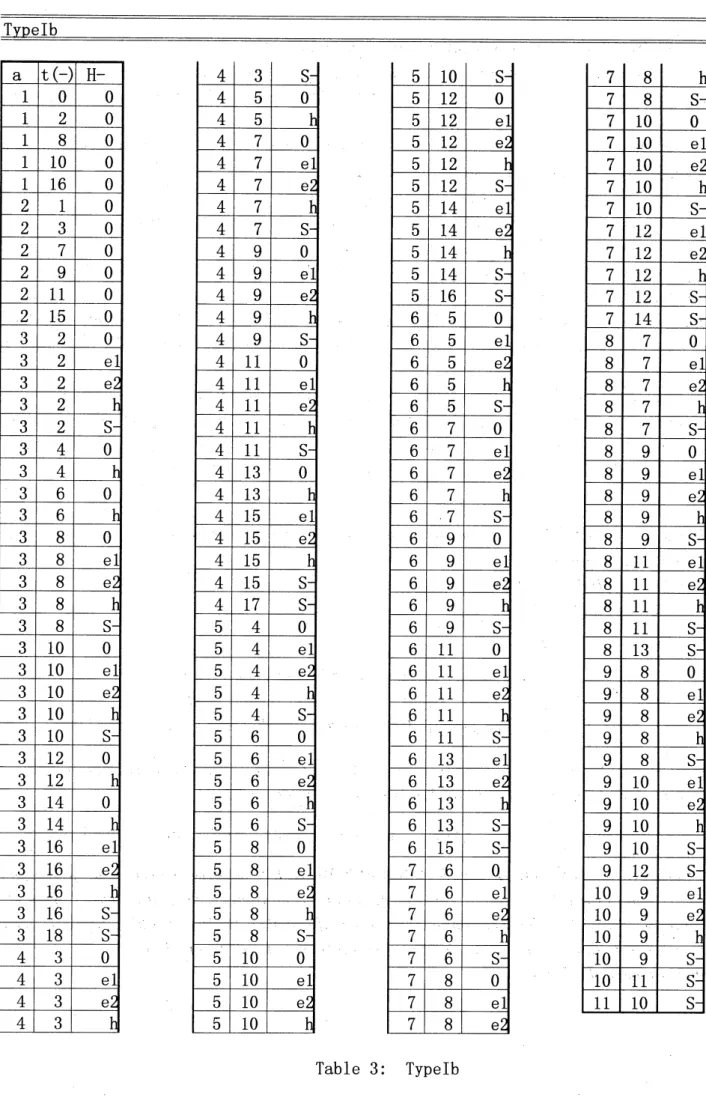
The results are written in Tables 1-3 below.
Notation: In Tables 1-3, the symbols a, $\mathrm{t}(-)$ and H- mean $a,$ $t_{(-)}$ and $H$-respectively.
And the symbols $0,$ $\mathrm{e}1,$ $\mathrm{e}2,$ $\mathrm{h}$ and S- stand for the data of $H_{-}$, namely, the subgroups $\{0\}$,
$<[ \frac{1}{2}e_{1}]>,$ $<[ \frac{1}{2}e_{2}]>,$ $<[ \frac{1}{2}h]>\mathrm{a}\mathrm{n}\mathrm{d}$ $A_{S_{-}}$ (recall
\S 4)
respectively.We remark that in
our
case, every $H_{-}$ in TypeIa is generated by auniquenonzero
element,and hence it is nothing but the characteristic element. Hence, we don’t need to designate the
characteristic elements in Type Ia, either.
In each ‘type’ (Type$0$, TypeIa or TypeIb), the data $(a, t_{(-)}, H_{-})$ are in bijective
corre-spondence with the genera because of the conclusions (1),(2) above and the fact that $a$ and
$t_{(-)}$ are genus invariants (seep.137 of [18]). Thus we see that there are 51 generaof Type$0,34$
genera
of TypeIa and174
genera of Type Ib inour
situation.Table
1:
TypeO\S 6.
Topologicalinterpretations
of each genusIn this section, for each
our
genus, we investigate the topological properties of nonsingularreal algebraic
curves
of bidegree $(4,4)$ on $RP^{1}\cross RP^{1}$ which realize that genus. We recallour
situationstated in
\S 2.
Let $RA$ be the real part of $A$, i.e., $A\cap RP^{1}\cross RP^{1}$. See the section 2 of [13] for the
definit.ions
of the following notions concerning $RA$:the notion of $(M-i)$
-curves
of
bidegree $(4,4)$,the torsion $(s, \mathrm{t})(\in Z\mathrm{x}Z)$ of each connected component of $RA$,
oval, non-oval, odd branch, even branch
We can set $B^{+}(B^{-})=\{F\geq 0\}(\{F\leq 0\})(\subset RP^{1}\cross RP^{1})$, where wefix a defining (real)
polynomial $F$ of$A$. We recall the two anti-holomorphic involutions $T^{+}$ and $T^{-}$ of $Y$, and let
$RY^{\pm}$ denote the fixed point sets of $T^{\pm}$. Then, since
our
bidegree is $(4,4)$, we can regard $RY^{\pm}$as the doubles of$B^{\pm}$ respectively (see Remark
3.2
of [12] for the reason) replacing $F\mathrm{b}\mathrm{y}-F$ ifnecessary.
We call $RA$ a dividing
curve
(orcurve
of
type I ([25])) if$A\backslash RA$ is disconnected, andnon-dividin.g
curve
(orcurve
of
typeII) if otherwise. Moreover, following [20], we call a real schemeis
of
type I if all thecurves
with this scheme are of type I,of
type II if they all are of type II,and
of
indeterminate type ifsome are oftype I and others are oftype II.Lemma 1 ([12]) Fora nonsingular real algebraic curve$RA$
of
bidegree $(4, 4)$ on$RP^{1}\cross RP^{1}$,we have the following:
(1)$[RY^{+}]=[RY^{-}]$ in $H_{2}(Y;^{z}/2)$
(2)$IfRA$ is dividing, then
$[RY^{\pm}]=$
’
$0$ (if $RA$ has only ovals)
$(le_{1})_{\mathrm{m}\mathrm{o}\mathrm{d}}\wedge 2$ (if $RA$ has odd branches with odd $s$) $(le_{2})_{\mathrm{m}\mathrm{o}}\wedge \mathrm{d}2$ (if $RA$ has odd branches with odd$t$)
$(lh)_{\mathrm{m}}\wedge \mathrm{o}\mathrm{d}2$ (if $RA$ has even branches with $(|s|,$$|t|)=(1,1)$)
in $H_{2}(Y;Z/2)$, where $l\wedge$
is the integer
defined
in [12], and we use the same notationsfor
thePoincar\’e $duds$
of
the cohomology classes $e_{i}(i=1,2)$defined
in\S 2.
We next quote the following collection ofuseful results. See [18] for the terminology.
Theorem 2 ([18], Theorems 3.10.5 and 3.10.6)
If
$Y$ belongs to a coarseprojectiveequiv-alence class
of
real$K3$surfaces
corresponding to an isomorphism classof
polarlized integralin-volutions $(L, \varphi, h)$
of
the even unimodular latticeof
signature $(3, 19)$ with$h^{2}=n$(: a designatedeven
positive integer), $t_{(+)}=1$, and the invariants $t_{(-)},$ $a,$ $\delta_{h},$ $\delta_{\varphi}$ and $\delta_{\varphi,h}$,(1) The realpart $RY$
of
$Y$ is an orientable dosedsurface
which is homeomo$7phic$ to$\{$
$\emptyset$
if
$\delta_{\varphi}=0,$ $(a, t_{()}-)=(10,9)$ $T^{2}$ II$T^{2}$if
$\delta_{\varphi}=0,$ $(a, t_{(-)})=(8,9)$ $\Sigma_{g}$II$k(S^{2})$ in the remaining cases,where we set $g= \frac{21-a-t(-)}{2}$ and $k= \frac{1-a+t_{(-)}}{2},$ $\Sigma_{g}$ denotes the orientable closed
surface of
genus$g$, and $k(S^{2})$ means the disjointunion
of
$k$ copiesof
$S^{2}$.
(2) When $RY\neq\emptyset$,
$\delta_{h}=0\Leftrightarrow$ the linear system $|h|_{R}$ cuts out on$RY$ a cycle
homologous to $\mathit{0}$ in $H_{1}(RY;Z/2)$.
(3) $\delta_{\varphi}=0\Leftrightarrow[RY]=0$ in $H_{2}(Y;^{z}/2)$.
(4) $\delta_{\varphi,h}=0\Leftrightarrow[RY]=h_{\mathrm{m}\mathrm{o}\mathrm{d} 2}$ in $H_{2}(Y;^{z}/2)$.
Let us return to the situation in
\S 2
again. We set $T=T^{+}$ or $T^{-}$ and $\varphi=\tau*$. Let $RY$be the fixed point set of $T$. We set $h=e_{1}+e_{2}$ in
\S 4.
Then $(L, \varphi, h)$ is a ‘polarized integralinvolution’ ([18]) with $h^{2}=4$. Hence, by Lemma 1 and Theorem 2, we have the following:
Lemma 3 Let $RA$ be a nonsingular real algebraic curve
of
bidegree $(4, 4)$ on $RP^{1}\cross RP^{1}$.Then we have the following:
(1) $\delta_{\varphi}=0\Leftrightarrow[RY]=0$ in $H_{2}(Y;^{z}/2)$.
(2) $\delta_{\varphi,h}=0\Leftrightarrow[RY]=h_{\mathrm{m}\mathrm{o}\mathrm{d} 2}$ in $H_{2}(Y;^{z}/2)$.
Moreover, suppose that $RA$ is dividing. Then we have the following:
(3) $[RY]=0$ in $H_{2}(Y;Z/2)\Leftrightarrow RAha\mathit{8}$ only ovals, or it has non-ovals with
$l\wedge$ even.
(4) $[RY]=h_{\mathrm{m}\mathrm{o}\mathrm{d} 2}$ in $H_{2}(Y;Z/2)\Leftrightarrow RA$ has non-ovals with $(|s|, |t|)=(1,1)$ and
$l\wedge$
odd.
When $RA$ has only ovals, $B^{+}$ or $B^{-}$ contains ‘the outermost component’ (cf. [12]). As
stated above, $RY^{\pm}$ are the doubles of $B^{\pm}$ respectively. Thus we can divide the situations of
$(Y, T)$ into the following 4 cases:
$\mathrm{A}$: $RA$ has only ovals and $RY$ contains the double of the outermost component.
$\mathrm{A}’$: $RA$ has only ovals and $RY$ does not contain the double of the outermost component.
$\mathrm{B}$: $RA$ has odd branches.
$\mathrm{C}$: $RA$ has even branches.
We now recall all the real schemes (i.e., isotopy types) of
curves
of bidegree $(4,4)$ on ahy-perboloid, whicharegiven in
\S 3.11
of [25] orat the end of [13]. We also give the correspondenceIt iseasily seen that the real scheme ofacurvedetermines the topological types of $RY^{\pm}$ as
in the following table:
Now the subgroup $H_{-}$ is defined by the invariants $\delta_{e_{1}},$ $\delta_{e_{2}}$ and $\delta_{h}$. Recall the definitions of
Lemma 4 ([13], Lemma 2) Let $RA$ be a nonsingular real algebraic curve
of
bidegree $(4, 4)$ on $RP^{1}\cross RP^{1}$.If
$RA$ has odd branches with odd $s$ (resp. t), then we have $\delta_{e_{1}}=0$ (resp. $\delta_{e_{2}}=0)$.The following lemma can be proved in the similar way to Lemma 4 above:
Lemma 5 Let $RA$ be
a
nonsingular real algebraiccurve
of
bidegree $(4,4)$on
$RP^{1}\cross RP^{1}$.Then we have the following:
(1)$If(Y, T)$ is in A$f$
case and $RY\neq\emptyset_{2}$ then $\delta_{e_{1}}=\delta_{e_{2}}=\delta_{h}=0$, namely, $H_{-}=A_{S_{-}}$.
(2)$If$we are in $C$ case, then$\delta_{h}=0$.
For only $h$, we can prove $‘\zeta \mathrm{t}\mathrm{h}\mathrm{e}$ inverse assertion” by Theorem 2, (2) above, and we get the
following:
Lemma 6 Let $RA$ be a nonsingular real algebraic curve
of
bidegree $(4, 4)$ on $RP^{1}\cross RP^{1}$.If
$RY\neq\emptyset$ and $\delta_{h}=0$
for
$(Y, T)$, then we are in $A$’ case or $C$ case.Lemma 7 Let $RA$ be a nonsingular real algebraic curve
of
bidegree $(4, 4)$ on $RP^{1}\cross RP^{1}$.Then,
for
$(Y, T)_{\rangle}$ we have$x\cdot T_{*}(x)\equiv x\cdot[RY]$ (mod 2) $\forall x\in H_{2}(Y;^{z})$
Proof.
$T:Yarrow Y$ is anorientation preserving involution, and its fixed point set $RY$ is anori-entable closedsurface (Theorem2, (1)). Hence,by Lemma3of [1], weget the requiredresults.$\square$
Remark 8 By the above lemma, we see
$v_{q}=[ \frac{1}{2}[RY]]$ $\in L_{+}^{*}/L_{+}=A_{L}+$ ’
where $v_{q}$ is the $charaCteri_{\mathit{8}}ti_{C}$ element (recall
\S 3) of
$q$.Proposition 9 Let$RA$ be a nonsingular real algebraiccurve
of
bidegree $(4, 4)$ on$RP^{1}\cross RP^{1}$.If
$RA$ is dividing, then $(L, \varphi, i)$ isof
Type$\mathit{0}$ or Type$Ia$.Proof.
If $RA$ is dividing, by (2) of Lemma 1, we have $[RY]\equiv s_{\varphi}$ (mod $2L$) forsome $s_{\varphi}\in S$.By Lemma 7, we have $\delta_{\varphi S}=0.\coprod$
Our aim is to restrict the real schemes of the
curves
which realize each genus enumeratedin Tables 1-3.
We first present ‘candidates’ of the real schemes of the
curves
which realize each genus byusing the above results. See Tables 4-6 below.
Proposition 10 In Type$Ia,$ A
cases
are impossible.(Namely, every real scheme with the superscript 1) in Table 5 can be removed.)
Proof.
In Table 5 (i.e., TypeIa), the real schemes 8, $\frac{4}{1}3,$ $\frac{1}{1}4,$ $\frac{3}{1}2,$ $\frac{5}{1},4,$ $\frac{2}{1}1,$ $\frac{1}{1}$ are presented ascandidates in thecolumun A. Suppose that there exists a
curve
$RA$ suchthat itsreal scheme is8, $(Y,T^{-})$ is in A case, $(L, \varphi, i)$ is ofTypeIa, and $H_{-}=<[ \frac{1}{2}e_{1}]>$. Since $(L, \varphi, i)$ is of Type Ia
and $H_{-}=<[ \frac{1}{2}e_{1}]>$, we see $v=[ \frac{1}{2}e_{1}]$. By Remark 8, we have $v_{q}=1 \frac{1}{2}1^{R}Y^{-}$]] $\in A_{L}+\cdot$ Hence, $\gamma_{r}([\frac{1}{2}e_{1}])=1\frac{1}{2}1^{R}Y^{-}]]$, where $\gamma_{r}=\gamma_{L}+^{S}-(\mathrm{r}\mathrm{e}\mathrm{c}\mathrm{a}\mathrm{l}1 \S 5)$. This
means
$\frac{1}{2}e_{1}+\frac{1}{2}[RY-]\in L$. In themeanwhile, by Lemma 1, $[RY^{+}]\equiv[RY^{-}]$ (mod $2L$). Hence, we also get $e_{1}\equiv[RY^{+}]$ (mod
$2L)$. Hence, for the same
curve
$RA$ withthe different involution $T^{+}$, the associated involutionof our lattice $(L, \varphi’, i/)$ with our condition is of TypeIa, too. It is obvious that $(Y, T^{+})$ is in
$\mathrm{A}$’
case.
So $RY^{+}$ is homeomorphic to $8S^{2}$. Then, by Theorem 2 (1), we see $(a, t_{(-)})=(4,17)$.But this pair of $(a, \mathrm{t}_{(-)})$ does not appearin TypeIa. This is a contradiction. For the remaining
real schemes, we can also prove the same assertion in the same way.$\square$
Proposition 11 In Type$\mathit{0}_{j}$ the real schemes $\frac{5}{1},$ $\frac{2}{1}1and/4/0$ are impossible.
(Namely, every real scheme with the superscript2) in Table
4
can be removed.)Proof.
We consider acurve
$RA$ such that its real scheme is $\frac{5}{1}$ and $(Y, T^{-})$ is in A case.Then, for the same
curve
$RA$ with the different involution $T^{+},$ $(Y,T^{+})$ is in $\mathrm{A}$’ case, and $RY^{+}$is homeomorphic to $\Sigma_{5}$. By Theorem 2 (1), we see $(a, t_{(-)})=(6,5)$. By Lemma 5, we have
$H_{-}=A_{S_{-}}$. Since $(a,t_{(-)}, H_{-})=(6,5, A_{S}-)$ appears only in TypeIb, we see $\delta_{\varphi}=1$. Hence,
$[RY^{+}]\neq 0(\in H_{2}(Y;Z/2))$ because ofRemark 8 and the end of
\S 3,
or Theorem 2 (3). Thenwe also get $[RY^{-}]\neq 0(\in H_{2}(Y;^{z}/2))$. Hence we have $\delta_{\varphi}=1$ also for$T^{-}$ This means $\frac{5}{1}$ does
not appear in Type$0$.
We next consider acurve $RA$ such that its real scheme is $\frac{2}{1}1$ and $(Y, T^{-})$ is inA case. Then,
forthe same
curve
$RA$ with the differentinvolution $T^{+},$ $RY^{+}$ is homeomorphic to $\Sigma_{2}\mathrm{I}\mathrm{I}1S^{2}$. ByTheorem2 (1), we see $(a, t_{(-)})=(8,9)$. If
moreover
$\delta_{\varphi}=0$, then thereal part is homeomorphicto $\mathcal{I}^{Q}$II$T^{2}$ by the same theorem. Hence wehave $\delta_{\varphi}=1$. Then we can prove that $\frac{2}{1}1$ does not
appear in Type$0$ in the
same
way as $\frac{5}{1}$.We last consider a
curve
$RA$ such that its real scheme is /4/0. Then $RY^{+}$ or $RY^{-}$ ishomeomorphic to $\Sigma_{5}$. Hence, we have $(a, t_{(-)})=(6,5)$, and $[ \frac{1}{2}h]\in H_{-}$ by Lemma 5. Since such
genera appear only in Type Ib, we get $\delta_{\varphi}=1$. Thus we can prove $\mathrm{t}\mathrm{h}\mathrm{a}\mathrm{t}/4/0$ does not appear
3
2 $<[ \frac{1}{2}h]>$ /0/7 3 2 $A_{S_{-}}$ $\frac{8}{1}$/0/74)
3 4 $\{0\}$ $\frac{1}{1}5$ 3 4 $<[ \frac{1}{2}h]>$ /1/63
6 $\{0\}$ $\frac{2}{1}4$ : 3 6 $<[ \frac{1}{2}h]>$ /2/5 3 8 $\{0\}$ $\frac{3}{1}3$ 3 8 $<[ \frac{1}{2}e_{1}]>$ $\frac{3}{1}3^{4)}$ $|4 \frac{3|}{\underline 3}$ 3 8 $<[ \frac{1}{2}e_{2}]>$ $\frac{3}{1}3^{4)}$3
8
$<[ \frac{1}{2}h]>$ /3/4 3 8 $A_{S_{-}}$ $\frac{5}{1}3$/3/44)
310.
$-\{0\}$ $\frac{4}{1}2$ 310
$<[ \frac{1}{2}e_{1}]>$ $\frac{4}{1}2^{4)}$ $|3 \frac{4|}{\underline 4}$ 3 10 $<[ \frac{1}{2}e_{2}]>$ $\frac{4}{1}2^{4)}$ 3 10 $<[ \frac{1}{2}h]>$ /4/3 3 10 $A_{S-}$ $\frac{4}{1}4$/4/34)
omitted (similar to the above)
4 13 $\{0\}$ $\frac{5}{1}$
4 13 $<[ \frac{1}{2}h]>$ /5/1
omitted (similar to the above)
6 5 $\{0\}$ 4 6 5 $<[ \frac{1}{2}e_{1}]>$ 44) $|4 \frac{0|}{\underline 0}$ 6 5 $<[ \frac{1}{2}e_{2}]>$ 44) 6
5
$<[ \frac{1}{2}h]>$ /0/4 6 5 $A_{S_{-}}$ $\frac{5}{1}$/0/44)
omitted (similar to the above)
6
9
$\{0\}$ $\frac{2}{1}1$ 69
$<[ \frac{1}{2}e_{1}]>$ $\frac{2}{1}1^{4)}$ $|\underline{\frac{2|2}{2}}$ 69
$<[ \frac{1}{2}e_{2}]>$ $\frac{2}{1}1^{4)}$6
9
$<[ \frac{1}{2}h]>$ /2/26
9 $A_{S_{-}}$ $\frac{3}{1}2$ /2/24)Table 6
We next consider the dividingness ofnonsingular real algebraic
curves
of bidegree $(4, 4)$on
ahyperboloid. We first quote the following known result:
Proposition 12 ([12]) Forthe dividingness
of
nonsingular real algebraic curves $RA$of
bide-gree $(4, 4)$ on a hyperboloid, we have the following:
(1)$M$
-curves
are dividing.(3)The real schemes $\frac{2}{1}5$ and $\frac{6}{1}1$ are
of
type I.(4)The real schemes $\frac{1}{1}6,$ $\frac{3}{1}4,$ $\frac{5}{1}2,$ $\frac{7}{1},6,$ $\frac{2}{1}3,$ $\frac{4}{1}1,$ $\frac{1}{1}2,$ $\frac{3}{1}$ and 2 are
of
type II (by the Arnol$\prime d_{\mathit{8}}$) type
congruence.)
(5)The real schemes $|\lambda_{1}|\lambda_{2}or/\lambda_{1}/\lambda_{2}$ with $\lambda_{1}-\lambda_{2}$ odd are
of
type II.(6)The real schemes $\frac{1}{1}\frac{1}{1},4(1,0)$ and $4(1,1)$ are
of
type I.By Proposition 9, we immediately get thefollowing:
Proposition 13 (1)Curves in Type$Ib$ are not dividing. (2) The real schemes which appear
only in Type$n$ are
of
type II.By (2) above, we get different proofs ofthe following results:
Corollary 14 (Zvonilov $[25],3.11$) We have thefollowing:
(1) The real schemes $\frac{5}{1}\rangle$ $4,$ $\frac{2}{1}1$ and $\frac{1}{1}$ are
of
type II.(2)The real schemes $|6|0,$ $|4|2,$ $|3|1and|2|0$ are
of
type II.(3) The real $schemeS/4/0,$ $/1/1and/\mathrm{O}/\mathrm{O}$ are
of
type II.Remark:
(1) Zvonilov proved the above assertions using his results in [23].
(2) Gilmer’s result ([4]) on the rotation numbers of dividing
curves
can also contribute to theabove assertion.
(3) We can prove the non-dividingness of4 by Gilmer’s Theorem 2 (b) in [4].
However, at present, it seems that we cannot prove the following assertions by
means
ofour
Tables
4-6.
Proposition 15 (Zvonilov $[25],3.11$) We have the following:
(1)The real scheme $|0|0$ is
of
type II.(2)The real scheme8 $|5|1$ and $2(1,2)$ are
of
type I.Remark:
By the above result, we can remove $2(1,2)$ from Table 6 (i.e.,Type Ib).
\S 7.
Some questionsIn
\S 6,
wetried to restrict the real schemes of thecurves
which realize eachgenus enumeratedin Tables 1-3. In this section, wegive some questions.
Question 1 Inthe situation
of\S 2,
we
set$K=RY\cap\pi-1(\infty\cross P^{1})$ (resp. $RY\cap\pi^{-1}(P^{1}\cross\infty)$),where $RY$ denotes the
fixed
point setof
T. We suppose that $RY\neq\emptyset$. Then, is the followingassertion true? $‘ {}^{t}If\delta_{e_{1}}$ (resp. $\delta_{e_{2}}$) $=0$, then $[K]=0(\in H_{1}(RY;Z/2)).$
If the above assertion is true, then we can remove the real schemes with the superscript 4)
from Tables
4-6.
Question 2 In the case
of
Type$Ia$, is $(a,t_{(}-),$$H-)=(10,9, e_{1})$ (resp. (10,9,$e_{2})$) realized byboth a curve with its real scheme $|0|0$ (resp. $\overline{\frac{0}{0}}$) and a curve with its real scheme $2(1,2)$ (resp.
$2(2,1))$?
Question 3 In each case
of
Type$\mathit{0}$ and Type$Ia$, is it possible that some dividing curves andsome non-dividing curves realze an identical value
of
$(a, t_{(-)}, H_{-})$ ($i.e.$, a genus)?Question 4 In the case
of
Type$\mathit{0}$, the4
genera with $(a, \mathrm{t}_{(-)})=(10,9)$ are all realized by anycurves (with their real parts empty)?
参考文献
[1] $\mathrm{V}.\mathrm{I}$. Arnol’d. Distribution of ovals of the real plane algebraic curves, involutions of
four-dimensional smooth manifolds, and the arithmetic integer-valued quadratic forms.
Funct.Anal. Appl., Vol. 5, pp. 169-176,
1971.
[2] $\mathrm{A}.\mathrm{I}$. Degtyarev. Classification ofsurfaces ofdegreefour having a nonsimple singular point.
Math. USSR-Izv., Vol. 35, No. 3, pp. 607-627, 1990.
[3] $\mathrm{A}.\mathrm{I}$. Degtyarev. Classification of quartics having a nonsimple singular point. $\mathrm{i}\mathrm{i}$. Topology
of
Manifolds
and $VarietieS_{\rangle}$ Advances in SovietMath., Vol. 18, pp. 23-54,1994.
[4] P. Gilmer. Algebraic
curves
in $RP(1)\cross RP(1)$. Proc. Amer. Math. Soc., Vol. 113, No. 1,pp. 47-52, 1991.
[5] $\mathrm{D}.\mathrm{A}$. Gudkov. On the topology of algebraic
curves
on a hyperboloid. Russian Math.Surveys, Vol. 34, No. 6, pp. 27-35,
1979.
[6] $\mathrm{I}.\mathrm{V}$. Itenberg. Curves of degree 6 with one non-degenerate doublle point and groups of
monodromy of non-singular
curves.
Real Algebraic Geometry, Proceedings, Rennes 1991,Lecture Notes in Math., Vol. 1524, pp. 267-288, 1992.
[7] $\mathrm{I}.\mathrm{V}$. Itenberg. Rigid isotopy classification of
curves
of degree 6 with one nondegeneratedoublepoint. Topology
of Manifolds
and Varieties, Advances in Soviet Math., Vol. 18; pp.[8] $\mathrm{I}.\mathrm{V}$. Itenberg. Groups ofmonodromyof non-singular
curves
ofdegree6.
Real Analytic andAlgebraic Geometry, Proceedings, Trento (Italy) 1992, pp. 161-168,
1995.
[9] $\mathrm{I}.\mathrm{V}$. Itenberg and $\mathrm{E}.\mathrm{I}$. Shustin. Real algebraic
curves
with real cusps. Topologyof
RealAlgebraic Varieties and Related Topics, Advances in the Mathematical Science829, A. $M$.
S. $Tran\mathit{8}lationS$ Series 2, Vol. 173, pp. 97-109, 1996.
[10] S. Matsuoka (Saito). Coarse projective classification of the double coverings of $P^{1}\cross P^{1}$
branched along
real
algebraiccurves
of bidegree $(4,4)$ (in Japanese) $=$ bidegree $(4,4)$ $\mathit{0})$実代数曲線で分岐する$P^{1}\cross P^{1}$の2重被覆の coarse projective classification. Hokkaido
Univ. Technical Report Series in Math. 19 ‘Topology
of
ComplexManifolds
$f$, pp. 39-52,
December
1990.
[11] S. Matsuoka (Saito). The configurations of the $M$
-curves
of degree $(4,4)$ in $RP^{1}\cross RP^{1}$and periods of real $K3$ surfaces. Hokkaido Math. J., Vol. 19, pp. 361-378, June 1990.
[12] S. Matsuoka (Saito). Nonsingular algebraic
curves
in $RP^{1}\cross RP^{1}$. Trans. Amer. Math.Soc., Vol. 324, pp. 87-107,
1991.
(written in 1988). .:.[13] S. Matsuoka (Saito). Congruences for M- and $(M-1)$
-curves
with odd branches on ahyperboloid. Bull. London Math. Soc., Vol. 24, pp. 61-67,
1992.
[14] G. Mikhalkin. Extensions of Rokhlin congruence for
curves
on surfaces. Real AlgebraicGeometry, Proceedings, Rennes 1991, Lecture Notes in Math., Vol. $1\dot{5}24$, pp. 372-377,
1992.
[15] G. Mikhalkin. The complex separation of real surfaces and extensions of Rokhlin
congru-ence.
Invent. Math., Vol. 118, pp. 197-222,1994.
[16] G. Mikhalkin. Congruences for real algebraic
curves
onan ellipsoid. Topologyof
Manifolds
and Varieties, Advance8 in
Soviet
Math., Vol. 18, pp. 223-233,1994.
[17] J. Milnor and D. Husemoller. Symmetric bilinear
forms.
Springer,1973.
[18] $\mathrm{V}.\mathrm{V}$. Nikulin. Integral symmmetric bilinear forms and some of their applications.
Math.
USSR
Izv., Vol. 14, pp. 103-167,1980.
[19] $\mathrm{V}.\mathrm{V}$. Nikulin. Involutionsof integral quadratic forms and their applications torealalgebraic
geometry. Math.
USSR
Izv., Vol. 22, pp. 99-172,1984.
[20] $\mathrm{V}.\dot{\mathrm{A}}$
. Rokhlin. $\backslash$
Complex topological characteristics of real algebraic
curves.
Russian[21] S. Saito. Correspondences between topological properties of real algebraic
curves
andinvariants of lattices with involutions (in Japanese) $=$ 実代数曲線の位相的性質と、対合
付格子の不変量の間の対応. Kyoto University Surikalsekikenkyusho Kokyuroku, Vol. 926,
pp. 21-29, 1995.
[22] $\mathrm{O}$ Viro. Progress in the topology of real algebraic varieties over the last sixyears. Russian
Math. Surveys, Vol. 41, pp. 55-82, 1986.
[23] $\mathrm{V}.\mathrm{I}$. Zvonilov. Complex topological characteristics of real algebraic
curves
on surfaces.Funct. Anal. Appl., Vol. 16, pp.
202-203.
[24] $\mathrm{V}.\mathrm{I}$. Zvonilov. Complex orientations of real algebraic
curves
with singularities. SovietMath. Dokl., Vol. 27, No. 1, pp. 14-17, 1983.
[25] $\mathrm{V}.\mathrm{I}$. Zvonilov. Complex topological invariants of real algebraic
curves
on a hyperboloidand on an ellipsoid. St.$Peter\mathit{8}burg$ Math. J., Vol. 3, No. 5, pp. 1023-1042,
1992.
[26] $\mathrm{V}.\mathrm{I}$. Zvonilov. Stratified spaces of real algebraic
curves
of bidegree $(m, 1)$ and $(m, 2)$ ona hyperboloid. Topology
of
Real Algebraic Varieties and Related Topics, Advances in theMathematical Sciences 29, A. M. S. Translations Series 2, Vol. 173, pp. 253-264, 1996.
Department of Mathematics
Hokkaido University of Education (Hakodate Campus)
1-2, Hachiman-cho,
Hakodate, 040, Japan.
$\mathrm{e}$-mail address: [email protected]
〒 040函館市八幡町1-2
北海道教育大学函館校数学教室