PERSPECTIVE. THE APPLICATION OF SYMBOLIC
INTERACTIONIST ROLE THEORY
journal or
publication title
Pragmatics
volume
26
number
2
page range
247-290
year
2016-06
URL
http://hdl.handle.net/10236/14618
SPEECH LEVEL SHIFTS IN JAPANESE: A DIFFERENT
PERSPECTIVE. THE APPLICATION OF SYMBOLIC
INTERACTIONIST ROLE THEORY
Yasuko Obana
Abstract
The present paper analyses speech level shifts in Japanese from a different perspective. By applying Symbolic Interactionist Role Theory, speech level shifts are categorised as the linguistic realisation of an interactional role, or ‘dissociative role’ I call in this paper. Dissociative roles are improvised identities, which occur when the speaker perceives a psychological change in relation to the other participant in the on-going interaction. Plus-level shifts (shifts from plain to polite forms, masu/desu) are triggered when the speaker experiences cautious, attentive, thoughtful and/or grateful feelings at a certain time of interaction, which conforms to the original nature of honorifics. This prompts a dissociative role which creates a certain psychological distance between this role and the other interactant. On the other hand, minus-level shifts (shifts from masu/desu forms to plain forms) are the implementation of the speaker’s another dissociative role, which is assimilated with the other interactant, giving rise to empathy or drawing the other into the speaker’s world.
Whether plus or minus level shifts occur, the interactants’ social roles, i.e., their original roles when the situation is defined, continue to exist throughout the discourse. The interactants are fully aware of their social roles such as teacher and student, friends, family members, and senior and junior in company (= Institutional Roles in this paper). However, when an Improvised Role is created, it is forwarded to the on-going interaction and linguistically implemented as a speech level shift.
This paper also clarifies that both speech level shifts and the so-called ‘conventional’ honorifics are situationally determined, and that they are not separate entities but the two ends of continuum by examining the features they share from the viewpoint of ‘roles’.
Keywords: Speech level shifts; Japanese; Identity; Role; Symbolic Interactionism.
1. Introduction
Interactionist (SI) Role Theory with new features added to Turner’s (2011) model of identities, and to discuss how speech level shifts can be analysed with this theory.
Japanese honorifics have been considered wakimae (= discernment) politeness (e.g., Hill et al. 1986; Ide 1989, 2006), which is often contrasted with volitional politeness that is achieved by individuals’ selection of “strategies” (e.g., Brown and Levinson 1987). However, as recent studies on politeness are more concerned with situational, discursive and even subjective judgements, speech level shifts in Japanese have attracted increasing attention, representing an example of this trend due to their dynamic changes within the same discourse. Unlike wakimae politeness that is allegedly associated with static and socially-given rules of behaviour people are expected to follow (e.g., Cook 2011; Saito 2010), speech level shifts as well as other situated politeness phenomena (e.g., Davies et al. 2011: Linguistic Politeness Research Group 2011) are more contextually sensitive and discursively determined.
Speech level shifts occur because speakers are “active agents who strategically choose to use honorific or non-honorific forms to achieve their interactional goals” (Cook 2011: 3658). The last 15 years or so have witnessed flourishing discussions on speech level shifts in Japanese (e.g. Barke 2011: Chin 2003: Cook 1996a,b, 1997, 2008, 2011; Geyer 2008; Ikuta 1983; Ishizaki 2000; Jones and Ono 2008; Makino 2002; Maynard 2001, 2004; Mimaki 1993; Okamoto 1999, 2009; Saito 2010; Takeda 2011; Yoshida and Sakurai 2005). Their data are extracted from authentic interactions such as telephone conversations, meeting scenes and interviews, as well as TV dramas and films, and different data apparently result in extracting different interpretations of speech level shifts. These studies prove that speech levels are not constant but variable in reality, and that their choice is situationally exercised and often of individuals’ own accord.
I agree that politeness should discursively be examined and that speech level shifts are a good example of how linguistic forms are situationally determined. However, previous studies on speech level shifts seem to have focussed on listing different pragmatic effects and a further step is necessary to postulate them in a theoretical framework. The present paper aims to detect what lies at the core of the phenomena of speech level shifts and their interpretations.
To analyse speech level shifts, I employ SI Role Theory, which highlights ‘identity’ as a product of interaction, and ‘role’ as embodied behaviour of identity; in other words, identity is the basis for role performance. ‘Identity’ is a well-accepted key term in sociology and social psychology, and depending on how the self is viewed, how the relationship between society and individuals is analysed, and how ‘identity’ is interpreted in social action, a great number of theories have been established1. The concept of identity is also salient in current linguistic research, particularly in sociolinguistics and discourse analysis. Because identity is now treated as “fluid,
1 For example, Burke (2006) counts more than 40 theories in social psychology alone (see
fragmentary, contingent and crucially constituted in discourse” (Benwell and Stokoe 2007: 17; emphasis in the original), this concept fits a recent trend in linguistics for discursive analysis of talk-in-action.
SI Theory also considers interaction to be a major resource for identity construction. However, it takes further steps to differentiate identity from role, and also to establish the hierarchy of transactional needs (J. Turner 2002, 2011) in classifying identities. I believe that these features serve as the most practical tool when clarifying differences and similarities between the so-called ‘conventional’ honorifics and speech level shifts, and when examining what identity types prompt speech level shifts.
The paper first reviews previous studies on speech level shifts in Japanese. Second, SI Role Theory is introduced and its relevant features are discussed. Lastly, by applying this SI Role Theory and by adding new types of role identity to Turner’s (2011) model, I explain how speech level shifts are classified in this model.
2. Review of previous studies on speech level shifts
In this section, I review previous studies on speech level shifts, and discuss how their pragmatic effects can be organised to find what lies at the core of phenomena of speech level shifts.
2.1. Plus-level shifts and their effects
Japanese honorifics are traditionally classified as three categories: Deferential forms (sonkei styles to exalt the addressee or a third person), humble forms (kenjoo styles to display self-effacing of the speaker or the speaker’s in-group people), and teinei-go (polite forms toward the listener).
Speech level shifts in general mean that honorific forms, especially masu/desu forms2 as a part of the verbal form in the predicate, cease to be used at a certain moment of interaction and change to plain forms (minus-level shifts). Speech level shifts also account for shifts from plain to masu/desu forms (plus-level shifts). Studies on speech level shifts have lately drawn increasing attention as a part of discursive or situated politeness which is a recent direction in politeness research, challenging the concept of politeness as a set of norms3.
2 Desu is a polite form of copula da, attached to an adjective (e.g., oishii desu = to be tasty)
or to a noun (e.g., seito desu = to be a student). Adjectival-verbs, which end with da in the dictionary form (e.g., shizukada = to be quiet), are conjugated (e.g., shizuka-desu). Masu is a polite form, a conjugated part of a general verb (e.g. iki-masu = to go).
3 In spite of the apparent dichotomy between volition (strategic politeness) and wakimae
(rigid and mandatory “social warrants” [Ide 1989: 196]), they both are shared expectations people follow. In this respect, they both are social norms. Brown and Levinson’s list of strategies are socially expected
Concerning plus-level shifts, Okamoto (2009), for example, claims that they often indicate “irony”. Because honorifics are basically “associated with formal, tense, status-appending, unfamiliar and/or distance settings” (Obana 2000: 205), deliberate use of honorfics in the non-honorific world often results in disclosing the speaker’s sarcastic attitude. This kind of honorific use between intimate friends also yields a joke as a creative strategy (Maynard 2004). Maynard (2001) also reports by examining TV dramas that the speaker’s weak and vulnerable psychology is witnessed when plus-level shifts are observed. This psychology is closely related to ‘power4’ between the interactants, and the person in a weaker position naturally creates some distance from the other to protect him/herself. Because honorifics occur by increasing some distance whether socially (e.g., senior versus junior in a company) or psychologically (e.g., strangers) (Nishida 1995: 28), plus-level shifts can be expected by creating a temporary distance from the other interactant, reflecting the speaker’s weaker position psychologically.
Barke (2011: 126) found by analysing TV dramas that plus-level shifts not only show “sarcasm, annoyance and a lack of intimacy” but also “assist the speaker in appearing calm and in control of his/her emotions in situations of conflict”. Interestingly, Barke’s finding appears to be quite opposite to Maynard’s (2001); the former is “calm and in control” and the latter “weakness”. However, they both point to the same psychological delineation, that is, a psychological distance due to one or the other possessing power although Barke’s example renders power in the speaker’s hand while Maynard’s in the listener’s hand.
Unlike Okamoto (2009), Maynard (2001) and Barke (2011), where plus-level shifts illustrate the speaker’s psychological distance, Cook places interpretations such as indexing “the speaker’s institutional identity” (Cook 2011), “acting on-stage” (Cook 2008), and “a public presentational mode of self… public display mode” (Cook 1996b: 74). For example, Cook (2008) finds in the situations of academic consultation that when professors occasionally use masu/desu forms toward their students, they are “taking a professional role and maintaining the professional stance” (Cook 2008: 28). In a similar way, Yoshida and Sakurai (2005) report that a wife suddenly uses
desu/masu forms, indexing “her sociocultural identity as a wife” (e.g., Gohandesuyo =
Dinner is ready, mentioned by a wife to her husband). Cook (1997) assumes that a plus-level shift handled by a mother in the interaction with her child is analysed as “acting in role” as a mother.
Other studies suggest different interpretations of plus-level shifts. For example, Takeda (2011) reports by analysing the informal interviews with university staff and
and people learn to use them appropriately and this also applies to honorific use. The only difference is that Japanese honorifics hold two levels of linguistic construction; first, the speaker’s strategic intention is linguistically constructed, and then, it is grammatically converted with honorific marking.
4
This conforms to one of the four conventional rules Ide (1989: 230) refers to: “be polite to a person with power”. Ide’s “power” may be a social feature, often related to an influential social position while Maynard refers to a psychological state.
students that plus-level shifts occur when speakers stress their own opinions, focus on the hearer, and switch to a different direction in interaction. Ishizaki (2000) examined telephone messages between university students and found that the weight of information determines a speech level; the more important the message is, the more polite forms are used. In a similar way, Geyer (2008) discusses that polite forms used in a request message to the local community aim “to impersonalize the speaker by framing the request as official, and therefore, not personal” (Geyer 2008: 58).
2.2. Minus-level shifts and their interpretations
Minus-level shifts mean that interactants basically use polite forms, but plain forms from time to time occur to index certain psychological shifts. Ikuta (1983) reports by examining a TV interview that the participants normally use desu/masu forms, but the interviewer’s use of plain forms shows “empathy” for the interviewee. Maynard (2001) examined a TV drama in which two people fall in love and style shifts indicate their emotional ups and downs, and concludes that da (plain form) indexes “a sense of familiarity, tolerance and indulgence”. In a similar way, Takeda (2011) reports that minus-level shifts occur when speakers express their emotions, show empathy for the other and are emotionally involved with the other’s story. Mimaki (1993) also refers to a minus-level shift by a female MC to her male guest, and concludes that it not only indicates the speaker’s stepping into a closer stance toward the guest but also shows her intention to draw his attention to the topic. Cook (1996a) finds in institutional talks that plain forms are derived from “off-stage” discourses (in contrast with “on-stage” contexts where interactants are more aware of their institutional identity).
While the above three studies commonly find the speaker’s psychological closeness to the other, the following findings indicate impersonal or non-interactional features at the time of the occurrence of minus-level shifts. Makino (2002) examines the data from round table discussions to find that the plain form indexes the speaker’s low involvement with the listener, directing the speaker’s attention toward him/herself. He calls this the “inward communication direction” (Makino 2002: 123). Takeda (2011) also finds that the plain form occurs when speakers give their own impressions as if they were speaking to themselves. This corresponds to Cook’s (1996b) “innate mode” and Saito’s (2010) “inward thought”. Chin (2003) examines the conversation between newly-met young adults of the same age group and reports that the plain form often occurs when speakers are searching for appropriate words or trying to remember something while talking.
Saito (2010) also reports by examining the data of subordinates’ plain forms toward their superiors in workplace that plain forms occur when highlighting information (e.g., providing opinions, clarifying superiors’ directives).
2.3. Summary and discussion
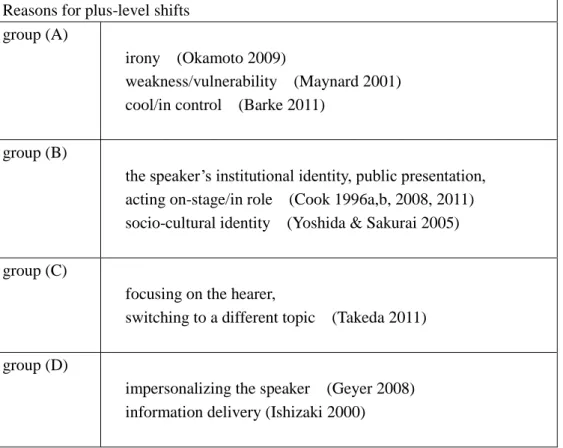
This subsection summarizes the reasons for speech level shifts discussed in Sections 2.1 and 2.2. Table 1 below shows that those reasons are grouped as (A) ~ (G) in accordance with common features involved with those reasons. These groups are further examined to see what pragmatic features commonly lie at the core of phenomena of speech level shifts.
2.3.1. Plus-level shifts: Distance
Let us first examine plus-level shifts, categorised as groups (A) ~ (D) of Table 1.
Table 1. Categories of speech level shifts
Reasons for plus-level shifts
group (A)
irony (Okamoto 2009)
weakness/vulnerability (Maynard 2001) cool/in control (Barke 2011)
group (B)
the speaker’s institutional identity, public presentation, acting on-stage/in role (Cook 1996a,b, 2008, 2011) socio-cultural identity (Yoshida & Sakurai 2005)
group (C)
focusing on the hearer,
switching to a different topic (Takeda 2011) group (D)
impersonalizing the speaker (Geyer 2008) information delivery (Ishizaki 2000)
Reasons for minus-level shifts
group (E)
Empathy (Ikuta 1983)
drawing the hearer’s attention (Mimaki 1993) showing familiarity, tolerance (Maynard 2011) off-stage (Cook 1996a)
group (F)
stressing one’s opinion (Takeda 2011) involved with the topic (Takeda 2011) information highlighted (Saito 2010)
group (G)
inward communication (Makino 2002) inward thoughts (Saito 2010)
innate mode (Cook 1996b)
attention to the speaker him/herself (Takeda 2011)
Group (A) shows the speaker’s psychological distance from the hearer. ‘Irony’ is a deliberate creation of distance from a person who the speaker is normally close to. Husband and wife usually do not use honorifics to each other, however, a wife uses honorifics when she is in conflict with her husband in order to be sarcastic, showing her anger in effect. The speaker’s ‘weakness’ or ‘vulnerability’ also shows that the speaker places him/herself distant from the hearer so that the former can guard him/herself from the other who is most likely holding some power over the speaker. The speaker in control is apparently in contrast with ‘vulnerability’, however, from the viewpoint of psychological distance, the speaker in control equally creates some distance from the hearer. When a conflict occurs and one is in control and behaves cool, one is stepping back to observe the whole conflict, and is not emotionally involved with the other in the given situation. Either way, group (A) illustrates one’s psychological guard by creating distance.
Group (B) is what is called stage performance. For example, university professors do or do not use honorifics out of personal choice, but if they do not, there are certain moments when they raise their speech level. Cook (1996b, 2008) points out that this occurs when they give instructions, advice or comments professionally, and concludes that plus-level shifts demonstrate the professor’s acting on stage.
However, this interpretation is misleading for the following reason. Given the situation where the participants are placed, they have already identified themselves as professor and student (= social identities) because identity is “the social positioning of
self and other” (Bucholtz and Hall 2005: 586), and know how they are expected to behave in this particular situation (= role performances in accordance with “the shared behavioural expectations” [Stryker 2002: 225]). Acting on-stage, professional performance or public mode has already been set up whether the professor uses plain or polite forms. Then, Cook’s (1996b, 2008) “acting on-stage” or “a public presentation mode of self” to explain the phenomena of plus-level shifts is not acceptable because this means that the professor on a public stage reinforces his/her social status and acts accordingly at the time of a plus-level shift. It is doubtful that such a double fortified-stage will display “a positive social role to the addressee” as Cook (2011: 3659) claims. This is because it will emphasize the professor’s profession as if reinstating his/her status, pressing the student to be more astutely aware of their social difference.
As far as Cook’s data (2008: 19-21) are concerned, the professor’s use of plain forms indeed does not “implicate the authoritarian image of the professor”, but “indexes their personal involvement with the student’s situation” (Cook 2008: 20). In other words, the professor basically takes a closer stance to the student, which is linguistically implemented as plain forms5. However, plus-level shifts occur when the professor is giving instructions, advice or professional opinions. These conducts substantiate the professor’s social role (Institutional Role in this paper) in relation to the other participant, student, who is in the receptive position of those professional conducts. Thus, the professor’s social power potentially inflicts a threat to the student despite the former’s egalitarianism in the first place. To avoid such a threat, the professor may use masu/desu forms as a strategy to take cautious but attentive attitudes to the student. Masu/desu forms, like any other ‘conventional’ honorific term, create a certain distance, and the distance in this case functions as mitigating a threat. This type of effect cannot be explained as long as honorific use is understood only as the evidence of social power or status.
The origin of Japanese honorifics is derived from ritual prayers when praising and worshiping gods and goddesses in animism, which later developed as Shintoism6. Asada (2001) examined ancient documents to find that the first written honorifics appeared in norito (lit. words of celebration), a prayer for calming down gods and goddesses’ wrath (e.g., natural disasters), as well as for thanking them for abundant harvests. Because Shintoism was developed to dignify emperors/empresses as descendants of gods/goddesses, honorific use was extended to human beings, first, to emperors/empresses, second, to their family members and court nobles. Later, honorifics further expanded to be used for people in older age or higher status. In
5 The professor’s egalitarian attitude should be judged by examining the whole discourse, and
we are right now based on Cook’s (2008) data. In other cases, some professors may use plain forms to index their higher social rank.
6 ‘Shinto’ means ‘the way of Gods’. Its mythology is described in Kojiki (Records of ancient
events) which was written in the 8th century, attempting to claim that emperors and empresses are descendants of gods and goddesses.
modern Japanese, the primary concern for the use of honorifics is, therefore, the consciousness of status/age differences.
However, the origin of honorifics, praising and feeling awe for gods and goddesses, still persists in modern Japanese. For example, close friends, who normally do not use honorifics to one another, may use honorifics when they show their profound gratitude7, or when they sincerely apologize. Family members may utter New Year’s greetings with honorifics (Akemashite omedetoo gozaimasu. Kotoshi mo doozo yoroshiku
onegaishimasu – Happy New Year. Let’s keep our closeness this year, too: The
underlined parts showing honorific marking). No matter how ritualistic such greetings are in modern Japanese, honorific use evidently shows the speaker’s respect with awe toward the other. Appreciation, gratitude and sincerity, therefore, can be achieved by using honorifics, i.e., creating a certain psychological distance with honorifics can in fact honour the other with admiration, thoughtfulness or attentiveness, although this effect is situationally obtained (and both speaker and listener recognise it).
Therefore, plus-level shifts created by the professor when his/her professional acts are discerned should be interpreted as his/her thoughtful approach to the student8. Although the student is fully aware of his/her receptive position when accepting the professor’s advice or instruction, the more burden the professor’s utterance results in casting on the student, the more considerate approach the professor may take. Thus, plus-level shifts are employed as a strategy to mitigate such a potential threat9.
It should be noted that the interactants’ close relationship basically does not change just because plus-level shifts occur (except “irony” [Okamoto 2009], which deliberately creates a psychological distance). In other words, the psychological distance between the interactants in reality remains the same even when plus-level shifts occur. However, the use of masu/desu forms must create a certain ‘distance’ somewhere. I assume that the speaker distances him/herself from the real ‘interacting-self’ which stands close to the other, and creates another role to suit the nature of the ongoing interaction. This is called a ‘dissociative’ role in this paper (this will further be explained in Section 3.3).
7 In this respect, showing gratitude in Japanese cannot be considered a positive strategy as
defined in Brown and Levinson (1987) because the more profound gratitude one has, the more distance one keeps from the other. Worshiping the other like this is a different kind of politeness from English gratitude which attempts to diminish the distance between the interactants as a positive strategy.
8 I have followed the way in which Cook (2008) interpreted the professor’s basic attitude to
the student as egalitarian, and have reached this analysis of the former’s use of plus-level shifts. However, if her original recorded data were accessed, the tone of the professor’s utterance and other features such as facial expressions and gestures at the time of plus-level shifts might prove Cook’s interpretation (i.e., the professor’s institutional identity) though in this case a sudden change from egalitarian to authoritarian attitudes should be admitted.
9 To achieve the same attentive effect, indirect strategies such as ~ tara doo kana (I wonder if
you do…), and ~ shitara ii to omou yo (I think it’s better to do ….) can be used instead of masu/desu forms.
A similar interpretation applies to groups (C) and (D) of Table 1. Switching to a different topic in interaction needs a careful approach to the other as it is the speaker’s unilateral action, and thus may not suit the other participant. Focussing on the other person means to directly approach him/her with enquiries or to intrude his/her territory. Therefore, the speaker needs to take a more cautious measure in handling the situation. If there are sensitive issues or delicate topics, the speaker may impersonalize him/herself, whereby direct responses to the other interactant are avoided. In a similar way, information delivery requires the speaker’s considerate conduct especially if information seriously affects the other. Impersonalization and information delivery may not create an actual psychological distance between speaker and hearer, however, the speaker’s dissociative role, creating some distance from the scene, views his/her real ‘self’ in interaction more objectively.
To sum up, plus-level shifts in all the groups, (A) ~ (D), point to one direction: distance. A certain distance is created at the time of the occurrence of a plus-level shift. The speaker’s momentarily-created role makes a certain distance, which triggers a plus-level shift, eliciting the speaker’s psychological shift at a certain point of time. Needless to say, this ‘distance’ is interpreted differently in different discourses (e.g., ‘irony’, ‘objectivity’, ‘thoughtfulness’), and the speaker’s strategic intention may or may not be successful because the listener is involved in judging its appropriateness.
2.3.2. Minus-level shifts: Assimilation
Let us now examine minus-level shifts categorised as groups (E) ~ (G) of Table 1. Groups (E) and (F) show the speaker’s more emotional involvement whether it is with the hearer or with the ongoing topic. Both interactants are aware of their social stance, i.e., the initial use of honorifics shows their difference in social status or age, or their unfamiliarity. However, when the speaker is emotionally involved, a certain dissociative role emerges, which is assimilated with the hearer. Empathy, expressing the speaker’s emotion (e.g., agreement, admiration, consensus) and stressing his/her information that is well accepted by the hearer, are all directed to acting in concert with the hearer. Drawing the hearer’s attention equally shows the speaker emotionally involved with the hearer by stepping closer to the latter.
Group (G), on the other hand, gives the impression that the speaker is not particularly involved with the interaction, instead, his/her attention is focussed on his/her own thought. For example, Saito (2010) provides a few extracts from her data in which company subordinates use plain forms in their superordinates’ presence. The first extract shows that a subordinate repeats his senior’s instructions by using plain forms, which, Saito (2010: 3276) assumes, “indexes his inner thought”, showing his “low awareness of or attention to” his superior. However, this assumption is not convincing because by repeating the superior’s exact words, the subordinate must be
giving a full attention to his superior. Furthermore, the former is giving special heed to the latter because he is performing precisely as instructed. Therefore, plain forms used in repeating the words should be interpreted as the subordinate being in alignment with his superior. In other words, the subordinate is creating a dissociative role, which is interactively assimilated with his superior.
Similarly, a minus-level shift witnessed in the second extract in Saito (2010: 3276) presents another assimilation with the other, which the speaker creates in the ongoing interaction. Saito interprets this as the subordinate’s strong assertion of his opinion on young employees who are quite mentally fragile, although at the same time she strangely categorises this phenomenon as the speaker’s inward thought (Saito 2010: 3275-3277). However, a closer examination of the discourse shows that both interactants are co-constructing a joint utterance. More precisely, the subordinate, agreeing with his superior, is adding a statement that conforms to his superior’s intent. The following is a part of Saito’s Extract 2, in which Marumori, Sasaki’s subordinate, uses the plain form, iwanai (do not say).
Sasaki : gan gan kooiwareru koto ni taishite yowai no kane. Sugi atariga soo da tte yuuto
‘I wonder if [they are] vulnerable to being told strongly. Since someone like Sugi reacts that way.’
Marumori: de jibun de nanimo iwanai.
‘And [they] do not say anything voluntarily.’
(Saito 2010: 3276, dialogue lines 3~5 – underline by the author)
Indeed, Marumori apparently asserts his opinion. However, his statement is in fact a continuation of Sasaki’s statement because Sasaki trails off by saying tte yuuto ([That] being said…), which is then taken over and completed by Marumori. This means that at this particular point of time, Marumori is in line with Sasaki as if they were of the same mind. This psychological shift creates a dissociative role, which is assimilated with Sasaki, and is linguistically realised as the plain form shown in the excerpt above. This is another type of empathy by constructing a joint utterance10. Therefore, the use of the plain form in this example is evidence of Marumori’s alignment with Sasaki in the interaction as if the former uttered on behalf of the latter. This psychological shift allows Marumori, though he is junior to Sasaki, to use the plain form. If Marumori wanted to assert his own opinion, he would have used polite forms to his senior to
10 Joint utterance is called “co-participant completion”, a practice that participants in
interaction “complete a turn-constructional unit (TUC)-in-progress initiated by another participant” (Hayashi 1999: 475), or “a trajectory mapped out by the prior speech which can serve as a resource for the recipient in processing the utterance” (Liddicoat 2004: 465).
avoid a potential conflict11. Furthermore, the minus-level shift here does not present the speaker’s inward thought, either, because the speaker is heavily involved with his superior in interaction, reading the latter’s mind and completing the latter’s utterance. Inward thoughts by using plain forms are also discussed in Makino (2002). He concludes that minus-level shifts occur when the speaker is devoted to describing scenes he/she experienced and expressing his/her own opinions. However, it is quite odd to consider the speaker’s such earnest transmission of his/her message to be the indication of little involvement with the addressee. Surely the message the speaker intends to deliver is what he/she wants the listener to understand, share or agree with. Therefore, it is more natural to assume that the speaker attempts to draw the listener’s attention into his/her world. As Megumi (2002) and Takeda (2011) report, plain forms start occurring when the speaker elaborates his/her own opinions. If this is the speaker’s inner thoughts or indifference to the addressee, why does he/she bother amplifying his/her opinions? When describing a scene, as in Makino (2002: 129), the speaker is excited to share the scene with the listener, as if both speaker and listener were experiencing the same scene. By shifting to plain forms from honorifics which initially keep a social distance between the interactants, the speaker engages with the listener, drawing the latter’s attention into the speaker’s world. The plain forms used in groups (E) and (F) are the speaker’s voluntary involvement with the other. In group (G), on the other hand, the speaker pulls and involves the other into the speaker’s territory. Or more precisely speaking, the speaker creates an assimilative identity with the ongoing discourse, inviting the other to join and share the story the speaker is building. I agree that there do exist utterances of the speaker’s inward thought, which triggers the occurrence of plain forms; for example, Chin (2003) reports on the speaker’s monologues when searching for an appropriate expression or recalling something. The speaker’s inward thought may also occur when he/she reflects upon or self-repairs his/her own utterance (e.g., A, chigatta. = Oh, an error!). In these instances, the speaker can be said to be temporarily stepping outside of the interaction, directing his/her attention to his/her own thought12.
However, I do not accept that just because an utterance appears to be of a monologue type, it should always be considered the speaker’s inward thought. As long as it draws the other’s response, or adds a certain effect on the current interaction, it should be regarded as a positive interactive action. To prove this, let us look at example (1) below.
11 If Marumori is assertive as Saito (2010) claims, the tone of his voice may be the evidence
for the assertion. However, Saito (2010) does not refer to any extra-linguistic features in her discussion to prove her point. Moreover, Marumori can be considered to be rude if he is assertive with a strong tone of voice by using the plain form.
12 Cook (2008: 25f), for example, analyses the student’s use of a plain form when recalling
the topic of her thesis in the middle of her statement, and calls this “soliloquy-like remark” (and then the student completes her statement with the desu form).
The following dialogue is an excerpt from student B interviewing professor A concerning A’s research trip to Papua New Guinea and its surrounding islands. Both interactants basically use masu/desu forms, however, A occasionally uses plain forms. (1) Talking about eating habits in Papua New Guinea:
A1: Maa, ichi-nichi ni-shoku gurai shika tabe-nai-desu ne, moo… well a day two-meals about only eat-not-Polite MD really
B1: A, soo-desu ka. oh so-Polite Q
A2: Asa to yoru wa shikkari tabe-te-ru-kanaa.
morning and night Top enough eat-TE-Prog-MD
B2: Sore wa nyuuginia desu ka. that Top New Guinea Polite Q
A3: Nyuuginia desu ne. New Guinea Polite MD
(A1: Well, (they) eat only twice a day, really. B1: Oh, really?
A2: (They) eat sufficiently in the morning and evening, presumably. B2: That is (about) New Guinea, isn’t it?
A3: Yes, (I’m talking about) New Guinea. )
Utterance A2 in (1) contains the plain form (-tabe-te-ru = be eating) and a mood marker (-kanaa = I assume/wonder). This mood marker is often referred to as a soliloquy marker. Thus, it may be argued that utterance A2 is the speaker’s inner thought by recalling something from her memory. However, the mood marker, -kanaa, should be past-tensed if it is used for recalling (i.e. tabe-te-ta-kanaa, in which –ta- is the past tense). Utterance A2 uses the present tense to exhibit the live ambience of the scene. Furthermore, the progressive form, -te-ru (the short form of –te-iru), meaning the repeated habit (of eating), enhances the scene as if both speaker and listener were actually observing New Guinean eating habits. While inviting Person B into A’s world, A also uses a tentative mood marker, -kanaa, (I assume), which is a politeness strategy by avoiding a strong assertion13. Therefore, utterance A2 is not the speaker’s inner thought; on the contrary, she draws the other (Person B) more closely into the ongoing topic. In other words, the speaker is assimilated with the ongoing topic by inviting the listener to be in line with the speaker. The interaction is continuing without any inner thoughts on either side, therefore, Person B confirms by uttering B2 that B correctly
13 By taking advantage of the monologue element of –kanaa, the speaker can hint a request
(e.g., Onagai dekinai kanaa. = I wonder if I could ask you to do~.), or avoid confronting assertions (e.g., Soo kanaa. = I wonder if (it is) so.).
understands that it is about Papua New Guinea (as Person A previously talked about other islands near Papua New Guinea and also utterance A2 carries an empty subject). In sum, minus-level shifts activate the speaker’s intention of involvement with the other participant or with the ongoing stream of interaction. I call this phenomenon “an improvised role-identity”, another dissociative role, which is assimilated with the other participant (e.g., empathy) or with the proceeding topic (e.g., describing a scene). Monologue-type utterances do trigger minus-level shifts due to the speaker’s inward thought when searching for an expression, or recalling something in the middle of his/her statement. However, even apparent monologue-types should be considered to be the act of a dissociative role if they are instrumental in prompting the other participant’s response or in affecting a subsequent direction of the interaction.
3. Symbolic Interactionist Role Theory and speech level shifts
This section introduces relevant features of SI Role Theory to the present paper and Turner’s (2011) model of identities. By adding further role types to this model, I explain how SI Role Theory applies to speech level shifts. However, before introducing SI Theory, I make a brief reference to other identity theories, and refer to notable features of SI Theory that can be distinguished from other identity studies.
3.1. Theories of identity and SI Role Theory
The term, ‘identity’, is one of the most prevailing concepts in current fields of social science. Identity is assigned high priority for investigation in sociology and (social) psychology, and there has been a great proliferation of definitions of, approaches to and perspectives of ‘identity’ in examining all sorts of human behaviour. The concept of identity is also employed in linguistic research, particularly in areas of sociolinguistics, pragmatics and discourse analysis (e.g., Antaki and Widdicombe 1998; Benwell and Stokoe 2006[2007]; Bucholtz and Hall 2005; Coulmas 2005[2010]; Deckert and Vickers 2011; de Fina 2010; de Fina et al. 2006; Geyer 2008; Hyland 2012; Joseph 2013; Miller 2013; Mullany 2010; Norris 2011; Spencer-Oatey 2007; Ylänne-McEwen 2004). Introducing all these studies is beyond the scope of the present paper, but there is a general consensus among current studies on identity. As Omoniyi and White (2006: 2) appropriately summarise, “identity is not fixed”, but rather it “is constructed within established contexts and may vary from one context to another”. In other words, “identity is a process that … takes place in specific interactional occasions”, resulting from “processes of negotiation and entextualization that are eminently social” and therefore, identity “entails ‘discursive work’” (de Fina, et al. 2006: 2). As a consequence, identity can be defined as “a situatedness of the person in
terms of standing in the context of a particular social relationship or group” (Gecas and Burke 1995: 45).
What is normally conducted in linguistic research when dealing with identity is that dialogues, for instance, are scrutinized to find certain linguistic terms, expressions and styles that point to a particular identity. For example, Drew and Sorjonen (1997) find personal pronouns used in the interaction which index the participants’ institutional identity such as ‘we’ referring to their own company. Kinuhata and Yang (2007) discuss military terms which were developed during the world wars such as jibun (self) when referring to oneself, -de arimasu (it is that…), a report style used at the end of the sentence. Particular use of language often reveals which social identity the speaker brings to the fore. For example, Deckert and Vickers (2011) give an example of a black American woman’s use of ‘O-kay’ in a particular way when strongly agreeing with the other interactant. In discourse analysis, the whole discourse is often examined, which implicates the emerging of certain identities. For example, Johnson (2006) examines the interview with a teacher, which eventually reveals that the interviewee is ‘a good teacher’ although there is no mention of this quality in the interview.
Although Symbolic Interactionist (SI) Role Theory, like other linguistic studies on identity, emphasizes interaction in which identity emerges and functions accordingly, and for this reason advocates the multiple and fluid quality of identity, it offers a few features distinctive from other theories of identity, which I believe serve as the most practical tools when clarifying differences and similarities between conventional honorifics and speech level shifts and what triggers the occurrence of speech level shifts. First, SI differentiates ‘identity’ from ‘role’14
. Identity, as the most public aspect of self, is “perceived and interpreted during the interaction with others” (Vryan et al. 2003: 368). Identities are meanings or perceptions each individual attributes to themselves in a role, providing them with a standpoint whereby their actions are implemented. Roles, on the other hand, are performances based on identities, and “are typically improvised as individuals seek to realize their various plans and goals” (Turner 2013: 337) while identities are “internalised role expectations” (Vryan et al. 2003: 368).
Identity and role are not always in one-to-one relationship because “individuals have diverse experiences and any role has multiple meanings” (Turner 2013: 342). For example, a professor identifies herself as a professor in the situation where she professionally interacts with her students. However, her role performance may somewhat differ from other professors. Her egalitarian attitude may be linguistically implemented in the use of plain forms in Japanese society. If she believes keeping aloof is a part of her identity as a professor, she may use masu/desu forms as her basic
14 These two terms are often used as equivalents in SI Theory, because this theory, as a typical example in social psychology, mainly observes sociologically typical behaviour in each social relationship (e.g., doctor-patient, father-son, academic staff-student) where role and identity are treated as coincident although SI researchers admit that individuals’ experience and perception create some different images of identity, thus leading to different role performances.
linguistic style. Or she can be more authoritarian by using imperative plain forms. By virtue of conducting different role performances, individuals present somewhat different role-performances as a professor although the identity as a professor itself, as a perception, can be commonly shared in society.
The second point to be worthy of attention regarding SI is that identities are classified according to the conditions of their occurrences. Hewitt and Shulman (2003[2011]) and Vryan et al. (2003) refer to three identity types: Situational, social and personal, depending on their basic attributes, (role) duration and placement. Turner (2002, 2011), then, elaborated further on identity types and organised them into “the hierarchy of transactional needs” (the term coined by Turner). Not only does Turner’s model clarify what social situations require identities and what psychological and social features are involved with each identity type, but also this model, as will be discussed in Section 3.2, provides us a potential to expand identity categories when necessary in other areas (such as a linguistic investigation in this paper).
In the next subsection, I explain general ideas of SI Theory, and introduce dissociative roles as an expansion of Turner’s model in order to analyse speech level shifts in Japanese.
3.2. Symbolic Interactionism
Role Theory is a discipline in social psychology that explains how individuals form their social identities, how they act accordingly (role performance), and what consequences are caused by performing their roles in social life. In short, Role Theory studies about self identity in society, and examines how one determines one’s social selves to present one’s social behaviour. Goffman (1959) explains the relationship between social identities and roles in terms of theatrical actors who play a role on the stage.
Role Theory has developed into different principles15 in accordance with what sociological aspects are primarily focussed. As one of role theories, Symbolic Interactionism (SI), which was initiated by Mead (1934) and further developed by Bulmer (1969), stresses interactional influences on individuals’ identities and roles. “Interaction is, … centrally a matter of negotiating identities and roles: ‘Who are we and what are we doing?’”(McCall 2003: 329). In other words, interaction creates, shapes and re-creates individuals’ identities; as interaction changes its nature, identities are altered to suit the ongoing interaction.
Interaction is fluid and changeable; so is identity. Roles, which are specified by identities and embodied as social behaviour, are also negotiable. This is because human beings always have a habit of interpreting things (objects or symbols) around them,
15 There are five perspectives: Cognitive, functional, organizational, structural and symbolic
and the meanings of symbols are created and changed through interaction. In interaction, all sorts of symbols surrounding the interactants become the target of their subjective interpretation, including their social relationship, the situation where they are placed and the content of their conversation, which are all added to the interpretation process. In other words, interpretation lies in the interactants’ situational behaviour, and is determined by how participants act toward the object, i.e., the focus of their interaction. Roles, which are interactional products, therefore, inevitably change their nature to conform to the ongoing interpretation of the situation (which encompasses all sorts of symbols).
Since traditional role theories focus more on the effect of roles on sociological phenomena (e.g., the effect of a doctor’s role on patients in hospital), the concept of roles/identities has been regarded as axiomatic, and thus the term, ‘role/identity’, is often used as a generic term that applies to all levels of social phenomena16. However, Turner (2011) (a revised version of J. Turner [2002]) subcategorises identities as four “transactional needs” according to levels of emotional intensity and conscious awareness in identity construction. Figure 1 shows Turner’s (2011: 335) model (simplified by the author).
Figure 1. Turner’s (2011) model of The Hierarchy of Transactional Needs
16 The types of identity introduced by Turner in Figure 1 are prevalent in many other studies,
and Turner adopted the most pervasive terms. However, to our knowledge, Turner is the first that organised those types of identity as a concept.
Core-Identity Social-Identity Group-Identity Role-Identity Level of emotional intensity Level of conscious awareness
According to Turner, the four transactional needs are “the universal needs that are
always present, and indeed are always activated when people interact in encounters”
(Turner 2011: 333 – italics intact). First, Core-Identity is “the conceptions and emotions that individuals have about themselves as persons that they carry to most encounters” (Turner 2011: 334), which is equivalent to “one’s personal identity to oneself” (Hewitt, 1989, 1991), or to “personal identity” (Goffman 1963), including “personal history, biological information and aspects of personality” (Vryan et al. 2003: 371). Vryan et al. (2003: 372) state that Core-Identity, or personal identity, is particularly transsituational, compared with the other identity types that are more contextually (socially or interactionally) constructed. Therefore, the level of emotional intensity in the case of Core-Identity is the highest of all the identity categories shown in Figure 1 as Core-Identity is the most personal and almost unconscious in one’s mind (on the other hand, Role-Identity is the most consciously recognised as it is publically determined, and often one is assigned a certain role in a given situation; therefore, the ‘level of conscious awareness’ is the highest as shown in Figure 1).
Second, Social-Identity is a categorical identity to others. It includes racial, ethnic, gender and national identities. Third, Group-Identity is individuals’ “incumbency in corporate units such as groups, organizations and communities” (Turner 2011: 334). This identity is “the perspective or culture (norms, values, beliefs, goals) of a given corporate unit individuals have internalised as part of the structure of self” (ibid). The fourth identity, Role-Identity, is “the least encompassing level of self” because role identities “are attached to specific roles, typically played out in the divisions of labour of corporate units – for example, schools, workplaces, families” (ibid). Role-Identities are closely related to Group-Identity because specific roles are often derived from the values and norms attached to a given corporate unit. That is, Group-Identity is a more abstract concept and Role-Identity provides its substantiation with specific examples of roles in social interaction.
Role-Identity is equivalent to “situational identity” (Vryan et al 2003: 368), which leads to “role enactments specific to a given context” (ibid: 372). “A role is a perspective from which the person acts in a defined situation” (Hewitt and Shulman 2011: 218), and situational identity is established on the basis of an individual’s role. A role is “a resource that participants in a situation use in order to carry out their activities”, and this situation “provides a container for roles”; thus, “roles are a property of the situation” (Hewitt and Shulman 2011: 51f).
All these identities in Figure 1 are not separate categories but intertwined in actual interaction though one identity can be more strongly presented than others at a particular moment in interaction. Furthermore, as the interaction proceeds, a role can shift to another, or a different role can be added to the initial role. As the nature of the ongoing interaction changes, roles also make adjustments to fit the situation.
3.3. Subcategories of Role-Identity and dissociative roles
Individuals’ linguistic choices are often determined by identifying themselves as a certain role in interaction. This applies to all the identities in Figure 117. However, further subcategories of Role-Identity can be established because more individually and psychologically oriented actions in daily life may also determine linguistic choices (Obana 2012a). Individuals’ daily tasks and short-term jobs which fall outside the identities in Figure 1, such as chairing a meeting and playing a role of MC at a friend’s wedding, may also influence linguistic choices at the time of those role-plays, and individuals’ psychological states can contribute to their opting for particular linguistic forms. Figure 2 shows the expansion of Turner’s Role-Identity of Figure 1.
Figure 2. Subcategories of Role-Identity
more socially determined: more normative and predictable
Institutional Roles: family members, job categories
Task-based Roles: chairperson, MC, organiser of an event, mentor, jury
Improvised Roles: dissociative roles, acting as a consultant to a friend, mothering or nursing a friend
more psychologically determined: more individual and instantaneous
Figure 2 shows subcategories of Role-Identities ranging from more socially determined roles to more temporary task-roles, and to improvised roles that are more psychologically or individually determined at a certain point of time in interaction.
Institutional Roles such as job categories (teacher, company employer, doctor) are social roles which bear certain expectations or responsibilities individuals are obliged (or willing) to fulfil. These roles carry more or less a normative force despite individuals’ somewhat different role performances (see Section 3.1), and “the performance of a job depends on a shared set of expectations....we observe and enact these shared expectations” (Sandstrom et al. 2010: 145). When the situation where we are placed is defined, we determine how we organise our social behaviour. Thus,
17 As discussed in Section 3.1, particular use of language identifies the speaker as a certain
social category such as black American woman (= Social-Identity), and as a representative of a company (= Role-Identity)
Institutional Roles are predictable just as Mead’s (1934) term, “the generalised other”, illustrates that we conform to certain patterns of behaviour in social interaction.
Institutional Roles are implemented in linguistic terms such as jargons in particular professions (e.g., gaisha meaning ‘a murdered victim’ used by police), job titles (professor, prime minister), academic writing styles (Hyland 2012), and addressing terms (nicknames to co-equal friends [Perinbanayagam 2012: 39], Mom and Dad, Sir)18.
As interaction is fluid and variable, roles that fit each situation can change or be negotiated. Task-based Roles are created upon request or consensus in interaction, and last until the required jobs are completed. For example, a student’s task to organise a seminar tour of his/her group commences upon request and ends when the tour is completed. During this period, the student acts as an organiser, and his/her group members, including the professor in charge of the seminar group, follow the organiser’s requests and respond to his/her enquiries. This task-role is also recognised by all the other members of the group, who identify themselves as recipients of the organiser’s task-role (another Task-based Role), and thus deliver an acceptable performance of their role. The organiser’s task-role is linguistically implemented, for example, in polite imperative forms in request as long as the content of the request is within the domain of his/her tasks as the organiser (Haugh and Obana 2011; Obana 2012a, 2012b19). Other examples of Task-based Roles are observed in duties assigned to a chairperson, a mentor and a group leader to fulfil their responsibilities in situations which foreground their task-roles.
Certain honorifics in Japanese can be considered the linguistic implementation of Task-based Roles. For example, colleagues in the same company, who may normally not use honorifics to one another, more likely use honorifics at a meeting as they are exposed to the public. At ceremonial occasions, the president of a company, who may normally not use honorifics to his employees, often uses honorifics to them in his speech. These phenomena of honorific shifts are due to the awareness of Task-based Roles as public speakers.
More psychologically-determined roles are called ‘Improvised Roles’, whereby the interactants momentarily create roles in accordance with how they feel about themselves in relation to the other interactants. These roles are the most changeable, dynamic and quite psychologically driven. For example, friends are Institutional Roles,
18 Japanese honorifics often (but not always) can be considered the implementation of
Institutional Roles. This will be further discussed in Section 4. We only note here that although honorifics are not static but changeable, many Institutional Roles, such as juniors (toward seniors in a company), service industries (facing their customers), expect them to use honorifics in the situation where their role performances are highlighted.
19 In these papers, the term, tachiba-role (stand-point-role), is used in analysing Japanese
examples. Tachiba is equivalent to social identity, institutional identity and task-based identity in this paper (vid., Figures 1 and 2), but does not encompass the other identities (e.g. core-identity in Figure 1 and improvised identity in Figure 2).
however, when one of them starts consoling another like a sister, this is a psychological identity determined voluntarily. Since Improvised Roles are the least socially enacted, they may more often fail to be accepted by the other interactant. The tone of language like a kind sister, for example, may be interpreted as soothing or condescending, depending on the situation, timing, the interactants’ closeness, and/or the recipient’s psychological state. On the other hand, it is Improvised Roles that contribute to dynamic actions in interaction, creating vibrant exchanges of acts, and clearly revealing the interactants’ psychological states.
Dissociative roles are one of Improvised Roles, through which the speaker creates an instantaneous role that is placed outside the interacting self. The term ‘dissociation’ is borrowed from psychology, defined as “a perceived detachment of the mind from the emotional state.... the act of separating...” (MedicineNet.Com 2011). Phenomena of dissociation range from shifts in mood and self observation as a third person to pathological cases of disharmony of the mind, the latter of which is the foremost concern in areas of psychology.
The self is not composed of a unity but “made up of modules, and the modules are made up of modules themselves” (Erdelyi 1994: 7). However, we normally do not recognise ongoing dissociations in our daily life, believing that we have a unified self. On the contrary, dissociations constantly occur whenever psychological shifts are witnessed; for example, absorption into film-watching and music-listening, day-dreaming, and speaking to oneself as if two persons were on the scene.
However, a dissociative role in this paper does not suggest that the speaker ignores the other in interaction. Rather, through a dissociative role, the speaker is in a sense momentarily dissociated from his/her social role (e.g., teacher vs. student as Institutional Role), creating another role in relation to the other participant in interaction. Furthermore, unlike day-dreaming or total devotion to something, the speaker is fully aware of his/her social role which was originally recognised and set up, and conscious of the ongoing interaction.
A dissociative role is the product of an emotive shift at a certain moment, which is linguistically implemented, for example, as speech level shifts. Because one is astutely aware of one’s social role even when a dissociative role is created, one readily goes back to the original speech level as soon as the dissociative role ceases to exist. In other words, the social role (such as Institutional Role) persists as the backbone and dissociative roles come and go, which sparks off raising or lowering speech levels and then resumes the original speech level. In many ways, a dissociative role which creates some distance from the ongoing scene gives rise to a plus-level shift, and that which is assimilated with the listener (either voluntarily or by pulling the listener into the speaker’s world) causes a minus-level shift20
.
20 There are other dissociative roles such as the creation of a third person in the speaker’s
Empathy, for example, which causes a minus-level shift, presents one’s dissociative role that momentarily reduces the emotional distance from the other, assimilating one’s dissociative identity with the other. On the other hand, while the interactants are close to each other by identifying their institutional roles (e.g., close friends), they can be quite cautious, for example, when delicate topics emerge, which can often raise the speech level, creating some distance between them, or more precisely, the distance between the speaker’s interactional identity-role and the listener. This is another dissociative role; one creates an Improvised Role, providing a comfortable distance from the other as if one were speaking from that distanced role-identity.
3.4. Speech level shifts as the linguistic implementation of dissociative roles
This subsection, by analysing the conversation data, further discusses how dissociative roles are realised as speech level shifts.
3.4.1. Plus-level shifts
The data21 used to analyse plus-level shifts come from 18 pairs22 of participants’ mobile phone conversation, in which one requests the other to join one for recording conversation for 20 minutes and informs the other that each participant will receive a book token worth 500 yen as a reward. Each conversation lasts 1 to 5 minutes. There are 10 male and 8 female pairs, aged between 18 and 26 years old, and they are all close friends (naturally their basic speech level is zero-honorific and they mainly use plain forms).
Table 2 shows the number of plus-level shifts which occur in both participants’ utterances.
Table 2: The number of plus-level shifts
The number of shifts 0 1 2 3 4 41 shifts in total The number of 1 3 7 4 3 18 pairs in total
21 The corpus comes from a part of the data collected by Mayumi Usami and her team at
Tokyo University of Foreign Studies, compiled as ‘BTS ni yoru tagengo hanashi kotoba koopasu’ (Multi-lingual conversation corpus by Basic Transcription System).
22 BTS states that there are 10 male and 10 female pairs, however, two files are overlapped
pairs
Note: M – male pairs (e.g. 2M = two male pairs) F – female pairs (e.g. 4F = four female pairs) There are no mixed pairs in the data.
Table 2 shows the correlation between the number of pairs and that of plus-level shifts. Plus-level shifts occurred 41 times in total. Only one out of the 18 pairs does not use plus-level shifts at all. The maximum number of shifts that took place in a single conversation is four times, which is observed in three pairs’ conversations. The data do not exhibit significant differences between male and female pairs in the use of speech level shifts, therefore, gender differences are not considered in this discussion.
Plus-level shifts occurred most frequently when the conversation was related to the request situation, which accounted for 35 out of the 41 plus-level shifts in total. The other six utterances refer to different things such as a joke and a different enquiry. Table 3 shows what features are involved surrounding the request situation.
Table 3: plus-level shifts in request and its related statements
Features The number of shifts
Preliminary to the request 2
Explanation of the request and its response 9
Post-request and its response 24
Total number of plus-level shifts 35
In Table 3, ‘Preliminary to the request’ means preambles before the actual content of a request is detailed, which occurred twice in the data. They are:
(2) JFC05: Onegai ga at-te denwashi-ta-n-desu kedo… request Nom have-TE phone-Past-Nomi-Polite MD (I wanted to ask you a favour and so contacted you.) (3) JMC05: … tyot, tyotto, tyotto sunmasen.
a little moment sorry (Sorry, just a second.)
C = correspondent (the person who initially contacted his/her friend) 05 = File number 5
Utterance (2) is a direct preliminary to the request, which occurred right at the beginning of the conversation. On the other hand, prior to utterance (3), the interactants (JMC05 and his friend, JMR05; R = respondent) first talked about an air ticket to Thailand and the conversation was about to end. Then, the speaker hastily interrupted with utterance (3), implying that there was something else he had wanted to talk about (the request, the main purpose of the phone call). In both cases, the speaker becomes tentative because the subsequent request may inflicts a threat. The speaker’s Improvised Role creates a certain psychological distance, which gives rise to the speaker’s careful approach to the other person, resulting in the occurrence of
desu/masu.
‘Explanation of the request and its response’ in Table 3 includes the explanation of the request, the speaker’s pressing the other to reply, and the other’s responses concerning the request. For example,
(4) JFC02: Toshoken ga deru-soo-desu.
book token Nom be offered-I hear-Polite (They say that a book token is offered.)
(5) JMC09: doo-desu ka?
how-Polite Q (What do you think?) (6) JFR03: Nan-desu ka, sore wa?
what-Polite Q that Top (What’s that?)
(7) JFR03: Watashi de ii-n-desu ka?
I with good-Nomi-Polite Q
(Is myself all right? = Am I good enough to do that?) NB: R = Respondent (the person who received a call)
Utterance (4) is a part of the request content, explaining how the requested job would be rewarded. This is similar to the feature in group (D) of Table 1 as discussed in Section 2: information delivery. The speaker is cautious in conveying the message (reward) without antagonising the other because the subsequent request may inflict a threat, or the explanation might give rise to the tone of a demand. Utterance (5) shows that the speaker is tentatively pressing the other for an answer. Utterances (6) and (7)