Bandgap engineering and charge recombination
reducing of NiWO4/CdS solid Z-scheme system
for efficient photocatalytic hydrogen
generation
著者
李 明潔
number
63
学位授与機関
Tohoku University
学位授与番号
環博第126号
URL
http://hdl.handle.net/10097/00127702
リ メイケツ
氏
名
李 明潔
授
与
学
位
博士(環境科学)
学 位 記 番 号
環博126号
学 位 授 与 年 月 日
平成
31 年 3 月 27 日
学位授与の根拠法規 学位規則第
4 条第 1 項
研究科,専攻の名称 東北大学大学院環境科学研究科(博士課程)先進社会環境学専攻
学 位 論 文 題 目
Bandgap engineering and charge recombination reducing of
NiWO
4/CdS solid Z-scheme system for efficient photocatalytic
hydrogen generation(効率的な水素製造を目的とした
NiWO
4/CdS 固体 Z スキームシステムのバンド構造制御と電荷再
結合抑制)
指
導
教
員 東北大学教授 田路和幸
論 文 審 査 委 員
主査 東北大学教授 田路 和幸 東北大学教授 川田 達也
東北大学准教授 上高原 理暢 東北大学准教授 高橋 英志
論 文 内 容 要 旨
The traditional fossil fuels will be used out in the near future. Conversion of solar light into clean hydrogen through a photocatalytic process is an attractive solution to the problems associated with fossil fuels. Directly splitting water via a single photocatalyst is difficult because the photocatalytic hydrogen generation requires proper bandgap structure and efficient charge transfer. A multiple component system that has attracted much attention since being discovered in 2006 is the solid Z-scheme system (SZSS) [1].
Some important factors determine the efficiency of SZSS: (1) the energy band alignment of Psi and PSII; (2) charge recombination of Psi and PSII; (3) interface between Psi and PSII and (4) the co-catalyst for oxygen/hydrogen generation. During the last few years, many studies have investigated the interface properties such as the exploration of different materials like metals [2, 3], carbon dots [4], and oxygen-defect [5] as electron mediators to facilitate the charge transfer between Psi and PSII. However, a control of the band alignment and the charge recombination of PSII and Psi have yet to be discovered. Considering the conflict between the large energy demand for water splitting and the requirement for visible light utilization, controlling the energy bandgap in SZSS is essential. Furthermore, charge recombination reducing of SZSS is an important way to increase the performance of SZSS.
Adjust the bandgap and reduce the recombination of SZSS are two important ways to improve the performance of SZSS. These improvements demand the element modulation, which are adjusting the properties of SZSS to a proper structure. The element modulation may induce some doping energy levels in the bandgaps of SZSS, leading to the change of the bandgaps. Furthermore, the element modulation may also change the ratio of Psi to PSII, which is essential for the charge transfer balance. However, element modulation of the SZSS constructed by traditional materials are difficult.
Recently, metal tungstates such as NiWO4, CoWO4, CuWO4, and ZnWO4 have been developed as
promising photocatalysts for the decomposition of contaminants [6, 7], or for efficient photocatalytic hydrogen generation [5, 8]. However, element modulation of metal tungstates/metal sulfide have yet to be
ion-exchange between NiWO4 precursor and Cd2+, S2– ions. This novel method easily realized element
modulation by changing the stoichiometry of the reactants in a synthetic solution. The element modulation provides an important way for the adjustment of bandgap and charge recombination of the SZSS. The effect of the element composition on the energy band, charge recombination, and photocatalytic activity (PCA) in hydrogen generation were reported. These results should provide interesting information for the rational design and fabrication of SZSS in the future.
In the chapter 2, the bandgap engineering of NiWO4/CdS SZSS via an ion-exchange reaction was
discussed. The results were published in "Bandgap engineering of NiWO4/CdS solid Z-scheme system
via an ion-exchange reaction. Applied Catalysis B: Environmental 241 (2019) 284–291”.
NiWO4/CdS SZSS was prepared as follow: NiWO4 was synthesized by the reaction between Ni2+ and
WO42–, and was deposited with Pt. Then the NiWO4 reacted with Cd2+ and S2– at 80 ℃. The amounts of S2–
were adjusted. Cd content was almost the same while the S content was 0, 15, 30 and 45 at%, and the corresponding samples were labelled as NWCS0, NWCS15, NWCS30 and NWCS45 respectively. The samples were characterized by SEM, EDS, XRD, UV-vis DRS and photoluminescence (PL).
Morphology of NWCS0~NWCS45 was aggregates. The samples were in low crystallized state. The basic reaction between NiWO4 and Cd2+, S2– ions was that CdS produced on NiWO4 and the NiWO4/CdS
SZSS was fabricated. Besides, we also found the ion-exchange reactions. Illustration of the ion-exchange reaction was shown in Scheme 1. Cd2+ can replace Ni while S2– can replace WO
42– in NiWO4. This
ion-exchange reaction indicates that the structure of NiWO4/CdS can be modulated by changing the Cd and
S precursors. Therefore, the ion-exchange reaction is essential for the element modulation.
The bandgap alignments of NWCS0~NWCS45 are shown in Scheme 1. The bandgap of pure NiWO4
was too large for visible light absorption. Although the cation-exchange reaction with Cd2+ produced CdWO 4
as Psi with a narrow bandgap, ECB is not favorable for hydrogen generation. The introduction of S with a low
electronegativity via an anion-exchange reaction produced CdS with higher ECB for the hydrogen generation
reaction. Further increasing the S content decreased CdS bandgap. This decreased bandgap enabled the utilization of a light source with a longer wavelength for Psi, which is essential for the PCA of SZSS.
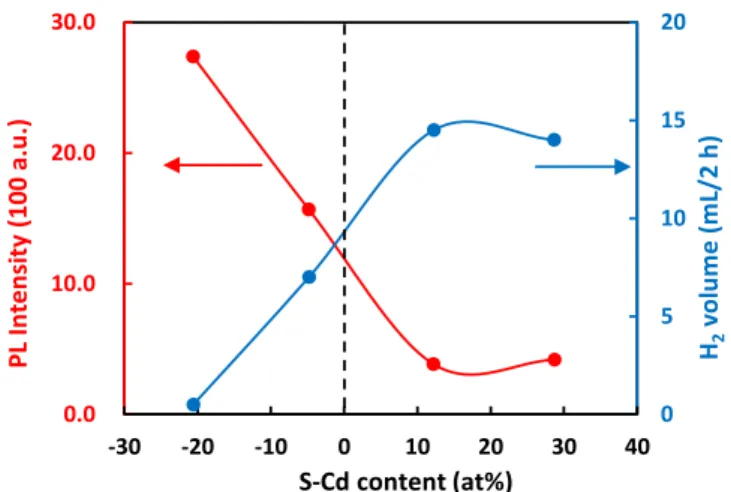
0 5 10 15 20 0.0 10.0 20.0 30.0 -30 -20 -10 0 10 20 30 40 H2 vo lu m e ( m L/ 2 h ) PL In te n si ty (100 a.u .) S-Cd content (at%)
Fig. 2. PL intensity and PCA of samples as a function of S-Cd content.
Fig. 2 shows the PL intensity at approximately 380 nm and the PCA in hydrogen generation as a function of S-Cd content. The PL intensity decreased dramatically as the S-Cd content increased from approximately -20 to 10 at%, but then slightly increased at 30 at%. On the other hand, PCA increased sharply as the S content increased from approximately -20 to 10 at%, but then slightly decreased at 30 at%. The PL intensity at approximately 380 nm provided an index of the charge recombination rate in
Eg1. The increased charge separation rate and PCA should be related to the change in the band structure
induced by the S content in the multicomponent system.
In the traditional method, SZSS were usually fabricated via the synthesis of Psi (or PSII) on PSII (or Psi) as a supporter. However, the band alignment cannot be adjusted. Using the NiWO4/CdS composition as a
representative, we developed a simple fabrication method that takes advantage of bandgap engineering through an ion-exchange reaction between the NiWO4 precursor and Cd2+, S2–. The bandgaps of Psi
decreased from 2.62 to 1.86 eV. The PCA reached 7.6 mmol/h/g.
In chapter 3, the charge recombination reducing of NiWO4/CdS SZSS via an ion-exchange reaction
was demonstrated. The results was submitted to “Applied Catalysis B: Environmental”.
NiWO4/CdS SZSS was synthesized by NiWO4 and Cd2+, S2– ions, which was similar with that of chapter
2. The samples were synthesized by hydrothermal method at 180 ℃. Two series of samples were prepared: (1) CdSx: Cd content was almost the same while S content was increased; (2) CdxSy: Cd and S contents were increased at a proper ratio. The samples were characterized by SEM, EDS, XRD, UV-vis DRS and PL. Morphologies of all the samples were aggregates. The samples were in crystal state. The samples were constructed by NiWO4 and CdS, while some NiS existed when the S content was higher than Cd. Similar
with chapter 2, element composition of NiWO4/CdS can be also modulated through the ion-exchange
reaction. The bandgaps of CdSx dramatically decreased with the increase of S content; while those of CdxSy slightly decreased with the increase of Cd and S contents. This result demonstrates that Cd and S contents influenced the CdS bandgap.
The ratio of CdS to NiWO4 can be modulated by adjusting Cd and S contents. For CdSx, the ratios of
CdS to NiWO4 were low because the Cd contents were low. This resulted in the low charge transfer rate of
CdS, which may limit the charge transfer of the whole SZSS. Therefore, the charge recombination of CdSx was high, because the charge transfer rates of NiWO4 and CdS were unbalance. This unbalanced charge
transfer rates induced the energy loss in the form of charge recombination. While for CdxSy, the ratio of CdS to NiWO4 was increased with the increase of Cd content, which lead to the increase of charge transfer rate of
CdS. Therefore, the charge recombination was decreased by the charge transfer balance. Recombination reducing of NiWO4/CdS was achieved by the element modulation.
NWCS30
NW(H)CS
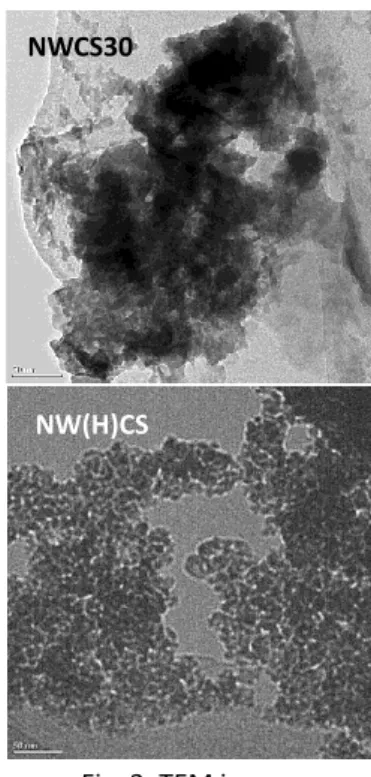
Fig. 3. TEM images
adjusting Cd and S contents. As a consequence, the PCA was largely increased.
In chapter 4, morphology control of NiWO4/CdS and the extending of
this method to MWO4/CdS (M=Ni, Co, Zn) were explored. Some results
were submitted to “Applied Catalysis B: Environmental”.
NiWO4 was prepared by hydrothermal method, and CdS was synthesized
on NiWO4, the sample was labelled as NW(H)CS. As shown in Fig. 3,
morphology of NW(H)CS was separated nano-particles with approximately 5~10-nm diameters. Compared with NWCS30 in chapter 2, although NWHCS has a better morphology, its PCA was low. The reason may be the amount of CdS in NWHCS was lower than that in NWCS30.
MWO4/CdS (M=Ni, Co, Zn) were fabricated. PCA of CoWO4/CdS was
similar with that of NiWO4/CdS. This result indicates that the method could
be used for other MWO4/MS.
In summary, we proposed a NiWO4/CdS SZSS with additional features
of a tunable bandgap and low charge recombination. By suing the ion-exchange reaction between NiWO4
and Cd2+, S2–, the element modulation of NiWO
4/CdS SZSS can be achieved. As a consequence, both
bandgaps and charge recombination properties of the SZSS can be controlled.
The contributions of this research are: (1) SZSS synthesized by NiWO4 and CdS was developed and
applied in photocatalytic hydrogen generation. The highest PCA in this work reached 8.44 mmol/h/g. (2) Both the bandgap and charge recombination of the SZSS has been adjusted, via a simple ion-exchange reaction, which provides interesting information for the fabrication of efficient SZSS. (3) The element modulation method described here brings a reference for tuning the properties of multicomponent system. This bandgap engineering method may be also extended to other special application, such as the optoelectronic devices design.
References.
[1] H. Tada, T. Mitsui, T. Kiyonaga, et al. Nat. Mater. 5 (2006) 782–786. [2] W. B. Li, C. Feng, S. Y. Dai, et al. Appl. Catal. B. 168-169 (2015) 465–471. [3] X. W. Wang, G. Liu, L. Z. Wang, et al. Adv. Energy. Mater. 2 (2012) 42–46. [4] X. Q. Wu, J. Zhao, L. P. Wang, et al. Appl. Catal. B. 206 (2017) 501–509. [5] X. Jia, M. Tahir, L. Pan, et al. Appl. Catal. B. 198 (2016) 154–161.
[6] U. M. García–Pérez, A. M–D. L. Cruz, J. Peral. Electrochimica. Acta. 81 (2012) 227–232 [7] T. Montini, V. Gombac, A. Hameed, et al. Chem. Phys. Lett. 498 (2010) 113–119.
(別紙)
論文審査結果の要旨及びその担当者
論文提出者氏名 李明潔
論 文 題 目
Bandgap engineering and charge recombination reducing of NiWO
4/CdS solid
Z-scheme system for efficient photocatalytic hydrogen generation
論文審査担当者 主査 教授 田路和幸 教授 川田達也 准教授 上高原理暢 准教授 高橋英志
論文審査結果の要旨
光触媒反応は光励起電子・正孔対による酸化還元反応である。従って、反応活性を向上させるには、1) 光吸収効 率の向上、2)光励起電子正孔対の再結合抑止、3) 電荷移動度の制御、および 4) 活性な反応サイトの形成、を全て同 時に制御し、光励起電子及び正孔を被反応物質へ効率よく伝達することが必須となる。特に、研究例の少ない1)及 び 2)に焦点をあて、李明潔氏は、複数種の半導体を適切に組み合わせることで、バンド構造を最適に制御した光触 媒ナノ材料の合成手法を開発し、その特性発現に寄与する因子について解明を試みた。 第一章は緒論であり、光触媒材料に関する前述の問題点とそれを解決するための手法について論理的な説明を行 っている。 第二章においては、バンドギャップ制御と再結合抑制を同時に達成するために、固体Z スキームシステム中の元 素を制御することを試みた。具体的には、NiWO4を母体としイオン交換法及び化学反応を利用することで、Cd 及びS の含有量を制御し、 NiWO4/CdWO4/CdS/NiS を合成する手法を開発した。Pt 担持効果を含めて、光触媒
材料の活性や光励起電子正孔対の再結合特性と、材料の組成やバンド構造、電荷移動経路などの相関について詳細
に検討した。Applied Catalysis B: Environmental, 241 (2019) 284-291 5th Nano Today Conference 資源・素
材2017(札幌) 第三章においては、固体Z スキームシステム中における活性低下の原因が半導体中及び半導体間における電荷移 動経路の相関に起因することを見出し、第一及び第二半導体光触媒材料間の電荷移動経路を最適化する手法の開発 を試みた。前述の複合材料中の中でも特にCdS/NiS/Pt を制御することによりバンドギャップを自在に制御する ことが可能であること、その結果として光吸収効率の向上と効率的な電荷移動を達成可能であること、光触媒活性 が著しく向上可能であること、を見出した。 第四章においては、Ni の代替として Co 及び Zn を選定し、複合材料の合成と特性について解明を試みた。これら
の材料のバンドギャップは大きく異なるが、光触媒活性は本研究でターゲットとしてNiWO4/CdWO4/CdS/NiS
複合光触媒材料が最も高いことを見出した。
第五章は結論であり、本研究の総括や意義について纏めている。
李明潔氏は、第一章に関わる内容についてChemical Engineering Journal(286, 232-238 (2016))にて、第二章に
関わる内容についてApplied Catalysis B: Environmental (241, 284-291 (2019))にて発表しており、第三章に関わる
内容についてApplied Catalysis B: Environmental に投稿中である。また、資源・素材 2017(札幌)や資源・素材東
北支部大会等の日本国内で開催される学会や5th Nano Today Conference (米国)などの国際会議に参加し、自身の成
果について報告を行っている。 以上より、李明潔氏は従来とは異なる視点から光触媒材料の効率化を図る手法を考案するとともに、実際に特性を 組成で制御可能な複合材料を合成することで、彼の考えた理論に対する正当性を検証するなど、先駆的な研究を行 った。 よって,本論文は博士(環境科学)の学位論文として合格と認める。