IoT Device Selection in Opportunistic
Networks: Implementation and Performance
Evaluation of Fuzzy-based Intelligent Systems
and a Testbed
by
Miralda Cuka
PhD Supervisor
Prof. Leonard Barolli
Graduate School of Engineering
Fukuoka Institute of Technology
Japan
2020
Abstract vii
1 Introduction 1
1.1 Background . . . 1
1.2 Thesis Purpose and Contribution . . . 2
1.3 Thesis Outline . . . 5
2 Next Generation Wireless Networks 6 2.1 Introduction . . . 6
2.2 Architecture of 5G . . . 7
2.2.1 Cloud RAN . . . 7
2.2.2 5G Challenges . . . 9
2.3 Software Defined Networking . . . 12
2.4 Software Defined Wide Area Network . . . 13
2.5 MANET Characteristics . . . 13
2.5.1 MANET Challenges . . . 14
3 IoT and Opportunistic Networks 16 3.1 Internet of Things (IoT) . . . 16
3.1.1 IoT Applications . . . 18
3.1.2 IoT Challenges . . . 19
3.2 Opportunistic Networks (OppNets) . . . 20
3.2.1 Architecture of OppNets . . . 21
3.2.2 OppNet Protocols . . . 22
3.2.3 OppNets Challenges . . . 24
4 Intelligent Algorithms 27
4.1 Introduction . . . 27
4.2 Genetic Algorithm . . . 28
4.3 Tabu Search (TS) . . . 30
4.4 Simulated Annealing (SA) . . . 32
4.4.1 Local Versus Global Search . . . 33
4.5 Particle Swarm Optimization (PSO) . . . 34
5 Fuzzy Logic 37 5.1 Introduction . . . 37
5.2 Fuzzy Logic Controller . . . 38
5.3 Fuzzification . . . 38
5.3.1 Inputs and Outputs of FC . . . 39
5.3.2 Linguistic Description of Parameters . . . 40
5.4 Fuzzy Sets . . . 41
5.4.1 Membership Functions . . . 43
5.4.2 FC Rules . . . 44
5.5 Defuzzification Methods . . . 45
6 IoT Device Selection Systems based on Fuzzy Logic 47 6.1 Problem Description . . . 47 6.2 System Parameters . . . 48 6.3 Systems Implementation . . . 50 6.3.1 Description of IDSS1 . . . 51 6.3.2 Description of IDSS2 . . . 52 6.3.3 Description of IDSS3 . . . 55 6.3.4 Description of IDSS4 . . . 59
7 Evaluation of Proposed Systems 64 7.1 Simulation Results for IDSS1 . . . 64
7.2 Simulation Results for IDSS2 . . . 66
7.3 Simulation Results for IDSS3 . . . 70
7.4 Simulation Results for IDSS4 . . . 77
7.5 Other Systems . . . 77
8 Testbed Implementation 80 8.1 Testbed Settings . . . 80 8.2 Testbed Parameters . . . 82 8.3 Fuzzy-based Testbed . . . 82 8.4 Evaluation Results . . . 84 8.4.1 Experimental Results . . . 86 9 Concluding Remarks 93 9.1 Conclusions and Future Work . . . 93
1.1 Thesis structure. . . 4
2.1 5G Services Architecture Layers. . . 8
2.2 A cloud based SD-WAN. . . 12
2.3 MANETs architecture. . . 14
3.1 IoT Architecture Layers [7]. . . 17
3.2 An estimation of the number of connected IoT devices. . . 19
3.3 An example of OppNets. . . 21
3.4 DTN Protocol Stack. . . 23
4.1 Genetic Algorithm Flowchart. . . 28
4.2 Two of the most common types of crossovers. . . 30
4.3 Chromosome before and after mutation. . . 30
4.4 Illustration of a tabu move. . . 32
4.5 Local and global minimum for SA. . . 34
4.6 PSO particle movement. . . 35
5.1 Fuzzification Types. . . 40
5.2 Crisp and Fuzzy Set. . . 41
5.3 Crisp vs. Fuzzy Sets. . . 42
5.4 Types of MF. . . 43
5.5 Membership Function for different linguistic values. . . 44
6.1 Fuzzy Logic Controller . . . 48
6.2 Triangular and trapezoidal MF. . . 48
6.3 Proposed Implemented System IDSS1. . . 52
6.5 Proposed Implemented System IDSS2. . . 55
6.6 Proposed Implemented System IDSS3. . . 57
6.7 Fuzzy MFs of IDSS3. . . 58
6.8 Proposed Implemented System IDSS4. . . 61
6.9 Fuzzy MFs for IDSS4. . . 61
7.1 Simulation results of IDSS1. . . 65
7.2 Simulation results of IDSS2 for IDS = 0.1. . . . 67
7.3 Simulation results of IDSS2 for IDS = 0.5. . . . 68
7.4 Simulation results of IDSS2 for IDS = 0.9. . . . 69
7.5 Simulation results of IDSS3 for IDW T = 0.1. . . . 71
7.6 Simulation results of IDSS3 for IDW T = 0.5. . . . 72
7.7 Simulation results of IDSS3 for IDW T = 0.9. . . . 73
7.8 Simulation results of IDSS4 for IDNC = 0.1. . . . 74
7.9 Simulation results of IDSS4 for IDNC = 0.5. . . . 75
7.10 Simulation results of IDSS4 for IDNC = 0.9. . . . 76
7.11 IDCD and its MFs. . . 78
8.1 Testbed Setup. . . 81
8.2 Testbed Implementation. . . 81
8.3 Proposed fuzzy-based testbed model. . . 83
8.4 Fuzzy membership functions. . . 85
8.5 Simulation Results for NDT=0.1. . . 87
8.6 Simulation Results for NDT=0.5. . . 88
8.7 Simulation Results for NDT=0.9. . . 89
8.8 Simulation Results for NDT=Near. . . 90
8.9 Simulation Results for NDT=Close. . . 91
6.1 FRB of IDSS1. . . 54
6.2 FRB of IDSS2. . . 56
6.3 FRB of IDSS3. . . 60
6.4 FRB of IDSS4. . . 62
8.1 Parameters and their term sets for FLC. . . 83
In Opportunistic Networks (OppNets) the contacts between Internet of Things (IoT) de-vices (nodes) are intermittent and links are highly variable. Upon receiving a message a device will store it in the buffer until another node comes in the transmission range or a forwarding opportunity exists. The IoT network consists of connected physical objects and devices with high mobility. By using the mobility of IoT devices, the OppNets pro-vide a self-organizing network as a communication opportunity. The IoT devices generate and exchange a huge amount of data through heterogeneous networks and OppNets ease the concept of heterogeneity with their independence on decentralized infrastructure. The IoT network consists of different devices with different resource capabilities. When mul-tiple IoT devices are deployed densely, there is a possibility that a node may reside in the coverage area of multiple devices. Thus, when a task requires an IoT device to complete it, it is very important to find the best device for that specific request. The IoT devices should be selected based on different parameters in order to achieve better network con-nectivity, stability and user coverage. In OppNets an end-to-end path between source and destination may not exist and network partitions occur often. Some of the most common issues for OppNets are energy consumption, storage constraint, limited contact oppor-tunities and finding an optimal and robust topology of the network devices to support connectivity services to events. To deal with these issues many parameters should be con-sidered which make the problem NP-Hard. Thus, the heuristic and intelligent algorithms are good solutions. In this research work, we consider IoT device selection in OppNets and propose new parameters and implement different intelligent systems based on Fuzzy Logic (FL). The proposed systems can be used in different environments and applications. We carried out many simulations and found that the performance of implemented systems is good. We observed that the complexity of the systems increases with the increase of the number of parameters. We also implemented a testbed and performed experiments in order to compare the simulation and experimental results. The experimental results
show that the implemented testbed makes a good selection of IoT devices. This thesis contributes in the research field as following: 1) Proposal of new parameters for IoT de-vice selection in OppNets. 2) Proposal and implementation of intelligent systems based on FL for appropriate selection of IoT devices in OppNet. 3) Performance evaluation of implemented systems for different parameters and scenarios. 4) Comparison of imple-mented intelligent simulated systems. 5) Implementation of a testbed for OppNet and its application in a real scenario. 6) Give insights about future developments and application of OppNets and IoT as important technologies for wireless communications. This thesis is constructed with 9 chapters. In Chapter 1 is presented the background, motivation and thesis structure. Chapter 2 introduces the next generation wireless networks and describes in more details 5G cellular network technologies, Software-Defined Wide Area Network (SDWAN) and Mobile Ad-hoc Networks (MANETs). In Chapter 3, we introduce the ar-chitecture, challenges and applications of IoT and OppNets. In Chapter 4, we introduce Intelligent Algorithms. In Chapter 5, we present Fuzzy Logic. In Chapter 6, we introduce our proposed Fuzzy-based intelligent systems for IoT device selection in OppNets. In Chapter 7, are shown the performance evaluation results of proposed simulation systems. In Chapter 8, we present the testbed implementation and evaluation. In Chapter 9, we conclude this thesis and give the future work.
Introduction
1.1
Background
Future communication systems are going to be increasingly complex, with thousands of heterogeneous nodes with diverse capabilities and different technologies interconnected with the aim of providing users ubiquitous access to information and advanced services at a high quality level at any place and time in a cost efficient manner. Opportunistic Networks (OppNets) provide an alternative way to support the diffusion of information in special locations within a city, particularly in crowded spaces where current wireless technologies can exhibit congestion issues. OppNets are an extension of Mobile Ad-hoc Networks (MANETs) so they face some issues similar to MANET such as limited bandwidth, disconnections and variable links. It starts as a seed network consisting of an original set of nodes and expands by growing to a larger network with new nodes consistently becoming part of the network. Nodes may be static or fixed so this makes the network easy to deploy since it’s not dependent on infrastructure, making OppNets suitable for interplanetary communications, terrestrial wireless networks, mobile sensor networks and so on.
The OppNets are variants of Delay Tolerant Networks (DTNs) which is a class of networks that has emerged in the recent times. Routing is a very challenging task due to un-connected nature, sparse connectivity, limited resources and no infrastructure. Rout-ing methods depend on schemes that utilize node mobility by havRout-ing the node carry the message and wait for an opportunity to transfer the message to the next node rather than transmitting them over a fixed source-to-destination path.
Internet of Things (IoT) is a network of devices which collect and exchange data and than act on this information. IoT is the consistently growing network of objects which connect the physical world with the virtual one. These objects generate huge amount of data which travels through different networks.
1.2
Thesis Purpose and Contribution
In this thesis by considering the challenges of selecting an IoT device in OppNets, we proposed and implemented four simulation systems and one testbed based on Fuzzy Logic (FL). In an OppNet scenario, IoT devices will create a seed network and later add helpers when an event that needs action happens. Based on the resources each network device has, some will be better suited than others for acting upon the event. These resources are measured by the parameters each device has. To be able to provide effective help, these parameters are used as inputs on our proposed systems and decisions are made based on usability of each device.
In this work, we have proposed a meta-heuristic platform based on FL for choosing the best IoT device to perform a task based on specific parameters that apply to OppNets challenges. Parameter combination varies for each proposed and implemented system because we have consistently tried to consider many scenarios and optimize the proposed system by selecting new parameters.
The first system we have proposed is IoT Device Selection System 1 (IDSS1), which uses three input parameters: IoT Device Speed (IDS), IoT Device Remaining Energy (IDRE), IoT Device Distance from Task (IDDT). For our second system IoT Device Se-lection System 2 (IDSS2), we decided to increase its complexity by adding a fourth pa-rameter IDS, IDDT, IDRE, IoT Device Storage (IDST). In our third system IoT Device Selection System 3 (IDSS3), we decided to use four parameters: IoT Device Waiting Time (IDWT), IoT Device Security (IDSC), IDRE, IDST. Different from our second sys-tem, in IDSS3 we have considered the waiting time and security of a device as two new parameters. In an OppNet scenario, where an event is taking place the effectiveness of completing said event is eased by having a device with many connections. These con-nections increase the chances of discovering new helpers which may become essential to complete the task. We have summarized this device property in one parameter, IoT De-vice Node Centrality (IDNC) which is included in the fourth system, IoT DeDe-vice Selection System 4 (IDSS4). In IDSS4 we have four input parameters: IDNC, IDWT, IDRE, IDST.
Based on input parameters, our proposed systems give the possibilities of each device to be selected as our output parameter IoT Device Selection Decision (IDSD). Comparing complexity of IDSS1 with IDSS2, IDSS3 and IDSS4, the systems with four parameters are more complex than IDSS1 since they need more computational resources.
With simulation systems we are able to emulate different scenarios but to gain a fur-ther insight into a real life system, a testbed is the best choice. A simulation system only focuses on a subset of properties of the real system while the testbed tests a system behav-ior based on certain inputs and reflects a more realistic scenario. We have implemented a simulation system for selecting IoT nodes in Oppnets, IoT Node Selection System 1 (INSS1) with four input parameters: Node’s Distance to Task, Node’s Remaining En-ergy, Node’s Buffer Occupancy, Node Inter Contact Time and Node Selection Decision as an output parameter. We implemented a testbed for further evaluation and compared the results obtained by both the simulation system and the tesbed and evaluate if they are comparable.
This thesis contributes in the research field as following:
1. Proposal of new parameters for IoT device selection in OppNets.
2. Proposal and implementation of intelligent systems based on FL for appropriate selection of IoT devices in OppNet.
3. Performance evaluation of implemented systems for different parameters and sce-narios.
4. Comparison of implemented intelligent simulated systems.
5. Implementation of a testbed for OppNet and its application in a real scenario. 6. Give insights about future developments and application of OppNets and IoT as
1.3
Thesis Outline
This thesis consists of 9 chapters and its structure is given in Fig.1.1. The thesis is organized as follows.
Chapter 1 presents the background, motivation and thesis structure.
Chapter 2 introduces general aspects of wireless networks and describes Next Gener-ation Wireless Networks (NGWN).
In Chapter 3, we introduce Internet of Things (IoT), Opportunistic Networks (Opp-Nets) and its architecture.
In Chapter 4, we present Intelligent Algorithms (IA).
In Chapter 5, we present FL, Fuzzy sets and Fuzzy membership functions.
In Chapter 6, we present our proposed fuzzy-based simulation systems for IoT device selection in OppNets.
In Chapter 7, are shown the performance evaluation results of proposed simulation systems.
In Chapter 8, we show testbed implementation and evaluation.
Next Generation Wireless Networks
2.1
Introduction
Technology companies and mobile carriers are working on overcoming the obstacles of existing wireless networks by adopting new wireless technologies that aim to define new global standards, handle the surge in data traffic and offer more spectrum bandwidth. Wireless IP-based Networks have evolved to overcome limitations and to support the rapidly increasing data. This rapid increase of the mobile nodes and the huge amount of data generated has created challenges for the wireless networks. The providers of ser-vices are facing bandwidth shortage hence the need for new technologies arises. The Next Generation Mobile Networks (NGMN) aim to offer ubiquitous connectivity in remote and challenging areas, lower latency and enable higher mobile speed. NGWN are bringing the vast array of Internet services and providing users with a successful platform for future mobile services. One of the most prominent next generation technologies is Fifth Gener-ation (5G) networks. As the next iterGener-ation of 4G Long term Evolution (LTE), 5G will be able to support and scale the massiveness of IoT devices. The next generation 5G wire-less communications will provide very high data rates, bring connection to remote and isolated areas, increase quality of service (QoS) and offer very low latency. To be able to accommodate the increasing demand for data that comes with the addition of new users, 5G technologies were developed [1].
2.2
Architecture of 5G
The 5G systems will support a wide range of services and applications by meeting the requirements of the fully connected and highly mobile societies. The spread of con-nected devices will pave the way to many services and will aid the communication needs of machine-to-human and machine-to-machine applications. The coexistence of multi-ple applications will impose many challenges that 5G has to overcome. To satisfy the demands, the concept of slicing has emerged as an efficient way for serving all the re-quired services on a common infrastructure. Slicing has been conceptualized as a way of optimizing, simplifying and sharing the infrastructure between operators. With net-work slicing, new capabilities are brought to 5G infrastructures which bring flexibility in deployment and efficient resource utilization. With the many new services provided by 5G, in addition to enhanced Mobile Broadband (eMBB), two new mobile services: ultra-reliable and Low-latency Communications (uRLLC) and massive Machine Type Commu-nications (mMTC) have to meet requirements. eMBB provides support for services with high bandwidth requirements such as Augmented Reality (AR), High Definition (HD), Virtual Reality (VR). uRLLC aims to support latency sensitive services such as remote management and assisted automated driving. mMTC will be able to support the massive amount of IoT devices expected to become part of the network and focuses on services that have high requirements for connection density requirements such as smart cities. In Fig.2.1 is shown the architecture of a 5G network for easy deployment of IoT devices since one of the key features of 5G is the support of the IoT applications.
As an extension of 4G broadband service, 5G allows an efficient scheduling of wire-less resources to devices so no two devices access the same resource simultaneously. The key to 5G, is providing diversified services with the end-to-end network slicing and meet these services demands with Software-Defined Networking (SDN) and Network Func-tions Virtualization (NFV), which support the physical infrastructure and brings cloud closer to core network, transport and access.
2.2.1
Cloud RAN
The Radio Access Network (RAN) has always evolved with the coming generations of mobile communications. In a RAN, radio sites coordinate the management of resources and provide radio access. When a device is connected wirelessly to the core network, its signal will travel within the network traffic and be transited by RAN to different wireless
Figure 2.1: 5G Services Architecture Layer (Figure from 5G Network Architecture, A
High-Level Perspective, Huawei Technologies.)
endpoints. The real time functions of RAN are power control, access network scheduling, retransmission, coding, interference coordination and link adaptation. All these functions require a high computer load and performance in real time. The non-real time functions of RAN include, cell selection, re-selection, inter-cell handover and multiple connection convergence. For the deployment of sites, dedicated hardware with high accelerator pro-cessing specifications and performance in close proximity to services, must be included. These functions require minimal real-time performance, latency requirements to dozens of milliseconds and are suitable for centralized deployment.
Multi-connectivity is gaining a reputation as an underlying fundamental construct for the deployment of the future network architecture. A huge leap in radio network deploy-ment is that CRAN can be seamlessly deployed in a unified network architecture.
In current fragmented networks, increasing speed and reducing latency can improve user experience. Reliable high-speed data cannot depend on a single frequency band or standard connections. In heterogeneous networks, multi-connectivity helps provide an optimal user experience based on LTE and 5G capabilities, such as high bandwidth and rates of high frequency, network coverage and reliable mobility of low frequency, and accessible Wi-Fi resources.
In scenarios that require high bandwidth or continuity, a user requires multiple con-current connections. To have high bandwidth, data aggregation of data from different
multiple subscriptions like: LTE, Wi-Fi, 5G is required. After a user has accessed a 5G high-frequency small cell, a LTE network access is required to maintain continuity.
In scenarios that source multiple technologies, Cloud RAN serves as an anchor for data connection which noticeably reduces alternative transmission. In the traditional ar-chitecture integrating base stations as an anchor for data connection, LTE, 5G, and Wi-Fi data are aggregated into a non-real time processing module of a specific standard to be forwarded to each access point. In the Cloud RAN architecture, non-real time processing function modules in access points of different modes are integrated into the Mobile Cloud Engine (MCE), which serves as an anchor for data connection. Data flows are transmitted to each access point over the MCE, which prevents alternative transmission and reduces transmission cost by 15%, and latency by 10 ms.
2.2.2
5G Challenges
Even though 4G has not been around long, the widespread use of devices, capacity of data, and the emergence of IoT, demand a network that can handle the diversified needs. The principal goal of 5G is to overcome the limitations of 4G and satisfy the needs of services and applications that are always evolving. Before deploying a large scale network that will fulfill demands, several challenges must be met.
Massiveness of IoT: It is predicted that IoT will create a massive increase in the
num-ber of connections and devices across the network. The numnum-ber of connected devices has already exceeded the population and many more are added to the network. Even though the amount of data generated by simple devices is relatively small, they still require in-frastructure for managing the data and the physical connections. Previous wireless mobile networks limited the number of connected users on specific nodes with control mecha-nisms. But old access control mechanisms cannot handle the growth of IoT devices, so new scheduling and control mechanisms are required.
Big Data: One of the main reasons that caused the early development of 5G was the
large volume of data. The amount of data generated and passing through mobile networks is increasing at about 25 to 50 percent a year, and it will continue to grow. This grow is not only because of the new applications that require high data rates, but also because of high screen resolution in 3D videos. Unlike 3G, 4G and 5G are all IP networks so the challenge of data capacity in an end to end network increases. Furthermore, this is not only for the air interface, but also for the access/ core network.
Capacity and Cost Ratio: Users are generating more and more data, but are unwilling
to pay more. Therefore, increasing the network capacity without increasing the cost is very challenging. One way is to separate the user data from the distribution of control, to meet the data requirements. This can be achieved by using macro cells to provide control plane signaling to wide areas and small cells within the macro cell for user plane data without added complexity. By using existing sites and spectrum to increase capacity no significant extra cost is added.
Fast Deployment of 5G Architecture: Speed of deployment of 3G and 4G was
re-stricted by the speed at which suitable backhaul network capacity could be provided to each new site, and the capacity/flexibility of the backhaul. 5G will be challenged to fur-ther develop CRAN as anofur-ther evolution in network design, complementing the user and control plane separation in the move towards more flexible cloud based networks. In this concept, some functions of the RAN are moved from the cell site back into a consolidated baseband cloud service. This provides a solution to support scaling and economy, lead-ing to deployment flexibility and easier reconfiguration, because the core signallead-ing and intelligence is held within the cloud and the only localized physical elements are the RF transceivers to provide RF connection to users.
Uninterrupted Services for Emergency Situations Many services such as emergency
services and medical monitoring require a high level of reliability and real time data. For example one area where wireless networks are being used is to provide a remote patient monitoring, care and access to its medical data so trained staff can provide remote support. Also, other emergency services such as police and ambulance services, need a always available high reliability link with call dropping or busy network issues. These dedicated services are offered by dedicated networks, but these networks do not have the resources for high bandwidth, high data capacity and reasonable coverage. Some of 5G requirements are for real time interaction and high data rates, as well as a fast service respond time. So 5G is supposed to offer "ultra reliable" services where the ability to connect and operate is independent on infrastructure. This is based on using device to device direct communication, ad-hoc backhaul, networking, and flexible re-configuration of networks.
Augmented Reality (AR): AR are being vastly deployed on personal and portable
de-vices, increasing the demands for network capacity and performance. One key aspect is that to enable interactions between the real and virtual world, latency must be very small since human brain is very sensitive to time delays. Thus when processing visual data,
VR services cannot be delivered unless the latency and delay are very small. The round trip between devices and servers must be extremely low and the communication link must be optimized. New signal/routing architectures will also be required as the overall la-tency required cannot be achieved using traditional centralized server architectures. So it is expected that critical low latency services will need infrastructure and architecture to locate the service/server close to the user, to ensure latency between user and service is minimized.
Machine-to-Machine: M2M have an important role in the overall IoT where one
sec-tor where this is being pushed forward is the automotive secsec-tor. There have already been developed and deployed automotive wireless connectivity applications, where the vehi-cles are used as a hub and cellular networks as the back-haul. Due to available battery power, vehicles are used as a base station or as a relay node within the network. Intelligent transport systems are creating demand for vehicle-to-vehicle and vehicle-to-infrastructure communications, as well as linking the vehicle to other devices. And an ultimate goal that now looks within reach is fully autonomous driving, but this will require secure and re-liable communications for a widespread public deployment (beyond current trials and deployment scenarios that still use driver intervention as a back-up mode). 5G networks should be able to support this, if the network can deliver the capacity/coverage/ latency combination required by use of heterogeneous network technologies. The challenge is to go from concept to network architecture to technology, and meet these requirements with flexibility, but also satisfy the high reliability/availability demands of autonomous driving.
Device-to-Device: Device-to-Device communications have not been fully supported
in previous cellular networks. In cellular networks the data goes from device to base station before going back to device, so direct links are not available. Such direct com-munications have some drawbacks as they have narrow spectrum bandwidth and limited capacity for transmitting data. In previous cellular networks, the technology of push-to-talk was implemented to deliver a similar experience, however, sufficient coverage for critical applications could not be guaranteed. In 5G networks the challenge is to support these types of communications and allow direct communication between devices.
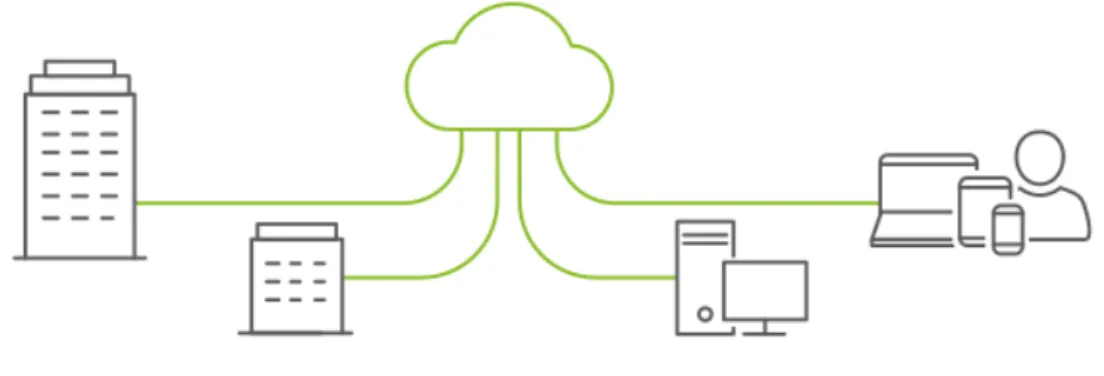
Figure 2.2: A cloud based SD-WAN.
2.3
Software Defined Networking
Traditional network architecture is failing to meet with the requirements imposed by the huge amount of data generated from big enterprises. On account of this, Software De-fined Networking (SDN) was developed to transform the existing networking architecture into a new one which supports all this change. In a SDN architecture, the network infras-tructure is separated from data, control and application plane. This independency enables enterprises to have more control and build highly flexible and scalable networks.
• Hierarchical architecture:
Conventional networks are hierarchical which served the client-server model, but such architectures do not adapt to the virtualization of servers, cloud services and the big data requirements of enterprises. Users are changing the traffic patterns by accessing different applications, databases, servers with any type of devices from anywhere, anytime.
• Diversity of devices:
Devices are increasingly more diverse and in need of a consistent connection to the network. This puts the enterprises under pressure to accommodate all these devices in a seamless manner.
Securely accessing corporate resources requires mobile users to connect to a branch or HQ firewall VPN which could be very far from their location. This causes user expe-rience issues, and encourages compliance violations (for example, direct access to Cloud
services that bypasses corporate security policy). Ultimately, the mobile workforce is not effectively covered by the WAN. The Cloud-based, secure SD-WAN shown in Fig.2.2 is aiming to address these challenges.
2.4
Software Defined Wide Area Network
With the new digital innovations, businesses are eager to adopt new technologies to re-duce cost and increase productivity. Traditional Wide Area Network (WAN) connects users to applications hosted in data centers. However, traditional WAN depend heavily on infrastructure which causes high latencies and single point failure. Furthermore, ap-plications are moving from data centers into cloud and users progressively more mobile are using more and more devices.
Software-Defined Wide Area Network (SD-WAN) have evolved as a solution for these issues as it extends the benefits of cloud to applications from every location of the net-work. Basically with SD-WAN you get the most out of your network resources and exist-ing infrastructure.
SD-WAN, handles traffic based on priority, quality of service and other business re-quirements by using software to intelligently steer the traffic across the WAN. Further-more, SD-WAN enhances security by eliminating the dependency on other devices as security solutions are built into the EDGE routers which ensures user’s traffic protection. Other key benefits are the increase of applications performance, reduces network com-plexity and cost, increasing bandwidth. They also simplify network management tasks and provide a programmable flexible interface for controlling the network.
2.5
MANET Characteristics
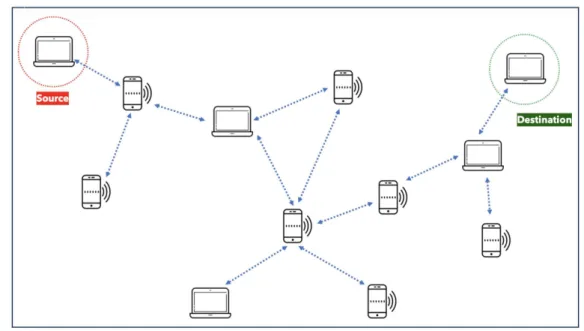
Mobile Ad-hoc NETworks (MANETs) are new paradigm of networks, offering unre-stricted mobility without any underlying infrastructure. Basically, MANETs are a collec-tion of nodes communicating with each other by forming a multi-hop network. In Fig.2.3 is shown the architecture of MANETs. In the following we show the characteristics of a MANET:
Dynamic Topologies: Nodes are free to move arbitrarily. The network topology may
change randomly and have no restriction on their distance from other nodes. As a result of this random movement, the whole topology is changing in an unpredictable manner,
Figure 2.3: MANETs architecture.
which in turn gives rise to both directional as well as unidirectional links between the nodes.
Energy Constrained Operation: Almost all the nodes in an Ad-hoc network rely on
batteries or other exhaustive means for their energy. The battery reduces due to extra work performed by the node in order to increase the lifetime of the network. Therefore, energy conservation is an important design optimization criterion.
Bandwidth Constraint: The capacity of wireless networks is significantly lower than
the capacity of infrastructure based networks. Due to the effect of noise, interference, fading and multiple access, throughput of a wireless network is much lower. This results in an obstacle for bandwidth utilization.
Limited Physical Security: MANETs are distributed systems very vulnerable to
phys-ical security where physphys-ical threats are always present. As a result, there is an increased possibility of denial-of-service type attacks, intrusions, spoofing and masquerading.
2.5.1
MANET Challenges
The area of applications for MANETs varies, ranging from small static networks with constrained power sources, to highly dynamic large scale networks. Despite the appli-cation, MANET need distributed algorithms to determine routing, link scheduling and network organization. Due to their dynamic topologies, protocol design and delivery of
messages in a decentralized environment is a complex task. In a static network, the short-est path from source to dshort-estination is calculated based on a cost function, but this idea is not extended in MANET due to variable wireless link quality, multiuser interference, power constraints, fading, and changes in topology. However, in some application such as military applications, latency, recovery from failure are significant concerns. Some challenges must still be solved since they make these networks very vulnerable.
Routing: Routing packets between two nodes with a network topology always
chang-ing, is a challenging task. Reactive routing protocols are better suited for these cases rather than proactive protocols. Due to the random movement of nodes in the network, multicast tree is not static, so multicast routing is always challenging. Also path from sender to receiver may contain multiple hops, which is more complex than single hop [2].
Security and Reliability: Like most of the wireless networks which have common
security vulnerabilities, Ad-hoc networks have their particular security issues such as, malicious neighbors relaying packets. So, different authentication and key management schemes are required. Furthermore, because of the limited transmission range, mobility-induced packet losses and data transmission errors, wireless links may become unreliable.
Quality of Service (QoS): In a constantly changing network, there exist different levels
of QoS. The inherent stochastic feature of communications quality in a MANET makes it difficult to offer guaranteed services to a device, so an adaptive QoS to support multimedia services over the traditional networks must be implemented.
Inter-networking: In addition to the communication within an Ad-hoc network,
inter-networking between MANETs and fixed networks (mainly IP based) is often expected in many cases. The coexistence of routing protocols in such environments, poses a challenge for mobility management [3].
Power Consumption and Conservation: For most of the light-weight mobile terminals,
the communication related functions should be optimized for lean power consumption. Conservation of power and power-aware routing must be taken into consideration.
IoT and Opportunistic Networks
3.1
Internet of Things (IoT)
Existing networks have already brought connectivity to a broad range of devices, such as mobiles, laptops, tablets, PC, etc. The Internet of Things (IoT) will extend the con-nectivity to devices beyond just mobile phones and laptops, but to buildings, wearables, cars, different things and objects. Considered as the next evolution of the Internet, IoT will enable devices to collect, analyze and exchange data. IoT is an intelligent network of enhanced and smart devices equipped with an IP address, which communicate with each other without the need of human interaction [4]. Multiple services will be enabled by connecting humans with devices and processes. A wide heterogeneous well connected network will benefit billions of people, economies, industries and potentially improve societies [5].
As shown in Fig.3.1, IoT architecture is made of Edge, Fog and Cloud layers which complement each other. Many enterprises are now mitigating toward a edge/fog/cloud infrastructure to increase the utilization of the end devices. IoT Edge layer is comprised of all smart IoT devices, sensors and embedded systems with varying operating systems, batteries, CPU Types, buffer sizes, which process the data directly or forward it to a node layer. The concept "fog computing" was introduced by Cisco company as an extension of the network’s outer perimeter in which data generated from the IoT devices is prepro-cessed by mini data centered servers before getting uploaded to the cloud. Large scale IoT architectures have problems with latency, where edge devices have not the necessary resources to process all the data from end devices and sensors. Every device with a net-work connectivity, computing capabilities and storage can be a fog node. It is estimated
Figure 3.1: IoT Architecture Layers [7].
that the amount of the data generated that needs to be analyzed on devices is enormous. IoT solutions aim to minimize latency so analyzing data to where it is collected, helps by offloading huge amount of data from the network traffic [6].
This layer acts as an intermediary between IoT devices and the cloud. Fog nodes decide whether to process the data locally, or send it to the cloud for further analysis and processing.
The cloud platform, receives the aggregated data from multiple fog nodes and per-forms detailed analysis for deeper insights benefiting businesses. The difference between fog and cloud computing is how and when the data is processed. Cloud computing is made of centralized data centers with powerful resources such as back-end servers. Therefore, processes huge amount of data from multiple edge/fog nodes and performs high-order computations such as predictive analysis.
3.1.1
IoT Applications
With the current hype around IoT, more and more companies are getting involved in investing on prominent technologies.
Smart Home: A smart or automated home is an living environment equipped with
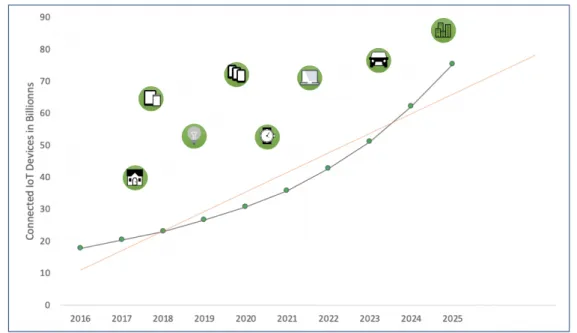
smart objects which connect to the outside Internet via a gateway. Home automatization allows the homes to be fully connected and be internally or externally controlled. Smart homes started as simple systems for lighting and heating, but have evolved into smart technologies which include a broad range of devices and appliances. In Fig.3.2 is shown an estimation of the number of connected IoT devices. It is expected that the number of IoT devices will reach 75 billion by 2025.
Smart City: Implementation of information and communication technologies for
ur-ban areas will improve the quality of life. Due to many opportunities people encounter in urbanized areas, more and more people are living in these areas, with more than half esti-mated to be living by 2050. This migration of people toward urban areas has accelerated technological inventions to tackle with issues such as scarcity of resources, environmental changes and globalization. The unprecedented volume of data gathered each day has a tremendous cost but provides insights on how the demand patterns are changing. Smart technologies give faster, low costing solutions, optimize systems and create a more livable city. Smart cities have a wide area of applications such as security, health care, energy, economic development etc.
Smart Cars: Modern vehicles are equipped with sensors, services, enhanced
compu-tation systems and features that allow them to collect information. A smart car may be a self-driving car which senses its environment and performs actions with no human input, or a smart environment which connects with other cars and collect data in real-time to avoid traffic jams, pre-order parts that need replacing, avoid accidents and so on [8].
Wearables: Accessories are getting equipped with sensors and software which
per-form tasks same as mobile phones and laptops with added functionalities such as real time health monitoring. In case of wearables, sensors are placed closest to skin and con-tinuously register vital parameters and movement. Using Bluetooth Low Energy (BLE) protocol they connect to other wearable devices such as smartphones, collect data and upload the gathered data to cloud for storing and deep analysis.
Figure 3.2: An estimation of the number of connected IoT devices (Data from
statista.com, Nov 27, 2016).
3.1.2
IoT Challenges
As IoT evolves to a bigger network there are many challenges to overcome. IoT is chang-ing the nature of Internet and as with many new technologies it will brchang-ing a broad range of benefits but also face many key challenges which are listed below:
Management Capabilities: As IoT networks evolves, it is becoming more and more
complex. The number of devices will exponentially increase which means the amount of data to be generated and processed will also increase. IoT connected devices, range from small sensors to powerful devices and gateways which connect to each other. These dif-ferent devices need to pass through a process of authentication, configuring, provisioning in order to manage the devices and have a high bandwidth and persistent connectivity.
Security: IoT platform offers a tremendous market for opportunities but it also poses
a security risk. IoT consists of different networks so some may be vulnerable to attacks becoming a threat to devices in other networks. These compromised networks can be used as gateways to unsecured networks, allowing sensitive data to be extracted. An IoT device carries a vast amount of sensitive data which is personal to user, such as credit cards details, health information, medical history. Different from mobile devices, lap-tops, tablets where security has been considered during the design phase, for devices such
as appliances and other objects security has not been a priority. Many IoT devices are resource-constraint and cannot compute security procedures such as advanced encryption or other measures.
Scalability: Scalability is a very big challenge since IoT devices need to have the
ability to adapt to changes in the environment and not be affected by future changes. The addition or withdrawal of the devices should not affect the network. What makes scalability a challenge is the different aspects that make up an IoT platform. Product companies need to consider and take into account different aspects such as manufacturing devices with more capacities for data, make them more durable by putting security first.
Standardization: The number of objects connected to the Internet exceeds the world’s
population and each of them generates a very large volume of data which needs to be managed, processed and exchanged securely. Every company is aiming at an enterprise level functioning IoT platform and are building their strategies to accommodate their busi-ness interests. As a consequence many IoT device’s users are required to download soft-wares and drivers to use existing technologies. Interoperability has been achieved through multi-protocol gateways, but scalability in IoT will lower the cost of data transfer, device manufacturing and reduce the gap between protocols.
3.2
Opportunistic Networks (OppNets)
Designed as a specialized ad hoc network suitable for applications such as emergency responses, OppNets are considered a sub-class of Delay-Tolerant Network (DTN) where communication opportunities (contacts) are intermittent, so an end-to-end path between the source and the destination may never exist. The network starts as a seed network made up of a small group of nodes and grows opportunistically during operation since nodes can join or leave the network at any given time. The link performance in an OppNets is highly variable. Therefore, TCP/IP protocol will break in this kind of environment because an end-to-end path between the source and the destination may only exist for a brief and unpredictable period of time.
Long propagation and variable queuing delays might be introduced and many Internet protocols which are designed to assume quick return of acknowledgements and data, can fail to work in such networks. One possible solution to resolve the above issues is to exploit node mobility and local forwarding in order to transfer data. Data can be stored and carried by taking advantage of node mobility and then forwarded during opportunistic
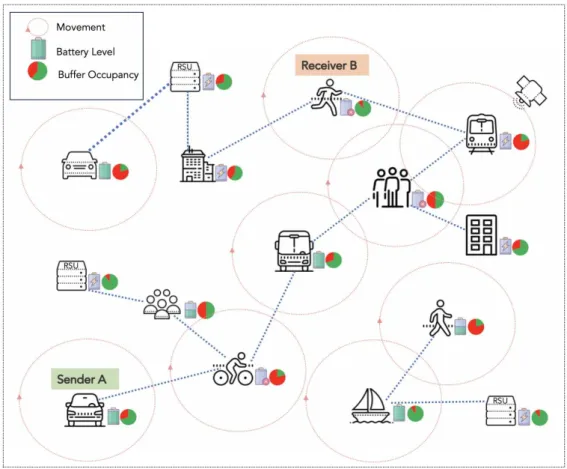
Figure 3.3: An example of OppNets.
contacts. Here entire chunks of message are transferred from one storage unit to a storage uit in another node along a path that is expected to reach the destination [9].
3.2.1
Architecture of OppNets
OppNets consist of nodes which can be anything from fixed devices, vehicles, pedestrians and so on. The data is sent from the source to destination using communication links cre-ated by opportunistic contacts that can be Wi-Fi, cellular technologies, Bluetooth or satel-lite links. These nodes can be IoT devices which roam and opportunistically encounter other IoT devices with which they perform data collection, exchanging or dissemination, as well as relay data between these networks enabling connectivity for other disconnected networks. In Fig.3.3 is shown an example of data forwarding in OppNets. In this exam-ple sender A, wants to send a message to receiver B. The message will go through many steps before reaching destination. Sender A in a car driving on the streets, will send the
message to a cycler passing by in that area. The cycler passing through traffic, will use Bluetooth to forward the message to the bus passing nearby, which will forward it to the pedestrian. The latter will forward the message to the tram whenever there is a contact opportunity, which means a node has come in its range of communication. Now the mes-sage is carried by the other node and the same process is repeated until the destination has been reached. There can be one or many links between sender A and destination B and, links may be disrupt and the topology of the network can change. It can also be seen from the figure that at a given time, not all nodes have the same resources. Some have more storage than others, whilst some have better battery levels. If a node becomes a dead node due to its battery running low, it will store the message until it is activated again introducing delay [10].
3.2.2
OppNet Protocols
OppNets different from traditional networks, have asymmetrical data rates, limited trans-mission range and are characterized by intermittent connectivity. Therefore, network par-titions happen all the time and to solve these problems OppNets uses Store-Carry-Forward mechanism where messages are stored in the nodes’ buffer until forwarded to immediate nodes to reach the destination. The topology of the network consistently changes with links coming up and down due to node mobility. They have evolved from ad hoc net-works but traditional ad hoc protocols do not work well as they require a fully connected end-to-end path, so other routing protocols must be used. Routing consists of forward de-cisions made based on predictions of future connectivities and node mobility information. OppNets being a variant of DTN are challenged networks with different devices and routing environments. Since the conventional TCP model is not applicable in these net-works because of the absence of an end-to-end path, a "bundle layer" is introduced be-tween the transport and the application layer. This new layer provides an end-to-end data transfer for heterogeneous networks by allowing bundle protocols such as (Spray and Wait, Epidemic, MaxProp, PRoPHET) to interface with different transport protocols. In Fig.3.4 is shown the protocol architecture of DTN. As shown in Fig.3.3, the packets gener-ated by the source node will go through different heterogeneous networks before reaching the destination. The transfer of these packets called "bundles" is provided by the bundle layer protocol through store-carry-forward mechanism. Different transport protocols can be used in different network segments [11, 12].
Figure 3.4: DTN Protocol Stack.
• Flooding based routing protocols: They spread the messages and their copies in
the network.
Epidemic Routing: Epidemic routing brings the concept of flooding in intermittent
connected networks. Each node maintains a list of the all the messages which are waiting to be delivered. When it comes in contact with another node, they will exchange all the messages they do not have in common, making all nodes aware of the destination. Even though the maximum delivery probability is reached by spreading messages all over the network which eventually reach the destinations, it creates a lot of congestion and a large overhead. Furthermore, due to limited resources nodes tend to have, the messages may be dropped and/or retransmitted. Another drawback of epidemic routing is that nodes continue to propagate messages even if they have been successfully delivered to destination.
Spray and Wait: The Spray and Wait protocol is an improvement of Epidemic
Rout-ing which limits the message forwardRout-ing by reducRout-ing the messages exchanged. The routing process consists of two phases: spray phase and wait phase. During the spray phase, one node will generate n copies of packets which will spread to the first nodes it encounters. After the spray phase, it goes to the second phase which is the wait phase where it waits for a confirmation that the message has been
re-ceived by the destination. Once the data is delivered the destination will send an acknowledgment using the same two phases.
• Forward based routing protocols: These types of protocols use a more efficient
mechanism to select relay nodes in order to increase the delivery probability, but lowering the overhead and limiting the resource usage.
PRoPHET (Probabilistic Routing Protocol using history of Encounters and Tran-sitivity): The PRoPHET protocol uses node’s mobility pattern to predict the
pos-sibility that certain node will visit the location again, based on past history. In PRoPHET, a message is relayed to a contact node only if the delivery probability to destination node of the contact node, is higher than that of the transmitting node. By doing so, delivery probability is increased. However, since a node has to buffer the message until the destination delivery probability is met, much longer delays will be introduced and nodes may have insufficient buffer sizes.
MaxProp: MaxProp protocol increases the delivery rate by using mechanisms that
prevent retransmission and deletion of duplicate packets. When one node comes in contact with another one, it will not forward all the messages, but only the one the contact does not have. Each node will keep a list of all the stored packets ranked based on the cost which indicates the possibility of reaching the destination. MaxProp will assign priority values to packets and prevent storing the same packet twice. When a packet reaches the destination, an acknowledgement message will inform the other nodes to drop the delivered packets they are still holding.
3.2.3
OppNets Challenges
In this subsection we present the challenges in the use and development of OppNets: Storage limitations: Nodes must have enough storage to store all messages for an unspecified period of time until there is a contact opportunity to transfer the messages. To deal with the storage limitations, buffer management and replication strategies must be considered. In OppNets, individual devices have variable capacities and the amount of traffic generated is not predictable. Therefore, devices with limited storage capabilities can severely affect QoS as transmission uses store-carry-forward mechanism.
Contact Opportunity: OppNets are networks which are formed when nodes come in contact with each other through physical proximity and share their services and resources by different communication media. However, due to node mobility and the dynamic
wireless channels, a node can make contacts with other nodes at an unprecedented time. Since contacts between nodes are unpredictable, with every contact opportunity nodes try to relay messages so they reach destination.
Cooperation Level: It may be required that some nodes provide their own resources (buffer, battery, bandwidth) for other nodes to use without getting compensation. Differ-ently from other traditional wireless networks, nodes are required to store the message in its own buffer for the other nodes, waisting both memory and battery resources. Some nodes don’t cooperate with other nodes and don’t participate in the routing process. De-pending on the level of cooperation, nodes are categorized based on the reputation. Some nodes show selfish behaviors and stop forwarding data reducing packet delivery ratio or the messages might not get delivered at all.
Intermittent Connectivity: In a network of nodes with high mobility, frequent and lengthy disruptions mean that a path from source to destination hardly exists. The incon-sistent connectivities between nodes due to mobility, is called intermittent connectivity. In such scenarios, links between two nodes are unpredictable and intermittent.
Energy: One of the main challenges of OppNets is energy consumption. Having a dynamic and time varying network topology, messages need to be replicated and relayed to nodes in their range. Continuously having to detect the environment for discovering nodes causes an energy consumption. What makes it even more challenging is that since OppNets are mostly deployed in challenging areas, there are restrictions with the battery recharging and replacing. Energy is essential in maximizing the network lifetime.
Security and Privacy: Always changing topology of the network presents many se-curity and privacy issues with OppNets. Therefore is important to ensure node authenti-cation, privacy protection, data integrity and confidentiality [13].
3.2.4
OppNets Applications
Different from traditional networks where nodes are all deployed together at the same time, in OppNets nodes constantly become part of the network continuously.
Emergency Scenarios: The network starts as a seed network which consists of nodes deployed in the initial phase of the network. If an event that needs an emergency response happens, the seed network will expand by adding helpers to the seed network. A seed network grows, when a node discovers potential helpers by a lookup in the directory or by scanning the spectrum for helpers. These helpers are invited or forced to join the
network, based on the emergency of the situation. A helper node is required to assist and must offer its resources if it is within range of a sensitive event [14]. After an event is detected and the seed network is formed, new potential helpers are admitted and added to the network, such as ambulance, firefighter, police car, infrastructure sensors nearby.
Inter-Planetary Networks (IPNs):Another application of OppNets is establishment of a communication between Earth and satellites or other planets. In these environments the communication exhibits frequent disconnections so OppNets can be applied.
Opportunistic Vehicular Networking: The high mobility of vehicles causes short contacts between vehicles limiting the data transmitted making them a version of Opp-Nets. Vehicles collect data from their own sensors, sensors installed in the city and dis-tribute data to other vehicles
Intelligent Algorithms
4.1
Introduction
With the huge amount of data generated, collected, processed and stored, Intelligent Al-gorithms (IA) have become prominent in order to retrieve, manipulate and interpret this data. IA, are designed to make decisions based on a variety of data, act on these data and make decisions, since classical logic is very limited in modeling all human reasoning.
So far, probability has been the only uncertainty with which mathematics has worked, but recently the uniqueness of probability theory as a model for capturing uncertainty and vagueness has been questioned. The uncertainty of probability generally relates to the occurrence of phenomena, as symbolized by the concept of randomness. Randomness and fuzziness differ in nature from probability being different aspects of uncertainty. The uncertainty lies in the meaning of the words, and since it is an essential characteristic of the words, it always follows them around to some extend.
Many attempts have been made, especially in this century, for augmenting the rep-resentational capabilities of logic, or for proposing non-additive models of uncertainty. One of the most radical and fruitful of these attempts was initiated by Prof. Lotfi Zadeh in 1965 with publication of his paper ”Fuzzy Sets” [15, 16, 17]. Fuzzy set theory has become accepted in the literature as a tool for dealing with certain forms of imprecision that frequently occur in decision making environments, but for which probability calculus is inadequate. Fuzzy theory use linguistic variables to describe the control parameters. By using relatively simple linguistic expressions is possible to describe and grasp very complex problems. A very important property of the linguistic variables is the capability of describing imprecise parameters.
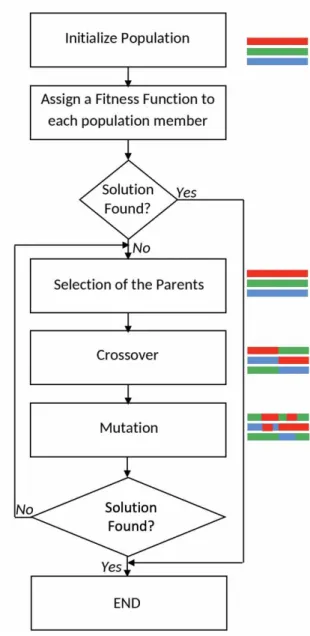
Figure 4.1: Genetic Algorithm Flowchart.
This chapter is about IA and the most commonly used IA. We will first introduce GA and its main concepts. Next we will give the basics of TS, SA, PSO.
4.2
Genetic Algorithm
The Genetic Algorithms (GAs) are a meta-heuristic paradigm that can be implemented and applied in various problems including unconstrained and constrained optimization problems, nonlinear and stochastic programming and also node placement methods. GAs
are a growing area of artificial intelligence and are inspired by Darwin’s theory of bi-ological evolution. Based on these evolutions, GAs can solve optimization problems. The heuristic search of GAs is based on Holland’s scheme theorem. Genetic Algorithms, simulated annealing and evolutionary strategies are mainly used for probabilistic search mechanism directed toward decreasing cost or increasing payoff. GAs generate a se-quence of populations by using a selection method and use crossover and mutation as search methods. One main difference between GAs and evolutionary strategies is that GAs uses crossover as a probabilistic mechanism and of useful data exchange to locate better solutions.
1. Selection: As selection operator, we use roulette-wheel selection [18, 19, 20]. In roulette-wheel selection, each individual in the population is assigned a roulette wheel slot sized in proportion to its fitness. That is, in the biased roulette wheel, good solutions have a larger slot size than the less fit solutions. The roulette wheel can obtain a reproduction candidate.
2. Crossover: The crossover operators are the most important ingredient of GAs. In-deed, by selecting individuals from the parental generation and interchanging their genes, new individuals (descendants) are obtained. The aim is to obtain descendants of better quality that will feed the next generation and enable the search to explore new regions of solution space not explored yet [21]. There exist many types of crossover operators explored in the evolutionary computing literature. Two of the most common types of crossover are shown in Fig. 4.2. It is very important to stress that crossover operators depend on the chromosome representation.
3. Mutation: Mutation operator is one of the GA ingredients. Unlike crossover op-erators, which achieve to transmit genetic information from parents to off-springs, mutation operators usually make some small local perturbation of the individuals, having thus less impact on newly generated individuals (see Fig. 4.3). Crossover is "a must" operator in GA and is usually applied with high probability, while muta-tion operators when implemented are applied with small probability. The ramuta-tionale is that a large mutation rate would make the GA search to resemble a random search. Due to this, mutation operator is usually considered as a secondary operator. GA is one of the most powerful heuristics for solving optimization problems that is based on natural selection. The GA repeatedly modifies a population of individual
(a)Single Point Crossover.
(b)Multi-point Crossover
Figure 4.2: Two of the most common types of crossovers.
Figure 4.3: Chromosome before and after mutation.
solutions as shown in Fig. 4.1. At each step, the genetic algorithm selects individuals at random from the current population to be parents and uses them to produce the children for the next generation. Over successive generations, the population "evolves" towards an optimal solution [22]. In Alg. 1 is shown the pseudo-code for a GA.
In our previous work, we have used GA for placement problems [23]. In IoT networks, when devices/nodes are deployed densely, there is a possibility that a node may reside in the coverage area of multiple different nodes. The goal is to find an optimal and robust topology for the network nodes that brings connectivity services to events.
4.3
Tabu Search (TS)
Tabu Search (TS) is a meta-heuristic method that provides optimal or very close optimal solutions to many combinatorial problems. Heuristic techniques have been used for NP-hard problems where it is very difficult to find an exact solution. The search methodology
Algorithm 1Genetic Algorithm Pseudocode t← 0;
Initializepopulation P(0)
Assigna fitness function to each population member P(0)o f sizeΘ whilemax_nr_of_generations_reached do
Selectthe parent pool Pp(t) o f sizeΦ;
Crossover pairs from parents pool Pp(t)with probability pc; Pc(t) =
Crossover(Pp(t));
Mutateindividuals in Pc(t) with probability pm; Pm(t) = Mutate(Pc(t));
Createnew population with individuals from crossover and mutation;
P(t + 1) = Individuals(Pc(t)∪Pm(t));
t← t + 1
end while
of TS is similar to neighborhood search. It starts from one point (solution) to another point until a termination criterion is satisfied. Search space of TS is the space of all the solu-tions that are considered during the search. Search space together with the neighborhood structure are the two basic elements of TS.
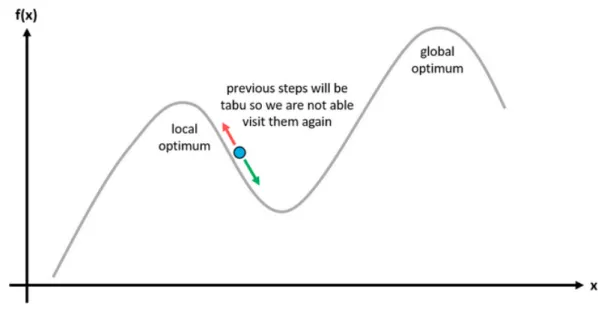
Each point starts as an initial solution in a search space, which by applying a series of local modifications called moves, improves to a solution which differs moderately from the previous one. The quality of solutions and computational time, depends on the com-plexity of the moves at each iteration. Whenever a local optimum has been reached, Local Search (LS) technique is applied which does not allow non-improving moves. This way going back to previously visited solutions is not allowed by the use of memories which are called tabu.
The final solution is called local optimum since it is better than the other solutions in the neighborhood but in most cases it will not be a global optimum [24]. While tabus are important as they prohibit moves that go back to non-improving solutions, they may also negatively affect the searching process.
When the tabu of a certain move is 0, than the move can be accepted again. In Fig. 4.4 it can be seen that the algorithm can not go back to the local optimum so it has to search other regions in the search space. Tabu moves are saved in a tabu list, where for each iteration each tabu is decremented by one. There are cases where tabu moves are allowed. For example, when a tabu move allows a new global solution.
Figure 4.4: Illustration of a tabu move.
4.4
Simulated Annealing (SA)
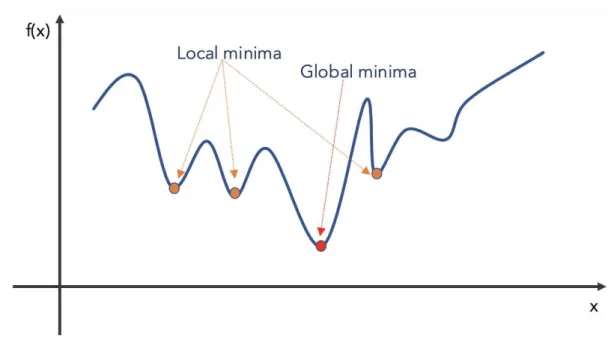
Simulated Annealing (SA) is a probabilistic method that finds the global minimum of a function that may have several local minimum. It takes the name from the physical pro-cess where an object is heated to a temperature where atoms rearranged and than cooled down slowly until the object freezes into a regular structure. SA, uses the idea of anneal-ing to find low cost solutions to combinatorial optimization problems. Many problems, as they become larger require many steps to reach a potential solution. Heuristic methods for optimization problems are important as they offer a solution in reasonable time, but they do not always guarantee the optimum one.
The current literature indicates that the use of simulated annealing algorithms broad-ens the solution space and results in a higher probability, though not guaranteed, of deter-mination a global optimum rather than a local optimum. The traditional search methods rely on an iterative descent approach that performs well if the objective function has a convex continuous shaped function. In practice, SA algorithms yield a polynomial time solution to an exponential time problem.
One feature of SA, is that it does not get trapped at local minimum. The algorithm employs a random search, which not only accepts changes that decrease objective func-tion, but also some changes that increase it. The latter are accepted with a probability.
The implementation of the SA algorithm depends on this annealing process structure and the process requires the following elements:
• a representation of possible solutions, • a generator of random changes in solutions, • a means of evaluating the problem functions.
Another significant component of an SA code is the random number generator, which is used both for generating random changes in the control variables and for the tem-perature dependent increase acceptance test [25]. SA algorithm always accepts a better solution based on the objective, but it also reduces the likelihood of the solution being trapped, by accepting a worse solution if an acceptance criterion value is greater than a selected random number.
4.4.1
Local Versus Global Search
For many problems, to find a solution that satisfies all the constraints, a large number of possible solutions must be searched. For example, consider the problem of composing a classroom schedule with constraints such as time constraints of students and lecturers and the availability of classrooms. Even for a problem with a relatively small number of constraints, it may be necessary to search through many possible schedules to find the one that satisfies all the constraints [26].
For certain cases, there have been found algorithms that solve large computational problems without having to search through the space of all possible solutions. However, sometimes such a large search cannot be avoided. The search space is referred as a com-binatorial search where the best way to search it, depends on the problem to be solved. Inability to detect the unsolvability of a problem instance, is one of the main drawbacks of local search. When dealing with optimization problems it is difficult to determine whether the solution found is globally optimal. In Fig. 4.5 is shown the graph for the local and global minimum of SA method. In contrast with the local search methods, with the global search techniques, we are able to tell if no solution exists after all the search space has been explored and no solution is found.
Figure 4.5: Local and global minimum for SA.
4.5
Particle Swarm Optimization (PSO)
Particle Swarm Optimization (PSO) is another heuristic optimization method based on swarm intelligence. It was introduced in 1995 by Kennedy and Eberhart and it is very popular due to its optimization performance. In PSO particles use their past experiences to find the optimum solution based on the experience of the swarm. PSO algorithm simulates the social behavior of birds in a flock which fly in synchrony with each other and regroup if suddenly change direction.
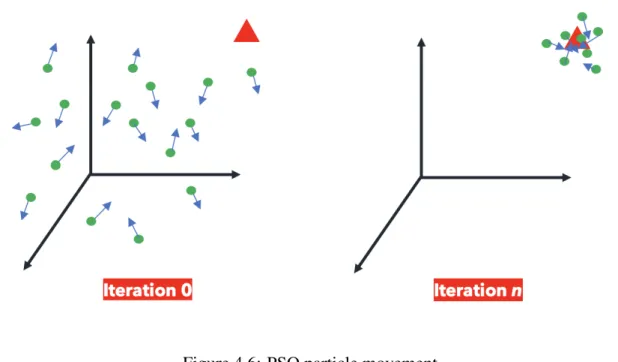
When searching for food, if the birds are scattered, they have a smaller chance of finding food than when together as a flock. When in a flock, one bird is always closer to the food and transmits this information to the other birds. Birds, or particles fly through out the search space with the aim of finding food or finding the optimum solution. To explain it in analogy with evolutionary paradigms, particle represents an individual in a population which is represented as a swarm. In Alg. 2 is shown the pseudo-code for PSO. Changes of the particle’s position within this search space are influenced by the information or experience of its neighbors. In a population P(0), each particle i has an
Figure 4.6: PSO particle movement.
initial position denoted as xi(k) at a discrete time step k. If a velocity vi(k + 1) is added to a particle, its position will change to another position xi(k + 1), i.e.
xi(k + 1) = xi(k) + vi(k + 1) (4.1) The position of each particle changes based on the best position this individual parti-cle has during its movement and its best position related to swarm position as shown in Fig. 4.6. In a population P(0) of particles i=1,...,nâ, each particle will keep in its mem-ory the best position of the search space for each iteration. The speed of the particles gets updated at each iteration. In Eq. 4.2 is shown the velocity of the particle i, at time step k.
vi(k + 1) = vi(k) + c1r1(yi(k)− xi(k)) + c2r2(yj(k)− xi(k)) (4.2)
Where:
• xi(k) - particle’s position at time step k.
• vi(k) - particle’s velocity.
• vi(k + 1) - updated particle’s velocity.
• c1, c2- acceleration constants that represent cognitive and social components.
• yi(k) - particle’s best individual position.
• yj(k) - particle’s best swarm position.
Velocity of the particle represents the experiential and social information exchanged form particles’ neighbor.
Algorithm 2PSO Pseudocode k← 0;
Initialize: population P(0) foreach particle i=1,....n do
Initialize: particle’s initial position xi(0)
Calculatefitness function of each particle f (xi)
if fi(x) <= fi(y) compare current fitness value with the best fitness value then then Setvalue f (yi) as the best
yi= xiglobal best position
end if end for
foreach particle i=1,....n do Eq. 4.1← xi(k + 1); Eq. 4.2← vi(k + 1); end for
![Figure 3.1: IoT Architecture Layers [7].](https://thumb-ap.123doks.com/thumbv2/123deta/6496753.1125070/26.892.152.848.151.499/figure-iot-architecture-layers.webp)