
根室層群産白堊紀有孔虫化石群について
51
0
0
全文
(2) Vol. 13, No. 2. Journal of Hokka ido Gaku gei Unive rsity. Ma r., 196.3. Upper Cretaceous Foraminifera from the Nemuro Group, Eastern Hokkaido, Japan Saburo YosHJDA Geological Insti tute, Ku:;hiro Bra nch, H ok kaido Gakugei Univers ity. EE ABSTRACT The N e muro g roup, which is unconformably overl a in by the lowe r Tertiary Crahoro gro up, cr ops o ut in eastern H okkaido. It has been sampl ed for foraminife ral conte nt. 109 species of Foraminifera-33 of which are new-are illustrated, described and their stratigraphic ranges determined .. Arenaceou s species constitutes the greater number of individ ua ls, a nd calcareous. species is small in number.. Planktonic forms-es pecially the genus Globigerina-arc rarely. fou nd, wh il e Globotruncana has not been found as yet. On the basis of stratigraphy and mega·-and microfaunas, the geo logical age of the Nem uro group is determined as uppermost Cretaceous.. INTRODUCTION Foraminife/al assembl ages of the Nemuro group in the eastern part of Hokkaido h ave received little attention in published literatures . Only a brief mention has been m ade of Foraminifera from the Urahoro and Hamana ka districts by the present write r .. This neg lect is. du e largely to the lack of interest on the part of the coal and petroleum occurrence in the Nemuro g roup which is poor in unde rground resources.* The area of this report covers Tokachi, Kushiro and N emuro provinces, about lSOkm from the eas tern extreme to the weste rn .. I t includes eight districts from which samples were. collected, namely, Hanasaki Peninsul a, Hamanaka dis trict, Akkeshi distric t and MonshizuKombumori district in the eastern part of this area ; H ombetsu district, Tokomuro district, Yubetsu district and Shiranuka district in the western part.. The geological relationships of. the Nemuro gro up and the sample localities are shown in figure s. The writer 's origial plans called fo r sampling each formation at known stra tigraphical interva ls, but poor exposures and structural complications. m;:~cle. this impossible . The sample. loca lities are based on correct stratigraphic sequence as far as possi ble,. but precise de termi-. natio n of s tratigraphic intervals between localities w as generally impossible.. *. However, oil indications hav e heen cliscuvere d recently in the ::-.lemuro group whi ch is distributed in the H anasaki Peni nsul a, and the geJlogica l survey is be ing carried od by the Japan Pet rol eum Expl oration Company.. 211. (5 2 ).
(3) Saburo Yoshida. A total of 245 samples was examined, and 183 were used in the study.. The number of. samples from each formation does not indicate the ratio of stratigraphic thickness, but rather reflects the adequacy of exposures.. All illustrations were drawn by the present writer.. ACKNOWLEDGMENTS It is the writer's great pleasure to acknowledge all assistance that has been rendered him in the course of the study. Prof. Kiyoshi ASANO, Institute of Geology and Paleontology, Tohoku University, for his constant encouragement, for permission to freely use his literature and laboratory equipments; Dr. Yokichi TAKAYANAGI of the same institution for his valuable advice and information on identification of foraminifers ; Prof. Tatsuro MATSUMOTO, Department of Geology, Kyushu University, for his suggestions concerning identification of Ammonites ; Mr Takashi MATSUNAGA, Japan Petroleum Exploration Co., Ltd., Tokyo for his technical assistance in facilitating the work ; Messrs.. Hisaichi IWAMOTO and Sei'ichi KOMURA of the same. company, Mr. Masayuki AOKI, Yubetsu Coal Mining Co., Ltd., Mr. Yutaka YOSHIMOTO, Nemuro High School, Mr. Hiroshi YOKOHIRA of writer's university, for their aid in the sampling works in the field; Mr. Hiroyuki OKESAKU, Kushiro Branch, Hokkaido Fisheries Scientific Institution, for his valuable advice on drawing the foraminiferous figures ; Dr. Haruyoshi FUJIMOTO, Professor Emeritus of the Tokyo University of Education, for his continuous encouragement.. The use of the laboratories of the Tokyo University of Edu-. cation and Tohoku University, and fine facilities of the Japan Petroleum Exploration Co., Ltd., Tokyo, is duly acknowledged. Prof. Yasuo SASA, Department of Geology and Mineralogy, Hokkaido Universi ty, for continuous encouragement and valuable suggestions concerning the stratigraphy of the area of this report. Finally, Prof. Wataru HASHIMOTO, Geological and Mineralogical Institute, Tokyo University of Education, read the final manuscript and kindly offered suggestions relative to various systematic problems.. HISTORICAL REVIEW. l• ;. K. Jimbo (1890) reported Inoceramus from this group for the first time.. Y . Sasa and. S. Nishida (1935) named the lowermost deposits in this area the " Nemuro Series", and many students sucr.eeded them in the study of the Nemuro group.. As the historical review and. the geological age of the Nemuro group and the Urahoro group which unconformably overlie the Nemuro group have been previously made by the present writer ( 1961)*, it will be omitted in this paper.. DEPOSITION OF TYPES The specimens treated here are deposited in the collection of the Geological Institute, the. *. The Cretaceous-Tertiary Boundary in Eastern Hokkaido, Japan, jour. Hokkaido Gakugei Univ. , Vol. 12. no. 1, llB, pp. 14-38. ( 53 ). 212.
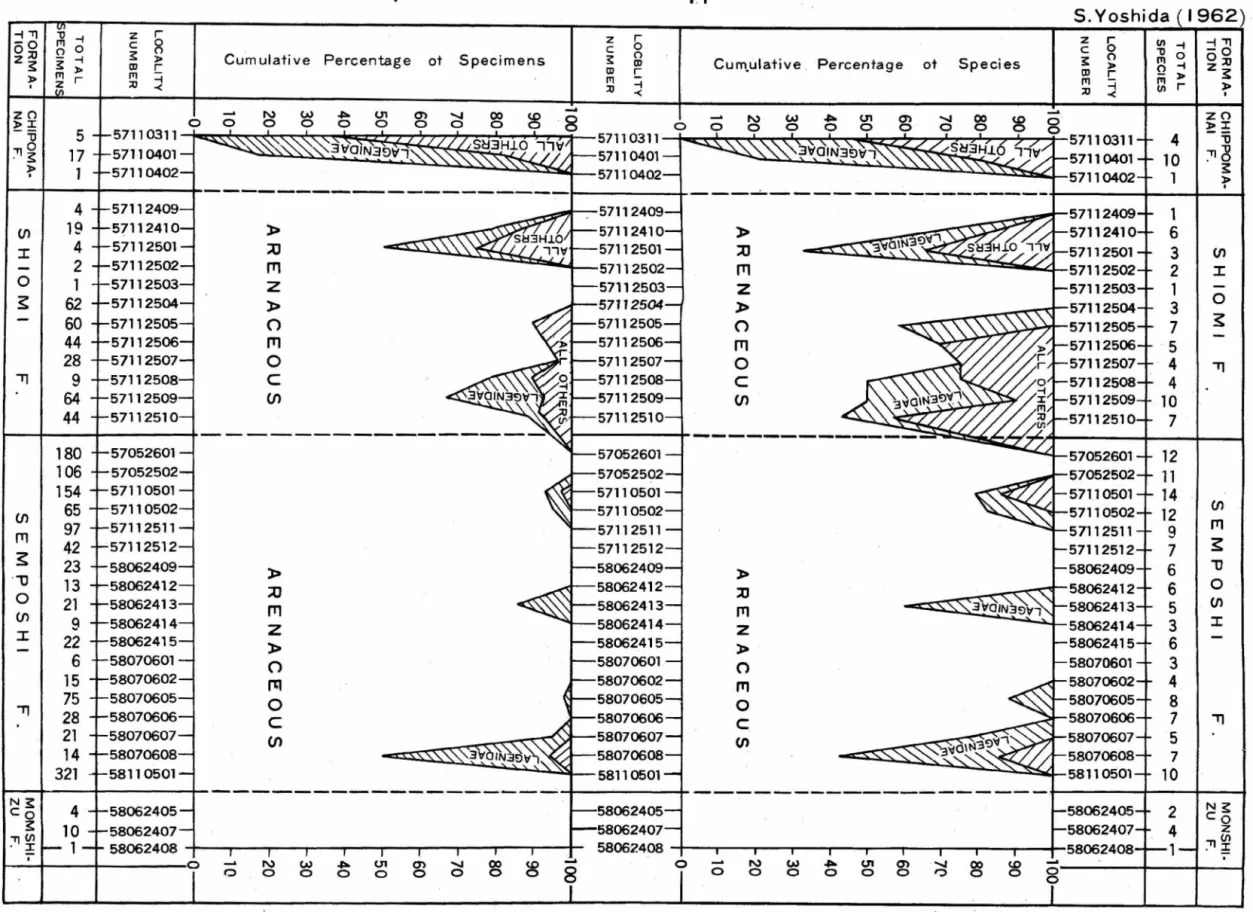
(4) Upper Cretaceous Foraminifera from the Nemuro Group, Eastern Hokkaido, Japan. Kushiro Branch of Hokkaido Gakugei University. Catalogue numbers of the registered specimens are indicated in the text as HGK (Hokkaido Gakugei University).. SAMPLE ANALYSIS Most of the samples were well indurated and did not yield to ordinary procedures for disintegration of sedimentary rocks.. The procedures are as follows :. (l) sample is mixed. thoroughly, crushed to peanut-sized fragments, and weighed out 100 grams ; (2) heated for 30 minutes to get rid of excess moisture ; and then drained off ;. (3) immersed in a spoonful gasolene for minutes. (4) added with boiling water and boiled for one hour ;. (5) sample. is poured into jar, placed on roller for abut 30 minutes, then washed through a 150 mesh screen ;. (6) sample is checked, and if not clean enough, steps (2)-(5) are repeated. The entire washed sample was then examined under the micro-scope on a gridded picking tray and the nu-44'. mber of individuals of each species was counted. Concentration of the foraminiferal tests by means of a carbon tetrachloride separation process proved impractica-. ~. 't. "'. <.>. 0 \ - - -.-----t- -··40'. ble, for many of the calcareous perforate tests and most of the arenaceous tests were filled up and consequently would not float.. FAUNAL CHARACTERISTICS Mainly based on Cushman's classification, 18 families, 44 genera and 109 species-33 of which are new-are dealt. -+---+--+-36'. with in the present study. The stratigraphic range and abundance of each species. 144'. are given. 111. Table I.. Species of similar ranges are grouped together. Two Fig. I . Map Showing the Area Treated in this Report. ~-. .. distinct faunas may be recognized in the MonshizuKombumori district, one occurring in the Semposhi for-. mation, and the other consisting of two subfaunas in the Shiomi and Chippomanai formations. There are 49 species in this -district, 20 of which are restricted to the Semposhi formation. Two subfaunas characterized by species may be recognized, each being restricted to the Shiomi and Chippomanai formations respectively.. Those species found only in the Chippomanai. formation, however, are few and occur too rarely to make this subfauna easily recognizable. Table H gives the relationships of the various groups of foraminifers by cumulative percentage graphs, with total number of species and specimens from 100 gram each sample from the Monshizu-Kombumori district. Representatives of arenaceous species are the most abundant. and the percentage of arenaceous specimens to total specimens is higher in the basal part, ann lower in the upper pa rt of th Nemuro group of the Monshizu-Kombumori district as Upper 213. Chippomanai formation······ ·· ····--····--······ ·· ······· · ···17. 4% (54 ). follow~ ..
(5)
(6) Table. II.. Group. Distribution of the Upper Cretaceous. Foraminifera 1962). S . Yoshida -i"Tl. -o. O;o z~ )>. -!. 0 -!. >. r. z. c. 3: CD. 1'1 :tl. r. ~. 4 C/1. :r. 19. 4 2. 0. 1. ~. 62 60 44 28. "Tf. 9 64. 44. C/1 IT1. 3:: ·-u 0 (/l. :::r::. ., N~. 180 106 154 65 97. 42 23 13 21 9 22 6 15 75 28 21 14 321. co. 4. ,(/). 10 1. ~. .. I. I. Percentage. ot. c. Specimens. 3:. CD IT1 :tl. <. 57110311 57110401 57110402. ,o . ~. Cumulative. c-!. zo. )>J:. -=u. z. R. >. 0. 0. N. 0. w. 0. ~. 0. U1. 0. 0'1 0. ....... 0. 00 0. r. z. 0. c. (). Cum.ulative. CD. c. :tl. 0. U1. 0. 0'1 0. ....... 0. (). 57112505 57112506 57112507 57112508 57112509 57112510. (). c (/). ::0 IT1. z. )>. (). ll1. 0. c. (/). 58062405 58062407 58062408. w. 0. ~. 0. U1. 0. 0'1 0. ....... 0. 00 0. <.0 0. ..... 8. <. 57112409 57112410 57112501 57112502 57112503 57112504 57112505. 0. 57112507. (/). 57052601 57052502 571.10501 57110502 57112511 57112512 58062409 58062412 58062413 58062414 58062415 58070601 58070602 58070605 58070606 58070607 58070608 58110501. )>. :::0 1'11 2 )>. 0 1'11. 0. c. (/). 58062405 58062407 58062408 0. N. 0. w. 0. 58062405 58062407 58062408 ~. 0. U1. 0. 0'1 0. ........ ":>. 00 0. -o O;o z~. r. (/1. )> I. zo. c. 0. -i"Tl. )>J:. IT1. 57052601 57052502 57110501 57110502 57112511 57112512 58062409 58062412 58062413 58062414 58062415 58070601 58070602 58070605 58070606 58070607 58070608 58110501. )>. c-!. -! 0 Q -! 1'1 > "0. 1'1. 00 0. z )>. 0. ~. ::0 IT1. 57112504. N. w. 0. )>. )>. 0. 0. 0. >. (/1. -;;. 57110311 57110401 57110402. 57112409 57112410 57112501 57112502. IT1. 0. N. 0. z. 57052601 57052502 57110501 57110502 57112511 57112512 58062409 58062412 58062413 58062414 58062415 58070601 58070602 58070605 58070606 58070607 58070608 58110501. CD. 1'1. 0. ::0 IT1. 3:. Species. <. <.0 0. )>. ot. -!. 57110311 57110401 57110402. 57112409 57112410 57112501 57112502 57112503 57112504 57112505 57112506 57112507 57112508 57112509 57112510. Percentage. r. 0 0. <.0 0. 0 0. ,-o . 0 ~. )> I. 1. 6 3 2. C/1. :::r::. 1. 0. 3 7 5 4 4 10 7. ~. "Tf. 12 11. 14 12. (/). ITI. 9. 3::. 7 6 6. 1J. 0 C/1. 5. :r. 3 6 3 4 8. .,. 7. 5 7. 10 2 4 1. N~. co. ,(/)z. .. .. ~.
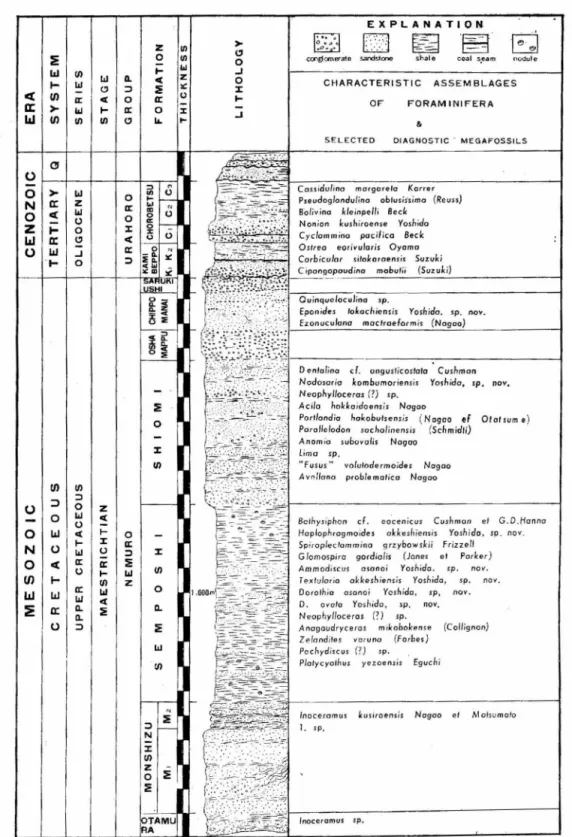
(7) Saburo Yoshida. EXPLANATIOK. z :!: Ill C(. 1Ill. I&J. Ill. a: >. Ul Ul Ill. 0. (/). w. w. ..... z. c. ll. lC:. 0. t-. a:. :E a: 0. J:. (/). Cl. 1&.. ~. Cl. a: w. c. (/). ::::l. (). E2j.. D. >. Cl. Ca'lglcmerat e. 0. sardstcne. N. 0. z. I&J 0. " >. :::>. w z. a:. 1-. 0 J:. a:. 0. Cl. Ill. -'. a: c(. •t-. 0. w u. -~ -. 1 ~· ~1. s·ha f e. cQal s.eam. nodul e. -' 0 J:. CH ARA CT ERISTI C. ..... OF. A SSE MBLA GES. F ORA M INIFE R A. -' SELECTEO. 0 0. ~. OIAGNOSTIC - MEGAFOSSILS. c). Ill. I-I-W N. :!5 () 0 1--=%. a:. 0 <J c 1·-::: a: - 0o. I-;;-. ::::l. 0. "'i.. :E o.. ""' " "'. ~ o~!. Q:E. 1------3--. ~~. ~. ::!! 0. D entolino cf. onguslicoslolo • Cushman Nod o.so rio kombumoriens is Yoshida, sp . nov. Neophylloceras (') s p._ Acilo hokka idoem is Nag a o Port,ondio ho kobutsensis (N agao eF or ot sum e ) Pa rallelodo n so c holinensis (Schmiclli) Anomia subo vofis Nagao. J: "Fusus " A vf"!llano. (/). 0. Ill. (/). ::J. 0. 0. 0. Ill. N. u. 0. c(. (/). 1-. ::::l. w u c(. t-. Ill. w a: u a: w. u. D. D. ::::l. w :!: a:. vofulodermoides Nagao preble matico Nagao. z c. t-. 0. J:. a:. ::::l. J:. a:. ::!! w z. (/). u. t-. (/). w. 0. ct. D.. :!. ::!!. w (/). f--rN. Nagao. :!. et. Mols vmolo. , ::J f--N. % (/). z 0. ::!!. ~-. sp.. rAMU. 5 . YOSHIDA ( 19 62\. Fig. II . Stratigraphic Column Showing Characteristic Foraminifera l Assemblages and D iagnostic Megafossils. ( 55 ). 214.
(8) .... ~. ". !:!. o;"'. Nisho-zawa. zawa. Kawaruppu-. Tokomuro district. ~I. s0. ,.Q. --. <I). s:"'. s. .... t::. p.. "'. c; ........ ~. District. Kombumori. Monshi zu-. District. Hamanaka. 9. F.. Kawaruppu. Kappei. Tokomuro. Kappei. Kawaruppu. Kappei. Kawaruppu. F.. F.. F.. F.. F.. F.. 40. 9. 43. 30. 32. 27. 26. 5. F.. Monshizu. F.. 30. 22. 15. I. 8. 27. 5. 25. F.. F.. F.. F.. F.. F.. F.. F.. SempOshi. Shiomi. Chippomanai. Nemuro. Hamanaka. - --. Kiritappu. Nemuro. Choboshi. Formation. I. 590. 79. 356. 283. 780. 161. 588. 97. 15. 1,212. 341. 23. 5. 23. 208. 104. 98. --. 50.0. ··---- -. 37.0. 100 -. 14. -·-··--. 162. 104. 69. of Specimens. 60.9 1. -. 10. 0. 4. of Species. - · ----···-. 77.9. 100. 70.4. %. 14. 6. 16. 14. 17. 9. 13. 8. 5. 35.01. 66. 7. 37. 2. 46. 7. 53. 1. 33.3. 50. 88.9. 100. 541. 76. 230. 246. 724. 123. 550. 95. 15. 91.7. 96.2. 64.6. 86.9. 92.8. 76.4. 93.5. 97.9. -;;-[. -. ITotal number I. 40.0. %. Arenaceous. 12.5. 37.0. 0. 16.0. %. -. 13.5. 0. 12.2. %. 4. 8 · - - -0 0. 1. 28. ·-- -- ·· --- - - -. 0. 12. of Specimens. ITotal number I. Lagenidae. - -. I. 15. 1. 15. 7. 4. 7. 6. 1. 0. I. 37.5. II. I. 34. 9. 23.3. 12.5. 25.9. 23.1. 11. 1. 0. 33. 1. 77. 13. 12. 12. 11. I. 5. 6. 1.3. 21.6. 4.6. 1.5. 7.5. 1.4. 1.0. ~::. 5 100 100 0 0 - - - -- - - - - - - - - -- - - - - · 3 4 20.0 53.3 17.4 8 13 56.5 ·- - - - -- --- - -·- 7 296 31.8 86.8 7 31.8 -- - -- - -20 66. 7 I, 185 97. 8 6 20.0 1. 4. 10. 5. 1D. I Total numb~~ Total number I I Species !specimens of Species Total number. of Arenaceous and Calcareous Foraminifers from each Formation in the subject Districts. (Calcareous Foraminifers are represented by the dominant Lagenidae).. m. Occurrence. .... Kawakami-zawa Kappei ;:. -~. ., i5"' .s ::s. a'...l. ... s "'"' J-:.1. t::. p... "'. ........ 0. -. .s. <I). a'...l. ~. Hanasaki Peninsula. District. '. Table. f. =. 11. ...... I>'. 0.: _c. !l>. ,.... 0 ::;-. ~. ::s. ;; ..,"'. !l>. tTl. s:: :0. 0. C'l ..,. 0. "'. 9 g.. 0. ..,....,. ~ !l>. e ....,:. 9. !l>. 0. ""..,. "'. ("). s0 s::"'. c:: .., 0 .., <1> <1>. "0 '0.
(9) .till. ~. '--'. ~. r-.. ~. J:Sh~~:,e~;s. kus~~~h7J~. ak~~~h~~~. sp. nov./· ... sp. nov.[ ···i:··. Asano. ;r1. ~-. '". 'C 'C. ;::r.:. I. I. "' ;r1. ~. '". "',... 'C "' 'C. ;::r.:. ;r1. (!>. '~". "' ;r1. 'C. 'C. Ill ,.... ~. -· "'. "'. 'C 'C. ;::r.:. ;r1. "'. \. i. 10. 1. 1. \-. ::. 1. \ · ··i· ~~ :. ::. \. · ·\. ·. ···. JI .. ···· \. 1. I. I. \·. I. ·r. ;r1. ;!:. U>. 01. a. '0. 0. g. ::r;:; ·. (!>. (f). ~. I .1. . .. 1.. .. 1. ...~~-- I ..Y.J . J. "' ;r1. 'C 'C. ""'. ~. ~. ~. ~. I I I I I 15 I 11 1_. I I I I I I I I rI 1 ·· · r · ·T· · · ~--····· 1······· r. J. ;r1. ~-. '". ~ '0 '0. ;r1. -·. 3. a·. (f). ::r-. District. ;r1. 0. "'..,. 3. z. (!>. l··. _II .. ······\ .. ... . J. ~o -. ;r1. '". :>;-'. ~. ~. ::r:. District. Hamanaka. ;r1. "'. 'C 'C. \· .. .... J I. ;r1. 0. "'. 3 ,.... s·. ,.... z. ~. (!>. J. ~. a· ;::l. ~. s". 0. IT). - --. ~·. 0 ~· ,.... 0". 12. \. ~. 5l::r. >-<:. 0. IB ~ I A "'.... ···· 1 · B ·. ~. ::r"' -·. 0. 0". ::r01. (). Peninsula. Hanasaki. t I I 30 I I I I1 ·······rI ······rI 22·36 I - r · · rI 1818 I1. J .. J. -· ;r1. '~". s. 0. .o· '0. ::r-. (). Monshizu· Kombumori. Eastern Part of the Area. \·. · · · · · \····i}··l· ··~:·· ·\· · ''···l···i·~···!l ...i6--· :- --~i--· l · ·ii·· l · · ·:·:· · l·Z···i ··· · - · 1J··· · · · · I· · ··· · · ·I· · · ~:-···l· ···:·:·· 1J ·--~~--·l· ·· ·~· l· . \······ ··!·· · \· .... ·······I \··· · ·\· ···l <:··l·· ······lr·········\ ······· ··1······· ········\ \ ~. i. I I1. .I. ;r1. -. Nisho-zawa Kawaruppu-1 Kawakamizawa zawa. A : Percentage to Total Arenaceous Specimens B : Percentage to Total Specimens (including Arenaceous and all the rest). S. (Bramlettia). S. (Bramlettia). Haplaphragmoides. nov.[. 1 -. I. ;r1. 0. "'..... s. 0. :>;-'. ~-. '". '0 '0. 0. o-J. ~. district. Tokomuro. Hombetsu District. Western Part of the Area. ~~ ~ ~~ l·· ·l ~~ l····l- ··\··· ··\ · · ··1··~~ ·I·· · I· ~ Spirop/ectammina grzybowsk#rizzell I ··l ·\ · ~ <~ ~ i~· - 1~--······--\···i~ ··\ ·I · I \· I . I·. \. ~ Silicosigmoilina futabaensis /·i!···\·-:: ~ ~~- ~-- ·····+·· ···\···········1········· ~ ·· ·... +. ~ l· . +··~··S. futabaensis ')f:S~{ci:,si:ubsp.nov.\ ii i · · · · \· · i~- - -1· ··~:-·· l· · {f J ... ··1··10_ i.. · · \ · :~··· J · ··i~···\···ii··+·· . · ·\· · · · · · i· · · · · ·\ · · · · · ··J········-·1···~~ --1-··t···. B. sp. A. Bathysiphon kushiroensis Yoshida, sp. nov.. '. Table IV. Dominant Arenaceous Species from Each Formation (over 10%), with the Percentage of Each Species to the Total Number of Arenaceous Specimens and others..
(10) Upper Cretaceous Foraminifera from the Nemuro Group, Eastern Hokkaido, Japan. Shiomi formation. · · · · · · · · · · · · · · · · · · · · · · · · · · · · · · · · · · · · · · · · · · · · ·86. 8%. Semposhi formation ·· · ··· · ·· · · · ·· · ··· ··· · · · · · · ··· ··· · ·· · ·· ·· ·97. 8% Lower. Monshizu formation··· ·· ·· ··········· ······· ··········· ·· ···· 100. O%. In this district, a very sharp break of the percentage is recognized between the uppermost Chippomanai formation and the Shiomi formation . The occurrence of arenaceous and calcareous foraminifers in other districts is illustrated in Table. I,. Lagenidae. abundant.. in which the latter species are represented by the most abundant and dominant Among the arenaceous species, those which are listed in Table. IV. are the most. On the other hand , with regard to the calcareous species a striking contrast is. exhibited by the Lageniidae which constitutes an appreciable proportion of such species.. It is. represented in the following table as exemplified in the Monshizu-Kombumori district: INDEX. MAP. Nemuro EASTERN. HOKKAIDO (YEZO). '. Kushiro. --• 0. '""'~ , .~. I. •. • -Obihir<J. Fig.. m. Index Map Showing the Position of Districts, Rivers, Valleys and Villages in the Area of this Report. Legend for the Names of Districts, Rivers, Valleys and Villages.. Eastern Part of the Area I . Nemuro Peninsula 2. Choboshi .3. Ochiishi I. Hanasaki ll. Hamanaka District 4. Esashito 5. Pompo roto 6. Hamanaka ill . Akkeshi District 9. Daikoku-jima IV. Monshi zu-Kombumori District 10. Monshizu 11. Oboro 12. Sempiishi. 7. Kiritappu. 8. Mochirippu. 1.3. Oshamappu. 14. Atoega. W estern Part of the Area V . Hombetsu District K. Kawakami-zawa B;· Kawaruppu-zawa C. Nishii-zawa VI. Tokomuro District R. Rushin-zawa 0. Osappe-zawa M. 1\iasuno-sawa VII. Yubetsu District P. Perutsunai-zawa S. Shunku-sitakara-zawa VIR. Shiranuka District. 217. (58 ). E. Jinjano-sawa. 15. Kombumori.
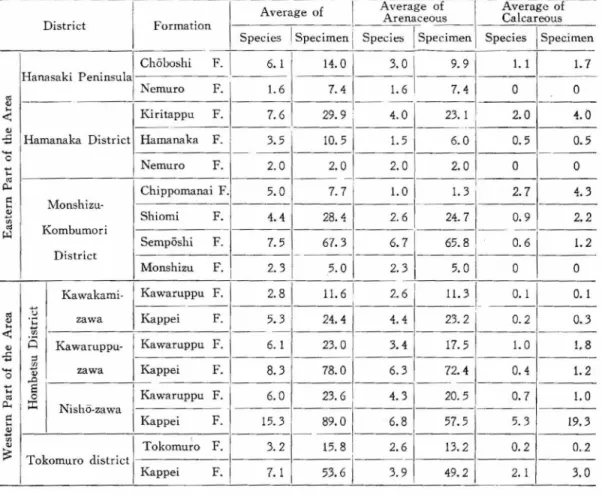
(11) Saburo Yoshida. species Upper. specimens. ···· ····· ···57. 1% ··· ·· ···· ·· · ···56. 5%. Chippomanai formation. Shiomi formation ··· ····· · ··· ·· ······ ·31.8%········ · ····· · 7.6% Semposhi formaiton ·· · ·· ······· ··· ···20. 0% ··· ··· ··· ··· ··· 1. 8% Lower. Monshizu formation · · · · · · ··· ·· · · ·· · · · 0. 0% · · · · · · · · · ··· ·· · 0. O% These relations are recognized in other districts expect the Kawakami, Nisho and Jinjanosawa Valleys of the Hombetsu and the Tokomuro districts as illustrated in T a ble. I-. AII this points out either that the break in the percentage shown in the above ta bles is a probable consequence of a changing depositional environment, or that it indicates the boundary of geological ages in some sense or other. The total number of species from 100 gram each samples is rather small and quite variable according to samples, and it is 14 at the greatest, which is the case with the Monsl1izuAnd the average numbers of species contained m the 100 gram samples. Kombumori district.. of each formation vary from 1. 6 to. 15. 3.. On the other hand, the greatest number of spe-. cimens contained in a 100 gram sample is 321, which is the case with the Monshizu-Kombumori district . The average numbers of specimens contained in the 100 gram samples of each formation vary from 2 to 89.. These are shown in Table. V.. Table V. Average Numbers of Species and Specimens Contained in the 100 gram Samples of each Formation.. -. ... ·. I District. Formation. I. IChoboshi. Species I Specimen. ... F.. Hanasaki Peninsula. .,"'.... .,. .s. I. -. "' ....~. Monshizu·. "'. Kombumori. ~. "'. ~. Kawakami·. 0. ..... "'. p.... ::::..... .~. zawa. Q"'. Kawaruppu·. ~. 9. 9. 1.1. 1.7. 7.4. 0. 0. 2.0. 4.0. 0. 5. 0.5. 0. 0. Kiritappu. F.. 7. 6. 29.9 :. 4.0. F. ,. 3.5. 10. 5. 1.5. 6. 0. F.. 2.0. 2. 0. 2.0. 2.0. -. 23. 1. - - - -·. ·. '. I. Chippomanai F.. 5. 0. 7. 7. 1.0. 1.3. 2. 7. 4. 3. Shiomi. F.. 4.4. 28. 4. 2. 6. 24. 7. 0. 9. 2.2. Semposhi. F.. 7.5. 67.3. 6. 7. 65. 8. 0.6. 1.2. 5.0. 2. 3. 0. 0. 0. 1. 0.1. 0.2. 0.3. -. F. I. 2. 3. I. 5. o 1 !. 11. 31_. Kawaruppu F.. 2.8. 11.6. F.. 5. 3. 24.4. 4.4. 23. 2 1. Kawaruppu F.. 6. 1. 23. 0. 3. 4. 17.5. 1.0. 1.8. F.. 8.3. 78.0. 6.3. 72.4. 0.4. 1.2. Kawaruppu F.. 6.0. 23. 6. 20. 5. o. 7. 1.0. 15.3 '. 89. 0. 6. 8. 57.5. 5.3. 19. 3. Tokomuro F.. 3.2. 15.8. 2.6. 13. 2. 0. 2. 0.2. F.. 7.1. 53. 61. 3.9. 49.2. 2. 1. 3.0. Kappei. 2.6. :::1. "' <:>. zawa. Kappei. ,.Q. s0. :I:. Nisho-zawa Kappei. ~. "'<U. ~. 3. 0 \. 14.0. 1.6. Monshizu. --. ISpecimen. 7.4. District. .s. Species. -. p.... .,"'.... ~ .,. i Species ISpecimen. 1.6. Nemuro. .......... Average of Calcareous. F.. Hamanaka District Harnanaka. '0. 6. 1. I. Average of Arenaceous. Nemuro. ----. ~. I. Average of. F.. 4. 31. Tokomuro district Kappei. ( 59 ). 218.
(12) Upper Cretaceous Foraminifera from the Nemuro Group, Eastern Hokkaido, Japan. SYSTEMATIC DESCRIPTIONS Family RHIZAMMINIDAE Genus Bathysiphon M.. Sars, 1872. Bathysiphon kushiroensis Yoshida, sp. nov. Pl. I, figs. Ia, lb. Test elongate, compressed cylindrical, slightly constricted at intervals ; wall thick, apparently composed at coarse spong spicules ; cavity of the test relatively narrow, the tubular test opening at both ends.. Length 0. 8 mm, breadth 0. 35 mm.. Holotype (HGK coli. cat. no. 601) from the Semposhi formation of the Monshizu-Kombumori district, Kushiro Province, Hokkaido. Loc. no. 57110501. This species resembles B. alexanderi Cushman from the Upper Cretaceous of Texas, North America, but differs from it in the thicker and coarser amorphous wall. This species is common and wide spread in the Nemuro group. Family REOPHACIDAE Subfamily REOPHACINAE Genus Reophax Montfort, 1808. Reophax kushiroensis Yoshida, sp. nov.. Pl. I, figs. 6, 7. Test small, elongate, increasing in width gradually toward the apertural end ; chambers numerous, short, usually broader than high ; sutures depressed ; wall arenaceous ; aperture terminal, round, sometimes with a trace of a slight neck.. Length 0. 3 mm, breadth 0. 12 mm.. Holotype (HGK coil. cat. no. 606) from the Kappei formation of the Kawaruppu-zawa Valley, Urahoro, Tokachi Province, Hokkaido. Loc. no. B13. This species is closely related to R. clavulinus (Reuss), but differs from it in that it has shorter and broader chambers, which are more rapidly increasing in width as they are added. Family AMMODISCIDAE Subfamily. A~1MODISCINAE. Genus Ammodiscus Reuss, 1861. Ammodiscus asanoi Yoshida, sp. nov. Pl. I, fig. 12. Test free, planispiral, discoidal much compressed, concave on both sides, periphery rounded ; undivided tubular second chamber very gradually increasing in size with succeeding coils, so that the test is thinnest centrally ; spiral sutures between the coils not depressed, sometimes distinct but in many specimens more or less obscured ; wall thin, very finely arenaceous with much cement, surface roughened.. In deformed specimens, the test sometimes elliptical. and the spiral suture indistinct; aperture semicircular, at the end of the tubular chamber. Diameter up to 0. 35 mm.. Holotype (HGK col!. cat. no. 611) from the Kappei formation of the Kawakami-zawa Valley, 219. ( 60).
(13) Saburo Yoshida. Hombetsu, Tokachi Province.. Loc. no. K142.. This species is closely related to A. planus Loeblich, but differs in the not depressed sutures and more roughened surface.. It occurs in the middle part of the Nemuro group of the. Hombetsu and the Monshizu-Kombumori districts. Family LITUOLIDAE Subfamily HAPLOPHRAGMUNAE Genus Haplophragmoides Cushman, 1910. Haplaphragmoides akkeshiensis Yoshida, sp. nov. Pl. I, figs. 13 a, 13 b, 14. Test planispiral, nautiloid, lenticular, central portion depressed, periphery rounded ; 10 or 12 chambers in the last-formed coil ; sutures sometimes obscured, almost straight, radial, slightly depressed ; wall arenaceous, roughly cemented ; color usually light gray.. Diameter. 0. 55 mm, thickness 0. 25 mm.. Holotype (HGK coli. cat. no. 613) from the Semposhi formation of Kamioboro, Akkeshi, Kushiro Province. Loc. no. 58110501. This species resembles H. nonionelloides Israelsky, but differs in its depressed central portion and roughened surface.. Commonly found throughout the Nemuro group.. H aplophragmoides kushiroensis Yoshida, sp. nov. Pl. IT, figs. 1a, 1 b, 1c, Za, 2b, 2c, Test nautiloid, globular, umbilicate, periphery broadly rounded ; 6-8 chambers in the lastformed coil ; sutures depressed, sometimes obscured, almost straight; wall arenaceous, roughly cemented ; aperture a low arch opening at the base of the apertural face of the last-formed chamber.. Diameter 0. 28 mm, thickness 0. 28 mm.. Holotype ( HGK coli. cat. no. 615) from the Semposhi formation of Oboro, Akkeshi, Kushiro Province. Loc. no. 57052601. This species resembles H. subglobosum (G. 0. Sars) , but differs in its depressed umbilicus, clearly discernible sutures and broader periphery. It also differs from H. obesus Takayanagi in having a greater number of chambers.. Many specimens of this species are compressed. and the test is thinner consequently. This is one of the most dominant species throughout the Nemuro group.. Haplaphragmoides akkeshiensis tokachiensis Yoshida, subsp. nov. Pl. II, figs, 3a, 3b. Test planispiral, compressed, periphery rounded ; chambers somewhat indistinct, about 11 in the last-formed coil in the adult, the borders of each chamber distinctly thickened, central portion depressed ; sutures sometimes obscured, almost straight, radial ; wall arenaceous, roughly cemented ; color usually light gray.. Diameter 0. 75 mm, thickness 0. 25 mm.. Holotype (HGK coli. cat. no. 617) from the Akkeshi formation of Tokotan, Akkeshi, Kushiro ( 61). 22D.
(14) Upper Cretaceous Foraminifera from the Nemuro Group, Eastern Hokkaido, Japan. Province.. Loc. no. 57081211.. This species is closely related to H. akkeshiensis Yoshida, but differs in its more thickened borders of each chambers.. And also this species from H. excavata Cushman and Water, in. having rougher surface of wall, obscured sutures and indistinct chamber. This species is rarely found from the Nemuro group of the Hamanaka, the Akkeshi, the Tokomuro and the Hombetsu districts. Family TEXTULARIIDAE Subfamily TEXTULARIINAE Genus Textularia Defrance, 1824. Textularia akkeshiensis Yoshida, sp. nov. Pl. III, figs. 1-3. Test elongate, depressed, with the sides either parallel or slightly increasing in breadth toward the apertural end, periphery rounded, slightly lobed in the adult ; chambers numerous, somewhat indistinct ; sutures slightly depressed,. sometimes obscured, slightly oblique ; wall distinctly arenaceous,. roughened surface ; aperture narrow,. last-formed chamber.. Length 1.2 mm, breadth 0-35 mm, thickness 0.2 mm.. at the inner margin of the. Holotype (HGK coli. cat. no. 627) from the Semposhi formation of Semposhi, Akkeshi, Kushiro Province.. Loc. no. 57110502.. This species differs from the others of the genus by its elongate and almost parallel side in the adult test.. This is commonly found from the Monshizu-Kombumori district,. and rarely. from the Hombetsu and the Tokomuro dis tricts .. Textularia akkeshiensis oboroensis Yoshida, subsp. nov. Pl. III, fig. 4. Test elongate, periphery broadly rounded, slightly increasing in breadth toward the apertural end ; chambers indistinct ; sutures indistinct ; wall arenaceous ; aperture narrow, margin of the last-formed chamber.. at the inner. Length 0.65 mm, breadth 0.23 mm, thickness 0.15 mm.. Holotype (HGK coli. cat. no. 630) from the Semposhi formation of Kamioboro, Akkeshi, Kushiro Province.. Loc. no. 58110501.. This species is closely related to T. akkeshiensis Yoshida, but differs in its broadly rounded periphery, obscured sutures and coarser surface. This is found in the Semposhi formation, and rarely from the Hombetsu and the Tokomuro districts. Family VALVULINIDAE Subfamily EGGERELLINAE Genus Dorothia Plummer, 1931. Dorothia asanoi Yoshida, sp. nov . 221.. ( 62).
(15) Saburo Yoshida. Pl. III, figs. lOa, lOb, 11, 12a, 12b, 13a, 13b. Test large, elongate, early portion tapering, later gradually flaring, nearly circular in cross section ; chambers of the earlier portion not distinctly seen, later triserial, and in the final biserial, inflated ; sutures indistinct in the earlier portion, distinct in the later portion ; wall arenaceous, roughly cemented ; aperture an arched opening at the base of the inner margin of the last-formed chamber.. Lenght 0.82 mm, diameter 0.4 mm.. Holotype (HGK coli. cat. no . 636) from the Kappei formation of the Nisho-zawa Valley, Urahoro, Tokachi Province.. Loc. no. C22.. This species is closely related to D. rutusa Cushman, but is distinguished from the latter by its indistinct ch ambers and tapering test in the earlier portion.. This is commonly found. from the Semposhi formation of the Monshizu-Kombumori district, and rarely found from the Hamanaka and the Hombetsu districts.. Dorothia oval a Yoshida, sp. nov. Pl. III, figs. 14a, 14b, 15, 16. Test shout, nearly circular in cross section, earliest portion triserial, and in the adult biserial ; chambers of the earlier portion somewhat obscure, later distinct, inflated ; sutures. .. indistinct in the earlier portion, distinct and depressed in the later portion ; wall made up of medium or coarse grained sand, roughly cemented ; aperture an arched opening at the base of the inner margin of the last-formed chamber. Length 0.65 mm, diameter 0.43 mm .. Holotype (HGK coli. cat. no. 640) from the Kappei formation of the Jinjano-sawa Valley, Urahoro, Tokachi Province.. Loc. no. E 29.. This species is closely relate d to D. retusa Cushman, but is distinguished from the latter by its more roughly cemented wall, indistinct sutures in the earlier portion.. And this species. also differs from D. subretusa Israelsky by its coarser, roughly cemented wall and more inflated chambers.. This species fairly common in the Semposhi formation of the Monshizu-. Kombumori district, but rare ly found from the Hombetsu and the Tokomuro districts. F amil y SILICINIDAE Subfamily RZEHAKININAE Genus Silicosigmoilina Cushman and Church, 1929. Silicosigmoilina futabaensis Asano Pl. IV, figs. la, lb, 1c.. Silicosigmoilina futabaensis Asano, Pacific Sci., vol. 4, p. 159, pl. 1, figs. 6, 7, 1950. Fukuta, Rep. Ceo/. Surv. Jap., no . 172, p. 10, pl. 1, figs. 7, 8, 1957. Trujillo, ]. Pal., vol. 34, p. 303, pl. 44, figs. 8a, b, 1960. Test compressed, oval in side view, periphery subacute-round; chambers planispiral in earlier and sigmoidal in later stages; sutures obscured , sometimes well marked between later chambers, not depressed; wall finely arenaceous, firmly cemented with siliceous cement; ( 63 ). 222.
(16) Upper Cretaceous Foraminifera from the Nemuro Group, Eastern Hokkaido, Japan. aperture simple, semicircular, without a tooth ; white or light gray in color.. Length 0.68 mm,. breadth 0.43 mm, thickness 0.15 mm. The type of this species are from the Upper Cretaceous of Fukushima Prefecture, Japan by Asano (1950). ture.. The present specimens have more rounded periphery and semicircular aper-. It appears continuously in the Nemuro group.. Silicosigmoilina futabaensis tokachiensis Yoshida, subsp. nov. Pl. IV, figs. 2a, 2b, 2c. Test elongate-oval in side view, earliest stage elongate, periphery subacute-rouned; chambers in the earliest stages planispiral,. later sigmoid ; sutures obscured ; wall finely arenaceous,. firmly cemented with a siliceous cement, smoothly finished ; aperture terminal, surrounded by weak color, but one side indistinct. Length 0.47 mm, breadth 0.25 mm, thickness 0.14 mm.. Holotype (HGK coli. cat. no. 644) from the Kappei formation of the Nisho-zawa Valley, Urahoro, Tokachi Province.. Loc. no. C 47.. This species is closely related to S. futabaensis Asano, but differs from the latter by its indistinct sutures between the later chambers.. An& this species also resembles S. (Bramlettia). akkeshiensis Yoshida, but is distinguished from the latter in its not inflated chambers and absence of the tooth-like projection. This is one of the most dominant species throughout the. ~emuro. group.. Subgenus Bramlettia Israelsky, 1951. Silicosigmoilina (Bramlettia) kushiroensis Yoshida, sp . nov. Pl. IV, figs. 3a, 3b, 3c, 4a, 4b, 4c, 5a, 5b, 5c, 6a, 6b, 6c. Test compressed, elongate-oval, periphery subacute ; chambers planispiral m earlier and sigmoidal in later stages ; sutures indistinct, but fairly well marked between later chambers, slightly depressed; wall finely arenaceous, firmly cemented with siliceous cement; aperture slightly projecting, semicircular or narrowly elliptical, with simple, broad toothlike projection. Length 0.95 mm, breadth 0.72 mm, thickness 0.18 mm.. Holotype (HGK coli. cat no. 648) from the Akkeshi formation of Tokotan, Akkeshi, Kushiro Loc. no. 56 M. This species closely resembles S. futabaensis Asano, but differs in the presence of the tooth-like projection. And it is also related to S. (Bramlettia) perplexa Israelsky, but distin-. Province.. guished from the latter by having much compressed test, more acuted periphery and slightly projecting aperture.. Bramlettia ezoensis Takayanagi (1960c, p. 84, pl. III, figs. 15a, 15b, 15c). may belong to this species. This is a dominant species throughout the Nemuro group.. Silicosigmoilina (Bramlettia) akkeshiensis Yoshida, sp. nov. Pl. V, figs. 1a, lb, lc, 2a, zb, 2c. Test large, ovoid, periphery subacute or broadly rounded ; chambers inflated, in the ear223. ( 64).
(17) Saburo Yoshida. liest stages planispiral, later sigmoid ; sutures somewhat obscured, not deeply depressed ; wall finely arenaceous, firmly cemented with a siliceous cement, smoothly finished; aperture terminal, simple, slightly projecting, elliptical, with simple broad tooth-like projection.. Length. 0.94 mm, breadth 0.57 mm, thickness 0.45 mm.. Holotype (HGK coiL cat. no. 649) from the Semposhi formation of Oboro, Akkeshi, Kushiro Province.. Loc. no. 57052601.. This species is closely related to, but differs from S. (Bramlettia) kushiroensis Yoshida, in having 1 more broadly rounded periphery and slightly depressed sutures.. This species also. differs from S. (Bramlettia) perplexa Israelsky in its slightly depressed sutures. Family LAGENIDAE Subfamily NODOSARilNAE Genus Robulus Montfort, 1808. Robulus kombumoriensis Yoshida, sp. nov. Pl. VI, figs. 1a, 1 b. Test subcircular in outline, lenticular in side view, involute, periphery subacute ; chambers distinct, increasing gradually in size as added, not inflated, 7 in the adult coil ; sutures distinct, slightly limbate, curved, not depressed ; wall smooth ; aperture radiate, with lower pare extending as a slit enlarged in the middle of the end of the apertural face.. Length 0.45 mm,. thickness 0.17 mm.. Holotype (HGK coli. cat. no. 656) from the Chippomanai formation of Kombumori, Kushiro Province.. Loc. no . 57110401.. This species is related to, but differs from R. alexanderi Sandidge, in having not raised sutures and flattened apertural face.. It is also distinguished from R. sp. CL (Israelsky, 1955,. pl. 19, figs. 5, 6) by its rounder apertural end.. Robulus kombumoriensis is rarely found in the upper part of the Nemuro group, which crops out in the Monshizu-Kombumori and the Hombetsu districts.. Robulus macrodiscus kiritappuensis Yoshida, subsp. nov. Pl. V, figs. 6a, 6b, 7a, 7b. Test involute, compressed, umbonate, periphery acute, keeled; chambers distinct, of uniform shape and increasing very gradually in size, not inflated, 6 to 7 in the adult coil ; sutures distinct, limbate, tangential, slightly curved ; wall smooth ; aperture the medium slit enlarged in the middle of the end of the apertural face.. Diameter 0.40 mm, thickness 0.22 mm.. Holotype (HGK coiL cat. no. 654) from the Kiritappu formation of Kiritappu, Hamanaka, Kushiro Province. Loc. no. 57080501. This species is closely related to R. macrodiscus (Reuss), but differs in its limbate sutures.. Robulus sp. BB (lsraelsky, 1955, pl. 15. figs. 30, 35) is somewhat similar in outline, but has more pointed apertural end. This species is rarely found in the Nemuro group. ( 65 ). 224.
(18) Uppe/ Cretaceous Foraminifera from the Nemuro Group, Eastern Hokkaido, Japan. Genus Lenticulina Lamarck, 1804. Lenticulina kushiroensis (Yoshida) Pl. VI, figs . 4a, 4b.. Robulus kushiroensis Yoshida, f. Hokkaido Gakugei Univ ., vol. 9, no. l, p. 254, pl. 1, figs. 2a, 2b, 1958. T es t small, planispiral, bilaterllY,, symmetrical, completely involute, periphery rounded, not keeled, apertural face very broadly triangular, somewhat concave ; 5 chambers in last coil, rapidly in creasing in size as added ; sutures distinct, curved, very slightly depressed, not limhate ; wall smooth ; aperture radiate, at the apez of the apertural face.. Length 0.25 mm,. breadth 0.15 mm, thickness 0.12 mm. The types of this species are from the Kiritappu formation of Kiritappu (Loc. no. 57080505), Hamanaka, Kushiro Province, where it is rather rare.. Known only from the type locality.. Genus Marginulina d'Orbigny, 1826. Marginulina hombetsuensis Yoshida, sp. nov. · Pl. VI, figs . 7a, 7b. Test small , slightly longer than broad , circular in transverse section ; chamber uncoiled, 4 in num her, distinct, increasing in size as added, strongly inflated in the apertural end ; sutures distinct, depressed, gr adu a lly more depressed in the later stages ; wall smooth ; aperture simple, terminal.. Length 0.25 mm, breadth 0.17 mm.. Holotype (HGK coli. cat. no. 6112) from the Kappei formation of the Ka\vakami-zawa Valley, Urahoro, Tokach i Province.. Loc. no. K 114.. This species differs from M. curvatura Cushman in having uncoiled chambers and terminal aperture.. It is also distinguished from l'v!. bullata Reuss in the termina l aperture.. Only found from th e type locality.. Dentalina kushiroensis Yoshida, sp. nov. Pl. VII, figs . 3, 4, 5, 6a, 6h. Test elongate, slightly tapering, usually straight, initial end broadly rounded ; chambers usually not inflated, but rarely slightly inflated, gradualy increasing in size as added, proloculum larger than the next chamber; sutures distinct, usually not depressed but rarely slightly depressed, limbate, earlier portion at right angle to the axis, but later slightly oblique; wall smooth ; aperture terminal, radiate.. Length 0.70 mm, breadth 0.14 mm .. Holotype (HGK coli. cat. no. 665) from the Kappei formation of the Jinjano-sawa Valley, Urahoro, Tokachi Province.. Loc. no. E 32.. This species is related to D. lorneiana d'Orbigny, but differs from the latter by having straight test, limbate sutures and not inflated chambers.. It is also distinguished from D. me-. galopolinata Reuss in the broadly rounded initial end and limbate sutures. This species is rarely found in the Nemuro group of the Hamanaka, Akkeshi, Monshizu225. ( 66).
(19) Saburo Yoshida. Kombumori, Hombetsu and Tokomuro districts. Genus Nodosaria Lamarck, 1912. Nodosaria kombumoriensis Yoshida, sp. nov. Pl. VIII, figs. 6, 7a, 7b, 8. Test elongate, straight, initial end usually broadly rounded, for most of its lenght with sides parallel or nearly so ; chambers not inflated, distinct, of uniform shape ; suture distinct, not depressed, early sutures not limbate but later sutures limbate ; wall smooth ; aperture radiate, terminal.. Length 1.46 mm, diameter 0.36 mm.. Holotype (HGK call. cat. no. 684) from the Shiomi formation of Somuteki, Kombumori, Kushiro Province.. Loc. no . 57112509.. This species differs from D. megalopolinata Reuss by having broadly rounded initial end, right angled sutures to the axis. It is rarely found in the Shiomi formation of the Monshizu-Kombumori district and the Kappei formation of the Tokomuro district. Genus Saracenaria Defrance, 1824. Saracenaria urahoroensis Yoshida, sp. nov. Pl. IX, figs. 9a, gb _ Test elongate-oval, triangular in transverse section, with the sides concave, periphery subacute, not keeled ; chambers distinct, uncoiled, 5 in number ; sutures distinct but not depressed ; aperture elongate slit in the median line of the ventral face.. Length 0.38 mm, breadth 0.21. mm, thickness 0.23 mm.. Holotype (HGK coli. cat. no . 706) from the Kawaruppu formation of the Kawaruppu-zawa Valley, Urahoro, Tokachi Province.. Loc. no. B 26.. This species is related to S. saratogana Howe and Wallace, but it differs from the latter in the elongate slit aperture and less number of chambers.. It is also distinguished from. S. pseudonavicula Marie by its strongly convex ventral face. Rarely found from the Kawaruppu and Kappei formation of the Hombetsu and the Tokomuro districts.. Saracenaria urahoroensis kawaruppuensis Yoshida, subsp. nov. Pl. IX, figs . lOa, lOb, lOc. Test elongate-oval, triangular in transverse section, with the sides strongly concave, periphery subacute-rounded ; chambers distinct, uncoiled, 7 in number ; sutures distinct but not depressed, curved ; aperture elongate slit in the median line of the ventral face.. Length. 0.4 mm, breadth 0.28 mm, thickness 0.25 mm.. Holotype (HGK coli. cat. no. 707) from the Kawaruppu formation of the Kawaruppu-zawa Valley, Urahoro, Tokachi Province.. Loc. no. B 26. ( 67 ). 226.
(20) Upper Cretaceous Foraminifera from the Nemuro Group, Eastern Hokkaido, Japan. This species is closely related to S. urahoroensis Yoshida, but distinguished from the latter by having wider ventral face, much concave sides and more chambers. Only found from the type locality. Family POLYMORPHINIDAE Subfamily POLYMORPHININAE Genus Guttulina d'Orbigny,. 18~9. Guttulina cretosa Yoshida, sp. nov. Pl. X, figs. lOa, lOb, lOc, lla, llb, llc. Test spheroidal, broadly rounded at the b ase, obtuse at the apertural end ; chambers rounded, inflated, arranged in aclockwise, quinqueloculine series, each succeeding chamber extending back to the base, but not covering the earlier chambers at the base ; sutures distinct, sometimes obscured, slightly depressed ; wall smooth ; aperture elongate, enlarged slit in the terminal wall.. Length 0.26 mm, breadth 0.23 mm, thickness 0.18 mm.. Holotype (HGK coil. cat. no. 719) from the Kappei fromation of the Jinjano-sawa Valley, Urahoro, Tokachi Province.. Loc. no. E 25.. This species is related to G. trigonula (Reuss), but differs from the latter by its elongate, enlarged slit like aperture.. This species is rather rare and wide spread with Hanasaki. Peninsula, H amanaka, Monshizu-Kombumori, Tokomuro and Hombetsu districts. Genus Globulina d'Orbigny, 1839. Globulina akkeshiensis Yoshida, sp. nov. Pl. XI, figs. 2a, 2b, 2c. Test subglobular in side view, slightly compressed, periphery broadly rounded, the base broadly rounded, obtuse at the apertural end ; chambers few, distinct, inflated ; sutures distinct, very slightly depressed ; wall smooth ; aper ture radiate, terminal, with a projection of the apertural face.. Length 0.52 mm, breadth 0.32 mm, thickness 0.25 mm.. Holotype (HGK coil. cat. no. 722) from the Akkeshi formation of Tokotan, Akkeshi, Kushiro Province.. Lac. no. 56 M.. This species differs from G. inflata R euss by its projected apertural end and inflated chambers.. Only found from the type locality. Genus Bulimina d'Orbigny, 1826. Bulimina akkeshiensis Yoshida, sp. nov. Pl. XI, fi gs. 8a, 8b, 9, 10. Test small, ovate, globular, subcircular in transverse section with greatest breadth above the middle, tapering evenly to a rather sharply rounded initial end ; chambers, except for last 3 chambers, obscured, enlarging very rapidly in size as they are added, inflated, last whorl composing about 1/2 or more of test ; sutures depressed ; wall except for the last 3 chambers, covered with spines, especially at the margins of the chambers, the last-formed whorl with spines at the margins of the chambers and with finely perforate ; aperture 227. ( 68).
(21) Saburo Yoshida. elongate with a small lip.. Length 0.25 mm, diameter 0.15 mm.. Holotype (HGK coil. cat. no. 728) from the Semposhi formation of Semposhi, Akkeshi, Kushiro Province.. Loc. no. 57110501.. This species is closely related to. B. arkadelphiana Cushman and Parker and B. arkadelphiana midwayensis Cushman and Parker, but differs from them by having rather rounded initial end and more inflated and larger (about 1/2 or more of test) last whorl.. This is also. distinguished . from B. stokesi Cushman and Renz by the chambers covering its spines. It occurs rarely in the Choboshi, Semposhi and Kappei formations of the Hanasaki Peninsula, Monshizu-Kombumori and Hombetsu districts. Family ROTALIIDAE Subfamily DISCORBINAE Genus Gyroidina d'Orbigny, 1826. Gyroidina tokachiensis Yoshida, sp. nov. Pl. XIII, figs. Sa, 8b, Sc, 9a, gb, 9c. Test compressed, elliptical in outline, trochoid, biconvex, the dorsal side nearly flat, periphery broadly rounded, umbilicus small, filled with shell material which raised out ; chambers indistinct, about 4 to 5 in the last formed coil ; sutures somewhat indistinct, limbate, very slightly depressed ; wall smooth, finely perforate ; aperture on the ventral side between the periphery and umbilicus. Diameter 0-3 mm, height 0.15 mm,. Holotype (HGK coll. cat. no. 749) from the Kappei formation of the Jinjano-sawa Valley, Urahoro, Tokachi Province.. Loc. no. E 32-. This species differs from G. depressa (A l th) by its shape of test, indistinct sutures and smaller number of chambers.. It occurs rarely in the Choboshi, Kawaruppu and Kappei. formations of the Hanasaki Peninsula, Hombetsu and Tokomuro districts.. Gyroidina urahoroensis Yoshida, sp. nov. Pl. XIV, figs. la, 1b, lc. Test much compressed, elongate-oval in dorsal view, trochoid, biconvex, the dorsal side slightly convex, the ventral side more convex, periphery rounded, umbilicus small, not deep ; chambers distinct, about 8 to 10 in the last-formed whorl ; sutures distinct, limbate, slightly raised ; wall perforate ; aperture on the ventral side between the periphery and the umbilicus. Diameter 0.22 mm, height 0.07 mm.. Holotype (HGK coil. cat. no. 750) from the Kawaruppu formation (lower) of the Kawarappuzawa Valley, Urahoro, Tokachi Province.. Loc. no. B 26.. This species is related to G. tokachiensis Yoshida, but distinguished from the latter by having more depressed test, distinct, raised sutures and great number of chambers.. This. species is rarely found in the Kiritappu, Kawaruppu and Tokomuro formations of the Hamanaka, Hombetsu and Tokomuro districts.. ( 69). 228.
(22) Upper Cretaceous Foraminifera from the Nemuro Group, Eastern Hokkaido, Japan. Gyroidina akkeshiensis Yoshida, sp. nov. Pl. XIV, figs. 2a, 2b, 2c. Test trochoid, plano-convex, dorsal side flattened or even slightly concave, ventral side strongly convex, with a small, deep umbilicus, periphery with a distinct angle at the dorsal edge and lobulate in outline ; chambers distinct, slightly inflated, increasing very slowly in size as added, usually 6 in the adult whorl ; sutures distinct, slightly depressed except for the central portion, oblique on dorsal side, straight, radial, slightly depressed on ventral side; wall smooth, perforate ; aperture a small opening at the middle of the base of the last chamber.. Diameter 0.25 mm, thickness 0.15 mm.. Holotype (HGK coiL cat. no. 751) from the Semposhi formation of Semposhi, Akkeshi, Kushiro Province.. Loc. no. 57110501.. G. globosa (Hagenow), but differs in its distinct angle at the dorsal edge and the shape of aperture. It is also distinguished from G. girardana (Reuss) in the This species resembles. small,. deep umbilicus, oblique sutures on dorsal side and smaller number of chambers.. Rarely found in the Shiomi, Semposhi, Kappei and Kawaruppu formations of the MonshizuKombumori and Hombetsu districts. Subfamily ROT ALIINAE Genus Eponides Montfort, 1808. Eponides tokachiensis Yoshida, sp. nov. Pl. XIV, figs. 3a, 3b, 3c. Test ovoid in outline, plano-convex, dorsal side flattened or very slightly convex, ventral side strongly convex, periphery usually rounded, composed of about 3 whorls, the last consisting of 7 to 8 chambers ; sutures somewhat oblique, those of central portion not depressed as in peripheral part where they may be slightly depressed on dorsal side, nearly radial and not depressed on ventral side ; umbilical region not depressed ; wall finely perforate ; aperture a narrow elongate slit at the inner margin of apertural face.. Diameter 0.22 mm, height. 0.12 mm.. Holotype (HGK coli. cat. no. 752) from the Kappei formation of the Nisho-zawa Valley, Urahoro, Tokachi Province. Loc. no. C 22. This species somewhat resembles Valvulineria umbilicatula (d'Orbigny), but differs from the latter in its umbilical region. And also it differs from Gyroidinoides octocamerata Cushman and Hanna in its not depressed sutures on ventral side.. This species is rarely found in the. Chippomanai formation of the Monshizu-Kombumori district, and also in the Kawaruppu and Kappei formations of the Nisho-zawa Valley, Hombetsu district.. Eponides hokkaidoensis Yoshida, sp. nov. Pl. XIV, figs. 4a, 4b, 4c, Sa, 5b, 5c ; Pl. XV, figs. 1a, lb, lc. Test ovoid, biconvex, ventral side more convex, periphery broadly rounded ; last whorl 229. ( 70 ).
(23) Saburo Yoshida. with about 6 chambers ; sutures not limbate, somewhat indistinct except for the last 2 or 3 chambers, slightly curved and depressed on the dorsal side, radial, meeting in a point and slightly depressed on ventral side ; wall smooth, finely perforate ; aperture at the middle of the base of the last chamber, with a lip.. Diameter 0.29 rom, thickness 0.19 rom.. Holotype (HGK coli. cat. no. 755) from the Kappei formation of the Kawaruppu-zawa Valley, Urahoro, Tokachi Province.. Loc . no. B 21.. This species resembles Gyroidina beissella White and G. simplex White, but differs from them in having a apertural lip. It differs from G. iendami Schijfsma in the shorter apertural slit.. And also it is distinguished from Eponides p!ummerae Cushman by its more rounded. periphery. It occurs sporadically m the upper part of the Nemuro group of eastern Hokkaido.. Eponides asanoi Yoshida Pl. XV, figs. 2a, 2b, 2c.. Eponides asanoi Yoshida, ]. Hokkaido Gakugei Univ ., vol. 9, no. 1, p. 257, pl. 2. figs. 4a, 4b, 4c, 1958. Test small, trochoid, subcircular in outline, biconvex, dorsal side slightly convex, ventral side very convex, periphery broadly rounded ; usually 5 chambers in the last whorl; sutures distinct, strongly oblique and slightly depressed except the central portion on dorsal side, radial, somewhat sigmoid and not depressed on ventral side ; wall smooth, finely perforate ; aperture a short slit between peripheral and umbilical margins.. Diameter 0.25 rom, thickness. 0.15 rom. This species is rarely found in the Chobos hi, Kiritappu, Kappei formations of the Hanasaki Peninsula, Hamanaka and Tokomuro districts.. It occurs very rarely from Yubetsu district.. Eponides hombetsuensis Yoshida, sp. nov. Pl. XV, figs. 3a, 3b, 3c. Test circular in outline, biconvex, central portion strongly convex on dorsal side, periphery acute, carinate an d lobulate in outline ; about 5 chambers in last whorl ; sutures indistinct, nearly straight and slightly depressed on ventral side ; wall coarsely perforate ; aperture a long narrow slit at base of apertural face of last chamber.. Diameter 0. 34 rom, thickness. 0.15 mm.. Holotype (HGK col\. cat. no. 757) from the Kappei formation of the Kawakami-zawa Valley, Urahoro, Tokachi Province.. Loc. no. K128 .. This species r esembles Rotalia nana Reuss, but differs from it in the indistinct sutures, acuted periphery and smaller number of chambers.. It is also distinguished from E . monte-. relensis Marie in the straight and radial sutures on ventral side. It appears rarely in the Choboshi and Kappei formations of the Hanasaki Peninsula and Hombetsu districts.. ( 71). 230.
(24) Upper Cretaceous Foraminifera from the Nemuro Group, Eastern Hokkaido, Japan. Eponides urahoroensis Yoshida, sp. nov. Pl. XV, figs. 4a, 4b, 4c. Test ovoid in outline, biconvex, somewhat compressed, periphery subacute, about 3 whorls visible on dorsal side ; about 7 chambers in the last whorl ; sutures slightly limbate, slightly depressed, oblique on dorsal side, slightly curved, depressed on ventral side ; wall coarsely perforate on dorsal side, finely perforate on ventral side ; aperture a long narrow slit at ventral margin of last chamber.. Diameter 0.24 mm, height 0.1 mm.. Holotype (HGK coll. cat. no. 758) from the Kappei formation of the }injano-sawa Valley, Urahoro, Tokachi Province.. Loc. no . E 25.. This species resembles G. hombetsuensis Yoshida, but distinguished from the latter by its more compressed test, subacuted periphery and more elongated aperture. This species is rarely found in. the Kappei formation of the Hombetsu and Tokomuro. districts. Subfamily SIPHONININAE Genus Epistomina Terquen, 1883. Epistomina kombumoriensis Yoshida, sp. nov. Pl. XVI, figs. la, lb, lc, Za, zb, Zc. Test trochoid, biconvex, dorsal side slightly convex, ventral side strongly convex, umbilical area filled, periphery somewhat angled and raised at the edge of the dorsal surface, dorsally showing the earlier whorls, ventrally involute ; chambers distinct, about 7 in the last-formed whorl, not infl ated, of uniform shape, very • gradually increasing in size as added; sutures strongly limbate, raised and oblique on the dorsal side, radial , gently curved and limbate on the ventral side ; wall perforate and roughened on the dorsal side, smooth on the ventral side ; aperture on the ventral side just below the periphery and also along the ventral margin of the chambers.. Diameter 0.29 mm, height 0.18 mm.. Holotype (HGK coli. cat. no. 760) from the Chippomanai formation of Chippomanai, Kombumori, Kushiro Province.. Loc. no . 57110401.. This species is rel ated to E . supracretacea ten Dam, but distinguished from the latter by its less convex dorsal side and more convex ventral side. Rarely found in the Chippomanai, Shiomi and Kappei formations of the Monshizu-Kombumori and Hombetsu distriets. Family GLOBIGERINIDAE Subfamily GLOBIGERININAE Gen us Globigerina d'Orbigny, 1826. Globigerina c£. triloculinoides Plummer Pl. XVI, figs. 4a, 4b, 4c, Sa, 5b, 5c.. Globigerina triloculinoides Plummer, Bull. Univ. Texas, p. 124. pl. 8, fig. lOa-c, 1926. 231. ( 72 ).
(25) Saburo Yoshida. Beck, ].Pal., vol. 17, no. 6, p. 609, pl. 108, figs. 2, 3, 1943Troelsen, Bull. U. S. Nat. Mus., 215, p. 129, pl. 30, fig. 4, 1957. Bolli, ibid., p. 70, pl. 15, figs. 18-20 ; pl. 17, figs. 25-26, 1957. Test small, trochospiral,. equatorial periphery. s trongly. lobate ; chambers spherical ,. about 8 arranged in 2 whorls, rapidly increasing in size as added ; sutures deeply depressed, radial on both sides ; umbilicus medium to small ; aperture a low arch, with a thin lip ; wall finely to coarsely perforate, surface often very finely pitted, sometimes with very short spines on well preserved specimen.. Greater diameter 0-13 mm.. are from the Pal eocene, Navarro county, Texas.. The types of this species. The present specimen (Pl. 16, figs . 4a-c). is identified to this species, but another specimen (Pl. 16, figs. Sa-c) differs from it by indistinct aperture.. This species is rarely found in the Kawaruppu and Kappei formations of. the Kawaruppu-zawa Valley and the Nisho-zawa Valley, Hombetsu district. Family ANOMALINIDAE Subfamily ANOMALININAE Genus Anomalina d'Orbigny, 1826. Anomalina tokachiensis Yoshida, sp. nov. Pl. XVII, figs. la, 1b, 1c. Test large, ~ircular m .outline, planispiral, periphery round, on the dorsal side earlier coils exposed as a central raised boss, on the ventral side only those of the last-formed coil visible, slightly umbilicate; chambers distinct,. about 10 in the last-formed whorl; sutures. slightly curved on both sides, slightly depressed ; wall distinctly perforate ; aperture a n arrow curved slit at base of final chamber.. Diameter 0.34 mm, thickness 0.11 mm.. Holotype (HGK coli. cat. no. 765) fr om the K appei formation of the Kawakami-zawa V alley, Urahoro, Tokachi Province.. L oc. no. K 128.. This species resembles A. tennesseensis W. Berry, but differs in its more curved sutures, the shape of test and more numerous chambers. It occurs rarely in the Shiomi and Kappei formations of the Monshizu-Kombumori and Hombetsu districts. Subfamily CIBICIDINAE Genus Cibicides Montfort, 1808. Cibicides hamanakaensis Yoshida Pl. XVII, figs. 2a, 2b, 2c, 3a, 3b, 3c.. Cibicides hamanakaensis Yoshida, ]. Hokkaido Gakugei Univ., vol. 9, n o. 1, p. 257, pl. 3, figs . 1a, 1b, 1c, ·1958Test nearly involute, somewhat compressed, dorsal side flattened or very slightly convex, ventral side convex, periphery subacute ; chambers of the last whorl distinct, slightly inflated in the later chambers, 8 to 10 in the adult whorl ; sutures on the dorsal side curved, strongly. c73). 232.
(26) Upper Cretaceous Foraminifera from the Nemuro Group, Eastern Hokkaido, Japan. limbate, raised, stwngly elevated at the edge of the umbilical area, on the ventral side curved, limbate, slightly depressed in the later portion ; wall smooth, coarsely perforate on dorsal side, finely perforate on ventral side ; aperture a low opening at the base of the last-formed chamber, with a slight lip, toward the umbilicus. mm.. Greater diameter 0.28 mm, thickness 0.15. Holotype (HGK coil. cat. no. 58004) from the Hamanaka formation of Pomporoto, Hamanaka, Kushiro Province.. Loc. no. 57061501.. This species is similar to Cibicides stephensoni Cushman, but differs in having a smaller number of chambers, strongly limbated and elevated dorsal sutures.. It is also distinguished. from C. subcarinatus Cushman and Deaderick in the fewer chambers and almost flattened dorsal side. This species is rarely found in the Choboshi, Hamanaka, Chippomanai, Shiomi and Kappei formations of the Hanasaki Peninsula, Hamanaka, Monshizu-Kombumori, Hombetsu and Tokomuro districts.. Cibicides kiritappuensis Yoshida Pl. XVII, figs. 4a, 4b, 4c.. Cibicides kiritappuensis Yoshida, ]. Hokkaido Gakugei Univ., vol. 9, no. 1, p. 257, pl. 2, figs. 6a, 6b, 6c, 1958. Test small, trochoid, dorsal side flattened or somewhat convex, ventral side convex, periphery subcarinate; chambers numerous, adout 8 in the last-formed coil; sutures limbate, curved on dorsal side, strongly limbate, curved and slightly raised on ventral side ; wall finely perforate ; aperture a low opening at the base of the last formed chamber, extending a short distance onto the dorsal side under the margin of the chambers.. Greater diameter 0. 25 mm,. thickness 0. 08mm.. Holotype (HGK coll. cat. no. 58003) from the Kiritappu formation of the Kiritappu, Hamanaka, Kushiro Province.. Loc. no. 57080507.. This species somewhat resembles Cibicides subcarinatus Cushman and Deaderick, but differs from it in having a smaller number of chambers and not elevated sutures at the edge of the umbilical area. It occurs rarely in the Choboshi, Kiritappu, Kawaruppu and Kappei formations of the Hanasaki Peninsula, Hamanaka an Hombetsu districts.. 233. ( 74).
(27) Saburo Yoshida. Explanation of Plate I Figs. la-b. Bathysiphon kushiroensis Yoshida, sp. nov. Holotype, Side and end views, x 50, HGK coli. cat. no. 601, lac. no. 57110501. From the Sempiishi formation, Semposhi, Monshizu-Kombumori district. 2, 3a-b. Bathysiphon cf. eocenicus Cushman and G. D. Hanna. 2: -Side view, x 46, HGK coil. cat. no. 602, loc. no. 57112511; 3a-b: -Side and end views, x 45, HGK coli. cat. no. 603, Joe. no. 57112511. Both from the Semposhi formation, Oboro, Monshizu-Kombumori district. 4. Bathysiphon sp. A. Side view, x 43, HGK coli. cat. no. 604, loc. no. 57110502. From the Semposhi formation, Sempiishi, Monshizu·Kombumori district. 5. Bathysiphon sp. B. Side view, x 49, HGK coil. cat. no. 605, Joe. no. 57112511. From the Sempiishi formation, Oboro, Monshizu-Kombumori district. 6, 7. Reophax kushiroensis Yoshida, sp. nov. 6: -Holotype, Side view, x 107, HGK coil. cat. no. 606, Joe. no. B!3; 7: -Paratype, Side view,. X. 108, HGK coil. cat. no. 607, loc. no. B13. Both from. th e Kappei formation, Kawaruppu-zawa Valley, Hombetsu district. &'l·h, 9. G/cmospira gordialis (Jones and Parker). 8a-b: -Side and edge views,. X. 67, HGK coli. cat.. no. 608, loc. no. B13. From the Kappei formation, Kawaruppu-zawa Valley, Hombetsu district; 9: -Side view, x 80, HGK coli. cat. no. 609, lac. no. 58062409. From the Sempiishi formation, Monshizu, Monshizu-Kombumori district. 10. Glonwspira sp. Side view, x 49, HGK cull. cat. no. 610, lac. no. 57052601.. From the Semposhi. formation, Oboro, Monshizu-Kombumori district. 11. Amnwdiscus glabratus Cushman and Jarvis, Side view,. X. 86, HGK coli. cat. no. 611, Joe. no. C33.. From the Kawaruppu formation, Nishii-zawa Valley, Hombetsu district. 12. Ammodiscus asanoi Yoshida, sp. nov. Holotype, Side view, x 102, HGK coli. cat. no. 612, Joe. no. K142. From the Kappei formation, Kawakami-zawa Valley, Hombetsu district. 13a-b, 14. Haplophragnwides akkeshiensis Yoshida, sp. nov. 13a-b: -Holotype, Side and apertural views, x 73, HGK coil. cat. no. 613, loc. no. 58110501; 14 : -Paratype, Sicle view, x 70, HGK coil. cat. no. 614, loc. no. 57110501. Both from the Semposhi formation, Semposhi, Monshizu-Kombumori district.. Explanation of Plate II Figs. la-c, 2a-c. Hapiophragnwides kushiroensis Yoshicla, sp. nov. la- c : -Paratype, Apertural edge, edge and side views,. X. 49, HGK coli. cat. no. 615, loc. no. 57052601.. From the Semp6shi formation,. Oboro, Monshizu-Kombumori distict; 2a-c: -Holotype , Apertural edge, edge and side views, x 93, HGK coli. cat. no. 616, Joe. no. 5708 12!1.. From the Akkeshi formation, Tokotan, Akkeshi. district. 3a-b. Haplaphragmoides akkeshiens:s to.'wtanensis Yoshida, subsp. nov. Holotype, Side and apertural edge views, x 61, HGK coil. cat. no. 617, loc.. no. 57081211.. From the Akkeshi formation,. Tokotan, Akkeshi district. 4-12, Spiroplectammina grzybowskii Frizzell. Side and terminal end views, 4: - x 49, HGK coli. cat. no. 618, loc. no. Bl3. From the Kappei formation, Kawaruppu-zawa Valley, Homhetsu district ; 5;-x 63, HGK col!. cat. no. 619, Joe. no. B13.. The same locality as above; 6:- x 87, HGK. coiL cat. no. 620, Joe. no. Bl3. The same locality as above; 7 : - x 48, HGK coli. cat. no. 621, Joe. no. 57112512.. From the Sempiishi formation, Oboro, Monshizu-Kombumori district; 8: - x. 69, HGK coil. cat. no. 622, Joe. no. 57112512. coil. cat. no. 623, Joe. no. E32.. The same locality as above; 9: - x 49, HGK. From the Kappei formaion, Jinjano-sawa Valley, Tokomuro. district; 10: - x 50, HGK coiL cat. no. 624, Joe. no. E25. ( 75 ). The same locality as above; 11 : -.
(28) Upper Cretaceous Foraminifera from the Nemuro Group, Eastern Hokkaido, Japan X. 51 , HGK coli. cat. no. 625, loc. no. 57110501.. From the Sempiishi formation, Semposhi,. Munshizu-Kombumori district ; 12: - x 55, HGK coli. cat. no. 626. loc. no. M56.. From the. Akkeshi formation, Tokotan, Akkeshi district.. Explanation of Plate III Figs. 1-3. Textularia akkeshiensis Yoshida, sp. nov. 1: -Holotype, Side xiew, x 47, HGK coiL cat. no. 627, loc. no. 57110502.. From the Semposhi formation , Semposhi,. Monshizu-Kombumori. district ; 2 : -Paratype, Side view, x 50, HGK co il. cat. no. 628, loc. no. 57110501.. The same. locality as above; 3: -Paratype, Side view, x 61, HGK coil. cat. no. 629, loc. no. B64.. From. the Kappei formation, Kawaruppu- zawa Valley, Hombetsu district. 4. Textularia akkeshiensis oboroensis Yoshida, subsp. nov. H olotype, Edge view, x 63, HGK coiL cat. no. 630, lac. no. 58110501.. From the Semposhi formation, Kamioboro, Monshizu-Kombumori. district. 5, 6. Textularia sp. 5: -Side view, x 38, HGK coli. cat. no. 631, loc. no. Bl3.. From the Kappei. formation, Kawaruppu-zawa Valley, Hombetsu dist rict ; 6: -Side view, x 57, HGK coli. cat. no. 632, lac. no. B!3. The same locality as above. ?a-b. Goesella? sp. Terminal and side views, x 69, HGK co li. cat. no. 633, loc. no. 57110501.. From. the Sempiishi formation, Semposhi, Monshizu-Kombumori district. 8, 9. Marssonella cf. lodoensis Israelsky, Both side views, 8: - x 80, HGK co iL cat. no. 634, loc. no. K 138. From the Kappei formation, K awakami-zawa Valley, Hombetsu district; 9:. -X. 83, HGK. coil. cat. no. 635, loc. no. K138. The same locality as above. !Oa-b, II, 12a-b, 13a-b. Dorothia asanoi Yoshida, sp. nov. !Oa-b: -Holotype, Side and terminal views, X. 49", HGK. coiL cat. no. 636, loc. no. C22. From the Kappei formation, Nish6-zawa Valley,. Hombetsu district; 11: -Paratype, Ed ge view,. X. 45, HGK coli. cat. no. 637, loc. no. C 22.. T he same locality as above; 12 a-b: -Paratype, Opposite sides views, x 28, HGK coil. cat. no. 638, loc. no. 57052601.. From the Semposhi formation, Oboro, Monshizu-Kombumori district;. 13 a-b, Paratype, Side and terminal end vi ews,. X. 39, HGK coli. cat. no. 639, loc. no. 57052601.. The same locality as above. 14a-b, 15, 16. Dorothia ovata Yoshida, sp. nov. 14a-b: -Holotype, Side a nd edge views, x 57, HGK coli. cat. no. 640, loc. no. E29. From the Kappei formati on, Jinjano-sawa Valley, Tokomuro district; 15: -Paratype, Side view, x 55, HGK coli. cat. no. 641, loc. no. B 26. From the Kawa· ruppu formation, Kawaruppu-zawa Valley, Hombetsu di stri ct ; 16 : -Paratype, Side view, x 70, HGK coiL cat. no. 642, loc. no. KIO?. From the Kappei formation, Kawakami-zawa Valley, Hombetsu district.. Explanation of Plate IV Figs. I a-c. Silicosigmoilina futabaensis Asano, Side and apertural views, x 65, HGK coil. cat. no. 643, loc. no. E 60. From the Tokomuro formation, Jinjano·sawa Valley, Tokomuro district. 2 a-c. Silicosigmoilina futabaensis tokachiensis Yoshida, subsp. nov. Holotype, Side and apertural views, x 94, HGK coil. cat. no. 644, Joe. no. C47. From the Kappei formation, Nishii-zawa Valley, Hombetsu district. 3 a-c, 4 a-c, 5 a-c, 6 a-c. Silicosigmoilina (Bramlettia) kushiroensis Yoshida, s p. nov. All opposite sides and apertural views, 6 a-c: - Holotype, x 47, HGK coli. cat. no. 648, loc. no. 56 M. From the. Ak~eshi. formation, Tokotan, Akkeshi district; 3 a-c: -Paratype, x 86, HGK coli. cat. no.. 645, loc. no. 58070606. From the Semposhi formation, Bin'nai, Monshizu-Kombumori district; 4 a-c: -Paratype, x 88, HGK coil. cat. no. 646, lac. no. C 47.. 235. ( 76 ). From the Kappei formation,.
(29) Saburo Yoshida Nisho-zawa Valley, Hombetsu district; 5 a-c: -Paratype, x 48, HGK coiL cat. no. 647. loc. no. 56M. From the Akkeshi formation, Tokotan, Akkeshi district.. Explanation of Plate V Figs. 1 a-c, 2 a-c. Silicosigmoilina (Bramlettia) akkeshiensis Yoshida, sp. nov. All opposite sides and apertural views, 1 a-c: -Holotype, x 48, HGK coli. cat. no. 649, loc. no. 57052601 ; 2 a-c: -Paratype, x 66, HGK coli. cat. no. 650, Joe. no. 57052601. Both from the Semp6shi formation, Oboro, Monshiz;uKombumori district. 3 a-b. Quinqueloculina sp. Side and terminal vie~s, x 129, HGK col!. cat. no. 651, Joe. no. 57110401. From the Chippomanai formation, Chippomanai, Monshizu-Kombumori district. 4. Spjrolcculina cf. cretacea Reuss. Side view, x 80, HGK coli. cat. no. 652, loc. no. K 136. From the Kappei formation, Kawakami-z;awa Valley, Hombetsu district. 5 a-c. Trochammina sp. Spiral, edge and umbilical views, x 200, HGK coli. cat. no. 653, loc. no. B21. From the Kappei formation, Ka'Yaruppu-zawa, Hombetsu district. 6 a-b, 7 a- b. Robulus macrodiscus kiritappuensis Yoshida, subsp. nov. 6 a-b: -Holotype, Side and edge views, x 90, HGK col!. cat. no. 654, loc. no. 57080501. From the Kiritappu formation, Kiritappu, Hamanaka district; 7 a-b: -Paratype, Side and edge views, x 74, HGK col!. cat. no. 655, loc. no. 56M. From the Akkeshi formation, Tokotan, Akkeshi district.. Explanation of Plate VI Figs. 1 a-b. Robulus kombumoriensis Yoshida, sp. nov. Holotype, Side and edge views, x 89, HGK coli. cat. no. 656, loc. no. 57110401. From the Chippomanai formation, Chippomanai, Monshizu-Kombumori district. 2 a-b. Robulus c£. pseudo-secans Cushman. Side and edge views, x 21, HGK col!. cat. no. 657, loc. no. 56 M. From the Akkeshi formation, Tokotan, Akkeshi district. 3 a-b. Robulus sp. Side and edge views, x 88, HGK coiL cat. no. 658, loc. no. 57110401. From the Chippomanai formation, Chippornanai, Monshizu-Kombumori district. 4 a-b. Lenticulina kushiroens.'s (Yoshida). Side and erlge views, x 148, HGK coil. cat. no. 659, loc. no. 57080505. From the Kiritappu formation, Kiritappu, Hamanaka district. 5 a-b. Lenticulina sp. Side and edge views, x 37, HGK col!. cat. no. 660, loc. no. 57080507. From the Kiritappu formation, Kiritappu, Hamanaka district. 6 a-h. Planularia sp. Side and edge views, x 126, HGK coli. cat. no. 661, loc. no. C 47. From the Kappei formation, Nish6-zawa Valley, Hombetsu district. 7 a-b. Marginulina hombetsuensis Yoshida, sp. nov. Holotype, Side and terminal views, x 156, HGK col!. cat. no. 662, Joe. no. K115. From the Kappei formation, Kawakami·zawa Valley, Hombetsu district.. Explanation of Plate VII Figs. 1, 2. Dentalina gracilis d'Orbigny. Both side views, 1 : - x 66, HGK coli. cat. no. 663, loc. no. C 22. From the Kappei formation, Nisho-zawa Valley, Hombetsu district ; 2: - x 37, HGK coiL cat. no. 664, Joe. no. C31. From the Kawaruppu formation, Nisho-zawa Valley, Hombetsu district. 3, 4, 5, 6 a-b. Dentalina kushiroensis Yoshida, sp. nov. All side views, 3: -Holotype, x 66, HGK col!. cat. no. 665, loc. no. E32. From the Kappei formation, Jinjano·sawa Valley, Tokomuro district; 4: -Paratype, x 81, HGK coli. cat. no. 666, loc. no. 57080507. From the Kiritappu formation, Kiritappu, Hamanaka district; 5: -Paratype, x 36, HGK coiL cat. no. 667, Joe. no. C 31. From the Kawaruppu formation, Nisho-zawa Valley, Hombetsu district; 6 a-b: -Paratype, x 76, HGK coli. cat. no. 668, 668, Joe. no. 57080505. From the Kiritappu formation, Kiritappu, Hamanaka. c77 ). 236.
図


+3

関連したドキュメント
ある周波数帯域を時間軸方向で複数に分割し,各時分割された周波数帯域をタイムスロット
方式で 45 ~ 55 %、積上げ方式で 35 ~ 45% 又は純費用方式で 35 ~ 45 %)の選択制 (※一部例外を除く)
しかし,物質報酬群と言語報酬群に分けてみると,言語報酬群については,言語報酬を与
(154kV群馬幹線(金井~群馬)ノンファーム型接続対象エリア25/34 ノンファーム型接続対象エリア 〇群馬県: 沼田市、高崎市、渋川市、 利根郡
SMALL SPILL: Absorb with an inert material and put the spilled material in an appropriate waste disposal.. LARGE SPILL: Absorb with an inert material and put spilled material in
事業開始年度 H21 事業終了予定年度 H28 根拠法令 いしかわの食と農業・農村ビジョン 石川県産食材のブランド化の推進について ・計画等..
古安田層 ・炉心孔の PS 検層結果に基づく平均値 西山層 ・炉心孔の PS 検層結果に基づく平均値 椎谷層 ・炉心孔の
累積ルールがない場合には、日本の付加価値が 30% であるため「付加価値 55% 」を満たせないが、完全累 積制度があれば、 EU で生産された部品が EU
