第 55 卷第 4 期
2020
年 8 月
JOURNAL OF SOUTHWEST JIAOTONG UNIVERSITY
Vol. 55 No.4
Aug. 2020
ISSN: 0258-2724 DOI:10.35741/issn.0258-2724.55.4.48
Research article Social Sciences
P
ARTICIPATION IN
C
O
-C
URRICULUM
A
CTIVITIES
AND
S
TUDENTS
’
L
EADERSHIP
S
KILLS
參加共同課程活動
和學生的領導技能
Sayuti Ab Ghania, *, MohdMahzanAwangb, Gloria Ajitc,MohdAmzari Mat Rania
aNational Defense University of Malaysia, Sungai Besi, Kuala Lumpur, Malaysia, [email protected]
bFaculty of Education, National University of Malaysia, Bangi, Selangor, Malaysia, [email protected]
c
Senibong National Secondary School, Lundu, Sarawak, Malaysia, [email protected] Received: April 14, 2020 ▪ Review: June, 06 2020 ▪ Accepted: July 18, 2020
This article is an open-access article distributed under the terms and conditions of the Creative Commons Attribution License (http://creativecommons.org/licenses/by/4.0)
Abstract
The article describes a new understanding of how active participation in co-curriculum activities enhances students’ leadership skills. The social capital theory states that active participation in social activities promotes various qualities of human beings, including leadership skills and networking. The study employed a survey research design involving 237 students aged 16 years from a rural area of Malaysia. A structured questionnaire that had gone through a reliability test and validation process in a pilot study was used. Results revealed moderate involvement of students in outdoor school activities. Results also demonstrated that students’ participation in Uniformed Units is higher if compared to clubs, associations, and sports. Due to the moderate level of student participation in these activities, correlation analyses revealed that it is interrelated with their leadership skills (at a moderate level as well). The results from this study illustrated a significant relationship between active participation and leadership skills; therefore, we propose an interesting module package to encourage students’ involvement in co-curricular programs as a mechanism to promote leadership abilities. An interrelationship between these two variables was confirmed by Pearson correlation analyses, which found that the significance level was less than 0.05, with a relationship strength level (r-value) of 0.723. New research results obtained from this study can be used to improve the current practices in co-curricular management, especially to ensure all activities can attract students’ interest in active involvement.
Keywords: co-Curricular Activities, Student Leadership Skills, Social Capital, Participation, Involvement
摘要 本文介紹了對積極參與共同課程活動如何增強學生的領導才能的新認識。社會資本理論指
出,積極參與社會活動可提高人類的各種素質,包括領導能力和人際關係。該研究採用了一項調 查研究設計,涉及來自馬來西亞農村地區的 237 名 16 歲的學生。使用了在初步研究中經過可靠性 測試和驗證過程的結構化問卷。結果顯示學生適度參與戶外學校活動。結果還表明,與俱樂部,
協會和體育相比,學生對統一單位的參與程度更高。由於學生參加這些活動的水平適中,相關分 析表明,這與他們的領導技能相互關聯(也是中等水平)。這項研究的結果說明了積極參與和領 導技能之間的顯著關係。因此,我們提出了一個有趣的模塊包,以鼓勵學生參與聯課計劃,以此 作為提高領導能力的一種機制。皮爾森相關分析證實了這兩個變量之間的相互關係,發現顯著性 水平小於 0.05,相關強度水平(r 值)為 0.723。從這項研究中獲得的新研究結果可用於改善當前 的課程管理實踐,尤其是確保所有活動都能引起學生對積極參與的興趣。 关键词: 課程活動,學生領導能力,社會資本,參與,參與
I. I
NTRODUCTIONAs a result of globalization and rapid changes over the last few decades, human capital has become ever more important in determining the success of a country [1]. Education is closely related to human capital, as the role of education
is to develop human beings who are
knowledgeable, ethical, and equipped with value-added skills that are useful in life and work [2]. One of the ways to develop value-added skills among students is through their involvement in co-curricular activities [3], [4]. The aim of school co-curricular activities is to instill, nurture, and develop leadership qualities, as well as social cohesion, among students [5]. Engaging in co-curricular activities has been found to positively contribute to students’ personality development [6], [7], [8], [9]. These activities provide students with an opportunity to socialize, build esteem, and increase confidence and self-reliance.
The Malaysian government emphasized that co-curricular programs are important for the development of leadership skills. However, even though co-curricular programs and activities are compulsory in schools, leadership skills are still an issue among school leavers. One of the main contributing factors for unemployment is a lack of soft skills, including leadership skills [10], [11], [12]. This is evident from the data published by the Department of Statistics Malaysia, which shows that the percentage of unemployment increased from November 2014 to February 2015 due to a lack of skills among school leavers [13].
Leadership skills can be developed through the involvement of students in co-curricular programs and activities. Active membership of students in various programs can help them shape their leadership skills as well as develop their talents [3], [4], [14]. In general, every individual has the potential to be a leader, and each unit or part of an organization needs to have a person who will lead a group. The commitment of the members of a group is essential to the achievement of goals, and the level of
commitment of members within a group is an indirect indicator of the quality of the leaders of the group [15]. Thus, the leadership skills of a leader are a dominant factor that can influence the commitment of members as well as act as an indicator of success. Therefore, leadership skills should be instilled in students from a young age. Leadership can not only be learned through formal methods but can be exemplified by existing leaders and learned through co-curricular activities [16].
Leadership is one of the essential skills for student survival both in higher education and in real work-life, There have been many studies on the relationship of involvement in classroom activities with leadership, but these studies have focused on the practice of various soft skills in higher education institutions [11], [12], [17], [18], [19], [20], [21].
The social capital theory (Putnam 2000) posits that a strong social network is very valuable. Bonding and bridging social capital through social activities among community members will strengthen trustworthiness and human wellbeing. In the school context, co-curricular activities are platforms for children to develop social networking and promote soft skills. Bonding Social Capital and Bridging Social Capital are sociological terminologies explained by Putnam [22] that are referring to the concepts of outward-looking network and inward-outward-looking network.
This study has examined the levels of participation of high-school students in various co-curricular programs and activities, their leadership skills, and the relationship between student participation in these activities and their leadership skills.
II. L
ITERATURER
EVIEWCo-curricular activities in school are planned as informal activities that are conducted outside the classroom compound and monitored by a
committee [14]. These activities provide
opportunities for students to practice and reinforce the knowledge, talents, leadership skills,
and social skills that have been formally conveyed in the classroom [5]. Thus, co-curricular activities help students continue the learning process outside of the classroom, and they need to be documented and evaluated [9], [23].
The school is an ideal location for promoting sports activities and is a safe environment for teens engaged in co-curricular activities [24]. Therefore, schools need to provide students with facilities to engage in these activities [25]. Previous studies showed that many students are not interested in certain school programs because of the limited activities available at their school [24], [26]. Additionally, some studies [27] outline that teacher motivation, and peer and parental influence are associated with the involvement of students in co-curricular programs. Further, there is a lack of involvement in classroom activities across adolescents, with a mean percentage decrease of 7% starting at the age of 10 [28].
The selection of co-curricular activities in schools are limited, so high-school students are getting involved in activities available at the school. Past studies revealed that male and female students have different preferences to get involved in co-curricular activities [29]. Lapa T.Y. [30]. also showed that men tend to be more physically active than women, and recent studies show that male students, especially, spend a lot of time in sports and social activities [31].
Previous studies have shown that the
involvement of students in co-curricular
programs is diverse based on ethnicity [32]. Ting et al. [33] showed that schools in the state of Sarawak have successfully bridged the ethnic gap, as involvement in both academic and co-curricular activities is not influenced by the ethnicity of the student. The acceptance of ethnic diversity in the state of Sarawak is high because this is a family value that is embedded in children at a very young age.
Student involvement in out-of-classroom activities means that their parents have to incur
costs for transportation, uniforms, sports
equipment, and membership fees, and therefore, the socioeconomic status of a student also influences their involvement in co-curricular programs and school activities [29].
The role of educational institutions is very important in human resources development all over the world. Therefore, human capital must be strengthened from the school level with the knowledge and practice of leadership skills [34]. Abd. Hassan [35] and Abd. Ghani et al. [36] view leadership as a relationship that involves individuals influencing other people's attitudes
and behaviors. Therefore, leaders need to have
knowledge, self-confidence, determination,
intervention, and social skills [36].
Leadership is capable of creating the desired ethics of a person. S.Haq [37] in his research categorizes leadership elements into technical skills, emotional intelligence (EQ), interpersonal skills, conceptual skills, and social intelligence. Technical skills make responsive individuals capable of making decisions. Conceptual skills enable individuals to rationally design and solve problems without controversy. Interpersonal skills and emotional intelligence create a positive environment and motivate employees. Leaders with emotional and social intelligence can make decisions even in critical situations.
Leadership skills including communication and group work are indirectly generated through regular involvement in structured activities. Grant et al. [38] coined that co-curricular activities such as football, rugby, basketball and frisbee were conducted during the eight-week break and were facilitated by school facilitators during the first, third, fifth and seventh weeks. Findings from this study show that the activities carried out with the facilitator and in the absence of the facilitator showed similar results. This proves that students themselves have leadership skills and are capable of leading activities that are conducted without adult supervision.
Massoni [14] found that active involvement of students would be able to promote leadership skills. Ahmad et al. [17] and Ahmad Esa et al. [39] found that a competitive curriculum can
develop leadership skills. In contrast,
involvement in those activities is not the only factors to foster student leadership qualities [21]. Undoubtedly, leadership skills can be acquired and enhanced through assignments and training [54] and can be shaped by various methods and activities [32].
Previous studies have found that leadership traits are often identified and highlight masculine or masculine traits [40]. However, Rosmadi Dollah [41] in her research found that leadership abilities and abilities do not differ between genders. This is because leadership qualities can be trained, nurtured and shaped among students. Involvement in these co-curricular activities
enables students to develop effective
communication skills with others, and thus develop leadership qualities. Undoubtedly, well-organized co-curricular activities and school programs have positive implications for students' well-being.
III. M
ETHODS/M
ATERIALSIn this study, researchers used questionnaires as instruments. The questionnaire used in this study was adapted from the LPDI instrument developed by R.I. Carter and D.R.Spotanski [42] to measure self-perception on student leadership skills in Louisiana. The instrument also adapted
the Multifactor Leadership Questionnaire
(MLQ5R) developed by B. M. Bass and B. J. Avolio [43] and the instrument developed by C. D. Townsend and R.I. Carter [44]. The questionnaire consisted of three sections, Part A on demographics of respondents, Part B on co-curricular activities participation, and Part C on student leadership.
Section A contained information on the respondents' demographics, including gender, ethnicity, and family monthly income. Part B is a series of questions addressing the building of student engagement in co-curricular activities,
including uniformed units, clubs, and
sports. There are 15 items in this section: five items each for uniformed units, clubs, and associations, as well as sports and games. Part C
is a question about building leadership
skills. There are four components to this construct, namely, communication, command, problem-solving, and team working skills. Each fraction contains five items. The questions in this section have been adapted from The Leadership
and Personal Development Inventory (LPDI)
developed by R.I. Carter and D.R.Spotanski
[42], The Multi-factor Leadership
Questionnaire (MLQ5R) developed by B. M.
Bass and B. J. Avolio [43], and The Leadership
Skills Inventory developed by D. Townsend and
R.I. Carter [44]. This questionnaire was used to collect data according to the respondent's understanding of leadership skills developed
through involvement in extra-curricular
activities. The questions in this section were a closed-response questionnaire (fixed response), using a five-point scale from “strongly disagree” to “strongly agree.” The questionnaire was also referenced to obtain validity from relevant field experts and was improved before being used for pilot studies.
This survey was conducted in Lundu District, Sarawak, Malaysia. The total number of Form 4 students in this district was 679. For a population of 679 people, a sample size of 237 people was adequate. The respondents were randomly selected.
A pilot study conducted had identified several improvements required including the use of language and sentence structure according to the
respondents' understanding concerning the
Cronbach Alpha coefficient. The pilot study provided an overview of the amount of time to respond to the questionnaire distributed. A total of 30 students were randomly selected to answer these questions. Data from this pilot study were analyzed using SPSS software version 22.0 to check its reliability score. The questions in the instrument were reviewed and modified aside based on their reliability. The coefficient values of 0.7 to 0.8 indicated that the reliability of the tested items was high. The pilot study results show that was high reliability of all items.
Table 1.
Cronbach's Alpha Score of student engagement in co-curricular activities and student leadership skills
Variable Number of items Alpha Cronbach's alpha Involvement in Uniformed Units 4 0.705 Involvement in Clubs and Associations 5 0.735 Engagement in Sports and Games 5 0.654 Communication skills 5 0.761 Give directions 5 0.796 Problem Solving 5 0.865 Working in a Group 5 0.729 Overall 34 0.861
Cronbach’s Alpha Score showed an overall alpha value, r = 0.861, indicating that item reliability was high. The real data collection was administered manually. The respondents were given a chance either to participate or withdraw from the survey. Data collected were analyzed using SPSS v22 software. Two types of statistical analyses in this research: descriptive and inferential. Descriptive statistics analysis was used to summarize respondents' demographic information – percentage, frequency, mean and standard deviation. Interpretation of mean scores in the variables was used as a reference to interpret the scores in this study. The mean scores of less than 2.33 were coded to be low-level; whereas the mean scores between 2.34and 3.67 are considered to be moderate; meanwhile, the mean score between 3.67 and 5.00was referred to be a higher level. The inferential statistic utilized in this research was Pearson’s Correlation. The mean score interpretation assumed that the
coefficients 0.01 to 0.29 indicate weak
relationships, the coefficients 0.30 to 0.49 indicate moderate relationships while the coefficients 0.50 to 1.00 show strong correlations between variables.
IV. R
ESULTS ANDD
ISCUSSION A. Student Involvement in CurriculumActivities
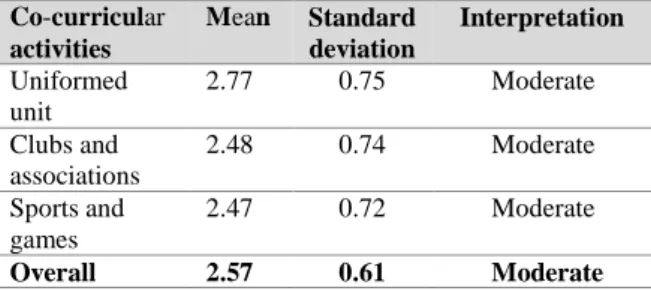
To calculate mean scores, sum the values and then divide by the number of cases. The results of the descriptive analysis of student involvement in school programs are shown in Table 2.
Table 2.
Student involvement in co-curricular activities
Co-curricular activities Mean Standard deviation Interpretation Uniformed unit 2.77 0.75 Moderate Clubs and associations 2.48 0.74 Moderate Sports and games 2.47 0.72 Moderate Overall 2.57 0.61 Moderate
Table 2 shows that students' involvement in school activities was moderate based on the mean score mean (min = 2.57 and SD = 0.61). The mean scores for student engagement in the Uniformed Unit showed the highest values (mean = 2.77 and SD = 0.75), while the mean scores for Sports and Games showed the lowest values (mean = 2.47 and SD = 0.72).
Table 3.
Detailed analysis of students’ participation in uniformed units, clubs, and sports
Types of Participation Min Standard deviation Min score Interpretation Uniformed Unit Competition 2.69 0.89 Moderate Gathering 2.97 0.91 Moderate Troop 3.16 1.15 Moderate Training 2.26 1.06 Low Average 2.61 0.63 Moderate Clubs Meeting 2.28 0.97 Low
Problem solving 2.54 0.98 Moderate
Management 2.10 0.99 Low Project 2.68 1.05 Moderate Gathering 2.81 0.98 Moderate Average 2.48 0.74 Moderate Sports Attendance 2.11 0.93 Low Tournament 2.51 1.08 Moderate Meeting 2.76 0.910 Moderate Cooperation 2.34 0.977 Moderate Training 2.61 1.10 Moderate Average 2.47 0.72 Moderate
B. Student Leadership Skills
The results from the descriptive analysis of student leadership skills levels are shown in Table 4.
Table 4.
Student leadership skills in co-curricular activities
Leadership skill Min Standard deviation Min score Interpretation Communication skills 2.74 0.68 Simple
Give directions 2.65 0.71 Simple Problem
Solving 2.54 0.74 Simple
Working in a
Group 2.50 0.70 Simple
Overall 2.61 0.63 Simple
Table 4 shows that students' leadership skills are modest based on the mean score mean (min = 2.61 and sp = 0.63). The mean scores for communication skills showed the highest values (mean = 2.74 and sp = 0.68), while the mean scores for group work skills showed the lowest values (mean = 2.50 and sp = 0.70). However, the interpolation of mean scores for both the highest and lowest values is modest.
C. Correlation Analysis
Table 5.
Pearson Correlation (Involvement of students in co-curricular activities and student leadership skills)
Involvement in Curriculum Activities Leadership skill Pearson correlation 0.723 (**) Sig. (2-tailed) 0.000 N 237
** The correlation was significant at 0.01 (2-tailed).
The relationship between involvement in school programs and student leadership skills was identified using the Pearson product-moment correlation coefficient. Results showed that is a significant and positive relationship between the involvement of students and leadership abilities among students (r = 0.732, n = 237, p <0.05) (Table 5).
Overall findings revealed that the
participation of students in school outdoor activities was at a moderate level. This finding is consistent with past study results [32]. These results contradict past study findings of low involvement of students in school activities [45], indicating that participation in classroom activities is not considered important for students, as they have not yet reached a high level of engagement.
Table 6.
Detailed Analysis of Students’ Participation in Uniformed Units, Clubs, and Sports
Skills Min Standard
deviation Min Score Interpretation Communication Skills Listening 2.16 0.92 Low Briefing 2.71 0.88 Moderate Public speaking 3.11 1.11 Moderate Discussion 3.00 0.89 Moderate Delegation 2.74 0.92 Moderate Average 2.74 0.68 Moderate Instructional Skills Knowledge 2.30 0.99 Low Management 2.95 1.03 Moderate Talent 2.65 0.90 Low Diplomacy 2.63 0.93 Moderate Distribution 2.73 0.99 Moderate Average 2.65 0.71 Moderate
Problem Solving Skills
Resolution 2.83 1.06 Moderate Diplomacy 2.58 0.93 Moderate Target 2.33 0.92 Moderate Cooperation 2.30 0.97 Low Diversity 2.66 1.02 Low Average 2.54 0.74 Moderate
Group Management Skills
Group task 2.61 0.91 Moderate Leading 2.86 0.96 Moderate New methods 2.54 0.91 Moderate Management 2.23 0.90 Low Variety 2.26 0.97 Low
Average 2.50 0.70 Moderate
The lack of involvement in school programs is caused by the lack of interest in these activities [2]. The purpose of students' involvement in university co-curricular programs is solely to fulfill their postgraduate requirements [45], rather than due to their interest in the activities. In fact, most students engage in co-curricular activities for socialization. There is a small group of students who are dissatisfied with how the curriculum is organized and implemented ([45], [46]). Therefore, cooperative planning and co-management of more attractive activities are needed, because the choice of co-curricular programs in schools is limited by available teaching resources. This limitation requires students who have no interest in the programs to participate as required, instead of being awarded points for participation. Lack of involvement in sports activities also results from the limitation of facilities and sporting equipment [25].
The mean comparison shows that students are more involved in Uniformed Units than clubs and sports. This is because hands-on activities as well as competitive activities such as parades, marching bands, first aid, and participating in
competitions are preferred. Results from this study are consistent with [32], where they found not many students involved in the Uniformed Unit. Compared to Uniformed Units and clubs, involvement in sports showed the lowest mean scores. This indicates that students are less interested in physical activities. This situation is rather concerning because sports provide an opportunity for the individual to relax, and have a healthy lifestyle [47]. Sporting activities are a medium of socialization [48] and have a positive impact on students' social relations [29] and motor skills [49]. Ruvalcaba et al. [50] found that engaging in sports enhances individual resilience through social support and engaging in the activity. Students' involvement in sports activities also develops leadership qualities [30].
In this study, it was found that student leadership skills, which include communication, giving directions, problem-solving, and working in groups, are at a moderate level. The highest mean scores are in communication skills, followed by giving directions, problem-solving ability, and working in groups. Leadership skills are often associated with students' ability to communicate effectively [51]. Through the ability to communicate, students will be better able to give directions, lead groups, and evenly distribute assignments to members. According to [41], there is a link between involvement in school activities and students' ability to solve problems.
Co-curricular activities coupled with
academic activities have the potential to bridge the gap between students through collaboration with members [52]. The findings of this study are in line with [51] study that student participation in planned classroom activities has led to an increase in their leadership skills.
Findings from this survey indicated that was a
strong relationship between co-curricular
activities and leadership skills. This is similar to [14] and [17] that students' active involvement in co-curricular programs can shape their leadership skills. The study conducted by Ting et al. [33] shows that co-curricular programs are one of the aspects that motivate students to attend school.
The development of student leadership
characteristics is nurtured through their
involvement in organized activities such as co-curricular activities [53]. Students' experience in leadership and teamwork also drives the development of individual leadership qualities.
The findings have provided insights into planning and better management. Studies on the active involvement of students in co-curricular activities and the development of leadership
skills through this engagement are necessary to determine the level of student engagement and the outcome of leadership skills applied, shaped, and developed in students. Findings from this study will benefit a wide range of students,
including students, advisors, school
administrators, and ministries. Findings from this research can be referred to when the planning and implementation of strategies for co-curricular activities and leadership skills are implemented.
This study implies that students seemed to do not attract to get involved in co-curricular programs in schools. They may be involved as their involvement is mandatory. Findings from this study also show that the level of student involvement in the curriculum programs is moderate. Students need to be exposed to the importance of active involvement in co-curricular activities in developing their leadership skills that will be utilized in the workplace as they grow older. Therefore, one of the challenges for the school is to create an environment where students can develop their skills.
This study suggests that the teacher should plan activities by taking into account the interest of students. The advisor teachers will act as facilitators while the tasks and responsibilities should be delegated to the student leaders gradually. Findings from this study show that boys are more active in co-curricular activities in sports and games than girls. Therefore, the organization of sports and games and other co-curricular activities should take into account the appropriateness of the activity without gender discrimination. Thus, all students will have the opportunity to actively participate.
Systematic professional training is required for teachers who have a lack of experience in managing school activities. The selection of advisory teachers for co-curricular activities should also take into account their experience, ability, and expertise in the field of work to be performed – not merely filling the vacancy in a way that could endanger students. It is important to have a thorough screening process to appoint credible teachers.
This study has several limitations. Among them, there is the possibility that students will answer the questions in a stressed or inattentive manner without understanding the questions asked. Also, students will also copy their friends' answers to specific questions, which makes them unreliable. Due to limited time, access, and financial factors, this study was also limited to the Lundu District using only questionnaire instruments.
Therefore, for the next study, it is proposed that a larger number of samples could be used and secondary schools in other districts in the state of Sarawak could be involved. Thus, the information obtained from the findings can be generalized to the entire population. Also, the study sample consisted of Form Four students, regardless of whether they were student leaders in the co-curricular activities. Therefore, in the proposal for further study, the researcher can compare whether there is a difference in the leadership skills of the student leaders and non-leader students in the activities involved.
Furthermore, the data collection procedure can also be varied and not limited to the questionnaire instrument, as it was in this study. Methods of data triangulation through interviews and observations are also recommended for further study to obtain detailed results regarding student involvement in co-curricular programs and their leadership skills.
C
ONCLUSIONEducation is a process that involves the acquisition of knowledge from various sources.
The learning process also involves the
communication and instructional processes
between students in the school environment. Leadership skills are different from those of academic knowledge, which pertain to the classroom and are assessed through assessment and examination. Leadership skills are acquired through engagement and interaction in activities that require students to lead their peers. Through involvement in various activities, students gradually develop into leaders by learning to
adhere to rules, to practice effective
communication, to find the courage to make decisions, and to inculcate positive values in themselves. Leadership skills should be instilled in students during their schooling so that they do not have to worry about leading a larger organization in the future.
A
CKNOWLEDGMENTAppreciation to the funders: the National Defence University of Malaysia and The National University of Malaysia (GG-2019-024).