
Title
Biochemical analysis and molecular breeding of oleaginous
microorganisms for ω3 polyunsaturated fatty acid production(
Dissertation_全文 )
Author(s)
Okuda, Tomoyo
Citation
Kyoto University (京都大学)
Issue Date
2014-03-24
URL
http://dx.doi.org/10.14989/doctor.k18343
Right
許諾条件により本文は2015-03-23に公開
Type
Thesis or Dissertation
Textversion
ETD
Biochemical analysis and molecular breeding
of oleaginous microorganisms
for ω3 polyunsaturated fatty acid production
Tomoyo Okuda
CONTENTS
ABBREVIATIONS ...2
INTRODUCTION ...3
CHAPTER I Selection and characterization of promoters based on genomic approach for the molecular breeding of oleaginous fungus Mortierella alpina 1S-4 ...5
CHAPTER II Characterization of galactose-dependent promoters from an oleaginous fungus Mortierella alpina 1S-4 ...21
CHAPTER III Omega-3 eicosatetraenoic acid (ETA) production by molecular breeding of the mutant strain S14 derived from Mortierella alpina 1S-4 ...31
CHAPTER IV Eicosapentaenoic acid (EPA) production by an oleaginous fungus Mortierella alpina expressing heterologous Δ17-desaturase gene under normal temperature ...41
CHAPTER V Isolation and characterization of a docosahexaenoic acid (DHA)-phospholipids producing microorganism Crypthecodinium sp. D31 ...52
CONCLUSIONS ...64
REFERENCES ...67
ACKNOWLEDGMENTS ...77
ABBREVIATIONS - 2 -
ABBREVIATIONS
16:0 Palmitic acid 16:1 Palmitoleic acid 18:0 Stearic acid 18:1 Oleic acid 18:2 Linoleic acidALA α-Linolenic acid
ARA Arachidonic acid
DGLA Dihomo-γ-linolenic acid
DHA ω3 Docosahexaenoic acid
DPA ω3 Docosapentaenoic acid
DTA ω6 Docosatetraenoic acid
EPA ω3 Eicosapentaenoic acid
ETA ω3 Eicosatetraenoic acid
GLA γ-Linolenic acid
LA Linoleic acid
OA Oleic acid
SDA Stearidonic acid
5-FOA 5-Fluoroorotic acid
bp Base pair(s)
cDNA Complementary DNA
DNA Deoxyribonucleic acid
EST Expression sequence tag
GLC Gas-liquid chromatography
GUS β-Glucuronidase
kb Kilobase(s)
LB medium Luria-Bertani medium
mRNA Messenger RNA
ORF Open reading frame
PCR Polymerase chain reaction
PUFA Polyunsaturated fatty acid
rDNA Ribosomal DNA
rRNA Ribosomal RNA
RNA Ribonucleic acid
SdhB Succinate dehydrogenase subunit B
INTRODUCTION
- 3 -
INTRODUCTION
Omega-3 polyunsaturated fatty acid (ω3-PUFA) is a general term for polyunsaturated fatty acids with a double bond (C=C) at the third-carbon bond from the methyl end of the carbon chain. Eicosapentaenoic acid (EPA, C20:5ω3), docosahexaenoic acid (DHA, C20:6ω3) and α-linolenic acid (ALA, C18:3ω3) are known as major ω3-PUFAs which abuntandly exists in nature. Stearidonic acid (SDA, C18:4ω3) and docosapentaenoic acid (DPA, C22:5ω3) can be found in oils accumulated in some kinds of plants and marine life. Eicosatetraenoic acid (ETA C20:4ω3) is hardly obtained from natural sources.
Omega-3 PUFAs such as EPA and DHA are known to be important structural components of membrane phospholipids, as well as precursors of signaling molecule eicosanoids [1]. Omega-3 PUFAs have attracted much attention for their beneficial effects on human health in reducing cardiac diseases such as arrhythmia, stroke and high blood pressure [2-4]. In addition, some reports suggest that ω3-PUFAs could prevent rheumatoid arthritis and asthma [5-7]. An ω3-PUFA derivative has also been identified as an important anti-inflammatory lipid mediator and possible anti-influenza agent [8, 9]. Therefore, the demand for ω3-PUFAs is rapidly increasing in the pharmaceutical, medical and nutritional fields.
Currently, ω3-PUFAs for human consumption are typically derived from a natural source, such as fish oils, sea animal oils and plant oils. However, these sources have some disadvantages, including unstable and limited supply, lower ω3-PUFA content, and undesirable contaminations. Recent investigations have focused on ω3-PUFA production by altenative source such as oleaginous bacteria, fungi, plants and microalgae [10, 11]. In particular, oleaginous microorganisms are more suitable as an alternative source for ω3-PUFA production than conventional sources, because these microorganisms can be cultivated easily and rapidly on a large scale and produce considerable amounts of high-quality ω3-PUFAs.
Thus, the author focused on oleaginous microorganisms as ω3-PUFA producers and carried out their biochemical analysis and molecular breeding for the production of ω3-PUFAs.
Chapter I describes the selection and characterization of promoters based on genomic approach for the molecular breeding of oleaginous fungus Mortierella alpina 1S-4. Chapter II describes the characterization of galactose-dependent promoters from M. alpina 1S-4. Chapter III describes ω3-eicosatetraenoic acid (ETA) production by molecular breeding of the mutant
INTRODUCTION
- 4 -
strain S14 derived from M. alpina 1S-4. Chapter IV describes EPA production by molecular breeding of the mutant strain ST1358 derived from M. alpina 1S-4. Chapter V describes the screening, isolation and characterization of docosahexaenoic acid (DHA)-producing microorganisms.
CHAPTER I
- 5 -
CHAPTER I
Selection and characterization of promoters based on
genomic approach for the molecular breeding of oleaginous fungus
Mortierella alpina 1S-4
As mentioned in general introduction to this thesis, lipid fermentation by microorganisms is noticed as an alternative method supplying PUFA more stably than conventional production [12], therefore the development of gene manipulation tools for lipid-producing microorganisms is important. Various lipids have been produced by means of molecular breeding of microorganisms in some studies [13-16]. Mortierella alpina 1S-4, an oleaginous fungus, is a lipid-producing microbe [17]. To date, the production of various kinds of PUFAs has been achieved by molecular breeding of M. alpina [14, 18-20]. Basic molecular breeding tools such as gene delivery systems, host-vector systems and transformation systems using auxotrophy or antibiotic resistance have been established in M. alpina 1S-4 [21-23]. However, the gene modifiability of M. alpina is still limited due to lack of identification of variations in promoters [24]. The properties of promoters strongly influence the expression level and duration of target genes [25-27]. The application of highly expressing and/or regulated promoters is one of most important factors in a valuable expression system [28-35]. In M. alpina, enrichment of promoter types would contribute to improving PUFA productivity and modifying PUFA composition, and may help elucidate the mechanisms regulating gene expression in this strain.
In general, promoter discovery in fungal biotechnology has been mainly based on the information of highly- or constitutively-expressed proteins [36, 37]. Recently, expression sequence tag (EST) analysis has been used as a powerful tool for investigating expressed genes. EST abundance data can present directly gene transcriptional levels, and make possible widespread approaches to find desired promoters in combination with the genomic information [38, 39].
In this chapter, the author describe selection and cloning of promoter regions of various genes of M. alpina 1S-4 on the basis of EST abundance data, and characterized these promoter regions by fusing β-glucuronidase (GUS) reporter assays.
CHAPTER I
- 6 -
MATERIALS AND METHODS
Strains, media, and growth conditions
A uracil auxotroph (ura5‒ strain), previously isolated from M. alpina 1S-4 deposited at the Graduate School of Agriculture of Kyoto University [40], was used as a recipient host strain for transformation. Czapek-Dox agar medium, supplemented with 0.05 mg/ml uracil, was used for sporulation of the ura5‒strain, as described previously [40]. SC agar medium [40] was used as a uracil-free synthetic medium for cultivation of the transformants derived from M. alpina 1S-4
ura5‒ strain at 28°C. GY medium (2% [wt/vol] glucose and 1% yeast extract) was used for reporter assays and extracting genomic DNA. GS medium (5% [wt/wt] soy flour, 0.3% K2HPO4, 0.05% MgCl2·6H2O and 0.05% CaCl2·2H2O) was used for large-scale cultivation. Liquid cultivations were performed at 28°C with shaking (300 rpm), except for large-scale cultivation when a jar-fermentor was used.
Escherichia coli strain DH5α was used for DNA manipulation and grown on LB agar
plates containing 50 μg/ml kanamycin.
Agrobacterium tumefaciens C58C1 was used for the transformation of M. alpina 1S-4 ura5‒ strain. LB-Mg agar medium, minimal medium (MM) and induction medium (IM) were used for the transformation, cultivation and infection of A. tumefaciens, respectively. The compositions of LB-Mg agar medium, MM, and IM have been described previously [40].
Genomic DNA preparation
M. alpina 1S-4 was cultivated in 10 ml of GY medium at 28°C for 4 d with shaking (300
rpm). Fungal mycelia were harvested by suction filtration and washed twice with sterile water. Preparation of genomic DNA was performed using a method described previously [41].
Construction of cDNA libraries of M. alpina 1S-4 and EST analysis
For large-scale cultivation, an inoculum was prepared in a 50-L jar fermentor containing 30 L of GY medium supplemented with 0.1% soybean oil, followed by cultivation for 2 d at 28°C. The main cultivation was carried out in a 10-kL fermentor (Kansai Chemical Engineering Co., Hyogo, Japan) with 4 kL of GS medium at 26°C with stirring. At 18, 42, 66, 90 and 114 h after starting cultivation, 5.33% or 4% glucose was added. For extracting the total RNA of M. alpina,
CHAPTER I
- 7 -
fungal mycelia were sampled after 17, 25, 42, 114, 209 and 281 h of cultivation. Total RNA was extracted from each sample by using RNeasy Mini Kit (QIAGEN).
First strand cDNA was synthesized by using SOLiDTM Total RNA-Seq for Whole Transcriptome Libraries (Applied Biosystems, Inc., California, USA). For EST and transcriptome analysis, a research contract service (Genaris, Inc., Kanagawa, Japan) was used.
Cloning of M. alpina promoters
Information regarding selected promoters analyzed in this chapter is shown in Table 1. Selected promoter regions were cloned from the genome of M. alpina 1S-4 by PCR performed using specific primers (Table 1-1) designed on the basis of the information available in the genomic database for this strain. For deletion constructs, the anti-sense primers used for PCR are shown in Table 1-1 and forward primers are shown in Table 1-2. XbaI and SpeI restriction enzyme sites were created at the 5′ end of each forward primer and at the 3′ end of each reverse primer, respectively. When an XbaI site was present in the promoter region, an SpeI site was created instead of the XbaI site at the 5′ end of the forward primer. When an SpeI site was present in the promoter region, an XbaI site was created instead of the SpeI site at the 3′ end of the reverse primer.
Construction of GUS reporter gene-carrying vectors for promoter analysis
The reporter gene vectors were constructed on the backbone of pBIG3ura5s [42]. The histone promoter (the histone H4.1 promoter short fragment [42]), succinate dehydrogenase subunit B (SdhB) terminator [22] and the ura5 marker gene [21] were amplified from the genomic DNA of M. alpina 1S-4. The ura5 expression cassette controlled by a histone promoter and SdhB terminator was generated by fusion PCR with additional EcoRI and XbaI restriction enzyme sites at the 5′ and 3′ ends, respectively, of this cassette. The ura5 expression cassette, digested with EcoRI and XbaI, was ligated to pBIG3ura5s [42] digested with the same restriction enzymes and designated as pBIG35Zh.
The β-Glucuronidase (GUS) gene was synthesized with optimized codon usage to reflect the codon bias of M. alpina 1S-4 obtained from the Kazusa database (http://www.kazusa.or.jp/ codon/), with additional SpeI and BamHI restriction enzyme sites at the 5′ and 3′ flanking ORFs, respectively. The GUS expression cassette, controlled by a histone promoter and SdhB
CHAPTER I
- 8 -
terminator, was generated by fusion PCR with additional XbaI and NheI restriction sites at the 5′ and 3′ ends of the cassette, respectively. This GUS expression cassette was digested with XbaI and NheI and ligated to pBIG35Zh digested with same restriction enzymes and designated pBIG35ZhGUSm (Fig. 1-1). In this vector, the histone promoter region, located upstream of the
GUS gene, can be removed by digestion with XbaI and SpeI, and replaced by another promoter
fragment digested with XbaI and/or SpeI for promoter assays.
Transformation of M. alpina 1S-4 ura5‒ strain
A spore suspension of M. alpina 1S-4 ura5‒ strain was freshly prepared by harvesting from cultures grown on Czapek-Dox agar medium supplemented with 0.05 mg/ml uracil and then filtering the suspension through Miracloth (Calbiochem) [40].
Transformation of M. alpina 1S-4 ura5‒ strain was performed using the Agrobacterium
tumefaciens-mediated transformation (ATMT) method described previously [42] with slight
modification. Briefly, Agrobacterium tumefaciens C58C1 was transformed with each vector via electroporation as described previously [43] and its transformants were isolated on LB-Mg agar plates supplemented with kanamycin (20 μg/ml), ampicillin (50 μg/ml) and rifampicin (50 μg/ml). Agrobacterium tumefaciens transformants were cultivated in 100 ml of MM supplemented with kanamycin (20 μg/ml) and ampicillin (50 μg/ml) at 28°C for 48 h with shaking (120 rpm). Bacterial cells were harvested by centrifugation at 8,000 × g, washed once
Fig. 1-1. Vector construct used in M. alpina 1S-4
promoter assays.
GUSm, codon-optimized β-glucuronidase gene for M. alpina; his p, M. alpina histone H4.1 promoter short
fragment; SdhB t, M. alpina SdhB transcription terminator; ura5, orotate phosphoribosyl transferase gene of M. alpina 1S-4; NPTIII, neomycin phosphotransferase III gene; TrfA, TrfA locus, which produces 2 proteins that promote replication of the plasmid; ColEI ori, ColEI origin of replication; oriV, pRK2 origin of replication; RB, right border; LB, left border. pBIG35ZhGUSm 12.5 kb SpeI XbaI oriV NPTIII TrfA LB his p ura5 SdhBt hisp GUSm SdhBt RB CoEl ori
CHAPTER I
- 9 -
with fresh IM, and then diluted to an optical density of 660 nm (OD660) of 0.1–0.2 in 10 ml of fresh IM. After pre-incubation for 12–16 h at 28°C with shaking (300 rpm) to an OD660 of 1.5–2.0, 100 μl of the bacterial cell suspension was mixed with an equal volume of a spore suspension (108 spores/ml) of M. alpina 1S-4 ura5- strain, and then spread on membranes (Whatman #50 Hardened Circles, 70 mm, Whatman International Ltd. UK) kept on cocultivation media (IM with 1.5% agar) and incubated at 23°C for 5 d. After cocultivation, the membranes were transferred to uracil-free SC agar plates that contained 0.03% Nile blue A (Sigma-Aldrich Japan) to distinguish between fungal colonies and the white color of the membrane. After 2 d of incubation at 28°C, hyphae from visible fungal colonies were transferred to fresh uracil-free SC agar plates, this was repeated 3 times to obtain candidates. Integration of the vector into the chromosome of the host strain was verified by PCR, as described previously [40].
GUS assay
Cell-free extracts of M. alpina were prepared by a slight modification of a method described previously [21]. All transformants and the wild-type strain of M. alpina 1S-4 were cultivated in 10 ml of GY medium for 2–14 d at 28°C with shaking (300 rpm), harvested by suction filtration, and washed twice with sterile water. Fungal mycelia were suspended in 2 volumes of 100 mM Tris-HCl containing 5 mM 2-mercaptoethanol (pH 7.5) and then disrupted by using a bead shocker (Wakenyaku Co. Ltd., Kyoto, Japan) at 5,000 rpm for 30 s twice with glass beads (φ 1.0 mm, Waken B Tech Co. Ltd., Kyoto, Japan). The extract was centrifuged at 15,000 × g for 10 min to remove cell debris and intact cells. The supernatant was used for the GUS assay as cell-free extract. All steps were performed at 4 °C.
β-Glucuronidase (GUS) assays were performed as described previously [44]. Enzyme
activity was calculated in terms of nanomoles of p-nitrophenol production per milligram of protein per minute at 37°C. Protein concentration was measured according to the Bradford method, using bovine serum albumin as a standard [45].
CHAPTER I
- 10 -
Promoter Primer F sequence (5′- 3′) Primer R sequence (5′- 3′)
PP1 p AATCTCTAGAaGCGCAGTCGGAATGCC AGTAACTAGTCGTGTTTTCTTTTGAAATGGG
PP2 p AAGCTCTAGAGACTGTAAAGACGGAGGGG AGTAACTAGTTGTGGATAGTGGGTAGTGG
PP3 p AACGTCTAGACGTGTTATCTTGCGCTGC TCATACTAGTGATGATTTAGAGGTGTTGG
SSA2 p TTAGTCTAGAAAAGTGCTGCTTCGGAACC AGATACTAGTGATGTAGATGTGAGTGTGAG
PP7 p AATATCTAGATGACCGTGCGCTTTTTGAGAC AGCAACTAGTCGTATATTTGTTGAAAGGTG
SSA22 p AATATCTAGAGGGTGCAGGTCCGGTCC AGCCACTAGTTCTACTCACCTTTTCCCTCAG
PP4 p TGAGTCTAGAAGAGTGATTTTGTGGCTGTAC CAATACTAGTGGCTGATGTATGTGTTGATG
PP8 p ATGCTCTAGATATGGCGACCCATTCACG AAGAACTAGTGGTTGAACAGAGTATGTTTGC
SAH1 p AATCTCTAGACTGGCGAATACATGCGCAC ATAGTCTAGAGGTGGATATGAAGGGTGG
PET9 p ACCTTCTAGAAGACGAGAAGAGTTCATGATG AATAACTAGTGATGAGTGTATGTGGAGAGTG
HSP104 p AATATCTAGAGTTGAAGGTGCAGACACCGG AATAACTAGTGGTGGGGCGTTATGTGG
HSC82 p ATCATCTAGAGAGCTCAAGATGAAGGTGCTC AATAACTAGTGGTGTGTGTGGTTTGCGGG
UBC5 p AACTACTAGTGTATACAGGTCTTAGAGACC ATTCACTAGTCGTGGGTGGAGAGAGTG
CDA1 p AACTCTAGATGAAAATAGAAATGGGTGGATGG ATTGACTAGTCGTAGGTTTCTTTGTGTGTG
RPP0 p AATGTCTAGACACAGTGACAAGGGTGTTAAC ATGCACTAGTGTTGATTATTGTTCGAGGG
PP5 p AACGTCTAGATGTTTTTTGTGCAAATTACCTCG AAGCACTAGTTTTGGATTGGGATTGCTTGAG
PP6 p AAAGTCTAGACTGGCAATAGTTAGTGCACG ATCAACTAGTGATGGAGGTTTGTTTGAGAAG
RPS16B p AATGTCTAGACCTGCAGAAAGATGATCCAAAAG AAGCACTAGTGATGAATAATGCCTATGATCAG
EFB1 p TTAGACTAGTCGTAGTTGACTCTTTTATG CAGTACTAGTGGTGGGTGCTTTGTCGATTTG
TDH1 p AACCTCTAGAAGGAAATAAATTCTCCTCGGTG AATAACTAGTGTTGAGTGGGTGTGTGTGG
CIT1 p ATTTTCTAGACACCTCAAAAACGTGCCTTG AATAACTAGTGGCGGATATGTGTATGGAG
TIF2 p AAGTTCTAGAGTCGACCTATCATCATTTTTGGC AGCGACTAGTGTTTTTTTTTGCTTTTTTTTTTATG
CAT2 p AATCACTAGTAAACGGTGGAGCATTCTCAC TATCACTAGTGAAGGCGATGGGCAGGG
ELO1 p AATGTCTAGACTTGCCCAGCATTACTCC TCATACTAGTCTTTGAGGGGAGGAATTGC
IPP1 p ACAATCTAGAGGCTGCGTTGCCGGGAG ATAGACTAGTGGTGGTGGTGAAGAGTAG
OLE1 p AGCATCTAGAGGGTTCTCACATTGAATTTG AATAACTAGTCGCTGTGCGTCCTGCGTTG
PGK1 p TGAATCTAGACACCGTCGCTATGTGAAG TTGCTCTAGAGCAGAAACACACTGGCAG
a The underlined sequences show synthesized XbaI (TCTAGA) and SpeI (ACTAGT) sites.
CHAPTER I
- 11 -
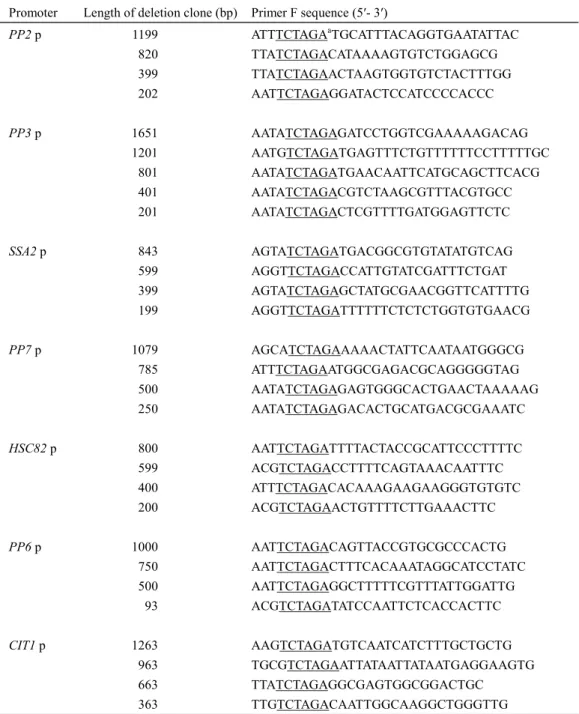
Promoter Length of deletion clone (bp) Primer F sequence (5′- 3′)
PP2 p 1199 ATTTCTAGAaTGCATTTACAGGTGAATATTAC 820 TTATCTAGACATAAAAGTGTCTGGAGCG 399 TTATCTAGAACTAAGTGGTGTCTACTTTGG 202 AATTCTAGAGGATACTCCATCCCCACCC PP3 p 1651 AATATCTAGAGATCCTGGTCGAAAAAGACAG 1201 AATGTCTAGATGAGTTTCTGTTTTTTCCTTTTTGC 801 AATATCTAGATGAACAATTCATGCAGCTTCACG 401 AATATCTAGACGTCTAAGCGTTTACGTGCC 201 AATATCTAGACTCGTTTTGATGGAGTTCTC SSA2 p 843 AGTATCTAGATGACGGCGTGTATATGTCAG 599 AGGTTCTAGACCATTGTATCGATTTCTGAT 399 AGTATCTAGAGCTATGCGAACGGTTCATTTTG 199 AGGTTCTAGATTTTTTCTCTCTGGTGTGAACG PP7 p 1079 AGCATCTAGAAAAACTATTCAATAATGGGCG 785 ATTTCTAGAATGGCGAGACGCAGGGGGTAG 500 AATATCTAGAGAGTGGGCACTGAACTAAAAAG 250 AATATCTAGAGACACTGCATGACGCGAAATC HSC82 p 800 AATTCTAGATTTTACTACCGCATTCCCTTTTC 599 ACGTCTAGACCTTTTCAGTAAACAATTTC 400 ATTTCTAGACACAAAGAAGAAGGGTGTGTC 200 ACGTCTAGAACTGTTTTCTTGAAACTTC PP6 p 1000 AATTCTAGACAGTTACCGTGCGCCCACTG 750 AATTCTAGACTTTCACAAATAGGCATCCTATC 500 AATTCTAGAGGCTTTTTCGTTTATTGGATTG 93 ACGTCTAGATATCCAATTCTCACCACTTC CIT1 p 1263 AAGTCTAGATGTCAATCATCTTTGCTGCTG 963 TGCGTCTAGAATTATAATTATAATGAGGAAGTG 663 TTATCTAGAGGCGAGTGGCGGACTGC 363 TTGTCTAGACAATTGGCAAGGCTGGGTTG
a The underlined sequences show synthesized XbaI (TCTAGA) site.
CHAPTER I
- 12 -
RESULTS
Selection, cloning and evaluation of various promoters of M. alpina 1S-4
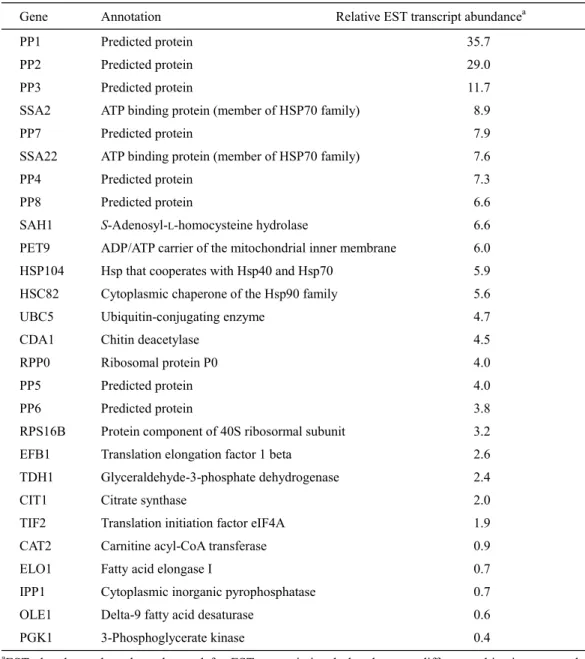
The cDNA libraries were prepared by using RNA extracted from the mycelia of M. alpina 1S-4 on during different cultivation stages (see Materials & Methods). EST analysis were performed for each cDNA sample, and the abundances of each EST clone during all cultivation stages were summed (data not shown). These totals were sorted in descending order. On the basis of these EST abundance data and previous reports regarding conventional promoters of other organisms [27, 46-48], putative promoter regions of 28 genes of M. alpina 1S-4 were selected as candidates of highly-expressing and/or temporally-regulated promoters (Table 1-3). Considering of the positions of putative transcriptional factor-binding sites in each selected promoter region, approximately 1000–2500 bp of the 5′ flanking region of individual ORFs were cloned as putative promoter regions from the genomic DNA of M. alpina 1S-4. To evaluate the activity of these putative promoters in M. alpina, pBIG35ZhGUSm plasmids carrying each putative promoter region, instead of the histone promoter, located upstream of the
β-glucuronidase (GUS) gene were constructed (Fig. 1-1) and transformed into M. alpina 1S-4
using the ATMT method. For each construct, 30 transformants were randomly selected and cultivated for 5 d in GY liquid medium, and then their GUS activities were measured. Due to the variety in GUS activity in individual M. alpina transformant lines with each promoter construct (a representative pattern is shown in Fig. 1-2), the average value of GUS activities in the 10 moderately expressing lines was used for comparison with different promoter activities (Fig. 1-3). As shown in Fig. 1-3, PP1, PP3, SSA2, PP7, HSC82, PP6, TDH1 and CIT1 promoters led to increased GUS activity compared with a conventional histone promoter. In particular, PP3 and PP6 promoters showed approximately 5-fold higher activity than the histone promoter.
The author also carried out the same experiments with GS medium, which was used for large-scale cultivation (see Materials and Methods). There were no apparent differences in the GUS activity levels between GY and GS media (data not shown). Therefore, GY medium was used to cultivate transformants in all subsequent GUS assays.
CHAPTER I
- 13 -
Gene Annotation Relative EST transcript abundancea
PP1 Predicted protein 35.7
PP2 Predicted protein 29.0
PP3 Predicted protein 11.7
SSA2 ATP binding protein (member of HSP70 family) 8.9
PP7 Predicted protein 7.9
SSA22 ATP binding protein (member of HSP70 family) 7.6
PP4 Predicted protein 7.3
PP8 Predicted protein 6.6
SAH1 S-Adenosyl-L-homocysteine hydrolase 6.6 PET9 ADP/ATP carrier of the mitochondrial inner membrane 6.0 HSP104 Hsp that cooperates with Hsp40 and Hsp70 5.9 HSC82 Cytoplasmic chaperone of the Hsp90 family 5.6 UBC5 Ubiquitin-conjugating enzyme 4.7
CDA1 Chitin deacetylase 4.5
RPP0 Ribosomal protein P0 4.0
PP5 Predicted protein 4.0
PP6 Predicted protein 3.8
RPS16B Protein component of 40S ribosormal subunit 3.2 EFB1 Translation elongation factor 1 beta 2.6 TDH1 Glyceraldehyde-3-phosphate dehydrogenase 2.4
CIT1 Citrate synthase 2.0
TIF2 Translation initiation factor eIF4A 1.9 CAT2 Carnitine acyl-CoA transferase 0.9
ELO1 Fatty acid elongase I 0.7
IPP1 Cytoplasmic inorganic pyrophosphatase 0.7 OLE1 Delta-9 fatty acid desaturase 0.6
PGK1 3-Phosphoglycerate kinase 0.4
aEST abundance data show the total for EST transcriptional abundance at different cultivation stages, by using relative values for histone H4.1.
CHAPTER I
- 14 -
Fig. 1-2. Distribution of GUS activity levels driven by the HSC82 promoter in M. alpina transformants
cultivated for 5 d in GY liquid medium.
Each plot denotes individual transformants, and all plots are sorted in ascending order of GUS activity. GUS activity is expressed in nanomoles of p-nitrophenol produced per minute per milligram of protein.
Fig. 1-3. GUS activity driven by various promoters in M. alpina transformants cultivated for 5 d in GY liquid
medium.
GUS activity is expressed in nanomoles of p-nitrophenol produced per minute per milligram of protein. The Bars represent the mean values with standard deviations of GUS activity in 10 individual transformant lines for each promoter construct. 0 5 10 15 20 25 30 Transformant line 0 5000 10000 15000 G U S ac tiv ity [n m ol /(m g· m in )] 0 2000 4000 6000 8000 10000 12000 14000 16000 18000 20000 22000 24000 G U S ac tiv ity [n m ol /(m g· m in )]
CHAPTER I
- 15 -
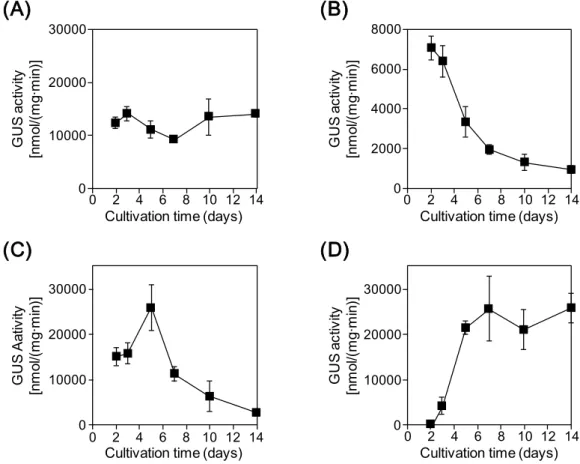
Time course measurements of promoter activity during cultivation of M. alpina 1S-4 Transformants with each promoter construct were cultivated in GY medium for 2–14 d and then GUS activity was evaluated in order to investigate the effect of cultivation time on GUS activity with different promoters (Fig. 1-4). Based on the pattern of time-dependent changes in GUS activity, promoters could be categorized into the following 4 groups; GUS activity levels controlled by the HSC82, PP7, SSA2, HSP104, UBC5 or PET9 promoter were almost constant throughout the cultivation period (Fig. 1-4A). With the CIT1, PP8, SAH1, EFB1, OLE1, HSC82,
CDA1, RPP0, RPS16B or CAT2 promoter, GUS activity levels were higher in the early stage of
cultivation and then decreased (Fig. 1-4B). GUS activity controlled by the PP6, ELO1 or TDH1 promoter peaked at the middle stage of cultivation (Fig. 1-4C). With the PP3, PP2, PP4, PP5,
SSA22, IPP1 or PGK1 promoter, GUS activity levels were low in the early stage, and then
increased with cultivation time (Fig. 1-4D).
Fig. 1-4. Representative patterns of time-depend changes in GUS activity with different promoters. Results
with (A) HSC82, (B) CIT1, (C) PP6 and (D) PP3 promoters are shown as representative.
All transformants for each promoter construct were cultivated in GY medium for 2–14 d. GUS activity is expressed in nanomoles of p-nitrophenol produced per minute per milligram of protein. Plots represent the mean values with standard deviations of GUS activity in 3 individual transformant lines for each construct. 0 2 4 6 8 10 12 14
Cultivation time (days)
G U S ac tiv ity [n m ol /(m g· m in )] 2000 4000 6000 8000 0
Cultivation time (days)
(B)
(A)
G U S ac tiv ity [n m ol /(m g· m in )] 10000 20000 30000 0 0 2 4 6 8 10 12 14Cultivation time (days)
G U S ac tiv ity [n m ol /(m g· m in )]
Cultivation time (days)
(D)
(C)
G U S A at iv ity [n m ol /(m g· m in )] 10000 20000 30000 0 0 2 4 6 8 10 12 14 10000 20000 30000 0 0 2 4 6 8 10 12 14CHAPTER I
- 16 -
PP2, PP3, PP6, PP7, SSA2, HSC82 and CIT1 promoters with constitutive or
time-dependent high-level activity were selected and used for subsequent studies.
Deletion analysis
In order to investigate the length of the promoter regions required to maintain high expression activity, a series of 5′ deletion constructs of the 7 selected promoters were generated (Fig. 1-5, left column) and introduced into M. alpina 1S-4. For each deletion construct, 30 randomly selected transformants were cultivated in GY medium for the appropriate number of days based on the above results, and then GUS activity was evaluated. For comparison, the GUS activity levels of 10 moderately expressing lines were averaged and represented as a value relative to each full-length promoter, which was set as 100% (Fig. 1-5, right column). In the
PP2, PP3 and PP6 promoters, relatively long lengths of the promoter regions (over 1,000 bp)
were required for high GUS expression, and the GUS activity levels dramatically diminished with deletion of the 5′ regions. In contrast, the other promoters maintained high activity even in relatively short regions (approximately 400–800 bp).
CHAPTER I
- 17 - Fig. 1-5. 5′-deletion analysis of 7 different promoters.
In the left column, constructs with different 5′ upstream deletions of individual promoters are shown. For each construct, the length of the fragment upstream from the transcription start site is shown on the left end. In the right column, GUS activity levels with the deleted constructs in M. alpina transformants are shown. All transformants were cultivated in GY liquid medium. Cultivation times were 5 d for the SSA2, HSC82, PP7 and
PP6 promoters, 3 d for the CIT1 promoter, and 14 d for the PP2 and PP3 promoters. The average GUS activity
of each full-length construct is set at 100% and has been used to define the relative GUS activity of individual deletion constructs. Bars represent the mean values with standard deviations of GUS activity in 10 individual transformant lines for each construct.
PP2
p
PP3
p
-2294 -1651 -1201 -801 -401 -201SSA2
p
PP7
p
-1341 -1079 -785 -500 -250PP6
p
-1519 -1000 -750 -500 -93HSC82
p
-1000 -800 -599 -400 -200CIT1
p
-1593 -1263 -963 -663 -363 -1609 -820 -399 -202 -1199 -843 -599 -399 -199 -999 0 50 100 150 200Relative GUS activity (%)
0 50 100 150 200
Relative GUS activity (%)
0 50 100 150 200
Relative GUS activity (%)
0 50 100 150 200
Relative GUS activity (%)
0 50 100 150 200
Relative GUS activity (%)
0 50 100 150 200
Relative GUS activity (%)
0 50 100 150 200
CHAPTER I
- 18 -
DISCUSSION
In general, promoters that are useful for gene manipulation systems exhibit either constitutively high, time-dependent and/or conditionally inducible expression. Thus, screening and investigation of beneficial promoters for M. alpina gene manipulation was performed by using an EST-based approach in this view point. EST abundance data can provide gene expression levels without post-translational influence. Therefore, by using an EST-based approach, the desired promoters can be identified more directly and efficiently than by using conventional approaches based on information on protein expression.
In many cases, EST analysis is employed to obtain transcriptional information at a certain point in the cultivation period. Because the transcriptional level of each gene generally changes depending on the cultivation stage, in this chapter, EST analysis with M. alpina was carried out at different cultivation stages. On the basis of the EST data and previous reports on conventional promoters of other organisms, 28 promoters of M. alpina 1S-4 were selected as candidates for highly expressing and/or regulated promoters (see Table 1-3).
The GUS reporter gene was used to monitor the promoter activity in this chapter because the GUS gene has been commonly used as a reporter gene for promoter assays for various organisms [25, 36]. In addition, the author considered that this study also means investigation of heterologous gene expression in M. alpina, because the GUS gene is a heterologous gene for this strain.
The GUS activity in M. alpina transformant lines with each promoter construct was distributed across a wide range (Fig. 1-2). This dispersion might be attributable to the differing locations of the GUS gene in chromosomal DNA, i.e., the position effect. It has previously been reported that M. alpina transformants generated by the ATMT method have a single copy of T-DNA at a random location in chromosomal DNA [42].
The comprehensive analysis showed that the PP3 and PP6 promoters were demonstrate remarkably higher GUS activity than the conventional histone promoter in M. alpina. The functions of the proteins coded by the PP3 and PP6 genes are unknown. Investigation of the function of these proteins functions might lead to new findings, which may in turn lead to new insights on M. alpina physiology. Interestingly, the GUS expression levels were not necessarily proportional to the EST abundance values (compare Fig. 1-3 with Table 1-3). There were some
CHAPTER I
- 19 -
cases where the GUS expression levels were much lower than expected from the EST abundance data, e.g. the SSA22 and PP8 promoters. In such cases, other factors besides promoters, such as the terminator and post-transcriptional processing might lead to high-transcriptional levels of the original gene, unlike the findings seen for heterologous GUS gene expression.
Time-course measurements of GUS activity levels with various promoters showed several temporally-different patterns of expression (Fig. 1-4). These promoters allow for phase-specific expression in M. alpina, unlike the conventional histone promoter expressing constitutively during cultivation time (data not shown). These time-dependent promoters could contribute to more efficient production of PUFAs in M. alpina by means of temporal coordination of enzyme expression with PUFA biosynthesis.
For the 5′ deletion analysis of promoter regions, 7 promoters were selected because of their characteristic expression patterns, such as high-level expression and/or time-dependent expression. A relatively long length (over 1,000 bp) was required to maintain high activity in the
PP2, PP3 and PP6 promoters. This finding suggests that transcription factor binding sites or
enhancer elements of these promoters are located considerably upstream. In contrast, the SSA2,
PP7, HSC82 and CIT1 promoters retained sufficient activity even in the truncated form
(400–800 bp). These short promoters with high activity will be advantageous in applications involving M. alpina gene manipulation because they will be useful for convenient vector construction.
More detailed deletion analysis and consensus sequence analysis of highly-expressing and/or regulated promoters will help identify functionally essential elements for transcriptional regulation. This in turn could help elucidate the transcriptional regulatory mechanisms of M.
alpina. The information of transcriptional regulatory elements of promoters for high-level
expression and time-dependent expression is also useful for applications. For example, in
Aspergillus oryzae, the introduction of multiple copies of the consensus sequence found in the
high-expression promoters has been reported to improve promoter activity [49].
SUMMARY
CHAPTER I
- 20 -
of EST abundance data. The activity of each promoter was evaluated by using the GUS reporter gene. Eight of these promoters were shown to enhance GUS expression more efficiently than the conventional histone promoter. Especially, the predicted protein 3 (PP3) and the predicted protein 6 (PP6) promoters demonstrated approximately 5-fold higher activity than the histone promoter. The activity of some promoters changed along with the cultivation phase of M. alpina 1S-4. Seven promoters with constitutive or time-dependent, high-level expression activity were selected, and deletion analysis was carried out to determine the promoter regions required to retain activity. The promoters described in this chapter will be useful tools for gene manipulation in this strain.
CHAPTER II
- 21 -
CHAPTER II
Characterization of galactose-dependent promoters from
an oleaginous fungus Mortierella alpina 1S-4
An inducible expression system is an significantly important tool for the control of gene expressions. It is necessary for the expression analysis of given genes, especially lethal and essential genes. Many investigations of inducible expression system have been carried out in various microorganisms [29, 35, 50]. Some of the most widely used regulatory systems are based on promoters that can be activated or repressed by the presence/absence of the inducer such as a carbon source in the medium [29-35, 51, 52]. These inducible expression systems have contributed to the functional analysis of genes of interest as well as for the efficient production of the heterologous proteins in these microorganisms.
As mentioned in chapter I, in Mortierella alpina 1S-4, a few constitutive expression promoters have been identified and applied to the gene expression system at present. The lack of an inducible expression system in M. alpina limits of detailed study of genes of interest, especially essential or lethal genes. To increase knowledge of M. alpina, it is essential to establish an inducible expression system.
In this chapter, the author describe the cloning and initial characterization of endogenous galactose inducible promoters for use in M. alpina 1S-4.
MATERIALS AND METHODS
Strains, media, and growth conditions
The strains and media described in chapter I were used. For galactose induction in the submerged cultivation, 500 mg/ml sterile galactose solution was added to the medium at 2% final concentration. All cultivations were performed as described in chapter I otherwise mentioned.
Genomic DNA preparation
CHAPTER II
- 22 -
Construction of GUS reporter gene-carrying vectors for promoter analysis
For GUS reporter assay, the vector pBIG35ZhGUSm (see chapter I) was used. The GAL1 and GAL10 promoter regions were amplified from the genome of M. alpina 1S-4 by PCR with specific primers (Table 2-1) designed based on the genomic database of this strain. For deletion constructs of the GAL10 promoter, GAL10pR was used as the anti-sense primer, and GAL10p2000F, GAL10p1600F, GAL10p1200F, GAL10p800F and GAL10p400F were used as the sense primers (Table 2-1). All cloned fragments were treated with XbaI and/or SpeI and inserted in front of the GUS ORF from pBIG35ZhGUSm digested with XbaI and SpeI.
Transformation of the M. alpina 1S-4 ura5‒ strain
The transformation of the M. alpina 1S-4 ura5‒ strain was performed by the ATMT method as
described in chapter I.
GUS assay
Preparation of cell-free extracts of M. alpina, GUS assays and measurement of protein concentrations were performed as described in chapter I.
Table 2-1. PCR primers used to clone the GAL1 and GAL10 promoter regions.
Primer name Sequence (5′ to 3′)
GAL1pF AATATCTAGAaACCACGCATGACAATGCCAC GAL1pR AAGAACTAGTTGTAAAAGGGGCTGACAGTG GAL10pF AATATCTAGAGGTTCCGAGAGGTGGATTTG GAL10pR ATAATCTAGATGGCTCCTGAAAGGACGAG GAL10p2000F AATTCTAGACGCAGAGTGATGGTCATTACC GAL10p1600F AATTCTAGACTCTATGGCAAGATTACGAG GAL10p1200F AATTCTAGATGCTCGTGAAGAGGGGCAC GAL10p800F ACGTCTAGACATTTTTTGCCGCCAATTCTG GAL10p400F ATTTCTAGACCCCCGCCTATTTTTTTTTTC a The underlined sequences indicate inserted XbaI (TCTAGA) and SpeI (ACTAGT) sites.
CHAPTER II
- 23 -
RESULTS
Cloning and basic evaluation of two GAL promoters in M. alpina 1S-4
The putative promoter region of the GAL1 andGAL10 genes of M. alpina 1S-4 were cloned as candidates for galactose-dependent promoters based on the M. alpina genome database. The lengths of cloned GAL1 and GAL10 promoter regions were 962 bp and 2331 bp, respectively.
To ascertain if these promoters were regulated by galactose in this strain, plasmids carrying the predicted GAL1 and GAL10 promoters fused to the GUS reporter gene were constructed and transformed into M. alpina 1S-4 by the ATMT method. All transformants had a single copy of T-DNA at a random location in the chromosomal DNA (data not shown). At least 30 independent transformants for each construct were randomly selected, evaluated for GUS activity, and cultivated on SC medium containing 2% galactose substituted for glucose. All transformants exhibited detectable levels of GUS activity (data not shown), and three individual transformants that showed moderate levels of GUS activity were used in subsequent studies.
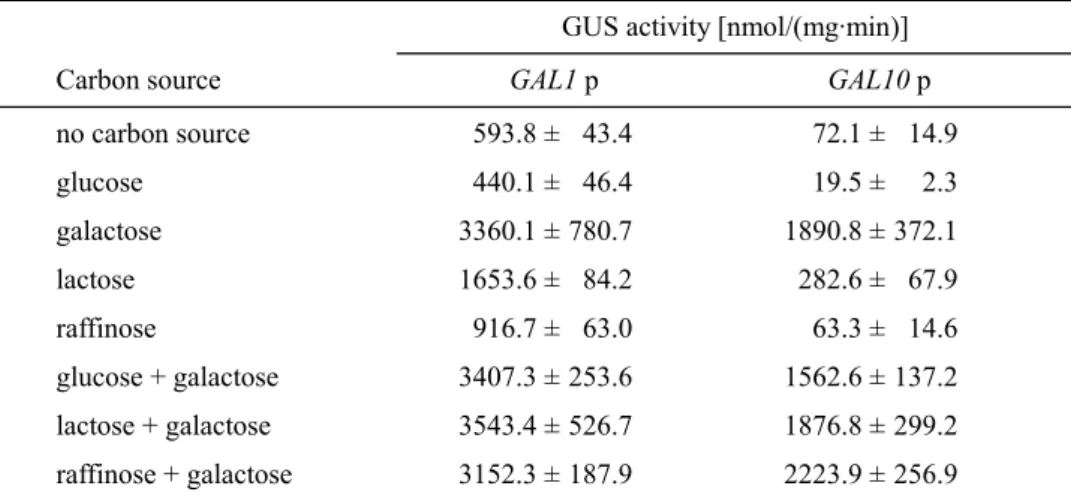
The transformants carrying GAL1 or GAL10 promoter-GUS genes were cultivated on SC agar medium containing 2% of sugars substituted for glucose (Table 2-2). As shown in Table 2-2, the expression of GUS regulated by the GAL promoters was clearly dependent on the presence of galactose in the medium. The GUS activity of fungi with GAL1 or GAL10 promoters grown on galactose medium was approximately 7-fold or 100-fold higher than those grown on glucose medium, respectively. With the GAL1 promoter, GUS expression was induced by galactose, lactose and raffinose; furthermore, the not-negligible level of GUS activity was detected even when grown on the medium without a carbon source. On the other hand, GUS expression with the GAL10 promoter was fairly repressed wh en fungi were grown on media lacking galactose with/without other kinds of sugars.
Because GUS expression with the GAL10 promoter were more sensitively induced/repressed by the presence/absence of galactose, the author focused on the GAL10 promoter for further investigation.
CHAPTER II
- 24 -
Induction-response of the GAL10 promoter by galactose addition
Time course measurements of GAL10 promoter activity after addition of galactose to the medium were carried out. The transformants were cultivated for 4 days in synthetic SC liquid medium containing 2% raffinose substituted for glucose as a sole carbon source, and then galactose (2% final concentration) was added to the medium. The GUS activity was monitored over a 48-h time course (Fig. 2-1). An increase in GUS expression was detected at 10 h after the addition of galactose, and then the GUS expression level reached a peak at 36 h.
As shown in Fig. 2-2, GUS expression was induced by the addition of galactose, regardless of cultivation phase of mycelia. In all cases, the induction of GUS expression was maintained for 2–3 days, and then GUS activity declined.
Table 2-2. GUS activity resulting from the β-glucuronidase gene fused to GAL1 and GAL10
promoters in transformants cultivated on solid media containing different carbon sources.
GUS activity [nmol/(mg·min)]
Carbon source GAL1 p GAL10 p
no carbon source 593.8 ± 43.4 72.1 ± 14.9 glucose 440.1 ± 46.4 19.5 ± 2.3 galactose 3360.1 ± 780.7 1890.8 ± 372.1 lactose 1653.6 ± 84.2 282.6 ± 67.9 raffinose 916.7 ± 63.0 63.3 ± 14.6 glucose + galactose 3407.3 ± 253.6 1562.6 ± 137.2 lactose + galactose 3543.4 ± 526.7 1876.8 ± 299.2 raffinose + galactose 3152.3 ± 187.9 2223.9 ± 256.9
All transformants were cultivated in SC medium containing 2% of each sugar substituted for glucose for 3 days at 28°C. The values represent mean GUS activity of three transformant lines (± standard deviation).
CHAPTER II
- 25 -
Fig. 2-1. GUS activity in response to GAL10 promoter induction by galactose addition in submerged cultivation.
Transformants were pre-cultivated in SC liquid medium containing raffinose substituted for glucose for 4 days, and then galactose was added at t=0. GUS activity was monitored over a 48 h time course. The values represent mean GUS activity of three transformant lines (± standard deviation).
Fig. 2-2. GUS activity in response to GAL10 promoter induction by galactose addition in different cultivation
phase in synthetic medium.
Transformants were cultivated in SC liquid medium containing raffinose substituted for glucose, and then galactose was added on day 4, 7 or 10 (arrows). The values represent mean GUS activity of three transformant lines. 0 1000 2000 3000 4000 0 2 4 6 8 10 12 14
Cultivation time (days)
G U S a ct ivi ty [n m ol /(m in ·m g) ] day 4 day 7 day 10 no addition 0 10 20 30 40 50 G U S a ct ivi ty [n m ol /(m in ·m g) ] 0 1000 2000 3000 5000 4000 Time (h)
CHAPTER II
- 26 -
Induction-response of the GAL10 promoter in complex medium
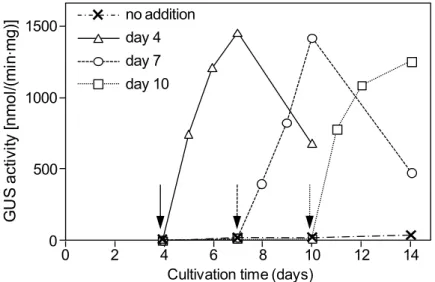
The induction of expression by the GAL10 promoter in the nutrient rich medium was also investigated. The transformants were cultivated in GY liquid medium (2% glucose and 1% yeast extract), and then galactose was added at day 4, 7 or 10 during the cultivation (Fig. 2-3). As shown in Fig. 2-3, GUS activity was induced by the addition of galactose in the same manner as that observed with synthetic medium. In all cases, the induction of GUS expression was maintained for approximately 3 days, and then GUS activity declined.
Deletion analysis of the GAL10 promoter
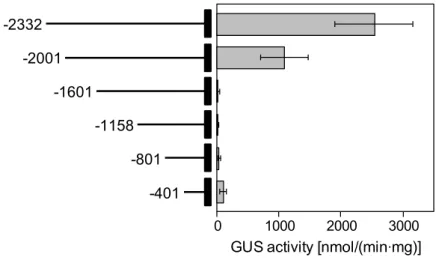
In order to investigate the length of promoter regions required to induce high expression, a series of 5′ GAL10 promoter deletion constructs was generated (Fig. 2-4, left) and introduced into M. alpina 1S-4. For each deletion constructs, 30 transformants were randomly selected and were cultivated for 3 days in SC agar medium containing galactose substituted for glucose, and then GUS activity was evaluated. For comparison, the GUS activity levels of each 10 moderately expressing lines were averaged and represented as relative values normalized to activity of the undeleted promoter, with 100% activity (Fig. 2-4, right). As shown in Fig. 2-4, a
Fig. 2-3. GUS activity in response to GAL10 promoter induction by galactose addition in
different cultivation phases in complex medium.
Transformants were cultivated in GY liquid medium, and galactose was added on day 4, 7 or 10 (arrows). The values represent mean GUS activity of three transformant lines.
0 2 4 6 8 10 12 14
Cultivation time (days)
G U S a ct ivi ty [n m ol /(m in ·m g) ] day 4 day 7 day 10 no addition 0 500 1000 1500
CHAPTER II
- 27 -
relatively long promoter region (over 2,000 bp) was required to induce sufficient GUS expression. GUS activity dramatically diminished with the deletion of 5′ regions. The deleted promoter (2,000 bp) showed the same tendency of response to sugars as the undeleted GAL10 promoter (data not shown), although GUS activity was lower.
DISCUSSION
In this chapter, the author investigated the promoter regions of the GAL1 and GAL10 genes as inducible promoter candidates for an oleaginous fungus M. alpina. The enzymes coded by these genes are involved in the galactose-metabolic pathway; GAL1 catalyzes phosphorylation of galactose, and GAL10 catalyzes epimerization from uridine diphosphate galactose to uridine diphosphate glucose. The promoter regions of genes homologous to of GAL1 and GAL10 have been reported as galactose-inducible promoters in various microorganisms including
Fig. 2-4. 5′-deletion analysis of the GAL10 promoter.
Left column) Constructs with different 5′ upstream deletions of the promoter region are shown. For each construct, the length of the fragment upstream from the transcription start site is shown on the left end. Right column) GUS activity levels with the deleted constructs in M. alpina transformants are shown. All transformants were cultivated for 3 days on SC agar medium containing 2% galactose substituted for glucose. The average GUS activity of the undeleted construct (2332 bp) was set at 100% and has been used to define the relative GUS activity of individual deletion constructs. Bars represent the mean values with standard deviations of GUS activity in 10 individual transformant lines for each construct.
0 1000 2000 3000 -401 -2332 -2001 -1601 -1158 -801
CHAPTER II
- 28 -
Saccharomyces cerevisiae [52]. Promoters of other genes involved in the galactose-metabolic
pathway, such as GAL4 and GAL7, also have been used as inducible promoters in such microorganisms [53-57]. Although GAL4 and GAL7 homologous were not found in the M.
alpina genome database, discovery of these genes could result in isolation of other
galactose-inducible promoters.
In general, useful inducible promoters exhibit the following features: (i) easily controlled by the presence or absence of components in the medium and (ii) fully repressed in the absence of inducer in the medium. For the convenience of induction in submerged cultivation, another useful feature of an inducible promoter was searched: (iii) induced by addition of the inducer into the medium, rather than by replacement of medium. The GUS reporter assay revealed that
GAL1 and GAL10 promoters were both regulated by the presence/absence of galactose in the
medium (Table 2-2). In particular, GUS activity regulated by the GAL10 promoter was extremely low in the medium without galactose. On the other hand, GUS activity was detectable even when other sugars were present in the medium containing galactose (Table 2-2). This result suggests that the GAL10 promoter activity can be fully repressed during cultivation in the medium containing sugars other than galactose, and then easily induced by the addition of galactose into the medium. Therefore, the author focused on GAL10 promoter and carried out further investigation.
To investigate the function of the GAL10 promoter in submerged cultivation, raffinose was used as a sole carbon source in pre-culture medium, because raffinose did not affect the induction of the GAL10 promoter in medium with/without galactose (Table 2-2). When galactose was added to the medium, in which transformants with the GAL10 promoter fused with the GUS gene were pre-cultivated, GUS activity was elevated 10 h after the addition of galactose (Fig. 2-1), was maintained for 2–3 days, and then declined (Fig. 2-2). The same tendency was observed in all cultivation phases of transformants (Fig. 2-2). This phenomenon might be caused by galactose assimilation resulting in a concentration decrease in the medium. Continued addition of galactose to the medium might achieve extended periods of induced expression.
In terms of industrial application, the inducibility of the GAL10 promoter in GY medium was also investigated, a conventional nutrient-rich medium for M. alpina cultivation. The
CHAPTER II
- 29 -
regardless of cultivation phase, as well as in the synthetic medium (Fig. 2-3). However, the induced GUS activity was lower and the induction response was slower than in synthetic medium (compare Fig. 2-2 and Fig. 2-3). This effect is likely caused by glucose in GY medium, because slightly repression of GUS activity with the GAL10 promoter by glucose was observed even in the presence of galactose (Table 2-2). In agreement with this findings, it has been reported for other microorganisms that glucose represses expression regulated by promoters that can be induced by carbon sources such as galactose and xylose [58-61]. In addition, the difference in nitrogen sources and trace elements between synthetic and complex media might also affect regulation and induction kinetics of this promoter. Further investigation of cultivation conditions could result in high levels of activity and/or prolonged induction with the GAL10 promoter for potential use. Recently, functional lipids such as PUFAs have been recognized for their beneficial effects on human health [62], and M. alpina has been utilized for the production of various PUFAs through molecular bleeding [14, 18-20]. The ability of the GAL10 promoter that can be induced even in complex medium as well as in synthetic medium will be a great advantage for industrial lipid production by M. alpina.
The 5′ deletion analysis of the GAL10 promoter region revealed that a relatively long length (over 2,000 bp) was required to regulate high GUS activity (Fig. 2-4). This result suggests that transcription factor binding sites, enhancer elements and induction factor binding sites of the GAL10 promoter are located in the far upstream region. A more detailed deletion analysis will lead to identification of functionally essential regulatory elements and elucidation of the inducible regulatory mechanisms of this promoter. Such information of inducible promoters is also useful for practical applications. For example, in Saccharomyces cerevisiae, the introduction of multiple copies of the consensus sequence, which is essential for the galactose-inducible promoters has been reported to improve inducibility of promoters [63].
SUMMARY
The putative promoter regions of two genes encoding galactose metabolic enzymes, GAL1 and GAL10, were cloned from the genome of M. alpina 1S-4. The GUS reporter gene assay in
M. alpina 1S-4 revealed that regulation of these promoters was dependent on the presence of
CHAPTER II
- 30 -
approximately 50-fold increase of GUS activity was demonstrated by addition of galactose into the culture media at any cultivation phase. The 5′ deletion analysis of the GAL10 promoter revealed that a promoter region of over 2,000 bp length was required for an inducible response and high-level activity. The GAL10 promoter will be a the valuable tool for gene manipulation in M. alpina 1S-4.
CHAPTER III
- 31 -
CHAPTER III
Omega-3 eicosatetraenoic acid (ETA) production by molecular
breeding of the mutant strain S14 derived from Mortierella alpina 1S-4
As mentioned in the general introduction to this thesis, 3-PUFAs are found in natural sources. Especially, α-linolenic acid (ALA, C18:3ω3), eicosapentaenoic acid (EPA, C20:5ω3) and docosahexaenoic acid (DHA, C22:6ω3) have been well studied because of their sufficient natural supply. Recently, stearidonic acid (SDA, C18:4ω3) and ω3-docosapentaenoic acid (DPA, C22:5ω3) have been reported to be accumulated in several natural oils [64, 65] and their sources are being developed, therefore research on their physiological function will be advancing in the near future. On the other hand, ω3-eicosatetraenoic acid (ETA, C20:4ω3) is hard to find in nature. In addition, there are only few reports of ETA production at a low level by overexpression of Δ6 desaturase gene in E. plantagineum [66], by mutation in Mortierella
alpina [67], and molecular breeding in Arabidopsis thaliana [68]. Although ETA has been
expected to show beneficial effects on human health just like eicosanoids, the detailed bioactivity of ETA has remained almost unknown because its sources were scarce.
Mortierella alpina 1S-4, an oleaginous fungus, is known as an industrial strain that
produces arachidonic acid (ARA, C20:4ω6) commercially [14]. To date, considerable accumulation of EPA have been reported by overexpressing endogenous ω3-desaturase gene in
M. alpina 1S-4 as a novel alternative source of 3-PUFAs [42]. The industrial production of
various kinds of PUFAs have been also succeeded by using mutants derived from M. alpina 1S-4 through chemical mutagenesis [17, 69]. M. alpina S14 is a Δ5-desaturation activity- defective mutant derived from M. alpina 1S-4, after treating the parental spores with a chemical mutagen [70] (Fig. 3-1). The strain S14 produces only a trace (about 1%) amount of ARA, and the ratio of dihomo-γ-linolenic acid (DGLA, C20:3ω6) to total fatty acids is markedly high, accounting for as much as 43% [71] and has been applied to the industrial production of DGLA [72]. ETA can be biosynthesized by ω3- (e.g. similar to Δ17-) desaturation from DGLA; therefore, the author hypothesized that this strain would be a good host strain for ETA production by expressing ω3- or Δ17-desaturase gene.
CHAPTER III
- 32 -
In this chapter, the author describe evaluation of ETA production using expression of the endogenous ω3-desaturase gene and the heterologous Δ17-desaturase gene in M. alpina S14.
MATERIALS AND METHODS
Strains, media, and growth conditions
M. alpina S14, a Δ5-desaturation activity-defective mutant, has been previously isolated
from M. alpina 1S-4 deposited in the Graduate School of Agriculture of Kyoto University [40]
and was used as a control strain in this chapter. The media described in chapter I were used. All
cultivation was performed as described in chapter I unless otherwise mentioned.
Isolation of uracil auxotrophs of M. alpina S14
Isolation of uracil auxotrophs was performed as described previously [21]. Mutant S14 was incubated on Czapek-Dox agar medium at 28ºC for 1 month, and allowed to sporulate at 12ºC for 1 month. Spores of ST1358 were harvested from the surface of Czapek-Dox (2.6×10⁸ spores/225 cm2); 2.6×10⁷ spores were spread on a GY agar medium containing 5-FOA (1.0 mg/mL) and uracil (0.05 mg/mL). By means of 5-FOA positive selection, uracil auxotrophs acquired that acquired 5-FOA resistance could be isolated.
Fig. 3-1. A biosynthetic pathway of PUFAs in the mutant strain S14 derived from
Mortierella alpina 1S-4.
OA, oleic acid; LA, linoleic acid; GLA, γ-linolenic acid; DGLA, dihomo-γ-linolenic acid; ARA, arachidonic acid; ALA, α-linolenic acid; SDA, stearidonic acid; ETA, ω3 eicosatetraenoic acid; EPA, eicosapentaenoic acid.
COOH COOH COOH COOH COOH COOH COOH COOH OA, 18:1ω9 LA, 18:2ω6 ALA, 18:3ω3 18:2ω9 GLA, 18:3ω6 SDA, 18:4ω3 20:2ω9 DGLA, 20:3ω6 ETA, 20:4ω3 20:3ω9 ARA, 20:4ω6 EPA, 20:5ω3 16:0 18:0 Δ5 desaturase defetive ω3 desaturase COOH COOH COOH COOH COOH COOH
CHAPTER III
- 33 - Fatty acid analysis
All strains were inoculated in GY medium and then the culture was carried out at 12ºC or 28ºC with reciprocal shaking (120 strokes/min) for a desired period. The mycelia were harvested by suction filtration and dried at 120ºC. The dried cells were weighed and transmethylated with 10% methanolic HCl and dichloromethane at 55ºC for 2 h, containing 0.2 mg of n-tricosanoic acid as an internal standard. The resultant fatty acid methylesters were extracted with n-hexane, concentrated and then analyzed using gas chromatography.
Isolation of the ura5 genomic gene of uracil auxotrophs of S14
The ura5 genomic gene was amplified using forward primer ura5upF (5-TTTCTGATGTG TCTCCCACC-3) and reverse primer ura5downR (5-TTCCAACAGAACCTTCCCTCG-3) with uracil auxotrophic S14 genomic DNA as the template. A 700-bp PCR product was cloned into the pUC118 vector using Reagent Set for Mighty Cloning Kit (Takara, Shiga, Japan), and then sequenced with a Beckman-Coulter CEQ8000 system (Beckman- Coulter, Fullerton, CA, USA) using M13 primers.
Construction of a transformation vector for M. alpina S14 ura5 strain
Transformation vectors pSDura5ω3 and pSDura5ω3×2 were constructed by the modification of pSDura5 [9, 10]. The ω3-desaturase gene was amplified using a forward primer, w3F2PciI (5-GGGAATATTAAGCTTACATGTCCCC-3) and a reverse primer, w3R2BamHI (5-GCCGGATCCAAATTGTTAATGCTTG-3) at 56ºC with M. alpina 1S-4 cDNA as a template. The 2 primers contained a PciI and a BamHI site, respectively (underlined). About 1.3-kb of PCR product was ligated to the pT7 Blue T-Vector (Novagen, Darmstadt, Germany), resulting in construction of a plasmid named pT7ω3. Its sequence was checked. The ω3-desaturase gene was digested with PciI and BamHI, followed by ligation into pBlueshtp treated with NcoI and BamHI to construct pBluesω3 [73]. The ω3-desaturase expression unit including a promoter and a terminator was cut out by EcoRI from pBluesω3 and ligated into pSDura5 digested with the same enzyme to generate pSDura5ω3 and pSDura5ω3×2 (Fig. 3-2). The latter plasmid possessed two ω3-desaturase expression units.
CHAPTER III
- 34 -
Saprolegnia diclina Δ17 desaturase gene (Sdd17m) was synthesized with optimized codon
usage to reflect the codon bias of M. alpina 1S-4 (obtained from the Kazusa database; http://www.kazusa.or. jp/codon/), with additional SpeI and BamHI restriction enzyme sites at the 5′ and 3′ ends, respectively. The Sdd17m expression cassette, with the SSA2 promoter and SdhB terminator, was generated by fusion PCR with XbaI and NheI restriction sites at the 5′ and 3′ ends of the cassette, respectively. This cassette was then digested with XbaI and NheI and ligated into pBIG35ZhSSA2pSdd17m, which had been digested with same restriction enzymes (Fig. 3-2).
Transformation of M. alpina S14
Transformation by microprojectile bombardment was performed as follows; a spore suspension from the M. alpina S14 ura5‒ strain was freshly prepared from cultures growing on Czapek-Dox agar medium supplemented with 0.05 mg/mL uracil; the suspension was filtered through Miracloth (Calbiochem) [40] and spread on a uracil-free SC medium. A PDS-1000/He Particle Delivery System (Bio-Rad Laboratories Inc., CA, USA) was used for the
Fig. 3-2. Vector constructs used for expression of (A) ω3-desaturase and (B) sdd17m in M. alpina S14.
ω3, Mortierella alpina ω3-desaturase; hisH 4.1p, M. alpina histone H4.1 promoter; trpC t, Aspergillus nidulans trpC transcription terminator; rDNA, M. alpina 1S-4 18S rDNA fragment; bla, ampicillin
resistance gene; ura5, orotate phosphoribosyl transferase gene of M. alpina; SSA2 p, M. alpina SSA2 promoter; SdhB t, M. alpina SdhB transcription terminator; Sdd17m, codon-optimized Δ17 fatty acid desaturase gene from Saprolegnia diclina; NPTIII, neomycin phosphotransferase III gene; TrfA, TrfA locus, which produces 2 proteins that promote replication of the plasmid; ColEI ori, ColEI origin of replication; oriV, pRK2 origin of replication; RB, right border; LB, left border.
(A) pSDura5ω3x2 11.0 kb ura5 bla rDNA hisH 4.1p trpCt ω3 hisH 4.1 p trpCt hisH 4.1 p trpCt ω3 pBIG35ZhSSA2p Sdd17m 12.3 kb oriV NPTIII TrfA LB his p ura5 SdhBt SSA2p Sdd17m SdhBt RB CoEl ori (B)
CHAPTER III
- 35 -
transformation. Tungsten particles (0.4 μm in diameter) coated with pSDura5, pSDura5ω3 and pSDura5ω3×2 were prepared according to the manufacturer’s manual. Bombardment was performed in the plate placed on the device under a helium pressure of 1,100 psi (7,580 kPa). After the bombardment, the plate was incubated at 28ºC (3–6 days).
Transformation by the ATMT method was performed as described in chapter I.
RESULTS
Isolation and characterization of uracil auxotrophs of M. alpina S14
M. alpina S14, a Δ5-desaturase defective mutant derived from M. alpina 1S-4, was used as
the host strain for heterologous gene expression. The strain S14 accumulates a higher amount of DGLA, a precursor for ETA, than does the wild-type strain 1S-4. To develop a transformation system using M. alpina S14, four uracil auxotrophic S14 mutants (S14-1, 2, 3, and 6) was obtained. The mutants grew on the SC medium with uracil, but not on uracil-free SC medium (Fig. 3-3A).
Fig. 3-3. Characterization of uracil
auxotrophic strains of M. alpina S14. (A) Growth of M. alpina 1S-4, S14 and uracil auxotrophic S14 on SC medium with or without uracil. (B) A mutation site of the ura5 gene in M. alpina uracil auxotrophic S14. wild S14 S14-1 S14-2 S14-3 S14-6 wild S14 S14-1 S14-2 S14-3 S14-6 (–) uracil (+) uracil (A)
Strain Gene mutation Derived result
S14-1 N.D.*
-S14-3 A 1 G Deficiency of start codon (B)
*: not determined S14-2 G 211 AG 212 T G 71 I
N.D.*
CHAPTER III
- 36 -
These S14 uracil auxotrophs were evaluated as a host strain for molecular breeding based on growth and fatty acid production and composition. As a result, all 4 uracil auxotrophs showed vigorous growth and as much fatty acid production and composition as the wild-type strain S14 (data not shown).
To assess whether the homologous ura5 gene was suitable as a selective marker for uracil auxotrophic mutants, the ura5 gene in the genome of these mutants was sequenced [5]. As shown in Fig. 3-3B, in case of a mutant S14-2, the mutation of base substitution was observed in the ura5 gene: the substitution of G for A and G for T were observed at the +211 and +212 nucleotide positions, leading to amino acid replacement, G 71 I. A base-pair change was detected in that of S14-3: the substitution of A to G at +1 caused the deficiency of start codon. S14-1 and -6 were found to have no mutations point in their ura5 gene.
Consequently, the strain S14-2 was used as a host strain for transformation in subsequent studies because of the evident multiple mutational points in its ura5 gene.
Transformation of the M. alpina S14 uracil auxotroph with pSDura5ω3×2 and fatty acid analysis
The vector pSDura5-ω3×2 was introduced into the M. alpina S14 uracil auxotroph using the microprojectile bombardment method and selected one stable transformant (ω3#1). Subsequently, the ETA production of the 1S-4 wild-type strain, S14 host strain, and the transformant ω3#1 was evaluated during cultivation at 12°C (Fig. 3-4). The amount of ETA in ω3#1 remarkably increased with the elapse of cultivation time compared to wild-type 1S-4 and host S14. The ETA contents of ω3#1 reached 42.1% in the total fatty acids, while those of wild-type 1S-4 and S14 were just 0.5% and 13.1%: ETA content of ω3#1 was up to 84.2-fold and 3.2-fold higher compared to wild-type 1S-4 and S14, respectively. ALA and SDA contents of ω3#1 were up to 3.7% and 14.2% of total fatty acid on Day 5. In contrast, no accumulation of 3-PUFAs including ETA was observed in ω3#1 when cultivated at 28°C (data not shown).
CHAPTER III
- 37 -
Transformation of the M. alpina S14 uracil auxotroph with pBIG35ZhSSA2pSdd17m and fatty acid analysis
In order to produce ETA in M. alpina S14 at a normal temperature, the Saprolegnia diclina fatty acid Δ17-desaturase gene (Sdd17m) was used. S. diclina is an oleaginous microorganism producing omega-3 PUFAs at a normal temperature, and Sdd17 is able to catalyze a desaturation at ω3 position of DGLA resulting in ETA biosynthesis [74] as well as endogenous ω3 desaturase in M. alpina. The expression vector pBIG35ZhSSA2pSdd17m (Fig. 3-2), carrying the codon-optimized Sdd17 gene (Sdd17m), was constructed and introduced into the M.
alpina S14 uracil auxotroph using the ATMT method. As a result, five stable transformants were
randomly selected and used for further studies.
Fig. 3-4. Time course of growth, fatty acid production, and composition of the M. alpina 1S-4
wild-type strain, S14 host strain, and its transformant ω3#1 overexpressing ω3-desaturase gene. All strains were cultivated in 10 mL of the GY liquid medium at 12C for 5, 7, 9, and 11 days. The data are shown as mean ± SD from 3 individual experiments. For all other abbreviations, see the legend of Fig. 3-1.




![腹部大動脈瘤の形成におけるω3多価不飽和脂肪酸[EPA]の抑制効果](data:image/gif;base64,R0lGODlhAQABAIAAAP///wAAACH5BAEAAAAALAAAAAABAAEAAAICRAEAOw==)