
Frequency of Student-Initiated Turns and Teacher-Solicited Questions in Junior and Senior High School English Classes in Japan
14
0
0
全文
(2) Nagoya. City. University. behavior in the classroom, but also the value placed on particular methods of instruction used in the learning environment. Consideration must also be given to what students and instructors view as important outcomes of the learning experience. One in particular is the ultimate goal of university entrance for which the majority of students are working toward. Only then is it possible to gain some understanding of the participative behavior exhibited by students and their views regarding the value of participation.. Hyland (1993) suggests that the Japanese education system places little value on independence or student display of creativity or imagination. Within both secondary and tertiary levels of education, traditional instruction methods prevail with classes being predominantly teacher-centered and students expected to remain passive. Rohien (1983) has observed that the common practice of completing set sections of the text leaves little time for classroom debate or discussion in many of the subjects studied in secondary school. Other factors such as large class size also reduces the desire of students to express personal opinions, thus inhibiting group discussions. Rohlen (1983) has concluded that generally the students are found to prefer the comfort of relatively passive and anonymous listening within the classroom setting, to that of active participation.. Kubota (1999) makes the point that secondary education in Japan is influenced by examination-oriented instruction where emphasis is placed on the memorization of information. Even though English is one of the most widely studied subjects in Japanese secondary schools, it is regarded as an academic pursuit with the underlying motivation for study being the university entrance exams. These exams place a strong emphasis on grammar and intensive reading with students being required to translate complex passages. The skills of listening and speaking are rarely addressed. Furthermore, according to Benson (1991) students have little motivation to use the language outside the classroom. Wray (1999) further stresses this fact, explaining that time in the classroom is devoted to teacher and textbook with little discussion or students' opinions being sought.. Research that has been conducted in the area of participation has discovered that the cultural group to which an individual belongs can also influence the level of interaction, which takes place between student and teacher in the classroom. Kumaravadivelu (1990), in an investigation of Asian and non-Asian second language learners of English, found significant differences in the distribution of talk in English as a second language (ESL) classes. Asian students were found to be less participative in the classroom, making fewer self-initiated turns and exhibiting more dependence on the teacher to solicit a student response.. 80 NII-Electronic. Library Service.
(3) Nagoya. City. University. Frequency of student-initiated turnsandteacher-solicited questionsinjuniorandseniorhighschoolEnglishclassesinJapan Bodycott and Walker (2000) found that Asian students studying English in tertiary institutions in Hong Kong were reluctant to participate in open discussions as a whole class. While some non-participative behavior may be attributed to language competence or confidence, it also appeared that students were concerned about loss of face and an unwillingness to stand out above others. It was observed that the majority of students would rarely volunteer to answer a teachers' general solicit and only when a specific individual was targeted would a response be given (personal solicit). It was also noted that the students saw such a method of extracting information as acceptable.. In the same study it was found that when individual students were targeted and asked to comment on a fellow classmates opinion they were unwilling to respond. "Students appeared extremely reluctant to question others' opinions, perhaps because they worried about making the other person, or themselves, loose 'face'" (Bodycott & Walker, 2000, p. 5).. While Japanese students in senior high school are faced with the task of preparing for university entrance exams, students in junior high school appear to have a different agenda. Often having arrived from an elementary school system where the emphasis has not been on that of mechanical learning, students tend to engage themselves more actively in the overall learning process (Kubota, 1999). This is not to say that elementary school students do not undergo the same entrance examination process before entering secondary school. However, what should be noted is that the general direction of instruction is not toward entrance exams in the elementary school system. Lewis (1995) found that many elementary school subjects promoted self-expression and that children were encouraged to be creative. Teachers also recognized the variety of approaches that could be utilized by students in problem solving exercises in subjects such as mathematics and science.. The rationale for undertaking this study is to examine what differences occur in the participation level of junior and senior high school students studying English, and to identify what factors influence the degree to which students contribute in the classroom. In addition, student classroom behavior and the teacherstudent relationship will be investigated in the Japanese context.. Method. subjects The of the study were students enrolled in junior high school and senior high school at the same private girls school in central Japan. The study involved two separate classes, one first year junior high. 81 NII-Electronic. Library Service.
(4) Nagoya. City. University. school class (JHS1) of forty 12- and 13-year-olds and the other a third year senior high school class (SHS3) of forty-five 17- and 18-year-olds. The JHS1 class was engaged in the study of English four periods a week with a Japanese English teacher and one period a week with a native English speaker, with each period lasting 50 minutes. The SHS3 class was an English elective class with a Japanese English teacher, meeting twice a week. In addition, these students studied English writing twice a week, and English reading and translation four times a week. In total the students studied English eight periods a week with three different teachers. They had no native English-speaking teacher. The SHS3 class, was considered a large group, with a usual class consisting of between 38-40 students.. Data was collected through observation and subsequent teacher and student interviews. The subjects who participated in the study were informed that they would be observed to examine the way in which they studied English. They were not aware that they would be observed in order to collect data on student levels of participation, in terms of response to teacher-solicits and student-initiated turns. The two teachers involved were, however, informed of the purpose of the study and were also aware that the students were the focus of observation and not themselves.. The study involved five 50-minute observations over a period of 5 weeks, however the initial 50-minute class was not included in the results as it served as a pilot observation. The study was conducted in the latter half of the second semester when the students were more than familiar with the teacher and there were no distractions in the school calendar. During the school year there are many events for which students must prepare, however after the completion of the school festival and the mid-term exam in the second semester, there are few extracurricular activities. For the JHS1 class however, the sudden illness of the regular English teacher at the beginning of the second semester resulted in a substitute teacher taking over the class. However, after the first classroom observation it became obvious that the students were more than comfortable with the new teacher, therefore the change in teachers did not present itself as a factor that would be necessary to take into consideration when analyzing the data collected.. For coding purposes four categories of classroom participatory behavior were identified (derived from Ely, 1986, p. 13):. 1. General solicit-where the teacher addressed a question to the whole class 2. Personal solicit-where the teacher addressed a question to an individual student 3. Student-initiated turn-in front of the whole class. 82 NII-Electronic. Library Service.
(5) •. Nagoya. City. University. Frequency of student-initiated turnsandteacher-solicited questionsinjuniorandseniorhighschoolEnglishclassesinJapan 4. Student-initiated turn-in close proximity to the teacher. At the conclusion of the observation period eight students were interviewed, four from JHS1 and four from SHS3 (see Appendix A). Before these interviews a pilot interview with two students from the SHS3 was carried out in order to construct a question schedule. Teacher interviews were also conducted on the completion of classroom observation (see Appendix B).. The students selected for interview from the JHS1 class became obvious candidates due to their level of participation over the 5-week period. Two active participants were selected, as they responded to and initiated many questions during the observation sessions. Two other students were selected as non-active participants, as they made no attempt to respond to or initiate any questions during the observation period. Upon completion of the classroom observation the teacher was consulted to determine her views regarding the four students who had been selected for interview. She was also in agreement with the selection that had been made.. The students to be selected from the SHS3 class were much more difficult to determine due to the overall lack of classroom participation from the majority of the students. After consultation with the classroom teacher who was much more familiar with the students (having worked with them for a period of 6 months) a group of four students was chosen, with two students representing more active participants and two representing less active participants in the class.. The student interviews were carried out individually taking approximately 10-15 minutes. A second year university student was used as the interviewer and interpreter. The questions and answers were conducted in Japanese to ensure detailed and accurate response from the students involved. The interviews were also recorded to allow for some of the details to be transcribed at a later date.. Class Description. In the following section the structure of each class will be outlined to give some insight into the way English. lessons. The SHS3. are conducted. class, being. the conclusion. in the secondary. concerned. of each short. school.. with the translation. unit, were. generally. of written. required. English. to translate. and the completion one or more. sentences,. of exercises directed. at by. 83 NII-Electronic. Library. Service.
(6) Nagoya. City. University. the teacher, during class time. At the conclusion of each unit a number of exercises were also included which reviewed the main grammatical points covered in the section. The teacher required both the translation and exercises to be completed for homework and when individuals were nominated during class they were expected to be able to provide the answers. In a study conducted by Sakui (2004) of teachers' practices in the classroom, grammar instruction was found to be central with limited interaction with the students apart from choral reading.. In the SHS3 class most of the lesson time was devoted to the students translating the required sections of the text, New Harvest Seminar - Text for Entrance Examination. At intervals throughout the lesson the teacher would emphasize specific grammatical points with explanations on the blackboard. Additional information was also provided to create a more interesting lesson. However, even when the teacher was explaining such material to the group there was almost no response from the students. The class was extremely quiet and even if the students did not understand what was being explained, on only one occasion was a student observed asking the person next to her to explain the information. This practice is a common occurrence in other classes, where students will reconfirm with the students around them as to whether or not the information that they are about to provide is correct. However, in the SHS3 class the students did not interact with one another but preferred to remain silent. Often when asked a question, a student would answer directly but then stop after a few words, unable to continue. In such cases rather than ask another student for assistance, a common trait of younger students, they would prefer to remain silent. This would usually result in the teacher offering some assistance and the student then continuing. If the student was unable to continue the teacher would sometimes provide the answer.. The 31-1S1class used the text New Crown English Series Book 1, in which each unit contained short dialogues with a number of exercises that followed. The main vocabulary for the unit was also displayed at the bottom of each page and emphasis was placed on the pronunciation and use of the new words and the grammatical features of the dialogue. The students also had a workbook, New Crown Compulsory Textfor Junior High School English Grade 1, from which they would complete set exercises for homework, these would then be checked during class time. The teacher would either select individual students or call on the whole class to provide an answer.. The JHS1 class was very animated, with a significant amount of verbal exchange taking place between the students and the teacher. As one would have expected there were a number of very quiet students in the class who rarely participated in whole class discussions. However, when presenting a question the teacher. 84 NII-Electronic. Library Service.
(7) Nagoya. City. University. Frequencyof student-initiatedturnsand teacher-solicitedquestionsin junior and seniorhighschool Englishclassesin Japan. was generally assured of someone in the class providing an answer. Approximately. one quarter of the class. were constantly. engaged in dialogue with the teacher. This created an atmosphere. where quieter students. were sometimes. encouraged to participate. silent classroom. setting. This was a factor that became evident after interviewing. SHS3 class. When questioned atmosphere. regarding. more frequently. her participation. than would otherwise. have occurred in a more. level in other classes. one student from the she reported. that the. of the class on that day was an influencing factor. If the class was very quiet this could result in. embarrassment. and an unwillingness. to provide a response to teacher-solicits.. Findings. 1 represents the figures for the distribution Table month observation. period. Statistically,. of teacher-solicits. there is a significant. and student-initiated. difference in the number of student-initiated. turns between the two classes. The JHS1 class was found to be quite participative, responses. to teacher-solicits. and self-initiated. turns initiated by one particular responsible. in the presence. in terms of providing. turns. However, what must be pointed out is the frequency of. student in the JHS1 class. In the week 1 observation. for 12 out of the 18 student-initiated. 28 turns. When interviewed. this student was. turns, and in week 4 the same student produced 16 of the. regarding her views about responding. of other students,. turns for the one. this student. expressed. to teacher-solicits. a lack of nervousness. and self-initiated turns and embarrassment,. therefore having no inhibitions about being vocal before her peers.. The teacher of the JHS1 class was found to make more whole class solicits as she was usually provided with an individual or choral response. When questioned the class she expressed her satisfaction. in. with both individual and choral responses. However, she noted that. some students in the group rarely participated. would often receive no response.. in relation to the students' level of participation. To these students she would sometimes direct a question but. She would then sometimes. simplify the question and if still no response. was given she would instruct the student to say they didn't know the answer.. 85 NII-Electronic. Library. Service.
(8) For the SHS3 class (see Table 1), four student-initiated turns in front of the class appear, however, students sitting at the front of the classroom were responsible for these. This allowed them to converse with the teacher in a relatively quiet voice that was inaudible to the rest of the group. One of the students who initiated a turn was selected for interview. When questioned regarding her turn in relation to her seating position it was discovered that she would have been reluctant to do so from the back of the classroom, as this would have required her to use a much louder voice. In the final observation one student asked two questions in succession, however both of these were in relation to the end of semester test. She was also positioned at the front of the classroom. Any students who needed to ask some questions about grammatical aspects of the lesson were found to communicate directly with the teacher at the conclusion of the class, this taking place at the front of the classroom, in close proximity to the teacher's desk. In week 1 for the SHS3 class three student-initiated turns appear, however all of these took place at the conclusion of the lesson, with the students approaching the teacher's desk. This is a common practice followed by many junior and senior high school students, as at the conclusion of each lesson there is a 10-minute interval before the next class. Rather than draw attention to themselves during lesson time students prefer to approach the teacher at the end of the lesson, where they place themselves in a less threatening situation. If other students are unable to hear their question to the teacher they feel less embarrassment. Some students are even observed to wait until the teacher has left the classroom to then ask a question.. In the SHS3 class there were only two teacher-solicits directed toward the whole class during the one month period. To these questions however, no response was given. When interviewed the classroom teacher explained that at the beginning of the year she had attempted to ask class directed questions but had received no response after repeated attempts to initiate such classroom behavior. Her views regarding this type of behavior were that students felt embarrassed to provide an answer, unless directed to do so. As a result of the students lack of voluntary participation the teacher altered her questioning style. She used.
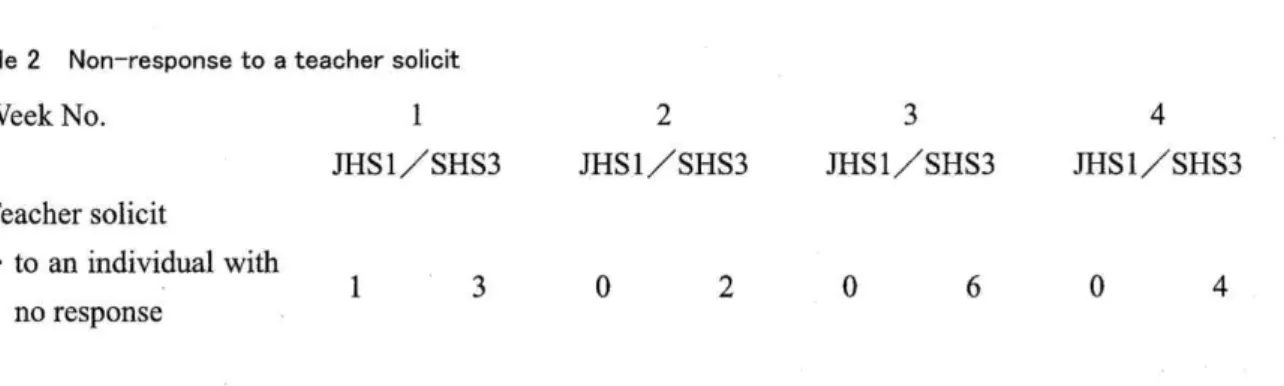
(9) personal. solicits. responded. amount. as the students. This also resulted. more. comfortable. in less time being. of time with no response. as general. solicits. question.. This may have been due, in part to the fact that they were reading. Students. who could. Students. unable. not answer. to answer. Sometimes. with answering. found. the question. the teacher occasions. know. The same silent response confronted. often. a question. that on three. usually. technique. and generally. consumed. a considerable. being given.. in the SHS3. was observed. were. wasted. with this questioning. Students. not respond.. class. appeared. to make. were also observed. often made waited. seconds. only did the students. in English. and was unable. when. answering. a. they had written.. to avoid any eye contact. with the teacher.. with regard. to the fact that. with still no response.. respond. on one occasion. with the teacher the translation. no verbalization. up to 10-15. was also observed. a question. no eye contact. to a question. Over. in Japanese. they could the period. it. with I don't. with the JHS1 class when a student. was. to do so.. Table 2 represents the distribution of non-responses from students to individual directed teacher-solicits. In the SHS3 class, students who generally answered the teacher's questions with a minimal waiting period were those students who appeared to have completed the Japanese translation and unit exercises for homework. However, even these students when answering did so in such quiet voices that it was impossible for the majority of the students in the room to hear the response. This made it necessary for the teacher to repeat many of the answers given by students.. In the JHS1 class, although some students answered in the same softly spoken voices there was generally more confidence in their voices when they responded to a teacher-solicit or initiated a turn. From an observational point of view it was possible to hear the students' responses, whereas responses in the SHS3 class were often inaudible to myself and the other students.. When interviewed, those students who were reluctant to participate during class time expressed embarrassment and a fear of making mistakes in the presence of other students. The non-participative.
(10) Nagoya. City. University. students from the SHS3 class explained that it was not necessary to question the teacher during the lesson as they could do so at the conclusion of the class, with relative comfort. One also mentioned that if she did not understand something she would review the material later rather than ask the teacher. The students also expressed their preference in often asking a friend to explain material covered in the lesson. Three of the four students interviewed from the SHS3 class pointed out the passive manner of senior high school students. One student explained that some students do not like classes in which other students participate. She also explained that many students feel no need to participate, as participation has no bearing on examination results. In addition, she mentioned that quieter students sometimes achieve the highest grades. Other reasons expressed for lack of participation during class time included the desire to remain one of the group and not appear different to other students. Also mentioned was that responding to class directed solicits and initiating turns before the group sometimes gave the impression that a student was attempting to make a good impression on the teacher.. Students interviewed from the JHS1 class also expressed the same embarrassment and nervousness in responding to teacher-solicits and initiating turns in the presence of their peers. However, the student who initiated the greatest number of turns was found to feel no embarrassment and felt it important to question the teacher regardless of what the other students thought. This response was very different from the opinions expressed by the other seven subjects interviewed. The same student also emphasized the need to question the teacher during class time, as the information she was seeking was probably the same as what the other students wanted to know. When questioned regarding her response to a teacher-solicit she could not answer she explained she would be unlikely to say she didn't know the answer, as the teacher would then direct the question to another student. She pointed out that she usually asked for a hint and attempted to answer the question. This response was unique as out of the other students interviewed five said they would say they didn't know and two said they would remain silent.. Discussion. There appears to be a significant difference in student participation levels between first year junior high school and third year senior high school students. Whether this change occurs as a result of teaching methods in senior years and the general emphasis on preparation for university entrance exams remains in question. However, it seems that those students who are new to the secondary school system may be predisposed to the idea of classroom discussion involving self-expression and original thinking. By the time these same students reach a senior level perhaps the single driving force behind study is that of. 88 NII-Electronic. Library Service.
(11) •. Nagoya. City. University. Frequency of student-initiated turnsandteacher-solicited questionsinjuniorandseniorhighschoolEnglishclassesinJapan university entrance exams. Over a period of six years students are molded to become passive learners and by their final year of high school appear content to simply sit and listen rather than participate in the learning process. As a numerical grade for participation is not included in the majority of school subjects, students see little need to become active members in the classroom. They also have no desire to risk making a mistake or drawing attention to themselves and thus appear different from their peers, when they can approach the teacher at a more convenient time at the conclusion of the lesson.. Until changes take place within the educational system there seems little that can be done to encourage those students in their final years of schooling to contribute more in the classroom setting. For classes such as oral communication, the inclusion of a participative grade, outlined at the beginning of the school year may provide incentive for students to attempt to contribute more, both in response to teacher solicits and self-initiated turns. This would allow for the criticism that quiet non-participative students are capable of attaining the highest grade. However, such a grading system would force students to participate rather than make the act voluntary. The ultimate goal of any classroom instructor would be voluntary participation without any thought as to the personal gains of such involvement in the lesson. One problem that may arise from the implementation of such a system is the number of students involved. If assessment of the students is made on a continual basis it may prove time consuming as compared with examination assessment, which only occurs twice a semester. With classes of up to 45 students, those who become obvious participants and non-participants may be easy to assess, however the large number of students who form the main body of the class may be difficult to assign a grade to.. With junior high school students who appear to accept the idea of classroom participation, the inclusion of further teaching strategies by the instructor, can only enhance the level of interaction. However, one concern is that while the dynamics of a class may lend itself to individual and choral responses to teachersolicits and frequent student-initiated turns, this may change at the commencement of the next school year. As is the case with most junior and senior high schools in Japan, at the beginning of each year, class members are rearranged to form new homeroom groups. This can undoubtedly affect the participation levels of individual students based upon the dynamics of the new group. For this reason, it would be beneficial to conduct a follow up study to determine what changes occur in the behavior of those students labeled as both active and non-active participants from the previous year.. When examining the methods of instruction used in English classes in senior high school it is important to look at the content of material covered in university entrance exams. Benson (1991) points out that many. 89 NII-Electronic. Library Service.
(12) Nagoya. City. University. questions have been raised with regard to the emphasis placed on grammar and reading, which in turn places pressure on the school system and its curriculum. It has been suggested that universities should reexamine the content of entrance exams with a more integrated test of students' language ability. Examinations should not only test grammar and reading but also speaking and listening skills. Perhaps this would give students more incentive to improve their communication skills in English, resulting in increased participation levels.. Conclusion. Clearly there need to be changes made in the education system in order for students to view classroom participation as a valuable component of the learning process. At present, the focus of most senior English classes is subject matter that will prove useful in university entrance examinations. The number of students accepted to prestigious universities is an important factor for parents when selecting a secondary school for their child. It is because of this that schools will continue to work toward the entrance of students to such institutions. Therefore, based upon what both parents and educators perceive as successful outcomes of secondary school education, modification of this system will be difficult.. In recent years a greater emphasis has been placed on English due to its recognition as an international language. It is seen not only as the language needed to communicate with native speakers of English, but also non-native English speakers. The Period for Integrated Study has seen the introduction of foreign language study and particularly English, across elementary schools in Japan. Perhaps its introduction at this early stage will encourage younger learners to feel more comfortable using the language resulting in greater classroom participation in later years.. What cannot be disputed is that the participation level of students in English classes must increase if their communicative competence is to improve. Students cannot continue to remain passive learners. Changes must take place in the education system, so that teachers recognize the need to develop the speaking and listening skills of students, in English. This must also coincide with students providing a response to teacher solicits, using English. At present, emphasis is placed on grammatical understanding of the language, with little time assigned for speaking.. English is often perceived as a language of grammar and textbooks, but is rarely viewed as a tool for communicative purposes and is seldom used outside the classroom. Students wishing to develop. 90 NII-Electronic. Library Service.
(13) Nagoya. City. University. Frequencyof student-initiatedturns and teacher-solicitedquestionsin junior and seniorhigh schoolEnglishclassesin Japan. communication conversation. skills in English are often forced to seek instruction schools. Obviously,. facilitate the development. outside the traditional. one of the future goals of secondary. of both grammatical. understanding. education. classroom. at. in Japan would be to. of English and linguistic competence. in the. use of the language.. In order to study all aspects of the English language, students must be encouraged the classroom.. to examine their role in. Students need to be directed from a position of passive reticence to reach their full potential. as active participants.. It is important for students to see their contribution. as part of the learning process,. and not simply the role of the teacher.. References. Benson, M. J. (1991). Attitudes and motivation towards English: A survey of Japanese freshman. RELC Journal, 22(1), 34-48. Bodycott, P., & Walker, A. (2000). Teaching abroad: Lessons learned about inter-cultural understanding for teachers in higher education. Teaching in Higher Education, 5(1), 79-95. Ely, C. M. (1986). An analysis of discomfort, risk taking, sociability, and motivation in the L2 classroom. Language Learning, 36, 1-25. Hyland, K. (1993). Culture and learning: A study of the learning style preferences of Japanese students. RELC Journal, 24(2), 69-86. Kubota, R. (1999). Japanese culture constructed by discourses: Implications for applied linguistics research and ELT. TESOL Quarterly, 33(1), 16-35. Kumaravadivelu, B. (1990). Ethnic variation in classroom interaction: Myth or reality. RELC Journal, 21(2), 45-54. Lewis, C. (1995). Educating hearts and minds. Cambridge: Cambridge University Press. Morisumi, M. (Ed.). (2000). New crown English series: New edition 1. Tokyo: Sanseido. Morisumi, M. (Ed.). (2000). New crown compulsory text for junior high school English grade 1. Tokyo: Sanseido. NHS Entrance Examination Committee. (2000). New harvest seminar: Text for entrance examination. Kyoto: Yamaguchi Shoten. Rohlen, T. P. (1983). Japan's high schools. Berkley, CA: University of California Press. Sakui, K. (2004). Wearing two pairs of shoes: Language teaching in Japan. ELT Journal, 58(2), 155-163.. 91 NII-Electronic. Library. Service.
(14) Nagoya. City. University. Appendix A Student Interview Schedule I. Do you enjoy studying English? 2. Is it important to study English? Why? 3. What personal goals do you have in relation to studying English? 4. In your English class is it important to be an active participant? For example, asking the teacher questions / answering the teacher's questions? 5. In your English class do you ask questions in front of the other students? If you ask a question in front of the other students how do you feel? For example, confident, self-conscious, nervous, embarrassed? 6. In your English class if you rarely ask questions what is the reason for this? 7. In your English class if you don't understand something the teacher has explained what do you do? 8. In your English class when you answer a question do you feel more comfortable answering in Japanese or English? 9. How do you feel when you answer a question in English? 10. In your English class, if the teacher asks you a question and you don't know the answer what do you do? 11. Do you behave the same in your other classes? Are you more or less active, in terms of asking and answering questions? 12. In the last month, how many times have you asked a question during your English class? 13. In the last month, how many times have you been to the staff room to ask your English teacher a question?. Appendix B Teacher Interview Schedule 1. Do you think asking questions is important? Why? 2. What form of questioning do you use? For example, general solicits / personal solicits? 3. What methods do you use to try and initiate student response to your questions? 4. If the class or an individual doesn't respond to a question what do you do? 5. Do you use a similar questioning style with all your classes? 6. Do you find student participation levels vary according to the age of the students? 7. Are you satisfied with the level of student-initiated participation in your class? 8. Are you satisfied with the students' responses to your questions? For example, general solicits / personal solicits?. 92 NII-Electronic. Library. Service.
(15)
図
関連したドキュメント
A tendency toward dependence was seen in 15.9% of the total population of students, and was higher for 2nd and 3rd grade junior high school students and among girls. Children with
Required environmental education in junior high school for pro-environmental behavior in Indonesia:.. a perspective on parents’ household sanitation situations and teachers’
熱力学計算によれば、この地下水中において安定なのは FeSe 2 (cr)で、Se 濃度はこの固相の 溶解度である 10 -9 ~10 -8 mol dm
We hope that foreign students in middle and high school will find this glossary useful and become fond of math.. Moreover, in order to improve the usefulness of this glossary, we
Compared to working adults, junior high school students, and high school students who have a
[Mag3] , Painlev´ e-type differential equations for the recurrence coefficients of semi- classical orthogonal polynomials, J. Zaslavsky , Asymptotic expansions of ratios of
INTERNATIONAL MASTER’S PROGRAM IN JAPANESE HUMANITIES INTERNATIONAL DOCTORATE IN JAPANESE HUMANITIES
JAPAN STUDIES PROGRAMS IN ENGLISH AT THE GRADUATE SCHOOL OF HUMANITIES THE INTERNATIONAL MASTER’S PROGRAM (IMAP) IN JAPANESE HUMANITIES AND THE INTERNATIONAL DOCTORATE (IDOC)
In case of any differences between the English and Japanese version, the English version shall
