九州大学学術情報リポジトリ
Kyushu University Institutional Repository
質問に基づく形式言語の機械学習に関する研究
坂本, 比呂志
Graduate School of Information Science and Electrical Engineering, Kyushu University
https://doi.org/10.11501/3147889
出版情報:Kyushu University, 1998, 博士(理学), 課程博士
CHAPTER 4
Learning Finite-Memory Automata
Automata theory is greatly attractive and several types of automata have b n introduced, e.g., two-way, two-head, and infinite-state automata.
A finit -memory autornaton is one of thes representations. Our interest is whether a finite-memory automaton expresses a regular language in a mor compact way than finite automata as well as whether such automata are l arnable using helpful queries.
In this chapter, we deal with finite-memo;y automata, denoted by FMA, introduced in
(32).
Assuming a restricted memory structur that consists of a finite number of registers, an FMA can store arbitrary input syn1bols. Thus, th language of an FMA is defin d ov r a potentially infinite alphab t.W first study the following d cision problem for any FMA A as well as for any deterministic one, d noted by DFMA: th m mbe;ship p;oblem (i.e., given an A and a string w decid whether w is accepted by A), and the non-emptiness p;oblem (i.e., given an A, d cide wheth r th language of A i nonempty). The membership probl m is P-complet provided th A is d t rministic and any other problem is NP-complete.
Other results ar obtained for inequivalence probl m (i.e., giv n two FMAs, decide whether they accept th same languag ). Using th NP-hardness of non-emptiness for DF MA, we show that the in qui val nee probl m for DFMAs is also NP-hard.
Moreover, this problem for FMAs is at least PSPACE-hard.
By the resulting intractability of the problen1s, we consider a restriction of FMAs and the class is referred to as simple DFMAs. We second establish the learnability of
the simple deterministic class via membership and equivalence queries.
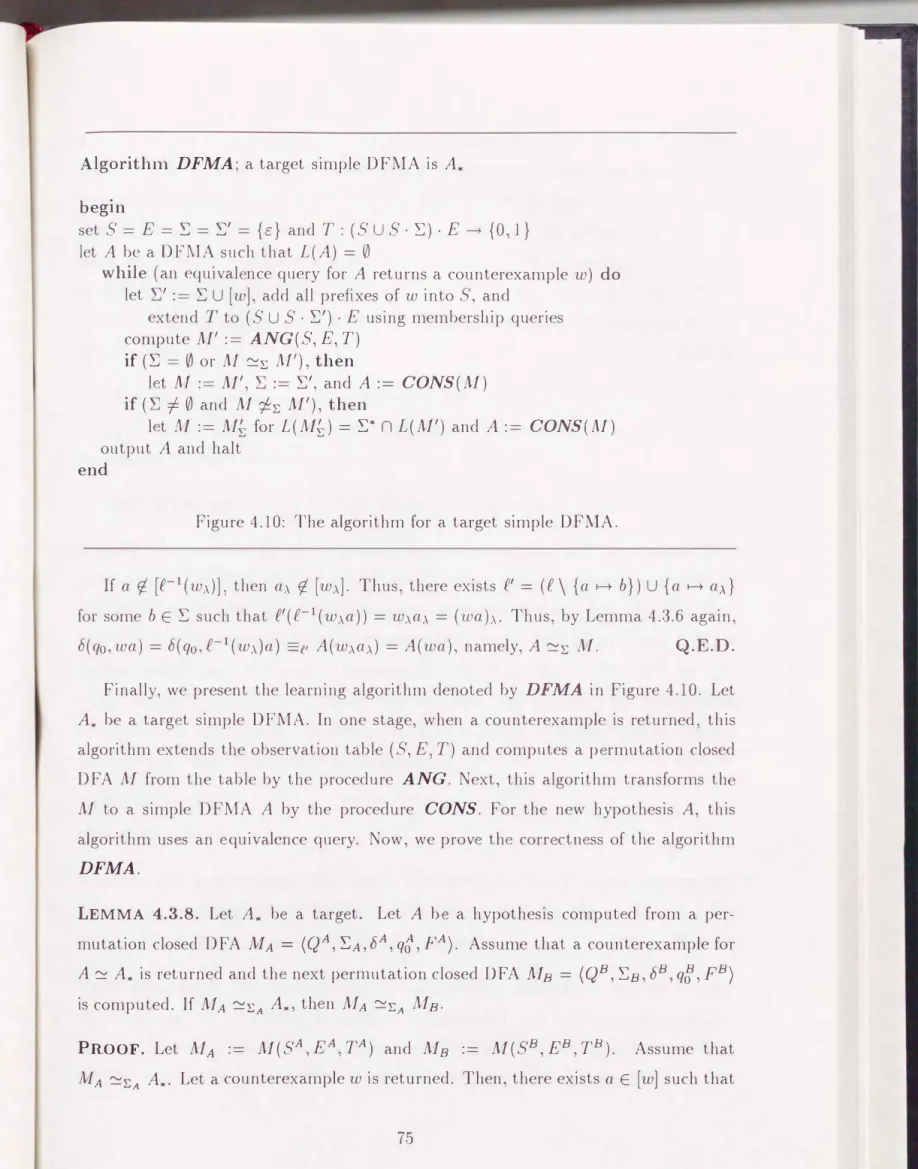
In order to arrive at a meaningful learning model, w first present a procedure, given any two simple DFMAs A and
B,to output a string accepted by exactly one of them if L(A) # L(B) and output "yes' otherwise. Then, we provide the announced learning algorithm, show its correctness, and analyze its running time. The algorithm is partially based on Angluin 's [4] observation table technique. Finally, we obtain the result that the class of simpl DFMAs is exactly learnable via membership and equivalenc qu ries.
4.1 FMAs and DFMAs
Rec ntly Kamin ki and Francez [32] introduced a n w model of computation the so
called finite-memory automata denoted by FMAs, for dealing with languages defined over an infinite alphabet. In this model, we assume a very restricted memory structure lik a work tape which consists of a finite number of registers. A register stores arbitrary symbols.
An FMA can check whether or not a register contains an input symbol. Reading an input symbol it changes its stat by exclusively using inforn1ation in which register of it work tap th input symbol is or will b tor d. If th input symbol has not been stored y t, then it is written into a cell of th work tape depending only on the current tate. Cons qu ntly, an FMA deals with any finite and pot ntially infinite alphabet.
Compar d to oth r con1putational models FMA is natural extension of finite au
tomaton and it can be also finitely described analogou ly to oth r computational mod
els. Moreover, the class of FMAs possesses s veral u ful closur properties ( cf. [32]).
We b gin with th definition.
Lt
n ={
aiI i
EIN} be any fix d countably infinite alphabet and let
�be any finite subset of
n.he fr monoid ov r
nis denoted by D*
and
n+is defined similarly. For any str·ing a, the xpres ions [a] and a[i] denote the range and the ith symbol of a, resp ctiv ly, wh r the range of a is the set of symbols appearing in a. Furth rmor ' for any
n E lN'w d fine
nn ={a
ED* I Ia I
= n}
.For each
��
n,the set
�nis
dfined similarly. Any s t
L� D* is also referred to as a
language.
Let � be a special symbol not belonging to
n.An assignment
ISa finite string
x1x2
· · ·Xn E (!1
U{rt} )n
such that ifxi = Xj
andi # j,
thenxi = rt
for all 1:s; i, j :s;
n.Finally, we define a
per·mutation
overn
u{rt}
as follows. Let51,52 � n
u{rt}. A
total function 'lj; :
51
---+52
is calledone-to-one
if there exists inverse of'l/;,
denot dby �>-I, such that for every
a E 51, 'lj;-1
·'lj;(a) =a.
Every such one-to-one mappingis said to b a
permutation,
especially d noted by 7r' over51
if51 = 52
and7r(rt) = rt
provid d
rt E
1·DEFINITION 4.1.1. (Kaminski
&
Francez[32]). A finite-memory automaton
(abbr.FMA)
is d noted by a 6-tuplA= (Q,q0
T,
g, 8 ,
F)
, where(1) Q
is a finite set andq0 E Q,
the 1 m nts ofQ
are are calledstates
andq0
is said to be theinitial state, (2)
T
E (!1
U{rt} )k
is an assignment of lengthk
called theinitial assignment, (3)
(},called thereas ignm nt,
is a partial function fromQ
to{ 1, 2 . . . k},
that is, for each pE Q,
g(
p ) E {1, 2, ... , k}
or und fined,(4) 8 � Q
x{1,
2,.
.., k}
xQ
is called thetransition relation,
and( 5)
F� Q
is call d the set offinal states.
Let A be an FMA. When A is in a state p and reads a symbol
a
then A changes its stat intoq
by a transition (p,i q) E 8
provideda
is the ith symbol of As current assignm nt i. Ifa tf:_ [
i]
, thenAr writes the g(p)th window bya
and change the state by a transition (p, g(p),q) E 8.
More formally, th computations of an FMA A ar defined as follows. Every pair of a state and an a ignm nt is call d a
configuration.
The pair( q0, T)
i ref rred to as theinitial configuration. A
ll configuration with final tates are calledfinal configurations.
We defin a r lation f-as follows: Let
a
and /3 b a signments, and let pq E Q.
Then, (p,a)
f-(q,/3)
iff there exist ana En, ani E {1, 2, ... , k},
and a (p,i, q) E 8
such that:1. a = a[i]
anda = /3
or2. a rf_ [a],
g(p)= i fJ[i] =a
anda[j] = fJ[j]
for allj f i.
When necessary, we write
(p, a)
f-a( q /3)
by sp cifying th symbola.
If ther exists a sequence of configurations eo,c1, ... , Cn
such thatci
f-a•ci+l
for all 0:s; i :s;
n, then we writec0
f--wcn,
where w= a0a1
·· ·an- Finally, we usec0
f-*Cn
provided there exists a wE
fl* such that Co f--w Cn· A is said toaccept
a string w ifc0
f--wcn,
wherec0
is the initial configuration andCn
is a final configuration of A. The language accepted by A is denoted by L(A) and defin d to be the set of all strings wE
fl* that are accepted by A.DEFINITION 4.1.2. (Kaminski and Francez
[32]).
An FMA is said to be deterministic (abbr. DFMA) if for ach p
E
Q and each 1 � i � k, the value ofe(p)
is defined and th re exists exactly oneq E
Q such that(p,
i,q) E
b, where k is the length of the initial a signment.Th following results are du to
[32].
The first proposition establishes a relationship betw en FMA and finite automata, that is, FMAs and finit automata are computationally equival nt with r spect to every finite alphabet. The second one deals with an FMA it elf, that is, ev ry language of an FMA is closed under permutations over the alphab t n.
PROPOSITION 4.1.1. (Kaminski
&
Francez[32]).
For every finite automaton Mover a finite alphab t�'
th re exists an FMAA
such thatL(A)
n�* = L(M).
Conversely for every FMAA
and finit alphabet�'
there exists a finite automaton M such thatL(M) = L(A)
n�*.
PROPOSITION 4.1.2. (Kaminski
&
Francez[32]).
LetA
be an FMA, T be the initial assignment ofA,
and 1r be a permutation overn
with1r(a) =a
for alla E [
T].
Then,1r
( L (A) )
= L(A)
, w her 1r(
L(A) ) = { 1r ( w) I w E L (A)} .
Sin1ilar to th ca e of finite automata, an FMA can be described as a directed graph whose nod d not stat s and dges denot tran itions. There is an edge lab led by k from nod ito node
j
iff(
i k,Sj) E
b. A node is labeled bye(s)
ife
is defin d fors.
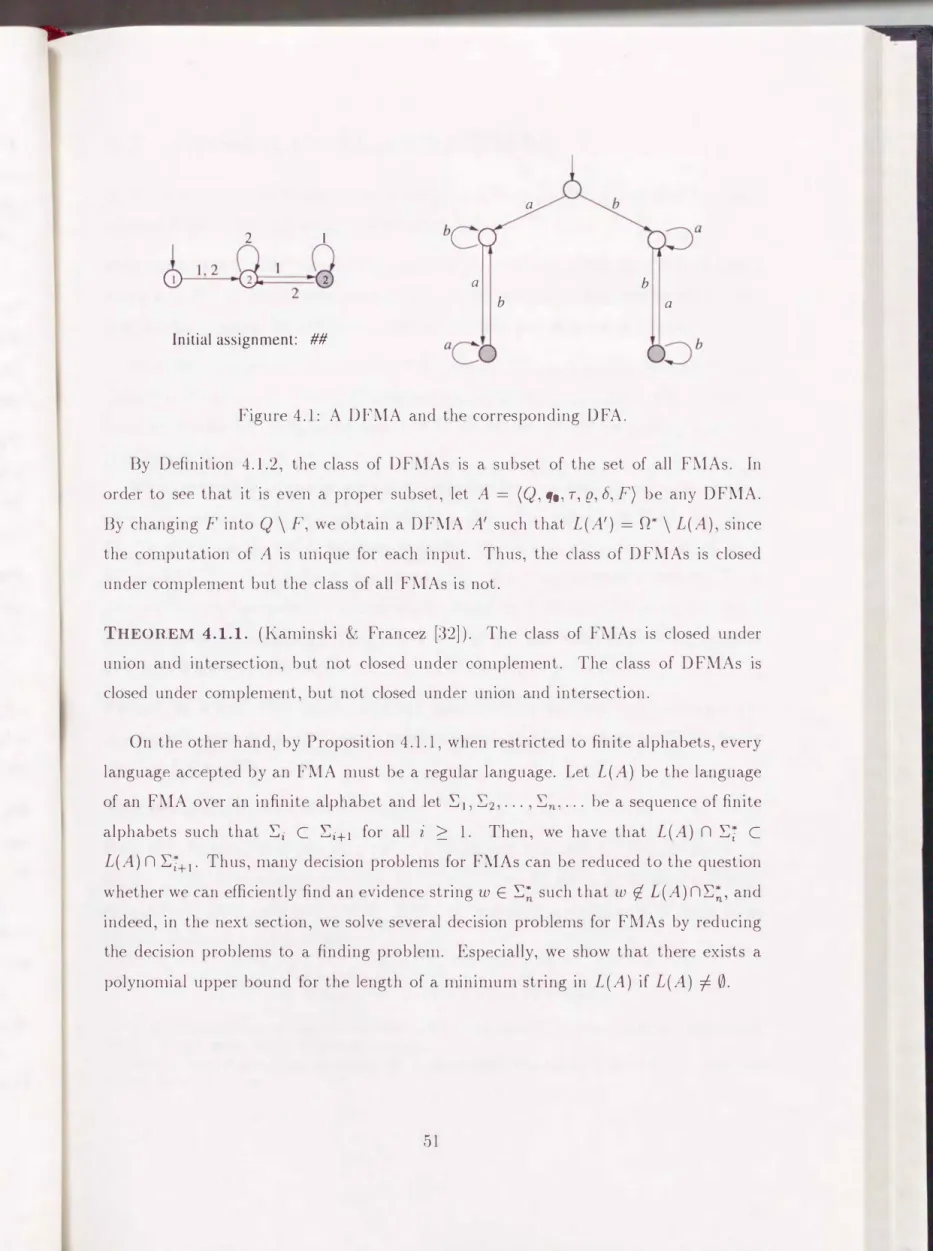
EXAMPLE 4.1.1. An example for an FMA with two regist rs is displayed in Fig
ure 4.1. Th registers ar initially mpty. Thus, th initial assignment is denoted by
The states from th left order are d noted by
q0, p
andq,
whereq0
is the initial state andq
is the unique final state. Since th transition r lation and reassignment are everywhere defined, this FMA is deterministic.An example run of this DFMA for the string
abae
is:(q0, rtrt)
�a(p, art)
�b(p, ab)
�a(q,ab)
�c(q,ae).
The languag ace pted by the DFMA isL = {awa I a En, wED*}.
Additionally, a corresponding DFA for th alphabet
� = {a, b}
is also illustrated.This DFA accepts the languag
{ewe I e E �' wE �*}.
a
2 1
�
2 a b b aInitial assignment: ##
ao·�M
Figure 4.1: A DFMA and the corresponding DFA.
By D finition 4.1.2, the class of DFMAs is a subset of the set of all FMAs. In ord r to se that it is even a proper subset, let
A= (Q,
q0, T, !],8, F)
be any DFMA.By changing F into
Q \ F,
we obtain a DFMAA'
such thatL(A') = n* \ L(A),
since the computation of A is unique for each input. Thus, the class of DFMAs is closed under compl ment but the class of all FMAs is not.THEOREM 4.1.1.
(
Kaminski & Francez[32]).
Th class of FMAs is closed und r union and intersection, but not closed under complement. The class of DFMAs is closed under complement, but not closed und r union and intersection.On th oth r hand by Proposition 4.1.1 wh n r tricted to finite alphabets every languag ace pted by an FMA must be a regular language. L t
L(A)
be the language of an FMA over an infinit alphab t and letL:1 L:2, ... , L:n,
...
be a sequence of finite alphabets such thatL:i
Cl:i+I
for all i � 1. Then, we have thatL( A)
nL:i
CL(A)
nL:i+I·
hus, many d cision problems for FMAs can be reduced to the question whether we can efficiently find an evidence string w EL:�
such that wrf_ L( A)
nL:�,
and indeed, in the next section, we solve several decision problems for FMAs by reducing the decision problems to a finding problem. Esp cially, we show that there exists a polynomial upper bound for the l ngth of a minimum string inL(A)
ifL(A) =/- 0.
4.2 Decision Problems for FMAs
In this section, w first study the membership problem* for FMAs as well as for deter
ministic FMAs. The definition is provided as follows.
PROBLEM 4.2.1. The membership problem
f
or FMAs IS given an FMA A and a string w E 0*, to decide wh ther w E L(A). The problem is denoted by MEM. The m mb r hip problem for DFMAs is defined similarly and denoted by MEMD.Since the computation time of an FMA equals the input length, we directly get MEMD E P and MEM E NP. A Turing machin simulating an FMA needs O(k log n
)
steps to r write the assignm nt, where k is the length of the assignment and n =
max
{ i I
ai
E[
w] } .
We show th P-hardness of MEMD by reducing the monotone circuit value problem to it. Th monotone circuit value problem is defined as follows ( cf.
[22]).
Let X ={Xi I li
ElN}
be th set of Boolean variables. We denote a circuit C over X by a sequence C1 C2, ... , Cn- Each component Ci (1 � i �
n)
is call d a gate ofct.
A circuit C is called monotone if C contains no negation. A truth assignment of a circuit ofm variables is a mappingf:{x1, ... , xm}---+ {0,1}.
The value ofC with respect to f is defin d as usual (cf.[50]).
PROBLEM 4.2.2. The monotone circuit valu problem, denot d by monotone Cvp, is given a monotone circuit C and a truth assignment
f
appropriate for C, to decide wheth rf(
C) = 1.THEOREM 4.2.1. MEMD is P-compl t
PROOF. We show that monoton CvP IS log- pac reducibl to MEMD. Let C =
cl) c2 .
. . Cn be a mono ton circuit, letxl) x2). . . Xm
b all variabl s in c and l tf
be any fixed truth assignment of C. First, w construct a string w E 0* from C as follows. For each
1 � i �
n, 1 t( ') { ai,
if Ci =Xi,
wz =
akaja·i, if C
i
= Ck 1\ Cj or Ci
= Ck v Cj.*In d cision problems, we assume a symbol ai E n = { aj
I j
E lN} to be encoded by a followed by bin(i) E {0, 1}*, where bin(i) denotes i in binary.twithout loss of generality, we assume the m input gates of a circuit C to be C1, ... , Cm, i.e., C'i =Xi fori= 1,
...
, m.The string
w
is th concatenation of all w(i)
's,
that is,w
=w(1)w(2)
· · ·w(n).
Computing
w
can be done in O(logn
)-space.Next, we have to construct an FMA
A
=( Q, q0, T,
(!, 8,F).
We set T =�2n,
and define th set Q of states as well as the reassignment (! by distinguishing the following cases for alli E {
1'.
..'n}.
Ifei
=Xi
we add the statePi
to Q and sete(Pi)
=i
provid d
f(xi)
= 1 ande(Pi)
=n + i
otherwise. Ifei
is not an input gate, we add four statesPi, Pi1, Pi2, Pi3.
Furth rmore, we sete(PiJ
=i, e(Pi3)
=n + i
in caseei
=e k
1\ej
and
e(PiJ
=n + i, e(PiJ
=i
ifei
=ek
Vej.
Clearly, this computation can be done in O(log n )-space.For each 1
::;
i::; n,
th transition relation 8 is defined as follows:2.
Letei
=ek
1\ej;
we distinguish the following cases:(a) If
i
<n
then let(pi,k,piJ, (pi,n + k,pi3), (Pi1,J,Pi2), (Pi1,n + j,piJ,
(Pi2,i,Pi+I), (Pi3,j,piJ, (Pi3,n + j,pi3), (Pi3 n + i,Pi+I) E
8.3. Let
ei
=ek
Vej;
we distinguish the following cases:(a) If
i
<n
then let(pi,n + k,Pi1), (pi,k,piJ, (Pi1,n + j Pi2), (Pi1,J,Pi3), (Pi2 n+i,Pi+I) (Pi3,J,Pi3) (Pi3 n + j Pi3), (Pi3,i,Pi+I) E
8.(b) In case
i
=n
l t(Pi n + k, Pi1) (Pi k Pi3) (Pi1 j, Pi3), (Pi3 j PiJ, (Pi3, n + j, PiJ, (Pi3, i, Pi+I) E
8.Finally, we define Qo =
PI
andF
={Pn+I}.
For each stat in Q, at most two tran itions are defined. Thus the FMA
A
can be computed in O(logn)
spac.
It remains to show thatwE L(A)
iffJ(e)
=1.
CLAIM 4.2.1. Let
i 2 1,
let(qo,T) r-w(I)w(2)···w(i) (Pi+I,ai+I)
and l t a be the last symbol ofw( i),
where( q0, T)
=(PI, ai )
. Then,ai+I [i]
= a iff( ei)
= 1 andai+I [n+i]
=a if
j(ei)
= 0.The proof is done by induction on
i.
By construction, only the gatesell e2 .. . , em
are variables. For each 1
::; i ::;
m,lw( i) I
= 1 ande(p) -j. e( q)
if p-j. q.
Thus, by the definition of A, the claim follows for alli
=1,
.. . , m.Next, assume the induction hypothesis for all
1 ::; i ::;
m. Note that, for each 1::; i ::; jTj,
the ith window is rewritten at most once, sinceg(p) -f g(q)
ifp -1
q. Now, leti �
rn; thenCi+l
=Ck
ACj
orCi+l
=Ck
VCj,
wherek
<j::; i.
First, w consider
Ci+l
=Ck
ACj.
If
f(Ci+I)
= 1, thenf(Ck)
= 1 andf(Cj)
= 1. By the induction hypothesis,ak[k]
=ak
andaj[j]
=aj.
Since these two symbols are never replaced,ai+I[k]
=ak
and
ai+I[j]
=aj.
Thus,(Pi+I,ai+I) �
aka](P(i+I)2,ai+I)·
Note thatw(i)
containsexactly on
ai
that does not appear in anyw(j)
for allj
<i.
Then,ai+l rf_ [ai+1].
Sincee(P(i+I)2)
=i +
1, it follows that(P(i+I)2, ai+I)
�a•+l(Pi+2, ai+2)
andai+2[i
+1]
=ai+l·
Thus,
(Pi+l ai+I) �w(i+l) (Pi+2,ai+2)
andai+2[i
+1]
=ai+l·
If
f(Ci+I)
= 0 th nf(Ck)
= 0 orf(Cj)
= 0. Suppose thatf(Ck)
= 0. By the induction hypothesis,ak[n+k]
=ak,
and thusai+I[n+k]
=ak.
Hence,(Pi+I,ai+I) �
ak(P(i+l)3' O'i+l)'
and by definition,(P(i+lb' O'i+l) �
a)(P(i+lb' O'i+I).
Sincee(P(i+l)J
=n + i + 1,
w also have(Pi+I, ai+I)
�aka1a'+1(Pi+2, ai+2).
Next, 1 t
f(Ck)
= 1. Sincef(Ci+I)
= 0, we concludef(Cj)
= 0. Thenai+I[k]
=ak
and
O'i+l[n
+j]
= aj. Thus,(Pi+l O'i+I) �
ak(P(i+l)p O'i+t)
and(P(i+l)p O'i+I)
�a1(P(i+Ih ai+I).
Again, sincee(P(i+Ih)
=n + i + 1,
we obtain(Pi+ I, ai+I) �
akaJa•+l(Pi+2, ai+2)·
Hence,(Pi+I, ai+I) �w(i+l) (Pi+2, ai+2)
andai+2[n + i + 1]
=ai+I·
Second 1 t
Ci+l
=Ck
vCj.
The reassignmente
onCi+l
is obtained from the reassignment forCi+l
=Ck
ACj
by switchingi + 1
andn + i + 1 j
andn + j,
andk
and
n + k
to one another, and th same witch s apply to 8. Thus, this case can be handl d analogously.Hence, for each
1 ::; i ::; n- 1, (p1,ai) �w(l)w(2)···w(i) (Pi+I,ai+I),
and for each 1::; j ::;
i,ai+
1[j]
=a
j ifff ( C j)
=1
andai +
1[ n + j]
=a j
ifff ( C j)
= 0. Now,(PI a!) �w(l)w(2)···w(n-l) (Pn an)·
Finally th computation(Pn, an) �w(n) (Pn+I, an+d
is defined only if
f(n)
=1.
This prov s Claim 4.2.1.We conclude that
f(C)
= 1 iffw
EL(A)
since F ={Pn+1}.
Ther fore, MEMD isP-complete.
Q.E.D.
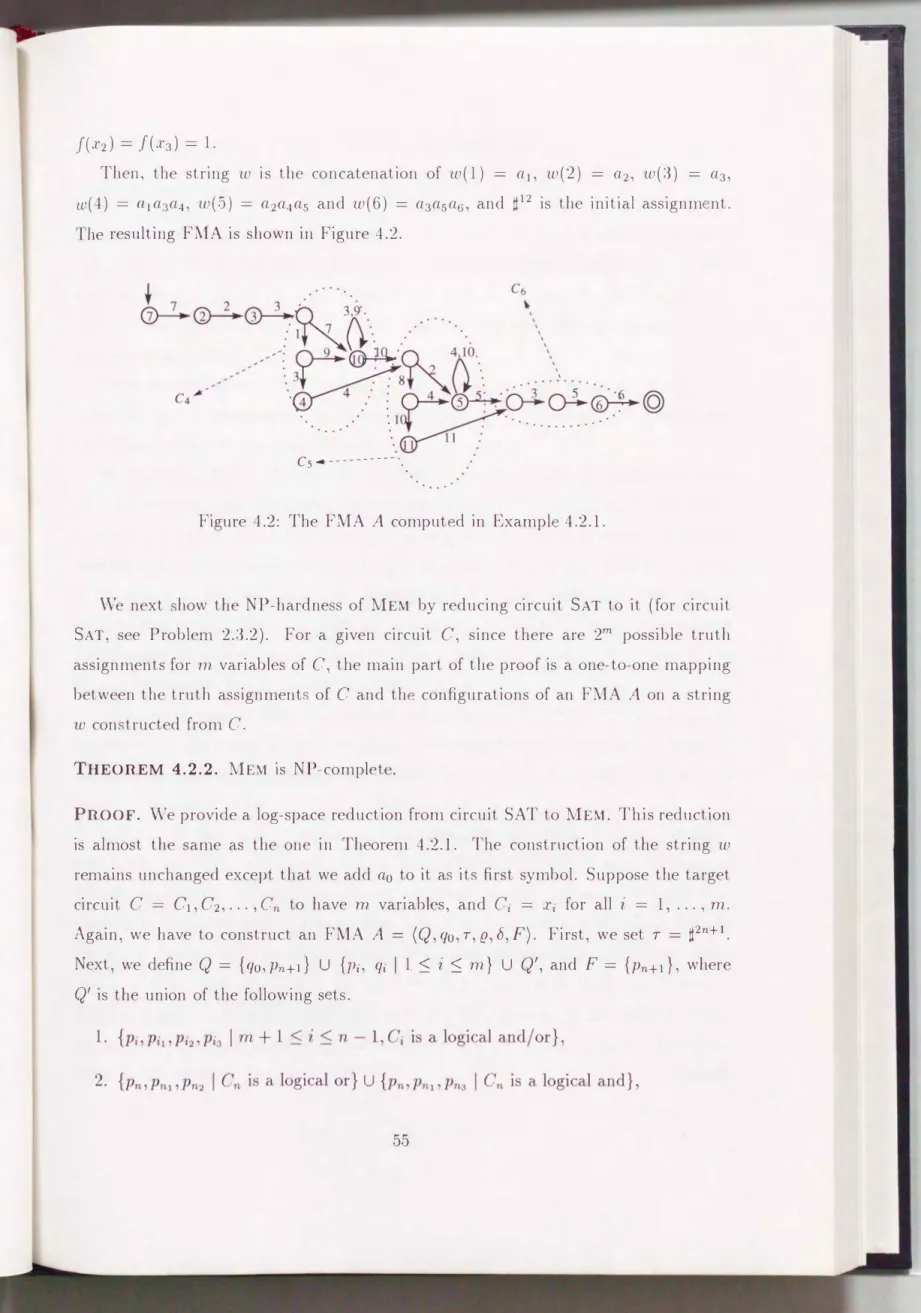
EXAMPLE 4.2.1. We illustrat th reduction d fined abov using the monotone cir
cuit
c
=cl, c2, ... 'c6,
wherci
=Xi
for i =1,
2, 3,c4
=cl
Ac3, Cs
=c2
vc4
and
C6
=C3
AC5
as well as the truth assignmentf
d fined asf(xi)
= 0 andj(x2)
=J(x3)
= 1.Then, the string
w
is the concatenation ofw(l)
=a1, w(2)
=a2, w
(3) =a3,
w(4) =
a1a3a4, w(5)
=a2a4a5
andw(6)
=a3a5a6,
and�12
is the initial assignm nt.The resulting FMA is shown in Figure 4.2.
Cs•---·.
Figure 4.2: The FMA A comput d in Exampl 4.2.1.
We next how the NP-hardness of MEM by reducing circuit SAT to it (for circuit SAT, see Problem 2.3.2). For a given circuit
C,
since there are 2m possible truth assignments form
variables ofC,
the main part of the proof is a one-to-one mapping between the truth assignment ofC
and th configurations of an FMA A on a stringw con tructed from
C.
THEOREM 4.2.2. MEM is NP-complet
PROOF. We provide a log-space reduction from circuit SAT to MEM. This reduction is almost the same as the on in Theorem 4.2.1. The construction of the string
w
remains unchanged except that we add
a0
to it a it first symbol. Suppose the target circuitc
=cl' c2, ... 'Cn
to havem
variables, andci
=Xi
for alli
= 1'... ' m.
Again, we have to construct an FMA A = (Q,
q0,
T, (}, 8,F).
First, we set T =�2n+l.
Next, we d fine Q =
{qo,Pn+d
U{pi, qi jl::; i::; m}
U Q', and F ={Pn+I},
wher Q' is the union of the following s ts.Finally, we define (} and 8 as follows. Let
e(q0)
=2n +
1 and let(q0, 2 n + l,pi), (qo, 2n+l, qt) E
8. For ach1 � i
< m, lete (p i )
= i and lete(qi)
=n+i.
Moreover, w put
(Pi i Pi+l) , (Pi
i,qi+I) E
8 as w ll as(qi, n +
i,qi+1), (qi, n + i, Pi+l) E
8.Fori= rn, we d fin
e (Pm)
= m ande(qm)
=n
+ m. Also, let(Pm,m,Pm+I), (qm, n +
rn,Pm+d E
8.Since we can assume that for any
i �
m+ 1, C i
=Ck
1\Cj
orC i
=Ck
vCj,
wher k <
j
<i.
Th gates can be treated exactly as in Theorem4.2. 1 .
Clearly, th reduction is O(logn
)-spac computable.We show Lhat
f( C)
=1
iffw E L(A).
First,A
readsa0
in stateq0,
it writesa0
in the2n +
1st window, and changes its state nondeterministically top1
orq1.
Furthermore, for each 1�
i < m, whenA
readsw(i)
=ai
in a statePi,
theai
is written in the ith window andA
nondet rministically changes its tate toPi+l
orqi+l·
IfA
is in a state qi, then ai is written on th n + ith window and A nondetern1inistically changes its state toPi+l
or qi+l· When A readsam
in statePm,
it writesam
in the mth window and changes its state toPm+l·
Suppose,A
is in stateqm·
Thenam
is written in the( n +
m )th window, butA
changes its state toPm+l,
too.Thus there xist 2m distinct computations on
(
q0 T) �aow(l)w(2)···w(m) (Pm+l, am+d·
Moreov r w can easily defin a on -to-on correspondence betw en the 2m possible assignm nt
am+
I and all pos ible2m
truth as ignn1entsf
: X -+ {0,1 }m
by settingXi
1--t 1 providedA
writesw( i)
in the ith window andXi
1--t 0 oth rwise.Let i > m; th cases of logical and/ or gates have alr ady been shown in Theo
rem
4.2.1.
Letci
=--.cj w(i)
=ajai
and(qo,T) �aow(l)w(2)···w(i-l) (Pi ai)·
Sinceaj
already app ars in w
(
l)w( 2)
· · · u(i-
1),ai[j]
=aj
orai[n + j]
=aj.
Iff(Cj)
=1,
then
ai[j]
=aj
and iff(Cj)
= 0, th nai[n + j]
=aj.
Ifi
< n, whenA
reads theaj,
it changes its state toPi1
ifai[j]
=aj,
and changes toPi2
otherwise. Sinceg(piJ
=n
+i
ande(PiJ
= i,(pi,ai) �a1a' (Pi+l,ai+t)
such thatai+I[i]
=ai
iff( C i)
= 1 andai+l [n
+ i]
=ai
if f(Ci)
= 0. If i =n,
thenPn1
is not defined. Thus,(Pn,an) �a1a' (Pn+l,an+d
iff J( C n )
=1 .
Hence,J(C)
=1
iffwE L(A).
Therefor ,MEM is NP-complete. Q.E.D.
Next, we study further decision problems for FMAs, that is, the non-emptiness and inequivalence probl ms. We b gin with the non- mptiness problem for FMAs defined as follows.
PROBLEM 4.2.3. The
non-emptiness problem jo1· FMAs
is given an FMAA,
to d - cide whetherL(A) =J
0. This problem is d noted by --.EMP. The non-emptiness problem for DFMAs is defined similarly and denoted by --.EMPD.Whil an FMA deals with an infinite alphabet, we can reduce it to a finite alphabet using the Proposition 4.1.2 which tells us that if a string
w
is accepted byA,
then the string1r(w)
for any 7r is accept d byA.
Vic versa, ifw ¢:_ L(A),
then so is1r(w)
for any permutation 1r.Mor ov r, Kaminski and Francez
[32]
showed that ifA
accepts a stringw
of length n, then A also ace pts a stringw'
of length n such thatll[w]ll
:S k, wher k is the length of the initial assignm nt. Thus,II [w] II
of any string accepted byA
can be reduced to be finite. However, we can not conclude --.EMPE
P from their result, since it is not providing an upp r bound on the length of a minimum string ace pted. Thu first we have to show an upper bound on the length of minimum strings accepted byA.
Clearly, in order to establish --.EMP
E
NP, this upp r bound has to be polynomial in the siz of A.Let
A
=(Q, q0 T
e,8, F)
be an FMA and let n b an assignment ofA
whereIIQII
= n andITI
= k. ByC(A)
w denote th t {(p a)I (q0 T)
1-* (p,a), pE Q
a ED U{�}k}.
A state p is said to breachable
if (p, a)E C(A)
for some a. By a we denote the set{ i I
1 :Si
:S k, a[ i] =J �}.
Now w ar r ady to prove the announced upper bound.LEMMA 4.2.1. If an FMA
A
=(Q q0, T,
e8, F)
ace pts at least one string w, then there is also a stringw'
such thatlwl
:S kn, wh re k =ITI
and n =IIQII·
PROOF. Assume any FMA A =
(Q, q0, T,
e,8, F)
and any stringw E L(A).
Thenw = b1 b2
·
· · bm for some m 2:: 1. If m :S kn, we ar done. Now, suppose that m > kn.Since
wE L(A),
there exists a computation c =(q0,T)
l-b1 • • • f-bm (p,a) with pE
F.Without loss of generality, w can also assume that p is the first state in c b longing
to F. Cons]der any con1putation step of the form
(Pi-l,ai_1)
r61(Pi,ai)
such thatai-l
=ai.
There ar two cases to be distingui hed.Case 1.
bi
E[ai-l]·
Then then the computation does exclusively depend on 8, that is,
ai-l
=ai.
Assum
bi
to be found at positionj
inai-l·
If(Pi-1,J,Pi-l)
E 8 andPi = Pi-l,
then we just r movebi
from w. L t w' be the resulting string. Clearly, w E L(A) iff w' E L(A).Otherwis , A has to reach a state that is different from
Pi-l·
The worst-case would happen, if the following symbols in w are equal tobi,
since thenj
remains unchanged.But even in this case, there are at most n-2 states being different from
Pi-l
and the possible singl ton tatp
1 E F. Finally, ifthen A must have reached on state twice or
Pi+n-2
is inF.
In the latter case, we are done again. Otherwise, i.e., ifPi+n-2 tf_ F,
we simply cut the whole circle by removing the corresponding symbols in w. Again, th resulting string is accepted iff w has been accepted.Case 2.
bi tf_ [ai-l]·
Then, the reassignment
g
i applied and we have again two cas s to consider. Letj
=g(Pi-1)
such thatai-l (j) f:- �·
Hence th r has already be n a symbol inai-l (j),
say tj. In this ca e we can r place
bi
in w by t1 without altering the computation and hence w are back to Cas 1.Now, suppos
ai-l #- ai,
that i ,j = g(pi_1)
such thatai_1(j)
replace
�
bybi.
Note that this case can happ n only k times.Cons quently, the resulting str]ng u can have a length at most kn.
LEMMA 4.2.2. -,EM
P
E NP.�·
Then, weQ.E.D.
PROOF. By Proposition 4.1.2 and Le1nma 4.2.1, it suffices to consider the finite al
phabet
'E = {
a1, ... , ak}
, w h re k =IT 1.
A nondeterministic Turing machine M that accepts -,EMP in polynomial tim b haves as follows. Given an FMA A =(Q, q0, T, g,
8,F),
the machine gu sses a string w E'E*
withlwl :::;
kn, where n =IIQII
as well as a state
p
E F and an assignm nta
E('E U {�})k.
If(q0,T)
r--w(p,a),
the machine M accepts A.By Lemma
4. 2.1,
!VI behaves correctly, and clearly, M works in time polynomial inthe siz of A.
Q.E.D.
In order to prove th NP-completeness of •EMP, we recall the satisfiability problen1, denoted by SAT (for this problem, see Probl In
2.3.1).
Letn 2:: 1,
and let G ba Boolean formula in conjunctive normal form over
X = { x1, ... , x2n},
where thex1, ... , Xn
are variables of G andXn+i = •xi
for alli
=1, ... , n.
For each clausCi = fj1
V · · · Veik
of G,eiz EX
for z=
1,.
..
, k. In particular, we use(Ci)
to denote the set{jl, J2, .
.., j k}.
Summarizing the r sults obtained above, we arrive at the following theorem.
THEOREM 4.2.3. •EMP is NP-complete.
PROOF. By Lemma
4.2.1
and4.2.2,
it suffices to prove that SAT is log-space reducible to •EMP. Letn 2:: 1,
and let G= /\J"=1 Cj
be a Boolean formula in conjunctive normal form ov rX= {x1, ... , X2n}·
Th want d FMA A
= (Q, q0,
T, {!,8, F)
is d fined as follows. Q ={ qi I
0::;
i::;
2n +
m+ 1},
T= {�}2n+I, F = { q2n+m+1}, e(q0)
=2n + 1
and for eachi::; 2n,
we sete( qi) = i.
Finally, we define8 = 81
U82
U83,
wh re2. 82 = {(qi, i qi+I), (qi, i, qn+i+l) 11::; i::; n-1}U{ (qi i qi+I) (qi, i, qi-n+l) I n+1::;
i ::; 2n -
1}
, andNote that th FMA A is loop-fr e. Th tate
qi
corre pond to the positive literalxi
andqn+i
to•Xi.
For achqi,
exactly two transitions(qi, i, qi+l)
and(qi, i, qn+i+I)
are defined if i is odd and
1 ::;
i::; n -
1, and exactly two transitions(qi, i, qi+l)
and
( qi, i, qi-n+d
are defin d ifi
is ven andn
+ 1::; i ::; 2n -
1. For the statesqn
and
q2n,
the transitions(qn, n, q2n+d
and(q2n 2n, q2n+d
are d fined. Thus, for eachs
� { 1 , 2,
.. ., n}
ands
={n
+1::; i::; 2n I i-n rf_ s},
there exists an aE (D
U{�})171
such that
(qo,
T)
�*(q2n+l,
a)
anda[j] En
iffjEsus (1 ::; j::; 2n).
Now, we prove that G is satisfiable iff
q2n+m+I
is reachable. Note that (} is undefined for eachq2n+i (1 ::; i ::;
m+ 1).
Thus, all computations fromq2n+I
depend only on the assigniTI nt 0'. For each 1::;
k::;
m, the clauseck
is satisfiable by a truth assignmentj
iff ther xists a lit ral of a variableXi
appearing inCk
such thatj(xi)
= 1 orJ( •Xi)
= 0( 1 ::; i ::; n).
By construction, the latter condition is fulfilled iff there exist a s t �{1,2, ... n}
with s ={n+ 1::; i::; 2n I i-n tf_ s}
such that i Es
ori + n
E :S. This condition is equivalent to the existence of ana
such thata[i]
E !1 ora[i + n]
E !1. Finally, the latter condition holds iff(q2n+k,i,q2n+k+1)
or
( q2n+k, i + n, q2n+k+
I)
ar defined. Hence, G is satisfiable iffq2n+m+l
is reachable.Therefore,
•EMP
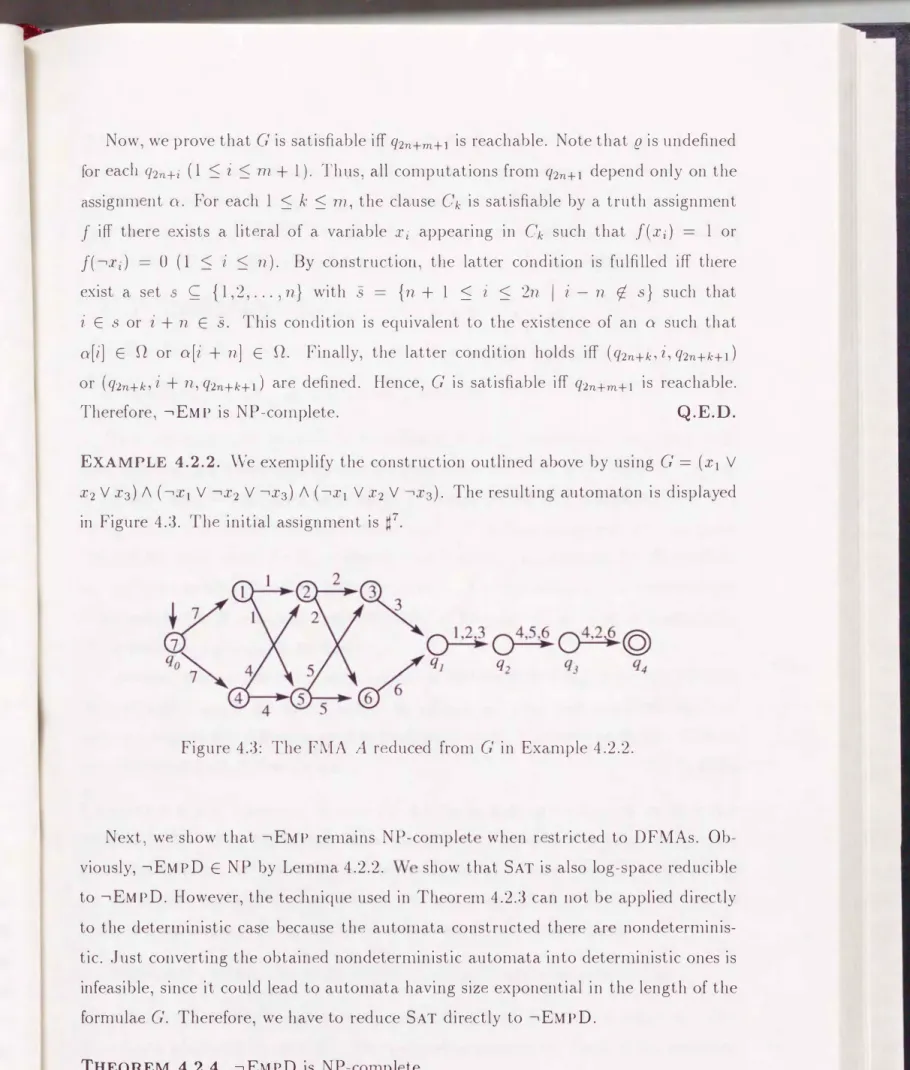
is NP-complete. Q.E.D.EXAMPLE 4.2.2. We ex mplify the construction outlined above by using G =
(x1
Vx2
Vx3)
1\( •x1
V•x2
V•x3)
1\( •x1
Vx2
V•x3).
The resulting automaton is displayed in Figure 4.3. Th initial assignment isr.
Figure 4.3: The FMA A r duced from G in Example 4.2.2.
Next w show that
•EMP
remains NP-compl t when r stricted to DFMAs. Obviously,
•EMPD
E NP by Lemma 4.2.2. We show that SAT is also log-space reducible to•EMPD.
However, th technique used in Theor m 4.2.3 can not be applied directly to the deterministic case because th automata constructed there ar nondeterministic. Just converting the obtain d nondeterministic automata into deterministic ones is infeasible, since it could lead to automata having siz exponential in the length of the formula G. Therefore, we have to reduce SAT dir ctly to
•EMPD.
THEOREM 4.2.4.
•EMPD
is NP-compl te.PROOF. W have to show that SAT is log-spacer ducible to --.EMPD. Let n � 1, and let let G
= /\j=1 C1
b a Boolean fonnula over X in conjunctive normal form.Th n an FMA
A= (Q,q0,r,g,8,F)
is computed as follows. LetQ = {qi I
0:::;i:::;
2n
+ n-z, +1},
1 t T= {�}2n+l,
1 tF = {q2n+m+1},
and setg(q0) =
2n + 1 as well asg( qi) = i
for all l:::; i
:::; 2n. Furth rmore, we s t8 = 81
U8 2
U83,
whereNot that ach path from th initial state
q0
toq2n+2
contains no loop. Each path fromqo
toq2n+2
contains xactly one of two edg s labeledi
or n + i for all 1:::; i
:::; n.Then, for every string w we hav
(q0, r)
�w(q2n+2 a)
iffa[i]
-:/- � ora[n
+i]
-:/- � for all 1 :::;i :::; n.
Moreover, there exist exactly2n
distinct configurations(q2n+2,
a).Thus, th r exists a one-to-one mapping from the truth assignments for all variables
x1, x2,
..., Xn
to th possible assignments onq2n+2.
The remaining part of the definition of the automatonA
is the same as in the proof of Th orem 4.2.3. Thus, G is satisfiable iff the final stateq2n+m+l
is reachable.However, inc om states are not lab led and some transitions are not defin d, th automaton i till not d terministic. By adding an extra state as a trash box, it is easy to compl t the definition of
A
to b d t rmini tic. We omit th details. Clearly,the computation of
A
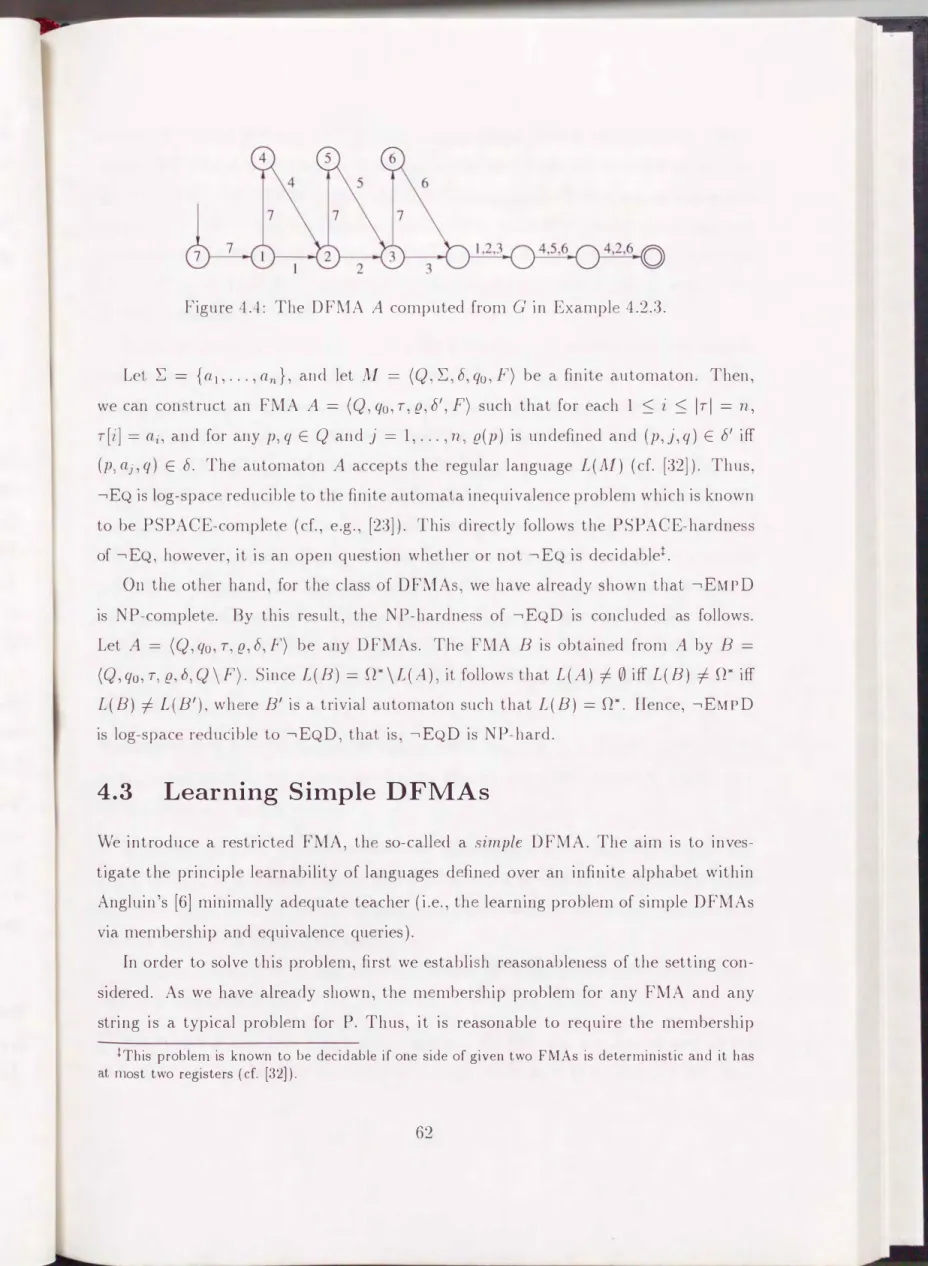
is in log-space. Q.E.D.EXAMPLE 4.2.3. Again, let us take th 3-CNF in Exan1ple 4.2.2 and we show the reduced DFMA
A
in Figure 4.4. This automatonA
has also the initial assignm nt�7.
Although some transitions ar not defined inA,
for instance there is no transition for the initial state and the first window, we put a special state p as a trash box for undefined transitions. Thus, this automaton is essentially deterministic.Additionally, we mention more difficult problem inequival nee for FMAs.
PROBLEM 4.2.4. Th inequival nee probl m for FMAs
A
and B, denoted by --.EQ, is to decide whetherL(A)
-:/- L(B). This problem is denoted by --.EQD if the automataA and B are both deterministic.
Figure 4.4: The DFMA
A
computed from G in Exampl 4.2.3.Let�= {a1,
• • . , an}
, and let M =(Q,�, 8, q0, F)
be a finite automaton. Then, we can con truct an FMAA
=( Q, q0, T,
(},8', F)
such that for each 1 :s; i :s;IT I
= n,T[i]
= ai, and for any pq
EQ
andj
= 1, ..
. , ne(p)
is undefined and(p,j, q)
E8'
iff(p
aj,q)
E8.
The automatonA
accepts the regular languageL(M)
(cf.[32]).
Thus•EQ is log-spac reducible to the finite automata inequivalence problem which is known to be PSPACE-compl te ( cf., e.g.,
[23]).
This directly follows the PSPACE-hardness of •EQ, however, it is an open question whether or not •EQ is decidablet.On th oth r hand, for the class of DFMAs, we have already shown that •EMPD is NP-complet . By this result, the NP-hardne s of •EQD is concluded as follows.
Let
A
=(Q, q0,
T,e, 8, F)
be any DFMAs. The FMA B is obtain d fromA
by B =(Q
,q
o,Te,8 Q\F).
SinceL(B)
=!l*\L(A)
it follow thatL(A)-#
0 iffL(B)-# !1*
iffL(B)-# L(B'),
wh re B ' is a trivial automaton such thatL(B)
=!1*.
Hence, •EMPDis log-spac r ducible to •EQD that is •EQD is NP-hard.
4.3 Learning Simple DFMAs
We introduce a restrict d FMA, th so-call d a imple DFMA. The aim is to inves
tigate the principl 1 arnability of languages d fin d over an infinite alphabet within Angluin's [6] minimally ad quate teacher (i.e., th learning probl m of simple DFMAs via membership and equivalenc qu ries).
In order to solve this probl m, first we establi h reasonableness of the setting con
sidered. As we have already shown, the m mbership problem for any FMA and any string is a typical probl m for P. Thus, it is reasonable to require the membership tThis problem is known to be decidable if one side of given two FMAs is deterministic and it has at most two registers (cf. [32]).
orad . On the oth r hand, while it is an open question whether the equivalence prob
lem for DFMAs is NP-hard ven if the automata are simple, we pr sent a procedure, giv n any two sin1pl DFMAs, to output a counterexample if they are not equal and output "y s" oth rwise. For the corT ctness of this procedure, we -first show that two auton1ata A and B are not equivalent iff there exists a finite alphabet
EA,B
such that L(A) nE�,B =J L(B)
nEA.,B·
Thus, it also se ms to be r asonable to require the equival nc oracle.N xt, we show the learnability of simple DFMAs using membership and equiva
lence queri s. Our learning algorithm is partially based on Angluin's observation table technique ( cf. [4]). However, sine the size of an alphabet is potentially infinite in our s tting, it is impossible to directly apply her notion. As we have already seen, the model of FMAs is a natural extension of DFAs (i.e., for every finite alphabet and every FMA th re xisLs a DFA consist nt with the th FMA over the alphabet). For the class of simple DFMAs, we show such a DFA to be computable by membership and equival nee queries using an observation tabl . Furthermore, we also provide th
method to transform the DFA to a simple DFMA, thereby pre erving consistency.
Consequently for each finite alphabet and each targ t, the algorithm can compute a simple DFMA consistent with the target over that alphabet. Together with the first re
sult we conclud that our algorithm can learn every sirnpl DFMA using membership and equivalence queri s.
DEFINITION 4.3.1. A simpl FMA i an FMA A =
(Q,
q0, T, e, p,,F)
such that its initial assignm nt contains no symbol in n, that i , T E {�}*. A simple DFMA is a DFMA A such that A is simple.In Definition 4.3.1, we use th differ nt expr ssion p, as a transition of an FMA and a DFMA. It is b cau that in thi s ction, the 8 is used as transitions for DFAs as usual. Thus in order to distinguish th se transitions, we set p, for finite-memory automata and 8 for finite automata.
Next, for decidability of quivalence of simpl DFMAs, we forn1ally define consis
tency for simple DF MAs.
DEFINITION 4.3.2. L t A and B b simple DFMAs. We say that A and B are consistent over an alphabet
E
if for every string w EE*,
w E L( A) iff w E L( B). Thisis denoted by
A �L:
B. In particular, when the alphabet is n, we say thatA
and B areequivalent,
denoted byA�
B. Similarly, for finite alphabets, we use this notation for DFAs.In Figure 4.5 below, we provide an algorithm DEC deciding whether or not any two sin1pl Dl� MAs
A
and B are equivalent. The behavior of DEC can be summarized as follows. Let A =(QA,qt,TA,eA,flA,FA)
and B =(Q8,qt,T8,g8,fl8,F8).
Furthern1or , let k = max
{ jTAj
,jT8j}.
Then, DEC takesA
and B as input, and computes� =
{ a1, a2,
... ,a
k} ·
N xt, it computes a particular set of configurations ofA
and of B d fin d on L: as follows.For the A let
C(A)
=QA
x(L:U{�} )ITAI.
Initially, letC(A, 0)
={(q0, TA)}.
For eachi
E lN, w proc d inductively. For alli � 1
we defineC(A, i)
=C(A, i -1) U C(A)i-I,
wher
C(A)i-I
={c
EC(A) I �a
EL:, �c'
EC(A,i- 1), c'
�ac}.
IfC(A,i)
=C(A, i- 1)
for ani � 0,
then 1 tC(A)
:=C(A, i).
Analogously,C(B)
is computed from B.Now, using
C(A),
the algorithm DEC computes a DFAMA
=(Q,
L:,b, q0 F)
as follows.Q
:=C(A) q0
:=(qt,TA) b � C(A)
x L: xC(A)
wher(c a,c')
Eb A
iffc
�ac'.
Furthermore,F � C(A),
where(p, T)
EF
iffp
EFA.
The automaton1148
is defined analogously. Now, using any standard algorithm for testing equivalence of two DFAs a a subroutine, DEC d cides wheth r or notL(J\.,fA)
=L(!II8),
and returnsyes' and 'no re pecb vely.
As it was hown in
[32],
for any FMAA
and any finite alphabet �, there exists a DFA M such that M�l: A
and M is computable fromA
and L:. Thus, we can establish the termination of DEC and for any giv n simpl DFMAsA
and B, and any finite L:, w can d cid wh ther or notA �l:
B. W show that there exists a number k depending onA
and B such thatA �l:
B irnpliesA �
B for a finite alphab t L: of cardinality k.First, we consider reflecting a string w E !1* to a string w' E L:* such that the transition of states of
A
on w is preserved. That is, w propose a method computing for every w E !1* a string w' EL:*
such thatA(
w)
=A(
w')
for a sufficiently larg butfinite L:. In order to formalize this idea, we ne d the following d finition.
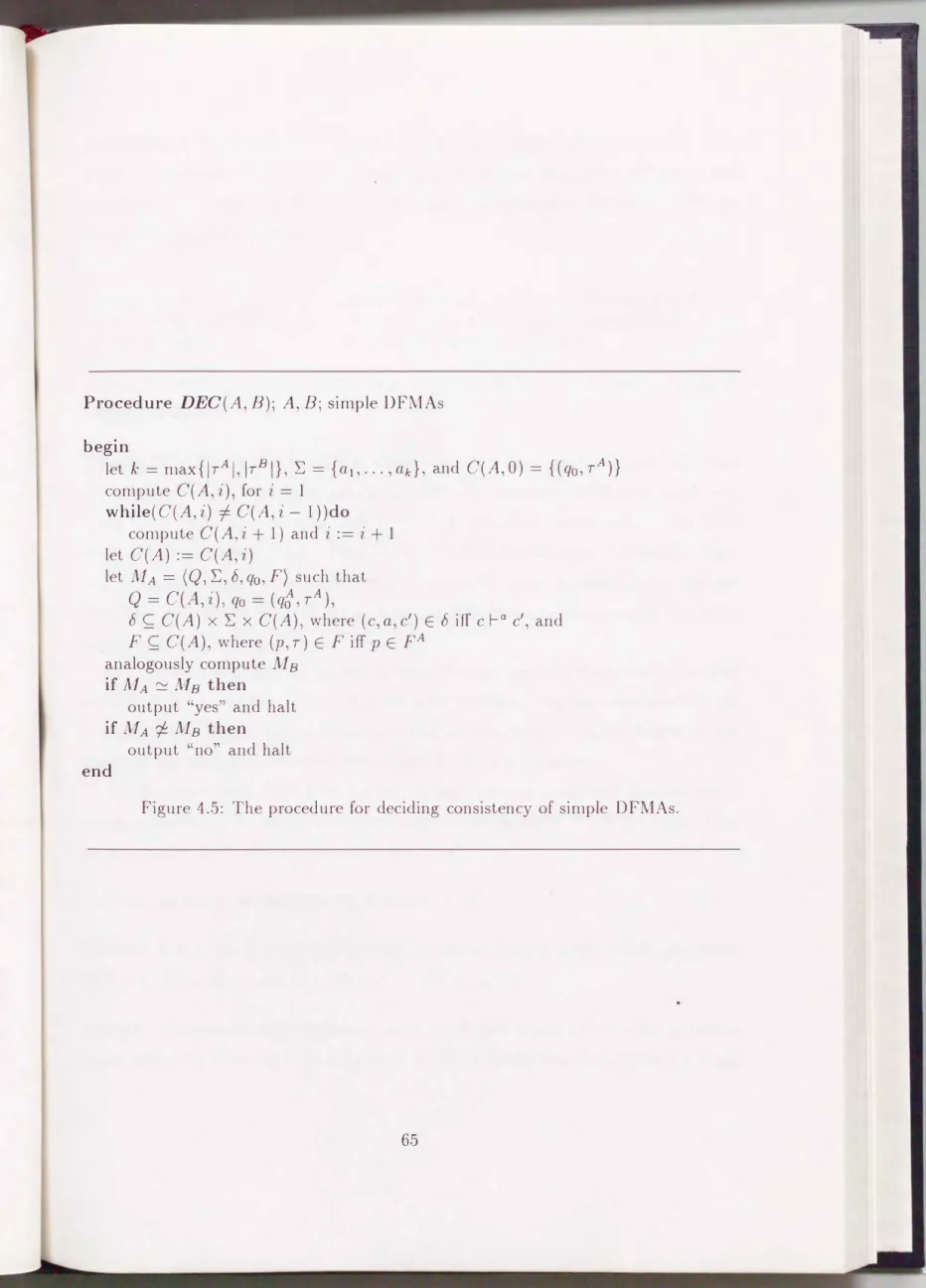
Procedure DEC(A,B); A,B;
simple DFMAsbegin
let k =
max{JTAJ,JT8J},
� ={a1, ... , a
k} ,
andC(A,O)
={(qo,TA)}
compute
C(A,
i), fori= 1while(C(A,
i)# C(A,
i-1))do
compute
C(A,
i +1)
and i := i + 1 letC(A)
:=C(A,i)
let
MA
=(Q, �'
8,q0, F)
such thatQ
= C(A,i)qo
=(qt,TA),
8 �
C(A)
X � xC(A)
where(
c, a, c')
E 8 iff c f-a c', andF
�C(A),
where(p,T)
EF
iff p EFA
analogously compute
Ms if MA
�M8 then
output 'yes and halt
if MA 7:- Ms then
output 'no" and halt
end
Figure 4.5: Th procedure for deciding consistency of simple DFMAs.
DEFINITION 4.3.3. Let A =
(Q,
q0T,
g, �LF)
be a simple DFMA and � a finite alphabet of cardinality k =IT
1. Then, for w E n+, we define sets w�
recursively as follows. For each a E n, 1 t a�
= �. Then, for each a E n and w E n+, l t(
wa)�
=Uw'Ew� {
w'a'}, wherea1EL:
if a=
Tw[i]
or a� [Tw],
a=Twa[i]
and��[Tw]
if a
� [Tw],
a=Twa[i], Tw[i]-::/-
�and� E[Tw]
if a �
[Tw],
a=Twa[i], Tw[i]
= �·For the r ader's understanding, we show an application of this notion taking an exampl a follows.
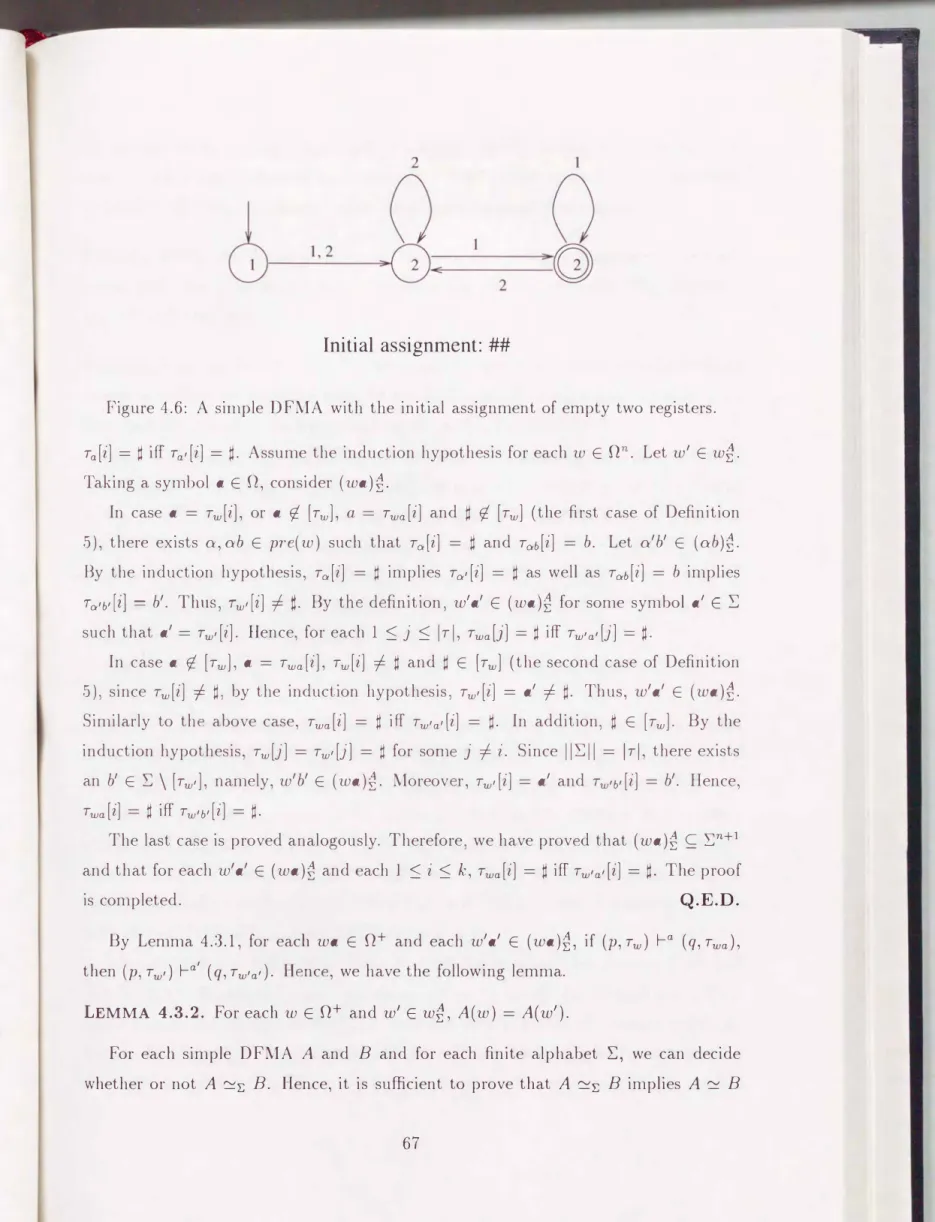
EXAMPLE 4.3.1. A simple DFMA, denoted by A, is illustrated in Figure 4.6. Since
ITI
=2,
s t � ={
al, a2}· Now, asa6alla6 En+. By Definition 4.3.3, al E(
as)�
= �.Since
Ta5
as�
,Ta5a6
= asa6, andTa1
= a1�
, this case corresponds to the third condition of Definition 4.3.3. Then, a2 E �\ [Ta1]
follows a1a2 E(
asa6)�
. SinceTa5a6
= asa6Ta5a6a11
= a san, andTa1 a2
= a1 a2 this case corresponds to the first condition of Definition 4.3.3. Then, a2 =Ta1a2 [2]
follows a1a2a2 E(
asa6an)�.
Similarly,a1a2a2a2 E
(
asa6alla6)�
.On this simple DFMA A, the first symbol of every input is substituted in the first window of the assignn1 nt. Once A reads other symbol , they are substituted in the second window. Thus ther is no computation su h as
(p
a�)
r6 (q b�). Hence, in this example, th econd condition of Definition 4.3.3 do s not happen.On the other hand, the string a2a1a1a1 is also in
(
asa6a11a6)�
and the two stringsa1a2a2a2 and a2a1a1a1 can simulate the computation (q0, ��)
r-asa6a11a6
(q1, asa6)
. That is, asa6ana6 E L(A) iff a1a2a2a2,a2a1a1a1 E L(A).Next, we formalize the prop rty of strings in w
�
.LEMMA 4.3.1. Let wE nn and w' E w
�
, wher the length of the initial assignment of A is k. Then, for each 1:::;i:::;
k,Tw[i] =�iff Tw'[i]
= �·PROOF. The proof is done by induction on th length of w E n+. For the induction basis, let a En. Then, a
�
= � and since T E {�}*,it is also true that for each a' E a�
,Initial assignment: ##
Figure 4.6: A simple DFMA with the initial assignment of empty two registers.
Ta[i]
=�iff'a'[i]
= �- Assume the induction hypothesis for eachw E nn.
Letw' E w�.
Taking a syn1bol
a E n,
consider( wa )�.
In case
a
=Tw[i],
ora
tf_[Tw], a= Twa[i]
and� tf_[Tw]
(the first case of Definition 5), there existsa, ab E pre(w)
such thatTa[i]
= � andTab[i]
=b.
Leta'b' E (ab)�.
By the induction hypothesis,
Ta[i]
= � impliesTa'[i] =
� as well asTab[i]
=b
impliesTa'b'[i]
==b'.
ThusTw'[i] #- �- By th
d finitionw'a'
E(wa)�
for some symbola'
E �such that
a'= Tw'[i] .
Hence, for each 1� j � ITI, Twa[)]=�
iffTw'a'[j] =
�-In case
a
tf_[Tw], a
=Twa[i], Tw[i]
-1-� and �E [Tw]
(the second case of Definition 5) sinceTw[i]
#-� by the induction hypothesisTw'[i]
=a'
-1-�- Thus,w'a' E (wa)�.
Similarly to th above case,
Twa[i]
= � iffTw'a'[i]
= �- In addition �E [Tw]·
By the induction hypothesisTw[j]
=Tw'[j]
=�for som j -1-i.
SinceIIL:II
=ITI,
there exists anb' E
l:\ [Tw'],
namely,w'b' E (wa)�.
Moreov r,Tw'[i] =a'
andTw'b'[i]
=b'.
Hence,Twa [ i]
= � iffT w'b' [ i]
= �.The last ca e is proved analogously. Therefore we have prov d that
( wa )� � L:n+I
and that for each
w'a' E
(wa)�
and ach 1� i �
k,Twa[i]
=�iffTw'a'[i]
= �- The proofis completed. Q.E.D.
By Lemma 4.3.1, for each
wa E n+
and eachw'a' E (wa)�,
if(P,Tw) �a (q,Twa),
then
(p, T w') �a' ( q, T w'a') .
H nc , we have the following le1nma.LEMMA 4.3.2. For each
w E n+
andw' E w�, A( w) = A( w').
For each simple DFMA
A
and B and for each finite alphabet L:, we can decide whether or not A �E B. Hence, it is sufficient to prove that A �E B implies A � Bfor the equivalence problem, where
JJL..JJJ = max{jTA J, jTB J} .
Moreover, by Lemma 4.3.2 this condition is simplified to that for eachw
E n+, there existsw'
E E+ such thatw' E
w� n w�.
The next lemma is the most critical part of this section.LEMMA 4.3.3. L t A and B be simple DFMAs with initial assignments
TA
andTB
respectively. L t L..J be an alphabet of cardinality k
= max{jTAj, jTBj}.
Then, for eachw
E n+w� n w� f= 0.
PROOF. Suppos that
jTAj � jTBj.
We show the desired result by induction on the 1 ngth ofw.
For the induction base, leta
Et.
Clearly, for eacha
E n,a� = a� =
E.OW' assum the induction hypothesis on nn' n
� 1.
Letwa
E nn+l.Case 1. Let
a
E[T;] n [T!]
. Then, there existsw'
Ew� nw�
such thatw'T;,[i]
E(wa)�
fora = T;[i]
andw'T!,[j]
E(wa)�
fora = T![j],
where 1:::; i :::; jTAj
and 1:::; j :::; J TB J.
Sinea
E[ T;],
we can assume thatw = aa{3
for somea
ED*
and j3 E(D\ {a})*.
By the induction hypothesis, there xistsa'a'f3'
E(aa{3)� n (aa{3)�.
Since
a ti [{3]
anda
E[T;] n [T!], T:a[i] = u�[i]
=T!aUJ = T![j] = a.
Thus by Lemma 4.3.1T:,a
,[i] = T:,[i] = T!,a,[j] = T!,[J] = a'.
Thusw'a'
= W1T:
,[i]
E(wa)�
and
w'a' = w'T!,[j]
E(wa)�.
That is,(wa)� n (wa)� f= 0.
Case 2. Let
a ti [ T;]
U[T!].
SinceJJEJJ = jTBj � jTAj
we can take aw'
Ew� n w�
such that
[T;,] � [ T!,]
.If
[T!,]
i a proper subs t of E, that is at 1 ast on window ofT!
, contains no symbol in E, then a ymbola'
E E\ [T!,]
is not in[T;,].
Thuw'a'
E(wa)� n (wa)�.
If
[T!,J = E,
then, by Lemma 4.3.1,T![j] =
bandT!aUJ = a
impliesT!, [ j] = b'
for some
b'
EE
and 1:::; j :::; jTBj.
Th n, let w'= a'b'{3',
whereb' ti [{3].
Sinceb'
E[T:,6,] n [Tt,6,]
andb' ti [{3'], w'
Ew� n w�
impli sw'b' = a'b'f3'b'
E(wb)� n (wb)�,
where
b = T![j].
Sinea ti [T!], � ti [T!]
andb
E[T!],
by th definition,(wb)� = (wa)�.
Similarly,(wb)� = (wa)�
ifb ti [ T
w]
, and(wb)� � (wa)�
oth rwise. Thus,w'b' =E (wa)� n (wa)�,
namely,(wa)� n (wa)� # 0.
Case 3. L t